anaheim-gazette 1878-03-09
Scanned page
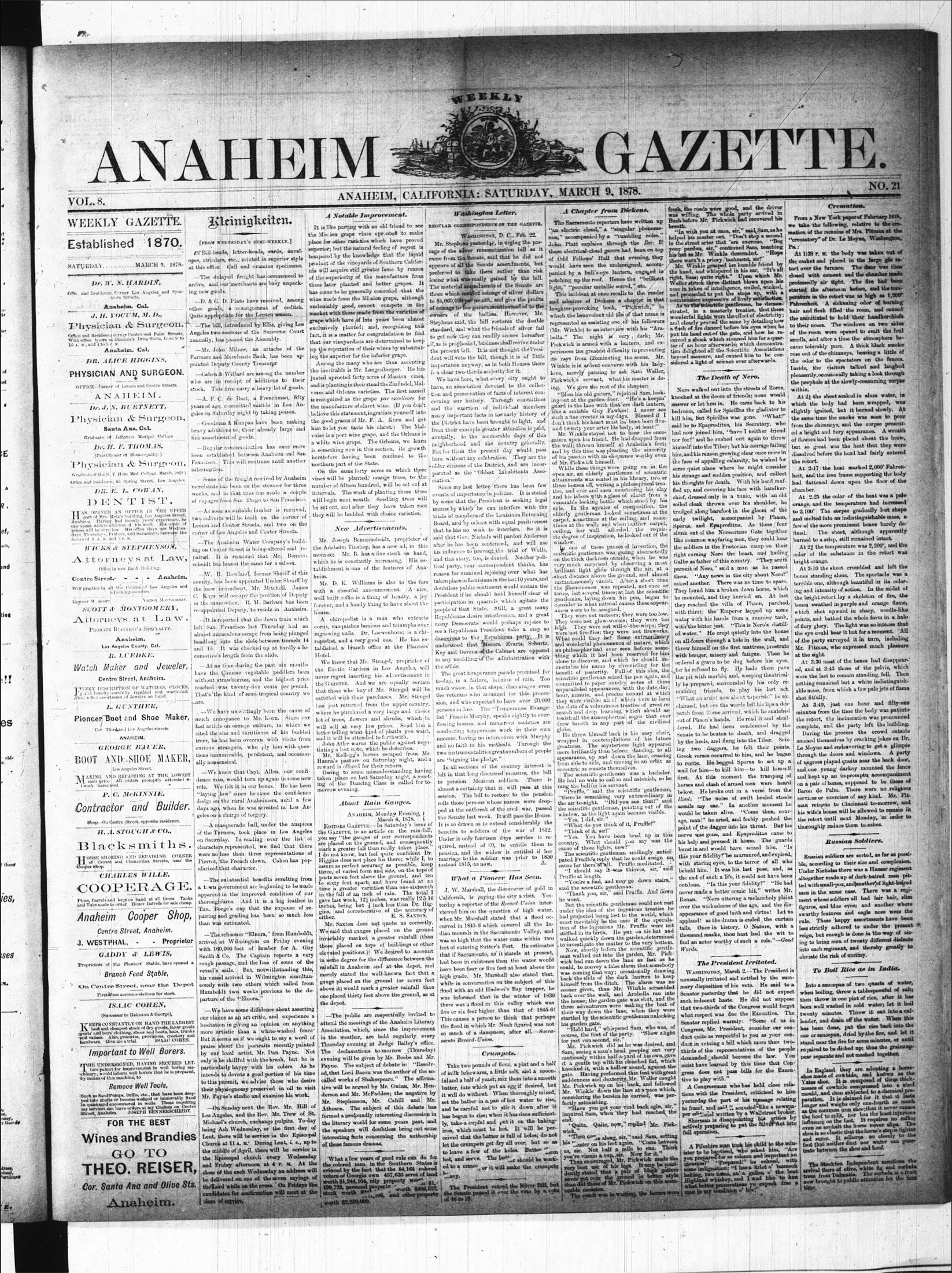
Searchable text
ANAHEIM
VOL. 8.
WEEKLY GAZETTE.
Established 1870.
SATURDAY... MARCH 9, 1878.
Dr. W. N. HARDIN,
Office and Residence Corner Los Angeles and Sycamore Streets.
Anaheim. Cal.
J. H. YOCUM, M. D., Physician & Surgeon.
Office and Residence corner Centre and Palm Streets.
With offices hours at Blankin's Drug Store, from 9 to 10 A.M., and 1 to 5 P.M.
Anaheim. Cal.
DR. ALICE HIGGINS,
PHYSICIAN AND SURGEON.
OFFICE—Carner of Lemon and Centre Streets.
ANAHEIM.
Dr. J. N. BURTNETT, Physician & Surgeon,
Santa Ana. Cal.
Graduate of Jefferson Medical College
Dr. H. F. THOMAS,
(Practitioner of Homeopathy.)
Physician & Surgeon,
Graduate of the N.Y. Hom Med College, March, 1869.
Kleinigkeiten.
[FROM WEDNESDAY'S SEMI-WEEKLY.]
Bill-heads, letter-heads, cards, envelopes, circulars, etc., printed in superior style at this office. Call and examine specimens.
The delayed freight has commenced to arrive, and our merchants are busy unpacking new goods.
D. & G. D. Plato have received, among other goods, a consignment of collish. Quite appropriate for the Lenten season.
The bill, introduced by Ellis, giving Los Angeles two sessions of the Supreme Court annually, has passed the Assembly.
Mr. John Milner, an attache of the Farmers and Merchants Bank, has been appointed Deputy County Treasurer.
Cahen & Willard are among the number who are in receipt of additions to their stock. This firm carry a heavy lot of goods.
A. F. C. de Bast, a Frenchman, fifty years of age, committed suicide in Los Angeles on Saturday night by taking poison.
Goodman & Kimpan have been making heavy additions to their already large and fine assortment of goods.
Regular communication has once more been established between Anaheim and San Francisco. This will continue until another interruption.
A Notable
It is like parting the Mission grape place for other varieties superior; but the most tempered by the kind product of the vinia will acquire still of the superiority of these later planters has come to be grown wine made from the undeniably good market with those grape which have exclusively planted fact, it is a matter that our vineyard up the reputation of the superior fruit Among the man the inevitable is Mr justed uprooted far and is planting in the voice and Orleans is recognized as the manufacture to believe this statement the good graces of him to let you take voise is a port wine a white wine grape is something newer heretofore having northern part of the On the same
PHYSICIAN AND SURGEON.
OFFICE—Corner of Lemon and Centre Streets.
ANAHEIM.
Dr. J. N. BURTNETT,
Physician & Surgeon,
Santa Ana, Cal.
Graduate of Jefferson Medical College
Dr. H. F. THOMAS,
(Practitioner of Homeopathy.)
Physician & Surgeon,
Graduate of the N.Y. Hom Med College, March 1890
Office and residence: 63 Spring Street, Los Angeles
DR. E. L. COWAN,
DENTIST.
HAS OPENED AN OFFICE IN THE UPPER part of Mrs. Mota's building, Los Angeles Street, Anaheim. Having had twenty years' experience, he can speak with confidence of his work. His scale of prices will be very low. His office days are Wednesday, Thursday, Friday, and Saturdays, between the hours of 9 A.M. and 5 P.M.
WICKS & STEPHENSON,
Attorneys at Law.
Office in new Bank Building.
Centre Street — Anaheim.
Will practice in all the Courts of Los Angeles and adjoining counties.
ROGERT W. SCOTT
Victor Montgomery.
SCOTT & MONTGOMERY,
Attorneys at Law.
PROBATE BUSINESS'S SPECIALTY.
Anaheim.
Los Angeles County, Cal.
R. LUEDKE.
Watch Maker and Jeweler,
Centre Street, Anaheim.
EVERY DESCRIPTION OF WATCHES, CLOCKS, and Jewelry carefully repaired and warranted. Also, a fine assortment of Jewelry on hand.
L. GUNTHER,
Pioneer Boot and Shoe Maker,
Cor. Third and Los Angeles streets.
ANAHEIM.
GEORGE BAUER,
BOOT AND SHOE MAKER,
Los Angeles Street.
MAKING AND REPAIRING AT THE LOWEST cash price. All orders promptly attended to I work guaranteed.
P. C. McKINNIE,
Contractor and Builder.
Shop—On Centre Street, opposite residence.
H. A. STOUGH & CO.
Blacksmiths.
HORSE SHOKING AND REPAIRING CORNER of Centre and Clementina Streets, near the Cooper Shop.
CHARLES WILLE.
COOPERAGE.
Cohen & Wallard are among the number who are in receipt of additions to their stock. This firm carry a heavy lot of goods.
A. F. C. de Bast, a Frenchman, fifty years of age, committed suicide in Los Angeles on Saturday night by taking poison.
Goodman & Kimpan have been making heavy additions to their already large and fine assortment of goods.
Regular communication has once more been established between Anaheim and San Francisco. This will continue until another interruption.
Some of the freight received by Anaheim merchants has been on the steamer for three weeks, and in that time has made a couple of voyages from San Diego to San Francisco.
As soon as suitable humber is received, two culverts will be built on the corner of Lemon and Center Streets, and two on the corner of Los Angeles and Center Streets.
The Anaheim Water Company's building on Center Street is being altered and repaired. It is rumored that Mr. Benner-scheidt has leased the same for a saloon.
W. R. Rowland, former Sheriff of this county, has been appointed Under Sheriff by the new incumbent, Mr. Mitchell, James C. Kays will occupy the position of Deputy in the same office. R. M. Barham has been re-appointed Deputy, to reside in Anaheim.
It is reported that the down train which left San Francisco last Thursday had an almost miraculous escape from being plunged headlong into the slide between tunnels 14 and 15. It was checked up at hardly a locomotive's length from the slide.
At no time during the past six months have the Chinese vegetable peddlers been without strawberries, and the highest price reached was twenty-five cents per pound. That's the kind of semi-tropical country we are.
We have unwittingly been the cause of much annoyance to Mr. Korn. Since our last article on orange culture, in which we cited the size and thriftiness of his budded trees, he has been overrun with visits from curious strangers, who ply him with questions innumerable, persistent, and occasionally nonsensical.
We knew that Capt. Allen, our confidence man, would turn up again in some new role. We felt it in our bones. He has been "laying low" since he came the confidence dodge on the rural Anaheimers, until a few days ago, when he was arrested in Los Angeles on a charge of torgery.
A masquerade ball, under the auspices of the Turners, took place in Los Angeles on Saturday. In reading over the list of characters represented, we find that there were no less than three representations of Pierrot, the French clown. Cahen has popularized that character.
The substantial benefits resulting from a town government are beginning to be made apparent in the improved condition of our
Contractor and Builder.
Shop—On Centre Street, opposite residence.
H. A. STOUGH & CO., Blacksmiths.
HORSE SHOKING AND REPAIRING. CORNER of Centre and Clementina Streets, near the Cooper Shop.
CHARLES WILLE, COOPERAGE.
Pipes, Barrels and kegs on hand at all times. Tanks and Tubs made to order. Honey Barrels for sale cheap.
Anaheim Cooper Shop,
Centre Street, Anaheim.
J. WESTPHAL, - Proprietor
GADDY & LEWIS,
Proprietors of the Planters' Stable, have opened a Branch Feed Stable,
On Centre Street, near the Depot First-class accommodations for stock.
ISAAC COHEN,
(Successor to Helmann & George).
KEEPS CONSTANTLY ON HAND THE LARGEST best and cheapest stock of dry-goods, fancy goods gents' and boys' clothing, shoes and boots, hats, trunks and valises. Also, groceries, provisions, crockery and hardware. Give me a trial.
ISAAC COHEN.
Important to Well Borers.
THE UNDERSIGNED, HAVING SECURED LETTERS patent for improvement in well boring machinery, would inform well borers that he is prepared by means of this machine, to Remove Well Tools,
Such as Sand Pumps, Drills, etc., that have been dropped into shafts or become wedged or immovably fixed in quicksand encountered in wells. Those requiring my services can leave orders at my tinshop on Centre Street, Anaheim. JOSEPH BENNERSCHIDT.
FOR THE BEST
Wines and Brandies
GO TO
THEO. REISER,
Cor. Santa Ana and Olive Sts.
Anaheim.
—A masquerade ball, under the auspices of the Turners, took place in Los Angeles on Saturday. In reading over the list of characters represented, we find that there were no less than three representations of Pierrot, the French clown. Cahen has popularized that character.
The substantial benefits resulting from a town government are beginning to be made apparent in the improved condition of our thoroughfares. And it is a big feather in Tim Boege's cap that the expense of repairing and grading has been so much less than was estimated.
The schooner "Elnora," from Humboldt, arrived at Wilmington on Friday evening with 100,000 feet of lumber for A. Guy Smith & Co. The Captain reports a very rough passage, and the loss of some of the vessel's sails. But, notwithstanding this, his vessel arrived in Wilmington simultaneously with two others which sailed from Humboldt two weeks previous to the departure of the "Elnora."
We have some defiance about asserting our claims as an art critic, and experience a hesitation in giving an opinion on anything more artistic than a white-washed fence. But it seems as if we ought to say a word of praise about the portraits recently painted by our local artist, Mr. Dan Payne. Not only is he skillful with the brush, but he is particularly happy with his colors. As he intends to devote a good portion of his time to this pursuit, we advise those who desire their physiognomy preserved in oil to visit Mr. Payne's studio and examine his work.
On Sunday next the Rev. Mr. Hill of Los Angeles, and the Rev. Mr. Trew of St. Michael's church, exchange pulpits. To-day being Ash Wednesday, or the first day of Lent, there will be service in the Episcopal Church at 11 a.m. Daring Lent, i.e., up to the middle of April, there will be service in the Episcopal church every Wednesday and Friday afternoon at 4 p.m. At the close of each Wednesday an address will be delivered on one of the seven sayings of the Lord while on the cross. On Fridays the candidates for confirmation will meet at the close of service.
About
EDITORS GAVE
the Gazette, in you say 'the gaze are placed on the mark a greater I do not know. Higgins does not insure as perfect three, of various posts seven feet to sixty feet at time a greater in the fall of a gave last week inches, being gins, and corne either.
Mr. Saxton We said that we invariably mailed those placed on elevated positions in some degree rainfall in Ana merely stated their gauge placed above it) would one placed thither the depot.
The public attend the meeting Association, wi in the weather Thursday even The declamation evening will be Payne. The eded, that Lord called works o tive will be ad derson and Mr. Stephen Athearn. Th e formed a prof le literary w w the speakers interesting f f of these famo ure.
What a few the colored n evinced by the voters of Ge worth $1,244 199,725 per stock worth worth $2,25
WEEKLY
EIM GA
ANAHEIM, CALIFORNIA: SATURDAY, MARCH 9, 1878.
A Notable Improvement.
It is like parting with an old friend to see the Mission grape vines prooted to make place for other varieties which have proved superior; but the natural feeling of regret is tempered by the knowledge that the liquid product of the vineyards of Southern California will acquire still greater fame by reason of the superiority of the manufacture from these later planted and better grapes. It has come to be generally conceded that the wine made from the Mission grape, although undeniably good, cannot compete in the market with those made from the varieties of grape which have of late years been almost exclusively planted; and, recognizing this fact, it is a matter for congratulation to find that our vineyardists are determined to keep up the reputation of their wines by substituting the superior for the inferior grape.
Among the many who are thus accepting the inevitable is Mr. Langenberger. He has just unrooted forty acres of Mission vines, and is planting in their stead the Zinfindel, Malvoise and Orleans varieties. The first named is recognized as the grape par excellence for the mannufacture of claret wine. (If you don't believe this statement, ingratiate yourself into the good graces of Mr. F. A. Korn and get him to let you taste his claret.) The Malvoise is a port wine grape, and the Orleans is a white wine grape. The Orleans, we learn is something new in this section, its growth heretofore having been confined to the northern part of the State.
On the same forty acres on which these Washington Letter.
REGULAR CORRESPONDENCE OF THE GAZETTE.
WASHINGTON, D.C., Feb. 22.
Mr. Stephens yesterday, in urging the passage of the silver remonetization bill as it came from the Senate, said that he did not approve of all the Senate amendments, but preferred to take them rather than risk losing what was really gained by the bill. The material amendments of the Senate are those which restrict coinage of silver dollars to $4,000,000 per month, and give the profits of coinage to the government instead of to the owners of the bullion. However, Mr. Stephens said, the bill restores the double standard, and what the friends of silver fail to get now they can readily secure hereafter if, as prophesied, business shall revive under the present bill. It is not thought the President will veto the bill, though it is of little importance anyway, as in both Houses there is a clear two-thirds majority for it.
We have here, what every city ought to have, an association devoted to the collection and preservation of facts of interest concerning our history. Through committees and the exertion of individual members many important facts in the early history of the District have been brought to light, and from their example greater attention is paid annually, to the memorable days of this neighborhood and the country generally. But for them the present day would pass here without any celebration. They are the older citizens of the District, and are incorporated as the "Oldest Inhabitants Assoc."
A Chapter from Dickens.
The Sacramento reporters have written up "an electric cloud," a "singular phenomenon," accompanied by a "runbling noise." John Platt explains through the Bee: If these electrical-cloud gazers had been on top of Odd Fellows' Hall that evening, they would have seen the undersigned, accompanied by a bull's-eye lantern, engaged in patching up the roof. Hence the "brilliant light," "peculiar metallic sound," etc.
This incident at once recalls to the reader and admirer of Dickens a chapter in that laughter-provoking book, "Pickwick," in which the benevolent old title of that name is represented as assisting one of his followers (Mr. Winkle) to an interview with his "Arabella." The night is very dark; Mr. Pickwick is armed with a lantern, and experiences the greatest difficulty in preventing its rays from illuminating the scene. Mr. Winkle is in ardent converse with his ladylove, merely pausing to ask Sam Weller, Pickwick's servant, what his master is doing. We give the rest of the chapter:
"Bless his old gaiters," rejoined Sam, looking out at the garden-door. "He's a-keepin' guard in the lane with that ere dark lantern, like a amiable Guy Fawkes! I never see such a fine creetur in my days. Blessed if I don't think his heart must ha' been born five-and-twenty year after his body, at least!"
Mr. Winkle stayed not to hear the encomium upon his friend. He had dropped from the wall; thrown himself at Arabella's feet; and by this time was pleading the sincerity of his passion with an eloquence worthy even of Mr. Pickwick himself.
While these things were going on in the open air an elderly gentleman of scientific
justed aprooted forty acres of Mission vines,
and is planting in their stead the Zinfindel, Malvoise and Orleans varieties. The first named is recognized as the grape par excellence for the manufacture of claret wine. (If you don't believe this statement, ingrate yourself into the good graces of Mr. F. A. Korn and get him to let you taste his claret.) The Malvoise is a port wine grape, and the Orleans is a white wine grape. The Orleans, we learn is something new in this section, its growth heretofore having been confined to the northern part of the State.
On the same forty acres on which these vines will be planted, orange trees, to the number of fifteen hundred, will be set out at intervals. The work of planting these trees will begin next month. Seedling trees will be set out, and after they have taken root they will be budded with choice varieties.
New Advertisements.
Mr. Joseph Bennerscheidt, proprietor of the Anaheim Tinshop, has a new ad, in this morning. Mr. B. has a fine stock on hand, which he is constantly increasing. His establishment is one of the features of Anaheim.
Mr. D. K. Williams is also to the fore with a cheerful announcement. A nice, well built coffin is a thing of beauty, a joy forever, and a handy thing to have about the house.
A chiropodist is a man who extracts corns, vanquishes bunions and triumphs over ingrowing nails. Dr. Loewenhorst is a chiropodist, and a very good one. He has established a branch office at the Planters' Hotel.
We know that Mr. Stengel, proprietor of Exotic Gardens in Los Angeles, will never regret inserting his advertisement in the Gazette. And we are equally certain that those who buy of Mr. Stengel will be satisfied with their purchases. Mr. Stengel has just returned from the upper country, where he purchased a very large and choice lot of trees, flowers and shrubs, which he will sell at very low prices. Send him a letter telling what kind of plants you want, and it will be attended to forthwith.
John Atter warns the public against negotiating a lost note, which he describes.
Mr. Kellogg's horses escaped from Mr. Hanna's pasture on Saturday night, and a reward is offered for their return.
Owing to some misunderstanding having taken place on last Saturday night, a meeting of the Dancing Class is called for tomorrow evening.
About Rain Gauges.
ANAHEIM, Monday Evening, March 4, 1878.
EDITORS GAZETTE:—In Saturday's issue of the Gazette, in an article on the rain-fall, you say "the gauges of our correspondents are placed on the ground, and consequently mark a greater fall than really takes place." I do not know, but feel quite confident Dr. Higgins does not place his there; while I insure as perfect accuracy as possible, keep three, of varied form and size, on the tops of posts seven feet above the ground, and ten to sixty feet apart; and have found at no time a greater variation than one-sixteenth in the fall of an inch of rain. The total I week was 12 inches was really 12.5-16
What a Pioneer Has Seen.
J. W. Marshall, the discoverer of gold in California, is paying the city a visit. Yes
Pickwick's servant, what his master is doing. We give the rest of the chapter:
"Bless his old gaiters," rejoined Sam, looking out at the garden door. "He's a keepin' guard in the lane with that're dark lantern, like a amiable Guy Fawkes! I never see such a fine creature in my days. Blessed if I don't think his heart must have been born five-and twenty year arter his body, at least."
Mr. Winkle stayed not to hear the encomium upon his friend. He had dropped from the wall; thrown himself at Arabella's feet; and by this time was pleading the sincerity of his passion with an eloquence worthy even of Mr. Pickwick himself.
While these things were going on in the open air, an elderly gentleman of scientific attainments was seated in his library, two or three houses off, writing a philosophical treatise, and ever and anon moistening his clay and his labors with a glass of claret from a venerable-looking bottle which stood by his side.
In the agonie of composition, the elderly gentleman looked sometimes at the carpet, sometimes at the ceiling, and sometimes at the wall; and when neither carpet, ceiling nor wall afforded the requisite degree of inspiration, he looked out of the window.
In one of these panses of invention, the scientific gentleman was gazing abstractedly on the thick darkness outside when he was very much surprised by observing a most brilliant light glide through the air, at a short distance above the ground, and almost instantaneously vanish. After a short time the phenomenon was repeated, not once or twice, but several times; at last the scientific gentleman laying down his pen, began to consider to what natural causes these appearances were to be assigned.
They were not meteors; they were too low. They were not glow-worms; they were too high. They were not will-o'the-wisp; they were not fire-flies; they were not fireworks. What could they be? Some extraordinary and wonderful phenomenon of nature, which no philosopher had ever before something which it had been reserved for him alone to discover, and which he should immortalize his name by chronicling for the benefit of posterity. Full of this idea, the scientific gentleman seized his pen again, and committed to paper sundry notes of these unparalleled appearances, with the date, day, hour, minute, and precise second at which they were visible: all of which were to form the data of a voluminous treatise of great research and deep learning, which should astonish all the atmospheric sages that ever drew breath in any part of the civilized globe.
He threw himself back in his easy chair, wrapped in contemplations of his future greatness. The mysterious light appeared more brilliantly than before: dancing, to all appearance, up and down the lane, crossing from side to side, and moving in an orbit as eccentric as comets themselves.
The scientific gentleman was a bachelor. He had no wife to call in and astomish, so he rang the bell for his servant.
"Pruffle," said the scientific gentleman; "there is something very extraordinary in the air to-night." "Did you see that?" said the scientific gentleman, pointing out of the window, as the light again became visible.
"Yes, I did, sir."
"What do you think of it, Pruffle?"
"Think of it, sir?"
"Yes. You have been bred up in this country. What should you say was the cause of those lights, now?"
The scientific gentleman smiling anticipated Pruffle's reply that he could assign no cause for them at all. Pruffle meditated.
"I should say it was thieves, sir," said Pruffle at length.
"You're a fool, and may go down stairs," said the scientific gentleman.
"Thank you, sir," said Pruffle. And down
About Rain Gauges.
ANAHEIM, Monday Evening, March 4, 1878.
EDITORS GAZETTE:—In Saturday's issue of the Gazette, in an article on the rainfall, you say "the gauges of our correspondents are placed on the ground, and consequently mark a greater fall than really takes place." I do not know, but feel quite confident Dr. Higgins does not place his there; while I to insure as perfect accuracy as possible, keep three, of varied form and size, on the tops of posts seven feet above the ground, and ten to sixty feet apart; and have found at no time a greater variation than one-sixteenth in the fall of an inch of rain. The total I gave last week, 123 inches, was really 125-16 inches, being but 4 inch less than Dr. Higgins, and corroborative of the accuracy of either.
E. S. SAXTON.
Mr. Saxton does not quote us correctly. We said that gauges placed on the ground invariably marked a greater rainfall (than those placed on tops of buildings or other elevated positions). We desired to account in some degree for the difference between the rainfall in Anaheim and at the depot, and merely stated the well-known fact that a gauge placed on the ground (or seven feet above it) would mark a greater rainfall than one placed thirty feet above the ground, as at the depot.
The public are respectfully invited to attend the meetings of the Anaheim Literary Association, which, since the improvement in the weather, are held regularly every Thursday evening at Judge Bailey's office. The declamations to-morrow (Thursday) evening will be given by Mr. Beebe and Mr. Payne. The subject of debate is: "Resolved, that Lord Bacon was the author of the so-called works of Shakespeare." The affirmative will be argued by Mr. Guinn, Mr. Henderson and Mr. McFadden; the negative by Mr. Stephenson, Mr. Cahill and Mr. Athearn. The subject of this debate has formed a profoundly interesting discussion in the literary world for some years past, and the speakers will doubtless bring out some interesting facts concerning the authorship of these famous dramas.
What a few years of good rule can do for the colored men in the Southern States is evinced by the fact that the 84,164 colored voters of Georgia own 457,635 acres of land worth $1,244,104, city property worth $1,993,725, personal property worth $2,250,000.
What a Pioneer Has Seen.
J. W. Marshall, the discoverer of gold in California, is paying the city a visit. Yesterday a reporter of the Record-Union interviewed him on the question of high water, when Mr. Marshall stated that a flood occurred in 1845-6 which covered all the Indian mounds in the Sacramento Valley, and was so high that the water came within two feet of entering Sutter's Fort. He estimates that if Sacramento, as it stands at present, had been in existence then the water would have been four or five feet at least above the high grade. Mr. Marshall also stated that, while in conversation on the subject of this flood with an old Hudson's Bay trapper, he was informed that in the winter of 1830 there was a flood in this valley which was five or six feet higher than that of 1845-6! This causes a person to think that perhaps the flood in which Mr. Noah figured was not so much of a dampness, after all—Sacramento Reord-Union.
Crumpets.
Take two pounds of flour, a pint and a half of milk lukewarm, a little salt, and a spoonful and a half of yeast; mix them into a smooth batter, into which put an egg if desired, but it will do without. When thoroughly mixed, set the batter in a pan of hot water to rise, and be careful not to stir it down after it has begun to rise; when it has risen sufficiently, take-a cupful and put it on the baking iron, which must be hot. It will be perceived that the batter is full of holes; do not let the crumpets get dry all over, but so as to leave a few of the holes. Butter hot, and serve. The butter should be worked to a creamy or it will make the crumpets heavy.
The President vetoed the Silver Bill, but the Senate passed it over the veto by a vote of 46 to 19.
There are several persons whose names were dropped at the outbreak of the civil war, passed the Senate last week. It will pass the House. It is so drawn as to extend considerably the benefits to soldiers of the war of 1812. Under it only fourteen days service is required, instead of 60, to entitle them to pension, and the widow is entitled if her marriage to the soldier was prior to 1850 instead of 1815, as now.
What a Pioneer Has Seen.
J. W. Marshall, the discoverer of gold in California, is paying the city a visit. Yesterday a reporter of the Record-Union interviewed him on the question of high water, when Mr. Marshall stated that a flood occurred in 1845-6 which covered all the Indian mounds in the Sacramento Valley, and was so high that the water came within two feet of entering Sutter's Fort. He estimates that if Sacramento, as it stands at present, had been in existence then the water would have been four or five feet at least above the high grade. Mr. Marshall also stated that, while in conversation on the subject of this flood with an old Hudson's Bay trapper, he was informed that in the winter of 1830 there was a flood in this valley which was five or six feet higher than that of 1845-6! This causes a person to think that perhaps the flood in which Mr. Noah figured was not so much of a dampness, after all—Sacramento Reord-Union.
Crumpets.
Take two pounds of flour, a pint and a half of milk lukewarm, a little salt, and a spoonful and a half of yeast; mix them into a smooth batter, into which put an egg if desired, but it will do without. When thoroughly mixed, set the batter in a pan of hot water to rise, and be careful not to stir it down after it has begun to rise; when it has risen sufficiently, take-a cupful and put it on the baking iron, which must be hot. It will be perceived that the batter is full of holes; do not let the crumpets get dry all over, but so as to leave a few of the holes. Butter hot, and serve. The butter should be worked to a creamy or it will make the crumpets heavy.
The President vetoed the Silver Bill, but the Senate passed it over the veto by a vote of 46 to 19.
There are several persons whose names were dropped at the outbreak of the civil war, passed the Senate last week. It will pass the House. It is so drawn as to extend considerably the benefits to soldiers of the war of 1812. Under it only fourteen days service is required, instead of 60, to entitle them to pension, and the widow is entitled if her marriage to the soldier was prior to 1850 instead of 1815, as now.
What a Pioneer Has Seen.
J. W. Marshall, the discoverer of gold in California, is paying the city a visit. Yesterday a reporter of the Record-Union interviewed him on the question of high water, when Mr. Marshall stated that a flood occurred in 1845-6 which covered all the Indian mounds in the Sacramento Valley, and was so high that the water came within two feet of entering Sutter's Fort. He estimates that if Sacramento, as it stands at present, had been in existence then the water would have been four or five feet at least above the high grade. Mr. Marshall also stated that, while in conversation on the subject of this flood with an old Hudson's Bay trapper, he was informed that in the winter of 1830 there was a flood in this valley which was five or six feet higher than that of 1845-6! This causes a person to think that perhaps the flood in which Mr. Noah figured was not so much of a dampness, after all—Sacramento Reord-Union.
Crumpets.
Take two pounds of flour, a pint and a half of milk lukewarm, a little salt, and a spoonful and a half of yeast; mix them into a smooth batter, into which put an egg if desired, but it will do without. When thoroughly mixed, set the batter in a pan of hot water to rise, and be careful not to stir it down after it has begun to rise; when it has risen sufficiently, take-a cupful and put it on the baking iron, which must be hot. It will be perceived that the batter is full of holes; do not let the crumpets get dry all over, but so as to leave a few of the holes. Butter hot, and serve. The butter should be worked to a creamy or it will make the crumpets heavy.
The President vetoed the Silver Bill, but the Senate passed it over the veto by a vote of 46 to 19.
There are several persons whose names were dropped at the outbreak of the civil war, passed the Senate last week. It will pass the House. It is so drawn as to extend considerably the benefits to soldiers of the war of 1812. Under it only fourteen days service is required, instead of 60, to entitle them to pension, and the widow is entitled if her marriage to the soldier was prior to 1850 instead of 1815, as now.
What a Pioneer Has Seen.
J. W. Marshall, the discoverer of gold in California, is paying the city a visit. Yesterday a reporter of the Record-Union interviewed him on the question of high water, when Mr. Marshall stated that a flood occurred in 1845-6 which covered all the Indian mounds in the Sacramento Valley, and was so high that the water came within two feet of entering Sutter's Fort. He estimates that if Sacramento, as it stands at present, had been in existence then the water would have been four or five feet at least above the high grade. Mr. Marshall also stated that, while in conversation on the subject of this flood with an old Hudson's Bay trapper, he was informed that in the winter of 1830 there was a flood in this valley which was five or six feet higher than that of 1845-6! This causes a person to think that perhaps the flood in which Mr. Noah figured was not so much of a dampness, after all—Sacramento Reord-Union.
Quite Quite now," replied Mr. Pickwick.
"Then come along sir," said Sam setting his master on his feet again. "Come betweens us sir. Not half a mile to run. Thin you're vinnin a cup,sir. Now for it."
Thus encouraged Mr. Pickwick made very best use of his legs. It may be condenedly stated that a pair of black gaiters never got over the ground in better style than did those of Mr. Pickwick on this more oracle occasion.
The coach was in waiting;the horses wore
GAZETTE.
NO. 21
from Dickens.
reporters have written up,
a "singular phenomenon by a "rumbling noise."
pass through the Bee: If sound gazers had been on top of Hall that evening, they
the undersigned, accompany eye lantern, engaged in proof. Hence the "brilliant metallic sound," etc.
once recalls to the reader Dickens a chapter in that book, "Pickwick," in an old file of that name is acting one of his followers in interview with his "Arachnite is very dark; Mr. Weller with a lantern, and exerted difficulty in preventing illuminating the scene. Mr. Weller converse with his lady-using to ask Sam Weller, what his master is doing rest of the chapter:
waiters," rejoined Sam, looken-door. "He's a-keepin' with that 'ere dark lantern, buy Fawkes! I never see him in my days. Blessed if I heart must ha' been born five-quarter his body, at least!" Yield not to hear the encoend. He had dropped from himself at Arabella's feet; was pleading the sincerity with an eloquence worthy even himself.
ings were going on in the early gentleman of scientific fresh, the roads were good, and the driver was willing. The whole party arrived in Bush before Mr. Pickwick had recovered his breath.
"In with you at once, air," said Sam, as he helped his master out. "Don't stop a second in the street arter that 'ere exercise. Beg your pardon, sir," continued Sam, touching his hat as Mr. Winkle descended. "Hope there warnn't a priory 'tachment, sir?"
Mr. Winkle grasped his humble friend by the hand, and whispered in his ear, "It's all right, Sam; quite right." Upon which Mr. Weller struck three distinct blows upon his nose in token of intelligence, smiled, winked, and proceeded to put the steps up, with a countenance expressive of lively satisfaction.
As to the scientific gentleman, he demonstrated, in a masterly treatise, that these wonderful lights were the effect of electricity; and clearly proved the same by detailing how a flash of fire danced before his eyes when he put his head out of the gate, and how he received a shook which stunned him for a quarter of an hour afterwards; which demonstration delighted all the Scientific Associations beyond measure, and caused him to be considered a light of science ever afterwards.
The Death of Nero.
Nero walked out into the streets of Rome, knocked at the doors of friends; none would answer or let him in. He came back to his bedroom, called for Spicillus the gladiator to kill him, but Spicillus was gone. "What!" said he to Epaproditus, his Secretary, who had now joined him, "have I neither friend nor foe?" and he rushed out again to throw himself into the Tiber; but his courage failing him, and his reason growing clear once more in the face of appalling calamity, he wished for some quiet place where he might consider his strength and sudden position, and collect
Cremation.
From a New York paper of February 16th, we take the following, relative to the cremation of the remains of Mrs. Pitman at the "crematory" of Dr. Le Moyne, Washington, Pa:
At 1:38 p.m. the body was taken out of the casket and placed in the large gas retort over the furnace. The door was then closed with cement and the chamber made professedly air tight. The fire had been started the afternoon before, and the temperature in the retort was as high as 1,200° Fahrenheit. A sickening odor of burning hair and flesh filled the room, and caused the uninitiated to hold their handkerchiefs to their noses. The windows on two sides of the room were opened to emit the foul smells, and after a time the atmosphere became tolerably pure. A thick black smoke rose out of the chimneys, hearing a little of the odor to the spectators on the fences. Inside, the visitors talked and laughed pleasantly, occasionally taking a look through the peephole at the slowly-consuming corpse within.
At 2½ the sheet soaked in alum water, in which the body had been wrapped, was slightly ignited, but it burned slowly. At the same time the smoke was seen to pour from the chimneys, and the corpse presented a bright and fiery appearance. A wreath of flowers had been placed about the brow, but so great was the heat that they were dissolved before the head had fairly entered the retort.
At 2:17/he heat marked 2,000° Fahrenheit and iron frame supporting the body
The Death of Nero.
Nero walked out into the streets of Rome, knocked at the doors of friends; none would answer or let him in. He came back to his bedroom, called for Spicillus the gladiator to kill him, but Spicillus was gone. "What!" said he to Epaproditus, his Secretary, who had now joined him, "have I neither friend nor foe?" and he rushed out again to throw himself into the Tiber; but his courage failing him, and his reason growing clear once more in the face of appalling calamity, he wished for some quiet place where he might consider his strange and sudden position, and collect his thoughts for death. With his head muffled up, and covering his face with handkerchief, dressed only in a tunic, with an old soiled cloak thrown over his shoulder, he trudged along barefoot in the gloom of the early twilight, accompanied by Phaon, Sporus, and Epaproditus. As these four slunk out of the Nomentane Gate together like common wayfaring men, they could hear the soldiers in the Prastorian camp on their right carving Nero the beast, and hailing Galba as father of this country. "They are in pursuit of Nero," said a man as he passed them. "Any news in the city about Nero" asked another. There was no time to spare. They found him a broken down horse, which he mounted, and they hurried en. At last they reached the villa of Phaon, parched with thirst: the Emperor lapped up some water with his hands from a running tank, with the bitter jest. "This is Nero's distilled water." He crept quietly into the house on all-fours through a hole in the wall, and threw himself on the first mattress, prostrate with hunger, misery and fatigue. Then he ordered a grave to be dug before his eyes, for he refused to fly. He bade them pave the pit with marble, and weeping theatrically he prepared, surrounded by his only remaining friends, to play his last act. "What an artist now about to perish!" he explained, but ere the words left his lips a dispatch from Rome arrived, which he snatched out of Phaon's hands. He read it and shuffled. He had been condemned by the Senate to be beaten to death, and dragged to the heels, and flung into the Tiber. Seizing two daggers, he felt their points. Greek verses occurred to him, and he began to recite. He begged Sporus to set up a wail for him—to kill him—to kill himself first. At this moment the tramping of horses and clash of armed men were heard below. He broke out in a verse from the Iliad: "The noise of swift heeled steeds assails my ear." In another moment he would be taken alive. "Come then, courage, man!" he cried, and feebly pushed the point of the dagger into his throat. But his nerve was gone, and Epaproditus came to help and pressed it home. The guards burst in and would have seized him. "Is this your fidelity?" he murmured, and expired, with staring eyes, to the terror of all who behold him. It was his last pose, and, as the end of such a life, it could not have been outdone. "Is this your fidelity?" "He had never made a better comic hit," writes Mr. Penan. "Nero uttered a melancholy plaint."
The Russian Soldiers.
Russian soldiers are sorted, as far as possible, according to their size and complexion. Under Nicholas there was a Hussar regiment altogether made up of dark-haired men fitted with small-pox, and another of light-haired men in the same case. There was a regiment whose soldiers all had fair hair, slim
"Did you see that?" said gentleman, pointing out of the light again became visible.
"You think of it, Pruffle?"
"Air?"
The gentleman smilingly anticipated that he could assign no tall. Pruffle meditated, "May it was thieves, sir," said him.
"Ool, and may go down stairs," gentleman said, "sir."
Pruffle And down gentile gentleman could not rest of the ingenious treatise he being lost to the world, which be the case if the specula-venious Mr. Pruffle were not birth. He put on his hat and down the garden, determined the matter to the very bottom, before the scientific gentleman into the garden, Mr. Pickdown the lane as fast as he may a false alarm that somebody way; occasionally drawing of the dark lantern to keep the ditch. The alarm was no more than Mr. Winkle scrambled in wall, and Arabella ran into garden-gate was shut, and the mirrors were making the best of the lane, when they were scientific gentleman unlocking door.
Whispered Sam, who was, of most of the party. "Show a light second, sir."
Jack did as he was desired, and man's head peeping out very thin half-a-yard of his own, gave up with his clenched fist, which with a hollow sound, against the ring performed this feat with great dexterity. Mr. Weller caught up on his back, and followed down the lane at a pace which, he burden he carried, was perching.
Got your vind back agin, sir." When they had reached the quite, now," replied Mr. Pick-down, sir."
Sam, setting his feet again. "Come between half a mile to run. Think a cup, sir. Now for it."
Married, Mr. Pickwick made the face of his leg. It may be conflated that a pair of black gaiters over the ground in better style than of Mr. Pickwick on this memorial.
Was in waiting, the horses were assails my ear." In another moment he would be taken alive. "Come then, courage, man!" he cried, and feebly pushed the point of the dagger into his throat. But his nerve was gone, and Epaprolitus came to his help and pressed it home. The guards burst in and would have seized him. "Is this your fidelity? He murmured, and expired, with staring eyes, to the terror of all who behold him. It was his last pose, and, as the end of such a life, it could not have been outdone. "Is this your fidelity?" "He had never made a better comic hit," writes Mr. Renan. "Nero uttering a melancholy plaint over the wickedness of the age, and the disappearance of good faith and virtue! Let us applaud! as the drama is ended the curtain falls. Once in history, O Nature, with a thousand masks, thou hast had the wit to find an actor worthy of such a role."—Good Words.
The President Irritated.
WASHINGTON, March 2.—The President is unusually irritated and nettled by the summary disposition of his veto. He said to a Senator yesterday that he did not expect such indecent haste. He did not suppose that two-thirds of the Congress would forget what respect was due the Executive. The Senator replied warmly: "Some of us in Congress, Mr. President, consider our conduct quite as respectful to you as your conduct in vetoing a bill which more than two-thirds of the representatives of the people demanded should become the law. You must have learned by this time that Congress does not pass bills for the Executive to play with."
A Congressman who has held close relations with the President, criticised to him yesterday the part of his message relating to fraud, and said it sounded like a newspaper written by a Wallstreet broker.
Sherman is disappointing his critics by actively preparing to put the Silver Act into full operation.
A Pileshire man took his child to the minister to be baptised, who asked him, "Are you prepared for so solemn and important occasion?" "Prepared!" he echoed, with some indignation; "I have a first o' haunock baking two hams, an'a gallon o' the best Highland whiskey, and I wad like to ken what better preparations ye expect free a man in my condition o' life."
Russian Soldiers.
Russian soldiers are sorted, as far as possible, according to their size and complexion. Under Nicholas there was a Hussar regiment altogether made up of dark-haired men pitied with small-pox, and another of light-haired men in the same case. There was a regiment whose soldiers all had fair hair, slim figures, and blue eyes; and another where swarthy features and eagle nose were the rule. These happy assortments have been less strictly adhered to under the present reign, but enough is done in the way of sizing to bring men of twenty different dialects into each regiment, and thereby greatly to obviate the risk of mutiny.
To Boil Rice as in India.
Into a sancepan of two quartz of water, when boiling, throw a tablespoonful of salt; then throw in one pint of rice, after it has been well washed in cold water; let it boil twenty minutes. Throw it out into a cellender, and drain off the water. When this has been done, put the rice back into the can or sancepan, dried by the fire, and let it stand near the fire for some minutes, or until required to be dished up; thus the grains appear separate and not mashed together.
In England they are adopting a horse-shoe made of cowhide, and known as the Yates shoe. It is composed of three thicknesses of cowhide compressed into a steel mould, and then subjected to a chemical preparation. It is claimed for it that it lasts longer and weighs only one-fourth as much as the common iron shoe; that it never can cause the hoof to split, nor has the least injurious influence on the foot. It requires no calls; even on asphalt the horse never skips. The shoe is so elastic that the horse's step is lighter and surer. It adheres so closely to the foot that neither dust nor water can penetrate between the shoe and hoof.
The Stockton Independent mentions the arrival there of olive, white fig and sorbala trees from Dalmatia. The sorbala is a fruit now brought to public attention for the first time.