anaheim-gazette 1878-02-23
Scanned page
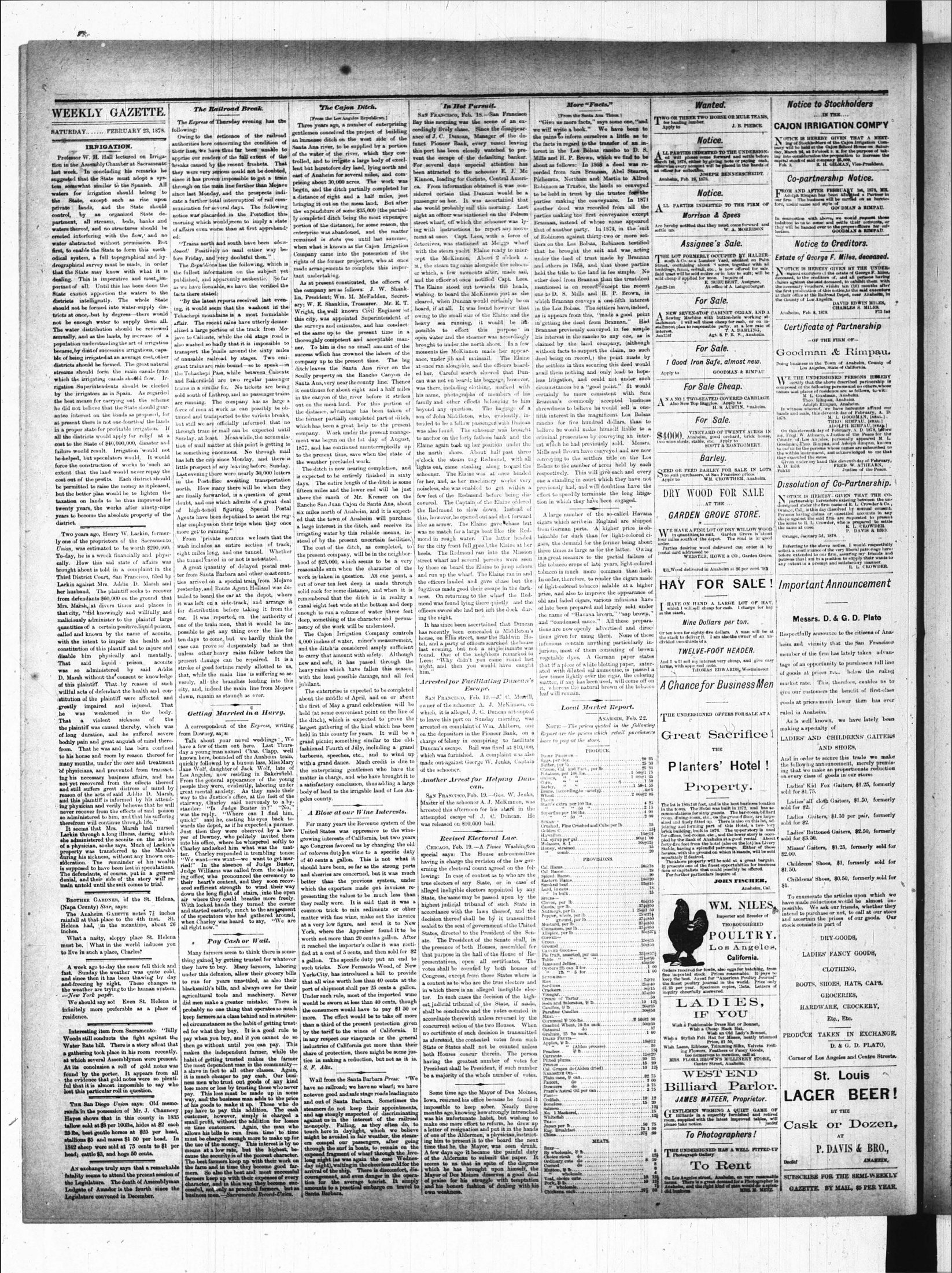
Searchable text
WEEKLY GAZETTE.
SATURDAY... FEBRUARY 23, 1878.
IRRIGATION.
Professor W. H. Hall lectured on Irrigation in the Assembly Chamber at Sacramento last week. In concluding his remarks he suggested that the State must adopt a system somewhat similar to the Spanish. All waters for irrigation should belong to the State, except such as rise upon private lands, and the State should control, by an organized State department, all streams, beds, banks and waters thereof, and no structures should be erected interfering with the flow, and no water abstracted without permission. But first, to enable the State to form this methodical system, a full topographical and hydrographical survey must be made, in order that the State may know with what it is dealing. This is imperative and most important of all. Until this has been done the State cannot apportion the waters to the districts intelligently. The whole State should not be formed into water-supply districts at once, but by degrees—there would not be enough water to supply them all. The water distribution should be reviewed annually, and as the lands, by increase of a population understanding the art of irrigation became, by dint of successive irrigations, capable of being irrigated at an average cost, other districts should be formed. The great natural streams should form the main canals from which the irrigating canals should flow. Irrigation Superintendents should be elected by the irrigators as in Spain. As regarded the best means for carrying out the scheme he did not believe that the State should guarantee interest on the bonds as proposed, for at present there is not one-fourth of the lands in a proper state for profitable irrigation. If all the districts would apply for relief at a cost to the State of $40,000,000, disaster and failure would result. Irrigation would not be helped, but speculators would. It would force the construction of works to such an extent that the land would never repay the
The Railroad Break.
The Express of Thursday evening has the following:
Owing to the reticence of the railroad authorities here concerning the condition of their line, we have thus far been unable to apprise our readers of the full extent of the breaks caused by the recent freshets. That they were very serious could not be doubted, since it has proven impossible to get a train through on the main line further than Mojave since last Monday, and the prospects indicate a further total interruption of rail communication for several days. The following notice was placarded in the Postoffice this morning which would seem to imply a state of affairs even worse than at first apprehended:
"Trains north and south have been abandoned! Positively no mail either way before Friday, and very doubtful then."
The Republic has the following, which is the fullest information on the subject yet published, and apparently authentic. So far as we have been able, we have the verified facts there stated:
"By the latest reports received last evening, it would seem that the washout in the Tehachepi mountains is a most formidable affair. The recent rains have utterly demoralized a large portion of the track from Mojave to Caliente, while the old stage road is also washed so badly that it is impossible to transport the mails around the sixty miles of unusable railroad by stages. Two emigrant trains are rain-bound—so to speak in the Tehachepi Pass, while between Caliente and Bakersfield are two regular passenger trains in a similar fix. No tickets are being sold south of Lathrop, and no passenger trains are running. The company has as large a force of men at work as can possibly be obtained and transported to the various breaks, but still we are officially informed that no through train or mail can be expected until Sunday, at least. Meanwhile, the accumulation of mail matter at this point is getting to be something enormous. No through mail has left the city since Monday, and there is little prospect of any leaving before Sunday. Last evening there were nearly 30,000 letters"
The Cajon Bay.
Three years ago, a number gentlemen conceived that an immense ditch on the Santa Ana river, to be submerged of the water of the river trolled, and to irrigate a lent but heretofore dry east of Anaheim for several about 30,000 acres begin, and the ditch paralleled a distance of eight and bringing it out on the map; the expenditure of some fully completed ditch being portion of the distance), enterprise was abandonned when what is known as Company came into its rights of the former property made arrangements to constant undertaking.
As at present constituted the company are as follows: President; Win M. Mary; W. E. Shanklin, T. Wright, the well known this city, was appointed the surveys and estimated the same up to the thoroughly competent officer. To him is due no success which has crown company up to the press ditch leaves the Santa Scully property on the Santa Ana, very near there it continues for about eighteen months in the canyon of the river out on the mesa land. The distance, advantageous for the former partially corroded which has been a great company. Work undertaken was begun on the 1877, and has continued to the present time, said the weather precluded.
The ditch is now near
which the irrigating canals should flow. Irrigation Superintendents should be elected by the irrigators as in Spain. As regarded the best means for carrying out the scheme he did not believe that the State should guarantee interest on the bonds as proposed, for at present there is not one-fourth of the lands in a proper state for profitable irrigation. If all the districts would apply for relief at a cost to the State of $40,000,000, disaster and failure would result. Irrigation would not be helped, but speculators would. It would force the construction of works to such an extent that the land would never repay the cost out of the profits. Each district should be permitted to raise the money as it pleased, but the better plan would be to lighten the taxation on lands to be thus improved for twenty years, the works after ninety-nine years to become the absolute property of the district.
Two years ago, Henry W. Larkin, formerly one of the proprietors of the Sacramento Union, was estimated to be worth $200,000. To-day, he is a wreck financially and physically. How this sad state of affairs was brought about is told in a complaint in the Third District Court, San Francisco, filed by Larkin against Mrs. Addie D. Marsh and her husband. The plaintiff seeks to recover from defendants $60,000 on the ground that Mrs. Marsh, at divers times and places in that city, "did knowingly and willfully and maliciously administer to the plaintiff large quantities of a certain positive liquid poison, called and known by the name of aconite, with the intent to impair the health and constitution of this plantif and to injure and disable him physically and mentally. That said liquid poison aconite was so administered by said Addie D. Marsh without the consent or knowledge of this plaintiff. That by reason of such willful acts of defendant the health and constitution of the plaintiff were affected and greatly impaired and injured. That he was weakened in the body. That a violent sickness of the plaintiff was caused thereby, which was of long duration, and he suffered severe bodily pain and great anguish of mind therefrom. That he was and has been confined to his house and room by reason thereof for many months, under the care and treatment of physicians, and prevented from transacting his necessary business affairs, and has not yet recovered from the effects thereof and still suffers great distress of mind by reason of the acts of said Addie D. Marsh, and this plaintiff is informed by his attending physician and verily believes that he will never recover from the effects of said poison so administered to him, and that his suffering therefrom will continue through life."
It seems that Mrs. Marsh had nursed Larkin through a long illness, during which she administered the aconite on the advice of a physician, so she says. Much of Larkin's property was transferred to the Marsh's during his sickness, without any known consideration. The remainder of his wealth is supposed to have been lost in speculations. The defendants, of course, put in a general denial, and their side of the story will remain untold until the suit comes to trial.
Getting Married in a Hurry.
A correspondent of the Express, writing from Downey, says:
Talk about your novel weddings! We have a few of them out here. Last Thursday a young man named Chas. Clapp, well known here, bounded off the Anaheim train, quickly followed by a buxom lass, Miss Mary Jane Wolf, daughter of Jack Wolf, late of Los Angeles, now residing in Bakersfield. From the general appearance of the young people they were, evidently, laboring under great mental anxiety. As they made their way to the Justice's office, at the foot of the stairway, Charley said nervously to a bystander: "Is Judge Buster in?" "No," was the reply. "Where can I find him, quick?" said he, casting his eyes back towards the depot, as if he expected a pursuer. Just then they were observed by a lawyer of Downey, who politely invited them into his office, where he whispered softly to Charley and asked him what was the matter. Charley responded in trembling tones: "We want—we want—we want to get married!" In the absence of Judge Buster, Judge Williams was called from the adjourning office, who pronounced the ceremony to their heart's content, and they soon recovered sufficient strength to wind their way down the long flight of stairs, into the open air where they could breathe more freely.
Scully property on the Santa Ana, very near that it continues for about eighteen miles in the canyon of the river out on the mesa land. The distance, advantageous for the former partially covered which has been a great company. Work undertaken was begun on the 1877, and has continued to the present time; said the weather precluded.
The ditch is now near is expected to be entire days. The entire length fifteen miles and the low above the ranch of M Rancho San Juan Cajon six miles north of Anahual that the town of Anahual a large interest in the irrigation water by this stead of by the present.
The cost of the ditch present company, w hood of $25,000, which reasonable sum when work is taken in question cut off over ten feet deep solid rock for some dismembered that the canal eight feet wide enough to run a volume deep, something of the nency of the work will.
The Cajon Irrigation 4,000 inches of water, and the ditch is consisted to carry that amount w new and soft, it has heavy rains which have with the least possible jubilant.
The enterprise is ex- about the middle of Athe first of May a grand held (at some convenience the ditch), which is e largest gathering of th held in this county for grand picnic; sometimes fashioned Fourth of Jub barbecue; speeches; e with a grand dance. The enterprising gen matter in charge; and a satisfactory conclusion body of land to the ir geles county.
A Blow at our
For many years there United States was o growing interests of C ago Congress favored ad valorem duty on wof 40 cents a gallon. should have been, so and sherries are conce better than the pr which the exporters presenting the values
and this plaintiff is informed by his attending physician and verily believes that he will never recover from the effects of said poison so administered to him, and that his suffering therefrom will continue through life."
It seems that Mrs. Marsh had nursed Larkin through a long illness, during which she administered the aconite on the advice of a physician, so she says. Much of Larkin's property was transferred to the Marsh's during his sickness, without any known consideration. The remainder of his wealth is supposed to have been lost in speculations. The defendants, of course, put in a general denial, and their side of the story will remain untold until the suit comes to trial.
Brother Gardner, of the St. Helena (Napa County) Star says:
The Anaheim Gazette notes 7½ inches rainfall at that place to the 4th inst. St. Helena had, in the meantime, about 26 inches.
What a nasty, sloppy place St. Helena must be. What in the world induces you to live in such a place, Charles?
A week ago to-day the snow fell thick and fast. Sunday the weather was quite cold, and since then it has been thawing by day and freezing by night. These changes in the weather are trying to the human system. —New York paper.
We should say so! Even St. Helena is infinitely more preferable as a place of residence.
Interesting item from Sacramento: "Billy Woods still conducts the fight against the Water Rate bill. There is a story afloat that a gathering took place in his room recently, at which several Assemblymen were present. At its conclusion a roll of gold notes was found by the porter. It appears from all the evidence that gold notes were so plentiful that it is almost impossible to say who lost this particular roll in question.
The San Diego Union says: Old memoranda in the possession of Mr. J. Chauncey Hayes shows that in this county in 1835 tallow sold at $8 per 100lbs, hides at $2 each 25 lbs, best gentle horses at $25 per head, stallions $5 and mares $1 50 per head. In 1842 sheep were sold at 75 cents to $1 per head; cattle $3, and hogs 50 cents.
An exchange truly says that a remarkable fatality seems to attend the present session of the Legislature. The death of Assemblyman Ludgate of Amador is the fourth since the Legislature convened in December.
Pay Cash or Wait.
Many farmers seem to think there is something gained by getting trusted for whatever they have to buy. Many farmers, laboring under this delusion, allow their grocery bills to run for years unsettled, as also their blacksmith's bills, and always owe for their agricultural tools and machinery. Never did men make a greater mistake. There is probably no one thing that operates so much keep farmers as a class behind and in straitened circumstances as the habit of getting trusted for what they buy. It is a good rule to pay when you buy, and it you cannot do so then go without until you can pay. This makes the independent farmer, while the habit of getting trusted makes the farmer the most dependent man in the community—a slave in fact to all other classes. Again, it is much cheaper to pay cash. Our business men who trust out goods of any kind lose more or less by trusting those who never pay. This loss must be made up in some way, and the business man adds to the price of his goods to make it up. Those who do pay have to pay this addition. The cash customer, however, simply is charged a small profit, without the addition for losses on time customers. Again, the man who allows his bills to run from time to time must be charged enough more to make up for the use of the money. This interest is by no means at a low rate, but the highest, because the security is of the poorest character. The best farmers keep up with their work on the farm and in time they become good farmers. So also the best and most successful farmers keep up with their expenses of every character, and in this way they become successful, not only as practical farmers, but as business men—Sacramento Record-Union.
Wail from the San have no railroad; we note even good and safe and out of Santa Barbara steamers do not keep and stay strongly suspicious against us in the monopoly. Failing touch here in daylight might be avoided inners compel our pains through the surf in exposed fragment of long night (as was a day night), waiting in arrival of the ship, couragement, and ejection for the average amounts to a practice Santa Barbara.
The Cajon Ditch.
[From the Los Angeles Republican.]
Three years ago, a number of enterprising gentlemen conceived the project of building an immense ditch on the west side of the Santa Ana river, to be supplied by a portion of the water of the river, which they controlled, and to irrigate a large body of excellent but heretofore dry land, lying north and east of Anaheim for several miles, and comprising about 30,000 acres. The work was begun, and the ditch partially completed for a distance of eight and a half miles, just bringing it out on the mesa land. But after the expenditure of some $35,000 (the partially completed ditch being the most expensive portion of the distance), for some reason, the enterprise was abandoned, and the matter remained in status quo until last summer, when what is known as the Cajon Irrigation Company came into possession of the rights of the former projectors, who at once made arrangements to complete this important undertaking.
As at present constituted, the officers of the company are as follows: J. W. Shanklin, President; Wm. M. McFadden, Secretary; W. E. Shanklin, Treasurer. Mr. E. T. Wright, the well known Civil Engineer of this city, was appointed Superintendent of the surveys and estimates, and has conducted the same up to the present time in a thoroughly competent and acceptable manner. To him is due no small amount of the success which has crowned the labors of the company up to the present time. The big ditch leaves the Santa Ana river on the Scully property on the Rancho Canyon de Santa Ana, very near the county line. Thence it continues for about eight and a half miles in the canyon of the river before it strikes out on the mesa land. For this portion of the distance, advantage has been taken of the former partially completed part of ditch, which has been a great help to the present company. Work under the present management was begun on the 1st day of August, 1877, and has continued uninterruptedly up to the present time, save when the state of the weather precluded work.
The ditch is now nearing completion, and is intended to be entirely finished in sixty
In Hot Pursuit.
SAN FRANCISCO, Feb. 18.—San Francisco Bay this morning was the scene of an exceedingly lively chase. Since the disappearance of J.C. Duncan, Manager of the defunct Pioneer Bank, every vessel leaving this port has been closely watched to prevent the escape of the defaulting banker. For several days especial attention has been attracted to the schooner E. J. McKinnon, loading for Corinto, Central America. From information obtained it was considered certain that Duncan would be a passenger on her. It was ascertained that she would probably sail this morning. Last night an officer was stationed on the Folsom street wharf, off which the schooner was lying with instructions to report any movement at once. Capt. Lees, with a force of detectives, was stationed at Meiggs wharf with the steam yacht Elaine ready to intercept the McKinnon. About 2 o'clock A.M., the steam tug came alongside the schooner which, a few moments after, made sail, and the officer at once notified Capt. Lees. The Elaine stood out towards the heads, wishing to board the McKinnon just as she cleared, when Duncan would certainly be on board, if at all. It was found however that owing to the small size of the Elaine and the heavy sea running, it would be impossible to effect this purpose in open water and the steamer was accordingly brought to under the north shore. In a few moments the McKinnon made her appearance, under jib and mainsail. The Elaine at once ran alongside, and the officers boarded her. Careful search showed that Duncan was not on board; his baggage, however, was there, including clothing, marked with his name, photographs of members of his family and other effects belonging to him beyond any question. The baggage of a son of John Middleton, who, evidently, intended to be a fellow passenger with Duncan was also found. The schooner was brought to anchor on the forty fathom bank and the Elaine again took up her position under the north shore. About half past three o'clock the steam tug Redmond, with all lights out, came stealing along toward the schooner. The Elaine was at once headed
More "Facts."
From the Santa Ana Times.
"Give us more facts," says some one, "and we will write a book." We have been to the pains to inform ourselves a little as to the facts in regard to the transfer of an interest in the Los Bolsas ranch to D. S. Mills and H. P. Brown, which we find to be about as follows: In 1868 a deed was recorded from Sam Brannan, Abel Stearns, Póthemus, Northam and Martin to Alfred Robinson as Trustee, the lands so conveyed to be held in trust by the trustee for the parties making the conveyance. In 1871 another deed was recorded from all the parties making the first conveyance except Brannan, instead of whose name appeared that of another party. In 1874, in the suit of Robinson against thirty-two or more settlers on the Los Bolsas, Robinson testified that he brought the suit and was acting under the deed of trust made by Brannan and others in 1868, and that those parties held the title to the land in fee simple. No other deed from Brannan than the trust deed mentioned is on record except the recent one to D. S. Mills and H. P. Brown, in which Brannan conveys a one-fifth interest in the Los Bolsas. The settlers have indeed, as it appears from this, "made a good point in getting the deed from Brannan." Had Brannan previously conveyed in fee simple his interest in the rancho to any one, as is claimed by the land company, (although without facts to support the claim, no such deed being on record),) the point made by the settlers in thus securing this deed would avail them nothing and only lead to hopeless litigation, and could not under such circumstances be a "good point." It would certainly be more consistent with Sam Brannan's commonly accepted business shrewdness to believe he would sell a one-fifth interest in the magnificent Los Bolsas ranch for five hundred dollars, than to believe he would make himself liable to a criminal prosecution by conveying an interest which he had previously sold. Messrs. Mills and Brown have conveyed and are now conveying to the settlers title on the Los Bolsas to the number of acres held by each respectively. This will give each and every
Scully property on the Rancho Canyon de Santa Ana, very near the county line. Thence it continues for about eight and a half miles in the canyon of the river before it strikes out on the mesa land. For this portion of the distance, advantage has been taken of the former partially completed part of ditch, which has been a great help to the present company. Work under the present management was begun on the 1st day of August, 1877, and has continued uninterruptedly up to the present time, save when the state of the weather precluded work.
The ditch is now nearing completion, and is expected to be entirely finished in sixty days. The entire length of the ditch is some fifteen miles and the lower end will be just above the ranch of Mr. Kremer on the Rancho San Juan Cajon de Santa Ana, about six miles north of Anaheim, and it is expected that the town of Anaheim will purchase a large interest in the ditch, and receive its irrigating water by this reliable means, instead of by the present uncertain facilities.
The cost of the ditch, as completed, to the present company, will be in the neighborhood of $25,000, which seems to be a very reasonable sum when the character of the work is taken in question. At one point, a cut of over ten feet deep is made through solid rock for some distance, and when it is remembered that the ditch is in reality a canal eight feet wide at the bottom and deep enough to run a volume of water three feet deep, something of the character and permanency of the work will be understood.
The Cajon Irrigation Company controls 4,000 inches of water, miner's measurement, and the ditch is considered amply sufficient to carry that amount with safety. Although new and soft, it has passed through the heavy rains which have fallen this season, with the least possible damage, and all feel jubilant.
The enterprise is expected to be completed about the middle of April, and on or about the first of May a grand celebration will be held (at some convenient point on the line of the ditch), which is expected to prove the largest gathering of the kind which has been held in this county for years. It will be a grand picnic; something similar to the old fashioned Fourth of July, including a grand barbecue, speeches, etc., and to wind up with a grand dance. Much credit is due to the enterprising gentlemen who have the matter in charge, and who have brought it to a satisfactory conclusion, thus adding a large body of land to the irrigable land of Los Angeles county.
A Blow at our Wine Interests.
For many years the Revenue system of the United States was oppressive to the wine-growing interests of California, but two years ago Congress favored us by changing the old ad valorem duty wine to a specific duty of 40 cents a gallon. This is not what it should have been, so far as the strong ports and sherries are concerned, but it was much better than the previous system, under which the exporters made gut invoices representing the values to be much less than scully property on the Rancho Canyon de Santa Ana, very near the county line. Thence it continues for about eight and a half miles in the canyon of the river before it strikes out on the mesa land. For this portion of the distance, advantage has been taken of the former partially completed part of ditch, which has been a great help to the present company. Work under the present management was begun on the 1st day of August, 1877, and has continued uninterruptedly up to the present time, save when the state of the weather precluded work.
The ditch is now nearing completion, and is expected to be entirely finished in sixty days. The entire length of the ditch is some fifteen miles and the lower end will be just above the ranch of Mr. Kremer on the Rancho San Juan Cajon de Santa Ana, about six miles north of Anaheim, and it is expected that the town of Anaheim will purchase a large interest in the ditch, and receive its irrigating water by this reliable means, instead of by the present uncertain facilities.
The cost of the ditch, as completed, to the present company, will be in the neighborhood of $25,000, which seems to be a very reasonable sum when the character of the work is taken in question. At one point, a cut of over ten feet deep is made through solid rock for some distance, and when it is remembered that the ditch is in reality a canal eight feet wide at the bottom and deep enough to run a volume of water three feet deep, something of the character and permanency of the work will be understood.
The Cajon Irrigation Company controls 4,000 inches of water, miner's measurement, and the ditch is considered amply sufficient to carry that amount with safety. Although new and soft, it has passed through the heavy rains which have fallen this season, with the least possible damage, and all feel jubilant.
The enterprise is expected to be completed about the middle of April, and on or about the first of May a grand celebration will be held (at some convenient point on the line of the ditch), which is expected to prove the largest gathering of the kind which has been held in this county for years. It will be a grand picnic; something similar to the old fashioned Fourth of July, including a grand barbecue, speeches, etc., and to wind up with a grand dance. Much credit is due to the enterprising gentlemen who have the matter in charge, and who have brought it to a satisfactory conclusion, thus adding a large body of land to the irrigable land of Los Angeles county.
A Blow at our Wine Interests.
For many years the Revenue system of the United States was oppressive to the wine-growing interests of California, but two years ago Congress favored us by changing the old ad valorem duty wine to a specific duty of 40 cents a gallon. This is not what it should have been, so far as the strong ports and sherries are concerned, but it was much better than the previous system, under which the exporters made gut invoices representing the values to be much less than scully property on the Rancho Canyon de Santa Ana, very near the county line. Thence it continues for about eight and a half miles in the canyon of the river before it strikes out on the mesa land. For this portion of the distance, advantage has been taken of the former partially completed part of ditch, which has been a great help to the present company. Work under the present management was begun on the 1st day of August, 1877, and has continued uninterruptedly up to the present time, save when the state of the weather precluded work.
The ditch is now nearing completion, and is expected to be entirely finished in sixty days. The entire length of the ditch is some fifteen miles and the lower end will be just above the ranch of Mr. Kremer on the Rancho San Juan Cajon de Santa Ana, about six miles north of Anaheim, and it is expected that the town of Anaheim will purchase a large interest in the ditch, and receive its irrigating water by this reliable means, instead of by the present uncertain facilities.
The cost of the ditch, as completed, to the present company, will be in the neighborhood of $25,000, which seems to be a very reasonable sum when the character of the work is taken in question. At one point, a cut of over ten feet deep is made through solid rock for some distance, and when it is remembered that the ditch is in reality a canal eight feet wide at the bottom and deep enough to run a volume of water three feet deep, something of the character and permanency of the work will be understood.
The Cajon Irrigation Company controls 4,000 inches of water, miner's measurement, and the ditch is considered amply sufficient to carry that amount with safety. Although new and soft, it has passed throughthe heavy rains which have fallen this season, withthe least possible damage,and all feel jubilant.
The enterprise is expected to be completed aboutthe middleofApril,andonoraboutthefirstofMayagrandcelebrationwillbeheld(atsomeconvenientpointonthelineoftheditch),whichisexpectedtoprovethelargestgatheringofthekindwhichhasbeenheldinthiscountyforyears.itwillbewaerg picnic;somethingsimilartotheoldfashionedFourthofJulyincludingagrandbarbecue,speechesetc.,andtowindupwithagranddance.Muchcreditisduetotheenterprisinggentlemenwhohavethematterincharge,andwhohavebroughtittoasatisfactoryconclusion,thessumingalargebodyoflandtotheirirrigablelandotLosAngelescounty.
A Blow at our Wine Interests.
For many yearstheRevenuesystemoftheUnitedStateswasoppressivetothewine-growinginterestsofCaliforniabuttwoyearsoag Congressfavoredusbychangingtheoldadvaloremdutywinetoapecifydutyof40centsa gallonThisisnotwhatithouldhavemoonsofarasthestrongportssherriesareconcernedbutitwamuchbetterthantheprevioussystemunderwhichtheexportersmadegutinvvoicesrepresentingthevaluestobemuchlessthanscullypropertyontheRanchoCanyondeSantaAnahasverynearthecountylineThenceitcontinuesforabouteightanda半milesinthesculllypropertyontheRanchoCanyondeSantaAnahasverynearthecountylineThenceitcontinuesforabouteightanda半milesinthesculllypropertyontheRanchoCanyondeSantaAnahasverynearthecountylineThenceitcontinuesforabouteightanda半milesinthesculllypropertyontheRanchoCanyondeSantaAnahasverynearthecountylineThenceitcontinuesforabouteightanda半milesinthesculllypropertyontheRanchoCanyondeSantaAnahasverynearthecountylineThenceitcontinuesforabouteightanda半milesinthesculllypropertyontheRanchoCanyondeSantaAnahasverynearthecountylineThenceitcontinuesforabouteightanda半milesinthesculllypropertyontheRanchoCanyondeSantaAnahasverynearthecountylineThenceitcontinuesforabouteightanda半milesinthesculllypropertyontheRanchoCanyondeSantaAnahasverynearthecountylineThenceitcontinuesforabouteightanda半milesinthesculllypropertyontheRanchoCanyondeSantaAnahasverynearthecountylineThenceitcontinuesforabouteightanda半milesinthesculllypropertyontheRanchoCanyondeSantaAnahasverynearthecountylineThenceitcontinuesforabouteightanda半milesinthesculllypropertyontheRanchoCanyondeSantaAnahasverynearthecountylineThenceitcontinuesforabouteightanda半milesinthesculllypropertyontheRanchoCanyondeSantaAnahasverynearthecountylineThenceitcontinuesforabouteightanda半milesinthesculllypropertyontheRanchoCanyondeSantaAnahasverynearthecountylineThenceitcontinuesforabouteightanda半milesinthesculllypropertyontheRanchoCanyondeSantaAnahasverynearthecountylineThenceitcontinuesforabouteightanda半milesinthesculllypropertyontheRanchoCanyondeSantaAnahasverynearthecountylineThenceit continuesforabouteightanda半milesinthesculllypropertyontheRanchoCanyondeSantaAnahasverynearthecountylineThenceit continuesforabouteightanda半milesinthesculllypropertyontheRanchoCanyondeSantaAnahasverynearthecountylineThenceit continuesforabouteightanda半milesinthesculllypropertyontheRanchoCanyondeSantaAnahasverynearthecountylineThenceit continuesforabouteightanda半milesinthesculllypropertyontheRanchoCanyondeSantaAnahasverynearthecountylineThenceit continuesforabouteightanda半milesinthesculllypropertyontheRanchoCanyondeSantaAnahasverynearthecountylineThenceit continuesforabouteightanda半milesinthesculllypropertyontheRanchoCanyondeSantaAnahasverynearthecountylineThenceit continuesforabouteightanda半milesinthesculllypropertyontheRanchoCanyondeSantaAnahasverynearthecountylineThenceit continuesforabouteightanda半milesinthesculllypropertyontheRanchoCanyondeSantaAnahasverynearthecountylineThenceit continuesforabouteightanda半milesinthesculllypropertyontheRanchoCanyondeSantaAnahasverynearthecountylineThenceit continuesforabouteightanda半milesinthesculllypropertyontheRanchoCanyondeSantaAnahasverynearthecountylineThenceit continuesforabouteightanda半milesinthesculllypropertyontheRanchoCanyondeSantaAnahasverynearthecountylineThenceit continuesforabouteightanda半milesinthesculllypropertyontheRanchoCanyondeSantaAnahasverynearthecountylineThenceit continuesforabouteightanda半milesinthesculllypropertyontheRanchoCanyondeSantaAnahasverynearthecountylineThenceit continuesforabouteightanda半milesinthesculllypropertyontheRanchoCanyondeSantaAnahasverynearthecountylineThenceit continuesforabouteightanda半milesinthesculllypropertyONTHECONTINUITYOFTHEWATERPRECEEDINGTHEWORKWILLBEUNDERSTUDY.
A Blow at our Wine Interests.
For many yearstheRevenue系统oftheUnitedStateswasoppressivetothewine-growinginterestsofCaliforniabuttwoyearsoag Congressfavoredusbychangingtheoldadvaloremdutywinetoapecifydutyof40centsa galllonThisisnotwhatithouldhavemoonsofarasthestrongportssherriesareconcernedbut它wamuchbetterthantheprevioussystemunderwhichtheexportersmadegutinvvoicesrepresentingthevaluestobemuchlessthanscULLLYPROPERTYONTHECOUNTINITIALITYOFTHEWATERPRECEEDINGTHEWORKWILLBEUNDERSTUDY.
A Blow at our Wine Interests.
For many yearstheRevenue系统oftheUnitedStateswasoppressivetothewine-growinginterestsofCaliforniabuttwoyearsoag Congressfavoredusbychangingtheoldadvaloremdutywinetoapecifydutyof40centsa galllonThisisnotwhatithould havemoonsofarasthestrongportssherriesareconcernedbut它wamuchbetterthantheprevioussystemunderwhichtheexportersmadegutinvvoicesrepresentingthevaluestobemuchlessthanscULLLYPROPERTYONTHECOUNTINITIALITYOFTHEWATERPRECEEDINGTHEWORKWILLBEUNDERSTUDY.
A Blow at our Wine Interests.
For many yearstheRevenue系统oftheUnitedStateswasoppressivetothewine-growinginterestsofCaliforniabuttwoyearsoag Congressfavoredusbychangingtheoldadvaloremdutywinetoapecifydutyof40centsa galllonThisisnotwhatithould havemoonsofarasthestrongportssherriesareconcernedbut它wamuchbetterthantheprevioussystemunderwhichtheexportersmadegutinvvoicesrepresentingthevaluestobemuchlessthanscULLLYPROPERTYONTHECOUNTINITIALITYOFTHEWATERPRECEEDINGTHEWORKWILLBEUNDERSTUDY.
A Blow at our Wine Interests.
For many yearstheRevenue系统oftheUnitedStateswasoppressivetothewine-growinginterestsofCaliforniabuttwoyearsoag Congressfavoredusbychangingtheoldadvaloremdutywinetoapecifydutyof40centsa galllonThisisnotwhatithould havemoonsofaras-thestrongportssherriesareconcernedbut它wamuchbetterthantheprevioussystemunderwhichtheexportersmadegutinvvoicesrepresentingthevaluestobemuchlessthanscULLLYPROPERTYONTHECOUNTINITIALITYOFTHEWATERPRECEEDINGTHEWORKWILLBEUNDERSTUDY.
A Blow at our Wine Interests.
For many yearstheRevenue系统oftheUnitedStateswasoppressivetothewine-growinginterestsofCaliforniabuttwoyearsoag Congressfavoredusbychangingtheoldadvaloremdutywinetoapecifydutyof40centsa galllonThisisnotwhatithould havemoonsofarascULLLYPROPERTYONTHECOUNTINITIALITYOFTHEWATERPRECEEDINGTHEWORKWILLBEUNDERSTUDY.
A Blow at our Wine Interests.
For many yearstheRevenue系统oftheUnitedStateswasoppressivetothewine-growinginterestsofCaliforniabuttwoyearsoag Congressfavoredusbychangingtheoldadvaloremdutywinetoapecifydutyof40centsa galllonThisisnotwhatithould havemoonsofarascULLLYPROPERTYONTHECOUNTINITIALITYOFTHEWATERPRECEEDINGTHEWORKWILLBEUNDERSTUDY.
A Blow at our Wine Interests.
For many yearstheRevenue系统oftheUnitedStateswasoppressivetothewine-growinginterestsofCaliforniabuttwoyearsoag Congressfavoredusbychangingtheoldadvaloremdutywinetoapecifydutyof40centsa galllonThisisnotwhatithould havemoonsofarascULLLYPROPERTYONTHECOUNTINITIALITYOFTHEWATERPRECEEDINGTHEWORKWILLBEUNDERSTUDY.
A Blow at our Wine Interests.
For many yearstheRevenue系统oftheUnitedStateswasoppressivetothewine-growinginterestsofCaliforniabuttwoyearsoag Congressfavoredusbychangingtheoldadvaloremdutywinetoapecifydutyof40centsa galllonThisisnotwhatithould havemoonsofarascULLLYPROPERTYONTHECOUNTINITIALITYOFTHEWATERPRECEEDINGTHEWORKWILLBEUNDERSTUDY.
A Blow at our Wine Interests.
For many yearstheRevenue系统oftheUnitedStateswasoppressiveto-thewine-growinginterests-ofCalifornia但 twoyearsoag Congressfavoredusbychanging-the-old-advalorem-duty-wine-to-apecifyduty-of-40-cents-a-gallon. ThisisnotwhatithouldhavemoonsofarascNULLLYPROPERTYONTHECOUNTINITIALITYOFTHEWATERPRECEEDINGTHEWORKWILLBEUNDERSTUDY.
A Blow at our Wine Interests.
For many yearstheRevenue系统of-theUnitedStateswasoppressiveto-thewine-growinginterests-ofCalifornia但 twoyearsoag Congressfavoredusbychanging-the-old-advalorem-duty-wine-to-apecifyduty-of-40-cents-a-gallon. ThisisnotwhatithouldhavemoonsofarascNULLLYPROPERTYONTHECOUNTINITIALITYOFTHEWATERPRECEEDINGTHEWORKWILLBEUNDERSTUDY.
A Blow at our Wine Interests.
For many years-the-Revenue-system-of-the-United-States-is-oppossible-to-the-wine-growing-interests-of-California-and-it-is-not-necessary-to-light-the-water-preceding-the-work-is-still-in-the-middle-of-Arizona-and-it-is-not-necessary-to-light-the-water-preceding-the-work-is-still-in-the-middle-of-Arizona-and-it-is-not-necessary-to-light-the-water-preceding-the-work-is-still-in-the-middle-of-Arizona-and-it-is-not-necessary-to-light-the-water-preceding-the-work-is-still-in-the-middle-of-Arizona-and-it-is-not-necessary-to-light-the-water-preceding-the-work-is-still-in-the-middle-of-Arizona-and-it-is-not-necessary-to-light-the-water-preceding-the-work-is-still-in-the-middle-of-Arizona-and-it-is-not-necessary-to-light-the-water-preceding-the-work-is-still-in-the-middle-of-Arizona-and-it-is-not-necessary-to-light-the-water-preceding-the-work-is-still-in-the-middle-of-Arizona-and-it-is-not-necessary-to-light-the-water-preceding-the-work-is-still-in-the-middle-of-Arizona-and-it-is-not-necessary-to-light-the-water-preceding-the-work-is-still-in-the-middle-of-Arizona-and-it-is-not-necessary-to-light-the-water-preceding-the-work-is-still-in-the-middle-of-Arizona-and-it-is-not-necessary-to-light_the-water-preceding_the-work-is-still-in-the-middle-of-Arizona-and-it-is-not-necessary-to-light_the-water-preceding_the-work-is-still-in-the-middle-of-Arizona-and-it-is-not-necessary_to-light_the-water-preceding_the-work-is-still-in-the-middle-of-Arizona-and_it-is-not-necessary_to-light_the-water-preceding_the-work-is-still-in-the-middle-of-Arizona-and_it-is-not-necessary-to-light_the-water-preceding_the-work-is-still-in-the-middle-of-Arizona-and_it-is-not-necessary-to-light_the-water-preceding_the-work-is-still-in-the-middle-of-Arizona-and_it-is-not-necessary-to-light_the-water-preceding_the-work-is-still-in-the-middle-of-Arizona-and_it-is-not-necessary-to-light_the-water-preceding_the-work-is-still-in-the-middle-of-Arizona-and_it-is-not-necessary-to-light_the-water-preceding_the-work_is-still-in-the-middle-of-Arizona-and_it-is-not-necessary-to-light_the-water-preceding_the-work-is-still-in-the-middle-of-Arizona-and_it-is-not-necessary-to-light_the-water-preceding_the-work-is-still-in-the-middle-of-Arizona-and_it-is-not-necessary-to-light_the-waterpreceding_the-work-is-still-in-the-middle-of-Arizona-and_it.is-not-necessary-to-light_the-waterpreceding_the-work-is-still-in.the-middle-of-Arizona-and_it.is-not-necessary-to-light_the-waterpreceding_the-work-is-still.in.the-middle_of-Arizona_and_it.is.not-necessary_to-light_the-waterpreceding_the_work_is-still.in.the-middle_of-Arizona_and_it.is.not-necessary_to-light_the-waterpreceding_the_work_is-still.in.the-middle_of-Arizona_and_it.is.not-necessary_to-light_the-waterpreceding_the_work_is-still.in.the-middle_of-Arizona_and_it.is.not-necessary_to-light_the-waterpreceding_the_work_is-still.in.the-middle_of-Arizona_and_it.is.not-necessary_to-light_the-waterpreceding_the_work_is-still.in.the-middle_of-Arizona_and_it.is.not-necessary_to-light_the-waterpreceding_the_work_is-still.in.the-middle_of-Arizona_and_it.is.not-necessary_to-light_the-waterpreceding_the_work_is-still.in.the-middle_of-Arizona_and_it.is.not-necessary_to-light_the-waterpreceding_the_work_is-still.in.the-middle_of-Arizona_and_it.is.not-necessary_to-light_the-waterpreceding_the_work_is-still.in.the-middle_of-Arizona_and_it.is.not-necessary_to-light_the-waterpreceding_thework_is-still.in.the-middle_of-Arizona_and_it.is.not-necessary_to-light_the-waterpreceding_thework_is-still.in.the-middle_of-Arizona_and_it.is.not-necessary_to-light_the-waterpreceding_thework_is-still.in.the-middle_of-Arizona_and_it.is.not-necessary_to-light_the-waterpreceding_thework_is-still.in.the-middle_of-A Arizona_and_it.is.not-necessary_to-light_the-waterpreceding_thework_is-still.in.the-middle_of-Arizona_and_it.is.not-necessary_to-light_the-waterpreceding_thework_is-still.in.the-middle_of-Arizona_and_it.is.not-necessary_to-light_the-waterpreceding_thework_is-still.in.the-middle_of-Arizona_and_it.is.not-necessary_to-light_the-waterpreceding_thework_is-still.in.the-middle_of-Arizona_and_it.is.not-necessary_to-light_the-waterprecedingTheworkIsStillInTheMiddleOfArizonaAndItIsNotNeededToRepresentTheImportanceOfWaterPrecipitationInTheWaterPrecipitationInTheWaterPrecipitationInTheWaterPrecipitationInTheWaterPrecipitationInTheWaterPrecipitationInTheWaterPrecipitationInTheWaterPrecipitationInTheWaterPrecipitationInTheWaterPrecipitationInTheWaterPrecipitationInTheWaterPrecipitationInTheWaterPrecipitationInTheWaterPrecipitationInTheWaterPrecipitationInTheWaterPrecipitationInTheWaterPrecipitationInTheWaterPrecipitationInTheWaterPrecipitationInTheWaterPrecipitationInTheWaterPrecipitationInTheWaterPrecipitationInTheWaterPrecipitationInTheWaterPrecipitationInTheWaterPrecipitationInTheWaterPrecipitationInTheWaterPrecipitationInTheWaterPrecipitationInTheWaterPrecipitationInTheWaterPrecipitationInTheWaterPrecipitationInTheWaterPrecipitationInTheWaterPrecipitationInTheWaterPrecipitationInTheWaterPrecipitationInTheWaterPrecipitationInTheWaterPrecipitationInTheWaterPrecipitationInTheWaterPrecipitationInTheWaterPrecipitationInTheWaterPrecipitationInTheWaterPrecipitationInTheWaterPrecipitationInTheWaterPrecipitationInTheWaterPrecipitationInTheWaterPrecipitationInTheWaterPrecipitationInTheWaterPrecipitationInTheWaterPrecipitationInTheWaterPrecipitationInTheWaterPrecipitationInTheWaterPrecipitationInTheWaterPrecipitationInTheWaterPrecipitationInTheWaterPrecipitation
A Blow at our Wine Interests.
For many years the Revenue system of the United States was oppressive to the wine-growing interests of California, but two years ago Congress favored us by changing the old ad valorem duty on wine to a specific duty of 40 cents a gallon. This is not what it should have been, so far as the strong ports and sherries are concerned, but it was much better than the previous system, under which the exporters made out invoices representing the values to be much less than they really were. It is said that it was a common trick to mix sediments or other matter with fine wine, make out the invoice at a very low figure, and send it to New York, where the Appraiser found it to be worth not more than 20 cents a gallon. After it reached the importer's cellar it was rectified at a cost of 5 cents, and then sold for $2 a gallon. The specific duty put an end to such tricks. Now Fernando Wood, of New York City, has introduced a bill to provide that all wine worth less than 40 cents at the port of shipment shall pay 25 cents a gallon. Under such rule, most of the imported wine would be sworn at less than 40 cents, though the consumers would have to pay $1 50 or more. The effect would be to take off more than a third of the present protection given by the tariff to the wines of California. If in any respect our vineyards or the general industries of California get more than their share of protection, there might be some justice in making a reduction, but not as it is. S.F. Alta.
Wail from the Santa Barbara Press: "We have no railroad; we have no wharf; we have noteven good and safe stage roads leading into and out of Santa Barbara. Sometimes the steamers do not keep their appointments, and are strongly suspected of discriminating against us in the interest of the railroad monopoly. Failing, as they often do, to touch here in daylight, which we believe might be avoided in fair weather, the steamers compel our passengers, after going through the surf in boats, to remain on the exposed fragment of wharf through the live-long night (as was again the case Wednesday night), waiting in the cheerless cold for the arrival of the ship. There is discomfort, discouragement, and even danger in the operation for the average tourist. It simply amounts to a practical embargo on travel to Santa Barbara."
Revised Electoral Law.
Chicago, Feb. 19.—A Times Washington special says: The House sub-committee having in charge the revision of the law governing the electoral count agreed on the following: In case of contest as to who are the true electors of any State, or in case of alleged ineligible electors appointed by any State, the same may be passed upon by the highest judicial tribunal of such State in accordance with the laws thereof, and the decision thereof shall be by it transmitted sealed to the seat of government of the United States, directed to the President of the Senate. The President of the Senate shall, in the presence of both Houses, assembled for that purpose in the hall of the House of Representatives, open all certificates. The votes shall be counted by both houses of Congress, except from those States where is a contest as to who are the true electors and in which there is an alleged ineligible elector. In such cases the decision of the highest judicial tribunal of the State, if made, shall be conclusive and the votes counted in accordance therewith unless reversed by the concurrent action of the two Houses. When no certificate of such decision is transmitted as aforesaid, the contested votes from such State or States shall not be counted unless both Houses concur therein. The person having the greatest number of votes for President shall be President, if such number be a majority of the whole number of votes.
Some time ago the Mayor of Des Moines, Iowa, resigned his office because he found it impossible to keep sober. Nearly three months ago, knowing how strongly intrenched was his unfortunate habit, but wishing to make one more effort to reform, he drew up a letter of resignation and put it in hands of one of the Aldermen, a physician, instructing him to present it to the board the next time that he, the Mayor, was seen drunk. A few days ago it became the painful duty of the Alderman to submit the paper. It seems to us that in spite of the disgrace which he has brought upon himself, the Mayor of Des Moines deserves a good deal of praise for his struggle with temptation and his honest fashion of dealing with his own weakness.
Wanted.
TWO OR THREE TWO HORSE OR MULE TEAMS,
for hauling lumber.
Apply to
J. B. PIERCE.
Notice.
ALL PARTIES INDEBTED TO THE UNDERSIGNED will please come forward and settle before March 1st, 1878, either by giving note or paying cash, otherwise every account will be placed in the hands of an officer for collection.
JOSEPH BENNERSCHEIDT.
Anaheim, Feb. 19, 1878.
Notice.
ALL PARTIES INDEBTED TO THE FIRM OF Morrison & Spees
Are hereby notified that they must come forward and settle unW. A. MORRISON.
Assignee’s Sale.
THE LOT FORMERLY OCCUPIED BY HALBERSTADT & Co., as a Lumber Yard, situated on Palm Street, containing about 4 acres, together with all buildings, fence, overall, etc., is now offered for sale.
Said tract will be sold entire or in lots to suit; will be sold cheap if applied for soon.
Inquire of E. SCHUBERT, Assignee,
At office of A. Langenberger.
For Sale.
A NEW SEVEN-STOP CABINET OLEGAN, AND A Sewing Machine with button-hole working attachment.
I will sell those cheap for cash, or on installment plan to responsible party, at a low rate of interest.
T. A. DARLING,
Jan15th
Agt. S. P. R. P., Anaheim.
For Sale.
1 Good Iron Safe, almost new.
Apply to
GOODMAN & RIMPAU.
For Sale Cheap.
A NO 1 TWO-SEATED COVERED CARRIAGE
Also New Top Buggies.
Apply to
H. S. AUSTIN, Anaheim.
For Sale.
$4000. VINEYARD OF TWENTY ACRES IN Anaheim, good orchard, brick house, two wine sheds, stable, etc.
Apply to SCOTT & MONTGOMERY.
Barley.
SEED OR FEED BARLEY FOR SALE IN LOTS
Notice to Stockholders
...IN THE...
CAJON IRRIGATION COMP’Y
NOTICE IS HEREBY GIVEN THAT A MEETING of Stockholders of the Cajon Irrigation Company will be held at the Cajon School House on Saturday, March 24, at 2 o'clock p.m. for the purpose of taking into consideration the proposition to increase the capital stock of said company $8,000.
Feb. 2.
R. H. GILMAN, Vice-President.
Co-partnership Notice.
FROM AND AFTER FEBRUARY 1st, 1878, MR. Adolph Rimpan has been admitted a Partner in our firm. The business will be carried on as heretofore, under name and style of GOODMAN & RIMPAU.
In connection with above, we would request those indebted to us to come and settle their accounts, or they will be handed over to the proper officers for collection.
Notice to Creditors.
Estate of George F. Miles, deceased.
NOTICE IS HEREBY GIVEN BY THE UNDERSIGNED executors of the estate of George F. Miles, deceased, to the creditors of, and all persons having claims against the said deceased, to exhibit them with the necessary vouchers, within ten (10) months after the first publication of this notice, to the said executors at their office at the Railroad Depot, near Anaheim, in the County of Los Angeles.
DAVID EDWIN MILES,
CHARLES S. MILES.
Anaheim, Feb. 8, 1878
F13-Int
Certificate of Partnership
—OF THE FIRM OF—
Goodman & Rimpau.
Doing business in the Town of Anaheim, County of Los Angeles, State of California.
WE THE UNDERSIGNED PERSONS HEREBY certify that the above described partnership is composed of the following persons and no others whose names and places of residence are as follows: to-wit:
M. L. Goodman, Anaheim.
Theo Rimpau, Anaheim.
Adolph Rimpau, Anaheim.
In witness whereof, we have hereunto affixed our hands and seals, this eleventh day of February, A. D. M. L. GOODMAN,[REAL.] THEO RIMPAU,[REAL.] ADOLPH RIMPAU,[REAL.] On this eleventh day of February, A. D. M. L. GOODMAN,[REAL.] Frog W. Athcairn,a Justice of the Peace for the County of Los Angeles, personally appeared M. L. Goodman,Theo Rimpau,and Adolph Rimpau,known to me to be the persons whose names are subscribed to the within instrument,and acknowledged to me that they executed the same.
Given under my hand this eleventh day of February,
A.D. 1878
FRED.W.ATHCIRN,
Feb13
Justice of the Peace.
For Sale Cheap.
AN A NO 1 TWO-SEATED COVERED CARRIAGE
Also New Top Buggies. Apply to
H. S. AUSTIN, Anaheim.
For Sale.
$4000. VINEYARD OF TWENTY ACRES IN
Anaheim, good orchard, brick house,
two wine sheds, stable, etc. Apply to
SCOTT & MONTGOMERY.
Barley.
SEED OR FEED BARLEY FOR SALE IN LOTS
to suit purchasers, at San Francisco prices.
WM. CROWTHER, Anaheim.
DRY WOOD FOR SALE
AT THE ...
GARDEN GROVE STORE.
WE HAVE A FINE LOT OF DRY WILLOW WOOD
in quantities to suit. Garden Grove is about
four miles south of the depot. The road is in good
order.
Parties desiring wood delivered can order it by
postal card addressed to
WEBSTER, HOWE & CO., Garden Grove.
Wood delivered in Anaheim at $6 per cord.
HAY FOR SALE!
I HAVE ON HAND A LARGE LOT OF HAY,
which I will sell cheap for cash. I charge for hay
at the stack,
Nine Dollars per ton.
Or ten tons for eighty-five dollars. A man will be at
the stack to deliver it. I am also the owner of an undivided two-thirds of a.
TWELVE-FOOT HEADER.
And I will sell my interest very cheap, and give easy
terms, with approved note.
THOMAS EDWARDS, Westminster.
A Chance for Business Men
THE UNDERSIGNED OFFERS FOR SALE AT A
Great Sacrifice!
THE
Planters' Hotel !
Property.
The lot is 180x140 feet, and is the best business location
in the town. The Hotel was built in 1872, and has accommodations for sixty guests. The bar-room, billiard
room, dining-room, etc., on the ground floor, are largesized and finely fitted up. There is also on this lot, of
joining and forming part of this hotel, a two-tory
brick building, built in 1876. The upper story is oceaped by the Bank of Anaheim at a good rental. About
forty-five feet from the hotel (also on the lot) is a Livery
Stable, having a splendid patromage. Either of these
houses, with the ground on which it stands, will be sold
separately if desired.
The above property will be sold at a great bargain.
It presents one of the finest opportunities for business
men or capitalists that could possibly be offered.
For further particulars inquire of
JOHN FISCHER,
Anaheim, Cal.
WE THE UNDERSIGNED PERSONS HEREBY
certify that the above described partnership is
composed of the following persons and no others, whose
names and places of residence are as follows, to-wit:
M. L. Goossman, Anaheim.
Theo Rimpaun, Anaheim.
Adolph Rimpaun, Anaheim.
In witness whereof, we have hereunto affixed our
bands and seals, this eleventh day of February, A. D.
M. L. GOODMAN, [REAL]
THEO RIMPAU, [REAL]
ADOLPH RIMPAU, [REAL]
On this eleventh day of February, A. D. 1878, before me, Freq. W. Athcairn, a Justice of the Peace for the County of Los Angeles, personally appeared M. L.
Goodman, Theo Rimpaun, and Adolph Rimpaun, known to me to be the persons whose names are subscribed to the within instrument, and acknowledged to me that they executed the same.
Given under my hand this eleventh day of February,
A. D. 1878
Fred. W. ATHEARN,
Feb13
Dissolution of Co-Partnership.
NOTICE IS HEREBY GIVEN THAT THE COpartnership heretofore existing between the undeigned under the firm name of R. L. Crowder & Co.
Orange, Cal., is this day dissolved by mutual consent.
Persons having claims or unsettled accounts in any
shape against the said firm are requested to present
the same at once.
R. L. Crowder, who is prepared to settle the
same at once.
Orange, January 2d, 1878.
Referring to the above notice, I would respectfully solicit a continuance of the very liberal patronage herebefore extended to our firm, assuring my friends and patrons that I am in a position to supply their wants to any extent in a prompt and satisfactory manner.
R. L. Crowder.
Important Announcement
Messrs. D. & G. D. Plato
Respectfully announce to the citizens of Anaheim and vicinity that the San Francisco member of the firm has lately taken advantage of an opportunity to purchase a full line
of goods at prices not below the ruling
market rate. This therefore enables us to
give our customers the benefit of first-class
goods at prices much lower than has ever
ruled in Anaheim.
As is well known, we have lately bean making a specialty of
LADIES' AND CHILDREN'S GAITERS
AND SHOES,
And in order to secure this trade we make
the following announcement, merely premising that we make an proportionate reduction
on every class of goods in our store:
Ladies' Kid Fox Gaiters, $1.25, formerly sold for $1.75.
Ladies' all cloth Gaiters, $1.50, formerly sold for $2.
Ladies' Gaiters, $1.50 per pair, formerly sold for $2.
Ladies' Buttoned Gaiters, $2.50, formerly sold for $3.50.
Misses' Gaiters, $1.25, formerly sold for $2.00.
Childrens' Shoes, $1, formerly sold for $1.50.
Children's Shoes, $0.50, formerly sold for $1.
To enumerate the articles upon which we
The lot is 180x140 feet, and is the best business location in the town. The Hotel was built in 1872, and has accommodations for sixty guests. The bar-room, billiard room, dining-room, etc., on the ground floor, are large-sized and finely fitted up. There is also on this lot, adjoining and forming part of this Hotel, a two-story brick building, built in 1876. The upper story is used for offices, bedrooms, etc., and the lower story is occupied by the Bank of Anaheim at a good rental. About forty-five feet from the hotel (also on the lot) is a Livery Stable, having a splendid patronsage. Either of these houses, with the ground on which it stands, will be sold separately if desired.
The above property will be sold at a great bargain. It presents one of the finest opportunities for business men or capitalists that could possibly be offered. For further particulars inquire of
JOHN FISCHER,
Anaheim, Cal.
WM. NILES,
Importer and Breeder of
THOROUGHÉRED
POULTRY.
Los Angeles,
California.
Orders received for fowls, also eggs for hatching, from fine imported stock. Prices reasonable. It pays to keep the best. Agent for "American Poultry Journal" the finest poultry journal in the world. Price only $1.25 per year. Specimen copies, 15cts. Letters of inquiry cheerfully answered.
LADIES,
IF YOU
Wish a Fashionable Dress Hat or Bonnet,
Wish a Cheap Hack Hat,
Wish an Old Lady's Bonnet,
Wish a Stylish Felt Hat for Misses, neatly trimmed Prices, $150,
Wish Lace, Eibbone, Trimming Silks, Velveta Prilling Flowers, Feathers or Fancy Goods, too numerous to mention, call at MRS. FLORA BROWN'S MILLINERY STORE,
Centre Street, Anaheim.
WEST END
Billiard Parlor.
JAMES MATEER, Proprietor.
GENTLEMEN WISHING A QUIET GAME OF
Billiards in a superbly furnished and retired room, supplied with the latest improved tables, will please take notice.
To Photographers!
THE UNDERSIGNED HAS A WELL FITTED-UP
Photograph Gallery
To Rent
On Los Angeles street, Anaheim, on very reasonable terms. There is a great demand for a Photographer in Anaheim, and the right kind of man would do a splendid business.
Ladies' all cloth Gaiters, $1.50, formerly sold for $2.
Ladies Gaiters, $1.50 per pair, formerly sold for $2.
Ladies' Buttoned Gaiters, $2.50, formerly sold for $3.50.
Misses' Gaiters, $1.25, formerly sold for $2.00.
Childrens' Shoes, $1, formerly sold for $1.50.
Childrens' Shoes, $0.50, formerly sold for $1.
To enumerate the articles upon which we have made reductions would be almost impossible. We ask our friends, whether they intend to purchase or not, to call at our store and ascertain the prices of our goods. Our stock consists in part of
DRY-GOODS,
LADIES' FANCY GOODS,
CLOTHING,
BOOTS, SHOES, HATS, CAPS,
GROCERIES,
HARDWARE, CROCKERY,
Etc., Etc.
PRODUCE TAKEN IN EXCHANGE.
D. & G. D. PLATO,
Corner of Los Angeles and Centre Streets.
St. Louis
LAGER BEER!
BY THE
Cask or Dozen,
AT
P. DAVIS & BRO.",
Decdth
ANAHEIM,
SUBSCRIBE FOR THE SEMI-WEEKLY
GAZETTE. BY MAIL, $5 PER YEAR.