anaheim-gazette 1878-01-26
Scanned page
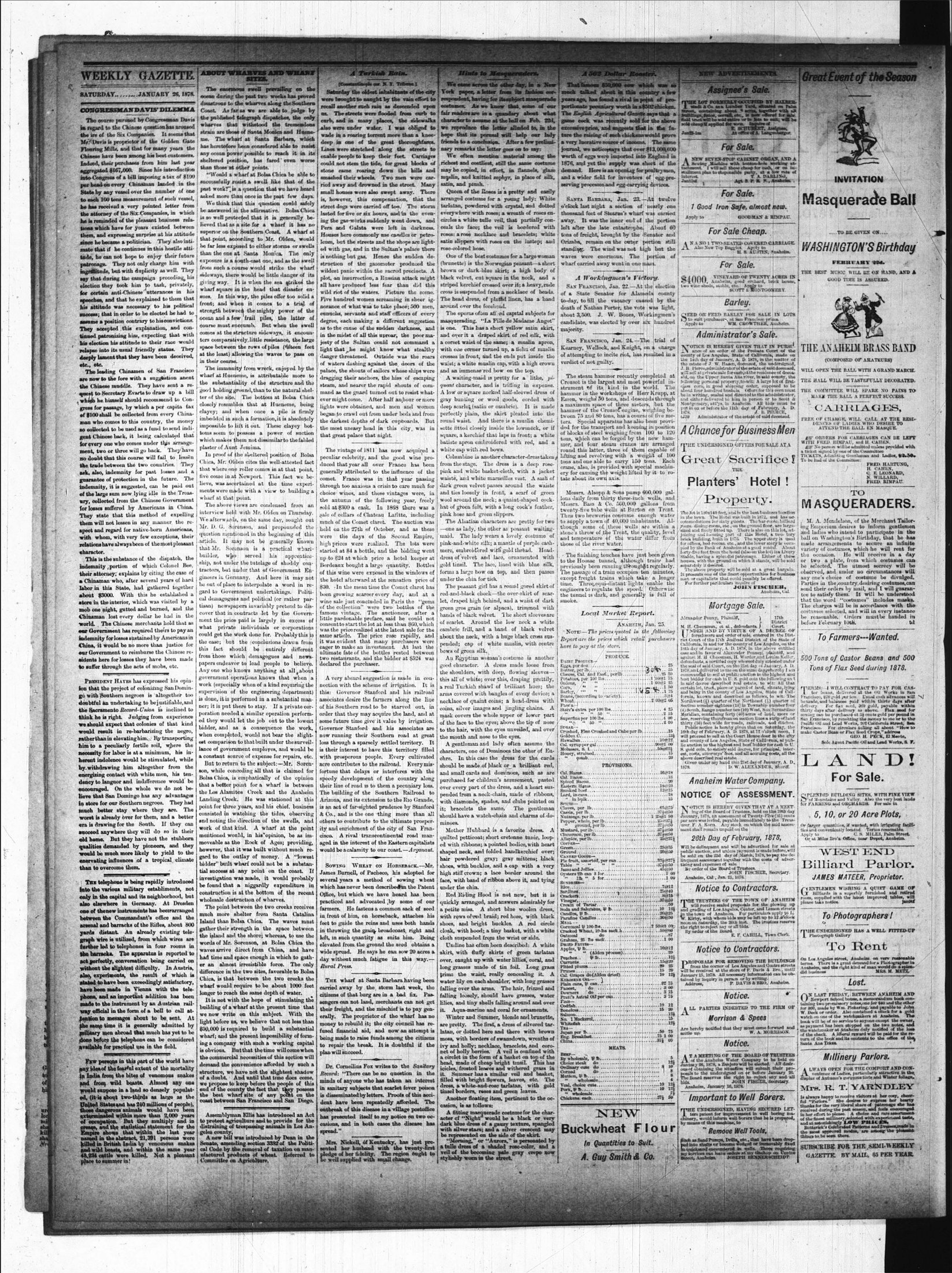
Searchable text
WEEKLY GAZETTE.
SATURDAY... JANUARY 26, 1878.
CONGRESSMAN DAVIS' DILEMMA
The course pursued by Congressman Davis in regard to the Chinese question has aroused the ire of the Six Companies. It seems that Mr. Davis is proprietor of the Golden Gate Flowering Mills, and that for many years the Chinese have been among his best customers. Indeed, their purchases from him last year aggregated $107,000. Since his introduction into Congress of a bill imposing a tax of $100 per head on every Chinaman landed in the State by any vessel over the number of one to each 100 tons measurement of such vessel, he has received a very pointed letter from the attorney of the Six Companies, in which he is reminded of the pleasant business relations which have for years existed between them, and expressing surprise at his attitude since he became a politician. They also intimate that if he continues in this hostile attitude, he can not hope to enjoy their future patronage. They not only charge him with ingratitude, but with duplicity as well. They say that during the campaign preceding his election they took him to task, privately, for certain anti-Chinese utterances in his speeches, and that he explained to them that his attitude was necessary to his political success; that in order to be elected he had to assume a position contrary to his convictions. They accepted this explanation, and continued patronizing him, expecting that with his election his attitude to their race would relapse into its usual friendly status. They deeply lament that they have been deceived, etc., etc.
The leading Chinamen of San Francisco are now to the fore with a suggestion anent the Chinese muddle. They have sent a request to Secretary Evarts to draw up a bill which he himself should recommend to Congress for passage, by which a per capita tax of $100 shall be collected from every Chinaman who comes to this country, the money so collected to be used as a fund to send indigent Chinese back, it being calculated that for every one who comes under this arrangement, two or three will go back. They have no doubt that this course will fail to lessen the trade between the two countries. They ask, also, indemnity for past losses and a
ABOUT WHARVES AND WHARF SITES.
The enormous swell prevailing on the ocean during the past two weeks has proved disastrous to the wharves along the Southern Coast. As far as we are able to judge by the published telegraph dispatches, the only wharves that withstood the tremendous strain are those of Santa Monica and Hueneme. The wharf at Santa Barbara, which has heretofore been considered able to resist any ocean power possible to reach it in its sheltered position, has fared even worse than those at other points.
"Would a wharf at Bolsa Chica be able to successfully resist a swell like that of the past week?" is a question that we have heard asked more than once in the past few days.
We think that this question could safely be answered in the affirmative. Bolsa Chica is so well protected that it is generally believed that as a site for a wharf it has no superior on the Southern Coast. A wharf at that point, according to Mr. Olden, would be far less exposed to either storms or swells than the one at Santa Monica. The only exposure is a south-east one, and as the swell from such a course would strike the wharf sideways, there would be little danger of its giving way. It is when the sea strikes the wharf square in the head that disaster ensues. In this way, the piles offer too solid a front; and when it comes to a trial of strength between the mighty power of the ocean and a few frail piles, the latter of course must succumb. But when the swell comes at the structure sideways, it encounters comparatively little resistance, the large space between the rows of piles (fifteen feet at the least) allowing the waves to pass on in their course.
The immunity from wreck, enjoyed by the wharf at Hueneme, is attributable more to the substantiality of the structure and the good holding ground, than to the natural shelter of the site. The bottom at Bolsa Chica closely resembles that at Hueneme, being clayey; and when once a pile is firmly imbedded in such a formation, it is absolutely impossible to lift it out. These clayey bottoms seem to possess a power of suction which makes them not dissimilar to the fabled plaster of Aunt Jemima.
In proof of the sheltered position of Bolsa Chica, Mr. Olden cites the well-attested fact that where one roller comes in at that point,
A
(Saturday) threw were brought together recall another us. The street curb, and in also were undone wade in a road deep in one Lines were stained people could not stench stone came smashed their ried away and small houses was, however, street dogs were lasted for five ing the gas-water Pera and Gau Houses here come leum, but they ed with gas, and is nothing but struction of wildest panic plot, an insurance all have produced wild riot of the Five hundred norance of what eunuchs, servic degree, each n as to the cause in the midst of jesty of the S light that he danger threaten of waters dash palace, she sh dragging their steam, and ne mand as the g ever might con lights were ob began to crawl the darkest day the most uneasy that great palace.
The vintage peculiar celebr induced that ye generally attr
are now to the fore with a suggestion anent the Chinese muddle. They have sent a request to Secretary Evarts to draw up a bill which he himself should recommend to Congress for passage, by which a per capita tax of $100 shall be collected from every Chinaman who comes to this country, the money so collected to be used as a fund to send indigent Chinese back, it being calculated that for every one who comes under this arrangement, two or three will go back. They have no doubt that this course will fail to lessen the trade between the two countries. They ask, also, indemnity for past losses and a guarantee of protection in the future. The indemnity, it is suggested, can be paid out of the large sum now lying idle in the Treasury, collected from the Chinese Government for losses suffered by Americans in China. They state that this method of expelling them will not lessen in any manner, the respect and regard for native-born Americans, with whom, with very few exceptions, their relations have always been of the most pleasant character.
This is the substance of the dispatch, the indemnity portion of which Colonel Bee, their attorney, explains by citing the case of a Chinaman who, after several years of hard labor in this State, had gathered together about $3000. With this he established a store in the interior, which was visited by a mob one night, gutted and burned, and the Chinaman lost every dollar he had in the world. The Chinese merchants hold that as our Government has required theirs to pay an indemnity for losses sustained by Americans in China, it would be no more than justice for our Government to reimburse the Chinese residents here for losses they have been made to suffer through the acts of mobs, etc.
President Hayes has expressed his opinion that the project of colonizing San Domingo with Southern negroes is altogether too doubtful an undertaking to be justifiable, and the Sacramento Record-Union is inclined to think he is right. Judging from experience we should expect that colonies of that kind would result in re-barbarizing the negro, rather than in elevating him. By transporting him to a peculiarly fertile soil, where the necessity for labor is at a minimum, his inherent indolence would be stimulated, while by withdrawing him altogether from the energizing contact with white men, his tendency to languor and indifference would be encouraged. On the whole we do not believe that San Domingo has any advantages in store for our Southern negroes. They had much better stay where they are. The worst is already over for them, and a better era is drawing for the South. If they can succeed anywhere they will do so in their old home. But they have not the stubborn qualities demanded by pioneers, and they would be much more likely to yield to the enervating influences of a tropical climate than to overcome them.
The telephone is being rapidly introduced into the various military establishments, not only in the capital and its neighborhood, but wharf at Hueneme, is attributable more to the substantiality of the structure and the good holding ground, than to the natural shelter of the site. The bottom at Bolsa Chica closely resembles that at Hueneme, being clayey; and when once a pile is firmly imbedded in such a formation, it is absolutely impossible to lift it out. These clayey bottoms seem to possess a power of suction which makes them not dissimilar to the fabled plaster of Aunt Jemima.
In proof of the sheltered position of Bolsa Chica, Mr. Olden cites the well-attested fact that where one roller comes in at that point, five come in at Newport. This fact we believe, was ascertained at the time experiments were made with a view to building a wharf at that point.
The above views are condensed from an interview held with Mr. Olden on Thursday. We afterwards, on the same day, sought out Mr. D. G. Sorenson, and propounded the question mentioned in the beginning of this article. It may not be generally known that Mr. Sorenson is a practical wharf-builder, who served his apprenticeship, not under the tutelage of shoddy contractors, but under that of Government Engineers in Germany. And here it may not be out of place to interpolate a word in regard to Government undertakings. Political demagogues and political (or rather partisan) newspapers invariably pretend to discover that in contracts let by the Government the price paid is largely in excess of what private individuals or corporations could get the work done for. Probably this is the case; but the conclusions drawn from this fact should be entirely different from those which demagogues and newspapers endeavor to lead people to believe. Any one who knows anything at all about government operations knows that when a work (especially when of a kind requiring the supervision of the engineering department) is done, it is performed in a substantial manner; it is put there to stay. If a private corporation needed a similar operation performed they would let the job out to the lowest bidder, and as a consequence the work, when completed, would not bear the slightest comparison to that built under the surveillance of government employees, and would be a constant source of expense for repairs, etc.
But to return to the subject:—Mr. Sorenson, while conceding all that is claimed for Bolsa Chica, is emphatically of the opinion that a better point for a wharf is between the Los Alamitos Creek and the Anaheim Landing Creek. He was stationed at this point for three years, and his chief business consisted in watching the tides, observing and noting the direction of the swells, and work of that kind. A wharf at the point mentioned would, in his opinion, be as improveable as the Rock of Ages; providing, however, that it was built without much regard to the outlay of money. A "lowest bidder" built wharf could not be a substantial success at any point on the coast. If investigation was made, it would probably be found that a niggardly expenditure in construction is at the bottom of the recent wholesale destruction of wharfs.
A very absurd connection with this: Governors associates design of his Southern order that they some future time Governor Stanley now running loss through an interest with prosperous acres contribute fortune that owe speedily develop their line of rope. The building of Arizona, and it is an act of faith & Co., and is its others to continue city and enrich cisco. A rivals aged in the infancy would be a calamity.
Sowing James Burnell several years which has never Office, but which
in store for our Southern negroes. They had much better stay where they are. The worst is already over for them, and a better era is drawing for the South. If they can succeed anywhere they will do so in their old home. But they have not the stubborn qualities demanded by pioneers, and they would be much more likely to yield to the enervating influences of a tropical climate than to overcome them.
The telephone is being rapidly introduced into the various military establishments, not only in the capital and its neighborhood, but also elsewhere in Germany. At Dresden one of the new instruments has been arranged between the Commandant's office and the arsenal and barracks of the Rifles, about 800 yards distant. An already existing telegraph wire is utilized, from which wires are further led to telephones in four rooms in the barracks. The apparatus is reported to act perfectly, conversation being carried on without the alightest difficulty. In Austria, also, experiments, the result of which is stated to have been exceedingly satisfactory, have been made in Vienna with the telephone, and an important addition has been made to the instrument by an Austrian railway official in the form of a bell to call attention to messages about to be sent. At the same time it is generally admitted by military men abroad that much has yet to be done before the telephone can be considered available for practical use in the field.
Few persons in this part of the world have any idea of the fearful extent of the mortality in India from the bites of venomous snakes and from wild beasts. Almost any one would suppose in a land so densely populated, (it is about two-thirds as large as the United States) and has 240 millions of people), those dangerous animals would have been exterminated within more than 2,000 years of occupation. But they multiply and in crease, and the statistical statement for the Empire shows that within the last year named in the abstract, 21,391 persons were killed in British India by venomous snakes and wild beasts, and within the same year 48,224 cattle were killed. Not a pleasant place to summer in!
Assemblyman Ellis has introduced an Act to protect agriculture and to provide for the distraining of trespassing animals in Los Angeles county.
A new bill was introduced by Dean in the Senate, amending section 3382 of the Political Code by the removal of taxation on manufactured products of wheat. Referred to Committee on Agriculture.
A Turkish Rain.
Saturday the oldest inhabitants of the city were brought to naught by the vain effort to recall another such rain as descended upon us. The streets were flooded from curb to curb, and in many places, the sidewalks also were under water. I was obliged to wade in a roaring torrent more than a knee-deep in one of the great thoroughfares. Lines were stretched along the streets to enable people to keep their feet. Carriages could not stem the tide, for great blocks of stone came roaring down the hills and smashed their wheels. Two men were carried away and drowned in the street. Many small houses were also swept away. There is, however, this compensation, that the street dogs were carried off too. The storm lasted for five or six hours, and in the evening the gas-works suddenly went down, and Pera and Galata were left in darkness. Houses here commonly use candles or petroleum, but the streets and the shops are lighted with gas, and in the Sultan's palace there is nothing but gas. Hence the sudden destruction of the gasometer produced the wildest panic within the sacred precincts. A plot, an insurrection, a Russian attack might all have produced less fear than did this wild riot of the waters. Picture the scene. Five hundred women screaming in sheer ignorance of what was to take place; 500 men, eunuchs, servants and staff officers of every degree, each making a different suggestion as to the cause of the sudden darkness, and in the midst of all this uproar, the poor majesty of the Sultan could not command a light that he might know what stealthy danger threatened. Outside was the roars of waters dashing against the doors of the palace, the shouts of sailors whose ships were dragging their anchors, the hiss of escaping steam, and nearer the rapid shouts of command as the guard turned out to resist whatever might come. After half an hour or more lights were obtained, and men and women began to crawl out from under beds and from the darkest depths of dark cupboards. But the most uneasy head in this city was in that great palace that night.
The vintage of 1811 has now acquired a peculiar celebrity, and the good wine produced that year all over France has been generally attributed to the influence of the
Hints to Masqueraders.
We came across the other day, in a New York paper, a letter from its fashion correspondent, having for its subject masquerade costumes. As we know that some of our fair readers are in a quandary about what character to assume at the hall on Feb. 224, we reproduce the letter alluded to, in the hope that its perusal will help our lady friends to a conclusion. After a few preliminary remarks the letter goes on to say:
We often mention material among the richest and costliest, still the same costume may be copied, in effect, in flannels, glaze mglsin, and knitted zephyr, in place of silk, satin, and pinsh.
Queen of the Roses is a pretty and easily arranged costume for a young lady: White tartlan, powdered with crystal, and dotted everywhere with roses; a wreath of roses encircles a white tulle veil, that partially conceals the face; the veil is bordered with roses: a rose necklace and bracelets; white satin slippers with roses on the instep; and rose-colored hose.
One of the best costumes for a large woman (brunette) is the Norwegian peasant—a short brown or dark-blue skirt; a high body of black velvet, cut square in the neck, and a striped kerchief crossed over it; a heavy, rude cross is suspended from a necklace of beads. The head dress, of plated linen, has a band around over the forehead.
The operas often affair capital subjects for masquerading. "La Fille de Madame Angot" is one. This has a short yellow satin skirt, and over it a draped skirt of red silk, with a corset waist of the same; a muslin apron, with one corner turned up, a fichu of muslin crossover in front, and the ends put inside the waist; a white muslin cap, with a high crown and an immense red bow on the top.
A waiting-maid is pretty for a lithe, piquant character, and is trifling in expense. A low or square necked half-sleeved dress of gray bunting or wool goods, corded with deep scarlet (satin or canabric). It is made perfectly plain, the skirt pleated into the round waist. And there is a muslin chemisette fitted closely inside the loweneck, or if square, a kerchief that laps in front; a white batiste apron embroidered with red, and a white cap with red bows.
Columbine is another character-dress taken from the stage. The dress is a deep rose-pink and white basket-cloth, with a jacket
A 502 Dollar Rooster.
That famous $50,000 cow which was much talked about in this country a few years ago, has found a rival in point of profitate pecuniary worth in a $502 chicken. The English Agricultural Gazette says that game cock was recently sold for the above excessive price, and suggests that in future the raising of such chickens would provide a very lucrative source of income. The same journal, we notice says that over $13,000,000 worth of eggs were imported into England in 1876, and yet the supply was short of demand. Here is an opening for poultrymen and a wider field for inventors of egg-providing processes and egg-carrying devices.
SANTA BARBARA, Jan. 23.—At twelve o'clock last night a section of nearly one thousand feet of Stearns's wharf was carried away. It was the inner end of the portion left after the late catastrophe. About 6 tons of freight, brought by the Senator and Orizaba, remain on the outer portion still standing. The wind was not high but the waves were enormous. The portion of wharf carried away went in one mass.
A Workingmen's Victory.
SAN FRANCISCO, Jan. 22.—At the election of a State Senator for Alameda county to-day, to fill the vacancy caused by the death of Nathan Porter, the vote was light about 3,500. J. W. Bones, Workingmen's candidate, was elected by over six hundred majority.
SAN FRANCISCO, Jan. 24.—The trial of Kearney, Wellock, and Knight, on a charge of attempting to incite riot, has resulted in verdict of not guilty.
The steam hammer recently completed an Creusot is the largest and most powerful instrument of its kind in the world. The hammer in the workshops of Herr Krupp, Essen, weighs 50 tons, and descends through a maximum space of three meters, but the hammer of the Creusot engine weighing between 75 and 80 tons, has a course of five meters. Special apparatus has also been provided for the transport and keeping in position of blocks of steel weighing from 100 to 120 tons, which can be forged by the new hammer, and four steam cranes are arranged round this latter, three of them capable of lifting and revolving with a weight of 100 tons and one able to carry 150 tons. Each crane also is provided with special machinery for causing the weight lifted by it to roar.
The vintage of 1811 has now acquired a peculiar celebrity, and the good wine produced that year all over France has been generally attributed to the influence of the comet. France was in that year passing through too anxious a crisis to care much for choice wines, and these vintages were, in the autumn of the following year, freely sold at $300 a cask. In 1868 there was a sale of cellars of Chateau Lafitte, including much of the Comet claret. The auction was held on the 27th of October, and as these were the days of the Second Empire, high prices were realized. The lots were started at $4 a bottle, and the bidding went up to $24 at which price a hotel keeper at Bordeaux bought a large quantity. Bottles of this wine were exposed in the windows of the hotel afterward at the sensation price of $30. In the mean time the Comet clarat has been growing scarcer every day, and at a wine sale just concluded in Paris the "gems of the collection" were two bottles of the famous vintage. The auctioneer, after a little pardonable preface, said he could not consent to start the lot at less than $60, which was the price realized at the latest sale for the same article. The price rose rapidly, and it was evident that many purchasers were eager to make an investment. At last the ultimate fate of the bottles rested between two restaurants, and the bidder at $524 was declared the purchaser.
A very absurd suggestion is made in connection with the scheme of irrigation. It is this: Governor Stanford and his railroad associates desire the farmers along the line of his Southern road to be starved out, in order that they may acquire the land, and at some future time give it value by irrigation. Governor Stanford and his associates are now running their Southern road at great loss through a sparsely settled territory. It is their interest to have this territory filled with prosperous people. Every cultivated acre contributes to the railroad. Every misfortune that delays or interferes with the speedy development of the country along their line of road is to them a pecuniary loss. The building of the Southern Railroad to Arizona, and its extension to the Rio Grande, is an act of far-sighted prudence by Stanford & Co., and is the one thing more than all others to contribute to the ultimate prosperity and enrichment of the city of San Francisco. A rival transcontinental road managed in the interest of the Eastern capitalists would be a calamity to our coast.—Argonaut.
Sowing Wheat on Horseback.—Mr. James Burnell, of Pacheco, his adopted for several years a method of sowing wheat which has never been described in the Patent Office, but which we have heard has been waiting-maid is pretty for a lithe, piquant character, and is trifling in expense. A low or square necked half-sleeveld dress of gray bunting or wool goods, corded with deep scarlet (satin or cambric). It is made perfectly plain, the skirt pleated into the round waist. And there is a muslin chemisette fitted closely inside the lowneck, or if square, a kerchief that laps in front; a white batiste apron embroidered with red, and a white cap with red bows.
Columbine is another character-dress taken from the stage. The dress is a deep rose-pink and white basket-cloth, with a jacket waist, and white marseilles vest. A sash of dark green velvet passes around the waist and ties loosely in front, a scarf of green wool around the neck; a quaint-shaped cock-hat of green felt, with a long cock's feather, pink hose and green slippers.
The Alsatian characters are pretty for two—one as lady, the other as peasant waiting-maid. The lady wears a lovely costume of pink-and-white silk; a mantle of purple cashmere, embroidered with gold thread. Head-dress of velvet and lace, ornamented with gold tinsil. The lace, lined with blue silk, forms a large bow on top, and then passes under the chin for ties.
The peasant girl has a round gored skirt of red-and-black check—the over-skirt of scarlet, draped high behind, and a waist of dark green gros grain (or alpaca), trimmed with bands of black velvet. The short sleeves are of scarlet. Around the low neck a white cambric frill, and a band of black velvet about the neck, with a huge black cross suspended; cap of white muslin, with centre bows of green silk.
An Egyptian woman's costume is another good character. A dress made loose from the shoulders, with deep, flowing sleeves—this all of white; over this, draping prettily, a real Turkish shawl of brilliant hues; the arms covered with bangles of every device; a necklace of quaint coins; a head-dress with coins, silver images and jingling chains. A mask covers the whole upper or lower part of the face to the eyes; above the tip of nose to the hair, with the eyes unveiled, and over the mouth and nose to the eyes.
A gentleman and lady often assume the characters, one of Dominoes the other of Euchre. In this case the dress for the cards should be made of black or a brilliant red, and small cards and dominoes, such as are purchased for children's amusement, pasted over every part of the dress, and a heart suspended from a neck-chain, made of ribbons, with diamonds, spades, and clubs pointed on it; bracelets the same. The gentleman should have a watch-chain and charms of dominoes.
Mother Hubbard is a favorite dress. A quilted petticoat; short cretonne tunic, looped with ribbons; a pointed bodice, with heart shaped neck, and folded handkerchief over; hair powdered gray; gray mittens; black shoes, with buckles, and a cap with a very high stiff crown; a lace border around the face, with band of ribbon above it, and tying under the chin.
Red Riding Hood is not new, but it is
The steam hammer recently completed an Creusot is the largest and most powerful instrument of its kind in the world. The hammer in the workshops of Herr Krupp, an Essen, weighs 50 tons, and descends through a maximum space of three meters, but thundered by tensions of seven 75 and 80 tons, has a course of five meters. Special apparatus has also been provided for the transport and in position of blocks of steel weighing from 100 to 120 tons, which can be forged by the new hammer, and four steam cranes are arranged round this latter, three of them capable of lifting and revolving with a weight of 100 tons and one able to carry 150 tons. Each crane also is provided with special machinery for causing the weight lifted by it to rotate about its own axis.
Messrs. Alsopp & Sons pump 600,000 gallons daily from thirty three-inch wells, and Messrs. Baass & Co. 500,000 gallons from twenty-five tube wells at Burton On Trent. Thus two breweries consume enough water to supply a town of 40,000 inhabitants. Although some of these wells are within stone's throw of the Trent, the quality level and temperature of the water differ from those of the river water.
The finishing touches have just been given to the Hoosac tunnel, although train had previously been running through it regularly. The passage of a train occupies ten minutes except freight trains which take a longer time. Three equi-distant lights enable engineers to regulate the speed. Otherwise the tunnel is dark, and generally is full of smoke.
Local Market Report.
ANAHEIM, Jan. 25.
NOTE: The prices quoted in the following Report are the prices which retail purchaser have to pay at the store.
PRODUCE
Daily Producer
Eggs per doz
Butter per lb
Cheese. Cal. and East. per lb
Potatoes per 100 lb.
Onions / / / / / / / / / / / / / / / / / / / / / / / / / / / / / / / / / / / / / / / / / / / / / / / / / / / / / / / / / / / / / / / /
Corn
Rice
Roastie (according to variety).
Wheat.
Floor.
Stair's extra per 100 lb.
Superfine per 100 lb.
Sugar.
Crushed Eme Crushed and Cube per lb.
Golden C.
Hawaiian.
Cal. syrup per gal.
Molasses. S. L.
Honey strained.
Comb.
PROVISIONS.
Cal. Hams.
Cal. Bacon.
Eastern Hams.
Smoked beef.
Lard in cans.
In bulk.
Spices.
Cloves per lb.
Cassia per lb.
Nutmegs per lb.
Pepper per lb.
Ground per lb.
Mustard per lb.
Chinnamon per lb.
Allspice per lb.
Cocoa.
Green.
Ground.
Canned Goose.
Pie fruit, assorted per can.
Table " " " " " " " " " " " " " " " " " " " " " " " " " " " " " " " " " " " " " " " " " " " " " " " " " " " " " " " " " " " " " " "
Jams and Jellies
Oysters 22 can 3 for
1 lb
5 for
Sundries
Rice
Sardines
Crackers
SOWING WHEAT ON HORSEBACK.—Mr. James Burnell, of Pacheco, has adopted for several years a method of sowing wheat which has never been described in the Patent Office, but which we have heard has been practiced and advocated by some of our farmers. He fastens a common sack of seed in front of him, on horseback, attaches his feet to guide the reins and uses both hands in throwing the grain broadcast, right and left, in such quantity as suits him. Being elevated from the ground the seed obtains a wide spread. He says he can sow 20 acres a day without much fatigue in this way.—Rural Press.
THE WHARF AT Santa Barbara having been carried away by the storm last week, the citizens of that burg are in a bad fix. Passengers can not land, merchants can not get their freight, and the mischief is to pay generally. The proprietor of the wharf has no money to rebuild it; the city council has refused financial aid, and now an attempt is being made to raise funds among the citizens to repair the break. It is doubtful if the plan will succeed.
Dr. Corneilus Fox writes to the Sanitary Record: "There can be no question in the minds of anyone who has taken an interest in sanitary subjects that scarlet fever poison is disseminated by letters. Proofs of this accident have been repeatedly afforded. The outbreak of this disease in a village postoffice has presented itself to my notice on two occasions, and in both cases the disease has spread."
Mrs. Nickell, of Kentucky, has just presented her husband with the twenty-first pledge of her fidelity. The region ought to be well supplied with small change.
Mother Hubbard is a favorite dress. A quilted petticoat; short cretonne tunic, looped with ribbons; a pointed bodice, with heart shaped neck, and folded handkerchief over; hair powdered gray; gray mittens; black shoes, with buckles, and a cap with a very high stiff crown; a lace border around the face, with band of ribbon above it, and tying under the chin.
Red Riding Hood is not new, but it is quickly arranged, and answers admirably for a petite miss. A short blue woolen dress, with rows of red braid; red hose, with black shoes, and bright buckles. A red circle cloak, with hood; a tiny basket, with a white cloth suspended from the wrist or side.
Undine has often been described: A white skirt, with fluffy skirts of green tarlatan over, caught up with water lillies, coral, and long grasses made of tin foil. Long grass trims the waist, really concealing it. A water lily on each shoulder, with long grasses falling over the arms. The hair, frizzed and falling loosely, should have grasses, water lilies, and tiny shells falling around and over it. Aqua-marine and coral for ornaments.
Winter and Summer, blonde and brunette, are pretty. The first, a dress of silvered tarlatan, or dotted here and there with brown moss, with borders of swansdown, wrenth of ivy and holly; necklace, bracelets, and coronet of holly berries. A veil is confined with a circlet in the form of a basket on top of the head, made of cheap bright tussil. This has icicles, frosted leaves and withered grass in it. Summer has a similar veil and basket, filled with bright flowers, leaves, etc. The dress, a white-and-rose tarlatan, with gold tinsel borders, reses and green leaves.
Another floating item, pertinent to the occasion, is as follows:
A fitting masquerade costume for the character of "Night" would be a black or very dark blue dress of a gauzy texture, spangled with silver stars; and a silver crescent may be represented on the side of the skirt.
"Morning," or "Aurora," is personated by a full dress of a shaded rose-color, and a veil of the becoming pale gray crepe now stylishly worn in the street.
NEW Buckwheat Flour
In Quantities to Suit.
A. Guy Smith & Co.
NEW ADVERTISEMENTS.
Assignee’s Sale.
THE LOT FORMERLY OCCUPIED BY HALBER,
wants A Co as a Leather Yard, situated on Palm Street, containing about 7 acres, together with all buildings, fence, corrall, etc., is now offered for sale. Field trust will be wild entire or in lots to suit; will be sold cheap if applied for work. Inquire of
E. SCHUBERT, Assignee,
At office of A. Langemberger.
For Sale.
A NEW SEVEN-STOP CABINET ORGAN, AND A
Sewing Machine with button-hole working attachment. I will sell these cheap for cash, or on installment plan to responsible party, at a low rate of interest.
T. A. DARLING,
Agt. S. P. K. P., Anaheim.
For Sale.
1 Good Iron Safe, almost new.
Apply to GOODMAN & RIMPAU.
For Sale Cheap.
AN NO. 1 TWO-SEATED COVERED CARRIAGE.
Also New Top Buggies. Apply to
H. S. AUSTIN, Anaheim.
For Sale.
$4000. VINEYARD OF TWENTY ACRES IN
Anahiem, good orchard, brick house,
two wine sheds, stable, etc. Apply to
SCOTT & MONTGOMERY.
Barley.
SEED OR FEED BARLEY FOR SALE IN LOTS
to suit purchaser, at San Francisco price.
Apply to WM. CROWTHER, Anaheim.
Administrator’s Sale.
NOTICE IS HEREBY GIVEN THAT IN PURSUANCE of an order of the Probate Court of the county of Los Angeles, State of California, made on the 14th day of January, A.D. 1878, in the matter of the estate of J. W. Hazen, deceased, the undersigned, J. B. Pierce, administrator of the estate of said deceased, will sell at private sale for cash at the residence of deceased, on the Upper Santa Ana river, in said county, the following personal property, to-wit: A large lot of first-class corn, in good shipping order, supposed to be about four hundred bushels. Offers for this corn must be in writing, sealed and directed to the administrator, and either delivered to him in person or to Scott & Montgomery, attys., in Anahiem. All bids must be put in or before the 11th day of February, A.D. 1878.
J. B. Pierce,
Administrator of the estate of said deceased.
A Chance for Business Men
THE UNDERSIGNED OFFERS FOR SALE AT A
Great Sacrifice!
THE
Great Event of the Season
INVITATION
Masquerade Ball
...TO BE GIVEN ON...
WASHINGTON’S Birthday
FEBRUARY 23d.
THE BEST MUSIC WILL BE ON HAND, AND A
GOOD TIME IS ASSURED.
THE ANAHEIM BRASS BAND
(COMPOSED OF ANATEURS)
WILL OPEN THE BALL WITH A GRAND MARCH.
THE HALL WILL BE TASTEFULLY DECORATED.
THE COMMITTEE WILL SPARE NO PAINS TO MAKE THE BALL A PERFECT SUCCESS.
CARRIAGES,
FREE OF CHARGE, WILL CALL AT THE RESIDENCES OF LADIES WHO DESIRE TO ATTEND THE BALL EN MASQUE.
ORDERS FOR CARRIAGES CAN BE LEFT WITH FRED RIMPAU, and H. CAIREN.
No person will be admitted unless provided with a ticket signed by one of the Committee
TICKETS, Admitting Gentleman and Ladies, $2.50.
To be had of the Committee:
FRED HARTUNG,
H. CAIREN,
C.E. LEONARD,
A Chance for Business Men
THE UNDERSIGNED OFFERS FOR SALE AT A Great Sacrifice!
THE Planters’ Hotel! Property.
The lot is 180x140 feet, and is the best business location in the town. The Hotel was built in 1872, and has accommodations for sixty guests. The bar-room, ballard room, dining-room, etc., on the ground floor, are larger sized and dwarfed than the lot, satisfying and fascinating part of this Hotel, a two-story brick building built in 1873. The upper story is used for offices, bedrooms, etc., and the lower story is occupied by the Bank of Anaheim at a good rental. About forty-five feet from the hotel (also on the lot) is Llvery Stable, having a splendid patronage. Either of these houses, with the ground on which it stands, will be sold separately if desired.
The above property will be sold at a great bargain. It presents one of the finest opportunities for business men or capitalists that could possibly be offered.
For further particulars require of JOHN FISCHER,
Anaheim, Cal.
Mortgage Sale.
Alexander Penny, Plaintiff,
vs.
M. H. Cheesman, et al., defendants
UNDER AND BY VIRTUE OF A DECREE OF foreclosure and order of sale, entered in the District Court of the 17th Judicial District of the State of California, in and for the county of Los Angeles, on the 18th day of January, A.D. 1878, in the above entitled case and in favor of Alexander Penney, plaintiff, and against M. H. Cheesman, H. Werdler, and Louis Keller, defendants, a certified copy whereof duly attested under the seal of said Court, on the 21st day of January, A.D. 1878, and delivered to me on the same daywhereby I am commanded to sell at public auction to the highest and best bidder for cash in U.S. gold coin the following and in said decree described real estate; to wrt: All that certain lot, tract, piece or parcel of hard, situate, lying and being in the county of Los Angeles, State of California, known and desired as follows:
The Northwest (3) quarter of the Northeast (1) quarter of Section number eightteen (18) in Township number four (4) South, Range number ten (10) West, San Bernardino Meridian, containing forty (40) acres of land, more or less, reserving therefrom on section lines a strip of land thirty (30) feet wide for roads, railroads, and ditches.
Public notice is hereby given that on Saturday, the 16th day of February, A.D. 1878, at 12 o'clock noon, I will proceed to sell at the Court House door in the city and county of Los Angeles, State of California, at public auction to the highest and best bidder for cash in U.S. gold coin, to satisfy said degree, for principal, interest, costs, attorneys' fees, and all accruing costs, all the above described real estate.
Given under my hand this 21st day of January, A.D. 1878.
Anaheim Water Company.
NOTICE OF ASSESSMENT.
NOTICE IS HEREBY GIVEN THAT AT A MEETING of the Board of Trustees, held on the 19th day January, 1878, an assessment of Twenty-Five (25) cents per acre was levied, payable immediately to the Treasurer F. A. Korn. Any stock on which the said assessment shall remain unpaid on the 26th Day of February, 1878,
Will be delinquent and will be advertised for sale at public auction, and unless payment is made before, will be sold on the 22d day of March, 1878, to pay the delinquent assessment together with the costs of advertising and expenses of sale.
By order of the Board of Trustees.
JOHN FISCHER, Secretary.
Anaheim, Cal., Jan. 21, 1878.
Notice to Contractors.
THE HALL WILL BE TASTEFULLY DECORATED.
THE COMMITTEE WILL SPARE NO PAINS TO MAKE THE BALL A PERFECT SUCCESS.
CARRIAGES,
FREE OF CHARGE, WILL CALL AT THE RESIDENCES OF LADIES WHO DESIRE TO ATTEND THE BALL EN MASQUE.
ORDERS FOR CARRIAGES CAN BE LEFT WITH FRED RIMPAU, and H. CAIREN.
No person will be admitted unless provided with a ticket signed by one of the Committee.
TICKETS, Admitting Gentleman and Ladies, $2.50.
To be had of the Committee:
FRED HARTUNG,
H. CAIREN,
C. E. LEONARD,
N. WILLARD,
FRED RIMPAU.
TO MASQUERADERS.
M. A. Mendelson, of the Merchant Tailoring Emporium desires to inform gentlemen and ladies who intend to participate in the ball on Washington's Birthday, that he has made arrangements to secure an infinite variety of costumes which he will rent for the occasion. He will receive in a day or two a plate, from which costumes can be selected. The utmost secrecy will be observed, and under no circumstances will any one choice of costume be divulged. Parties in the country desire costumes can send their orders by mail, and I will guarantee to satisfy them. It will be understood that the word "costumes" includes masks. The charges will be in accordance with the costumes selected, and will in every instance be reasonable. Orders must be handed in before February 10th.
To Farmers---Wanted.
500 Tons of Castor Beans and 500 Tons of Flax Seed during 1878.
TERMS: I WILL CONTRACT TO PAY FOR CASTOUR beans, delivered at the Oil Works in San Francisco; 670 gold per ton. Usual cash advances will himself paid within thirty days; the debt so settled; for fixed price, payable within thirty days after delivery as above. Flax seed for sowing can be purchased at 34 cents gold per pound in San Francisco; by remitting the money to me or to the Pacific Oil and Lead Works; 209 California Street; San Francisco. For circulars telling all about "How to make Castor Bean or Flax Seed Crops," address GEO. H. PECK, El Mente.
Sole Agent Pacific Oil and Lead Works, S. F.
LAND!
For Sale.
PLENDID BUILDING SITES WITH FINE VIEW OF Mountains and Valley. Also the very best lands for FARMING AND ORCHARDS. For sale in
5, 10, or 20 Acre Plots,
Or larger quantities if wanted with irrigating facilities and conveniently located. Terms reasonable.
Apply to C. S. MILES Palm Street.
Or at Miles Bro.'s Office near Depot, Anaheim.
WEST END
Billiard Parlor.
JAMES MATEER, Proprietor.
GENTLEMEN WISHING A QUIET GAME OF Billiards in a superbly furnished and retired room, supplied with the latest improved tables, will
NOTICE IS HEREBY GIVEN THAT AT A MEETING OF the Board of Trustees, held on the 19th day January, 1878, an assessment of Twenty-Five (25) cents per acre was levied, payable immediately to the Treasurer, P. A. Korn. Any stock on which the said assessment shall remain unpaid on the 26th Day of February, 1878.
Will be delinquent and will be advertised for sale at public auction, and unless payment is made before, will be sold on the 22d day of March, 1878, to pay the delinquent assessment together with the costs of advertising and expenses of sale.
By order of the Board of Trustees.
JOHN FISCHER, Secretary.
Anaheim, Cal., Jan. 21, 1878.
Notice to Contractors.
THE TRUSTEES OF THE TOWN OF ANAHEIM will receive sealed proposals for the plowing up and grading of Los Angeles Center, and Lemon streets in the town of Anaheim. For particulars apply to J. W. Kirby, with whom bills may be left up to 12 o'clock noon on Saturday, the 26th inst. The trustees reserve the right to reject any or all bids.
By order of the Board.
E. F. CAHILL, Town Clerk.
Notice to Contractors.
PROPOSALS FOR REMOVING THE BUILDINGS from the corner of Los Angeles and Centre streets will be received at the store of P. Davis & Bro., until January 15, 1878. All necessary information can be obtained by inquiry in person or by writing.
Address,
P. DAVIS & BRO., Anaheim.
Notice.
ALL PARTIES INDEBTED TO THE FIRM OF Morrison & Spees
Are hereby notified that they must come forward and settle up.
W. A. MORRISON.
Notice.
AT A MEETING OF THE BOARD OF TRUSTEES of the Anaheim Water Company to be held on January 26, 1878, a Zunjero will be elected. All desirous of obtaining the situation will submit their proposals to the undersigned on or before January 26. The Board reserves the right to reject any and all bids.
JOHN FISCHER, Secretary.
Anaheim, January 16, 1878.
Important to Well Borers.
THE UNDERSIGNED, HAVING SECURED LETTERS patent for improvement in well boring machinery, would inform well borers that he is prepared, by means of this machine, to "Remove Well Tools,
Such as Sand Pumps, Drills, etc., that have been dropped into shafts or become wedged or immovably fixed in quick sand encountered in wells. These requiring my services can have orders at my shop on Central Street, Anaheim.
JOSEPH BENNERSCHEIDT
WEST END
Billiard Parlor.
JAMES MATEER, Proprietor.
GENTLEMEN WISHING A QUIET GAME OF Billiards in a superbly furnished and retired room, supplied with the latest improved tables, will please take notice.
To Photographers!
THE UNDERSIGNED HAS A WELL FITTED-UP Photograph Gallery
To Rent
On Los Angeles street, Anaheim. On very reasonable terms. There is a great demand for a Photographer in Anaheim, and the right kind of man would do a splendid business.
MRS. M. METZ.
Lost.
ON LAST FRIDAY, BETWEEN ANAHEIM AND Newport School house, a memorandum book containing two premissory notes, one for $40 and the other for $80, made by Wm. Pickering, and payable to John W. Deck or order. Also contained a check for a gold watch on one of the watchmakers at Anaheim. The book will be of no service to anyone except the owner, as payment has been stopped on the two notes, and the watchmaker at Anaheim duly notified of the loss of the check. A liberal reward will be paid for the return of the book and its contents to the office of the Santa Ana Times.
Millinery Parlors.
ALWAYS OPEN FOR THE COMFORT AND CONVENience of Ladies, particularly attractive in the display of Antique's gorgeous tints and Winter foliage.
Mrs. R. T. YARNDLEY
Is always happy to receive visitors at her cosy, cheerful "Parlors." She desires to express her hearty thanks for the very liberal share of patronage she has received during the past season, and feels encouraged in her effort to please. A choice and rare assortment of the finest millinery selected with experience taste, and at astonishingly low prices.
Butterick's Celebrated Patterns and Dresses, made in the most approved modes, are among the pleasant things to be seen there.
SUBSCRIBE FOR THE SEMI-WEEKLY GAZETTE. BY MAIL, $5 PER YEAR.