anaheim-gazette 1877-12-29
Scanned page
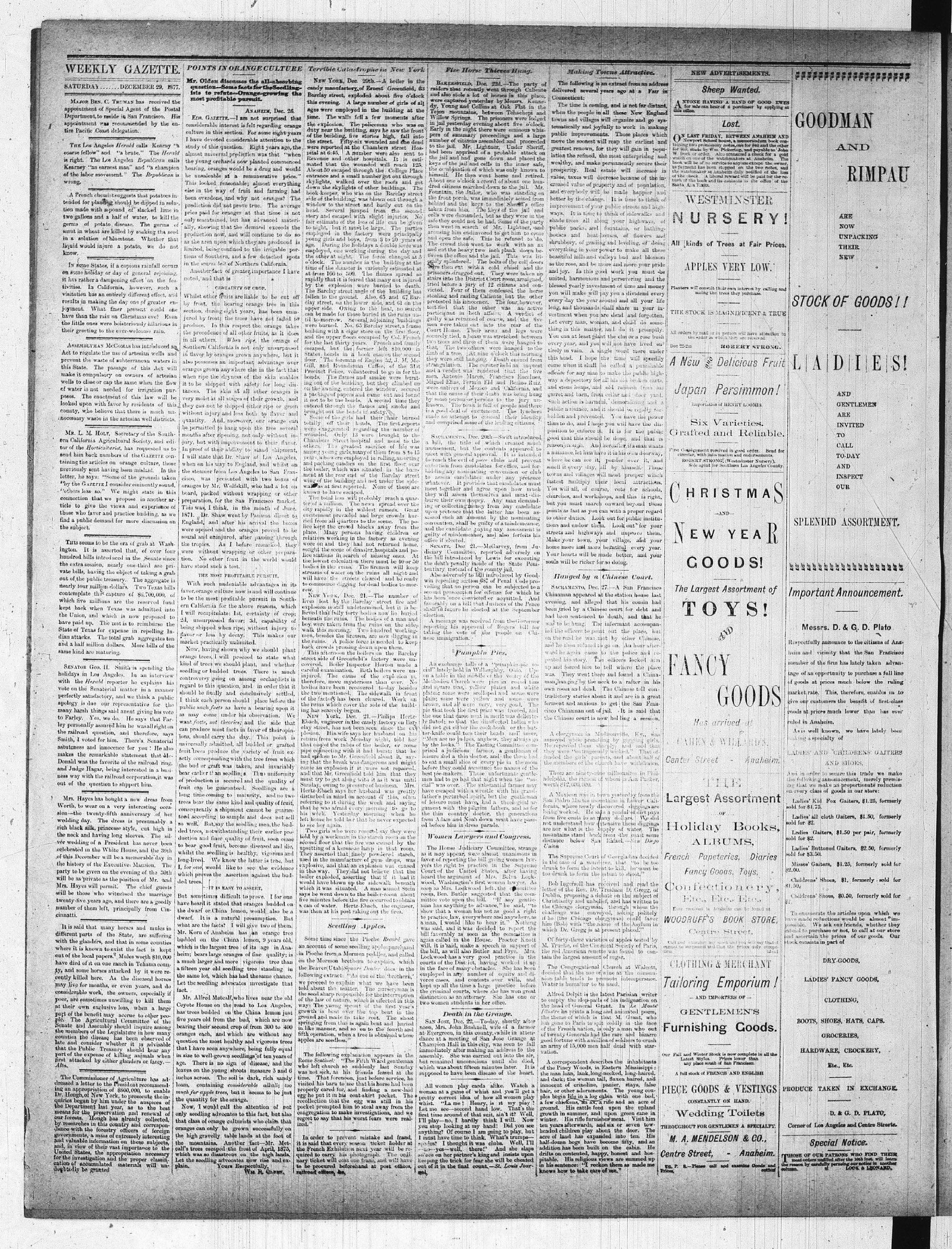
Searchable text
WEEKLY GAZETTE.
SATURDAY...DECEMBER 29, 1877.
MAJOR BEN. C. TRUMAN has received the appointment of Special Agent of the Postal Department, to reside in San Francisco. His appointment was recommended by the entire Pacific Coast delegation.
The Los Angeles Herald calls Kearny "a coarse fellow" and "a brute." The Herald is right. The Los Angeles Republican calls Kearney "an earnest man" and "a champion of the labor movement." The Republican is wrong.
A French chemist suggests that potatoes intended for planting should be dipped in solution made with a compound of slaked lime in two gallons and a half of water, to kill the germs of potato disease. The germs of sunut in wheat are killed by soaking the seed in a solution of bluestone. Whether that liquid would injure a potato, we do not know.
In some States, if a copious rainfall occurs on some holiday or day of general rejoicing, it has rather a dampening effect on the festivities. In California, however, such a visitation has an entirely different effect, and results in making the day one of greater enjoyment. What finer present could one have than the rain on Christmas eve? Even the little ones were boisterously hilarious in their greeting to the ever-welcome rain.
ASSEMBLYMAN McComas has introduced an Act to regulate the use of artesian wells and prevent the waste of subterranean waters in this State. The passage of this Act will make it compulsory on owners of artesian wells to close or cap the same when the flow of water is not needed for irrigation purposes. The enactment of this law will be looked upon with favor by residents of this county, who believe that there is much unnecessary waste in the artesian well districts.
MR. L. M. HOLT, Secretary of the Southern California Agricultural Society, and editor of the Horticulturist, has requested us to send him back numbers of the Gazette containing the articles on orange culture, those points in orange culture Mr. Olden discusses the all-absorbing question—Some facts for the Seedlings to refute—Orange-growing the most profitable pursuit.
ANAHEIM; Dec. 26.
EDS. GAZETTE.—I am not surprised that considerable interest is felt regarding orange culture in this section. For some eight years I have devoted considerable attention to the study of this question. Eight years ago, the almost universal prediction was that "when the young orchards now planted commenced bearing, oranges would be a drug and would be unsaleable at a remunerative price." This looked reasonable; almost everything else in the way of fruit and farming had been overdone, and why not oranges? The prediction did not prove true. The average price paid for oranges at that time is not only maintained, but has advanced materially, showing that the demand exceeds the production now, and will continue to do so as the area upon which they are produced is limited, being confined to the irrigable portions of Southern, and a few detached spots in the warra belt of Northern California.
Another fact of greater importance I have noted, and that is
CERTAINITY OF CROP.
Whilst other fruits are liable to be cut off by frost, the bearing orange tree in this section, during eight years, has been uninjured by frost; the trees have not tailed to produce. In this respect the orange takes the precedence of all other fruits, as it does in all others. When ripe, the orange of Southern California is not only unsurpassed in flavor by oranges grown anywhere, but it also possesses an important advantage over oranges grown anywhere else in the fact that when ripe the dryness of the skin enables it to be shipped with safety for long distances. The skin of all other oranges is very moist at all stages of their growth, and they cannot be shipped either ripe or green without injury and loss both to flavor and quantity. And, moreover, our orange can be permitted to hang upon the tree several months after ripening, not only without injury, but with improvement to their flavor.
In proof of their ability to stand shipment, I will state that Dr. Shaw of Los Angeles, when on his way to England, and whilst on Terrible Cutting.
NEW YORK, Dew candy manufacturer Barclay street, express this evening. A large age were employed time. The walls were explosion. The duty near the building of the building, five the street. Fifty-five were reported at the capital at 6:45. A new Revenue and other matter that the wagon about 50 escaped the entrance and a small skylights, walked down the skylights book-keeper, who was side of the building window to the street head. Several juices story and escaped with fair estimate of them to night, but it not employed in the young girls and boyage. During the last employed, one work the other at night. o'clock. The number time of the disaster at from 100 to 300 rapidly that it is feared by the explosion.
The Barclay street fallen to the ground clay street, on the lower side. Owing can be made for those til to-morrow. Seven were burned. No building with a eight and the upper floors for the last thirty years escaped, but the Staten bonds in a floor. The foreman Gill, and Roundsm Precinct Police, volved bonds. The flames ing out of the building on the awning, entail a package of papers it not to be the bone entered through these brought out the bones.
Some of the girls totally off their were exaggerated r wounded. Only 1 Chambers Street hoft others. The greatest among young girls many years who were emptied and packing candies
MR. L. M. HOLT, Secretary of the Southern California Agricultural Society, and editor of the Horticulturist, has requested us to send him back numbers of the GAZETTE containing the articles on orange culture, those previously sent having been misland. In the letter, he says: "Some of the grounds taken by the GAZETTE I consider eminently sound, 'others less so.' We might state in this connection that we propose in another article to give the views and experience of those who favor and practice budding, as we find a public demand for more discussion on the subject.
This seems to be the era of grab at Washington. It is asserted that, of over four hundred bills introduced in the Senate since the extra session, nearly one-third are private bills, having the object of taking a grab out of the public treasury. The aggregate is nearly four million dollars. Two Texas bills contemplate the capture of $6,700,000, of which five millions are the reserved fund kept back when Texas was admitted into the Union, and which is now proposed to have paid up. The test is to reimburse the State of Texas for expense in repelling Indian attacks. The total grab aggregates ten and a half million dollars. More bills of the same kind are maturing.
Senator Geo. H. Smith is spending the holidays in Los Angeles. In an interview with the Herald reporter he explains his vote on the Senatorial matter in a manner perfectly satisfactory, and we think a public apology is due our representative for the many harsh things said anent giving his vote to Farley. Yes, we do. He says that Farley personally assured him he was all right on the railroad question, and therefore, says Smith, I voted for him. There’s Senatorial astuteness and innocence for you! He also makes the remarkable statement that McDonald was the favorite of the railroad ring, and Judge Hagar, being interested in a business way with the railroad corporation, it was out of the question to support him.
Mrs. Hayes has bought a new dress from Worth, to wear on a very interesting occasion—the twenty-fifth anniversary of her wedding day. The dress is presumably a rich black silk, princesse style, cut high in the neck and having long sleeves. The silver wedding of a President has never been celebrated in the White House, and the 30th of this December will be a memorable day in the history of the Executive Mansion. The party to be given on the evening of the 30th will be as private as the position of Mr. and
With such undeniable advantages in its favor, orange culture now is and will continue to be the most profitable pursuit in Southern California for the above reasons, which I will recapitulate: 1st, certainty of crop; 2d, unsurpassed flavor; 3d, capability of being shipped when ripe; without injury to flavor or loss by decay. This makes our market practically unlimited.
Now, having shown why we should plant orange trees, I will proceed to state what kind of trees we should plant, and whether seedling or budded trees. There is much controversy going on among orchardists in regard to this question, and in order that it should be finally and conclusively settled, I think each person should place before the public such facts as have a bearing upon it as may come under his observation. We want facts, not theories; and the side that can produce most facts in favor of their opinions, should carry the day. This point is universally admitted, all budded or grafted fruit trees produce the variety of fruit exactly corresponding with the tree from which the bud or graft was taken, and invariably bear earlier than seedlings. Thus uniformity of production is secured and the quality of fruit can be guaranteed. Seedlings are a long time coming to maturity, and no two trees bear the same kind and quality of fruit, consequently a shipment cannot be guaranteed according to sample and does not sell so well. But, say the seedling men, the budded trees, notwithstanding their earlier production and finer quality of fruit, soon cease to bear good fruit, become diseased and die, whilst the seedling is healthy, vigorous and long-lived. We know the latter is true, but I, for one would like to see the evidence which proves the assertion against the budded trees.
Procinct Police, vol. bonds. The flames ing out of the building on the awning enter a package of papers it not to be the bone entered through this brought out the bons.
Some of the girls totally off their were eagerated r wounded. Only I Chambers Street had others. The greatest among young girls, nine years, who were emptied and packing candles in the boiler, which went at the rear encing of the building wait as at first report known to have escaped.
The total loss willter of a million. The city rapidly in the excitement prevalent from all quarter lie kept the crowd place. Many persons relatives working in wore on and they sought the scene of dull life stations in search the lowest calculation bodies in the runs. streams of water on will have the street to commence digging row.
New York, Dec. lives lost by the explosion is still unheeded that fully tortured beneath the ruins. Boy were taken from walk this morning men, besides the fires the ruins. A police back crowds pressing This afternoon the street side of Greenwich covered. Boiler Inspections injured. The cause therefore, more mysteries bodies have been reeled two mentioned. Of the factory has been the ruins which covering has scarcely begun.
New York, Dec Ebach, engineer in third street, has not blossom. His wife says return from work Mr that one of the tubes pipe connecting with had spoken to Mr. Griging that the break was cause an explosion if and that Mr. Greening must try to get along Sunday, owing to pre-Hertz-Ebach says her disturbed in mind on referring to it during that he was afraid even his work. Yesterday left home he told her to see her again.
Two girls who were told by a workman in second floor that she upsetting of a kerosene They asserted that fire used in the manufacture explosive, and that an in this way. They did boiler exploded, assuer would have blown up
Mrs. Hayes has bought a new dress from Worth, to wear on a very interesting occasion—the twenty-fifth anniversary of her wedding day. The dress is presumably a rich black silk, princess style, cut high in the neck and having long sleeves. The silver wedding of a President has never been celebrated in the White House, and the 30th of this December will be a memorable day in the history of the Executive Mansion. The party to be given on the evening of the 30th will be as private as the position of Mr. and Mrs. Hayes will permit. The chief guests will be those who witnessed the marriage twenty-five years ago, and there are a goodly number of them left, principally from Cincinnati.
It is said that many horses and mules in different parts of the State, are suffering with the glanders, and that in some counties where it is known to exist the fact is kept out of the local papers. Mules worth $10,000 have died of it on one ranch in Tehama county, and some horses attacked by it were recently killed here. As the diseased horses may live for months, or even years, and do considerable work, the owners, especially if poor, are sometimes unwilling to kill them at their own exclusive loss, when a large part of the benefit may accrue to other people. The Agricultural Committee of the Senate and Assembly should inquire among the members of the Legislature in how many counties the disease has been observed of late and consider whether it is advisable that the Public Treasury should bear any part of the expense of killing animals when first attacked by either glanders or farcies.
The Commissioner of Agriculture has addressed a letter to the President recommending an appropriation of $800,000, to enable Dr. Hough, of New York, to prosecute the inquiries begun by him under the auspices of the Department last year, as to the best means for the preservation and renewal of our forests. Hough has already collected, by researches in this country and correspondence with the forestry officers of foreign governments, a mass of extremely interesting and valuable information on these subjects, and, in view of their vast importance to the United States, the appropriation necessary for the investigation and the proper classification of accumulated materials will undoubtedly be granted.
Seedlings are a long time coming to maturity, and no two trees bear the same kind and quality of fruit, consequently a shipment cannot be guaranteed according to sample and does not sell so well. But, say the seedling men, the budded trees, notwithstanding their earlier production and finer quality of fruit, soon cease to bear good fruit, become diseased and die, whilst the seedling is healthy, vigorous and long-lived. We know the latter is true, but I, for one would like to see the evidence which proves the assertion against the budded trees.
IT IS EASY TO ASSERT,
But sometimes difficult to prove. I for one have heard it stated that oranges budded on the dwarf or China lemon, would also be a dwarf. It is a natural presumption. But what are the facts? I will give two of them. Mr. Korn of Anaheim has an orange tree budded on the China lemon, 9 years old, which is the largest tree of its age in Anaheim; bears large oranges of fine quality; is a much larger and more vigorous tree than a fifteen year old seedling tree standing in the same lot, which has had the same chance. Let the seedling advocates investigate that fact.
Mr. Alfred Metcalf, who lives near the old Coyote House on the road to Los Angeles, has trees budded on the China lemon just five years old from the bud, which are now bearing their second crop of from 300 to 400 oranges each, and which are without any question the most healthy and vigorous trees that I have seen anywhere, being fully equal in size to well-grown seedlings of ten years of age. There is no sign of disease, and the leaves on the young shoots measure 5 and 6 inches across. The soil is dark, rich sandy loam, containing considerable alkali; too much for apple trees, but it seems to be just the quantity for the orange.
Now, I would call the attention of not only seedling advocates to this fact, but also that class of orange culturists who claim that oranges can only be grown successfully on the high gravelly table lands at the foot of the mountains. Another fact—Mr. Metcalf's trees escaped the frost of April, 1875, which was so disastrous on the high lands. Let the seedling advocates now rise and explain.
Yours Respectfully,
Wm R. Glenne
Terrible Cataotropae in New York
New York, Dec. 20th.—A beiler in the candy manufactory of Ernest Greenfield, 63 Barelay street, exploded about five o'clock this evening. A large number of girls of all ages were employed in the building at the time. The walls fell a few moments after the explosion. The policeman who was on duty near the building, says he saw the front of the building, five stories high, fall into the street. Fifty-six wounded and one dead were reported at the Chambers street Hospital at 6:45. A number were also sent to Revenue and other hospitals. It is estimated that the wounded will reach 125. About 50 escaped through the College Place entrance and a small number got out through skylights, walked over the roofs and got down the skylights of other buildings. The book-keeper, who was on the Barelay street side of the building, was blown out through a window to the street and badly cut on the head. Several jumped from the second story and escaped with slight injuries. No fair estimate of the loss of life can be given to night, but it must be large. The parties employed in the factory were principally young girls and boys, from 3 to 20 years of age. During the holidays a double force was employed, one working during the day and the other at night. The force changed at 5 o'clock. The number in the building at the time of the disaster is variously estimated at from 100 to 500. The flames spread so rapidly that it is feared that many not injured by the explosion were burned to death. The Barley street angle of the building has fallen to the ground. Also, 65 and 67 Barley street, on the lower side, and 61 on the upper side. Owing to the heat, no search can be made for those buried in the ruins until to-morrow. Several adjoining buildings were burned. No, 65 Barley street, a frame building with a cigar store on the first floor, and the upper floors occupied by Col. French for the last thirty years. French and family escaped, but the former left $10,000 in Staten bonds in a book case on the second floor. The foreman of Engine 32, J. M. McGill, and Roundsman Coffee, of the 31st Precinct Police, volunteered to go in for the bonds. The flames and smoke were bursting out of the building, but they climbed up on the awning, entered the window, secured a package of papers and came out and found it not to be the bonds. A second time they entered through the flames and smoke and brought out the bonds if safety.
Some of the girls had their hair burned totally off their heads. The first reports were exaggerated regarding the number of wounded. Only 13 were brought to the Chambers Street hospital and none to others. The greatest sacrifice of life was among young girls many of them from 8 to 15 years, who were employed in rolling, assorting and packing candies on the first floor over fire.
Five Horse Thieves Hung.
Bakersfield, Dec. 22d.—The party of raiders that recently went through Caliente and also stole a lot of horses in this place, were captured yesterday by Messrs. Kennedy, Young and Collins at Oak Flat in the Tejon mountains, between Tebachepi and Willow Springs. The prisoners were lodged in jail yesterday about five o'clock. Early in the night there were ominous whispers of summary proceedings and a large number of citizens assembled and proceeded to the jail. Mr. Lightner, Under Sheriff, had been apprised of a probable attack on the jail and had gone down and placed the keys of the jail and cells in the inner safe, the combination of which was only known to himself. He then went home and retired. About one o'clock a crowd of about one hundred citizens marched down to the jail. Mr. Fountain, the Jailor, who was standing on the front porch, was immediately seized from behind and the keys to the Sheriff's office taken from him. The keys of the jail and cells were demanded, but as they were in the safe they could not be bad. Some of the party then went in search of Mr. Lightner, and arising him endeavored to get him to come and open the safe. This he refused to do. The crowd then went to work with an ax and cut the heavy two inch plank down between the office and the jail. This was literally splintered. The bolts of the cell doors were then cut with a cold chisel and the prisoners dragged out. They were taken up stairs into the District Court room, arraigned, tried before a jury of 12 citizens and convicted. Four of them confessed, the horse stealing and raiding Caliente but the other protested his innocence. The four, however, testified that the other was an active participant in both affairs. A verdict of guilty was returned of course, and the five men were taken out into the rear of the Court House. Their arms and legs were securely tied, a beam was stretched between two trees and three of them were hanged to that. The two others were hanged to the limb of a tree. At nine o'clock this morning they were still hanging./Death ensued from strangulation. The coroner held an inquiry and a verdict was rendered that the five men, Antonio Maron, Francisco Eneches, Miguel Elias, Fermin Eld and Benoise Ruiz, were natives of Mexico and California, and that the cause of their death was being hung by some person or persons to the jury unknown. The town is full of people and there is a good deal of excitement. The lynchers made no attempt to conceal their identity and comprised some of the leading citizens.
SAGRAMENTO, Dec. 20th—Swift introduced a bill, the title of which created much amusement, but the contents appeared to meet with general approval. It is intended to reach the evil of peace clubs and prevent extortion from candidates for office for him.
Making Towns Attractive.
The following is an extract from an address delivered several years ago at a Fair in Connecticut:
The time is coming, and is not far distant when the people in all these New England towns and villages will organize and go systematically and joyfully to work in making public improvements. Those places which move the soonest will reap the earliest and greatest renown, for they will gain in population the refined, most enterprising and wealthy, and make permanently secure their prosperity. Real estate will increase in value, taxes will decrease because of the increased value of property and of population, and everybody will be made happier and better by change. It is time to think of improvement of your public streets and highways. It is time to think of sidewalks and shade trees all along your highways, of public parks, and fountains; or bathing-houses and heat houses; of flowers and shrubbery; of grailing and leveling; of doing everything in your power to make all these beautiful mills and valleys bud and blossom as the rose, and be more and more your pride and joy. In this good work you must be united, harmonious and persevering; and the blessed yearly investment of time and money you will make will pay you a dividend every day the year around and all your life long, and thousands shall share in your investment when you are dead and forgotten.
Let every man, woman, and child do something in this matter; and do it promptly. You can at least plant the elm or a rose bush every year, and you will not have lived entirely in vain. A single word more under this head.
I hope the time will speedily come when it shall be called a punishable offense for any man to make the public highway a depository for all his old broken carts, and stone heaps; and old railbush from garret and barn; from cellar and door yard.
Such action is harmful; demoralizing; and a public nuisance; and it should be rigorously forbidden and prevented.
You have the power thus to do, and I hope you will have the disposition to enforce it. It is for the public good that this should be done, and that is reason enough.
And hereafter if a man wants a nuisance let him have it in his own doorway where he can see it, ponder over it,
and
Precinct Police, volunteered to go in for the bonds. The flames and smoke were bursting out of the building, but they climbed up on the awning, entered the window, secured a package of papers and came out and found it not to be the bonds. A second time they entered through the flames and smoke and brought out the bonds in safety.
Some of the girls had their hair burned totally off their hands. The first reports were exaggerated regarding the number of wounded. Only 13 were brought to the Chambers Street hospital and none to the others. The greatest sacrifice of life was among young girls, many of them from 8 to 15 years, who were employed in rolling, assorting and packing candles on the first floor over the boiler, which was situated in the basement at the rear end of the Barclay street wing of the building and not under the sidewalk as at first reported. None of these are known to have escaped.
The total loss will probably reach a quarter of a million. The news spread over the city rapidly in the wildest rumors. Great excitement prevailed and large crowds hurried from all quarters to the scene. The police kept the crowd blocks away from the place. Many persons having children or relatives working in the factory as evening wore on and they had not returned home, sought the scene of disaster, hospitals and police stations in search of missing ones. At the lowest calculation there must be 40 or 50 bodies in the ruins. The firemen will keep streams of water on the ruins all night and will have the streets cleared and be ready to commence digging for dead bodies to morrow.
New York, Dec. 21.—The number of lives lost by the Barclay street fire and explosion is still undetermined, but it is believed that fully forty bodies now lie buried beneath the ruins. The bodies of a man and boy were taken from the ruins on the sidewalk this morning. Two hundred working men, besides the fireman, are now digging in the ruins. A police force is needed to keep back crowds pressing down upon them.
This afternoon the boilers on the Barclay street side of Greenfield's factory were uncovered. Boiler Inspector Horton made a careful examination. Both boilers were uninjured. The cause of the explosion is therefore, more mysterious than ever. No bodies have been recovered to-day besides two mentioned. The sidewalk in front of the factory has been cleared. Work on the ruins which cover the side of the building has scarcely begun.
New York, Dec. 21.—Philips Hertz-Ebach, engineer in the candy factory on Barclay street, has not been seen since the explosion. His wife says her husband on his return from work Monday night, told her that one of the tubes of the boiler, or some pipe connecting with it had burst; that he had spoken to Mr. Greenfield about it, saying that the break was dangerous and might cause an explosion if it were not repaired, and that Mr. Greenfield told him that they must try to get along with it as it was until Sunday, owing to pressure of business. Mrs. Hertz-Ebach says her husband was greatly disturbed in mind on account of this, often referring to it during the week and saying that he was afraid every morning to go to his work. Yesterday morning when he left home he told her that he never expected to see her again.
Two girls who were rescued say they were told by a workman in the starch room on the second floor that the fire was caused by the upsetting of a kerosene lamp in that room. They asserted that finely powdered starch, used in manufacture of gum drops, was explosive, and that an explosion was caused in this way. They did not believe that the boiler exploded, asserting that if it had it would have blown on the sidewall himself.
SACRAMENTO, Dec. 20th—Swift introduced a bill, the title of which created much amusement, but the contents appeared to meet with general approval. It is intended to reach the evil of peace clubs and prevent extortion from candidates for office, and for bidding any nominating convention or club to assess candidates under any pretence whatever. It provides that candidates must meet together and agree upon how much they will assess themselves and must disburse their own money. Any man demanding or collecting money from any candidate upon pretence that the latter has been assessed such an amount by the nominating convention, shall be guilty of a misdemeanor, and the candidate paying any assessment is guilty of misdemeanor, and also forfeits his office if elected.
SENATE, Dec 21.—McGarvey, from Judicial Committee, reported adversely on the bill introduced by Lewis for executing the death penalty inside of the State Penitentiary instead of the county jail.
Also adversely to bill introduced by Goodwin repealing section 67 of Penal Code providing that no person can be subjected to a second prosecution for offense for which he has been once convicted or acquitted. And favorably on a bill that Justices of the Peace shall in future be elected at the September election.
A message was received from the Governor reporting his approval of Rogers bill for taking the vote of the people on Chinese immigration.
Pumpkin Pies.
An exchange tells of a "pumpkin pie social" lately held in Walloughby, Ohio. Upon a table in the middle of the ventry of the Methodist Church were pies in round tins and square tins, yellow plates and white plates; some were scalloped and some were plain; some were yellow and some were brown, and all were very, very good. The pie that took the first prize was frosted, and the one that came next in merit was delicately fluted; so that the disaffected ladies who did not get either the cook-book or the butter-knife could toss their heads and sneer; "Men are no judges, anyhow, they always go by the looks." The Tasting Committee comprised a judicious farmer, a gentleman of leisure and a thin doctor, and the three had to eat a small slice of every pie in the room before they could announce the names of the best pie-makers. Those fortunate gentlemen had to go bad that night when the "social" was over. The substantial farmer may have escaped with a wrestle with his grandfather's perturbed spirit, but the gentleman of leisure must have had a theoretical argument with the pilgrim fathers, and as for the thin country doctor, the generations from Adam and Noah down must have passed before him in dress parade.
Women Lawyers and Congress.
The House Judiciary Committee, strange as it may appear, were almost unanimous in favor of reporting the bill giving women lawyers right to practice in the Supreme Court of the United States, after having heard the argument of Mrs. Belva Lockwashington's first woman lawyer As
offense for any man so make the public highway a depository for all his old broken carts, and stone heaps, and old rainbush from its garret and barn, from cellar and door yard. Such action is harmful, demoralizing and a public nuisance, and it should be rigidly torbid and prevented. You have the power tins to do, and I hope you will have the disposition to enforce it. It is for the public good that this should be done, and that is reason enough. And hereafter if a man wants a nuisance, let him have it in his own doorway, where he can see it, ponder over it, and smell it every day, all by himself. Those towns and villages will most prosper which fastest multiply their local attractions. You will all, of course, vote for schools, churches, and workshops, and this is right, but you must march onward beyond these points as fast as you can with a proper regard to other duties. Look out for public institutions and endow them. Look out for your streets and highways and improve them. Make your town, your village, and your home more and beautiful every year. Your hearts will be made better, and your souls will be richer for so doing.
Hanged by a Chinese Court.
Sacramento, Dec. 27.—A San Francisco Chinaman appeared at the station house last evening, and alleged that his cousin had been tried by a Chinese court for debt and had been sentenced to death, and that he was to be hung. The informant accompanied the officers to point out the place, but on the road he was met by other Chinese, and then refused to go on. An hour afterward he again came to the police and re-entered his story. The officers locked him up and forced him to tell where the place was. They went there and found a Chinaman hanging by the neck to a rafter in his own room and dead. The Chinese tell contradictory stories about it and are in a great ferment and anxious to get the San Francisco Chinaman out of jail. It is said that the Chinese court is now holding a session,
A clergyman in Mediaronville, Ky., was annoyed while preaching by giggling girls. He reproved them sharply and said that they were "outrageously wicked." That of funded the girls' parents, and about half of the members of the church have withdrawn.
There are ninety-nine millionaires in Philadelphia, the richest of whom is Asa Packer, worth $12600000.
A Mexican was in town yesterday from the San Pedro Mates mountains in Lower California, where newly discovered diggings are being worked. He sets a painful dirt pays from five cents to as many dollars. We did not understand how extensive these diggings are nor what is the supply of water. The mountains stand back from the coast some distance below San Rafael—San Diego Union.
The Supreme Court of Georgia has decided in case of a murderer that "to be too drunk to form the intent to kill," he must be too drunk to form the intent to shoot."
Sunday, owing to pressure of business, Mrs. Hertz-Ebach says her husband was greatly disturbed in mind on account of this, often referring to it during the week and saying that he was afraid every morning to go to his work. Yesterday morning when he left home he told her that he never expected to see her again.
Two girls who were rescued say they were told by a workman in the starch room on the second floor that the fire was caused by the upsetting of a kerosene lamp in that room. They asserted that finely powdered starch, used in the manufacture of gum drops, was explosive, and that an explosion was caused in this way. They did not believe that the boiler exploded, asserting that if it had it would have blown up the sidewalk beneath which it was situated. A man named Stein says he went down to the boil-room about five minutes before the fire occurred to obtain a can of water. Hertz-Ebach, the engineer, was then at his post raking out the tires.
Seedling Apples.
Some time since the Pioche Record gave an account of some seedling apples purchased in Pioche from a Mormon peddler, and called on the Mormon brethern to explain, which the Beaver (Utah Square Dealer) does in the following extract: "As one of the brethern," we proceed to explain what we have been told about the matter. The nurseryman is the seed sharp responsible for the interruption of the law of nature, which is effected in this way: The young sprout of the first year's growth is bent over the top bent in the ground and made to take root. The shoot springing from this is again bent and buried in like manner, and so on to the fourth and fifth operation, when a tree is obtained whose apples are seedless."
The following explanation appears in the Rome Sentinel: "The Fifth Ward gentleman who left church so suddenly last Sunday was not sick, as his friends feared at the time. That forenoon, just before service, he visited his barn to see that his horse had been properly cared for, and finding a new-laid egg he put it in his coat-skirt pocket. The recollection that the egg was still in his pocket prompted him to steal away from the congregation to make investigations, and we regret to say that his worst fears were realized."
In order to prevent mistake and fraud, it is said that every season ticket holder at the French Exhibition next year will be required to carry his photograph. The ordinary ticket will cost one franc, and will have to be procured beforehand at post offices, railroad offices,
Women Lawyers and Congress.
The House Judiciary Committee, strange as it may appear, were almost unanimous in favor of reporting the bill giving women lawyers the right to practice in the Supreme Court of the United States, after having heard the argument of Mrs. Belva Lockwood, Washington's first woman lawyer. As soon as Mrs. Lockwood left, the committee room, Ben Butler suggested that the committee vote upon the bill. "If any gentleman has anything to advance," he said, "to show that a woman has not as good a right to practice law everywhere and anywhere, as a man, I would like to hear it." Nothing was said, and it was decided to report the bill favorably as soon as the committee is again called in the House. Proctor Knott will, it is said, make a speech in support of the bill, as will also Butler and Frye. Mrs. Lockwood has a very good practice in the courts of the District, having worked it up in the face of many obstacles. She has been employed in any number of equity and divorce cases, and contests over wills, and kept up all the time a large practice before the criminal courts, where she has won great distinction as an attorney. She has one or two women students in her office.
Death in the Grange.
San Jose, Dec. 22.—To-day, shortly after noon, Mrs. John Bushnell, wife of a farmer at Evergreen, in this county, while in attendance at a meeting of San Jose Grange at Champion Hall in this city, was seen to fall immediately after making an address to the assembly. She was carried out into the air, but remained unconscious until she died, which was about fifteen minutes later. It is supposed to have been disease of the heart.
All women play cards alike. Watch a woman at a game of whist and you'll get a pretty correct idea of how all women play whist. "La me! Henry, is it my play? Let me see—second hand low. That's the first time around of that suit, ain't it? Well, I'll play—no, I hardly think I will. Now you stop looking at my hand! Did you see anything? Of course I am going to play, but I must have time to think. What's trumps—spades? I thought it was clubs. Well, I'll—no—yes—well; there!" And she slaps an ace on her partner's king and insists upon keeping the trick for fear she will be cheated out of it in the final count.—St. Louis Journal.
A Mexican was in town yesterday from the San Pedro Mountains in Lower California, where newly discovered diggings are being worked. He subs a panful of dirt pays from five cents to as many dollars. We did not understand how extensive these diggings are nor what is the supply of water. The mountains stand back from the coast some distance below San Rafael.—San Diego Union.
The Supreme Court of Georgia has decided in the case of a murderer, that "to be too drunk to form the intent to kill," he must be too drunk to form the intent to shoot."
Bob Ingefossoll has received and read the letter of the Rev. Dr. Trusham Di Gregg of Dublin, proposing a debate on the subject of Christianity and unbelief, and has written to the Chicago clergyman, through whom the challenge was conveyed, asking politely if he (the Chicago clergyman) could favor him (Bob) with "the name of the Asylum in which Dr. Gregg is at present placed."
Of forty-three varieties of apples tested by M. Truelle, of the Chemical Society of Paris, the red American renette was found to contain the largest amount of sugar.
The Congregational Church at Walcott, decided that the use of wine at the communion table tends to promote intemperance. Watar is hereafter to be used.
Alfred Delpit is the latest Parisian writer to empty the shop-pairs of his indignation on the head of General Grant. In Le Monte Illustre he prints a long and animated poem, the theme of which is that M. Grant, who has gone to Paris to spit cokelly in the face of French nation, is only a man who out of twenty Generals had the rare and bizarre good fortune with a million of soldiers to crush an army of 15,000 men half dead with starvation.
A correspondent describes the inhabitants of the Pine Woods, in Eastern Mississippi: "the man lean, lank, long-necked, long-haired, and dark; the woman tall, flaxen haired, and innocent of crinoline, panier, stays, false hair, or other adornments. The young couples begin life in a log cabin with one bed, a few chickens, an ax, a rifle and an acre of ground. His cattle feed upon the upland growth in summer, and upon green cane in winter. His rifle furnished meat. Visit him ten years afterwards, and six or seven tow-headed children play about the door. The acre of land has expanded into ten. His half-dozen hogs have become fifty, and an addition has been built on the cabin. He drifts on contented, happy, honest and hospitable. His religious views are summed up in his sentence: "I reckon them as made me knows how to take care of me."
NEW ADVERTISEMENTS.
Sheep Wanted.
ANYONE HAVING A HAND OF GOOD EWES
for sale can hear of a purchaser by applying at this office.
Lost.
ON LAST FRIDAY, BETWEEN ANAHEIM AND
Newport School house, a memorial book containing two promissory notes, one for $40 and the other for $60, made by Wm. Pickering, and payable to John W. Deck or order. Also contained a check for a gold watch on one of the watchmakers at Anaheim. The book will be of no service to anyone except the owner, as payment has been stopped on the two notes, and the watchmaker at Anaheim duly notified of the loss of the check. A liberal reward will be paid for the return of the book and its contents to the office of the Santa Ana Times.
WESTMINSTER NURSERY!
All kinds of Trees at Fair Prices.
APPLES VERY LOW.
Planters will consult their own interest by calling and seeing the trees they purchase.
THE STOCK IS MAGNIFICENT & TRUE
All orders by mail or in person will have attention in the order in which they are received.
Dec 22nd
ROBERT STRONG.
A New Delicious Fruit
Japan Persimmon!
Importation of HENRY LOOMIS.
Six Varieties.
Grafted and Reliable.
First Consignment received in good order. Send for circular, with information and endorsements.
ROBERT STRONG (Westminster Nursery).
Sale agent for Southern Los Angeles County.
GOODMAN
AND
RIMPAU
ARE
NOW
UNPACKING
THEIR
NEW
STOCK OF GOODS!!
LADIES!
AND
GENTLEMEN
ARE
INVITED
TO
CALL
TO-DAY
AND
Japan Persimmon!
Importation of HENRY LOOMIS.
Six Varieties.
Grafted and Reliable.
First Consignment received in good order. Send for circular, with information and endorsements.
ROBERT STRONG (Westminster Nursery).
Sole agent for Southern Los Angeles County.
CHRISTMAS
AND
NEW YEAR GOODS!
The Largest Assortment of TOYS!
AND
FANCY GOODS
Has arrived at CAHEN & WILLIAMS,
Center Street - Anaheim.
THE Largest Assortment
OF...
Holiday Books,
ALBUMS,
French Papeteries, Diaries,
Fancy Goods, Toys,
AND
GENTLEMEN
ARE
INVITED
TO
CALL
TO-DAY
AND
INSPECT
OUR
SPLENDID ASSORTMENT.
Important Announcement.
Messrs. D. & G. D. Plato
Respectfully announce to the citizens of Anaheim and vicinity that the San Francisco member of the firm has lately taken advantage of an opportunity to purchase a full line of goods at prices much below the ruling market rate. This, therefore, enables us to give our customers the benefit of first-class goods at prices much lower than has ever ruled in Anaheim.
As is well known, we have lately been making a specialty of
LADIES' AND CHILDREN'S GAITERS AND SHOES.
And in order to secure this trade we make the following announcement, merely premising that we make an proportionate reduction on every class of goods in our store:
Ladies' Kid Fox Gaiters, $1.25, formerly sold for $1.75.
Ladies' all cloth Gaiters, $1.50, formerly sold for $2.
Ladies' Gaiters, $1.50 per pair, formerly sold for $2.
Ladies' Buttoned Gaiters, $2.50, formerly sold for $3.50.
Misses' Gaiters, $1.25, formerly sold for $2.00.
Children's Shoes, $1, formerly sold for...
Largest Assortment
OF
Holiday Books,
ALBUMS,
French Papeteries, Diaries
Fancy Goods, Toys,
Confectionery,
Etc., Etc., Etc.
Ever received in Anaheim can be found at
WOODRUFF'S BOOK STORE,
Centre Street.
CLOTHING & MERCHANT
Tailoring Emporium!
AND IMPORTERS OF -
GENTLEMEN'S
Furnishing Goods.
Our Fail and Winter Stock is now complete in all the Latest Styles. Prices lower than any place south of San Francisco.
A full stock of French and English
PIECE GOODS & VESTINGS
CONSTANTLY ON HAND.
Wedding Toilets
THROUGHOUT FOR GENTLEMEN A SPECIALTY.
M. A. MENDELSON & CO.,
Centre Street, - Anaheim.
W.P.R.-Please call and examine Goods and prices.
To enumerate the articles upon which we have made reductions would be almost impossible. We ask our friends, whether they intend to purchase or not, to call at our store and ascertain the prices of our goods. Our stock consists in part of
DRY-GOODS,
LADIES' FANCY GOODS,
CLOTHING,
BOOTS, SHOES, HATS, CAPS.
GROCERIES,
HARDWARE, CROCKERY,
Etc., Etc.
PRODUCE TAKEN IN EXCHANGE.
D. & G. D. PLATO,
Corner of Los Angeles and Centre Streets.
Special Notice.
THOSE OF OUR PATrons WHO FIND THEIR most orders unfulfilled after the 19th insn. will learn the reason by carefully perusing our notice in another column.