anaheim-gazette 1877-12-15
Scanned page
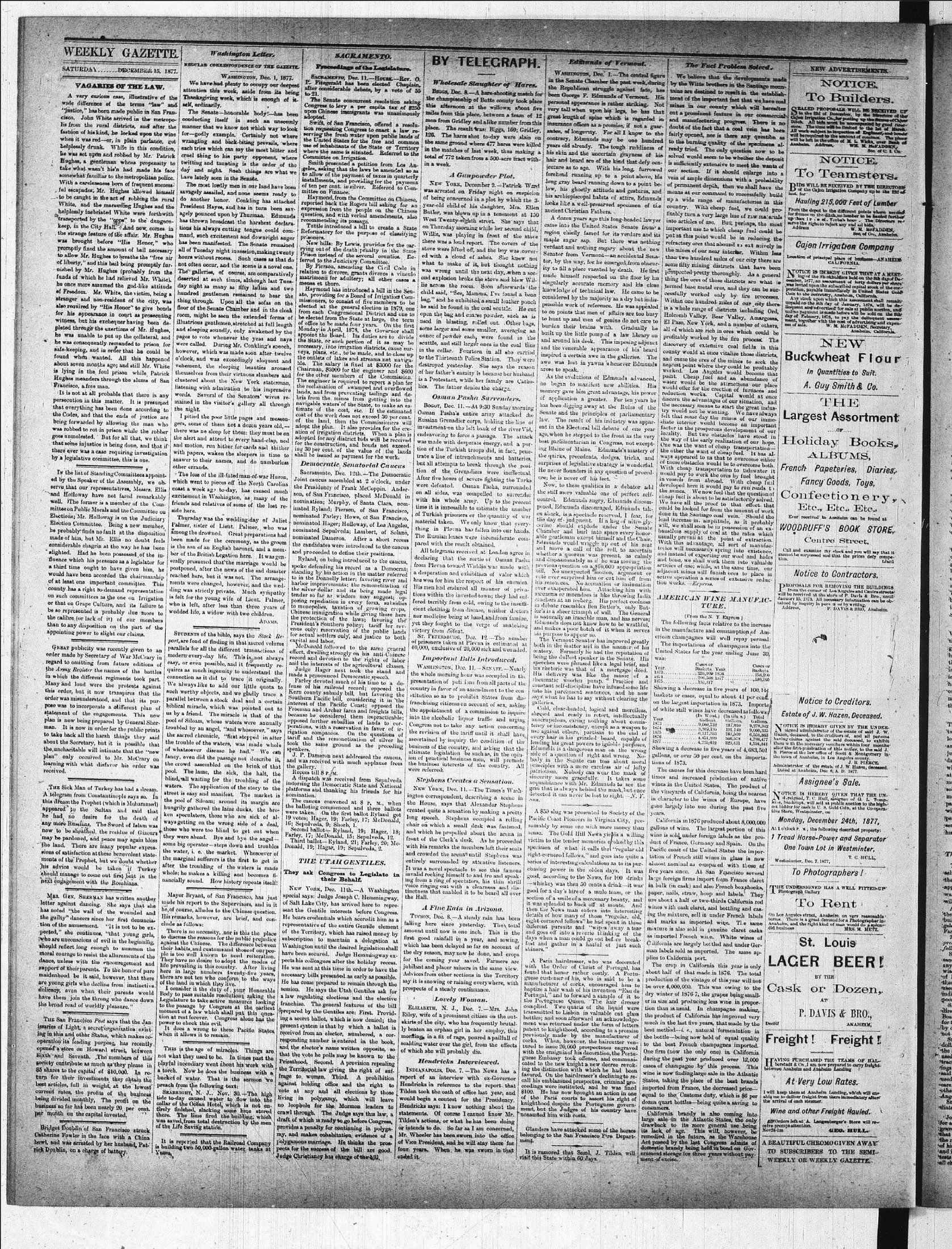
Searchable text
WEEKLY GAZETTE
SATURDAY...DECEMBER 15, 1877.
VAGARIES OF THE LAW.
A very curious case, illustrative of the wide difference of the terms "law" and "justice," has been made public in San Francisco. John White arrived in the metropolis from the rural districts, and after the fashion of his kind, he locked upon the wine when it was red—or, in plain parlance, got helplessly drunk. While in this condition, he was set upon and robbed by Mr. Patrick Hughes, a gentleman whose propensity to take what wasn't his'n had made his face somewhat familiar to the metropolitan police. With a carelessness born of frequent successful escapades, Mr. Hughes allowed himself to be caught in the act of robbing the rural White, and the marauding Hughes and the helplessly inebriated White were forthwith transported by the "ops" to the dungeon keep, in the City Hall. And now, comes in the strange feature of the affair. Mr. Hughes was brought before "His Honor," who promptly fixed the amount of bail necessary to allow Mr. Hughes to breathe the "free air of liberty," and this bail being promptly furnished by Mr. Hughes (probably from the funds of which he had relieved Mr. White), he once more assumed the god-like attitude of Freedom. Mr. White, the victim, being a stranger and non-resident of the city, was also required by "His Honor" to give bonds for his appearance in court as prosecuting witness, but his exchequer having been depleted through the exertions of Mr. Hughes, he was unable to put up the collateral, and he was consequently remanded to prison for safe-keeping, and in order that he could be found when wanted. All this happened about seven months ago; and still Mr. White is lying in the foul prison while Patrick Hughes meanders through the slums of San Francisco, a free man.
It is not at all probable that there is any persecution in this matter. It is presumed that everything has been done according to the Codes, and that the ends of justice are being forwarded by allowing the man who was robbed to rot in prison while the robber goes unmolested. But for all that, we think that some injustice is being done, and that if there ever was a case requiring investigation by a legislative committee, this is one.
Washington Letter.
REGULAR CORRESPONDENCE OF THE GAZETTE.
WASHINGTON, Dec. 1, 1877.
We have had plenty to occupy our deepest attention this week, aside from its being Thanksgiving week, which is enough of itself, ordinarily.
The Senate—honorable body!—has been conducting itself in such an unseemly manner that we know not which way to look for—godly example. Certainly not where wrangling and back-biting prevails, where each tries which can say the most bitter and cruel thing to his party opponent, where twitting and tanning is the order of the day and night. Such things are what we have lately seen in the Senate.
The most lonely men in our land have been savagely assailed, and none seems ready to do another honor. Conkling has attacked President Hayes, and has in turn been savagely pounced upon by Thurman. Edmunds has thrown broadcast the harshest declarations his always cutting tongue could command, such excitement and downright anger has been manifested. The Senate remained all of Tuesday night in secession, making twenty hours without recess. Such cases as that do not often occur, and the scene is a novel one. The galleries, of course, are comparatively deserted at such times, although last Tuesday night as many as fifty ladies and two hundred gentlemen remained to hear the thing through. Upon all the sofas on the floor of the Senate Chamber and in the cloak room, might be seen the extended forms of illustrious gentlemen, stretched at full length and sleeping soundly, only awakened by the pages to vote whenever the yeas and nays were called. During Mr. Conkling's speech, however, which was made soon after twelve o'clock, and was exceedingly eloquent and vehement, the sleeping beauties aroused themselves from their virtuous slumbers and clustered about the New York statesman, listening with admiration to his impressive words. Several of the Senators' wives remained in the visitor's gallery all through the night.
I pitied the poor little pages and messengers, some of them not a dozen years old,—there was no sleep for them: they must be on the alert and attend to every hand-clap, nod and motion, run hither for carls and thither with papers, waken the sleepers in time to answer to their names, and do numberless other things.
SACRIFICE.
Sacramento, Dec. 21.
The Senate concurred Congress to levy a fee upon Chinese immigrants adopted.
Swift, of San Francisco requesting Congress serving the fresh water of the United States for use of inhabitants of where the same is at Committee on Irrigation.
Smith presented a letter asking that they should allow of the payment installments, and provide ten per cent. in silicone mittee on Finance.
Haymond, from the reported back the Roosevelt expression from the question, and with vow recommending its part.
Tuttle introduced a Reformatory for the prisoners.
New bills: By Lewin trying out of the death penalty Prison instead of the referred to the Judiciary.
By Pierson, amend relation to divorce, give matrimonii for adulterate mena et thoro.
Haymond has introduced providing for a Be misitonser, to consist of elected at the general from each Congression be elected from the State office to be made for Monday in April, 1877 appoint the Board.
In the state, or such portions necessary into irrigation views, plans etc., to be be the outlets of lakes and able. The salary is five Chairman, $3000 for three for the other members.
The engineer is required the reclamation of swamp lands, and from prevent bris from the mines for navigable waters of the estimate of the cost, at least cost of the work does not of the land, then adopt the plan. It alsoitation of irrigation district adopted for any district for the construction, aming 30 per cent. of the shall be issued as paym
is lying in the foul prison while Patrick Hughes meanders through the slums of San Francisco, a free man.
It is not at all probable that there is any persecution in this matter. It is presumed that everything has been done according to the Codes, and that the ends of justice are being forwarded by allowing the man who was robbed to rot in prison while the robber goes unmolested. But for all that, we think that some injustice is being done, and that if there ever was a case requiring investigation by a legislative committee, this is one.
In the list of Standing Committees appointed by the Speaker of the Assembly, we observe that our representatives, Messrs. Ellis and Holloway have not fared remarkably well. The former is a member of the Committee on Public Morals and the Committee on Elections; Mr. Holloway is on the Judiciary Election Committee. Being a new member, he probably finds no fault at the disposition made of him, but Mr. Ellis no doubt feels considerable chagrin at the way he has been slighted. Had he been possessed, of the influence which his presence as a legislator for a third time ought to have given him, he would have been accorded the chairmanship of at least one important committee. This county has a right to demand representation on such committees as the one on Irrigation or that on Grape Culture, and its failure to be so represented is probably due more to the calibre (or lack of it) of our members than to any disposition on the part of the appointing power to alight our claims.
Great publicity was recently given to an order made by Secretary of War McCrary in regard to omitting from future editions of the Army Register the names of the battles in which the different regiments took part. Many and loud were the protests against this order, but it now transpires that the order was misunderstood, and that its purpose was to incorporate a different plan of statement of the engagements. This new plan is now prepared by General Sherman. It is now in order for the public prints to take back all the harsh things they said about the Secretary, but it is possible that the uncharitable will intimate that the "new plan" only occurred to Mr. McCrary on learning with what disfavor his order was received.
The Sick Man of Turkey has had a dream. A telegram from Constantinople says so. In this dream the Prophet (which is Mohammed) appeared to the Sultan and said that he had no desire for the death of any more Russians. The Sword of Islam was now to be sheathed, the residue of Giaours may be pardoned, and peace may again bless the land. There are many popular expressions of satisfaction at these benevolent statements of the Prophet, but we doubt whether his advice would be taken if Turkey should manage to come out first best in the next engagement with the Romans.
Students of the Bible, says the Stock Report, are fond of finding in that sacred volume parallels for all the different transactions of modern every-day life. This is not always easy, or even possible, and it frequently requires as much ingenuity to understand the connection as it did to trace it originally. We always like to add our little quota to such worthy objects, and we gladly trace a parallel between a stock deal and a certain biblical miracle, which was pointed out to us by a friend. The miracle is that of the pool of Siloam, whose waters were annually troubled by an angel, "and whosoever," says the sacred chronicle, "first stepped in after the trouble of the waters, was made whole of whatsoever disease he had." We can fancy, even did the passage not describe it, the crowd assembled on the brink of that pool. The lame, the sick, the halt, the blind, all waiting for the troubling of the waters. The application of the story to the street is easy and manifest. The market is the pool of Siloam; around its margin are hungrily gathered the lame ducks, the broken speculators, those who are sick of always getting on the wrong side of a deal, those who were too blind to get out when they were ahead. Bye and bye the angel—some big operator—steps down and troubles the water, i.e., the market. Whosoever of the marginal sufferers is the first to get in after the troubling of the waters is made whole; he makes a killing and becomes financially sound. How history repeats itself.
I pitied the poor little pages and messengers, some of them not a dozen years old,—there was no sleep for them: they must be on the alert and attend to every hand-clap, nod and motion, run hither for cards and thither with papers, waken the sleepers in time to answer to their names, and do numberless other errands.
The loss of the ill-fated man-of-war Huron, which went to pieces off the North Carolina coast a week ago to day, has caused much excitement in Washington, as many of the friends and relatives of some of the lost reside here.
Thursday was the wedding day of Juliet Palmer, sister of Lieut. Palmer, who was among the drowned. Great preparations had been made for the ceremony, as the groom is the son of an English baronet, and a member of the British Legation here. It was generally presumed that 'the marriage would be postponed, after the news of the sad disaster reached here, but it was not. The arrangements were changed, however, and the welding was strictly private. Much sympathy is felt for the young wife of Lieut. Palmer, who is left, after less than three years of wedded life, a widow with two children.
Adams.
Students of the Bible, says the Stock Report, are fond of finding in that sacred volume parallels for all the different transactions of modern every-day life. This is not always easy, or even possible, and it frequently requires as much ingenuity to understand the connection as it did to trace it originally. We always like to add our little quota to such worthy objects, and we gladly trace a parallel between a stock deal and a certain biblical miracle, which was pointed out to us by a friend. The miracle is that of the pool of Siloam, whose waters were annually troubled by an angel, "and whosoever," says the sacred chronicle, "first stepped in after the trouble of the waters, was made whole of whatsoever disease he had." We can fancy, even did the passage not describe it, the crowd assembled on the brink of that pool. The lame, the sick, the halt, the blind, all waiting for the troubling of the waters. The application of the story to the street is easy and manifest. The market is the pool of Siloam; around its margin are hungrily gathered the lame ducks, the broken speculators, those who are sick of always getting on the wrong side of a deal, those who were too blind to get out when they were ahead. Bye and bye the angel—some big operator—steps down and troubles the water, i.e., the market. Whosoever of the marginal sufferers is the first to get in after the troubling of the waters is made whole; he makes a killing and becomes financially sound. How history repeats itself.
Chairman, $8300 for this for other members; The engineer is required; reclamation of swamp lands, and from preventive bris from the mines for navigable waters of their timate of the cost; then adopt the plan. It alsoation of irrigation district adopted for any district; for the construction,and ing 30 per cent.of.the shall be issued as payment.
Democratic Senate
Sacramento, Dec. 12
Joint caucus assembled bythe Presidency of Frankson,sof San Francisco,the nomination;Murphy,counselined Ryland;Pierson,nominated Farley;Hownominated Hager;Hollownominated Sepulveda;Hownominated Dameron.Athe candidates were introducedand proceededtodefine.Ryland.onbeing introspoke defending his recordstandingbyhisactionintotheDonnollyletter.harbor improvements;thatthe silver dollar and its tenderso faras wisdomposing repudiation in evengto monopolies,taxationChinaimmigrationwhiletheprotectionofthel President's Southern politeenne only:reservationonlyforactual settlers only,a capitaland labor.
McDonald followedto effect,dwelling stronglyoncordanddevotiontothandtheinterestsoftheaJudge Hagernexttomadea pronounced Democrat.Farley devotedmuchoffenseofhisrailroadrecordsKerncountysubsidybill,SouthernPacificbill,counseinterestofthePacificCoFreemanandArcherfaresbecauseheconsideredtheopposedfurthersubsidiesopportunitieswithareservatioregistrationcompanies.Ontariffandtheremonetizetookthesamegroundspeakers.
J.P.Dameronnextaddandwasreceivedwithmutuethegallery.Recees till 8 P.M.
A dispatch was receivedindorsingtheDemocraticSplatformsandthankinghimnomination.
The caucus convenedattheballotingcommencedawere taken.Onthefirstb19votes;Hager,19;Farley16;Sepulveda,9;Shorb,1Second ballot—Ryland,Farley,17;McDonald,15;Third ballot—Ryland,21Donald,19;Hagar,19;Septhe UTAH GE
They ask Congresstotheir Beha
THE Sick Man of Turkey has had a dream. A telegram from Constantinople says so. In this dream the Prophet (which is Mohammed) appeared to the Sultan and said that he had no desire for the death of any more Russians. The Sword of Islam was now to be sheathed, the residue of Giaours may be pardoned, and peace may again bless the land. There are many popular expressions of satisfaction at these benevolent statements of the Prophet, but we doubt whether his advice would be taken if Turkey should manage to come out first best in the next engagement with the Rooshians.
MRS. GEN. SHERMAN has written another letter against dancing. She says that she has noted "the wail of the wounded and the guilty" dancers since her first denunciation of the amusement. "It is not to be expected," she continues, "that young girls, who are unconscious of evil in the beginning, should reflect long enough to summon the moral courage to resist the allurements of the dance, unless with the encouragement and support of their parents. To the honor of pure maidenhood be it said, however, that there are young girls who decline from instinctive delicacy, even when their parents would have them join the throng who dance down the broad road of worldly pleasure."
The San Francisco Post says that the Janissaries of Light, a secret organization existing in this and other States, which makes cooperation its leading purpose, has recently opened a store on Howard street, between Sixth and Seventh. The members of this society contribute as much as they please in $5 shares to the capital of $10,000. In return for their investments they obtain the best articles, full in weight, at the lowest current rates, the profits of the business being divided monthly. The profit on the business so far has been nearly 20 per cent. per month on the capital invested.
Bridget Doublin of San Francisco struck Catherine Fowler in the face with a China bowl, and was arrested by her husband, Patrick Doublin, on a charge of battery.
Mayor Bryant, of San Francisco, has just made his report to the Supervisors, and in it he, of course, alludes to the Chinese question. His remarks, however, are brief, and conclude as follows:
There is no necessity, nor is this the place to discuss the reasons for the public prejudice against the Chinese. The difference between their habits, customs and those of our people is too well known to need reiteration. They have no desire to adopt the modes of life prevailing in this country. After living here in large numbers twenty-five years, there are not ten who conform to the ways of the land in which they live.
I consider it the duty of your Honorable Body to pass suitable resolutions asking the Legislature to take active measures looking to the passage by Congress at the earliest moment of a law which shall put this question at rest forever. Congress alone has the power to check this evil.
It does a wrong to these Pacific States when it allows it to remain.
This is the age of miracles. Things are not what they used to be. In times past the playful incendiary went about his work with a torch. Now he does the business with a bucket of water. That is the sermon we preach from the following text:
SEABRIGHT, N. J., Nov. 30.—The high tide to-day caused water to flow into the collar of the Ocean Hotel, which is not entirely finished, slacking some lime stored there. The lime fired the building; which was saved from total destruction by the men of the Life Saving station.
It is reported that the Railroad Company is building two 50,000-gallon water tanks at Yuma.
New York, Dec. 11th.-special says: Judge Joseph Cohen of Salt Lake City, has arrived sent the Gentile interests He bears credentials which are representative of the entire city has been secured. Judge Batespects his colleagues after the He was sent at this time in one necessary bills presented as an He has come prepared to remit session. He says the Utah Law regulating elections and franchise. The general feature prepared by the Gentiles are ing a secret ballot, which is not present system is that by whom received from an elector, number responding number is entered and the elector's name written that the vote he polls may be Priesthood. Second. A provision Territorial law giving therfrage to women. Third. Against holding office and vote at any and all elections living in polygamy, which no loophole for the Mormon crawl through. The Judge said draft of which is ready to go be provides a penalty for continuing my, and makes cohabitation polygamous marriage. He thuspects for the success of the Judge Christiancy has charge
SACRAMENTO.
Proceedings of the Legislature.
SACRAMENTO, Dec. 11.—Hogan.—Rev. O. P. Fitzgerald has been elected Chaplain, after considerable debate, by a vote of 56 to 21.
The Senate concurrent resolution asking Congress to levy a per capita tax of $250 upon Chinese immigrants was unanimously adopted.
Swift, of San Francisco, offered a resolution requesting Congress to enact a law reserving the fresh water upon public lands of the United States for the free and common use of inhabitants of the State or Territory where the same is situated. Referred to the Committee on Irrigation.
Smith presented a petition from Los Angeles, asking that the laws be amended so as to allow of the payment of taxes in quarterly installments, and providing for the payment of ten per cent. in silver. Referred to Committee on Finance.
Haymond, from the Committee on Chinese, reported back the Rogers bill asking for an expression from the people on the Chinese question, and with verbal amendments, also recommending its passage.
Tuttle introduced a bill to create a State Reformatory for the purpose of classifying prisoners.
New bills: By Lewis, provides for the carrying out of the death penalty in the State Prison instead of the several counties. Referred to the Judiciary Committee.
By Pierson, amending the Civil Code in relation to divorce, grants divorce a vinculo matrimonii for adultery; all other cases a mensa et thoro.
Haymond has introduced a bill in the Senate, providing for a Board of Irrigation Commissioners, to consist of five members to be elected at the general election in 1879, one from each Congressional District and one to be elected from the State at large, the term of office to be made four years. On the first Monday in April, 1878, the Governor shall appoint the Board. Its duties are to divide the state, or such portion of it as may be necessary, into irrigation districts, cause surveys, plans, etc., to be made, and to close up the outlets of lakes and streams not navigable. The salary is fixed at $3000 for the Chairman, $3000 for the engineer and $600 for the other members of the Commission. The engineer is required to report a plan for the reclamation of swamped and overflowed lands, and from preventing tailings and debris from the mines from getting into the navigable waters of the State, to make an estimate of the cost, etc. If the estimated cost of the work does not exceed 30 per cent. of the land, then the Commissioners will adopt the plan. It also provides for the creation of irrigation districts. When a plan is adopted for any district bids will be received for construction, and bonds not exceeding 30 per cent. of the value of the lands shall be issued as payment for the work.
Democratic Senatorial Caucus
BY TELEGRAPH.
Wholesale Slaughter of Hares.
Broos, Dec. 8.—A hare-shooting match for the championship of Butte county took place this afternoon at the willows, about five miles from this place, between a team of 12 men from Gridley and alike number from this place. The result was: Biggs, 169; Gridley, 123. The hares shot to-day were alain on the same ground where 477 hares were killed in the matches of last week, thus making a total of 772 taken from a 500-acre tract within a week.
A Gunpowder Plot.
New York, December 9.—Patrick Ward was arrested on Friday night on suspicion of being concerned in a plot by which the 3-year-old child of his daughter, Mrs. Ellen Butler, was blown up in a tenement at 150 West Twenty-eighth street. She says that on Thursday morning while her second child, Willie, was playing in front of the stove there was a loud report. The covers of the stove were lifted off, and the boy was covered with a cloud of ashes. She knew not what to make of it, but thought nothing was wrong until the next day, when a second explosion broke the stove and blew Willie across the room. Soon afterwards the child said, "See Mamma I've found a bean bag," and he exhibited a small leather pouch he said he found in the coal scuttle. He cut open the bag and coarse powder, such as is used in blasting, rolled out. Other bags, some larger and some smaller, averaging an ounce of powder each, were found in the scuttle, and still larger ones in the coal bins in the cellar. Fourteen in all she carried to the Thirteenth Police Station. They were destroyed yesterday. She says the reason of her father's enmity is because her husband is a Protestant, while her family are Catholics. The father denies the charge.
Osman Pasha Surrenders.
Bogot, Dec. 11.—At 9:30 Sunday morning Osman Pasha's entire army attacked the Russian Grenadier corps, holding the line of investment on the left bank of the river Vid, endeavoring to force a passage. The attack was made with desperate energy, and a portion of the Turkish troops did, in fact, penetrate a line of intrenchments and batteries, but all attempts to break through the post.
Edmunds of Vermont.
Washington, Dec. 1.—The central figure in the Senate Chamber the past week, during the Republican struggle against fate, has been George F. Edmunds of Vermont. His personal appearance is rather striking. Not very tall when upon his legs, he has that great length of spine which is regarded in insurance offices as a promise, if not a guarantee, of longevity. For all I know to the contrary, Edmunds may be one hundred years old already. The tough rudness of his skin and the uncertain grayness of his hair and beard are of the kind that defy conjecture as to age. With his long furrowed forehead running up to a point above, his long gray beard running down to a point below, his ghostly attitude and gestures, and his archiepiscopal habits of attire, Edmunds looks like a well-preserved specimen of the ancient Christian Fathers.
A dozen years ago this long-headed lawyer came into the United States Senate from a region chiefly famed for its verdure and its maple sugar sap. But there was nothing verdant and nothing sugary about the new Senator from Vermont—an accidental Senator, by the way, for he emerged from obscurity to fill a place vacated by death. He first made himself respected on the floor by his singularly accurate memory and his close knowledge of technical law. He came to be considered by the majority as a dry but indispensible work of reference. He was appealed to on points that men of affairs are too busy to hunt up and men of genius do not care to burden their brains with. Gradually he built up the little pump of a law library on and around his desk. This imposing adjunct and the venerable appearance of his beard inspired a certain awe in the galleries. The awe was lost in yawns whenever Edmunds arrose to speak.
As the evolutions of Edmunds advanced, no began to manifest new abilities. His memory gave him great advantage, his power of application a greater. For ten years he has been digging away at the Rules of the Senate and the principles of parliamentary law. The result of his industry was apparent in the Electoral bill debate of one year ago, when he stepped to the front as the very best parliamentarian in Congress, not excepting Blaine of Maine. Edmunds's mastery of the quirks, precedents, dodges, tricks, and surprises of legislative strategy is wonderful.
Democratic Senatorial Caucus
Sacramento, Dec. 12th.—The Democratic Joint caucus assembled at 2 o'clock, under the Presidency of Frank McCoppin. Anderson, of San Francisco, placed McDonald in nomination; Murphy, of Santa Clara, nominated Ryland; Pierson, of San Francisco, nominated Farley; Howe, of San Francisco, nominated Hager; Holloway, of Los Angeles, nominated Sepulveda; Lambert, of Solano, nominated Dameron. After a short recess the candidates were introduced to the caucus and proceeded to define their positions.
Ryland, on being introduced to the caucus, spoke defending his record as a Democrat; standing by his action in the matter referred to in the Donnolly letter; favoring river and harbor improvements; the remonetization of the silver dollar and its being made legal tender so far as wisdom may suggest; opposing repudiation in every form, subsidies to monopolies, taxation of growing crops, Chinese immigration while giving those here the protection of the laws; favoring the President's Southern policy; tariff for revenue only: reservation of the public lands for actual settlers only, and justice to both capital and labor.
McDonald followed to the same general effect, dwelling strongly on his anti-Cinese record and devotion to the rights of labor and the interests of the agricultural classes.
Judge Hager next took the stand and made a pronounced Democratic speech.
Farley devoted much of his time to a defense of his railroad record; opposed the Kern county subsidy bill, but favoring the Southern Pacific bill, considering it in the interest of the Pacific Coast; opposed the Freeman and Archer fares and freights bills, because he considered them impracticable; opposed further subsidies of lands to corporations, with a reservation in favor of irrigation companies. On the questions of tariff and the remonetization of silver he took the same ground as the preceding speakers.
J. P. Dameron next addressed the caucus, and was received with much applause from the gallery.
Receives till 8 p.m.
A dispatch was received from Sepulveda indorsing the Democratic State and National platforms and thanking his friends for his nomination.
The caucus convened at 8 p.m., when the balloting commenced and three ballots were taken. On the first ballot Ryland got 19 votes; Hager, 19; Farley, 17; McDonald, 16; Sepulveda, 9; Shorb, 1.
Second ballot—Ryland, 19; Hager, 18; Farley, 17; McDonald, 15; Sepulveda, 12.
Third ballot—Ryland, 21; Farley, 20; McDonald, 19; Hagar, 19; Sepulveda, 2.
THE UTAH GENTILES.
They ask Congress to Legislate in their Behalf.
Osman Pasha Surrenders.
Bogot, Dec. 11.—At 9:30 Sunday morning Osman Pasha's entire army attacked the Russian Grenadier corps, holding the line of investment on the left bank of the river Vid, endeavoring to force a passage. The attack was made with desperate energy, and a portion of the Turkish troops did, in fact, penetrate a line of intrenchments and batteries, but all attempts to break through the position of the Grenadiers were ineffectual. After five hours of severe fighting the Turks were defeated. Osman Pasha, surrounded on all sides, was compelled to surrender with his whole army. Up to the present time it is impossible to estimate the number of Turkish prisoners or the quantity of war material taken. We only know that everything in Plevna has fallen into our hands. The Russian losses were inconsiderate compared with the result obtained.
All telegrams received at London agree in declaring that the sortie of Osman Pasha from Plevna toward Widdin was made with a desperation and exhibition of valor which has won for him the respect of his enemies. His men had endured all manner of privations within the invested town; they had suffered terribly from cold, owing to the insufficient clothing from disease, neither doctors nor medicine being at hand, and from famine, yet they fought to the verge of snatching victory from defeat.
St. Petersburg, Dec. 12.—The number of prisoners taken at Plevna is estimated at 40,000, exclusive of 20,000 sick and wounded.
Important Bulls Introduced.
Washington, Dec. 11.—Nearly the whole morning hour was occupied in the presentation of petitions from all parts of the country in favor of an amendment to the constitution so as to prohibit States from disfranchising citizens on account of sex, asking the appointment of a commission to inquire into the alcoholic liquor traffic and urging Congress not to take any action concerning the revision of the tariff until it shall have ascertained by inquiry the condition of the business of the country, and asking that the ultimate legislation be such as, in the opinion of practical business men, will promote the business interests of the country. All were referred.
Stephens Creates a Sensation.
New York, Dec. 11.—The Times's Washington correspondent, describing a scene in the House, says that Alexander Stephens created quite a sensation by making a pretty long speech. Stephens occupied a rolling chair on which a small desk was fastened, and which he propelled about the arena in front of the Clerk's desk. As he proceeded with his remarks the members left their seats and crowded the arena until Stephens was entirely surrounded by attentive listeners. It was a novel spectacle to see this famous invalid rocking himself to and fro and speaking from a ring of spectators, his thin shrimp
As the evolutions of Edmunds advanced, no began to manifest new abilities. His memory gave him great advantage, his power of application a greater. For ten years he has been digging away at the Rules of the Senate and the principles of parliamentary law. The result of his industry was apparent in the Electoral bill debate of one year ago, when he stepped to the front as the very best parlementarian in Congress, not excepting Blaine of Maine. Edmunds's mastery of the quirks, precedents, dodges, tricks, and surprises of legislative strategy is wonderful. He never flounders in any question of procedure; he is never off his feet.
Now, to these qualities in a debator add still more valuable one of perfect self-control. Edmunds angry, Edmunds discomposed, Edmunds discouraged, Edmunds taken aback, is a spectacle reserved, I fear, for the day of judgment. If a key of nitro-glycerine should explode under the Senate Chamber and hurt into space every honorable gentleman except himself and the Chair. Edmunds would wriggle up out of his seat and move a call of the roll, to ascertain whether a quorum was present, as calmly and dispassionately as if he was moving the previous question on a $10,000 appropriation bill. No unexpected motion, argument or vote ever surprised him or cut him off from his resources. No accusation or insinuation ever exasperated him. Attaching him with sarcasm or nuance does like throwing India crackers at an iceberg. His perfect coolness in debate resembles Ben Butter's only Butler's is a sheer triumph of will. The General is naturally an irascible man, and has nerves; Edmunds does not know how to be wrathful, and makes a poor bobch of it when it serves his purpose to appear so.
The Vermont Senator has improved greatly both in the matter and in the manner of his oratory. Formerly he had the reputation of being the dullest speaker in the Senate. His speeches were phrased like a legal brief, and his rhetoric was that of a mortgage deed. His delivery was like the music of a rheumatic wooden pump. Practice and constant self-discipline have infused some life into his parchment sentences, and he now says what he has to say without clearing the galleries.
Cold, clear-headed, logical and merciless, shrewd and ready in retort, intellectually unscrupulous, caring nothing about consistency or inconsistency, except as a weapon to use against others, partisan to the end of every hair in his grizzled beard, capable of lending his great powers to ignitable purposes. Edmunds is a dangerous man on the wrong side of a question of right and wrong. Nobody in the Senate can toss about moral principles with a more careless air of lofty patriotism. Nobody can wear the mask of sincerity more gracefully. It takes some acquaintance with Mr. Edmunds to see the grim that is always behind the mask but once detected it can never be lost to sight.
A $50 slug was presented to Society of the Pacific Coast Pioneers in Virginia City, presumably by some one with more money than sense. The Gold Hill News yields a willing victim to the tender memories evoked by this specimen of what it calls "regular old sight-corned fellows," and goes into quite a series of interesting calculations as to its purchasing power in the olden days. It was good according to the News, for 100 drinks whose value is wine is soda duct of P.P.Cationation of almost no five years large foreseeable...
THE UTAH GENTILES.
They ask Congress to Legislate in their Behalf.
New York, Dec. 11th.—A Washington special says: Judge Joseph C. Hemmingway, of Salt Lake City, has arrived here to represent the Gentile interests before Congress. He bears credentials which accredit him as a representative of the entire Gentile element of the Territory, which has raised money by subscription to maintain a delegation at Washington until the desired legislation shall have been secured. Judge Hemmingway expects his colleagues after the holiday recess. He was sent at this time in order to have the necessary bills presented as early as possible. He has come prepared to remain through the session. He says the Utah Gentiles ask for a law regulating elections and the elective franchise. The general features of the bill prepared by the Gentiles are: First. Providing a secret ballot, which is now denied; the present system is that by which a ballot is received from an elector, numbered, a corresponding number is entered in the book, and the elector's name written opposite, so that the vote he polls may be known to the Priesthood. Second. A provision repealing the Territorial law giving the right of suffrage to women. Third. A prohibition against holding office and the right to vote at any and all elections by those living in polygamy, which will leave no loophole for the Mormon leaders to crawl through. The Judge says this law, a draft of which is ready to go before Congress, provides a penalty for continuing in polygamy, and makes cohabitation evidence of a polygamous marriage. He thinks the prospects for the success of the bill are good. Judge Christiany has charge of the bill.
NEW YORK, Dec. 11.—The Times’s Washington correspondent, describing a scene in the House, says that Alexander Stephens created quite a sensation by making a pretty long speech. Stephens occupied a rolling chair on which a small desk was fastened, and which he propelled about the arena in front of the Clerk’s desk. As he proceeded with his remarks the members left their seats and crowded the arena until Stephens was entirely surrounded by attentive listeners. It was a novel spectacle to see this famous invalid rocking himself to and fro and speaking from a ring of spectators, his thin shrill voice ringing out with a clearness and distinctness that enabled it to be heard all over the Hall.
A Fine Rain in Arizona.
TUCSON, Dec. 8.—A steady rain has been falling here since yesterday. The total amount until now is one inch. This is the first good rainfall in a year, and sowing, which has been delayed so far on account of the dry season, may now be done, and crops for the coming year saved. Farmers are jubilant and placer miners in the same view. Advices from other sections in the Territory say it is snowing or raining everywhere, with prospects of a steady continuance.
Lovely Woman.
ELIZABETH, N. J., Dec. 7.—Mrs. John Riley, wife of a prominent citizen on the outskirts of the city, who has frequently brutally beaten an orphan girl in her employ, this morning in a fit of rage, poured a pailfull of scalding water over the girl, from the effects of which she will probably die.
Hendricks Interviewed.
INDIANAPOLIS, Dec. 7.—The News has a report of an interview with ex-Governor Hendricks in reference to the report that Tilden took the oath of office last year, and would begin a contest for the Presidency. Hendricks says: I know nothing about the statements. Of course I cannot know Mr. Tilden’s actions, or what he has been doing or intends to do. So far as I am concerned, Mr. Wheeler has been sworn into the office of Vice President, and he will stay there for four years. When he was sworn in that ended it.
A $50 slug was presented to Society of the Pacific Coast Pioneers in Virginia City, presumably by some one with more money than sense. The Gold Hill News yields a willing victim to the tender memories evoked by this specimen of what it calls the “regular old eight-cornered fellows,” and goes into quite a series of interesting calculations as to its purchasing power in the olden days. It was good, according to the News, for 100 drinks—whiskey was then 50 cents a drink—it was good for a day’s hire of a mule team, or the section of a smile of a mercenary beauty, and it was splendid to buck off at monte. And then the News man enters into interesting details of how many of those “regular, old, eight-cornered fellows” he had spent in those different pursuits and “wipes away a tear and goes off into a reverie thinking of the days when a man could go out before breakfast and gather in a hatful of just such shiners.”
A Paris hairdresser, who was decorated with the Order of Christ of Portugal, has found that honor rather costly. A Portuguese customer of his, who is said to be a manufacturer of corks, encouraged him to baptize a hair wash of his invention “Eau de Portugal,” and to forward a sample of it to the Portuguese Queen. The hair dresser complied. Two quartes of the liquid were transmitted to Lisbon in valuable cut glass bottles; and soon afterward an acknowledgment was returned under the form of letters patent to knighthood, according to a promise previously made by the manufacturer of corks. When, however, the hairstutter ventured to issue 20,000 prospectuses engraved with the ensignia of his decoration, the Portuguese Embassy took offense, and communicated to the new knight a new decree revoking the distinction with which he had been favored. On the hairdresser’s declining to recall his emblazoned prespectus, criminal proceedings were instituted, and he was fined $100. He has now brought an action in one of the Paris courts to assert his right of knighthood despite the Portuguese government, but the Judges of his country have nonsuited him with costs.
Glanders have attacked some of the horses belonging to the San Francisco Fire Department.
It is rumored that Saml J. Tilden will visit this State within 60 days.
California gallons of wine is sold in product of F.P.C.C.C.C.C.C.C.C.C.C.C.C.C.C.C.C.C.C.C.C.C.C.C.C.C.C.C.C.C.C.C.C.C.C.C.C.C.C.C.C.C.C.C.C.C.C.C.C.C.C.C.C.C.C.C.C.C.C.C.C.C.C.C.C.C.C.C.C.C.
California gallons of wine is sold in product of F.P.C.C.C.C.C.C.C.C.C.C.C.C.С.С.С.С.С.С.С.С.С.С.С.С.С.С.С.С.С.С.С.С.С.С.С.С.С.С.С.С.С.С.С.С.С.С.С.С.С.С.С.С С С С С С С С С С С С С С С С С С С С С С С С С С С С С С С С С С С С С С С С С С С С С С С С ССССССССССССССССССССССССССССССССССССССССССССССССССССССССССССССССССССССССССССССССССССССССССССССССССССССССССССССССССССССССССССССС
California gallons of wine is sold in product of F.P.C.C.C.S.S.S.S.S.S.S.S.S.S.S.S.S.S.S.S.S.S.S.S.S.S.S.S.S.S.S.S.S.S.S.S.S.S.S.S.S.S.S.S.S.S.S.S.S.S.S.S.S.S.S.S.S.S.S.S.S.S.S.S.S.S.S.S.S.$$$$$$$$$$$$$$$$$$$$$$$$$$$$$$$$$$$$$$$$$$$$$$$$$$$$$$$$$$$$$$$$$$$$$$$$$$$$$$$$$$$$$$$$$$$$$$$$$$$$$$$$$$$$$$$$$$$$$$$$$$$$$$$$$$$$$$$$$$$$$$$
California gallons of wine is sold in product of F.P.P.P.P.P.P.P.P.P.P.P.P.P.P.P.P.P.P.P.P.P.P.P.P.P.P.P.P.P.P.P.P.P.P.P.P.P.P.P.P.P.P.P.P.P.P.P.P.$$
The Fuel Problem Selected.
We believe that the developments made by the Witte brothers in the Santiago mountains are destined to result in the establishment of the important fact that we have coal mines in our county which will hereafter cut a prominent feature in our commercial and manufacturing progress. There is no doubt of the fact that a coal vein has been fairly opened, nor is there any question as to the burning quality of the specimens already tried. The only question now to be solved would seem to be whether the deposit is sufficiently extensive to meet the wants of our section. If it should enlarge into a vein of ample dimensions with a probability of permanent depth, then we shall have the means at our command to successfully build up a wide range of manufactures in this country. With cheap fuel, we could profitably turn a very large line of raw materials into articles of use. But perhaps, the most important use to which cheap fuel could be put at this point would be in reducing the refractory ores that abound so extensively in the mines of our near interior. Within less than two hundred miles of our city there are some fifty mining districts that have been prospected pretty thoroughly. As a general thing the ores of these districts are what termed base metal ores, and they can be successfully worked only by fire processes. Within one hundred miles of our city there is a whole range of districts including Ord, Holcomb Valley, Bear Valley, Amargossa, El Paso, New York, and a number of others, all of which are rich in ores which could be profitably worked by the fire process. The discovery of extensive coal fields in this county would at once vitalize those districts, and cause the ores of the mines to seek the nearest point where they could be profitably worked. Los Angeles would become that point. Cheap fuel and an abundance of water would be the attractions our place would offer for the erection of furnaces and reduction works. Capital would at once discern the advantages of our situation, and the necessary means to start the great industry would not be wanting. We have always felt that some day the mines of our immediate interior would become an important factor in the prosperous development of our locality. But two obstacles have stood in the way of the early realization of our hope. One was the want of cheap transportation—the other the want of cheap fuel. It has always appeared to us that to overcome either of these obstacles would be to overcome both...
AMERICAN WINE MANUFACTURE.
[From the N. Y. Express]
The following facts relative to the increase in the manufacture and consumption of American champagnes will well repay perusal:
The importations of champagnes into the United States for the year ending June 30 was:
| Cases or Year | Baskets | Year | Baskets |
| :--- | :--- | :--- | :--- |
| 1873 | 236,999 | 1876 | 158,000 |
| 1874 | 200,598 | 1877 | 158,705 |
| 1875 | 133,317 | | |
Showing a decrease in five years of 100,144 baskets or cases, equal to about 41 per cent on the largest importation in 1873. Imports of white still wines have decreased as follows:
| (In Wast.) | (In Gla. s.) | Total |
| :--- | :--- | :--- |
| 1873 | 9,600,732 | 217,919 | 9,278,342 |
| 1874 | 8,294,135 | 191,140 | 9,000,335 |
| 1875 | 6,317,833 | 241,330 | 6,558,863 |
| 1876 | 4,421,899 | 306,578 | 4,708,477 |
| 1877 | 4,258,419 | 329,431 | 4,594,841 |
Showing a decrease in five years of 4,683,501 gallons, or over 50 per cent, on the importations of 1873.
The causes for this decrease have been hard times and increased production of native wines in the United States. The product of the vineyards of California, being the nearest character to the wines of Europe, have gone largely into use during the past five years.
California in 1876 produced about 8,000,000 gallons of wine. The largest portion of this wine is sold under foreign labels as the product of France, Germany and Spain. On the Pacific coast of the United States the importation of French still wines in glass is now almost nominal as compared with those of five years since. At San Francisco several large foreign firms import from France claret work. Los Angeles would be that point. Cheap fuel and an abundance of water would be the attractions our place would offer for the creation of furnaces and reduction works. Capital would at once discern the advantages of our situation, and the necessary means to start the great industry would not be wanting. We have always felt that some day the mines of our immediate interior would become an important factor in the prosperous development of our locality. But two obstacles have stood in the way of the early realization of our hope. One was the want of cheap transportation—the other the want of cheap fuel. It has always appeared to us that to overcome either of these obstacles would be to overcome both. With cheap transportation to tidewater it would pay to work the ores by fuel brought in vessels from abroad. With cheap fuel developed here it would pay to run roads to the mines. We now feel that the question of cheap fuel is about to be satisfactorily solved. We have all the proof to that effect that could be looked for from the amount of work done in the Santiago coal vein. Should the lead increase in amplitude, as it probably will, we shall soon be in possession of an exhaustless supply of coal at the rates which usually prevail at the point of extraction. With this advantage, all sort of manufactures will necessarily spring into existence, and instead of exporting our wool and hides and bone, we shall work them into valuable articles of use; while, at the same time, our adjacent mines will funnish ores to place in active operation a series of extensive reduction works.
Call and examine my stock and you will say that it cannot be surpassed and that the prices defy competition.
Notice to Contractors.
PROPOSALS FOR REMOVING THE BUILDINGS from the corner of Los Angeles and Centre streets will be received at the store of P. Davis & Bro., until January 16, 1783. All necessary information can be obtained by inquiry in person or by writing.
Address: P. DAVIS & BRO., Anaheim.
Notice to Creditors.
Estate of J. W. Hazen, Deceased.
NOTICE IS HEREBY GIVEN BY THE UNDER-Signed administrator of the estate of said J. W. Hazen, deceased, to the creditors of, and all persons having claims against the said deceased, to exhibit them with the necessary vouchers within four months after the first publication of this notice, to the said J. B. Pierce at the law office of Scott & Montgomery in the town of Anaheim, in Los Angeles county.
J. B. PIERCE Administrator of the estate of J. W. Hazen, deceased.
Dated at Anaheim, Dec. 6, A.D. 1877.
Assignee's Sale.
NOTICE IS HEREBY GIVEN THAT THE UNDER-Signed administrator of G. L. Tempkin, bankrupt, will sell at public auction to the highest bidder for cash in U.S. Gold Coin, at the Co-operative Store, Westminster, on Monday, December 24th, 1877.
At no clock p.m., the following described property:
1 Tread Horse-Power and Separator One Town Lot in Westminter,
Westminster, Dec. 7, 1877,
To Photographers I
California in 1876 produced about 8,000,000 gallons of wine. The largest portion of this wine is sold under foreign labels as the product of France, Germany and Spain. On the Pacific coast of the United States the importation of French still wines in glass is now almost nominal as compared with those of five years since. At San Francisco several large foreign firms import from France claret in bulk (in cask) and also French box shoaks, paper, nails, straw, hoop and labels. They use about a half or two-thirds California red wines with cask claret, and bottling and casing the mixture, sell it under French labels and marks as imported wine. The same mixture is also sold in genuine claret casks as imported French wine. White wines of California are largely bottled and under German labels sold as imported. The same applies to California port.
The crop in California this year is only about half of that made in 1876. The total production of the vintage of this year will not be over 4,000,000. This was owing to the dry winter of 1876-7, the grapes being smaller in size and producing less wine in proportion than usual. In champagne making, the product of California has improved very much in the last five years, that made by the best method—i.e., natural fermentation in the bottle—being now held of equal quality to the best French champagnes imported. One firm (now the only one) in California during the past year produced over 12,000 cases of champagne by this process. This wine is now finding large sale in the Atlantic States, taking the place of the best brands imported from France, the decreased price—equal to the Customs duty, which is $6 per dozen quart bottles—being quite a saving to consumers.
California brandy is also coming into large sale in the Atlantic States, the only drawback to its more general use being its lack of age. This will, however, be remedied in the future, as the Warehouse Act passed by the last Congress admits of domestic brandy being held in bond on Government storage for three years without payment of excise.
NOTICE IS HEREBY GIVEN THAT THE UNDERSIGNED HAS A WELL FITTED UP PHOTOGRAPH GALLERY
To Photographers!
THE UNDERSIGNED HAS A WELL FITTED UP PHOTOGRAPH GALLERY
To Rent
On Los Angeles street, Anaheim, on very reasonable terms. There is a great demand for a Photographer in Anaheim, and the right kind of man would do a splendid business.
St. Louis
LACER BEER!
BY THE
Cask or Dozen,
AT
P. DAVIS & BRO.
Dec51F
ANAHEIM,
Freight! Freight!
HAVING PURCHASED THE TEAMS OF HALBERDT & CO., I am now prepared to carry freight between Anaheim and Anaheim Landing
At Very Low Rates.
I will keep them at Anaheim Landing, which will enable me to deliver freight from there immediately after the arrival of each steamer.
Wine and other Freight Haulled.
EXOrders left at A. Langemberger's Store will receive prompt attention.
Nov24-1m
GEO. HULL.
A BEAUTIFUL CHROMO GIVEN AWAY TO SUBSCRIBERS TO THE SEMI-WEEKLY OR WEEKLY GAZETTE.