anaheim-gazette 1877-12-08
Scanned page
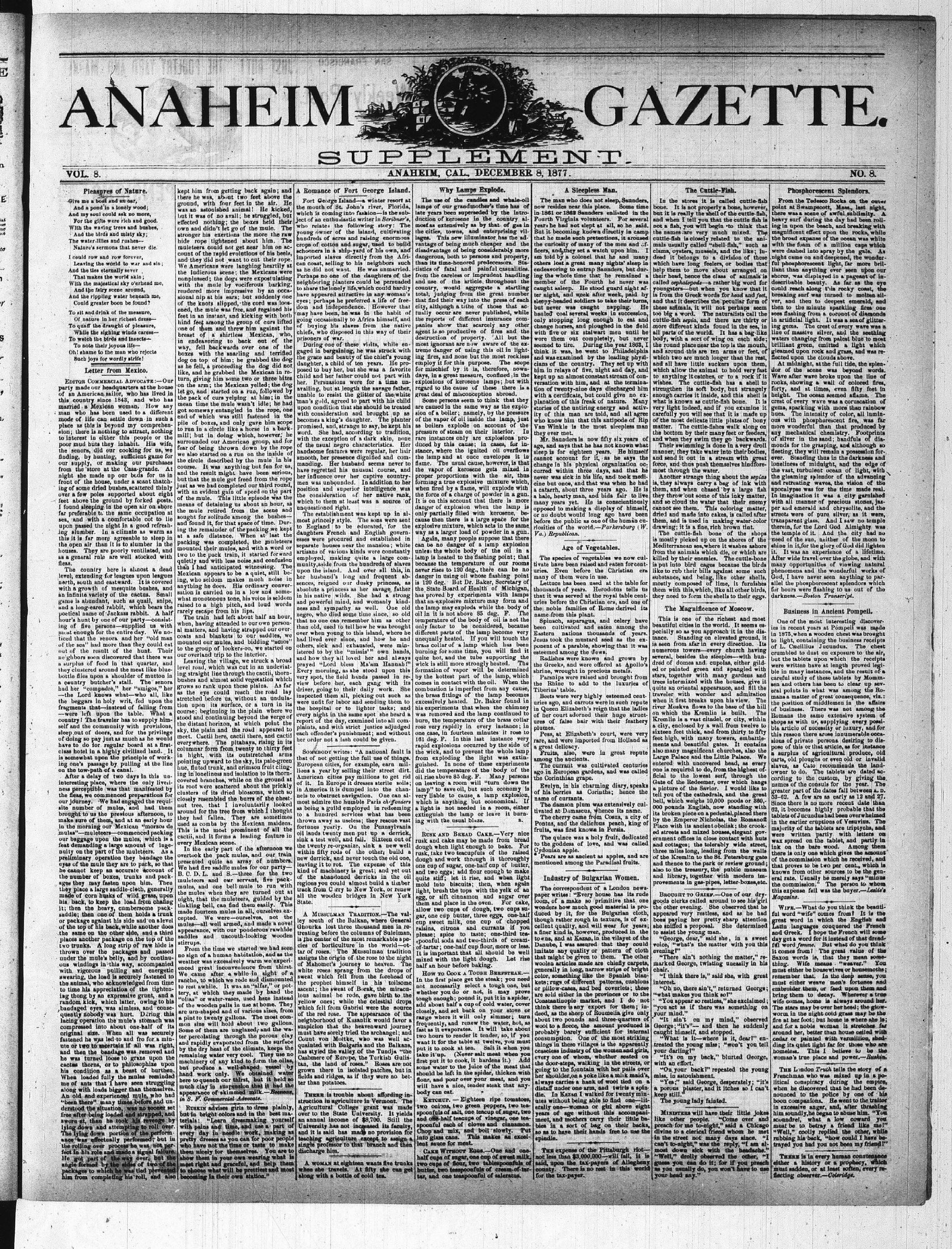
Searchable text
ANAHEIM
VOL. 8.
Pleasures of Nature.
Give me a boat and an ear,
And a pond in a lonely wood;
And my soul could ask no more,
For the gifts were rich and good.
With the waving trees and bushes,
And the birds and misty sky;
The water-lilies and rushes—
Nature's sermons that never die.
I could row and row forever,
Leaving the world to war and sin;
And the ties eternally sever
That makes the world akin;
With the majestical sky o'erhead me,
And the fairy scene around,
And the rippling water beneath me,
Could greater boon be found?
To sit and drink of the measure,
Of nature in her richest dress—
To quaff the draught of pleasure,
While the alghing winds caress—
To watch the birds and insects—
To note their joyous life—
Oh! shame to the man who rejects
Such joys for wordly strife!
Letter from Mexico.
EDITOR COMMERCIAL ADVOCATE:—Our party made our headquarters at the house of an American sailor, who has lived in this country since 1848, and who has married a Mexican woman. How any man who has been used to a different mode of life can settle down in such a place as this is beyond my comprehension; there is nothing to attract, nothing to interest in either this people or the poor mud huts they inhabit. His wife, the senors, did our cooking for us, we finding, by hunting, sufficient game for our supply, or making our purchases kept him from getting back again; and there he was, about two feet above the ground, with four feet in the air. He was an astonished animal! He kicked, but it was of no avail; he struggled, but effected nothing; the boxes held their own and didn't let go of the mule. The stronger his exertions the more the raw hide rope tightened about him. The multeers could not get near him on account of the rapid evolutions of his heels, and they did not want to cut their rope. We Americans were laughing heartily at the ludicrous scene; the Mexicans were nonplussed; the dogs were expostulating with the mule by vociferous barking, rendered more impressive by an occasional nip at his ears; but suddenly one of the knots slipped, the cord was loosened, the mule was free, and regained his feet in an instant, and kicking with both hind feet among the group of curs lifted one of them and threw him against the breast of a shirtless Mexican, who, in endeavoring to back out of the way, fell backwards over one of the boxes with the snarling and terrified dog on top of him; he grabbed the dog as he fell, a proceeding the dog did not like, and he grabbed the Mexican in return, giving him some two or three bites on the arm; the Mexican yelled; the dog let go, and started on a run, followed by the pack of curs yelping at him; in the mean time the mule wasn't idle; he had got somewhat entangled in the rope, one end of which was still fastened in the pile of boxes, and only gave him scope to run in a circle like a horse in a bark-mill; but in doing which, however, he surrounded our American group, and for fear of being thrown down by the rope we also started on a run on the inside of the circle described by the mule in his A Romance of Fort George Island
the mouth of St. John which is coming into object of an enthusiastic who relates the follo young owner of the hundreds of acres and crops of cotton and schooners in a ship-y imported slaves dire can coast, selling to as he did not want. Perhaps no one of these neighboring planters to share the lonely life have appeared attractive eyes; perhaps he prefers dom and independen may have been, he was going occasionally too of buying his slave chiefs, who disposed prisoners of war.
During one of these gaged in bargaining, the grace and beauty daughter, a child of supposed to buy her, but child and her father her. Persuasions we availing, but at length unable to resist the man's gold, agreed to upon condition that she with consideration becomes a king's daunt promised, and, strange word. She had, acco with the exception of of the usual negro c handsome features we smooth, her presence manding. Her husband
EDITOR COMMERCIAL ADVOCATE:—Our party made our headquarters at the house of an American sailor, who has lived in this country since 1843, and who has married a Mexican woman. How any man who has been used to a different mode of life can settle down in such a place as this is beyond my comprehension; there is nothing to attract, nothing to interest in either this people or the poor mud huts they inhabit. His wife, the senora, did our cooking for us, we finding, by hunting, sufficient game for our supply, or making our purchases from the store at the Casa-grande. At night she made up our beds for us in front of the house, under a scant thatching of some dried bushes, scattered thinly over a few poles supported about eight feet above the ground by forked posts. I found sleeping in the open air on shore far preferable to the same occupation at sea, and with a comfortable cot to lie upon passed the night in a good refreshing slumber. In a climate as warm as this it is far more agreeable to sleep in the open air than it is to slumber in the houses. They are poorly ventilated, and as a general rule are well stocked with fleas.
The country here is almost a dead level, extending for leagues upon leagues north, south and eastward. It is covered with a growth of mesquite bushes, and an infinite variety of the cactus. Small game is abundant, such as quail, snipe, and a long-eared rabbit, which bears the poetical name of Jackass rabbit. A half hour's hunt by one of our party—consisting of five persons—supplied us with meat enough for the entire day. We noticed that the senora and her "old man of the sea" had more than they could eat out of the result of the hunt. Their neighbors soon discovered that there was a surplus of food in that quarter, and they clustered around the meat like blue-bottle dices upon a shoulder of mutton in a country butcher's stall. The senora had her "compadre," her "amigos," her—the Lord knows what—who all, like the beggars in holy writ, fed upon the fragments that—instead of falling from—were left upon the table. What a country! The traveler has to supply himself and the community with provisions, sleep out of doors, and for the privilege of doing so pay just as much as he would have to do for regular board at a first-class hotel in a highly civilized land. It is somewhat upon the principle of working one's passage by pulling at the line on the tow-path of a canal.
After a delay of two days in this uninteresting place, where the only livelihood perceptible was that manifested by the fleas, we commenced preparations for our journey. We had engaged the requisite number of mules, and had them brought to us the previous afternoon, to make sure of them, and at an early hour in the morning our Mexican "morzos de mulas"—muleteers—commenced packing our baggage upon the mules, which is a feat demanding a large amount of ingenuity on the part of the muleteers. As a preliminary operation they bandage the eyes of the mule they are to pack, so that he cannot keep an accurate account of the number of boxes, trunks and packages they may fasten upon him. Then
In the early part of the afternoon we overtook the pack mules, and our train presented quite an array of numbers. We had five saddle mules for our party—B. C. D. L. and S.—three for the two muleteers and our servant, five pack-
possed to buy her, but child and her father eighteen years old unable to resist the man's gold, agreed to upon condition that she with consideration adopts a king's daunt promised, and strangely word. She had, accustomed with the exception of of the usual negro color handsome features we smooth, her presence manding. Her husband have regretted his use her influence over her men was unwounded position and superiority the consideration to which to them at least unquestioned right.
The establishment most princely style. To England to be daughters French and less were procured separate houses near artisans of various kind employed, making munty aside from upon the island. And her husband's long-sences, reigned our absolute princess assists in his native wilds and powerful mind, affness and sympathy negro, who died some no one can remember than old, used to tell over when young to that had lived ever since others, sick and exhorted to by the "mute" and how they all love prayed "Lord bless us Every morning," as she very spot, the field he view before her, driver going to their inspected them all, were unfit for labor at the hospital or to every night in the same report of the day, exact plains, and with strict each offender's punish her order not a lash on somebody writes: that of not getting the European cities, for cities a year by selling American cities pay it. In Europe it is in America it is dummynels to obstruct navigation most admire the humour being as being a guild emblem to a hundred service thrown away as useless fortunes yearly. On oil lands twenty men sink a test well, and on the twenty re-organize within fifty rods of new derrick, and never leaving it to rot. The kind of machinery is of the abandoned rigors you could al-
interesting place, where the only ironness perceptible was that manifested by the fleas, we commenced preparations for our journey. We had engaged the requisite number of mules, and had them brought to us the previous afternoon, to make sure of them, and at an early hour in the morning our Mexican "morzos de mulas"—multeers—commenced packing our baggage upon the mules, which is a feat demanding a large amount of ingenuity on the part of the multeers. As a preliminary operation they bandage the eyes of the mule they are to pack, so that he cannot keep an accurate account of the number of boxes, trunks and packages they may fasten upon him. Then they place a large saddle-cleth, generally made of corn husks of wild grass, upon his back, to keep the load from chasing it; then the heavy, cumbersome pack-saddle; then one of them holds a trunk or package against his side and on a level of the top of his back, while another does the same on the other side, and a third places another package on the top of the two trunks. A long strip of raw hide is thrown over the packages and passed under the mule's belly, and by continuous windings in this way, accompanied with vigorous pulling and energetic swearing, the load is securely fastened to the animal, who acknowledged from time to time his appreciation of the tightening thong by an expressive grunt, and a random kick, which latter, owing to his bandaged eyes, was aimless, and consequently nobody was hurt. During this lacing operation the mule's stomach was compressed into about one-half of its original size. When all was securely fastened he was led to and fro for a minute or two to ascertain if all was right, and then the bandage was removed and he was turned loose to graze upon the cactus thorns, or to philosophize upon his condition as a beast of burthen. When loaded fully the mules reminded me of ants that I have seen struggling along with loads bigger than themselves. An old and experienced mule, who had "been there" many times before and understood the situation, was no sooner set free after being loaded and strapped, and sworn at, than he took his revenge by lying down and attempting to roll over. The lying down portion of the performance was effectually performed; but in the rolling over process he was not perfect in his role and made a signal failure. He got part of the way over, but the angle formed by the sides of two of the packages to which he was tied prevented him from completing his roll, and also its root were scattered about the prickly clusters of its dried blossoms, which so closely resembled the burrs of the chestnut tree, that I involuntarily looked around for the tree from which I thought they had fallen. They are sometimes used as combs by the Mexican maidens. This is the most prominent of all the cactii, and it forms a leading feature in every Mexican scene.
In the early part of the afternoon we overtook the pack mules, and our train presented quite an array of numbers. We had five saddle mules for our party—B. C. D. L. and S.—three for the two multeers and our servant, five pack-mules, and one bell-mule to run with the mules when they are turned out at night, that the multeers, guided by the tinkling bell, can find them easily. This made fourteen mules in all, ourselves excepted. We were—ourselves, not the mules—all well armed, and made a novel appearance, with our poederous rawhide saddles and uncouth-looking wooden stirrups.
From the time we started we had seen no sign of a human habitation, and as the weather was excessively warm we experienced great inconvenience from thirst. We came after a while in sight of a rancho, to which we rode and dismounted to rest awhile. It was an "alfar," or pottery, at which they made by hand the "ollas" or water-vases, used here instead of the wooden pails in use at home. They are urn-shaped and of various sizes, from a pint to twenty gallons. The most common size will hold about two gallons. Some of them are unglazed, and the water percolating through the porous clay and rapidly evaporated from the surface by the dry heat of the climate, keeps the remaining water very cool. They use no machinery of any kind to form the ollas, but produce a well-shaped vessel by hand work only. We obtained water here to quench their thirst, but it held so much clay in suspension that it had the appearance of skimmed milk.—Beeman, in S. F. Commercial Advocate.
Ruskin advises girls to dress plainly, but in bright colors and in the best materials: "Learn dressmaking yourself with pains and time, and use a part of every day in needle work, making as pretty dresses as you can for poor people who have not the time or taste to make them nicely for themselves. You are to show them in your own wearing what is most right and graceful, and help them to choose what will be prettiest and most becoming in their own station."
A Romance of Fort George Island.
Fort George Island—a winter resort at the mouth of St. John's river, Florida, which is coming into fashion—is the subject of an enthusiastic writer in Scribner's, who relates the following story: The young owner of the island, cultivating hundreds of acres and raising enormous crops of cotton and sugar, used to build schooners in a ship-yard of his own, and imported slaves directly from the African coast, selling to his neighbors such as he did not want. He was unmarried. Perhaps no one of the daughters of the neighboring planters could be persuaded to share the lonely life, which could hardly have appeared attractive in any woman's eyes; perhaps he preferred a life of freedom and independence. However that may have been, he was in the habit of going occasionally to Africa himself, and of buying his slaves from the native chiefs, who disposed in this way of their prisoners of war.
During one of these visits, while engaged in bargaining, he was struck with the grace and beauty of the chief's young daughter, a child of ten years. He proposed to buy her, but she was a favorite child and her father could not part with her. Persuasions were for a time unavailing, but at length the savage father, unable to resist the glitter of the white man's gold, agreed to part with his child upon condition that she should be treated with consideration and brought up as becomes a king's daughter. The planter promised, and, strange to say, he kept his word. She had, according to tradition, with the exception of a dark skin, none of the usual negro characteristics. Her handsome features were regular, her hair smooth, her presence dignified and commanding. Her husband seems never to
Why Lamps Explode.
The use of the candles and whale-oil lamps of our grandmother's time has of late years been superseded by the introduction of kerosene in the country almost as extensively as by that of gas in the cities, towns, and enterprising villages. This new illuminator has the advantage of being much cheaper and the disadvantage of being considerably more dangerous, both to persons and property, than its time-honored predecessors. Statistics of fatal and painful casualties from the careless or imprudent handling and use of the article throughout the country, would aggregate a startling total; judging from the great number that find their way into the press of each city, although a title of those that actually occur are never published, while the reports of different insurance companies show that scarcely any other agent is so productive of fires and the destruction of property. All but the most ignorant are now aware of the extreme danger of using this oil in lightning fires, and none but the most reckless employ it for this purpose. The scope for mischief by it is, therefore, nowadays, in a great measure, confined in the explosions of kerosene lamps; but with regard to the cause of these there is a great deal of misconception abroad.
Some persons seem to think that they are caused in the same way as the explosion of a boiler; namely, by the pressure of the vapor of oil inside the lamp, just as boilers explode on account of the pressure of steam on their interior. In rare instances only are explosions produced by this cause; in cases, for instance, where the ignited oil overflows the lamp and at once envelopes it in flame. The usual cause, however, is that
A Sleepless Man.
The man who does not sleep, Saunders, now resides near this place. Some time in 1861 or 1862 Saunders enlisted in the Fourth Virginia volunteers. For several years he had not slept at all, so he said. But it becoming known directly in camp that he made such pretentions, it aroused the curiosity of many of the men and officers, and they set a watch upon him. I am told by a colonel that he and many others lost a great many nights' sleep in endeavoring to entrap Saunders, but during the whole time that he remained a member of the Fourth he never was caught asleep. He stood guard night after night, and week after week, paid by sleepy-headed soldiers to take their turns, but never was caught napping. He hauled coal several weeks in succession, only stopping long enough to eat and change horses, and ploughed in the field with five or six stalwart men until he wore them out completely, but never seemed to tire. During the year 1863, I think it was, he went to Philadelphia and was examined by the leading physicians of the country. They set up with him in relays of five, night and day, and kept up an almost constant stream of conversation with him, and at the termination of twenty-nine days discharged him with a certificate, but could give no explanation of this freak of nature. Many stories of the untiring energy and activity of this man are told, and all agree who know him that this antipode of Rip Van Winkle is the most sleepless man they ever met.
Mr. Saunders is now fifty six years of age, and says that he has not known what sleep is for eighteen years. He himself cannot account for it, as he says the change in his physical organization oc-
posed to buy her, but she was a favorite child and her father could not part with her. Persuasions were for a time unavailing, but at length the savage father, unable to resist the glitter of the white man's gold, agreed to part with his child upon condition that she should be treated with consideration and brought up as becomes a king's daughter. The planter promised, and strange to say, he kept his word. She had, according to tradition, with the exception of a dark skin, none of the usual negro characteristics. Her handsome features were regular, her hair smooth, her presence dignified and commanding. Her husband seems never to have regretted his unusual course, and her influence over her captive countrymen was unbounded. In addition to her position and superior intelligence was the consideration of her native rank, which to them at least was a source of unquestioned right.
The establishment was kept up in almost princely style. The sons were sent to England to be educated, for the daughters French and English governesses were procured and established in separate houses near the mansion; white artisans of various kinds were constantly employed, making quite a large community, aside from the hundreds of slaves upon the island. And over all this, in her husband's long and frequent absences, reigned our dusky princess, as absolute a princess as her savage father in his native wilds. She had a strong and powerful mind, and womanly kindness and sympathy as well. One old negro, who died some time since, so old that no one can remember him as other than old, used to tell how he was brought over when young to this island, where he had lived ever since, and how he and others, sick and exhausted, were ministered to by the "missis'" own hands, and how they all loved her and always prayed "Lord bless Ma'am Hannah!" Every morning, as she stood upon this very spot, the field hands passed in review before her, each gang with its driver, going to their daily work. She inspected them all, picking out such as were unfit for labor and sending them to the hospital or to lighter tasks; and every night in the same spot she heard a report of the day, examined into all complaints, and with strict justice adjudged each offender's punishment; and without her order not a lash could be given.
Somebody writes: "A national fault is that of not getting the full use of things. European cities, for example, earn millions a year by selling their street dirt. American cities pay millions to get rid of it. In Europe it dresses sterile soils; in America it is dumped into the channels to obstruct navigation. One can almost admire the humble Paris chiffoniers as being a guild employed in redeeming to a hundred services what has been thrown away as useless; they rescue vast fortunes yearly. On the Pennsylvania oil lands twenty men put up a derrick, sink a test well, and fail. Sixteen out of the twenty-reorganize, sink a new well within fifty rods of the other; build a new derrick, and never touch the old one, leaving it to rot. The expense of this kind of machinery is great; and yet out of the abandoned derricks in the oil reservoir you could almost build a timber for mischief by it is, therefore, nowadays, in a great measure, confined in the explosions of kerosene lamps; but with regard to the cause of these there is a great deal of misconception abroad.
Some persons seem to think that they are caused in the same way as the explosion of a boiler; namely, by the pressure of the vapor of oil inside the lamp, just as boilers explode on account of the pressure of steam on their interior. In rare instances only are explosions produced by this cause; in cases, for instance, where the ignited oil overflows the lamp and at once envelopes it in flame. The usual cause, however, is that the vapor of kerosene gets mixed in proper proportions with the air, thus forming a true explosive mixture which, when fired by a flame, will explode with the force of a charge of powder in a gun. It is on this account that there is more danger of explosion when the lamp is only partially filled with kerosene, because there is a large space for the explosive mixture, which acts in the same way as a larger load of powder in a gun.
Again, many people suppose that there can be no danger of a lamp explosion unless the whole body of the oil in a lamp is heated to the flashing point; that because the temperature of our rooms never rises to 120 deg., there can be no danger in using oil whose flashing point is 120 deg. But Dr. Baker, Secretary of the State Board of Health of Michigan, has proved by experiments with lamps that an explosive mixture may form and the lamp may explode while the body of oil in it is not above 85 deg. F. The temperature of the body of oil is not the only factor to be considered, because different parts of the lamp become very unequally heated. If you will touch the brass collar of a lamp which has been burning for some time, you will find it quite hot, and the tube supporting the wick is still more strongly heated. The formation of vapor will be determined by the hottest part of the lamp, which comes in contact with the oil. When the combustion is imperfect from any cause, the brass fittings of the lamp becomes excessively heated. Dr. Baker found in his experiments that when the chimney was removed and the lamp continued to burn, the temperature of the brass collar rose very rapidly in every instance; in one case, in fourteen minutes it rose to 161 deg. F. In this last instance very rapid explosions occurred by the side of the wick, and to prevent the whole lamp from exploding the light was extinguished. In none of these experiments did the temperature of the body of the oil rise above 85 deg. F. Many persons on leaving a room will "turn down the lamp" to save oil, but such economy is very liable to cause a lamp explosion, which is anything but economical. If a light is not needed in a room, either extinguish the lamp or leave it burning with the usual blaze.
RUSK AND BREAD CAKE.—Very nice rusk and cake may be made from bread dough when light enough to bake. For rusk, take two teacupfuls of the raised dough and work through it thoroughly one cup of sugar, one-half cup of butter, and two eggs; add flour enough to make quite stiff; let it rise, and when light him in relays of five night and day, and kept up an almost constant stream of conversation with him, and at the termination of twenty-nine days discharged him with a certificate, but could give no explanation of this freak of nature. Many stories of the untiring energy and activity of this man are told, and all agree who know him that this antipode of Rip Van Winkle is the most sleepless man they ever met.
Mr. Saunders is now fifty six years of age, and says that he has not known what sleep is for eighteen years. He himself cannot account for it, as he says the change in his physical organization occurred within three days, and that he never was sick in his life, and took medicine but once, and that was when he had a catarrh, about three years ago. He is a hale, hearty man, and bids fair to live many years yet. He is conscientiously opposed to making a display of himself, or no doubt would long ago have been before the public as one of the human curiosities of the world.—Parkersburg (Wa.) Republican.
Age of Vegetables.
The species of vegetables we now cultivate have been raised and eaten for centuries. Even before the Christian era many of them were in use.
Lettuce has been used at the table for thousands of years. Herodotus tells us that it was served at the royal table centuries before the Christian era, and one of the noble families of Rome derived its name from this plant.
Spinach, asparagus, have been cultivated and eaten among the Eastern nations thousands of years. Jesus took the mustard seed as the exponent of a parable, showing that it was esteemed among the Jews.
Radishes were known and grown by the Greeks, and were offered at Apollo's shrine, wrought in precious metals.
Parsnips were raised and brought from The Rhine to add to the luxuries of Tiberius' table.
Beets were very highly esteemed centuries ago, and carrots were in such repute in Queen Elizabeth's reign that the ladies of her court adorned their huge structures of false hair with their feathery plumes.
Peas, at Elizabeth's court, were very rare, and were imported from Holland as a great delicacy.
Fruits also were in great repute among the ancients.
The currant was cultivated centuries ago in European gardens,and was called the Corinthian grape.
Evelyn,在 his charming diary,speaks of his berries as Corinths; hence the name of currants.
The damson plum was extensively cultivated at Damascus whence its name.
The cherry came from Cosus,a city of Pontus,and the delicious peach,king of fruitswas first known in Persia.
The quince was a holy fruit,dedicated to the goddess of love,and was called Cydonian apple.
Pears are as ancient as apples,and are mentioned among the Paradisias.
Industry of Bulgarian Women.
A Mussulman Tradition.—The valley south of the Balkan, where General Ghourka lost three thousand men in retreating before the columns of Suleiman, is the center of the most remarkable species of horticulture in the world—otar of roses. The Mussulman tradition assigns the origin of the rose to the night of Mahomet's journey to heaven. The white roses sprang from the drops of sweat which fell from the forehead of the prophet himself in his toilsome ascent; the sweat of Borak, the miraculous animal he rode, gave birth to the yellow ones; while the celestial drops which fell from Gabriel were the source of the red rose. The appearance of the neighborhood of Kasanlik would favor a suspicion that the heavenward journey must have sorely tried the archangel; and Count von Moltke, who was well acquainted with Bulgaria and the Balkans, has styled the valley of the Tundja "the Cashmere of Europe, the Turkish Gulistan, the land of roses." Roses are not grown there in isolated patches, but in fields and ridges, as if they were no better than potatoes.
There is trouble about affording instruction in agriculture in Vermont. The Agricultural College grant was made over to the State University. It yields an annual income of $8,700. Still the University has not increased its faculty, and it is said has made no provision for teaching agriculture except to assign a single professor to that branch and then discharge him.
A woman at eighteen wants five trunks when she travels. At fifty she can get along with a bottle of cold tea.
Rusk and Bread Cake.—Very nice rusk and cake may be made from bread dough when light enough to bake. For rusk, take two teacupfuls of the raised dough and work through it thoroughly one cup of sugar, one-half cup of butter, and two eggs; add flour enough to make quite stiff; let it rise, and when light mold into biscuits; then, when again light, brush the tops with the yolk of an egg, or sift cinnamon and sugar over them and place in the oven. For cake, allow two cups of dough, two cups sugar, one cup butter, three eggs, one-half cup sweet milk, one cup of chopped raisins, citrons and currants if you please; spice to taste; one-third teaspoonful soda and two-thirds of cream-tartar; one-half cup flour, more or less. It is important that all should be well mixed with the light dough. Let rise half an hour before baking.
How to Cook a Tough Beefsteak.—In the first place get the steak; you need not necessarily select a tough one, but whether you do or not, it may prove tough enough; pound it, put it in a spider, add about half a cup of cold water, cover closely, and set back on your stove or range where it will only simmer; turn frequently, and renew the water, hot, as fast as it evaporates. It will take about two hours to render it tender, so, if you want it for the table at twelve, you must put it to cook at ten. Salt it when you take it up. (Never salt meat when you first put it to cook, it hardens it.) Add some water to the juice of the meat that should be left in the spider, thicken with flour, and pour over your meat, and you will have a nice, tender steak that anybody can eat.
Ketchup.—Eighteen ripe tomatoes, two onions, two green peppers, two teaspoonfuls of salt, one teacup of sugar, two and one-half teacups of vinegar, one teaspoonful each of cloves and cinnamon. Chop and mix, and boil slowly. Put into glass cans. This makes an excellent sauce for meat.
Cake Without Eggs.—One and one-half cups of sugar, one cup of sweet milk, two cups of flour, two tablespoonfuls of butter, two teaspoonfuls of cream-of-tartar, and one teaspoonful of saleratus.
Evelyn, in his charming diary, speaks of his berries as Corinthia; hence the name of currants.
The damson plum was extensively cultivated at Damascus, whence its name.
The cherry came from Cosus, a city of Pontus, and the delicious peach, king of fruits, was first known in Persia.
The quince was a holy fruit, dedicated to the goddess of love, and was called Cydonian apple.
Pears are as ancient as apples, and are mentioned among the Paradisal fruits.
Industry of Bulgarian Women.
The correspondent of a London newspaper writes: "Every house has its rude loom, of a make so primitive that one wonder how much good material is produced by it, for the Bulgarian cloth, though rather rough in texture, is of excellent quality, and will wear for years; a finer kind is, however, produced in the towns, and at Kazan, in the vilayet of the Danube, I was assured that they could limitate any quality or pattern of cloth that might be given to them. The other woolen articles made are chiefly carpets, generally in long, narrow strips of bright color, something like the Spanish blankets; rugs of different patterns, cushions or pillow-cases; and bed coverlets; these are sold either in the provinces or to the Constantinople market, and I do not think there is any export for them; indeed, as the sheep of Roumelia give only about two pounds and three-quarters of wool to a fleece, the amount produced is probably barely sufficient for internal consumption. One of the most striking things in these villages is the apparently ceaseless industry of the women and girls, every one of whom, whether seated on the door-steps, walking in the streets, or going to the fountain with her pails over her shoulder, on a yoke like a milk maid's, always carries a hank of wool tied on a distaff under one arm, and twirls a spindle. In Kazan I walked for twenty minutes without being able to find one—literally one—woman or girl above eight years of age without this accompaniment, and mothers carry their little babies in a sort of bag on their backs, so as to have their hands free to use the spindle."
The expense of the Pittsburgh riot—not less than $3,000,000—will fall, it is said upon the tax-payers of Allegheny county. There is no rest in this world for the tax-payer.
GAZETTE.
NO. 8.
Man.
not sleep, Saunders,
place. Some time
wars enlisted in the
teers. For several
at all, so he said.
in directly is camp
tentions, it aroused
of the men and of
match upon him. I
that he and many
any nights' sleep in
Saunders, but durat he remained a
with he never was
good guard night after week, paid by
to take their turns,
at napping. He
keeps in succession,
enough to eat and
dugged in the field
art men until he
seletly, but never
ing the year 1863, I
to Philadelphia
the leading physithey set up with
night and day, and
istant stream of cond at the terminaays discharged him
could give no exof nature. Many
energy and activiold, and all agree
is antipode of Rip
most sleepless man
fifty six years of
was not known what
years. He himself
as he says the
organization oc-
The Cuttle-Fish.
In the stores it is called cuttle-fish bone. It is not properly a bone, however,
but it is really the shell of the cuttle-fish,
and when I tell you that the cuttle fish is not a fish, you will begin to think that the names are very much mixed. The cuttle-fish is closely related to the animals usually called "shell-fish," such as clams, oysters, mussels, and the like; indeed it belongs to a division of these which have long feelers, or bodies that help them to move about arranged on their head, hence the class of animals is called cephalopods—a rather big word for youngsters—but when you know that it is from the Greek words for head and feet, and that it describes the peculiar form of these animals, it will not perhaps seem too big a word. The naturalists call the cuttle-fish sepia, and there are thirty or more different kinds found in the sea, in all parts of the world. It has a bag-like body, with a sort of wing on each side; the round place near the top is the mouth, and around this are ten arms or feet, of which two are much longer than the rest, and all have little suckers upon them, which allow the animal to hold very fast to anything it catches, or to a rock if it wishes. The cuttle-fish has a shell to strengthen its soft body, but strangely enough carries it inside, and this shell is what is known as cuttle-fish bone. It is very light indeed, and if you examine it carefully you will see that it is made up of the most delicate little plates of bony matter. The cuttle-fishes walk along on the bottom by their many feet or feeders, and when they swim they go backwards.
Their swimming is done in a very droll manner, they take water into their bodies, and send it out in a stream with great force, and thus push themselves hindforest.
Phosphorescent Splendors.
From the Tedesco Rocks on the outer point at Swampscott, Mass., last night, there was a scene of awful sublimity. A heavy surf during the day had been rolling in upon the beach, and breaking with magnificent effect upon the rocks, while the broad expanse of the ocean was white with the foam of a million caps which were dashed into spray by the gale. As night came on and deepened, the wonderful phosphorescent light, far more brilliant than anything ever seen upon our shores, was displayed in a pageant of indescribable beauty. As far as the eye could reach along this rocky coast, the breaking surf was turned to molten silver, and then to deepest emerald, and then to the minute sparkling fires one sees flashing from a coronet of diamonds in artificial light. It was a sea of glittering gems. The crest of every wave was a line of massive silver, and the seething waters changing from palest blue to most brilliant green, emitted a light which gleamed upon rock and grass, and was reflected upon the clouds above.
At midnight, at the full tide, the splendor of the scene was beyond words. Wave after wave broke upon the line of rocks, showing a wall of colored fires, forty, and at times, even fifty feet in height. The ocean seemed alarms. The crest of every wave was a coruscation of gems, sparkling with more than rainbow hues. The intensity of color, all luminous with phosphorescent fire, was far more wonderful than that produced by any mechanical chemistry. Footprints of silver in the sand; handfuls of diamonds for the grasping, and although so fleeting, they will remain a possession forever. Standing thus in the darkness and loneliness of midnight, and the edge of
night and day, and instant stream of condid at the terminaays discharged him
could give no exof nature. Many
energy and activold, and all agree
its antipode of Rip
most sleepless man
fifty six years of
is not known what
years. He himself
tas he says the
total organization ocdays, and that he
life, and took mediage when he had
years ago. He is
birds fair to live
his consciously
display of himself,
ago have been
one of the human cu-
—Parkersburg (W.
metables.
tables we now culand eaten for centthe Christian era
use.
at the table for
Merodotus tells us
the royal table centian era, and one of
Rome derived its
and celery have
eaten among the
hundreds of years.
seed as the exowing that it was
news.
and grown by
offered at Apollo's
cicious metals.
and brought from
to the luxuries of
ly esteemed centwere in such repute
sign that the ladies
their huge structwith their feathery
court, were very
from Holland as
in great repute
cultivated centuries
ans, and was called
ning diary, speaks
inths; hence the
as extensively culence its name.
from Cosus, a city of
ous peach, king of
in Persia.
only fruit, dedicated
and was called
as apples, and are Paradisal fruits.
Barian Women.
which allow the animal to hold very fast
to anything it catches, or to a rock if it wishes. The cuttle-fish has a shell to strengthen its soft body, but strangely enough carries it inside, and this shell is what is known as cuttle-fish bone. It is very light indeed, and if you examine it carefully you will see that it is made up of the most delicate little plates of bony matter. The cuttle-fishes walk along on the bottom by their many feet or feeders, and when they swim they go backwards.
Their swimming is done in a very droll manner, they take water into their bodies, and send it out in a stream with great force, and thus push themselves hindforemost through the water.
Another strange thing about the sepias is, they always carry a bag of ink with them, and when chased by a large fish they throw out some of this inky matter, and so cloud the water that their enemy cannot see them. This coloring matter, dried and made into cakes, is called after them, and is used in making water-color drawing; it is a fine, rich brown tint.
The cuttle-fish bone of the shops is mostly picked up on the shores of the Mediterranean sea, where it washes ashore from the animals which die, or which are killed by their enemies. The cuttle-bone is put into bird cages because the birds like to rub their bills against some such substance, and being, like other shells, mostly composed of lime, it furnishes them with this, which, like all other birds, they need to form the shells to their eggs.
The Magnificence of Moscow.
This is one of the richest and most beautiful cities in the world. It seems especially so as you approach it in the distance. Standing on elevated ground, it is seen from afar in every direction. Its numerous towers—every church having several, besides the steeples—with hundred of domes and cupolas, either gilded or painted green and spangled with stars, together with many gardens and trees intermixed with the houses, give it quite an oriental appearance, and fill the traveler with wonder and admiration when it first breaks upon his view. The river Moskva flows to the base of the hill on which the Kremlin is built. The Kremlin is a vast citadel, or city, within a city, enclosed by a wall from twelve to sixteen feet thick, and from thirty to fifty feet high, with many towers, embattlements and beautiful gates. It contains also many magnificent churches, also the Large Palace and the Little Palace. We entered with uncovered head, as every one is required to do, from the highest official to the lowest serf, through the Gate of the Redeemer, over which hangs a picture of the Savior. I would like to tell you of the cathedral, and the great bell, which weighs 10,000 poods or 360,-000 pounds English, now standing with its broken piece on a pedestal, placed there by the Emperor Nicholas, the Romanov Place with its ancient obelisk; the crooked streets and mixed houses, elegant government offices in close contact with huts and cottages; the tolerably wide street, three miles long, leading from the walls of the Kremlin to the St. Petersburg gate and thence to the park or review ground; also to the treasury, the public museum and library, together with modern improvements in gas-pipes, letter-boxes etc.
Business in Ancient Pompeii.
One of the most interesting discoveries in recent years at Pompeii was made in 1875, when a wooden chest was brought to light, containing the business receipts of L. Cascillius Jucundus. The chest crumbled to dust on exposure to the air, but the tablets upon which the receipts were written have at length proved legible in many instances, and the result of a careful study of these tablets by Mommsen and others has been to clear up several points in what was among the Romans a matter of great consequence, viz.: the position of middlemen in the affairs of business. There was not among the Romans the same extensive system of shops as with us, supplying every possible article of necessity or luxury, and for this reason there arose innumerable occasions of private persons desiring to dispose of this or that article, as for instance a surplus of agricultural produce, old carts, old ploughs or even old or invalid slaves, as Cato recommends the landowner to do. The tablets are dated according to the custom, by giving the names of the consuls for the year. The greater part of the dates fall between A.D. 53-62. A few are as early as 12 and 27. Since there is no more recent date than 62, it becomes highly probable that the tablets of Jucundus had been overwhelmed in the earlier eruptions of Vesuvius. The majority of the tablets are triptychs, and were written partly with letters on wax spread on the tablet, and partly in ink on the bare wood. Among them there is only one which gives the amount of the commission which he received, and that proves to be two per cent., which is known from other sources to be the general rate. Usually he merely says "minus
Brought to Grief.—One of our dry-goods clerks called around to see his girl the other evening. She observed that he appeared very restless, and as he had been paying her pretty sharp attention she sniffed a proposal. She determined to assist the young man.
"George, dear," said she, in a sweet voice, "what's the matter with you this evening?"
"There ain't nothing the matter," remarked George, twisting uneasily in his chair.
"I think there is," said she, with great interest.
"Oh no, there ain't," returned George; "what makes you think so?"
"You appear so restless," she exclaimed; "you act as if there was something on your mind."
"It ain't on my mind," observed George; "it's"—and then he suddenly caught himself, and stopped.
"What is it—where is it, dear?" entreated the young miss; "won't you tell your darling?"
"It's on my back," blurted George, with an effort.
"On your back?" repeated the young miss, in astonishment.
"Yes;" said George, desperately; "it's a porous plaster, and it itches so I can't keep still."
The young lady fainted.
Ministers will have their little jokes like other people. "Come over and preach for me to-night," said a Chicago divine to a clerical friend whom he met in the street not many days since. "I can't to-night," was the reply, "I am almost down sick with the headache."
"Well," drolly observed the other, "I guess you can do it; for if you preach as you usually do, you won't have to use your head any."