anaheim-gazette 1877-12-08
Scanned page
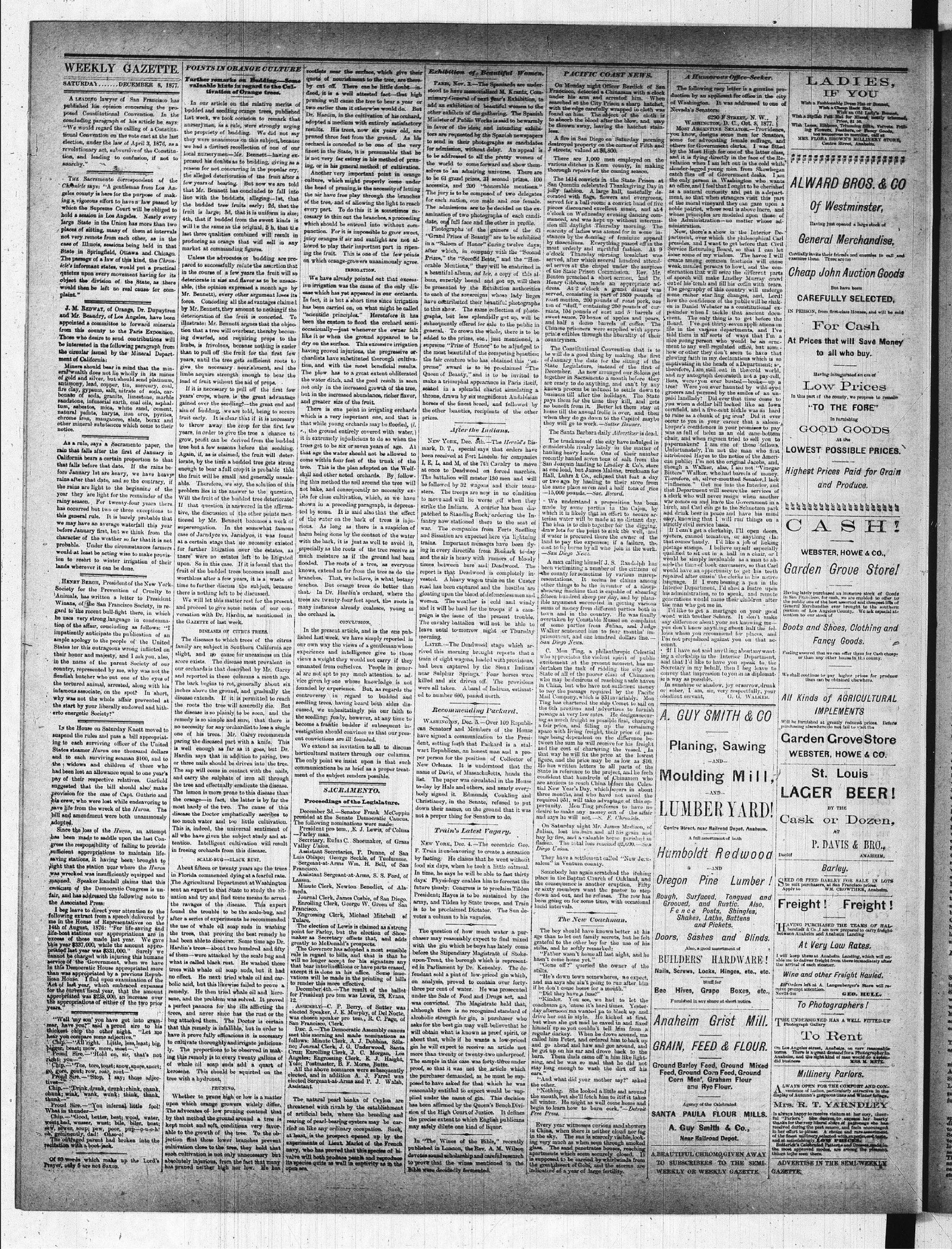
Searchable text
WEEKLY GAZETTE.
SATURDAY...DECEMBER 8, 1877.
A leading lawyer of San Francisco has published his opinion concerning the proposed Constitutional Convention. In the concluding paragraph of his article he says: "We would regard the calling of a Constitutional Convention on the vote cast at the last election, under the law of April 3, 1876, as a revolutionary act, subversive of the Constitution, and leading to confusion, if not to anarchy."
The Sacramento correspondent of the Chronicle says: "A gentleman from Los Angeles county is here for the purpose of making a vigorous effort to have a law passed by which the Supreme Court will be obliged to hold a session in Los Angeles. Nearly every large State in the Union has more than two places of sitting, many of them at intervals not very remote from each other, as in the case of Illinois, sessions being held in that State in Springfield, Ottawa and Chicago. The passage of a law of this kind, the Chronicle's informant states, would put a practical quietus upon every movement having for its object the division of the State, as there would then be left no real cause for complaint."
J. M. Redway, of Orange, Dr. Dupuytren and Mr. Beaudry, of Los Angeles, have been appointed a committee to forward minerals from this county to the Paris Exposition. Those who desire to send contributions will be interested in the following paragraph from the circular issued by the Mineral Department of California:
Miners should bear in mind that the mineral wealth does not lie wholly in its mines of gold and silver, but should send platinum, antimony, lead, copper, tin, mercury, coal, fire clay, gypsum, salt, nitrate of soda, carbonate of soda, granite, limestone, marble sandstone, infusorial earth, coal oils, asphaltum, asbestos, mica, white sand, cement, natural paints, baryta, iron ores, pyrites, chrome iron, manganese, slate, borax and other mineral substances which come to their notice.
As a rule, says a Sacramento paper, the rain that falls after the first of January in California bears a certain proportion to that that falls before that date. If the rain is too heavy or too late it may cause damage to crops and trees.
In our article on the relative merits of budded and seedling orange trees, published last week, we took occasion to remark that nurserymen, as a rule, were strongly urging the propriety of budding. We did not say they were unanimous on this subject because we had a distinct recollection of one of our local nurserymen—Mr. Bennett—having expressed his doubts as to budding, giving as a reason for not concurring in the popular cry, the alleged deterioration of the fruit after a few years of bearing. But now we are told that Mr. Bennett has concluded to fall into line with the buddists, alleging—1st, that the budded tree fruits early; 2d, that the fruit is large; 3d, that it is uniform in size; 4th, that if budded from the sweet kinds it will be the same as the original; 5 h., that the last three qualities combined will result in producing an orange that will sell in any market at commanding figures.
Unless the advocates or budding are prepared to successfully refute the assertion that in the course of a few years the fruit will deteriorate in size and flavor as to be unsaleable, (the opinion expressed a month ago by Mr. Bennett), every other argument loses its force. Conceding all the advantages claimed by Mr. Bennett, they amount to nothing if the deterioration of the fruit is conceded. To illustrate: Mr. Bennett argues that the objection that a tree will overbear, thereby becoming dwarfed, and requiring props to the limbs, is frivolous, because nothing is easier than to pull off the fruit for the first few years, until the tree gets sufficient roots to give the necessary nourishment, and the limbs acquire strength enough to bear the load of fruit without the aid of props.
If it is necessary to pull off the first few years' crops, where is the great advantage gained over the seedling?—the great end and aim of budding, we are told, being to secure fruit early. It is clear that if it is necessary to throw away the crop for the first few years, in order to give the tree a chance to grow, profit can be derived from the budded tree but a few seasons before the seedling. Again, if, as is claimed, the fruit will deteriorate, by the time a budded tree gets strong rootlets near the quots of nourishment by cut off. Than deed, it is a well-pruned will cause two earlier than it did Dr. Haruin, in the adopted medium results. His trees pruned three feet from orchard is conceded finest in the State; it is not very far estranged or in his generality.
Another very important culture which might be head of pruning on air have free play of the tree,and of every part.To do necessary to thin out which should be entailed punction. For it is juicy oranges if air allowed to play their fruiting fruit. This is on which orange-growers IRRRE
We have already practiced irrigation was thus ease which has yet applied.In fact,它是but a shallow has been carried on,"scientific principle been the custom to occasionally—just like it or when the dry on the surface.having proved injurious chardists have substituted tion,and with the The plow has to attach water ditch,and not only in the increase but in the increased size and greater size of thThere is one point which is a very important that while young orchards it is extremely injudicious trees get to be six or eight age the water she comes within four feet
As a rule, says a Sacramento paper, the rain that falls after the first of January in California bears a certain proportion to that that falls before that date. If the rains before January 1st are heavy, we have heavy rains after that date, and so the contrary, if the rains are light to the beginning of the year they are light for the remainder of the rainy season. For twenty-four years there has occurred but two or three exceptions to this general rule. It is barely probable that we may have an average waterfall this year before January first, but we think from the character of the weather so far that it is not probable. Under the circumstances farmers would at least be acting wise to make provision to resort to winter irrigation of their lands wherever it can be done.
HENRY BERGH, President of the New York Society for the Prevention of Cruelty to Animals, has written a letter to President Winans, of the San Francisco Society, in regard to the recent bull-fight there, in which he uses very strong language in condemnation of the affair, concluding as follows: "I impatiently anticipate the publication of an ample apology to the people of the United States for this outrageous wrong inflicted on their honor and majesty, and I ask you, also, in the name of the parent Society of our country, represented by me, why was not the fiendish butcher who cut one of the eyes of the tortured animal, arrested, along with his infamous associate, on the spot? In short, why was not the whole affair prevented at the start by your liberally endowed and hitherto energetic Society?"
In the House on Saturday Knott moved to suspend the rules and pass a bill appropriating to each surviving officer of the United States steamer Huron one thousand dollars and to each surviving seaman $100, and to the widows and children of those who had been lost an allowance equal to one year's pay of their respective relatives. Garfield suggested that the bill should also make provision for the case of Capt. Guthrie and his crew, who were lost while endeavoring to save life from the wreck of the Huron. The bill and amendment were both unanimously adopted.
Since the loss of the Huron, an attempt has been made to saddle upon the last Congress the responsibility of failing to provide sufficient appropriations to maintain life-saving stations, it having been brought to light that the station near where the Huron was wrecked was insufficiently equipped and manned. Speaker Randall claims that this
DISEASES OF CITRUS TREES.
The diseases to which trees of the citrus family are subject in Southern California are slight, and no cause for uneasiness on this score exists. The disease most prevalent in our orchards is that described by Mr. Garey and reported in these columns a month ago. The bark begins to rot, generally about six inches above the ground, and gradually the disease extends. If it is permitted to reach the roots the tree will assuredly die. But the disease is so plainly to be seen, and the remedy is so simple and sure, that there is no necessity for any orchardist to lose a single one of his trees. Mr. Garey recommends paring the diseased part with a knife. This is well enough as far as it goes, but Dr. Hardin says that in addition to paring, two or three nails should be driven into the tree. The sap will come in contact with the nails, and carry the sulphate of iron all through the tree and effectually eradicate the disease. The lemon is more prone to this disease than the orange—in fact, the latter is by far the most hardy of the two. The cause of this disease the Doctor emphatically ascribes to too much water and too little cultivation. This is, indeed, the universal sentiment of all who have given the subject study and attention. Intelligent cultivation will result in freeing orchards from this disease.
SCALE-BUG—BLACK RUST.
About fifteen or twenty years ago the trees in Florida commenced dying at a fearful rate. The Agricultural Department at Washington
In the present article lished last week, we have our own way the view experience and intellect views a weight they were emanated from ourselves are not apt to pay more vice given by one who founded by experience controversy in regard seedling trees, having cushes we unhesitatingthe seedling; ready, how become a frantic buddies investigation should convient convictions are ill fled.
We extend an invitation horticultural matters that The only point we insist communications be as bement of the subject renoun
Suggested that the bill should also make provision for the case of Capt. Guthrie and his crew, who were lost while endeavoring to save life from the wreck of the Huron. The bill and amendment were both unanimously adopted.
Since the loss of the Huron, an attempt has been made to saddle upon the last Congress the responsibility of failing to provide sufficient appropriations to maintain life-saving stations, it having been brought to light that the station near where the Huron was wrecked was insufficiently equipped and manned. Speaker Randall claims that this criticism of the Democratic Congress is unfair, and has addressed the following note to the Associated Press:
I beg leave to direct your attention to the following extract from a speech delivered by me in the House of Representatives on the 14th of August, 1876: "For life-saving and life-boat stations our appropriations are in excess of those made last year. We gave this year $337,000, while the amount appropriated last year was $331,000." Surely we cannot be charged with injuring this humane service of the Government, when we have in this Democratic House appropriated more than was appropriated by a previous Republican House. I find upon examination of the Act of last year, which embraced expenses for the current fiscal year, that the amount appropriated was $238,000, an increase over the appropriations of either of the two prior years."
"Well 'my son' you have got into grammar, have you?" said a proud sire to his thickest chip the other night. "Let me hear you compare some adjective."
Chip.—"All right. Little, less, least; big, bigger, beast; mow, more, most—"
Proud Sire.—"Hold on, sir, that's not right; you—"
Chip.—"Toe, tore, toast; snow, snore, snort; go, gown, gout; row, roar, rout—"
Proud Sire.—"Stop, I say; those adjectives—"
Chip.—"Drink, drank, drunk; chink, chank, chunk; wink, wank, wunk; think, thank, thunk—"
Proud Sire.—"You infernal little fool! What in thunder—"
Chip.—"Good, better, best; wood, water, weist had, wusser, wust; bile, biler, bust; saw, sewer, soup; pew, poor, pup—o-u-c-h! oh, geminently, dad! Ohao-o!"
The outraged parent had broken into the recitation with a boot-jack.
Of 69 words which make up the Lord's Prayer, only 5 are not Saxon.
About fifteen or twenty years ago the trees in Florida commenced dying at a fearful rate. The Agricultural Department at Washington sent an expert to that State to study the situation and try and find some means to arrest the ravages of the disease. This expert found the trouble to be the scale-bug, and after a series of experiments he recommended the use of whale oil soap suds in washing the trees, that proving the best remedy he had been able to discover. Some time ago Dr. Hardin's trees—about two hundred and fifty of them—were attacked by the scale bug and what is called black rust. He washed these trees with whale oil soap suds, but it had no effect. He next tried whale oil and carbolic acid, but this likewise failed to prove a remedy. He then tried whale oil and kerosene, and the problem was solved. It proved a perfect panacea for the ills afflicting the trees, and never since has the rust or the bug attacked them. The Doctor is certain that this remedy is infallible, but in order to have it prove fully efficacious it is necessary to cultivate thoroughly and irrigate judiciously. The proportions to be observed in making this remedy is to every twenty gallons of whale oil soap suds add a quart of kerosene. This should be squirted on the tree with a hydronet.
Pruning.
Whether to prune high or low is a matter upon which orange growers widely differ. The advocates of low pruning contend that by that method the ground around a tree is kept moist and soft conditions very favorable to the growth of the tree. To the objection that these lower branches prevent cultivation close to the tree they hold that such cultivation is not only unnecessary but absolutely injurious from the fact that many has pruned neither high nor low. He has
The natural pearl bank threatened with rivals by artificial beds where rearing of pearl-bearing oysters on like any ordinary oyster at least is the prospect of experiments of Lieut. Marsh navy who has proved that valve will both produce pearls quite as well in open sea.
December 3d.-Senate presided at the Senate
The following nomination:
President pro tem., E.-Farley man.
Secretary, Rufus C. S.
Valley Union.
Assistant Secretaries,
Luis Obispo; George Sesergeant-at-Arms W.
Francisco.
Assistant Sergeant-atLassen.
Minute Clerk, Newton
media.
Journal Clerk, James G.
Enrolling Clerk, George
Francisco.
Engrossing Clerk, MiTulare.
The election of Lewis is point for Farley but the maker as Secretary offers greatly to McDonald's preThe Governor has adopt rule in regard to bills and will no longer accept for that bear interlineations or except it is done in his variations will be made in this render this more effective.
December 4th.-The refor President pro tem was 12.
Assembly-C. P. Berrelected Speaker, J.E.Muwas chosen speaker pro t
San Francisco,Clerk.
Dec. 5.-The Democratics met this morning and manoise: Minute Clerk,A.
no; Journal Clerk,j.G.W.
Cruz; Enrolling Clerk,j.A.
Angeles; Engrossing ClerYolo; Postmaster,B.F.N.
All the above nominees elected and in addition elected Sergeant-at-Arms Assistant.
rootlets near the surface, which give their quota of nourishment to the tree, are thereby cut off. There can be little doubt—indeed, it is a well attested fact—that high pruning will cause the tree to bear a year or two earlier than it otherwise would do. But Dr. Hardin, in the cultivation of his orchard, adopted a medium with entirely satisfactory results. His trees, now six years old, are pruned three feet from the ground. As his orchard is conceded to be one of the very finest in the State, it is presuppable that he is not very far estray in his method of pruning, or in his general method of cultivation.
Another very important point in orange culture, which might properly come under the head of pruning, is the necessity of letting the air have free play through the branches of the tree, and of allowing the light to reach every part. To do this it is sometimes necessary to thin out the branches, a proceeding which should be entered into without compunction. For it is impossible to grow sweet, juicy oranges if air and sunlight are not allowed to play their important part in ripening the fruit. This is one of the few points on which orange-growers unanimously agree.
IRRIGATION.
We have already pointed out that excessive irrigation was the cause of the only disease which has yet appeared in our orchards. In fact, it is but a short time since irrigation has been carried on, on what might be called "scientific principles." Heretofore it has been the custom to flood the orchard semi-occasionally—just whenever the owner felt like it or when the ground appeared to be dry on the surface. This excessive irrigation having proved injurious, the progressive orchardists have substituted thorough cultivation, and with the most beneficial results. The plow has to a great extent obliterated the water ditch, and the good result is seen not only in the increased growth of the tree, but in the increased abundance, richer flavor, and greater size of the fruit.
There is one point in irrigating orchards which is a very important one, and that is that while young orchards may be flooded, (i.e., the ground entirely covered with water), it is extremely injudicious to do so when the trees get to be six or seven years of age. At that age the water should not be allowed to come within four feet of the trunk of the tree.
Exhibition of Beautiful Women.
PARIS, Nov. 3.—The Spaniards are understood to have memorialized M. Krantz, Commissary-General of next year's Exhibition, to add an exhibition of beautiful women to the other exhibits of the gathering. The Spanish Minister of Public Works is said to be warmly in favor of the idea; and intending exhibitors are requested by the Spanish newspapers to send in their photographs as candidates for admission, without delay. An appeal is to be addressed to all the pretty women of the world to come forward and show themselves to an admiring universe. There are to be 61 grand prizes, 31 second prizes, 100 accessits, and 200 "honorable mentions."
The jury is to be composed of two delegates for each nation, one male and one female. The admissions are to be decided on the examination of two photographs of each candidate, one full face and the other in profile.
Photographs of the gainers of the 61 "Grand Prizes of Beauty" are to be exhibited in a "Saloon of Honor" during twelve days; after which, in company with the "Second Prizes," the "Secofid Beats," and the "Honorable Mentions," they will be enshrined in a beautiful album, ad her, a copy of this album, superbly bound and got up, will then be presented by the Exhibition authorities to each of the sovereigns whose lady lieges have contributed their beautiful photographs to this show. The same collection of photographs, but less splendidly got up, will be subsequently offered for sale to the public in general. To crown the whole, there is to be added to the prizes, etc., just mentioned, a supreme "Prize of Honor" to be adjudged to the most beautiful of the competing beauties; the fair creature who has obtained this "supreme" award is to be proclaimed "The Queen of Beauty," and is to be invited to make a triumph appearance in Paris itself, seated in a splendid chariot simulating a throne, drawn by six magnificent Andalusian horses of the finest breed, and followed by the other beauties, recipients of the other prizes.
After the Indians.
NEW YORK, Dec. 5th.—The Herald's Dismark, D. T., special says that orders have been received at Fort Lincoln for companies I, E, L, and M, of the 7th Cavalry to move
PACIFIC COAST NEWS.
On Monday night Officer Burdick of San Francisco detected a Chinaman with a clock under his arm and arrested him. When searched at the City Prison a sharp hatchet, with the edge carefully wrapped in cloth was found on him. The object of the cloth is to absorb the blood after the blow, and may be thrown away, leaving the hatchet stainless.
A fire in San Diego on Saturday morning destroyed property on the corner of Fifth and J streets, valued at $6,800.
There are 1,000 men employed on the various ditches in Kern county, in making thorough repairs for the coming season.
The 1414 convicts in the State Prison at San Quentin celebrated Thanksgiving Day in jolly fashion. A large hall, tastefully decorated with flags, flowers and overgreens, served for a ball-room; a convict band of five pieces discoursed excellent music, and at 4 o'clock on Wednesday evening dancing commenced, and was kept up without intermission till daylight Thursday morning. The scarcity of ladies was atoned for in some instances by the domning of feminine apparel by masseuses. Everything passed off in the most orderly and marthful fashion. At 9 o'clock Thursday morning breakfast was served, after which several hundred attended serves at the chapel under the auspices of the State Prison Commission. Rev. Mr. Benton preached a short sermon, and Dr. Henry Gibbons, made an appropriate address. At 2 o'clock a grand dinner was served, consisting in part of 1800 pounds of roast mutton; 200 pounds of roast pork; one ton of "bluff," containing 200 pounds of currants; 104 pounds of suet and 5 barrels of sweet sauce; 70 boxes of apples and pears; and half a dozen barrels of coffee. The Chinese prisoners were supplied with appropriate edibles through the liberality of their countrymen.
The Constitutional Convention that is to be will do a good thing by making the first January date for the sitting of the State Legislature, instead of the first of December. As now arranged our Solons get together in Sacramento a month before they are ready to do anything, and can't by any known process be induced to settle down to business till after the holidays. The State pays them for the time they kill, and gets no benefit from it. Butter let them stay at home till the annual frolic is over, and then when they do go down to the Capitol maybe they will go to work. —Sutter Banner.
The Santa Barbara daily Advertiser is dead.
The truckmon of the city have indulged in considerable rivalry lately in the matter of hauling heavy loads. One of their number recently hauled seven tons of salt from the San Joaquin landing to Lindley & Col.'s store.
The plow has to a great extent obliterated the water ditch, and the good result is seen not only in the increased growth of the tree, but in the increased abundance, richer flavor, and greater size of the fruit.
There is one point in irrigating orchards which is a very important one, and that is that while young orchards may be flooded, (i.e., the ground entirely covered with water), it is extremely injudicious to do so when the trees get to be six or seven years of age. At that age the water should not be allowed to come within four feet of the trunk of the tree. This is the plan adopted on the Wolfskill and other noted orchards. By following this method the soil around the tree will not bake, and consequently no necessity exists for close cultivation, which, as we have shown in a preceding paragraph, is deprecated by some. It is said also that the effect of the water on the bark of trees is injurious. As long as there is a suspicion of harm being done by the contact of the water with the bark, it is just as well to avoid it, especially as the roots of the tree receive as much moisture as if the ground had been flooded. The roots of a tree, as everyone knows, extend as far from the tree as do the branches. That, we believe, is what botany teaches. But orange trees do better than that. In Dr. Hardin's orchard, where the trees are twenty-four feet apart, the roots in many instances already coalesce, young as the orchard is.
CONCLUSION.
In the present article, and in the one published last week, we have simply reported in our own way the views of a gentleman whose experience and intelligence give to those views a weight they would not carry if they emanated from ourselves. People in general are not apt to pay much attention to advice given by one whose knowledge is not founded by experience. But, as regards the controversy in regard to budded and seedling trees, having heard both sides discussed, we unhesitatingly pin our faith to the seedling; ready, however, at any time to become a frantic budder if subsequent investigation should convince us that our present convictions are ill founded.
We extend an invitation to all to discuss horticultural matters through our columns. The only point we insist upon is that such communications be as brief as a proper treatment of the subject renders possible.
SACRAMENTO.
Proceedings of the Legislature.
December 3d. — Senator Frank McCoppin presided at the Senate Democratic Caucus. The following nominations were made:
President pro tem., E. J. Lewis, of Colusa — Farley man.
Secretary, Rufus C. Shoemaker, of Grass Valley Union.
Assistant Secretaries, P. Dunne, of San Luis Obispo; George Seckle, of Tuolumme; Sergeant-at-Arms Win. H. Bell, of San Francisco.
Assistant Sergeant-at-Arms, S. S. Ford, of Lassen.
NEW YORK, Dec. 5th. — The Herald's Bismark, D. T., special says that orders have been received at Fort Lincoln for companies I, E, L, and M, of the 7th Cavalry to move at once to Deadwood on forced marches. The battalion will muster 180 men and will be followed by 32 wagons and their teamsters. The troops are now in no condition to move and will be worse off when they strike the Indians. A courier has been dispatched to Standing Rock; ordering the Infantry now stationed there to the seat of war. The companies from Forts Snelling and Sissation are expected here via lightning trains. Important messages have been flying in every direction from Bismark to day and the air is heavy with rumors of bloody times between here and Deadwood. The report is that Deadwood is completely invested. A heavy wagon train on the Custer road has been captured and the hostiles are floating upon the blood of defenceless men and women. The weather is cold and windy and it will be hard for the troops if a campaign is the issue of the present trouble. The cavalry battalion will not be able to leave until to-morrow night or Thursday morning.
LATER. — The Deadwood stage which arrived this morning brought reports that a train of eight wagons, loaded with provisions, had been captured by the Sioux Indians near Sulphur Springs. Four horses were killed and six driven off. The provisions were all taken. Aband of Indians, estimated to number 660, passed north.
Recommending Packard.
WASHINGTON, Dec. 5. — Over 100 Republican Senators and Members of the House have signed a communication to the President, setting forth that Packard is a stalwart Republican, an honest man and a proper person for the position of Collector of New Orleans. It is understood that the name of Davis, of Massachusetts, heads the list. The paper was circulated in the House today by Hale and others, and nearly everybody signed it. Edmunds, Conkling and Christiacy, in the Senate, refused to put down their names, on the ground that it was not a proper thing for Senators to do.
Train's Latest Vagary.
NEW YORK, Dec. 4. — The eccentric Geo.F. Train is endeavoring to create a sensation by fasting. He claims that he went without food six days, when he took a little oatmeal. In time, he says he will be able to fast thirty days. Physiology enables him to forecast the prime award is to be proclaimed "The Queen of Beauty," and is to be invited to make a triumphal appearance in Paris itself, seated in a splendid chariot simulating a throne, drawn by six magnificent Andalusian horses of the finest breed, and followed by the other beauties, recipients of the other prizes.
After the Indians.
NEW YORK, Dec. 6th. — The Herald's Bismark, D. T., special says that orders have been received at Fort Lincoln for companies I, E, L, and M, of the 7th Cavalry to move at once to Deadwood on forced marches. The battalion will muster 180 men and will be followed by 32 wagons and their teamsters. The troops are now in no condition to move and will be worse off when they strike the Indians. A courier has been dispatched to Standing Rock; ordering the Infantry now stationed there to the seat of war. The companies from Forts Snelling and Sissation are expected here via lightning trains. Important messages have been flying in every direction from Bismark to day and the air is heavy with rumors of bloody times between here and Deadwood. The report is that Deadwood is completely invested. A heavy wagon train on the Custer road has been captured and the hostiles are floating upon the blood of defenceless men and women. The weather is cold and windy and it will be hard for the troops if a campaign is the issue of the present trouble. The cavalry battalion will not be able to leave until to-morrow night or Thursday morning.
LATER. — The Deadwood stage which arrived this morning brought reports that a train of eight wagons, loaded with provisions, had been captured by the Sioux Indians near Sulphur Springs. Four horses were killed and six driven off. The provisions were all taken. Aband of Indians, estimated to number 660, passed north.
Recommending Packard.
WASHINGTON, Dec. 5th. — Over 100 Republican Senators and Members of the House have signed a communication to the President, setting forth that Packard is a stalwart Republican, an honest man and a proper person for the position of Collector of New Orleans. It is understood that the name of Davis, of Massachusetts, heads the list. The paper was circulated in the House today by Hale and others, and nearly everybody signed it. Edmunds, Conkling and Christiacy, in the Senate, refused to put down their names, on the ground that it was not a proper thing for Senators to do.
Train's Latest Vagary.
NEW YORK, Dec. 4th. — The eccentric Geo.F. Train is endeavoring to create a sensation by fasting. He claims that he went without food six days, when he took a little oatmeal. In time, he says he will be able to fast thirty days. Physiology enables him to forecast the prime award is to be proclaimed "The Queen of Beauty," and is to be invited to make a triumphal appearance in Paris itself, seated in a splendid charistrat simulating a throne, drawn by six magnificent Andalusian horses of the finest breed, and followed by the other beauties, recipients of the other prizes.
After the Indians.
NEW YORK, Dec. 6th. — The Herald's Bismark, D. T., special says that orders have been received at Fort Lincoln for companies I, E, L, and M, of the 7th Cavalry to move at once to Deadwood on forced marches. The battalion will muster 180 men and will be followed by 32 wagons and their teamsters. The troops are now in no condition to move and will be worse off when they strike the Indians. A courier has been dispatched to Standing Rock; ordering the Infantry now stationed there to the seat of war. The companies from Forts Snelling and Sissation are expected here via lightning trains. Important messages have been flying in every direction from Bismark to day and the air is heavy with rumors of bloody times between here and Deadwood. The report is that Deadwood is completely invested. A heavy wagon train on the Custer road has been captured and the hostiles are floating upon the blood of defenceless men and women. The weather is cold and windy and it will be hard for the troops if a campaign is the issue of the present trouble. The cavalry battalion will not be able to leave until to-morrow night or Thursday morning.
LATER. — The Deadwood stage which arrived this morning brought reports that a train of eight wagons, loaded with provisions, had been captured by the Sioux Indians near Sulphur Springs. Four horses were killed and six driven off. The provisions were all taken. Aband of Indians, estimated to number 660, passed north.
Recommending Packard.
WASHINGTON, Dec. 5th. — Over 100 Republican Senators and Members of the House have signed a communication to the President, setting forth that Packard is a stalwart Republican, an honest man and a proper person for the position of Collector of New Orleans. It is understood that the name of Davis, of Massachusetts, heads the list. The paper was circulated in the House today by Hale and others, and nearly everybody signed it. Edmunds, Conkling and Christiacy, in the Senate, refused to put down their names, on the ground that it was not a proper thing for Senators to do.
Train's Latest Vagary.
NEW YORK, Dec. 4th. — The eccentric Geo.F. Train is endeavoring to create a sensation by fasting. He claims that he went without food six days, when he took a little oatmeal. In time, he says he will be able to fast thirty days. Physiology enables him to forecast the prime award is to be proclaimed "The Queen of Beauty," and is to be invited to make a triumphal appearance in Paris itself, seated in a splendid charistrat simulating a throne, drawn by six magnificent Andalusian horses of the finest breed, and followed by the other beauties, recipients of the other prizes.
On Saturday night Mr. James Madison of Julian lost his barn and all his grain and hay by fire,and a valuable horse perished in flames.The total loss reached $2000.-San Diego Union.
They have a settlement called "New Jerusalem" in Ventura county.Somebody has again scrutchedthe itching place inthe Baptist Churchof Oakland,and
SACRAMENTO.
Proceedings of the Legislature.
December 3d.—Senator Frank McCoppin presided at the Senate Democratic Caucus. The following nominations were made:
President pro tem., E. J. Lewis, of Colusa — Farley man.
Secretary, Rufus C. Shoemaker, of Grass Valley Union.
Assistant Secretaries, P. Dunne, of San Luis Obispo; George Seckle, of Tuolumme.
Sergeant-at-Arms Win. H. Bell, of San Francisco.
Assistant Sergeant-at-Arms, S. S. Ford, of Lassen.
Minute Clerk, Newton Benedict, of Alameda.
Journal Clerk, James Cosbie, of San Diego.
Enrolling Clerk, George W. Green of San Francisco.
Engrossing Clerk, Michael Mitchell of Tulare.
The election of Lewis is claimed as a strong point for Farley, but the election of Shoemaker as Secretary offsets that, and adds greatly to McDonald's prospects.
The Governor has adopted a most sensible rule in regard to bills, and that is that he will no longer accept for his signature any that bear interlineations or have parts erased, except it is done in his office. Some innovations will be made in the printing of bills to render this more effective.
December 4th.—The result of the ballot for President pro tem was Lewis, 28, Evans, 12.
Assembly—C. P. Berry, of Sutter was elected Speaker, J. E. Murphy, of Del Norte, was chosen speaker pro tem., R. C. Page, of San Francisco, Clerk.
Dec. 5.—The Democratic Assembly cancus met this morning and made nominations as follows: Minute Clerk, A. J. Dobbins, Solano; Journal Clerk, J. G. Underwood, Santa Cruz; Enrolling Clerk, J. C. Morgan, Los Angeles; Engrossing Clerk, E. J. Haight, Yolo; Postmaster, B. F. Morse, Butte.
All the above nominees were subsequently elected, and in addition A. J. Farrel was elected Sergeant-at-Arms and P. J. Walsh, Assistant.
The natural pearl banks of Ceylon are threatened with rivals by the establishment of artificial beds, where the breeding and rearing of pearl-bearing oysters may be carried on like any ordinary occupation. Such, at least, is the prospect opened up by the experiments of Lieut. Mariot of the French navy, who has proved that this species of bivalve will both prodase pearls and reproduce its species quite as well in captivity as in the open sea.
In "The Wines of the Bible," recently published in London, the Rev. A. M. Wilson devotes sound scholarship and careful research to prove that the wines mentioned in the Bible were decidedly fermented.
Train's Latest Vagary.
New York, Dec. 4.—The eccentric Geo. F. Train is endeavoring to create a sensation by fasting. He claims that he went without food six days, when he took a little oatmeal. In time, he says he will be able to fast thirty days. Physiology enables him to forecast the future thusly: Congress is to proclaim Tilden President; Hayes is to be sustained by the army, and Tilden by State troops, and Train is to be proclaimed Dictator. The Sun devotes a column to his vagaries.
The question of how much water a purchaser may reasonably expect to find mixed with the gin which he buys has lately come before the Stipendiary Magistrate of Stoke-upon-Trent, the borough which is represented in Parliament by Dr. Kenealey. The defendant sold a pint of low-priced gin which, on analysis, proved to contain over forty-three per cent of water. He was prosecuted under the Sale of Food and Drugs act, and was convicted. The Magistrate held that, although there is no recognized standard of alcoholic strength for gin, a purchaser who asks for the best gin may well believe that he will obtain what is known as proof spirit, or about that, while if he wants a low-priced gin he will expect to receive an article not more than twenty or twenty-two underproof. The sample in this case was forty-three under proof, so that it was not the article which the purchaser demanded, as he must be supposed to have asked for that which he was reasonably entitled to expect would be supplied under the name of gin. This decision has been affirmed by the Queen's Bench Division of the High Court of Justice. It defines the precise extent to which English publicans may safely dilute one kind of liquor.
On Saturday night Mr. James Madison, of Julian, lost his barn and all his grain and hay by fire, and a valuable horse perished in flames. The total loss reached $2,000.-Sun Diego Union.
They have a settlement called "New Jerusalem" in Ventura county.
Somebody has again scrutched the itching place in the Baptist Church of Oakland, and the consequence is another eruption. Fifty or sixty members want the pastor to step down and out, and he refuses. The row has been going on for some time, with occasional lucid intervals.
The New Coachman.
The boy should have known better at his age than to let out family secrets, but he felt grateful to the other boy for the use of his stilts, and he softly remarked:
"Father wasn't home all last night, and he hasn't come home yet."
"Gone off?" queried the owner of the stilts.
"He's down town somewhere," we expect, and ma says she ain't going to run after him if he don't come home for a month."
"Did they have a fault?"
"Kinder. You see, we had to let the coachman go," cause it's hard times. Yesterday afternoon ma wanted pa to black up and drive her out in style. He kicked at first, but when she got mad he caved in and fixed himself up so you couldn't tell him from a regular darkey. When he drove around, ma called him Peter, and ordered him to back up and go ahead and haw and gee around, and he got up on his ear and drove back to the barn. Then duds came off in him like lightning, and he was so mad that he did not stay long enough to wash the dirt off his ears."
"And what did your mother say?" asked the other.
"Nothing." She looked a little sad around the mouth, but she'll fetch him to itif it takes all winter. He might as well come home and begin to learn how to burn cork."—Detroit Free Press.
Every year witnesses curious sand showers in China, when there is neither cloud nor fog in the sky. The sun is scarceely visible, looking very much as when seen through smoked glass. The sand penetrates houses, reaching apartments which seem securely closed. It is supposed to be carried by whirlwinds from the great desert of Gobi, and the storms are indicative of a year of large fertility.
A HUMOROUS OFFICE-SEEKER.
The following may letter is a genuine production by an applicant for office in the city of Washington. It was addressed to one of Nevada's Senators:
6290 F STREET, N. W., WASHINGTON, D. C., Oct. 8, 1877.
MOST ARGENTINE SENATOR—Providence, you know, designs some men for Senators, some for advocating female suffrage, and others for Government clerks. I was fitted by the Most High for one of the latter class, and it is flying directly in the face of the Revolution when I am left out in the cold while slender-legged young men from Skowhegan catch flies off of Government desks. I am the only person in Washington who wants an office, and I feel that I ought to be cherished as a natural curiosity and put in a department, so that when strangers visit this part of the moral vineyard they can gaze upon a noble patriot, whose soul is above here, and whose principles are modeled upon those of the Administration—no matter whose administration.
Now, there's a show in the Interior Department, over which the philosophical Carl presides, and I want to get before that Civil Service Returning Board, so that I can let loose some of my wisdom. The havoc I will create among common fractions will cause weak, minded persons to howl, and the consternation that will seize the different parts of speech will make Lindley Murray crawl out of his tomb and fill his coffin with tears.
The geography of this country will undergo some rather starling changes, and, Lord! how the confidence of the public will be shaken in Daniel Webster as a constitutional expounder when I tackle that ancient document. The only thing is to get before the board. I've got thirty-seven applications on file in the various departments, and I've told them in all sorts of ways that I'm a nice young person who would be an ornament to any well-regulated office, but somehow or other they don't seem to have that glowing faith in my declarations which is so captivating in the heads of a Department; so therefore, I am still out in the cold world, and my autograph decorateth not a pay-roll, Boza, were you ever busted—broke—up a tree? Were you ever haunted by wild-eyed grocers and pursued by the smiles of an unpaid landlord? Did ever that time come to you when a dollar bill looked like an Iowa cornfield, and a five-cent nickle was as hard to raise as a chunk of pig iron? Did it ever occur to you in your career that a saloon keeper's confidences in your promises to pay was as full of holes as an old cane-bottom chair, and when ragmen tried to sell you to papermakers? I am one of those fellows. Unfortunately, I'm not the man who first introduced Hayes to the notice of the American public; I'm not the original Jacobs, and...
daily Advertiser is dead. the city have indulged in lately in the matter of One of their number tons of salt from the to Lindley & Co's store Malone, truckman for chapped that feat a day going to their store from and a half tons of rice Record.
proposition has been tried in the Cajon, by an effort to secure armade at no distant day together for the digging, to sink the well, and where the owner of the houses; if a failure, the who join in the work.
self J. S. Randolph has number of the citizens of one by various misrepresents he claims among inventor of a sheep is capable of shearing per day, and by planned in getting various different parties both in country. He was finally able Russel on complaint on Julian, and Judge to four months' im- hundred dollars fine.—
obilanthropic Celestial solent spirit of public present moment, has unridding the city and over class of Chinamen of reaching a safe haven not sufficient money acquired by the Pacific $51 invariably. Mon ship Comet to sail on advertisers to furnish prices. He designs secur-possible first, charging up the remaining light, their price of pass on the difference be-receive for his freight carrying the vessel. In the price at the lowest may be as low as $10. to all parts of the project, and he feels ups of Chinamen who before the Celeschich occurs in about have not saved the advantage of this op-professes to have no money out of the affair S. E. Chronicle.
Mr. James Madison, of all his grain and stable horse perished in reached $2,000.—Sun called "New Jeru-ty.
erated the itching arch of Oakland, and therefore, I am still out in the cold world, and my autograph decorate not a pay-roll, Boss, were you ever busted—broke-up a tree? Were you ever haunted by wild-eyed grocers and pursued by the smiles of an unpaid landlady? Did ever that time come to you when a dollar bill looked like an Iowa cornfield, and a five-cent nickle was as hard to raise as a chunk of pig iron? Did it ever occur to you in your career that a saloon-keeper's confidence in your promises to pay was as full of holes as an old cane-bottom chair, and when ragmen tried to sell you to papermakers? I am one of those fellows. Unfortunately, I'm not the man who first introduced Hayes to the notice of the American public; I'm not the original Jacobs, and though a Walker, alas, I am not "Vinegar Bitters" Walker, who had barrels of money. Therefore, oh, silver-mouthed Senator, I lack "influence." Get me into the Interior, and that Department will secure the services of a clerk who will never resign when another war comes on and leave the Government in a lurch, and Carl can go to the Schuetzen park and drink beer in peace and have his mind easy, knowing that I will run things on a strictly civil service basis.
If I can't get a clerkship, I'll open doors, oysters, canned tomatoes, or anything else that comes handy. I'd like a job of licking postage stamps. I believe myself especially qualified to sit out in a hall in a chair, or I would be simply invaluable as a man to absorb the time of book canvassers, so that Carl would have an opportunity to get his teeth repaired after cussin' the clerks in his native language. If I were bossing a pen in the Interior Department, I'd shed a lustre upon his administration, so to speak, and remote generations would name their children after the man who got me in.
I'd like to get a mortgage on your good word with brother Schurz. It don't make any difference about your not knowing me—you don't know anything about half the follows whom you recommend for places, and I'm not prejudiced against you on that account.
If I have not said anything about my wanting a clerkship in the Interior Department, and that I'd like to have you speak to the Secretary in my behalf, then I beg leave to convey that impression to you in as diplomatic a way as possible.
In sunshine or shadow, joy or sorrow, drunk or sober, I am, sir, very respectfully, your obedient servant,
A. GUY SMITH & CO
Planing, Sawing
Moulding Mill,
LUMBER YARD!
Centre Street, near Railroad Depot, Anaheim.
A full assortment of both
Humboldt Redwood
Oregon Pine Lumber
AND
LUMBER YARD!
Centre Street, near Railroad Depot, Anaheim.
A full assortment of both
Humboldt Redwood
AND
Oregon Pine Lumber!
Rough, Surfaced, Tongued and Grooved, and Rustic. Also,
Fence Posts, Shingles,
Shakes, Laths, Battens
and Pickets.
Doors, Sashes and Blinds.
Also, a good assortment of
BUILDERS' HARDWARE!
Nails, Screws, Locks, Hinges, etc., etc.
Stuff for
Bee Hives, Grape Boxes, etc.,
Purchased in any shape at short notice.
Anaheim Grist Mill.
GRAIN, FEED & FLOUR.
Ground Barley Feed, Ground Mixed
Feed, Ground Corn Feed, Ground
Corn Meal', Graham Flour
and Rye Flour.
Agency of the Celebrated
SANTA PAULA FLOUR MILLS.
A. Guy Smith & Co.,
Near Railroad Depot.
A BEAUTIFUL CHROMQ.GIVEN AWAY
TO SUBSCRIBERS TO THE SEMIWEEKLY OR WEEKLY GAZETTE.
LAGER BEER!
BY THE
Cask or Dozen,
AT
P. DAVIS & BRO.,
Dec 6th
ANAHEIM.
Barley.
SEED OR FEED BARLEY FOR SALE IN LOTS
to suit purchasers, at San Francisco prices.
Apply to WM. CROWTHER, Anaheim.
Freight! Freight!
HAVING PURCHASED THE TEAMS OF HALberstadt & Co., I am now prepared to carry freight
between Anaheim and Anaheim Landing.
At Very Low Rates.
I will keep them at Anaheim Landing, which will enable me to deliver freight from there immediately after
the arrival of each steamer.
Wine and other Freight Hauled.
EZ Orders left at A. Langenberger's Store will receive prompt attention.
GEO. HULL.
To Photographers!
THE UNDERSIGNED HAS A WELL FITTED-UP
Photograph Gallery
To Rent
On Los Angeles street, Anaheim, on very reasonable
terms. There is a great demand for a Photographer in
Anaheim, and the right kind of man would do a spendid business.
Millinery Parlors.
ALWAYS OPEN FOR THE COMfort AND CONvenience of Ladies, particularly attractive in the
display of Autumn's gorgeous tints and Winter foliage.
Mrs. R. T. YARNDLEY
Is always happy to receive visitors at her coy, cheerful "Parkers." She desires to express her hearty thanks for the very liberal share of patronage she has received during the past season, and feels encouraged in her effort to please. A choice and rare arrangement of the finest millinery selected with expertise and taste,
and at astonishingly low PERCENTAGE.
Butterick's Celebrated Patterns and Dreams, made in the most approved modes, are among the pleasant things to be seen there.
ADVERTISE IN THE SEMI-WEEKLY
GAZETTE.