anaheim-gazette 1877-12-01
Scanned page
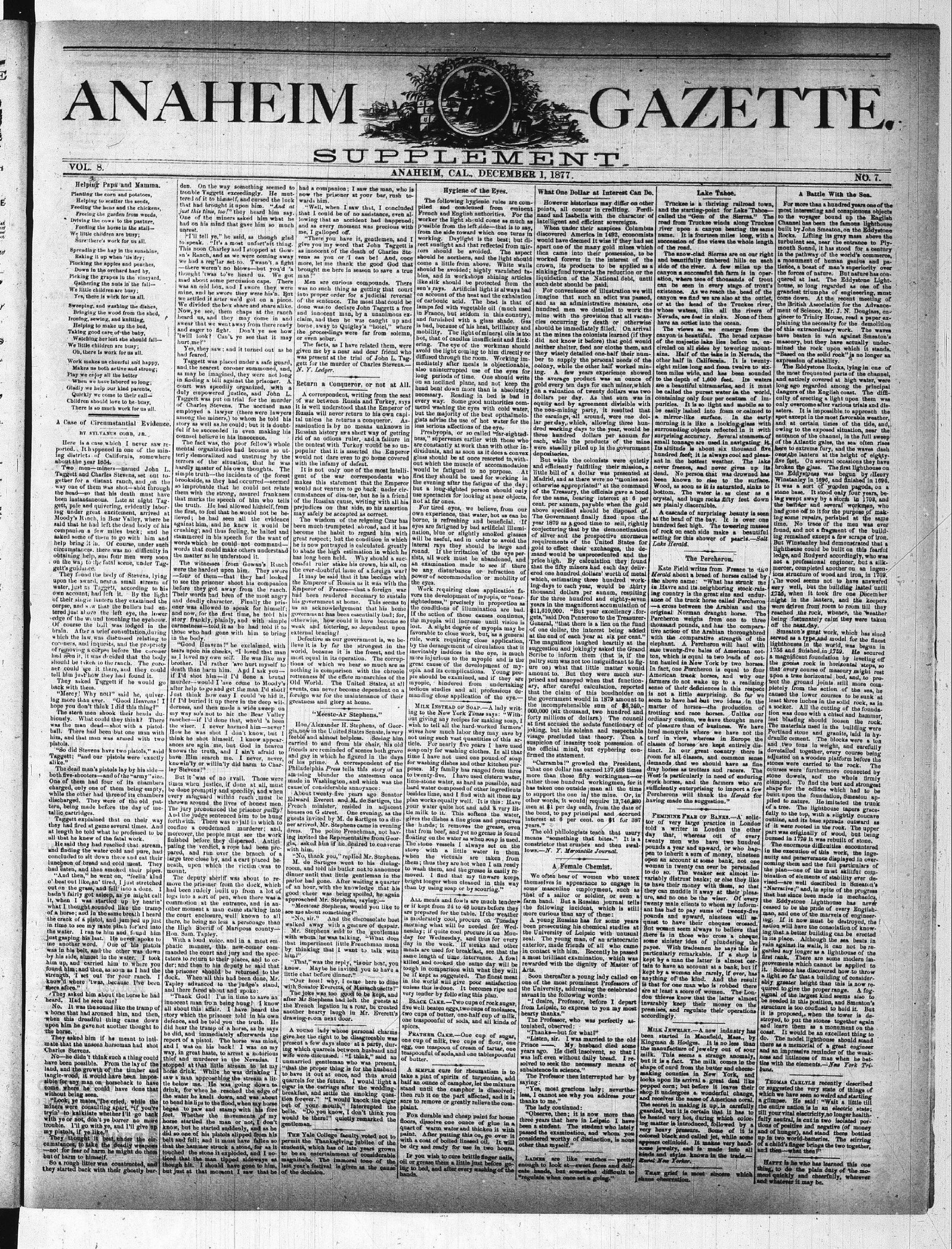
Searchable text
ANAHEIM
VOL. 8.
Helping Papa and Mamma.
Planting the corn and potatoes,
Helping to scatter the seeds,
Feeding the hens and the chickens,
Freeing the garden from weeds,
Driving the cows to the pasture,
Feeding the horse in the stall—
We little children are busy;
Sure there's work for us all.
Spreading the hay in the sunshine,
Raking it up when 'tis dry;
Plucking the apples and peaches,
Down in the orchard hard by,
Picking the grapes in the vineyard,
Gathering the nuts in the fall—
We little children are busy;
Yes, there is work for us all.
Sweeping, and washing the dishes,
Bringing the wood from the shed,
Ironing, sewing, and knitting,
Helping to make up the bed,
Taking good care of the baby,
Watching her lest she should fall—
We little children are busy;
Oh, there is work for us all.
Work makes us cheerful and happy,
Makes us both active and strong;
Play we enjoy all the better
When we have labored so long;
Gladly we help our kind parents,
Quickly we come to their call—
Children should love to be busy,
There is so much work for us all.
A Case of Circumstantial Evidence.
BY SYLVANUS COBB, JR.
Here is a case which I never saw reported. It happened in one of the mining districts of California, somewhere about the year 1854.
On the way something seemed to trouble Taggett exceedingly. He muttered of it to himself, and cursed the luck that had brought it upon him. "And at just this time, too!" they heard him say. One of the miners asked him what he had on his mind that gave him so much unrest.
"I'll tell ye," he said, as though glad to speak. "It's a most unfortunate thing. This noon Charley and I stopped at Gowan's Ranch, and as we were coming away we had a regular set to. Twasn't a fight —there weren't no blows—but you'd'a thought 'twas to've heard us. We got mad about some percussion caps. There was an old box, and I swore they were mine, and he swore they were his'n. But we settled it arter we'd got on a piece. We divided the box share and share alike. Now, ye see, them chaps at the ranch heard us, and they may come in and swear that we went away from there ready and eager to fight. Don't ye see how 'twill look? Can't ye see that it may hurt me?"
Yes, they saw; and it turned out as he had feared.
Taggett was placed under a safe guard, and the nearest coroner summoned, and, as may be imagined, they were not long in finding a bill against the prisoner. A court was speedily organized, with a duly empowered justice, and John L. Taggett was put on trial for the murder of Charles Stevens. The accused man employed a lawyer (there were lawyers among the miners) to whom he told his story as well as he could; but it is doubtful if he succeeded in even making his counsel believe in his innocence.
The fact was, the poor fellow's whole mental organization had become so utterly demoralized and unstrung by the terrors of the situation, that he was had a companion; I now the prisoner awards him.
"Well, when I save that I could be of no lowing that an acciety and as every moment me, I galloped off."
"There you have give you my word to as innocent of the devens as you or I more, let me thank brought me here in man!"
Men are curious was no such thing into proper order for of the sentence. The done was to declare and innocent man, claim, and then he borne away to Quigh the proceedings were or even sober.
The facts, as I have given me by a near a was present at the tr gett for the murder of N. Y. Ledger.
Return a Conqueror
A correspondent, w of war between Russia it is well understood Russia will never retu tal unless he returns sassination is by no Russian history as a sh rid of an odious rule the contest with Turk popular that it is asses would not dare even with the infamy of de
A Case of Circumstantial Evidence.
BY Sylvanus Cobb, Jr.
Here is a case which I never saw reported. It happened in one of the mining districts of California, somewhere about the year 1854.
Two men—miners—named John L. Taggett and Charles Stevens, set out together for a distant ranch, and on the way one of them was shot—shot through the head—so that his death must have been instantaneous. Late at night Taggett, pale and quivering, evidently laboring under great excitement, arrived at Moody's Ranch, in Bear Valley, where he said that he had left the dead body of his companion a few miles back; and he asked some of them to go with him and help bring it in. Of course, under such circumstances, there was no difficulty in obtaining help, and four men were soon on the way to the fatal scene, under Taggett's guidance.
They found the body of Stevens, lying upon the sward, near a small stream of water, just as Taggett, according to his own account, had left it. By the light of their single lantern they examined the corpse, and saw that the bullets had entered just above the left eye, the lower edge of the wound touching the eyebrow. Of course the ball was lodged in the brain. After a brief consultation during which the law was discussed relating to coroners, and inquests, and the propriety of removing a corpse before the coroner had seen it, it was decided that the body should be taken to the ranch. The coroner could see it there, and they could tell him just how they had found it.
They asked Taggett if he would go back with them.
"Mercy! Why not?" said he, quivering more than ever. "Good Heavens! I hope you don't think I did this thing?"
The stern men shook their heads dubiously. What could they think? There was the man dead—shot with a pistol-ball. There had been but one man with him, and that man was armed with two pistols.
"So did Stevens have two pistols," said Taggett; "and our pistols were exactly alike."
The dead man's pistols lay by his side—both five-shooters—and of the "army" size. One of them had four of its chambers charged, only one of them being empty, while the other had three of its chambers discharged. They were of the old pattern, being made before the day of metallic cartridges.
Taggett explained that on their way they had fired at game several times. And at length he told what he professed to be all that he knew of the fatal work.
He said they had reached that stream, and finding the water cold and pure, had concluded to sit down there and eat their luncheon of bread and cold meat. They had eaten, and then smoked their pipes.
"And then," he went on, "feelin' kind o' beat out like an tired." Just strained and the nearest coroner summoned, and as may be imagined, they were not long in finding a bill against the prisoner. A court was speedily organized, with a duly empowered justice, and John L. Taggett was put on trial for the murder of Charles Stevens. The accused man employed a lawyer (there were lawyers among the miners) to whom he told his story as well as he could; but it is doubtful if he succeeded in even making his counsel believe in his innocence.
The fact was, the poor fellow's whole mental organization had become so utterly demoralized and unstrung by the terrors of the situation, that he was hardly master of his own thoughts. The simple truth—the incidents of the forest brookside, as they had occurred—seemed so improbable that he could not relate them with the strong, assured frankness that marks the speech of him who tells the truth. He had allowed himself, from the first, to feel that he would not be believed; he had seen all the evidence against him, and he knew it would be crushing; and thus feeling, he halted and stammered in his speech for the want of words which he could not command—words that could make others understand the matter as he understood it.
The witnesses from Gowan's Ranch were the hardest upon him. They swore—four of them—that they had looked to see the prisoner shoot his companion before they got away from the ranch. Their words had been of the most angry and deadly character. Finally the prisoner was allowed to speak for himself; and now, for the first time, he told his story frankly, plainly, and with simple earnestness—toil it as he had told it to those who had gone with him to bring in the body.
"Good Heavens!" he exclaimed, with tears upon his cheeks, "I loved that man as I loved my own self. He was like my brother. I'd rather 'ave hurt myself to death than harm him. And I ask you—if I'd shot him—if I'd done a brutal murder—would I 'ave come to Moody's after help to go and get the man I'd shot? Just think how easy I could've hid it. If I'd buried it up there in the deep wilderness, and then made a wide sweep on my way so it's not to hit the Bear Valley ranches—if I'd done that, who'd 'a been the wiser. I never harmed him—never! How he was shot I don't know, but I think he shot himself. I know appearances are agin with God in heaven knows the truth, and I ain't afraid to have Him search me. I never, never, known 'ly or willin'ly did harm to Charley Stevens!"
But it was of no avail. Those were times when justice, if done at all, must be done promptly and speedily, and when every safeguard within reach must be thrown around the lives of honest men. The jury pronounced the prisoner guilty! And the judge sentenced him to be hung forth with. There was no jail in which to confine a condemned murderer; and, moreover, the people must see the work finished before they dispersed. Anticipating the verdict, a rope had been prepared, and run over the branch of a large tree close by, and a cart placed beneath, upon which the victim was to mount.
The deputy sheriff was about to return a Conqueror.
A correspondent, who of war between Russia it is well understood that Russia will never return until he returns sassination is by no Russian history as a shred of an odious rule; the contest with Turkey popular that it is assured would not dare even try with the infamy of death.
It is not only one gent of the war conqueror makes this statement would not venture to give circumstances of disa-tion of the Russian cause; prejudices on that subject may safely be accepted.
The wisdom of the been much trumpeted because the habit to great respect; but the idea he is now portrayed is to abate the high estimation has long been held.
cessful ruler strike his ever-doubtful issue.
It may be said that in the Emperor of Russia Emperor of France—had been rendered naïve his government at home us an acknowledgement government has been cared otherwise; how could it weak and tottering, so external bracing?
Defective as our governor lie it is by far far the world, because it is most equal in its operations of which we hear nothing in comparison to rottenness of the efete Old World. The Unite events can never become foreign war for the maiden greatness and glory at last.
"Meeste-Ar St"
Hon/Alexander H. Stigia now in the United States feeble and almost helpless carried to and from his friends are reminded of his gay and gay in which he fight of his prime. A corre Philipthia Press tells amusing blunder thereto made in Washington, and cause of considerable anomaly About twenty-five years Edward Everett and M. French minister, residues on G street. One guests invited by M. de Nier arrived, Mr. Stephens dress. The polite Frenzling invited the Representative gia, asked him if he dealt with him.
"No, thank you," replied M. de Sartiges went room, and told his butler dinner until that little girl parlor had gone.
Taggett explained that on their way they had fired at game several times. And at length he told what he professed to be all that he knew of the fatal work.
He said they had reached that stream, and finding the water cold and pure, had concluded to sit down there and eat their luncheon of bread and cold meat. They had eaten, and then smoked their pipes.
"And then," he went on, "feelin' kind o' beat out like, an' tired, I just stretched out on the grass, and fell into a doze. I hadn't fairly got asleep, as ye might call it, when I was startled up by hearin' what I thought sounded like the tramp of a horse; and in the same breath I heard the crack of a pistol, and jumped up just in time to see my mate pitch for ard into the water. I ran to him and found him just gasping his last. He never spoke to me another word. One of his pistols was in his belt, and the other was down by his side, almost in the water. I took him up, and carried him to where you found him; and then, as soon as I had the strength, I set out for your ranch. I know'd where 'twas, because I've been there afore."
They asked him about the horse he had heard. Had he seen one?
No. It was the sound like the trump of a horse that had aroused him, and then, when this dreadful thing came down upon him he gave not another thought to the horse.
They asked him if he meant to intimate that the unseen horseman had shot Charles Stevens.
No—he didn't think such a thing could have been possible. From the lay of the land, and the growth of the timber and tangle-wood, it would have been impossible for any man on horseback to have come where he could have done that without being seen.
"Look, ye mates," the cried, while the miners were consulting apart, "if you're tryin' to kalkilate whether I'll go back with ye or not, don't ye borrer no more trouble. I'll go with ye, and I'll give up my pistols, if ye like."
They thought it best, under the circumstances, to take the deadly weapons—not for fear of harm he might do them but of harm to himself.
So a rough litter was constructed, and they started back with their ghostly burtimes when justice, if done at all, must be done promptly and speedily, and when every safeguard within reach must be thrown around the lives of honest men. The jury pronounced the prisoner guilty! And the judge sentenced him to hung forthwith. There was no jail in which to confine a condemned murderer; and, moreover, the people must see the work finished before they dispersed. Anticipating the verdict, a rope had been prepared, and run over the branch of a large tree close by, and a cart placed beneath, upon which the victim was to mount.
The deputy sheriff was about to remove the prisoner from the dock, which had been rudely built up from a lot of logs into a sort of pen, when there was a commotion at the entrance, and in another moment a man came stalking into the court enclosure, well known to all there, he being no less a personage than the High Sheriff of Mariposa county—Hon. Sam. Tapley.
With a loud voice, and in a most emphatic manner, this new-comer commanded the court and jury and the spectators to return to their places, and to order; and then to his deputy he said that the prisoner should be returned to the dock. When all this had been done, Mr. Tapley advanced to the judge's stand, and there faced about and spoke:
"Thank God! I'm in time to save an innocent man from being hung! I know all about this affair. I have heard the story which the prisoner told in his own defence, and he told you the truth. He did hear the trump of a horse, as he says he did, and immediately afterwards the report of a pistol. The horse was mine, and I was on his back! I was on my way, in great haste, to arrest a notorious thief and murderer in the Nevadas. I stopped at that little stream to let my horse drink. While he was drinking I saw a man approaching the stream a little below me. He was going down to drink, for when he reached the edge of the water he knelt down, and was about to bend his lips to the flood, when my horse began to paw and stamp with his fore feet. Whether the movements of my horse startled the man or not, I don't know, but he started suddenly, and as he did so one of his pistols slipped from his belt and fell; and it must have fallen so that the hammer struck a stone, for as it touched the stone it exploded, and I noticed that the man tipped sideways as though hit. I should have gone to him, but just at that moment I saw that he
About twenty-five years Edward Everett and Mr. French minister, residence houses on G street. On guests invited by M. de Nier arrived, Mr. Stephens dress. The polite French ing invited the Representative gis, asked him if he dealt with him.
"No, thank you," replied M. de Sartiges went room, and told his butterfly dinner until that little parlor had gone. After waking of an hour, with the know good cheer was being approached Mr. Stephens.
"Meestear Stephens, we see me about something?" "No, sir." And the dog walked away with a geset Mr. Stephens said to with whom he was talking that impertinent little F by thinking that I want him?
"That," was the reply," know. Maybe he invited little chat before dinner."
"Our host! why, I can with Senator Everetts, of H"
The joke was too good after Mr Stephens had left the French legation in a another hearty laugh in drawing-room next door.
A young lady whose pants give her right to be di present a few days since ing which quarrels between wife were discussed. "I't unmarried gentleman who that proper thing is for have it out at once, and quarrels for the future. I cigar in the carriage after breakfast, and settle the situation forever." "I would know out of your mouth," in belle. "Do you know, I would be there!" quietly gentleman.
The Yale College faculty permit the Thanksgiving students, which has of late to be an entertainment on magnitude. The immortal last year's festival is given of the decision.
CIM GA
SUPPLEMENT.
ANAHEIM, CAL., DECEMBER 1, 1877.
had a companion; I saw the man, who is now the prisoner at your bar, rush towards him.
"Well, when I saw that, I concluded that I could be of no assistance, even allowing that an accident had happened; and as every moment was precious with me, I galloped off."
"There you have it, gentlemen, and I give you my word that John Taggett is as innocent of the death of Charles Stevens as you or I can be! And, once more, let me thank the good God that brought me here in season to save a true man!"
Men are curious compounds. There was no such thing as getting that court into proper order for a judicial reversal of the sentence. The most that could be done was to declare John Taggett a free and innocent man, by a unanimous exclaim, and then he was caught up and borne away to Quigley's "hotel," where the proceedings were far from solemn, or even sober.
The facts, as I have related them, were given me by a near and dear friend who was present at the trial of John L. Taggett for the murder of Charles Stevens.—N. Y. Ledger.
Return a Conqueror, or not at All.
A correspondent, writing from the seat of war between Russia and Turkey, says it is well understood that the Emperor of Russia will never return to his own capital unless he returns a conqueror. Assassination is by no means unknown in Russian history as a short way of getting rid of an odious ruler, and a failure in the contest with Turkey would be so unpopular that it is asserted the Emperor would not dare even to go home covered with the infamy of defeat.
Hygiene of the Eyes.
The following hygienic rules are compiled and condensed from eminent French and English authorities. For the worker the light should come as much as possible from the left side—that is to say, from the side toward which one turns in working. Daylight is the best; but direct sunlight and that reflected from mirrors should be avoided. The aspect should be northern, and the light should come a little from above. White walls should be avoided; highly varnished tables, and in workshops shining articles like silk should be protected from the sun's rays. Artificial light is always bad on account of the heat and the exhalation of carbonic acid. The best is that of lamps fed with vegetable oil (much used in France, but seldom in this country), and furnished with a glass shade. Gas is bad, because of his heat, brilliancy and mobility. The light of mineral oils is too hot, that of candles insufficient and flickering. The eye of the workman should avoid the light coming to him directly or diffused through the room. Working immediately after meals is objectionable, also uninterrupted use of the eyes for long periods of time. One should write on an inclined plane, and not keep the head bent down more than is absolutely necessary. Reading in bed is bad in every way. Some good authorities commend washing the eyes with cold water, but the majority of the best ophthalmologists advise the use of hot water for the less serious affections of the eye.
Presbyopia, or so called "far-sightedness," supervenes earlier with those who are constantly at work than with other individuals, and as soon as it does a convex glass should be at once resorted to, without which the muscle of accommodation
What One Dollar at Interest Can Do.
However historians may differ on other points, all concur in crediting. Ferdinand and Isabella with the character of intelligent and efficient sovereigns.
When under their auspices Columbus discovered America in 1492, economists would have deemed it wise if they had set apart one of the many gold mines which then came into their possession, to be worked forever in the interest of the crown, its products to be applied as a sinking fund towards the reduction or the liquidation of the National debt, until such debt should be paid.
For convenience of illustration we will imagine that such an edict was passed, and as an administrative measure, one hundred men we detailed to work the mine with the provision that all vacancies occurring by death or otherwise should be immediately filled. On arrival at the mines the colonists learned (if they did not know it before) that gold would neither shelter, feed nor clothe them, and they wisely detailed one-half their number to supply the personal needs of the colony, while the other half worked mining. A few years experience showed the average product was an ounce of gold every ten days for each miner, which on a valuation of twenty dollars was two dollars per day. As that sum was in equity and by agreement divisible with the non-mining party, it resulted that the earnings, all around, were one dollar per day, which, allowing three hundred working days to the year, would be three hundred dollars per annum for each, while the products of the mine were steadily piled up in the government depositories.
But while the colonists were quietly and officiously fulfilling their mission...
Return a Conqueror, or not at All.
A correspondent, writing from the seat of war between Russia and Turkey, says it is well understood that the Emperor of Russia will never return to his own capital unless he returns a conqueror. Assassination is by no means unknown in Russian history as a short way of getting rid of an odious ruler, and a failure in the contest with Turkey would be so unpopular that it is asserted the Emperor would not dare even to go home covered with the infamy of defeat.
It is not only one of the most intelligent of the war correspondents who makes this statement that the Emperor would not venture to go back under circumstances of disaster, but he is a friend of the Russian cause, writing with all his prejudices on that side, so his assertion may safely be accepted as correct.
The wisdom of the reigning Czar has been much trumpeted abroad, and it has become the habit to regard him with great respect; but the condition in which he is now portrayed is calculated greatly to abate the high estimation in which he has long been held. Why should a successful ruler stake his crown, his all, on the ever-doubtful issue of a foreign war?
It may be said that it has become with the Emperor of Russia as it was with the Emperor of France—that a foreign war had been rendered necessary to sustain his government at home. This seems to us an acknowledgement that his home government has been essentially bad; for, otherwise, how could it have become so weak and tattering, so dependent upon external bracing?
Defective as our government is, we believe it is by far the strongest in the world, because it is the freest, and the most equal in its operation. The corruptions of which we hear so much are as nothing in comparison with the chronic rottenness of the effete monarchies of the Old World. The United States, at all events, can never become dependent on a foreign war for the maintenance of their greatness and glory at home.
"Meeste-Ar Stephens."
Hon/Alexander H. Stephens, of Georgia, now in the United States Senate, is very feeble and almost helpless. Seeing him carried to and from his chair, his old friends are reminded of scenes both grave and gay in which he figured in the days of his prime. A correspondent of the Philadelphia Press tells this story of an amusing blunder the statesman once made in Washington, and which was the cause of considerable annoyance:
About twenty-five years ago Senator Edward Everett and M. de Sartiges, the French minister, resided in adjacent houses on G street. One evening, as the guests invited by M. de Sartiges to a dinner arrived, Mr. Stephens came in evening dress. The polite Frenchman, not having invited the Representative from Georgia, asked him if he desired to converse with him.
"No, thank you," replied Mr. Stephens. M. de Sartiges went to his dining room, and told his butler not to announce dinner until that little gentleman in the parlor had gone. After waiting a quarter also uninterrupted use of the eyes for long periods of time. One should write on an inclined plane, and not keep the head bent down more than is absolutely necessary. Reading in bed is bad in every way. Some good authorities commend washing the eyes with cold water, but the majority of the best ophthalmologists advise the use of hot water for the less serious affections of the eye.
Presbyopia, or so called "far-sightedness," supervenes earlier with those who are constantly at work than with other individuals, and as soon as it does a convex glass should be at once resorted to without which the muscle of accommodation would be fatigued to no purpose. At first they should be used for working in the evening after the fatigue of the day; but a long-sighted person should only use spectacles for looking at near objects, not at far ones.
For tired eyes, we believe, from our own experience, that water, hot as can be borne, is refreshing and beneficial. If eyes are fatigued by bad artificial illumination, blue or slightly smoked glasses will be useful, and in order to avoid the lateral rays they should be large and round. If the irritation of the eye persists, all work must be abandoned, and an examination made to see if there any disturbance or refraction of power of accommodation or mobility of the eyes.
Work requiring close application favors the development of myopia, or "near-sightedness," precisely in proportion as the conditions of illumination are bad. If the action of those causes continues, the myopia will increase until vision is lost. A slight degree of myopia may be favorable to close work, but, as a general rule, work requiring close application, by derangement of circulation that inevitably indicts in the eye, is much more injurious to the myopic and is the great cause of the development of myopia and its complications. Young people should be examined, and if they are myopic, hindered from undertaking tedious studies and all professions demanding close application of the eye.
Milk Instead of Soap—a lady writing to the New York Times says: "Without giving any recipes for making soap, I wish to tell all the hard-worked farmers' wives how much labor they may save by not using such vast quantities of this article. For nearly five years I have used soaponly for washing clothes. In all that time I have not used one pound of soap for washing dishes and other kitchen purposes. My family has ranged from three to twenty-five. I have used cistern water, lime-stone water, as hard as possible, and hard water composed of other ingredients besides lime, and I find with all these my plan works equally well. It is this: Have your water quite hot and add a very little milk to it. This softens the water, gives the dishes a fine gloss and preserves the hands; It removes the grease, even that from beef, and yet no grease is found floating on the water as when soap is used. The stone vessels I always set on the stove with a little water in them when the victuals are taken from them; thus they are hot when I am ready to wash them, and the grease is easily removed. I find that my tinware keeps bright longer when cleaned in this manner.
A few years experience showed the average product was an ounce of gold every ten days for each miner, which on a valuation of twenty dollars was two dollars per day. As that sum was in equity and by agreement divisible with the non-mining party, it resulted that the earnings all around were one dollar per day,, which allowing three hundred working days to the year, would be three hundred dollars per annum for each, while the products of the mine were steadily piled up in the government depositories.
But while the colonists were quietly and efficiently fulfilling their mission, a little bill of a dollar was presented at Madrid, and as there were no "monies not otherwise appropriated" at the command of the Treasury, the officials gave a bond for the same, bearing interest at 6 per cent. per annum, payable when the gold above specified should be disposed of. The Government finally fixed upon the year 1879 as a good time to sell, rightly conjecturing that by the demonetization of silver and the prospective enormous requirements of the United States for gold to effect their exchanges, the demand would be unprecedented and the price high. By calculation they found that the fifty miners had each day delivered one hundred dollars' worth of metal which, estimating three hundred working-days to each year, would be thirty thousand dollars per annum, resulting for three hundred and eighty-seven years in the magnificent accumulation of $11,010,000." But your excellency forgets," said Don Penseroso to the Treasurer-General," "that there is a lien on the fund of one dollar,the interest being added at end of each year at six per cent." The magnificos laughed heartily at the suggestion and jokingly asked the Grand Scribe to inform them (that is, if the paltry sum was not too insignificant to figure on) what that little matter would amount to. But they were much surprised and annoyed when that functionary, after careful calculation, reported that the claim of this bondholder on the government would in 1879 amount to the incomprehensible sum of $6,240,-000,000 (six thousand,two hundred and forty millions of dollars). The council at first accused the sedate functionary of joking, but his solemn and respectable visage precluded that theory. Then a suspicion of insanity took possession of the official mind, but cyphering confirmed the statement.
"Carramba!" growled the President,"that one dollar has earned 137,468 times more than those fifty workingmen—or rather those hundred workingmen; for it has taken one outside man all the time to support the one in the mine. Or, in other words,它 would require 13,746,280 men at $1 per day each,从 date of the bond,到 pay principal和 accrued interest at 6 per cent.on $1 for 387 years."
The old philologist teaches that usury means "something that bites." It is a constrictor that crushes and then swallows.-N.Y.Mercantile Journal.
A Female Chemist.
We often hear of women who unsex themselves in appearance to enmenue...
About twenty-five years ago Senator Edward Everett and M. de Sartiges, the French minister, resided in adjacent houses on G street. One evening, as the guests invited by M. de Sartiges to a dinner arrived, Mr. Stephens came in evening dress. The polite Frenchman, not having invited the Representative from Georgia, asked him if he desired to converse with him.
"No, thank you," replied Mr. Stephens. M. de Sartiges went to his dining-room, and told his butler not to announce dinner until that little gentleman in the parlor had gone. After waiting a quarter of an hour, with the knowledge that his good cheer was being spoiled, he again approached Mr. Stephens, saying,
"Meestear Stephens, would you like to see me about something?"
"No sir." And the disconsolate host walked away with a gesture of despair. Mr. Stephens said to the gentleman with whom he was talking, "What does that impertinent little Frenchman mean by thinking that I want to talk with him?"
"That," was the reply, "is our host, you know. Maybe he invited you to have a little chat before dinner."
"Our host! why, I came here to dine with Senator Everett, of Massachusetts!"
The joke was too good to be kept, and after Mr. Stephens had left the guests at the French legation in a roar, he created another hearty laugh in Mr. Everett's drawing-room next door.
A young lady whose personal charms give her the right to be disagreeable was present a few days since at a party, during which quarrels between husband and wife were discussed. "I think," said an unmarried gentleman who was present, "that the proper thing is for the husband to have it out at once, and thus avoid quarrels for the future. I would light a cigar in the carriage after the wedding-breakfast, and settle the smoking question forever." "I would knock the cigar out of your mouth," interrupted the belle. "Do you know, I don't think you would be there!" quietly remarked the gentleman.
The Yale College faculty voted not to permit the Thanksgiving jubilee of the students, which has of late years grown to be an entertainment of considerable magnitude. The immoral tone of the last year's festival is given as the cause of the decision.
All meals and fowls are much tenderer if kept from 24 to 48 hours before they are prepared for the table. If the weather is moderately cool, procure on Tuesday morning what will be needed for Wednesday; if quite cool procure it on Monday for Wednesday, and thus for every day in the week. If steaks and other meats are used for breakfast, see that the same length of time intervenes. A fowl killed and cooked the same day will be tough in comparison with what they will be if kept as suggested. The finest meat in the world will give poor satisfaction unless this is done. It becomes ripe and very tender by following this plan.
BLACK CAKE.—Two cups of rock sugar, five well beaten eggs, two cups of molasses, two cups of butter, one-half cup of milk, one teaspoonful of soda, and all kinds of spices.
FEATHER CAKE.—One cup of sugar, one cup of milk, two cups of flour, one egg, one teaspoon of cream of tartar, one teaspoonful of soda, and one tablespoonful of butter.
A SIMPLE cure for rheumatism is to take a pint of spirits of turpentine, add half an ounce of camphor, let the mixture stand until the camphor is dissolved; then rub it on the part affected, and it is sure to remove or greatly relieve the complaint.
For durable and cheap paint for house floors, dissolve one ounce of glue in a quart of warm water and thicken it with paint. After putting this on, go over it with a coat of boiled linenseed oil. It will be dry and ready for use in two hours.
If you wish to cure brittle finger nails, oil or grease them a little just before going to bed, and after every washing of the hands.
We often hear of women who unsex themselves in appearance to engage in some masculine employment, such as that of a sailor or soldier, or even a farm hand. But a Russian journal tells the following incident, which is still more curious than any of these:
A young Russian has for some years been prosecuting his chemical studies at the University of Leipsic with unusual zeal. The young man, of an aristocratic exterior, made friends of all who came in contact with him. Recently he passed a most brilliant examination, which was rewarded with the dignity of Master of Arts.
Soon thereafter a young lady called on one of the most prominent Professors of the University, addressing the celebrated savant in the following words:
"I desire Professor, before I depart from Leipsic, to express to you my most hearty thanks."
The Professor, who was perfectly astonished, observed:
"Thanks—but for what?"
"Listen, sir. I was married to the old Prince——My husband died some years ago. He died insolvent, so that I was left even without daily bread. I resolved to seek the necessary means of subsistence in science."
The Professor then interrupted her by saying:
"Yes, most gracious lady; nevertheless, I cannot see why you address your thanks to me."
The lady continued:
"Observe, then; it is now more than three years that here in Leipsic I have been a student. The student who lately passed the examination, and whom you considered worthy of distinction, is none other than myself."
Ladies are like watches — pretty enough to look at—sweet faces and delicate hands, but somewhat difficult to regulate when once set a going."
GAZETTE.
NO. 7.
Interest Can Do.
It may differ on other crediting. For details with the character of interest sovereigns.
Transpices Columbus in 1492, economists wise if they had set gold mines which their possession, to be the interest of the reduction or the National debt, until laid.
Illustration we will en edict was passed, native measure, one installed to work the vision that all vacant death or otherwise filled. On arrival artists learned (if they were) that gold would for clothes them, and one-half their num- personal needs of the half worked min- experience showed was an ounce of each miner, which twenty dollars was two that sum was in amount divisible with it resulted that and, were one dol-lowing three hun- the year, would be per annum for ducts of the mine in the government artists were quietly
Lake Tahee.
Truckee is a thriving railroad town, and the starting-point for Lake Tahee—called the "Gem of the Sierra." The road from Truckee winds along Truckee river upon a canyon bearing the same name. It is fourteen miles long, with a succession of fine views the whole length of the road.
The snow-clad Sierras are on our right and beautifully timbered hills on each side of the river. A few miles up the canyon a successful fish farm is in operation, where tens of thousands of trout can be seen in every stage of trout's existence. As we reach the head of the canyon we find we are also at the outlet, or at the head of the Truckee river, whose waters, like all the rivers of Nevada, are lost in sinks. None of them have an outlet into the ocean.
The views as we emerge from the canyon is beautiful. The broad expanse of the majestic lake lies before us, encircled on all sides by towering mountains. Half of the lake is in Nevada, the other half in California. It is twenty-eight miles long and from twelve to sixteen miles wide, and has been sounded to the depth of 1,600 feet. Its waters are a beautiful ultramarine, and it must be called the purest water in the world, containing only four per centum of impurities. It is so light and mobile as to be easily lashed into foam or calmed to a mirror-like surface. In the early morning it is like a looking-glass with surrounding objects reflected in it with surprising accuracy. Several steamers of small tonnage are used in navigating it. Its altitude is about six thousand five hundred feet; it is always cool and pleasant in the hottest weather. The lake
A Battle With the Sea.
For more than a hundred years one of the most interesting and conspicuous objects to the voyager bound up the English Channel has been the famous lighthouse built by John Smeaton, on the Eddystone Rocks. Lifting its gray mass above the turbulent sea, near the entrance to Plymouth Sound, it has stood for a century in the pathway of the world's commerce, a monument of human genius and patience, a boast of man's superiority over the forces of nature. But nature has conquered at last. The Eddystone Lighthouse, so long regarded as one of the grandest triumphs of engineering, must come down. At the recent meeting of the British Association for the Advancement of Science, Mr. J. N. Douglass, engineer to Trinity House, read a paper explaining the necessity for the demolition of this extraordinary work. The waves have beaten in vain against Smeaton's masonry, but they have actually undermined the rock upon which it stands. "Based on the solid rock" is no longer an expression of stability.
The Eddystone Rocks, lying in one of the most frequented parts of the channel, and entirely covered at high water, were long ago regarded among the principal dangers of the English coast. The difficulty of erecting a light upon them was only overcome after various trials and disasters. It is impossible to approach the spot except in the most favorable weather, and at certain times of the tide, and owing to the exposed situation, near the entrance of the channel, in the full sweep of the Atlantic gales, the sea often rises here to extreme fury, and the waves dash over the lantern at the height of eighty-five feet. On several occasions they have
masters were quietly following their mission, a man was presented at where no "monies not paid" at the command officials gave a bond interest at 6 per cent when the gold be disposed of. They fixed upon the same to sell, rightly the demonetization prospective enormous United States for exchanges, the de-cedent and the intention they found each day delivers worth of hundred work would be thirty annum, resulting and eighty-seven accumulation of our excellency for to the Treasurer a lien on the fund being added six per cent." Heartily at the asked the Grand that is, if the insignificant to figure matter would were much surmised that functionation, reported boundholder on 1879 amount to sum of $6,240, two hundred and twenty.) The council the functionary of land respectable theory. Then a bank possession of cyphering conThe President, died 137,468 times workingmen—or workingmen, for it can all the time the mine. Or, inquire 13,746,880 from the date of death and accrued on $1 for 387 reach that usury bites." It is a sand then swal- Journal.
FEMININE FEAR OF BANKS. A solicitor of very large practice in London told a writer in London the other day that, whereas out of every twenty men who have two hundred pounds a year and upward, or who happen to inherit a sum of money, nineteen open an account at some bank, not one woman in twenty can ever be persuaded to do so. The weaker sex almost invariably distrust banks; or else they like eight miles long and foam twelve to sixteen miles wide, and has been sounded to the depth of 1,600 feet. Its waters are a beautiful ultramarine, and it must be called the purest water in the world, containing only four per centum of impurities. It is so light and mobile as to easily lashed into foam or calmed to a mirror-like surface. In the early morning it is like a looking-glass with surrounding objects reflected in it with surprising accuracy. Several steamers of small tonnage are used in navigating it. Its altitude is about six thousand five hundred feet; it is always cool and pleasant in the hottest weather. The lake never freezes, and never gives up its dead. No person that was drowned has been known to rise to the surface. Wood, as soon as it is saturated, sinks to bottom. The water is as clear as a crystal, and huge rocks fifty feet down are plainly discernible.
A cascade of surprising beauty is seen at the head of the bay. It is over one hundred feet high. The towering masses of rock on each side make a beautiful setting for this shower of pearls.—Salt Lake Herald.
The Percheron.
Kate Field writes from France to the Herald about a breed of horses called by the above name: "What has struck me in Havre and its neighboring stock-raising country is the great size and endurance of the truck horse called Percheron—a cross between the Arabian and the original Norman draught horse. The Percheron weighs from one to three thousand pounds, and has the comparative action of the Arabian thoroughbred with the comparative strength of the elephant. A Percheron will haul with ease twenty-five bales of American cotton, which is equal to two loads of cotton hauled in New York by two horses. In fact, one Percheron is equal to four American truck horses, and why our farmers do not wake up to a realizing sense of their deficiencies in this respect is not a little surprising. So far we seem to have had but two ideas in the matter of horses—the production of trotting and race horses. Unlike our ordinary custom, we have thought more of pleasure than business. We have bred mongrels where we have not the turf in view, whereas in Europe the classes of horses are kept entirely distinct. In our great country there is room for all classes, and common sense demands that we should have as fine dray horses as trotters and racers. The West is particularly in need of enduring work horses, and the farmers who are sufficiently enterprising to import a few Percherons will thank the Herald for having made the suggestion."
Feminine Fear of Banks. A solicitor of very large practice in London told a writer in London the other day that, whereas out of every twenty men who have two hundred pounds a year and upward, or who happen to inherit a sum of money, nineteen open an account at some bank, not one woman in twenty can ever be persuaded to do so. The weaker sex almost invariably distrust banks; or else they like eight miles long and foam twelve to sixteen miles wide, and has been sounded to the depth of 1,600 feet. Its waters are a beautiful ultramarine, and it must be called the purest water in the world, containing only four per centum of impurities. It is so light and mobile as to easily lashed into foam or calmed to a mirror-like surface. In the early morning it is like a looking-glass with surrounding objects reflected in it with surprising accuracy. Several steamers of small tonnage are used in navigating it. Its altitude is about six thousand five hundred feet; it is always cool and pleasant in the hottest weather. The lake never freezes, and never gives up its dead. No person that was drowned has been known to rise to the surface. Wood, as soon as it is saturated, sinks to bottom. The water is as clear as a crystal, and huge rocks fifty feet down are plainly discernible.
A cascade of surprising beauty is seen at the head of the bay. It is over one hundred feet high. The towering masses of rock on each side make a beautiful setting for this shower of pearls.—Salt Lake Herald.
The Percheron.
Kate Field writes from France to the Herald about a breed of horses called by the above name: "What has struck me in Havre and its neighboring stock-raising country is the great size and endurance of the truck horse called Percheron—a cross between the Arabian and the original Norman draught horse. The Percheron weighs from one to three thousand pounds, and has the comparative action of the Arabian thoroughbred with the comparative strength of the elephant. A Percheron will haul with ease twenty-five bales of American cotton, which is equal to two loads of cotton hauled in New York by two horses. In fact, one Percheron is equal to four American truck horses, and why our farmers do not wake up to a realizing sense of their deficiencies in this respect is not a little surprising. So far we seem to have had but two ideas in the matter of horses—the production of trotting and race horses. Unlike our ordinary custom, we have thought more of pleasure than business. We have bred mongrels where we have not the turf in view, whereas in Europe the classes of horses are kept entirely distinct. In our great country there is room for all classes, and common sense demands that we should have as fine dray horses as trotters and racers. The West is particularly in need of enduring work horses, and the farmers who are sufficiently enterprising to import a few Percherons will thank the Herald for having made the suggestion."
Feminine Fear of Banks. A solicitor of very large practice in London told a writer in London the other day that, whereas out of every twenty men who have two hundred pounds a year and upward, or who happen to inherit a sum of money, nineteen open an account at some bank, not one woman in twenty can ever be persuaded to do so. The weaker sex almost invariably distrust banks; or else they like eight miles long and foam twelve to sixteen miles wide, and has been sounded to the depth of 1,600 feet. Its waters are a beautiful ultramarine, and it must be called the purest water in the world, containing only four per centum of impurities. It is so light and mobile as to easily lashed into foam or calmed to a mirror-like surface. In the early morning it is like a looking-glass with surrounding objects reflected in it with surprising accuracy. Several steamers of small tonnage are used in navigating it. Its altitude is about six thousand five hundred feet; it is always cool and pleasant in the hottest weather. The lake never freezes, and never gives up its dead. No person that was drowned has been known to rise to the surface. Wood, as soon as it is saturated, sinks to bottom. The water is as clear as a crystal, and huge rocks fifty feet down are plainly discernible.
A cascade of surprising beauty is seen at the head of the bay. It is over one hundred feet high. The towering masses of rock on each side make a beautiful setting for this shower of pearls.—Salt Lake Herald.
The Percheron.
Kate Field writes from France to the Herald about a breed of horses called by the above name: "What has struck me in Havre and its neighboring stock-raising country is the great size and endurance of the truck horse called Percheron—a cross between the Arabian and the original Norman draught horse. The Percheron weighs from one to three thousand pounds, and has the comparative action of the Arabian thoroughbred with the comparative strength of the elephant. A Percheron will haul with ease twenty-five bales of American cotton, which is equal to two loads of cotton hauled in New York by two horses. In fact, one Percheron is equal to four American truck horses, and why our farmers do not wake up to a realizing sense of their deficiencies in this respect is not a little surprising. So far we seem to have had but two ideas in the matter of horses—the production of trotting and race horses. Unlike our ordinary custom, we have thought more of pleasure than business. We have bred mongrels where we have not the turf in view, whereas in Europe the classes of horses are kept entirely distinct. In our great country there is room for all classes, and common sense demands that we should have as fine dray horses as trotters and racers. The West is particularly in need of enduring work horses, and the farmers who are sufficiently enterprising to import a few Percherons will thank the Herald for having made the suggestion."
Feminine Fear of Banks. A solicitor of very large practice in London told a writer in London the other day that, whereas out of every twenty men who have two hundred pounds a year and upward, or who happen to inherit a sum of money, nineteen open an account at some bank, not one woman in twenty can ever be persuaded to do so. The weaker sex almost invariably distrust banks; or else they like eight miles long and foam twelve to sixteen miles wide, and has been sounded to the depth of 1,600 feet. Its waters are a beautiful ultramarine, and it must be called the purest water in the world, containing only four per centum of impurities. It is so light and mobile as to easily lashed into foam or calmed to a mirror-like surface. In the early morning it is like a looking-glass with surrounding objects reflected in it with surprising accuracy. Several steamers of small tonnage are used in navigating it. Its altitude is about six thousand five hundred feet; it is always cool and pleasant in the hottest weather. The lake never freezes, and never gives up its dead. No person that was drowned has been known to rise to the surface. Wood, as soon as it is saturated, sinks to bottom. The water is as clear as a crystal, and huge rocks fifty feet down are plainly discernible.
A cascade of surprising beauty is seen at the head of the bay. It is over one hundred feet high. The towering masses of rock on each side make a beautiful setting for this shower of pearls.—Salt Lake Herald.
The Percheron.
Kate Field writes from France to the Herald about a breed of horses called by the above name: "What has struck me in Havre and its neighboring stock-raising country is the great size and endurance of the truck horse called Percheron—a cross between the Arabian and the original Norman draught horse. The Percheron weighs from one to three thousand pounds, and has the comparative action of the Arabian thoroughbred with the comparative strength of the elephant. A Percheron will haul with ease twenty-five bales of American cotton, which is equal to two loads of cotton hauled in New York by two horses. In fact, one Percheron is equal to four American truck horses, and why our farmers do not wake up to a realizing sense of their deficiencies in this respect is not a little surprising. So far we seem to have had but two ideas in the matter of horses—the production of trotting and race horses. Unlike our ordinary custom, we have thought more of pleasure than business. We have bred mongrels where we have not the turf in view, whereas in Europe the classes of horses are kept entirely distinct. In our great country there is room for all classes, and common sense demands that we should have as fine dray horses as trotters and racers. The West is particularly in need of enduring work horses, and the farmers who are sufficiently enterprising to import a few Percherons will thank the Herald for having made the suggestion."
Feminine Fear of Banks. A solicitor of very large practice in London told a writer in London the other day that, whereas out of every twenty men who have two hundred pounds a year and upward, or who happen to inherit a sum of money, nineteen open an account at some bank, not one woman in twenty can ever be persuaded to do so. The weaker sex almost invariably distrust banks; or else they like eight miles long and foam twelve to sixteen miles wide, and has been sounded to the depth of 1,600 feet. Its waters are a beautiful ultramarine, and it must be called the purest water in the world, containing only four per centum of impurities. It is so light and mobile as to easily lashed into foam or calmed to a mirror-like surface. In the early morning it is like a looking-glass with surrounding objects reflected in it with surprising accuracy. Several steamers of small tonnage are used in navigating it. Its altitude is about six thousand five hundred feet; it is always cool and pleasant in the hottest weather. The lake never freezes, and never gives up its dead. No person that was drowned has been known to rise to the surface. Wood, as soon as it is saturated, sinks to bottom. The water is as clear as a crystal, and huge rocks fifty feet down are plainly discernible.
A cascade of surprising beauty is seen at the head of the bay. It is over one hundred feet high. The towering masses of rock on each side make a beautiful setting for this shower of pearls.—Salt Lake Herald.
The Percheron.
Kate Field writes from France to the Herald about a breed of horses called by the above name: "What has struck me in Havre and its neighboring stock-raising country is the great size and endurance of the truck horse called Percheron—a cross between the Arabian and the original Norman draught horse. The Percheron weighs from one to three thousand pounds, and has the comparative action of the Arabian thoroughbred with the comparative strength of the elephant. A Percheron will haul with ease twenty-five bales of American cotton, which is equal to two loads of cotton hauled in New York by two horses. In fact, one Percheron is equal to four American truck horses, and why our farmers do not wake up to a realizing sense of their deficiencies in this respect is not a little surprising. So far we seem to have had but two ideas in the matter of horses—the production of trotting and race horses. Unlike our ordinary custom, we have thought more of pleasure than business. We have bred mongrels where we have not the turf in view, whereas in Europe the classes of horses are kept entirely distinct. In our great country there is room for all classes, and common sense demands that we should have as fine dray horses as trotters和racers.The West is particularly in need of enduring work horses,andthe farmerswhoare sufficientlyenterprisingtoimporta fewPercheronswillthanktheHeraldforhavingmadethesuggestion."
Feminine Fear Of Banks.A solicitorofverylargepracticeinLondontoldawriterinLondontheotherdaythatwhereasoutofeverytwentymenwhohavetwohundredpoundsayearandupwardorwhophappentoinheritasumofmoney,nineteenopenanaccountatsomebanknotonewomanintwentycaneverbepersuadedtodoso.Theweakersexalmostinvariablydistrustbanks;orelsetheylikefourmileslongandfoamtwelvetosixtenmileswide,andhasbeensoundedtothedepthof1600feet.Itswatersarea beautifulultramarine,anditmustbefoundedinhighwater.were长期ago regarded amongthe principal dangersoftheEnglishcoast.Thedifficultyof erectingalightupon themwasonlyovercomeaftervariousstructureofwoodandiron.in1709.Thewoodseemsnottohaveansweredverywell,boththebuildinglastuntil1755whenit tookfireoneDecembernightinthelantern,andthekeepersweredeployedfromroomtowntilltheyreachedtherock whencehegainedthethreeinchesinthesolidrock.asinaiSocket.Allthecuttingofthefoundationwasdonewithachiselandhammer,thematerialusedinthebuildingwereportedlooselyshouldoenormalcement.Theblockswerea tonandtwotonsinweight,andcarefullydovetailedtogethereverycoursebeingadjustedonawoodenplatformbeforethestoneswerecarriedtotherock.Thecourseswerefurthermoreconnectedbystonedowels,andthewholefirmclimbedtotherock.Thecourseswerefurthermoreconnectedbystonedowels,andthewholefirmclimbedtotherock.Thecourseswerefurthermoreconnectedbystonedowels,andthewholefirmclimbedtotherock.Thecourseswerefurthermoreconnectedbystonedowels,andthewholefirmclimbedtotherock.Thecourseswerefurthermoreconnectedbystonedowels,andthewholefirmclimbedtotherock.Thecourseswerefurthermoreconnectedbystonedowels,andthewholefirmclimbedtotherock.Thecourseswerefurthermoreconnectedbystonedowells,andthewholefirmclimbedtotherock.Thecourseswerefurthermoreconnectedbystonedowells,andthewholefirmclimbedtotherock.Thecourseswerefurthermoreconnectedbystonedowells,andthewholefirmclimbedtotherock.Thecourseswerefurthermoreconnectedbystonedowells,andthewholefirmclimbedtotherock.Thecourseswerefurthermoreconnectedbystonedowells,andthewholefirmclimbedtotherock.Thecourseswerefurthermoreconnectedbystonedowells,andthewholefirmclimbedtotherock.Thecourseswerefurthermoreconnectedbystonedowells,andthewholefirmclimbedtotherock.Thecourseswerefurthermoreconnectedbystonedowells,andthewholefirmclimbedtotherock.Thecourseswerefurthermoreconnectedbystonedowells,andthewholefirmclimbedtotherock.Thecourseswerefurthermoreconnectedbystonedowells,andthewholefirmclimbedtotherock.Thecourseswerefurthermoreconnectedbystonedowells,andthewholefirmclimbedtotherock.Thecourseswerefurthermoreconnectedbystonedowells,andthewholefirmclimbedtotherock.Thecourseswerefurthermoreconnectedby stonedowells,andthewholefirmclimbedtotherock.Thecourseswerefurthermoreconnectedbystonedowells,andthewholefirmclimbedtotherock.Thecourseswerefurthermoreconnectedbystonedowells,andthewholefirmclimbedtotherock.Thecourseswerefurthermoreconnectedbystonedowells,andthewholefirmclimbedtotherock.Thecourseswerefurthermoreconnectedbystonedowells,andthewholefirmclimbedtotherock.Thecourseswerefurthermoreconnectedbystonedowells,andthewholefirmclimbedtotherock.Thecourseswerefurthermoreconnectedby stonedowells,andthewholefirmclimbedtotherock.Thecourseswerefurthermoreconnectedbystonedowells,andthewholefirmclimbedtotherock.Thecourseswerefurthermoreconnectedbystonedowells,andthewholefirmclimbedtotherock.Thecourseswerefurthermoreconnectedby stonedowells,andthewholefirmclimbedtotherock.Thecourseswerefurthermoreconnectedby stonedowells,andthewholefirmclimbedtotherock.Thecourseswerefurthermoreconnectedby stonedowells,andthewholefirmclimbedtotherock.Thecourseswerefurthermoreconnectedby stonedowells,andthewholefirmclimbedtotherock.Thecourseswerefurthermoreconnectedby stonedowells,andthewholefirmclimbedtotherock.Thecourseswerefurthermoreconnectedby stonedowells,andthewholefirmclimbedtotherock.Thecourseswerefurthermoreconnectedby stonedowells,andthewholefirmclimbedto.the Rock whencehegainedthethreeinchesin.the.hotter.drive.materials.werealsousedforenduringworkhorsesandequipment.outperformingitaswell.becauseitwasnecessaryforenduringworkhorsesandequipment.outperformingitaswell.becauseitwasnecessaryforenduringworkhorsesandequipment.outperformingitaswell.becauseitwasnecessaryforenduringworkhorsesandequipment.outperformingitaswell.becauseitwasnecessaryforenduringworkhorsesandequipment.outperformingitaswell.becauseitwasnecessaryforenduringworkhorsesandequipment.outperformingitaswell.becauseitwasnecessaryforenduringworkhorsesandequipment.outperformingitaswell.becauseitwasnecessaryforenduringworkhorsesandequipment.outperformingitaswell.becauseitwasnecessaryforenduringworkhorsesandequipment.outperformingitaswell.becauseitwasnecessaryforenduringworkhorsesandequipment.outperformingitaswell.becauseitwasnecessaryforenduringworkhorsesandequipment.outperformingitaswell.becauseitwasnecessaryforenduringworkhorsesandequipment.outperformingitaswell.becauseitwasnecessaryforenduringworkhorsesandequipment.outperformingitaswell.becauseitwasnecessaryforenduringworkhorsesandequipment.outperformingitaswell.becauseitwasnecessaryforenduringworkhorsesandequipment.outperformingitaswell.becauseitwasnecessaryforenduringworkhorsesandequipment.outperformingitaswell.becauseitwasnecessaryforenduringworkhorsesandequipment.outperformingitaswell.becauseitwasnecessaryforenduringworkhorsesandequipment.outperformingitaswell.because它wasnecessaryforenduringworkhorsesandequipment.outperforming它wasnecessaryforenduring工作horses和equipments和equipments和equipments和equipments和equipments和equipments和equipments和equipments和equipments和equipments和equipments和equipments和equipments和equipments和equipments和equipments和equipments和equipments和equipments和equipments和equipments和equipments和equipments和equipments和equipments和equipments和equipments和equipments和equipments和equipments和equipments和equipments和equipments和equipments和equipments和equipments和equipments和equipments和equipments和equipments和equipments和equipments和equipments和equipments和equipments和equipments和equipments和equipments和equipments和e equipments和e equipments和e equipments和e equipments和e equipments和e equipments和e equipments和.e equipments和.e equipMENTS AND EQUIPMENTS AND EQUIPMENTS AND EQUIPMENTS AND EQUIPMENTS AND EQUIPMENTS AND EQUIPMENTS AND EQUIPMENTS AND EQUIPMENTS AND EQUIPMENTS AND EQUIPMENTS AND EQUIPMENTS AND EQUIPMENTS AND EQUIPMENTS AND EQUIPMENTS AND EQUIPMENTS AND EQUIPMENTS AND EQUIPMENTS AND EQUIPMENTS AND EQUIPMENTS AND EQUIPMENTS AND EQUIPMENTS AND EQUIPMENTS AND EQUIPMENTS AND EQUIPMENTS AND EQUIPMENTSAND EQUIPMENTS AND EQUIPMENTS AND EQUIPMENTS AND EQUIPMENTS AND EQUIPMENTS AND EQUIPMENTS AND EQUIPMENTS AND EQUIPMENTS AND EQUIPMENTS AND EQUIPMENTS AND EQUIPMENTS AND EQUIPMENTS AND EQUIPMENTSAND EQUIPMENTSAND EQUIPMENTSAND EQUIPMENTSAND EQUIPMENTSAND EQUIPMENTSAND EQUIPMENTSAND EQUIPMENTSAND EQUIPMENTSAND EQUIPMENTSAND EQUIPMENTSAND EQUIPMENTSAND EQUIPMENTSAND EQUIPMENTSAND EQUIPMENTSANDEQUIPMENTSANDEQUIPMENTSANDEQUIPMENTSANDEQUIPMENTSANDEQUIPMENTSANDEQUIPMENTSANDEQUIPMENTSANDEQUIPMENTSANDEQUIPMENTSANDEQUIPMENTSANDEQUIPMENTSANDEQUIPMENTSANDEQUIPMENTSANDEQUIPMENTSANDEQUIPMENTSANDEQUIPMENTSANDEQuipment.Sand.Equipment.Sand.Equipment.Sand.Equipment.Sand.Equipment.Sand.Equipment.Sand.Equipment.Sand.Equipment.Sand.Equipment.Sand.Equipment.Sand.Equipment.Sand.Equipment.Sand.Equipment.Sand.Equipment.Sand.Equipment.Sand.Equipment.Sand.Equipment.Sand.Equipment.Sand.Equipment.Sand.Equipment.Sand.Equipment.Sand.Equipment.Sand.Equipment.Sand.Equipment.Sandal.Equipment.Sandal.E
FEMININE FEAR OF BANKS.—A solicitor of very large practice in London told a writer in London the other day that, whereas out of every twenty men who have two hundred pounds a year and upward, or who happen to inherit a sum of money, nineteen open an account at some bank, not one woman in twenty can ever be persuaded to do so. The weaker sex almost invariably distrust banks; or else they like to have their money with them, so that they can muddle it away at their pleasure, and no one be the wiser. Of every twenty male clients to whom my informant has had to pay sums of twenty-five pounds and upward, nineteen will request to have their cheques crossed. But women seem always to believe that there is in those who cross a cheque some sinister idea of plundering the payee. With tradesmen he says this is particularly remarkable. If a shop is kept by a man the latter is almost certain to have an account at a bank, but if kept by a woman she rarely, if ever, has anything of the kind. And the result is that for one man who is robbed there are at least a score of women. The London thieves know that the latter almost invariably keep their money on the premises, and regulate their operations accordingly.
MILK JEWELRY.—A new industry has been started in Mansfield, Mass., by Kingman & Hodges. It is no less than the manufacture of jewelry out of sour milk. This seems a strange anomaly, but it is a fact. The milk comes in the shape of curd from the butter and cheese-making counties in New York, and looks upon its arrival a great deal like popped corn; but before it leaves their shop it undergoes a wonderful change, and receives the name of American coral. The secret in making it up, is carefully guarded, but it is certain that it has to be heated very hot, during which coloring matter is introduced, followed by a very heavy pressure. Some of it is colored black and called jet, while some appears celluloid. It makes very handsome jewelry, and is made into all kinds and styles known in the trade—Royal New Yorker.
THOMAS CARLYLE recently described or suggested the very state of things of which we have seen so weird and startling a glimpse. He said: "Wait a little till the entire nation is in an electric state; till your vital electricity, no longer healthfully neutral, is cut in two isolated portions of positive and negative (of money and of hunger), and stand there bottled up in two world-batteries. The stirring of a child's finger brings the two together, and then—what then?"
HAPPY is he who has learned this one thing, to do the plain duty of the moment quickly and cheerfully, wherever and whatever it may be.