anaheim-gazette 1877-11-24
Scanned page
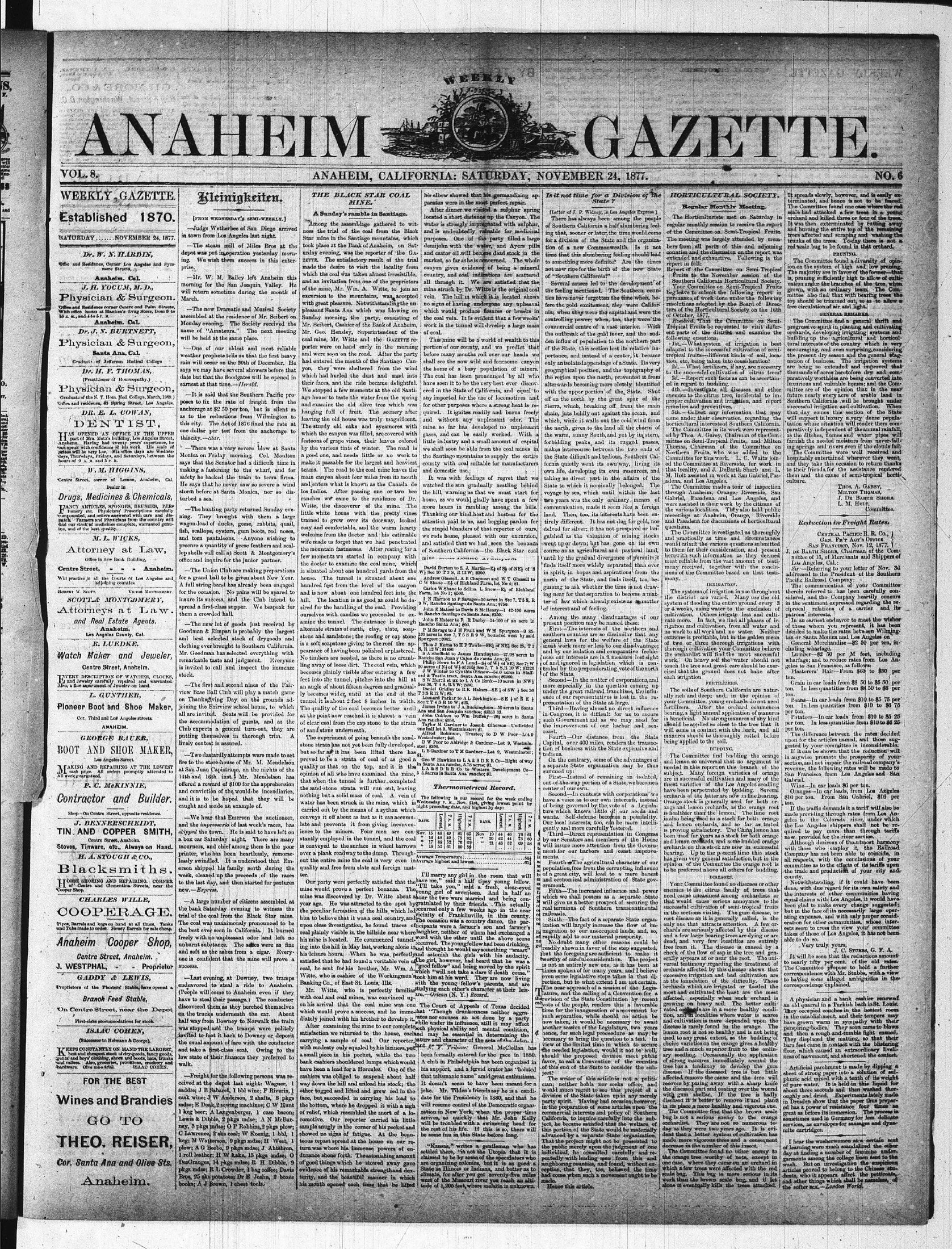
Searchable text
ANAHEIM
VOL. 8.
WEEKLY GAZETTE.
Established 1870.
SATURDAY... NOVEMBER 24, 1877.
Dr. W. N. HARDIN,
Office and Residence, Corner Los Angeles and Rycamore Streets,
Anaheim. Cal.
J. H. YOCUM, M. D.,
Physician & Surgeon.
Office and Residences corner Centre on Palm Streets,
With office hours at Blanken's Drug Store, from 9 to 10 A.M., and 4 to 5 P.M.
Anaheim. Cal.
Dr. J. N. BURTNETT,
Physician & Surgeon,
Santa Ana, Cal.
Graduate of Jefferson Medical College
Dr. H. F. THOMAS,
(Practitioner of Homnopathy.)
Physician & Surgeon,
Graduate of the N.Y.Hom Med College, March, 1860.
Office and residence, 63 Spring Street, Los Angeles.
DR. E. L. COWAN,
DENTIST,
HAS OPENED AN OFFICE IN THE UPPER part of Mrs. Metz's building, Los Angeles Street, Anaheim. Having had twenty years' experience, he can speak with confidence of his work. His scale of practice will be very low. His office days are Wednesdays, Thursdays, Fridays, and Saturdays, between the hours of 9 A.M. and 5 P.R.
Kleinigkeiten.
[FROM WEDNESDAY'S SEMI-WEEKLY.]
-Judge Wetherbee of San Diego arrived in town from Los Angeles last night.
-The steam mill of Miles Bros at the depot was put in operation yesterday morning. We wish them success in this enterprise.
-Mr. W. M. Bailey left Anaheim this morning for the San Joaquin Valley. He will return sometime during the month of March.
-The new Dramatic and Musical Society assembled at the residence of Mr. Seibert on Monday evening. The Society received the name of "Amateurs." The next meeting will be held at the same place.
-One of our oldest and most reliable weather prophets tells us that the first heavy rain will occur on the 20th of December. He says we may have several showers before that date but that the floodgates will be opened in earnest at that time.-Herald.
-It is said that the Southern Pacific proposes to fix the rate of freight from the anchorage at $2.50 per ton, but is silent as to the reductions from Wilmington to this city. The Act of 1876 fixed the rate at one dollar per ton from the anchorage to this city.-Star.
-There was a very severe blow at Santa Monica on Friday morning. Col. Moulton says that the Senator had a difficult time in
Dr. H. F. THOMAS,
(Practitioner of Homoeopathy.)
Physician & Surgeon,
Graduate of the N. Y. Hon. Med College, March, 1860.
Office and residence, 63 Spring Street, Los Angeles.
DR. E. L. COWAN,
DENTIST,
Has opened an office in the Upper part of Mrs. Metta's building, Los Angeles Street, Anaheim. Having had twenty years' experience, he can speak with confidence of his work. His scale of practice will be very low. His office days are Wednesday, Thursdays, Fridays, and Saturdays, between the hours of 9 A.M. and 5 P.R.
W. M. HIGGINS,
Centre Street, corner of Lemon, Anaheim, Cal.
Dealer in Drugs, Medicines & Chemicals,
FANCY ARTICLES, SPONGES, BRUSHES, PERFUMERY etc. Physicians' Prescriptions carefully compoundal, and orders answered with care and dispatch. Farmers and Physicians from the country will find our stock of medicines complete, warranted genuine, and of the best quality.
M. L. WICKS,
Attorney at Law,
Office in new Bank Building,
Centre Street, - - Anaheim.
Will practice in all the Courts of Los Angeles and adjoining counties.
HORNET W. SCOTT.
VICTOR MONTGOMERY.
SCOTT & MONTGOMERY,
Attorneys at Law.
and Real Estate Agents.
Anaheim,
Los Angeles County, Cal.
R. LUEDKE.
Watch Maker and Jeweler,
Centre Street, Anaheim.
EVERY DESCRIPTION OF WATCHES, CLOCKS, and Jewelry carefully repaired and warranted. Also a fine assortment of Jewelry on hand.
L. GUNTHER,
Pioneer Boot and Shoe Maker,
Cor. Third and Los Angeles streets.
ANAHEIM.
GEORGE BAUER,
BOOT AND SHOE MAKER,
Los Angeles Street.
MAKING AND REPAIRING AT THE LOWEST cash price. All orders promptly attended to All work guaranteed.
P. C. McKINNIE,
Contractor and Builder.
Shop—On Centre Street, opposite residence.
J. BENNERSCHEIDT,
TIN AND COPPER SMITH,
Centre Street, Anaheim.
Stoves, Tinware, etc., Always on Hand.
H. A. STOUGH & CO,
Blacksmiths.
HORSE SHOOKING AND REPAIRING CORNER
It is said that the Southern Pacific proposes to fix the rate of freight from the anchorage at $250 per ton, but is silent as to the reductions from Wilmington to this city. The Act of 1876 fixed the rate at one dollar per ton from the anchorage to this city.—Star.
There was a very severe blow at Santa Monica on Friday morning. Col. Montlon says that the Senator had a difficult time in making a fastening to the wharf, and for safety he backed the train to terra firma. He says that he never saw so severe a wind storm before at Santa Monica, nor so disturbed a sea.
The hunting party returned Sunday evening. They brought with them a large wagon-load of ducks, geese, rabbits, quail, fish, scallops, oysters, gum boots, red noses, and torn pantaloons. Anyone wishing to procure a quantity of geese feathers and scallop shells will call at Scott & Montgomery's office and inquire for the junior partner.
The Union Club are making preparations for a grand ball to be given about New Year. A full string band has already been engaged for the occasion. No pains will be spared to insure its success, and the Club intend to spread a first-class supper. We bespeak for them a crowded hall.
The new lot of goods just received by Goodman & Rimpan is probably the largest and best selected stock of drygoods and clothing ever brought to Southern California. Mr. Goodman has selected everything with remarkable taste and judgment. Everyone is invited to call and inspect the immense stock.
The first and second nines of the Fairview Base Ball Club will play a match game on Thanksgiving Day on the grounds adjoinning the Fairview school house, to which all are invited. Seats will be provided for the accommodation of guests, and as the Club expects a general turn-out, they are putting themselves in thorough trim. A lively contest is assured.
Two dastardly attempts were made to set fire to the store-house of Mr. M. Mendelson at San Juan Capistrano, on the nights of the 14th and 16th inat. Mr. Mendelson has offered a reward of $100 for the apprehension and conviction of the would-be incendiaries, and it is to be hoped that they will be caught and made an example of.
We hear that Emerson the auctioneer, and the impressario of last week's races, has skipped the town. He is said to have left on a box car Saturday night. There are many mourners, and chief among them is the poor printer, who has been heartlessly, remorselessly swindled. It is understood that Emerson shipped his family north during the week, cleaned up the proceeds of the races to the last day, and then started for restures we may have several showers before that date but that the floodgates will be opened in earnest at that time.—Herald.
It is said that the Southern Pacific proposes to fix the rate of freight from the anchorage at $250 per ton, but is silent as to the reductions from Wilmington to this city. The Act of 1876 fixed the rate at one dollar per ton from the anchorage to this city.—Star.
There was a very severe blow at Santa Monica on Friday morning. Col. Montlon says that the Senator had a difficult time in making a fastening to the wharf, and for safety he backed the train to terra firma. He says that he never saw so severe a wind storm before at Santa Monica, nor so disturbed a sea.
The hunting party returned Sunday evening. They brought with them a large wagon-load of ducks, geese, rabbits, quail, fish, scallops, oysters, gum boots, red noses, and torn pantaloons. Anyone wishing to procure a quantity of geese feathers and scallop shells will call at Scott & Montgomery's office and inquire for the junior partner.
The Union Club are making preparations for a grand ball to be given about New Year. A full string band has already been engaged for the occasion. No paints will be spared to insure its success, and the Club intend to spread a first-class supper. We bespeak for them a crowded hall.
The new lot of goods just received by Goodman & Rimpan is probably the largest and best selected stock of drygoods and clothing ever brought to Southern California. Mr. Goodman has selected everything with remarkable taste and judgment. Everyone is invited to call and inspect the immense stock.
The first and second nines of the Fairview Base Ball Club will play a match game on Thanksgiving Day on the grounds adjoinning the Fairview school house, to which all are invited. Seats will be provided for the accommodation of guests, and as the Club expects a general turn-out, they are putting themselves in thorough trim. A lively contest is assured.
Two dastardly attempts were made to set fire to the store-house of Mr. M. Mendelson at San Juan Capistrano, on the nights of the 14th and 16th inat. Mr. Mendelson has offered a reward of $100 for the apprehension and conviction of the would-be incendiaries, and it is to be hoped that they will be caught and made an example of.
We hear that Emerson the auctioneer, and the impressario of last week's races, has skipped the town. He is said to have left on a box car Saturday night. There are many mourners, and chief among them is the poor printer, who has been heartlessly, remorselessly swindled. It is understood that Emerson shipped his family north during the week, cleaned up the proceeds of the races to the last day, and then started for restures we may have several showers before that date but that the floodgates will be opened in earnest at that time.—Herald.
It is said that the Southern Pacific proposes to fix the rate of freight from the anchorage at $250 per ton, but is silent as to the reductions from Wilmington to this city. The Act of 1876 fixed the rate at one dollar per ton from the anchorage to this city.—Star.
There was a very severe blow at Santa Monica on Friday morning. Col. Montlon says that the Senator had a difficult time in making a fastening to the wharf, and for safety he backed the train to terra firma. He says that he never saw so severe a wind storm before at Santa Monica, nor so disturbed a sea.
The hunting party returned Sunday evening. They brought with them a large wagon-load of ducks, geese, rabbits, quail, fish, scallops, oysters, gum boots, red noses, and torn pantaloons. Anyone wishing to procure a quantity of geese feathers and scallop shells will call at Scott & Montgomery's office and inquire for the junior partner.
The Union Club are making preparations for a grand ball to be given about New Year. A full string band has already been engaged for the occasion. No paints will be spared to insure its success, and the Club intend to spread a first-class supper. We bespeak for them a crowded hall.
The new lot of goods just received by Goodman & Rimpan is probably the largest and best selected stock of drygoods and clothing ever brought to Southern California. Mr. Goodman has selected everything with remarkable taste and judgment. Everyone is invited to call and inspect the immense stock.
The first and second nines of the Fairview Base Ball Club will play a match game on Thanksgiving Day on the grounds adjoinning the Fairview school house, to which all are invited. Seats will be provided for the accommodation of guests, and as the Club expects a general turn-out, they are putting themselves in thorough trim. A lively contest is assured.
Two dastardly attempts were made to set fire to the store-house of Mr. M. Mendelson at San Juan Capistrano, on the nights of the 14th and 16th inat. Mr. Mendelson has offered a reward of $100 for the apprehension and conviction of the would-be incendiaries, and it is to be hoped that they will be caught and made an example of.
We hear that Emerson the auctioneer, and the impressario of last week's races, has skipped the town. He is said to have left on a box car Saturday night. There are many mourners, and chief among them is the poor printer, who has been heartlessly, remorselessly swindled. It is understood that Emerson shipped his family north during the week, cleaned up the proceeds of the races to the last day, and then started for restures we may have several showers before that date but that the floodgates will be opened in earnest at that time.—Herald.
It is said that the Southern Pacific proposes to fix the rate of freight from the anchorage at $250 per ton, but is silent as to the reductions from Wilmington to this city. The Act of 1876 fixed the rate at one dollar per ton from the anchorage to this city.—Star.
There was a very severe blow at Santa Monica on Friday morning. Col. Montlon says that the Senator had a difficult time in making a fastening to the wharf, and for safety he backed the train to terra firma. He says that he never saw so severe a wind storm before at Santa Monica, nor so disturbed a sea.
The hunting party returned Sunday evening. They brought with them a large wagon-load of ducks, geese, rabbits, quail, fish, scallops, oysters, gum boots, red noses, and torn pantaloons. Anyone wishing to procure a quantity of geese feathers and scallop shells will call at Scott & Montgomery's office and inquire for the junior partner.
The Union Club are making preparations for a grand ball to be given about New Year. A full string band has already been engaged for the occasion. No paints will be spared to insure its success, and the Club intend to spread a first-class supper. We bespeak for them a crowded hall.
The new lot of goods just received by Goodman & Rimpan is probably the largest and best selected stock of drygoods and clothing ever brought to Southern California. Mr. Goodman has selected everything with remarkable taste and judgment. Everyone is invited to call and inspect the immense stock.
The first and second nines of the Fairview Base Ball Club will play a match game on Thanksgiving Day on the grounds adjoinning the Fairview school house, to which all are invited.Seats will be provided forthe accommodationofguests,andastheClubexpectsageneralturn-out,theyareputtedoutbythemconveysitoffaboutafailuretotheminers.stantheymployedintotheinventoriesoftheminers.stantheymployedintotheinventoriesoftheminers.stantheymployedintotheinventoriesoftheminers.stantheymployedintotheinventoriesoftheminers.stantheymployedintotheinventoriesoftheminers.stantheymployedintotheinventoriesoftheminers.stantheymployedintotheinventoriesoftheminers.stantheymployedintotheinventoriesoftheminers.stantheymployedintotheinventoriesoftheminers.stantheymployedintotheinventoriesoftheminers.stantheymployedintotheinventoriesoftheminers.stantheymployedintotheinventoriesoftheminers.stantheymployedintotheinventoriesoftheminers.stantheymployedintotheinventoriesoftheminers.stantheymployedintotheinventoriesoftheminers.stantheymployedintotheinventoriesoftheminers.stantheymployedintotheinventoriesoftheminers.stantheymployedintotheinventoriesoftheminers.stantheymployedintotheinventoriesoftheminers.stantheymployedintotheinventoriesoftheminers.stantheymployedintotheinventoriesoftheminers.stantheymployedintotheinventoriesoftheminers.stantheymployedintotheinventoriesoftheminers.stantheymployedintotheinventoriesoftheminers.stantheymployedintotheinventoriesoftheminers.stantheymployedintotheinventoriesoftheminers.stantheymployedintotheinventoriesoftheminers.stantheymployedintotheinventoriesoftheminers.stantheymployedintotheinventoriesofttheminers.stantheymployedintotheinventoriesofttheminers.stantheymployedintotheinventoriesofttheminers.stantheymployedintotheinventoriesofttheminers.stantheymployedintotheinventoriesofttheminers.stantheymployedintotheinvestmentsofthestainlessnessoftheminers.stantheymployedintotheinvestmentsofthestainlessnessoftheminers.stantheymployedintotheinvestmentsofthestainlessnessoftheminers.stantheymployedintotheinvestmentsofthestainlessnessoftheminers.stantheymployedintotheinvestmentsofthestainlessnessoftheminers.stantheymployedintotheinvestmentsofthestainlessnessoftheminers.stantheymployedintotheinvestmentsofthestainlessnessoftheminers.stantheymployedintotheinvestmentsofthestainlessnessoftheminers.stantheymployedintotheinvestmentsofthestainlessnessoftheminers.stantheymployedintotheinvestmentsofthestainlessnessoftheminers.stantheymployedintotheinvestmentsofthestainlessnessoftheminers.stantheymployedintotheinvestmentsofthestainlessnessoftheminers.stantheymployedintotheinvestmentsofthestainlessnessoftheminers.stantheymployedintotheinvestments ofthestainlessnessoftheminers.stantheymployedintotheinvestments ofthestainlessnessoftheminers.stantheymployed(intotheinvestments ofthestainlessnessoftheminers.stantheymployed(intotheinvestments ofthestainlessnessoftheminers.stanttheymployed(intotheinvestments ofthestainlessnessoftheminers.stanttheymoded(intotheinvestments ofthestainlessnessoftheminers.stanttheymoded(intotheinvestments ofthestainlessnessoftheminers.stanttheymoded(intotheinvestments ofthestainlessnessoftheminers.stanttheymoded(intotheinvestments ofthestainlessnessoftheminers.stanttheymoded(intotheinvestments ofthestainlessnessoftheminers.stanttheymoded(intotheinvestments ofthestainlessnessoftheminers).stanthemode(intotheinvestments ofthestainlessnessoftheminiests(stemade(intotheinvestments ofthestainlessnessoftheminiests(stemade(intotheinvestments ofthestainlessnessoftheminiests(stemade(intotheinvestments ofthestainlessnessoftheminiests(stemade(intotheinvestments ofthestainlessnessoftheminiests(stemade(intotheinvestments ofthestainlessnessoftheminiests(stemade(intotheinvestments ofthestainlessnessoftheminiests(stemade(intotheinvestments ofthestainlessnessoftheminiests(stemade(intotheinvestments ofthestainlessnessoftheminiests(stemade(intotheinvestments ofthestainlessnessoftheminiests(stemade(intotheinvestments ofthestainlessnessoftheminiests(stemade(intotheinvestments ofthestainlessnessoftheminiests(stemade(intotheinvestments ofthestainlessnessoftheminiests(stemade(intotheinvestments ofthestainlessnessoftheminiests(stemade(intotheinvestments ofthestainlessnessoftheminiests(stemade(intotheinvestments ofthestainlessnessoftheminiests(stemade(intotheinvestments ofthestainlessnessoftheminiests(stemade(intotheinvestments ofthestainlessnessoftheminiests(stemade(intotheinvestments ofthestainlessnessoftheminiests(stemade(intothe.investments ofthestainlessnessOfTheMinuteStreet).stemade(intothe.investments OfTheMinuteStreet).stemade(intothe.investments OfTheMinuteStreet).stemade(intothe.investments OfTheMinuteStreet).stemade(intothe.investments OfTheMinuteStreet).stemade(intothe.investments OfTheMinuteStreet).stemade(intothe.investments OfTheMinuteStreet).stemade(intothe.investments OfTheMinuteStreet).stemade(intothesetting).stemade(intothesetting).stemade(intothesetting).stemade(intothesetting).stemade(intothesetting).stemade(intothesetting).stemade(intothesetting).stemade(intothesetting).stemade(intothesetting).stemade(intothesetting).stemade(intothesetting).stemade(intothesetting).stemade(investment).stemade(investment).stemade(investment).stemade(investment).stemade(investment).stemade(investment).stemade(investment).stemade(investment).stemade(investment).stemade(investment).stemade(investment).stemade(investment).stemade(investment).stemade(investment).stemsetting).stemsetting).stemsetting).stemsetting).stemsetting).stemsetting).stemsetting).stemsetting).stemsetting).stemsetting).stemsetting).stemsetting).stemsetting).stemsetting).stemsetting().stemsetting().stemsetting().stemsetting().stemsetting().stemsetting().stemsetting().stemsetting().stemsetting().stemsetting().stemsetting().stemsetting().stemsetting().stemsetting().stemsetting().stemsetting(). stemsetting(). stemsetting(). stemsetting(). stemsetting(). stemsеттing(). stemsеттing(). stemsеттing(). stemsеттing(). stemsеттing(). stemsеттing(). stemsеттing(). stemsеттing(). stemsеттing(). stemsеттing(). stemsеттing(). stemsеттing(). stemsеттing(). stemsеттинг.). stemsеттинг()). stiensеттинг()). stiensеттинг()). stiensеттинг()). stiensеттинг()). stiensеттинг()). stiensеттинг()). stiensеттинг()). stiensеттинг()). stiensеттинг()). stiensеттинг()). stiensеттинг()). stiensеттинг()). stiensеттинг()). stiensеттинг()). stiensеттинг()). stiensеттинг()). стiensеттинг()). стiensеттинг()). стiensеттертистинг()). стiensеттертистинг()). стiensеттертистинг()). стiensеттертистинг()). стiensеттертистинг()). стiensеттертистинг()). стiensеттертистинг()). стienstеттертистинг()). стienstеттертистинг()). стienstеттертистинг()). стienstеттертистинг()). стienstеттертистинг()). стienstеттертистинг()). стienstёттертистинг()). стienstёттертистtring()). стienstёттертистtring()). стienstёттертистtring()). стienstёттертистtring()). стienstёттертистtring()). стienstёттертистtring()). стienstёТертистtring()). СтienstёТертистtring()). СтienstёТертистtring()). СтienstёТертистtring()). СтienstёТертистtring()). СтienstёТертистtring()). СтienstёТертистtring()). СтienstёТертистtring()). СтienstёТертистtring()). СтienstёТертистtring()). СтienstёТертистtring()). СтienstёТертистгiring)). СтienstёТертистгiring)). СтienstёТертистгiring)). СтienstёТертистгiring)). СтienstёТертистгiring)). СтienstёТертистгiring)). СтienstёТертистгiring)). СтienstёТертистгiring)). СтienstёТертистгiring)). СтienstёТертистгiring)). СтienstёТертистгiring)). СтienstёТертистгiring)). СтienstёТермістигiring)). СтienstёТермістигiring)). СтienstёТермістигiring)). СтienstёТермістигiring)). СтienstёТермістигiring)). Стusstёнтестигging)). Стusstёнтестигging)). Стusstёнтестигging]). Стusstёнтестигging)). Стusstёнтестигging)). Стusstёнтестигging)). Стusstёнтестигging)). Стusstёнтестигging)). Стusstёнтестигging)). Стusstёнтестигging)). Стusstёнтестигging)). Стusstёнтестигging)). Стusstёнтестигging }). Стusstёнтестигgging)). Стusstёнтестигgging)). Стusstёнтестигgging')). Стusstёнтестигgging')). Стusstёнтестигgging')). Стusstёнтестигgging')). Стusstёнтестигgging')). Стusstёнтестигgging')). Стusstёнтестигgging')). Стusstёнтестигgging')). Стusstёнтестигgging }). Стusstёнтестигgging }). Стusstёнтестигgging }). Тостянце ). Тостянце ). Тостянце ). Тостянце ). Тостянце ). Тостянце ). Тостянце ). Тостянце ). Тостянце ). Тостянце ). Тостянце ). Тостянце ). Тостянце ). Тостянце ). Тостянце ). Тостянце ). Тостянце ). Тостянце ). Тостянце ). Тстьянце ). Тстьянсе ). Тстьянсе ). Тстьянсе ). Тстьянсе ). Тстьянсе ). Тстьянсе ). Тстьянсе ). Тстьянсе ). Тстьянсе ). Тстьянсе }. Тстьянсе }. Тстьянсе }. Тстьянсе }. Тстьянсе }. Тстьянсе }. Тстьянсе }. Тстьянсе }. Тстьянсе }. Тестьянсе }. Тестьянсе }. Тестьянсе }. Тестьянсе }. Тестьянсе }. Тестьянсе }. Тестьянсе }. Тестьянсе }. Тестьянсе }. Тестьянсе }. Тестьянсе }. Тестьянсе }. Тестьянсе }. Тестьянсе }. Тестьянсе }. Тестьянсе }. Тествие́ ). Тествие́ ). Тествие́ ). Тествие́ ). Тествие́ ). Тествие́ ). Тествие́ ). Тествие́ ). Тествие́ ). Тествие́ ). Тествие́ ). Тествие́ ). Тествие́ ). Тествие́ ). Тествие́ ). Тествие́ ). Тествие́ ). Тествие́ ). Тествие́ ). Тествие́ ). Тествие́ ). Тествие́ ). Теущее́ ). тещеое́ ). тещеое́ /. тещеое́ /. тещеое́ /. тещеое́ /. тещеое́ /. тещеое́ /. тещеое́ /. тещеое́ /. тещеое́ /. тещеое́ /. тещеое́ /. тещеое́ /. тещеое́ /. тещеое́ /. тещеое́ /. тещеое́ /. тещеое́ /. тещеое́ /. тещеое́ /. тещеое́ /. тещеое́ /. тещеое́ /. тещеое́ /. тещеое́ /. тещеое́ /. тежее́ /. тежее́ /. тежее́ /. тежее́ /. тежее́ /. тежее́ /. тежее́ /. тежее́ /. тежее́ /. тежее́ /. тежее́ /. тежее́ /. тежее́ /. тежее́ /. тежее́ /. тежее́ /. тежее́ /. тежее́ /. тестяне '. тестяне '. тест
FOR THE BEST Wines and Brandies GO TO THEO. REISER, Cor. Santa Ana and Olive Sts. Anaheim.
—We hear that Emerson the auctioneer, and the impresario of last week's races, has skipped the town. He is said to have left on a box car Saturday night. There are many mourners, and chief among them is the poor printer, who has been heartlessly remorselessly swindled. It is understood that Emerson shipped his family north during the week, cleaned up the proceeds of the races to the last day, and then started for pastures new. —Express.
—a large number of citizens assembled at the bank Saturday evening to witness the trial of the coal from the Black Star mine. The coal was unanimously pronounced to be the best ever seen in California. It burned freely with no unpleasant odor and left no unburnt substance. The ashes were as fine and soft as the ashes from a cigar. Everyone is confident that the mine will prove a success.
—Last evening, at Downey, two tramps endeavored to steal a ride to Anaheim. (People will come to Anaheim even if they have to steal their passage.) The conductor discovered them as they perched themselves on the trucks underneath the car. About half way from Downey to Norwalk the train was stopped and the tramps were politely invited to foot it back to Downey or deposit the usual amount of fare with the conductor and take a first-class seat. Owing to the low state of their finances they preferred to walk.
—Freight for the following persons was received at the depot last night: Wagner, 1 saddle; J B Sabaret, 1 bbl wine; F Riverin, 1 cask wine; J W Anderson, 2 shafts, 8 pkgs mdse; E Doak, 2 sewing machines; C W Hunt 1 keg beer; A Langenberger, 1 case bacon; Lewis & Dibble, 2 pkgs mdse; A N McBurney, 5 pkgs mdse; O P Robbins, 2 pkgs plow; C Lawrence, 2 sks coal; W Koenig, 1 bbl, 1 keg; M Wattson, 9 pkgs mdse; H West, 1 plew; A G Beebe, 9 pkgs mdse; J Ahtabron, 1 roll leather; H W Lake, 15 pkgs mdse; O DesGranges, 14 pkgs mdse; R H Dibble, 9 pkgs mdse; R L Crowder, 1 bag coffee; Davis Bros., 25 sks potatoes; Dr E Joslin, 2 boxes books; A J Brown, 1 chest tools.
WEEKLY
EIM GAZETTE
ANAHEIM, CALIFORNIA: SATURDAY, NOVEMBER 24, 1877.
THE BLACK STAR COAL MINE.
A Sunday's ramble in Santiago.
Among the assemblage gathered to witness the trial of the coal from the Black Star mine in the Santiago mountains, which took place at the Bank of Anaheim, on Saturday evening, was the reporter of the Gazette. The satisfactory result of the trial made the desire to visit the locality from which the coal was taken almost irresistible, and an invitation from one of the proprietors of the mine, Mr. Wm. A. Witte, to join an excursion to the mountains, was accepted with great pleasure. Notwithstanding the unpleasant Santa Ana which was blowing on Sunday morning, the party, consisting of Mr. Seibert, Cashier of the Bank of Anaheim, Mr. Geo. Hensley, Superintendent of the coal mine, Mr. Witte and the Gazette reporter were on hand early in the morning and were soon on the road. After the party had entered the mouth of the Santiago Canyon, they were sheltered from the wind which had hurled the dust and sand into their faces, and the ride became delightful. We stopped a few moments at the old Santiago house to taste the water from the spring and examine the old olive tree which was hanging full of fruit. The scenery after leaving the old house was truly magnificent. The sturdy old oaks and sycamores with which the canyon was filled, are covered with festoons of grape vines, their leaves colored by the various tints of winter. The road is a good one, and needs little or no work to make it passable for the largest and heaviest his elbow showed that his gormandizing apparatus were in the most perfect repair.
After dinner we visited a sulphur spring located a short distance up the Canyon. The water is strongly impregnated with sulphur, and is undoubtedly valuable for medicinal purposes. One of the party filled a large demijohn with the water, and Ayers pills and castor oil will become dead stock in the market, so far as he is concerned. The whole canyon gives evidence of being a mineral country, and coal indications are scattered all through it. We are satisfied that the mine struck by Dr. Witte is the original coal vein. The hill in which it is located shows no signs of having undergone any upheaval which would produce features or breaks in the coal vein. It is evident that a few weeks' work in the tunnel will develop a large mass of coal.
This mine will be a world of wealth to this portion of our county, and we predict that before many months roll over our heads we shall see the now wild and lonely canyon home of a busy population of miners. The coal has been pronounced by all who have seen it to be the very best ever discovered in the State of California, and equal to any imported for the use of locomotives and for other purposes where a strong heat is required. It ignites readily and burns freely and without any unpleasant odor. The mine so far has developed no unpleasant gases, and can be easily worked. With a little industry and a small amount of capital we shall soon be able from the coal mines in the Santiago mountains to supply the entire county with coal suitable for manufacturers.
Is it not time for a Division of the State?
[Letter of J. P. Wildney, in Los Angeles Express]
There has always been among the people of Southern California a half slumbering feeling that, sooner or later, the time would come for a division of the State and the organization of a new Commonwealth. Is it not time that this slumbering feeling should lead to something more definite? Are the times not now ripe for the birth of the new State of "Southern California?"
Several causes led to the development of the feeling mentioned. The Southern counties have never forgotten the time when, before the gold excitement, they were California; when they were the capital and were the controlling power; when, too, they were the commercial centre of a vast interior. With the outbreak of the gold fever, and the sudden influx of population to the northern part of the State, this section lost its relative importance, and instead of a center, it became only an isolated appendage of a State. Its very geographical position, and the topography of the region upon the north, prevented it from afterwards becoming more closely identified with the upper portion of the State. Shut off on the north by the great spur of the Sierra, which breaking off from the main chain, juts boldly out against the ocean, and which, while it walls out the cold wind from the north, gives to the land all the charm of the warm, sunny South, and yet by its stern, forbidding peaks and its rugged passes, makes intercourse between the two ends of the State difficult and tedious, Southern California quietly went its own way, living its
Santa
oulton
time in
and for
firma.
wind
to distract
by
largest
quail,
noses,
being to
scald
memory's
Year.
engaged
to and
toak for
by
largest
and
noses,
being to
scald
memory's
Year.
engaged
to and
toak for
by the largest and heaviest teams.
The road to the coal mine leaves the main canyon about four miles from its mouth and enters what is known as the Canada de los Indios. After passing one or two bee ranches we came to the residence of Dr. Witte, the discoverer of the mine. The little white house with the pretty vines trained to grow over its doorway, looked cozy and comfortable, and the warm hearty welcome from the doctor and his estimable wife made us forget that we had penetrated the mountain fastnesses. After resting for a few moments we started in company with the doctor to examine the coal mine, which is situated about one hundred yards from the house. The tunnel is situated about one hundred feet from the level of the canyon and is now about one hundred feet into the hill. The location is as good as could be desired for the handling of the coal. Providing ourselves with candles we proceeded to examine the tunnel. The entrance is through alternate stratas of earth, clay, slate, soapstone and sandstone; the roofing or cap stone is a soft soapstone giving to the roof the appearance of having been polished or plastered. No timbers are needed, as there is no crumbling away of loose dirt. The coal vein, which becomes plainly visible after entering a few feet into the tunnel, pitches into the hill at an angle of about fifteen degrees and gradually becomes wider, until at the end of the tunnel it is about 2 feet 8 inches in width. The quality of the coal becomes better until at the point now reached it is almost a vein of clear coal from the cap stone to the strata of sand stone underneath.
The experiment of going beneath the sand-stone strata has not yet been fully developed, but so far as it has been lifted there has proved to be a strata of coal of as good a quality as that on the top, and it is the opinion of all who have examined the mine, that when the tunnel is further completed the sand-stone strata will run out, leaving nothing but a solid mass of coal. A vein of water has been struck in the mine, which is carried out by the means of a sython which conveys it off about as fast as it can accumulate and prevents it from giving inconvenience to the miners. Four men are constantly employed in the tunnel, and the coal is conveyed to the surface in wheel barrows over a plank roadway to the dump. Throughout the entire mine the coal is very even in quality and free from slate and foreign matter.
Our party were perfectly satisfied that they were sheltered from the wind which had hurled the dust and sand into their faces, and the ride became delightful. We stopped a few moments at the old Santiago house to taste the water from the spring and examine the old olive tree which was hanging full of fruit. The scenery after leaving the old house was truly magnificent. The sturdy old oaks and sycamores with which the canyon was filled, are covered with festoons of grape vines, their leaves colored by the various tints of winter. The road is a good one, and needs little or no work to make it passable for the largest and heaviest teams. The road to the coal mine leaves the main canyon about four miles from its mouth and enters what is known as the Canada de los Indios. After passing one or two bee ranches we came to the residence of Dr. Witte, the discoverer of the mine. The little white house with the pretty vines trained to grow over its doorway, looked cozy and comfortable, and the warm hearty welcome from the doctor and his estimable wife made us forget that we had penetrated the mountain fastnesses. After resting for a few moments we started in company with the doctor to examine the coal mine, which is situated about one hundred yards from the house. The tunnel is situated about one hundred feet from the level of the canyon and is now about one hundred feet into the hill. The location is as good as could be desired for the handling of the coal. Providing ourselves with candles we proceeded to examine the tunnel. The entrance is through alternate stratas of earth, clay, slate, soapstone and sandstone; the roofing or cap stone is a soft soapstone giving to the roof the appearance of having been polished or plastered. No timbers are needed, as there is no crumbling away of loose dirt. The coal vein, which becomes plainly visible after entering a few feet into the tunnel, pitches into the hill at an angle of about fifteen degrees and gradually becomes wider, until at the end of the tunnel it is about 2 feet 8 inches in width. The quality of the coal becomes better until at the point now reached it is almost a vein of clear coal from the cap stone to the strata of sand stone underneath.
The experiment of going beneath the sand-stone strata has not yet been fully developed, but so far as it has been lifted there has proved to be a strata of coal of as good a quality as that on the top, and it is the opinion of all who have examined the mine, that when the tunnel is further completed the sand-stone strata will run out, leaving nothing but a solid mass of coal. A vein of water has been struck in the mine, which is carried out by the means of a sython which conveys it off about as fast as it can accumulate and prevents it from giving inconvenience to the miners. Four men are constantly employed in the tunnel, and the coal is conveyed to the surface in wheel barrows over a plank roadway to the dump. Throughout the entire mine the coal is very even in quality and free from slate and foreign matter.
I'll marry any girl in the room that will have me," said a half tinny young fellow.
The coal has been pronounced by all who have seen it to be the very best ever discovered in the State of California, and equal to any imported for use of locomotives and for other purposes where a strong heat is required. It ignites readily and burns freely and without any unpleasant odor. The mine so far has developed no unpleasant gases, and can be easily worked. With a little industry and a small amount of capital we shall soon be able from the coal mines in the Santiago mountains to supply the entire county with coal suitable for manufacturers and domestic use.
It was with feelings of regret that we watched sun gradually nestling behind the hill, warning us that we must start for home, as we would glally have spent a few more hours in rambling among the hills. Thanking our kind host and hostess for the attention paid to us, and begging pardon for the stupid blunders of that reporter of ours, we rode home, pleased with our excursion, and satisfied that we had seen the bonanza of Southern California—the Black Star coal mine—in Rancho Santiago de Santa Ana; $150.
John E Matere to Davis S McHenry-1 42-100 acres in Rancho Santiago de Santa Ana; $150.
John E Matere to R. R Darby-54-100 of an acre in Rancho Santa Ana; $60.
P M Savage to J H Fruit and W H Spurgeon-9 85-100 acres in Sec 7, T 5 R 9 W, bounded west by said Spurgeon; $822.
Thos J Kerns to H P Towle-SE of NE See 25, T 3 S,R 12 W; $1400.
S A Sheffield to James Huntington-27.98 acres in Rancho San Juan y Calon de Santa Ana; $1.
Phipho Howe to F A Lund-84 of W of SE See 7; W 20 acres of N of W of SE See 7, T 5 S,R 10 W; $1320
Jon Winter to Cynthia O Snow-54.6 acres in Stafford & Trustin tract, Santa Ana ranch; $6000.
S W Morill et ut xu L A Coank-10 acres in NW See 30, T 4 S,R 9 W; $490.
Daniel Grullet to R R Haines-SE of SW See 30 T 3 S,R 12 W; $8.
Leonard Parker to AL Beckington-SE of SE See 2 T 4 S,R 10 W; $25.
James Irvine to J A Buckingham-50 acres in Santa Ana and San Josequin ranchos; $3233 S3.
Jon Winderbob to Wm Buffsky-20 acres in Santa Ana ranchos.
Taylor M Gardner to Joseph Giberson-Undivided one half lot, Westminster; $1.
Alfred Robbins, Trustee, to D W Poor-Lot 9 Westminster; $400.
D W Poor to Aldridge & Gardner-Lot 9, Westminster; $300.
L B Gardner to TM Gardner-Let 9, Westminster; $1.
Geo W Hawkins to L A & S D R R Co-Bight way in Santa Ana rancho; $5.78 acres; $1.
L A & S D R R Co-to Western Development Co-5.5acres in Santa Ana rancho; $1.
Thermometrical Record.
The following is our record for the week ending Wednesday p.m., Nov. 21st, giving lowest point by night preceding date, and highest by day:
DATE Lowest High Highest Date Lowest High Highest Date Lowest High Highest Date Lowest High Highest Date Lowest High Highest Date Lowest High Highest Date Lowest High Highest Date Lowest High Highest Date Lowest High Highest Date Lowest High Highest Date Lowest High Highest Date Lowest High Highest Date Lowest High Highest Date Lowest High Highest Date Lowest High Highest Date Lowest High Highest Date Lowest High Highest Date Lowest High Highest Date Lowest High Highest Date Lowest High Highest Date Lowest High Highest Date Lowest High Highest Date Lowest High Highest Date Lowest High Highest Date Lowest High Highest Date Lowest High Highest Date Lowest High Highest Date Lowest High Highest Date Lowest High Highest Date Lowest High Highest Date Lowest High Highest Date Lowest High Highest Date Lowest High Highest Date Lowest High Highest Date Lowest High Highest Date Lowest High Highest Date Lowest High Highest Date Lowest High Highest Date Lowest High Highest Date Lowest High Highest Date Lowest High Highest Date Lowest High Highest Date Lowest High Highest Date Lowest High Highest Date Lowest High Highest Date Lowest High Highest Date Lowest High Highest Date Lowest High Highest Date Lowest High Highest Date Lowest High Highest Date Lowest High Highest Date Lowest High Highest Date Lowest High Highest Date Lowest High Highest Date Lowest High Highest Date Lowest High Highest Date Lowest High Highest Date Lowest High Highest Date Lowest High Highest Date Lowest High Highest Date Lowest High HighestDateLowestHighHighHighHighHighHighHighHighHighHighHighHighHighHighHighHighHighHighHighHighHighHighHighHighHighHighHighHighHighHighHighHighHighHighHighHighHighHighHighHighHighHighHighHighHighHighHighHighHighHighHighHighHighHighHighHighHighHighHighHighHighHighHighHighHighHighHighHighHighHighHighHighHighHighHighHighHighHighHighHighHighHighHighHighHighHighHighHighHighHighHighHighHighHigh highhighhighhighhighhighhighhighhighhighhighhighhighhighhighhighhighhighhighhighhighhighhighhighhighhighhighhighhighhighhighhighhighhighhighhighhighhighhighhighhighhighhighhighhighhighhighhighhighhighhighhighhighhighhighhighhighhighhighhighhighhighhighhighhighhighhighhighhighhighhigh high high high high high high high high high high high high high high high high high high high high high high high high high high high high high high high high high high high high high high high high high high high high high high high high high high high high high high high high high high high high high high high high high high high high high high high high高高高高高高高高高高高高高高高高高高高高高高高高高高高高高高高高高高高高高高高高高高高高高高高高高高高高高高高高高高高高高高高高高高高高高高高高高高高高高高高高高高高高高高高高高高高高高 高 高 高 高 高 高 高 高 高 高 高 高 高 高 高 高 高 高 高 高 高 高 高 高 高 高 高 高 高 高 高 高 高 高 高 高 高 高 高 高 高 高 高 高 高 高 高 高 高 高 高 高 高 高 高 高 高 高 高 高 高 高 高 高 高 高 高 高 高 高,高,高,高,高,高,高,高,高,高,高,高,高,高,高,高,高,高,高,高,高,高,高,高,高,高,高,高,高,高,高,高,高,高,高,高。高,高,高,高,高、高,高,高、高,高、高,高、高、高、高、高、高、高、高、高、高、高、高、高、高、高、高、高、高、高、高、高、高、高、高、高、高、高、高、高、高、高、高、高、高、高、高、高、高、高、高、高、高、高、高、高、高、高、高、高、高、高、
Four men are constantly employed in the tunnel, and the coal is conveyed to the surface in wheel barrows over a plank roadway to the dump. Throughout the entire mine the coal is very even in quality and free from slate and foreign matter.
Our party were perfectly satisfied that they have met with you," said a half tinny young fellow.
David Burton to S.J Martin-E] of S.]of NE] of S.W]See 10 T 3 S,R 12 W; $300.
Andrew Glassell, A B Chapman and W T Glassell to C W Shane-E] of Richland Farm, lot No 4; $91.
Carlos W Shane to Selina L Snow-E] of Richland Farm, lot No 1; $600.
I N Harmon to P Savage-10 acres in Sec 7, T 5 S,R 9 W; $500.
John E Matere to Davis S McHenry-1 42-100 acres in Rancho Santiago de Santa Ana; $150.
John E Matere to R. R Darby-54-100 of an acre in Rancho Santiago de Santa Ana; $60.
John E Matere to AL Beckington-SE of SE See 25,T 3 S,R 12 W; $1400.
S A Sheffield to James Huntington-27.98 acres in Rancho San Juan y Calon de Santa Ana; $1.
Phipho Howe to F A Lund-84 of W of SE See 7,T 5 S,R 10 W; $1320
Jon Winter to Cynthia O Snow-54.6 acres in Stafford & Trustin tract,Santa Ana rancho;$6000.
S W Morill et ut xu L A Coank-10 acres in NW See 30,T 4 S,R 9 W; $490.
Daniel Grullet to R R Haines-SE of SW See 30 T 3 S,R 12 W; $8.
Leonard Parker to AL Beckington-SE of SE See 25,T 3 S,R 12 W; $1400.
S A Sheffield to James Huntington-27.98 acres in Rancho San Juan y Calon de Santa Ana; $1.
Phipho Howe to F A Lund-84 of W of SE See 7,T 5 S,R 10 W; $1320
Jon Winter to Cynthia O Snow-54.6 acres in Stafford & Trustin tract,Santa Ana rancho;$6000.
S W Morill et ut xu L A Coank-10 acres in NW See 30,T 4 S,R 9 W; $490.
Daniel Grullet to R R Haines-SE of SW See 30 T 3 S,R 12 W; $8.
Leonard Parker to AL Beckington-SE of SE See 25,T 3 S,R 12 W; $1400.
S A Sheffield to James Huntington-27.98 acres in Rancho San Juan y Calon de Santa Ana; $1.
Phipho Howe to F A Lund-84 of W of SE See 7,T 5 S,R 10 W; $1320
Jon Winter to Cynthia O Snow-54.6 acres in Stafford & Trustin tract,Santa Ana rancho;$6000.
S W Morill et ut xu L A Coank-10 acres in NW See 30,T 4 S,R 9 W; $490.
Daniel Grullet to R R Haines-SE of SW See 30 T 3 S,R 12 W; $8.
Leonard Parker to AL Beckington-SE of SE See 25,T 3 S,R 12 W; $1400.
S A Sheffield to James Huntington-27.98 acres in Rancho San Juan y Calon de Santa Ana; $1.
Phipho Howe to F A Lund-84 of W of SE See 7,T 5 S,R 10 W; $1320
Jon Winter to Cynthia O Snow-54.6 acres in Stafford & Trustin tract,Santa Ana rancho;$6000.
S W Morill et ut xu L A Coank-10 acres in NW See 30,T 4 S,R 9 W; $490.
Daniel Grullet to R R Haines-SE of SW See 30 T 3 S,R 12 W; $8.
Leonard Parker to AL Beckington-SE of SE See 25,T 3 S,R 12 W; $1400.
S A Sheffield to James Huntington-27.98 acres in Rancho San Juan y Calon de Santa Ana; $1.
Phipho Howe to F A Lund-84 of W of SE See 7,T 5 S,R 10 W; $1320
Jon Winter to Cynthia O Snow-54.6 acres in Stafford & Trustin tract,Santa Ana rancho;$6000.
S W Morill et ut xu L A Coank-10 acres in NW See 30,T 4 S,R 9 W; $490.
Daniel Grullet to R R Haines-SE of SW See 30 T 3 S,R 12 W; $8.
Leonard Parker to AL Beckington-SE of SE See 25,T 3 S,R 12 W; $1400.
S A Sheffield to James Huntington-27.98 acres in Rancho San Juan y Calon de Santa Ana; $1.
Phipho Howe to F A Lund-84 of W of SE See 7,T 5 S,R 10 W; $1320
Jon Winter to Cynthia O Snow-54.6 acres in Stafford & Trustin tract,Santa Ana rancho;$6000.
S W Morill et ut xu L A Coank-10 acres in NW See 30,T 4 S,R 9 W; $490.
Daniel Grulletto R R Haines-SE OF SW See
the sand-stone strata will run out, leaving nothing but a solid mass of coal. A vein of water has been struck in the mine, which is carried out by the means of a sython which conveys it off about as fast as it can accumulate and prevents it from giving inconvenience to the miners. Four men are constantly employed in the tunnel, and the coal is conveyed to the surface in wheel barrows over a plank roadway to the dump. Throughout the entire mine the coal is very even in quality and free from slate and foreign matter.
Our party were perfectly satisfied that the mine would prove a perfect bonanza. The mine was discovered by Dr. Witte about year ago. He was attracted to the spot by the peculiar formation of the hills which led him to believe that it was a coal country, and upon close investigation, he found traces of coal plainly visible in the hillside near where his mine is located. He commenced tunneling into the hill in May last, working alone in his leisure hours. When he was perfectly satisfied that he had found a veritable vein of coal, he sent for his brother, Mr. Wm. A. Witte, who is cashier of the Workingmen Banking Co., of East St. Louis, Ills.
Mr. Witte, who is perfectly familiar with coal and coal mines, was convinced upon his arrival that the coal mine was one which would prove a success, and he immediately joined with his brother to develop it.
After examining the mine to our complete satisfaction we returned to the house, each carrying a sample of coal. Our reporter with modesty only equaled by his laziness, pre-a small piece in his pocket, while the two bank cashiers shouldered lumps which would have been a load for a Hercules. One of the cashiers was obliged to suspend about half way down the hill and unload his stock; the other tugged and lifted and grew red in the face, but succeeded in carrying his load to the bottom, where he dropped it with a sigh of relief, which resembled the snort of a locomotive. Our reporter carried his little sample anugly in the corner of his pocket and showed no signs of fatigue. At the bounteous repast spread at the house on our return was where his immense powers of endurance shone forth. The astonishing amount of good things which he stowed away gave evidence of his remarkable strength and dexterity, and the beautiful manner in which his mouth opened each time that he lifted
"I'll marry any girl in the room that will have me," said a half tipsy young fellow. "I'll take you," said a fresh, clear-eyed young girl of seventeen. And in half an hour the two were married and being congratulated by their friends. This actually occurred only a few weeks ago in the near vicinity of Franklinville, in this county. The occasion was a country dance, the participants were a farmer's son and farmer's daughter, neither of whom had exchanged a word with the other until the above scene occurred. The young fellow had been drinking and thought he would say something "smart" and astonish the girls with his audacity. The girl, however, had heard that he was a "good fellow" and being moved by the spirit which "will not take a dare if death come." took him at his word. They are now living with the young fellow's parents, and are studying each other's character at their leisure.
Orlean (N.Y.) Record.
The Court of Appeals of Texas decided that "Though drunkenness neither aggravates nor excuses an act done by a party under its influence, still it may affect both physical ability and mental condition, and may be essential in determining the nature and character of the acts of the defendant."
Kansas," writes a gentleman who has settled there, "is not the Utopia that it is claimed to be by some of the speculators who are organizing colonies, but it is as good a State as Illinois or Indiana, and better as to climate, for after you get seventy-five miles west of the Missouri river you reach an altitude of 1,205 feet, where malaria is unknown.
Second—In contests with corporations we have a voice as to our own interests, instead of being governed by the vote of a Legislature which knows little of our needs and wants. Self-defense becomes a possibility. Our local interests; too, can be more intelligently and more carefully fostered.
Third—Direct representation in Congress by our Senators and members of the House will insure more attention from the Government for our harbors and coast improvements.
Fourth—The agricultural character of our population, free from the corrupting influence of a great city, will lead to a more honest and economical administration of State government.
Fifth—The increased influence and power which we shall possess as a separate State will give us a better prospect of securing the real terminus of Southern transcontinental railroads.
Sixth—The fact of a separate State organization will largely increase the flow of immigration to our unoccupied lands, and so, rapidly add to our material prosperity.
No doubt many other reasons could be readily shown in favor of the step suggested, but the foregoing are sufficient to make it sworthy of careful consideration. The project is not an entirely new one, as it has been at times spoken of for many years, and I believe even some legislative steps taken in that direction, but to what extent I am not certain. The near approach of a session of the Legislature, and the calling of a Convention for a revision of the State Constitution by recent vote of the people, renders this a favorable time for the inauguration of a movement for such separation, while should no action be now taken; it would be necessary to await another session of the Legislature, two years hence, for such legal procedure as may be necessary to bring the question to a test. In view of the limited time in which to secure the needed legislation, would it not be well, should the proposed division meet public favor, to call a Convention of the counties of this end of the State to consider the subject?
The writer of this article is not a politician; neither holds nor seeks office; and would much regret to see this project of a division of the State taken up in any merely party spirit. Having had occasion, however, in the preparation of some articles upon the commercial interests and policy of Southern California, to inquire carefully into the subject, he became satisfied that the welfare of this portion of the State would be materially advanced by a separate State organization. That the projects might not be presented to the public merely upon the judgment of one individual, he consulted carefully and repeatedly with leading men from this and neighboring counties, and found, without exception, that they, too, believed the time had come when such a movement ought to be made.
Hence this article.
GAZETTE.
R. 24, 1877.
HORTICULTURAL SOCIETY.
Regular Monthly Meeting.
The Horticulturists met on Saturday in regular monthly session to receive the report of the Committee on Semi-Tropical Fruits. The meeting was largely attended by members from all parts of this and adjoining counties and the discussion on the report was extended and exhaustive. Following is the report in full:
Report of the Committee on Semi-Tropical Fruits to the November session of the Southern California Horticultural Society.
Your Committee on Semi-Tropical Fruits beg leave to submit the following report in persistence of work done under the following resolutions adopted by the Board of Directors of the Horticultural Society on the 16th of October, 1877.
Resolved, "That the Committee on Semi-Tropical Fruits be requested to visit different parts of the district and examine the following questions:
1st. What system of irrigation is best adapted to the successful cultivation of semitropical fruits—different kinds of soil, location, etc., being taken into consideration?
2nd. What fertilizers, if any, are necessary to the successful cultivation of citrus trees?
3rd. Report such facts as can be ascertained in regard to budding.
4th. Investigate all diseases and other enemies to the citrus tree, incidental to improper cultivation and irrigation, and report remedies and preventives.
5th. Collect any information that may come under their observation regarding the horticultural interests of Southern California.
The Committee in its work were represented by Thoa A. Garey, Chairman of the Committee on Semi-Tropical Fruits, and Milton Thomas, Chairman of the Committee on Northern Fruits, who was added to the Committee for this work. L. C. Waite joined the Committee at Riverside, for work in
It spreads slowly, however, and is easily terminated, and hence is not to be feared. The Committee found one case where the red scale had attacked a few trees in a young orchard and killed three or four of the trees. It was then exterminated by cutting away and burning the entire top of the remaining trees affected and scraping and washing the trunks of the trees. To-day there is not a red scale bug to be found in that orchard.
PRUNING.
The Committee found a diversity of opinion on the system of high and low pruning. The majority are in favor of the former—that is, pruning sufficiently high to allow cultivation under the branches of the tree when grown, with an ordinary team. The Committee also find that with bearing trees the top should be trimmed out, so as to allow a free circulation of air and light.
GENERAL REMARKS.
The Committee find a general thrift and progressive spirit in planting and cultivating orchards, developing irrigating systems and building up the agricultural and horticultural interests of the country which is very encouraging, and even surprising considering the present dry season and the general magnation of business. The irrigation systems are being so extended and improved that thousands of acres harotofore dry and comparatively worthless are being converted into luxurious and valuable homes; and the Committee are of the opinion that in the near future nearly every acre of arable land in Southern California will be brought under successful irrigation and cultivation. When that day comes this section of the State will support in luxury a very dense population whose situation will render them comparatively independent of the annual rainfall, as the ditches, flumes and water pipes will furnish the needed moisture from never-falling springs and rivers even if the clouds fail.
The Committee were well received and hospitably entertained wherever they went, and they take this occasion to return thanks.
The great spur of the mining off from the main against the ocean, and out the cold wind from the hand all the charm of earth, and yet by its stern, and its rugged passes, between the two ends of seduous, Southern Californias own way, living its own resources, and not in the affairs of the criminally belonged. The until within the last only ordinary means of mine it seem like a foreign interest have been ennobled has not dug for gold, nor has not prospered or landed on mining stocks that has gone on its own natural and pastoral land, divergence of pursuits it merely separated than ever and aspirations from the land finds itself, too, beber the time is not drawn to become a material exists as matter ruling.
disadvantages of our be named these; facts of the northern and so dissimilar that any welfare of the State less to our disadvantage; and comparative feeble in a measure lost sight of which is considerable vote of the north matter of corporations, and the question coming up road franchises, the influences is lost in the retate at large. Most no direct influence difficult for us to secure as we may need for our harbor and seaance from the State does, renders the transacce the State expensive and some of the advantages of organization may be thus remaining an isolated town of a State, we become with corporations we own interests, instead the vote of a Legislature of our needs and becomes a possibility. So can be more intelligently fostered. Preservation in Congress members of the House mention from the Governors and coast improve cultural character of our corrupting influence lead to a more honest administration of State governors.
What to citizens, if any, are necessary to the successful cultivation of citrus trees? 3d.—Report such facts as can be ascertained in regard to building.
4th.—Investigate all diseases and other enemies to the citrus tree, incidental to improper cultivation and irrigation, and report remedies and preventives.
5th.—Collect any information that may come under their observation regarding the horticultural interests of Southern California.
The Committee in its work were represented by Thos. A. Garey, Chairman of the Committee on Semi-Tropical Fruits, and Milton Thomas, Chairman of the Committee on Northern Fruits, who was added to the Committee for this work. L. C. Waite joined the Committee at Riverside, for work in that locality, and J. DeEarth Shorb and L. M. Holt assisted in work at San Gabriel, Pasadena, and Los Angeles.
The Committee made a tour of inspection through Anaheim, Orange, Riverside, San Gabriel, Pasadena and Los Angeles, and were assisted in their work by the citizens of the various localities. They also held public meetings at Anaheim, Orange, Riverside and Pasadena for discussions of horticultural questions.
The Committee investigated as thoroughly and practically as time and circumstances would admit the various questions submitted to them for their consideration, and present herewith such information as they deemed most reliable from the vast amount of testimony received, together with the conclusions of the Committee based on that testimony.
IRRIGATION.
The systems of irrigation in use throughout the district are varied. Many use the old system of flooding the entire ground every 3 or 4 weeks, using water to the exclusion of cultivation. Others irrigate less and cultivate more. In fact, we find all phases of irrigation and cultivation, from all water and no work to all work and no water. Neither extreme is profitable, but in the golden mean of two or three thorough irrigations with thorough cultivation your Committee believe the orchardist will find the most successful work. On heavy soil the water should not touch the tree and great care should be exercised that the ground does not bake after each irrigation.
PERTILIZERS.
The soils of Southern California are naturally rich and deep; and, in the opinion of your Committee, young orchards do not need fertilizers. After the orchard commences bearing a light annual application of manures is beneficial. No strong manures of any kind should be applied so close to the tree that it will come in contact with the bark, and all manures should be thoroughly rotted before being applied to the soil.
BUDDING.
The Committee find budding the orange and lemon so universal that no argument is needed in this report on this branch of the subject. Many foreign varieties of orange are in successful cultivation and many of the finest varieties of the Los Angeles escolling have been perpetrated by budding. Several orchards of the latter are now in fine bearing. Orange stock is generally used for both orange and lemon orchards, as the orange root is healthier than the lemon. The lime root is also being used as a stock for both orange and lemon orchards, and so far as tested is proving satisfactory. The Chin lemon has been used for years as a stock for both orange and lemon orchards, and some budded orange orchards on this stock are now in successful bearing. Up to the present time this stock has given very general satisfaction, but in the opinion of the Committee the orange root is to be preferred above all others for budding.
DISSEASES.
Your Committee found no diseases or other enemies to the citrus family of trees that need cause uncasiness among orchardists or that would cause serious annoyance to the successful cultivation of semi-tropical fruits in the sections visited. The gum disease, or root disease as it is generally called, is the only one that attracts attention. A few orchards are seriously affected by this disease and a few large bearing trees are dying or are dead, and very few localities are entirely free from it. The disease is caused by a check of the flow of sap in the tree and generally appears at or near the root. The universal testimony regarding the treatment of orchards affected by this disease shows that excessive irrigation and bad cultivation are at the foundation of the difficulty. Those orchards which are irrigated or flooded the most and cultivated the least are the most affected, especially when such orchard is growing on heavy soil. The better cultivated orchards are in a more healthy condition, and in localities where water is scarce and cultivation is more depended upon the disease is rarely found in the orange. The lemon root is not so healthy and is not being used to any great extent, as the budding of choice varieties on the orange gives a healthy tree and a much superior fruit to the ordinary seedling. Occasionally the application of strong manures immediately around the tree has a tendency to develop the gum disease. If the diseased tree is but little affected, remove the cause and the tree will recover by paring away with a sharp knife the diseased part and coating over the wound with gum shellac. If the tree is badly diseased it is better to remove it and plant in its place a more healthy and vigorous one.
The Committee find that the brown scale bug is not a serious enemy to the orange orchardist. They are not so numerous today as they were two years ago. It is evident that a better system of cultivation has made more vigorous trees and a consequent decrease in the number of this insect.
The Committee found no other enemy to the orange tree worthy of note, except in one case, where they came on an orchard in which a few trees were affected with the red scale bug. This bug is more serious in its work than the brown scale bug, and if let alone it eventually kills the trees attacked.
Wine—In car loads $6 per ton.
Oranges—In car loads, from Los Angeles $10 per ton. From San Gabriel, $10 per ton.
If the traffic demands it a tariff will also be made providing through rates from Los Angeles to the Colorado river, under which the Los Angeles shippers shall not be required to pay more than through tariffs now provided for the river service.
Although desirous of the utmost harmony with those who employ it, the Railroad Company has not been able to coincide, in all respects, with the conclusions of your committee as to the effects of its tariffs upon the trade and production of your city and county.
Notwithstanding, if it could have been done, with due regard for its own safety and the interests of other communities having equal claims with Los Angeles, it would have glad to make every change suggested; but in the face of its necessarily large operating expenses, and with only proper consideration for other communities, whose interests seem to cross the view your committee takes of those of Los Angeles, it has not been able to do so.
Very truly yours,
J. C. Sturks, G. F. A.
It will be seen that the reductions amount to nearly fifty per cent. of the old rates. The Committee propose to hold a further correspondence with Mr. Stubbs, with a view to having some alleged ambiguities in the correspondence explained.
A physician and a bank cashier renewed an old quarrel in a Turkish bath in St. Louis. They occupied couches in the bestest room in the establishment, and their tempers may have grown warm in sympathy with their peripring bodies. They soon came to blows and then a rough-and-tumble fight ensued. They displaced the matting, so that their bare feet came in contact with the blistering floor, which caused an extraordinary liveliness of movement, and shortened the contest.
Artificial parchment is made by dipping a sheet of strong paper into a solution of sulphuric acid mixed with a tenth of its weight of pure water. It is held in this liquid for about three seconds and then washed thoroughly and dried. Experiments later made in Dresden show that the paper thus prepared has a power of resistance four times as great as before its immersion. The process is sometimes used in Germany for less delicate services, as envelopes for sausages and dynamite cartridges.
I hear the washerwomen are certain seat of learning were much scandalized the other day at finding a number of feminine undergarments among the college linen sent to the wash. But on investigation she suspicious articles proved to belong to the Chinese students, who it appears affect the petitions, and other things which shall be named, of the softer sex—London World.