anaheim-gazette 1877-11-17
Scanned page
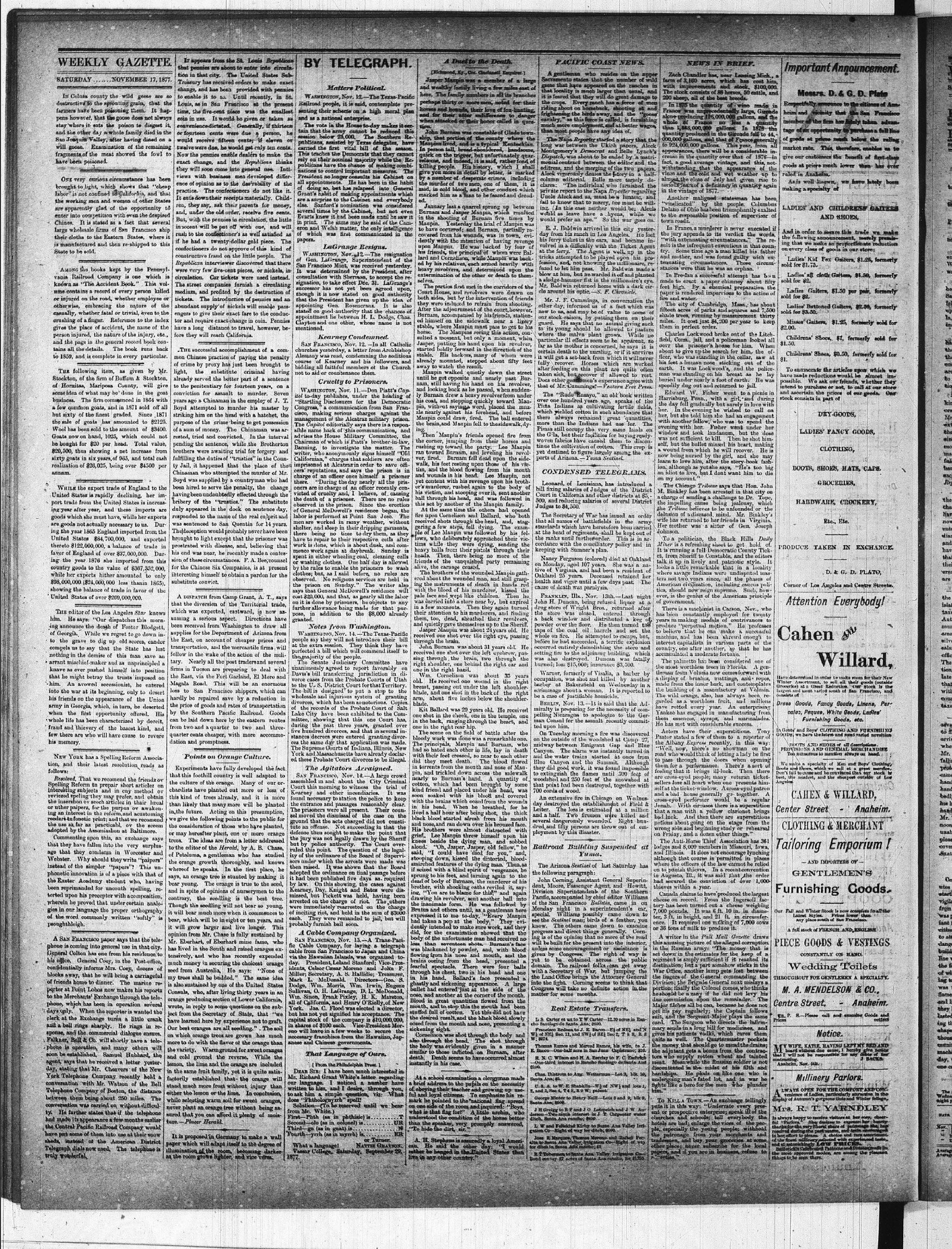
Searchable text
WEEKLY GAZETTE.
SATURDAY ... NOVEMBER 17, 1877.
In Colusa county the wild geese are so destructive to the sprouting grain, that the farmers have been poisoning them. It happens however, that the goose does not always stay where it eats the poison to digest it, and the other day a whole family died in the San Joaquin Valley, after having dined on a will goose. Examination of the remaining fragments of the meat showed the fowl to have been poisoned.
One very curious circumstance has been brought to light, which shows that "cheap labor" is not confined to California, and that the working men and women of other States are apparently glad of the opportunity to enter into competition with even the deprived Chinese. It is stated as a fact that several large wholesale firms of San Francisco ship their cloths to the Eastern States, where it is manufactured and then re-shipped to this State to be sold.
Among the books kept by the Pennsylvania Railroad Company is one which is known as "The Accident Book." This volume contains a record of every person killed or injured on the road, whether employee or otherwise, embracing the nature of the casualty, whether fatal or trivial, even to the crushing of a finger. Reference to the index gives the place of accident, the name of the person injured, the nature of the injury, etc., and the page in the general record book contains all the details. The book runs back to 1859, and is complete in every particular.
The following item, as given by Mr. Stockton, of the firm of Buffum & Stockton, of Hornitas, Mariposa County, will give some idea of what may be done in the goat business. The firm commenced in 1864 with a few common goats, and in 1871 sold off all but sixty of the finest graded. Since 1871 the sale of goats has amounted to $2125. Wool has been sold to the amount of $3400. Goats now on hand, 1025, which could not be bought for $20 per head. Total value, $20,500, thus showing a net increase from sixty goats in six years, of 965, and total cash realization of $26,025, being over $4,500 per
It appears from the St. Louis Republican that pennies are about to enter into circulation in that city. The United States Sub-Treasury has received orders to make exact change, and has been provided with pennies to enable it to do so. Until recently, in St. Louis, as in San Francisco at the present time, the five-cent piece was the smallest coin in use. It would be given or taken as convenience dictated. Generally, if thirteen or fourteen cents were due a person, he would receive fifteen cents; if eleven or twelve were due, he would get only ten cents. Now the pennies enable dealers to make the exact change, and the Republican thinks they will soon come into general use. Interviews with business men developed difference of opinion as to the desirability of the practice. The confectioners do not like it. It entails down their receipts materially. Children, they say, ask their parents for money, and under the old order, receive five cents. But, with the pennies in circulation, the little innocent will be put off with one, and will rush to the confectioner's as well satisfied as if he had a twenty-dollar gold piece. The confectioners do not approve of this kind of constructive fraud on the little people. The Republican interviewer discovered that there were very few five-cent pieces, or nickels, incirculation. Car tickets were used instead. The street companies furnish a circulating medium, and profited by the destruction of tickets. The introduction of pennies and an abundant supply of nickels will enable passengers to give their exact fare to the conductor and require exact change in coin. Pennies have a long distance to travel, however, before they will reach California.
The successful accomplishment of a common Chinese practice of paying the penalty of crime by proxy has just been brought to light, the substitute criminal having already served the better part of a sentence to the penitentiary for fourteen years, on a conviction for assault to murder. Seven years ago a Chinaman in the employ of J. T. Boyd attempted to murder his master by striking him on the head with a hatchet, the purpose of the crime being to get possession of a sum of money. The Chinaman was arrested, tried and convicted. In the interval pending the sentence, while the Brotherton brothers were awaiting trial for forgery and fulfilling the duties of "trusties" in the County Jail it happened that the place of the
The following item, as given by Mr. Stockton, of the firm of Buffum & Stockton, of Hornitas, Mariposa County, will give some idea of what may be done in the goat business. The firm commenced in 1864 with a few common goats, and in 1871 sold off all but sixty of the finest graded. Since 1871 the sale of goats has amounted to $2125. Wool has been sold to the amount of $3400. Goats now on hand, 1025, which could not be bought for $20 per head. Total value, $20,500, thus showing a net increase from sixty goats in six years, of 965, and total cash realization of $26,025, being over $4500 per annum.
While the export trade of England to the United States is rapidly declining, her import trade from the United States is increasing year after year, and these imports are goods which she must have, while her exports are goods not actually necessary to us. During the year 1865 England imported from the United States $84,700,000, and exported thereto $122,000,000, a balance of trade in favor of England of over $37,000,000. During the year 1876 she imported from this country goods to the value of $367,352,000, while her exports hither amounted to only $98,000,000 ($24,000,000 less than in 1865), showing the balance of trade in favor of the United States of over $269,000,000.
The editor of the Los Angeles Star knows him. He says: "Our dispatches this morning announce the death of Foster Blodgett, of Georgia. While we regret to go down into the grave to dig up old scores, candor compels us to say that the State has lost nothing in the demise of this man save an arrant mischief-maker and as unprincipled a knave as ever pushed himself into position that he might betray the trusts imposed on him. An avowed secessionist, he entered into the war at its beginning, only to desert his friends on the appearance of the Union army in Georgia, which, in turn, he deserted when the first opportunity offered. His whole life has been characterized by deceit, fraud and thievery of the basest kind, and few there are who will have cause to revere his memory.
New York has a Spelling Reform Association, and their latest resolution reads as follows:
Resolved That we recomend the friendz ov Spelling Reform tu prepair short articlez on interesting subjects and in eny method ov revized speling they may prefer, and obtain the inserson ov seech articlesz in their local or other paiperz, for the purpus ov awakening an interest in the reform, and acustoming readers tufonetic print; and that we recomend the use aa far az practicabl, ov the sceem adopted by the Assosiashon at Baltimore.
Commenting upon this, an exchange says that they have fallen into the very surplusage that they condemn in Worcester and Webster. Why should they write "paiperz" instead of the simpler "papers"? This unphonetic innovation is of a piece with that of the Exeter Academy student who having light, the substitute criminal having already served the better part of a sentence to the penitentiary for fourteen years, on a conviction for assault to murder. Seven years ago a Chinaman in the employ of J. T. Boyd attempted to murder his master by striking him on the head with a hatchet, the purpose of the crime being to get possession of a sum of money. The Chinaman was arrested, tried and convicted. In the interval pending the sentence, while the Brotherton brothers were awaiting trial for forgery and fulfilling the duties of "trusties" in the County Jail, it happened that the place of the Chinaman who attempted the murder of Mr. Boyd was supplied by a countryman who had been hired to serve the penalty, the change having been undoubtedly effected through the bribery of the "trusties." The substitute duly appeared in the dock on sentence day, responded to the name of the real calprit and was sentenced to San Quentin for 14 years. The deception would probably never have been brought to light except that the prisoner was prostrated with disease, and believing that his end was near, he recently made a confession of these circumstances. F.A. Bee; counsel for the Chinese Six Companies, is at present interesting himself to obtain a pardon for the substitute convict.
A dispatch from Camp Grant, A. T., says that the diversion of the Territorial trade, which was expected, eastward, is now assuming a serious aspect. Directions have been received from Washington to draw all supplies for the Department of Arizona from the East, on account of cheaper prices and transportation, and the mercantile firms will follow in the wake of the action of the military. Nearly all the post traders and several firms in Tucson are preparing to deal with the East, via the Fort Garland, El Moro and Magala Road. This will be an enormous loss to San Francisco shippers, which can hardly be repaired save by a reduction in the price of goods and rates of transportation by the Southern Pacific Railroad. Goods can be laid down here by the eastern routes from two and a quarter to two and three-quarter cents cheaper, with more accommodation and promptness.
Points on Orange Culture.
Experiments have fully developed the fact that this foothill country is well adapted to the culture of the orange. Many of our orchardists have planted out more or less of this kind of trees already, and it is more than likely that many more will be planted in the future. Acting on this presumption, we give the following points to the public for the consideration of those who have planted, or may hereafter plant, one or more orange trees. The ideas are from a letter addressed to the editor of Herald, by A. B. Chase, of Petaluma, a gentleman who has studied the orange growth thoroughly, and knows whereof he speaks. In the first place, he says, an orange tree is stunted by making it light,
the substitute criminal having already served the better part of a sentence to the penitentiary for fourteen years, on a conviction for assault to murder. Seven years ago a Chinaman in the employ of J. T. Boyd attempted to murder his master by striking him on the head with a hatchet, the purpose of the crime being to get possession of a sum of money. The Chinaman was arrested, tried and convicted. In the interval pending the sentence, while the Brotherton brothers were awaiting trial for forgery and fulfilling the duties of "trusties" in the County Jail, it happened that the place of the Chinaman who attempted the murder of Mr. Boyd was supplied by a countryman who had been hired to serve the penalty, the change having been undoubtedly effected through the bribery of the "trusties." The substitute duly appeared in the dock on sentence day, responded to the name of the real calprit and was sentenced to San Quentin for 14 years. The deception would probably never have been brought to light except that the prisoner was prostrated with disease, and believing that his end was near, he recently made a confession of these circumstances. F.A. Bee; counsel for the Chinese Six Companies, is at present interesting himself to obtain a pardon for the substitute convict.
During the day oners are in charge of an accused of erualty and I am dead of a prisoner. Observed in the prison. Of General McDowell's labor is performed at Poemen are worked in rainshelter, and sleep in their shelter being no time able to repair to their rear work is done, which is an mence work again at day spent in either wheeling or washing clothes. On by the rules to enable them clothes; but as I said before observed. No religions are on prison on Sunday. says that General McDowell cost $20,000, and that, after it is done by prisoners further allowance being paid pose, in addition to these granted.
Notes from WASHINGTON Nov. 14: people say they will not at at the extra session. The perfected a bill which will winthe majority of people.
The Senate Judiciary unanimously agreed to read Davis's bill transferring voice cases from The Probe to U.S.District Court.The bill is designed to do wholesale and injurious divorcees which has been one record of the records of The Pine Lake City have been examined during past three years five hundred divorces,and statues decrees were entered into The Supreme Courts of New York and Massachusetts indeed these Probate Court d
The Agitators SAN FRANCISCO Nov., assembled in and about at Court this morning to write Kearney and other incumbent found necessary to station The entrance and passages The prisoners were all preset movedthe dismissal o ground thatthe acts chantute an offense.Not sure defense then sought to makethe jury was not legally dugbut by police authority,rules this point.The quality ofthe ordinanceofthe sors underwhichthe arrows then raised It was shown adoptedthe ordinanceon it had been published five
Spelling Reform to repair short articlez on interesting subjects and in any method or reviseed spelling they may prefer, and obtain the inscription ov seech articlez in their local or other paiperz, for the purpus ov awakening an interest in the reform, and acustoming readers to fonetic print; and that we recomend the use az far az practicabl, ov the seem adopted by the Assosiashon at Baltimore.
Commenting upon this, an exchange says that they have fallen into the very surplusage that they condemn in Worcester and Webster. Why should they write "paiperz" instead of the simpler "papers"? This unphonetic innovation is of a piece with that of the Exeter Academy student who, having been reprimanded for uncouth spelling, retorted upon his preceptor with a composition, wherein he proved that under certain analogies in our language the proper orthography of the word commonly written "softly" is psoughthleigh.
A San Francisco paper says that the telephone is coming into general use in that city. General Colton has one from his residence to his office. General Coey, in the Post-office, confidentially informs Mrs. Coey, dozens of blocks away, that he will bring a carriageful of friends home to dinner. The marine reporter at Point Lobos now makes his reports to the Merchants' Exchange through the telephone, which has been in operation several days only. When the reporter is wanted the clerk at the Exchange turns a little crank and a bell rings sharply. He rings in response, and the commercial dialogue ensues. Falkner, Bell & Co. will shortly nave a telephone is operation, and many others will soon be established. Samuel Huhbard, the agent, says that he received a letter yesterday, stating that Mr. Cheovers of the New York Telephone Company recently held a conversation with Mr. Watson of the Bell Telephone Company of Boston, the distance between them being about 250 miles. The conversation was carried on without difficulty. He further states that if the telephone had made its appearance a few months earlier the Central Pacific Railroad Company would have put some of them into use at their snow sheds, instead of the American District Telegraph dials now used. The telephone is truly wonderful.
It is proposed in Germany to make a wall paper which will adapt itself to the degree of illumination of the room, becoming darker as the room grows lighter, and vice versa.
Court this morning to witness Kearney and other incumbent found necessary to station the entrance and passage. The prisoners were all presed moved the dismissal o ground that the acts charge tute an offense. Not such defense then sought to mute the jury was not legally done but by police authority. Ruled this point. The quality of the ordinance on it had been published five by law. On this showing Kearney, Day, Knight and missed, but Pickett was arrested on the charge of were immediately rearrested of inciting riot, and held in each. They were remanded probably furnish bail soon.
A Cable Company
SAN FRANCISCO, NOV. 1877
DEAR SIR: I have been Mr. Richard Grant Whitley our language. I noticed written to him, and I desire to ask him a simple question does "Phtholognyrrh" speak Solution—To be reserved from Mr. White.)
First—Phth (as in phthi Second—olo (as in colonial Third—gn (as in gnat) is Fourth—yrrh (as in myrrh)
What a language!
Vassar College, Saturday 1877.
BY TELEGRAPH.
Matters Political.
WASHINGTON, Nov. 12.—The Texas-Pacific Railroad people, it is said, contemplate presenting their scheme on a high moral plan and as a national enterprise.
The vote in the House to-day makes it certain that the army cannot be reduced this session below 23,000. The Southern Republicans, assisted by Texas delegates, have carried the first vital bill of the season. This teaches the Democrats that they cannot rely on their nominal majority while the Republicans have the chance of making combinations to control important measures. The President no longer consults his Cabinet on all appointments. He has been in the habit of doing so, but has relapsed into General Grant's habit of making appointments which are a surprise to the Cabinet and everybody else. Sanford's nomination was considered several times by the Cabinet, but not even Evarts knew it had been made until he saw it in print. The same may be said of the Cameron and Welsh matter, the only intelligence of which was first communicated in the paper.
LaGrange Resigns.
WASHINGTON, Nov. 12.—The resignation of Gen. LaGrange, Superintendent of the San Francisco Mint, was received yesterday. It was determined by the President, after consultation with Sherman, to accept the resignation, to take effect Dec. 31. LaGrange's successor has not yet been agreed upon, though it is now stated on good authority that the President has given up the idea of appointing Gen. Rosencrans. It is also stated on good authority that the chances of appointment lie between H. L. Dodge, Chas. Clayton and one other, whose name is not mentioned.
Kearney Condemned.
SAN FRANCISCO, Nov. 12.—In all Catholic churches yesterday, a letter from Archbishop Alemany was read, condemning the seditious course of Kearney and his followers, and bidding all faithful members of the Church not to aid or countenance them.
Cruelty to Prisoners.
WASHINGTON, Nov. 11.—Don Piatt's Capitol to-day publishes, under the heading of "Startling Disclosures for the Democratic Congress," a communication from San Francisco, making serious charges against the management of the Alcatraz military prison. The Capitol editorially says there is a responsible name back of this communication, and advises the House Military Committee, the Chairman of which is Piatt's brother-in-law, Banning, to investigate the matter. The writer, who anonymously signs himself "Old Californian," charges that soldiers are often imprisoned at Alcatraz in order to save off-
A Duet to the Death.
[Richmond, Ky., Our Chancellor Emperor]
Jasper Manpin was a member of a large and wealthy family living a few miles east of here. The family numbers in all its branches perhaps thirty or more men, noted for their horses and hounds, their love of fox-hunting, and for their after midwinter to danger when attacked or their honor called in question.
John Burnam was constable of Glade township, that portion of the county where the Manpin lived, and is a typical Kenbackian. In person tall, broad-shouldered, handsome, quick on the trigger, but unfortunately quarrelsome, and indeed, it is said, rather fond of killing people. His history, which I shall give you more detail by letter, is marked by a number of desperate erimes, including the murder of two men, one of them, it is said, in cold blood, and other conduct which marked him as a man to be feared and dreaded.
January last a quarrel sprung up between Burnam and Jasper Manpin, which resulted in the shooting of Burnam five times by Maupin. Yesterday the trial of Manpin was to have occurred; and Burnam, partially recovered from his wounds, was in town, evidently with the intention of having revenge upon Manpin. He was backed by four of his friends, the principal of whom were Ballard and Cornelson, while Maupin was backed by his relatives, each armed heavily with heavy revolvers, and determined upon the extermination of the other or death to themselves.
The parties first met in the corridors of the Court House, and revolvers were drawn on both sides, but by the intervention of friends they were induced to refrain from shooting. After the adjournment of the court, however, Burnam accompanied by his friends, stationed himself on the sidewalk near a luxury stable, where Maupin must pass to get to his horse. The Maupin seeing this action, consulted a moment, but only a moment, when Jasper putting his hand upon his revolver, started boldly forward in the direction of the stable. His backers, many of whom were already mounted, stopped about fifty feet away to watch the result.
Maupin walked quietly down the street until he got opposite and nearly past Burnam, still having his hand on his revolver, and looking back as he passed, when suddenly Burnam drew a heavy revolver from under his coat, and stepping quickly toward Maupin, without saying a word, placed the muzzle nearly against his forehead, and before Maupin could draw fired. The ball entered the brain, and Maupin fell to the sidewalk, dying.
Then Maupin's friends opened fire from the corner, jumping from their horses and rushing up toward the party. Lee Maupin ran toward Burnam, and leveling his revolver, fired. Burnam fell dead upon the sidewalk, his feet resting upon those of his vicinity.
PACIFIC COAST NEWS.
A gentleman who resides on the upper Sacramento states that the number of wild game that have appeared on the ranches in that locality is much larger than usual, and it is feared that they will do great damage to the crops. Every ranch has a force of men riding about on horseback, shooting at and frightening the birds away, and the "goose cavalry," as this force is called, is furnishing much more employment, and at better wages than most people have any idea of.
The Napa Reporter started a story that the long war between the Ukiah papers, Aleck Montgomery's Democrat and Bella Lynch's Dispatcher was about to be ended by a matriennial contract between the editor and the editress, and the merging of the two papers. Aleck vigorously denies the story in a half-column editorial. Balle more tarsely declares: "The individual who furnished the private report to the Napa Reporter regarding Uncle Aleck and us, must be limnic, and fail to know that to marry two must be willing." (In this case neither would be; Aleck would as leave have a hyena, while we would prefer an ape.) So the war goes on.
E.J. Baldwin arrived in this city yesterday from his ranch in Los Angeles. He lost his ferry ticket in the ears, and became involved in a difficulty with the Ticket Agent at the ferry. The Agent is well up in the tricks attempted to be played upon his profession, and not knowing the millionaire refused to let him pass. Mr. Baldwin made a blow at him, but he warded it off and planted a sledge-hammer flat in the millionaire's eye. Mr. Baldwin returned home with a dark circle around his optic.
Mr.J.F.Cummings; in conversation other day informed us of a fact which was now to us, and may be of value to some of our stock-raisers; by putting them on their guard. He says that no animal giving suck to its young should be allowed to pasture where the malva plant grows. While no particular ill effects seem to be apparent; so far as the mother is concerned, he says it is certain death to the nursling; or if it survives it will get a set-back from which it will never fully recover. Horses which are worked after feeding on this plant are quite often taken sick; but recover if allowed to rest. Does other genius's experience agree with that of Mr.Cummings?—Ventura Free Press.
The "Rudo Ensayo," an old book written over one hundred years ago, speaks of the Pima Indians as cultivating fertile fields, which yielded cotton in such abundance that there always remained great quantities; more than the Indians had used for. The Pimas still occupy the very same hauls on the Gila; but their facilities for buying ready-woven fabrics have caused them to discontinue the cultivation of cotton. This crop is yet destined to figure largely among the exports of Arizona. —Yuma Sentinel.
Cruelty to Prisoners.
Washington, Nov. 11.—Don Piatt’s Capitol to-day publishes, under the heading of “Startling Disclosures for the Democratic Congress,” a communication from San Francisco, making serious charges against the management of the Alcatraz military prison. The Capitol editorially says there is a responsible name back of this communication, and advises the House Military Committee, the Chairman of which is Piatt brother-in-law, Banning, to investigate the matter. The writer, who anonymously signs himself “Old Californian,” charges that soldiers are often imprisoned at Alcatraz in order to save officers’ reputations, and says the prison is in charge of an officer once himself a prisoner there. “During the day nearly all the prisoners are in charge of an officer recently convicted of cruelty and, I believe, causing the death of a prisoner. There are no rules observed in the prison. Since the erection of General McDowell’s residence began, the labor is performed at Point San Jose. The men are worked in rainy weather, without shelter, and sleep in their dripping garments, there being no time to dry them, as they have to repair to their respective cells after work is done, which is about duak, and commence work again at daybreak. Sunday is spent in either wheeling coal, cleaning cells or washing clothes. One half day is allowed by the rules to enable the prisoners to wash clothes; but, as I said before, no rules are observed. No religious services are held in the prison on Sunday.” The writer also says that General McDowell’s residence will cost $20,000, and that, as nearly all the labor on it is done by prisoners, he objects to any further allowance being made for that purpose, in addition to the $8,000 already granted.
Notes from Washington.
Washington, Nov. 14.—The Texas-Pacific people say they will not introduce their bill at the extra session. They think they have perfected a bill which will commend itself to the majority of the people.
The Senate Judiciary Committee have unanimously agreed to report favorably on Davis’s bill transferring jurisdiction in divorce cases from the Probate Courts of Utah to the U.S. District Court for that Territory. The bill is designed to put a stop to the wholesale and injurious system of granting divorces, which has been so notorious. Copies of the records of the Probate Court of Salt Lake City have been exhibited to the Committee, showing that this one Court has, during the past three years, granted over five hundred divorces, and that in several instances decrees were entered granting divorces the same day that application was made. The Supreme Courts of Indiana, Illinois, New York and Massachusetts have already declared these Probate Court divorces to be illegal.
The Agitators Arraigned.
San Francisco, Nov. 14.—A large crowd assembled in and about the City Criminal Court this morning to witness the trial of Kearney and other incendiaries. It was found necessary to station the police to keep the entrance and passages reasonably clear. The prisoners were all present. Their counsel moved the dismissal of the case on the ground that the acts charged did not constitute an offense. Not succeeding in that the defense then sought to make the point that the jury was not legally drawn by the Sheriff but by police authority. The Court overruled this point. The question of the legality of the ordinance of the Board of Supervisors under which the arrests were made was then raised. It was shown that the Board adopted the ordinance on final passage before it had been published five days as required.
Maupin walked quietly down the street until he got opposite and nearly past Burnam, still having his hand on his revolver, and looking back as he passed, when suddenly Burnam drew a heavy revolver from under his coat, and stepping quickly toward Manpin, without saying a word, placed the muzzle nearly against his forehead, and before Maupin could draw, fired. The ball entered the brain, and Maupin fell to the sidewalk, dying.
Then Maupin’s friends opened fire from the corner, jumping from their horses and rushing up toward the party. Lee Maupin ran toward Burnam, and leveling his revolver, fired. Burnam fell dead upon the sidewalk, his feet resting upon those of his victim, and the blood flowing from his mouth and wounds in his head. Lee Maupin, not yet content with his revenge upon his brother’s murderer, rushed again to the body of his victim, and stooping over it, sent another ball through his head, and was followed in this act by another of the Maupin family.
At the same time the others had opened fire upon Cornelison and Ballard, who both received shots through the head, and staggering a few steps, fell dying. The example of Lee Maupin was followed by his fellows, who deliberately approached their victims while they were dying, sending the heavy balls from their pistols through their heads. Then, there being no more of the friends of the vanquished party remaining alive, the carriage ceased.
The brothers of the wounded Maupin gathered about the wounded man, and still grasping the instruments of death in hands red with the blood of his murderer, kissed the pale face and wept like children. Then he was carried into a store near by, but expired in a few moments. Then they again turned their attention to his murderers, and finding them too dead, sheathed their revolvers, and quietly gave themselves up to the Sheriff.
Jasper Maupin was about 24 years old. He received one shot over the right eye, passing through the brain.
John Burnam was about 31 years old. He received one shot over the left eyebrow, passing through the brain, two through the right shoulder, one behind the right ear and one in the right hand.
Wm. Cornelison was about 35 years old. He received one wound in the right breast, passing out under the left shoulder blade, and one shot in the back of the right arm, about five inches below the shoulder blade.
Kit Ballard was 29 years old. He received one shot in the cheek, one in the temple, one in the back, ranging through the heart, and one in the right rear hip.
The scene on the field of battle after the bloody work was done was a remarkable one. The principals, Maupin and Burnam, who had so hated each other in life, lay in death with their feet crossed, so near to each other did they meet death. The blood flowed in torrents from the mouth and nose of Manpin, and trickled down across the sidewalk nearly to Burnam’s hand. A quantity of cotton, which had been brought by some kind friend and placed under his head, was soon soaked with his blood and covered with the brains which oozed from the wounds in his head. When he breathed, for he lived a half hour after being shot, the thick black blood started afresh from his mouth and nose, and ran down over his bronzed face. His brothers were almost distracted with grief. Lee Maupin threw himself upon his knees beside the dying man, and sobbed aloud: “Oh Jasper, Jasper, old fellow,” he said: “I could have died for you,” and, stooping down, kissed the distorted, blood-mirrored features of the dying man. Then, as if seized with a blind spirit of vengeance, he sprung to his feet, and turning again to the dead body of Burnam, the murderer of his
After feeding on this plant are quite often taken sick but recover if allowed to rest. Does other gentlemen’s experience agree with that of Mr. Cummings?—Ventura Free Press.
The “Rudo Ensayo,” an old book written over one hundred years ago, speaks of the Pima Indians as cultivating fertile fields which yielded cotton in such abundance that there always remained great quantities; more than the Indians had use for. The Pimas still occupy the very same lands on the Gila but their facilities for buying ready-woven fabrics have caused them to discontinue the cultivation of cotton. This crop is yet destined to figure largely among the exports of Arizona.—Yuma Seintnel.
CONDENSED TELEGRAMS.
Leonard, of Louisiana, has introduced a bill fixing salaries of Judges of the District Court in California and other districts at $5,-500,and reducing salaries of several District Judges to $4,$500.
The Secretary of War has issued an order that all names of battlefields in the army standards which have heretofore been carried at the head of regiments shall be kept out of the ranks until further order. This is in accordance with the conciliatory policy and in keeping with Sunner’s plan.
Naney Ferguson (colored) died at Oakland on Monday; aged 107 years. She was a native of Virginia,and had been a resident of Oakland 25 years.Decased retained her health and vigor until a few days past.The cause of death was paralysis.
FRANKLIN III., Nov. 13th.-Last night John H. Duncan,被 refused liquor at a drug store of Wright Bros.,returned afterthe store was closed,intended througha back window and distributed a kegof powder overthe floor.He then turnedthe taps ofthe coal oil barrels and setthe whole on fire.He attempted to escapebutbeforehehad succeeded,a terrific explosionoccurred entirely demolishingthe storeand settingfiretotheadjoiningbuildingwhichwasalsodestroyed.Duncanwasfatallyburned;loss$15,$000;insurance$3,$500.
Warner(formerly of Visalia,a barberby occupation,theshotandkilledbyanbarberatBakersfieldonWednesdayina seriimageabouta woman.InItisreportedtobeacaseofjustifiablehomicide.
BERLIN,Nov.13.-Itis saidthattheAdmiraltyispreparingforthenecessitycomitteduphim.
On Tuesday morning a fire was discoveredonthe outsideofthewoodshedatCamp27.midwaybetweenEmigrafGapandBlueCanyon.The alarmwasinstantlyturnedinandthewatertrainsstartedatoncefromBlueCanyonandtheSummit.Althoughtheydidgoodwork.itwasfoundimpossibletoextinguishtheflamesuntil300feetofwoodshedand250feetofthesnowshadesatthatpointhadbeendestroyed,togetherwith700cordsofwood.
An extensive fire in Chicago on Wednesday destroyedtheestablishmentofField&Leiter.The lossisestimatedatafillionanda半half.Twofiremenwerekilledandseveral dangerouslywounded.Sighthundredand fiftypersonsarethrowoutofemploymentbythisdisaster.
Railroad Building Suspended at Yuma.
The Arizona Sentiaelof last Saturdayhasfollowing paragraph:
John Corning.AssistantGeneralSuperin-
Court this morning to witness the trial of Kearney and other incendiaries. It was found necessary to station the police to keep the entrance and passages reasonably clear. The prisoners were all present. Their counsel moved the dismissal of the case on the ground that the acts charged did not constitute an offense. Not succeeding in that the defense then sought to make the point that the jury was not legally drawn by the Sheriff but by police authority. The Court overruled this point. The question of the legality of the ordinance of the Board of Supervisors under which the arrests were made was then raised. It was shown that the Board adopted the ordinance on final passage before it had been published five days as required by law. On this showing, the cases against Kearney, Day, Knight and Bates were dismissed, but Pickett was held, having been arrested on the charge of riot. The others were immediately rearrested on the charge of inciting riot, and held in the sum of $3000 each. They were remanded to jail, but will probably furnish bail soon.
A Cable Company Organized.
SAN FRANCISCO, Nov. 15.—A Trans-Pacific Cable Company, for laying a telegraph cable from San Francisco to Japan and China via the Hawaiian Islands, was organized today. President, Leland Stanford; Vice-Presidents, Celsor Caesar Moreno and John F. Miller; Secretary, A. S. Hallidie; Treasurer, Mark L. McDonald. Directors—Geo. S. Dodge, Wm. Morris, Wm. Irwin, Engene Sullivan, O. H. LaGrange, D. L. McDonald, Wm. Sinon, Frank Pixley, H. K. Marston, all of California, and Henry O'Rielly, of New York. Jas. C. Flood was elected a director, but has not yet signified his acceptance. The capital stock of the company is $10,000,000, in shares of $100 each. Vice-President Moreno will leave in a few weeks to secure the necessary franchises from the Hawaiian, Japanese and Chinese governments.
That Language of Ours.
[From the Philadelphia Press.]
DEAR SIR: I have been much interested in Mr. Richard Grant White's letter regarding our language. I noticed a number have written to him, and I desire, through you, to ask him a simple question, viz: What does "Phtholognyrrh" spell?
Solution—(To be reserved until we hear from Mr. White.)
First—Phth (as in phthisic) is... T Second—olo (as in colonal) is... UR Third—gn (as in gnat) is... N Fourth—yrrh (as in myrrh) is... KR or Turner.
What a language!
NATTE GRAYSON.
Vassar College, Saturday, September 28, 1877.
At a school examination a clergyman made a brief address to the pupils on the necessity of obeying their teacher and growing up useful and loyal citizens. To emphasize his remark he pointed to the national flag spread on one side of the room and inquired: "Boys, what is that flag for?" A little arhin, who understood the condition of the house better than the speaker, very promptly answered, "To hide the dirt, sir."
A. H. Stephens is assuredly a loyal American. He said the other day: "I would rather be hanged in the United States than live in any other country."
An extensive fire in Chicago on Wednesday destroyed the establishment of Field & Leiter. The loss is estimated at a million and a half. Two firemen were killed and several dangerously wounded. Night hundred and fifty persons are throw out of employment by this disaster.
Railroad Building Suspended at Yuma.
The Arizona Sentiael of last Saturday has the following paragraph:
John Corning, Assistant General Superintendent, Moore, Passenger Agent, and Hewitt, Division Superintendent of the Southern Pacific, accompanied by chief editor Williams of the San Francisco Bulletin, came in on Monday night in a superintendent's car special. Williams possibly came down to see the Sentinel man; birds of a feather, you know. The others came down to examine progress and direct things generally. Corning is of the opinion that no more of the road will be built for the present into the interior, unless some encouragement or assistance is given by Congress. The right of way is yet to be obtained across the public domain. The railroad folks can get away with a Secretary of War, but jumping the Land Office brings the Attorney General into the fight. Corning seems to think that Congress will take no definite action in the matter for some months.
Real Estate Transfers.
L S Carter et ux to T W Carter—12 30 acres in Rancho Santiago de Santa Ana; $600.
Francisco Redena to J. E Bacon—E] of NE] and NW] of NE] Sec. 11, and SW] of SE] Sec. 2, T 8 S, R 8 W; $874.
Thomas Ramos and Merced Ramos, his wife, to J. E Bacon—One-half acre in San Juan Capistrano; $10.
R N.C. Wilson and H.A.Parelay to F.C.Eachrich—One-third interest in Rancho Santiago de Santa Ana; $100.
Chas Thistrom to Aurk.Wetterman—Lot 2, blk 10,Santa Ana; $5.
U.S.A.to W.R.Shanklin—W]of NW]and lots 1,2,and 3;Sec 4,T4 S,R9 W; patent.
George Minter to Henry Neill—Lots $ and 9,blk 9,Santa Ana; $400.
J H Greigg to RP and J O Letspaich and J W Anderson—Two sixth interest in J.T Carpenter water ditch,Santa Ana rancho;$400.
Jose R Marques, Thomas Marquez and Rafael Perilla to Santa Ana Valley irrigation Co—Right of way for ditch in Santa Ana rancho;$150.
R T Toberman to Santa Ana Valley irrigation Co-bond convey 27 acres of Santa Ana rancho;$150.
NEWS IN BRIEF.
Zach Chandler has near Lansing Mich., a farm of 3,160 acres, which has cost him with improvements and stock, $100,000. The stock consists of 89 horses, 50 cattle, and 200 sheep, all of the best breeds.
In 1875 the quantity of wine made in France was unprecedentedly large. Gironde alone producing 116,000,000 gallons, and the whole of France no less a quantity than 1,848,000,000 gallons. In 1878 the quantity produced in the Gironde fall to 44,000,000 gallons, and that of France generally to 924,000,000 gallons. This year, from all appearances, there will be a considerable increase in the quantity over that of 1876—in fact, a good average vintage, and this, notwithstanding that the appearance of the vines and the cold and wet weather up to almost the close of July had given rise to serious fears of a deficiency in quantity again in the vintage of 1877.
Another maligned statesman has been "vindicated" by the people. Columbus Delano of Ohio has been triumphantly exalted to the responsible position of supervisor of town roads.
In Francona a murderer is never executed if the jury appends to its verdict the words "with extenuating circumstances." The result is the infrequent executions in that country. Some time ago a man killed his father and mother, and was found guilty with extenuating circumstances. These circumstances were that he was an orphan.
In Pre-laun a successful attempt has been made to erect a paper chimney about fifty feet high. By a chemical preparation the paper is rendered impervious to the action of fire and water.
The city of Cambridge, Mass., has about fifteen acres of parks and squares and 7,500 shade trees, running by measurement thirty miles. It cost just $4,200 per year to keep them in perfect order.
Charles Lockwood broke out of the Litchfield, Conn., jail, and a policeman looked all over the prisoner's house for him. When about to give up the search for him, the officer, who was standing in the cellar, saw at his feet a human nose sticking out of the earth. It was Lockwood's, and the policeman was standing on his breast as he lay buried under nearly a foot of earth. He was speedily dug out and returned to jail.
Edward W. Fisher went to a picnic in Harrisburg, Penn., with a girl, and during the day fell gradually but surely in love with her. In the evening he wished to call on her, but she told him she had an engagement with another fellow; who was to spend the evening with her. Fisher went under her window and took laudanum, but the dose was not sufficient to kill. Then he shot himself, but the bullet missed his heart, making a wound from which he will recover. He is now being nursed by the girl, and she may learn to love him, after the story-book fashion.
Important Announcement.
Messrs. D. & G. D. Plate
Respectfully answer to the ultimates of Anheims and vicinity that the San Francisco member of the firm has lately taken advantage of an opportunity to purchase a full line of goods at prices much below the ruling market rate. This therefore enables us to give our customers the benefit of first-class goods at prizes much lower than has ever ruled in Anheims.
As is well known, we have lately been making a specialty of
LADIES' AND CHILDREN'S GAITERS AND SHOES.
And in order to secure this trade we make the following announcement, merely promising that we make an proportionate reduction on every class of goods in our store:
Ladies' Kid Fox Gaiters, $1.25, formerly sold for $1.75.
Ladies' all cloth Gaiters, $1.50, formerly sold for $2.
Ladies' Gaiters, $1.50 per pair, formerly sold for $2.
Ladies' Buttoned Gaiters, $2.50, formerly sold for $3.50.
Misses' Gaiters, $1.25, formerly sold for $2.00.
Childrens' Shoes, $1, formerly sold for $1.50.
Childrens' Sheets, $0.50, formerly sold for $1.
To enumerate the articles upon which we have made reductions would be almost impossible. We ask our friends, whether they intend to purchase or not, to call at our store and ascertain the prices of our goods. Our stock consists in part of
DEY-GOODS,
LADIES' FANCY GOODS,
CLOTHING,
plant are quite often if allowed to rest experience agree with Ventura Free Press.
an old book written ago, speaks of the activating fertile fields, such abundance that had great quantities, was had use for. The very same lands on utilities for buying ready-made them to disconcert. This crop is largely among the ex-Telegraph.
has issued an order in fields in the army before been carried out. This is in accidental policy and in plan.
died at Oakland years. She was a nailed been a resident of deceased retained her few days past. The ysis.
13th.—Last night refused liquor at a ros., returned after entered through distributed a key of. He then turned the barrels and set the apted to escape, but, a terrific explosion shaking the store and building, which Duncan was fatally insurance $3,500.
Visalia, a barber by killed by another on Wednesday in a man. It is reported to homicide.
is said that the Adlthe necessity of comologize to the Gerault recently commit.
a fire was discovered lodged at Camp 27, Gap and Blue is instantly turned in started at once from Summit. Although was found impossible until 300 feet of the snowshoes at troyed, together with Chicago on Wednesdays of Field &imated at a million were killed and sunded. Sight hunter throw out of emerald last Saturday has General Superin
to enumerate the articles upon which we have made reductions would be almost impossible. We ask our friends, whether they intend to purchase or not, to call at our store and ascertain the prices of our goods. Our stock consists in part of
DEY-GOODS,
LADIES' FANCY GOODS,
CLOTHING,
BOOTS, SHOES, HATS, CAPS.
GROCERIES,
HARDWARE, CROCKERY,
Etc., Ete.
PRODUCE TAKEN IN EXCHANGE.
D. & G. D. PLATO,
Corner of Los Angeles and Centre Streets.
Attention Everybody!
Cahen Willard,
Have determinate in order to make room for their New Winter Assortment, to sell all their goods (outside Groceries) at a Great Reduction. Our Stock is the largest and most varied south of San Francisco, and consists of
Dress Goods, Fancy Goods, Linens, Per-cales, Peques, White Goods, Ladies' Furnishing Goods, etc.
In Gents' and Boys' CLOTHING AND FURNISHING GOODS we have the latest and most varied notion.
BOOTS AND SHOES of all descriptions.
PROVISIONS AND GENERAL MERCHANDISE
Ten numerous to mention always on hand.
We make a specialty of Men and Boys' Clothing, Boots and Shoes, which we sell at a great merrier. Don't fail to come and be convinced that our stock is best, this newest, and the cheapest outside of Los Angeles.
CAHEN & WILLARD,
Center Street - Anaheim.
CLOTHING & MERCHANT
Tailoring Emporium!
AND IMPORTERS OFGENTLEMEN'S
CAHEN & WILLARD,
Center Street - Anaheim.
CLOTHING & MERCHANT
Tailoring Emporium!
AND IMPORTERS OF
GENTLEMEN'S
Furnishing Goods.
Our Fall and Winter Stock is now complete in all the latest styles. Prices lower than any place south of San Francisco.
A full stock of FRENCH AND ENGLISH
PIECE GOODS & VESTINGS
CONSTANTLY ON HAND.
Wedding Toilets
THROUGHOUT FOR GENTLEMEN A SPECIALTY.
M. A. MENDELSON & CO., Centre Street, - Anaheim.
MR. P. S.-Please call and examine Goods and Prices.
Notice.
MY WIFE, KATIE, HAVING LEFT MY BED AND BOARD WITHOUT ONE Cause, I hereby give notice that I will not be responsible for any debts of her contracting.
Anaheim, Nov. 6th.
Millinery Parlors.
ALWAYS OPEN FOR THE COMfort AND Convenience of Ladies, particularly at night, in the display of Autumn's gorgeous tints and Winter foliage.
Mrs. R. T. YARNDLEY
Is always happy to receive visitors at her coy, cheerful "Parkers." She desires to express her heart thanks for the very liberal share of patronage she has received during the past season, and feels satisfied in her efforts to please. A choice and rare importance of the finest millinery collected with expert and taste, and at astonishingly low prices.
Butterfields Celebrated Patterns and Dressing made in the most approved modes, are among the pleasant things to be seen there.