anaheim-gazette 1877-11-10
Scanned page
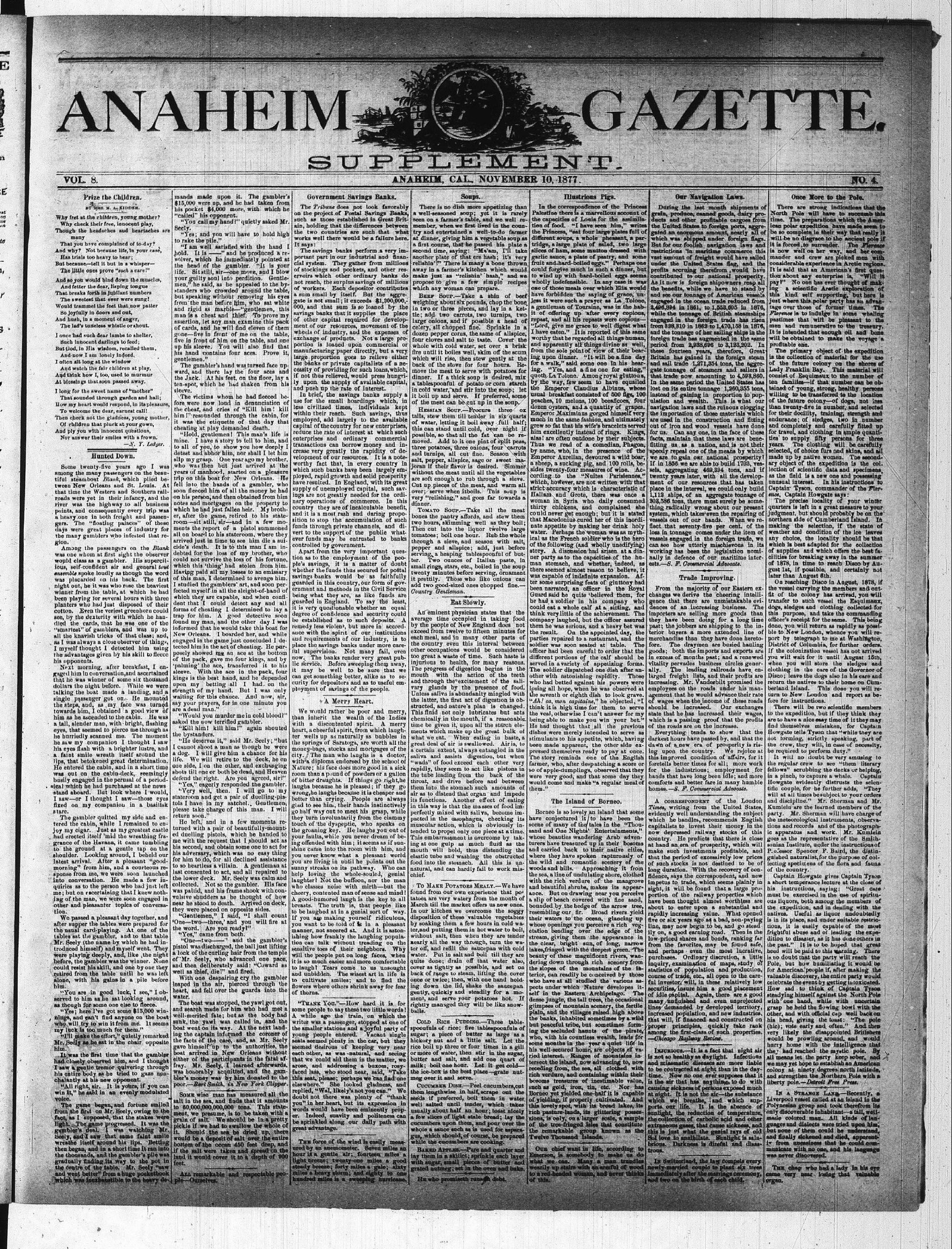
Searchable text
ANAHEIM
VOL. 8.
Prize the Children.
BY LENN. M. A. KIDDER.
Why fret at the children, young mother?
Why check their free, innocent play,
Though the headaches and heartaches are many
That you have complained of to-day?
And why? Not because life, in your case,
Has trials too heavy to bear;
But because—tell it but in a whisper—
The little ones prove "such a care!"
And so you would blind down the muscles,
And fetter the dear, lapsing tongue
That breaks forth in fabillant numbers
The sweetest that ever were sung!
Would trammel the feet that now patter
So joyfully in doors and out,
And hush, in a moment of anger,
The lad's tuneless whistle or shout.
I once had such dear lambs to shelter,
Such innocent darlings to feed;
But God, in His wisdom, recalled them,
And now I am lonely indeed.
I often sit long at the window
And watch the fair children at play,
And think how I, too, used to murmur
At blessings that soon passed away.
I long for the sweet name of "mother"
That sounded through garden and hall;
How my heart would respond, in its pleasure,
To welcome the dear, earnest call!
Then check not the gladness, young mother,
Of children that pluck at your gown,
And ply you with innocent questions,
Nor answer their smiles with a frown.
—N. Y. Ledger.
Hunted Down.
mands made upon it. The gambler's $15,000 were up, and he had taken from his pocket $4,000 more, with which he "called" his opponent.
"You call my hand?" quietly asked Mr. Seely.
"Yes; and you will have to hold high to rake the pile."
"I am well satisfied with the hand I hold. It is——" and he produced a revolver, which he immediately pointed at the head of the gambler. "It is your life. Sit still, sir—one move, and I blow your guilty soul into perdition. Gentlemen," he said, as he appealed to the bystanders who crowded around the table, but speaking without removing his eyes from the man before him, who sat white and rigid as marble—"gentlemen, this man is a cheat and thief. To prove my assertion, let any man examine this pack of cards, and he will find eleven of them gone—five in front of me on the table, five in front of him on the table, and one up his sleeve. You will also find that his hand contains four aces. Prove it, gentlemen."
The gambler's hand was turned face upward, and there lay the four aces and the Jack. At his feet, on the floor, lay a ten-spot, which he had shaken from his sleeve.
The victims whom he had fleeced before were now loud in denunciation of the cheat, and cries of "Kill him! kill him!" resounded through the cabin, for it was the etiquette of that day that cheating at play demanded death.
"Hold, gentlemen! This man's life is mine. I have a story to tell to him, and to all of you, to show you how deeply I detest and abhor him, nor shall I let him slip my grasp. One year ago my brother, who was then but just arrived at the Government Says
The Tribune does pay on the project of Post such as those establishin holding that the two countries are works well there would It says:
The savings banks are important part in our internal system. They gain stockings and pockervoirs which other companies do not reach, the surplus of workers. Each deed a sum small by itself gate is not small; it exceeds 000, and that sum is savings banks that it is of other capital requirement of our resources wheels of industry, and exchange of products. Portion is loaned up manufacturing paper or large proportion goes to banks or privatecessity of providing for if not thus relieved, wily upon the supply oand push up the rate oIn brief, the savinguse for the small house less civilized times within their reach. Employed, add largelycapital of the country freduce the rate of interest enterprises and ordinance transactions can borrow crease very greatly therelovement of our resourceworthy fact that, in
And watch the fair children at play,
And think how I, too, used to murmur
At blessings that soon passed away.
I long for the sweet name of "mother"
That sounded through garden and hall;
How my heart would respond, in its pleasure,
To welcome the dear, earnest call!
Then check not the gladness, young mother,
Of children that pluck at your gown,
And ply you with innocent questions,
Nor answer their smiles with a frown.
—X. Y. Ledger.
Hunted Down.
Some twenty-five years ago I was among the many passengers on the beautiful steamboat Blank, which plied between New Orleans and St. Louis. At that time the Western and Southern railroads were yet in their infancy, and the river was the highway to all business points, and consequently every trip was a heavy one in both freight and passengers. The "floating palaces" of those days were great places of industry for the many gamblers who infested that region.
Among the passengers on the Blank was one whom at first sight the observer would class as a gambler. His supercilious, self-confident air and general tout ensemble spoke loudly as though the word was placarded on his back. The first night out, he it was who rose the heaviest winner from the table, at which he had been playing for several hours with three planters who had just disposed of their cotton. Even the veriest greenhorn could see, by the dexterity with which he handled the cards, that he was one of the "smartest" of gamblers, and was up to all the knavish tricks of that class; and, as I was always a close observer of things, I myself thought I detected him using the advantages given by his skill to fleece his opponents.
Next morning, after breakfast, I engaged him in conversation, and ascertained that he was winner of some six thousand dollars the night before. While we were talking the boat made a landing, and a single passenger got on. He mounted the steps, and, as my face was turned towards him, I obtained a good view of him as he ascended to the cabin. He was a tall, slender man, with bright, flashing eyes, that seemed to pierce me through as he hurriedly scanned me. The moment he saw my companion I thought I saw his eyes flash with a brighter lustre, and a faint smile wreath itself around the lips, that betoken great determination. He entered the cabin, and in a short time was out on the cabin-deck, seemingly busily engaged in the perusal of a periodical which he had purchased at the news stand aboard. But look where I would, I saw—or I thought I saw—those eyes fixed on my companion in a basilisk stare.
The gambler quitted my side and entered the cabin, while I remained to enjoy my cigar. Just as my greatest castle had erected itself 'mid the wreathing fragrance of the Havana, it came tumbling to the ground at a gentle tap on the shoulder. Looking around, I beheld our latest arrival. After a pleasant "good-morning" from him, and a courteous response from me, we were soon launched into conversation. He made a few inwardward, and there lay the four aces and the Jack. At his feet, on the floor, lay a ten-spot, which he had shaken from his sleeve.
The victims whom he had fleeced before were now loud in denunciation of the cheat, and cries of "Kill him! kill him!" resounded through the cabin, for it was the etiquette of that day that cheating at play demanded death.
"Hold, gentlemen! This man's life is mine. I have a story to tell to him, and to all of you, to show you how deeply I detest and abhor him, nor shall I let him slip my grasp. One year ago my brother, who was then but just arrived at the years of manhood, started on a pleasure trip on this boat for New Orleans. He fell into the hands of a gambler, who soon fleeced him of all the money he had on his person, and then obtained from him notes and mortgages on the property to which he had just fallen heir. My brother, after the game, retired to his stateroom—sit still, sir—and in a few moments the report of a pistol summoned all on board to his stateroom, where they arrived just in time to see him die a suicide's death. It is to this man I am indebted for the loss of my brother, who could not survive the loss of his fortune, which this 'thing' had stolen from him. Having paid all my losses to an emissary of this man, I determined to avenge him. I studied the gamblers' art, and soon perfected myself in all the sleight-of-hand of which they are capable, and when confident that I could detect any and all forms of cheating I determined to lay a trap for him. A good detective soon found my man, and the other day I was informed that he would take this boat for New Orleans. I boarded her, and while engaged in the game just concluded I detected him in the act of cheating. He purposely showed me an ace at the bottom of the pack, gave me four kings, and by 'palming' the ace, transferred it to his sleeve. With the ace in the pack, four kings is the beat hand, and he depended upon my betting all I had on the strength of my hand. But I was only waiting for this chance. And now, sir, say your prayers, for in one minute you are a dead man."
"Would you murder me in cold blood?" asked the now terrified gambler.
"Kill him! kill him!" again shouted the bystanders.
"He deserves it," said Mr. Seely; "but I cannot shoot a man as though he were a dog. I will give him a chance for his life. We will retire to the deck, he on one side. On the other, and exchanging shots till one or both be dead, and Heaven defend the right. Are you agreed, sir?"
"Yes," eagerly responded the gambler.
"Very well, then. I will go to my stateroom and get a pair of duelling-pistols I have in my satchel." Gentlemen, please take charge of this man. I will return soon."
He left, and in a few moments returned with a pair of beautifully-mounted duelling pistols, which he handed to me with the request that I should act as his second, and obtain some one to act for his adversary, which was no easy thing for him to do, for all declined assistance to so heartless a villain. A gentleman at last consented to act, and all repaired to the lower deck. Mr. Seely was calm and contentious of providing for if not thus relieved, wily upon the supply or push up the rate of reduction of the rate of interpersonal enterprises and ordinary transactions can borrow crease very greatly thereloadment of our resourceworthy fact that, in which such banks have played, rapid growth has have resulted. In England supply of unemployed things are not greatly new military operations of our country they are of interest and it is a most rash action to stop the accrual funds through private ventures to the support of ever funds may be controlled by government.
Apart from the very tion as to the employee ple's savings, it is also whether the funds thus savings banks would guarded in this countrymen and methods in being what they are, guarded in England.
It is very questionable degree of confidence as to be established as to remedy less violent; butance with the spirit or requirements of our place the savings banks ful supervision. Not now. The banks render lic service. Before swait it may be well to can get something better curry for depositors and employment of savings offices.
A Merry Day
We would rather be than inherit the wealth with a discontented heart,a cheerful spirit,temper well up as naturalthe springs of Saratoga money-bags stocks and city.The man who laived with a diploma endorse Nature;his face does no room than a pound of bitter draughts If laughs because he is plung wrong,here laughs became better than crying.Plugd to see him,their hgo half way out to meetthey turn involuntarily touch of the dyspeptic,the groaning key.He your faults,ywhile you ring offended with him;shine came into the roofyou never know whatyou are living in until sunny streaks on its parhelp loving the whole laughter? Not the buffu
The gambler quitted my side and entered the cabin, while I remained to enjoy my cigar. Just as my greatest castle had erected itself mid the wreathing fragrance of the Havana, it came tumbling to the ground at a gentle tap on the shoulder. Looking around, I beheld our latest arrival. After a pleasant "good-morning" from him, and a courteous response from me, we were soon launched into conversation. He made a few inquiries as to the person who had just left me; but on recounting that I knew nothing of the man, we were soon engaged in other and pleasanter topics of conversation.
We passed a pleasant day together, and after supper the tables were prepared for the usual card-playing. At one of the tables sat the gambler, and to that table Mr. Seely (the name by which he had introduced himself) and myself went. They were playing deeply, and, like the night before, the gambler was the winner. None could resist his skill, and one by one they retired from the table until he was left alone with his gains in a pile before him.
"You are in good luck, I see," I observed to him as he sat looking around, as though for some one else to fleece.
"Yes; here I've got some $15,000 winings, and can't find anyone on the boat who will try to win it from me. It seems my luck is too much for them."
"I'll make the effort," quietly remarked Mr. Seely as he sat in the chair opposite him.
It was the first time that the gambler had closely observed him, and I thought I saw a gentle tremor quivering through his entire body as he tried to gaze nonchalantly at his new opponent.
"All right, air. It is youra, if you can win it," he said in an evenly modulated voice.
The game began, and fortune smiled from the first on Mr. Seely, owing to the fact, as I supposed, that the stakes were light. The game progressed. It was the gambler's deal. I was watching Mr. Seely, and I saw that same faint smile wreathe itself around his lips. Betting then began, and in a short time it ran into the thousands, and the gambler's pile was gradually finding its way to the pot in the centre of the table. Mr. Seely "saw and went better" from a huge pocketbook which was inconvenient to the heavy de
"Yes," eagerly responded the gambler. "Very well, then. I will go to my stateroom and get a pair of duelling-pistols I have in my satchel." Gentlemen, please take charge of this man. I will return soon."
He left, and in a few moments returned with a pair of beautifully-mounted duelling pistols, which he handed to me with the request that I should act as his second, and obtain some one to act for his adversary, which was no easy thing for him to do, for all declined assistance to so heartless a villain. A gentleman at last consented to act, and all repaired to the lower deck. Mr. Seely was calm and collected. Not so the gambler. His face was pallid, and his frame shook with convulsive shudders as he thought of how near he stood to death. Arrived on deck, they were placed on opposite sides.
"Gentlemen," I said, "I shall count 'One—two—three,' and you will fire at the word: Are you ready?"
"Yes," came from both.
"One—two——" and the gambler's pistol was discharged, the ball just lifting a lock of the curling hair from the temple of Mr. Seely, who advanced one pace, and then deliberately said: "Coward as well as thief, die!" and fired.
With one despairing cry the gambler leaped in the air, pierced through the heart, and fell over the guards into the water.
The boat was stopped, the yawl got out, and search made for him who had met a well-merited fate; but as the body had sunk, the yawl was called in, and the boat went on its way. At the next landing the captain informed the coroner of the facts of the case, and, as Mr. Seely gave himself up to the authorities, the boat arrived in New Orleans without either of the participants in the fatal affray. Mr. Seely, I learned afterwards, was honorably acquitted, and the gambler's money was by him donated to the poor—Bart Smith, in New York Clipper.
Some wise man has measured all the salt in the sea, and finds that it amounts to 60,000,000,000 tons. This statement, we presume, is to be taken with a grain of salt. We should be in a pretty pickle if we had to swallow the whole of it. Should the sea be dried up, there would be a deposit of salt over the entire bottom of the ocean 450 feet deep, and if the salt were taken and spread on the land it would cover it to a depth of 900 feet.
All remarkable and respectable people—Ourselves.
"Thank You."—How some people to say these A while ago the trawriter was a passenger, the smaller stations and young people entered seats seemed plenious in each other, as was now that we could aid them arose, and addressing faced less, who stood in this seat, please; perhaps elsewhere." She looked replied, "Wal, likely's not doubt not there was you" in her heart, but words would have been er. Indeed, suavity be sprinkled along our great advantage.
The force of the windured by an anemometer hour is a gentle air; light breeze; twenty-o'clock steady breeze; forty miles a heavy storm; hundred miles is a sw
Government Savings Banks.
The Tribune does not look favorably on the project of Postal Savings Banks, such as those established in Great Britain, holding that the differences between the two countries are such that what works well there would be a failure here. It says:
The savings banks perform a very important part in our industrial and financial system. They gather from millions of stockings and pockets, and other reservoirs which other ordinary banks do not reach, the surplus savings of millions of workers. Each depositor contributes a sum small by itself. But the aggregate is not small; it exceeds $1,200,000,000, and that sum is so loaned by the savings banks that it supplies the place of other capital required for development of our resources, movement of the wheels of industry, and the expenses of exchange of products. Not a large proportion is loaned upon commercial or manufacturing paper directly, but a very large proportion goes to relieve either the banks or private capitalists of a necessity of providing for such loans, which if not thus relieved, would press hungriily upon the supply of available capital, and push up the rate of interest.
In brief, the savings banks supply a use for the small hoardings which, in less civilized times, individuals kept within their reach. Such savings, thus employed, add largely to the available capital of the country for new enterprises, reduce the rate of interest at which such enterprises and ordinary commercial transactions can borrow money and increase very greatly the rapidity of development of our resources. It is a noteworthy fact that, in every country in
Soups.
There is no dish more appetizing than a well-seasoned soup; yet it is rarely seen on a farmer's table, and we well remember, when we first lived in the country and entertained a well-to-do farmer at dinner, giving him a vegetable soup as a first course, that he passed his plate a second time, saying: "Ma'am, I'll take another plate of that ere hash; it's very relishin'!" There is many a bone thrown away in a farmer's kitchen which would make just as "relishin' hash," and we propose to give a few simple recipes which any woman can prepare.
Beef Soup.—Take a shin of beef weighing about six pounds, chop the bone in two or three pieces, and lay in a kettle; add two carrots, two turnips, two large onions, and if possible a head of celery, all chopped fine. Sprinkle in a dozen pepper cornus, the same of allspice, four cloves and salt to taste. Cover the whole with cold water, set over a brisk fire until it boiles well, skim off the scum which will rise, then stew gently at the back of the stove for four hours. Remove the meat to serve with potatoes for dinner. If a thick soup is desired, mix a tablespoonful of potato or corn starch in cold water, and stir into the soup; let it boil up and serve. If preferred, some of the meat can be cut up in the soup.
Hessian Soup.—Procure three ox tails, stew them till tender in six quarts of water, letting it boil away full half; this can stand until cold, over night if possible, so that all the fat can be removed. Add to it one pint of split peas, three potatoes, three onions, four carrots and turnips, all cut fine. Season with salt, pepper, allspice, sage or sweet majorem if their flavor is desired.
Illustrious Pigs.
In the correspondence of the Princess Palestine there is a marvellous account of the capacities of Louis for the assimilation of food. "I have seen him," writes the Princess, "eat four large plates full of different soups, a whole pheasant, a partridge, a large plate of salad, two large slices of ham, some mutton dressed with garlic sauce, a plate of pastry, and some fruit and hard-boiled eggs." Perhaps one could forgive much in such a dinner, but to wind up with hard-boiled eggs seems wholly indefensible. In any case it was one of those meals over which Ella would have forbidden the saying of grace, unless it were such a prayer as La Tolone, a gentleman of Tournaine, was in the habit of offering up after every copious, repast, and all his repasts were copious—"Lord, give me grace to well digest what I have eaten." It is reported of this same worthy that he regarded all things human, and apparently all things divine as well, from the sole point of view of their bearing upon dinner. "It will be a fine day for a walk," said some one in his hearing. "Yes, and a fine one for eating," quoth La Tolone. Among royal gluttonies by the way, few seem to have equailed the Emperor Claudius Albinus, whose usual breakfast consisted of 500 figs, 100 peaches, 10 melons, 100 beaafcoes, four dozen oysters, and a quantity of grapes. Emperor Maximinus gorged himself very much in the same fashion, and ultimately grew so fat that his wife's bracelets served him excellently instead of rings. Kings alas! are often outdone by their subjects. Thus we read of a comedian, Phagon, by name who, in the presence of the Emperor Aurellan, devoured a wild boar, a sheep, a sucking pig, and 100 rolls, be-
cessity of providing for such loans, which, if not thus relieved, would press hungrily upon the supply of available capital, and push up the rate of interest.
In brief, the savings banks supply a use for the small hoardings which, in less civilized times, individuals kept within their reach. Such savings, thus employed, add largely to the available capital of the country for new enterprises, reduce the rate of interest at which such enterprises and ordinary commercial transactions can borrow money and increase very greatly the rapidity of development of our resources. It is a noteworthy fact that, in every country in which such banks have been largely employed, rapid growth and solid prosperity have resulted. In England, with its great supply of unemployed capital, such savings are not greatly needed for the ordinary operations of commerce. In this country they are of incalculable benefit, and it is a most rash and daring proposition to stop the accumulation of such funds through private channels, and divert to the support of the public what ever funds may be entrusted to banks controlled by government.
Apart from the very important question as to the employment of the people's savings, it is a matter of doubt whether the funds thus secured for postal savings banks would be as faithfully guarded in this country, our form of government and methods in the Civil Service being what they are, as like funds are guarded in England. To say the least, it is very questionable whether an equal degree of confidence and security could be established as to such deposits. A remedy less violent, but more in accordance with the spirit of our institutions and requirements of our industry, is to place the savings banks under more careful supervision. Not many fail, even now. The banks render very great public service. Before sweeping them away, it may be well to be sure that we can get something better, alike as to security for depositors and as to useful employment of savings of the people.
A Merry Heart.
We would rather be poor and merry, than inherit the wealth of the Indies with a discontented spirit. A merry heart, a cheerful spirit, from which laughter well up as naturally as bubbles in the springs of Saratoga, are worth all the money-bags, stocks and mortgages of the city. The man who laughs is a doctor, with a diploma endorsed by the school of Nature; his face does more good in a sick room than a pound of powders or a gallon of bitter draughts. If things go right, he laughs because he is pleased; if they go wrong, he laughs because it is cheaper and better than crying. People are always glad to see him, their hands instinctively go half way out to meet his grasp, while they turn involuntarily from the clammy touch of the dyspeptic, who speaks on the groaning key. He laughs you out of your faults, while you never dream of being offended with him; it seems as if sunshine came into the room with him, and you never know what a pleasant world you are living in until he points out the sunny streaks on its pathway. Who can help loving the whole-souled, genial laughter? Not the buffoon, nor the man move the meat to serve with potatoes for dinner. If a thick soup is desired, mix a tablespoonful of potato or corn starch in cold water, and stir into the soup; let it boil up and serve. If preferred, some of the meat can be cut up in the soup.
HESSIAN SOUP—Procure three ox tails, stew them till tender in six quarts of water, letting it boil away full half; this can stand until cold, over night if possible, so that all the fat can be removed. Add to it one pint of split peas, three potatoes, three onions, four carrots and turnips, all cut fine. Season with salt, pepper, allspice, sage or sweet majoran if their flavor is desired. Simmer without the meat until all the vegetables are soft enough to rub through a sieve. Cut up pieces of the meat, and warm all over; serve when it boils. This soup is very "relishing," and goes far towards a dinner.
TOMATO SOUP—Take all the meat bones the pantry affords, and stew them two hours, skimming well as they boil; Then cut into the liquor twelve large tomatoes; boll one hour. Rub the whole through a sieve, and season with salt, pepper and allspice; add just before serving, a heaping tablespoonful of butter. Two ounces of Italian paste, in small rings, stars, etc., boiled in the soup twenty minutes before serving, ornament it prettily. Those who like onions can add two good-sized ones chopped fine.—Country Gentleman.
Eat Slowly.
An eminent physician states that the average time occupied in taking food by the people of New England does not exceed from twelve to fifteen minutes for each meal, and in many other parts of the country even this interval between other occupations would be considered too great a waste of time. Such haste is injurious to health, for many reasons. The progress of digestion begins in the mouth with the action of the teeth and through the excitement of the salivary glands by the presence of food. Unless saliva is abundantly mingled with the latter, the first act of digestion is obstructed, and nature's plan is changed. This fluid not only lubricates but acts chemically in the mouth, if a reasonable time be given it, upon all the starch elements which make up the great bulk of what we eat. When eating in haste, a great deal of air is swallowed. Air is to a certain extent, always entangled in the saliva and assists digestion, but when "wads" of food exceed each other very rapidly, they seem to act like pistons in the tube leading from the back of the throat, and drive before and between them into the stomach such amounts of air as to distend that organ and impede its functions. Another effect of eating in this way is that the masses of food imperfectly mixed with saliva become impacted in the osophagus, checking its muscular action, which is obviously intended to propel only one piece at a time. This embarrassment is overcome by taking at one gulp as much fluid as the mouth will hold, thus distending the elastic tube and washing the obstructed food into the stomach. All this is unnatural, and can hardly fail to work mischief.
The Island of Borneo.
Borneo is so lovely an island that some have conjectured it to have been the scene of many of the tales in the "Thousand and One Nights' Entertainments," whose beauties wandering Arab adventurers have treasured up in their bosoms and carried back to their native cities, where they have spoken rapturously of the wild and romantic scenery of the woods and hills. Approaching it from the sea, a line of undulating shore, clothed with the rich verdure of the mangrove ing. "Yes, and a fine one for eating," quoth La Tolone. Among royal gluttony, by way few seem to have equalled the Emperor Claudius Albinus, whose usual breakfast consisted of 500 figs, 100 peaches, 10 melons, 100 becaffees, four dozen oysters, and a quantity of grapes. Emperor Maximinus gorged himself very much in the same fashion, and ultimately grew so fat that his wife's bracelets served him excellently instead of rings. Kings alas! are often outdone by their subjects. Thus we read a comedian, Phagon, by name, who, in the presence of the Emperor Aurelian, devoured a wild boar, a sheep, a sucking pig, and 100 rolls, besides twenty-four measures of wine. According to the "Nuites Parisiennes," which however, are not written with that strict accuracy which is characteristic of Hallam and Grote; there was once a woman in Syria who daily consumed thirty chickens, and complained she could never get enough; but it is stated that Macedonia cured her of this inordinate appetite by making her drink holy water. Perhaps the woman was as mythical as the French soldier who is the follower (and wholly unedifying) story. A discussion had axised at a dinner party as to the capacities of the human stomach, and whether indeed, as there seemed almost reason to believe, it was capable of indefinite expansion. After some surprising feats of gluttony had been narrated an officer in the Royal Guard said he quite believed them; for he had a soldier in his company who could eat a whole calf at a sitting,and think very little of the achievement. The company laughed, but the officer assured them he was serious,and a heavy bet was the result. On the appointed day,the parties repaired to a restaurant,and the soldier was soon seated at table.The officer had been careful to order that different portions of the calf should be served in a variety of appetizing forms.The soldier dispatched one dish after another with astonishing rapidity. Those who had betted against his powers were losing all hope,当en he was observed atthe seventh or eighth dish to look grave.“Ah! ca mon capitaine,”he objected,“I think it is high time for them to servethe veal ,otherwise I can't answer for mybeing able to make you win your bet.”He had thought that allthe previousdishes were merely intended to serveas stimulants to his appetitewhich,havingbeen made apparent,the other sideexpressed themselves ready to pay at once.The story reminds one ofthe English farmerwho,after despatchinga score orsoof apple-dumplings,observed that theywere very good,and that some day theywould come and make“a regular mealof them.”
The Island of Borneo.
Borneo is so lovely an island that some have conjectured it to have been the scene of many ofthe tales inthe "Thousand and One Nights' Entertainments,"whose beauties wandering Arab adventurers have treasured up in their bosomsand carried back to their native citieswhere they have spoken rapturouslyofthe wildand romanticsceneryofthewoodsandhills.Approachingitfromthesea,alineofundulatingshore,clothedwiththerichverdureofthemangroveing."Yes,anda fineoneforeating,"quothLaTolone.Amongroygluttony,byleway,fewseemtohaveequalledtheEmperorClaudiusAlbinuswhoseusualbreakfastconsistedof500figs,100peaches,10melons,100becaffees,fourdozenoysters,andaquantityofgrapes.EmperorMaximinusgorgedhimselfverymuchinthesamefashion,andultimatelygrewsofatthathiswife'sbraceletsservedhimexcellentlyinsteadofrings.Kingsalas!are oftenoutdonebytheirsubjectsThuswereadacomedian,Phagon,byleawarm,thepresenceoftheEmperorAurelian.devoureda Wildboar,a sheep,suckingpig,and100rollsbesidestwenty-fourmeasuresofwine.Accordingtothe"NuitesParisiennes",whichhowever,nottheworldlossinthevaccineseowerecanseworkingnallyininstances.S.-
Fromthechangesgencethedomenochimportortheyhaftenast;theteriobusemerchantfore.Tgoods;在excessvitalfaly.Largefiresincreasingemployeeagementoftowardsstatethatiswhichisrotherowshandstomorrow homes.-
Everydarkesthadeingupuphingupthisimpressforetoreliefcountries.athandmakesupplementthatthesuchlongduringidence,simplycomfortsfoundhere.-
A corneaTimes,w evidentlywhichhichcapitalnowdependscountry.athandmakesupplementthatthesuchlongduringference,simplycomfortsfoundhere.-
A corneaTimes,w evidentlywhichhichcapitalnowdependscountry.athandmakesupplementthatthesuchlongduringference,simplycomfortsfoundhere.-
A corneaTimes,w evidentlywhichhichcapitalnowdependscountry.athandmakesupplementthatthesuchlongduringference,simplycomfortsfoundhere.-
A corneaTimes,w evidentlywhichhichcapitalnowdependscountry.athandmakesupplementthatthesuchlongduringference,simplycomfortsfoundhere.-
A corneaTimes,w evidentlywhichhichcapitalnowdependscountry.athandmakesupplementthatthesuchlongduringference,simplycomfortsfoundhere.-
A corneaTimes,w evidentlywhichhichcapitalnowdependscountry.athandmakesupplementthatthesuchlongduringference,simplycomfortsfoundhere.-
A corneaTimes,w evidentlywhichhichcapitalnowdependscountry.athandmakesupplementthatthesuchlongduringference,simplycomfortsfoundhere.-
A corneaTimes,w evidentlywhichhichcapitalnowdependscountry.athandmakesupplementthatthesuchlongduringference,simplycomfortsfoundhere.-
A corneaTimes,w evidentlywhichhichcapitalnowdependscountry.athandmakesupplementthatthesuchlongduringference,simplycomfortsfoundhere.-
A corneaTimes,w evidentlywhichhichcapitalnowdependscountry.athandmakesupplementthatthesuchlongduringference,simplycomfortsfoundhere.-
A corneaTimes,w evidentlywhichhichcapitalnowdependscountry.athandmakesupplementthatthesuchlongduringference,simplycomfortsfoundhere.-
A corneaTimes,w evidentlywhichhichcapitalnowdependscountry.athandmakesupplementthatthesuchlongduringference,simplycomfortsfoundhere.-
A corneaTimes,w evidentlywhichhichcapitalnowdependscountry.athandmakesupplementthatthesuchlongduringference,simplycomfortsfoundhere.-
A corneaTimes,w evidentlywhichhichcapitalnowdependscountry.athandmakesupplementthatthesuchlongduringference,simplycomfortsfoundhere.-
A corneaTimes,w evidentlywhichhichcapitalnowdependscountry.athandmakesupplementthatthesuchlongduringference,simplycomfortsfoundhere.-
A corneaTimes,w evidentlywhichhichcapitalnowdependscountry.athandmakesupplementthatthesuchlongduringference,simplycomfortsfoundhere.-
A corneaTimes,w evidentlywhichhichcapitalnowdependscountry.athandmakesupplementthatthesuchlongduringference,simplycomfortsfoundhere.-
A corneaTimes,w evidentlywhichhichcapitalnowdependscountry.athandmakesupplementthatthesuchlongduringference,simplycomfortsfoundhere.-
A corneaTimes,w evidentlywhichhichcapitalnowdependscountry.athandmakesupplementthatthesuchlongduringference,simplycomfortsfoundhere.-
A corneaTimes,w evidentlywhichhichcapitalnowdependscountry.athandmakesupplementthatthesuchlongduringference,simplycomfortsfoundhere.-
A corneaTimes,w evidentlywhichhichcapitalnowdependscountry.athandmakesupplementthatthesuchlongduringference,simplycomfortsfoundhere.-
A corneaTimes,w evidentlywhichhichcapitalnowdependscountry.at handmadeupsolutionofthevaccineseowerecanseworkingnallyininstances.S.-
Everydarkesthadeingupuphingupthisimpressforetoreliefcountries.athandmakesupplementthatthesuchlongduringference,simplycupromotionseowerecanseworkingnallyininstances.S.-
Everydarkesthadeingupuphingupthisimpressforetoreliefcountries.athandmakesupplementthatthesuchlongduringference,simplycupromotionseowerecanseworkingnallyininstances.S.-
Everydarkesthadeingupuphingupthisimpressforetoreliefcountries.athandmakesupplementthatthesuchlongduringference,simplycupromotionseowerecanseworkingnallyininstances.S.-
Everydarkesthadeingupuphingupthisimpressforetoreliefcountries.athandmakesupplementthatthesuchlongduringference,simplycupromotionseowerecanseworkingnallyininstances.S.-
Everydarkesthadeingupuphingupthisimpressforetoreliefcountries.athandmakesupplementthatthesuchlongduringference,simplycupromotionseowerecanseworkingnallyininstances.S.-
Everydarkesthadeingupuphingupthisimpressforetoreliefcountries.at handmadeupsolutionofthevaccineseowerecanseworkingnallyininstances.S.-
Everydarkesthadeingupuphingupthisimpressforetoreliefcountries.at handmadeupsolutionofthevaccineseowerecanseworkingnallyininstances.S.-
Everydarkesthadeingupuphingupthisimpressforetoreliefcountries.at handmadeupsolutionofthevaccineseowerecanseworkingnallyininstances.S.-
Everydarkesthadeingupuphingupthisimpressforetoreliefcountries.at handmadeupsolutionofthevaccineseowerecanseworkingnallyininstances.S.-
Everydarkesthadeingupuphingupthisimpressforetoreliefcountries.at handmadeupsolutionofthevaccineseowerecanseworkingnallyininstances.S.-
Everydarkesthadeingupuphingupthisimpressforetoreliefcountries.at handmadeupsolutionofthevaccineseowerecanseworkingnallyininstances.S.-
Everydarkesthadeingupuphingupthisimpressforetoreliefcountries.at handmadeupsolutionofthevaccineseowerecanseworkingnallyininstances.S.-
Everydarkesthadeingupuphingupthisimpressforetoreliefcountries.at handmadeupsolutionofthevaccineseowerecanseworkingnallyininstances.S.-
Everydarkesthadeingupuphingupthisimpressforetoreliefcountries.at handmadeupsolutionofthevaccineseowerecanseworkingnallyininstances.S.-
Everydarkesthadeingupuphingupthisimpressforetoreliefcountries.at handmadeupsolutionofthevaccineseowerecanseworkingnallyininstances.S.-
Everydarkesthadeingupuphingupthisimpressforetoreliefcountries.at handmadeupsolutionofthevaccineseowerecanseworkingnallyininstances.S.-
Everydarkesthadeingupuphingupthisimpressforetoreliefcountries.at handmadeupsolutionofthevaccineseowerecanseworkingnallyininstances.S.-
Everydarkesthadeingupuphingupthisimpressforetoreliefcountries.at handmadeupsolutionofthevaccineseowerecanseworkingnallyininstances.S.-
Everydarkesthadeingupuphingupthisimpressforetoreliefcountries.at handmadeupsolutionofthevaccineseowerecanseworkingnallyininstances.S.-
EverydarkesthadeingupuphingupthisimpressForestreationsshowingunlessindicationofwhatisbeingusedbyeachperson,themselveswanderingarounda forestland,themselveswanderingarounda forestland,themselveswanderingarounda forestland,themselveswanderingarounda forestland,themselveswanderingarounda forestland,themselveswanderingarounda forestland,themselveswanderingarounda forestland,themselveswanderingarounda forestland,themselveswanderingarounda forestland,themselveswanderingarounda forestland,themselveswanderingarounda forestland,themselveswanderingarounda forestland,themselveswanderingarounda forestland,themselveswanderingarounda forestland,themselveswanderingarounda forestland,themselveswanderingarounda forestland,themselveswanderingarounda forestland,themselveswanderingarounda forestland,themselveswanderingarounda forestland,themselveswanderingarounda forestland,themselveswanderingarounda forestland,themselveswanderingarounda forestland,themselveswanderingarounda forestland,themselveswanderingarounda forestland,themselveswanderingarounda forestland,themselveswanderingarounda forestland,themselveswanderingarounda forestland,themselveswanderingarounda forestland,themselveswanderingarounda forestland,themselveswanderingarounda forestland,themselveswanderingrounda forestland,themselveswanderingrounda forestland,themselveswanderingrounda forestland,themselveswanderingrounda forestland,themselveswanderingrounda forestland,themselveswanderingrounda forestland,themselveswanderingrounda forestland,themselveswanderingrounda forestland,themselveswanderingrounda forestland,themselveswanderingrounda forestland,themselveswanderingrounda forestland,themselveswanderingrounda forestland,themselveswanderingrounda forestland,themeselveswanderingrounda forestland,themeselveswanderingrounda forestland,themeselvewsandwingingtothewholeworldwidedistinctionofwhatisbeingusedbyeachperson,themeselvewsandwingingtothewholeworldwidedistinctionofwhatisbeingusedbyeachperson,themeselvewsandwingingtothewholeworldwidedistinctionofwhatisbeingusedbyeachperson,themeselvewsandwingingtothewholeworldwidedistinctionofwhatisbeingusedbyeachperson,themeselvewsandwingingtothewholeworldwidedistinctionofwhatisbeingusedbyeachperson,themeselvewsandwingingtothewholeworldwidedistinctionofwhatisbeingusedbyeachperson,,themeselvewsandwingingtothewholeworldwidedistinctionofwhatisbeingusedbyeachperson,,themeselvewsandwingingtothewholeworldwidedistinctionofwhatisbeingusedbyeachperson,,themeselvewsandwingingtothewholeworldwidedistinctionofwhatisbeingusedbyeachperson,,themeselvewsandwingingtothewholeworldwidedistinctionofwhatisbeingusedbyeachperson,,themeselvewsandwingingtothewholeworldwidedistinctionofwhatisbeingusedbyeachperson,,themeselvewsandwingingtothewholeworldwidedistinctionofwhatisbeingusedbyeachperson,,themeselsavewsandwingingtothewholeworldwidedistinctionofwhatisbeingusedbyeachperson,,themeselsavewsandwingingtothewholeworldwidedistinctionofwhatisbeingusedbyeachperson,,themeselsavewsandwingingtothewholeworldwidedistinctionofwhatisbeingusedbyeachperson,,themeselsavewsandwingingtothewholeworldwidedistinctionofwhatisbeingusedbyeachperson,,themeselsavewsandwingingtothewholeworldwidedistinctionofwhatisbeingusedbyeachperson,,themeselsavewsandwingingtothewholeworldwidedistinctionofwhatisbeingusedbyeachperson,,themeselsavewsandwingingtothewholeworldwidedistinctionofwhatisbeingusedbyeachperson,,themeselsavewsandwingingtothewholeworldwidedistinctionofwhatisbeingusedbyeachperson,,themeselsavewsandwingingtothewholeworldwidedistinctionofwhatisbeingusedbyeachperson,,themeselsavewsandwingingtothewholeworldwidedistinctionofwhatisbeingusedbyeachperson,,themeselsavewsandwingingtothewholeworldwidedistinctionofwhatisbeingusedbyeachperson,,themeselsavewsandwingingtothewhole世界widedistinctionofwhatisbeingusedbyeach person,themeselsavewsandwingingtothewhole世界widedistinctionofwhatisbeingusedbyeach person,themeselsavewsandwingingtothewhole世界widedistinctionofwhatisbeingusedbyeach person,themeselsavews和wingingtothewhole世界widedistinctionofwhatisbeing usedby each person,themeselsavews和wingingtothewhole世界widedistinctionofwhatis being used by each person,themeselsavews和wingingtothewhole世界widedistinctionofwhatis being used by each person,themeselsavews和wingingtothewhole世界 wide distinction.of what is being used by each person.themeselsavews和wingingtothewhole世界 wide distinction.of what is being used by each person.themeselsavews和wingingtothewhole世界 wide distinction.of what is being used by each person.themeselsavews和wingingtothewhole世界 wide distinction.of what is being used by each person.themeselsavews和 wingingtothewhole世界 wide distinction.of what is being used by each person.themeselsavews和 wingingtothewhole世界 wide distinction.of what is being used by each person.themeselsavews和 wingingtothewhole世界 wide distinction.of what is being used by each person.themeselsavews和 wingingtothewhole世界 wide distinction.of what is being used by each person.themeselsavews和 wingingtothewhole世界 wide distinction.of what is being used by each person.themeselsavews和 wingingtothewhole世界 wide distinction.of what is being used by each person.themeselsavews和 wingingtothewhole世界 wide distinction.of what is being used by each person.themeselsavews和 wingingtothewhole世界 wide distinction.of what is being used by each person.themeselsaves.wandwingingtothewhole世界 wide distinction.of what is being used by each person.themeselsaves.wandwingingtothewhole世界 wide distinction.of what is being used by each person.themes elsaves.wandwingingtothewhole世界 wide distraction.of what is being used by each person.themes elsaves.wandwingingtothewhole世界 wide distraction.of what is being used by each person.themes elsaves.wandwingingtothewhole世界 wide distraction.of what is being used by each person.themes elsaves.wandwingingtothewhole世界 wide distraction.of what is being used by each person.themes elsaves.wandwingingtothewhole世界 wide distraction.of what is being used by each person.themes elsaves.wandwingingtothewhole世界 wide distraction.of what is being used by each person.themes elsaves.wandwingigtothewhole世界 wide distraction.of what is being used by each person.themes elsaves.wandwingigtothewhole世界 wide distraction.of what is being used by each person.themes elsaves.wandwingigtothewhole世界 wide distraction.of what is being used by each person.themes elsaves.wandwingigtothewhole世界 wide distraction.of what is being used by each person.themes elsaves.wandwingigtothewhole世界
laughs because he is pleased; if they go wrong, he laughs because it is cheaper and better than crying. People are always glad to see him, their hands instinctively go half way out to meet his grasp, while they turn involuntarily from the clammy touch of the dyspeptic, who speaks on the groaning key. He laughs you out of your faults, while you never dream of being offended with him; it seems as if sunshine came into the room with him, and you never know what a pleasant world you are living in until he points out the sunny streaks on its pathway. Who can help loving the whole-souled, genial laughter? Not the buffoon, nor the man who classes noise with mirth—but the cheery, contented man of sense and mind! A good-humored laugh is the key to all breasts. The truth is, that people like to be laughed at in a genial sort of way. If you are making yourself ridiculous, you want to be told of it in a pleasant manner, not sneered at. And it is astonishing how frankly the laughing population can talk without treading on the sensitive toes of their neighbors. Why will the people put on long faces, when it is so much easier and more comfortable to laugh? Tears come to us unsought and unbidden. The wisest art in life is to cultivate smiles; and to find the flowers where others shrink away for fear of thorns.
"Thank You."—How hard it is for some people to say these two little words! A while ago the train, on which the writer was a passenger, stopped at one of the smaller stations and a joyful party of young people entered. Vacant single seats seemed plenty in the car, but they seemed desirous of keeping very near each other, as was natural, and seeing that we could aid them in the matter, we arose, and addressing a buxom, rosy-faced lass, who stood near, said, "Take this seat, please; perhaps we can find one elsewhere." She looked gladness, and replied, "Wal, likely's not you can."
We doubt not there was plenty of "thank you" in her heart, but its expression in words would have been eminently proper. Indeed, sinuity and politeness can be sprinkled along our daily path with great advantage.
The force of the wind is easily measured by an anemometer. Seven miles an hour is a gentle air; fourteen miles a light breeze; twenty-one miles a good steady breeze; forty miles a gale; sixty miles a heavy storm; and eighty to one hundred miles is a sweeping hurricane.
To Make Potatoes Mealy.—We have found from our own experience that potatoes are very watery from the month of March till the market offers us new ones. In our kitchen we overcome the soggy disposition of these valuable vegetables by soaking them a few hours in cold water, and putting them in hot water to boil, without salt, then when they are tender nearly all the way through, turn the water off, and refill the saucepan with cold water. Put in salt and boil till they are quite done; drain off that water also, cover as tightly as possible, and set on back of range to steam, lifting the cover once or twice; then, with one hand holding down the lid, shake the saucepan gently, quickly and steadily for a moment, and serve your potatoes hot. If rightly managed they will be like snowballs.
Cold Rice Pudding.—Three tablespoonfuls of rice; five tablespoonfuls of sugar; a piece of butter as large as a hickory nut and a little salt. Let the rice boil up three or four times in a gill or more of water, then stir in the sugar, butter and salt, and add one quart of milk; boil one hour. Let it get cold—the ice-box is the best place—grate nutmeg over it and serve.
Cucumber Dish.—Peel cucumbers, cut them lengthwise in half, scrape out the seeds if preferred, boil them in water well salted until tender, which takes usually about half an hour; toast nicely a few slices of light stale bread; lay the cucumbers upon them, and pour over the whole a sauce such as is used for asparagus, which should, of course, be prepared while the cucumbers are cooking.
Baked Apples.—Pare and quarter and lay them in a skillet; sprinkle each layer with sugar, small pieces of butter and grated nutmeg; set in the oven and bake.
He who promises runs debt.
The Island of Borneo.
Borneo is so lovely an island that some have conjectured it to have been the scene of many of the tales in the "Thousand and One Nights' Entertainments," whose beauties wandering Arab adventurers have treasured up in their bosoms and carried back to their native cities, where they have spoken rapturously of the wild and romantic scenery of the woods and hills. Approaching it from the sea, a line of undulating shore, clothed with the rich verdure of the mangrove and beautiful shrubs, makes its appearance. But on drawing near you perceive a slip of beach covered with fine sand, bounded by the hedge of the arrow tree, resembling our fir. Broad rivers yield their waters to the ocean, glancing up whose openings you perceive a rich vegetation bending over the edge of the stream, giving them the appearance in the clear, bright sun, of long narrow lakes,fringed with the deepest green. The beauty of these magnificent rivers, wandering down through rich scenery from the slopes of the mountains of the interior, can readily be conceived by those who have at all studied the various aspects under which Nature develops itself in the Eastern Archipelago. The dense jungle, the tall trees, the occasional glimpses of mountain scenery, the fertile plain, and the villages raised high above the banks, inhabited sometimes by a wild but peaceful tribe, but sometimes forming the secluded haunts of the pirate, who with his countless wealth leads for some months in the year a quiet life in his well-secured home; are objects of varied interest. Ranges of mountains intersect the island, now advancing to, now receding from, the sea, all clothed with rich verdure, and containing within their bosoms treasures of inestimable value, such as gold, iron, tin, etc. Nor has Borneo yet yielded one-half it is capable of yielding; if properly cultivated. And this lovely spot, with its broad lakes, its rich pasture lands, its glittering possessions, is only on a larger scale, a sample of the tree-fringed islands that constitute the remarkable group known as the Twelve Thousand Islands.
Our chief want in life, according to Emerson, is somebody to make us do what we can. Many a man trundles wearily up stairs with an armful of wood to a red-headed woman, and never thinks of this.
GAZETTE.
NO. 4
Pigs.
One of the Princess wellous account of for the assimilation him," writes large plates full of pheasant, a parsalad, two large cotton dressed with pastry, and some eggs." Perhaps one much a dinner, but soiled eggs seems in any case it was which Ellis would ing of grace, uncer as La Tolone, was in the haber every copious, rats were copious—well digest what sorted of this same all things human, divine as well, few of their bear will be a fine day one in his hear one for eating," royal glutton, who have equaled Albinus, whose end of 500 figs, 100 beacoffees, four quantity of grapes, urged himself very often, and ultimately its bracelets served of rings. Kings, by their subjects, comedian, Phagon, presence of the buried a wild boar, and 100 rolls, be
Our Navigation Laws.
During the last month shipments of grain, produce, canned goods, dairy products and other profitable cargoes from the United States to foreign ports, aggregated an enormous amount, nearly all of which was shipped under foreign flags. But for our foolish navigation laws and restrictions in maritime commerce this vast amount of freight would have sailed under the United States flag, and the profits accruing therefrom would have contributed to our national prosperity. As it now is foreign shipowners reap all the benefits, while we have to stand by and see our tonnage of American vessels engaged in the ocean trade reduced from 2,496,894 in 1861, to 1,553,605 in 1876, while the tonnage of British steamships engaged in the foreign trade has risen from 328,310 in 1862 to 1,470,158 in 1876, and the tonnage of her sailing ships in the foreign trade has augmented in the same period from 2,938,696 to 3,123,202. In these fourteen years, therefore, Great Britain has gained in the foreign steam and sail trade 1,271,354 tons, the aggregate tonnage of steamers and sailors in that trade now amounting to 4,593,860. In the same period the United States has lost on its entire tonnage 1,260,355 tons instead of gaining in proportion to population and wealth. This is what our navigation laws and the ruinous clogging the importation of those materials which are used in the construction and fitting out of iron and wool vessels have done for us. Can any one, in the face of these facts, maintain that these laws are benefitting us as a nation, and is not their speedy repeal one of the means by which we are to gain our national prosperity? If in 1856 we are able to build 1703 vessels,
Once More to the Pole.
There are strong indications that the North Pole will have to succumb this time. The preparations which the American polar expedition have made seem to be so complete in their way that really it will be no disgrace to the ancient pole if it is forced to surrender. The Florence is now well on her way, and her commander and crew are picked men with considerable experience in Arctic regions. It is said that an American's first question about any enterprise is, "Will it pay?" No one has ever thought of making a scientific Arctic exploration of this kind self supporting; but here is just where this polar party has an advantage over those of former times. The Florence is to indulge in some whaling pastimes that will be pleasant to the men and remunerative to the treasury. It is intended that enough oil and bone will be obtained to make the voyage a profitable one.
The primary object of the expedition is the collection of material for the use of the future colony on the shores of Lady Franklin Bay. This material will consist of Esquimaux to the number of ten families—if that number can be obtained of young, strong, healthy persons willing to be transferred to the location of the future colony—of dogs, not less than twenty-five in number, and selected for their docility, training, strength and endurance; of sledges, two in number and completely and carefully fitted up for travel, and clothing in ample quantities to supply fifty persons for three years. The clothing will be carefully selected, of choice furs and skins, and all made up by native women. The secondary object of the expedition is the col-
one for eating," being royal gluttony, to have equalled Albinus, whose end of 500 figs, 100 beacafoes, four quantity of grapes. Argued himself very and ultimately his bracelets served of rings. Kings, by their subjects. Comedian, Phagon, presence of the injured a wild boar, and 100 rolls, beaches of wine. Accused Parisiennes," written with that characteristic of there was once a daily complained she but it is stated rather of this inordination her drink holy man was as mythor who is the hero (holly unified) and arisen at a dinicities of the humeither, indeed, as reason to believe, it is expansion. Affection of gluttony had ear in the Royal believed them, for the company who at a sitting, and achievement. The officer assured him a heavy bet was pointed day, the restaurant, and the at table. The order that the calf should be appetizing forms. One dish after an rapidity. Those his powers were was observed at which to look grave. "He objected, "I them to serve it answer for my win your bet." All the previous intended to serve as cake, which, having the other side ex-try to pay at once. Of the English catching a score or observed that they at some day they a regular meal of
Borneo.
Island that some have been the lives in the "Thou-entertainments." King Arab adventures in their bosoms their native cities, rapturously of the scenery of the moaching it from long shore, clothed in the mangrove
A CORRESPONDENT of the London Times, writing from the United States, evidently well understanding the subject which he handles, recommends English capitalists to invest their money in the now depressed railway stocks of this country. He predicts that there is close at hand an era of prosperity, which will make such investments profitable, and that the period of excessively low prices of such stocks is not destined to be of long duration. With the recovery of confidence, says the correspondent, and new impetus to trade which seems plainly in gate tonnage of steamers and sailers in that trade now amounting to 4,593,860. In the same period the United States has lost on its entire tonnage 1,260,355 tons, instead of gaining in proportion to population and wealth. This is what our navigation laws and the ruinous clogging the importation of those materials which are used in the construction and fitting out of iron and wood vessels have done for us. Can any one, in the face of these facts; maintain that these laws are benefitting us as a nation, and is not their speedy repeal one of the means by which we are to gain our national prosperity? If in 1856 we are able to build 1703 vessels, aggregating 469,894 tons, and if twenty years later, with all the development of our resources that has taken place in the interval, we could only build 1,112 ships, of an aggregate tonnage of 203,586 tons, there must surely be something radically wrong about our present system, which takes even the repairing of vessels out of our hands. When we reflect that saventy-five per cent. of the loss in tonnage comes under the item of vessels engaged in the foreign trade, we can see how utterly mischievous in its working has been the legislation nominally in defence of our maritime interests.—S. F. Commercial Advocate.
Trade Improving.
From the majority of our Eastern exchanges we derive the cheering intelligence that there are unmistakable evidences of an increasing business. The importers are selling more goods than they have been doing for a long time past; the jobbers are shipping to the interior buyers a more extended line of merchandise than they have done heretofore. The draymen are busied hauling goods; both the imports and exports are in excess of months past; and a renewed vitality pervades business circles generally. The leading railroads have enlarged freight lists, and their profits are increasing. Mr. Vanderbilt promised the employees on the roads under his management that he would advance their rate of wages when the income of these roads should be increased. Our exchanges state that he has increased their wages, which is a passing proof that the profits of the roads are on the increase.
Everything tends to show that the darkest hours have passed by, and that the dawn of a new era of prosperity is rising upon the country. We rejoice at this improved condition of affairs; for it foretells better times for all; more work for hands that have long been idle; and more comforts and better fare in many humble homes.—S. F. Commercial Advocate.
A CORRESPONDENT of the London Times, writing from the United States, evidently well understanding the subject which he handles, recommends English capitalists to invest their money in the now depressed railway stocks of this country. He predicts that there is close at hand an era of prosperity, which will make such investments profitable, and that the period of excessively low prices of such stocks is not destined to be of long duration. With the recovery of confidence, says the correspondent, and new impetus to trade which seems plainly in Lady Franklin Bay. This material will consist of Esquimaux to the number of ten families—if that number can be obtained of young, strong, healthy persons willing to be transferred to the location of the future colony—of dogs, not less than twenty-five in number; and selected for their docility, training, strength and endurance; of sledges, two in number and completely and carefully fitted up for travel, and clothing in ample quantities to supply fifty persons for three years. The clothing will be carefully selected, of choice furs and skins, and all made up by native women. The secondary object of the expedition is the collection scientific data and specimens, as the field is a new one and possessing unusual interest. In his instructions to Captain Tyson, commander of the Florence, Captain Howgate says:
The precise locality of your winter quarters is left in a great measure to your judgment, but should probably be on the northern side of Cumberland Island. In making the selection, if the state of weather and condition of the ice leaves any choice, the locality should be that which is best adapted for the collection of supplies and which offers the best facilities for breaking away in the summer of 1878, in time to reach Disco by August 1st, if possible, and certainly not later than August 6th.
On reaching Disco in August, 1878, if the vessel carrying the members and outfit of the colony has arrived, you will transfer to such vessel Esquimaux, dogs, sledges and clothing collected for this purpose, and take the commanding officer's receipt for the same. This being done, you will return as rapidly as possible to New London, whence you will report by telegraph to me at Washington District of Columbia, for further orders. If the colonization vessel has not arrived you will wait for it until August 15th when you will store the sledges and clothing in the care of the Governor of Disco; leave the dogs also in his care and return the natives to their home on Cumberland Island. This done you will return to New London and report as before for instructions.
There will be two scientific members to the expedition, but if they think they are to have a nice easy time of it they may find themselves mistaken for Captain Howgate tells Tyson that "while they are not forming, strictly speaking, part of the crew, they will, in case of necessity, be required to perform duty."
It will no doubt be very amusing to the regular crew to see "them literary fellows" scrubbing the decks or helping in a pinch; to capture a whale. Captain Howgate evidently distrusts the scientific couple; for he further adds, "They will at all times bes subject to your orders and discipline." Mr. Sherman and Mr. Kumlein are the learned members of the party. Mr. Sherman will have charge of the meteorological instruments, observations and records and of the photographic apparatus and work. Mr. Kumlein goes as the representative of the Smithsonian Institute under the instructions of Professor Spencer F. Baird, the distinguished naturalist; for the purpose of collecting specimens of the flora and fauna of the country.
Captain Howgate gives Captain Tyson a short temperance lecture at the closing
Borneo.
Island that some have been the sites in the "Thousand Entertainment," being Arab adventurers in their bosoms, their native cities, rapturously of the scenery of the coaching it from long shore, clothed of the mangrove takes its appearance near you perceive with fine sand, the arrow tree, broad rivers yield man, glancing up receive a rich vegetation edge of the appearance in of long, narrow deep green. The distant rivers, wanched scenery from mountains of the is received by those various asure develops it chippelego. The trees, the occasional greenery, the fertile raised high above times by a wild sometimes form of the pirate wealth, leads for a quiet life in rare objects of value mountains advancing to, now all clothed with living within their restrictable value, etc. Nor has half it is capable cultivated. And broad lakes, its glittering possessor scale, a sample that constitute known as the hills.
Life, according to man trandles a painful of wood and never thinks
A CORRESPONDENT of the London Times, writing from the United States, evidently well understanding the subject which he handles, recommends English capitalists to invest their money in the now depressed railway stocks of this country. He predicts that there is close at hand an era of prosperity, which will make such investments profitable, and that the period of excessively low prices of such stocks is not destined to be of long duration. With the recovery of confidence, says the correspondent, and new impetus to trade, which seems plainly in sight, it will be found that a large proportion of the railway properties which have been thought almost worthless are about to enter upon a substantial and rapidly increasing value. What opened five or six years ago as a bad, non-paying line, may now begin to be, and go steadily on, a good earning road. Then in the low-priced shares and bonds, ranking far from the favorites, may be found safe, and perhaps even the most lucrative purchases. Ordinary discretion, a little inquiry, examination of maps, study of statistics of population and production, course of trade, etc., all open to the careful investor, will, in these relatively low securities, insure him a good placement of idle capital. Again, there are a good many unfinished and even unprojected lines demanded by developed territory, increased population, and new industries that will, if financed and constructed on proper principles, quickly take rank among the first-class of such properties.
—Chicago Railway Review.
Injurious.—It is a fact that night air is not so healthy as daylight. Infectious and mismatic diseases are more liable to be contracted at night than in the daytime. Now no one ever supposes that it is the air that has anything to do with causing sickness of persons exposed much at night. It is not the air—the substance which we breathe—and which supports our life. It is the absence of sunlight, the reduction of temperature, the collection of carbolic acid and other extraneous gases, that cause sickness, and this is just what the genial rays of old Sol love to annihilate. Sunlight is salubrious. Darkness is direful and disastrous.
In Switzerland, the law compels every newly-married couple to plant six trees immediately after the marriage ceremony, and two on the birth of each child.
Mr. Sherman and Mr. Kumlein are the learned members of the party. Mr. Sherman will have charge of the meteorological instruments, observations and records and of the photographic apparatus and work. Mr. Kumlein goes as the representative of the Smithsonian Institute, under the instructions of P.O. Jessor Spencer F. Baird, the distinguished naturalist, for the purpose of collecting specimens of the flora and fauna of the country.
Captain Howgate gives Captain Tyson a short temperance lecture at the close of his instructions, saying: "Great care must be exercised in the use of spirituous liquors, both among the members of the expedition, and in dealing with the natives. Useful as liquor undoubtedly is in its place, and under suitable restrictions, it is easily capable of the most frightful abuse and of leading the expedition to disaster, as it has done others in the past." It is to be hoped that great head will be paid to this warning. There is no doubt that the party will reach the Pole, but how humiliating it would be for American people if, after making the valuable discovery, the entire party would celebrate the event by getting intoxicated. How sad to think of Captain Tyson steadying himself against the North Pole with one hand, while with uncertain grasp he held the flowing bowl with the other, and with official cap well back on his head, giving the toast: "The pole (hic); vote early and often." And then very likely the disappointed Britishers would be prowling around, and would hurry home with the intelligence that they had reached the mystic pole. By all means let the party keep sober, and we may yet hope to establish an American colony at ninety degrees north latitude, and strengthen the Northern Pole with a liberty pole.—Detroit Free Press.
In A Strange Land—Recently, a Liverpool vessel called at an island in the Polynesian group and took therefrom its only discoverable inhabitant—a tall, well-made colored man. All kinds of languages and dialects were tried upon him; but none of them could he understand, and finally sickened and died, apparently from uneasiness that he could communicate with no one, and his language was never discovered.
The chap who had a lady in his eye came very near losing that valuable organ.