anaheim-gazette 1877-11-03
Scanned page
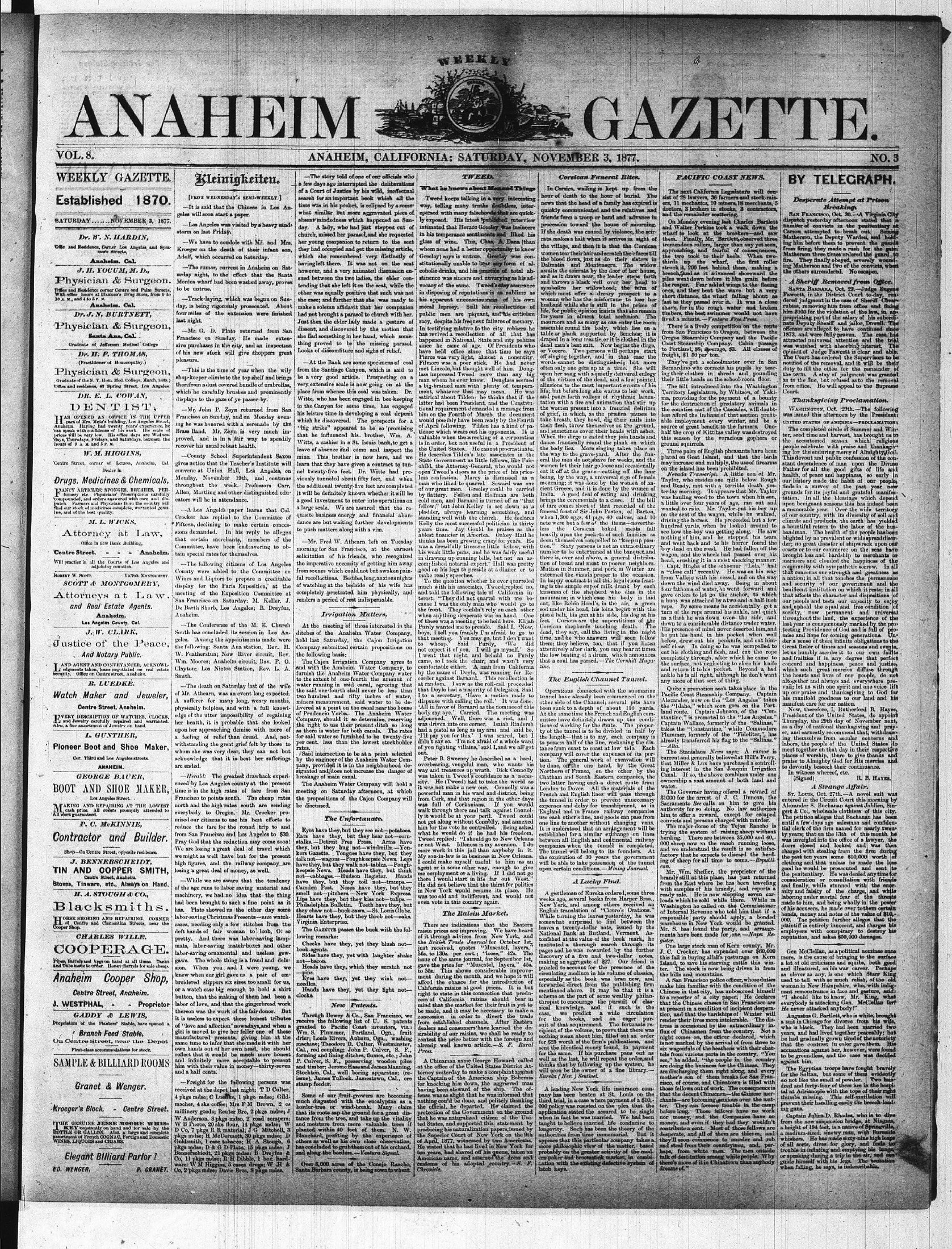
Searchable text
WEEKLY GAZETTE.
Established 1870.
SATURDAY... NOVEMBER 3, 1877.
Dr. W. N. HARDIN,
Office and Residence, Corner Los Angeles, and Sycamore Streets,
Anaheim, Cal.
J. H. YOCUM, M. D., Physician & Surgeon.
Office and Residence corner Centre and Palm Streets, With office hours at Blanken’s Drug Store, from 9 to 10 A.M., and 4 to 5 P.M.
Anaheim, Cal.
Dr. J. N. BURTNETT, Physician & Surgeon,
Santa Ana, Cal.
Graduate of Jefferson Medical College
Dr. H. F. THOMAS,
(Practitioner of Homoeopathy.)
Physician & Surgeon,
Graduate of the N.Y. Hom. Med. College, March, 1860.
Office and residence, at Spring Street, Los Angeles.
DR. E. L. COWAN,
DENTIST,
Has opened an office in the upper part of Mrs. Metz’s building, Los Angeles Street, Anaheim. Having had twenty years’ experience, he can speak with confidence of his work. His scale of practice will be very low. His office days are Woolness Days, Thursdays, Fridays, and Saturdays, between the hours of 9 A.M. and 5 P.M.
W. M. HIGGINS,
Centre Street, corner of Lemon, Anaheim, Cal.
Kleinigkeiten.
[FROM WEDNESDAY’S SEMI-WEEKLY.]
It is said that the Chinese in Los Angeles will soon start a paper.
Los Angeles was visited by a heavy sandstorm on last Friday.
We have to condole with Mr. and Mrs. Kroeger on the death of their infant son, Adolf, which occurred on Saturday.
The rumor, current in Anaheim on Saturday night, to the effect that the Santa Monica wharf had been washed away, proves to be untrue.
Track-laying, which was begun on Sunday, is being vigorously prosecuted. About four miles of the extension were finished last night.
Mr. G. D. Plato returned from San Francisco on Sunday. He made extensive purchases in the city, and an inspection of his new stock will give shoppers great pleasure.
This is the time of year when the wily shop-keeper climbs to the top shelf and brings therefrom a dust covered bundle of umbrellas, which he carefully brushes and prominently displays to the gaze of ye passer-by.
Mr. John P. Zeyn returned from San Francisco on Sunday, and on Monday evening he was honored with a serenade by the Brass Band. Mr. Zeyn is very much improved, and is in a fair way to speedily recover his usual robust health.
County School Superintendent Saxon gives notice that the Teacher’s Institute will
Physician & Surgeon,
Graduate of the N.Y. Hom Med College, March 1860.
Office and residence, 43 Spring Street, Los Angeles.
DR. E. L. COWAN,
DENTIST,
Has opened an office in the upper part of Mrs. Metz's building, Los Angeles Street, Anaheim. Haying had twenty years experience, he can speak with confidence of his work. His scale of prices will be very low. Its office days are Wednesday, Thursday, Friday, and Saturday, between the hours of 9 A.M. and 5 P.M.
W. M. HIGGINS,
Centre Street, corner of Lemon, Anaheim, Cal.
Dealer in
Drugs, Medicines & Chemicals,
FRANCY ARTICLES; SPONGES, BRUSHES, PERFUMERY etc. Physicians' Prescriptions carefully compounded, and orders answered with care and dispatch. Farmers and Physicians from the country will find our stock of medicines complete, warranted genuine, and of the best quality.
M. L. WICKS,
Attorney at Law,
Office in new Bank Building.
Centro Street, - - Anaheim.
Will practice in all the Courts of Los Angeles and adjourning counties.
ROBERT W. SCOTT.
VICTOR MOSTOEMERY.
SCOTT & MONTGOMERY,
Attorneys at Law.
and Real Estate Agents.
Anaheim,
Los Angeles County, Cal.
J. W. CLARK,
Justice of the Peace,
And Notary Public.
AND AGENT AND CONVEYANCER, ACKNOWLEDGMENTS taken, basis negotiated on real estate security. Office on Centre street, Anaheim.
R. LUEDKE.
Watch Maker and Jeweler,
Centre Street, Anaheim.
VERY DESCRIPTION OF WATCHES, CLOCKS, and Jewelry carefully repaired and warranted. Also, a fine assortment of Jewelry on hand.
L. GUNTHER,
Pioneer Boot and Shoe Maker,
Cor. Third and Los Angeles streets.
ANAHEIM.
GEORGE BAUER,
BOOT AND SHOE MAKER,
Los Angeles Street.
MAKING AND REPAIRING AT THE LOWEST cash price. All orders promptly attended to All work guaranteed.
P. C. McKINNIE,
Contractor and Builder.
Shop—On Centre Street, opposite residence.
J. BENNERSCHEIDT,
TIN AND COPPER SMITH,
Centre Street, Anaheim.
—This is the time of year when the wily shop-keeper climbs to the top shelf and brings therefrom adjust covered bundle of umbrellas, which he carefully brushes and prominently displays to the gaze of ye passer-by.
Mr. John P. Zeyn returned from San Francisco on Sunday, and on Monday evening he was honored with a serenade by the Brass Band. Mr. Zeyn is very much improved, and is in a fair way to speedily recover his usual robust health.
County School Superintendent Saxon gives notice that the Teacher's Institute will convene at Union Hall, Los Angeles, on Monday, November 19th, and continue throughout the week. Professors Carr, Allen, Martling and other distinguished educators will be in attendance.
A Los Angeles paper learns that Col. Crocker has replied to the Committee of Fifteen, declining to make certain concessions demanded. In his reply he alleges that certain merchants, members of the Committee, have been endeavoring to obtain special rates for themselves.
The following citizens of Los Angeles County were added to the Committee on Wines and Liquors to prepare a creditable display for the Paris Exposition, at the meeting of the Exposition Committee at San Francisco on Saturday: M. Keller, J. De Barth Shorb, Los Angeles; B. Dreyfus, Anaheim.
The Conference of the M.E. Church South has concluded its session in Los Angeles. Among the appointments made were the following: Santa Ana station, Rev. H.W. Featherstun; New River circuit, Rev.Wm. Moores; Anaheim circuit, Rev.P.O. Clayton; Los Nietos Station, Rev.L.A.Smith.
The death on Saturday last of the wife of Mr. Athearn, was an event long expected. A sufferer for many long, weary months, physically helpless, and with a full knowledge of the utter impossibility of regaining her health, it is probable that she looked upon her approaching demise with more of a feeling of relief than dread. And notwithstanding the great grief felt by those to whom she was very dear, they can not but acknowledge that it is best her sufferings are ended.
Herald: The greatest drawback experienced by Los Angeles county at the present time is in the high rates of fare from San Francisco to points south. The cheap rates north and the high rates south are sending everybody to Oregon. Mr. Crocker promised our citizens to use his best efforts to reduce the fare for the round trip to and from San Francisco and Los Angeles to $30. Pray God that the reduction may come soon! We are losing a great deal of travel which we might as well have but for the present high figures, and the railway company are losing a great deal of money, as well.
While we are aware that the tendency from the Santiago Canal be a very good article very extensive scale is place whence this Witte, who has been en in the Canyon for some his leisure time in dev which he discovered.
"Big strike" appeared that he influenced his Witte, a cashier in a leave of absence and c mine. This brother learn that they have given nel twenty-five feet.viously tunneled about the additional twenty-it will be definitely known a good investment to e large scale. We are quisite business energy dance are but waiting to push matters along.
Mr. Fred W. Athene morning for San Francisco solicitation of his friend the imperative necessities from scenes which could ful recollections. Beside of watching at the beach completely prostrated renders a period of rest.
Irrigation
At the meeting of ditches of the Anaheim held last Saturday, the Company submitted coe the following basis:
The Cajon Irrigation and with the Anaheim furnish the Anaheim W to the extent of one-four water running in said the said one-four share two hundred and fifteen miners measurement, livered at a point on the of Prudencio Yorba.
Company, should it as right to use their as there is water for bo for said water so furnish per cent. less than tha rates.
Said intersection to b by the engineer of the pany provided it is in signaled and does not i breakage of main canal.
The Anaheim Water meeting on Saturday the propositions of tha be discussed.
The Unfo
Eyes have they, but t Ears have they, but stalks.-Detroit Free they, but they hug n kers Gazette. Tongues talk not—wagons—Pou have they, but they wall keepsie News. Heads not—cabbages—Huds have they, but they
BOOT AND SHOE MAKER,
Los Angeles Street.
P. C. McKINNIE,
Contractor and Builder.
Shop—On Centre Street, opposite residence.
J. BENNERSCHEIDT,
TIN AND COPPER SMITH,
Centre Street, Anaheim.
Stoves, Tinware, etc., Always on Hand.
H. A. STOUGH & CO.,
Blacksmiths.
HORSE SHOEING AND REPAIRING. CORNER of Centre and Clementina Streets, near the Cooper Shop.
CHARLES WILLE.
COOPERAGE.
Flies, Barrels and keys on hand at all times. Tanks and Tabs made to order. Honey Barrels for sale cheap.
Anaheim Cooper Shop,
Centre Street, Anaheim.
J. WESTPHAL, - Proprietor
GADDY & LEWIS,
Proprietors of the Planters' Stable, have opened a Branch Feed Stable, On Centre Street, near the Depot First-class accommodations for stock.
SAMPLE & BILLIARD ROOMS
Granet & Wenger.
Kroeger's Block, - Centre Street.
THE GENUINE JENSE MOORE WHISKEY constantly on hand and for sale by the BITTLE OR GALLON. Also, a large and complete assortment of French COGNAC, Foreign and Domestic WINES, LIQUORS and CIGARS.
Elegant Billiard Parlor!
ED. WENGER,
P. GRANET.
While we are aware that the tendency of the age runs to labor saving material and machinery, we had no idea that the thing had been brought to such a fine point as it has. Plato showed us the other day some labor-saving Christmas Presents—nice watch-cases, needing only a few stitches from the deft hands of fair woman to look; O! so pretty. And there was labor-saving lamp-mats, labor-saving match-boxes and other labor-saving ornamental and useless gewgaws. The whole thing is a fraud and delusion. When you and I were young, we knew when our girl gave us a pair of embroidered slippers six sizes too small for us, or a watch case big enough to hold a shirt button, that the making of them had been a labor of love, and that the gingerbread work thereon was the work of the fair donor. But it is useless to expect these honest tributes of "love and affection" nowadays, and when a girl is moved to give her feller one of these manufactured presents, giving him at the same time to infer that she made it with her own hands out of her own head, she should reflect that it would be much more honest and infinitely more acceptable to present him with their value in money—thirty-seven and a half cents.
Freight for the following persons was received at the depot last night: T D Culter, 4 pkga mdse; C Lucelke, 1 pkga mdse; Gildmacher, 4 sks coffee; Mrs F M Brown, 2 cs millinery goods; Reuter Bro, 2 pkga mdse; J W Anderson, 8 pkga mdso, 2 road scrapers; W B Pierce, 20 sks flour, 14 pkga mdse; W D Co, 7 pkga R R material; J G Mitchell, 3 pkga mdse; H McDermott, 30 pkga mdse; D Goldsmith, 1 case tobacco; H A Stough, 6 pkga mdse; D & G D Plato, 15 pkga mdse; J Bernerschiedt, 21 pkga mdse; B Dreyfus & Co, 11 pkga mdse; R H Dibble, 1 box hardware; W M Higginas, 5 cases drugs; W H & Co, 2 pkga mdse; Davis Bros, 3 pkga mdse.
Some of our fruit-growth disgusted with border-tree or wind-that its roots sap the ground from the tree, and moisture from moist planted within 40 feet. Blanchard, profiting by others as well as his own has concluded to grub tht and along the borders...
Over 8,000 acres of Santa Barbara county,
WEEKLY
CIM GAY
ANAHEIM, CALIFORNIA: SATURDAY, NOVEMBER 3, 1877.
The story told of one of our officials who a few days ago interrupted the deliberations of a Court of Justices by his wild, ineffectual search for an important book which all the time was in his pocket, is eclipsed by a somewhat similar but more aggravated piece of absent-mindedness which happened on Sunday. A lady, who had just stepped out of church, missed her parasol, and she requested her young companion to return to the seat they had occupied and get the missing article, which she remembered very distinctly of having left there. It was not on the seat however, and a very animated discussion ensued between the two ladies, the elder conending that she left it on the seat, while the other was equally positive that such was not the case; and further that she was ready to make a solemn affidavit that her companion had not brought a parasol to church with her. Just then the elder lady made a gesture of dissent, and discovered by the motion that she had something in her hand, which something proved to be the missing parasol. Looks of discomfiture and sighs of relief.
At the Bank are some specimens of coal from the Santiago Canyon, which is said to be a very good article. Prospecting on a very extensive scale is now going on at the place from whence this coal was taken. Dr. Witte, who has been engaged in bee-keeping in the Canyon for some time, has engaged his leisure time in developing a coal deposit which he discovered. The prospects for a "big strike" appeared to be so promising that he influenced his brother, Win. A. Witte, a cashier in a St. Louis bank, to get a leave of absence and come and inspect the mine. This brother is now here, and we learn that they have given a contract to tunn.
TWEED.
What he knows about Man and Things
Tweed keeps talking in a very interesting way, telling many truths doubtless, interpreted with many falsehoods that are quickly exposed. His latest published interview intimated that Horace Grealay was insincere in his temperance sentiment and liked his glass of wine. This, Chas. A. Dana (than whom none had a better opportunity to know Grealey) says is untrue. Grealay was constitutionally unable to bear any form of alcoholic drinks, and his practice of total abstinence was sincere and unwary as his advocacy of the same. Tweed's easy assurance in disposing of reputations is as sublime as his apparent unconsciousness of his own moral leprosy. Still his reclections of public men are piquant, and his criticism racy, despite his frequent failures of memory. In testifying relative to the city robbers he has revived a recollection of all that has happened in National, State and city politics since he came of age. Of Presidents who have held office since that time he says Pierce was very light, almost a nonentity. Filmoro was a poor stick. He had never met Lincoln, but thought well of him. Douglass impressed Tweed more than any big man whom he ever knew. Douglass seemed a big-brained man with plenty of temperament, whatever that may mean. He was satirical about Tilden; he thinks that if the latter had been President, and the Constitutional requirement demanded a message from him on the Fourth of March, the document would possibly have been ready by the Fourth of April following. Tilden has a kind of patience which wears out his opponents. It is valuable when the wrecking of a corporation is in order, but not useful in a President of the United States. He cannot procrastinate. He describes Tilden's late associates in the State Government as little fellows, like Fairchild, the Attorney General, who would not
Corsican Funeral Rites.
In Corsica, wailing is kept up from the hour of death to the hour of burial. The news that the head of a family has expired is quickly communicated and the relatives and friends form a troop or band and advance in procession toward the house of mourning. If the death was caused by violence, the scirrata makes a halt when it arrives in sight of the village, and then it is that the Corsican women tear their hair and scratch their faces till the blood flows, just as do their sisters in Dalmatia and Montenegro. The widow awaits the scirrata by the door of her house, and as it draws near, the leader steps forth and throws a black veil over her head to symbolize her willowhood; the term of which must offer a dreary prospect to a woman who has the misfortune to lose her husband while she is still in the prime of life, for public opinion insists that she remain for years in almost total seclusion. The mourners and as many as can enter the room assemble round the body, which lies on a table or plank supported by benches; it is draped in a long mantle, or it is clothed in the dead man's best suit. Now begins the dirge, or Vocero. Two persons will perhaps start off singing together, and in that case the words cannot be distinguished; but more often only one gets up at a time. She will open her song with a quietly delivered enlogy of the virtues of the dead, and a few pointed allusions to the most important events of his life; but before long she warms to her work, and pours forth volleys of rhythmic lamentation with a fire and animation that stir up the women present into a fronzied delirium of grief, in which, as the praiseria pauses to take breath, they howl, dig their nails into their flesh, throw themselves on the ground, and sometimes cover their heads with ashes. When the dirge is ended they join hands and dance frantically round the plank on which the body lies. More singing takes place on the way to the grave-yard. After the funeral the men do not shave for weeks, and the women let their hair go loose and occasionally
from the Santiago Canyon, which is said to be a very good article. Prospecting on a very extensive scale is now going on at the place from whence this coal was taken. Dr. Witte, who has been engaged in bee-keeping in the Canyon for some time, has engaged his leisure time in developing a coal deposit which he discovered. The prospects for a "big strike" appeared to be so promising that he influenced his brother, Wm. A. Witte, a cashier in a St. Louis bank, to get a leave of absence and inspect the mine. This brother is now here, and we learn that they have given a contract to tunnel twenty-five feet. Dr. Witte had previously tunneled about fifty feet, and when the additional twenty-five feet are completed it will be definitely known whether it will be a good investment to enter into operations on a large scale. We are assured that the requisite business energy and financial abundance are but waiting further developments to push matters along with a vim.
Mr. Fred W. Athearn left on Tuesday morning for San Francisco, at the earnest solicitation of his friends, who recognized the imperative necessity of getting him away from scenes which could not but awaken painful recollections. Besides, long, anxious nights of watching at the beltside of his wife has completely prostrated him physically, and renders a period of rest indispensable.
Irrigation Matters.
At the meeting of those interested in the ditches of the Anaheim Water Company, held last Saturday, the Cajon Irrigation Company submitted certain propositions on the following basis:
The Cajon Irrigation Company agree to and with the Anaheim Water Company, to furnish the Anaheim Water Company water to the extent of one-fourth the amount of water running in said canal, agreeing that the said one-fourth shall never be less than two hundred and fifty inches of water, miners measurement, said water to be delivered at a point on the canal near the house of Prudencio Yorba. The Anaheim Water Company, should it so determine, reserving the right to use their present ditch so long as there is water for both canals. The rates for said water so furnished to be twenty-five per cent. less than the lowest stockholder rates.
Said intersection to be at a point selected by the engineer of the Anaheim Water Company, provided it is in the neighborhood designated and does not increase the danger of breakage of main canal.
The Anaheim Water Company will hold a meeting on Saturday afternoon, at which the propositions of the Cajon Company will be discussed.
The Unfortunate.
Eyes have they, but they see not—potatoes. Ears have they, but they hear not—corr stalks. Detroit Free Press. Arms have they, but they hug not—windmills. Yonkers Gazette. Tongues have they, but they talk not—wagons. Poughkeepsie News. Legs have they, but they walk not—tables. Poughkeepsie News. Heads have they, but think not—cabbages. Hudson Register. Hands have they, but they toll not—tramps.
met Lincoln, but thought well of him. Douglass impressed Tweed more than any big man whom he ever knew. Douglass seemed a big-brained man with plenty of temperament, whatever that may mean. He was satirical about Tilden: he thinks that if the latter had been President, and the Constitutional requirement demanded a message from him on the Fourth of March, the document would possibly have been ready by the Fourth of April following. Tilden has a kind of patience which wears out his opponents. It is valuable when the wrecking of a corporation is in order, but not useful in a President of the United States. He cannot procrastinate.
He describes Tilden's late associates in the State Government as little fellows, like Fairchild, the Attorney-General, who would not open Tweed's doors as the price of his priceless confession. Marcy is dismissed as a man who liked to quarrel. Seward was one of our great men. Greeley could be carried by flattery. Felton and Hoffman are both cold men, and Barnard is turned off as "that fellow;" but John Kelley is set down as a plodder, always learning something, and standing well with the church. He declares Kelly the most successful politician in thirty years time. Jay Gould he praises as the ablest financier in America. Oakey Hall he thinks has been growing crazy for years. He was a dreadfully tiresome little fellow, with his weak little puns, and he was fairly useful in drawing up cunning bills, but not an accomplished notarial expert. Hall was pretty good on his legs to preside at a dinner or to make ready speeches.
To the question whether he ever quarreled much with his associates, Tweed replied no, and told the following tale of California interest: "They did not quarrel with me because I was the only man who would go to the front. They couldn't rely on each other when anything desperate was on hand. One of these was a meeting to be held here. Elijah Purly wanted me to preside. Said I, Now, boys, I tell you frankly I'm afraid to go to that meeting. You may go, but I don't want to whoop. Said Purdy, 'We did not expect it of you. I will go myself.' So I went that night, and behold no Purdy came, so I took the chair, and wasn't very comfortable either. A man from California by the name of Doyle, was running for Recorder against Barnard.
This recollection is at random. I saw as the roll-call proceeded that Doyle had a majority of Delegates. Said I to a secretary, 'Have a motion made to dispense with calling the roll.' It was done. 'All in favor of Barnard as the nominee of this body say aye.' Carried. The meeting was adjourned. Well, there was a riot, and I was driven into one corner. Isaiah Rindersh had a pistol as long as my arm and said he, 'I'll pay you for this.' I was scared, but I didn't say so. 'I'm not afraid of a whole ward of you fighting villains,' said I, and we all got out.
Peter B. Sweeney he described as a hard, overbearing, vengeful man, who wants his way and treasures up wrath. Dick Connolly was taken in Tweed's confidence as a necessity. He (Tweed) had to take the world as it was not make a new one. Connolly was a powerful man in his ward and district, being from Cork, and that region in the other days was full of Corkonians. If you would walk through there and talk against Connolly it would be at your peril. Tweed could not get along without Connolly, and annexed him for the vote he controlled. Being asked what he would do if he had his freedom, Tweed replied: "I should go to New Orleans or out West. Illeness is my aversion. I do more work in this jail than anybody in it. My son-in-law is in business in New Orleans. I could make myself useful to him as an agent or in some other way, enough to give me employment or a living. If I did not go there I would start in life far out West."
Oral communication will be established for a similar exchange on lines between all English and continental railway companies when the tunnel is completed. The tunnel will belong to its founders. At the expiration of 30 years the government will be able to take possession of the tunnel upon certain conditions.
A Lucku Find.
Quarterly Journal
The Anacostia Water Company will hold a meeting on Saturday afternoon, at which the propositions of the Cajon Company will be discussed.
The Unfortunate
Eyes have they, but they see not—potatoes. Ears have they, but they hear not—cornstalks. Detroit Free Press. Arms have they, but they hug not—windmills. Yankers Gazette. Tongues have they, but they talk not—wagons. Poughkeepsie News. Legs have they, but they walk not-tables. Poughkeepsie News. Heads have they, but think not—cabbages. Hudson Register. Hands have they, but they toil not—tramps. Camden Post. Noses have they, but they smell not—pitchers. New York Express. Lips have they, but they kiss not—tulips. Philadelphia Bulletin. Teeth have they, but they chaw not—buck-saws. St. Louis Globe. Hearts have they, but they throb not—oaks. Virginia Enterprise.
The Gazette passes the buck with the following remarks:
Cheeks have they, yet they blush not—book-agents.
Sides have they, yet with laughter shake not—bacon.
Heads have they, which they scratch not—pins.
Eyes have they, yet they wink not—needles.
Hands have they, yet they fight not—clocks.
New Patents.
Through Dewey & Co., San Francisco, we receive the following list of U. S. patents granted to Pacific Coast inventors, viz.: Wm. S. Plummer, Portland, Ogn., fruit drier; Louis Rivers, Anburn, Ogn., washing machine; Theodore D. Culter, Westminster, Cal., rod coupling; John P. Culver, S. F., forming and lining ditches, flumes, etc.; John P. Culver, S. F., preserving wooden piles and timber; Jerome Hass and James Manning, Stockton, Cal., well boring apparatus; (reissue), James Tullock, Jamestown, Cal., ore stamp feeder.
Some of our fruit-growers are becoming much disgusted with the encalyptus as a border-tree or wind-break. Many claim that its roots sap the ground for a great distance from the tree, and take up the vitality and moisture from more valuable trees if planted within 40 feet of them. N. W. Blanchard, profiting by the experience of others as well as his own close observation, has concluded to grab them out of his orchard, and along the bandera. Ventura Signal.
Over 5,000 acres of the Consjo Rancho, Santa Barbara county, is being sown to wheat.
There are indications that the Eastern raisin prices are improving. We have heard of it through advices from New York, and the British Trade Journal for October 1st, just received, quotes "Muscatel, layers," 56s. to 130s. per cwt.; "loos," 42s. The issue of the same journal, for September 1st, gave the price for "Muscatel, layers," 45s. to 56s. This shows considerable improvement during the month, and we hope it will afford the chance for the introduction of California raisins at good prices. It is but right to state in this connection that producers of California raisins should bear in mind that the market for their fruit is yet to be made, and it may be necessary to make a concession in order to divert the trade from established channels. After Eastern dealers and consumers have learned the desirability of our raisins, we shall be ready to contest the price better with the foreign and already well known article. S. F. Rural Press.
A Chinaman name George Howard called at the office of the United States District Attorney yesterday to make a complaint against the Captain of the American ship Bohemia for knocking him down, the aggrieved man having been steward of the ship. The offense was so slight that he was informed that nothing could be done, and politely thanking the official, he departed. He claimed the protection of the Government on the ground that he was naturalized citizen of the United States, and supported this statement by producing his naturalization papers, issued by the Superior Court of New York on the 9th of April, 1877, witnessed by two Americans. He stated that he had lived in New York for ten years, had shaved off his queue, taken an American name, and assumed the dress and customs of his adopted country. S. F. Chronicle.
A gentleman of Eureka ordered some three weeks ago, several books from Harper Bros., New York, and among others received an English translation of "Cicero's Orations." While turning the leaves yesterday, he was somewhat surprised to find between the leaves a twenty-dollar note, issued by the National Bank at Rutland, Vermont. As tainted at the value of the book mark, he instituted a thorough search through its pages and he was rewarded by the further discovery of a five and two-dollar notes, making an aggregate of $27. Our friend is puzzled to account for the presence of the circulating medium in his volume of classics, especially as the book was bran new, and forwarded direct from the publishing firm mentioned above. It may be that it is a scheme on the part of some wealthy philanthropist to encourage the pursuit of classical knowledge, and if such is the case, we predict a wide circulation for the books, and an eager pursuit of that acquirement. The fortunate recipient of the volume, to prove that there was nothing mean about him, filled out an order for $25 worth of the firm's publications, and sent the identical money found, in payment for the same. If his purchase pans out as well as last he will repeat the order, and thinks that by following up the system, he will soon be the owner of a fine library. Eureka (Nov.) Sentinel.
A leading New York life insurance company has been beaten at St. Louis on the third trial, in a case where payment of a $10,-000 policy was resisted on the plea that the application stated the assured to be single when in fact he was married. We had been taught to believe married life conducive to longevity. Such has been the theory of the authorities from time immemorial. But it appears that this particular company takes a more philosophic view of the matter based probably on the greater activity of the modern poker and bromatick market, in combination with the existing defective system of latch keys.
GAZETTE.
MER 3, 1877.
PACIFIC COAST NEWS.
The next California Legislature will consist of 28 lawyers, 36 farmers and stock-raisers, 11 mechanics, 10 miners, 18 merchants, 5 doctors, 3 brokers in stocks, 3 contractors, and the remainder scattering.
On Monday evening last Charles Bartlett and Walter Perkins took a walk down the wharf to look at the breakers—and saw them. Finally, Mr. Bartlett observed three tremendous rollers, larger than any yet seen, approaching, and fearful of consequences, the two took to their heels. When two-thirds up the wharf, the first roller struck it, 200 feet behind them, making a breach—and as it advanced shoreward the piles went down before it like grain before the reaper. Fear added wings to the fleeing ones, and they beat the wave but a very short distance, the wharf falling about as fast as they passed over it. It was a close shave, for in the rough water and broken timbers, the heat swimmer would not have lived a minute. — Ventura Free Press.
There is a lively competition on the route from San Francisco to Oregon, between the Oregon Steamship Company and the Pacific Coast Steamship Company. Cabin passage to Portland, $8; average, $3. All classes of freight, $1 50 per ton.
They've got a schoolmaster over in San Bernardino who corrects his pupils by tearing their clothes in shreds and pounding their little heads on the school-room floor.
The bill introduced into the Washington Territory Legislature, by Whitson, of Yakima, providing for the payment of a bounty for the destruction of predatory animals in the counties cast of the Cascades, will doubtless afford the Indians of that section profitable employment every winter, and be a source of great benefit to the farmers. One-half the crop of Kittitas valley was destroyed this season by the voracious gophers or ground squirrels.
Three pairs of English pheasants have been placed on Goat Island, and that the birds may increase and multiply, the use of firearms
BY TELEGRAPH.
Desperate Attempt at Prison Breaking.
SAN FRANCISCO, Oct. 30.—A Virginia City dispatch yesterday afternoon stated that a number of convicts in the penitentiary at Carron attempted to break out. Seizing Matherson, the Deputy Warden, and holding him before them to prevent the guards from firing, they made a rush for the patrMatherson three times ordered the guard to fire. They finally obeyed, severely wounding Matherson and two of the convicts, when the others surrendered. No escape.
A Sheriff Removed from Office.
SANTA BARBARA, Oct. 29.—Judge Engene Fawcett, in the District Court to-day, rendered judgment in the case of Sheriff Obvarubias, removing him from office and fining him $100 for the violation of the law, in appropriating part of the salary of his subordinate Deputy Sheniff and jailor Dowell. The offenses are alleged to have continued since 1873, and were fully proven. The case has attracted universal attention and the trial was watched with absorbing interest. The opinion of Judge Fawcett is clear and able. The Court has ordered the Supervisors to be notified of the removal, and it will be their duty to fill the office for the remainder of the term. A stay of judgment was granted as to the fine, but refused as to the removal from office. He will appeal to the Supreme Court.
Thanksgiving Proclamation.
WASHINGTON, Oct. 29th.—The following was issued this afternoon by the President: UNITED STATES OF AMERICA—PROCLAMATION!
The completed circle of Summer and Winter, sebel time and harvest, has brought us to the accustomed season which religious people celebrate with praise and thanksgiving for the enduring mercy of Almighty God. This devout and public confession of the constant dependence of man upon the Divine
At a time, she will deliver enlightened news to her work, and a few pointed important events of his life warns her to her work, of rhythmic lameness that stir up the prairie pauses to dig their nails into ourselves on the ground, their heads with ashes, and they join hands and lead the plank on which singing takes place on yard. After the funeral for weeks, and the loose and occasionally cutting off the hair universal sign of female beauty by the women of amusement by the women of eating and drinking, it is close. If the bill that recorded of the sun Paston, of Barton, wages 40 calves, and 10 items—nevertheless baked meats fall sets of such families as called to "keep up possessions" not an extraordinary demand at the banquet, and vice, a general distribution to poorer neighbors. And pork in Winter are proper to the occasion. All this lugubrious feast of milk drank by each guard who dies in the case his body is laid in the air, a green loins beig with the his side, his dog at his superstitious of the touching death. He living in the night awaits will soon follow that if you listen you may hear at times rum, which announces the Channel Tunnel.
With the submarine been commenced on the channel; several pits have stood about 110 yards, French and English combed up the condition route. The proper bone divided in half by say, each company is mine, reckoning the distance at low tide. Each expense of its porch or excavation will be hand, by the Great on the other by the Eastern companies, the direct route from the materials of the bones will pass through our transhipment, as in the railway companies and goods can pass without changing vans. An arrangement will be made exchange on lines and continental railway tunnel is completed, to its founders. At years the government assessing of the tunnel — Mining Journal.
Bernardino who corrects his pupils by tearing their clothes in shreds and pounding their little heads on the school-room floor.
The bill introduced into the Washington Territory Legislature, by Whitson, of Yakima, providing for the payment of a bounty for the destruction of predatory animals in the counties east of the Cascades, will doubtless afford the Indians of that section profitable employment every winter, and be a source of great benefit to the farmers. One-half the crop of Kittitas valley was destroyed this season by the voracious gophers or ground squirrels.
Three pairs of English pheasants have been placed on Goat Island, and that the birds may increase and multiply, the use of firearms on the island has been prohibited.
Nevada Transcript: A little son of Mr. Taylor, who resides one mile below Rough and Ready, met with a terrible death yesterday morning. It appears that Mr. Taylor was hauling wood to the town when his son, a little over four years of age, ran out and wanted to ride. Mr. Taylor put his boy up on the seat of the wagon, while he walked, driving the horses. He proceeded but a few hundred yards, when he looked around to see how the boy was getting along. He saw nothing of him, and he stopped his team and went back and to his horror found the boy dead on the road. He had fallen off the wagon, and the wheels had passed over his head, crushing it in a roost shocking manner.
Capt. Hughes of the schooner "Lola," had a "close call" recently. He was on his way from Vallejo with his vessel, and on the way down the wind died away. Being in about four fathoms of water, he went forward and gave orders to let go the anchor, to which buoy was attached by a two-and-a-half-inch rope. By some means he accidentally got a turn of the rope around his ankle, and quick as a flash he was down over the side, and down to a considerable distance under water. His presence of mind never deserted him, and he put his hand in his pocket when well below, drew out his penknife, and ent himself clear. In doing so he was compelled to cut his clothing and flesh, and cut the rope completely through, after which he came to the surface, not neglecting to close his knife and return it to his pocket. Beyond a bad ankle he is all right, although he don't want any more of that sort of thing.
Quite a promotion soon takes place in the Pacific Coast Steamship Company. Captain Alexander, now on the "Los Angeles" takes the "Idaho," which soon goes on the Portland route. Captain Johnson, of the "Constantine," is promoted to the "Los Angeles." Captain Wallace, formerly of the "Salinas," takes the "Constantine," while Commodore Plummer, formerly of the "Fideliter," has already transferred his flag to the "Salinas."
Alla.
The Stanislaws News says: A rumor is current and generally believed at Hill's Ferry, that Miller & Lux have purchased a controlling interest in the San Joquin Irrigation Canal. If so, the above combines under one ownership a vast amount of both land and water.
The Governor having offered a reward of $1000 for the arrest of J. C. Duncan, the Sacramento Bee calls on him to give his authority for so doing. No law authorizes him to offer a reward, except for escaped convicts and persons charged with murder.
The major-domo of the Tejon Rancho is trying the system of raining sheep without herding. There are between 35,000 and 40,000 sheep now on the ranch running loose, and we understand the result is so satisfactory that he expects to discard the herding of sheep for all time to come.—Republican.
Mr. Wm. Sheffier, the proprietor of the brandy still at this place, has just returned from East Fortune where he has been traveling duty to fill the office for the remainder of the term. A stay of judgment was granted as to the fine, but refused as to the removal from office. He will appeal to the Supreme Court.
Thanksgiving Proclamation.
WASHINGTON, Oct. 29th.—The following was issued this afternoon by the President: UNITED STATES OF AMERICA—PROCLAMATION!
The completed circle of Summer and Winter, seed time and harvest, has brought us to the accustomed season which religious people celebrate with praise and thanksgiving for the enduring mercy of Almighty God. This devout and public confession of the constant dependence of man upon she Divine Father for all the good gifts of life and health, of peace and happiness, so early in our history made the habit of our people finds in a survey of the past year new grounds for its joyful and grateful manifestation. In all the blessings which depend upon benignignant seasons this has indeed been a memorable year. Over the wide territory of our country, with its diversity of soil and climate and products, the earth has yielded a beautiful return to the labor of the husbandman. The health of the people has been blighted by no prevalent or widespread disorder; no great disaster of shipwreck upon our coasts or to our commerce on the seas have brought loss and hardship to merchant or mariners and clouded the happiness of the community with sympathetic sorrow. In all that concerns our strength and greatness as a nation; in all that touches the permanence and security of our government and the beneficent institution on which it rests; in all that affects the character and dispositions of our people and tests our capacity to enjoy and uphold the equal and free condition of society; now permanent and universal throughout the land, the experience of the last year is conspicuously marked by the protecting Providence of God and is full of promise and hope for coming generations. Under a sense of these infinite obligations to the Great Ruler of times and seasons and events, let us humbly ascribe it to our own failures and frailities if in any degree that perfect concord and happiness; peace and justice, which such great mercies diffuse through the hearts and lives of our people, do not altogether and always and everywhere prevail; let us with one spirit and one voice lift up our praise and thanksgiving to God for his manifold goodness to our land and his manifest care for our nation.
Now therefore, I, Rutherford B. Hayes,
President-of-the United States, do appoint Thursday, the 29th day of November next,
as a day of national Thanksgiving and prayer,
and earnestly recommend that, withdrawing themselves from secular concerns and labors, the people of the United States do meet together on that day in their respective places of worship; there to give thanks and praise to Almighty God for His mercies and to devoutly beseech their continuance.
In witness whereof, etc.
(R.Signed)
A Strange Affair.
St. Louis, Oct. 27th.—A novel suit was entered inthe Circuit Court this morning by Alexander S. Buchanan against Johlien,Singert&Co.,wholesale clothiersofthis city.The petition alleges that Buchanan has been until a few days ago salesmanand confidential clerkofthe firm namedfor nearly twenty years;that onthe 13thofthis monthhewas inveighedintotheofficeofa lawyer,thedoorsclosedandlockedandwasthenchargedwithstealingfromthefirmduringthepasttenearssome$10,000worthofclothingandthatunlesshemadethelossgoodhewouldbeprosecutedandsenttothepenitentiary.Hewisdenanytimeforconsiderationorconsultationwithfriendseventh
The Governer having offered a reward of $1000 for the arrest of J. C. Duncan, the Sacramento Bee calls on him to give his authority for so doing. No law authorizes him to offer a reward, except for escaped convicts and persons charged with murder.
The major-domo of the Tejon Rancho is trying the system of raising sheep without herding. There are between 35,000 and 40,000 sheep now on the ranch running loose, and we understand the result is so satisfactory that he expects to discard the herding of sheep for all time to come.—Republican.
Mr. Wm. Sheffier, the proprietor of the brandy still at this place, has just returned from the East where he has been traveling with samples of his brandy, and reports a ready sale. He is now shipping seven carloads which he sold while there. While in Washington he called on the Commissioner of Internal Revenue who told him that if a responsible party should apply, a bonded warehouse in New York would be granted. Mr. S. has found the party, and arrangements have been made for one.—Napa Register.
One large stock man of Kern county, Mr. J. C. Crocker, has expended over $60,000 this fall in buying alfalfa pasture on Kern Island, to save his starving cattle this winter. The stock is now being driven in from the hills and mountains.
A San Francisco police officer, whose duties make him familiar with the condition of the Chinese in that city, has unbosomed himself to a reporter of a city paper. He declares that the Chinese classes in San Francisco are at present in a condition of incipient desperation, and that the harmlips of Winter will render their lives more intolerable. The distress is occasioned by the extraordinary influx of Chinamen from the country. Not a night comes on, the officer declared, which is not marked by the arrival of from three to six wagonfuls of the heatens with their chattels from various parts in the country. "You see," he added, "the people in the country are doing the business for the Chinese. They are discharging them right along, and every mother's son of them breaks for San Francisco, of course, and Chinatown is filled with those fellows out of work. The consequence is that the decent Chinamen—the Chinese merchants—are becoming anxious over the matter. They can foresee trouble in the camp before long. Those fellows have no work nor money, and the Companies have no money, and even if they had they wouldn't contribute a cent. Most of those fellows are desperate, and all of them are thieves, and they'll soon commence to murder and rob and steal from their countrymen, and perhaps from white men. The men outside talk of destination among white people. Why there's more of it in Chinatown than anybody dreams of."
St. Louis, Oct. 27th.—A novel suit was entered in the Circuit Court this morning by Alexander S. Buchanan against Johllen Singert & Co., wholesale clothiers of this city. The petition alleges that Buchanan has been until a few days ago salesman and confidential clerk of the firm named for nearly twenty years; that on the 13th of this month he was invigilated into the office of a lawyer, the doors closed and locked and was then charged with stealing from the firm during the past ten years some $10,000 worth of clothing and that unless he made the loss good he would be prosecuted and sent to the penitentiary. He was denied any time for consideration or consultation with friends and finally, while stunned with the enormity and falsity of the charge, and while laboring under mortal fear of the threats made to him, and being wholly in the power of his accusers, he made over to them certain bonds, money and notes of the value of $10,000. The petition further alleges that the plaintiff is entirely innocent, and charges his employers with conspiracy to destroy his reputation, and asks $50,000 damages.
Gen McClellan, as a political nominee once more, is the cause of bringing to the surface a lot of old criticisms and squibs, both good and illnatured, on his war career. Perhaps as clever as any, is one which Starr King used to tell with so much relish, of the old woman in New Hampshire, who with indignant remonstrance in face and gesture, said: "I should like to know, Mr. King, what everybody is attacking Gen. McClellan for! He never attacked anybody!"
Augustus G. Bartlett, who is white, brought a suit in Chicago for divorce from his wife, who is black. They had been married two years, and had lived together peaceably; but he had gradually grown tired of the notoriety that the contrast in color gave them. His accusations against her, however, were found to be groundless, and the case was decided against him.
The Egyptian troops have fought bravely for the Sultan, but some of them avidly do not like the smell of powder. Two hundred and forty-four of them are in the hospital at Adrianople with the tops of their right thumbs missing. This self-mutilation will prevent their handling easily the breech-loading guns.
Captain Julius D. Rhodes, who is to dive from the new suspension bridge at Niagara, a height of 194 feet, is a native of Springville, a medium-sized, sinewy man, with Burnside whiskers. He has made sixty-nine high leaps of all sorts, dives for glory, and finds no trouble in inflating and emptying his lungs or speaking during a trip in the air, and can guide himself with his legs. The sensation when falling, he says, is indusorbable.