anaheim-gazette 1877-10-27
Scanned page
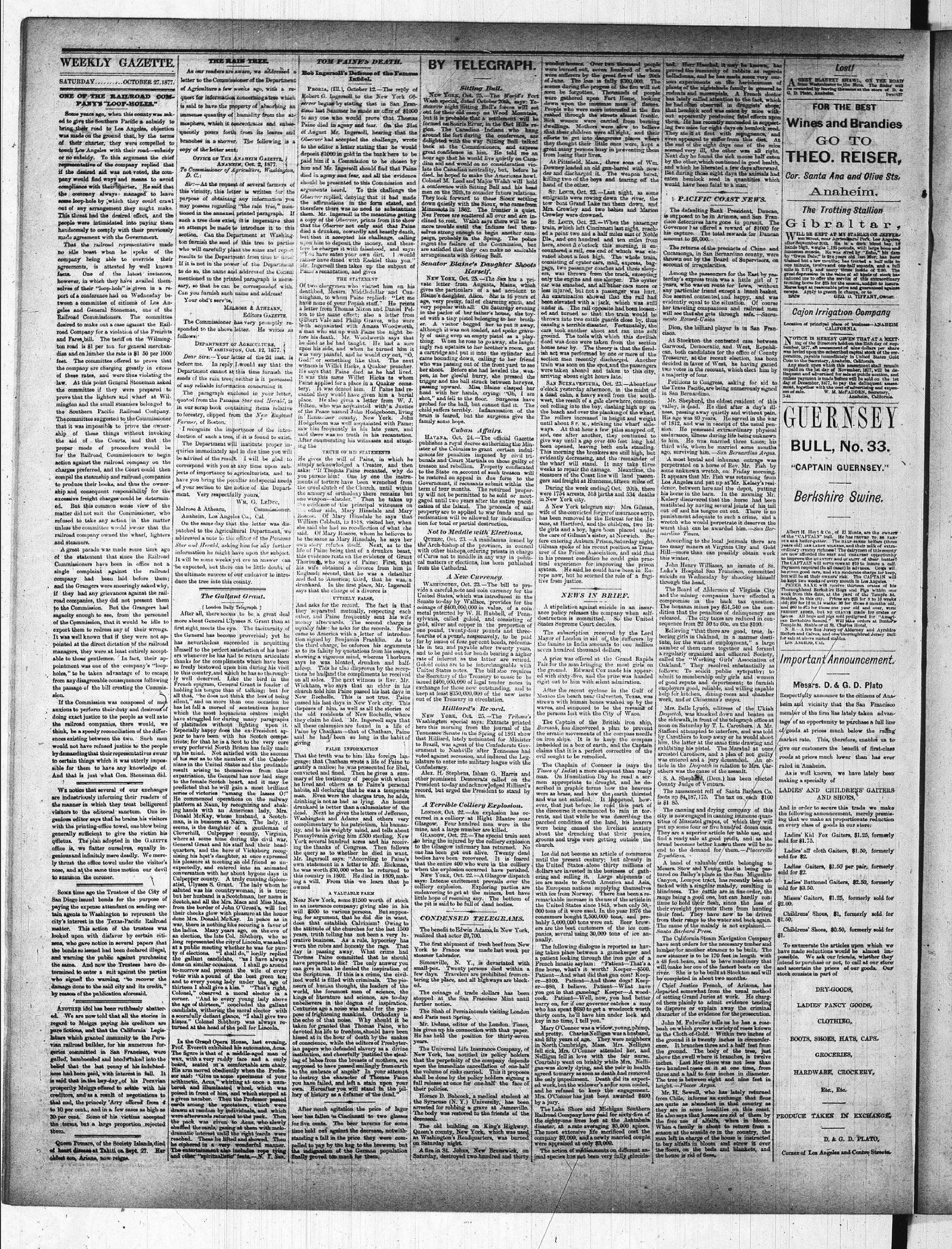
Searchable text
WEEKLY GAZETTE
SATURDAY...OCTOBER 27,1877.
ONE OF THE RAILROAD COMPANY'S "LOOP-HOLE."
Some years ago, when this county was asked to give the Southern Pacific a subsidy to bring their road to Los Angeles, objection was made on the ground that, by the terms of their charter, they were compelled to touch Los Angeles with their road—subady or no subsidy. To this argument the chief representative of the company replied that if the desired aid was not voted, the company would find ways and means to avoid compliance with their charter. He said that the company always managed to leave some loop-hole by which they could crawl out of any arrangement they might make. This threat had the desired effect, and the people were intimidated into paying them handsomely to comply with their previously made agreement with the Government.
That the railroad representative made no idle boast when he spoke of the company being able to override their agreements, is attested by well known facts. One of the latest instances, however, in which they have availed themselves of their "loop-hole" is given in a report of a conference had on Wednesday between a committee of citizens of Los Angeles and General Stoneman, one of the Railroad Commissioners. The committee desired to make out a case against the Railroad Company for a violation of the Freights and Pares bill. The tariff on the Wilmington road is $1 per ton for general merchandise and on lumber the rate is $1 50 per 1000 feet. The committee offered to prove that the company are charging greatly in excess of these rates, and were thus violating the law. At this point General Stoneman asked the committee if they were prepared to prove that the lighters and wharf at Wilmington and the small steamers belonged to the Southern Pacific Railroad Company. The committee suggested to the Commissioner that it was impossible to prove the ownership of these things without invoking the aid of the Courta, and that the proper mode of procedure would be for the Railroad Commissioners to begin action against the railroad company on the
THE RAIN TREE
As our readers are aware, we addressed a letter to the Commissioner of the Department of Agriculture a few weeks ago, with a request for information concerning a tree which is said to have the property of absorbing an immense quantity of humidity from the atmosphere, which it concentrates and subsequently pours forth from its leaves and branches in a shower. The following is a copy of the letter sent:
OFFICE OF THE ANAHEIM GAZETTE,
ANAHEIM, Oct. 2, 1877.
To Commissioner of Agriculture, Washington,
D.C.:
Sir:At the request of several farmers of this vicinity, this letter is written for the purpose of obtaining any information you may possess regarding "the rain tree," mentioned in the annexed printed paragraph. If such a tree does exist, it is imperative that an attempt be made to introduce it to this section. Can the Department at Washington furnish the seed of this tree to parties who will carefully plant the same and report results to the Department from time to time. If it is not in the power of the Department to do so, the name and address of the Consumption mentioned in the printed paragraph is necessary, so that he can be corresponded with. Can you furnish such name and address?
Your obd't serv'ts,
MZLROSE & ATHEARN,
Editors GAZETTE.
The Commissioner has very promptly responded to the above letter. He writes as follows:
DEPARTMENT OF AGRICULTURE.
WASHINGTON, Oct. 12, 1877.
Dear Sirs:Your letter of the 2nd inst. is before me.In reply I would say that the Department cannot at this time furnish the seeds of the rain tree; neither is it possessed of any reliable information concerning it.
The paragraph enclosed in your letter, quoted from the Panama Star and Herald, is in our scrap book containing items relative to forestry, clipped from the New England Farmer, of Boston.
I recognize the importance of the introduction of such a tree, if it is found to exist.
The Department will institute proper inquiries immediately and in due time you will be advised of the result.I will be glad to correspond with you at any time upon
TOM PAINTER
Bob Ingersoll's Dairy Inventory
PEORIA,(Ill.),Oct.
Robert G. Ingersoll server begins by stating since last Summer he has to any one who wonders Paine died in agony of August Mr. Ingersoll Observer had accepted to the editor a letter depositing $1000 in gold paid him if a Commissary him and Mr. Ingersoll died in agony and fear should be presented to arguments heard.
Observer replied, denying the affirmations in therefore there was no need them.Mr. Ingersoll insisted a copy of the Observer that the Observer not died a drunken, coward but that it accepted upon him to deposit his fore he charges it with "You have eaten your rather have dined with Mr. Ingersoll then take Paine a recantation,
THE STORY
Of two clergymen who dentibbed, Messrs.McNingham, to whom Paine have none of your Population a letter from Thomas Manning both acquainted with a man who sat up with fore his death.Mr.William died as he had tamed upon his side,and what was very painful,and God!"or something witness is Willet Hickey He says that Paine did It was this same Willem Paine applied for a plaster.It was denied he canted they would have place.He also gives a Hilton,who was acquainted of the Peace named Joan in Rensselaer county Hodgeboom was well saw him frequently in said there was no truth After enumerating his ing the
TRUTH OF HILLMAN
He gives the will of simply acknowledled
the company are charging greatly in excess of these rates, and were thus violating the law. At this point General Stoneman asked the committee if they were prepared to prove that the lighters and wharf at Wilmington and the small steamers belonged to the Southern Pacific Railroad Company. The committee suggested to the Commission that it was impossible to prove the ownership of these things without invoking the aid of the Courts, and that the proper mode of procedure would be for the Railroad Commissioners to begin action against the railroad company on the charges preferred, and the Court could then compel the steamship and railroad companies to produce their books, and thus the ownership and consequent responsibility for the excessive freight charges could be determined. But this common sense view of the matter did not suit the Commissioner, who refused to take any action in the matter unless the committee would swear that the railroad company owned the wharf, lighters and steamers.
A great parade was made some time ago of the statement that since the Railroad Commissioners have been in office not a single complaint against the railroad company had been laid before them; and the Grangers were aceringly asked why, if they had any grievances against the railroad companies, they did not present them to the Commission. But the Grangers had sagacity enough to see, from the personnel of the Commission, that it would be idle to expect them to redress any of their wrongs. It was well known that if they were not appointed at the direct dictation of the railroad managers, they were at least entirely acceptable to those gentlemen. In fact, their appointment was one of the company's "loopholes," to be taken advantage of or escape from any disagreeable consequences following the passage of the bill creating the Commission.
If the Commission was composed of men anxious to perform their duty and desirous of doing exact justice to the people as well as to the railroad companies, there would, we think, be a speedy reconciliation of the differences existing between the two. Such men would not have refused justice to the people by demanding that their representatives swear to certain things which it was utterly impossible for them to have any knowledge of. And that is just what Gen. Stoneman did.
We notice that several of our exchanges are industriously informing their readers of the manner in which they treat belligerent visitors to the editorial sanctum. One ingenious editor says that he brains his visitors with the printing-office towel, one blow being generally sufficient to give the victim his quiletus. The plan adopted in the GAZETTE office is, we flatter ourselves, equally ingenious and infinitely mere deadly. We merely thrust the office towel under the visitor's nose, and at the same time motion our devil to summon the coroner.
Department cannot at this time furnish the seeds of the rain tree; neither is it possessed of any reliable information concerning it.
The paragraph enclosed in your letter, quoted from the Panama Star and Herald, is in our scrap book containing items relative to forestry, clipped from the New England Farmer, of Boston.
I recognize the importance of the introduction of such a tree, if it is found to exist.
The Department will institute proper inquiries immediately and in due time you will be advised of the result. I will be glad to correspond with you at any time upon subjects of importance to agriculturists, and to have you bring the peculiar and special needs of your section to the notice of the Department. Very respectfully yours,
Wm. G. LEDUC,
Melrose & Athearn,
Commissioner.
Anaheim, Los Angeles Co., Cal.
On the same day that the letter was dispatched to the Agricultural Department, we addressed a note to the editor of the Panama Star and Herald, asking him for any further information he might have upon the subject. It will be some weeks yet ere an answer can be expected, but there can be little doubt of the ultimate success of our endeavor to introduce the tree into this county.
The Gallant Grant.
[London Daily Telegraph.]
After all, there seems to be a great deal more about General Ulysses S. Grant than at first sight meets the eye. The tacticity of the General has become proverbial; yet he has nevertheless succeeded in acquitting himself to the perfect satisfaction of his hearers whenever he has had to return articulate thanks for the compliments which have been so freely bestowed upon him during his visit to this country, and which he has so thoroughly well deserved. Like the bird in the French epigram, General Grant is fonder of holding his tongue than of talking; but for all that, "he does not think the less of being silent," and on more than one occasion he has let fall a morsel of sententious humor which the most loquacious orators might have struggled for during many paragraphs of platitudes without lighting upon it. Especially happy does the ex-President appear to have been with his Scotch companions; for that he is a Scot to the very core every porfervid North Briton has fully made up his mind. Not satisfied with the success of his mot as to the numbers of the Caledonians in the United States and the profitable result arising to themselves from their expatriation, the General has now laid siege to the female Scotch heart, and it may be predicted that he will gain a most brilliant series of victories "among the lasses O!"
He commenced operations on the railway platform at Naun, by recognizing and shaking hands with an American lady, Mrs. Donald McKay, whose husband, a Scotchman, is in business at Naun. The lady, it seems, is the daughter of a gentleman of Cloverhill, Culpepper county, Virginia, where at some time during the civil war, General Grant and his staff had their headquarters, and the hero of Vicksburg recognizing his host's daughter, at once expressed his pleasure at meeting an old friend so unexpectedly, and entered into an animated conversation with her about bygone days in Culpepper county. A truly cunning diplomacy.
He says that Paine did it was this same Wainland Paire applied for a plastery. It was denied because they would have placed him. He also gives him Hilton, who was acquired of the Peace named Joan in Rensselaer county. Hodgeboom was well aware saw him frequently in said there was no truth After enumerating his use.
TRUTH OF HILTON
He gives the will of simply acknowledge asks: "If Thomas Painter you pursue him? One mentions of torture have been cruel clutch of this armory of orthodoxy one weapon—slander." The evidence of this record other side, Mary Roscoe. Of Mary Hill William Coblett, in 1825 she said she had no recourse said. Of Mary Roscoe be the same as Mary Hill own story refutes its life of Painter being that this evidence rests on Thorburn who says on his wife obtained a copy England; second, that and fled to America; that drunkard. In the first says that the charge of one giving.
FALSE INFO
That the truth was to be guessed; that Chatham wrote gratify a malice; he was convicted and fined. The mary of the testimony owe he lived and others as habits, all declaring that man. Even were the drinking is not as bad as drunkard is better than dead. Next he gives Washington and Adams complimentary to his pardon York several hundred asking the thanks of Congregation query as to whether Mr. Ingersoll says: "A own statement in a letter he was worth $30,000 wishing this country in 1802. B ing a will. From this
We notice that several of our exchanges are industriously informing their readers of the manner in which they treat belligerent visitors to the editorial sanctum. One ingenious editor says that he brains his visitors with the printing-office towel, one blow being generally sufficient to give the victim his quletus. The plan adopted in the Gazette office is, we flatter ourselves, equally ingenious and infinitely mere deadly. We merely thrust the office towel under the visitor's nose, and at the same time motion our devil to summon the coroner.
Some time ago the Trustees of the City of San Diego issued bonds for the purpose of paying the expense attendant on sending certain agents to Washington to represent the city's interest in the Texas-Pacific Railroad matter. This action of the trustees was looked upon with disfavor by certain citizens, who gave notice in several papers that the bonds so issued had been declared illegal, and warning the public against purchasing the same. And now the Trustees have determined to enter a suit against the parties who signed the warning, "to recover the damage done to the said city and its credit," by reason of the publication aforesaid.
Another idol has been ruthlessly shattered. We are now told that all the stories in regard to Meiggs paying his creditors are pure fictions, and that the California Legislature which granted immunity to the Peruvian railroad builder, for his numerous forgery committed in San Francisco, were gulled, bamboozled and hoodwinked into the belief that the last penny of his indebtedness had been paid, with interest in fall. It is said that in the hay-day of his Peruvian prosperity Meiggs offered to settle with his creditors, and as a result of negotiations to that end, the princely Arry offered from 4 to 10 per cent, and in a few cases as high as 30 per cent. Some of his victims accepted the terms, but a large proportion rejected them.
Queen Pomare, of the Society Islands, died of heart disease at Tahiti on Sept. 27. Her oldest son, Ariana, now reigns.
In the Grand Opera House, last evening, Prof. Everett exhibited his automaton, Acuta. The figure is that of a middle-aged man of wax, with a very ruddy face and a curly beard, seated in a comfortable arm chair. His arm moved obediently when the Professor said: "Give us some specimens of your arithmetic, Acuta," whirling at once a numbered and illuminated wheel, which was poised in front of him, and which stopped at a given number. Then the Professor passed cards among the spectators, which were drawn at random by individuals, and which were afterwards returned to the pack. Then the pack was given to Acuta, who slowly shuffled the cards, gazing at them with melodramatic interest until the right cards were reached. These he lifted and showed. Then he ciphered in a very wonderful manner. The entertainment also includes rope tying and other "spiritualistic" facts.—N. F. San.
After much agitation beer has fallen in Cincinnati for five cents. The beer time held out against the standing a fall in the prince palled to pay by the king the indignation of the finally proved too much
TOM PAINE'S DEATH.
Bob Ingersoll's Defense of the Famous Infidel.
PEORIA, (Ill.), October 12.—The reply of Robert G. Ingersoll to the New York Observer begins by stating that in San Francisco last Summer he made an offer of $1000 to any one who would prove that Thomas Paine died in agony and fear. On the 31st of August Mr. Ingersoll, hearing that the Observer had accepted the challenge, wrote to the editor a letter stating that he would deposit $1000 in gold in the bank here to be paid him if a Commission to be chosen by him and Mr. Ingersoll should find that Paine died in agony and fear, and all the evidence should be presented to this Commission and arguments heard. To this challenge the Observer replied, denying that it had made the affirmations in the form stated, and therefore there was no need to substantiate them. Mr. Ingersoll in the meantime getting a copy of the Observer, prints from it to show that the Observer not only said that Paine died a drunken, cowardly and beastly death, but that it accepted his challenge, calling upon him to deposit the money, and therefore he charges it with falsehood, and says: "You have eaten your own dirt." I would rather have dined with Ezekiel than you." Mr. Ingersoll then takes up the subject of Paine's recantation, and gives
THE STATEMENT
Of two clergymen who visited him on his deathbed, Messrs. Middledollar and Cunningham, to whom Paine replied: "Let me have none of your Popish stuff." He prints a letter from Thomas Nixon and Daniel Pelton to the same effect; also a letter from Gilbert Vale and Philip Graves, who were both acquainted with Amasa Woodworth, a man who sat up with Paine the night before his death. Mr. Woodworth says that he died as he had taught. He had a sore upon his side, and when he turned him it was very painful, and he would cry out, "O God!" or something like that. The next witness is Willet Hicks, a Quaker preacher. He says that Paine died as he had lived. It was this same Willet Hicks to whom Paine applied for a place in a Quaker cemetery. It was denied him. If Paine had recanted they would have given him a burial place. He also gives a letter from W. J. Hilton, who was acquainted with a Justice of the Peace named John Hodgeboom, living in Rensselaer county, New York. John Hodgeboom was well acquainted with Pame; saw him frequently in his late years, and said there was no truth in his recantation. After enumerating his witnesses and attesting the
TRUTH OF HIS STATEMENTS
He gives the will of Paine, in which he simply acknowledged a Creator, and then
BY TELEGRAPH.
Sitting Bull.
New York, Oct. 25.—The World's Port Wash special, dated October 20th, says: Tomorrow night Sitting Bull's forces will set out for their old camp or Wood Mountain, but it is probable that a settlement will be formed on Souris River, in the Dirt Hills region. The Canadian Indians who hung around the fort during the conference, are delighted with the way Sitting Bull talked back at the Commissioners, and express great confidence in him. He told me an hour ago that he would live quietly on Canadian soil and would no consideration violate the Canadian neutrality, but, before he died, he hoped to make the Americans howl. Colonel M. Leod and Major Walah will hold a conference with Sitting Bull and his head men on the 26th, to consider future relations. They look forward to these Sioux settling down quietly with the Sioux, who came from Minnesota in 1862. The frontier is quiet. Nez Perces are scattered all over and are inclined to rest. Walah says there will be no more trouble until the Indians feel themselves strong enough to begin another campaign, probably in the Spring. The police regret the failure of the Commission, but are satisfied that they can make no amicable arrangements with Sitting Bull.
Senator Blaine's Daughter Shoots Herself.
New York, Oct. 25.—The Sun has a private letter from Augusta, Maine, which gives the particulars of a sad accident to Blaine's daughter, Alice. She is 16 years of age, very pretty, full of charming spirit, and very popular with all. On Saturday evening in the parlor of her father's house, she toyed with a tiny pistol belonging to her brother. A visitor begged her to put it away, although it was not loaded, and spoke gravely of using over an empty pistol as a plaything. When he rose to go away, she laughingly ran upstairs to her brother's room, got a cartridge and put it into the cylinder and came bounding down, calling to her friend who was passing out of the front yard to see her shoot. Before she had leveled the weapon, in her gleeful hurry, she pressed the trigger and the ball struck between her eyes, passing upward. Miss Blaine clasped her head with her hands, crying: "Oh, I am shot," and fell to the floor. Surgeons have probed for the ball, but cannot find it. The child suffers terribly. In inflammation of the brain is feared, but the surgeons give the family some hope.
Cuban Affairs.
HAVANA, Oct. 24.—The official Gazette publishes a royal decree authorizing the Minister of the Colonies to grant certain indulgences for penalties imposed by civil tribunals and Court Martials on those guilty of treason and rebellion. Propaganda
He says that Paine died as he had lived. It was this same Willet Hicks to whom Paine applied for a place in a Quaker cemetery. It was denied him. If Paine had recanted they would have given him a burial place. He also gives a letter from W. J. Hilton, who was acquainted with a Justice of the Peace named John Hodgeboom, living in Rensselaer county, New York. John Hodgeboom was well acquainted with Paine; saw him frequently in his late years, and said there was no truth in his recantation. After enumerating his witnesses and attesting the
TRUTH OF HIS STATEMENTS
He gives the will of Paine, in which he simply acknowledged a Creator, and then asks: "If Thomas Paine recanted, why do you pursue him? One by one the instruments of torture have been wrenched from the cruel clutch of the Church, until within the armory of orthodoxy there remains but one weapon—slander." Then he takes up the evidence of the principal witnesses on other side, Mary Hinsdale and Mary Roscoe. Of Mary Hinsdale he says that William Cobbett, in 1818, visited her, when she said she had no recollection of what she said. Of Mary Roscoe, whom he believes to be the same as Mary Hinsdale, he says her own story refutes itself. Next, as to the life of Paine being that of a drunken beast, this evidence rests on the evidence of Grant Thorburn, who says of Paine: First, that his wife obtained a divorce from him in England; second, that he was a defaulter and fled to America; third, that he was a drunkard. In the first place, Mr. Ingersoll says that the charge of a divorce is
UTTERLY FALSE,
And asks for the record. The fact is that they separated mutually, respecting each other, and Paine frequently sent his wife money afterwards. The second charge is equally false: he asks for the records. Paine came to America with a letter of introduction signed by Benjamin Franklin. As to the third charge, he enforces his arguments as to its falsity by quotations from his essays, showing a vigorous mind, whereas Thorburn says he was bloated, drunken and half-asleep. This he also disproves by the receptions he had and the compliments he received on all sides. The next witness is Rev. Mr. Wickham, who says that an elder in his church told him Paine passed his last days in New Rochelle. This is not true. Paine passed his last days in New York city. This disposes of him, as well as all the stories of the old residents of New Rochelle, where they claim he died. Mr. Ingersoll says that all these calumni are found in a life of Paine by Chatham—that of Chatham, Paine said he had been so long in the habit of giving
FALSE INFORMATION
That the truth was to him like foreign language; that Chatham wrote a life of Paine to gratify a malice; he was prosecuted for libel, convicted and fined. Then he gives a summary of the testimony of people with whom he lived and others as to Paine's personal habits, all declaring that he was a temperate man. Even were the charges true, he adds, drinking is not as bad as lying. An honest drunkard is better than a calumniator of the deal. Next he gives the letters of Jefferson, Washington and Adams and others very complimentary to his patriotism, his humanity, and to his weight mind, and tells about Pennsylvania giving him £500 sterling, New York several hundred acres and his receiving the thanks of Congress. Then follows the query as to whether he died in want. Mr. Ingersoll says: "According to Paine's own statement in a letter to Mr. Rickman, he was worth $30,000 when he returned to this country in 1802. He died in 1809, making a will. From this we learn that he
CUBAN AFFAIRS.
HAVANA, Oct. 24. —The official Gazette publishes a royal decree authorizing the Minister of the Colonies to grant certain indulgences for penalties imposed by civil tribunals and Court Martials on those guilty of treason and rebellion. Property confiscated to the State on account of such treason will be restored on appeal in due form to the Government, if recusants submit within the term of tour months. The returned property will not be permitted to be sold or mortgaged until two years after the entire pacification of the Island. The proceeds of said property are to applied to war funds and no reclamation will be allowed for indemnification for total or partial destruction.
NOT TO MEDDLE WITH ELECTIONS.
QUEREC, Oct. 23. —A mandamus issued by the Arch-bishop of the province, in council with other bishops, ordering priests in charge of Cures not to meddle in any way in political matters or elections, has been published from the Cathedral.
A NEW CURRENCY.
WASHINGTON, Oct. 23. —The bill to provide a careful note and coin currency for the United States, which was introduced in the Senate to-day by Wallace, provides for the coinage of $400,000,000 in value, of a coin metal patented by W. H. Hubbell, of Pennsylvania, called goldoid, and consisting of gold, silver and copper in the proportion of one pound, twenty-four pounds and three-fourths of a pound, respectively, to be paid for by issues of four per cent bonds, redeemable in ten and payable after twenty years, and to be paid out for bonds bearing a higher rate of interest as the latter are retired. Goldoid coins are to be interchangeable with United States notes. The bill also requires the Secretary of the Treasury to cause to be issued $400,000,000 of legal tender notes in exchange for those now outstanding, and to keep at least $350,000,000 of the new issue out of the Treasury in circulation.
HILLARD'S RECORD.
NEW YORK, Oct. 25. —The Tribune's Washington special says: Extracts printed here this morning from the journal of the Tennessee Senate in the Spring of 1861 show that Hillard, lately nominated Minister to Brazil, was agent of the Confederate Government to Nashville after Tennessee had voted against secession, and induced the Legislature to enter into military league with the Confederacy.
Alex H. Stephens, Isham G. Harris and other prominent Democrats called on the President to-day andacknowledged Hillard's record, but urged the President to stand by him.
A TERRIBLE COLLIERY EXPLOSION.
LONDON, Oct. 22. —An explosion has occurred in a colliery at Hight Blantre near Glasgow. Four hundred men were in the mine, and a large number are killed.
GLASGOW, Oct. 22. —The special train sent so bring the injured by the colliery explosion to the Glasgow infirmary has returned. No one has been got out alive. Twenty dead bodies have been recovered. It is feared that the entire 400 who were in the colliery when the explosion occurred have perished.
NEW YORK, Oct. 22. —A Glasgow dispatch says: Intense excitement prevails over the were taken aboard and taken to this city, arriving about eight hours late.
SAN BUENAVENTURA, Oct. 23. —About four o'clock yesterday afternoon, in the midst of a dead calm, a heavy swell from the south-west, the result of a gale elsewhere, commenced rolling into the bay, dashing high up on the beach and over the planking of the wharf. The rollers increased in height and weight until about S.P., striking the wharf sideways. At that hour a few piles snapped off, and one after another, they continued to give way until a gap over 400 feet long had been opened, leaving both embs standing. This morning the breakers are still high, but evidently decreasing, and the remainder of the wharf will stand. It may take three weeks to repair the damage. Meantime, the steamers of the Coast line will land passengers and freight at Huenewille, fifteen miles off.
During the week ending October 20th, there were 1754 arrests, 518 births and 534 deaths in New York city.
A New York telegram say: Mrs. Gilman, wife of the convicted forgorof insurance script, has been removed to the Retreat for the Insane at Hartford, and the children, two little girls and a boy, have been placed under the care of Gilman's sister at Norwich. Before entering Auburn Prison,Saturday night,Gilman spoke of his recent position as Treasurer of the Prison Association,and said that in his present condition he could gain practical experience for improving the prison system.He said he could have been in Europe now,但他 scorned the role of a figitive from justice.
NEWS IN BRIEF.
A stipulation against suicide in an insurance policy releases the company when self-destruction is committed.So The United States Supreme Court decides.
The subscription received by the Lord Mayor of London in aid of the sufferers by the famine in India amounts to one million seven hundred thousand dollars.
A prize was offered at the Grand Rapids Fair for the man bringing most girls on the ground.Edward Cox made his appearance with sixty-five,and the prize was handed right out to him with silent admiration.
After recent cyclone in the Gulf of Mexicothe beach near Galveston,Texaswas strewn with human bones washed up by the waves,and supposedto betheremainsofthepersonslostwiththeCityofWaco.
The Captain of British iron ship,Burmahhas discovereda planto preventthe erratic movementsofthecompassneedleonir ships.ItistokeepthecompassimbedinainboxofcarthandtheCaptainclaimsatitisaperfectcorrectiveoftheevil soughttobe remedied.
The Chaplainof Coonoorisis(saystheTimesofIndia)amoreeloquentreadyman.OnHumiliationDayhereadsarsmonappropriatetodrought,andhesdescribedingraphictermshowthe heavenswereasbrass,andhowtheearththirstedandwasnot satisfiedIthappenedhoweverthatjustbeforehereadthispartofthediscourseitcommencedtoraintorents,andthatwhilehewasdescribingtheparchedconditionoftheland,hishearerswerebeingcausedtheliveliestanxietyaboutthedrenchingthat theirponies,groomsandtrapsweregettingoutsidethechurch.
Ice did not become an articleofcommerceuntilthepresentcentury;butalreadyintheUnitedStatesalone thirtymillionsofdollarsareinvestedinbusinessofgatheringandsellingit.LargeshipmentsoficearemadeitsoSouthAmerica和Asia
A VALUABLE FARM
Near New York, some $1500 worth of stock in an insurance company; giving also in his will $500 to various persons. But supposing, for argument, that he did die in want, does that establish Calvinism? Owing to the attitude of the churches for the last 1500 years, truth telling has not been a very lucrative business. As a rule, hypocrisy has worn the robes and honesty the rags. That day is passing away. What crime had Thomas Paine committed that he should have prepared to die? The only answer you can give is that he denied the inspiration of the Scriptures. If this is a crime, the civilized world is filled with criminals. The pioneers of human thought, the leaders of the world, the foremost men of science, the kings of literature and science, are to-day unbelievers in the dogma of inspiration. Centuries ago a noise was made for the purpose of frightening mankind. Orthodoxy is the echo of that noise. Why should it be taken for granted that Thomas Paine, who devoted his life to freedom, should have been hissed at in the hour of death by the snakes of conscience, while the editors of Presbyterian papers who defended slavery as a divine institution, and cheerfully justified the stealing of babes from the breasts of mothers, are supposed to have passed smilingly from earth to the embrace of angels? In your attempt to destroy the character of Thomas Paine you have failed, and left a stain upon your own. Hereafter you will stand in the pillory of history as a defamer of the dead."
After much agitation the price of lager beer has fallen in Cincinnati to two glasses for five cents. The beer taverna for some time held out against the decrease, notwithstanding a fall in the price they were compelled to pay by the keq to the brewers; but the indignation of the German population finally proved too much for them.
A TERRIBLE COLLIERY EXPLOSION.
LONDON, Oct. 22.—An explosion has occurred in a colliery at Hight Blantre near Glasgow. Four hundred men were in the mine, and a large number are killed.
Glasgow, Oct. 22.—The special train sent so bring the injured by the colliery explosion to the Glasgow infirmary has returned. No one has been got out alive. Twenty dead bodies have been recovered. It is feared that the entire 400 who were in the colliery when the explosion occurred have perished.
NEW YORK, Oct. 22.—A Glasgow dispatch says: Intense excitement prevails over the colliery explosion. Exploring parties are endeavoring to get at the miners, but have little hope of rescuing any. The bottom of the pit is said to be full of dead bodies.
CONDENSED TELEGRAMS.
The benefit to Edwin Adams, in New York, realized that actor $9,700.
The first shipment of fresh beef from New York to France was made last week per steamer Labrador.
Simonville, N. Y., is devastated with small-pox. Twenty persons died within a few days. Travelers are prohibited from entering the place, and all highways are blocked.
The coinage of trade dollars has been stopped at the San Francisco Mint until further notice.
The Shah of Persia intends visiting London and Paris next Spring.
Mr. Delane, editor of the London Times, his given up his connection with that paper. He has held the position for thirty-seven years.
The Universal Life Insurance Company, of New York, has notified its policy holders that the perpetuity of the company depends upon the immediate cancellation of one-half the volume of risks carried. This it proposes shall be done by the policy holders signing a full release at once for one-half the face of their policies.
Horace D. Babcock, a medical student at the Syracuse (N.Y.) University, has been arrested for robbing a grave at Jamesville. The body was restored to the friends of the deceased.
The old building on King's Highway. Queen's county, New York, which was used as Washington's Headquarters, was burned on Saturday night.
A fire in St. Johns, New Brunswick, on Saturday, destroyed two hundred and thirty
The following dialogue is reported as having taken place between a gamekeeper and a patient looking through the iron gate of a French lunatic asylum: "Patient—That's a fine horse, what's it worth? Keeper—$500. Patient—and what did that gun cost? Keeper—$100. Patient—and those dogs? Keeper—$80. I believe. Patient—What have you got in that gamebag? Keeper—A woodcock. Patient—Well, now, you had better hurry on, for if our governor catches a man who has spent $680 to get a woodcock worth thirty cents, he'll have him under lock and key in no time, I tell you."
Mary O'Connor was a widow, young, plump, and pretty. Charles Nelligan was a husband, and fifty years of age. They were neighbors in North Cambridge, Mass. Mrs. Nelligan fell sick; Mrs. O'Connor attended her, and Nelligan fell in love with the fair nurse. Courtship went on briskly while Mrs. Nelligan was slowly dying, and the pair in health agreed to marry as soon as death had removed the only impediment. Death did its expected work, but the widower's ardor soon cooled, and he refused to keep the engagement. Mrs. O'Connor has just been awarded $400 by a jury.
The Lake Shore and Michigan Southern Railroad Company have paid for sixty-five of the eighty-one lives lost at the Ashtabula disaster, at a rate averaging $5,000 apiece. The most extensive life sacrificed cost the company $9,000, and a newly married couple were appraised at only $3,000.
The action of medinaments on different animal species has not been very fully elucidated...
PACIFIC COAST NEWS.
The defaulting Bank President, Duncan, is supposed to be in Arizona, and San Francisco detectives have gone in pursuit. The Governor has offered a reward of $1000 for his capture. The total rewards for Duncan amount to $6,000.
The returns of the precincts of Chino and Cucamonga, in San Bernardino county, were thrown out by the Board of Supervisors, on account of irregularities.
Among the passengers for the East by yesterday's express train was a little girl of 7 years, who was on route for Iowa, without any particular friend except a lunch basket. She seemed contented and happy, and was evidently equal to the situation. Of course her traveling companions and railroad men will see that she gets through safely. — Sacramento Record-Union.
Dion, the billiard player is in San Francisco.
At Stockton the contested case between Garwood, Democratic, and West, Republican, both candidates for the office of County Treasurer, at the recent election, has been decided in favor of West, he having gained two votes in the recount, which elect him by a majority of four.
Petitions to Congress, asking for aid to the Texas Pacific, are being numerously signed in San Bernardino.
Mr. Shepherd, the oldest resident of this valley, is dead. He died after a day's illness, passing away quietly and without pain. His age was 89 years. He served in the war of 1812, and was in receipt of the usual pension. He possessed extraordinary physical endurance, illness during life being unknown to him. He was married three times; his third wife, whom he married some months ago, surviving him. — San Bernardino Argus.
A most brutal and inhuman outrage was perpetrated on a horse of Roy Mr. Rich by Herr Haechal, it may be known, has proved the immunity of rabbits as regards balladonna, and he has made some very curious experiments on the harmlessness of plants of the nightshade family in general to rodents and marsupials. A French doctor has lately called attention to the fact, which he had often observed in druggists' shops, that hemlock seed was eaten by mice without apparently producing fatal effects upon them. He has recently succeeded in supporting two mice for eight days on hemlock seed. They ate it at first with suspense, and even appeared to suffer from this dist. At the end of the eight days one of the mice seemed very ill, the other was all right. Next day he found the sick mouse half eaten by the other, which continued in good health, and which he liberated a few days afterward. Dat during those eight days the animals had eaten hemlock seed in quantities which would have been fatal to a man.
Lost!
FOR THE BEST Wines and Brandies GO TO THEO. REISER,
Cor. Santa Ana and Olive Sts.
Anaheim.
The Trotting Stallion
Gibraltar,
WILL BE KEPT AT MY STARLES ON JEFFERSON STREET, near Agricultural Park, Los Angeles, after September 30th. He is a dark blood bay, 18 hands high, weighs 1,125 pounds, with large bone and innumerable muscle. He was stired by "Echo," his dam by "Owen Dale," is five years old last May, has been trained but a few months; has trotted a half mile in one minute, twelve and one-half seconds, and a full mile in 2:27, and many times inside of 2:30. The great depression in the value of all kinds of stock has induced me to offer the service of this extraordinary trotting horse for $25 for the season, and $40 to insure. Marxs kept at reasonable price and guaranteed against escape. Apply to green in charge, or to GEO. O. TIFFANY, Owner.
Cajon Irrigation Company
Location of principal place of business—ANAHEIM CALIFORNIA.
NOTICE IS HEREBY GIVEN THAT AT A MEETING OF the Directors held on the 25th day of September, 1877, all assessment of nine dollars per share was levied upon the subscribed capital stock of the corporation, payable immediately in United States Gold Coin to the Secretary, Anaheim, California.
Any stock upon which this assessment shall remain unpaid on the last day of November, 1877, will be delinquent and advertised for sale at public auction, and unless payment is made before will be paid on the 1st day of December, 1877, to pay the delinquent assessment together with the cost of advertising and expenses of sale.
W. M. McFADDEN, Secretary,
3-4s
Anaheim, California.
GUERNSEY
BULL, No. 33.
GUERNSEY
BULL, No. 33.
"CAPTAIN GUERNSEY."
Berkshire Swine.
According to the local journals there are too many miners at Virginia City and Gold Hill—more than can possibly obtain work this winter.
John Henry Williams, an inmate of St. Luke's Hospital San Francisco, committed suicide on Wednesday by shooting himself through the head.
The Board of Allermen of Virginia City and the mining companies have effected a compromise in the back tax question. The bonanza mines pay $51,340 on the condition that the penalties of delinquency are released. The city taxes are reduced in consequence from $2,500 to 60e. on the $100.
Believing "that there are good, true, laboring girls in Oakland," a large number of them came together and formed a regularly organized and officered Society, called the "Working Girls' Association of Oakland." They resolved substantially as follows: To solicit public sympathy; to admit to membership only girls and women of good repute and deportment; to furnish employers good, reliable, and willing capable help for kitchen, dining-room and chamber work, and at Chinaman's wages.
Mrs. Belle Lynch, editor of the Ukiah Despatch, was knocked down and beaten on the sidewalk, in front of the telegraph office at noon on Saturday by T. L. Carothers. A Mr. Stafford attempted to interfere, and was told by Carothers to keep away or he would shoot him, the latter at the same time drawing and exhibiting his pistol. The Marshal at once arrested Carothers, and a plan of not guilty was entered and a jury demanded. An article in the Despatch in relation to Mrs. Carothers was the cause of the assault.
S. A. Shepherd, (Dem.) has been elected County Judge of Ventura.
The assessment roll of Santa Barbara Co. foots up $4,187,175. The tax on each $100 is $1.85.
The canning and drying company of this city is now engaged in canning immense quantities of Muscatel grapes, of which they will put up some four or five hundred dozen cans. They are a superior article for table use, and find a ready sale at good profit, and as the brand becomes better known there will be no end to the demand for them. —Placerville Republican.
A band of valuable cattle belonging to Messrs. Stow and Young, that is being pastured on Bailey's place in the San Miguelito Canyon, Lompoe tract, has recently been at
GUERNSEY
BULL, No. 33.
"CAPTAIN GUERNSEY."
Berkshire Swine.
Albert H. Hoyt & Co., of El Monte, are the owners of the "CAPTAIN" bull. He has proved to be famous as a heifer-gutter. The half-serrated beefers (three years old) are Labor Milkers, and their milk of extraordinary cranyness! The dairymen of this county are now afforded the best and cheapest opportunity to improve the quantity and quality of their butter! The CAPTAIN will serve cows at $10 to insure a calf. Payment required (in all cases) in advance. Cows will be given good care, and at a moderate charge for keep, but will be at their owners' risk. The CAPTAIN will be kept two weeks of every month in Los Angeles.
PETER SAXE will receive thirteen crates of his Thoroughbred Berkshire Hogs and Pigs within one week from this date, at the yard of the Temple St. Stables, in this city. Prices are $25 for 8 to 10 weeks; $30 for 12 to 14 weeks; 35 for those 6 months old, and $60 to $75 for those one year old and over, with freight added, but no change made for crates or boxes. All hogs and pigs sold pedigree for "Amarican Berkshire Record." Will take orders at Butter's Temple St. Stable or at St. Charles Hotel.
N.H. Fine Jersey or Alderney and Ayrshire Heifers and Calves, and one thoroughbred Jersey Bull for sale at above named stables.
LOS ANGELES, CA.
Important Announcement.
Messrs. D. & G. D. Plato
Respectfully announce to the citizens of Anaheim and vicinity that the San Francisco member of the firm has lately taken advantage of an opportunity to purchase a full line of goods at prices much below the ruffling market rate. This, therefore, enables us to give our customers the benefit of first-class goods at prices much lower than has ever ruled in Anaheim.
As is well known, we have lately been making a specialty of
LADIES' AND CHILDREN'S GAITERS AND SHOES,
And in order to secure this trade we make the following announcement, merely premising that we make an proportionate reduction on every class of goods in our stores:
Ladies' Kid Fox Gaiters, $1.25, formerly sold for $1.75.
Ladies' all cloth Gaiters, $1.50, formerly sold for $2.
Ladies' Gaiters, $1.50 per pair, formerly sold for $2.
Ladies' Buttoned Gaiters, $2.50 formerly sold for $2.
The assessment roll of Santa Barbara Co. foots up $4,187,175. The tax on each $100 is $1.85.
The canning and drying company of this city is now engaged in canning immense quantities of Muscadine grapes, of which they will put up some four or five hundred dozen cans. They are a superior article for table use, and find a ready sale at good profit, and as the brand becomes better known there will be no end to the demand for them.—Placerville Republiean.
A band of valuable cattle belonging to Messrs. Stow and Young, that is being pastured on Bailey's place in the San Miguelito Canyon, Lompoc tract, has recently been attacked with a singular malady, resulting in blindness. The cattle are in fine order, the range being a good one, but can hardly continue to hold their flesh, since the loss of their eyesight prevents them from hunting their feed. They have now to be driven from their range to the water and back again. The cause of the malady is not explained.—Santa Barbara Press.
The California Steam Navigation Company have sent orders for the necessary timber and lumber for another steamer to be built. The new steamer is to be 170 feet in length with a 48 foot beam, and to have machinery that will make her one of the fastest boats on the river. She is to be built as Stockton and will be completed in about two months.
Chief Justice French, of Arizona, has departed somewhat from the usual method of setting Grand Juries at work. He charged them plainly to admit evidence tending to disprove or explain away the criminal character of the evidence for the prosecution.
John M. Fulweiler tells us he has a rosebush on which grows a variety of roses known as the Cloth-of-Gold. Within two inches of the ground it is twenty inches in circumference. It branches three and a half feet from the ground. The body of the tree, just above the swell where it branches, is twelve inches. Last May there was not less than two hundred roses on it at one time, from three and a half to four inches in diameter. The tree is between eight and nine feet in height.—Placer Argus.
Mr. H. Sewell, who has lately returned from Chile, informs an exchange that fleas are quite as abundant in that country as they are in some localities on this coast. He also says that houses are rid of them by the free use of alfalfa, when in bloom. When a family is about to return from a season at the seaside or in the country, the man left in charge of the house is instructed to buy alfalfa in bloom and strew it over the floors, on the beds and blankets, and the house is rid of fleas.
LADIES' AND CHILDRENS' GAITERS AND SHOES,
And in order to secure this trade we make the following announcement, merely premising that we make an proportionate reduction on every class of goods in our stores:
Ladies' Kid Fox Gaiters, $1.25, formerly sold for $1.75.
Ladies' all cloth Gaiters, $1.50, formerly sold for $2.
Ladies' Gaiters, $1.50 per pair, formerly sold for $2.
Ladies' Buttoned Gaiters, $2.50, formerly sold for $3.50.
Misses' Gaiters, $1.25, formerly sold for $2.00.
Childrens' Shoes, $1, formerly sold for $1.50.
Childrens' Shoes, $0.50, formerly sold for $1.
To enumerate the articles upon which we have made reductions would be almost impossible. We ask our friends, whether they intend to purchase or not, to call at our store and ascertain the prices of our goods. Our stock consists in part of
DRY-GOODS,
LADIES' FANCY GOODS,
CLOTHING,
BOOTS, SHOES, HATS, CAPS,
GROCERIES,
HARDWARE, CROCKERY,
Etc., Etc.
PRODUCE TAKEN IN EXCHANGE,
D. & G. D. PLATO,
Corner of Los Angeles and Centre Streets.