anaheim-gazette 1877-09-22
Scanned page
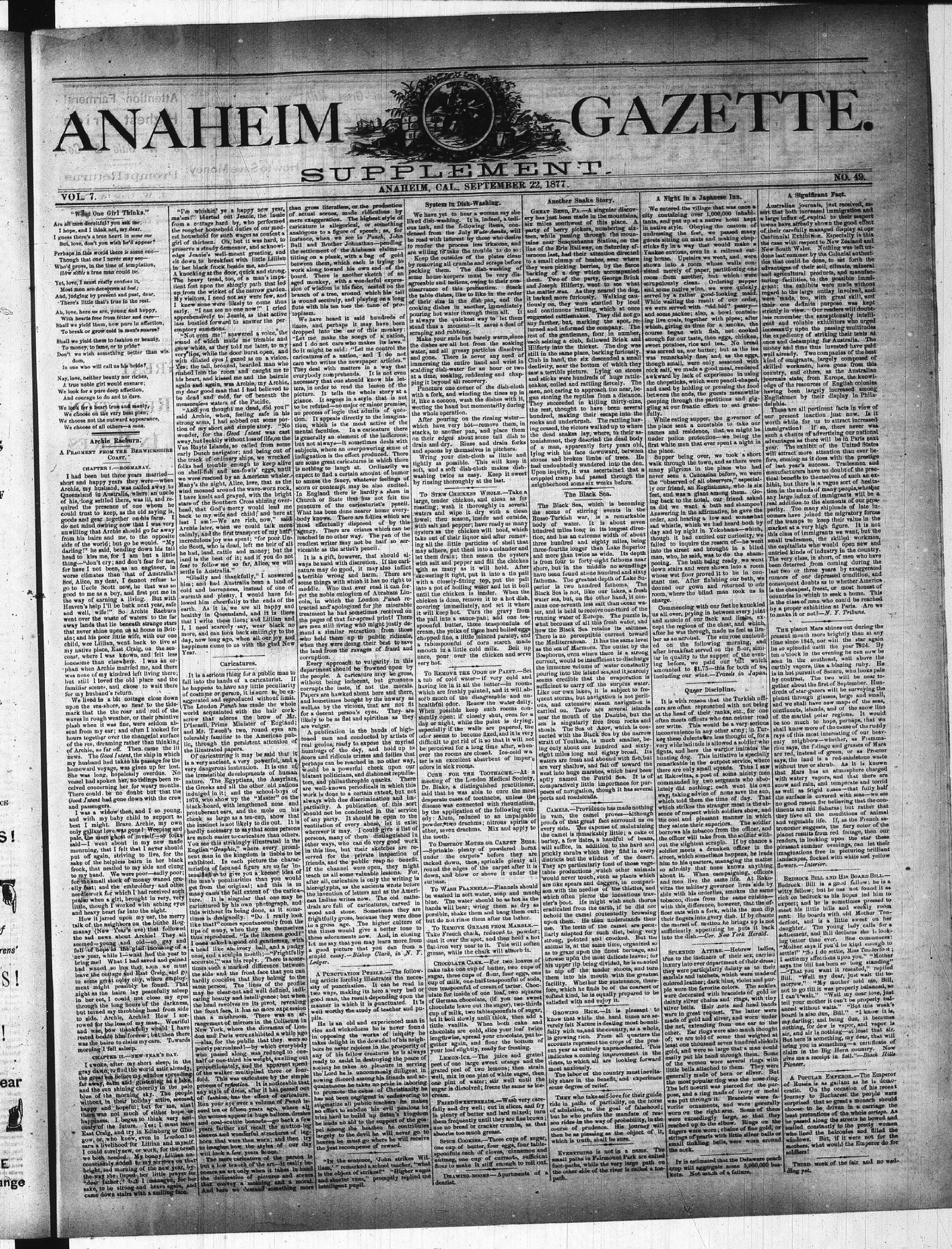
Searchable text
ANAHEIM
VOL 7.
"What One Girl Thinks."
Are all men deceitful? you ask me;
I hope, and I think not, my dear.
I guess there's a true heart in some one
But love, don't you wish he'd appear?
Perhaps in this world there is some one—
Though that one I never may see—
Who'd prove, in the time of temptation,
How noble a true man could be.
Yet, love, I must really confess it,
Most men are deceivers at best;
And, judging by present and past, dear,
There's little that's true in the rest.
Ah, love, here we are, young and happy,
With hearts free from fetter and care—
Shall we yield them, now pure in affection,
To break or grow cold in men's snare?
Shall we yield them to fashion or beauty,
To money, to fame, or to pride?
Don't we wish something better than wisdom,
In one who will call us his bride?
Nay, love, neither beauty nor riches,
A true noble girl would ensnare;
We look for a pure deep affection,
And courage to do and to dare.
We look for a heart true and manly,
We choose on the very best plan;
We choose not the outward appearance,
We choose of all others—a man.
Archie Raeburn.
A Fragment from the Berwickshire Coast.
Nay, love, neither beauty nor riches,
A true noble girl would ensnare;
We look for a pure deep affection,
And courage to do and to dare.
We look for a heart true and manly,
We choose on the very best plan;
We choose not the outward appearance,
We choose of all others—a man.
Archie Raeburn.
A Fragment from the Berwickshire Coast.
CHAPTER I.—ROGMANAY.
I had been but three years married—short and happy years they were—when Archie, my husband, was called away to Queensland in Australia, where an uncle of his, long settled there, was ill, and required the presence of one whom he could trust to keep, as the old saying is, goods and gear together on his farm. I do not mind owning now that I was very unwilling that Archie should go far away from his bairn and me, to the opposite side of the world; but go he would. "My darling!" he said, bending down his tail head to kiss me, for I am but a little thing—"don't cry; and don't fear for me, for have I not been, as an engineer, in worse climates than that of Australia? See, Alice, my dear, I cannot refuse to go to Uncle Scott now, he that was so good to me as a boy, and first put me in the way of earning a living. But with Heaven's help I'll be back next year, safe and well, wife!" So Archie Raeburn went over the waste of waters to the far away lands that lie beneath strange stars that never shine upon us at home in Britain; and his poor little wife, with our one child, wee Lillian, went back to live at my native place, East Craig, on the seacoast, where I was known, and felt less lonely than elsewhere. I was an orphan when Archie married me, and there was none of my kindred left living there; but still I loved the old place and the familiar scene, and chose to wait there for my husband's return.
We lived in a bit cottage close down upon the sea-shore, so near to the tide-mark that the roar and roll of the waves in rough weather, or their phaintive plash when it was fine, were seldom absent from my ear; and often I looked for hours together over the changeable surface of the sea, dreaming rather than thinking of Archie, so far off. Then came the ill news. The Good Intent, the ship in which my husband had taken his passage for the homeward voyage, was given up for lost. She was long, hopelessly overdue. No vessel had spoken her, no tidings been received concerning her for weary months. There could be no doubt but that the Good Intent had gone down with the crew and passengers.
I was a widow then, and I so young, and with my baby child to support as best I might. Brave Archie, my own only gallant love was gone! Weeping and pale, the mere ghost of myself—so folks said—I went about in my new made mourning, that I felt that I never should put off again, striving to live, for the sake of the helpless bairn in her black frock, that nestled to my side and clung to my hand. We were poor—sadly poor; for the small stock of money waned crucis,
"And you thought me dead, did you?" said Archie, when feeling safe in his strong arms. I had sobbed out some portion of my short and simple story. "No wonder, for the Good Intent was cast away, but luckily without loss of life on the Van Ruyte Isanda, so called from some early Dutch navigator; and being out of the track of ordinary ships, we wrecked folks had trouble enough to keep alive on shell-fish and sea-fowl's egg, until we were rescued by an American whaler. Many's night, Alice, love, that as the wind moaned around the wave-worn rock, I have knelt and prayed, with the bright stars of the Southern Cross shining overhead, that God's mercy would lead me back to my wife and child; and here at last I am!—We are rich now," said Archie later, when we could talk more calmly, and the first transport of my half-incredulous joy was spent: "for poor Uncle Scott, who is dead, left me heir of all he had, land, cattle and money; but the land is the best of it; and if you do not fear to follow me so far, Alice, we will settle in Australia."
"Gladly and thankfully," I answered him; and had Australia been a land of cold and barrenness, instead of one of warmth and plenty. I would have followed him cheerfully to the ends of the earth. As it is, we are all happy and healthy in Queensland, and it is there that I write these lines; and Lillian and I, I need scarcely say, wear black no more, and can look back smilingly to the day, now long ago, when all our joy and happiness came to us with the glad New Year.
Caricatures.
It is a serious thing for a public man to fall into the hands of a caricaturist. If he happens to have any little peculiarity of costume or person, it is sure to be exaggerated and reproduced without limit. The London Punch has made the whole world acquainted with the hair cork-screw that adorns the brow of Mr. D'Israeli, Prime Minister of England; and Mr. Tweed's two, round eyes are tolerably familiar to the American public, through the persistent attention of the illustrated papers.
Of caricaturing it may be said that it is a very ancient, a very powerful, and a very dangerous institution. It is one of the irresistible developments of human nature. The Egyptians, the Assyrians, the Greeks and all the other old nations indulged in it; and the school-boys of 1870, who show up the "Master" on the black-board, with lengthened nose and protuberant ears, and the mole on his cheek as large as a tea-cup, show that the instinct is not likely to die out. It is hardly necessary to say that some persons are much easier to caricature than others. You see this strikingly illustrated in the English "Graphic," where every prominent man in the kingdom is liable to be exhibited. In each picture the characteristics of face and figure are so far intensified as to give you a keener idea of man's peculiarities than you would rush into the room and caught me to his heart, and kissed me and the bainnie again and again, was Archie, my archie, my dear good man that I had believed to be dead and cold, far off beneath the measureless waters of the Pacific.
"And you thought me dead, did you?" said Archie when feeling safe in his strong arms. I had sobbed out some portion of my short and simple story. "No wonder, for the Good Intent was cast away but luckily without loss of life on the Van Ruyte Isanda, so called from some early Dutch navigator; and being out of the track of ordinary ships, we wrecked folks had trouble enough to keep alive on shell-fish and sea-fowl's egg, until we were rescued by an American whaler. Many's night, Alice, love, that as the wind moaned around the wave-worn rock, I have knelt and prayed, with the bright stars of the Southern Cross shining overhead, that God's mercy would lead me back to my wife and child; and here at last I am!—We are rich now," said Archie later when we could talk more calmly, and the first transport of my half-incredulous joy was spent: "for poor Uncle Scott, who is dead, left me heir of all he had, land, cattle and money; but the land is the best of it; and if you do not fear to follow me so far,Alice,we will settle in Australia."
"It gladily and thankfully," I answered him; and had Australia been a land of cold and barrenness instead of one of warmth and plenty. I would have followed him cheerfully to the ends of the earth. As it is,we are all happy and healthy in Queensland,and it is there that I write these lines;and Lillian和I,I need scarcely say,wear black no more,and can look back smilingly to the day,now long ago,when all our joy and happiness came to us with the glad New Year.
It is a gift,however ways be used with discipline may do good,a terrible wrong and some things with which meddle。Who that get the noble oculogin colin,在which tracted and apologize treatment he had so soon pages of that fair are men still living who held them up when they were done land from the raid corruption.
Every approach department should be the people. A caricature without being indebted to taste,Papers are hawked and sometimes boured well as by the vicious for a decent person likely to be as flat as any vulgar.
A publication informed men and real genius,ready to humbugs of the dawn scorn and ridicule perhaps can be read would be a powerful blatant politician,tors,and philanthropist are well-known work is done to a certain always with due diligence partiality. A public should not be conceived of any party. It is ventilation of even wherever it may persons,many of other ways,who can in this line,but serve for the friends,and the people if the channel will teach us all some after all,caricature!
There could be no doubt but that the Good Intent had gone down with the crew and passengers.
I was a widow then, and I so young, and with my baby child to support as best I might. Brave Archie, my own only gallant love was gone! Weeping and pale, the mere ghost of myself—so folks said—I went about in my new made mourning, that I felt that I never should put off again, striving to live, for the sake of the helpless bairn in her black frock, that nestled to my side and clung to my hand. We were poor—sadly poor; for the small stock of money waned cruelly fast; and the embroidery and other needlework for which I had received such praise when a girl, brought in very, very little, though I worked with aching eyes and heavy heart far into the night.
How it jarred upon my ear, the merry talk of the neighbors on the blithe Hogmanay (New Year's eve) that followed the sad news about Archie! They all seemed—young and old—so gay and full of hope in the glad incoming of a new year, while I—what had the year to bring me! What I had saved and gained had waned so low that soon we must leave the cottage and East Craig, and go to some great noisy city, where employment might possibly be found. That night as the bairn lay peacefully asleep in her cot, I could not close my eyes through the long hours of the darkness, but turned my throbbing head from side to side. Archie, Archie! How I sorrowed for the loss of my man. Weariful and was, how thankfully would I have rested beside him forever; but then there was the bairn to claim my care. Towards morning I fell asleep.
CHAPTER II.—NEW-YEAR'S DAY.
I awoke, after my short sleep, in the gray dawn, to find the world astir already, the great sea before my window spreading far away, calm and glistening as a lake, and the sun shining cheerily in the pale blue of the morning sky. The people without, in their holiday attire, seemed happy and hopeful; but for me, alas! there was not much of either hope or happiness. I began to think very seriously of the future. Yes; I must leave East Craig, and try in Edinburgh or Glasgow, or who knew even in London! to earn a livelihood for Lillian and myself. I could surely sew, or work, for the bread we both needed. My boony Lillian unconsciously added to my sorrows on that bright, and morning of the new year, by the way she lisped her little prayer for "dear father;" but I managed; for her sake, to be strong and brave again, and came down stairs with a smiling face.
The mere caricature of the person is but a low branch of the art—it really becomes an art only when it takes in hand the delineation of pictures and scenes that convey a meaning and a moral. And here we demand something more
In the semilam," remains is the object of intelligence pu
IM GAZ
SUPPLEMENT.
ANAHEIM, CAL., SEPTEMBER 22, 1877.
than gross literalism, or the production of actual scenes, made ridiculous by mere exaggeration. The highest style of caricature is allegorical, or something analogous to a figure of speech; as, for instance, when we see in Punch, John Boll and Brother Johnathan—pending the settlement of the Alabama claims—tilting on a plank, with a bag of gold between them, which each is trying to work along toward his own end of the board. There is another sketch of an aged monkey, with a wonderful expression of wisdom in his face, seated on the branch of a tree, around which his tail is wound securely, and playing on a long flute with his ten toes the tune of protoplasm.
We have heard it said hundreds of times, and perhaps it may have been dropped into the ear of this monkey: "Let me make the songs of a nation, and I do not care who makes its laws." So it might be said: "Let me control the caricatures of a nation, and I do not care who writes the newspaper articles." They deal with matters in a way that everybody comprehends. It is not even necessary that one should know his letters, in order to read the lesson of the picture. It tells the whole story at a glance. It argues in a style that is not to be refuted—no major or minor premise, no process of logic that admits of question. It appeals directly to the imagination, which is the most active of the mental faculties. In a caricature there is generally an element of the ludicrous; but not always—it sometimes deals with subjects, where an overpowering sense of indignation is the effect produced. There are some great caricatures in which there
System In Dish-Washing.
We have yet to hear a woman say she liked dish-washing. It is, indeed, a tedious task, and the following items, condensed from the July Wade-Anake, will be read with interest by those who desire to render the process less irksome, and are willing to take the trouble to do so:
Keep the outsides of the plates clean by removing all crumbs and scraps before packing them. The dish-washing of some house-keepers must be very disagreeable and tedious, owing to their nonobservance of this precaution. Stack the table dishes, like to like in the order of their size in the dish pan, and the cooking dishes in another, immediately pouring hot water through them all. It is always the quickest way to let them stand thus a moment—it saves a deal of scraping and rubbing.
Make your suds but barely warm, since the dishes are all hot from the soaking water, and all greasy particles dissolved and gone. There is never any need of immersing the entire hand and wrist in scalding dish-water for an hour or two at a time, soaking, reddening and chapping it beyond all recovery.
Puncture one corner of the dish-cloth with a fork, and winding the tines up in it, like a cocoon, wash the dishes with it, wetting the hand but momentarily during the whole operation.
After pouring on the rinsing water—which have very hot—remove them in stacks, to another pan, and place them on their edges about some tall dish to drain and dry. Riuse and drain forks and spoons by themselves in pitchers.
Wring your dish-cloth as little and lightly as possible. This will keep it
Another Snake Story.
GREAT BEND, PA.—A singular discovery has just been made in the mountains, six miles southwest of this place. A party of berry pickers, numbering sixteen, while passing through the mountains near Susquehanna Station, on the line of the Erie Railway, on Saturday afternoon last, had their attention directed to a small clump of bushes, near where they were picking berries, by the fierce barking of a dog which accompanied them. Two of the party, George Brink and Joseph Hilferty, went to see what the matter was. As they neared the dog, it barked more furiously. Walking cautiously on, they were startled by loud and continuous rattling, which at once suggested rattlesnakes. They did not go any further, but, marking the spot, returned and informed the company. The rest of the gentlemen four in number, each selzing a club, followed Brink and Hilferty into the thicket. The dog was still in the same place, barking furtively. Club in hand, the six descended a small declivity, near the bottom of which they saw a terrible picture. Lying on stones and sticks were hundreds of huge rattle snakes, coiled and rattling fiercely. The men, not caring to approach too near, began stoning the reptiles from a distance. They succeeded in killing thirty-nine, the rest thought to have been several hundred, making their escape into the rocks underbrush. The rattling having ceased, the victors walked up to where the dead snakes lay, where, to their astonishment, they described the dead body of a man, apparently forty years old, lying with his face downward, between stones and broken limbs of trees. He had undoubtedly wandered into the den.
A Night
We enter city contests, and win in native areas undressing guests sitting sticks fly in Yankee enclosing house shown inside room from scrupulous served by While walk we were seen and some ing live coat which gives course be enough for sweet potato was served was reminiscent rock salt awkward the chapstle used between peeping tingling at o fully. While on the place names are under po first whithe Supper walk three
They deal with matters in a way that everybody comprehends. It is not even necessary that one should know his letters, in order to read the lesson of the picture. It tells the whole story at glance. It argues in a style that is not to be refuted—no major or minor premise, no process of logic that admits of question. It appeals directly to the imagination, which is the most active of the mental faculties. In a caricature there is generally an element of the ludicrous; but not always—it sometimes deals with subjects, where an overpowering sense of indignation is the effect produced. There are some great caricatures in which there is nothing to laugh at. Ordinarily we expect to find a certain amount of humor to amuse the fancy, whatever feelings of scorn or contempt may be also excited.
In England there is hardly a sham in Church or State that has not felt the puncture of the caricaturist's pencil. What has been done nearer home everybody knows. There are follies which are most effectually disposed of by this agency. There are crimes which can be reached in no other way. The pen of the readiest writer may not be half so serviceable as the artist's pencil.
It is a gift, however, that should always be used with discretion. If the caricature may do good, it may also inflict a terrible wrong and harm. There are some things with which it has no right to meddle. Who that ever read it can forget the noble culogium of Abraham Lincoln, in which the London Punch retracted and apologized for the miserable treatment he had sometimes received on the pages of that far-spread print? There are men still living who might justly demand a similar retraction from those who held them up to public ridicule, when they were doing their best to save the land from the ravages of fraud and corruption.
Every approach to vulgarity in this department should be frowned upon by the people. A caricature may be gross, without being indecent, but grossness corrupts the taste, if not the morals. Papers are hawked about here and there, and sometimes bought by the unwary as well as by the vicious, that are not fit for a decent person's eyes. They are likely to be as flat and spiritless as they are vulgar.
A publication in the hands of high-toned men and conducted by artists of real genius, ready to expose the myriad humbugs of the day, and hold up to scorn and ridicule crimes and follicles that perhaps can be reached in no other way, would be a powerful check upon our blatant politicians, and dishonest repudiators, and philanthropic quacks. There are well-known periodicals in which this work is done to a certain extent, but not always with due discrimination and impartiality. A publication of this sort should not be conducted in the service of any party. It should be open to the ventilation of every abuse, let it exist wherever it may. I could give a list of persons, many of them distinguished in other ways, who can do very good work in this line, but their sketches are reserved for the private inspection of friends, and the public reap no benefit. If the channel were open, they might teach us all some valuable lessons. For, after all, caricature is only the writing in scalding dish-water for an hour or two at a time, soaking, redening and chapping it beyond all recovery.
Puncture one corner of the dish-cloth with a fork, and winding the tines up in it, like a cocoon, wash the dishes with it, wetting the hand but momentarily during the whole operation.
After pouring on the rinsing water—which have very hot—remove them, in stacks, to another pan, and place them on their edges about some tall dish to drain and dry. Rinse and drain forks and spoons by themselves in pitchers.
Wring your dish-cloth as little and lightly as possible. This will keep it soft, and a soft dish-cloth makes dish-washing twice as easy. Keep it sweet by rinsing thoroughly at the last.
To STEW CHICKENS WHOLE.—Take a large, tender chicken, and clean as for roasting; wash it thoroughly in several waters and wipe it dry with a clean towel; then season, inside and outside, with salt and pepper; have ready as many oysters as the chicken will hold, which take out of their liquor and after removing all the little particles of shell that may adhere, put them into a colander and let them drain; then season the oysters with salt and pepper and fill the chicken with as many as it will hold. After skewering it tight, put it into a tin pail with a closely-fitting top, put the pail into a pot of boiling water and let it boil until the chicken is tender. When the chicken is done, remove it to a hot dish, covering immediately, and set it where it will keep hot. Turn the gravy from the pail into a sauce-pan; add one teaspoonful butter, three teaspoonfuls of cream, the yolks of three hard boiled eggs chopped fine, a little minced parsley, and a tablespoonful of corn starch made smooth in a little cold milk. Boil up once, pour over the chicken and serve very hot.
To REMOVE THE ODOR OF PAINT.—Set a tub of cold water—if very cold and having ice in it all the better—in rooms which are freshly painted, and it will absorb much of the disagreeable and unhealthful odor. Renew the water daily. When possible keep such rooms constantly open; if closely shut, even for a day or night, while the paint is drying, especially if the walls are papered, the odor seems to become fixed, and it is very difficult to get rid of it so that it will not be perceived for a long time after, whenever the rooms are closed. Ice-cold water is an excellent absorbent of impure odors in sick rooms.
CURE FOR THE TOOTHACHE.—At a meeting of the London Medical Society, Dr Blake, a distinguished practitioner, said that he was able to cure the most desperate cases of toothache, unless the disease was connected with rheumatism, by the application of the following remedy: Alum, reduced to an impalpable powder; two drachms; nitrous spirits of ether; seven drachms. Mix and apply to the tooth.
To Destroy MOTHS ON CARPET BUGS.—Sprinkle plenty of powdered borax under the carpets before they are tacked down, then sprinkle plenty all round the edges of the carpet after it is down, and blow or shove it under the surprise.
Saw a terrible picture. Lying on stones and sticks were hundreds of huge rattle snakes, coiled and rattling fiercely. The men, not caring to approach too near, began stoning the reptiles from a distance. They succeeded in killing thirty-nine, the rest thought to have been several hundred, making their escape into the rocks and underbrush. The rattling having ceased, the victors walked up to where the dead snakes lay, where to their astonishment, they deserved the dead body of a man, apparently forty years old, lying with his face downward between stones and broken limbs of trees. He had undoubtedly wandered into the den. Upon inquiry, it was ascertained that a crippled tramp had passed through the neighborhood some six weeks before.
The Black Sea.
The Black Sea, which is becoming the scene of stirring events in the Russo-Turkish war, is a remarkable body of water. It is about seven hundred miles long in its longest direction, and has an extreme width of about three hundred and eighty miles, being three-fourths longer than Lake Superior and more than twice as wide. Its depth is from four to forty-eight fathoms near shore, but in the middle no soundings have been found at one hundred and sixty fathoms. The greatest depth of Lake Superior is two hundred fathoms. The Black Sea is not, like our lakes, a fresh water sea, but on the other hand, it contains one-seventh less salt than ocean water, and is held to receive one-third of the running water of Europe. The puzzle is what becomes of all this fresh water, and how the Black Sea retains its saltness. There is no perceptible current toward the Mediterranean. It has the same level as the sea of Marmora. The outlet by the Bosphorus, even where there is a strong current, would be insufficient to discharge immense volume of water constantly pouring into the island sea,and it scarcely seems credible that the evaporation is sufficient to carry off the surplus water. Like our own lakes,它 is subject to frequent storms,但 navigation is not perilous,and extensive steam navigation is carried on. There are several islands near mouth of the Danube,but the sea is singularly free from rocks and shoals.The Sea of Azov,which is connected with the Black Sea by the narrow strait of Yenikale,is much smaller,being only about one hundred and sixty miles long and eighty broad.Its waters are fresh and abound with fish,但 are very shallow,and fall off toward the west into huge marshes,which have been aptly named the Putrid Sea. It is of comparatively little importance for purposes of navigation,though it has several ports和roadsteads.
CAMELS.-Providence has made nothing in vain,the camel proves—although proofs of that great fact surround us on every side.The expense of maintainingthe camel is remarkably little;a cake of barley,a few hates,a handful of beans,sill suffice,int addition to the hard and prickly shrubs which they find in every districts but the wildest of the desert They are particularly fond of those vegetable productions which other animals would never touch,such as plants which rock salt,awkward,the chapsand used between peeping at gliding at fully.
While at these places names are under pearl first white,the place Supplier walk three many planks never seethe "obstacle" our friend first whitelife at our friend first whitelife at our friend first whitelife at our friend first whitelife at our friend first whitelife at our friend first whitelife at our friend first whitelife at our friend first whitelife at our friend first whitelife at our friend first whitelife at our friend first whitelife at our friend first whitelife at our friend first whitelife at our friend first whitelife at our friend first whitelife at our friend first whitelife at our friend first whitelife at our friend first whitelife at our friend first whitelife at our friend first whitelife at our friend first whitelife at our friend first whitelife at our friend first whitelife at our friend first whitelife at our friend first whitelife at our friend first whitelife at our friend first whitelife at our friend first whitelife at our friend first whitelife at our friend first whitelife at our friend first whitelife at our friend first whitelife at our friend first whitelife at our friend first whitelife at our friend first whitelife at our friendshipfirstwhitelifeatourfriendfirstwhitelifeatourfriendfirstwhitelifeatourfriendfirstwhitelifeatourfriendfirstwhitelifeatourfriendfirstwhitelifeatourfriendfirstwhitelifeatourfriendfirstwhitelifeatourfriendfirstwhitelifeatourfriendfirstwhitelifeatourfriendfirstwhitelifeatourfriendfirstwhitelifeatourfriendfirstwhicliffeatourfriendfirstwhicliffeatourfriendfirstwhicliffeatourfriendfirstwhicliffeatourfriendfirstwhicliffeatourfriendfirstwhicliffeatourfriendfirstwhicliffeatourfriendfirstwhicliffeatourfriendfirstwhicliffeatourfriendfirstwhicliffeatourfriendfirstwhicliffeatourfriendfirstwhicliffeatourfriendfirstwhicliffeatourfriendfirstwhicliffeatourfriendfirstwhicliffeatourfriendfirstwhicliffeatourfriendfirstwhicliffeatourfriendfirstwhicliffeatourfriendfirstwhicliffeatourfriendfirstwhicliffeatourfriendfirstwhicliffeatourfriendfirstwhicliffeatourfriendfirstwhicliffeatourfriendfirstwhicliffeatourfriendfirstwhicliffeatourfriendfirstwhicliffeatourfriendfirstwhicliffeatourfriendfirstwhicliffeatourfriendfirstwhicliffeatourfriendfirstwhicliffeatourfriendfirstwhicliffeatourfriendfirstwhicliffeatourfriendfirstwhicliffeatourfriendfirstwhicliffeatourfriendfirstwhicliffeatourfriendfirstwhicliffeatourfriendfirstwhicliffeatourfriendfirstwhicliffeatourriendfirstwhicliffeatourfriendfirstwhicliffeatourfriendfirstwhicliffeatourfriendfirstwhicliffeatourfriendfirstwhicliffeatourfriendfirstwhicliffeatourfriendfirstwhicliffeatour友谊firstwhicliffeatourt谊.firstwhicliffe.atourt谊.firstwhicliffe.atourt谊.firstwhicliffe.atourt谊.firstwhicliffe.atourt谊.firstwhicliffe.atourt谊.firstwhicliffe.atourt谊.firstwhicliffe.atourt谊.firstwhicliffe.atourt谊.firstwhiclffe.atourt谊.firstwhiclffe.atourt谊.firstwhiclffe.atourt谊.firstwhiclffe.atourt谊.firstwhiclffe.atourt谊.firstwhiclffe.atourt谊.firstwhiclffe.atourt谊.firstwhiclffe.atourt谊.firstwhiclffe.atourt谊.firstwhiclffe.atourt谊.firstwhiclffe.atourt谊.firstwhiclffe.atourt谊.firstwhiclffe.atourt谊.firstwhiclffe.atourt谊.firstwhiclffe.atourt谊.firstWhocliffe.atourt谊.firstWhocliffe.atourt谊.firstWhocliffe.atourt谊.firstWhocliffe.atourt谊.firstWhocliffe.at尿道-firstWhocliffe.at尿道-firstWhocliffe.at尿道-firstWhocliffe.at尿道-firstWhocliffe.at尿道-firstWhocliffe.at尿道-firstWhocliffe.at尿道-firstWhocliffe.at尿道-firstWhocliffe.at尿道-firstWhocliffe.at尿道-firstWhocliffe.at尿道-firstWhocliffe.at尿道-firstWhocliffe.at尿道-firstWhocliffe.at尿道-firstWhocliffe.at尿道-firstWhocliffe.at尿道-firstWhocliffe.at尿道-firstWhocliffe.at尿道-firstWhocliffe.at尿道-firstWhocliffe.at尿道-firstWhocliffe.at尿道-firstWhocliffe.at尿道-firstWhocliffe.at尿道-firstWhocliffe.at尿道-firstWHocliffe.at尿道-firstWHocliffe.at尿道-firstWHocliffe.at尿道-firstWHocliffe.at尿道-firstWHocliffe.at尿道-firstWHocliffe.at尿道-firstWHocliffe.at尿道-firstWHocliffe.at尿道-firstWHocliffe.at尿道-firstWHocliffe.at尿道-firstWHocliffe.at尿道-firstWHocliffe.at尿道-firstWHocliffe.at尿道-firstWHocliffe.at尿道-firstWHocliffe.at尿道-firstWHocliffe.at尿道-firstWHocliffe.at尿道-firstWHocliffe.at尿道-firstWHocliffe.at尿道-firstWHocliffe.at尿道-firstWHocliffe.at尿道-firstWHocliffe.at尿道-firstWHacliffe.at尿道-firstWHacliffe.at尿道-firstWHacliffe.at尿道-firstWHacliffe.at尿道-firstWHacliffe.at尿道-firstWHacliffe.at河道-firstWHacliffe_at河道_firstWHacliff_e_at河道_firstWHacliff_e_at河道_firstWHacliff_e_at河道_firstWHacliff_e_at河道_firstWHacliff_e_at河道_firstWHacliff_e_at河道_firstWHacliff_e_at河道_firstWHacliff_e_at河道_firstWHacliff_e_at河道_firstWHacliff_e_at河道_firstWHacliff_e_at河道_firstWHacliffs_e_at河道_firstWHacliffs_e_at河道_firstWHacliffs_e_at河道_firstWHacliffs_e_at河道_firstWHacliffs_e_at河道_firstWHacliffs_e_at河道_firstWHacliffs_e_at河道_firstWHacliffs_e_at河道_firstWHacliffs_e_at河道_firstWHacliffs_e_at河道_firstWHacliffs_e_at河道_firstWHacliffs_e_at河道_firstWHacliffs_e_at河道_firstWHacliffs_e_at河道_firstWHacliffs_e_at河道_firstWHacliffs_e_at河道_firstWHacliffs_e_at河道_firstWHacliffs_e_at河道_firstWHacliffs_e_at河道_firstWHacliffs_e_at河道_firstWHacliffs_e_at河道_firstWHacliffs_e_at河道First WHacliffs_e_at河道First WHacliffs_e_at河道First WHacliffs_e_at河道First WHacliffs_e_at河道First WHacliffs_e_at河道First WHacliffs_e_at河道First WHacliffs_e_at河道First WHacliffs_e_at河道First WHacliffs_e_at河道First WHacliffs_e_at河道First WHacliffs_e_at河道First WHacliffs_e_at河道First WHacliffs_e_at河道First WHacliffs_e_AT河道First WHacliffs_e_AT河道First WHacliffs_e_AT河道First WHacliffs_e_AT河道First WHacliffs.e_AT河道First WHacliffs.e_AT河道First WHacliffs.e_AT河道First WHacliffs.e_AT河道First WHacliffs.e_AT河道First WHacliffs.e_AT河道First WHacliffs.e_AT河道First WHacliffs.e_AT河道First WHacliffs.e_AT河道First WHacliffs.e_AT河道First WHacliffs.e_AT河道First WHacliffs.e_AT河道First WHacliffs.e_AT河道First WHacliffs.e_AT河道First WHacliffs.e_AT河道First WHacliffs.e_AT河道First WHacliffs.e_AT河道First WHacliffs.e_AT河道First WHClaffs.e_AT河道First WHClaffs.e_AT河道First WHClaffs.e_AT河道First WHClaffs.e_AT河道First WHClaffs.e_AT河道First WHClaffs.e_AT河道First WHClaffs.e_AT河道First WHClaffs.e_AT河道First WHClaffs.e_AT河道First WHClaffs.e_AT河道First WHClaffs.e_AT河道First WHClaffs.e_AT河道First WHClaffs.e_AT河道第一WHClaffs.e_AT河道第一WHClaffs.e_AT河道第一WHClaffs.e_AT河道第一WHClaffs.e_AT河道第一WHClaffs.e_AT河道第一WHClaffs.e_AT轨道第一轨道第一轨道第一轨道第一轨道第一轨道第一轨道第一轨道第一轨道第一轨道第一轨道第一轨道第一轨道第一轨道第一轨道第一轨道第一轨道第一轨道第一轨道第一轨道第一轨道第一轨道第一轨道第一轨道第一轨道第一轨道第一轨道第一轨道第一轨道第一轨道第一轨道第一轨道第一轨道第一轨道第一轨道第一轨道第一轨道第一轨道一轨道一轨道一轨道一轨道一轨道一轨道一轨道一轨道一轨道一轨道一轨道一轨道一轨道一轨道一轨道一轨道一轨道一轨道一轨道一轨道一轨道一轨道一轨道一轨道一轨道一轨道一轨道一轨迹一轨迹一轨迹一轨迹一轨迹一轨迹一轨迹一轨迹一轨迹一轨迹一轨迹一轨迹一轨迹一轨迹一轨迹一轨迹一轨迹一轨迹一轨迹一轨迹一轨迹一轨迹一轨迹一轨迹一轨迹一轨迹一轨迹一轨迹一轨迹一轨迹一轨迹一轨迹一轨迹一轨迹一轨迹一轨迹一轨迹一轨迹一轨迹一轨迹一轨迹一轨迹一一轨迹一一轨迹一一轨迹一一轨迹一一轨迹一一轨迹一一轨迹一一轨迹一一轨迹一一轨迹一一轨迹一一痕迹一一痕迹一一痕迹一一痕迹一一痕迹一一痕迹一一痕迹一一痕迹一一痕迹一一痕迹一一痕迹一一痕迹一一痕迹一一痕迹一一痕迹一一痕迹一一痕迹一一痕迹一一痕迹一一痕迹一一痕迹一一痕迹一一痕迹一一痕迹一一痕迹一一痕迹一一痕迹一一痕迹一一痕迹一一痕迹一一痕迹一一痕迹一一痕迹一一痕迹一一痕迹一一痕迹一一痕迹——痕迹——痕迹——痕迹——痕迹——痕迹——痕迹——痕迹——痕迹——痕迹——痕迹——痕迹——痕迹——痕迹——痕迹——痕迹——痕迹——痕迹——痕迹——痕迹——痕迹——痕迹——痕迹——痕迹——痕迹——痕迹——痕迹——痕迹——痕迹——痕迹——痕迹——痕迹——痕迹——痕迹——痕迹——痕迹——痕迹——痕迹——痕迹——痕迹——痕迹——痕迹——痕迹——痕迹——痕迹——痕迹——痕迹——痕迹——痕迹——足迹——足迹足迹足迹足迹足迹足迹足迹足迹足迹足迹足迹足迹足迹足迹足迹足迹足迹足迹足迹足迹足迹足迹足迹足迹足迹足迹足迹足迹足迹足迹足迹足迹足迹足迹足迹足迹足迹足迹足迹足迹足迹足迹足迹足迹足迹足迹足迹足迹足迹足迹足迹足迹足迹足迹足迹足迹足迹足迹足迹足迹足迹足迹足迹足迹足迹足迹足迹足迹足迹足迹足迹足迹足迹足迹足迹足迹足迹足迹足迹足迹足迹足迹足迹足迹足迹足球足球足球足球足球足球足球足球足球足球足球足球足球足球足球足球足球足球足球足球足球足球足球足球足球足球足球足球足球足球足球足球足球足球足球足球足球足球足球足球足球足球足球足球足球足球足球足球足球足球足球足球 football football football football football football football football football football football football football football football football football football football football football football football football football football football football football football football football football football football football football football football football football football football football football football football football football football football football football football football football football football football football football football football football football football football football footfootfootfootfootfootfootfootfootfootfootfootfootfootfootfootfootfootfootfootfootfootfootfootfootfootfootfootfootfootfootfootfootfootfootfootfootfootfootfootfootfootfootfootfootfootfoot-foot-foot-foot-foot-foot-foot-foot-foot-foot-foot-foot-foot-foot-foot-foot-foot-foot-foot-foot-foot-foot-foot-foot-foot-foot-foot-foot-foot-foot-foot-foot-foot-foot-foot-foot-foot-foot-foot-foot-foot-foot-foot-foot-foot-foot-foot-foot-foot-foot-foot-foot-foot-foot-foot-foot-foot-foot-foot-foot-foot-foot-foot-foot-foot-foot-foot-foot-foot-foot-footer-footer-footer-footer-footer-footer-footer-footer-footer-footer-footer-footer-footer-footer-footer-footer-footer-footer-footer-footer-footer-footer-footerfooter-footer footer footer footer footer footer footer footer footer footer footer footer footer footer footer footer footer footer footer footer footer footer footer footer footer footer footer footer footer footer footerFooterFooterFooterFooterFooterFooterFooterFooterFooterFooterFooterFooterFooterFooterFooterFooterFooterFooterFooterFooterFooterFooterFooterFooterFooterFooterFooterFooterFooterFooterFooterFooterFooterFooterFooterFooterFooterFooterFooterFooterFooterFooterFooterFooterFooterFooterFooterFooterFooterFooterFooterFoot Foot Foot Foot Foot Foot Foot Foot Foot Foot Foot Foot Foot Foot Foot Foot Foot Foot Foot Foot Foot Foot Foot Foot Foot Foot Foot Foot Foot Foot Foot Foot Foot Foot Foot Foot Foot Foot Foot Foot Foot Foot Foot Foot Foot Foot Foot Foot Foot Foot Foot Foot Foot Foot Foot Foot Foot Foot Foot Foot Foot Foot Foot Foot Foot Foot Foot Foot Foot Foot Foot Foot Foot Foot Foot Foot Foot Foot FootFootFootFootFootFootFootFootFootFootFootFootFootFootFootFootFootFootFootFootFootFootFootFootFootFootFootFootFootFootFootFootFootFootFootFootFootFootFootFootFootFootFootFootFootFootFootFootFootFootFootFootFootFootFootFootFootFootFootFootFootFootFootBootBootBootBootBootBootBootBootBootBootBootBootBootBootBootBootBootBootBootBootBootBootBootBootBootBootBootBootBootBootBootBootBootBootBootBootBootBootBoot Boot Boot Boot Boot Boot Boot Boot Boot Boot Boot Boot Boot Boot Boot Boot Boot Boot Boot Boot Boot Boot Boot Boot Boot Boot Boot Boot Boot Boot Boot Boot Boot Boot Boot Boot Boot Boot Boot Boot Boot Boot Boot Boot Boot Boot Boot Boot Boot Boot Boot Boot Boot Boot Boot Boot Boot Boot Boot Boot Boot Boot Boot Boot Boot Boot Boot Bootboot boot boot boot boot boot boot boot boot boot boot boot boot boot boot boot boot boot boot boot boot boot boot boot boot boot boot boot boot boot boot boot boot boot boot boot boot boot boot boot boot boot boot boot boot boot boot boot boot boot boot boot boot boot boot boot boot boot boot boot boot boot boot boot boot boot boot boot boot boot boot boot boot boot bootbootbootbootbootbootbootbootbootbootbootbootbootbootbootbootbootbootbootbootbootbootbootbootbootbootbootbootbootbootbootbootbootbootbootbootbootbootbootbootbootbootbootbootbootbootbootstrapbootstrapbootstrapbootstrapbootstrapbootstrapbootstrapbootstrapbootstrapbootstrapbootstrapbootstrapbootstrapbootstrapbootstrapbootstrapbootstrapbootstrapbootstrapbootstrapbootstrapbootstrapbootstrapbootstrapbootstrapootstrapbootstrapbootstrapbootstrapbootstrapbootstrapbootstrapbootstrapbootstrapbootstrapbootstrapbootstrapbootstrap涨幅涨幅涨幅涨幅涨幅涨幅涨幅涨幅涨幅涨幅涨幅涨幅涨幅涨幅涨幅涨幅涨幅涨幅涨幅涨幅涨幅涨幅涨幅涨幅涨幅涨幅涨幅涨幅涨幅涨幅涨幅涨幅涨幅涨幅涨幅涨幅涨幅涨幅涨幅涨幅涨幅涨幅涨幅涨幅涨幅涨幅涨幅涨幅涨幅涨幅幅度幅度幅度幅度幅度幅度幅度幅度幅度幅度幅度幅度幅度幅度幅度幅度幅度幅度幅度幅度幅度幅度幅度幅度幅度幅度幅度幅度幅度幅度幅度幅度幅度幅度幅度幅度幅度幅度幅度幅度幅度幅度幅度幅度幅度幅度幅度幅度幅度幅度幅度幅度幅度梯度梯度梯度梯度梯度梯度梯度梯度梯度梯度梯度梯度梯度梯度梯度梯度梯度梯度梯度梯度梯度梯度梯度梯度梯度梯度梯度梯度梯度梯度梯度梯度梯度梯度梯度梯度梯度梯度梯度梯度梯度梯度梯度梯度梯度梯度梯度梯度梯度梯度梯度梯度梯度梯度梯度梯度梯度梯度梯度梯度梯度梯度梯度梯度梯度梯度梯度梯度梯度梯度梯度梯度梯度梯度季度季度季度季度季度季度季度季度季度季度季度季度季度季度季度季度季度季度季度季度季度季度季度季度季度季度季度季度季度季度季度季度季度季度季度季度季度季度季度季度季度季度季度季度季度季度季度季度季度季度季度季度季度季度季度季度季度季度季度季度季度季度季度季度季度季度季度季度季度季度季度季度季度季度季度季度季度季度季度季度季度季度季度季度季度季度季度季节季节季节季节季节季节季节季节季节季节季节季节季节季节季节季节季节季节季节季节季节季节季节季节季节季节季节季节季节季节季节季节季节季节季节季节季节季节季节季节季节季节季节季节季节季节季节季节季节季节季节季节季节季节季节季节季节季节季节季节季节季节季节季节 seasonal seasonal seasonal seasonal seasonal seasonal seasonal seasonal seasonal seasonal seasonal seasonal seasonal seasonal seasonal seasonal seasonal seasonal seasonal seasonal seasonal seasonal seasonal seasonal seasonal seasonal seasonal seasonal seasonal seasonal seasonal seasonal seasonal seasonal seasonal seasonal seasonal seasonal seasonal seasonal seasonal seasonal seasonal seasonal seasonal seasonal seasonal seasonal seasonal seasonal seasonal seasonal seasonal seasonal seasonal seasonal seasonal seasonal seasonal seasonal seasonal seasonal seasonal seasonal seasonal seasonal seasonal neutral neutral neutral neutral neutral neutral neutral neutral neutral neutral neutral neutral neutral neutral neutral neutral neutral neutral neutral neutral neutral neutral neutral neutral neutral neutral neutral neutral neutral neutral neutral neutral neutral neutral neutral neutral neutral neutral neutral neutral neutral neutral neutral neutral neutral neutral neutral neutral neutral neutral neutral neutral neutral neutralutral neutralutralutralutralutralutralutralutralutralutralutralutralutralutralutralutralutralutralutralutralutralutralutralutralutralutralutralutralriminalternalriminalternalriminalternalriminalternalriminalternalriminalternalriminalternalriminalternalriminalternalriminalternalriminalternalriminalternalriminalternal criminalcriminalcriminalcriminalcriminalcriminalcriminalcriminalcriminalcriminalcriminalcriminalcriminalcriminalcriminalcriminalcriminalcriminalcriminalcriminalcriminalcriminalcriminalcriminalcriminalcriminalcriminalcriminalcriminalcriminalcriminalcriminalcriminalcriminalcriminalcriminalcriminalcriminalcriminalcriminalcriminalcriminalcriminal crimin犯罪嫌疑人犯罪嫌疑人犯罪嫌疑人犯罪嫌疑人犯罪嫌疑人嫌疑人犯罪嫌疑人嫌疑人嫌疑人嫌疑人嫌疑人嫌疑人嫌疑人嫌疑人嫌疑人嫌疑人嫌疑人嫌疑人嫌疑人嫌疑人嫌疑人嫌疑人嫌疑人嫌疑人嫌疑人嫌疑人嫌疑人嫌疑人嫌疑人嫌疑人嫌疑人嫌疑人嫌疑人嫌疑人嫌疑人嫌疑人嫌疑人嫌疑人嫌疑人嫌疑人嫌疑人嫌疑人嫌疑人嫌疑人嫌疑人嫌疑人嫌疑人嫌疑人嫌疑人嫌疑人嫌疑人嫌疑人嫌疑人嫌疑人嫌疑人嫌疑人嫌疑人嫌疑人嫌疑人嫌疑人嫌疑人嫌疑人代理人代理人代理人代理人代理人代理人代理人代理人代理人代理人代理人代理人代理人代理人代理人代理人代理人代理人代理人代理人代理人代理人代理人代理人代理人代理人代理人代理人代理人代理人代理人代理人代理人代理人代理人代理人代理人代理人代理人代理人代理人代理人代理人代理人代理人代理人代理人代理人代理人代理人代理人代理人代理人代理人代理人代理人代理人代表人代表人代表人代表人代表人代表人代表人代表人代表人代表人代表人代表人代表人代表人代表人代表人代表人代表人代表人代表人代表人代表人代表人代表人代表人代表人代表人代表人代表人代表人代表人代表人代表人代表人代表人代表人代表人代表人代表人代表人代表人代表人代表人代表人代表人代表人代表人代表人代表人代表人代表人代表人本人本人本人本人本人本人本人本人本人本人本人本人本人本人本人本人本人本人本人本人本人本人本人本人本人本人本人本人本人本人本人本人本人本人本人本人本人本人本人本人本人本人本人本人本人本人本人本人本人本人本人本人本人本人
are well-known periodicals in which this work is done to a certain extent, but not always with due discrimination and impartiality. A publication of this sort should not be conducted in the service of any party. It should be open to the ventilation of every abuse, let it exist wherever it may. I could give a list of persons, many of them distinguished in other ways, who can do very good work in this line, but their sketches are reserved for the private inspection of friends, and the public reap no benefit. If the channel were open, they might teach us all some valuable lessons. For after all, caricature is only the writing in hieroglyphs, as the ancients wrote before the invention of letters and as the American Indian writes now. The old cathedrals are full of caricatures, carved in wood and stone. Sometimes they are frightfully gross, because they were done in a gross age. The higher culture of the times would give a better tone to these adornments now. And, in closing let me say that you may learn more from a good picture that you can from a stupid essay.—Bishop Clark, in N. Y. Ledger.
A PUNCTUATION Puzzle.—The following article forcibly illustrates the necessity of punctuation. It can be read in two ways, making its hero a very bad or good man, the result depending upon the manner in which it is punctuated. It is well worthy the study of teacher and pupils.
He is an old and experienced man in vice and wickedness he is never found in opposing the works of iniquity he takes delight in the downfall of his neighbors he never rejoices in the prosperity of any of his fellow creatures he is always ready to assist in destroying the peace of society he takes no pleasure in serving the Lord he is uncommonly diligent in sowing discord among his friends and acquaintances he takes no pride in laboring to promote the cause of Christianity he has not been negligent in endeavoring to stigmatize all public teachers he makes no effort to subdue his evil passions he tries hard to build up Satan's kingdom he lends no aid to the support of the gospel among the heathen he contributes largely to the devil he will never go to heaven he must go where he will receive the just recompense of reward.
"In the sentence, 'John strikes William,' remarked a school teacher, "what is the object of strikes?" "Higher wages and shorter runs," promptly replied the intelligent pupil.
Dr. Blake, a distinguished practitioner, said that he was able to cure the most desperate cases of toothache, unless the disease was connected with rheumatism, by the application of the following remedy: Alum, reduced to an impalpable powder; two drachms; nitrous spirits of ether, seven drachms. Mix and apply to the tooth.
To Destroy Moths or Carpet Bugs.—Sprinkle plenty of powdered borax under the carpets before they are tacked down, then sprinkle plenty all round the edges of the carpet after it is down, and blow or shove it under the surbase.
To Wash Flannels.—Flannels should be washed in soft water, soap and much blue. The water should be as hot as the hands will bear; wring them as dry as possible; shake them and hang them out; but do not rinse them after the lather.
To Remove Grease From Marble.—Take French chalk, reduced to powder; dust it over the spot, and then hold a hot flat-iron very near to it. This will soften grease, while the chalk will absorb it.
Chocolate Cake.—For two loaves of cake take one cup of butter, two cups of sugar, three cups of flour, four eggs, one cup of milk, one half teaspoonful of soda, one teaspoonful of cream of tartar. Chocolate for inside of one loaf, two squares of German chocolate (if you use sweet chocolate leave out the sugar), two-thirds cup of milk, two tablespoonfuls of sugar, let it boil slowly until thick, then add a little vanilla. When both cake and chocolate are cold, slice your loaf twice lengthwise, spread your chocolate, put together again, and flour the bottom of your loaf slightly, ready for frosting.
Lemon-Ice.—The juice and grated peel of one large sweet orange and the grated peel of two lemons; then strain well, mix in one pint of white sugar, then one pint of water; stir well until the sugar is dissolved; freeze the same as icecream.
Fried Sweetbreads.—Wash very carefully and dry well; cut in slices, and fry in plenty of butter and lard mixed; turn them frequently until they are fine brown; use no bread or cracker crumbs, as that absorbs too much grease.
Spice Cookies.—Three cups of sugar, one cup of butter, four eggs, four tablespoonfuls each of cloves, cinnamon and nutmeg, one cup of currants, sufficient flour to make it stiff enough to roll out.
Drawing Rooms—Apartments of a dentist.
CAMELS.—Providence has made nothing in vain, the camel proves—although proofs of that great fact surround us on every side. The expense of maintaining the camel is remarkably little; a cake of barley, a few dates, a handful of beans, will suffice, in addition to the hard and prickly shrubs which they find in every districts but the wildest of the desert. They are particularly fond of those vegetable productions which other animals would never touch, such as plants which are like spears and daggers, in comparison with the needles of the thistles, and which often pierce the incautious traveler's boot. He might wish such thorns eradicated from the earth if he did not behold the camel contentedly browsing upon them. He then understands their use. The teeth of the camel are peculiarly adapted for such diet, being very strong, pointed and crooked. But the animal is, at the same time, organized so as to graze upon the finest herbage, and browse upon the most delicate leaves; for his upper lip being divided, he is enabled to nip off the tender shoots, and turn them into his mouth with the greatest facility. Whether the sustenance, therefore, which finds be of the coarsest or softest kind, he is equally prepared to be satisfied with and enjoy it.
GROWING RICH.—It is pleasant to know that while the hard times are severely felt Nature is dealing most bountifully with us,and the country,a whole is growing rich. From all quarters the accounts represent the crops of the present year as entirely unprecedented. This indicates a coming improvement in the times, to which all are looking forward most anxiously.
The labor of the country must inevitably share in the benefit, and experience some degree of relief.
THEY who take self-love for their guide ride in paths of partiality, on the horse of adultery, to the goal of falsehood; but he who prefers the mandate of reason rides in the way of probability, in the course of prudence. His journey will then be as pleasing as the object of it, which is truth, shall be sure.
EVERYTHING is not in a name. The small paths in Fairmount Park are called foot-paths, while the very large path on the other side of the river is called a toe-path.
GAZETTE.
NO. 49.
A Story.
Singular discovery of the mountains, this place. A numbering six through the mountain station, on the on Saturday afternoon directed near where by the fierce brush accompanied George Brink to see what neared the dog, Walking cautiously by loud which at once They did not go the spot, re-company. The tour in number, bowed Brink and The dog was marking furiously. Descended a small man of which they lying on stones of huge rattle-fiercely. The reach too near, be from a distance. During thirty-nine, have been several escape into the The rattling hav-alked up to where there, to their assist the dead body forty years old, downward, between lots of trees. He freed into the den.
A Night in a Japanese Inn.
We entered the village that was once a city containing over 1,000,000 inhabitants, and put up at a native hotel kept in native style. Obeying the custom of undressing the feet, we passed many guests sitting on mats and making chopsticks fly in a way that would make a Yankee envious, even in a railroad eating house. Upstairs we went, and were shown into a room whose walls consisted merely of paper, partitioning one room from another, but which were scrupulously clean. Ordering supper and some native wine, we were quickly served by a rather good-looking maid. While waiting the result of our order, we were served with "tid bid" pastry—and some sackee; also, a bowl containing live coals, together with pipes; after which, giving us time for a smoke, the course began with fish, not cooked enough for our taste, then eggs, chicken, sweet potatoes, rice and tea. No bread was served us, nor butter; but as the tea was remarkably fine, and as the eggs, though small, were only seasoned with rock salt, we made a good meal, rendered awkward by lack of experience in using the chopsticks, which were pencil-shaped, and used by holding or pressing the food between the ends, the guests meanwhile peeping through the partitions and giggling at our frantic effort to eat gracefully.
While eating supper, the governor of the place sent a constable to take our names and residence, that we might be under police protection—we being the first white men that ever spent a night in the place.
Supper being over, we took a short walk through the town, and as there were
A Significant Fact.
Australian journals, just received, assert that both increased immigration and a large influx of capital to their seasport towns have already shown the good effect of their carefully managed display at our Centennial Exhibition. Especially is this case with respect to New Zealand and New South Wales. Nothing was left undone last summer by the Colonial authorities that could be done, to set forth the advantages of their soil, climate, mineral and agricultural products, and manufacturing facilities, to the possible immigrant; the exhibits were made without regard to the large outlay involved, and were made, too, with great skill, and their one definite purpose was kept strictly in view. Our readers will doubtless remember the exceptionally intelligent and voluble exhibitors who urged incessantly upon the passing multitudes the expediency of striking their tents at once and decamping for Australia. The money and time thus invested have paid well already. Two companies of the best kind of emigrants, largely composed of skilled workmen, have gone from this country, and others, as the Australian journals state, from Europe, the knowledge of the resources of English colonies having been largely increased among Englishmen by their display in Philadelphia.
These are all pertinent facts in view of our present inaction just now. Is it worth while for us to attract increased immigration? If so, there never was such a chance of advertising our national advantages as there will be in Paris next year. The exhibit of the United States will attract more attention than ever before, coming as it does with the prestige of last year's success. Tradesmen and
By lying on stones of huge rattle fiercely. The beach too near, be from a distance. Being ninety-nine, have been several escape into the sea. The rattling havalked up to where there, to their assail the dead body forty years old, downward, between lots of trees. He entered into the den, uncertained that a mess through the weeks before.
While eating supper, the governor of the place sent a constable to take our names and residence, that we might be under police protection—we being the first white men that ever spent a night in the place.
Supper being over, we took a short walk through the town, and as there were many pilgrims in the place who had never seen a Caucasian before, we were the "observed of all observers," especially our friend, an Englishman, who is six feet, and was a giant among them. Going back to the hotel, our friend asked us did we want a bath and shampoo? Answering in the affirmative, he gave the order, and hearing a low and somewhat sad whistle, which we had heard both by day and by night in Yokohama—which, though it had excited our curiosity, we failed to inquire the reason of—he went into the street and brought in a blind man, who, he said, was to do the shampooing. The bath being ready we went down stairs and were shown into a room whose wet floor proved it to be in constant use. After finishing our bath, we donned our gown and returned to our room, where the blind man took us in charge.
Commencing with our feet he knuckled us all over, prying in between every joint and muscle of our black and limbs, except the regions of the chest, and which, after he was through, made us feel as limber as an acrobat. The sun rose unclouded on the following morning, and after breakfast served on the floor, similar in quality to the supper of the evening before, we paid our bill which amounted to $1.75—this for both of us, including our wine. —Travels in Japan.
Queer Discipline.
It is with reason that the Turkish officers are often reproached with not being at the head of their ranks, etc., for one often meets officers who can neither read nor write. This would be a very serious inconvenience in any other army; in Turkey these defects are less thought of, for a very wide latitude is allowed a soldier who fights, and here the warrior imitates the hunting dog. This initiative is specially remarkable in the outpost service, where there are only small squads. Thus I saw at Rakovitza, a post of some ninety men commanded by two sergeants who absolutely did nothing; each went his own way, taking advice of none save the sun, which told them the time of day. That which strikes the stranger most is the absence of respect which soldiers show, and the cool and pleasant manner in which they salute their superiors. The soldier borrows his tobacco from the officer, and the officer will take from the soldier without the slightest scruple. If by chance a soldier meets a drunken officer in the street, which sometimes happens, he leads him to his quarters, managing the matter so adroitly that none knows anything about it. When campaigning, officers and men live the same life. At Rakovitza we made a good meal, rendered awkward by lack of experience in using the chopsticks, which were pencil-shaped, and used by holding or pressing the food between the ends, the guests meanwhile peeping through the partitions and giggling at our frantic effort to eat gracefully.
While eating supper, the governor of the place sent a constable to take our names and residence, that we might be under police protection—we being the first white men that ever spent a night in the place.
Supper being over, we took a short walk through the town, and as there were many pilgrims in the place who had never seen a Caucasian before, we were the "observed of all observers," especially our friend, an Englishman, who is six feet, and was a giant among them. Going back to the hotel, our friend asked us did we want a bath and shampoo? Answering in the affirmative, he gave the order, and hearing a low and somewhat sad whistle, which we had heard both by day and by night in Yokohama—which, though it had excited our curiosity, we failed to inquire the reason of—he went into the street and brought in a blind man, who, he said, was to do the shampooing. The bath being ready we went down stairs and were shown into a room whose wet floor proved it to be in constant use. After finishing our bath, we donned our gown and returned to our room, where the blind man took us in charge.
Commencing with our feet he knuckled us all over, prying in between every joint and muscle of our black and limbs, except the regions of the chest, and which, after he was through, made us feel as limber as an acrobat. The sun rose unclouded on the following morning, and after breakfast served on the floor, similar in quality to the supper of the evening before, we paid our bill which amounted to $1.75—this for both of us, including our wine. —Travels in Japan.
The planet Mars shines out during the present month more brightly than at any time since 1845, nor will the star again be so splendid until the year 1924. By ton o'clock in the evening he can now be seen in the southeast, well above the earthly vapors, like a blazing ruby. He is in hot pursuit of Saturn, who looks pale by contrast. The two will be near together about the first of September. Hundreds of star-gazers will be surveying the planet through glasses large and small, and we shall have new maps of the seas, continents, islands,and of the snow line of the martial polar regions. It would be too much to hope perhaps that we shall know more of the cause of the ruddy rays of this most interesting of our heavenly neighbors—whether as Flammaion says,the foliage and grasses of Mars are red instead of green ,or as Proctor says,the land is a red-sandstone waste without tree or shrub.As it is known that Mars has an atmosphere charged with watery vapor,sand that there are snow and rain,and temperate and torrid as well as frigid zones—that fully half the surface is covered with seas—we see no good reason for believing that the continents are red Saharas;but rather that they have all the conditions of animal and vegetable life. If ,as the French astronomer suggests,the fiery color of the planet results from red foliage then our readers ,in looking upon the star these pleasant summer evenings,can let their imaginations free in picturing brilliant landscapes,flecked with white and yellow flowers.—Interior.
ence has made nothing of proves—although the fact surround us on the sense of maintainingably little; a cake of a handful of beans, motion to the hard and with they find in every desert of the desert. My fond of those vegetables such as plants which daggers, in comparison of the thistles, and the incautious travellers wish such thorns on earth, if he did not contentedly browsing them understands their camel are peculiar diet, being very old crooked. But the same time, organized so the finest herbage, and most delicate leaves; for it divided, he is enabled under shoots, and turn with the greatest sustenance, there be of the coarsest or equally prepared to be enjoyed it.
It is pleasant to the hard times are seized dealing most bountiful country, as a whole. From all quarters the crops of the presided over unprecedented. This long improvement in the soil are looking forward.
The country must inevitably benefit, and experience relief.
A self-love for their guide partiality, on the horse the goal of falsehood; bears the mandate of reaway of probability, in theance. His journey will ring as the object of it, shall be sure.
Is not in a name. The fairmount Park are called the very large path on the river is called a toe-
SPLENDID ATTIRE.—Hebrew ladies, true to the instincts of their sex, carried luxury into ever department of their dress; they were particularly dainty as to their sandals and latchets, which were made of colored leather; dark blue, violet and purple were the favorite colors. The ankles were decorated with bracelets of gold or dainty silver chains and rings, with tiny silver bells. Hair nets and head bands were in great request. The latter were made of gold and silver, and worn under the net, extending from one ear to the other. Ear rings were also much thought of; we are told of some that weighed at least one thousand seven hundred shekels gold, and were so large that a man could easily put his hand through them. Some of the women wore several rings with little bells attached to them. They were generally made of horn or silver. But the most popular ring was the nose-ring. The left nostril was pierced for the purpose, and a ring made of ivory or metal was put through it. Bracelets were favorite ornaments, and were generally worn on the right arm. Some of them were exceedingly large, so that they reached up to the elbow. Rings on the fingers were worn; chains of fine gold, or strings of pearls with little silver balls or small tinkling bells, were worn around the neck.
It is estimated that the Delaware peach crop will aggregate some 5,000,000 baskets. Not much of a failure.
BEDROCK BILL AND HIS BOARD BILL.—Bedrock Bill is a good fellow; he is a witty fellow; but he has not found it as rich on bedrock as his hopes led him to expect; and he is sometimes pressed to meet his little bills and weekly room rent. He boards with old Mother Tenderfoot, and is a little sweet on her daughter. The young lady calls for a settlement, and Bill declares she is looking better than ever. She commences: "Mother says if you'd be kind enough to settle?" "So I do settle, Miss Tenderfoot; I settle my affections upon you." "Mother says the bill has been so long standing"—"That you want it resealed," replied Bill. "Well my dear, just wait till tomorrow." "My mother told me, Bill, not to go till it was properly balanced, so I can't wait." "Well my dear love, just tell your mother it can't be properly balanced without waits." "But this week's board is also due, Bill." "I know it is, my darling; and being due, it becomes nothing, for dew is vapor, and vapor is air, and air is nothing—at least that air. But here is something, my dear, that will bring you in something—a certificate of claim in the Big Horn country. Now give me a receipt in full."—Black Hills Pioneer.
A POPULAR EMPEROR.—The Emperor of Russia is as gallant as he is democratic. On the occasion of his recent journey to Bucharest the people were surprised that so great a monarch should choose to be driven in a carriage the least pretentions of the whole cartage. As he passed along the streets he bowed and smiled constantly to the pretty women who lined the balconies and filled the windows. But, if it were not for the mothers, what would the Emperor do for soldiers!
THIRD week of the fair and no wedding yet.