anaheim-gazette 1877-09-22
Scanned page
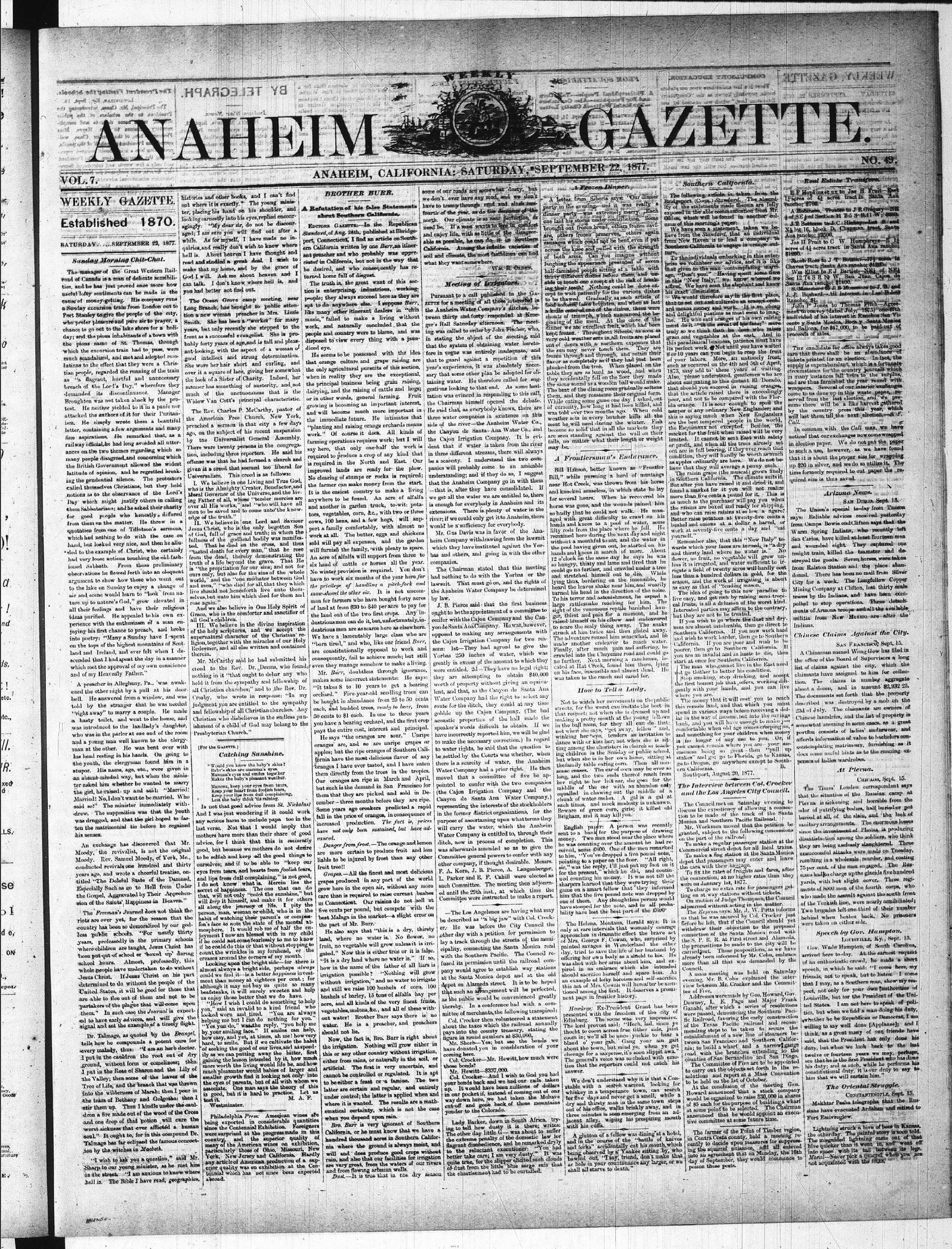
Searchable text
WEEKLY GAZETTE.
Established 1870.
SATURDAY...SEPTEMBER 22, 1877.
Sunday Morning Chit-Chat.
The manager of the Great Western Railroad of Canada is a man of delicate sensibilities, and he has just proved once more how useful lofty sentiments can be made in the cause of money-getting. His company runs a Sunday excursion train from London out to Port Stanley to give the people of the city, who prefer pleasure and pure air to prayer, a chance to go out to the lake shore for a holiday; and the pious inhabitants of a town with the pious name of St. Thomas, through which the excursion train had to pass, were much scandalized, and met and adopted resolutions to the effect that they were a Christian people, regarded the running of the train as "a flagrant, hurtful and unnecessary breach of the Lord's Day," wherefore they demanded its discontinuance. Manager Broughton was not taken aback by the protest. He neither yielded to it in a panic nor attacked the authors of it for their Puritanism. He simply wrote them a beautiful letter, containing a few arguments and many fine aspirations. He remarked that, as a railway official, he had long avoided all utterances on the two themes regarding which so many people disagreed, and concerning which the British Government allowed the widest histories and other books, and I can't find out where it is exactly.* The young minister, placing his hand on his shoulder, and looking earnestly into his eyes, replied encouragingly: "My dear sir, do not be discouraged; I am sure you will find out after a while. As for myself, I have made no inquiries, and really don't wish to know where hell is. About heaven I have thought and read and studied a great deal. I wish to make that my home, and by the grace of God I will. Ask me about heaven and I can talk. I don't know where hell is, and you had better not find out.
The Ocean Grove camp meeting, near Long Branch, has brought to public attention a new woman preacher in Mrs. Lizzie Smith. She has been a "worker" for many years, but only recently she stepped to the front as a successful evangelist. She is probably forty years of age, and is tall and pleasant-looking, with the aspect of a woman of good intellect and strong determination. She wore her hair short and curling, and over it a square of lace, giving her somewhat the look of a Sister of Charity. Indeed, her manner has something of austerity, and not much of the uncannyness that is the Widow Van Cott's principal characteristic.
The Rev. Charles P. McCarthy, pastor of the American Free Church, New York, preached a sermon in that city a few days ago, on the subject of his recent suspension by the Universalist General Assembly. There were twenty persons in the congregation, including three reporters. He said his offense was that he had formed a church and Brother A Refutation of about South.
Editors Gazette Standard, of Aug. 24th port, Connecticut. I own California written preacher and whi cciated in California, he desired, and wh i turned home full of The truth is, the t ion is enterprising people; they always apt to do anywhere like many other it music," failed to work, and natural people and country disposed to view evi diced eye.
He seems to be p that orange culture the only agricultur al when in reality th e principal busine dairying, and the r or in other words, growing is becoming and will become the immediate fut ull "planting and raisin work." Of course farming operations say here, that one required to produce is required in the
tian people, regarded the running of the train as "a flagrant, hurtful and unnecessary breach of the Lord's Day," wherefore they demanded its discontinuance. Manager Broughton was not taken aback by the protest. He neither yielded to it in a panic nor attacked the authors of it for their Puritanism. He simply wrote them a beautiful letter, containing a few arguments and many fine aspirations. He remarked that, as a railway official, he had long avoided all utterances on the two themes regarding which so many people disagreed, and concerning which the British Government allowed the widest latitude of opinion, and he regretted breaking the prudential silence. The protestors called themselves Christians, but they held notions as to the observance of the Lord's Day which might justify others in calling them Sabbatarians; and he asked their charity for good people who honestly differed from them on the matter. He threw in a quotation from one of Tillotson's sermons, which had nothing to do with the case on hand, but looked very nice, and then he alluded to the example of Christ, who certainly had very loose notions touching the old-fashioned Sabbath. From these preliminary observations he flowed forth into an eloquent argument to show how those who went out to the lake on Sunday to enjoy a change of air and scene would learn to "look from nature up to nature's God," grow elevated in all their feelings and have their religious ideas purified. He appealed to his own experience with the enthusiasm of a man enjoying his first chance to preach, and broke into poetry: "Many a Sunday have I spent on the tops of the highest mountains of Scotland and Ireland, and ever felt when I descended that I had spent the day in a manner which met the approval of my own conscience and of my Heavenly Father."
A preacher in Alleghany, Pa., was awakened the other night by a pull at his door bell. He answered from a window, and was told by the stranger that he was needed "right away" to marry a couple. He made a hasty toilet, and went to the house, and was introduced to the landlady's daughter, who was in the parlor at one end of the room and a young man well known to the clergyman at the other. He was bent over with his head resting in his hands. On going to the youth, the chergyman found him in a stupor. His name, age, etc., were given in an absurd-minded way, but when the minister asked him whether he wanted to marry the girl, he raised up and said: "Married! Married! No, I don't want to be married. Who said so?" The minister immediately withdrew. The supposition was that the youth was drugged, and that the girl hoped to fasten the matrimonial tie before he regained his senses.
An exchange has discovered that Mr. Moody, the revivalist, is not the original Moody. Rev. Samuel Moody, of York, Me., conducted revivals one hundred and thirty years ago, and wrote a cheerful treatise, entitled "The Delightful State of the Damned,
over it a square of lace, giving her somewhat the look of a Sister of Charity. Indeed, her manner has something of austerity, and not much of the unconsciousness that is the Widow Van Cott's principal characteristic.
The Rev. Charles P. McCarthy, pastor of the American Free Church, New York, preached a sermon in that city a few days ago, on the subject of his recent suspension by the Universalist General Assembly. There were twenty persons in the congregation, including three reporters. He said his offense was that he had formed a church and given it a creed that seemed too liberal for Universalism. This creed is as follows:
I. We believe in one Living and True God, who is the Almighty Creator, Benefactor, and Meral Governor of the Universe, and the loving Father of all, whose "tender mercies are over all His works," and "who will have all men to be saved and to come unto the knowledge of the truth."
II. We believe in one Lord and Saviour Jesus Christ, who is the only begotten Son of God, full of grace and truth; in whom the fullness of the godhead bodily was manifested. That he died on the cross, and thus "tasted death for every man," that he rose from the dead, thereby demonstrating the truth of a life beyond the grave. That He is "the propitiation for our sins; and not for ours only, but also for the sins of the whole world," and the "one mediator between God and men," "who died for all, that they which live should not henceforth live unto themselves, but unto him which died for them and rose again."
And we also believe in One Holy Spirit of Grace, who is the comforter and sanctifier of all God's children.
III. We believe in the divine inspiration of the holy scriptures, and we accept the supernatural character of the Christian religion, together with the miracles of our Holy Redeemer, and all else written and contained therein.
Mr. McCarthy said he had submitted his creed to the Rev. Dr. Deems, who found nothing in it "that ought to debar any who hold it from the sympathy and fellowship of all Christian churches;" and to the Rev. Dr. Crosby, who wrote in response: "In my judgment you are entitled to the sympathy and fellowship of all Christian churches. Any Christian who disbelieves in the endless punishment of a child of God may belong to the Presbyterian Church."
[For the Gazette]
Catching Sunshine.
"Would you know the baby's skies? Baby's skies are mamma's eyes. Mamma's eyes and smiles together Makes the baby's pleasant weather.
Mamma, keep your eyes from tears, Keep your heart from foolish fears, Keep your lips from dull complaining,
Lest the baby think its raining.
Is not that good advice from St. Nicholas And I was just wondering if it could work any serious harm to include papa too in the last verse. Not that I would imply that mothers have more than their share of good advice, for I think that this is eminently good, but because we mothers do not desire to be selfish and keep all the good things to ourselves; and if to be able to "keep our eyes from tears, and hearts from foolish fears, and lips from dull complaining," is not good,
the only agriculture when in reality they are principal business dairying, and the raw or in other words growing is becoming and will become the immediate future "planting and raising work." Of course farming operations say here, that one required to produce is required in these improved lands at No clearing of sturgee farmer can make It is the easiest cow anywhere to be fed and another in gates, vegetables, cows 100 hens, and port a family company work at all. The sold will pay all eats will furnish the lamb An acre of alfalfa six head of cattle No winter provision have to work six months' privilege of snow-shovel the other mon for farmers ww land at from $50 land out of this dustrious man can dustrious men are We have a lament "born tired," and are constitutions consequently fail even they manage Mr. Burr, does make some incarnation"It takes 8 to orchard." Five be bought in about each, and budded 50 cents to $1 each you have a bearer pays the entire cows He says "the orange are ample apples; but they formia have these oranges I have eaten them directly from Our oranges are but such is the them that they cember—three Some years ago fall in the price increased process hare not only ranced.
Danger from are more certifiable to be injure fruit tree!!
Grapes... All granges produced
An exchange has discovered that Mr. Moody, the revivalist, is not the original Moody. Rev. Samuel Moody, of York, Me., conducted revivals one hundred and thirty years ago, and wrote a cheerful treatise entitled "The Doleful State of the Damned, Especially Such as Go to Hell from Under the Gospel, Aggravated by Their Apprehension of the Saints' Happiness in Heaven."
The Freeman's Journal does not think the riots are over yet, for the reason that the country has been so demoralized by our godless public schools. For nearly thirty years, professedly in the primary schools where children are taught, Jesus Christ has been put out of school or boxed up during school hours. Almost, professedly, this whole people have undertaken to do without Jesus Christ. If Jesus Christ on his part determined to do without the people of the United States, it will be good for those that are able to flee out of them and not to be partakers of the plague that will come upon them." In such case the Journal is expected to have early advices, and will give the signal and set the example of a timely flight.
Dr. Talmage, as quoted by the Brangel, tells how he compounds a potent cure for every malady, thus: "I am an herb doctor. I put in the cauldron the root out of dry ground, without form or comeliness; then I put in the Rose of Sharon and the Lily of the Valley; then some of the leaves of the Tree of Life, and the branch that was thrown into the wilderness of Marah; then I pour in the tears of Bethany and Golgotha; then I stir them up. Then I kindle under the cauldron a fire made out of the wood of the Cross and one drop of that potion will cure the worst sickness that ever afflicted a human soul." It ought to, for in this compound Dr. Talmage has far eclipsed the famous concoction by the witches in Macbeth.
"I wish to ask you a question," said Mr. Sharp to our young minister, as he met him in the street. "I am anxious to know where hell is. The Bible I have read, geographies,
Is not that good advice from St. Nicholas! And I was just wondering if it could work any serious harm to include papa too in the last verse. Not that I would imply that mothers have more than their share of good advice, for I think that this is eminently good, but because we mothers do not desire to be selfish and keep all the good things to ourselves; and if to be able to "keep our eyes from tears, and hearts from foolish fears, and lips from dull complaining," is not good, I do not know what is. Herein lies the secret of happiness. The one that can do that, will not only "catch the sunshine," but will keep it himself, and make it for others all along the journey of life. I pity the person, man, woman or child, who is in the habit of watching their parent's or companion's face to note the state of the mental atmosphere. It would rob me of half the enjoyment I now am blessed with in my child if he could not come fearlessly to me to know if he could do this or that without stopping to count the wrinkles in my forehead, or the creases around the corners of my mouth.
Looking upon the bright side—for there is almost always a bright side, perhaps always could we find it—is a better happiness investment than money at eighteen per cent.; for although it may not buy us quite so many beafsteaks, it will surely sweeten and help us enjoy those better that we do have.
"How I wish I could do something to help you," said an invalid to a kind friend who looked worn and tired. "You are always helping me but I can do nothing for you." "Yes you do," was the reply, "you help me by your smiling face." If smiles can help, how easy, and yet, at times, ah me! how very hard, to smile. But if we cultivate the habit of seeking the good of our lives, and as speedily as we can putting away the bitter, first gaining the lesson intended by it, how much more worth the living would life be, and how much pleasanter would babies of larger and smaller growth find it looking not only into the eyes of parents, but of all with whom we associate. One man says the theory of this is good, but it is hard to practice. Let us test it.
M.A.F.
Westminster.
Philadelphia Press: American wines are being exported in considerable quantities since the Centennial Exhibition. Foreigners were surprised at the progress made in this country, and the superior quality of many of the American wines on exhibition, particularly those of Ohio, Missouri, New York, New Jersey and California. Hardly any article of American production of a superior quality was on exhibition at the Centennial which has not since been exported abroad.
But such is the case them that they fall in the price increased process hare not only ranced.
Danger from more certain liability to be injured fruit tree!!
Grapes. All grapes produce grow here in care than is reed in Connecticut five cents per pear best Malaga in part of Mr.
He also says land, where fruit no vegetable gated." Now "It is a dry lace how in the main irrigation pool without irrigation still we re bushels of bark acre, and all vegetables made out water! Water. He should not live.
Now, the firing irrigations this or any other from artificial. They cannot be cooled to be either latter are cooled under control where it is veryematical oceans when you die.
Bro. Burke California, on handred thursday mia where will and rain, and al are very greedy and from flame...
ANAHEIM, CALIFORNIA: SATURDAY, SEPTEMBER 22, 1877.
BROTHER BURR.
A Refutation of his false Statements about Southern California.
EDITORS GAZETTE:—In the Republican Standard, of Aug. 24th, published at Bbridgeport, Connecticut, I find an article on Southern California written by one Burr, an itinerant preacher and who probably was appreciated in California, but not in the way that he desired, and who consequently has returned home full of disgust.
The truth is, the great want of this section is enterprising, industrious, working people; they always succeed here as they are apt to do anywhere else. I suppose Burr, like many other itinerant dealers in "chin music," failed to make a living without work, and naturally concluded that the people and country were to blame, and was disposed to view every thing with a janniced eye.
He seems to be possessed with the idea that orange culture and grape raising are the only agricultural pursuits of this section, when in reality they are the exceptional, the principal business being grain raising, dairying, and the raising of cattle and hogs; or in other words, general farming. Fruit growing is becoming an important interest, and will become much more important in the immediate future. He intimates that "planting and raising orange orchards means work." Of course it does. All kinds of farming operations requires work; but I will say here, that only one-half the work is required to produce a crop of any kind that is required in the North and East. Our some of our roads are somewhat dusty, but we don't ever have any mud, and we don't have to tramp through mud and almost fourth of the year. As do the densities of the north. Our climate is as near perfection as need be. If a man wants to live in comfort and enjoy life, with as little of the disagreeable as possible, he can do it in Southern California. Among the infinite varieties of soil and climate, the most fastidious can find what they want somewhere.
WM. R. OLDEN.
Meeting of Erneston.
Pursuant to a call published in the Gazette for a meeting of all those interested in the Anaheim Water Company's ditches, between thirty and forty responded at Kroger's Hall Saturday afternoon. The meeting was called to order by John Fischer, who, in stating the object of the meeting, said that the system of obtaining water hortofore in vogue was entirely inadequate, and that to guard against a repetition of this year's experiences, it was absolutely necessary that some other plan be adopted for obtaining water. He therefore called for suggestions looking to that end. As some hesitation was evinced in responding to this call, the Chairman himself opened the debate. He said that, as everybody knows, there are three water companies in existence on this side of the river—the Anaheim Water Co., the Canyon de Santa- Ana Water Co., and the Cajon Irrigation Company. It is evident that if water is taken from the river in three different streams, there will always be a scarcity. I understand the two comA Frozen Dinner.
A letter from Siberia says: Our dinner party in the evening—and it was really a dinner party—was extremely merry. Each one laid his stores under contribution. Some brought out frozen bread, others frozen caviar, others frozen preserves, others again sausages which could not be bent even if put across the knee and pulled with the strength of both arms. Can you imagine without laughing the appearance presented of seven half-famished people sitting at a table with thirty different dishes before them, and unable to touch one except at the rank of breaking their teeth? Nothing could be done except to wait patiently for the various dishes to be thawed. Gradually as each article of food softens, faces brighten, and when as last a knife entered one of the dishes, there were shouts of triumph, which announced the beginning of the meal. At the close of the dinner we ate excellent fruit, which had been kept frozen. Throughout Siberia, as soon as very cold weather sets in, all fruits are placed out of doors with a northern exposure that the sun may never touch them. They are frozen through and through, and retain their flavor as completely as if they had just been plucked from the tree. When placed on the table they are as hard as wood, and when they accidentally fell on the floor they made the same sound as a wooden ball would make. The heat of the dining room gradually softens them, and they reassume their original form. While cating some game one day I asked, of curiosity, how long it had been killed, and was told over two months ago. When cold weather sets in every butcher kills all the meat he will need during the winter. Fish become so solid that in all the markets they are seen standing against the wall on their tails, no matter what their length or weight may be.
A Frontiersman's Endurance.
English paper: A person was recently sent to a bank for the purpose of drawing money. Two men stood near the place where he was counting over the amount he had received, some £600. One of the men remarked to him, "You've dropped a five pound note, pointing to a paper on the floor." All right, sir," was the reply, I'll just put my foot on it for the present," which he did, and continued counting his money. It was not till the only agricultural pursuits of this section, when in reality they are the exceptional, the principal business being grain raising, dairying, and the raising of cattle and hogs; or in other words, general farming. Fruit growing is becoming an important interest, and will become much more important in the immediate future. He intimates that "planting and raising orange orchards means work." Of course it does. All kinds of farming operations requires work; but I will say here, that only one-half the work is required to produce a crop of any kind that is required in the North and East. Our improved lands are ready for the plow. No clearing of stumps or rocks is required; the farmer can make money from the start. It is the easiest country to make a living anywhere to be found. An acre of alfalfa and another in garden truck, to-wit: potatoes, vegetables, corn, &c., with two or three cows, 100 hens, and a few hogs, will support a family comfortably, with almost no work at all. The butter, eggs and chickens sold will pay all expenses, and the garden will furnish the family, with plenty to spare. An acre of alfalfa will support from three to six head of cattle or horses all the year. No winter provision is required. You don't have to work six months of the year here for the privilege of handling a pitch-fork and snow-shovel the other six. It is not uncommon for farmers who have bought forty acres of land at from $30 to $40 per acre to pay for the land out of the two first crops. Any industrious man can do it, but, unfortunately, industrious men are as scarce here as elsewhere. We have a lamentably large class who are "born tired," and who, like our friend Burr, are constitutionally opposed to work and consequently, fail to achieve much; but still even they manage somehow to make a living.
Mr. Burr, doubtless through ignorance, makes some incorrect statements: He says: "It takes 8 to 10 years to get a bearing orchard." Five-year-old seedling trees can be bought in abundance from 25 to 50 cents each, and budded trees, ready to bear, from 50 cents to $1 each. In one to three years you have a bearing orchard, and the first crop pays the entire cost, interest and principal.
He says "the oranges are sour." Unripe oranges are, and so are unripe grapes or apples; but the ripe oranges of Southern California have the most delicious flavor of any oranges I have ever tasted, and I have eaten them directly from the trees in the tropics. Our oranges are ripe in March and April, but such is the demand in San Francisco for them that they are picked and sold in December—three months before they are ripe. Some years ago croakers predicted a rapid fall in the price of oranges, in consequence of increased production. The fact is, prices have not only been sustained, but have advanced.
Danger from frost.—The orange and lemon are more certain to produce fruit and less liable to be injured by frost than any other fruit tree!!
Grapes.—All the finest and most delicious grapes produced in any part of the world year's experiences, it was sary that some other plan be adopted for obtaining water. He therefore called for suggestions looking to that end. As some hesitation was evinced in responding to this call, the Chairman himself opened the debate. He said that, as everybody knows, there are three water companies in existence on this side of the river—the Anaheim Water Co., the Canyon de Santa-Ana Water Co., and the Cajon Irrigation Company. It is evident that if water is taken from the river in three different streams, there will always be a scarcity. I understand the two companies will probably come to an amicable understanding; and if they do so, I suggest that the Anaheim Company go in with them—that is, after they have consolidated. If we get all the water we are entitled to, there is enough for everybody in Anaheim and its extensions. There is plenty of water in the river; if we could only get it to Anaheim, there would be a sufficiency for everybody.
Mr. Gus Davis was in favor of the Anaheim Company withdrawing from the lawsuit which they have instituted against the Yorbas and others, and going in with the other companies.
The Chairman stated that this meeting had nothing to do with the Yorbas or the lawsuit. That must go on, and the rights of the Anaheim Water Company be determined by law.
J. B. Pierce said that the first business ought to be the appointment of a committee to confer with the Cajon Company and the Canyon de Santa Ana Company. He was, however, opposed to making any arrangements with the Cajon Irrigation Company for two reasons: 1st—They had agreed to give the Yorbas 250 inches of water, which was in excess of the amount to which they were entitled. 2nd—They have no legal right; they are attempting to obtain $40,000 worth of property without giving an equivalent, and that, as the Canyon de Santa Ana Water Company had the right to select any route for the ditch, they could at any time gobble up the Cajon Company. (The bad acoustic properties of the hall made the speaker's words difficult to obtain. If we have incorrectly reported him, we will be glad to make the necessary correction.) In regard to water rights, he said that the question to be settled by the Courts was whether, when there is a scarcity of water, the Anaheim Water Company had a prior right. He then moved that a committee of five be appointed to confer with the two companies (the Cajon Irrigation Company and the Canyon de Santa Ana Water Company) representing the interests of the stockholders in the former district organizations, for the purpose of ascertaining upon what terms they will carry the water, which the Anaheim Water Company is entitled to, through their ditch, now in process of completion. This was afterwards amended so as to give the Committee general powers to confer with any other company, if thought desirable. Messrs. F. A. Korn, J. B. Pierce, A. Langenberger, L. Parker and E. F. Cahill were elected as table they are as hard as wood, and when they accidentally fell on the floor they made same sound as a wooden ball would make. The heat of the dining room gradually softens them, and they reassume their original form. While cating some game one day I asked, out of curiosity, how long it had been killed; and was told over two months ago. When cold weather acts in every butter kills all the meat he will need during the winter. Fish become so solid that in all the markets they are seen standing against the wall on their tails, no matter what their length or weight may be.
A Frontiersman's Endurance.
Bill Hanson, better known as "Frontler Bill," while pursuing a herd of mustangs near Hot Creek, was thrown from his horse and knocked senseless, in which state he lay several hours. When he recovered his horse was gone, and the wounds pained him so badly that he could not walk. He managed with great difficulty to crawl on his hands and knees to a pool of water, some fifty rods from the place where he fell. He remained here during the next day and night without a monthful to eat, and the water in the pool having given out, he started on his hands and knees in search of more. About 12 o'clock on the same day he says he was so hungry, thirsty and lame and tired that he could go no further, and crawled under a tree and stretched himself out to dig. While lying thus, bordering on the insensible, he heard the leaves shake near him, and wearily turned his head in the direction of the noise. To his terror and astonishment, he espied a large rattlesnake reaching for him. The sight of the venomous reptile banished hunger, thirst and pain for a moment, and he raised himself on his elbow and endeavored to scare the scaly thing away. The snake struck at him twice and then glided away. The adventure roused him somewhat, and he made another endeavor to reach water. Finally, after much pain and suffering, he crawled into the Cheyenne road and could go no further. Next morning a ranchman located at Hat Creek, found him there, lying on his face, insensible and almost dead. He was taken to the ranch and cared for.
How to Tell a Lady.
Not to watch her movements on the public streets, for the worst can imitate the best in that respect; not when she dressed up and making a pretty month at the young follows in the ball room; for they all can do that; not when she says "get away fellow" and winking her eye; tenders an invitation to dance with or kiss her; not when she is sitting among the choristers in church or teaching children in the Sunday or public school; but when she is in her own home; sitting at the family table eating corn. Then all nonsense ceases. The ear of corn may be ever so long, and the two ends thereof reach from her right to her left ear; she goes for the middle of the car with an abandon only equalled in chawing out the middle of a chunk of water melon. A gal is a gal at such times, and mock modesty is unknown. Beware of green corn girls; it killed old Brigham, and it may kill you.
English paper: A person was recently sent to a bank for the purpose of drawing money. Two men stood near the place where he was counting over the amount he had received, some £600. One of the men remarked to him, "You've dropped a five pound note," pointing to a paper on the floor. "All right,sir," was the reply, I'll just put my foot on it for the present," which he did, and continued counting his money. It was not till then
but such is the demand in San Francisco for them that they are picked and sold in December—three months before they are ripe. Some years ago croakers predicted a rapid fall in the price of oranges, in consequence of increased production. The fact is, prices have not only been sustained, but have advanced.
Danger from frost.—The orange and lemon are more certain to produce fruit and less liable to be injured by frost than any other fruit tree!
Grapes.—All the finest and most delicious grapes produced in any part of the world grow here in the open air, without any more care than is required to raise currant bushes in Connecticut. Our raisins do not sell at five cents per pound, but compete with the best Malaga in the market—a slight error on the part of Mr. Burr.
He also says that "this is a dry, thirsty land, where no water is. No flower, no fruit, no vegetable will grow unless it is irrigated." Now this is either true or it is false. "It is a dry land where no water is." If so, how in the name of the father of all liars is irrigation possible? "Nothing will grow without irrigation," and no water to irrigate and still we raise 100 bushels of corn, 100 bushels of barley, 15 tons of alfalfa hay per acre, and all kinds of the very finest fruits, vegetables, melons, &c., and all of these without water! Brother Burr says there is no water. He is a preacher, and preachers should not lie.
Now, the fact is, Bro. Burr is right about the irrigation. Nothing will grow either in this or any other country without irrigation, either from rains, or naturally in the soil, or artificial. The first is very uncertain, and cannot be controlled or regulated. It is apt to be either a feast or a famine. The two latter are certain and regular, and entirely under control; the latter is applied when and where it is wanted. The results are a mathematical certainty, which is not the case when you depend upon rain.
Bro. Burr is very ignorant of Southern California, or he must know that we have a hundred thousand acres in Southern California where the ground is always moist, and will and does produce good crops without rain, and also that our facilities for irrigation are very great, from the waters of our rivers and from flowing artesian wells.
Dust.—It is true that in the dry season pointed to confer with the two companies (the Cajon Irrigation Company and the Canyon de Santa Ana Water Company), representing the interests of the stockholders in the former district organizations, for the purpose of ascertaining upon what terms they will carry the water, which the Anaheim Water Company is entitled to, through their ditch, now in process of completion. This was afterwards amended so as to give the Committee general powers to confer with any other company, if thought desirable. Messrs. F. A. Korn, J. B. Pierce, A. Langenberger, L. Parker and E. F. Cahill were elected as such Committee. The meeting then adjourned until the 29th inst., at which time the Committee were instructed to make a report.
The Los Angelesos are having what may be described as "a big jaw" with Col. Crocker: He was before the City Council the other day with a petition for permission to lay a track through the streets of the municipality, connecting the Santa Monica road with the Southern Pacific. The Council refused its permission until the railroad company would agree to establish way stations at the Santa Monica depot and at the old depot on Alameda street. It is to be hoped that such an arrangement will be perfected, as the public would be conveniently thereby. In a conference had with a committee of merchants, the following transpired:
Col. Crocker then volunteered a statement about the taxes which the railroad annually pays into the county treasury, stating the figure in round numbers at $30,000.
Mr. Shorb—Yes; but see the bonds we have donated you in consideration of your coming here.
Col. Crocker—Mr. Hewitt, how much were those bonds?
Mr. Hewitt—$337,000.
Col. Crooker—and I wish to God you had your bonds back and we had our rails taken up. It would have been millions of dollars in our pocket if, instead of coming out of our way down here, we had taken the Mohave cut-off and gone back of those mountains yonder to the Colorado.
Lady Barker, down in South Africa, trying to tell how dusty it is there; writes: The other day little G—was about to suffer the extreme penalty of the domestic law for flagrant disobedience, and he remarked dryly to the reluctant executioner: "You had better take care; I am very dusty." It was quite true, for the slipper elicited such clouds of dust from the little blue serge suit that the chastisement had to be curtailed.
English paper: A person was recently sent to a bank for the purpose of drawing money. Two men stood near the place where he was counting over the amount he had received, some £600. One of the men remarked to him, "You've dropped a five pound note," pointing to a paper on the floor. "All right, sir," was the reply, I'll just put my foot on it for the present," which he did, and continued counting his money. It was not till then sharper learned that they were trying their game on a smart fellow that they informed him that the five pound note was dropped by one of them. Any thoughtless person would have stooped for the note, and in all probability have lost the best part of the £600.
The Helena, Montana, Herald says: It is only at rare intervals that womanly coursing approaches in dramatic effect the brave act of Mrs. George F. Cowan, who surprised bainted savages in Wonderland the other day, tried to save the life of her husband by offering her own body as a shield to his. He was shot with her arms about him, and ex pired in an embrace which she intended should sacrifice herself and spare him. An example of lofty heroism and self-sacrifice this act of Mrs. Cowan will hereafter be mentioned among the first. It deserves a prominent page in frontier history.
Hawkeye: Ex-President Grant has been presented with the freedom of the city Edinburg. The scene was very impressive. The lord provost said: "Hechlad, since thocht to coom across free tither sile, jujcoin in; we'll all be unco; yuckie to hear blaud o' your gab. Gang your aim go about the town, but mind ye, when ye gye cheenge for a saxpense, it's soon slippit awaiention that the reporters could not catch it answer.
We don't understand why it is that a Co stable with a search warrent, looking for five days and never get a smell, while dry and thirsty man in the same town steal out of his office, walks briskly away, and three minutes is seen emerging from an jacent alley, wiping his prespiring mongwith his cuffs.
A glutton of a fellow was dining at a house and in the course of the "battle of kaan and forks" accidentally cut his mouth, being observed by a Yankee sitting by his bawled out, "I say, friend, don't make ear hole in your constance any larger, or shall all starve to death."
GAZETTE.
NO. 49.
Dinner.
Berria says: "Our dinner and it was really a extremely merry. Each order contribution. Some spread, others frozen cavi-preserves, others again if not be bent, even if put pulled with the strength in you imagine without chance presented of seven sitting at a table with us before them, and unanticipated at the rank of breakfast could be done oxy-ly for the various dishes usually as each article of brighten, and when at last of the dishes, there were which announced the best. At the close of the present fruit, which had been englout Siberia, as soon as fruits in all fruits are placed on northern exposure that touch them. They are through, and retain their as if they had just been free. When placed on the floor as wood, and when fell on the floor they made a wooden ball would make room gradually softens assume their original form. Game one day fasked, ontong it had been killed, and months ago. When cold butcher kills all the during the winter. Fish eat in all the markets they against the wall on their that their length or weight
Southern California.
The following article is taken from the Bridgeport (Conn.) Standard. The abundance of the statements made therein are fully exposed in the able communication from Mr. Ollen, which will be found in another column of this morning's paper.
We have seen a statement, taken we believe from the Standard, that an individual from Southern California to engage in orange culture.
To the individuals embarking in this enterprise we volunteer our advice, and it is like that given to the man contemplating marriage, "Don't you." Having spent some time in this "New Italy," we know whereof we affirm. We have seen the elephant and know his exact dimensions.
We would therefore say in the first place, that to set out and cultivate an orange orchard means money and work. It is no cheap and delightful pastime as most seem to imagine. He who eats oranges of his own raising must do it "in the sweat of his face;" more truly so we think than he does who raises grain and vegetables at the east. And in this paradisical business, patience must have its perfect work. Not until you have waited 8 or 10 years can you begin to reap the fruit of your labors. More, an untimely frost, such as occurred on the 4th and 5th of April, 1875, may add to these years of waiting. Also, please understand, gentlemen who are about emigrating to this distant El Dorado, that should you succeed in raising oranges, that the article raised there is exceedingly poor, and not to be compared with the Florida orange. It is sour enough to spoil the temper of any ordinary New Englander; and this is saying much when New Englanders are the best tempered people in the world, the Esquimaux not excepted. Besides, the market for the fruit when raised will be very limited. It cannot be sent East with safety or profit, and when all the trees already set out are in full bearing, if they ever reach that condition, they will hardly be worth as much as apples ordinarily are here. We do not be interested in our exchanges now come wrapped in election paper. We do not put the paper to such a use, however, as we have found that it is about the proper size for wrapping up $20 in silver, and we do so utilize it. The Real Estate Transfer.
B F Hopkins et ux to Jas H Fruit—East 14 acres of 44 acres tract in Santa Ana rancho; $700.
A Robinson, Trustee to J R Gregory—NH 4 of SE j of Section M E 6 S B R 11 W; $800.
J T Bottoms to J C Hinkley—Just 8 and Na lot 16, block D, Chapman tract, Santa Ana rancho; $2500.
Jas H Fruit to C W Humphreys—E 14 acres of 44 acres tract in Santa Ana rancho; $1800.
Jacob Ross to J T Bottom—174 miles in Chaves tract, Santa Ana rancho; $1800.
Wan Elliot to E J Bartlet—NH 4 Sec I2 T4 S R 10 W, San Juan Cajon de Santa Ana rancho; $1400.
S Meansmore O J B Mossmore to J. R and J. F Bushard—All interest in Los Bolos Itencho; $1.
John P Jones to Thomas Pitch—Agreement to convey (dated July, 1873) one fifth and divided of his interest in Ramahos San Vicente y Santa Monica, Boona y Santa Monica and Ballona, for $47,000, to be paid out of proceeds of sales.
The candidate for office always takes good care that there shall be an abundance of tickets printed for an election. In fact, the supply is superabundant, which is a fortunate circumstance for the country journals which in many instances fall theirs to the surplus, and are thus furnished the year round with wrappers. Several of our interior exchanges come to us done up in this waste paper, reserved from the last election, and we presume there will be a like harvest gathered by the country press this year, which will last them till the next election—E P Call.
In common with the Call man, we have noticed that our exchanges now come wrapped in election paper. We do not put the paper to such a use, however, as we have found that it is about the proper size for wrapping up $20 in silver, and we do so utilize it. The
The Interview between Col. Crocker and the Los Angeles City Council.
The Council met on Saturday evening to discuss the expedition of allowing a connection to be made of the truck of the Santa Monica and Southern Pacific Railroad.
Mr. Workmen moved that the petition be granted, subject to the following concessions on the part of the railroad:
To make a regular passenger station at the Commercial street depot for all local trains.
To make a flag station at the Santa Monica depot that passengers may enter and leave the cars with their baggage.
To fix the rates of freights and fares, after the connection, at no higher rates than they
1875, may add to these years of waiting. Also, please understand, gentlemen who are eniginating to this distant El Dorado, that should you succeed in raising oranges, that the article raised there is exceedingly poor, and not to be compared with the Florida orange. It is sour enough to spoil the tamper of any ordinary New Englander and this is saying much when New Englanders are the best tempered people in the world, the Esquimax not excepted. Besides, the market for the fruit when raised will be very limited. It cannot be sent East with safety or profit, and when all the trees already set out are in full bearing, if they ever reach that condition, they will hardly be worth as much as apples ordinarily are here. We do not believe that they will average a penny each.
The raisin grape (the muscat) grows finely in Southern California. The climate suits it. But after you have raised it and dried it, and found a market for it you will not realize more than five cents a pound for it. This is as much as the purchaser will pay you when the raisins are boxed and ready for shipping, and who can raise raisins at so low a figure? Better raise potatoes at twenty-five cents a bushel and onions at a dollar a barrel, or work at seventy-five cents a day and "eat yourself."
Remember also, that this "New Italy" towards which your faces are turned, is "a dry and thirsty land where no water is." No flower, no fruit, no vegetable will grow unless it is irrigated, and water sufficient to irrigate a field of twenty acres will hardly cost less than a hundred dollars in gold, for the season, and the work of irrigating is about as easy as that of "bending mason."
The idea of going to this new paradise to live easy, and get rich by raising semi-tropical fruits, is all a delusion of the worst kind. Interested parties may affirm to the contrary, but they are not to be trusted.
If you wish to go where the dust and dryness are almost intolerable, then go direct to Southern California. If you now work hard and wish to work harder, then go to Southern California. If you are poor and wish to be poorer, then go to Southern California. If you are an invalid and in haste to die, then start at once for Southern California.
The man who cannot live in the East need not go thither to better his condition.
Stop smoking, stop drinking, and accept the first honest job that offers working diligently with your hands, and you can live where you are.
The money that it will cost you to reach this remote land, and that which you must spend in various ways before receiving a dollar in the way of income, put into the savings bank, and you will have enough to make you comfortable when old age comes creeping on, and something for your children when money is no longer of any use to you. Or, if you cannot remain where you are - your unassess being so great - then "pull up stakes" and go; go to Florida, go to Kansas, go to Oregon, go anywhere except Southern California.
Southport, August 20, 1877.
The Interview between Col. Crocker and the Los Angeles City Council.
The Council met on Saturday evening to discuss the expedition of allowing a connection to be made of the truck of the Santa Monica and Southern Pacific Railroad.
Mr. Workmen moved that the petition be granted, subject to the following concessions on the part of the railroad:
To make a regular passenger station at the Commercial street depot for all local trains.
To make a flag station at the Santa Monica depot that passengers may enter and leave the cars with their baggage.
To fix the rates of freights and fares, after the connection, at no higher rates than they
1875, may add to these years of waiting. Also, please understand, gentlemen who are eniginating to this distant El Dorado, that should you succeed in raising oranges, that the article raised there is exceedingly poor, and not to be compared with the Florida orange. It is sour enough to spoil the tamper of any ordinary New Englander and this is saying much when New Englanders are the best tempered people in the world, the Esquimax not excepted. Besides, the market for the fruit when raised will be very limited. It cannot be sent East with safety or profit, and when all the trees already set out are in full bearing, if they ever reach that condition, they will hardly be worth as much as apples ordinarily are here. We do not behave that they will average a penny each.
The raisin grape (the muscat) grows finely in Southern California. The climate suits it. But after you have raised it and dried it, and found a market for it you will not realize more than five cents a pound for it. This is as much as the purchaser will pay you when the raisins are boxed and ready for shipping, and who can raise raisins at so low a figure? Better raise potatoes at twenty-five cents a bushel and onions at a dollar a barrel, or work at seventy-five cents a day and "eat yourself."
Remember also, that this "New Italy" towards which your faces are turned, is "a dry and thirsty land where no water is." No flower, no fruit, no vegetable will grow unless it is irrigated, and water sufficient to irrigate a field of twenty acres will hardly cost less than a hundred dollars in gold, for the season, and the work of irrigating is about as easy as that of "bending mason."
The idea of going to this new paradise to live easy, and get rich by raising semi-tropical fruits, is all a delusion of the worst kind. Interested parties may affirm to the contrary, but they are not to be trusted.
If you wish to go where the dust and dryness are almost intolerable, then go direct to Southern California. If you now work hard and wish to work harder, then go to Southern California. If you are poor and wish to be poorer, then go to Southern California. If you are an invalid and in haste to die, then start at once for Southern California.
The man who cannot live in the East need not go thither to better his condition.
Stop smoking, stop drinking, and accept the first honest job that offers working diligently with your hands, and you can live where you are.
The money that it will cost you to reach this remote land, and that which you must spend in various ways before receiving a dollar in the way of income, put into the savings bank, and you will have enough to make you comfortable when old age comes creeping on, and something for your children when money is no longer of any use to you. Or if you cannot remain where you are - your unassess being so great - then "pull up stakes" and go; go to Florida, go to Kansas, go to Oregon, go anywhere except Southern California.
Southport, August 20, 1877.
The Interview between Col. Crocker and the Los Angeles City Council.
The Council met on Saturday evening to discuss the expedition of allowing a connection to be made of the truck of the Santa Monica and Southern Pacific Railroad.
Mr. Workmen moved that the petition be granted, subject to the following concessions on the part of the railroad:
To make a regular passenger station at the Commercial street depot for all local trains.
To make a flag station at the Santa Monica depot that passengers may enter and leave the cars with their baggage.
To fix the rates of freights and fares, after the connection, at no higher rates than they
1875, may add to these years of waiting. Also, please understand, gentlemen who are eniginating to this distant El Dorado, that should you succeed in raising oranges, that the article raised there is exceedingly poor, and not to be compared with the Florida orange. It is sour enough to spoil the tamper of any ordinary New Englander and this is saying much when New Englanders are the best tempered people in the world, the Esquimax not excepted. Besides, the market for the fruit when raised will be very limited. It cannot be sent East with safety or profit, and when all the trees already set out are in full bearing, if they ever reach that condition, they will hardly be worth as much as apples ordinarily are here. We do not behave that they will average a penny each.
The raisin grape (the muscat) grows finely in Southern California. The climate suits it. But after you have raised it and dried it, and found a market for it you will not realize more than five cents a pound for it. This is as much as the purchaser will pay you when the raisins are boxed and ready for shipping, and who can raise raisins at so low a figure? Better raise potatoes at twenty-five cents a bushel and onions at a dollar a barrel, or work at seventy-five cents a day and "eat yourself."
Remember also, that this "New Italy" towards which your faces are turned, is "a dry and thirsty land where no water is." No flower, no fruit, no vegetable will grow unless it is irrigated, and water sufficient to irrigate a field of twenty acres will hardly cost less than a hundred dollars in gold, for the season, and the work of irrigating is about as easy as that of "bending mason."
The idea of going to this new paradise to live easy, and get rich by raising semi-tropical fruits, is all a delusion of the worst kind. Interested parties may affirm to the contrary, but they are not to be trusted.
If you wish to go where the dust and dryness are almost intolerable, then go direct to Southern California. If you now work hard and wish to work harder, then go to Southern California. If you are poor and wish to be poorer, then go to Southern California. If you are an invalid and in haste to die, then start at once for Southern California.
The man who cannot live in the East need not go thither to better his condition.
Stop smoking, stop drinking, and accept the first honest job that offers working diligently with your hands,and you can live where you are.
The money that it will cost you to reach this remote land,and that which you must spend in various ways before receiving a dollar in the way of income,put into the savings bank,and you will have enough to make你 comfortable when old age comes creeping on,and something for your children when money is no longer of any use to you. Or if you cannot remain where you are - your unassess being so great - then "pull up stakes"和go;go到Florida,go到Kansas,go到Oregon,go anywhere except Southern California。
Southport,August 20,1877.
The Interview between Col. Crocker and the Los Angeles City Council.
The Council met on Saturday evening to discuss the expedition of allowing a connection to be made of the truck of the Santa Monica and Southern Pacific Railroad.
Mr. Workmen moved that the petition be granted,subject to the following concessions on the part of the railroad:
To make a regular passenger station at the Commercial street depot for all local trains.
To make a flag station at the Santa Monica depot that passengers may enter and leave the cars with their baggage.
To fix the rates of freights和fares,after the connection,at no higher rates than they
1875,may add to these years of waiting.Also,please understand,gentlemen who are eniginating to this distant El Dorado,that should you succeed in raising oranges,that the article raised there is exceedingly poor,and not to be compared with the Florida orange。It is sour enough to spoil the tamper of any ordinary New Englander和this is saying much when New Englanders are the best tempered people in the world,the Esquimax not excepted.Because they were only used as tools for their own purposes.The Union's special today from Tueson says: Reliable advice received yesterday from Camps Bowies on Clifton says that The Warm Spring Indians,who recently left San Carlos,have killed at least fourteen men and wounded eight They captured one freight train,killedthe teamsterand destroyedthe goods.Seven horses,were taken from Ralston Station和the place abandoned There has been no mail from Silver City for a week.The Longfollow Copper Mining Company at Clifton,lost thirty male teams bythe Indians,and have been compelledto stop operations.The three detachmentsofArizona troopsandalltheavailablemilitiafromNew Mexicoare afterthe Indians.
Chinese Claims Againstthe City.
SAN FRANCISCO,Sept.15.
A Chinanan named Wong Gow has filed inthe officeoftheBoardofSupervisorsa longlistofclaimsagainstthecitywhichtheclaimantshaveassignedtothirmorecollectionabouta dozen,andinamount$293225.Thedocumentssetforththatthepropertydescribedwasdestroyedbya mobonthe23rdofJuly.TheclaimantsareownersofChineselandries,andthelistofpropertyissomewhatamusinginsomecases.asagreatportfonconsistsofladies'underwear,andaffordsinformationofvaluetobachlerscontemplatingmatrimony,furnishingasitdoessomeusefulhintsastotheruningexpensesofladieswardrobes.
At Plevna.
CHICAGO,Sept.15.
The Times'London correspondent saysthatthe situationoftheRussiancampatPlevnais sickeningandhorriblefromthecolorofputrifyingbodies,halfburiedorpotburiedatall.of,theslain,andthe lackof sanitaryarrangements.TheenormouslosssinsincetheinvestmentOfPlacesisproducingdissatisfactionamongthe Soldiers,thewhohaytheyarebeinguselessslaughtered.Treeunsuccessfulattacksweremadeontuesday resultinginawholesmurder,andcosting75percentofthemenengaged.The Russianshadtochargeuptheglaciasfivehundredvarswithbut slightcoverThreeregi-
A person was recently for the purpose of drawing men stood near the place where over the amount he had received a five pound note, paper on the floor, "All right, reply, I'll just put my foot on it," which he did, and continued that they were trying their part fellow that they informed the pound note was dropped by Any thoughtless person would for the note, and in all probabilities the best part of the £600.
Montana, Herald says: It is intervals that womanly courage dramatic effect the brave act of F. Cowan, who surprised by lies in Wonderland the other save the life of her husband by own body as a shield to his. He her arms about him, and exembrace which she intended face herself and spare him. As lotty heroism and self-sacrifice, Cowan will hereafter be men the first. It deserves a prominent history.
Ex-President Grant has been with the freedom of the city of The scene was very impressive. Post said: "Hech, lad, since ye can across free tither sale, just I all be unco yuckie to hear a four gab. Gang your ain gaitown, but mind ye, when ye get a saxpense, it's soon slippit awa." Voice was so choked with emo reporters could not catch his understand why it is that a Conna search warrant, looking for a temperance town, can search and never get a smell, while a man in the same town steps office, walks briskly away, and in time is seen emerging from an ady, wiping his prespiring mouth off.
Of a fellow was dining at a hotel, course of the "battle of knives accidentally cut his mouth, which lived by a Yankee sitting by, who said, friend, don't make that your countenance any larger, or we serve to death."
The Council met on Saturday evening to discuss the expediency of allowing a connection to be made of the track of the Santa Monica and Southern Pacific Railroad.
Mr. Workmen moved that the petition be granted, subject to the following concessions on part of the railroad:
To make a regular passenger station at the Commercial street depot for all local trains.
To make a flag station at the Santa Monica depot that passengers may enter and leave the cars with their baggage.
To fix the rates of freights and fares after the connection; at no higher rates than they were on January 1st, 1877.
To charge no extra rate for passengers getting on at way stations without tickets.
On motion of Judge Thompson, the Council adjourned without acting in the matter.
The Express says: Mr. J. W. Potts informs us that he was assured by Col. Crocker just before he left, that if the Council should yet withdraw their objection to the proposed connection of the Santa Monica road with the S. P. R. R. at First street and Alameda, the propositions he made to the city will be carried out. Those propositions, as we have already been informed by Mr. Cohn, embrace more than all that was demanded by the Council.
A mass meeting was held on Saturday evening, Mr. B. Cohn explained the interview between Mr. Crocker and the Committee of Five.
Addresses were made by Geo. Howard, Gov. Downey, L. E. Page and Major Frank Ganahl, after which a series of resolutions were passed, denouncing the Southern Pacific Railroad, favoring the early construction of the Texas Pacific railroad and recommending steps to be taken to secure the establishment of a new line of steamers between San Francisco and Southern California; to build a wharf and a narrow gauge road with the branches extending to the counties of San Bernardino and San Diego.
The Committee of Five are to be appointed to carry out the objects set forth in the resolutions and report at a Mass Convention to be held on the 1st of October.
At the conclusion of the meeting Gen. Howard announced that a stock company would be organized to raise $30,000 in shares of $5 each for the purpose of building a wharf at some point to be selected. The Chairman announced that he would appoint an executive committee at some future time.
The farmer of the Point of Timber region, in Contra Costa county, held a meeting recently to decide upon measures for suppressing the squirrel nuisance, and all entered into an agreement that on Monday, the 16th day of September, they would commence to poison those pests.
The Times' London correspondent says that the situation of the Russian camp at Plovna is sickening and horrible from the odor of putrifying bodies, half buried or not buried at all, of the slain, and the lack of sanitary arrangements. The enormous losses since the investment of Plovna is producing dissatisfaction among the soldiers, who think they are being uselessly slaughtered. Three unsuccessful attacks were made on Tuesday, resulting in a wholesale murder, and costing 75 per cent. of the men engaged. The Russians had too charge up the glaciers five hundred yards, with but slight cover. Three regiments of 8000 men of the fourth corps, who made the assault against the south front of the Turkish line, were nearly annihilated; Two brigades left one-third of their number behind when beaten back. No prisoners were taken on either side.
Speech by Gov. Hampton.
LOUISVILLE, Ky., Sept. 15.
Gov. Wade Hampton, of South Carolina, arrived here today. At this earnest request of an enthusiastic crowd, he made a short speech, in which he said: "I come here, my friends, not to speak, but to listen. I come that I may, as a Southern man, show my respect, not only for your own authorities of Louisville, but for the President of the United States. I am not here to speak of politics, but when we find a man doing his duty, whether he be Republican or Democrat, I am willing to say well done [Applause]; and I think, as a great many of our friends have said, that the President has only done his duty, but when we look back to the last twelve or fourteen years we may perhaps see that he is the first President who has done his duty; and as such, while he performs his constitutional duty, it is our duty to say to him that we will sustain him."
The Oriental Struggle.
CONSTANTINOPLE, Sept. 15.
Makhtar Paaha telegraphs that the Russians have evacuated Ardahan and retired to Fort Emivroglow.
Lightning struck a hive of bees in Kansas; otherwise The painful story is soon told. The misguided lightning came out of that hive quicker than it went in; and went off into spaces with its tail between its legs. Moral—Never pick a quarret when you are not acquainted with the folks.