anaheim-gazette 1877-09-08
Scanned page
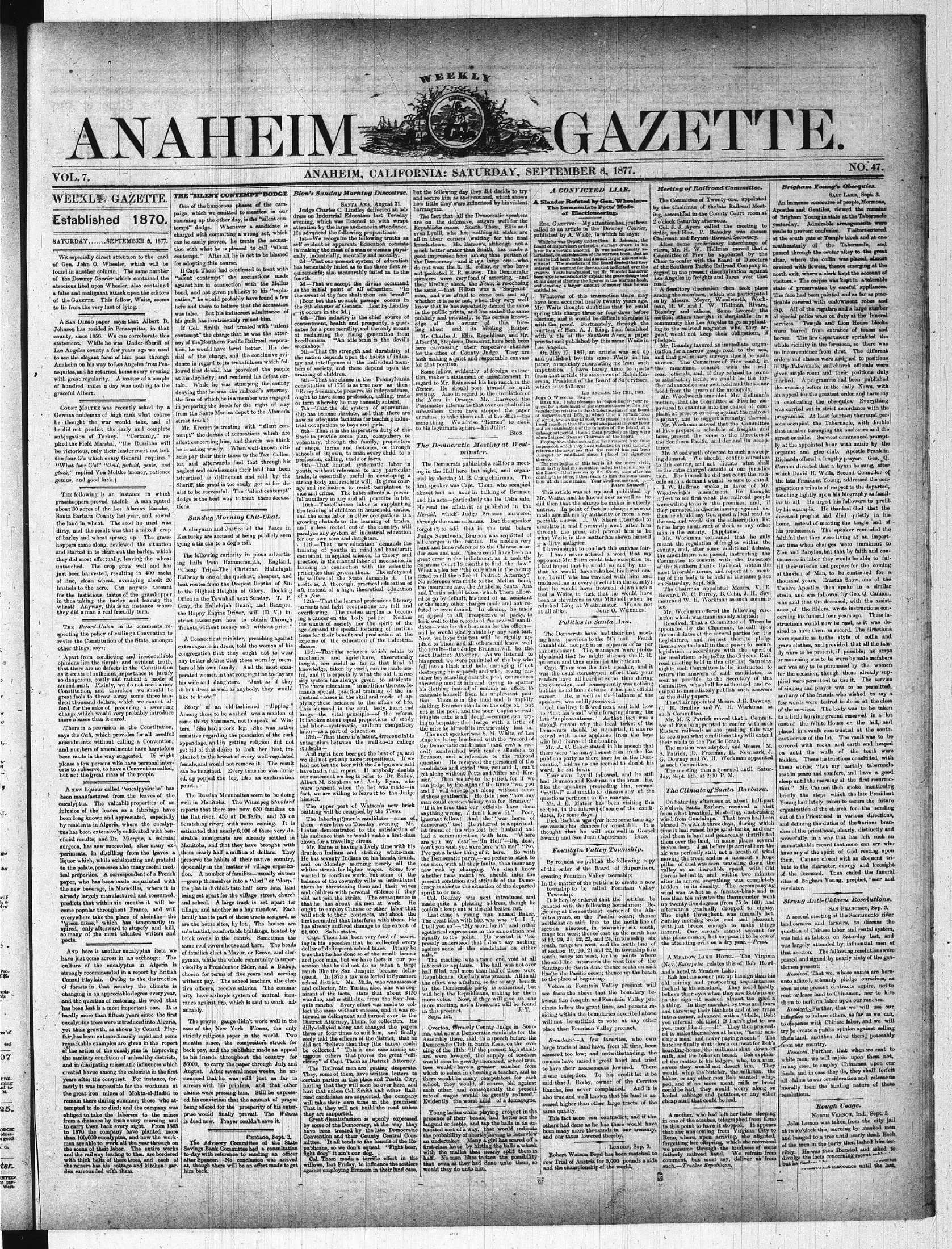
Searchable text
WEEKLY GAZETTE.
Established 1870.
SATURDAY...SEPTEMBER 8, 1877.
We especially direct attention to the card of Gen. John O. Wheeler, which will be found in another column. The same number of the Downey Courier which contained the atrocious libel upon Wheeler, also contained a false and malignant attack upon the editors of the Gazette. This fellow, Waite, seems to lie from the very lust of lying.
A San Diego paper says that Albert B. Johnson has resided in Penasquitas, in that county, since 1856. We can corroborate this statement. While he was Under-Sheriff of Los Angeles county a few years ago we used to see the elegant form of him pass through Anaheim on his way to Los Angeles from Penasquitas, and he returned home every evening with great regularity. A matter of a couple of hundred miles a day was nothing to the graceful Albert.
Count Moltke was recently asked by a German nobleman of high rank what course he thought the war would take, and if he did not predict the early and complete subjugation of Turkey. "Certainly," replied the Field Marshal, "the Russians will be victorious, only their leader must not lack the four G's which every General requires."
"The silent contempt" dodge
One of the humorous phases of the campaign, which we omitted to mention in our summing up the other day, is the "silent contempt" dodge. Whenever a candidate is charged with committing a wrong act, which can be easily proven, he treats the accusation with what he is pleased to call "silent contempt." After all, he is not to be blamed for adopting this course.
If Capt. Thom had continued to treat with "silent contempt" the accusations made against him in connection with the Mellus bond, and not given publicity to his "explanation," he would probably have found a few here and there to believe that the accusation was false. But his indiscreet admittance of his guilt has irretrievably ruined him.
If Col. Smith had treated with "silent contempt" the charge that he was the attorney of the Southern Pacific Railroad corporation, he would have fared better. His denial of the charge, and the conclusive evidence in regard to its truthfulness which followed that denial, has provoked the people at his duplicity, and rendered his defeat certain. While he was stumping the county denying that he was the railroad's attorney, the firm of which he is a member was engaged in preparing the deeds for the right of way from the Santa Monica depot to the Alameda street track!
Mr. Kremer is treating with "silent contempt" the dozens of accusations, which are affoat concerning him, and therein we think he is acting wisely. When well-known citizens pay their taxes to the Tax Collector, and afterwards find that through his Bion's Sunday Morning Judge Charles C. Lindbergh dress on Industrial Edn evening, which was listed attention by the large au He advanced the following:
1st—We recognize the self evident or apparent in making the most of a cally, industrially, ment
2d—That our present has lamentably failed as requirement; also measure fourth.
3d—That we accept that as the initial point of the sweat of thy face shi (Beer bet that no such the 8th chapter of Gene- it occurs in the 3d.)
4th—That industry is contentment, health and antee for a pure morality of reclaiming the risk hoodlumism. "An idle workshop."
5th—That the strength the nation depends upon try and intelligence of bers of society, and the training of children.
6th—That the clause constitution of 1776 is a "Every freeman, to pres ought to have some pro or farm whereby he ma
7th—That the old ship has become obsolete now no adequate facility trial occupations to boy
8th—That it is the in State to provide some voluntary, through tha of shops, farms and schools of it own, to t profession, calling trad
9th—That limited
COUNT MOLTKE was recently asked by a German nobleman of high rank what course he thought the war would take, and if he did not predict the early and complete subjugation of Turkey. "Certainly," replied the Field Marshal, "the Russians will be victorious, only their leader must not lack the four G's which every General requires." "What four G's?" "Geld, geduld, genie, und gluck," replied Von Moltke (money, patience genius, and good luck.)
The following is an instance in which grasshoppers proved useful: A man rented about 30 acres of the Los Alamos Rancho, Santa Barbara County last year, and sowed the land in wheat. The seed he used was dirty, and the result was that a mixed crop of barley and wheat sprang up. The grasshoppers came along, reviewed the situation and started in to clean out the barley, which they did most effectually, leaving the wheat untouched. The crop grew well and has just been harvested, resulting in 400 sacks of fine, clean wheat, averaging about 20 bushels to the acre. Can anyone account for the fastidious tastes of the grasshopper in thus taking the barley and leaving the wheat? Anyway, this is an instance where they did a man a real friendly turn.
THE RECORD-UNION in its comments respecting the policy of calling a Convention to revise the Constitution of the State, amongst other things, says:
Apart from conflicting and irreconcilable opinions lies the simple and evident truth, that there are no defects in the Constitution as it exists of sufficient importance to justify so dangerous, costly and radical a mode of amendment. Plainly, we do not need a new Constitution, and therefore we should be great fools to throw away some three hundred thousand dollars, which we cannot afford, for the sake of procuring a sweeping change, which would very probably introduce more abuses than it cured.
There is a provision in the Constitution, says the Call, which provides for all needful amendments without calling a Convention, and numbers of amendments have heretofore been made in the way suggested. It might please a few persons who have personal interests to subserve, to have a Convention called, but not the great mass of the people.
A NEW LIQUOUR CALLED "eucalyptus" has been manufactured from the leaves of the eucalyptus. The valuable properties of an infusion of the leaves as a fehr refuge have been long known and appreciated, especially by residents in Algeria, where the eucalyptus has been extensively cultivated with beneficial results; and Dr. Miergue, a colonial surgeon, has now succeeded, after many experiments, in distilling from the leaves a liquor which, while exhilarating and grateful to the palate, possesses also many useful medical properties. A correspondent of a French paper who has been made acquainted with lowed that denial, has provoked the people at his duplicity, and rendered his defeat certain. While he was stumping the county denying that he was the railroad's attorney. The firm of which he is a member was engaged in preparing the deeds for the right of way from the Santa Monica depot to the Alameda street track!
Mr. Kremer is treating with "silent contempt" the dozens of accusations which are afloat concerning him, and therein we think he is acting wisely. When well-known citizens pay their taxes to the Tax Collector, and afterwards find that through his neglect and carelessness their land has been advertised as delinquent and sold by the Sheriff, the proof is too easily got at for deniast to be successful. The "silent contempt" dodge is the best way to treat these accusations.
SUNDAY Morning Chit-Chat.
A cleryman and Justice of the Peace in Kentucky are accused of being publicly seen tying a tin can to a dog's tail.
The following curiosity in pious advertising hails from Hammersmith, England. "Cheap Trip—The Christian Hallelujah Railway is one of the quickest, cheapest, and best routes from the Deepest Depths of Sin to the Highest Heights of Glory. Booking Office in Townhall next Sunday. T. P. Gray, the Hallelujah Guard, and Beaupre, the Happy Engine Driver, will (D. V.) instruct passengers how to obtain Through Tickets without money and without price."
A Connecticut minister, preaching against extravagance in dress, told the women of his congregation that they ought not to wear any better clothes than those worn by members of his own family. And the most exasperated women in that congregation to-day are his wife and daughters. "Just as if they didn't dress as well anybody, they would like to know."
Story of an old-fashioned "dipping": Among those to be washed was a maiden of some thirty Summers, not to speak of Winters. She had a cork leg. She was rather sensitive regarding the possession of the cork appendage, and in getting religion did not get rid of that desire to look her best, implanted in the breast of every well-regulated female, and would not remove it. The result can be imagined. Every time she was ducked, up popped the leg, like an exclamation point.
The Russian Mennonites seem to be doing well in Manitoba. The Winnipeg Standard reports that there are now 650 families on the Rat river. 450 at Dufferin, and 33 on Scratching river; with more coming. It is estimated that nearly 6,000 of these very desirable immigrants are already settled in Manitoba, and that they have brought with them nearly half a million of dollars. They preserve the habits of their native country, especially in the matter of village organization. A number of families—usually sixteen—group themselves into a "dorf" or "dorp."
10th—That Chinese training of children and the same labor in growing obstacle to their and unless rooted out paralyze any system for our own sons and daughters.
11th—That new education training of youths in combined practice, in the manual farming in connection principles that govern the welfare of the Storm motto is. A thorough all, instead of a high of a few.
12th—That the learnings pursuits and light occur overflowing. The use ing a cancer on the bed the wants of society age demand the specializations for their benefit in expense of the educational classes.
13th—That the science mechanics and agriculture taught are useful knowledge taken by itself, and it is especially city system has always The "new education," mands special practical dustrial classes in this applying these sciences This demand is the lungs—the vital print It invokes about equal labor—and systematic labor—as a part of ed.
15th—That there is antagonism between students—And right here beer we did not get any milk had not bet the beer we have had a full report our statement we began Albert M. Stephens were present when fact, we are willing to himself.
The upper part of building will be occupied.
The laboring(?) men them—were here on T Linton demonstrated his audience that he wclown for a traveling Mr. Raine is having drunken Indians and He has seventy Indians and on Monday me whites struck for high wanted to continue w balance of the coward
A new liquor called "eucalyptus" has been manufactured from the leaves of the eucalyptus. The valuable properties of an infusion of the leaves as a febrifuge have been long known and appreciated, especially by residents in Algeria, where the eucalyptus has been extensively cultivated with beneficial results; and Dr. Miergue, a colonial surgeon, has now succeeded, after many experiments, in distilling from the leaves a liquor which, while exhilarating and grateful to the palate, possesses also many useful medical properties. A correspondent of a French paper, who has been made acquainted with the new beverage, in Marseilles, where it is already largely manufactured and consumed, predicts that within six months it will become popular throughout France, and will everywhere take the place of absinthe—the "green muse," which has temporarily inspired, only afterward to stupefy and kill, so many of the most talented writers and poets.
And here is another eucalyptus item we have just come across in an exchange: The culture of the eucalyptus in Algeria is strongly recommended in a report by British Consul Playfair. Owing to the destruction of forests in that country the climate is changing in an appreciable degree every year, and the question of restoring the wood that has been lost is a most important one. It is hardly more than fifteen years since the first eucalyptus trees were introduced into Algeria, yet their growth, as shown by Consul Playfair, has been extraordinarily rapid, and some remarkable examples are given in the report of the action of the eucalyptus in improving the sanitary condition of unhealthy districts, and in dissipating miasmatic influences which created havoc among the colonists in the first years after the conquest. For instance, formerly it was impossible for the workmen at the great iron mines of Mokta-el-Hadid to remain there during summer; those who attempted to do so died; and the company was obliged to take the laborers to the mines from a distance by train every morning and to carry them back every night. From 1868 to 1870 the company have planted more than 100,000 eucalyptus, and now the workmen are able to work all the year through on the scene of their labor. The entire works and the railway leading to them are bordered with thick belts of these trees, and each of the miners has his cottage and kitchen garden surrounded with them.
The Russian Mennonites seem to be doing well in Manitoba. The Winnipeg Standard reports that there are now 650 families on the Rat river. 450 at Dufferin, and 33 on Scratching river; with more coming. It is estimated that nearly 6,000 of these very desirable immigrants are already settled in Manitoba, and that they have brought with them nearly half a million of dollars. They preserve the habits of their native country, especially in the matter of village organization. A number of families—usually sixteen—group themselves into a "dorf" or "dorp." the plat is divided into half acre lots, land being set apart for the village street, church and school. A large tract is set apart for tillage, and another as a hay meadow. Each family has its part of these tracts assigned, as are the house sites, by lot. The houses are substantial, comfortable buildings, heated by brick ovens in the centre. Sometimes the same roof covers house and barn. The heads of families elect a Mayor, or Reeve, and clergyman, while the whole community is supervised by a President or Elder, and a Bishop, chosen for terms of five years and serving without pay. The school teachers, also executive officers, receive salaries. The community have a simple system of mutual insurance against fire, which is said to work admirably.
The prayer gauge didn't work well in the case of the New York Witness, the only strictly religious paper in the world. Two months since, the compositor's struck for back pay, and the publisher made an appeal to his friends throughout the country for $6000, to carry the paper through July and August. After several more weeks, he announced that he was still just as far in arrears with his printers, and that other claims were pressing him. Still he expressed his conviction that the amount of prayer being offered for the prosperity of his enterprise would finally prevail. The Witness is dead now. Prayer couldn't save it.
Chicago, Sept. 2.
The Advisory Committee of the State Savings Bank Committee had a consultation to-day with reference to sending an officer after Spencer. No conclusion was arrived at, though there will be an effort made to get him back.
The upper part of building will be occupied.
The laboring(?) men—were here on T.Linton demonstrated by his audience that he wclown for a traveling man.
Mr. Raine is having drunken Indians and He has seventy Indians and on Monday morning whites struck for higher wages to continue with balance of the cowardry them by threatening them and children with petitions did not join the strike that he has about to ought to employ China will stick to their co-foundrel that in has already suffered over $1,000. So he states Capt. Thom has been in his speeches this dollar of delinquent true that he has done poor man, but with session that he did no ranch like the San Francisco. In 1873 a tax school district. Mr. Tullivan of the facts was due, and is still oquin rancho. Every lect the same without turned as delinquent District Attorney. The dilly-dallyied along three or four times coolly told the officers did not "believe that be collected." This merous others that ciency" of Capt. Thom.
The Railroad men They, some of them certain parties in this hinting that they will hint that unless Col road candidates are sure will take their own That is, they will not be supported.
Great dissatisfaction by some of the Demo have been treated Convention and their mittee. It all tends publicans, so we don't fight dog;" it ain't out Col. Thom made willows, last Friday against employing B
WEEKLY
EMI GAZE
ANAHEIM, CALIFORNIA: SATURDAY, SEPTEMBER 8, 1877.
Bion's Sunday Morning Discourse.
SANTA ANA, August 31.
Judge Charles C. Lindley delivered an address on Industrial Education last Tuesday evening, which was listened to with wrap attention by the large audience in attendance. He advanced the following propositions:
1st—We recognize the following truths as self evident or apparent: Education consists in making the most of a man or woman physically, industrially, mentally and morally.
2d—That our present system of education has lamentably failed to the three first requirements; also measurably failed as to the fourth.
3d—That we accept the divine command as the initial point of all education. "In the sweat of thy face shall thou eat bread!"
(Beer bet that no such passage occurs in the 8th chapter of Genesis. Lost by Lindley it occurs in the 3d.)
4th—That industry is the chief source of contentment, health and prosperity, a guarantee for a pure morality, and the only means of reclaiming the rising generation from hoodlumism. "An idle brain is the devil's workshop."
5th—That the strength and durability of the nation depends upon the habits of industry and intelligence of the individual members of society, and these depend upon the training of children.
6th—That the clause in the Pennsylvania constitution of 1776 is as true now as then: "Every freeman, to preserve his independence, ought to have some profession, calling, trade or farm whereby he may honestly subsist.
7th—That the old system of apprenticeship has become obsolete, and that there are now no adequate facilities for teaching industrial occupations to boys and girls.
8th—That it is the imperative duty of the State to provide some plan, compulsory or voluntary, through the family, proprietors of shops, farms and factories, or through schools of its own, to train every child to a profession, calling, trade or farm.
9th—That limited systematic labor in but the following day they did decide to try and secure him as their counsel, which shows how little they were influenced by his violent harrangues.
The fact that all the Democratic speakers are on the defensive, augurs well for the Republican cause. Smith, Them, Ellis and even Lynill, who has nothing at stake, are all in their corners waiting for the final knock-down. Mr. Barrows, although not a much better orator than Smith, has made a good impression here among that portion of the Democracy—and it is a large one—who do not wear the R. R. collar, or who have not pocketed R. R. money. The Democratic speakers were very fond of asserting—and their hireling sheet, the News, is re-echoing the same,-that Hilton was a "Sargent-man," and was afraid to come out and say whether it is so or not, when they very well know that he has repeatedly denied the same in the public prints, and has stated the same publicly and privately, to the certain knowledge of the owner of this hireling sheet and its hireling Editor.
Mr. Charles J. Ellis, Republican, and Mr. Albert M. Stephens, Democrat, have both been canvassing their respective chances for the office of County Judge. They are both making a quiet and respectable canvass for that position.
Some fellow, evidently of foreign extraction, makes a statement or misstatement in regard to Mr. Raine and his hop ranch in the Review. He should post himself or quit writing. Also in regard to the circulation of the News in Orange. Mr. Harwood the Postmaster informs us that over one-half of its subscribers there have stopped the paper or refuse to take them out of the office—the same thing. We advise "Romeo" to stick to his legitimate sphere—his Juliet.
BION.
The Democratic Meeting at Westminster.
The Democrats published a call for a meet-
A CONVICTED LIAR.
A Slander Refuted by Gen. Wheeler—The Immaculate Petit Mode of Electioneering.
EDG. GAZETTE:—My attention has just been called to an article in the Downey Courier, published by A. Waite, in which he says:
While he was Deputy under Chas. R. Johnson, the Board of Supervisors ordered a warrant drawn in his favor for a certain amount. It was subsequently assented, on examination of the warrant book, that an arrest had been made and a much larger amount substituted. The members of the Board denied that they ordered the warrant for the amount indicated over the crature. Years have passed, yet Mr. Wheeler has never been able to satisfactorily explain the grave charge laid at his door of altering the course in the warrant book, and drawing a larger amount of money than he was entitled to.
Whatever of this transaction there may have been occurred nearly twenty years ago. Mr. Waite thought doubtless that he could spring this charge three or four days before election, and it would be difficult to refute it with the proof. Fortunately, through the courtesy of Hon. A. J. King, I am furnished with a file of the Southern News, a paper printed and published by this same Waite in Los Angeles.
On May 17, 1861, an article was set up and published by this same Waite in his paper, completely exonerating me from such imputation. I have barely time to quote from that article the statement of Ralph Emerson, President of the Board of Supervisors, which is as follows:
JOHN O. WHEELER; Esq.
DEAR SIR: I take pleasure in responding to your request for a statement of the circumstances within my recollection relative to the October session of the Board of Supervisors of 1859, at which time a certain place of script, amounting to 80099, was passed in your favor. I will resolutely that the script was passed in your favor and on examination of the minutes of the board, at a subsequent period I found them precisely as they were when I signed them as Chairman of the Board.
Hoping that this declaration may remove any false impression which may have reflected on your humor, I referrate the assertion that the record has not been changed or mutilated since I placed my signature thereto.
The recollection of this fact is all the more vivid.
6th—That the clause in the Pennsylvania constitution of 1776 is as true now as then: "Every freeman, to preserve his independence, ought to have some profession, calling, trade or farm whereby he may honestly subsist.
7th—That the old system of apprenticeship has become obsolete, and that there are now no adequate facilities for teaching industrial occupations to boys and girls.
8th—That it is imperative duty of the State to provide some plan, compulsory or voluntary, through the family, proprietors of shops, farms and factories, or through schools of its own, to train every child to a profession, calling, trade or farm.
9th—That limited, systematic labor in youth, without reference to any particular trade, is essentially useful in developing a strong body and resolute will. It gives courage and inclination to resist temptation to vice and crime. The habit affords a powerful auxiliary in any and all pursuits in life.
10th—That Chinese labor is supplanting the training of children in household duties, and the same labor in other occupations is a growing obstacle to the learning of trades, and unless rooted out of the country, will paralyzey any system of industrial education for our own sons and daughters.
11th—That "new education" demands the training of youths in mind and handicraft combined, in applied science, in theory and practice, in the manual labor of mechanics, in farming in connection with the scientific principles that govern them. The safety and the welfare of the State demands it. Its motto is, A thorough, practical education of all, instead of a high, theoretical education of a few.
12th—That the learned professions, literary pursuits and light occupations are full and overflowing. The useless surplus is becoming a cancer on the body politic. Neither the wants of society nor the spirit of the age demand the special fostering of institutions for their benefit and production at the expense of the education of the industrial classes.
13th—That the sciences which relate to mechanics and agriculture, theoretically taught, are useful as far as that kind of knowledge, taken by itself, can be made useful, and it is especially what the old University system has always given to students. The "new education," in addition thereto, demands special, practical training of the industrial classes in the skill and mode of applying these sciences to the affairs of life. This demand is the soul, body, heart and lungs—the vital principle—of the reform. It invokes about equal proportions of study and labor—systematic, uniform compulsory labor—as a part of education.
15th—That there is a latent, irreconcilable antagonism between the well-to-do college students—
And right here beer got the best of us, and we did not get any more propositions. If we had not bet the beer with the Judge, we would have had a full report. If anybody doubts our statement we beg to refer to Dr. Bailey, Albert M. Stephens and Andy Ryan, who were present when the bet was made—in fact, we are willing to leave it to the Judge himself.
The upper part of Watson's new brick building will be occupied by the Times.
The laboring? men's candidates—some of them—were here on Tuesday evening. Mr. Linton demonstrated to the satisfaction of his audience that he would make a first-class clown for a traveling circus.
Mr. Raine is having a lively time with his drunken Indians and striking white-men. He has seventy Indians on his hands, drunk, and on Monday morning nearly all the whites struck for higher wages. Some few wanted to continue work, but some of the balance of the cowardly villains intimidatedSome fellow, evidently of foreign extraction, makes a statement or misstatement in regard to Mr. Raine and his hop ranch in the Review. He should post himself or quit writing. Also in regard to the circulation of the News in Orange. Mr. Harwood the Postmaster informs us that over one-half of its subscribers there have stopped the paper or refuse to take them out of the office—the same thing. We advise "Romeo" to stick to his legitimate sphere—his Juliet.
Bios.
The Democratic Meeting at Westminster.
The Democrats published a call for a meeting in the Hall here last night, and organized by electing M. B. Craig chairman. The first speaker was Capt. Thom, who occupied almost half an hour in talking of Brunson and his acts—particularly the De Celis sale. He read the idleavit as published in the Herald, which Judge Brunson answered through the same columns. But the speaker forgot (?) to add that in the trial before Judge Sepulveda, Brunson was acquitted of all charges in the matter. He made a very faint and lame reference to the Chinese murder case and said, "there could have been no great error in the indictment, as it took the Supreme Court 18 months to find the flaw." What a plea for "the only man in the county titied to till the office of District Attorney." No reference was made to the Mellus bond, the insurance case, the Anaheim, Santa Ana and Tustin school taxes, which Thom allowed to go by default, his need of an assistant or the many other charges made and not refuted or even denied. In closing, he made an appeal to all, irrespective of party, to look well to the records of the several candidates—vote for the best men for the offices—and he would gladly abide by any such test.Now, we hope this test will be rigiously applied to Thom and all others and know well the result—that Judge Brunson will be the next District Attorney.As we listened to his speech we were reminded of the boy who fell into a black mud hole, damaging if not destroying his apparel; and who, seeing another boy standing near the pool, commences throwing mud at him and trying to spatter his clothing instead of making an effort to extricate himself from his unpleasant position.Them is in the mud and is rapidly sinking; Brunson stands on the edge of, but not in the pool, and the Captain—realizing his cake is all dough—commences trying to bespatter the Judge with a little of the mire he himself is irretrievably lost in.
The next speaker was S. M. White, of Los Angeles, being burdened with the "record of the Democratic candidates" (and such a record!) sandwiched with tender allusions to Brunson,and a reference to the railroad question.Hew reviewed the personnel of the candidates and stated "we, you and I, can't get along without Potts and Miles and Kremer." Then we are to be pitied, for if we can judge by the signs of the times "we, you and I" will have to get along without some of these gentlemen. He didn't see "how any man could conscientiously vote for Brunson."
If it be true that our officials have done anything wrong, I don't know it." Poor ignorant fellow! And the "war horse of democracy" too! He referred to a spiritualist friend of his who lost her husband and had a communication with him."Where are you my dear?"—In Hell"-Oh,dear,'don't you wish you were here with me?'NoI've got a better thing of it here." So with the Democratic party—we prefer to stick to our men with all their faults than incur any new risk by changing. We don't know whether twas meant we should infer the present condition and attitude of the Demo-imputation.I have barely time to quote from that article the statement of Ralph Emerson,President of the Board of Supervisorswhich is as follows:
JOHN O. WHEELER.Esq.-Dear Sir!I take pleasure in responding to your request for a statement of the circumstances within my collection relative to the October session of the Board of Supervisors of 1859,a at which time a certain piece of script, amounting to $600,mwas passed in your favor.I well rescaled that the script was passed in your favor and on examination of the minutes of the board.at a subsequent period.I found precisely as they were when I signed them as Chairman of the Board.Hoping that this declaration may remove any false impression which may have reflected on your honor.I reiterate the assertion that the record has not been changed or mutilated since I placed my signature thereto.The recollection of this fact is allthe more valid that having had my attention called to minutes of the Board of that session by Mr. Shore,scan after his coming into office.I then made to himthe same assertion which I know make.Your obedient servant,
RALPH EMERSON.
This article was set up and published by Mr. Waite,and he knows now as well as he did then thatthe chargebe makesis utterly untrue.In pointof fact,nothing was evermade againstme by authorityorfroma respectable source.J.W.Shore attemptedtocirculateit,andIpromptwentafterhimthroughthepress,andprovedhimtowhatWaiteinthismatterhasshownhimselfa dirtymaligner.
I have soughtto conductthis gunvasfairly.Ihave never uttereda wordmy opponentMr.Pottscouldtakeexceptionto.Ihad hoped thathe wouldsoactbyme--thathewouldhaverebukedhishiredor,Lynillwhohastravelledmeinhimandtraducedmeineveryprecinctinthecounty;thathewouldhavetrowneddownsucha toolasWaite.infact,thehewhavebeasedchivalrousaswasMitchellwhenherebukedLingatWestminsterWearenotatall alike.JOHN O.WHEELER.
PoliticsinSanta Ana.
The Democrats have had their last meetinghereprevioustothe5thinst.FrankGanahdlbidnotputinanappearanceasperannouncement.ThemanagerswerobviouslyafraidthathemightdiscusstheR.Rquestionandthendangertheticket.CaptThomwasthefirstspeaker,anditwasthe usual stereotypedeffortthatyourreadershaveall heardatsometime duringthecampaign,andconsequentlywhethernitisusedofficialcareer.Heaswellasthebalanceofthespeakers.wascoldlyreceived.
Col.Godfreyfollowednext,and toldhowhe"losthiswind"whileforagingduringthe"unpleasantness."AsthatfactwasastrongreasonwhythelocalticketoftheDemocratsshouldbesupported.itwasreceivedwithsomeapplause(fromtheboyswhohadchargeofthebonfire.Mr.A.C.Bakerstatedinhisspeechthattherewere"asamanyhonestmenintheRepublicanpartyastheredarebeintheDemocratic,"andasnoone seemedto doubthisword,hesatdown.
YourownLynillfollowed,andhe stillhadBrunsonandEastinman.thebrainHelikethespeakersprecedinghim,semed"rattled"andunableto discussanyofthequestions pertinenttothecavass.Mr.J.E.Materhasbeenvisitingthissection,inthesinterestofsomeofthecandidates,forsomedays.DickBarhamwasovertimeagocanvassinghichancesforconstable。它思道thathewillrunwellinGaupelSwampandSanJuanCapistrano.Bios.
FountainValleyTownship.
ByrequestwepublishthefollowingcopyoftheorderoftheBoardofSupervisors,creatingFountainValleytownship;Inthematterofthe petitiontocreatea new
The upper part of Watson's new brick building will be occupied by the Times.
The laboring(?) men's candidates—some of them—were here on Tuesday evening. Mr. Linton demonstrated to the satisfaction of his audience that he would make a first-class clown for a traveling circus.
Mr. Raine is having a lively time with his drunken Indians and striking white-men. He has seventy Indians on his hands, drunk, and on Monday morning nearly all the whites struck for higher wages. Some few wanted to continue work, but some of the balance of the cowardly villains intimidated them by threatening them and their wives and children with personal violence if they did not join the strike. The consequence is that he has about six men at work. He ought to employ Chinese or other labor that will stick to their contracts, and shoot the first scoundrel that interferes with them. He has already suffered damage to the extent of $1,000. So he states.
Capt. Thom has been very fond of asserting in his speeches that he collected every dollar of delinquent school taxes. It may be true that he has done so of the small farmer and poor man, but we have facts in our possession that he did not do so when a large ranch like the San Joaquin became delinquent. In 1873 a tax was levied in Sycamore school district. Mr. Mills, who was assessor and collector, Mr. Tustin, also, who was cognizant of the facts, state that about $150 was due, and is still due, from the San Joaquin rancho. Every effort was made to collect the same without success, and it was returned as delinquent and turned over to the District Attorney, Thom, for collection. He dilly-dallyied along and changed the papers three or four times to suit him, and finally coolly told the officers of the district, that he did not "believe that they (the taxes) could be collected." This is one case among numerous others that proves the great "efficiency" of Capt. Thom as District Attorney.
The Railroad men are getting desperate. They, some of them, have written letters to certain parties in this place and Tustin City, hinting that they will soon be over here, and hint that unless Col. Smith and other Railroad candidates are supported, the company will take their own time in the premises! That is, they will not build the road unless they are supported.
Great dissatisfaction is openly expressed by some of the Democracy, at the way they have been treated by the late Democratic Convention and their County Central Committee. It all tends to the benefit of the Republicans, so we don't squawal. "Fight bear, fight dog," it ain't our dog.
Col. Thom made a terrific effort in the willows, last Friday, to influence the settlers against employing Brunson in their land case,
can judge by the signs of the times "we, you and I" will have to get along without some of these gentlemen. He didn't see "show any man could conscientiously vote for Brunson."
"If it be true that our officials have done anything wrong, I don't know it." Poor, ignorant fellow! And the "war horse of democracy" too! He referred to a spiritualist friend of his who lost her husband and had a communication with him. "Where are you my dear?"—"In Hell"—Oh, dear, don't you wish you were here with me? "No, I've got a better thing of it here." So with the Democratic party, we prefer to stick to our men, with all their faults, than incur any new risk by changing. We don't know whether twas meant we should infer the present condition and attitude of the Democracy is akirto the situation of the departed spirit to or not.
Col. Godfrey was next introduced and made quite a pleasing address, though he couldn't keep out of the old beaten rut.
Last came a young man named Baker. The great idea with him was "I—I—I tell you so"—"My word for it" and other egotistical expressions in the same strain and equally to the point. He wanted it "expressly understood that I don't say nothing against none of the candidates on either side."
The meeting was a tame one, void of all interest or applause. The hall was not over half filled, and more than half of these were Republicans. One lady was present. All in all the effort was a failure, so far as any benefit to the Democratic party is concerned, but will help the Republicans, making for them more votes. Now, if they will give us one more meeting, not a Democrat will be found in this precinct.
Sept. 1st.
Overton, formerly County Judge in Sonoma, and now a Democratic candidate for the Assembly there, said, in a speech before the Democratic Club in Santa Rosa, on the evening of the 11th: "If the present high standard were lowered, the supply of teachers would soon be greatly increased, school trustees would have a greater number from which to select in choosing a teacher, and as there would be many competitors for each school, they would, of course, bid against each other, and consequently the present rate of wages would be greatly reduced." Evidently the worst kind of a demagogue.
Young ladies while playing croquet in the presence of their beaux, had better act the languid or feeble, and tap the balls in an exhausted sort of a way, that would indicate the probability of shortly having to interview an undertaker. Many a girl has scared off a first-class lover by hitting the balls a whack with the mallet that nearly split them in half. No man likes to face the possibility that even as they had done unto them, so would they do unto him.
By request we publish the following copy of the order of the Board of Supervisors, creating Fountain Valley township; In the matter of the petition to create a new township to be called Fountain Valley Township.
It is hereby ordered that the petition be granted with the following boundaries: Beginning at the southeast corner of the Alamitos grant, on the Pacific ocean; thence northeast on said line to the northline of section nineteen, in township six south, range ten west; thence east on the northline of 19,20,21,22,and 24,在 township six south, range ten west,and the northline of section 19,20,21and 22,在 township five south,range ten west.for the points where she said line intersects the west line of the Santiago de Santa Ana; thence south on said line'to the Pacilio ocean; thence up the beach to the place of beginning.
Voters in Fountain Valley precinct will see from above that the boundary between San Joaquin and Fountain Valley precinct follow the grant lines,and persons residing within the boundaries described above will not be entitled to vote at any other place than Fountain Valley precinct.
Broadaze:A few favorites,who own large tracts of land have,从 all time,被 assessed too low;and notwithstanding,the owners have raised a great howl and tried to have their assessments lowered. There is one exception.To his credit let it be said that J.Bixby,owner of the Cerritos Rancho,has never complained.And it is also true and well known that his land is assessed higher than other large tracts of the same quality.
This fact none can contradict;and if the others had done as he has there would have been many more thousands in our treasury,and our taxes lowered thereby.
London,Sep.3.
Robert Watson Boyd has been matched to row Trial of Austria for 5,000 pounds a side and the championship of the world.
AZETTE.
8, 1877. NO. 47.
MEETING of Railroad Committee.
The Committee of Twenty-one, appointed by the Chairman of the late Railroad Meeting, assembled in the County Court room at 2 o'clock Saturday afternoon.
Col. J. J. Ayers called the meeting to order, and Hon. P. Beaudry was chosen Chairman and Bryant Howard Secretary.
After some preliminary interchange of views, Mr. H. W. Hellman moved that a Committee of Five be appointed by the Chair to confer with the Board of Directors of the Southern Pacific Railroad Company in regard to the present discrimination against Los Angeles in freights and fares over that road.
A desultory discussion then took place among the members, which was participated in by Messrs. Meyer, Woodworth, Workman, H. W. and I. W. Hellman, Rivara, Beaudry and others. Some favored the motion; others thought it despicable in a community like Los Angeles to go supplicating to the railroad magnates who, they argued, would not keep their obligations, if pledged.
Mr. Beaudry favored an immediate organization for a narrow gauge road to the sea, and that preliminary surveys should be made at once. The Committee of Five could, in the meantime, consult with the railroad officials, and, if they refused to come to satisfactory terms, we would be further advanced on our own road and the sooner freed from the grasp of the monopoly.
Mr. Woodworth amended Mr. Hellman's motion, that the Committee of Five he empowered to examine into the causes of complaint at present existing against the railroad company, and to suggest a remedy. Carried.
Mr. Workman moved that the Committee of Five prepare a schedule of freights and fares, present the same to the Directors of the Southern Pacific, and demand its acceptance.
Mr. Woodworth objected to such a sweeping demand. We should confine ourselves to this county, and not dictate what shall
Responding to your request for a statement of Ralph Emerson's Board of Supervisors, May 13th, 1861.
It is all the more vivid when called to the minutes of Mr. Shore, soon after his death to him the same assurer our obedient servant, Ralph Emerson.
I may remove any false collection on your honor. I place my signature at the record has not been taken.
Mr. Woodworth amended Mr. Hellman's motion, that the Committee of Five he empowered to examine into the causes of complaint at present existing against the railroad company, and to suggest a remedy. Carried.
Mr. Workman moved that the Committee of Five prepare a schedule of freights and fares, present the same to the Directors of the Southern Pacific, and demand its acceptance.
Mr. Woodworth objected to such a sweeping demand. We should confine ourselves to this county, and not dictate what shall be the rates charged outside of our jurisdiction. For himself he did not court the ridicule such a demand would be sure to entail.
L.W. Hellman spoke in favor of Mr. Woodworth's amendment. He thought it best to see first what the railroad people were willing to do in the premises, and, if they persisted in discriminating against us, then he should say God speed a local road to the sea, and would sign the subscription list for as large an amount of stock as any other man in the county. [Applause.
Mr. Workman explained that he only meant the regulation of freights within the county, and, after some additional debate, the amendment was passed, instructing the Committee to consult with the Directors of the Southern Pacific Railroad, obtain the most favorable terms, and report at a meeting of this body to be held at the same place on Saturday, Sept. 8th.
The Chairman appointed Messrs. V.E Howard, W.C.Furrey, B.Cohn, J.H.Seymour and W.H.Workman as such committee.
Mr. Workman offered the following resolution which was unanimously adopted:
Resolved, That a Committee of Three be appointed by the Chairman, to call upon the candidates of the several parties for the Legislature, and request them to pledge themselves to do all in their power to secure legislation in accordance with the spirit of the resolutions adopted at the Citizens' Railroad meeting held in this city last Saturday night; such Committee to be instructed to return the answers of said candidates, as soon as possible, to the Secretary of this Committee, who shall be authorized and required to immediately publish such answers in the daily papers.
The Chair appointed Messrs.J.G.Downey, C.H.Bradley and W.H.Workman as such Committee.
Mr.M.S.Patrick moved that a Committee of Five be appointed to confer with such Eastern railroads as are pushing this way to see upon what conditions they will extend their roads to the Pacific Coast.
The motion was adopted, and Messrs.M.S.Patrick,D.Freeman,H.Newmark,J.G.Downey and W.H.Workman appointed as such Committee.
The meeting then adjourned until Saturday, Sept. 8th, at 2:30 P.M.
The Climate of Santa Barbara.
On Saturday afternoon at about half-past 3 o'clock, Santa Barbara received a visit from a hot breathed, blustering, dust-raising wind from Guadalupe. That town had been blessed (2) with it three days, during which time it had raised huge sand-banks, and carried them inland and generously distributed them over the land, in some places several inches deep. Just before its arrival here the air was perfectly still, not a breath of wind moving the trees, and in a moment a huge pillar of dust was seen traveling down the valley at an incredible speed, with Old Boreas behind it, and within two minutes after its arrival everything was completely given ample room and their positions duly marked. A programme had been published the evening before in the daily News, with an appeal for the greatest order and harmony in celebrating the obsequies. Everything was carried out in strict accordance with the programme. At least fourteen thousand persons occupied the Tabernacle, with double that number thronging enclosure and the street outside. Services commenced promptly at the appointed hour with music by the organist and glee club. Apostle Franklin Richards offered a lengthy prayer. Geo.Q.Cannon directed that a hymn be sung, after which David H.Wells, Second Councilor of the late President Young, addressed the congregation a tribute of respect to the departed, touching lightly upon his biography as familiar to all. He urged his followers to profit by his example. He thanked God that the deceased prophet had died quietly in his home, instead of meeting the tragic end of his predecessor. The speaker reminded the faithful that they were living at an important time when changes were imminent to Zion and Babylon, but that by faith and continuance in labor they would be able to fulfill their mission and prepare for the coming of the Son of Man, to be continued for a thousand years. Erastus Snow, one of the Twelve Apostles, then spoke in a similar strain, and was followed by Geo.Q.Cannon, who said that the deceased, with the assistance of the Elders, wrote instructions concerning his funeral four years ago. These instructions would now be read, as it was desired to have them on record. The directions were specific as to the style of coffin and grave clothes, and provided that all the family were to be present; if possible; no orape or mourning was to be worn by male members nor was any to be purchased by the women for the occasion, though those already supplied were permitted to use it. The service of singing and prayer was to be permitted, and any of the friends who wished to say a few words were desired to do so at the close of the services. The body was to be taken to a little burying ground reserved in a lot east of the White House on the hill, and placed in a vault constructed at the southeast corner of the lot. The vault was to be covered with rocks and earth and heaped on until the walls of the tomb were hidden. These instructions concluded with these words: "Let my earthly tabernacle rest in peace and comfort, and have a good sleep until the morning of the first resurrection." Mr.Cannon then spoke mentioning briefly the steps which the late President Young had lately taken to secure future organization of the church for the sending out of the Priesthood in various directions, and defining the duties of the various branches of the priesthood, clearly, distinctly and powerfully, in a way that has left such an unmistakable record that none can err who have any of the spirit of God resting upon them. Cannon closed with an eloquent tribute to the character, energy and foresight of the deceased. Thus ended the funeral rites of Brigham Young, prophet, seer and
The Climate of Santa Barbara.
On Saturday afternoon at about half-past 3 o'clock, Santa Barbara received a visit from a hot breathal, blustering, dust-raising wind from Guadalupe. That town had been blessed (?) with it three days, during which time it had raised huge sand-banks, and carried them inland and generously distributed them over the land, in some places several inches deep. Just before its arrival here the air was perfectly still, not a breath of wind moving the trees, and in a moment a huge pillar of dust was seen traveling down the valley at an incredible speed, with Old Borcas behind it, and within two minutes after its arrival everything was completely hidden in its density. The accompanying wind was as hot as a furnace-blast and in less than ten minutes the thermometer went up twenty-five degrees (from 75 to 100) and afterwards gradually dropped to eighty. The night throughout was unusually hot. Sunday morning broke cool and pleasant, with just breeze enough to make things natural. Our servants cannot account for this phenomenon, but suppose it to be one of the attending evils on a dry year.—Press.
A Meadow Lake Hotel — The Virginia (Nev.) Enterprise relates this of Bob Howland's hotel, at Meadow Lake:
Bob had no sooner put up his sign than his old mining and prospecting acquaintances flocked to his standard. They could hardly believe their eyes when they saw Bob's name on the sign—it seemed almost too good a thing. In they marched by twos and fours and throwing their blankets and other traps into a corner, advanced with a "Hello, Bob! you infernal old thief!" If I ain't glad to see you, may I be d——d!"
They then proceeded to make themselves at home, "never missing a meal and never paying a cent." The butcher finally shut down on meat for Bob's boarding-house, the milkman shut down on milk, and the baker on bread. Bob explained the matter to his lodgers, who, to a man, swore they would not desert him. They would whip the butcher, the milkman, the baker, or any other man Bob wanted whipped, and if no more meat, milk or bread could be had, they would worry along on boiled cabbage and potatoes, or any other cheap stuff that could be had.
A mother, who had left her baby sleeping in one of the coaches, telegraphed from Reno to this point to have it stopped. It appears that she was coming from Virginia City to Reno, where upon arriving, she alighted, forgetting her offspring, which she recovered we presume through the kindness of some fatherly railroad hand. We refrain from comment, but must say, deliver us from such.—Truckee Republican,
Mr. Cannon then spoke mentioning briefly the steps which the late President Young had lately taken to secure the future organization of the church for the sending out of the Priesthood in various directions, and defining the duties of the various branches of the priesthood, clearly, distinctly and powerfully, in a way that has left such an unmistakable record that none can err who have any of the spirit of God resting upon them. Cannon closed with an eloquent tribute to the character, energy and foresight of the deceased. Thus ended the funeral rites of Brigham Young, prophet, seer and revelator.
Strong Anti-Chinese Resolutions.
SAN FRANCISCO, Sep. 3.
A second meeting of the Sacramento river land owners and farmers, to discuss the question of Chinese labor and rental system, was held at Isleton on Saturday last, and was largely attended by influential men of that section. The following resolutions were passed and signed by nearly sixty of the gentlemen present:
Resolved, That we, whose names are hereunto affixed, solemnly pledge ourselves, as soon as our present contracts expire, not to rent or lease land to Chinamen, nor to hire them to perform labor upon our ranches.
Resolved Further, that we will use our influence to induce others, as far as we can, to dispense with Chinese labor, and we will try to create a public opinion against selling them land, and thus drive them peaceably from our country.
Resolved Further, that when we rent to white men, we will enjoin upon them not, in any case, to employ Chinamen upon our lands, and in case they do, they shall forfeit all claims to our consideration and release us morally from the binding nature of these resolutions.
Rough Usage.
NORTH VERNON, Ind., Sept. 3.
John Lemon was taken from the city jail at two o'clock this morning by masked men and hanged to a tree until nearly dead. Each of the men in the party then lashed him terribly. He was then liberated and asked to divulge the facts concerning recent events but he declined innocence until the last.