anaheim-gazette 1877-09-01
Scanned page
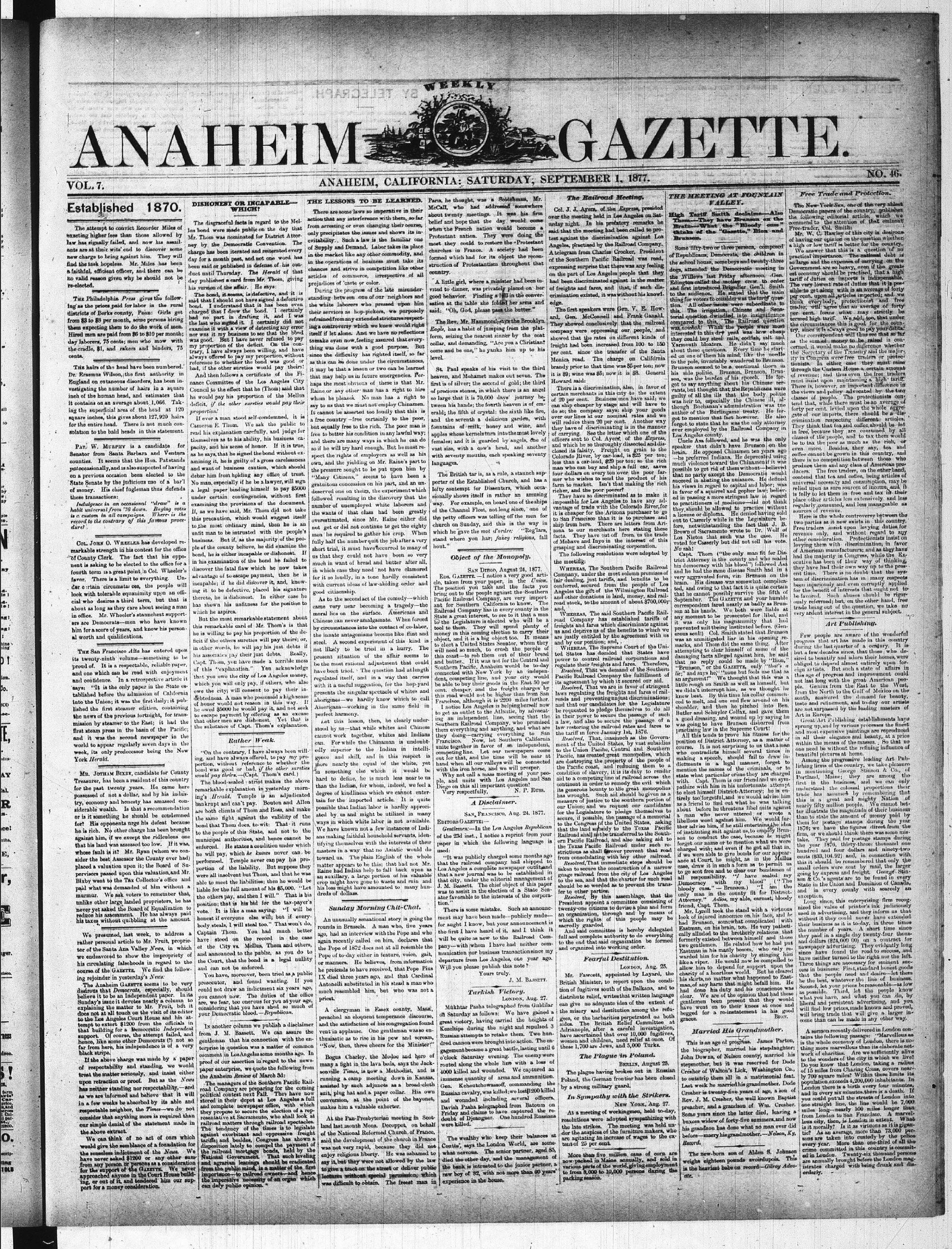
Searchable text
Established 1870.
The attempt to convict Recorder Miles of exacting higher fees than those allowed by law has signally failed, and now his assailants are at their wits' end to discover some new charge to bring against him. They will find the task hopeless. Mr. Miles has been a faithful, efficient officer, and there can be no valid reason given why he should not be re-elected.
The Philadelphia Press gives the following as the prices paid for labor in the rural districts of Berks county, Penn: Girls get from $3 to $3 per month, some persons hiring them expecting them to do the work of men. Hired men are paid from $6 to $10 per month; day laborers, 75 cents; men who mow with the cradle, $1, and rakers and binders, 75 cents.
The hairs of the head have been numbered. Dr. Erasmus Wilson, the first authority in England on cutaneous disorders, has been investigating the number of hairs in a square inch of the human head, and estimates that it contains on an average about 1,066. Taking the superficial area of the head at 120 square inches, this gives about 127,920 hairs for the entire head. There is not much consolation to the bald heads in this statement.
Pat. W. Murphy is a candidate for Senator from Santa Barbara and Ventura counties. It seems that the Hon. Pat stands
DISHONEST OR INCAPABLE—WHICH?
The disgraceful facts in regard to the Melius bond were made public on the day that Mr. Thom was nominated for District Attorney by the Democratic Convention. The charge has been iterated and reiterated every day for a month past, and not one word has been said or published in defense of his conduct until Thursday. The Herald of that day published a card from Mr. Thom, giving his version of the affair. He says:
The bond, it seems, is defective, and it is said that I should not have signed a defective bond. I understand that it has been even charged that I drew the bond. I certainly had no part in drafting it, and I was the last who signed it. I certainly did not examine it with a view of detecting any error nor was it my business to see that the bond was good. But I have never refused to pay my proportion of the deficit. On the contrary, I have always been willing, and have always offered to pay my proportion, without reference to whether the bond was good or bad, if the other sureties would pay their proportion!
And then follows a certificate of the Finance Committee of the Los Angeles City Council to the effect that he (Thom) said that he would pay his proportion of the Melius deficit, if the other sureties would pay their proportion!
If ever a man stood self-condemned, it is Cameron E. Thom. We ask the public to read his explanation carefully, and judge for themselves as to his ability, his business capacity, and his sense of honor. If it is true, as he says, that he signed the bond without examining it, he is guilty of a gross carelessness.
THE LESSONS
There are some legal action that any intracting or evitable from arresting or only precipitates the evitability. Such of Supply and Demand in the market like in the operations of chances and striving articles of common prejudices of castes.
During the program standing between the white laborer their services as being refrained from any ing a controversy within itself if let alone tomake even now thing was done since the difficulty as this can be done it may be that a law that may help us haps the most obey Raine or any other whom he pleases say to us that we cannot be assess a free country—but equally free to free to better his own and there are many so if he will try his spect the rights oown, and the yield
Dr. Erasmus Wilson, the first authority in England on cutaneous disorders, has been investigating the number of hairs in a square inch of the human head, and estimates that it contains on an average about 1,066. Taking the superficial area of the head at 120 square inches, this gives about 127,920 hairs for the entire head. There is not much consolation to the bald heads in this statement.
Pat. W. Murphy is a candidate for Senator from Santa Barbara and Ventura counties. It seems that the Hon. Pat stands pat occasionally, and is also suspected of having on a previous occasion been elected to the State Senate by the judicious use of a bar of money. His chief fugleman thus defends these transactions:
Indulgence in an occasional "draw" is a habit universal from '76 down. Buying votes is a custom in all campaigns. Where is the record to the contrary of this famous procedure?
Col. John O. Wheeler has developed remarkable strength in his contest for the office of County Clerk. The fact that his opponent is asking to be elected to the office for a fourth term is a great point in Col. Wheeler's favor. There is a limit to everything. Under certain circumstances, the people will look with tolerable equanimity upon an official who desires a third term, but that is about as long as they care about seeing a man in office. Mr. Wheeler's staunchest supporters are Democrats—men who have known him for a score of years, and know his personal worth and qualifications.
The San Francisco Alta has entered upon its twenty-ninth volume—something to be proud of. It is a respectable, reliable paper, and one which can be read with enjoyment and confidence. In a retrospective article it says: "It is the only paper in the State established before the admission of California into the Union; it was the first daily; it published the first steamer edition, containing the news of the previous fortnight, for transmission by steamer to the East; it had the first steam press in the basin of the Pacific; and it was the second newspaper in the world to appear regularly seven days in the week, its only predecessor being the New York Herald."
Mr. Jotham Bixby, candidate for County Treasurer, has been a resident of this country for the past twenty years. He came here possessed of not a dollar, and by his industry, economy and honesty he amassed considerable wealth. Is that a recommendation or is it something he should be condemned for? His opponents urge his defeat because he is rich. No other charge has been brought against him, if we except the ridiculous one that his land was assessed too low. If it was, whose fault is it? Mr. Ryan (whom we consider the best Assessor the County ever had) placed a valuation upon it; the Board of Supervisors passed upon this valuation, and Mr. Bixby went to the Tax Collector's office and bad, if the other sureties would pay their bad, if the other sureties would pay their bad.
And then follows a certificate of the Finance Committee of the Los Angeles City Council to the effect that he (Thom) said that he would pay his proportion of the Mellus deficit, if the other sureties would pay their proportion!
If ever a man stood self-condemned, it is Cameron E. Thom. We ask the public to read his explanation carefully, and judge for themselves as to his ability, his business capacity, and his sense of honor. If it is true, as he says, that he signed the bond without examining it, he is guilty of a gross carelessness and want of business caution, which should debar him from holding any office of trust. No man, especially if he be a lawyer, will sign a legal paper binding himself to pay $5000 under certain contingencies, without first examining the provisions of the document. If, as we have said, Mr. Thom did not take this precaution, which would suggest itself to the most ordinary mind, then he is an unfit man to be intrusted with the people's business. But if, as the majority of the people of the county believe, he did examine the bond, he is either incapable or dishonest. If in his examination of the bond he failed to discover the fatal flaw which he now takes advantage of to escape payment, then he is incapable; if he did discover it, and knowing it to be defective, placed his signature thereto, he is dishonest. In either case he has shown his unfitness for the position to which he aspires.
But the most remarkable statement about this remarkable card of Mr. Thom's is that he is willing to pay his proportion of the deficit if the others sureties will pay theirs; or, in other words, he will pay his just debts if his associates pay their just debts. Really, Capt. Thom you have made a terrible mess of this "explanation." You acknowledge that you owe the city of Los Angeles money, which you will only pay, if others, who also owe the city; will consent to pay their indebtedness. A man who possessed a high sense of honor would not reason in this way. If he owed $5000 he would pay it, and not seek to escape payment by offering as an excuse that other men are dishonest. Yet that is the substance of Capt. Thom's explanation.
Rather Weak.
"On the contrary, I have always been willing, and have always offered, to pay my proportion, without reference to whether the bond was good or bad, if the other sureties would pay theirs." (Capt. Thom's card.)
The blood-sealed patriot makes the above remarkable explanation in yesterday morning's Herald. Temple is an adjudicated bankrupt and can't pay. Bouton and Allen are both clients of Thom and Ross, and make the same fight against the validity of the bond that Thom does, to-wit: That it runs to the people of this State, and not to the municipal authorities, and hence cannot be enforced. He states a condition under which he will pay, which he knows never can be performed. Temple never can pay his proportion of the liability. But suppose they were all insolvent but Thom, and that he was able to meet the liabilities; then he would be hard to define than the Indian degree of kindliness for the imminent possible that Immediately by us and ways in which We have known ans making faithifying themselves masters in a way toward us. The matter appears Raine had India an auxiliary, a crop might have
for the past twenty years. He came here possessed of not a dollar, and by his industry, economy and honesty has amassed considerable wealth. Is that a recommendation or is it something he should be condemned for? His opponents urge his defeat because he is rich. No other charge has been brought against him, if we except the ridiculous one that his land was assessed too low. If it was, whose fault is it? Mr. Ryan (whom we consider the best Assessor the County ever had) placed a valuation upon it; the Board of Supervisors passed upon this valuation, and Mr. Bixby went to the Tax Collector's office and paid what was demanded of him without a murmur. We ask voters to remember that, unlike other large landed proprietors, he has never yet asked the Board of Equalization to reduce his assessment. He has always paid his taxes without quibbling at the amount.
We presumed, last week, to address a rather personal article to Mr. Fruit, proprietor of the Santa Ana Valley News, in which we endeavored to show the impropriety of his circulating falsehoods in regard to the course of the Gazette. We find the following rejoinder in yesterday's News:
The Anaheim Gazette seems to be very desirous that Democrats, especially, should believe it to be an Independent paper. In its Sunday's issue it devotes nearly a column to explaining the matter to Mr. Fruit, but it does not at all touch on the visit of its editor to the Los Angeles Court House and his attempt to extort $1200 from the officials in that building for a Democratic Independent support. Of course, the attempt failed, and hence, like some other Democrats (?) not so far from here, his independence is of a very black stripe.
If the above charge was made by a paper of respectability and standing, we would treat the matter seriously, and insist either upon retraction or proof. But as the News has neither standing nor respectability,—and as we are informed and believe that it will in a few weeks be absorbed by its able and respectable neighbor, the Times—we do not consider that anything more is required than our simple denial of the statement made in the above extract.
We can think of no act of ours which would give the semblance of a foundation for the senseless indictment of the News. We have never asked $1200 or any other sum from any person or persons as a consideration for the support of the Gazette. We never approached anyone in the Court House building, or out of it, and tended him our support for a money consideration.
remarkable explanation in yesterday morning's Herald. Temple is an adjudicated bankrupt and can't pay. Bouton and Allen are both clients of Thom and Ross, and make the same fight against the validity of the bond that Thom does, to-wit: That it runs to the people of this State, and not to the municipal authorities, and hence cannot be enforced. He states a condition under which he will pay, which he knows never can, be performed. Temple never can pay his proportion of the liability. But suppose they were all insolvent but Thom, and that he was able to meet the liabilities; then he would be liable for the full amount of his $5,000. "Let the others pay, and then I will." That is his position; that is his bid for the tax-payer's vote. It is like a man saying: "I will be honest if everyone else will; but if everybody steals, I will steal too." That won't do, Captain Thom. You had much better have stood on the record in the case of the City vs. Mellus, Thom and others, and announced to the public, as you do to the Court, that the bond is a legal nullity and can not be enforced.
You have, moreover, been tried as a public prosecutor, and found wanting. If you could not draw an indictment six years ago, you cannot now. The duties of the office are, we fear, too onerous for you at your age, considering that you have shed so much of your Democratic blood. —Republican.
In another column we publish a disclaimer from J. M. Bassett. We can assure the gentleman that his connection with the enterprise in question was a matter of common comment in Los Angeles some months ago. In proof of our assertion in regard to the newspaper enterprise, we quote the following from the Anaheim Review of March 3d:
The managers of the Southern Pacific Railroad Company are preparing for the coming political contest next Fall. They have now stored in their depot at Los Angeles a full and complete newspaper office, with which they propose to secure the election of a representative at Sacramento, who shall look at railroad matters through railroad spectacles. The tendency of the times is to legislate against exorbitant and oppressive freight tariffs; and besides, Congress has shown a disposition lately to compel the payment of the railroad mortgage bonds, held by the National Government. That such levelling and agrarian leanings should be eradicated from the public mind is a matter of the first importance—to railroad owners—and hence the imperative necessity of an organ which can defy public opinion.*
THE LESSONS TO BE LEARNED.
There are some laws so imperative in their action that any interference with them, so far from arresting or even changing their course, only precipitates the issues and shows its inevitability. Such a law is the familiar one of Supply and Demand. Labor takes its place in the market like any other commodity, and in the operations of business must take its chances and strive in competition like other articles of commerce, irrespective of all prejudices of caste or color.
During the progress of the late misunderstanding between one of our neighbors and the white laborers who pressed upon him their services as hop-pickers, we purposely refrained from any extended strictures respecting a controversy which we knew would right itself if let alone. And we have no reflections to make even now, feeling assured that everything was done with a good purpose. But since the difficulty has righted itself, so far as this can be done under the circumstances, it may be that a lesson or two can be learned that may help us in future emergencies. Perhaps the most obvious of these is that Mr. Raine or any other man has a right to hire whom he please. No man has a right to say to us that we must not employ Chinamen. It cannot be asserted too loudly that this is a free country—free certainly to the poor, but equally free to the rich. The poor man is free to better his condition in any lawful way; and there are many ways in which he can do so if he will try hard enough. But he must respect the rights of employers as well as his own, and the yielding on Mr. Raine's part to Paris, he thought, was a Scotchman, Mr. McCall, who had addressed somewhere about twenty meetings. It was his firm belief and hope that the day would come when the French nation would become a Protestant nation. They were doing the most they could to restore the Protestant churches in France. A society had been formed which had for its object the reconstruction of Protestantism throughout that country.
A little girl, where a minister had been invited to dinner, was privately placed on her good behavior. Finding a fall in the conversation at the table she folded her arms and said: "Oh, God, please pass the butter."
The Rev. Mr. Hammond says the Brooklyn Eagle, has a habit of jumping from the platform, seizing the nearest sinner by the coat collar, and demanding, "Are you a Christian? come and be one," he yanks him up to his level.
St. Paul speaks of his visit to the third heaven, and Mohamet makes out seven. The first is of silver; the second of gold; the third of precious stones, in which there is an angel so large that it is 70,000 days' journey between his hands; the fourth heaven is of emerald; the fifth of crystal: the sixth like fire, and the seventh a delicious garden, with fountains of milk, honey and wine, and apples whose kernels turn into the most lovely females; and it is guarded by angels, one of vast size, with a cow's head, and another with seventy mouths, each speaking seventy languages.
The Railroad Meeting.
Col. J. J. Ayers, of the Express, presided over the meeting held in Los Angeles on Saturday night. In his predatory remarks he said that the meeting had been called to protest against the discrimination against Los Angeles, practised by the Railroad Company. A telegram from Charles Crocker, President of the Southern Pacific Railroad was read, expressing surprise that there was any feeling on the part of Los Angeles people that they had been discriminated against in the matter of freights and fares, and that, if such discrimination existed, it was without his knowledge.
The first speakers were Gen. V. E. Howard, Gen. McConnell and Frank Ganahl. They showed conclusively that the railroad company were oppressing our people, and showed that the rates on different kinds of freight had been increased from 100 to 150 per cent. since the transfer of the Santa Monica road. The charge on California brandy prior to that time was $5 per ton; now it is $9; wine was $5; now it is $8. General Howard said:
There is a discrimination, also, in favor of certain merchants in this city to the extent of 20 per cent. Business men have said; we can ship cheaper by stage and will have to do so; the company says; ship your goods over our lines at our nominal rates and we will reduce them 20 per cent. Another way they have of discriminating is in the manner of carrying. See the letter which one of the officers sent to Col. Ayers, of the Express, and which he so thoroughly dissected and disclosed its falsity. Freight on grain to the Colorado River, by car-load, is $25 per ton; less than a car-load, $29 per ton; so the rich
it may be that a lesson or two can be learned that may help us in future emergencies. Perhaps the most obvious of these is that Mr. Raine or any other man has a right to hire whom he please. No man has a right to say to us that we must not employ Chinamen. It cannot be asserted too loudly that this is a free country—free certainly to the poor, but equally free to the rich. The poor man is free to better his condition in any lawful way; and there are many ways in which he can do so if he will try hard enough. But he must respect the rights of employers as well as his own, and the yielding on Mr. Raine's part to the pressure sought to be put upon him by "Many Citizens," seems to have been a gratuitous concession on his part, and an undeserved one on theirs, the experiment which followed resulting in the discovery that the number of unemployed white laborers and the wants of that class had been greatly overestimated, since Mr. Raine either did not get or did not continue to get the eighty men he required to gather his crop. When fully half the number quit the job after a very short trial, it must have occurred to many of us that they could not have been so much in want of bread and butter after all, in which case they need not have clamored for it so loudly, in a tone hardly consistent with current ideas of law-abiding order and good citizenship.
As to the second act of the comedy—which came very near becoming a tragedy—the moral lics on the surface. Americans and Chinese can never amalgamate. When forced by circumstances into the contact of co-labor, the innate antagonisms become like flint and steel. A second experiment of this kind is not likely to be tried in a hurry. The present situation of the affair seems to be the most rational adjustment that could have been tried. The question had at length regulated itself, and in a way that carries with it a useful suggestion, for the hop-yard presents the singular spectacle of whites and aborigines—we hardly know which to call Americans—working in the same field in perfect harmony.
Let this lesson, then, be clearly understood by us—that while whites and Chinese cannot work together, whites and Indians can. For while the Chinaman is undoubtedly superior to the Indian in intelligence and skill, and in this respect is more nearly the equal of the white, yet in something else which it would be hard to define, he is much less near to us than the Indian, for whom, indeed, we feel a degree of kindness which we cannot entertain for the imported article. It is quite possible that Indian labor is hardly appreciated by us and might be utilized in many ways in which white labor is not available. We have known not a few instances of Indians making faithful household servants, identifying themselves with the interests of their masters in a way that no Asiatic would do toward us. The plain English of the whole matter appears to be this: that had not Mr. Raine had Indian help to fall back upon an auxiliary, a large portion of his valuable corn might have gone to waste and ruined.
St. Paul speaks of his visit to the third heaven, and Mohamet makes out seven. The first is of silver; the second of gold; the third of precious stones, in which there is an angel so large that it is 70,000 days' journey between his hands; the fourth heaven is of emerald; the fifth of crystal: the sixth like fire, and the seventh a delicious garden, with fountains of milk, honey and wine, and apples whose kernels turn into the most lovely females; and it is guarded by angels, one of vast size, with a cow's head, and another with seventy mouths, each speaking seventy languages.
The British tar is, as a rule, a staunch supporter of the Established Church, and has a lofty contempt for Dissenters, which occasionally shows itself in rather an amusing way. For example, on board one of the ships of the Channel Fleet, not long since, one of the petty officers was telling off the men for church on Sunday, and this is the way in which he gave the mot d'ordre: "Reg'lars, stand where you har; faney religions, fall hout."
Object of the Monopoly.
SAN DIEGO, August 24, 1877.
EDS. GAZETTE: — I notice a very good article, taken from your paper, in the Union. The position you take and the facts you bring out to the people against the Southern Pacific Railroad Company, are very important for Southern California to know. The Railroad Company has in every county in the State a great interest, to see to it that a man to the Legislature is elected who will be a tool to them. They will spend plenty of money in this coming election to carry their object, and it is a big object too. It means to elect a United States Senator, whom they will need so much, to crush the people of this coast—to rob them out of their bread and butter. If it was not for the Central and Southern Pacific, Anaheim would be to-day connected with New York by an independent, competing line, and your city would be able to buy their goods in the East 50 per cent. cheaper, and the freight charges by this road would not be higher than from San Francisco, although it is 2200 miles further.
I notice Los Angeles is helping herself now to get an outlet to the Athletic, by advocating an independent line, seeing that the Southern Railroad Company, who promised them everything and anything, what are they doing—carrying everything to San Francisco. Now, let Southern California unite in favor of an independent, competing line. Let our newspapers come out for that, and the time will be near at hand when all our valleys will be connected with the iron horse, and we will prosper.
Why not call a mass meeting of your people, and unite with Los Angeles and San Diego on this all important question?
Very respectfully,
N. P. Russ.
A Disclaimer.
SAN FRANCISCO, Aug. 24, 1877.
EDITORS GAZETTE: —
Gentlemen: — In the Los Angeles Republican of the 23rd inst., I notice a reprint from your paper in which the following language is used:
"It was publicly charged some months ago that the railroad company had shipped to Los Angeles a complete newspaper outfit and that a new journal was to be established in that city, under the editorial management of its generous bounty to the great monopolies has wrought. Such aid should be given as a measure of justice to the southern portion of our Union; and we request our candidates for the Legislature to pledge themselves to secure, if possible, the passage of a memorial to the Congress of the United States, asking that the land subsidy to the Texas Pacific Railroad shall not be transferred to the Southern Pacific Railroad, and also asking aid to the Texas Pacific Railroad under such restrictions as shall prevent that road from consolidating with any other railroad."
Resolved: That immediate steps should be taken to secure the construction of a narrow gauge railroad from the city of Los Angeles to the sea, and that the charter for such road
Sunday Morning Chit-Chat.
An unusually sensational story is going the rounds in Brussels. A man who, five years ago, had an interview with the Pope and who again recently called on him, declares that the Pope of 1872 does not at all resemble the Pope of to-day either in feature, voice, gait, or manners. He believes, from information he pretends to have received, that Pope Pius IX died three years ago, and that Cardinal Antonelli substituted in his stead a man who much resembled him, but who was not a priest.
A clergyman in Easex county, Mass, preached an eloquent temperance discourse, and the satisfaction of his congregation found vent in applause. One gentleman was so enthusiastic as to rise in his pew and scream, "Now, then, three cheers for the Minister!"
Bogus Charley, the Modoc and hero of many a fight in the lava beds, says the Jacksonville Times, is now a Methodist, and is running a camp meeting down in Kansas, assisted by such adjuncts as a broad-cloth suit, plug hat and a paper collar. His own conversion, at the point of the bayonet, makes him a valuable exhorter.
At the Pan-Presbyterian meeting in Scotland last month Mons. Decoppet, on behalf of the National Reformed Church of France, said the development of the church in France was not very rapid, because they did not enjoy religious liberty. He was ashamed to say it, but they were not allowed by the law to give a tract on the street or deliver public lectures without special permission, which was difficult to obtain. The freest man in Diego on this all important question?
Very respectfully,
N. P. Russ.
A Disclaimer.
SAN, FRANCISCO, Aug. 24. 1877.
EDITORS GAZETTE:
Gentlemen:—In the Los Angeles Republican of the 23d inst., I notice a reprint from your paper in which the following language is used:
"It was publicly charged some months ago that the railroad company had shipped to Los Angeles a complete newspaper outfit and that a new journal was to be established in that city, under the editorial management of J. M. Bassett. The chief object of this paper was to assist in the election of a State Senator favorable to the interests of the corporation."
There is some mistake. Such an announcement may have been made—publicly made for aught I know, but your announcement is the first I have heard of it, and I think it will be quite as new to the Railroad Company—with whom I have had neither communication nor business transactions since my departure from Los Angeles, one year ago. Will you please publish this note?
Yours truly.
J. M. Bassett.
Turkish Victory.
LONDON, Aug. 27.
Mukhtar Pasha telegraphed from Guldilar on Saturday as follows: We have gained a great victory, having carried the heights of Kezeltipe during the night and repulsed 3 Russian attempts to retake them. Two hundred cannon were brought into action. The engagement became a great battle, lasting until 6 o'clock Saturday evening. The enemy were routed along the whole line with a loss of 4000 killed and wounded. We captured an immense quantity of arms and ammunition. Gen. Kechoutchowassoff, commanding the Russian cavalry, was killed; we lost 1200 killed and wounded including several officers. Davish Pasha telegraphed from Batoum on Friday and claims to have captured the redoubt of Djeanguer. One hundred Russians were killed.
The wealthy who keep their balances at Coutta', says the London World, are somewhat nervous. The senior partner, aged 85, died the other day, and the management of the bank is intrusted to the junior partner, a raw boy of 82, with not more than 60 years' experience in the house.
Fearful Destitution.
LONDON, Aug. 25.
Mr. Fawcett, appointed by Layard, the British Minister, to report upon the condition of fugitives south of the Balkans, and to distribute relief, writes that written language can give no adequate idea of the extent of the misery and destitution among the refugees, or the barbarities perpetrated on both sides. The British Relief Committee adrianople, after a careful investigation have ascertained that over 10,000 fugitives women and children, need relief at once. Of these 1,700 are Jews, and 5,000 Turks.
The Plague in Poland.
BERLIN, August 25.
The plague having broken out in Russia Poland, the German frontier has been closed by a strong military guard.
In Sympathy with the Strikers.
NEW YORK, Aug. 27.
At a meeting of workingmen, held to-day resolutions were adopted sympathizing with the late strikes. The meeting was held under the auspices of the furniture makers, who are agitating an increase of wages to the extent of 25 per cent.
More than five million cans of corn are now packed in Maine annually, and sold various parts of the world, giving employment to from 8,000 to 10,000 persons during the packing season.
AZETTE.
ER 1, 1877. NO. 46.
Broad Meeting.
of the Express, presided
held in Los Angeles on Satthis prefatory remarks he
had been called to proscrimination against Losby the Railroad Company,
Charles Crocker, President
Pacific Railroad was read,
that there was any feeling
Angeles people that they
stated against in the matter
was, and that, if such disit, it was without his knowl.
were Gen. V. E. Howannell and Frank Ganahl.
inspectively that the railroad
pressing our people, and
rates on different kinds of
increased from 100 to 150
the transfer of the Santa
the charge on California
at time was $5 per ton; now
$5; now it is $8. General
mination, also, in favor of
in this city to the extent
Business men have said; we
may stage and will have to
any says: ship your goods
our nominal rates and we
20 per cent. Another way
criminating is in the manner
the letter which one of the
Col. Ayors, of the Express,
thoroughly dissected and disFreight on grain to the
my car-load, is $25 per ton;
and, $29 per ton; so the rich
THE MEETING AT FOUNTAIN VALLEY.
High Tariff Smith declaims—Also
Thom—They have Branson on the Brain—What the "Bloody ones" thinks of the "Gasette," Blon and Branson.
Some fifty-two or three persons, composed of Republicans, Democrats, the children in the school house, some boys and twenty-three dogs, attended the Democratic meeting in the Willows last Friday afternoon. Gen. Edington called the motley crow to order and first introduced Brigadier Gen'l. Smith to the audience. He stated that the main thing for voters to consider was the tariff question. All other issues were subordinate to this. The irrigation, Chinese and Senatorial question dwindled into insignificance compared to this. The Railroad question was notehahl. What the people were most interested in this dry year was how cheap they could buy steel rails, codfish, salt and Yarmouth bloaters. He didn't say much about these questions. Every time he started on one of them his mind, like the needle to the pole, invariably wandered to Brinson. Brinson seemed to be a continual thorn in his side politic. Brinson, Brinson, Brinson, was the burden of his speech. He forgot to say anything about his Chinese servants, but thought that the Republicans were guilty of all the ills that the body politic was heir to, especially the Chinese ill, although Buchanan's administration was the author of the Burlingame treaty. He forgot to mention that fact however. He also forgot to state that he was the only attorney ever employed by the Railroad Company in Los Angeles county.
Uncle Asa followed, and he was the only speaker that didn't have Branson on the brain. He opposed Chinamen ten years ago—he preferred Indians. He deprecated using much violence toward the Chinamen if it was Free Trade and Protection.
The New York Sun, one of the very ablest Democratic papers of the country, publishes this following editorial article, which we comment to the attention of that eminent Free-trader, Col. Smith:
Mr. W. C. Hawley of this city is desirous of having our opinion on the question whether a high or low tariff is better for the country.
We answer that this is a question of no practical importance. The national debt is so large and the expenses of carrying on the Government are so heavy, even if the greatest economy should be practised, that a high tariff of duties on imports is indispensable. The very lowest rate of duties that it is possible to get along with is an average of forty per cent, upon all articles imported; and we think everybody, protectionist and free trader, will agree that an average of forty per cent forms what may strictly be termed high tariff. We add, too, that under the circumstances this is good for the country, since it is always good to pay your debts.
Our correspondent will thus see that so far as the sum of money to be raised is concerned, it would make no difference whether the Secretary of the Treasury and the majority in Congress were free traiders or protectionists. In either case they must raise through the Custom House a certain amount of revenue; and thus even the free traders must insist upon maintaining a high tariff. There is, however, an important difference in the views and policy advocated by the two classes of people. The protectionists contend that, while there must be an average of forty per cent, levied upon the whole aggregate of our imports, there should be a discrimination respecting different articles. They think that tea and coffee should be let in free, because they are consumed by all classes of the people, and to tax them would be to tax the poor as much as the rich, or even more. Besides they say, tea and coffee cannot be grown in this country, and there is no competition between those who produce them and any class of American pro-
minimization, also, in favor of this city to the extent Business men have said: we may stage and will have to deny says; ship your goods our nominal rates and we 20 per cent. Another way discriminating is in the manner the letter which one of the Col. Ayerst, of the Express, thoroughly dissected and discussed Freight on grain to the car load, is $25 per ton; and, $29 per ton; so the rich and ship a full car, saves every ton over the poor far too send the product of his Isn't that making the rich poor poorer?
discriminated as to make it Angeles to have any ad with the Colorado River, for the Arizona purchaser to go than it is to purchase and There are letters from Arichants here stating these cut off from us the trade way in the interest of this discriminating corporation.
Resolutions were adopted by the Southern Pacific Railroad the most solemn promises of tariffs, and benefits to be paid from the people of Los of the Wilmington Railroad in land, money, and rail amount of about $700,000;
said Southern Pacific Railroad has established tariffs of which discriminate against the benefits to which we pay by the agreement with us; and,
the Supreme Court of the United States have total railroad corporations and rights and fares. Therefore, we demand of the Southern Company the fulfillment of which it secured our aid.
We are in favor of stringent freights and fares of rail-unting unjust discriminations; candidates for the Legislature pledge themselves to do all to secure the passage of a railroad rates and fares to January 1st, 1876.
that, insamuch as the Governed States, by vast subsidies specific, Central and Southernized great monopolies, which the property of the people of it, and reducing them to a poverty, it is its duty to render line of railroad across the border to remedy the evil whichunity to the great monopolies Such aid should be given as a price to the southern portion of we request our candidates to pledge themselves to take, the passage of a memorial of the United States, asking absidy to the Texas Pacific but transferred to the Southroad, and also asking aid to the Railroad under such reallever prevent that roading with any other railroad. It immediate steps should be the construction of a narrow from the city of Los Angeles that the charter for such road
Brinson seemed to be a continuum in his side politic. Brunion, Brunion, Brunion, was the burden of his speech. He forgot to say anything about his Chinese servants, but thought that the Republicans were guilty of all the ills that the body politic was heir to, especially the Chinese ill, although Buchanan's administration was the author of the Burlingame treaty. He forgot to mention that fact however. He also forgot to state that he was the only attorney ever employed by the Railroad Company in Los Angeles county.
Uncle Asa followed, and he was the only speaker that didn't have Brunion on the brain. He opposed Chinamen ten years ago—he preferred Indians. He deprecated using much violence toward the Chinamen if it was possible to get rid of them without—believed that no party except the Democratic would succeed in abating the nuisance. He defined his views in regard to capital and labor; was in favor of a squirrel and gopher law; believed in passing a more stringent law in regard to practitioners of medicine—did not think they should be allowed to practice without a license or diploma. He denied having sold out to Causerly while in the Legislature before, notwithstanding the fact that J. B. Brown of Sacramento wrote to Dr. Wolf of Nietos that such was the case. He voted for Causerly but did not sell his vote. No sah!
Capt. Thom ("the only man fit for District Attorney in the county and who sealed his democracy with his blood") followed Asa and he had the same disease Smith had in a very aggravated form, viz. Brunion on the brain. His disease was somewhat complicated, and owing to that fact it is quite certain that he cannot possibly survive the fifth of September. The Gazette and your humble correspondent fared nearly as badly as Brunion at his hands. We both were liable at any moment to be prosecuted for libel, and it was only his magnanimity that had prevented suitbeing instituted before. (Generous soul!) Col. Smith stated that Brunion was an unmitigated liar in his opening remarks, and Thom did the same thing. After attempting to clear himself of some of the damaging facts alleged against him, he said that no reply could be made by "Bien," "Brunion," or the Gazette, only "that's a lie;" and says he "none but fools use that as an argument!" We thought that this was a little rough on Smith as well as himself, but we didn't interrupt him, as we thought he knew best. By this time his collar commenced to melt, and one end flew around on his shoulder, and then he pitched into Ben Butler and Schuyler Colfax, and gave them a good dressing, and wound up by saying he was going to have Brunion disbarred from practicing law in the Supreme Court!
All this tends to prove his fitness for the position of District Attorney, as a matter of course. It is not surprising to us that a man who contradicts himself several times in making a speech, should fail to draw indictments in a legal manner, forget to mention the names of the criminals, or to state what particular crime they are charged with. Capt. Thom is our friend and we sympathize with him in his unfortunate attempt to elect himself District-Attorney; he is entirely too forgetful, and we would advise him as a friend to find out what he was talking about before he threatens libel suits against a man who never uttered or wrote a libellous word against him. We would further advise him, if he still entertains the idea of instituting suit against us, to comply Brunion to conduct the case, because he might forget our name or to mention what we were charged with; and even if he got all that in, if we were able to give bonds for our appearance at Court, he might, as in the Mellus case, draw it in such a form as to permit us to go Scot free and to clear our bondsmen of all responsibility. "I have sealed my Democracy with my blood" ("The Custom House a certain amount of revenue; and thus even the free traders must insist upon maintaining a high tariff. There is, however, an important difference in the views and policy advocated by the two classes of people. The protectionists contend that, while there must be an average of forty per cent. levied upon the whole aggregate of our imports, there should be a discrimination respecting different articles. They think that tea and coffee should be let in free, because they are consumed by all classes of the people, and to tax them would be to tax the poor as much as the rich, or even more. Besides, they say, tea and coffee cannot be grown in this country, and there is no competition between those who produce them and any class of American producers. The free traderr, on the other hand, contend that tea and coffee, being articles of universal necessity and consumption, may be relied upon as suras sources of income, and it is folly to let them in free and tax in their place other articles less extensively and less regularly consumed, and less manageable as sources of revenue.
Here is the whole controversy between the two parties as it now exists in this country. Free traders insist upon levying duties for revenue only, and without regard to any other consideration. Protectionists insist on levying them with discrimination, in favor of American manufacturers; and as they have had the majority in Congress, while the Executive has been of their way of thinking, they have had their own way up to the present time. There is no doubt that the system of discrimination has in many respects been injuriously and even corruptly applied for the benefit of interests that ought not to be favored. Such abuses should be rigorously reformed; but, on the other hand, free trade being out of the question, we take no very ardent interest in the general subject.
Art Publishing.
Few people are aware of the wonderful progress that art has made in this country during the last quarter of a century. It is but a few decades since, that those who desired to beautify and adorn their homes were obliged to depend almost entirely upon foreign artists. But such a state of affairs in this age of progress and improvement could not last long with the great American people. Genius from the East to the West, from the North to the Gulf of Mexico on the south, answered the demand for beauty, taste and refinement, and to-day our artists are not surpassed by the leading masters of Art in Europe.
Great Art Publishing establishments have sprung up,and by various processes,the finest and most expensive paintings are reproduced in all their elegance and beauty,a price within the means of the masses . So that no one need be without the refining influence of beautiful pictures at home.
Among progressive leading Art Publishing firms of the country,we take pleasure in mentioning George Stinson & Co.,of Portland,Maine;they are among first inthe business,andwe canonly understandthecolossalproportions their tradehasassumedbyrememberingthatthisisagreatandmightNationofnearly fifty millionpeople.We cannot better illustratethe magnitudeofthebusinessthantostatetheamountofmoneypaidbythemforpostagestampsduringtheyear1876;wehavethefiguresdirectfromthe firm;orweshouldthinktherewassome mistake.Teypaidforpostagestampsduringtheyear1876,triptych-threehundredonehundredandfourdollarsandninety-twocounts($33104.92)and.inconnectionwiththisitshouldbe rememberedthatonlythesmallorderswere sentbymail,thelargergoingbyexpressandfreight.GeorgeStinson&Co.'sagentsaretobefoundinevery
This is an age of progress. James Parton, the biographer, married his stepmother; John Downs, of Nelson county, married his stepmother, but it was reserved for Dode Crécher of Walton's Lick, Washington Co., to outstrip them all in a matrimonial feat. Last week he married his grandmother. Dode Crécher is twenty-five years of age, a son of Rev. J. M. Cresher, the well known Baptist preacher, and a grandson of Wm. Cresher. Some years since the latter died, leaving a baxon widow of forty-five summers, and now his grandson has done what no man ever did before—marry his grandmother. —Nelson, Ky.
The new-born son of Alden S. Johnson weighs eighteen pounds avoirdupois. This is the heaviest babe on record—Gilroy Adoate.
A sermon recently delivered in London contains the following passage: "Marvellous as is the whole economy of London, there is nothing more marvellous than its elaborate network of charities. Are we sufficiently alive to the wonders of the city in which we live? Do you know that London, taking a radius of 15 miles from Charing Cross, covers nearly 700 square miles? Within these limits its population exceeds 4,200,000 inhabitants. In London there is a birth every four minutes, and in every six minutes, there is a death. If you could put all the streets of London into one straight line, the line would be 7,000 miles long—nearly 100 miles longer than from London to San Francisco. A marvellous city, then, is London in extent. What is it morally? Is it virtuous as it is gigantic? As an average, more than 73,000 persons are taken into custody by the police every year. More than one-third of all the crime committed in this country is committed in London. Twenty-six thousand persons are annually brought before the London magistrates charged with being drunk and disorderly."