anaheim-gazette 1877-08-18
Scanned page
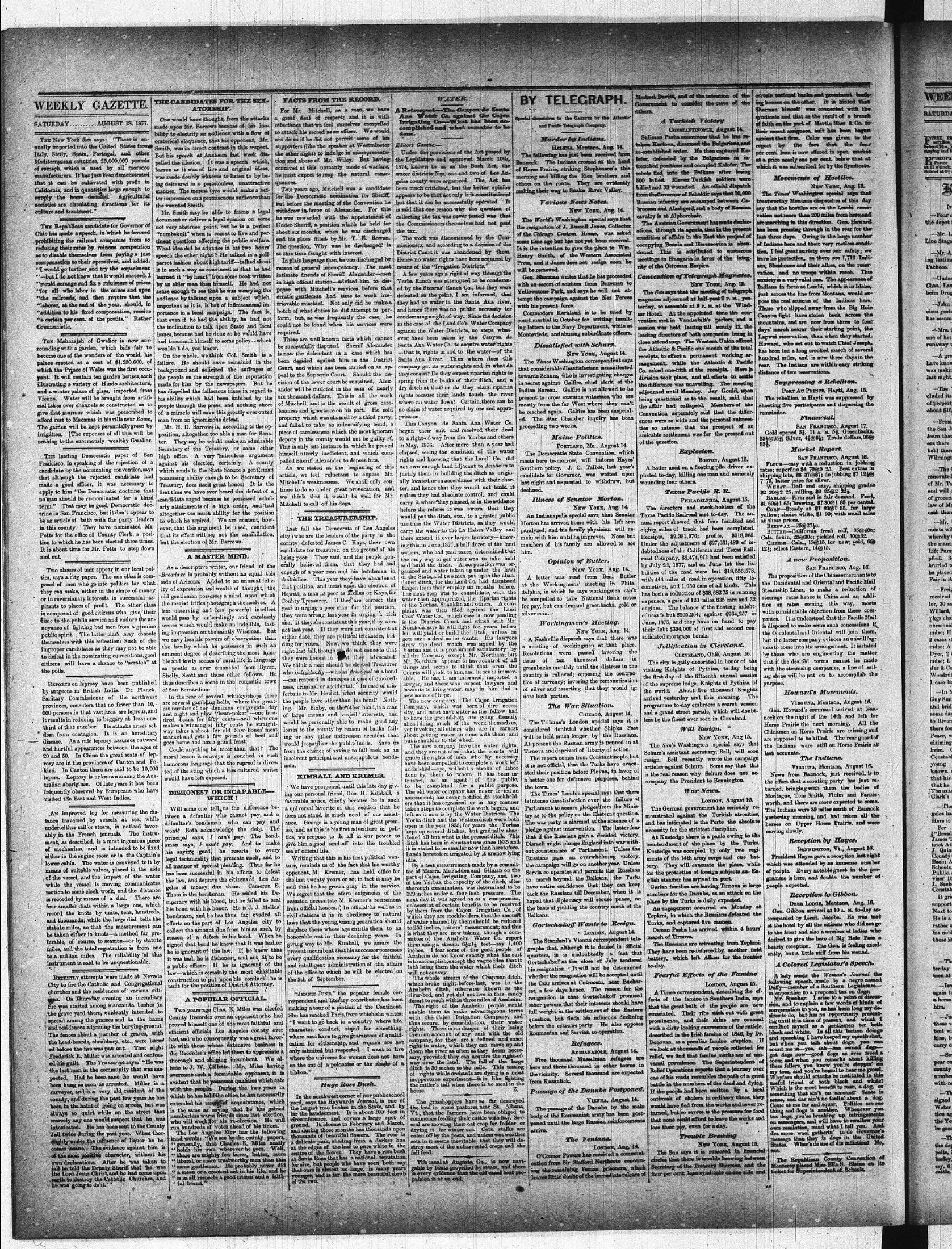
Searchable text
WEEKLY GAZETTE.
SATURDAY...AUGUST 18, 1877.
The New York Sun says: "There is annually imported into the United States from Italy, Sicily, Spain, Portugal, and other Mediterranean countries, 25,000,000 pounds of amach, which is used by all morocco manufacturers. It has just been demonstrated that it can be cultivated with profit in California, and in quantities large enough to supply the home demand. Agricultural societies are circulating directions for its culture and treatment."
The Republican candidate for Governor of Ohio has made a speech, in which he favored prohibiting the railroad companies from so reducing their rates by ruinous competition as to disable themselves from paying a just compensation to their operatives, and added: "I would go further and try the experiment"—but I do not know that it would succeed; I "would arrange and fix a minimum of prices" for all who labor in the mines and upon the railroads, and then require that the "laborer, at the end of the year, should, in addition to his fixed compensation, receive "a certain per cent. of the profits." Rather Communistic.
The Maharajah of Gwalior is now surrounding with a garden, which bids fair to become one of the wonders of the world, his palace erected at a cost of $1,250,000, of which the Prince of Wales was the first occupant. It will contain ten garden houses, each illustrating a variety of Hindo architecture, and a winter palace of glass, imported from Vienna. Water will be brought from artificial lakes over channels so constructed as to give that murmur which was prescribed to afford rest to Macenas in his villa near Rome, The garden will be kept perennially green by irrigation. (The expenses of all this will be nothing to the enormously wealthy Gwalior.
The leading Democratic paper of San Francisco, in speaking of the rejection of a THE CANDIDATES FOR THE SENATORSHIP.
One would have thought, from the attacks made upon Mr. Barrows because of his inability to electrify an audience with a flow of oratorical eloquence, that his opponent, Mr. Smith, was in direct contrast in this respect. But his speech at Anaheim last week dispelled the illusion. It was a speech which barren as it was of live and original ideas, was made doubly irksome to listen to by being delivered in a passionless, unattractive manner. The mere tyrion would make a better impression on a promiscuous audience than the vanished Smith.
Mr. Smith may be able to frame a legal document or deliver a legal opinion on some not very abstruse point, but he is a perfect "numbekull" when it comes to live and pertinent questions affecting the public welfare. What idea did he advance in his two hours' speech the other night? He talked in a poll-parrot fashion about high tariff—talked about it in such a way as convinced us that he had learned it "by heart" from some book written by an abler man than himself. He had not sense enough to see that he was wearying the audience by talking upon a subject which, important as it is, is but of infinitessimal importance in a local campaign. The fact is, that even if he had the ability, he had not the inclination to talk upon State and local issues, because had he done so he would have had to commit himself to some policy—which wouldn't do, you know.
On the whole, we think Col. Smith is a failure. He should have remained in the background and solicited the suffrages of the people on the strength of the reputation made for him by the newspapers. But he has dispelled the fallacious ideas in regard to his ability which had been imbibed by the people through the press, and nothing short of a miracle will save this greatly over-rated man from an ignominious defeat.
Mr. H. D. Barrows is, according to the opposition, altogether too able a man for Senator. They say he would make an admirable Secretary of the Treasury, or some other high office. A very ridiculous argument against his election, certainly. A county FACTS FROM THE REALITY.
For Mr. Mitchell, as a man a great deal of respect; and reluctance that we feel correlative to attack his record as an officer not do so if he did not permit supporters (like the speaker at the other night) to indulge in motion and abuse of Mr. Wiley. Connived at this unmanly mode he must expect to respp the new quenches.
Two years ago, Mitchell was for the Democratic nomination but before the meeting of the Council withdrew in favor of Alexander he was rewarded with the award Under-Sheriff, a position which about six months, when he was his place filled by Mr. T. The question: Why was he awarded at this time fraught with interruption? In plain language then, he was reason of general incompetence; intimate friends of Sheriff Allen in high official station—advised pense with Mitchell's services erratic gentleman had time to trivialize mischief. Not only did botch of what duties he did at form, but, as was frequently said could not be found when his required.
These are well known facts which have successfully disputed. She is now the defendant in a case been denied against him in Court, and which has been carried to the Supreme Court. Scission of the lower court be superseded will be muted in the six thousand dollars. This is of Mitchell, and is the result lessness and ignorance on his property which was claimed by and failed to take an indemnity piece of carelessness which they deputy in the county would not. This is only one instance in which himself utterly inefficient and pelled Sheriff Alexander to de-
which the Prince of Wales was the first occupant. It will contain ten garden houses, each illustrating a variety of Hindo architecture, and a winter palace of glass, imported from Vienna. Water will be brought from artificial lakes over channels so constructed as to give that murmur which was prescribed to afford rest to Macanas in his villinear Rome, The garden will be kept perennially green by irrigation. (The expenses of all this will be nothing to the enormously wealthy Gwalior.
The leading Democratic paper of San Francisco, in speaking of the rejection of a candidate by the nominating convention, says that although the rejected candidate had made a good officer, it was necessary to apply to him "the Democratic doctrine that no man should be re-nominated for a third term." That may be good Democratic doctrine in San Francisco, but it don't appear to be an article of faith with the party leaders in this county. They have nominated Mr. Potts for the office of County Clerk, a position to which he has been elected three times. It is about time for Mr. Potts to step down and out.
Two classes of men appear in our local politics, says a city paper. The one class is composed of men who go into politics for what they can make, either in the shape of money or in reversionary interests in successful aspirants to places of profit. The other class is composed of good citizens who give their time to the public service and endure the annoyance of fighting bad men from a genuine public spirit. The latter class may console themselves with this reflection: Such of the improper candidates as they may not be able to defeat in the nominating conventions, good citizens will have a chance to "scratch" at the polls.
Reports on leprosy have been published by surgeons in British India. Dr. Planck, Sanitary Commissioner of the northwest provinces, considers that no fewer than 10,000 persons in that vast area are leprous, and it results in reducing to beggary at least one-third of that number. Its attacks arises soldom from contagion. It is an hereditary disease. As a rule leprosy assumes outward and hurtful appearances between the ages of 20 and 50. In China the great seats of leprosy are in the provinces of Canton and Fokien. In Canton there are said to be 10,000 lepers. Leprosy is unknown among the Australian aborigines. Of late years it has been frequently observed by Europeans who have visited the East and West Indies.
An improved log for measuring the distance traversed by vessels at sea, while under.either sail or steam, is noticed favorably in the French journals. The instrument, as described, is a most ingenious piece of mechanism, and is intended to be fixed either in the engine room or in the Captain's lower cabin. The water is conveyed to it by means of suitable valves, placed in the side of the vessel, and the impact of the water background and solicited the suffrages of the people on the strength of the reputation made for him by the newspapers. But he has dispelled the fallacious ideas in regard to his ability which had been imbibed by the people through the press, and nothing short of a miracle will save this greatly over-rated man from an ignominous defeat.
Mr. H. D. Barrows is, according to the opposition, altogether too able a man for Senator. They say he would make an admirable Secretary of the Treasury, or some other high office. A very ridiculous argument against his election, certainly. A county which sends to the State Senate a gentleman possessing ability enough to be Secretary of Treasury, does itself great honor. It is the first time we have ever heard the defeat of a candidate urged because he possessed scholarly attainments of a high order, and had altogether too much ability for the position to which he aspired. We are content, however, that this argument be used, confident that its effect will be, not the annihilation, but the election of Mr. Barrows.
A MASTER MIND.
As a descriptive writer, our friend of the Broadaxe is probably without an equal this side of Arizona. Added to an unusual felicity of expression and wealth of thought, the old gentleman possesses a mind upon which the merest trifles photograph themselves. A less observing and less powerful intellect would pass by unheedingly and carelessly scenes which would make an indelible, lasting impression on the saintly Wiseman. But we envy less his powers of observation than the faculty which he possesses in such an eminent degree of describing the most humble and lowly scenes of rural life in language as poetic as ever emanated from Byron, Shelly, Scott and those other fellows. He thus describes a scene in the romantic town of San Bernardino:
In the rear of several whisky-shops there are several gambling hells; where the greatest number of her denizens congregate day and night and play "bean-poker"—one hundred beans for fifty cents—and when one makes a winning of fifty cents he straightway takes a shoot for old Saw-Bones' meat market and gets a few pounds of beef and goes home and has a grand feast.
Could anything be nicer than that? The moral lesson it conveys is couched in such humorous language that the reproof is divested of the sting which a less cultured writer would have left exposed.
DISHONEST OR INCAPABLE—WHICH?
Will some one tell us the difference between a defaulter who cannot pay, and a defaulter's bondsman who can pay and wont? Both acknowledge the debt. The principal says, I can't pay. The bondsman says, I won't pay. And to make his saying good, he resorts to every legal technicality that presents itself, and to all manner of special pleading. Thus far he has been successful in his efforts to defeat the law, and deprive the citizens of Los An-
Court, and which has been called peal to the Supreme Court. This cision of the lower court be sundander will be muleted in the six thousand dollars. This is of Mitchell, and is the result lessness and ignorance on his property which was claimed by and failed to take an indemnite piece of carelessness which they deputy in the county would not. This is only one instance in which himself utterly inefficient, and pelled Sheriff Alexander to detain.
As we stated at the beginning article, we feel reluctant to Mitchell's weakness. We tinue to do so under great pressure we think that it would be Mitchell to call off his dogs.
THE TREASURES
Last fall the Democrats city (who are the leaders of the county) defeated James C. Kendall candidate for treasurer, on this being poor. They said, and erally believed them, that enough of a poor man and his that office. This year they held that position, and insist upon Hewitt, a man as poor as New County Treasurer. If they were year in urging a poor man for they were wrong last year; one if they are consistent this not last year. If they were either date, they are political ding for votes. Now, we threw last fall though we do they were honest in that We think a man should be e individual—who as prince—can respond in damages in necessity, criminal or accidental fortune to Mr. Hewitt, what people have other than being Mr. Bixby, on the basis of large means and vestiges would be personally able to losses to the county by reason or any other unforeseen would jeopardize the public from the chance of having to insolvent principal and unsuccessful men.
KIMBALL AND E
We have postponed until ing our personal friend, George favorable notice, chiefly because a universal favorite in this does not stand in much needance. George is a young man ise, and as this is his first actics, we propose to do all give him a good send-off in sea of official life.
Writing that this is his future reminds us of the fact opponent, M. Kremer, hailing last twenty years or so...
An improved log for measuring the distance traversed by vessels at sea, while under either sail or steam, is noticed favorably in the French journals. The instrument, as described, is a most ingenious piece of mechanism, and is intended to be fixed either in the engine room or in the Captain's lower cabin. The water is conveyed to it by means of suitable valves, placed in the side of the vessel, and the impact of the water while the vessel is moving communicates motion to some clock-work, and the distance is recorded by means of a dial. There are four smaller dials within a large one, which record the knots by units, tens, hundreds, and thousands; while the large dial tells the statute miles, so that the measurement can be taken either in knots—a method far preferable, of course, to seamen—or by statute miles, and the total registration is from one to a million miles. The reliability of this instrument is said to be unquestionable.
Recently attempts were made at Nevada City to fire the Catholic and Congregational churches and the residences of various citizens. On Thursday evening an incendiary fire was started among manzanita bushes in the grave yard there, evidently intended to spread among the grasses and to the barns and residences adjoining the burying-ground. The fences about a number of graves, with the head-boards, shrubbery, etc., were burned before the fire was put out. That night Frederick R. Miller was arrested and confessed his guilt. The Transcript says: "He was the last man in the community that was suspected. Had he been sane he would have been hung as soon as arrested. Miller is a surveyor, and is a very old resident of the county, and during the past few years he has been in the habit of going on sprees, but was always so quiet while on the street that scarcely any one would suspect that he was intoxicated. He has been sent to the County Jail twice during the past year. When thoroughly under the influence of liquor he becomes insane. The evidence against him is of the most positive character, without his own declarations. After he was taken to jail he told the Deputy Sheriff that he was the Lord Jesus Christ, and he had come upon earth to destroy the Catholic Churches, and he was going to do it."
DISHONEST OR INCAPABLE WHICH?
Will some one tell us the difference between a defaulter who cannot pay, and a defaulter's bondsman who can pay and wont? Both acknowledge the debt. The principal says, I can't pay. The bondsman says, I won't pay. And to make his saying good, he resorts to every legal technicality that presents itself, and to all manner of special pleading. Thus far he has been successful in his efforts to defeat the law, and deprive the citizens of Los Angeles of money due them. Cameron E. Thom is the bondsman. He sealed his Democracy with his blood, but he failed to seal his bond with his honor. He is J. J. Mellus' bondsman, and he has thus far evaded all efforts on the part of Los Angeles city to collect the amount due from him as such, by reason of a defect in his bond. When he signed that bond he knew that it was bad, or he is ignorant of the law. If he knew that it was bad, he is dishonest, and not fit to be a public officer. If he is ignorant of the law—which is certainly the most charitable construction to put upon his conduct—he is unfit for the position of District Attorney.
A POPULAR OFFICIAL
Two years ago Chas. E. Miles was elected County Recorder over an opponent who had proved himself one of the most faithful and efficient officials Los Angeles county ever had, and who consequently was a great favorite with those whose extensive business in the Recorder's office led them to appreciate a thorough and obliging incumbent. We alude to J. W. Gillette. Mr. Miles having overcome such a formidable opponent, it is evident that he possesses qualities which take with the people. During the two years in which he has held the office, he has necessarily extended his range of acquaintance, which is the same as saying that he has gained numberless warm friends since last election, who will work for his re-election. He will run hundreds of votes ahead of his ticket.
The Los Angeles Star has the following kind words: "We see by the county papers," generally, that Charles R. Miles neatly holds his own wherever he goes. Well, there are mighty few fairer, better, more liberal, or more treatworthy men than this same gentleman. He probably never did a mean or a crooked act in his life, and he is in all respects a good citizen and a faithful friend."
FACTS FROM THE RECORD.
For Mr. Mitchell, as a man, we have great deal of respect; and it is with reluctance that we feel ourselves compelled to attack his record as an officer. We would not do so if he did not permit some of his supporters (like the speaker at Westminster) to indulge in misrepresentation and abuse of Mr. Wiley. But having annuived at this unmanly mode of warfare, we must expect to reap the natural consequences.
Two years ago, Mitchell was a candidate for the Democratic nomination for Sheriff, but before the meeting of the Convention he withdrew in favor of Alexander. For this he was rewarded with the appointment of Under-Sheriff, a position which he held for about six months, when he was discharged and his place filled by Mr. T. E. Rowan. The question, Why was he discharged? is at this time fraught with interest.
In plain language then, he was discharged by reason of general incompetency. The most intimate friends of Sheriff Alexander—men in high official station—advised him to dismeasure with Mitchell's services before that erratic gentleman had time to work irretrievable mischief. Not only did he make a mock of what duties he did attempt to perform, but, as was frequently the case, he could not be found when his services were required.
These are well known facts which cannot be successfully disputed. Sheriff Alexander is now the defendant in a case which has been decided against him in the District Court, and which has been carried on an appeal to the Supreme Court. Should the decision of the lower court be sustained, Alexander will be muteted in the sum of nearly six thousand dollars. This is all the work of Mitchell, and is the result of gross carelessness and ignorance on his part. He sold property which was claimed by a third party, and failed to take an indemnifying bond; a piece of carelessness which the most ignorant deputy in the county would not be guilty of. This is only one instance in which he proved himself utterly inefficient, and which compelled Sheriff Alexander to depose him.
WATER.
A Retrospect—The Canyon de Santa Ana Water Co. against the Gajen Irrigating Co.—What has been accomplished and what remains to be done.
Editors Gazette—
Under the provisions of the Act passed by the Legislature and approved March 10th, 1874, known to us as the Bush Act, the water districts No. one and two of Los Angeles county were organized. The Act has been much criticized, but the better opinion appears to be that not only is it constitutional but that it can be successfully operated. It is said that one reason why the question of collecting the tax was never tested was that the Commissioners themselves had not paid the tax.
The work was discontinued by the Commissioners, and according to a decision of the District Court it was abandoned by them. Hence no water rights have been acquired by means of the "Irrigation Districts."
A few years ago a right of way through the Yorba Ranch was attempted to be condemned by the Stearns' Ranch Co., but they were defeated on the point, I am informed, that they had no water in the Santa Ana river, and hence there was no public necessity for condemning a right-of-way. Since the decision in the case of the Land Co.'s Water Company against the Water Districts, no steps whatever have been taken by the Canyon de Santa Ana Water Co. to acquire water rights—that is, rights in and to the water—of the Santa Ana River. Then where does this company get its water rights and in what do they consist? Do they expect riparian rights to spring from the banks of their ditch, and a dry ditch at that? or do they claim riparian rights because their lands touch the river where no water flows? Certain, there can be no claim of water acquired by use and appropriation.
This Canyon de Santa Ana Water Co. begun their suit and received their deed to a right-of-way from the Yorbas and others in May, 1876. After more than a year had elapsed, seeing the condition of the water rights and knowing that the Land Co. did not reach enough land adjacent to Anahiem to
BY TELEGRAPH.
Special dispatch to the Gazette by the Atlantic and Pacific Telegraph Company.
Murder by Indiana.
HELENA, Montana, Aug. 14.
The following has just been received from Bannock: The Indians crossed at the hand of Horse Prairie, striking Stephenson's this morning and killing the Rice brothers and others on the route. They are evidently making their way to Snake River Valley.
Various News Notes.
NEW YORK, Aug. 14.
The World's Washington special says that the resignation of J. Russell Jones, Collector of the Chicago Custom House, was asked some time ago but has not yet been received. It is the intention to give the place to Win Henry Smith, of the Western Associated Press, and if Jones does not resign soon he will be removed.
Gen. Sherman writes that he has proceeded with an escort of soldiers from Bozeman to Yellowstone Park, and says he will not attempt the campaign against the Nax Peres with his present force.
Commodore Kerkland is to be tried by court martial in October for writing insulting letters to the Navy Department, while at Montaviedo, and abusing subordinate officers.
Dissatisfied with Schurz.
NEW YORK, August 14.
The Times Washington correspondent says that considerable dissatisfaction is manifested towards Schurz, who is investigating charges in secret against Galfire, chief clerk of the Indian Bureau. Galfire is not allowed to be present to cross examine witnesses, who are mostly from far West where they can't be reached again. Galfire has been suspended. The Star Chamber inquiry has been proceeding two weeks.
Maine Politics.
PORTLAND, Me., August 14.
The Democratic State Convention, which meets here to-morrow, will indorse Hayes' magnates adjourn day after soror Hotel. Avention met in session was hated directive close attendance the Atlantic dree receipts; to eff raignment, Co. asked one division took the difference adjourned un being questioned the affair has Convention ences were so interspeciable settling of the question
THE TREASURERSHIP.
Last fall the Democrata of Los Angeles city (who are the leaders of the party in the county) defeated James C. Kays, their own candidate for treasurer, on the ground of his being poor. They said, and the people generally believed them, that they had had enough of a poor man and his bondsmen in that office. This year they have abandoned that position, and insist upon the election of Hewitt, a man as poor as Bellus or Kays, for County Treasurer. If they are correct this year in urging a poor man for the position, they were wrong last year in urging a rich one. If they are consistent this year, they were not last year. If they were not consistent at either date, they are political tricksters, bidding for votes. Now, we think they were right last fall, though we do not concede that they were honest in what they advocated.
We think a man should be elected Treasurer who individually—who as principal on a bond—can respond in damages in case of crookedness, criminal or accidental. In case of misfortune to Mr. Hewitt, what security would the people have other than his bond? Nothing. Mr. Bixby, on the other hand, is a man of large means and vested interests, and would be personally able to make good any losses to the county by reason of banks failing or any other unforeseen accident that would jeopardize the public funds. Save us from the chance of having to fall back on an insolvent principal and unscrupulous bondsmen.
KIMBALL AND KREMER.
We have postponed until this late day giving our personal friend, Geo. H. Kimball, a favorable notice, chiefly because he is such a universal favorite in this section that he does not stand in much need of our assistance. George is a young man of great promise, and as this is his first adventure in politics, we propose to do all in our power to give him a good send-off into the troubled sea of official life.
Writing that this is his first political venture, reminds us of the fact that his worthy opponent, M. Kremer, has held office for the last twenty years or so; in fact it may be
By a test measurement made by a committee of Messrs. McFadden and Gilman on the part of Cajon Irrigation Company, and two of the Yorbas the capacity of the ditch after company gets its water rights they consist? Do they expect riparian rights to spring from the banks of their ditch, and a dry ditch at that? or do they claim riparian rights because their lands touch the river where no water flows? Certain there can be no claim of water acquired by use and appropriation.
This Canyon de Santa Ana Water Co. begin their suit and received their deed to a right-of-way from the Yorbas and others in May, 1876. After more than a year had elapsed, seeing the condition of the water rights and knowing that the Land Co. did not own enough land adjacent to Anaheim to justify them in building the ditch as originally located, or in accordance with their charter, and hence that they would not build it unless they had absolute control, and could carry it where they pleased, as in the evidence before the referee it was sworn that they would put the ditch, etc., to a greater public use than the Water Districts, as they would carry the water to the La Habra Valley and there extend it over larger territory—knowing this, in June, 1877, a half dozen of the land owners, who had paid taxes, determined that the only way to get water was to take hold and build the ditch. A corporation was organized and water taken up under the laws of the State, and two men put upon the abandoned ditch, for the Land Co. had dismissed Hagen from their employ six months before. The next step was to consolidate, with the water then appropriated, the riparian rights of the Yorbas, Shanklin and others. A complaint was then filed against the Land Co.'s Water Co., which case is now pending in the District Court and which suit Mr. Northam says he will fight for years before he will yield or build the ditch, unless he gets such a deed as he wants. His lawyers drew the deed which was signed by the Yorbas and it is pronounced satisfactory by all the Company except Mr. Northam; but Mr. Northam appears to have control of all things and seems to think that even the Courts will yield to him, and hence is immovable. He has I am informed, imported a lawyer; and those who expect lawyers and lawsuits to bring water, may in him find a new source of hope.
The new company, The Cajon Irrigation Company, which was born of dire necessity, and must have water as the fellow had to have the ground-hog, are going steadily ahead doing much of the work themselves, yet invoking all others who are in earnest about getting water, to come with them and put a shoulder to the wheel.
The new company have the water rights, and they are not afraid that the courts will ignore the rights of men who by necessity have been compelled to complete a work left unfinished—aye, without a stroke of labor done by them to whom it has been intrusted, as an agent of the public, to be completed for a public purpose.
The old water company has never levied an assessment; has never notified its stockholders that it has organized or in any manner taken steps to complete the work begun, and left as it now is by the Water Districts. The Yorba ditch and the Watson ditch were both open in the year 1835; for years the Yorbas kept up several ditches, but gradually abandoned all but what is present ditch. This ditch has been in constant use since 1835 and it is stated to be smaller now than heretofore. Lands heretoof irrigated by it arenow lying idle.
Servia co-operates and permits the Russians to march beyond the Balkans, the Turks
Maine Politics.
Portland, Me., August 14.
The Democratic State Convention, which meets here to-morrow, will indorse Hayes' Southern policy. J. C. Talbot, last year's candidate for Governor, was waited upon last night and requested to withdraw, but declined.
Illness of Senator Morton.
New York, Aug. 14.
An Indianapolis special says that Senator Morton has arrived home with his left arm paralyzed, and his family physician will remain with him until he improves. None but members of his family are allowed to see him.
Opinion of Butler.
New York, Aug. 14.
A letter was read from Ben. Butler at the Workingmens' meeting in Philadelphia, in which he says workingmen can't be compelled to take National Bank notes for pay, but can demand greenbacks, gold or silver coin.
Workingmen's Meeting.
New York, Aug. 14.
A Nashville dispatch says that there was a meeting of workingmen at that place. Resolutions were passed favoring the issue of ten thousand dollars in greenbacks monthly until the distress in the country is relieved; opposing the contraction of currency; favoring the remonetization of silver and asserting that they would ignore both parties.
The War Situation.
Chicago, August 14.
The Tribune's London special says it is considered doubtful whether Shipka Pass will be held much longer by the Russians. At present the Russian army is penned in at Tirnova and deprived of liberty of action.
The report comes from Constantinople, but it is not official, that the Turks have evacuated their position before Plevna, in favor of a better one for defensive purposes, behind the town.
The Times' London special says that there is intense dissatisfaction over the failure of Parliament to secure pledges from the Ministry as to the policy on the Eastern question. The war party is alarmed at the absence of a pledge against intervention. The latter fear that if the Russians gain a decided victory, Disraeli might plunge England into war without countenance of Parliament. Unless the Russians gain an overwhelming victory, the campaign will go on another year. Servia co-operates and permits the Russians to march beyond the Balkans, the Turks
The Gerrish monstrated and has interspersed necessity for At Kustebombardm Kustedge mentions of tertiary. That for the proper glish steamer
We have postponed until this late day giving our personal friend, Geo. H. Kimball, a favorable notice, chiefly because he is such a universal favorite in this section that he does not stand in much need of our assistance. George is a young man of great promise, and as this is his first adventure in politics, we propose to do all in our power to give him a good send-off into the troubled sea of official life.
Writing that this is his first political venture, reminds us of the fact that his worthy opponent, M. Kremer, has held office for the last twenty years or so; in fact it may be said that he has grown gray in the service. We regret that the stern exigencies of the occasion necessitate M. Kremer's retirement from official honors. In official as well as in civil stations it is in obedience to natural laws that the young, rising generation should displace those whose age entitle them to an honorable rest in their declining years. In giving way to Mr. Kimball, we assure the present incumbent that his successor possesses every qualification necessary for the faithful and intelligent administration of the affairs of the office to which he will be elected on the 5th of September.
"JENNIE JUNE," the popular female correspondent and literary contributor, has been making a tour of a portion of the Continent. She has reached Paris, from which she writes: "I want to go back to a country where life, character, conduct, stand for something, where men have to give guarantees of qualification for citizenship, and women are not only admired but respected. I want to live where the universe for women does not turn on the cut of a polonaise or the shade of a ribbon."
Huge Rose Bush.
In the northwest corner of our public school yard, says the Haywards Journal, is one of the largest rose bushes in the State, and by far the handsomest. It is about 100 feet in circumference, and covers a large spot of ground. It blooms in February and March, and during those months has thousands upon thousands of beautiful flowers. The rose is a delicate pink, shading from a darker hue at the edges of the leaf to pure white in the centre of the flower. They have a rose bush at Santa Rosa that has a national reputation for size, but people who have seen both say that ours is almost as large, is many years younger, and is far the more beautiful shrub of the two.
The grasshoppers have so far destroyed the feed in some pastures near St. Albans, Vt., that the farmers have been obliged to commence feeding their cattle with hay. Several are mowing their oat crop for fodder or drying it for winter use. Corn stalks are eaten off by the pests, and unless wet weather sets in it seems inevitable that they will destroy most of the unharvested crops and the fall feed.
The canal at Augusta, Ga., is now navigable by boats propelled by steam, and there is every evidence that the old canal boat propulsion is at an end.
The Times' London special says that there is intense dissatisfaction over the failure of Parliament to secure pledges from the Ministry as to the policy on the Eastern question. The war party is alarmed at the absence of a pledge against intervention. The latter fear that if the Russians gain a decided victory, Disraeli might plunge England into war without countenance of Parliament. Unless the Russians gain an overwhelming victory, the campaign will go on another year. Unless Servia co-operates and permits the Russians to march beyond the Balkans, the Turks have entire confidence that they can keep back the Russians till December, when it is hoped that diplomacy will secure peace, on the basis of yielding the country north of the Balkana.
Gortschakoff Wants to Resign.
London, August 14.
The Standard's Vienna correspondent telegraphs that, although it is denied in official quarters, it is undoubtedly a fact that Gortschakoff at the close of July tendered his resignation. It will not be determined whether the resignation will be accepted until the Czar arrives at Cotroceni, near Bucharest, a few days hence. The reason for the resignation is that Gortschakoff promised other powers that their interests should have full weight in the settlement of the Eastern question, but finds his influence declining before the extreme party. He also opposes Roumanian and Servian co-operation.
Refugees.
Adrianapole, August 14.
Five thousand Muscalman refugees are here and three thousand in other towns in the vicinity. Several thousand are expected from Kazanlick.
Passage of the Danube Postponed.
Vienna, August 14.
The passage of the Danube by the main body of the Roumanian army has been postponed until the large Russian reinforcements arrive.
The Fenians.
London, Aug. 14.
O'Connor Powers has received a communication from Sir Stafford Northcote concerning the remaining Fenian prisoners, which leaves little doubt of the immediate release of
Michael Davitt, and of the infestion of the Government to consider the case of the others.
A Turkish Victory
CONSTANTINOPOLIS, August 14.
Saliman Pasha announces that he has retaken Karlova, disarmed the Bulgarians, and re-established order. He then captured Kalefer, defended by the Bulgarians in entrenched positions and occupied Kalofer. The rebels fled into the Balkans after losing 500 killed. Eleven Turkish soldiers were killed and 33 wounded. An official dispatch from the Governor of Feheldir says that 10,000 Russian infantry are encamped between Cahroonan and Alambgerd, and a body of Russian cavalry is at Alphorchair.
The Austrian Government has made declarations, through its agents, that in the present condition of affairs in the East the project of occupying Bosnia and Herzegovina is abandoned. This is attributed to numerous meetings in Hungaria in favor of the integrity of the Ottoman Empire.
Convention of Telegraph Magnates.
NEW YORK, Aug. 15.
The Sun says that the meeting of telegraph magnates adjourned at half-past 2 p.m., yesterday, to assemble at 8 p.m. at the Windor Hotel. At the appointed time the convention met in Vanderbilt's parlors, and a session was held lasting till nearly 12, the loading directors of both companies being in close attendance. The Western Union offered the Atlantic & Pacific one month of the total receipts, to effect a permanent working arrangement, while the Atlantic & Pacific Co. asked one-fifth of the receipts. Here is division took place, and all efforts to settle the difference was unavailing. The meeting adjourned until Monday. Jay Gould, upon being questioned as to the result, said that the affair had collapsed. Members of the Convention separately said that the differences were so wide and the personal animosities so intense that the prospect of an amicable settlement was for the present out of the question.
Explosion.
BOSTON, August 15.
certain national banks and prominent banking houses on the other. It is hinted that Sherman himself was connected with the syndicate and that as the result of a breach of faith on the part of Martin Bliss & Co. to their recent assigns, suit has been begun against that firm. Color was given to the report by the fact that the four per cent. loan is now offered in open market at a price nearly one per cent. below that at which it was subscribed for by the Syndicate.
Movements of Hostiles.
NEW YORK, Aug. 15.
The Times' Washington special says that trustworthy Montana dispatches of this day say that the hostiles are on the Lembi reservation not more than 200 miles from here, and are marching in this direction. Gen. Howard has been pressing through in the rear for the last three days. Owing to the large number of Indians here and their very restless condition, I feel great anxiety over our safety; we have no protection, as there are 1,712 Indians, Shoebones and their allies, on the reservation, and no troops within reach. This anxiety is a very valid one. The appearance of Indians in force at Lembi, which is in Idaho, just across the line from Montana, would expose the real animus of the Indians here. Those who slipped away from the Big Hole Canyon fight have stolen back across the mountains, and are now from three to four days' march nearer their starting point, the Lapwai reservation, than when they started. Howard, who set out to watch Chief Joseph, has been led a long crooked march of several hundred miles, and is now three days in the rear. The Indians are within easy striking distance of two reservations.
Suppressing a Rebellion.
PORT AU PRINCE, Hayti, Aug. 16.
The rebellion in Hayti was suppressed by shooting five participants and dispersing the remainder.
Financial.
SAN FRANCISCO, August 17.
Gold opened 5½ l. 11 A.M. 5¾ Greenbacks, 95½@95½; Silver, 4½@6½; Trade dollars, 95½.
Market Report.
SAN FRANCISCO, August 16.
FLOUR—easy with a reduction in jobbing
Co. asked one-fifth of the receipts. Here is division took place, and all efforts to settle the difference was unavailing. The meeting adjourned until Monday. Jay Gould, upon being questioned as to the result, said that the affair had collapsed. Members of the Convention separately said that the differences were so wide and the personal animosities so intense that the prospect of an amicable settlement was for the present out of the question.
Explosion.
Boston, August 15.
A boiler used on a floating pile driver exploded to-day, killing one man and seriously wounding four others.
Texas Pacific R.R.
Philadelphia, August 15.
The directors and stock-holders of the Texas Pacific Railroad met to-day. The annual report showed that four hundred and eighty miles of track had been completed. Receipts, $2,381,976; profits, $318,985. Under the adjustment of $27,031,489 of indebtedness of the California and Texas Railroad Company, $8,474,911 had been satisfied by July 2d, 1877, and on June last the liabilities of the road were but $18,556,578, with 444 miles of road in operation, fifty locomotives, and 1,050 cars of all kinds. This has been a reduction of $38,682.75 in running expenses, a gain of 120 miles, 635 cars and 32 engines. The balance of the floating indebtedness is but $205,264; against $934,257 in June, 1875, and they have on hand to pay their debt $394,000 of first and second consolidated mortgage bonds.
Jollification in Cleveland.
Cleveland, Ohio, August 16.
The city is gaily decorated in honor of the visiting Knights of Pythias, to-day being the first day of the fifteenth annual session of the supreme lodge, Knights of Pythias, of the world. About five thousand Knights arrived yesterday and this morning. The programme to-day embraces a secret session and a grand street parade, which will doubtless be the finest ever seen in Cleveland.
Will Resign.
New York, Aug 15.
The Sun's Washington special says that Schurz's assistant secretary, Bell, will soon resign. Bell recently wrote the campaign articles against Schurz. Some say that this is the real reason why Schurz does not accompany the President to Bennington.
War News.
London, August 15.
The German government has seriously remonstrated against the Turkish atrocities, and has intimated to the Porte the absolute necessity for the strictest discipline.
At Kustedge there is a panic owing to the bombardment of the place by the Turks. Kustedge was occupied by only two regiments of the 14th army corps and one battery. They will evacuate the place, while for the protection of foreign subjects an English steamer has arrived in port.
Suppressing a Rebellion.
Port Au Prince, Hayti, Aug. 15.
The rebellion in Hayti was suppressed by shooting five participants and dispersing the ramsinder.
Financial.
San Francisco, August 17.
Gold opened $5½; 11 A.M. M. $5½; Greenbacka, 95½@95½; Silver, 4½@9½; Trade dollars, 95½@95½.
Market Report.
San Francisco, August 16.
FLOUR—easy with a reduction in jobbing rates; superfine $4 75@5 25. Best extras in shipping lots, $6 37@7; do jobbing $7 12½@7 75; latter price for silver.
WHAT—Dull and easy, shipping grades $2 20@2 25; milling, $2 25@2 32¹².
BARLEY—Firm and in fair demand. Feed, $1 60@1 65; brewing, $1 80@1 85 per cental.
CORN—Steady at $1 80@1 85; for large yellow; choice white, $1 90; with small sales at these prices.
BERWAX—25@27¹⁰o.
BUTTER—California fresh roll, 35@40o; Cala. firkin, 28@30o; pickled roll, 30@32o.
CHINESE—Cala., 13@15, for new; gold, 6@12½; select Eastern, 14@15.
A New Proposition.
San Francisco, Aug. 16.
The proposition of the Chinese merchants to the Occidental and Oriental and Pacific Mail Steamship Lines, to make a reduction of steerage rates hence to China and an addition on rates coming this way, meets with considerable objection from these companies. It is understood that the Pacific Mail is disposed to make some such concessions if the Occidental and Oriental will join them, but the latter company evinces an unwillingness to come into the arrangement. It is stated by those who are engineering the matter that if the desired terms cannot be made with the steamship companies, a line of sailing ships will be put on to accomplish the purpose.
Howard's Movements.
Virginia, Montana, August 16.
Gen. Howard's command arrived at Bannock on the night of the 14th and left for Horse Prairie the next morning. All the Chinamen on Horse Prairie are missing and are supposed to be killed. The rear guard of the Indians were still on Horse Prairie at last accounts.
The Indians.
Virginia, Montana, August 16.
News from Bannock, just received, is to effect that a scouting party has just returned, bringing with them the bodies of Montague, Tom Smith, Fluim and Farnesworth, and there are more expected to come. The Indians were 35 miles south of Bannock yesterday morning, and had taken all the horses on Upper Horse Prairie, and were moving slowly.
Reception by Hayes.
Bennington, Vt., August 16.
President Hayes gave a reception last night which was attended by an immense number of people. Every notable guest in the programme is here, and doubles the number of
War News.
London, August 15.
The German government has seriously remonstrated against the Turkish atrocities, and has intimated to the Ports the absolute necessity for the strictest discipline.
At Kustedge there is a panic owing to the bombardment of the place by the Turks. Kustedge was occupied by only two regiments of the 14th army corps and one battery. They will evacuate the place, while for the protection of foreign subjects an English steamer has arrived in port.
Garian families are leaving Tirnova in large numbers for the Dannube, as an attack on the place by the Turks is daily expected.
An engagement occurred on Monday at Topkmi, in which the Russians defeated the Turks, and captured five cannons.
Osman Pasha has arrived within 4 hours' march of Tirnova.
The Russians are retreating from Topkmi. They have been re-inforced by another field battery, which left Alken for the frontier to-day.
Fearful Effects of the Famine
London, August 15.
A Times correspondent, describing the effects of the famine in Southern India, says that the great bulk of the people are now emaciated. Their ribs stick out with great prominence, and their skins are covered with a dirty looking excrease of the cuticle, described in the Irish famine of 1846, by Dr. Donovan, as a peculiar famine eruption. If we look at thousands of people collected for relief, we find that famine marks are of universal prevalence. The Superintendent of Relief Operations reports that a journey over one of his roads resembles the path of a great battle in the numbers of the dead and dying. If the people had been smitten by a local outbreak of cholera in ordinary times, they would have fled from the works and never returned, but so severe is the pressure for food that none could afford to leave the works and lose their pay, even for a day.
Trouble Brewing
New York, August 15.
The Sun says it is rumored in financial circles that there is trouble brewing between Secretary of the Treasury Sherman and the four per cent loan syndicate on one side and turned, bringing with them the bodies of Montague, Tom Smith, Fluim and Farnesworth, and there are more expected to come. The Indians were 35 miles south of Bannock yesterday morning, and had taken all the horses on Upper Horse Prairie, and were moving slowly.
Reception by Hayes.
Bennington, Vt., August 16.
President Hayes gave a reception last night which was attended by an immense number of people. Every notable guest in the programme is here, and double the number of people expected.
Reception to Gibbon.
Deker Lodok, Montana, Aug. 16.
Gen. Gibbon arrived at 10 A.M. to-day accompanied by Lieut. Jacoba. He was met at the hotel by all the citizens who did not go to the front and also a number of ladies who desired to give the hero of Big Hole Pass a hearty reception. The Gen. is feeling excellently, but a little stiff from his wound.
A Colored Legislator's Speech.
A lady sends the Woman's Journal the following speech, made by a negro named Daffy—member of a Southern Legalature—in opposition to a proposed tax on dogs:
Mr. Speaker: I arise to a point of discussion, and to explain a few words of kindness to you, as has been long my desires to do, but has no opportunity present until this time of present, and which I conduct myself as a gentlemen ter both black and white. In all this section doings and speeching I have kepted my mouth shut, but when you talk about dogs, you can count me in—yes, sah—has owned dogs—got dogs now—good dogs as ever breed a coon; and when you remarks about killing them fellers, you know you're stepping on my toes, and you're bound to hear me growl. Whyfore should attacks be instituted in this useful friend of both black and white? Which is the most benefit to man, a dog, or something that isn't no account? Sense is sense, and dar ain't no foolin' about a dog. Come at me far and squar. Politics are one thing and dogs is another. Whenever you tax dogs, you're breaking up infringements on seameners, and will have to swallow your own resolution, mind what I tell you. And des more wool gatherin' in de Governor's message than they is dogs in the United States. What's de use of dis infliction? No, ear.
The Republican County Convention of Monterey placed Miss Ella S. Blaine on its ticket for Superintendent of Schools.