anaheim-gazette 1877-08-11
Scanned page
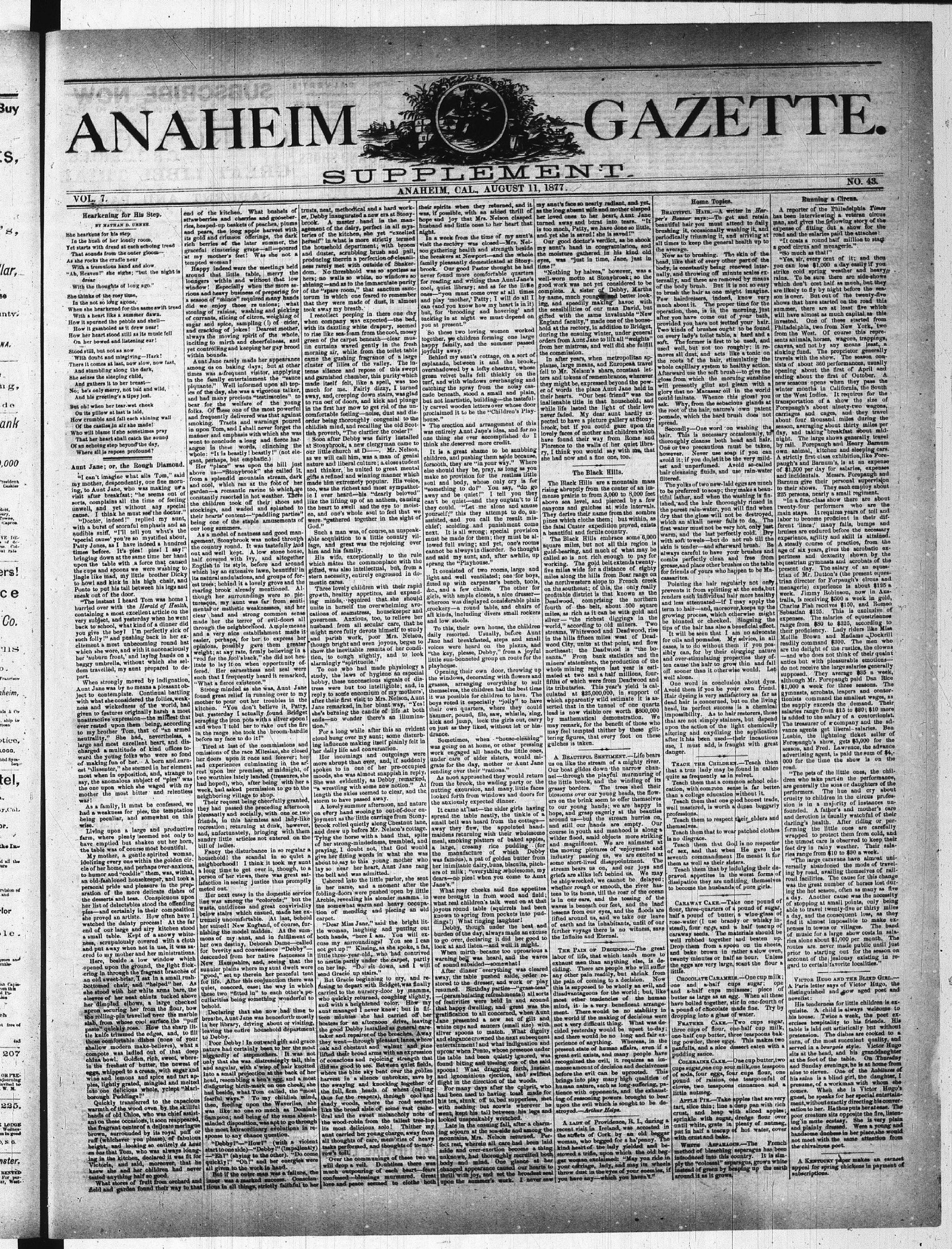
Searchable text
Hearkening for His Step.
BY NATHAN D. URNER
She hearkens for his step.
In the husb of her lonely room,
Yet starts with dread at each echoing tread
That sounds from the outer gloom—
As she rocks the cradle near
With a tremulous hand and slow
"Ah, Heaven!" she sighs; "but the night is drear
With the thoughts of long ago."
She thinks of the rosy time,
In the not so long agone;
When she hearkened for the same swift tread
With a heart like a summer dawn.
How it spurned the pebble and shell—
How it gamboled as it drew near!
How her heart stood still as its music fell
On her bowed and listening ear!
Stood still, but not as now
With doubt and misgiving—Hark!
There it comes at last, now slow, now fast,
And stumbling along the dark,
She seizes the sleeping child,
And gathers it to her breast—
No; he's only merry, not bad and wild,
And his greeting's a tipay jest.
But oh! when her tear-wet cheek
On its pillow at last is laid,
How crumble and fall each shining wall
Of the castles in air she made!
Who will blame if she sometimes pray
That her heart shall catch the sound
Of an echoing step beyond the day,
Where all is repose profound?
end of the kitchen. What bushels of strawberries and cherries and gooseberries, heaped-up baskets of peaches, plums and pears, the long apple harvest with its gold and crimson offerings, the dark rich berries of the later summer, the graceful clustering grape—all—poured at my mother's feet! Was she not a tempted woman?
Happy indeed were the meetings held around that little table, merry the loungers within and without that low window! Especially when the more serious and heavy business of preparing for a season of "mince" required many hands did we enjoy those reunions; what stoning of raisins, washing and picking of currants, slicing of citron, weighing of sugar and spice, sampling (!) of cider, and cracking of jokes! Dearest mother, always the moving spirit of the whole, inciting to mirth and cheerfulness, and yet controlling and keeping her gay brood within bounds.
Aunt Jane rarely made her appearance among us on baking days; but at other times was a frequent visitor, supplying in the family entertainment the "sauce piquante." Well informed upon all topics of the day, she was a vigorous talker, and had many precious "testimonies" to bear for the welfare of the young folks. Of these one of the most powerful and frequently delivered was that against smoking. Tracts and warnings poured in upon Tom, and I shall never forget the manner and emphasis with which she was wont to conclude a long and fierce harangue in these words, clinching the whole: "It is beastly! beastly!" (not elegant, perhaps, but emphatic.)
trusts, neat, methodier, Debby invagurat brook. A master agreement of the daily series of the kitchen herself" in what is the household depot and duster, scrubbing therein in ness rarely met with dom. No threshhoors; no walls so shining—and as to of the "spare room," torium in which on that they were made took away my breath.
I recollect peepers when company wore with its dazzling wight to rise like sea-floor green of the carpet lin curtains wavemorning air, while came the gushing cluster of lilies of tense silence and garnished charm made itself felt, much for me. Away, and creeping to run out of doors in the first hay mo comfortable feeling order being thorough childish mind, and tish proverb, "The soon after Debby at Stonybrook, a our little church as we will call him nature and liberal."
And stumbling along the dark,
She seizes the sleeping child,
And gathers it to her breast—
No; he's only merry, not bad and wild,
And his greeting's a tipsy jest.
But oh! when her tear-wet cheek
On its pillow at last is laid,
How crumble and fall each shining wall
Of the castles in air she made!
Who will blame if she sometimes pray
That her heart shall catch the sound
Of an scholing step beyond the day,
Where all is repose profound?
Aunt Jane; or, the Rough Diamond.
"I can't imagine what ails Tom," said my mother, despondently, one fine morning, to Aunt Jane, who was making us a visit after breakfast; "he seems out of sorts, complains all the time of feeling unwell, and yet without any special cause. I think he must see the doctor."
"Doctor, indeed!" replied my sister, with a burst of scornful emphasis and an audible sniff. "I'll tell you what's the 'special cause' you're so mystified about, Patty Jones, as I have indeed a hundred times before. It's pies! pies! I say!" bringing down at the same time her hand upon the table with a force that caused the cups and spoons we were washing to jingle like mad, my little brother Dicky to howl and kick in his high chair, and Ponto to put his tail between his legs and sneak out of the door.
"The instant I heard Tom was home I hurried over with the Herald of Health, containing a most excellent article on the very subject, and yesterday when he went back to school, what kind of a dinner did you give the boy? I'm perfectly sick of such folly!" and pushing back in her excitement a most unbecoming round hat which she wore, and with it unconsciously her 'auburn front,' and laying hands on a baggy umbrella, without which she seldom travelled, my aunt prepared to depart.
When strongly moved by indignation, Aunt Jane was by no means a pleasant object to contemplate. Continual battling with what she considered the follies, weakness and wickedness of the world, had given to features originally harsh a most unattractive expression—the mildest that ever rested upon them being, according to my brother Tom, that of "an armed neutrality." She had, nevertheless, a large and most excellent heart, and discharged a multitude of kind offices toward the young folks who were so fond of making fun of her. A born and earnest "dissenter," she seemed in her element most when in opposition, and, strange to say, the anomalous subject of "pies" was the one upon which she waged with my mother the most bitter and relentless war!
As a family, it must be confessed, we had a weakness for pies, the temptation being peculiar, and somewhat on this wise.
Living upon a large and productive farm, where plenty seemed not only to have emptied but shaken out her horn, the table was of course most bountiful.
My mother, a gentle-spirited woman, idolizing every one within the golden circle of her home, and perhaps over-anxious to humor and "coddle" them, was withal, an old-fashioned housekeeper, and took a among us on baking days. Our times was a frequent visitor, supplying in the family entertainment the "sauce piquante." Well informed upon all topics of the day, she was a vigorous talker, and had many precious "testimonies" to bear for the welfare of the young folks. Of these one of the most powerful and frequently delivered was that against smoking. Tracts and warnings poured in upon Tom, and I shall never forget the manner and emphasis with which she was wont to conclude a long and fierce harangue in these words, clinching the whole: "It is beastly! beastly!" (not elegant, perhaps, but emphatic.)
Her "place" was upon the hill just above us—"Stonybrook" she called it, from a splendid mountain stream, dark and cool, which ran at the foot of her garden—a romantic ravine to which we constantly resorted in hot weather. There the children took off their shoes and stockings, and waded and splashed to their hearts' content—"paddling parties" being one of the staple amusements of our long summers.
As a model of neatness and good management, Stonybrook was noted through the country round. It was tastefully laid out and well kept. A low stone house, half covered with ivy, and altogether English in its style, before and around which lay an extensive lawn, beautiful in its natural undulations, and groups of forest trees; behind it a lovely grove and the roaring brook already mentioned. Although her surroundings were so picturesque, my aunt was far from sentimental or mathetic weaknesses, and her clear head and strong common sense made her the terror of evil-doers all through the neighborhood. Ample means and a very nice establishment made it easier, perhaps, for her to express her opinions, possibly gave them greater weight; at say rate, firmly believing in a "rod for the fool's back," she did not hesitate to lay it on when opportunity offered. Her earnestness and zeal were such that I frequently heard it remarked, "What a fierce existence."
Strong minded as she was, Aunt Jane found great relief in running over to my mother to pour out her troubles in the kitchen. "You don't believe it, Patty, but yesterday I actually found Bridge scraping the iron pots with a silver spoon! and when I told her to rake out the fire in the range she took the broom-handle before my face to do it!"
Tired at last of the commissions and omissions of the race Millesian, she closed her doors upon it once and forever; her sad experiences culminating in the arrest upon her premises, at midnight, of two worthies lately landed (treasuries) she had hoped), who, after being with her a week, had asked permission to go to the neighboring village to shop.
Their request being cheerfully granted, they had passed the preceding afternoon pleasantly and socially, with one or two friends, in this harmless and lady-like recreation; returning at dusk, however, and unfortunately, bringing with them sundry little articles not entered on the bill of ladies.
Fancy the disturbance in so regular a household! The scandal in so quiet a neighborhood! I think it took my aunt a long time to get over it, though, to a person of her views; there was great satisfaction in seeing justice thus promptly
Soon after Debt at Stonybrook, a new little church as we will call him nature and liberals and thinker; he gifts a refined and made him extremely too; was the richest ic I ever heard—like the lifting up the heart to swell en, and one's whore were "gathered to God."
Such a man was able acquisition lage, and great him and his family.
His wife, excels which mates them gifted; was also in stern necessity; eats meistic cares.
Three lovely chin growth, healthy ing minds; reguite unite in herself cations of seams governess. Anxious husband from a might more fully and parish woill though bright an show the inevitable tion; to cough alarmingly "spirit"
To one who study, the laws hobbily these uneasy tress were but reply to some en after their first v Jane remarked; she's burning th ends—no wound tion."
For a long while cloud hung over influence ming her daily life an
Her incoming more abrupt th spoken to in o moods; she was She was evident "a wrestling wit length the skies storm to have p
A lovely sum on every hand joyment as the brook rolled quand drew up be Tying the horse of her strong-nurpy praying; I doubt give her fitting about to say to lay so near h be the bell and w Uhersed into
As a family, it must be confessed, we had a weakness for pies, the temptation being peculiar, and somewhat on this wise.
Living upon a large and productive farm, where plenty seemed not only to have emptied but shaken out her horn, the table was of course most bountiful.
My mother, a gentle spirited woman, idolizing every one within the golden circle of her home, and perhaps over-auxious, to humor and "coddle" them, was, withal, an old-fashioned housekeeper, and took a personal pride and pleasure in the preparation of the more delicate dishes of the desserts and teas. Conspicuous upon her list of delectables stood the offending pies—and certainly in their composition she proved an artiste. How often have I watched the dainty process! At the far end of our large and airy kitchen stood a small table. Kept of a snowy whiteness, scrupulously covered with a cloth and put away when not in use, it was sacred to my mother and her ministrations.
Here, beside a low window which opened upon the ground, the light fllickering in through the fragrant branches of an old sweet-briar, I sat in a small rush-bottomed chair, and "helped" her. As she stood with her white arms bare, the sleeves of her neat chintz tucked above her dimpled elbows, a large checked apron securing her from the flour, how the rolling-pin travelled over the marble slab, from whose cool surface the "puff pasta" quickly rose. How the sharp little knife trimmed the edges, and, to fill those comfortable diheses (none of your shallow modern make-believes), what a compote was ladled out of that deep china bowl. Golden, rich, sweet, wherein in the freshest of butter, the newest of eggs, whipped to a cream, with sugar and wine and lemons and spice and tart apples, lightly grated, mingled and melted into one delicious whole, yclept "Marlborough Puddings!"
Quickly transferred to the capacious warmth of the wood oven by the skillful hands of old Chloe, who was chief assistant on these occasions, it soon reappeared, the fragrant center of a delicate meringue brown, surrounded by its royal puff or ruff (whichever you please), of fabulous height, and looking so entirely dehaut as bas that Tom, who was always lounging in the kitchen, declared it was fit for Victoria, and said, moreover, that he knew she and her children had never tasted anything half so good.
What stores of fruit from archard and field and garden found their way to that
Their request being cheerfully granted, they had passed the preceding afternoon pleasantly and socially, with one or two friends, in this harmless and lady-like recreation; returning at dusk, however, and unfortunately, bringing with them sundry little articles not entered on the bill of ladies.
Fancy the disturbance in so regular a household! The scandal in so quiet a neighborhood! I think it took my aunt a long time to get over it, though, to a person of her views, there was great satisfaction in seeing justice thus promptly meted out.
Her next essay in the domestic service line was among the "coloreds;" but the waste, untidiness and great conviviality below stairs which ensued, made her extremely uncomfortable. At last, behold her suited! New England, of course, furnishing the model maiden. At the summons of my aunt, and in fulfilment of her own destiny, Deborah Dame—called for brevity and convenience "Debby"—descended from her native fastnesses in New Hampshire, and, seeing that the sunnier plains where my aunt dwelt were "good," set up therein her peaceful tent for life. After this conjunction there was quiet, concord, ease; the way in which these two "fitted in" to each other's peculiarities being something wonderful to behold.
Declaring that she now had time to breathe, Aunt Jane was henceforth mostly in her library, driving about or visiting, leaving the entire household department to Debby.
Poor Debby! In outward gift and grace nature had certainly been to her the most niggardly of stepmothers. It was not only that she was distressingly tall, thin and angular, with a wisp of hair knotted into a small projection at the back of her head, resembling a hen's egg, and a most disfiguring birth-mark on one cheek, she had beside what Tom called, the "most fearful ways." To my childish mind, then, feeding upon the Waverlies, she was like no one so much as Dominle Sampson; and being of the same absent-minded disposition, was apt to go through the most extraordinary evolutions in response to any chance question.
"Debby!"—"How!" (with a violent start to one side)—"Debby!" (impatiently)—"Eh!" (shying to the other). "Do come quickly!" "Oh!" and her energies were all given to the work in hand.
But if the outer man was a failure, the inner was a marked success. Consciences in all things: strictly faithful to her
A lovely sum on every hand joyment as the brook rolled quiet and drew up be Tying the horse of her strong-n praying, I doubt give her fitting about to say to lay so near by the bell and wipe Ushered into in her name,
folding-doors Archie, revealing the somewhat tion of men carpet.
"Dear Miss teile woman both hands," cuse my surre not get up!" little three-year to nestle partion on her lap. "Send Gracie un But Gracie fusing to depare carried to the who quickily rite hostess for am the good Debt taker and rep they went—the oak and chest lifted their body of conscious did me good where the blight harvest in at the swaying full firm thus for the shady wood like the brook dral and tha wood-rott its most daunt carried all thoughts tasks perform row's toll.
Over the e will drop a much output confessed—love and pe
CLIM GATE
SUPPLEMENT.
ANAHEIM, CAL., AUGUST 11, 1877.
trusts, neat, methodical and a hard worker, Debby inaugurated a new era at Stonybrook. A master hand in the management of the dairy, perfect in all mysteries of the kitchen, she yet "excelled herself" in what is more strictly termed the household department; with broom and duster, scrubbing brush and pail, producing therein a perfection of cleanliness rarely met with outside of Shakerbrook. No threshold was so spotless as hers; no walls so white, no windows so shining—and as to the immaculate purity of the "spare room," that sanctum sanctorum in which one feared to remember that they were made of dust, it almost took away my breath.
I recollect peeping in there one day when company was expected—the bed, with its dazzling white drapery, seemed to rise like sea-foam from the cool, mossy green of the carpet beneath—clear muslin curtains waved gently in the fresh morning air, while from the toilet table came the gushing fragrance of a large cluster of lilies of the valley. The intense silence and repose of this swept and garnished chamber, this purity which made itself felt, like a spell, was too much for me. Fairly dizzy, I turned away, and creeping down stairs, was glad to run out of doors, and kick and plunge in the first hay mow to get rid of the uncomfortable feeling—noise, dust and disorder being thoroughly congenial to the childish mind, and recalling the old Scottish proverb, "The clartier the cosister."
Soon after Debby was fairly installed at Stonybrook, a new clergyman came to our little church at D——. Mr. Nelson, as we will call him, was a man of genial nature and liberal culture; a close student their spirits when they returned, and it was, if possible, with an added thrill of hope and joy that Mrs. Nelson clasped husband and little ones to her heart that night.
In a week from the time of my aunt's visit the rectory was closed—Mrs. Nelson gathering health and strength beside the breakers at Newport—and the whole family pleasantly domesticated at Stonybrook. Our good Pastor thought he had never found more comfortable quarters for reading and writing than Aunt Jane's cool, quiet library; and as for the little ones—"you must come over at all times and play 'mother,' Patty; I will do all I can (and you know how my heart is in it) but, for 'brooding and hovering' and tucking in at night we must depend on you at present."
So these two loving women worked together, we children forming one large happy family, and the summer passed joyfully away.
Behind my aunt's cottage, on a sort of esplanade, between it and the brook, overshadowed by a lofty chestnut, whose green velvet balls fell thickly on the turf, and with windows overhanging and catching the spray from the noisy cascade beneath, stood a small and plain, but not in artistic building—the tastefully carved wooden letters over whose door proclaimed it to be the "Children's Playhouse."
The erection and arrangement of this was entirely Aunt Jane's idea, and for no one thing she ever accomplished do I think she deserved more credit.
It is a great shame to be snubbing children, and pushing them aside because, forsooth, they are "in your way." Where my aunt's face so nearly radiant, and yet, as the long absent wife and mother elapsed her loved ones to her heart, Aunt Jane turned away and burst into tears. "It is too much, Patty, we have done so little, and yet she is saved! she is saved!"
Our good doctor's verdict, as be shook my aunt's hand in congratulation, and the moisture gathered in his kind old eyes, was "just in time, Jane, just in time!"
"Nothing by halves," however, was a well-worn motto at Stonybrook; so the good work was not yet considered to be complete. A sister of Debby, Martha by name, much younger and better looking, and speedily making havoc with the sensibilities of our man David, but gifted with the same invaluable "New England faculty," made one of the household at the rectory, in addition to Bridget, during the ensuing winter, under general orders from Aunt Jane to lift all "weights" from her mistress, and well did she fulfill the commission.
In after years, when metropolitan applause, large means, and European travel fell to Mr. Nelson's share, constant letters and tokens of remembrance, wherever they might be, expressed beyond the power of words the place Aunt Jane held in their hearts. "Our best friend" was the inalienable title in that household; and while life lasted the light of their love never faded. My dear aunt hardly expected to have a picture gallery at Stonybrook, but if you could gaze upon the lovely faces of mother and children which have found their way from Rome and Florence to the walls of her quiet library, I think you would say with me that she had now and a fine one, too.
Applying "sauce and garnished chamber," this purity which made itself felt, like a spell, was too much for me. Fairly dizzy, I turned away, and creeping down stairs, was glad to run out of doors, and kick and plunge in the first hay mow to get rid of the uncomfortable feeling—noise, dust and disorder being thoroughly congenial to the childish mind, and recalling the old Scottish proverb, "The clartier the cosier!"
Soon after Debby was fairly installed at Stonybrook, a new clergyman came to our little church at D——. Mr. Nelson, as we will call him, was a man of genial nature and liberal culture; a close student and thinker, he united to great mental gifts a refined and winning manner which made him extremely popular. His voice, too, was the richest and most sympathetic I ever heard—his "dearly beloved" like the lifting up of an anthem, causing the heart to swell, and the eye to moisten, and one's whole soul to feel that we were "gathered together in the sight of God."
Such a man was, of course, an unspeakable acquisition to a little country village, and great was the rejoicing over him and his family.
His wife, exceptionally to the rule which makes the commonplace with the gifted, was also intellectual, but from a stern necessity, entirely engrossed in domestic cares.
Three lovely children with their rapid growth, healthy appetites, and expanding minds, required that she should unite in herself the overwhelming avocations of seamstress, housekeeper and governess. Anxious, too, to relieve her husband from all secular care, that he might more fully devote himself to study and parish work, poor Mrs. Nelson, though bright and even joyous, began to show the inevitable results of her condition, to cough slightly, and to look alarmingly "spiritueile."
To one who had made physiology a study, the laws of hygiene an especial hobby, these unconscious signals of distress were but too intelligible; and, in reply to some encomium of my mothers, after their first visit to Mrs. Nelson, Aunt Jane remarked, in her blunt way, "Yes! she's burning the candle of life at both ends—no wonder there's an illumination."
For a long while after this an evident cloud hung over my aunt; some disturbing influence making itself plainly felt in her daily life and conversation.
Her incomings and outgoings were more abrupt than ever, and if suddenly spoken to in one of her pre-occupied moods, she was almost snappish in reply. She was evidently, as Debby remarked, "a wrestling with some new notion." At length the skies seemed to clear, and the storm to have passed away.
A lovely summer afternoon, and nature on every hand wooing to out-of-door enjoyment as the little carriage from Stonybrook rolled quietly along Chestnut lane, and drew up before Mr. Nelson's cottage. Tying the horse with a hand that, spite of her strong-mindedness, trembled, and praying, I doubt not, that God would give her fitting words in what she was about to say to this young mother who lay so near her heart, Aunt Jane rang the bell and was admitted.
Ushered into the little parlor, she sent tense silence and repose of this swept and garnished chamber, this purity which made itself felt, like a spell, was too much for me. Fairly dizzy, I turned away, and creeping down stairs, was glad to run out of doors, and kick and plunge in the first hay mow to get rid of the uncomfortable feeling—noise, dust and disorder being thoroughly congenial to the childish mind, and recalling the old Scotish proverb, "The clartier the cosier!"
Soon after Debby was fairly installed at Stonybrook, a new clergyman came to our little church at D——. Mr. Nelson, as we will call him, was a man of genial nature and liberal culture; a close student and thinker, he united to great mental gifts a refined and winning manner which made him extremely popular. His voice, too, was the richest and most sympathetic I ever heard—his "dearly beloved" like the lifting up of an anthem, causing the heart to swell, and the eye to moisten, and one's whole soul to feel that we were "gathered together in the sight of God."
Such a man was, of course, an unspeakable acquisition to a little country village, and great was the rejoicing over him and his family.
His wife, exceptionally to the rule which makes the commonplace with the gifted, was also intellectual, but from a stern necessity, entirely engrossed in domestic cares.
Three lovely children with their rapid growth, healthy appetites, and expanding minds, required that she should unite in herself the overwhelming avocations of seamstress, housekeeper and governess. Anxious, too, to relieve her husband from all secular care that he might more fully devote himself to study and parish work, poor Mrs. Nelson, though bright and even joyous, began to show the inevitable results of her condition, to cough slightly, and to look alarmingly "spiritueile."
To one who had made physiology a study, the laws of hygiene an especial hobby, these unconscious signals of distress were but too intelligible; and in reply to some encomium of my mothers, after their first visit to Mrs. Nelson, Aunt Jane remarked, in her blunt way, "Yes! she's burning the candle of life at both ends—no wonder there's an illumination."
For a long while after this an evident cloud hung over my aunt; some disturbing influence making itself plainly felt in her daily life and conversation.
Her incomings and outgoings were more abrupt than ever, and if suddenly spoken to in one of her pre-occupied moods,她 was almost snappish in reply. She was evidently,as Debby remarked,“a wrestling with some new notion.” At length the skies seemed to clear,and the storm to have passed away.
A lovely summer afternoon,and nature on every hand wooing to out-of-door enjoyment as the little carriage from Stonybrook rolled quietly along Chestnut lane,and drew up before Mr. Nelson's cottage。Tying the horse with a hand that,spite of her strong-mindedness,trembled,and praying,I doubt not,that God would give her fitting words in what she was about to say to this young mother who lay so near her heart,Aunt Jane rang the bell和was admitted。
Usshered into the little parlor,she sent overshadowed by a lofty chestnut,whose green velvet balls fell thickly on the turf,and with windows overhanging and catching the spray from the noisy cascade beneath,stood a small and plain,但 not inartistic,building—the tastefully carved wooden letters over whose door proclaimed it to be the "Children's Playhouse."
The erection and arrangement of this was entirely Aunt Jane's idea,and for no one thing she ever accomplished do I think she deserved more credit.
It is a great shame to be snubbing children,and pushing them aside because,forsooth,they are "in your way." Where else should they be,pray,as long as you make no provision for the restless little soul and body,whose only cry is for "something to do!" You say,“do go away and be quiet!” I tell you they can't be quiet—and they oughtn't to if they could。“Let me alone and amuse yourself;" this they attempt to do,unassisted,和 you call the result mischief;scolding和 punishment come next. It is all wrong;special provision must be made for them;they must be allowed full swing;and yet,一one's rooms cannot be always in disorder. So thought said my aunt,and,after awhile,up sprang the "Playhouse."
It consisted of two rooms,大型和 well ventilated;one for boys, fitted up with carpenter's bench,tools,&c., and a few chairs.The other for girls,with ample closets,a nice dresser—whereon was displayed considerable plain crockery—a round table,and chairs of all kinds,包括 divers small rockers和 low stools.
To this,their own house,the children daily resorted。Usually,before Aunt Jane had breakfasted,steps and small voices were heard on the piazza,and“The key,please,Debby,”from a joyful little sun-bonneted group en route for the playhouse.
Opening their own door,throwing up the windows,decorating with flowers和 grasses,arranging everything to suit themselves,the children had best time it was possible for children to have.The boys voted it especially "jolly"to have their own quarters,where they could hammer,pound,flew whistle,sing,kick and jump,lock the girls out,车 carry just as they liked without let or hindrance.
Sometimes,当“house-cleaning”was going on at home,或 other pressing work engaged all hands,小儿 ones under care of elder sisters would migrate for the day,mother or Aunt Jane sending over their "rations."
As nooon approached they would return from the brook,the wading party or the nutting excursion,和 many.little faces looked forth from windows and doors for the anxiously expected dinner.
It came at last—the elder girls having spread the table neatly,the tinkle of a small bell was heard from the cottage—away they flew,the appointed handmaidens returning with their wholesome meal,smoking platters of baked apples,a large,creamy rice pudding(for the manufacture of which Debby was famous),a pat of golden butter from her inimitable dairy,buns,biscuits,pitchers of milk;“everything wholesome,我 dears—no pies!when you come to Aunt
The Black Hills.
The Black Hills are a mountain mass rising abruptly from the center of an immense prairie to from 3000 to 8000 feet above sea level,and pierced by a few canyons and guilches at wide intervals. They derive their name from the sombre pines which clothe them;但 within,作为 fatal ister expired proved exists a beautiful and fertile country.
The Black Hills embrace some 5000 square miles wide for a distance of eighty miles along the northwestern slope to French creek on the southeast;of this,the only really profitable district is that known as the Deadwood,comprising the northern fourth of the belt,约500 square miles,as rich as it can be with gold and silver—“the richeat diggings in the world,” according to old miners.Two streams Whitewood and Deadwood,rise in the hills fifteen miles west of Deadwood City.unite at that point,and flow northeast;the Deadwood is “the bonanza.”From bank statistics和the miners' statements,the production of the whole mining region last year is estimated at two and a half millions,四 fifths of which were from Deadwood and its tributaries.This year's yield is calculated at $25000000,在 support of which apparently wild estimate it is asserted that in the tunnel of one quartz lead is now visible ore worth $800000 by mathematical demonstration.We may remark,对于 benefit of those who may feel tempted thither by these glittering figures,该 every foot on these gulches is taken.
A BEAUTIFUL SENTIMENT.-Life bears us on like the stream of a mighty river. Our boat glides down-the narrow channel—through the playful murmuring of the little brook,and the winding of its grassy borders.The trees shed their blossoms over our young heads,the flowers on the brink seem to offer themselves to our young hands;we are happy in hope,and grasp eagerly at the beauties around us—but the stream hurries on,and still our hands are empty.Our course in youth and manhood is along a wilder flood,and objects more striking and magnificent.We are animated at moving pictures of 'enjoyment and industry passing us,'we are excited at some short-lived disappointment.The stream bears us on,and our joys and griefs are alike left behind us.We may be shipwrecked,我们 cannot delay;
A lovely summer afternoon, and nature on every hand wooing to out-of-door enjoyment as the little carriage from Stonybrook rolled quietly along Chestnut lane, and drew up before Mr. Nelson's cottage. Tying the horse with a hand that, spite of her strong-mindedness, trembled, and praying, I doubt not, that God would give her fitting words in what she was about to say to this young mother who lay so near her heart, Aunt Jane rang the bell and was admitted.
Ushered into the little parlor, she sent in her name, and a moment after the folding-doors were pushed open by little Archie, revealing his slender mamma in the somewhat warm and heavy occupation of mending and piecing an old carpet.
"Dear Miss Jane," said the bright little woman, laughing and putting out both hands, "here I am. You will excuse my surroundings! You see I can not get up!" Kissing, as she spoke, a fat, little three-year-old, who had contrived to nestle partly under the carpet, partly on her lap. "Do sit down, and I will send Gracie up stairs."
But Gracie beginning to cry, and refusing to depart with Bridget, was finally carried to the nursery-door by mamma, who quickly returned, coughing slightly, and with a heightened color. How my aunt managed I never knew; but in fifteen minutes she had carried off her hostess for an afternoon drive, leaving the good Debby installed as general care-taker and repairer of the breaches. Away they went—through pleasant lanes, where oak and chestnut and walnut and pine lifted their broad arms with an expression of conscious and rejoicing strength that did me good to see. Between quiet fields, where the blue sky bent over the golden harvest in a silence unbroken, save by the swaying and knocking together of the full, firm heads of wheat (calling thus for the reapers), through cool and shady woods, where the road seemed like the broad aisle of some vast cathedral and the sweet melancholy note of the wood-robin from the tallest tree-top its most delicious solo! Thither my aunt carried her young charge, away from all thoughts of care, memories of heavy tasks performed, and thoughts of to-morrow's toll.
Over the communings of these two we will drop a veil. Doubless there was much outpouring of each heart—fears confessed—blessings murmured. Great love and peace seemed to clothes both from the brook, the wapling party nutturing excursion, and many little faces looked forth from windows and doors for the anxiously expected dinner.
It came at last—the elder girls having spread the table neatly, the tinkle of a small bell was heard from the cottage—away they flew, the appointed handmaidens returning with their wholesome meal, smoking platters of baked apples, a large, creamy rice pudding (for the manufacture of which Debby was famous), a pat of golden butter from her inimitable dairy,buns,biscuits,pitchers of milk; "everythingwholesome,my dears—no pies! when you come to Aunt Jane's."
What rosy cheeks and fine appetites were brought in from wood and field; what real children's talk went on at that joyous round table (squirrels had been known to spring from pockets into puddings!) What ringing laughter!
Debby, though under the heat and burden of the day, always made an excuse to go over, declaring it did her good to look at and listen—and well it might.
When mirth became too uproarious a warning bell was heard, and the waves of sound subsided—somewhat!
After dinner everything was cleared away; the table pushed aside, order restored to the dresser, and work or play resumed. Birthday parties—"grass-teas" (perambulating refreshments!) all sorts of festivities were held in and around that happy dwelling, and great was the gratification to all concerned, when Aunt Jane presented a new set of gilt and white cups and saucers (small size) with silver spoons to match. What dignity and elegance crowned the next subsequent entertainment! and what indignation and uproar when Ponto, whose presence under the table had been quietly ignored, was found biting and tossing one of the said spoons! What dragging forth, instant and ignominious ejection, and swiftest flight in the direction of the woods.
For many days after the culprit, who had been used to having toast made for his tea, slunk off to bed supperless, met with nothing but scowls wherever he went, kept his tail between his legs and looked unspeakably wretched.
Late in the ensuing fall, after a charming sojourn at the sea-side and among the mountains,Mrs. Nelson returned. Perfect rest, wherein all care had been laid aside and over-exertion become a thing unknown, had thoroughly recruited both body and mind. One glance at her changed appearance caused our hearts to thrill with joy,and set the broadest seal upon the summer's work. I never saw grassy borders. The trees shed their blossoms over our young heads,the flowers on the brink seem to offer themselves to our young hands; we are happy in hope,and grasp eagerly at the beauties around us—but the stream hurries on,and still our hands are empty. Our course in youth and manhood is along a wilder flood, amid objects more striking and magnificent. We are animated at the moving pictures of enjoyment and industry passing us; we are excited at some short-lived disappointment. The stream bears us on,and our joys and griefs are alike left behind us. We may be shipwrecked,we cannot be delayed; whether rough or smooth,the river hastens to its home,till the roar of the ocean is in our ears,and the tossing of the waves is beneath our feet,and the land lessens from our eyes,and the floods are lifted around us,and we take our leave of earth and its inhabitants,until of our further voyage there is no witness,save the Infinite and Eternal.
THE PAIN OF DECIDING.-The great labor of life,that which tends more to exhaust men than anything else,是 deciding. There are people who will suffer any other pain readily,但 shrink from the pain of coming to a decision.Now this is supposed to be wholly an evil,and disadvantageous for the world;but,如 most other tendencies of the human mind,它 is a very beneficent arrangement. There would be no stability in the world if the making of decisions were not a very difficult thing. What was decided yesterday would be upset to-day;and there would be no long and fair experience of anything. Whereas,在the present state of human affairs,even if a great evil exists,and many people have recognized the evil,它 requires an immense amount of decision and decisiveness before the evil can be unrooted. This brings into play many high qualities of human nature,such as long-suffering,patience with opponents,and the exhausting of reasoning powers brought to bear upon the evil which is sought to be destroyed.-Arthur Helga.
A LADY OF PROVIDENCE,R.L.,during a recent visit in Ireland,was accosted in the streets of Cork by an old beggar woman,谁 begged for a ha'penny.The kind heart of the lady yielded and bestowed a trifle Upon which the old beggar woman exclaimed: "May you ride in your carriage,Lady,and may its wheels throw dust in the eyes of your enemies,f if you have any—which you haven't."
GAZETTE.
NO. 43.
Home Topics.
BEAUTIFUL HAIR.—A writer in Harper's Bazaar says:—To get and retain beautiful hair you must attend to daily brushing it, occasionally washing it, and periodically trimming it, and striving at all times to keep the general health up to the average.
Now as to brushing. The skin of the head, like that of every other part of the body, is constantly being renewed internally, and throwing off minute scales externally, and these are removed by means of the body brush. But it is not so easy to brush the hair as one might imagine. Few hairdressers, indeed, know very much about it. The proper time for the operation, then, is in the morning, just after you have come out of your bath, provided you have not wetted your hair. Two kinds of brushes ought to be found on every lady's toilet table, a hard and a soft. The former is first to be used, and used well, but not too roughly; it removes all dust, and acts like a tonic on the roots of the hair, stimulating the whole capillary system to healthy action. Afterward use the soft brush—to give the gloss from which the morning sunshine will presently glint and gleam with a glory that no Macassar oil in the world could imitate. Whence this gloss? you ask. Why, from the sebacious glands at the root of the hair, nature's own patent pomade, which the hard brush does not spread.
Secondly—One word on washing the hair. This is necessary occasionally, to thoroughly cleanse both head and hair. One or two precautions must be taken, however. Never use soap if you can avoid it; if you do, let it be the very mildest and unnourished. Avoid so-called
Running a Circus.
A reporter of the Philadelphia Times has been interviewing a veteran circus man, and gives the following story of the expense of fitting out a show for the road and the salaries paid the attaches:
"It costs a round half million to stag-a good circus and menagerie."
"So much as that!"
"Yes, sir, every cent of it; and then you can lose $1,000 a day easily if you strike cold spring weather and heavy rains. To be sure there are side-shows which don't cost half as much, but they are likely to fly by night before the season is over. But out of the twenty-five shows that have started on the road this summer, there are at least five which will have almost as much capital as this invested. One of these started from Philadelphia, two from New York, two from the West. Of course this represents animals, horses, wagons, trappings, canvas, and not by any means least, a sinking fund. The proprietor generally travels with the show. The season consists of about 300 performances, usually opening about the first of April and ending about the first of October. A new seasons opens when they pass the winter months in California, the South or the West Indies. It requires for the transportation of a show the size of Forepaugh's about ninety-two wagons, carriages and cages, and they travel about four thousand miles during the season, averaging about thirty miles per day, and taking breakfast about midnight. The large shows generally travel by rail. Forepaugh and Henry Barnum own animal, kitchen and sleeping cars. A strictly first-class exhibition, like Forepaugh's and Barnum's, is at an expense
are a mountain mass
in the center of an immune 3,000 to 8,000 feet
at wide intervals.
come from the sombre
them; but within, as
pedition proved, exists
a country.
embrace some 5,000
not all this region is
much of what may be
enough to pay for
belt extends twentydistance of eighty
is from Bear range on
ope to French creek
of this, the only really
as that known as the
rising the northern
treat, about 500 square
can be with gold and
diggings in the
to old miners. Two
and Deadwood, rise
miles west of Deadout that point, and flow
Deadwood is "the boank statistics and the
production of the
action last year is estilated a half millions, fourfrom Deadwood and
this year's yield is cal100,000, in support of
wild estimate it is as
tunnel of one quartz
ore worth $800,000
for demonstration. We
the benefit of those who
thither by these glitevery foot on these
Sentiment.—Life bears
ham of a mighty river.
Down the narrow chanplayful murmuring of
and the winding of its
The trees shed their
young heads, the flowseem to offer themselves
ands; we are happy in
eagerly at the beauties
the stream hurries on,
ands are empty. Our
and manhood is along a
and objects more striking.
We are animated at
curves of enjoyment and
ing us, we are excited at
disappointment. The
on, and our joys and
soft behind us. We may
we cannot be delayed;
Taught the Children.—Teach them that a true lady may be found in calico quite as frequently as in velvet.
Teach them that a common school education, with common sense is far better than a college education without it.
Teach them that one good honest trade, well mastered, is worth a dozen beggarly professions.
Teach them to respect their elders and themselves.
Teach them that to wear patched clothes is no disgrace.
Teach them that God is no respecter of sex, and that when He gave the seventh commandment He meant it for them as well as their sisters.
Teach them that by indulging their deprived appetites in the worst forms of dissination they are unfitting themselves.
Afterward use the soft brush—to give the gloss from which the morning sunshine will presently glint and gleam with a glory that no Macassar oil in the world could imitate. Whence this gloss? you ask. Why, from the sebacious glands at the root of the hair, nature's own patent pomade, which the hard brush does not spread.
Secondly—One word on washing the hair. This is necessary occasionally, to thoroughly clean both head and hair. One or two precautions must be taken, however. Never use soap if you can avoid it; if you do, let it be very mildest and unpuffured. Avoid so-called hair cleansing fluids, and use rain-water filtered.
The yolks of two new-laid eggs are much to be preferred to soap; they make a beautiful lather, and when the washing is finished; and the hair thoroughly rinsed in the purest rain-water, you will find when dry that the gloss will not be destroyed, which an alkali never fails to do. The first water must not be very hot, only just warm, and the last perfectly cold. Dry with soft towels—but do not rub till the skin is tender—and afterward brush. Be always careful to have your brushes and combs perfectly clean and free from grease, and place other brushes on the table for friends of yours who happen to be Macassarites.
Pointing the hair regularly not only prevents it from splitting at the ends, but renders each individual hair more healthy and less attenuated—if I may apply the term to hair—and moreover keeps up the growing process, which otherwise might be blunted or checked. Singing the tips of the hair has also a beneficial effect.
It will be seen that I am no advocate for oils and pomades. My advice, in all cases, is to do without them if you possibly can, for by their clogging nature and over-stimulating properties they often cause the hair to grow thin and fall off sooner than it otherwise would. Let well alone.
One word in conclusion about dyes. Avoid them if you be your own friend. Hair dyeing is very satisfactory as far as dead hair is concerned, but on the living head, its perfect success is a chemical impossibility. As to hair restorers, those that are not simply stainers, but depend upon the action of the light chemically altering and oxydizing the application after it has been used—their incautious use, I must add, is fraught with great danger.
Trach The Children.—Teach them that a true lady may be found in calico quite as frequently as in velvet.
Teach them that a common school education, with common sense is far better than a college education without it.
Teach them that one good honest trade, well mastered, is worth a dozen beggarly professions.
Teach them to respect their elders and themselves.
Teach them that to wear patched clothes is no disgrace.
Teach them that God is no respecter of sex, and that when He gave the seventh commandment He meant it for them as well as their sisters.
Teach them that by indulging their deprived appetites in the worst forms of dissipation they are unfitting themselves.
Opening about the first of April and ending about the first of October. A new seasons opens when they pass the winter months in California, the South or the West Indies. It requires for the transportation of a show the size of Forepaugh's about ninety-two wagons, carriages and cages, and they travel about four thousand miles during the season, averaging about thirty miles per day, and taking breakfast about midnight. The large shows generally travel by rail. Forepaugh and Henry Barnum own animal, kitchen and sleeping cars. A strictly first-class exhibition, like Forepaugh's and Barnum's, is at an expense of $1,500 per day for salaries, expenses and incidentals. Messrs. Forepaugh and Barnum give their personal supervision to their shows. They each employ about 225 persons, nearly a small regiment.
"In a first-class show there are about twenty-four performers who are the main stays. It requires years of toll and labor to become proficient in their different 'lines,' many falls, bumps and bruises are endured before the necessary experience, agility and skill is attained. A steady course of practice, from the age of six years, gives the acrobatic expertness and dexterity shown by the equestrian gymnasts and acrobats of the present day. The salary of an equestrian of Mr. Dutton's (the present equestrian director for Forpaugh's circus and menagerie) experience is about $125 a week. Jimmy Robinson, now in Australia, is receiving $500 a week in gold, Charles Fish receives $150, and Romeo Sebastian $125. This is exclusively of expenses. The salaries of equestriennes range from $80 to $325, according to their proficiency. Lady riders like Miss Mollie Brown and Madame Dockrill readily command $300. The men who are the delight of the rustics, the clowns—and who does not think of their quaint antics but with pleasurable emotions—do not receive the large salaries generally supposed. They average $35 a week, although Mr. Forepaugh paid Dan Rice $1,000 a week for three seasons. The gymnasts, acrobats, leapers and contortionists command the smallest wages, as the supply exceeds the demand. Their salaries range from $15 to $80; $10 more is added to the salary of a contortionist. The treasurer of a company and the advance agents get liberal-salaries. Ben Lusbie, the lightning ticket seller of Forpaugh's show, gets $5,000 for the season, and Fred. Lawrence, the advance advertising agent, is paid the sum of $4,-000 for the time she show is on the road.
"The pets of the little ones, the children who take part in the performance, are generally the sons or daughters of the performers. The hue and cry about cruelty to children in the circus profession is in a majority of instances unfounded. A father's and mother's care and devotion is usually watchful of their darling's health. After riding or performing the little ones are carefully wrapped to protect them from cold, and the utmost care is observed to keep their feet dry in rainy weather. Their salaries range from $10 to $30 a week."
"The large caravans have almost universally abandoned the mode of traveling by road, availing themselves of railroad facilities. The cause for this change
The trees shed their young heads, the flowering them to offer themselves hands; we are happy in seaglerly at the beauties of the stream hurries on, hands are empty. Our land manhood is along a road objects more striking. We are animated at moments of enjoyment and joy us, we are excited at disappointment. The moon, and our joys and craft behind us. We may we cannot be delayed; for smooth, the river has still the roar of the ocean and the tossing of the four feet, and the land eyes, and the floods are and we take our leave inhabitants, until of our there is no witness, save Eternal.
DECIDING.—The great hat which tends more to ban anything else, is dearest people who will suffer headily, but shrink from being to a decision. Now it to be wholly an evil, and so far for the world; but, like adenencies of the human every beneficent arrangement be no stability in making of decisions were result thing. What was de would be upset to-day; that be no long and fair ex-thing. Whereas, in the human affairs, even if a a, and many people have evil, it requires an im- mind of decision and decisiveness can be uprooted. This by many high qualities of such as long-suffering, pa-ponents, and the exhausting powers brought to bear which is sought to be de-our Helps.
Providence, R. L., during a Ireland, was accosted in Cork by an old beggar begged for a ha'penny. The nine lady yielded and be-upon which the old beg-claimed: "May you ride in lady, and may its wheels the eyes of your enemies, if—which you haven't."
CARAWAY CAKE.—Take one pound of flour, three-quarters of a pound of sugar, half a pound of butter, a wine-glass of rose-water (I use brandy or whisky instead), four eggs, and a half teacup of caraway seeds. The materials should be well rubbed together and beaten up. Drop them from a spoon on tin sheets, and bake brown in rather a slow oven, twenty minutes or half an hour. Unless the eggs are very large, scant the flour a little.
CHOCOLATE CARAMEIS.—One cup milk; one and a-half cups sugar; one and a-half cups molasses; piece of butter as large as an egg. When all these have boiled together, stir in one-fourth of a pound of chocolate made fine. Try by dropping into a glass of water.
FEATHER CAKE.—Two cups sugar, three cups of flour, one-half cup milk, one-half cup butter, three teaspoons baking powder, three eggs. This makes two panfulls, and a nice dessert eaten with a pudding sauce.
COLERAINE CAKE.—One cup butter, two cups sugar, one cup sour milk, one teaspoon of soda, four eggs, four cups flour, one pound of raisins, one teaspoonful of cloves, two teaspoons cinnamon and a little nutmeg.
APPLE PIE.—Take apples that are very tart, slice thin; line a deep pan with rich crust, and heap with sliced apples; sprinkle with sugar, dredge flour over until white, grate in plenty of nutmeg, put in half a teacup of hot water, cover with crust and bake.
WHITE APPARATUS.—The French method of bleaching asparagus has been introduced into this country. It is simply the "colossal" asparagus, grown white instead of green by heaping up the earth around it as it grows.
are generally the sons or daughters of the performers. The hue and cry about cruelty to children in the circus profession is in a majority of instances unfounded. A father's and mother's care and devotion is usually watchful of their darling's health. After riding or performing the little ones are carefully wrapped to protect them from cold, and the utmost care is observed to keep their feet dry in rainy weather. Their salaries range from $10 to $30 a week.
"The large caravans have almost universally abandoned the mode of traveling by road, availing themselves of railroad facilities. The cause for this change was the great number of horses lost during the hot season, often as many as five a day. Another cause was the necessity of stopping at small points, only being able to travel twenty-five or thirty miles a day, and the consequent loss, as they find it almost impossible to make expenses in towns or villages. The band of music for a large show costs in salaries alone about $1,000 per month. The routes are never made public until just prior to starting out for the season on account of the jealousy existing in regard to certain favorite localities."
VICTOR HUGO AND THE BLIND GIRL.—A Paris letter says of Victor Hugo, the distinguished and now aged poet and novelist:
His tenderness for little children is exquisite. A child is always welcome to his house. Twice a week, the poet exercises hospitality to his friends. His table is laid out artistically but without pretension. The dishes are cooked to a turn, of the most succulent quality, and served in a bourgois style. Victor Hugo sits at the head, and his granddaughter at the foot of the table. On Thursday and Sunday evenings, he is at home from nine to eleven. One of the habitues of his salon is a blind girl, the daughter, I presume, of a workman with whom she comes. When she is Victor Hugo's guest, he speaks for her special entertainment without exactly directing his conversation to her. He thus puts her at ease. The poor creature sits opposite the fire, listening in mute ecstasy. She is very plain and plainly dressed. Were a young and handsome duchess in her place she would not meet with the same attention from the chivalrous poet.
A Kentucky paper makes an earnest appeal for spring chickens in payment of subscriptions.