anaheim-gazette 1877-08-04
Scanned page
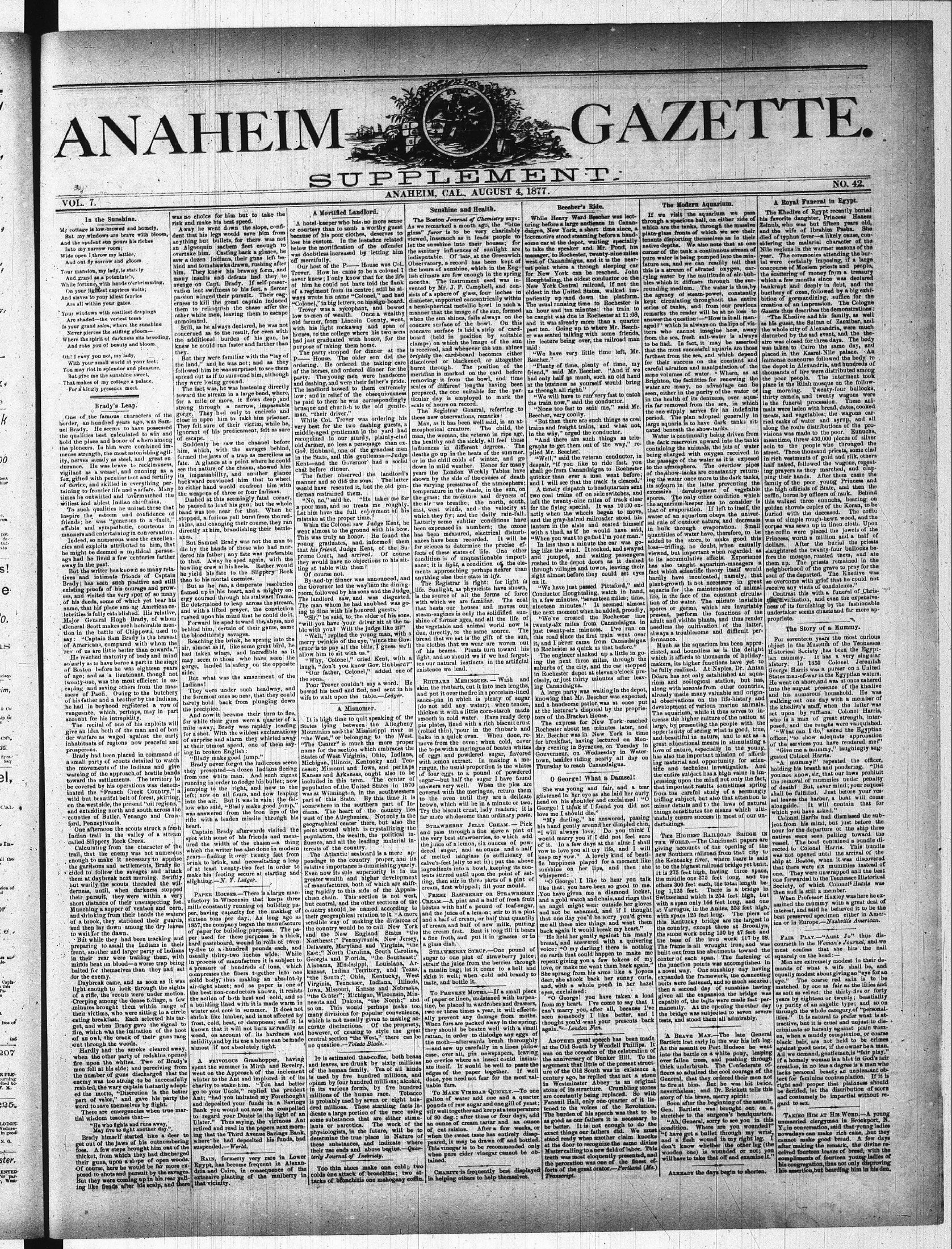
Searchable text
ANAHEIM
VOL. 7.
In the Sunshine.
My cottage is low-browed and homely,
But my windows are brave with bloom,
And the opulent sun pours his riches
Into my narrow room;
Wide open I throw my lattice;
And out fly sorrow and gloom.
Your mansion, my lady, is stately
And grand as a potentate's,
While fortune with hands o'erbrimming,
On your lightest caprices waits;
And slaves to your idlest fancies
Are all within your gates.
Your windows with costilest drapings
Are shaded—the veriest tomb
Is your grand salon, where the sunshine
Never pierces the stifling gloom—
Where the spirit of darkness alta brooding,
And robs you of beauty and bloom.
Oh! I envy you not, my lady,
With your small world at your feet;
You may riot in splendor and pleasure.
But give me the sunshine sweet,
That makes of my cottage a palace,
For a kingly presence meet.
Brady's Leap.
One of the famous characters of the border, an hundred years ago, was Samuel Brady. He seems to have possessed the qualities best calculated to win and hold the place and honor of a hero among the pioneers. In him were combined immense strength, the most astonishing agility, nerves steady as steel, and great endurance. He was brave to recklessness.
was no choice for him but to take the risk and make his best speed.
Away he went down the slope, confident that his legs would save him from anything but bullets, for there was not an Algonquin sachem fleet enough to overtake him. Casting back a glance, he saw a dozen Indians, their guns left behind and tomahawks drawn, rushing after him. They knew his brawny form, and many insults and defeats had they to avenge on Capt. Brady. If self-preservation lent swiftness to his feet, a fiercer passion winged their pursuit. Their eagerness to kill the great captain induced them to relinquish the chase after the other white men, leaving them to escape unmolested.
Still, as he always declared, he was not concerned as to the result, for even with the additional burden of his gun, he knew he could run faster and farther than they.
But they were familiar with the "lay of the land," and he was not; and as they followed him he was surprised to see them spread out as if to surround him, although they were losing ground.
The fact was, he was hastening directly toward the stream in a large bend, where for a mile or more, it flows deep, and strong through a narrow, impassable gorge. They had only to encircle and close in upon him to take him prisoner. They felt sure of their victim, while he, ignorant of his predicament, felt as sure of escape.
Suddenly he saw the channel before him, which, with the savages behind, formed the jaws of a trap as merciless as fate. A glance at a point where he could
A Mortified Ladder.
A hotel-keeper who hated courtesy than to snuffle because of his poor cloak lose his custom. In the below the mortification was doubtless increased off mercifully.
Our host of the P——Trover. How he came never knew; I only know of him he could not help of a regiment from its ways wrote his name "Colonel," in big letters.
Trover was a sycophant low to men of wealth. Old farmer, from Lincoln with his light rockawhorse, to the college he had just graduated with purpose of taking them.
The party stopped for P——House. The ordering. He ordered of the horses, and order party. The young men and dashing, and were to The landlord bowed to low; and in relief of t he paid to them he was brusque and churlish man, "their driver."
While Col. Trover very best for the two middle-aged gentleman recognized in our stale farmer, no less a p Gov. Hubbard, one of in the State, and this Kent—and the Gover
Brady's Leap.
One of the famous characters of the border, an hundred years ago, was Samuel Brady. He seems to have possessed the qualities best calculated to win and hold the place and honor of a hero among the pioneers. In him were combined immense strength, the most astonishing agility, nerves steady as steel, and great endurance. He was brave to recklessness, vigilant as a weasel, and cunning as a fox, gifted with peculiar tact and fertility of device, and skilled in everything pertaining to frontier life and warfare. Many times he outwitted and overmatched the williest and ablest Indian chieftains.
To such qualities he united those that inspire the esteem and confidence of friends; he was "generous to a fault," affable and sympathetic, courteous in manners and entertaining in conversation.
Indeed, so numerous were the excellencies and exploits attributed to him, that he might be deemed a mythical personage had he lived a few centuries farther away in the past.
But the writer has known so many relatives and intimate friends of Captain Brady; has seen such positive and still existing proofs of his courage and prowess, and visited the very spot of so many of his deeds, some of which yet bear his name, that his place among American celebrities is fully established. His relative, Major General Brady, of whom General Scott makes such honorable mention in the battle of Chippewa, used to say: "Captain Sam Brady is the bravest of Americans, compared with whom the rest of us are little better than cowards."
He reached maturity of body and mind so early as to have borne a part in the siege of Boston before he was eighteen years of age; and as a lieutenant, though not twenty-one, was the most efficient in escaping and saving others from the massacre of Paoli. Owing to the butchery of his father and a brother by the Indians, he had in boyhood registered a vow of vengeance, which, perhaps, may in part account for his intrepidity.
The recital of one of his exploits will give an idea both of the man and of border warfare as waged against the early inhabitants of regions now peaceful and prosperous.
Brady had been placed in command of a small party of scouts detailed to watch the movements of the Indians and give warning of the approach of hostile bands toward the settlements. The territory to be covered by his operations was denominated the "French Creek Country," a wild but beautiful belt of forest, skirting on the west side, the present "oil regions," and extending north and south across the counties of Butler, Venango and Crawford, Pennsylvania.
One afternoon the scouts struck a fresh Indian trail in the valley of a stream called Slippery Rock Creek.
Calculating from the character of the trail, that the enemy was not numerous enough to make it necessary to apprise the garrisons and settlements, Brady decided to follow the savages and attack them at daybreak next morning. Swiftly followed him he was surprised to see them spread out as if to surround him, although they were losing ground.
The fact was, he was hastening directly toward the stream in a large bend, where, for a mile or more, it flows deep and strong through a narrow, impassable gorge. They had only to encircle and close in upon him to take him prisoner. They felt sure of their victim, while he, ignorant of his predicament, felt as sure of escape.
Suddenly he saw the channel before him, which, with the savages behind, formed the jaws of a trap as merciless as fate. A glance at a point where he could see the nature of the chasm, showed him its impassability, and another glance backward convinced him that to wheel to either hand would confront him with the weapons of three or four Indians.
Dashed at this seemingly fatal corner, he paused to load his gun; but the whole band was too near for that. When he stopped, a furious yell burst from the redskins, and changing their course, they ran directly at him, brandishing their battleaxes.
But Samuel Brady was not the man to die by the hands of those who had murdered his father; any fate was preferable to that. Away he sped again, with the howling crew at his heels. Rather would he yield his fate to the Slippery Rock than to his mortal enemies.
But as he ran, a desperate resolution flamed up in his heart, and a mighty energy coursed through his stalwart frame. He determined to leap across the stream, and with a lifted prayer, the conviction rushed upon his mind that he could do it.
Forward he sped toward the abyss, and behind him, certain of their game, came the bloodthirsty savages.
Reaching the brink, he sprang into the air, almost as if, like some great bird, he had taken wings, and incredible as it may seem to those who have seen the gorge, landed in safety on the opposite side.
But what was the amazement of the Indians!
They were under such headway, and the foremost ones so near, that they could barely hold back from plunging down the precipice.
And now it became their turn to flee for while their guns were a quarter of a mile away. Brady was rapidly loading for a shot. With the wildest exclamations of surprise and alarm they whirled away at their utmost speed, one of them saying in broken English:
"Blady make good jump."
Brady never forgot the ludicrous scene they presented—a dozen Indians fleeing from one white man. And such zigzag running in order to dodge his bullet; now jumping to the right, and now to the left; now on all fours, and now leaping into the air. But it was in vain; the fellow who said, "Blady make good jump," was answered from the iron lips of the rifle with a leaden missile through his heart.
Captain Brady afterwards visited the spot with some of his friends and measured the width of the chasm—a thing which the writer has also done in modern years—finding it over twenty feet from brink to brink, and necessitating a leap of at least twenty-two feet in order to make his footing secure at starting and alighting.—N. Y. Ledger.
Followed him he was surprised to see them spread out as if to surround him, although they were losing ground.
The fact was, he was hastening directly toward the stream in a large bend, where for a mile or more, it flows deep and strong through a narrow, impassable gorge. They had only to encircle and close in upon him to take him prisoner. They felt sure of their victim, while he, ignorant of his predicament, felt as sure of escape.
Suddenly he saw the channel before him, which, with the savages behind, formed the jaws of a trap as merciless as fate. A glance at a point where he could see the nature of the chasm, showed him its impassability, and another glance backward convinced him that to wheel to either hand would confront him with the weapons of three or four Indians.
Dashed at this seemingly fatal corner, he paused to load his gun; but the whole band was too near for that. When he stopped, a furious yell burst from the redskins, and changing their course, they ran directly at him, brandishing their battleaxes.
But Samuel Brady was not the man to die by the hands of those who had murdered his father; any fate was preferable to that. Away he sped again, with the howling crew at his heels. Rather would he yield his fate to the Slippery Rock than to his mortal enemies.
But what was the amazement of the Indians!
They were under such headway, and the foremost ones so near, that they could barely hold back from plunging down the precipice.
And now it became their turn to flee for while their guns were a quarter of a mile away. Brady was rapidly loading for a shot. With the wildest exclamations of surprise and alarm they whirled away at their utmost speed, one of them saying in broken English:
"Blady make good jump."
Brady never forgot the ludicrous scene they presented—a dozen Indians fleeing from one white man. And such zigzag running in order to dodge his bullet; now jumping to the right, and now to the left; now on all fours, and now leaping into the air. But it was in vain; the fellow who said, "Blady make good jump," was answered from the iron lips of the rifle with a leaden missile through his heart.
Captain Brady afterwards visited the spot with some of his friends and measured the width of the chasm—a thing which the writer has also done in modern years—finding it over twenty feet from brink to brink, and necessitating a leap of at least twenty-two feet in order to make his footing secure at starting and alighting.—N. Y. Ledger.
It is high time to go States lying between Mountains andthe West,"or below"The Center"is my name for the sectionStates of West Virginia,Michigan Illinois,nesee; MissouriandKansasand Arkansasincluded in this testpopulationoftheUwasat Wilmington,andpartofthisState,somewhereintheDiana.TheheartwestoftheAllegheny geographical centerpoint aroundwhichpopulation,thewefluence,andalltheterestsofthecounty
The Atlantic seependage tothecorrelativeimportanceEvennowitssolegreaterwealthand
be covered by his operations was denominated the "French Creek Country," a wild but beautiful belt of forest, skirting on the west side, the present "oil regions," and extending north and south across the counties of Butler, Venango and Crawford, Pennsylvania.
One afternoon the scouts struck a fresh Indian trail in the valley of a stream called Slippery Rock Creek.
Calculating from the character of the trail, that the enemy was not numerous enough to make it necessary to apprise the garrisons and settlements, Brady decided to follow the savages and attack them at daybreak next morning. Swiftly but warily the scouts threaded the wilderness, until when darkness stopped their pursuit, they were within a very short distance of their unsuspecting foe. Munching a supper of venison and corn, and drinking from their hands the waters of a brook, they stationed their guards, and then lay down among the dry leaves to wait for the dawn.
But while they had been tracking and preparing to assail the Indians in their front, another and larger party of Indians in their rear were trailing them, with minds bent on blood—a worse trap being baited for themselves than they had set for the enemy.
Daybreak came, and as soon as it was light enough to look through the sights of a rifle, the scouts were under motion. Creeping among the dense foliage, a few minutes brought them within range of their victims, who were sitting in a circle eating breakfast. Each selected his target, and when Brady gave the signal to fire, which was the imitation of the boot of an owl, the crack of their guns rang out through the woods.
Hardly had the smoke cleared away, when the other party of redskins opened fire upon the whites. Two of Brady's men fell at his side; and perceiving from the number of guns discharged that the enemy was too strong to be successfully resisted, the wary captain instantly adopted the motto, "Discretion is the better part of valor," and gave his party the word to save themselves by flight.
There are emergencies when true martial wisdom teaches that—
"He who fights and runs away,
May live to fight another day."
Brady himself started like a deer to get out of the jaws of his outnumbering foes. A few steps brought him out of the thicket, from which they had discharged their guns, upon a slope of open woods. Of course, here he would be far more exposed to shots and pursuit by the savages. But they were coming up in his rear pelling like flends after his scalp, and there jumping to the right, and now to the left; now on all fours, and now leaping into the air. But it was in vain; the fellow who said, "Blady make good jump," was answered from the iron lips of the rifle with a leaden missile through his heart.
Captain Brady afterwards visited the spot with some of his friends and measured the width of the chasm—a thing which the writer has also done in modern years—finding it over twenty feet from brink to brink, and necessitating a leap of at least twenty-two feet in order to make his footing secure at starting and alighting.—N.Y.Ledger.
PAPER HOUSES.—There is a large manufactory in Wisconsin that keeps three mills constantly running on building paper, having capacity for the making of sixteen tons per day.. As long ago as 1857, the company began the manufacture of paper for building purposes. The paper used for these purposes is a thick, hard pasteboard, wound in rolls of twenty-five to a hundred pounds each, and usually thirty-two inches wide. While in process of manufacture it is subject to a pressure of hundreds of tons, which compresses the fibers together into one solid body, thus making an absolutely air-tight sheet; and as paper is one of the best non-conductors known, it resists the action of both heat and cold, and so a building lined with it is made warm in winter and cool in summer. It does not shrink like lumber; and is not affected by frost, cold, heat, or dampness; and it is known that it will not burn as readily as wood, on account of its hardness and solidity, and by its use a house can be made almost if not absolutely tight.
A PRIVOLOUS Grasshopper, having spent the summer in Mirth and Revelry, went on the Approach of the inclement winter to the Ant and implored it of its charity to stake him. "You had better go to your Uncle," replied the prudent Ant; "had you imitated my Forethought and deposited your funds in a Savings Bank you would not now be compelled to regard your Duster in the light of an Ulster." Thus saying, the virtuous Ant retired and read in the papers next morning that the Third Avenue Savings Bank, where he had deposited his funds, had suspended.—World.
RAIN, formerly very rare in Lower Egypt, has become frequent in Alexandria and Cairo, in consequence of the extensive planting of the mulberry in that vicinity.
A Mortified Landlord.
A hotel-keeper who has no more sense or courtesy than to snub a worthy guest because of his poor clothes, deserves to lose his custom. In the instance related below the mortification of the offender was doubtless increased by letting him off mercifully.
Our host of the P——House was Col. Trover. How he came to be a colonel I never knew; I only know that for the life of him he could not have told the flank of a regiment from its centre; still he always wrote his name "Colonel," and had "Colonel," in big letters, on his sign-board.
Trover was a sycophant, and bowed low to men of wealth. Once a wealthy old farmer, from Lincoln County, went, with his light rockaway and span of horses, to the college where his two sons had just graduated with honor, for the purpose of taking them home.
The party stopped for dinner at the P——House. The older son did the ordering. He ordered the taking care of the horses, and ordered dinner for the party. The young men were handsome and dashing, and were their father's pride. The landlord bowed to them extremely low; and in relief of the obsequiousness he paid to them he was correspondingly brusque and churlish to the old gentleman, "their driver."
While Col. Trover was ordering his very best for the two dashing guests, a middle-aged gentleman in the yard had recognized in our sturdy, plainly-clad old farmer, no less a personage than ex-Gov. Hubbard, one of the grandest men in the State, and this gentleman—Judge Kent—and the Governor had a social
Sunshine and Health.
The Boston Journal of Chemistry says: As we remarked a month ago, the "blue glass" furor is to be very charitably viewed, inasmuch as it leads people to let the sunshine into their houses; for the sanitary influences of sunlight are indisputable. Of late, at the Greenwich Observatory, a record has been kept of the hours of sunshine, which in the English climate are few enough in the spring months. The instrument used was invented by Mr. J. F. Campbell, and consists of a sphere of glass, four inches in diameter, supported concentrically within a hemispherical metallic bowl in such a manner that the image of the sun, formed when the sun shines, falls always on the concave surface of the bowl. On this concave surface is laid a strip of cardboard (held in position by suitable clamps) on which the image of the sun is received, and whenever the sun shines brightly the card-board becomes either discolored or blackened, or altogether burnt through. The position of the meridian is marked on the card before removing it from the bowl, and time scales of different lengths having been prepared, the one suitable for the particular day is employed to mark the scale of hours on record.
The Registrar General, referring to these new observations, remarks:
Man, as it has been well said, is an atmospheric creature. The child, the man, the woman, the veteran in ripe age, the healthy and the sickly, all feel these influences in different degrees. The deaths go up in the heats of the summer, or in the chill colds of winter, and go down in mild weather. Hence for many
Beecher’s Ride.
While Henry Ward Beecher was lecturing before a large audience in Canandaigua, New York, a short time since, a locomotive stood steaming before a hand-some car at the depot, waiting specially to take the speaker and Mr. Pond, his manager, to Rochester, twenty-nine miles west of Canandaigua, and it is the nearest point where a through sleeping car for New York can be reached. John Houghtaling, the oldest conductor on the New York Central railroad, if not the oldest in the United States, walked impatiently up and down the platform. The usual running time to Rochester is an hour and ten minutes; the train to be caught was due in Rochester at 11:08, and it was already more than a quarter past ten. Going up to where Mr. Beecher was seated talking with some friends, the lecture being over, the railroad man said:
"We have very little time left, Mr. Beecher."
"Plenty of time, plenty of time, my friend," said Mr. Beecher. "And if we had only half as much, such an old hand at the business as yourself would bring us through all right."
"We will have to run very fast to catch the train now," said the conductor.
"None too fast to suit me," said Mr. Beecher, very coolly.
"But then there are such things as coal trains and freight trains, and what not, in the way," urged the conductor.
"And there are such things as telegraphs to get them out of the way," replied Mr. Beecher.
"Well," said the veteran conductor, in despair. "If you like to ride fast, you
of the horses, and ordered dinner for the party. The young men were handsome and dashing, and were their father's pride. The landlord bowed to them extremely low; and in relief of the obsequiousness he paid to them he was correspondingly brusque and churlish to the old gentleman, "their driver."
While Col. Trover was ordering his very best for the two dashing guests, a middle-aged gentleman in the yard had recognized in our sturdy, plainly-clad old farmer, no less a personage than ex-Gov. Hubbard, one of the grandest men in the State, and this gentleman—Judge Kent—and the Governor had a social chat before dinner.
The father observed the landlord's manner and so did the sons. The latter would have resented it, but the old gentleman restrained them.
"No, no," said he. "He takes me for a poor man, and so treats me roughly. Let him have the full enjoyment of his mistake at the proper time."
When the Colonel saw Judge Kent, he went almost to the ground with his bow. This was truly an honor. He found the young graduates, and informed them that his friend, Judge Kent, of the Supreme Court, had arrived. Of course they would have no objections to his sitting at table with them?
Of course not.
By-and-by dinner was announced, and the Governor led the way into the dining room, followed by his sons and the Judge. The landlord saw, and was disgusted. The man whom he had snubbed was going to dine with his honored guests.
"Sir," he said, to the elder of his sons, "will you have your driver sit at the table with you? Will the judge like it?"
"Well," replied the young man, with a merry twinkle of the eye, "since the Governor is to pay all the bills, I guess we'll allow him to sit with us."
"Why, Colonel," cried Kent, with a laugh, "don't you know Gov. Hubbard?" "Our father, Colonel," added one of the sons.
Poor Trover couldn't say a word. He bowed his head and fled, and sent in his wife to wait upon the table.
A Mismomer.
It is high time to quit speaking of the States lying between the Allegheny Mountains and the Mississippi river as "the West," or belonging to the West. "The Center" is much the more proper name for the section which embraces the States of West Virginia, Ohio, Indiana, Michigan, Illinois, Kentucky and Tennessee; Missouri and Iowa, and perhaps Kansas and Arkansas, ought also to be included in this term. The center of population of the United States in 1870 was at Wilmington, in the southwestern part of this State. By this time it is somewhere in the southern part of Indiana. The heart of the country lies west of the Alleghenies. Not only is the geographical center there, but also the point around which is crystallizing the population, the wealth, the political influence, and all the leading material interests of the country.
The Atlantic seaboard is a mere appendage to the country proper, and its relative importance is diminishing yearly. Even now its sole superiority is in its greater wealth and higher development
RHUBARB MERINGUES. — Wash and skin the rhubarb, cut it into inch lengths, and put it over the fire in a porcelain-lined sauce-pan in which is plenty of sugar (do not add any water); when tender, thicken it with a little corn-starch made smooth in cold water. Have ready deep pie plates, lined with a rich biscuit crust (rolled thin), pour in the rhubarb and bake in a quick oven. When done, remove from the oven; when cold, cover the tops with a meringue of beaten whites of eggs and powdered sugar, flavored with lemon extract. In making a meringue, the usual proportion is the whites of four eggs to a pound of powdered sugar—but half the sugar I have found answers very well. When the pies are covered with the meringue, return them to the oven until they are a delicate brown, which will be in a minute or two. Try the biscuit crust, lady readers; it is far more wholesome than ordinary paste.
STRAWBERRY JELLY CREAM. — Pick and pass through a fine sieve a pint of the very best strawberries, to which add the juice of a lemon, six ounces of powdered sugar, and an ounce and a half of melted isinglass (a sufficiency of calve's-feet jelly to set it); put the above ingredients into a bowl, keeping its contents stirred until upon the point of setting, then stir in three parts of a pint of meridian is marked on the card before removing it from the bowl, and time scales of different lengths having been prepared, the one suitable for the particular day is employed to mark the scale of hours on record.
The Registrar General, referring to these new observations, remarks:
Man, as it has been well said, is an atmospherical creature. The child, the woman, the veteran in ripe age, the healthy and the sickly, all feel these influences in different degrees. The deaths go up in the heats of the summer, or in the chill colds of winter, and go down in mild weather. Hence for many years the London Weekly Tables have shown by the side of the causes of death varying pressures of the atmosphere; temperature in the shade, in the sun, on the grass; the moisture and dryness of the air we breathe; the north, south, east, west winds, and the velocity at which they fly; and the daily rain-fall. Latterly some subtler conditions have been expressed in numbers; the ozone has been measured, electrical disturbances have been recorded. It will be science to determine the precise effects of these states of life. One other condition is of unquestionable importance; it is light, a condition of the elements approaching perhaps nearer than anything else their state in life.
The Registrar is right; for light is life. Sunlight, as physicists have shown, is the source of all the forms of force with which we are familiar. The coal that heats our houses and moves our steam-engines is only the solidified sunshine of former ages, and all the life of the vegetable and animal world now is due directly, to the same source. The bread that we eat is the gift of the sun, the clothes that we wear are woven out of his beams. Plants turn toward his light, and so should we if we had forgotten our natural instincts in the artificial existence we lead.
O George! What a Damsel!
She was young and fair, and a tear glistened in her eye as she laid her curly head on his shoulder and exclaimed: "O George! I think if I found you did not love me I should die."
My darling," he answered, passing his hand gently around her dimple chin. "I will always love. Do you think I would marry you if I did not feel sure of it. In a few days at the altar I shall vow to love you all my life, and I will keep my vow." A lovely kind of beatific happiness played for a moment like sunshine on her lips, and then she whispered: "O George! I like to hear you talk
It is estimated that coffee, both beans and leaves, are drunk by sixty millions of the human family. Tea of all kinds is used by five hundred millions, and opium by four hundred millions; alcohol in its various forms, by five hundred millions of the human race. Tobacco is probably used by seven or eight hundred millions. These startling facts indicate a large portion of the race using some substances that are either stimulants or narcotics. The work of the physiologists in the future will be to determine the true place in Nature of these substances, and indicate where their use ends and abuse begins.
Quarterly Journal of Inheritance.
Too thin shoes make one cold; two colds one attack of bronchitis; two attacks of bronchitis one mahogany coffin.
Strawberry Jelly Cream.—Pick and pass through a fine sieve a pint of the very best strawberries, to which add the juice of a lemon, six ounces of powdered sugar, and an ounce and a half of melted isinglass (a sufficiency of calve's-feet jelly to set it); put the above ingredients into a bowl, keeping its contents stirred until upon the point of setting, then stir in three parts of a pint of cream, first whipped; fill your mould.
Fresh Raspberry or Strawberry Cream.—A pint and a half of fresh fruit beaten with half a pound of loaf-sugar, and the juice of a lemon; stir to it a pint and a half of cream, or half that quantity of cream and half of new milk, putting the cream first. Beat it long till it bears a fine froth, and put it in glasses or in a glass dish.
Strawberry Syrup.—One pound of sugar to one pint of strawberry juice; strain the juice from the berries through a muslin bag; let it come to a boil and skin it well; when cold add brandy to taste, and bottle it.
To Prevent Moths.—If a small piece of paper or linen, moistened with turpentine, be placed in wardrobes and drawers, two or three times a year, it will effectually prevent any damage from moths. When furs are packed away in the spring they should be beaten well with a small rattan, in order to dislodge any eggs of the moth—afterwards brush thoroughly—and sew up carefully in a linen pillow case; over all, pin newspapers, leaving no crevice where an insect could insinuate itself. It would be well to paste the edges of the paper together. If well done, you need not fear for the most valuable fur.
To Make Vinegar Quickly.—To one gallon of water add one and a quarter pounds of raw sugar and one gill of yeast; stir well together and keep at temperature of 80 deg.; after three or four days, add an ounce of cream tartar and an ounce of cut raisins. After a few weeks, or when the sweet taste has entirely disappeared, it may be drawn off and bottled. This vinegar is to be recommended only when pure cider vinegar cannot be obtained.
Charity is frequently best displayed in helping others to help themselves.
She was young and fair, and a tear glistened in her eye as she laid her curly head on his shoulder and exclaimed: "O George! I think if you found you did not love me I should die."
"My darling," he answered, passing his hand gently around her dimple chin, "I will always love. Do you think I would marry you if I did not feel sure of it. In a few days at the altar I shall vow to love you all my life, and I will keep my vow." A lovely kind of beatific happiness played for a moment like sunshine on her lips, and then she whispered:
"O George! I like to hear you talk like that; you have been so good to me. You have given me a diamond locket, and a gold watch and chain,and rings that an angel might wear outside her gloves and not be ashamed, and if I thought that one day you'd be sorry you'd give me all these nice things and want them back again it would break my heart."
He held her gently against his manly breast, and answered with a quivering voice: "O my darling! there is nothing on earth that could happen to make me repent giving you a few tokens of my love, or make me want them back again." She sprang from his arms like a joyous deer, she shook back her sunny curls, and, with a whole poeth in her hazel eyes, exclaimed:
"O George! you have taken a load from my heart. I've come to say that I can't marry you, after all, because I've seen somebody I like better, and I thought you'd want your presents back again."—London Fun.
Another great speech has been made at the Old South by Wendell Phillips. It was on the occasion of the celebration of the anniversary of Bunker Hill. To the argument that little of the present structure of the Old South was in existence a century ago, he replied that not a stone in Westminster Abbey is an original stone of its structure. Crumbling stones are constantly being replaced. So with Fanenil Hall, only one quarter of it listened to the voices of the Revolution. The burden of his speech was that to be as good as our fathers it is necessary to be better. It is not enough to do the exact things our fathers did. We must stand ready when another claim knocks at the door to recognize the same divine Master calling to a new field of labor. This truth was most eloquently presented, and the peroration was one of the finest efforts of the great orator.—Portland (Ma.) Transcript.
GAZETTE.
NO. 42.
The Modern Aquarium.
If we visit the aquarium we pass through a spacious hall, on either side of which are the tanks, through the massive plate-glass fronts of which we see their tenants disporting themselves as in their native depths. We also note that at one corner of the tank a continuous stream of pure water is being pumped into the miniature sea, and we can readily tell that this is a stream of aerated oxygen, carrying water by the multitude of air-bubbles which it diffuses through the surrounding medium. The water is thus, by the agency of steam-power, constantly kept circulating throughout the entire series of tanks, and from our previous remarks the reader will be at no loss to answer the question:—"How is it all managed?" which is always on the lips of visitors who cannot imagine how, away from the sea, fresh salt-water is always to be had. In fact, it may be asserted that the most successful aquaria are those farthest from the sea, and which depend for their success on the constant and careful aeration and manipulation of the same volumes of water. Where, as at Brighton, the facilities for renewing the water are many, no advantage can be seen, either in the purity of the water or in the health of its denizens, over aquaria far removed from the sea, in which the one supply serves for an indefinite period. The plan adopted generally in large aquaria is to have dark tanks situated beneath the show-tanks.
Water is continually being driven from the dark reservoirs upward into the tanks containing the animals, the jets of water being charged with oxygen received in the passage of the water as it is exposed there. The overflow pipes
A Royal Funeral in Egypt.
The Khedive of Egypt recently buried his favorite daughter, Princess Hanem Zeinub, who was but fifteen years old, and the wife of Ibrahim Pasha. She died of typhus fever—a likely cause, considering the malarial character of the Nile regions in the warmer seasons of the year. The ceremonies attending the burial were certainly imposing, if a large concourse of Moslem priests and people, the scattering of money from a treasury which a few months since was declared bankrupt and deeply in debt, and the bucthery of oxen, followed by a big exhibition of gormandizing, suffice for the creation of an impression. The Cologne Gazette thus describes the demonstrations:
"The Khedive and his family, as well as his guest, the Sultan of Zanzibar, and the whole city of Alexandria, were much disturbed by the sad event, and the theatre was closed for three days. The body was taken to Cairo the same day, and placed in the Kasrel-Nile palace. An immense concourse followed the body to the depot in Alexandria, and hundreds of thousands of lions were distributed among the poor people. The interment took place in the Rilah mosque on the following morning. Twenty-four bullocks, thirty camels, and twenty wagons were in the funeral procession. These animals were laden with bread, dates, cooked meats, and vegetables; the wagons carried casks of water and syrup, and all along the route distributions of the provisions was made to the poor. Eunuchs, meantime, threw 450,000 pieces of silver coin to the people who thronged the street. Three thousand priests, some clad in rich vestments of gold and silk, others half naked, followed the wagons, repeat-
And if we touch an old hand itself would bring every fast to catch conductor.
Me, said Mr.
things as coal and what not, conductor.
things as tele- of the way," reconductor in ride fast, you gua to Rochester man went before; track is cleared." Headquarters sent inside switches, and tracks of track clear. It was 10:30 ex- began to move, broader stood his seat seated himself. Would have said, that car was goo-cked, and swayed passengers doors as it dashed down, leaving their row could set eyes.
Pittsford," said watch in hand, twelve miles; time, not seemed almost the added, proudly the Rochester line Canandaigua in inches. I've run on train went over from Canandaigua thus that before."
Up a little in goo-lies, through the door the car stopped eleven o'clock minutes after leaving in the depot, teacher was expected, was at once put up by the propriie-house.
New York-reached minutes later, and New York in time搜集ed on Mon-ouse, on Tuesday in Wednesday in Water nearly all day on Canandaigua.
At a Damsel!
fair, and a tear she laid her curly and exclaimed: "O Found you did not answered, passing and her dimpled chin. Do you think I did not feel sure that the altar I shall live, and I will lovely kind of beati- for a moment like lips, and then she to hear you talk
Water is continually being driven from the dark reservoir upward into the tanks containing the animals, the jets of water being charged with oxygen received in the passage of the water as it is exposed to the atmosphere. The overflow pipes of the show-tanks are constantly returning the water once more to the dark tanks, its sojourn in the latter preventing the excessive development of vegetable spores. The only other condition which the aquarium-keeper has to consider is that of evaporation. If left to itself, the water of an aquarium obeys the universal rule of outdoor nature, and decreases in bulk through evaporation. Small quantities of water have, therefore, to be added to the store, to make good this loss—trifling, no doubt, when casually viewed, but important when regarded as its accumulative effects. Experience has also taught aquarium-managers a fact which scientific theory itself would hardly have inculcated, namely, that plant-growth is not necessary in great aquaria for the maintenance of animal life, in the face of the constant circulation of the water. The minute invisible spores or germs, which are invariably present, perform the functions of the adult and visible plants, and thus render needless the cultivation of the latter, always a troublesome and difficult performance.
Much as the aquarium has been appreciated, and boundless as is the delight which it affords to thousands of holiday-makers, its higher functions have yet to be fully realized. At Naples, Dr. Antan Dörn has not only established an aquarium and zoological station, but has along with savants from other countries, already made many valuable and original observations on the life-history and development of various marine animals. The aquarium, while it thus serves to increase the higher culture of the nation at large, by presenting the people with the opportunity of seeing what is good, true, and beautiful in nature, and to act as a great educational means in stimulating a love of nature, especially in the young, has also the important mission of affording material and opportunity for scientific and technical investigation. And the entire subject has a high value in impressing upon the mind not only the fact that important results sometimes spring from the careful study of a seemingly trifling subject, but also that attention to minor details and to the laws of natural things constitutes the means which ultimately ensure success in most of our undertakings.
The Highest Railroad Bridge IN THE WORLD.-The Cincinnati papers are giving accounts of the opening of the new Southern railroad from that city to the Kentucky river, where there is said to be the highest railroad bridge yet built. It is 275 feet high, having three spans, the middle one 375 feet long, and tue deptentions for careful admixture of the same volumes of water. Where, as at Brighton, the facilities for renewing the water are many, no advantage can be seen, either in the purity of the water or in the health of its denizens, over aquaria far removed from the sea, in which the one supply serves for an indefinite period. The plan adopted generally in large aquaria is to have dark tanks situated beneath the show-tanks.
Water is continually being driven from the dark reservoir upward into the tanks containing the animals, the jets of water being charged with oxygen received in the passage of the water as it is exposed to the atmosphere. The overflow pipes of the show-tanks are constantly returning the water once more to the dark tanks, its sojourn in the latter preventing the excessive development of vegetable spores. The only other condition which the aquarium-keeper has to consider is that of evaporation. If left to itself, the water of an aquarium obeys the universal rule of outdoor nature, and decreases in bulk through evaporation. Small quantities of water have, therefore, to be added to the store, to make good this loss—trifling, no doubt, when casually viewed, but important when regarded as its accumulative effects. Experience has also taught aquarium-managers a fact which scientific theory itself would hardly have inculcated, namely, that plant-growth is not necessary in great aquaria for the maintenance of animal life, in the face of the constant circulation of the water. The minute invisible spores or germs, which are invariably present, perform the functions of the adult and visible plants, and thus render needless the cultivation of the latter, always a troublesome and difficult performance.
Much as the aquarium has been appreciated, and boundless as is the delight which it affords to thousands of holiday-makers, its higher functions have yet to be fully realized. At Naples, Dr. Antan Dörn has not only established an aquarium and zoological station, but has along with savants from other countries, already made many valuable and original observations on the life-history and development of various marine animals. The aquarium, while it thus serves to increase the higher culture of the nation at large, by presenting the people with the opportunity of seeing what is good, true, and beautiful in nature, and to act as a great educational means in stimulating a love of nature, especially in the young, has also the important mission of affording material and opportunity for scientific and technical investigation. And the entire subject has a high value in impressing upon the mind not only the fact that important results sometimes spring from the careful study of a seemingly trifling subject, but also that attention to minor details and to the laws of natural things constitutes the means which ultimately ensure success in most of our undertakings.
The HIGHEST RAILROAD BRIDGE IN THE WORLD.-The Cincinnati papers are giving accounts of the opening of the new Southern railroad from that city to the Kentucky river, where there is said to be the highest railroad bridge yet built. It is 275 feet high, having three spans, the middle one 375 feet long, and tue deptentions for careful admixture of the same volumes of water. Where, as at Brighton, the facilities for renewing the water are many, no advantage can be seen either in purity of the water or in health of its denizens, over aquaria far removed from the sea, in which the one supply serves for an indefinite period. The plan adopted generally in large aquaria is to have dark tanks situated beneath the show-tanks.
Water is continually being driven from the dark reservoir upward into the tanks containing the animals, the jets of water being charged with oxygen received in the passage of the water as it is exposed to the atmosphere. The overflow pipes of the show-tanks are constantly returning the water once more tothe dark tanks, its sojourn in the latter preventing the excessive development of vegetable spores. The only other condition whichthe aquarium-keeper has to consider is that of evaporation. If left to itself,the waterof an aquarium obeysthe universal ruleofoutdoor nature,anddecreasesinbulkthroughevaporation.Smallquantitiesofwaterhave,toreadtothestore,tomakegoodthisloss-trifling,nodoubtwhencasuallyviewed,bbutimportantwhenregardedastoitsaccumulativeeffects.Experiencehasalsotaughtaquarium-managerssafactwhichscientifictheoryitselfwouldhardlyhaveneinculcated,nameflyforthemaintenanceofanimallife,inthefaceoftheconstantcirculationofthewater.Theminerealresultsometimesspringfromthecarefulstudyofaseeminglytriflingsubject,bbutalsothatattentiontomineraldetailsandtothelawsofnaturalthingsconstitutesmeanswhichultimatelyensuresuccessinmostofourundertakings.
For seventeen yearsthe most curious objectintheMuseumoftheTennessee Historical SocietyhasbeentheEgyptianmummy.Ithasaverysingularhistory.In1850ColonelJeremiahGeorgeHarriswasapurseronUnitedStatesman-of-warintheEgyptianwaters.Hewwentonshore,andwasatonceusheredintotheaugustpresenceofthekhediveandhisnumeroushousehold.Hewwalkingoutonedaywithamemberofthekhedive'sstaff,whenthelatterwassetupbyruffians.ColonelHarriswhoisamainofgreatstrength,intersposed,andtheroughsweravaiquished.“WhatcanIdo,"askedtheEgyptianofficer,"toshowadequateappositionoftheservicesyouhaverendermet?"“Givemeamummy,"laughinglysuggestedColonelHarris.
"A mummy?"repeatedtheofficer,holdinghisbreathandpondering.“Didyounotknow,sir,mustourinewsprohibittherenovalofmummiesunderpenaltyofdeath?Butnevermind,yourrequestshallbefulfilled.Justbeforeyourvesselleavestheharbor,a boatwillcomeloalside.Ittwillcontainthatforwhichyouhaveasked.”
ColonelHarrishaddismissethesubjectfromhismind,但justbeforethehourforthedepartureoftheshipthreenativeswereseenpullingtowardthevessel.TheboatcontainedabundledirectedtoColonelHarris.Thebundlewasnotopened untilthearrivaloftheshipatBoston,当它wasdiscoveredthattherewere sixmummies insteadofone TheywereunwrappedandthebestoneforwardedtotheTennesseeHistorical
THE HIGHEST RAILROAD BRIDGE IN THE WORLD.—The Cincinnati papers are giving accounts of the opening of the new Southern railroad from that city to the Kentucky river, where there is said to be the highest railroad bridge yet built. It is 275 feet high, having three spans, the middle one 375 feet long, and the others 300 feet each, the total length being 1,125 feet. There is a bridge in Switzerland which is 254 feet high, but with a span only 144 feet long, and one at Varrugus, in the Andes, 252 feet high, with spans 125 feet long. The piers of this Kentucky bridge are the largest in the country, except those at Brooklyn, the stone work being 130 by 47 feet and the base of the iron work 117 by 28. The frame is all wrought iron, and was built out from the abutments toward the center of each span. The fastening of the junction points was accomplished in a novel way. One sunshiny day having expanded the framework, the connecting bolts were fastened, and so much secured; then a second day of sunshine having given all the expansion the bridge was capable of, the bolts were made first permanently. At the opening the other day the bridge was subjected to seven severe tests, and stood them all admirably.
A BRAVE MAN.—The late General Bartlett lost early in the war his left leg. At the assault on Port Hudson he went into the battle on a white pony, leaping over fallen trees, and pushing through thick underbrush. The Confederate officers so admired the cool courage of the General, that they ordered their men not to fire at him. But he was hit twice, nevertheless; and Dr. Brickett tells this story of his brave, merry spirit:
Soon after the beginning of the assault, Gen. Bartlett was brought out on a stretcher to the surgeon's headquarters.
"Ah, General, sorry to see you in this condition. Where are you wounded?"
"I have got a bullet through my wrist, and a flesh wound in my right leg. I don't know whether the other leg (the wooden one) is wounded or not; you will have to take that off and examine it."
Already the days begin to shorten.
TAKING HIM AT HIS WORD.—A young unmarried clergyman in Brockport, N.Y., in conversation, said that young ladies nowadays can make rich cake, but they cannot make good bread. A few days after making the remark, the divine received fourteen loaves of bread, with the compliments of fourteen young ladies of his congregation, thus not only disproving his assertion, but boarding him in his den.