anaheim-gazette 1877-08-04
Scanned page
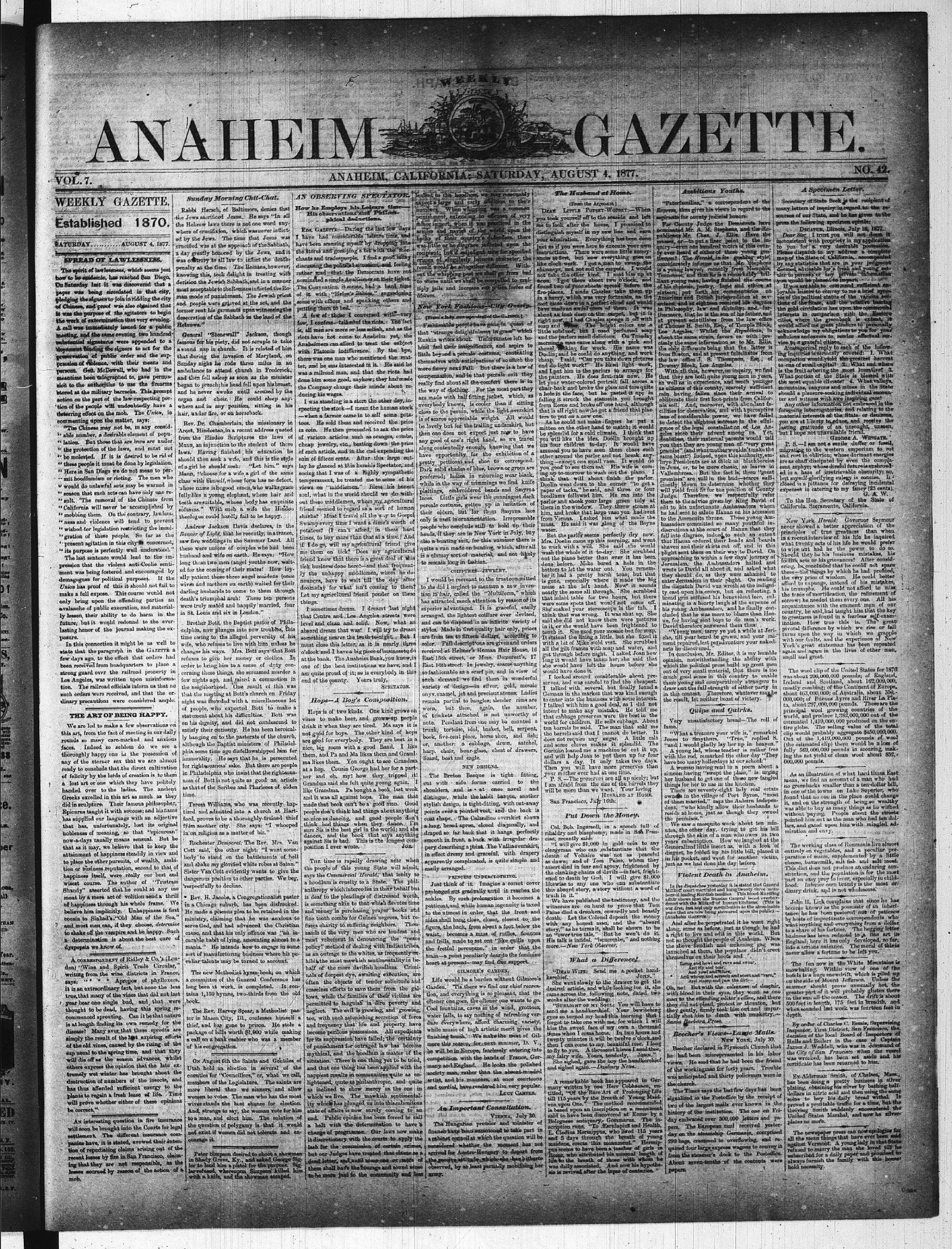
Searchable text
WEEKLY GAZETTE,
Established 1870.
SATURDAY...AUGUST 4, 1877.
SPREAD OF LAWLESSNESS.
The spirit of lawlessness, which seems just how to be epidemic, has reached San Diego. On Saturday last it was discovered that a paper was being circulated in that city, pledging the signers to join in ridding the city of Chinese, and proof was also obtained that it was the purpose of the agitators to begin the work of extermination that very evening. A call was immediately issued for a public meeting, and the same evening two hundred substantial signatures were appended to a petition binding the signers to act for the preservation of public order and the suppression of violence, with their means and persons. Gen. McDowell, who had in the meantime been telegraphed to, gave permission to the authorities to use the firearms stored as the military barracks. This prompt action on the part of the law-respecting portion of the people will undoubtedly have a deterring effect on the mob. The Union, in commenting upon the matter, says:
"The Chinese may not be, in any considerable number, a desirable element of population. But those that are here are under the protection of the laws, and must not be molested. If it is desired to be rid of these people it must be done by legislation."
Sunday Morning Chit-Chat.
Rabbi Harach, of Baltimore, denies that the Jews sacrificed Jesus. He says "In all the Hebrew laws there is not one word anywhere of crucifixion, which was never inflicted by the Jews. The time that Jesus was crucified was at the approach of the Sabbath, a day greatly honored by the Jews, and it was contrary to all law to inflict the death penalty at the time. The Romans, however, knowing this, took delight in treating with derision the Jewish Sabbath, and in a manner most acceptable to the Romans inflicted the Roman mode of punishment. The Jewish priest and people were grieved at the act, and the former rent his garments upon witnessing the desecration of the Sabbath in the land of the Helnews."
General "Stonewall" Jackson, though famous for his piety, did not scruple to take a sound nap in church. It is related of him that during the invasion of Maryland, on Sunday night he rode three miles in an ambulance to attend church in Frederick; and then fell asleep as soon as the minister began to preach; his head fell upon his breast, and he never awoke until aroused by the organ and choir. He could sleep anywhere and in any position, sitting in his hair, under fire, or on horseback.
Rev. Dr. Chamberlain, the missionary in Argoot, Hindostan, in a recent address quoted from the Hindoo Scriptures the laws of Mann, an injunction to the student of those laws. Having finished his education he should then seek a wife, and this is the style of civil marriage."
Get. McDowell, who had in the meantime been telegraphed to, gave permission to the authorities to use the firearms stored at the military barracks. This prompt action on the part of the law-respecting portion of the people will undoubtedly have a deterring effect on the mob. The Union, in commenting upon the matter, says:
"The Chinese may not be, in any considerable number, a desirable element of population. But those that are here are under the protection of the laws, and must not be molested. If it is desired to be rid of these people it must be done by legislation. Here in San Diego we do not mean to permit hoodlumian or rioting. The men who would do unlawful acts may be warned in season that such acts can have only one result. The removal of the Chinese from California will never be accomplished by mobbing them. On this contrary, lawlessness and violence will tend to prevent wished-for legislation restricting the immigration of these people. So far as the present agitation in this city concerned, its purpose is perfectly well understood."
The last sentence would lead to the impression that the violent anti-Coolie sentiment was being fostered and encouraged by demagogues for political purposes. If the Union has proof of this it should not fail to make a full expose. This course would not only bring upon the offending parties an avalanche of public execration, and materially lessen their ability to do harm in the future, but it would redound to the everlasting honor of the journal making the exposure.
In this connection it might be as well to state that the paragraph in the GAZETTE a few days ago, to the effect that orders had been received from headquarters to place a strong guard over the railroad property in Los Angeles, was written upon misinformation. The railroad officials inform us that no such orders were received, and that the ordinary precautions were considered ample.
THE ART OF BEING HAPPY.
We are led to make a few observations on this art, from the fact of meeting in our daily rounds so many care-marked and anxious faces. Indeed so seldom do we see a thoroughly happy one in the possession of any of the storner sex that we are almost ready to conclude that the direct cultivation of felicity by the lords of creation is to them a lost art or one which they have politely handed over to the ladies. The ancient Greeks excelled in this art as much as they did in sculpture. Their famous philosopher, Epicurus taught it with success; and his name has supplied our language with an adjective that has, unfortunately, lost its original nobleness of meaning, so that "epicurean" now-a-days usually means sensual. But he that as it may, we believe that to keep the attainment of happiness steadily in view and to place the other pursuits, of wealth, ambition or business reputation, second to that of happiness itself, were really our best and most course. The author of "Tristram ambulance to attend church in Frederick, and then fell nausea as soon as the minister began to preach; his head fell upon his breast, and he never awoke until aroused by the organ and choir. He could sleep anywhere and in any position, sitting in his hair, under fire, or on horseback.
Rev. Dr. Chamberlain, the missionary in Areot, Hindostan, in a recent address quoted from the Hindoo Scriptures the laws of Mann, an injunction to the student of those laws. Having finished his education he should then seek a wife, and this is the style of a girl he should seek: "Let him." says Mann, "choose for a wife a girl of the same class with himself, whose form has no defect, whose name is good omen, who walks gracefully like a young elephant, whose hair and teeth are suitable, whose body has exquisite softness." With such a wife the Hindoo theologue could hardly fail to be happy.
Andrew Jackson Davis declares, in the Banner of Light, that he recently, in a trance, saw five weddings in the Summer Land. All these were unions of couples who had been husband and wife on earth. He says: "How long those two men (angel youths now, waited for the coming of their mates! How lovingly patient those three angel maidens (once wives and mothers on earth) waited for their darling husbands to come to them through death's triumphal arch! These ten persons were truly mated and happily married, four in St. Louis and six in London."
Brother Bott, the Baptist pastor of Philadelphia, now plunges into new troubles, this time owing to the alleged perversity of his wife, who refuses to live with him unless he changes his ways. Mrs. Bott says that Bott refuses to give her money or clothes. In order to bring him to a sense of duty concerning these things she screamed murder a few nights ago, and raised a commotion in the neighborhood. One result of this was that the meeting at Bott's church on Friday night was crowded with a miscellaneous lot of people, who expected Bott to make a statement about his difficulties. Bott was on his dignity, and did not condescend to satisfy their curiosity. He has been heroically hanging on to the pastorate of the church, although the Baptist ministers of Philadelphia some time ago disfellowshipped him for immorality. He says that he is persecuted for righteousness' sake. But there are people in Philadelphia who insist that the righteousness of Bott is not quite as good an article as that of the Scribes and Pharisees of olden time.
Teresa Williamis, who was recently baptized and admitted into a church at Hartford, proves to be a thoroughly-trained thief from another city. She says: "I whooped in on religion as a matter of biz."
Rochester Democrat: The Rev. Mrs. Van Cott said, the other night: "I want somebody to stand on the battlements of hell and shake my glorified white robes at Satan." Sister Van Cott evidently wants to give the dangerous position to other parties. We beg,
was a railroad man, and done him some good, and the Company change for ducing his wages.
I was standing in a specting the stock—I—when a farmer came too. He sold them all in coin. He then proceeded with various articles selling cheap jewelry, etc., by each article, and in sum of fifteen cents. lay he glanced at this seeing that I was of a temperament, he treated views on "maidlemen soul," what in the work out these middlemen friend seemed to regain sharks? Must I travel Swamp every time I walk potatoes? (F can't time, to buy more than if I do go, will my arm me them on tick? friend know that they tick business done here by the unhappy mini-nounces, have to wear doomeday for what Let my agricultural things.
I sometimes dreamt that Centre and Loss level and clean and absurd dream that something nearer than must close this letter o'clock and I have a bit at the bank. The Anno one of the best insult am quite proud of it end of the county.
Hops—A Boy
Hops is of two kinds vines to make beer when they are not good for boys. They are good for everybody nice, big room with them, and Pa and Ma likes them. You at a hop. Cousin Gerner and oh, my! Grandma said she felt like Grandma. Palm and it was all against made that book can't people don't think b so nice as dancing think bad things sure Sis is the best g舞ances, and the best against Sis is bad position I ever wrote.
The time is rapid—the people of this year says the Commerce
A CORRESPONDENT of Ridley & Co.'s (London) "Wine and Spirit Trade Circular," writing from the wine districts in France, says: "Appeos of phylloxera, it is an extraordinary fact, but none the less true, that many of the vines that did not last year bear one single bud, and that were thought to be dead, having this spring recommenced sprouting. Can it be that nature is at length finding its own remedy for the disease? Many aver that these sprouts are simply the result of the last expiring efforts of the old vines, caused by the rising of the sap usual to the spring time, and that they will die off as the season advances, whilst others express the opinion that the late extremely wet winter has brought about the destruction of numbers of the insects, and has thus afforded sufficient energy to the plants to regain a fresh lease of life. Time will prove whether either of these opinions be correct."
An interesting question in fire insurance will soon be brought into the Courts for legal settlement. The different insurance companies have, it is stated, avowed their intention of repudiating claims arising out of the recent losses by fire in San Francisco, claiming that they are not responsible, as the losses accrued by reason of the action of a mob.
Teresa Williams, who was recently baptized and admitted into a church at Hartford, proves to be a thoroughly-trained thief from another city. She says: "I whooped in on religion as a matter of biz."
Rochester Democrat: The Rev. Mrs. Van Cott said, the other night: "I want somebody to stand on the battlements of hell and shake my glorified white robes at Satan." Sister Van Cott evidently wants to give the dangerous position to other parties. We beg respectfully to decline.
Rev. H. Jacobs, a Congregationalist pastor in a Chicago suburb, has been disfrocked. He made a piteous plea to be retained in the ministry, claiming that he was anxious to serve God, and had advanced the Christian cause, and that his only offence was "an incurable habit of lying, amounting almost to a mania." He intends how to engage in some sort of manufacturing business where his peculiar talents may be turned to account.
The new Methodist hymn-book, on which a committee of the General Conference has long been at work, is completed. It contains 1,150 hymns, two-thirds from the old book.
The Rev. Harvey Spear, a Methodist pastor in Mason City, Ill., confesses himself a thief, and has gone to prison. He stole a package of bills worth $1,000 while making a call on a bank cashier who was a member of his congregation.
On August 5th the Saints and Gentiles of Utah hold an election in several of the counties for "Councillors," or, what we call, members of the Legislature. The saints are more liberal than we sinners, and allow women to vote. The man who has the most wives stands the best chance for election. And, strange to say, the woman vote for him to a man, and elect him. The solution of the question of polygamy is that it would not exist if women did not tolerate and encourage it.
Peter Simpson desired to shoot a showman in Shady Grove, Ky., and asked George Sigler to land him a pistol for the purpose. Sigler refused, whereupon Simpson killed him with a knife, and the showman escaped.
AN OBSERVING SPECTATOR.
How he Employs his Leisure time—His observations and Philological delinctions.
Eds. Gazette: During the last few days I have had considerable leisure time, and have been amusing myself by dropping into the stores and gossiping a bit with the merchants and tradespeople. I find a good many discussing the political situation, and feeling rather mad that the Democrats have not nominated a single Analeimer on their ticket. The Convention, it seems, had a hard time of it with "Helen's Babies," sanguorizing some with offices and spanking others and putting them to bed.
A few of those I conversed with—very few, I confess—talked of the riots. The fact is, all men are more or less selfish, and as the riots have not come to Anaheim yet, the Anaheimers can afford to treat the subject with Platonic indifference. By the bye, there was one man who mentioned the matter, and he was interested in it. He said he was a railroad man, and that the riota had done him some good, anyhow; they had made the Company change their minds about reducing his wages.
I was standing in a store the other day, inspecting the stock—I mean the human stock—when a farmer came in to sell some potatoes. He sold them and received the price in coin. He then proceeded to ask the price of various articles such as oranges, combs, cheap jewelry, etc., beating down the price of each article, and in the end expending the sum of fifteen cents. After this large outlay he glanced at this humble spectator and lentent to the hoodlam, we may reasonably expect a large and early addition to their numbers. When whipping was a common punishment, extending to offenses of very minor import, when it was practiced in the armies and navies of the world upon the backs of their country's defenders, there was little or no disgrace inflicted upon the recipient; but if adjudged now for specified crimes of singularly benign character, the result would be altogether different. Without the whipping past we shall go from bad to worse until we shall be compelled to multiply jails and increase our police forces ad libitum.
New York Fashions—City Gossip.
Fashionable people have gone in quest of that "strange delightfulness in grass" which Ruskin writes about. Unfortunates left behind feel their insignificance, and aspire to little beyond a percale costume, contenting themselves with anticipations of so much the more finery next Fall. But there is a law of compensation, and in that parlale suit they really find about all the comfort there is in the way of clothing. For the most part they are made with half fitting jacket, which, as everybody knows, is cooler than if sitting close to the person, while the light overskirt is of scarce appreciable weight. All would be lovely but for the trailing underskirt, but then one does not expect just now to have any good of one's right hand, so we travel along contentedly enough, knowing that we have opportunity for the exhibition of a pretty petticoat and shoe to correspond.
The Husband at Home.
From the Argument.
DEAR LITTLE POTSEY-WORRY:—When you took yourself off to the seaside and left me to look after the house, I promised to distinguish myself in my new line and earn your admiration. Everything has been done just as if you were here to execute your own instructions. There were some little annoyances at first, but now everything goes on like clock-work. I got a man to sweep the chimneys, and not soil the carpets. I would not take the other kind. I sent him up at noon. I got there about two o'clock, and found two of your sheets spread before the fire-places. I made Charles take them up in a hurry, which was very fortunate, as the soot came down in a perfect cloud and would have made an awful mess of them. It was about an inch deep on the carpet, but it is right now. I had Charles sponge it off with soap and water. The bright colors are a little subdued, but I used perfumed soap and the parlors smell delicious. On Tuesday morning man came along with a pick and shovel, looking for work. His name was Doolin; said he could do anything, and work cheap. I said, "Can you take down pictures and do light work?" He liked light work, and I put him in the parlors to arrange for the painters. He does first-rate now. He let your water-colored portrait fall across a chair-back and broke the glass and tore quite a hole in the face, but he pasted it np; in falling it struck the statue you brought from home and broke off one hand, although that is all right now; he got a friend that plasters to put on a new one.
As he could not make fingers he put a mitten on the other hand to match; it would be splendid for a cold climate. I think that you will like the idea. Doolin brought up his four children to-day. It would have amused you to have seen them chase each other around the parlor and not break anything—except one small vase. It would do
was a railroad man, and that the riota had done him some good, anyhow; they had made the Company change their minds about reducing his wages.
I was standing in a store the other day, inspecting the stock—I mean the human stock—when a farmer came in to sell some potatoes. He sold them and received the price in coin. He then proceeded to ask the price of various articles such as oranges, combs, cheap jewelry, etc., beating down the price of each article, and in the end expending the sum of fifteen cents. After this large outlay he glanced at this humble Speetatror, and seeing that I was of a highly sympathetic temperament, he treated me to some of his views on "maiddemen." Blessa his honest soul, what in the world should we do without these middlemen, whom my agricultural friend seemed to regard as a sort of human sharks? Must I travel all the way to Gospel Swamp every time I want a dime's worth of potatoes? (I can't afford, in these hard times, to buy more than that at a time.) And if I do go, will my agricultural friend give me them on tick? Does my agricultural friend know that there is a great deal of this tick business done here—and that frequently the unhappy middleman, whom he nounces, have to wait till the day after doomaday for what isn't coming to them? Let my agricultural friend powder on these things.
I sometimes dream. I dreamt last night that Centre and Los Angeles streets were level and clean and solid. Now, what an absurd dream that was! I will try to dream something nearer the truth tonight. But I must close this letter, as it is nearly three o'clock and I have a big piece of business to do at the bank. The Anaheim Bank, you know, is one of the best institutions we have, and I am quite proud of it; so is everybody in this end of the county. Yours truly.
SPECTATOR.
Hops—A Boy's Composition.
Hops is of two kinds. One kind grows on vines to make beer, and grown up people drink it when they are tired. Ma says it is not good for boys. The other kind of hops are good for everybody. They are best in a nice, big room with a good Band. I like them, and Pa and Ma likes them and Grandma likes them. You ought to see Grandma at a hop. Cousin George had her for a partner and oh, my! how tripped it! Grandma said she felt quite young again. I like Grandma. Pa bought a book last week and it was all against hops. The man that made that book can't be a good man. Good people don't think bad things about anything so nice as dancing, and good people don't think bad things when they dance. I'm sure Sis is the best girl in the world; and she dances, and the book that says anything against Sis is bad. This is the longest composition I ever wrote.
THE TIME IS RAPIDLY DRAWING Near when the people of this young State will admit, says the Commercial Herald, that lenity to a hoodlum is cruelly to a State. The phil-
more finery next fall. But there is a law of compensation, and in that parallels suit they really find about all the comfort there is in the way of clothing. For the most part they are made with half fitting jacket, which, as everybody knows, is cooler than if sitting close to the person, while the light overskirt is of scarce appreciable weight. All would be lovely but for the trailing underskirt, but then one does not expect just now to have any good of one's right hand, so we travel along contentedly enough, knowing that we have opportunity for the exhibition of a pretty petticoat and shoe to correspond. Dark solid shades of blue, brown or green are preferred; ladies in mourning wear black, while in the way of trimmings we find knife plaitings, embricidered bands and Smyrna laces. Little girls wear the cunningest dark porcelain costume, gotten up in imitation of their elders, but for them Smyrna lace only is used in ornamentation. Irreprossible people who conclude still to hold up their heads, if they are in New York in July, buy also a hunting suit, for this summer there is quite a run made on bunting, which, after all is a clumsy sort of material, and not likely to remain long in fashion.
COIFURES—JEWELRY.
I would be recrent to the trust committed to me did I neglect to mention a new invention in hair, called the "Multiform," which has attracted much attention by reason of its superior advantages. It is graceful, easily arranged, the lightest collarure ever devised, and can be disposed in an infinite variety of styles. Made in first quality hair only, prices are from ten to fifteen dollars, according to color. Full descriptions are given and orders received at Helmer's Human Hair House, 16 East 15th street, or Mme. Demoreat's, 17 East 14th street. In jewelry, seance anything so fashionable as a scarf pin, and in view of such demand we find them in wonderful variety of design—in silver, gold, mosaic onyx, enamel, jet and precious stones. Ladies remain partial to bangles; slender rims are worn, but then again, the number, of trinkets attached is not unworthy of note. Pendant from one may be counted a trunk; tortoise, idol, basket, bell, serpent, book, five-cent piece, horse shoe, and fish; or another: a cabbage, drum, satchel, harp, chair, hour-glass, chest of drawers, lizard, boat and eagle.
NEW DESIGNS.
The Breton Basque is tight fitting, cut with side forms carried to the shoulders, and is at once novel and distinguish while the habit basque, another stylish design is tight-fitting, with cut-away points over a pointed vest, and the back is coat shape. The Calandine overskirt shows a long broad apron, closed diagonally, and draped so far back that it hangs perfectly smooth in front, a back with irregular drapery describing a point. The Vullina overskirt, in effect dressy and graceful, with drapery apparently complicated, is quite simple and easily arranged.
PRINCESS UNDERCLOTHING.
Col. Bob. Ingersoll, in a speech full of ribaldry and blasphemy, made in San Francisco recently said:
"I will give $1,000 in gold coin to any clergyman who can substantiate that the death of Voltaire was not as peaceful as dawn; and of Tom Paine, whom they assert died in fear and agony, frightened by the clanking chains of devils—in fact, frightened to death by God. I will give $1,000
The time is rapidly drawing near when the people of this young State will admit, says the Commercial Herald, that lenity to a hoodlum is cruelty to a State. The philanthropy which intercedes in their behalf but is deaf to the pleadings of distressed worth, is something akin to that which devotes time and money in purchasing prayer books and fine tooth combs for Guinea negroes, but refuses charity to suffering neighbors. Thousands of the very men who are loudest and most venerable in denouncing the "peace policy" method of dealing with Indian tribes, as an outrage to the whites, as frequently exhibits the most mawkish sentimentality in behalf of the more devilish hoodlum. Criminals of deepest dye, awaiting execution, are often the objects of tender solicitude and ceaseless efforts to save them from the gallows, while the families of their victims are permitted to languish in dire poverty and neglect. The evil is growing, and growing, too, with such astonishing secretion of force and frequency that life and property have become perilous possessions. All expedients for its suppression have failed; the certainty of punishment for outraged law has become mythical, and the hoodlum is master of the situation. There is one thing yet to be tried, and that one thing has been applied with the nappiest results in communities quite as enlightened, quite as philanthropic, and quite as inclined to show mercy as the one in which we live. The mawkish sentimentality which has plunged us into this calamitious state of affairs is now surely coming to an end. Public opinion has been forced to call a halt with the determination to have a change of programme. Our laws now make discretionary with the courts to apply the lash for the commission of certain crimes, but our Judges have treated that clause as a dead letter, and until some one or more of them shall have the courage and sound sense to be more just to the community and less like Grandma said she left quite young again.
Col. Bob Ingersoll, in a speech full of ribaldry and blasphemy, made in San Francisco, July 16th:
Put Down the Money.
Col. Bob Ingersoll, in a speech full of ribaldry and blasphemy, made in San Francisco, July 16th:
"I will give $1,000 in gold coin to any clergyman who can substantiate that the death of Voltaire was not as peaceful as dawn; and of Tom Paine, whom they assert died in fear and agony, frightened by the clanking chains of davils—in fact, frightened to death by God. I will give $1,000 likewise to any one who can substantiate this absurd story, a story without a word of truth in it."
We have published the testimony, and the witnesses are on hand to prove that Tom Paine died a drunken, cowardly and beastly death. Let the Colonel deposit the money with any honest man, and the "absurd story," as he terms it, shall be shown to be an "ower true tale." But he won't do it. His talk is infidel, "buncombe," and nothing more.
New York Observer.
What a Difference!
"DEAR WIFE: Send me a pocket handkerchief."
She went slowly to the drawer to get the desired article, and while looking for it, she came across the following note, dated two weeks after the wedding:
"SUNNIGHT OF MY SOUL: You will have to send me a handkerchief. Your bewitching eyes so turned my head this morning that I forgot to take one with me, for which I will kiss the sweet face of my own a thousand times when I come home. In two hours and twenty minutes it will be twelve o'clock and then I can come to my beautiful rose. I long to fly to you. A thousand kisses I send thus, my fair wife. Youra tenderly, JOHN."
She sighed, gave the boy the handkerchief and sighed again.
A remarkable book has appeared in Germany written by one Herr Cobhausen, entitled "Of the Rare Art of Prolonging Life till 115 years by the Breath of Young Maidens upon One." The method recommended is based upon an inscription on a monument said to have been discovered at Rome by a Bolognese antiquary Gommarus. The inscription runs: "To Acculapius and Health,
L. Clodius Hermippus, who listed 115 years and 5 days through the breath of young maidens, erects this monument." Hermippus seems to have been a teacher of girls in Rome, who attributed his unusual length of life to the breath of those with whom he was daily associated. And now his hypothesis is revived after the lapse of centuries."
GAZETTE.
4, 1877. NO. 42.
At Home.
MARY WOXY:—When the seaside and left house, I promised to buy new line and earn anything has been done to execute your own store some little annoyance everything goes on a man to sweep the carpet. I would I seet him up at about two o'clock, and spread before the Charles take them up every formunate, as the perfect cloud and would them. It was his carpet, but it is also sponge it off with bright colors one used perfumed soap malicious. On Tuesday long with a pick and work. His name was no anything, and work you take down pictures He like light work, earlors to arrange for a first-rate now. He portrait fall across a the glass and torre quite he pasted it up; in tatouette you brought off one hand, although got a friend that plasme.
These fingers he put a hand to match; it would climate. I think that Doollin brought up day. It would have seen them chase each ear and not break any vase. It would do Ambitions Youths.
"Paterfamilias," a correspondent of the Express, thus gives his views in regard to the aspirants for county judicial honors:
For County Judge the Democrat have nominated Mr. A. M. Stephens, and the Republican Mr. Chas. J. Ellis. Have the masses, or—to put a finer point to the inquiry—even one hundred voters of this county ever heard of either of these young gentlemen! The Herald, in its gushing style, considerably informs us that Mr. Stephens is a young lawyer, recently from Memphis, Tennessee, and that he is a remarkably brilliant young man, having finished this course of his rhetoric, poetry, logic and ethics at nineteen; put forth his commentaries on American and British jurisprudence at seventeen; and at eighteen received his degrees in Philosophy, law and divinity; and, furthermore, that he is the son of his father, and at present scintillates from the law office of Thomas H. Smith, Esq., of Tumple Block, Los Angeles. Whilst the Republiacan, in about the same strain, favors us with precisely the same information as to Mr. Ellis, this only difference being that the latter is from Boston, and at present fulminates from the law office J. S. Thompson, Esq., of Downey Block, Los Angeles.
With all this, however, on inquiry, we find that they are both quite young men in years as well as in experience, and much younger as citizens of this county, scarce sufficient rain having fallen since their arrival to obliterate their first foot-prints from California soil. And moreover, with abundant facilities for observation, and with a perspective lens of considerable power, we have failed to detect the slightest increase in the sufficiency of the legal constellation of Los Angeles since their advent among us. Yet, doubtless their maternal parents would tell you that they are young men of "very great promise" (and what mother wouldn't make the same boast?) Indeed, upon this authority, embroid Presidents are as thick as blackberries.
A Specimen Letter.
Secretary of State Beck is the recipient of many letters of inquiry in regard to the resources of our State, and he has given to the press the following specimen epistle:
DECATUR, Illinois, July 18, 1877.
Dear Sir: I trust you will not deem it inconsistent with propriety in my application to you for a very desirable possession. Please dispatch to my address a complete map of the State of California, accompanied by any statistics that are in your judgment deemed advisable for a fresh and young settler to peruse or any private information you would be pleased to impart.
If you are able to command sufficient enjoyable leisure to convey me a brief synopsis of the political status of the various sections of the State; and the relative bearing the gold circulation has upon the commercial interests in comparison with the Eastern cities, where the greenback is extant, it would afford me great pleasure to personally acknowledge my obligations to you for your endulons endeavours to render affectual service to a grateful citizen.
A categorical reply to each of the following inquiries is seriously coveted: 1. What occupation would yield the greatest harvest to one of small capital? 2. What and where is the fruit arboring the most lucrative? 3. What portion of the State is blessed with the most equable climate? 4. What valleys, mountains, canyons and mines in the State should a pleasure-seeking individual encounter and witness with awe inspiring grace?
Any other information not embraced in the foregoing interrogatories, and relating to the material interests of the State or denizens, you are at liberty to adduce, and receive the lasting gratitude of an unsought unseen, but I hope not unavailable friend.
GEORGE A. WINGATE.
P. S. — I am not a snail duffer or foxil migrating to the western emporium to rot and rust in oblivion; whose dormant energies are as chaff dissipated by even the compla
With all this, however, on inquiry, we find that they are both quite young men in years, as well as in experience, and much younger as citizens of this county, scarcely sufficient rain having fallen since their arrival to obliterate their first foot-prints from California soil. And moreover, with abundant facilities for observation, and with a perceptive lens of considerable power, we have failed to detect the slightest increase in the sufficiency of the legal constellation of Los Angeles since their advent among us. Yet, doubtless, their maternal parents would tell you that they are young men of "very great promise" (and what mother wouldn't make the same boast!) Indeed, upon this authority, embryo Presidents are at thick as black borzing in June, or, to be more classic, as leaves in Vallembrosa. But the fact is, these "great promises" are still in the bad—scarce sufficiently blown to determine whether they will yield fruit fit for the position of County Judge. Therefore, we respectfully refer them to the advice given by King David of old to his unfortunate Ambassadors whom he had sent to salute Hanun on his accession to the Ammonite throne. These young Ambassadors committed so many youthful discreeties at the court of Hanum that they fall into disgrace, indeed to such an extent that Hanun ordered their heads and beards shaven and their skirts cut off, and in this plight sent them on their way to David. On approaching to within a few days' journey of Jerusalem, the Ambassadors halted and wrote to David all about it, and asked what they should do, as they were ashamed to enter Jerusalem in their plight. On reading the dispatch David was wroth at the indignity cast upon his crown, but on reflecting, a broad grin suffused his benevolent face, culminating in a hearty laugh at the expense of his young Ambassadors, and he finally concluded that he was more to blame than Hanun, for having sent boys to do men's work. David therefore answered them thus:
"Young men, tarry ye yet a while at Jericho, till your beard be grown, and your marriage repaired, lest petal adventure your nakedness be discovered."
In conclusion, Mr. Editor, it is my humble opinion, notwithstanding the ability with which the political press build up great men out of very small material, that there is too much good sense in this country to enable those young and comparatively strangers to draw out the full strength of either party in this contest. Therefore, whatever may be the result, let neither boast of victory.
Quips and Quirks.
Very unsatisfactory bread—The roll of fame.
"What a treasure your wife is," remarked Jones to Smythurs. "True," replied S. "and I would gladly lay her up in heaven."
A young lad, whose teacher is rather free with the rod, remarked the other day: "They have too many holderdays at our school."
A woman having read in a poem about a sinner having "swept the plain," is urging her husband to get one of those new-fangled things for her to use in the kitchen.
There are seventy-eight lady real estate owners in the village of Port Byron, "most of them married," says the Auburn Independent: "who kindly allow their husbands to reside at home, just as though they owned the premises."
We saw a mosquito work about ten minutes, the other day... trying to get his bill through the skin of a man who owes us two years subcaption. How we laughed at the demoralized little insect as, with a look of disgust, he folded up his little bill, placed it in his pocket, and went for another victim, just as we had done the day before.
Violent Death in Anaheim.
What portion of the State is blessed with the most equable climate? 4. What valleys, mountains, canyons and mines in the State should a pleasure-seeking individual encounter and witness with awe inspiring grant?
Any other information not embraced In the foregoing interrogatories, and relating to the material interests of the State or denizens, you are at liberty to educate and receive the lasting gratitude of an unwounded, unseen, but I hope not unavailable friend.
GEORGE A. WINGATE.
P. S. — I am not a senile duffer or fossil, migrating to the western emporium to rot and rust in oblivion; whose dormant energies are as chaff dissipated by even the complacent zephyr; whose direful future is anhroud in a haze of irrepressible obscurity; no, but myself-glorifying enegy is conise. It closed is a pittance for defraying incidental expenses in catering to my fancy (23 cents).
G. A. W.
To the Hon. Secretary of the State of California. Saargento, California.
New York Herald: Governor Seymour never showed a better appreciation of the principles of true greatness than when in a recent interview of his life he enquired what twenty acts of his life he would prefer to wipe out had he the power to do so. Should they be his business mistakes, his foolish acts or his grievances? After considering he concluded that he could not spare these—the things by which he had profited, the very price of wisdom. He could better afford to expunge instead of his mistakes, his triumphs. He could not afford to miss the tonic of mortification, the refinement of sorrow; he needed them every one. All his acquaintance with the eminent men of our country, he said, had taught him that the key to greatness is found in a fearless self-examination. How true this is. The great pivotal difference by which we rise or fall turns upon the way in which we grapple with our faults, and the experience of New York's great statesman has been repeated again and again in the lives of other men, small and great.
The wool clip of the United States for 1870 was about 200,000,000 pounds; of England, Ireland and Scotland, about 162,000,000 mostly combing; of the Continent of Europe, about 463,000,000; of Australia, about 390,-000,000; of Buenos Aires and River La Plata, about 297,000,000 pounds. These are the principal wool growing countries of the world, and produce 1,382,000,000 out of the estimated 1,419,000,000 produced on the entire globe. The selling value of the total clip would probably aggregate $450,000,000. Out of the 1,419,000,000 pounds of wool (the estimated clip) there would be a loss of fully 569,000,000 pounds in scouring making the net yield of clean wool about 852,-000,000 pounds.
As an illustration of what hard times East mean, we find an account of a man who had no greenbacks smaller than a ten-dollar bill in one of the towns on Lake Superior, who found that no one in the place could change it, and on the strength of being so wealthy was able to buy as many things as he wished without paying. People about the streets pointed him out as the man who had ten dollars and gazed upon him with mingled admiration and envy.
The working class of Roumania live almost entirely on vegetables, and a peculiar preparation of maize supplemented by a little cheese, buttermilk, salt fish and salt meat. This diet does not produce an enduring constitution, and the population is for the most part an easy prey to fewer,... especially in child-
There are seventy-eight lady real estate owners in the village of Port Byron, "most of them married," says the Auburn Independent, "who kindly allow their husbands to reside at home, just as though they owned the premises."
We saw a mosquito work about ten minutes, the other day, trying to get his bill through the skin of a man who owes us two years' subscription. How we laughed at the demoralized little insect as, with a look of disgust, he folded up his little bill, placed it in his pocket, and went for another victim, just as we had done the day before.
Violent Death in Anaheim.
In the dispatch yesterday it is stated that General Milloff court marital and hung twenty three members of leading Kurdish families. This blood-Kordling affair shows that the Russian General issued overburdened with the Milloff of humankindness. (This is our first, last and only contribution to the abominable puns that are now being showered upon the public.) (Anaheim Gazette).
And after he perpetrated it he wont right along, same as before, just as though he had a right to live and edit in this world. But not so thought the people of Anaheim. When the above fiendish and sickening gag was launched at them, the populace didn't erect themselves on their hooks and
Ramp and howl and rave and swear,
Ant rip and tear,
And yowl and blare,
And whoop and screech and snort and "rare."
Aral stamp and jaw the dirt.
Oh no! But with the calmness of despair, with blood in their eyes, they went as one man to the offending editor's office, and there they did not plead, protest or threaten, but they gently, firmly took him out and impartially shot him to death with musketry.
Santa Barbara Press.
Beecher's Views—Large Malls.
New York, July 30.
Beecher declared in Plymouth Church that he had been misrepresented in his labor views. He said that he had been the friend of the workingman for forty years. Trouble was anticipated and thirty policemen were in the church.
The Times says the last few days has been signalized in the Postoffice by the receipt of two of the largest mails ever known in the history of the institution. The one on Friday embraced over 300,000 letters and papers. The European mail received yesterday on the steamship Germanis, comprised 293 bags, crammed to overflowing, and required four large express wagons to convey it from the steamer's dock to the Postoffice. About seven-tenths of the contents were papers.
The working class of Roumania live almost entirely on vegetables, and a peculiar preparation of maize, supplemented by a little cheese, buttermilk, salt fish and salt meat. This diet does not produce an enduring constitution, and the population is for the most part an easy prey to fever, especially in childhood. Interior corn brandy is the most ordinary drink, and is not wholesome.
John H. Lick complains that since he has become known as the possessor of an inheritance he has been peeled out of patience by hosts of importunate correspondents who want anything and everything from a dollar to a share of his fortune. The begging letter business has been reduced to a line art in England; here it has only developed, so far, into a serious nuisance. The moral of this is never allow a fortune to be left you.
The fun now in the White Mountains is snowballing. Within view of one of the hotels is a huge snowdrift, which is piled up on the side of Mount Jefferson. Unless the summer should prove unusually hot, the greater part of it will probably glisten there in the sun all the season. The drift is about 500 feet in length, 175 feet in breadth, and when sounded last week was fourteen feet in depth.
By order of Charles C. Bemis, Supervising Inspector, First District, San Francisco, the decision of the local Board of Inspectors of Hulls and Boilers in the case of Captain James J. Waddell, who was in command of the City of San Francisco when the vessel was wrecked, has been set aside and his certificate has been returned to him.
Ex-Alderman Smith, of Chelsea, Mass., has been doing a pretty business in silver plating, obtaining his silver by bathing half-dollars in nitric acid and then using the same coins to buy his daily bread withal. It proved a profitable traffic for a time, but the thriving Smith suddenly encountered the United States Marshal, and now he silver-plates no more.
The newspaper press can now apologize for all the mean things that have ever been said against Vermout. A young lady in that State refused to marry the man she loved till he subscribed for a daily paper and promised to always furnish the family with this household necessity.