anaheim-gazette 1877-07-28
Scanned page
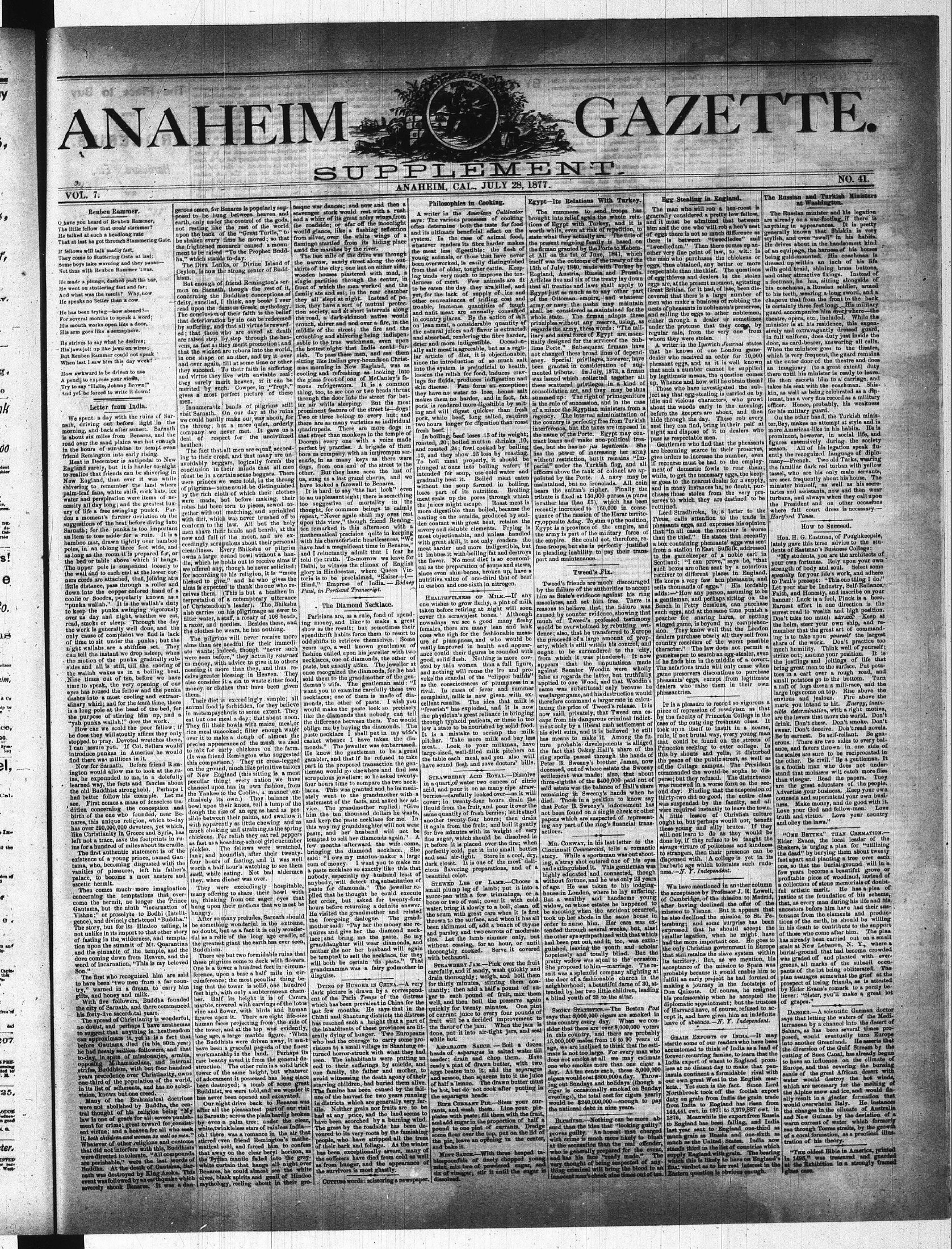
Searchable text
ANAHEIM
VOL. 7.
Renben Rammer.
Q. have you heard of Renben Rammer,
The little fellow that would stammer?
He talked at such a headlong rate
That at last he got through Stammering Gate.
If fellows will talk madly fast,
They come to Stuttering Gate at last;
Some boys take warning and they pause—
Not thus with Renben Rammer 'twas.
He made a plunge, dashed past the bar,
He went on stuttering fast and far;
And what was the result? Why, now
He speaks no better than a cow.
He has been trying—how absurd?
For several months to speak a word;
His mouth works open like a door;
His arm goes like a semaphore.
He strives to say what he desires;
His jaws jolt up like jaw on wires;
But Renben Rammer could not speak.
When last I saw him this day week!
How awkward to be driven to use
A pencil to express your views,
Try to say "Hallo, Johnny Brown!"
And yet be forced to write it down!
Letter from India.
We spent a day with the ruins of Sarnath,
driving out before light in the morning, and back after sunset. Sarnath is about six miles from Benares, and the road over the sand plains was hot enough in the hours of sunshine to tempt even friend Remington into early rising.
Heat in December is antipodal to Newgerous omen, for Benares is popularly supposed to be hung between heaven and earth, only under the control of the gods, not resting like the rest of the world; upon the back of the "Great Turtle," to be shaken every time he moved; so that the frightened monarch caused a monument to be raised "To the Prophet Buddha," which stands to-day.
The Diva Lanka, or Divine Island of Ceylon, is now the strong center of Buddhism.
But enough of friend Remington's sermon on Sarnath, though the rest of it, concerning the Buddhist conceptions of deity, excelled, I think, any book I ever read upon the famous Greek mythology. The conclusion of their faith is the belief that deterioration by sin can be redeemed by suffering, and that all virtue is rewarded; that those who are saved at death are raised step by step through the heavens, as fast as they merit promotion; and that the wicked are reborn into the world, in one shape or another, and try it over and over again, till at some time or other they succeed. To their faith in suffering and virtue they live with enviable zeal; they surely merit heaven, if it can be merited by such. Cowper, in "Truth," gives a most perfect picture of these men.
Inumerable bands of pilgrims still visit Sarnath. On our day at the ruins we could hardly make our way about, for the throng; but a more quiet, orderly company we never met. It gave us a deal of respect for the uncivilized heathen.
The fact that all men are equal, according to their creed, and that many are unavoidably beggars, logically forms the besque war dances; and scavenger stork would and a whirr of its great roadside; or snarf would glance, like a flamingo startled from amid the marshes by the last mile of the narrow, sandy skirts of the city; one wooden houses plastic single partition through front of which the meadow ate and sat; in they all slept at night lice, they have a sort of tion society, and at shine the road, a dark-skin crouch, shiver and no middle of the street; cronching and shivering sable to the true water the hottest night that nish. To pass these r sitting like Italian greas morning in New cooling and refreshing the glass front of one mous refrigerators thing, too, to see one through the door into ter air while sleeping prominent feature of Two or three belong there are as many v quadrupeds. There that street than month Doorga; every one perfect by practise. bore us company wit enade, in as many days from one end
Letter from India.
We spent a day with the ruins of Sarnath, driving out before light in the morning, and back after sunset. Sarnath is about six miles from Benares, and the road over the sand plains was hot enough in the hours of sunshine to tempt even friend Remington into early rising.
Heat in December is antipodal to New England surely, but it is harder to night to realize that friends can be shivering in New England, than ever it was while shivering to remember the land where palm-leaf fans, white suits, cork hats, ice water and perspiration were items of necessity all day long; and the greatest luxury of life a free swinging punka. Paradou a moment’s farther deviation on the suggestions of the heat before diving into Sarnath; for the punka is too important an item to toss aside for a ruin. It is a bamboo mat, drawn tightly over bamboo poles, in an oblong three feet wide, and as long as the room it is prepared for, or the bed or table above which it hangs. The upper pole is suspended loosely to the wall and to each end at the lower corners cords are attached, that, joining at a little distance, pass through a roller and down into the copper colored hand of a coolie or Soodra, popularly known as a "puka wallah." It is the wallah’s duty to keep the punka swinging vigorously over us day and night, whether we eat, read, smoke or sleep. Through the day the work is generally well done, and the only cause of complaint we find is lack of time to sit under the punka; but the night wallahs are a shiftless set. They can tell the instant we drop asleep, when the motion of the punka gradually subsides and all is still, till the sporing of the wallah wakes us in a boiling heat. Nine times out of ten, before we have time to speak, the very opening of our eyes has roused the fellow and the punka dashes into a most cooling and extraordinary whirl; and for the tenth time, there is a long pole at the head of the bed, for the purpose of stirring him up, and a "yah punka wallah!" does the work.
How can we scold the poor fellow; if he does they will stoutly affirm they only stopped to pray. Devoted wretches these, I can assure you. If Col. Sellers would introduce punkas in America he would find there was millions in it.
Now for Sarnath. Before friend Rampton would allow me to look at the ruins, he expounded to me, in a dolefully learned way, the facts and fancies about the old Buddhist stronghold. Perhaps I had better follow his example. Let me see. First comes a mass of senseless tradition concerning the conception and birth of the one who founded, near Benares, this unique religion, which to-day has over 290,000,000 devotees, yet which, like Christianity in Greece and Syria, has left not a trace, save the footprints in ruins for a hundred miles of its cradle.
The first authentic statement is of the existence of a young prince, named Gautama, who, becoming disgusted with the vanities of pleasures, left his father’s palace, to become a most austere and they succeed. To their faith in suffering and virtue they live with enviable zeal; they surely merit heaven, if it can be merited by such. Cowper, in “Truth,” gives a most perfect picture of these men.
Innumerable bands of pilgrims still visit Sarnath. On our day at the ruins we could hardly make our way about, for the throng; but a more quiet, orderly company we never met. It gave us a deal of respect for the uncivilized heathen.
The fact that all men are equal, according to their creed, and that many are unavoidably beggars, logically forms the conclusion in their minds that all men must be in a certain sense beggars. There were princes we were told, in the throng of pilgrims—some could be distinguished by the rich cloth of which their clothes were made, but before making their robes had been torn to pieces, sewed together without matching, and sprinkled with dirt, which was never brushed off to conform to the law. All but the holy men shave their heads and beards, at the new and full of the moon, and are exceedingly scrupulous about their personal cleanliness. Every Bhikshu or pilgrim owns a large round bowl without a handle, which he holds out to receive alms if we offered any, though he never solicited; for according to his religion, it is “more blessed to give,” and he who gives the alms is expected to thank the one who receives them. (This is but a heathen in terpretation of a cotemporary utterance of Christendom’s leader). The Bhikshu also carries on his pilgrimage anew to filter water, a staff, a rosary of 108 beads, a razor, and needles. Besides these, and the clothes he wears, he has nothing.
The pilgrims will never receive more alms than are needful for their immediate wants; indeed, though “never such were seen before,” they actually returned us money, with advice to give it to others needing it more than they, and thus receive greater blessing in Heaven. They also consider it a sin to waste either food, money or clothes that have been given them.
Their diet is exceedingly simple; all animal food is forbidden for they believe in metempsychosis to some extent. They eat but one meal a day; that about noon. They fill their bowls with maize meal, or rice meal uncooked; filter enough water over it to make a dough of almost the precise appearance of the mush we used to mix for early chickens on the farm. (It was friend Remington who suggested: this comparison.) They sit cross-legged on the ground, much like primitive tailors of New England (this sitting is a most peculiar thing; every nation we have chanced upon has its own fashion, from the Yankee to the Coolies, a manner exclusively its own.) They balance the bowl upon their knees, roll a lump of dough the size of an egg as hard as possible between their palms, and swallow it with apparently as little chewing and as much choking and straining, as the spring chickens. For relish they eat red peppers as fast as a boarding-school girl cucumber pickles. The fellows were wretched, lank, and houndish, after their twenty-four hours of fasting, and it was well worth a half hour’s watching to see them swell, while eating. Not bad aldermen they when dinner was over.
The Diamond
Parisians are, as being money,and life show as the result; spendthrift habits for odd shifts to retrieve years ago,a well fashion called upon necklaces,一one of di paste,但exactly once recognized them sold them to the great tleman’s wife.The want you to examine necklaces;one of di monds,the other would make the like the diamonds,the difference between oblige me by buying paste necklace I casket whence I monds.”The jewel He knew the gem gambler,and that part in the proposed tleman would go e scrupulous jeweller four hours time to lace. This was greatly went to tha statement of the fice.Vehe grandi him the ten thouand keep the paste this way my gran paste,and her tempted to sell her few months after bringingthe diaseid:“I owe my sum of money.a paste necklace s nobody,e especially anybody will die
learned way, the facts and theories about the old Buddhist stronghold. Perhaps I had better follow his example. Let me see. First comes a mass of senseless tradition concerning the conception and birth of the one who founded, near Benares, this unique religion, which to-day has over 290,000,000 devotees, yet which, like Christianity in Greece and Syria, has left not a trace, save the footprints in ruins for a hundred of miles about its cradle.
The first authentic statement is of the existence of a young prince, named Gautama, who, becoming disgusted with the vanities of pleasures, left his father's palace, to become a most austere and ascetic hermit.
Then comes much more imagination concerning the temptations that overcome the hermit, no longer the Prince Gautama, but the ninth "incarnation of Vishnu;" or proselyte to Bodhi (Intelligence), and divinely christened "Buddha." The story, but for its Hindoo telling, is not unlike its import to that other story of fasting in the wilderness, and temptation upon the summit of Mt. Quarantina and the pinnacle of the temple, and the dove coming down from Heaven, and the word of incarnation, "This is my beloved Son."
The first who recognized him are said to have been "two men from a far country," warned in a dream to carry him gifts, and honey and milk.
With five followers, Buddha founded the city of Sarnath, and there commenced his forty-five sacerdotal years.
The spread of Christianity is wonderful, no doubt, and perhaps I have anathemas to suggest that anything in heathendom can approximate it, yet it is a fact that before Gautama died (in his 80th year) he had twenty million followers, and that to-day, in spite of missionaries, armies, opposing Mohammedans, and internal strife, Buddhism, with but four hundred years precedence over Christianity, owns one-third of the population of the world, in its list of adherents, and has no subdivision, knows but one creed.
Many of the Brahminical doctrines were not abolished by Buddha, the central thought of his religion being "My law is one of grace for all; severe punishment for crime; great reward for consistent virtue; and a heaven for all who seek it; both children and women as well as men." Whatever of other religions and customs that did not interfere with this, Buddhists were directed to tolerate. "All compounds are perishable," were the last words of Buddha. At the death of Gautama, Sarnath was destroyed by King Asoka. This event was followed by an earthquake which severely shook Buddha. It was a dan-chanced upon has its own fashion, from the Yankee to the Coolie, a manner exclusively its own.) They balance the bowl upon their knees, roll a lump of the dough the size of an egg as hard as possible between their palms, and swallow it with apparently as little chewing and as much choking and straining, as the spring chickens. For relish they eat red peppers as fast as a boarding-school girl cucumber pickles. The fellows were wretched, lank, and houndish, after their twenty-four hours of fasting, and it was well worth a half hour's watching to see them swell, while eating. Not bad aldermen they, when dinner was over.
They were exceedingly hospitable, many offering to share their bowl with us, thinking from our eager eyes that hung upon their motions that we must be hungry.
After so many preludes, Sarnath should be something wonderful in the extreme, no doubt, but as a fact it is only wonderful as a relic of the long ago cradle, of the greatest giant the earth has ever seen, Buddhism.
There are but two formidable ruins that these pilgrims come to deck with flowers. One is a tower a hundred feet in circumference, upon a base a half mile in circumference; the most peculiar thing being that the tower is solid, one hundred feet high, with only a subterranean chamber. Half its height it is of Carara marble, covered with carvings of the lotus vine and flower, with birds and human figures upon it. There are eight life-size human faces projecting from the side of the tower, and at the top was evidently long ago, a large marble figure. When the Buddhists were driven away, it must have been a graceful pagoda of the finest workmanship in the land. Perhaps its rare beauty saved it from the general destruction. The other ruin is a solid brick tower of the same height, but whatever of adornment it possessed has long since been destroyed; a tomb of some great Buddhist, we were told,and we wonder it has never been opened and excavated.
Our night drive back to Benares was after all the pleasantest part of our visit to Sarnath; across the plain hardly broken by even a palm tree; under the clear white twinkleless stars of rainless India—oh! there was a romance in the air that stirred even friend Remington's mathematical soul, and forced him to confess that away on the clear beryl horizon, as the Tyrian mantle faded into the grey-white curtain that hangs all night over Benares, he could almost see the white elves, black spirits and genii of Hindoo mythology, reeling about in their gro-
DYING OF HURT dark picture is sent off of Paris which has been past few months Chihli and Shan has reached such an inhabitant as rarely dying of who had the courage to turn vision to a small turned horror-streem. The inhabitant end to their arduous one family, they avoid witnessing starving children. The famine haunted in districts where tile. Neither had at any price have been scorned. The grass by those vowed to its people, who had their bark has been exceeded the sufferers here as from hungers the survivors here.
IMMIGRATION GAZE SUPPLEMENT.
ANAHEIM, CAL., JULY 28, 1877.
tesque war dances; and now and then a scavenger stork would rest with a rush and a whirr of its great noisy wings, from the roadside; or afar off the moonlight would glance, like a flashing reflection from silver, over the white wings of a flamingo startled from its hiding place amid the marshes by the river.
The last mile of the drive was through the narrow, sandy street along the outskirts of the city; one hut on either side, wooden houses plastered with mud, a single partition through the center, in front of which the men worked and the family ate and sat; in the rear chamber they all slept at night. Instead of police, they have a sort of mutual protection society, and at short intervals along the road, a dark-skinned native would crouch, shiver and nod over a fire, in the middle of the street; the fire and the crouching and shivering being indispensable to the true watchman, even upon the hottest night that India could furnish.
To pass these men, and see them sitting like Italian grey-hounds on Christmas morning in New England, was as cooling and refreshing as looking into the glass front of one of McCauley's famous refrigerators. It is a common thing, too, to see one or two heads thrust through the door into the street for better air while sleeping. But the most prominent feature of the street is—dogs! Two or three belong to every hut; and there are as many varieties as individual quadrupeds. There are more dogs in that street than monkeys in the temple of Doorga; every one with a voice made perfect by practise. A brigade of them bore us company with an impromptu serenade, in as many keys as there were from one end of the street to the
Philosophies in Cooking.
A writer in the American Cullicator says: The various processes of cooking often determine both the taste for food and its ultimate beneficial effect on the system. In the case of animal food, whatever renders its fibre harder makes the meat less digestible; the flesh of young animals, or those that have never been overworked, is easily distinguished from that of older, tougher cattle. Keeping tends very much to improve the tenderness of meat. Few animals are fit to be eaten the day they are killed, and yet, for the lack of supply of ice and other conveniences of trifling cost and trouble, immense quantities of tough and unfit meat are annually consumed in country places. By the action of salt on lean meat, a considerable quantity of the natural juices and flavor is extracted and absorbed, rendering the fibre harder, drier and more indigestible. Occasionally salt meat is agreeable, but as a regular article of diet, it is objectionable, since the introduction of so much salt into the system is prejudicial to health, lessens the relish for food, induces cravings for fluids, produces indigestion and skin disease. Fatts form an exception; they have no water to lose, hence salt makes them no harder, and in fact, fat pork is rendered more digestible by salting and will digest quicker than fresh pork, while beef, long salted, requires two hours longer for digestion than roast fresh beef.
In boiling, beef loses .15 of its weight; roasted ,20; boiled mutton shrinks .10, and roasted .24; fowl cooked by boiling .13, and they show .25 loss by roasting. To boil meat properly, it should be boiled in boiling water; if Egypt—Its Relations With Turkey.
The summons to send troops has brought into relief again the whole relations of Egypt with Turkey, and it is worth while, even at risk of repetition, to state what they actually are. The title of the present reigning family is based on the firman granted by the Porte to Mehmet Ali on the 1st of June, 1841, which itself was the outcome of the treaty of the 15th of July, 1840, made with Turkey by England, Anatria, Russia and Prussia. Articles five and six of the treaty lay down that all treaties and laws shall apply to Egypt just as much as to any other part of the Ottoman empire, and whatever army or navy the passha may maintain shall be considered as maintained for the whole state. The firman adopts these principles without any reserve, using, as regards the army, these words: "The military and naval force of Egypt are essentially designed for the service of the Sublime Porte." Subsequent firmans have not changed these broad lines of dependency. Special privileges, however, have been granted in consideration of augmented tribute. In July, 1873, a firman was issued which collected together all these scattered privileges in a kind of consolidation act, and they may be thus summed up: The right of primogeniture is the rule of succession, and in the case of a minor the Egyptian ministers from a regency. The internal administration of the country is perfectly free from Turkish interference, but the taxes are imposed in the name of the Porte. Egypt may contract loans and make non-political treaties, but she has no jus legationis. She has the power of increasing her army without restriction, but it remains "Imperial" under the Turkish flag, and all
Eggs.
The man generally gives him and his eggs there is "tweedled other very" the man with eggs; thus respectable of egg thieves of plants and sellings either under their regular whom they whom that he dealer wipe pheasant that such by legitim化 up. When those object say they idle and about before they hide their nest they night and pass as well.
Gentle are become give order if recourse
The Diamond Necklace.
Parisians are, as a rule, fond of spending money, and like to make a great show as the result; but sometimes their spendthrift habits force them to resort to old shifts to retrieve themselves. Some years ago, a well known gentleman of fashion called upon his jeweller with two necklaces, one of diamonds, the other of paste, but exactly alike. The jeweller at once recognized the diamonds, for he had sold them to the grandmother of the gentleman's wife. The gentleman said: "I want you to examine carefully these two necklaces; one of them is made of diamonds, the other of paste. I wish you would make the paste look so precisely like the diamonds that nobody can tell the difference between them. You would oblige me by buying the diamonds. The paste necklace I shall put in my wife's casket whence I have taken the diamonds." The jeweller was embarrassed. He knew the gentleman to be a great gambler, and that if he refused to take part in the proposed transaction the gentleman would go elsewhere and find less scrupulous jewellers; so he asked twenty-four hours time to compare the two necklaces. This was granted and he immediately went to the grandmother with a statement of the facts, and asked her advice. The grandmother replied: "Give him the ten thousand dollars he wants, and keep the paste necklace for me. In this way my granddaughter will not wear paste, and her husband will not be tempted to sell her diamonds again."
A few months afterward the wife come, bringing the diamond necklace. She said: "I love my mantua-maker a large sum of money. I want you to make me a paste necklace so exactly like this that nobody, especially my husband least of anybody will detect the substitution into the system is prejudicial to health, lessens the relish for food, induces cavities for fluids, produces indigestion and skin disease. Fats form an exception; they have no water to lose, hence salt makes them no harder, and in fact, fat pork is rendered more digestible by salting and will digest quicker than fresh pork, while beef, long salted, requires two hours longer for digestion than roast fresh beef.
In boiling, beef loses .15 of its weight; roasted ,20; boiled mutton shrinks .10, and roasted .24; fowl cooked by boiling .13, and they show .25 loss by roasting. To boil meat properly, it should be plunged at once into boiling wafer; if intended for soup, use cold water and gradually heat it. Boiled meat eaten without the soup formed in boiling, loses part of its nutrition. Broiling meat seals up the pores through which the juices might escape. Roast meat is more digestible than boiled, because the coating on the outside, produced by sudden contact with great heat, retains the savory and saluble elements. Frying is most objectionable, and unless handled with great skill, it not only renders the meat harder and more indigestible, but it imbues it with boiling fat and destroys the flavor. No meat diet is so economical as the preparation of soups and stews, since even shin-bones, broken up, have a nutritive value of one-third that of beef in carbon and one-sixth in nitrogen.
HEALTHFULNESS OF MILK.—If any one wishes to grow flechy, a pint of milk taken before retiring at night will soon cover the scrawniest bones. Although nowadays we see a good many fleshy females, there are many lean and lank ones who sigh for the fashionable measure of plumpness, and would be vastly improved in health and appearance could their figures be rounded with good, solid flesh. Nothing is more coveted by thin women than a full figure, and nothing will rouse the ire and provoke the scandal of the "clipper builds" as the consciousness of plumpeness in a rival. In cases of fever and summer complaint, milk is now given with excellent results. The idea that milk is "feverish" has exploded, and it is now the physician's great reliance in bringing through typhoid patients, or those in too low a state to be nourished by solid food. It is a mistake to scrimp the milk pitcher. Take more milk and buy less meat. Look to your milkman, have large-sized, well-filled milk pitchers on the table each meal, and you also will have sound flesh and save doctors' bills.
STRAWBERRY ACID ROYAL.—Dissolve in a quart of water two ounces of citric acid, and pour it on as many ripe strawberries—carefully looked over—as it will cover; in twenty-four hours drain the liquid from the fruit, and pour it over the same quantity of fresh berries; let it stand another twenty-four hours; then drain it again from the fruit; and boil it gently for five minutes with its weight of very fine sugar, which should be dissolved in it before it is placed over the fire; when perfectly cold, put it into small bottles and seal air-tight. Store in a cool, dry, dark closet. It is one of the most delicious preparations, and of a beautiful color.
MR. CONWAY, in his last letter to the Cincinnati Commercial, tells a romantic story. While a sportsman was out shooting, a stray shot entered one of his eyes and extinguished it. This gentleman was highly educated and connected, though without fortune, and he was only 28 years
Dying of Hunger in China. A very dark picture is drawn by a correspondent of the Paris Temps of the distress which has been prevalent in China for the last few months. He says that in the Chihli and Shantung districts the distress has reached such a height that a part of the inhabitants of these provinces are literally dying of hunger. Two Europeans who had the courage to carry some provisions to a small village in Shantung returned horror-struck with what they had seen. The inhabitants were putting an end to their sufferings by suicide, and one family, the father and mother, to avoid witnessing the death agony of their starving children, had buried them alive. The famine has been caused by the failure of the harvest for two years running in districts which are generally very fertile. Neither grain nor fruits are to be had at any price, and the land seems to have been scorched by a burning wind. The grass by the roadside has been devoured to its very roots by the famishing people, who have stripped all the trees of their bark and foliage. As the winter has been exceptionally severe, many of the sufferers have died from cold as well as from hunger, and the appearance of the survivors is most ghastly.
Currents words: scissoring a newspaper.
Stewed Leg of Lamb. Choose a small plump leg of lamb; put it into a sauce-pan with a few trimmings, or a bone or two of veal; cover it with cold water, bring it slowly to a boil, clean off the scum with great care when it is first thrown to the surface, and when it has all been skimmed off, add a bunch of thyme and parsley and two carrots of moderate size. Let the lamb simmer only, but without ceasing, for an hour, or until thoroughly cooked. Serve it covered with beechamel.
Strawberry Jam. Pick over the fruit carefully, and if sandy, wash quickly and drain thoroughly; weigh, and boil them for thirty minutes, stirring them constantly; then add a half pound of sugar to each pound of fruit, mix them well, and then boil the preserve again quickly for twenty minutes. One pint of currant juice to every four pounds of fruit will be a decided improvement to the flavor of the jam. When the jam is done, put it into air-tight jars, and seal while hot.
Asparagus Sauce. Boil a dozen heads of asparagus in salted water till tender; drain and chop them. Have ready a pint of drawn butter, with two eggs beaten into it; add the asparagus and season, then squeeze into it the juice of half a lemon. The drawn butter must be hot, but do not cook after putting in the asparagus heads.
Ripe Currant Pie. Stem your currants, and wash them. Line your pieplates with paste; fill them with the fruit, and add sugar in the proportion of half a pound to one pint of currants. Dredge some flour over the top, put on the lid of the pie, leave an opening in the center, and bake it.
Mint Sauce. With three heaped tablespoonfuls of finely chopped young mint, mix two of powdered sugar, and six of vinegar; stir it until the sugar is dissolved.
Mr. Conway, in his last letter to the Cincinnati Commercial, tells a romantic story. While a sportsman was out shooting, a stray shot entered one of his eyes and extinguished it. This gentleman was highly educated and connected, though without fortune, and he was only 28 years of age. He was taken to his lodging-house in London, where he lay suffering. But a wealthy and handsome young widow, on whose estates he happened to be shooting when the accident occurred, took up her abode in the same house in order to nurse him. Her care was extended through several weeks, but, alas! the other eye sympathized with that which had been put out, and it, too, was extinguished, leaving the youth and scholar hopelessly and totally blind. But the pretty widow was equal to the occasion. She proposed to him—marriage. The result was a splendid company alighting at the door of a fashionable church in the neighborhood; a beautiful dame of 30, attended by her two little children, leading a blind youth of 23 to the altar.
Smoky Statistics. The Boston Post says that 8,000,000 cigars are smoked in this country every day. When we consider that there are over 8,000,000 voters in this country, and there are probably 15,000,000 males from 16 to 90 years of age, we are inclined to think that the estimate is not too large. For every man who does not smoke at all we may estimate one who smokes more than one cigar a day. At ten cents each, these 8,000,000 cigars would cost $800,000 a day. Throwing out Sundays and holidays (though a cigar is occasionally smoked on Sunday evenings), the total cost for cigars yearly would be $240,000,000—enough to pay the national debt in nine years.
Blushing. Nothing can be more absurd than the idea that "looking guilty" proves guilty. An honest man charged with crime is much more likely to blush at the accusation than the real offender, who is generally prepared for the event, and has his face "ready made." The very thought of being suspected of anything criminal will bring the blood to an innocent man's cheek nine times out of ten.
GAZETTE.
NO. 41.
With Turkey.
and troops has
the whole relation, and it is
of repetition, to
share. The title of
this is based on
Porte to Mehmence, 1841, which
of the treaty of the
with Turkey by
Britain and Prussia.
The treaty lay down
shall apply to
any other part,
and whatever
may maintain
maintained for the
man adopts these
preserve, using, as
words: "The milEgypt are essenservice of the Subtenant firmans have
all lines of dependences, however, have
operation of auguly, 1873, a firman
acted together all
ages in a kind of
they may be thus
of primogeniture,
and in the case
ministers from a
administration of
free from Turkish
exes are imposed in
Egypt may conmon-political treatectionis. She
increasing her army
it remains "Immish flag, and all
Egg Stealing in England.
The man who will rob a hen-roost is generally considered a pretty low fellow,
and it must be admitted that between him and the one who will rob a hen's nest of eggs there is not so much difference as there is between "tweedledee" and "tweedledam." Then there comes up another very fine point of law, to wit: Is the man who purchases the chickens or eggs, thus obtained, any better or more respectable than the thief. The questions of egg thieves and dealers in the stolen eggs are at the present moment, agitating Great Britian, for it had, of late, been discovered that there is a large number of men who make a business of robbing the nests of pheasants in noblemen's preserves, and selling the eggs to other noblemen, either through a dealer or sometimes under the pretense that they come, by regular sale, from the very one from whom they were stolen.
A writer in the Ipswich Journal states that he knows of one London game-dealer who received an order for 10,000 pheasant eggs, and as it is well known that such a number cannot be supplied by legitimate means, the question comes up. Whence and how will he obtain them?
Those who have investigated the subject say that egg-stealing is carried on by idle and vicious characters, who prowl about the woods early in the morning, before the keepers are about, and then hide through the day. These rob every nest they can find, bring in their pelf at night and dispose of it to dealers who pass as respectable men.
Gentlemen who find that the pheasants are becoming scarce in their preserves, give orders to increase the number, even if recourse must be had to the employ-
The Russian and Turkish Ministers at Washington.
The Russian minister and his legation are already on a war-footing, if there is anything in appearances. It is pretty generally known that Shiskin is very stylish, and even "swell" in his habits. He drives about in the handsome kind of an equilpage, the harness of his horses being gold-mounted. His coachman is dressed up within an inch of his life with gold braid, shining brass buttons, and other attractive fixings. Instead of a footman, he has, sitting alongside of his coachman, a Russian soldier, armed to his teeth, wearing a long sword, and a chapeau that from the front to the back is certainly three feet long. His military guard accompanies him everywhere—the theatre, opera, etc., included. While the minister is at his residence, this expensively and extravagantly dressed guard, in full uniform, does duty just inside the door, as card-bearer, answering all calls. When the minister goes to the theatre, which is very frequent, the guard remains at the outer door of the theatre and does an imaginary (to a great extent) duty there until his minister is ready to leave. He then escorts him to a carriage, and takes his seat with the coachman. Shiskin, as well as being celebrated as a diplomat, has a very fine record as a military officer. Hence, probably, his weakness for his military guard.
On the other hand, the Turkish minister,Bey,makes no attempt at style and is more American-like in his habits. He is prominent, however, in social life,and figures extensively during the society season. All of his legation speak fluently the recognized language of diplomacy—French. Two old Turks, wearing
In Fix.
Much discouraged authorities to accept the fight against his ring free. There is that the failure was evidence, showing that professed testimony led by rebutting evi-transferred to Europe the amount of prophethin his control, and ordered to the city, plundered. It now imputations made Woodin were wholly matter, but truthfully, and that Woodin's aid only because he his destruction would larger rate in calculation's release. It is that Tweed can es-sous criminal indictal cash settlement of is believed he still it. Among the fu-lopments is alleged Hall's share of the through the hands of brother James, now vice estate the Sweeny era; also, that about $400,000 paid out of balance of Hall's share one's hands when he position to know say July's indorsement has single check or other expected of representing's financial trans-
This last letter to the special tells a romantic Hartman was out shootered one of his eyes. This gentleman was had connected, though he was only 23 years old.
It is a pleasure to record so vigorous a piece of repression of rowdyism as that by the faculty of Princeton College in the case of the outgoing freshman class. It took upon itself to insult in a coarse, rule, if not brutal way, every young man that could be found on the streets of Princeton seeking to enter college. In this by shouts and yells, it disturbed the peace of the public street, as well as of the College campus. The President commanded the would-be sophs to disperse; but they refused. The disturbance was renewed in a worse form on the second day. Finding that the suspension of thirty-two did no good, the entire class was suspended by the faculty, and all were required instantly to leave the town. A little lesson of Christian culture ought to, but perhaps would not, benefit these young and silly brutes. If they will not learn to do as they would be done by, if they refuse to be taught the savage virtue of politeness and kindness to strangers, then their presence can be dispensed with. A college is yet in its barbaric age which tolerates such rudeness.—N.Y. Independent.
"One Better" than Creation.—Elder Evans, the local leader of the Shakers, is urging a plan for "utilizing the dead" by burying them about twenty feet apart and planting a tree over each one, so that the burial-ground will in a few years become a beautiful grove or profitable piece of woodland, instead of future memorials of doubt-an imaginary (to a great extent) duty there until his minister is ready to leave. He then escorts him to a carriage, and takes his seat with the coachman. Shikin, as well as being celebrated as a diplomat, has a very fine record as a military officer. Hence, probably, his weakness for his military guard.
On the other hand, the Turkish minister,Bey, makes no attempt at style and is more American-like in his habits. He is prominent, however, in social life, and figures extensively during the society season. All of his legation speak fluently the recognized language of diplomacy—French. Two old Turks, wearing the familiar dark red turban with yellow tassel, who are his only male servants, are seen frequently about his house. The minister himself, as well as his secretaries and assistants, now and then wear turbans, and always when they call upon the President and on other occasions where full court dress is necessary.—Hartford Times.
How to Succeed.
Hon. H. G. Eastman, of Poughkeepsie, lately gave this terse advice to the students of Eastman's Business College:
"My students, you are the architects of your own fortunes. Rely upon your own strength of body and soul. Select some specially for your life's work, and adhere to Paul's precept: 'This one thing I do.' Let your star be Industry, Self-Reliance, Faith, and Honesty, and inscribe on your banner: Luck is a fool, Pluck is a hero. Earnest effort in one direction is the surest road to wealth and high position. Don't take too much advice. Keep at the helm, steer your own ship, and remember that the great art of commanding is to take upon yourself the largest share of the work. Don't practice too much humility. Think well of yourself; strike out; assume your position. It is the jostlings and joltings of life that bring great men to the surface. Put potatoes in a cart over a rough road, and small potatoes go to the bottom. Turn a raft of logs down a mill-race, and the large logs come on top. Rise above the envious and jealous. Fire above the mark you intend to hit. Energy, insincible determination, with a right motive, are the levers that move the world. Don't drink. Don't chew. Don't smoke. Don't swear. Don't deceive. Don't read novels. Be in earnest. Be self-reliant. Be generous. There are two sides to every balance, and favors thrown in one side of the scales are sure to be reciprocated in the other. Be civil. Be a gentleman. It is a foolish man who does not understand that molasses will catch more flies than vinegar. Read the papers. They are the great educators of the people. Advertise your business. Keep your own counsels and superintend your own business. Make money, and do good with it. Love your God and fellow-men. Love truth and virtue. Love your country and obey the laws."
"One Better" than Creation.
Elder Evans, the local leader of the Shakers, is urging a plan for "utilizing the dead" by burying them about twenty feet apart and planting a tree over each one, so that the burial-ground will in a few years become a beautiful grove or profitable piece of woodland, instead of future memories of doubt-
This last letter to the
special, tells a romantic
artist was out shootered one of his eyes.
This gentleman was
and connected, though
he was only 28 years
kken to his lodginghere he lay sufferingand handsome young
states he happened to
the accident occurred,
in the same house in
Her care was external weeks, but, alas,
utilized with that which
and it, too, was extincate youth and scholar
totally blind. But the
equal to the occasion.
—marriage. The recompany alighting at
monable church in the
beautiful dame of 30, at
little children, leading
to the altar.
We have mentioned in another column
the acceptance by Professor J. R. Lowell,
of Cambridge, of the mission to Madrid,
after having declined the offer of the
mission to Vienna. But it appears that
he also declined the mission to St. Petersburg;
and some surprise has been expressed that he should accept the smaller legation, when he might have had the more important one. He goes to
the only Christian government in Europe that still retains the slave system within its territory. But, as we mention, his acceptance of the mission to Spain was probably because it would enable him to fulfill an early project he had formed of making a journey in the footsteps of Don Quixote. Of course, he resigned his professorship when he accepted the diplomatic appointment; but the trustees of Harvard have, of course, refused to accept it, and have given him an indefinite leave of absence. —N. Y. Independent.
GRAIN EXPORTS OF INDIA — It may startle some of our readers who have been accustomed to think of India as a land of forever-recurring famine, to learn that the India export of wheat to England promises at no distant day to make that peninsula continent a formidable rival with our own great West in the English markets. Yet such is the fact. Since Lord Northbrook took off the foolish export duty on grain from India the grain trade from India to England has risen from 144,441 cwt. in 1871 to 3,279,887 cwt. in 1876. Meanwhile the export from Russia to England has been falling, and India last year sent to England one-third as much grain as Russia and one-sixth as much as the United States. India now stands third in the list of countries which supply England with grain. The hearing which this is likely to have on England's final verdict as to her real interest in the Eastern question is obvious enough.
"ONE BETTER" THAN CREMATION. — Elder Evans, the local leader of the Shakers, is urging a plan for "utilizing the dead" by burying them about twenty feet apart and planting a tree over each one, so that the burial-ground will in a few years become a beautiful grove or profitable piece of woodland, instead of a collection of stone memorials of doubtful artistic merit. He has a plea of justice at the foundation of his scheme, that, as every man during his life and his ancestors before him have had their sustenance from the elements and productions of the earth, he should be willing in his death to contribute to the support of those who come after him. The plasa has already been carried out on a small scale at New Lebanon, N. Y., where a burial-ground that had become crowded was graded off and planted with evergreen, all marks of the subsoil occupants of the lot being obliterated. The plan assages somewhat the grief at the prospect of losing friends, as is attested by Elder Evans's remark to a portly believer: "Sister, you'll make a great lot of grapes."
DANGER. — A scientific German doctor says that letting the waters of the Mediterranean by a channel into the desert of Sahara, as has been several times proposed, would eventually turn Europe into another Greenland. He asserts that the diversion of the Gulf Stream by the cutting of Suez Canal, has already begun to have an influence on the climate of Europe, and that covering the burning sands of the great African desert with water would destroy the hot winds, which are necessary for the melting of the Alpine snow and ice, and would finally result in a glacier formation that would overwhelm Italy. He instances the changes in the climate of Australia and New Guinea by the deviation of a warm current of water which formerly ran through Torres straits, by the growth of a coral formation, as a practical illustration of his theory.
"The oldest Bible in America, printed in 1495," was treasured and guarded at the Exhibition in a strongly framed glass case.