anaheim-gazette 1877-07-28
Scanned page
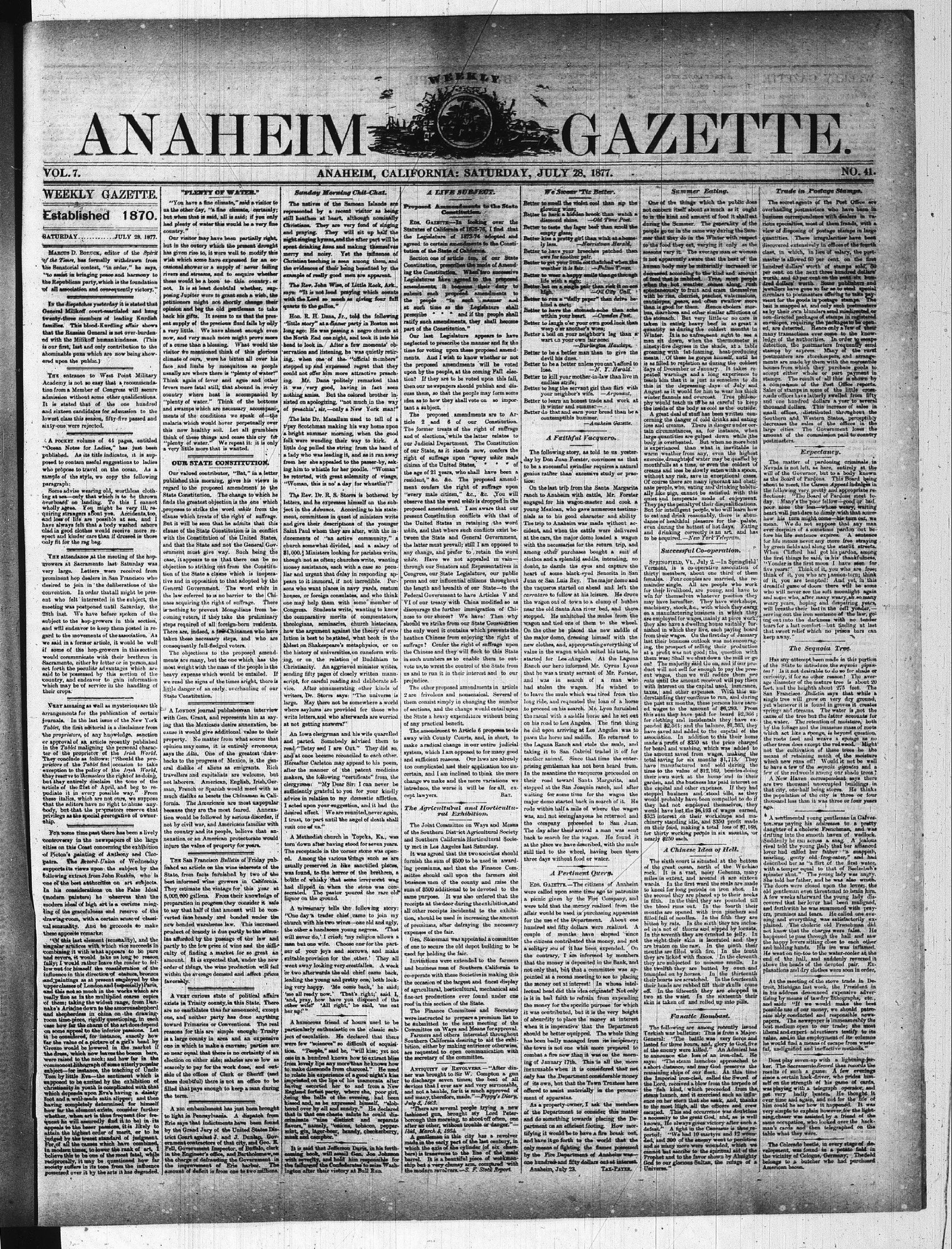
Searchable text
ANAHEIM
VOL. 7.
WEEKLY GAZETTE.
Established 1870.
SATURDAY...JULY 28, 1877.
MARGUS D. BORUCK, editor of the Spirit of the Times, has formally withdrawn from the Senatorial contest, "in order," he says, "to assist in bringing peace and harmony to the Republican party, which is the foundation of all association and consequently victory."
In the dispatches yesterday it is stated that General Millkoff court-martialed and hung twenty-three members of leading Kurdish families. This blood-Kurdling affair shows that the Russian General is not over-burdened with the Millkoff humankindness. (This is our first, last and only contribution to the abominable puns which are now being showered upon the public.)
The entrance to West Point Military Academy is not so easy that a recommendation from a Member of Congress will secure admission without some other qualifications. It is stated that of the one hundred and sixteen candidates for admission to the lowest class this season, fifty-five passed and sixty-one were rejected.
A pocket volume of 44 pages, entitled "Ocean Notes for Ladies," has just been published. As its title indicates, it is supposed to contain useful suggestions to ladies.
"PLENTY OF WATER."
"You have a fine climate," said a visitor to us the other day, "a fine climate, certainly; but when that is said, all is said; if you only had plenty of water this would be a very fine country."
Our visitor may have been partially right, but in the outcry which the present drought has given rise to, it were well to modify this wish which some have expressed for an occasional shower or a supply of never failing rivers and streams, and to enquire whether these would be a boon to this country or not. It is at least doubtful whether, supposing Jupiter were to grant such a wish, the petitioners might not shortly change their opinion and beg the old gentleman to take back his gifts. It seems to us that the present supply of the precious fluid fails by only a very little. We have almost enough even now, and very much more might prove more of a curse than a blessing. What would the visitor we mentioned think of this glorious climate of ours, were he bitten all over his face and limbs by mosquitoes as people usually are where there is "plenty of water?" Think again of fever and ague and other fevers more fatal still, that abound in every country where heat is accompanied by "plenty of water." Think of the bottoms and swamps which are necessary accompaniments of the conditions we speak of—the malaria which would hover perpetually over this now healthy soil. Let all grumblers think of these things and cease this cry for "plenty of water." We repeat it: it is only a very little more that is wanted.
OUR STATE CONSTITUTION.
The entrance to West Point Military Academy is not so easy that a recommendation from a Member of Congress will secure admission without some other qualifications. It is stated that of the one hundred and sixteen candidates for admission to the lowest class this season, fifty-five passed and sixty-one were rejected.
A pocket volume of 44 pages, entitled "Ocean Notes for Ladies," has just been published. As its title indicates, it is supposed to contain useful suggestions to ladies who propose to travel on the ocean. As a sample of the style, we copy the following paragraph:
Some advise wearing old, worthless clothing at sea—only that which is to be thrown overboard on landing. To this I cannot wholly agree. You might be very ill, requiring strangers about you. Accidents, too, and loss of life are possible at sea, and I have always felt that a body washed ashore clad in good clothes would receive more respect and kinder care than if dressed in those only fit for the rag bag.
The attendance at the meeting of the hop-growers at Sacramento last Saturday was very large. Letters were received from prominent hop dealers in San Francisco who desired to join in the deliberations of the convention. In order that all might be present who felt interested in the subject, the meeting was postponed until Saturday, the 28th inst. We have before spoken of the subject to the hop-growers in this section, and will endeavor to keep them posted in regard to the movements of the association. As we said in a former article, it would be well if some of the hop-growers in this section would communicate with their brethren in Sacramento, either by letter or in person, and set forth the peculiar advantages which are said to be possessed by this section of the country, and endeavor to gain information which may be of service in the handling of their crops.
Very amusing as well as mysterious are the arrangements for the publication of certain journals. In the last issue of the New York Tablet, the first editorial is a disclaimer from the proprietors, of any knowledge sanction or approval of an article recently published in the Tablet maligning the personal character of the proprietor of the Irish World. They conclude as follows: "Should the proprietors of the Tablet find occasion to take exception to the policy of the Irish World, they reserve to themselves the right of doing, but they entirely disclaim the tone of the article of the 21st of April, and beg to repudiate it in every possible way." From these italics, which are not ours, we suppose that the editors have no right to abuse anybody, but that the proprietors reserve that privilege as the special prerogative of ownership.
For some time past there has been a lively controversy in the newspapers of the large cities on this Coast concerning the exhibition of Picton's painting of Anthony and Cleopatra. The Record-Union of Wednesday supports its views upon the subject by the following extract from John Ruskin, who is one of the best authorities on art subjects.
Our valued contributor, "Bat," in a letter published this morning, gives his views in regard to the proposed amendment to the State Constitution. The change to which he finds the greatest objection is the one which proposes to strike the word white from the clause which treats of the right of suffrage. But it will be seen that he admits that this clause of the State Constitution is in conflict with the Constitution of the United States, and that the State and not the General Government must give way. Such being the case, it appears to us that there can be no objection to striking out from the Constitution of the State a clause which is inoperative and in opposition to that adopted by the General Government. The word white in the law referred to is no barrier to the Chinese acquiring the right of suffrage. There is nothing to prevent Mongolians from becoming voters, if they take the preliminary steps required of all foreign-born residents. There are, indeed, a few Chinamen who have taken these necessary steps, and who are consequently full-fledged voters.
The objections to the proposed amendments are many, but the one which has the most weight with the mass of people is the heavy expense which would be entailed. If we read the signs of the times aright, there is little danger of an early overhauling of our State Constitution.
A London journal publishes an interview with Gen. Grant, and represents him as saying that the Mexicans desire annexation, because it would give additional value to their property. No matter from what source that opinion may come, it is entirely erroneous, says the Alta. One of the greatest drawbacks to the progress of Mexico, is the general dislike of aliens as emigrants. Rich travellers and capitalists are welcome, but not laborers. American, English, Irish, German, French or Spanish would meet with as much dialike as besets the Chinaman in California. The Americans are most unpopular because they are the most feared. Annexation would be followed by serious disorder, if not by civil war, and Americans familiar with the country and its people, believe that annexation or an American protectorate would injure the value of property for years.
The San Francisco Bulletin of Friday published an article on the wine interests of the State, from facts furnished by two of the best informed wine growers in California.
Our state constitution.
Our state constitution.
Our state constitution.
Our state constitution.
Our state constitution.
Our state constitution.
Our state constitution.
Our state constitution.
Our state constitution.
Our state constitution.
Our state constitution.
Our state constitution.
Our state constitution.
Our state constitution.
Our state constitution.
Our state constitution.
Our state constitution.
Our state constitution.
Our state constitution.
Our state constitution.
Our state constitution.
Our state constitution.
Our state constitution.
Our state constitution.
Our state constitution.
Our state constitution
The late Dr. Macallum uses pay Scotchman making his bright summer morning; folk were wending their wrist little dog pulled the string a lady who was leading it; a man from her she appealed to her retorted, with great solace; "Woman, this is no' a day."
The Rev. Dr. R. S. Storr letters, and he expresses himselfject in the Advance. Accountment, committees in quest ooand give their descriptionsSaint Paul whom they are adductionsof "an active church somewhat divided,$1,000.; Ministers looking for though not as often; churches money assistance; each with liar and urgent that delay inpearsa to it immoral; if not sons who want places in navieshouses, or foreign consulatesone may help them withCongress. Students write;the comparative meritsoftheologians, seminaries,cliowhowthe argument against thlution is best to be statedwablest on Shakespeare's methehistory of universities;on ing.or on the relation oChristianity. An aggrieved sending fifty pages of closelyscript, for careful reading and vice. After ennumeratingwriters, Dr. Storr says: "large.May there not be sowhere saylums are providedwrite letters,and who afteratnot getting answers."
An Iowa clergyman and hadd parted. Somebody adread,"Betsy and I are Outandand at once became reconciledHereafter Carleton may applaureafter the manner ofthe makers,the following"cerclygmans: "My Dear Sir: sufficiently grateful to youadvice in relation to my doI acted upon your suggestiondesired effect.We are reunI trust,tot part untilthe ansvisit one of us."
A Methodist church in Torn down after having stood.The receptacle in the corner.ed.Among the various things preservedin like was found,tothe horrorofbottleof whiskythat some
For some time past there has been a lively controversy in the newspapers of the large cities on this Coast concerning the exhibition of Picton's painting of Anthony and Cleopatra. The Record-Union of Wednesday supports its views upon the subject by the following extract from John Ruakin, who is one of the best authorities on art subjects. In his considerations on the False Ideal (modern painters) he observes that the modern ideal of high art is a curious mingling of the gracefulness and reserve of the drawing-room, with a certain sense of classical sensuality. And he proceeds to make these apposite remarks:
"Of this last element (sensuality), and the singular artifacts with which vice succeeds in combining it with what appears to be pure and severe, it would take us long to reason fully; I would rather leave the reader to follow out for himself the consideration of the influence in this direction of statues, bronzes and paintings as at present employed by the upper classes of London and (especially) Paris, and this not so much in the works which are really fine as in the multiplied coarse copies of them; taking the widest range, from Danmake's Ariadne down to the amorous shepherd and shepherdess in china on the drawing-room time-piece, rigidly questioning, in each case how far the charm of the art does depend on some appeal to the inferior passions. Let it be considered, for instance, exactly how far the value of a picture of a girl's head by Grenzo would be lowered in the market if the dress, which now leaves the bosom bare, were raised to the neck; and how far in the commonest lithograph of some utterly popular subject—for instance, the teaching of Uncle Tom by little Eva—the sentiment which is supposed to be excited by the exhibition of Christianity in youth is complicated with that which depends upon Eva's having a daunting foot and a well-made satin slipper; and then having completely determined for himself how far the element exists, consider further whether, when art is thus frequent (for frequent he will assuredly find it to be) in its appeals to the baser passions, it is likely to attain the highest order of merit, or to be judged by the trust standard of judgment. For, of all the causes which have combined, in modern times, to lower the rank of art, I believe this to be one of the most fatal, while reciprocally, it may be questioned how far society suffers in its tone from the influence possessed over it by the arts it has degraded.
The San Francisco Bulletin of Friday published an article on the wine interests of the State, from facts furnished by two of the best informed wine growers in California. They estimate the vintage for this year at 8,000,000 gallons. From their knowledge of preparation in progress they consider it safe to say that half of that amount will be converted into brandy and bonded under the new bonded warehouse law. This increased product of brandy is due partly to the stimulus afforded by the passage of the law and partly to the low price of wine and the difficulty of finding a market for so great an amount. It is expected that, under the new order of things, the wine production will fall within the average demand and affect prices favorably.
A very curious state of political affairs exists in Trinity county, in this State. There are no candidates thus far announced, except one, and neither party has done anything toward Primaries or Conventions. The real reasons for this are simple enough: Trinity is a large county in area and an expensive one in which to make a canvass; parties are so near equal that there is no certainty of an election on either side; salaries are so low as scarcely to pay for the work done, and outside of the offices of Clerk or Sheriff (and these doubtful) there is not an office to be filled that pays enough to keep a man during the term.
A big embazlement has just been brought to light in Pennsylvania. A dispatch from Erie says that indictments have been found by the Grand Jury of the United States District Court against J. and J. Dunlap, Government contractors of that city, and Goo. K. Fall, Government Inspector, of Buffalo, clark in the Engineer's office, and Bartholomew, on the charge of defrauding the Government in the improvement of Erie harbor. The amount of deficit is from one to two millions.
SUNDAY MORNING CHIT-CHAT.
The natives of the Samean Islands are represented by a recent visitor as being still heathen at heart, although nominally Christians. They are very fond of singing and praying. They will sit up half the night singing hymns, and the after part will be spent drinking kins and making themselves merry and noisy. Yet the influence of Christian teaching is seen among them, and the evidences of their being benefited by the example of really good men are apparent.
The Rev. John Wise, of Little Rock, Ark., says: "It is not lead praying which counts with the Lord so much as giving four full quarts to the gallon."
Hon. R. H. Dana, Jr., told the following "little story" at a dinner party in Boston not long ago: He was passing a negro church at the North End one night, and took it into his head to look in. After a few moments' observation and listening, he was quietly retiring, when one of the "official members" stepped up and expressed regret that they could not offer him more attractive preaching. Mr. Dana politely remarked that it was very good, having in fact seen nothing amiss. But the colored brother insisted on apologizing, "not much in the way of preachin', air—only a New York man!"
The late Dr. Macallum used to tell of a tripy Scotchman making his way home upon a bright summer morning, when the good folk were wending their way to kirk. A little dog pulled the string from the hand of a lady who was leading it, and as it ran away from her she appealed to the passer-by, ask-
A LIVE SUBJECT.
Proposed Amendments to the State Constitution.
Edna Gazette—In looking over the Statutes of California of 1875-76, I find that the Legislature of 1873-74 adopted and agreed to certain amendments to the Constitution of the State of California.
Section one of article ten, of our State Constitution, prescribes the mode of Amending the Constitution. When two successive Legislatures have agreed to the proposed amendments, it becomes their duty to submit such proposed amendments to the people "in such manner and at such time as the Legislature shall prescribe * * * * and if the people shall ratify such amendments, they shall become part of the Constitution."
Our last Legislature appears to have neglected to prescribe the manner and fix the time for voting upon these proposed amendments. And I wish to know whether or not the proposed amendments will be voted upon by the people, at the coming Fall election? If they are to be voted upon this fall, then our newspapers should publish and discuss them, so that the people may form some idea as to how they shall vote on so important a subject.
The proposed amendments are to Article 2 and 6 of our Constitution. The former treats of the right of suffrage and of elections, while the latter relates to our Judicial Department. The Constitution of our State, as it stands now, confers the right of suffrage upon "every white male citizen of the United States."
We Swear Tic Better.
Better to small the violet cool than sip the glowing wine;
Better to hark a hidden brook than watch a diamond shine. —Old Time Post.
Better to taste the lager beer than smell the empty glass;
Better kiss a pretty girl than wink at a homely lace. —Norristown Herald.
Better to have your breeches patched than owe for another pair.
Better to get your little cot thatched when the weather it is fair. —Pulham Terrace.
Better to wear a happy smile than go through life with a sight.
Better hat on a single pair than risk it on eye high. —Oil City Call.
Better to run a "daily paper" than drive behind a cart.
Better to have the stomach ache than ache within your heart. —Camden Post.
Better to laugh oar your own good luck than weep oar another's woes.
Better a ball on your neighbor's lag than a wart on your own fair nose. —Burlington Hawley.
Better to be a better man than to give the devil his dues.
Better to be a better unless you can't afford to lose. —N. Y. Harold.
Better to kill your mother-in-law than live in endless strife;
Better to hug the servant girl than flirt with your neighbor's wife. —Argonaut.
Better to learn an honest trade and work at its winter and summer. —Better do that and earn your bread than be a contemptible bummer. —Anheim Gazette.
A Faithful Vacquero.
The following story, as told to us yesterday by Don Juan Forater, convinces us that
The late Dr. Macallum used to tell of a pay Scotchman making his way home upon a bright summer morning, when the good folk were wending their way to kirk. A little dog pulled the string from the hand of a lady who was leading it, and as it ran away from her she appealed to the passer-by, asking him to whistle for her poole. "Woman" he retorted, with great solemnity of visage, "Woman, this is no' a day for whustlin'!"
The Rev. Dr. R. S. Storra is bothered by letters, and he expresses himself on the subject in the Advance. According to his statement, committees in quest of ministers write and give their descriptions of the younger Saint Paul whom they are after, with the inducements of 'an active community,' a church somewhat divided, and a salary of $1,000. Ministers looking for parishes write, though not as often; churches write, wanting money assistance, each with a case so peculiar and urgent that delay in responding appears to it immoral, if not incredible. Persons who want places in navy yards, custom houses, or foreign consulates, and who think one may help them with some member of Congress. Students write, wanting to know the comparative merits of commentators, theologians, seminaries, church historians, how the argument against the theory of evolution is best to be stated, what book is the oldest on Shakespeare's metaphysics, or on the history of universities, on cuneform writing, or on the relation of Buddhism to Christianity. An aggrieved minister writes, sending fifty pages of closely written manuscript, for careful reading and deliberate advice. After enumerating other kinds of writers, Dr. Storra says: "The universe is large. May there not be somewhere a world where saylums are provided for those who write letters, and who afterwards are worried at not getting answers."
An Iowa clergyman and his wife quarellled and parted. Somebody advised them to read "Betsy and I are Out." They did so, and at once became reconciled to each other. Hereafter Carleton may append to his poem, after the manner of the patent medicine makers, the following "certificate" from the clergyman: "My Dear Sir: I can never be sufficiently grateful to you for your kindly advice in relation to my domestic affection. I acted upon your suggestion, and it had the desired effect. We are reunited, never again, I trust, to part until the angel of death shall visit one of us."
A Methodist church in Topoka, Ka., was torn down after having stood for seven years. The receptacle in the corner stone was opened. Among the various things such as are usually preserved in like sanctified places, was found, to the horror of the brethren, a bottle of whisky that some irreverent wag upon by the people, at the coming Fall election? If they are to be voted upon this fall, then our newspapers should publish and discuss them, so that the people may form some idea as to how they shall vote on so important a subject.
The proposed amendments are to Article 2 and 6 of our Constitution. The former treats of the right of suffrage and of elections, while the latter relates to our Judicial Department. The Constitution of our State, as it stands now, confers the right of suffrage upon "every white male citizen of the United States," of the age of 21 years, who shall have been a resident," &c. &c. The proposed amendment confers the right of suffrage upon "every male citizen," &c., &c. You will observe that the word white is dropped in the proposed amendment. I am aware that our present Constitution conflicts with that of the United States in retaining the word white, and that where such conflicts exist between the State and General Government, the latter must prevail; still I am opposed to any change, and prefer to retain the word white. Have we not appealed in vain—through our Senators and Representatives in Congress, our State Legislature, our public press and our influential citizens throughout the length and breadth of our State—to the Federal Government to have Articles V and VI of our treaty with China modified so as discourage the further immigration of Chinese to our shores? We have! Then why should we strike from our State Constitution the only word it contains which prevents the heathen Chinese from enjoying the right of suffrage? Confer the right of suffrage upon the Chinese and they will flock to this State in such numbers as to enable them to outvote us, to wrest the control of the State from us and to run it in their interest and to our prejudice.
The other proposed amendments in article 2 are frivolous and nonsensical. Several of them consist simply in changing the number of sections, and the change would entail upon the State a heavy expenditure without being of any practical benefit.
The amendment to Article 6 proposes to de away with County Courts, and, in short, to make a radical change in our entire judicial system, which I am opposed to for many good and sufficient reasons. Our laws are already too complicated and their application too uncertain, and I am inclined to think the more change we make and the more variations we introduce, the worse it will be for all, except lawyers.
BAT.
The Agricultural and Horticultural Exhibition.
The Joint Committee on Ways and Means of the Southern District Agricultural Society and Southern California Horticultural Society met in Los Angeles last Saturday.
It was agreed that the two societies should furnish the sum of $500 to be used in awarding premina, and that the Finance Committee should call upon the farmers and business men of the county and raise the loss.
Better to kill your mother-in-law than live in endless strife;
Better to hung the servant girl than flirt with your neighbor's wife.
Argonaut.
Better to learn an honest trade and work at its winter and summer.
Better do that and earn your bread than be a contemptible bummer.
A Faithful Vacquero.
The following story, as told to us yesterday by Don Juan Forster, convinces us that to be a successful swindler requires a natural genius rather than excessive study or practice:
On the last trip from the Santa Margarita ranch to Anaheim with cattle, Mr. Forster engaged for his wagon-master and cook a young Mexican, who gave numerous testimonials as to his good character and ability. The trip to Anaheim was made without accident, and when the cattle were delivered at the cars, the major domo loaded a wagon with the necessaries for the return trip, and among other purchases bought a suit of clothes and a splendid saddle, intending no doubt, to dazzle the eyes and capture the heart of some black-eyed Senorita in San Juan or San Luis Rey. The major domo and the vaqueros started on ahead and left the carrataro to follow at his leisure. He drove the wagon out of town to a clump of bushes near the old Santa Ana river bed, and there stopped. He unhitched the mules from the wagon and tied one of them to the wheel. On the other he placed the new saddle of the major domo, dressing himself with the new clothes, and appropriating everything of value in the wagon which suited his taste, he started for Los Angeles. At the Laguna Ranch our hero informed Mr. Cyrus Lyons that he was a trusty servant of Mr. Forster, and was in search of a man who had stolen the wagon. He wished to leave the mule which was tired from the long ride, and requested the loan of a horse proceeded on his search. Mr. Lyon furnished the rascal with a saddle horse and he set out on his road to Los Angeles. The first thing he did upon arriving at Los Angeles was to pawn the horse and sadilla. He returned to the Laguna Ranch and stole the mule, and taking it to San Gabriel traded it off for another animal. Since that time the enterprising gentleman has not been heard from. In the meantime the vaqueros proceeded on their road toward Santa Margarita, and stopped at the San Joaquin ranch, and after waiting for some time for the wagon the major domo started back in search of it. He rode within half a mile of where the wagon was, and not seeing anyone he returned and the company proceeded to San Juan. The day after their arrival a man was sent back to search for the wagon. He found it at the place we have described, with the mule still tied to the wheel, having been there three days without food or water.
A Pertinent Quer...
The Agricultural and Horticultural Exhibition.
The Joint Committee on Ways and Means of the Southern District Agricultural Society and Southern California Horticultural Society met in Los Angeles last Saturday.
It was agreed that the two societies should furnish the sum of $500 to be used in awarding premiums, and that the Finance Committee should call upon the farmers and business men of the county and raise the sum of $500 additional to be devoted to the same purpose. It was also ordered that the receipts at the door during the exhibition, and all other receipts incidental to the exhibition, should be used in increasing the amount of premiums, after defraying the necessary expenses of the fair.
Gen. Stoneman was appointed a committee of one to secure the old depot building to be used for holding the fair.
Invitations were extended to the farmers and business men of Southern California to co-operate with these Societies in making this occasion of the largest and finest display of agricultural, horticultural, mechanical and fine-art productions ever found under one roof in this section of the State.
The Finance Committee and Secretary were instructed to prepare a premium list to be submitted to the next meeting of the Committee on Ways and Means for approval.
Farmers and others interested throughout Southern California desiring to aid the exhibition, either by making entries or otherwise, are requested to open communication with the secretary of the committee.
ANTIQUITY OF REVOLVERS — "After dinner was brought to Sir W. Compton a gun to discharge seven times; the best of all devices that I ever saw and very serviceable, and not a baule, for it is much approved of and many, therefore, made." — Peppy's Diary, July 5, 1662.
"There are several people trying a new fashioned gun, brought my Lord Peterborough this morning, to shoot off often, one after another, without trouble or danger." — Ibid., March 4, 1664.
A gentleman in this city has a revolver made in the early part of the last century, in which the axis of the cylinder (of six chambers) is transverse to the line of the main barrel. It is a beautiful piece of workmanship but a very chinny arm, compared with the modern revolvers. — S. F. Stock Report.
A pertinent query.
EDS. GAZETTE. — The citizens of Anaheim were called upon some time ago to patronize a picnic given by the Fire Company, and were told that the money realized from the affair would be used in purchasing apparatus for the use of the Department. About one hundred and fifty dollars were realized. A couple of months have elapsed since the citizens contributed this money, and not a solitary souf it has been expended. On the contrary, I am informed by members that the money is deposited in the Bank, and not only that, but that a committee was appointed at a recent meeting to see to placing the money out at interest! In whose intellectual head did this idea originate? Not only is it in bad faith to refrain from expanding the money for the specific purpose for which it was contributed, but it is the very height of absurdity to place the money at interest when it is imperative that the Department should be better equipped. The whole thing has been badly managed from its incipiency; the town is not one whit more prepared to combat a fire now than it was on the morning of January 17th. This is all the more inexcusable when it is considered that not only has the Department considerable money of its own, but that the Town Trustees have offered to assist materially in the procurement of apparatus.
As a property owner, I ask the members of the Department to consider this matter and do something towards placing the Department on an efficient footing. How mortifying it would be to have a fire break out, and have it go forth to the world that the only means of fighting the flames possessed by the Fire Department of Anaheim was one hundred and fifty dollars out at interest.
Anaheim, July 23. TAX-PAYER.
AZETTE.
NO. 41.
Better.
than sip the
kink than watch a
old Time Post.
than smell the
wink at a hometown Herald.
patched than
fitted when the
Fulton Town.
than go through
can risk it on see
Oil City Call.
than drive beache than ache
Camden Post.
good luck than
Gton Harcke.
man to give the
you can't afford to
N.Y. Herald.
law than live in
than flirt with
Argonaut,
de and work at
bread than be a
Souheim Gazette.
quero.
Summer Eating.
One of the things which the public does not concern itself about as much as it ought to is the kind and amount of food it shall eat during the Summer. The generality of the people go on in the same way during the Summer that they do in the Winter with respect to the food they eat, varying it only as the seasons vary it. The average man or woman is not apparently aware that the heat of the human body may be materially increased or decreased according to the kind and amount of food that is inhabited. True, most people when the hot weather comes along, rush spontaneously to fruit and cram themselves with berries, cherries, peaches, watermelons, cantaloupes, pears, and often swallow more than is good for them. Hence cholera morbus, diarrhoea and other similar afflictions of the stomach. But very little or no care is taken in eating heavy beef in as great a quantity as during the coldest months in Winter. It is no unfrequent sight to see a man sit down, when the thermometer is ninety-five degrees in the shade, at a table groaning with fat-foaming, heat-producing meats. Of those he gorges himself, until he is filled to repletion as during the coldest days of December or January. It takes repeated warnings and a long experience to teach him that it is just as senseless to do this in the depressing days of July and August as it would for him to wear his thick winter fannings and overcoat. True philosophy would teach us to be as careful to keep the inside of the body as cool as the outside.
A great deal of stuff has been written concerning the danger of cold drinks and eating ices and creams. There is danger under certain circumstances, as, for instance, when large quantities are gulped down while the body is overheated. But when no more heat is experienced than what is inevitable in warm weather from any, even the highest exercise, draughts of water may be quaffled by monthfulls at a time, or even the coldest of
Trade in Postage Stamps.
The secret agents of the Post Office are overhauling postmasters who have been in business correspondence with dealers in various specialties, most of them franks, with a view of disposing of postage stamps in large quantities. These irregularities have been discovered extensively in offices of the fourth class, in which, in lieu of salary, the postmaster is allowed 60 per cent. on the first hundred dollars' worth of stamps sold; 60 per cent. on the next three hundred dollars' worth; and 40 per cent. on the next six hundred dollars' worth. Some publishers and jewellers have gone so far as to send special circulars to postmasters offering to take payment for the goods in postage stamps. The bait is snapped at, and only such postmasters as by their own blunders send mislabeled or non-directed packages of stamps in registered envelopes, requiring the packages to be opened, are detected. Hence only a few of their many transactions ever come to the knowledge of the authorities. In order to escape detection, the postmasters frequently send stamps by express. Many of the rural postmasters are storekeepers, and arrangements are made by them with the mercantile houses from which they purchase goods to accept either whole or part payment in stamps. The result of all this is shown by a companion of the Post Office reports. Sales of stamps in some of the little crossroads offices have latterly swelled from fifty and one hundred dollars a year to several thousand dollars. This increase of sales in small offices, distributed throughout the Southern and Western States, perceptibly decreases the sales of the offices in the large cities. The Government loses the amount of the commission paid to country postmasters.
Expectancy.
The matter of paroloning criminals in
Successful Co-operation.
Springfield, Vt., July 2. — In Springfield, Vermont, is a co-operative association of thirty members, about one third of them females. Four couples are married, the remainder single. All are people who work for their livelihood, are young, and have to win for themselves whatever position they may have hereafter. They have workshops, machinery, stock, &c., with which they carry on a manufacturing business in which they are employed for wages, mainly at piece work; they also have a dwelling house suitably furnished in which they live, each paying board from their wages. On the first day of January last their business outlook was not encouraging, the prospect of selling their production at a profit was not good; the question with them was: Shall we shut down the mill or go on? The majority said Go on, and if our product will not sell for enough to pay the present wages, then we will reduce them pro-rata until the amount received will pay them with interest on the capital used, insurance, taxes, and other expenses. With this understanding they continue to run, and during the past six months, these persons have earned wages to the amount of $6,293. From this sum they have paid for board $2,366; for clothing and incidentals they have expended $2,561; and the balance $1,363, they have saved and added to the capital of the association. In addition to this their home made a profit of $350 at the price charged for board and washing, which was added to the amount saved from wages, making the total saving for six months $1,713. They have manufactured and sold during the time to the value of $12,169, besides doing their own work at the home and in their garden, and the business has paid interest on the capital and other expenses. If they had stopped business and stood idle, as they would probably have been compelled to do if they had not employed themselves, they would have lost the $6,193 of wages earned, $525 interest on their workshops and machinery standing idle, and $350 profit made on their food, making a total loss of $7,168, for thirty working people in six months, or nearly $250 each.
A Chinese Idea of Hell.
The sixth court is situated at the bottom of the great ocean, north of the Wuchiao rock. It is a vast, noisy Gehenna, many miles in extent, and around it are sixteen houses from which they purchase goods to accept either whole or part payment in stamps. The result of all this is shown by a comparison of the Post Office reports. Sales of stamps in some of the little crossroads offices have latterly swallowed fifty and one hundred dollars a year to several thousand dollars. This increase of sales in small offices, distributed throughout the Southern and Western States, perceptibly decreases the sales of the offices in the large cities. The Government loses the amount of the commission paid to country postmasters.
Expectancy.
The matter of pardoning criminals in Nevada is not left, as here, entirely at the will of the Governor, but to a body known as the Board of Pardons. This Board being about to meet, the Carson Appeal indulges in following very pretty and appropriate reflections: "The Board of Pardons meet today. Many's the poor fellow—good or bad poor none—the less—whose weary, waiting heart will just dare to dimly wish that somehow his turn might—his turn out, we mean. We do not suppose that any man ever despairs of a sometime pardon out before his life sentence expires. A sentence for life means never any more free straying by green fields and along the starlit streets. When Clifford had got his pardon, among the first things he said, is his thankfulness: 'Yonder is the first moon I have seen for five years!' Think of it, you who are free; think of it, you who are passion-torn; think of it, you are tempted! And yet, in this dreadful game of doom there will be some who will never see the soft moonlight again and some who, after many weary, an so many weary years, hoping and despairing years, will breathe their last in the call yonder—sewing out the iron sentence of the law, going out into the darkness with no tender tears for a last comfort—but finding at last that sweet relief which no prison bars can keep away."
The Sequoia Tree.
Has any attempt been made in this portion of the State to introduce the sequoia gigantea? Is it not desirable to do so for shade or curiosity, if for no other reason? The average diameter of the mature tree is about 20 feet, and the height about 275 feet. The San Francisco Bulletin says that while a single tree will grow on very dry ground, yet whenever it is found in groves it creates springs and streams. The water is not the cause of the tree but the latter accounts for the water. The retention of moisture both by the foliage and the immense mass of roots which act like a sponge, is beyond question, the roots feed and weave a sponge as no other trees does except the redwood. Might not the cultivation of these trees be the means of retaining much of the moisture which new runs off? Would it not be well to have a few of the sequoia gigantea and a few of the redwoods among our shade trees?
A New Haven correspondent says there are two thousand unoccupied buildings in that city one-half being stores. He thinks the population of the city is three or four thousand less than it was three or four years ago.
A sentimental young gentleman in Galveston was paying his addresses to a pretty daughter of a choleric Frenchman, and was drifting into the smooth haven of wetlock. Suddenly he ran across a snag. A jacolona rival told the young lady that her affliated lover had called her father "a mappish, snarling, gouty old frog-cater," and had described her as "a flirt of the first water, with a temper equal to that of Beelzebah's spinster albeit." The young lady was angry. She told her father, and he was also wroth.
A Chinese Idea of Hell.
The sixth court is situated at the bottom of the great ocean, north of the Wuchiao rock. It is a vast, noisy Gehenna, many miles in extent, and around it are sixteen wards. In the first ward the souls are made to kneel for long periods on iron shot. In the second they are placed up to their necks in filth. In the third they are pounded till the blood runs out. In the fourth their mouths are opened with iron pinchers and filled full of needles. In the fifth they are bitten by rats. In the sixth they are enclosed in a net of thorns and sipped by locusta. In the seventh they are crushed to jelly. In the eight their skin is lacerated and they are beaten on the raw. In the ninth their mouths are filled with fire. In the tenth they are licked with flames. In the eleventh they are subjected to noisome smells. In the twelfth they are butted by oxen and trampled on by horses. In the thirteenth their hearts are scratched. In the fourteenth their heads are rubbed till their skulls come off. In the fifteenth they are chopped in two at the waist. In the sixteenth their skin is taken off and rolled up into pills.
Fanatic Bombast.
The following are among recently issued Turkish war bulletins: This is from a Major-General: "The battle was very fierce and lasted for three hours, and glory to God, five of the enemy were killed." An Admiral has to announce the loss of an iron-clad. He says: "The steam launches approached to a short distance, and may God preserve the remaining ships of our fleet. At this time the Imperial iron-clad, called the Sword of the Lord, received a blow from the torpedo of the fish kind, which proceeded from the steam launch, and it exercised such an influence on her stern that she sank, and thanks to the most High, all the officers and crew escaped. This sad occurrence was doubtless a necessity to the great God, and, as is well known, He always gives victory after such a defeat." A fight in the Canesus is thus reported: "We had 10 martyrs and 12 wounded, and 300 of the enemy went to perilition and as many more were wounded, which we cannot but ascribe to the spiritual aid of the Prophet and to the favor shown by Alnighty God to our glorious Sultan, the refuge of a Universe."
A sentimental young gentleman in Galveston was paying his address to a pretty daughter of a choleric Frenchman, and was drifting into the smooth haven of wedlock. Suddenly he ran across a snag. A jealous rival told the young lady that her afflianced lover had called her father "a snappish, snarling, gouty old frog-oater," and had described her as "a flirt of the first water, with a temper equal to that of Baelzehab's spinater alunt." The young lady was angry. She told her father, and he was also wrong. The doors were closed upon the lover; the old gentleman even threatened to brain him. A few weeks afterward the young lady discovered that her lover had been maligned, and forthwith he was summoned with prayers, promises and tears. He called one evening and everything was satisfactorily explained. The choleric old Frenchman did not know that the charges were false. He happened to pass through the hall and saw the happy lovers sitting close to each other and holding hands. His ice was inflamed. He went on tip-toe to the water-cooler at the end of the hall, and suddenly reversed it above the heads of the devoted pair. Explanations and dry clothes were soon in order.
At the meeting of the stove trade in Detroit, Michigan last week, the President in his address denounced expensive advertising by means of tawdry lithographs, etc., and said: "If we would make the best possible use of our money, we should patronize ably conducted and responsible newspapers. The newspaper is immeasurably the best medium open to our trade; the most liberal and expert advertisers testify to its value, and in the employment of its columns he would find a means of escape from wasteful, undignified and ineffective methods."
Dont play seven-up with a lightning-jerker. The Sacramento Record thus records the results of such a game: A few evenings since a certain hack-driver, who prides himself on the strength of his game of cards, was playing with a telegraph operator, and got very badly beaten. He thought it over time and again, and not for the life of him could he see how it happened. It was very simple to explain however, for the lightning-chaser was assisted by a friend of the same occupation, who looked over the hackman's cards and then telegraphed on the table what they were.
The Colorado breeze, in every stage of development, was found in a potato field in the vicinity of Cologne, Germany. The field belongs to a butcher who had purchased American bacon.