anaheim-gazette 1877-07-21
Scanned page
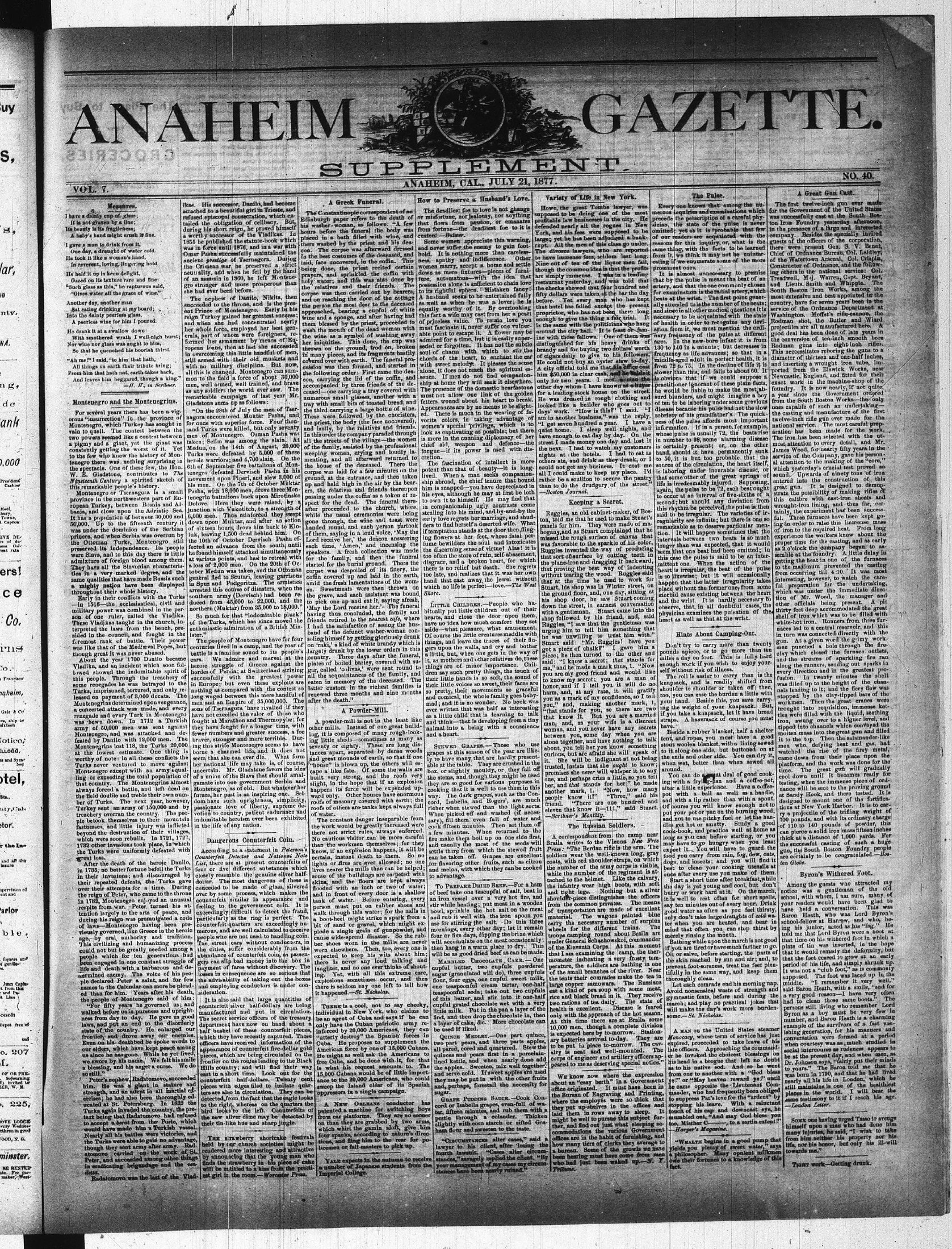
Searchable text
ANAHEIM
VOL. 7.
Measures.
I have a daisy cup of glass;
It is not graven by a line;
Its beauty is its fragility;
A baby's hand might crush it fine.
I gave a man to drink from it,
One day, a draught of water cold.
He took it like a woman's hand,
In reverent, loving, lingering hold.
He held it up in keen delight,
Gazed on its texture rare and fine:
"Such glass as this," he rapturous said,
"Gives water all the grace of wine."
Another day, another man
Sat eating drinking at my board;
Into the dalty peerless glass,
A peerless wine for him I poured.
He drank it at a swallow down:
With smothered wrath I well-nigh burst;
Nor wine nor glass was aught to him,
So that he quenched his boorish thirst.
"Ah me!" I said, "to him that hath,
All things on earth their tribute bring;
From him that hath not, earth takes back,
And leaves him beggared, though a king."
—H. H., in Seribner.
Montenegro and the Montenegrins.
For several years there has been a vigorous "insurrection" in the province of Montenegro, which Turkey has sought in vain to quell. The contest between the two powers seemed like a contest between a pigmy and a giant, yet the giant was constantly getting the worst of it. Yet to the few who knew the history of Montenegro there was nothing surprising in Ikas. His successor, Danilo, had become attached to a beautiful girl in Trieste, and refused episcopal consecration, which entailed the obligation of celibacy. But, during his short reign, he proved himself a worthy successor of the Vladikas. In 1855 he published the statute-book which was in force until 1876, and in a war with Omar Pasha successfully maintained the ancient prestige of Taernagora. During the Crimean war, he preserved a strict neutrality, and when he fell by the hand of an assassin in 1860, he left Montenegro stronger and more prosperous than she had ever been before.
The nephew of Danilo, Nikita, then succeeded to the throne, and is the present Prince of Montenegro. Early in his reign Turkey gained her greatest success; and when she had concentrated nearly her whole force, employed her best generals, part of whom were foreigners, reformed her armament by means of European loans, then at last she succeeded in overcoming this little handful of men, still armed with their old muskets and with no military discipline. But now, all this is changed. Montenegro can summon to the field a force of about 30,000 men, well armed, well trained, and brave as any soldiers the world ever saw. The remarkable campaign of last year Mr. Gladstone sums up as follows:
"On the 28th of July the men of Taernagora encountered Muktar Pasha, and for once with superior force. Four thousand Turks were killed, but only seventy men of Montenegro. Osman Pasha was taken; Selim was among the slain. At Medun, on the 14th of August, 20,000 Turks were defeated by 5,000 of these heroic warriors; and 4,700 slain. On the 6th of September five battalions of Mon-
A Greek
The Constantinople Edinburgh paper recalls his washer-woman hours before the first placed in a bath there washed by the con. The corpse was in the best costumes laid, face uncovered being done, the prayers and sprinkling holy water; and the relatives and corpse was then carried and on reaching the person the most approached, bearing wine and a sponge, them blessed by the wash the mouth of the wine as a sympathy iniquities. The thrown on the ground in many pieces, and covered over with excession was then for the following order con, carrying the accompanied by the ceased—one carryin numerous small gifts tray with small bits the third carrying these were followed the priest, the body and lastly, by the In this order the con all the streets of the family, assis weeping women, menting, and all the house of the
Montenegro and the Montenegrins.
For several years there has been a vigorous "insurrection" in the province of Montenegro, which Turkey has sought in vain to quell. The contest between the two powers seemed like a contest between a pigmy and a giant, yet the giant was constantly getting the worst of it. Yet to the few who knew the history of Montenegro there was nothing surprising in the spectacle. One of these few, the Hon. W. E. Gladstone, contributes to The Nineteenth Century a spirited sketch of this remarkable people's history.
Montenegro or Tsernagora is a small province in the northwestern part of European Turkey, between Bosnia and Albania, and close upon the Adriatic Sea. It has a population of between 30,000 and 50,000. Up to the fifteenth century it was under the dominion of the Serbian princes, and when Serbia was overrun by the Ottoman Turks, Montenegro still preserved its independence. Its people were Slavs, and to this day there is little admixture of foreign blood among them. They have all the Slavonian characteristics in a very marked degree, and the same qualities that have made Russia such a mighty nation have been displayed throughout their whole history.
Early in their conflicts with the Turks—in 1516—the ecclesiastical, civil and military power was combined in the person of one ruler, called the Vladika. These Vladikas taught in the church, interpreted the laws from the bench, presided in the council, and fought in the foremost rank of battle. Their power was like that of the Medieval Popes, but though great it was never abused.
About the year 1700 Danilo became Vladika, and an incident which soon followed showed the indomitable spirit of this people. Through the treachery of some renegades he was betrayed to the Turks, imprisoned, tortured, and only released on payment of 3,000 ducats. The Montenegro grimes determined upon vengeance, a concerted attack was made, and every renegade and every Turk in Montenegro was hewn down. In 1712 a Turkish army of 50,000 men was sent against Montenegro, and was attacked and defeated by Danilo with 12,000 men. The Montenegro grimes lost 118, the Turks 20,000 at the lowest estimate. One thing is worthy of note: in all these conflicts the Turks never ventured to move against Montenegro except with an army equalling or exceeding the total population of that country. The Montenegro grimes almost always forced a battle, and left dead on the field double and treble their own number of Turks. The next year, however, Turkey sent an army of 150,000 and by treachery overran the country. The people betook themselves to their mountain fastnesses, and little injury was inflicted beyond the destruction of their villages, which were soon rebuilt. In 1721, 1727, 1732 other invasions took place, in which the Turks were uniformly defeated with great loss.
After the death of the heroic Danilo, in 1785, no better fortune befell the Turks in their invasions; and discouraged by their repeated defeats, the Turks gave
"On the 28th of July the men of Tsernagora encountered Muktar Pasha, and for once with superior force. Four thousand Turks were killed, but only seventy men of Montenegro. Osman Pasha was taken; Selim was among the slain. At Medun, on the 14th of August, 20,000 Turks were defeated by 5,000 of these heroic warriors; and 4,700 slain. On the 6th of September five battalions of Montenegro defeated Dervisch Pasha in his movement upon Piperi, and slew 3,000 of his men. On the 7th of October Muktar Pasha, with 18,000 men, drove three Montenegrin battalions back upon Mirotinsko Dolove. Here they were raised, by a junction with Vukotitch, to a strength of 6,000 men. Thus reinforced they swept down upon Muktar, and after an action of sixteen hours, drove him back to Kluik, leaving 1,500 dead behind him. On the 10th of October Dervisch Pasha effected an advance from the south; until he found himself attacked simultaneously at various points, and had to retreat with a loss of 2,000 men. On the 20th of October Medun was taken, and the Ottoman general fled to Scutari, leaving garrisons in Spuz and Podgoritzia. The armistice arrested this course of disasters, when the southern army (Dervisch) had been reduced from 45,000 to 22,000, and the northern (Muktar) from 35,000 to 18,000."
So much for that "indomitable pluck" of the Turks, which has since moved the enthusiastic admiration of a British Minister."
The people of Montenegro have for four centuries lived in a camp, and the roar of battle is a familiar sound to its people's ears. We admire and marvel at the heroic struggle of Greece against the hordes of Persia; at Switzerland striving successfully with the greatest power in Europe; but even these exploits are nothing as compared with the contest so long waged between this mere handful of men and an Empire of 35,000,000. The sons of Tsernagora have rivalled if they have not excelled the valor of those who fought at Marathon and Thermopylle; for they have fought for a longer time, with fewer numbers and greater success, a foe braver, stronger and more terrible. During this strife Montenegro seems to have borne a charmed life, and it does not seem that she can ever die. What form her national life may take is, of course, uncertain. Mr. Gladstone favors the idea of a union of the Slavs that should amalgamate into one government Serbia and Montenegro, as of old. But whatever her future, her past is an inspiring one. Seldom have such uprightness, simplicity, passionate love of liberty, supreme devotion to country, patient endurance and indomitable heroism ever been exhibited in the life of any nation.
Dangerous Counterfeit Coin.
According to a statement in Peterson's Counterfeit Detector and National Note List, there are at present counterfeits of four or five different substances which closely resemble the genuine silver half-dollar. The most dangerous of these is all this is changed. Montenegro can summon to the field a force of about 30,000 men, well armed, well trained, and brave as any soldiers the world ever saw. The remarkable campaign of last year Mr. Gladstone sums up as follows:
"On the 28th of July the men of Tsernagora encountered Muktar Pasha, and for once with superior force. Four thousand Turks were killed, but only seventy men of Montenegro. Osman Pasha was taken; Selim was among the slain. At Medun, on the 14th of August, 20,000 Turks were defeated by 5,000 of these heroic warriors; and 4,700 slain. On the 6th of September five battalions of Montenegro defeated Dervisch Pasha in his movement upon Piperi, and slew 3,000 of his men. On the 7th of October Muktar Pasha, with 18,000 men, drove three Montenegrin battalions back upon Mirotinsko Dolove. Here they were raised, by a junction with Vukotitch, to a strength of 6,000 men. Thus reinforced they swept down upon Muktar, and after an action of sixteen hours, drove him back to Kluik, leaving 1,500 dead behind him. On the 10th of October Dervisch Pasha effected an advance from the south; until he found himself attacked simultaneously at various points, and had to retreat with a loss of 2,000 men. On the 20th of October Medun was taken; and the Ottoman general fled to Scutari, leaving garrisons in Spuz and Podgoritzia. The armistice arrested this course of disasters when the southern army (Dervisch) had been reduced from 45,000 to 22,000,and the northern (Muktar) from 35,000 to 18,ooo."
So much for that "indomitable pluck" of the Turks which has since moved the enthusiastic admiration of a British Minister."
The people of Montenegro have for four centuries lived in a camp,and the roar of battle is a familiar sound to its people's ears.
We admire and marvel at the heroic struggle of Greece against the hordes of Persia; at Switzerland striving successfully with the greatest power in Europe; but even these exploits are nothing as compared with the contest so long waged between this mere handful of men and an Empire of 35,ooo,Ooo
The sons of Tsernagora have rivalled if they have not excelled the valor of those who fought at Marathon and Thermopylle; for they have fought for a longer time with fewer numbers and greater success,a foe braver,stronger and more terrible.During this strife Montenegro seems to have borne a charmed life,and it does not seem that she can ever die.Wallmine national life may take is,of course,uncertain.Mr.Gladstone favorstheideaofunionoftheSlavsthatshouldamalgamateintoonegovernmentSerbiasandMontenegro.asofold.Butwhateverherpastisaninspiringone.Seldomhavesuchuprightness,simplify,passionateloveofliberty,supremedevotiontocountry,patientenduranceandindomitableheroismeverbeenexhibitedinthelifeofanynation.
Dangerous Counterfeit Coin.
According to a statement in Peterson's Counterfeit Detector and National Note List,theareatpresentcounterfeitisfourorsevensubstanceswhichcloselyresemblesthegenuinesilverhalf-dollar.Themostdangerousoftheseisallthisischanged.Montenegrocansummontothefieldafforceofabout30,ooomenwellarmedwelltrainedandbravesasany Soldiersthefollowingordercon,carryingthebodyandlastly,byleInthisorderthecontainallstreetsoftheofthefamilyassistingweepingwomen,andmenting,andallthehouseofthecorpsewaslaidforground.attheentrupundhighers,therelativespassingunderthespectforthedeadafterproceedtedwhiletheusualcogoneghedthrough,andhandedround,andofthem,sayinginLordreceiveher,"eachtime,'Amewearspeakers.Afreshforthefamily.startfordurplecorpsewasdespoiledcoffincoveredupamidthefreshlane.en.Sweetmeatstheregrave,andeasystartedforbushcorpsewasdespoiledcoffincoveredupamidthefreshlane.en.Sweetmeatstheregrave,andeasystartedforbushcorpsewasdespoiledcoffincoveredupamidthefreshlane.en.Sweetmeatstheregrave,andeasystartedforbushcorpsewasdespoiledcoffincoveredupamidthefreshlane.en.Sweetmeatstheregrave,andeasystartedforbushcorpsewasdespoiledcoffincoveredupamidthefreshlane.en.Sweetmeatstheregrave,andeasystartedforbushcorpsewasdespoiledcoffincoveredupamidthefreshlane.en.Sweetmeatstheregrave,andeasystartedforbushcorpsewasdespoiledcoffincoveredupamidthefreshlane.en.Sweetmeatstheregrave,andeasystartedforbushcorpsewasdespoiledcoffincoveredupamidthefreshlane.en.Sweetmeatstheregrave,andeasystartedforbushcorpsewasdespoiledcoffincoveredupamidthefreshlane.en.Sweetmeatstheregrave,andeasystartedforbushcorpsewasdespoiledcoffincoveredupamidthefreshlane.en.Sweetmeatstheregrave,andeasystartedforbushcorpsewasdespoiledcoffincoveredupamidthefreshlane.en.Sweetmeatstheregrave,andeasystartedforbushcorpsewasdespoiledcoffincoveredupamidthefreshlane.en.Sweetmeatstheregrave,andeasystartedforbushcorpsewasdespoiledcoffincoveredupamidthefreshlane.en.Sweetmeatstheregrave,andeasystartedforbushcorpsewasdespoiledcoffincoveredupamidthefreshlane.en.Sweetmeatstheregrave,andeasystartedforbushcorpsewasdespoiledcoffincoveredupamidthefreshlane.en.Sweetmeatstheregrave,andeasystartedforbushcorpsewasdespoiledcoffincoveredupamidthefreshlane.en.Sweetmeatstheregrave,andeasystartedforbushcorpsewasdespoiledcoffincoveredupamidthefreshlane.en.Sweetmeatstheregrave,andeasystartedforbushcorpsewasdespoiledcoffincoveredupamidthefreshlane.en.Sweetmeatstheregrave,andeasystartedforbushcorpsewasdespoiledcoffincoveredupamidthefreshlane.en.Sweetmeatstheregrave,andeasystartedforbushcorpsewasdespoiledcoffincoveredupamidthefreshlane.en.Sweetmeatstheregrave,andeasystartedforbushcorpsewasdespoiledcoffincoveredupamidthefreshlane.en.Sweetmeatstheregrave,andeasystartedforbushcorpsewasdespoiledcoffincoveredupamidthefreshlane.en.Sweetmeatstheregrave,andeasystartedforbushcorpsewasdespoiledcoffincoveredupamidthefreshlane.en.Sweetmeatstheregrave,andeasystartedforbushcorpsewasdespoiledcoffincoveredupamidthefreshlane.en.Sweetmeatstheregrave,andeasystartedforbushcorpsewasdespoiledcoffincoveredupamidthefreshlane.en.Sweetmeatstheregrave,andeasystartedforbushcorpsewasdespoiledcoffincoveredupamidthefreshlane.en.Sweetmeatstheregrave,andeasystartedforbushcorpsewasdespoiledcoffincoveredupamidthefreshlane.en.Sweetmeatstheregrave,andeasystartedforbushcorpsewasdespoiledcoffincoveredupamidthefreshlane.en.Sweetmeatstheregrave,andeasystartedforbushcorpsewasdespoiledcoffincoveredupamidthefreshlane.en.Sweetmeatstheregrave,andeasystartedforbushcorpsewasdespoiledcoffincoveredupamidthefreshlane.en.Sweetmeatstheregrave,andeasystartedforbushcorpsewasdespoiledcoffincoveredupamidthefreshlane.en.Sweetmeatstheregrave,andeasystartedforbushcorpsewasdespoiledcoffincoveredupamidthefreshlane.en.Sweetmeats这里 Graved here not strictNo cautious visit than the work know if an exp certain instant lights or fires al lives nearer tha some ouf buikings and ther constant bank would there not strictNo cautious visit than the work know if an exp certain instant lights or fires al lives nearer tha some ouf buikings and ther constant bank would there not strictNo cautious visit than the work know if an exp certain instant lights or fires al lives nearer tha some ouf buikings and ther constant bank would there not strictNo cautious visit than the work know if an exp certain instant lights or fires al lives nearer tha some ouf buikings and ther constant bank would there not strictNo cautious visit than the work know if an exp certain instant lights or fires al lives nearer tha some ouf buikings and ther constant bank would there not strictNo cautious visit than the work know if an exp certain instant lights or fires al lives nearer tha some ouf buikings and ther constant bank would there not strictNo cautious visit than the work know if an exp certain instant lights or fires al lives nearer tha some ouf buikings and ther constant bank would there not strictNo cautious visit than the work know if an exp certain instant lights or fires al lives nearer tha some ouf buikings and ther constant bank would there not strictNo cautious visit than the work know if an exp certain instant lights or fires al lives nearer tha some ouf buikings and ther constant bank would there not strictNo cautious visit than the work know if an exp certain instant lights or fires al lives nearer tha some ouf buikings and ther constant bank would there not strictNo cautious visit than the work know if an exp certain instant lights or fires al lives nearer tha some ouf buikings and ther constant bank would there not strictNo cautious visit than the work know if an exp certain instant lights or fires al lives nearer tha some ouf buikings和ther constant bank would there not strictNo cautious visit than the work know if an exp certain instant lights or fires al lives nearer tha some ouf buikings和ther constant bank would there not strictNo cautious visit than the work know if an exp certain instant lights or fires al lives nearer tha some ouf buikings和ther constant bank would there not strictNo cautious visit than the work know if an exp certain instant lights or fires al lives nearer tha some ouf buikings和ther constant bank would there not strictNo cautious visit than the work know if an exp certain instant lights or fires al lives nearer tha some ouf buikings和ther constant bank would there not strictNo cautious visit than the work know if an exp certain instant lights or fires al lives nearer tha some ouf buikings和ther constant bank would there not strictNo cautious visit than the work know if an exp certain instant lights or fires al lives nearer tha some ouf buikings和ther constant bank would there not strictNo cautious visit than the work know if an exp certain instant lights or fires al lives nearer tha some ouf buikings和ther constant bank would there not strictNo cautious visit than the work know if an exp certain instant lights or fires al lives nearer tha some ouf buikings和ther constant bank would there not strictNo cautious visit than the work know if an exp certain instant lights or fires al lives nearer tha some ouf buikings和ther constant bank would there not strictNo cautious visit than the work know if an exp certain instant lights or fires al lives nearer tha some ouf buikings和ther constant bank would there not strictNo cautious visit than the work know if an exp certain instant lights or fires al lives nearer tha some ouf buikings和ther constant bank would there not strictNo cautious visit than the work know if an exp certain instant lights or fires al lives nearer tha some ouf buikings和ther constant bank would there not strictNo cautious visit than the work know if an exp certain instant lights or fires al lives nearer tha some ouf buikings和ther constant bank would there not strictNo cautious visit than the work know if an exp certain instant lights or fires al lives nearer tha some ouf buikings和ther constant bank would there not strictNo cautious visit than the work know if an exp certain instant lights or fires al lives nearer tha some ouf buikings和ther constant bank would there not strictNo cautious visit than the work know if an exp certain instant lights or fires al lives nearer tha some ouf buikings和ther constant bank would there not strictNo cautious visit than the work know if an exp certain instant lights or fires al lives nearer tha some ouf buikings和ther constant bank would there not strictNo cautious visit than the work know if an exp certain instant lights or fires al lives nearer tha some ouf buikings和ther constant bank would there not strictNo cautious visit than the work know if an exp certain instant lights or fires al lives nearer tha some ouf buikings和ther constant bank would there not strictNo cautious visit than the work know if an exp certain instant lights or fires al lives nearer tha some ouf buikings和ther constant bank would there not strictlyNo cautioning visitor is composing little sheds—severity apart,separate and great mount“house”is blowing cape like fate.built very strong slight.in laho happens its force ward only.Otter roofs of masonry roofs off others are force ward only.Otter roofs of masonry roofs off others are force ward only.Otter roofs of masonry roofs off others are force ward only.Otter roofs of masonry roofs off others are force ward only.Otter roofs of masonry roofs off others are force ward only.Otter roofs of masonry roofs off others are force ward only.Otter roofs of masonry roofs off others are force ward only.Otter roofs of masonry roofs off others are force ward only.Otter roofs of masonry roofs off others are force ward only.Otter roofs of masonry roofs off others are force ward only.Otter roofs of masonry roofs off others are force ward only.Otter roofs of masonry roofs off others are force ward only.Otter roofs of masonry roofs off others are force ward only.Otter roofs of masonry roofs off others are force ward only.Otter roofs of masonry roofs off others are force ward only.Otter roofs of masonry roofs off others are force ward only.Otter roofs of masonry roofs off others are force ward only.Otter roofs of masonry roofs off others are force ward only.Otter roofs of masonry roofs off others are force ward only.Otter roofs of masonry roofs off others are force ward only.Otter屋顶的屋顶的屋顶的屋顶的屋顶的屋顶的屋顶的屋顶的屋顶的屋顶的屋顶的屋顶的屋顶的屋顶的屋顶的屋顶的屋顶的屋顶的屋顶的屋顶的屋顶的屋顶的屋顶的屋顶的屋顶的屋顶的屋顶的屋顶的屋顶的屋顶的屋顶的屋顶的屋顶的屋顶的屋顶的屋顶的屋顶的屋顶的屋顶的屋顶的屋顶的屋顶的屋顶的屋顶的屋顶的屋顶的屋顶的屋顶的屋顶的屋顶的屋顶的屋顶的屋顶的屋顶的屋顶的屋顶的屋顶的屋顶的屋顶的屋顶的屋顶的屋顶的屋顶的屋顶的屋顶的屋顶的屋顶的屋顶的屋顶的屋顶的屋顶的屋顶的屋顶的屋顶的屋顶的屋顶的屋顶的屋顶的顶部の顶部の顶部の顶部の顶部の顶部の顶部の顶部の顶部の顶部の顶部の顶部の顶部の顶部の顶部の顶部の顶部の顶部の顶部の顶部の顶部の顶部の顶部の顶部の顶部の顶部の顶部の顶部の顶部の顶部の顶部の顶部の顶部の顶部の底部の底部の底部の底部の底部の底部の底部の底部の底部の底部の底部の底部の底部の底部の底部の底部の底部の底部の底部の底部の底部の底部の底部の底部の底部の底部の底部の底部の底部の底部の底部の底部の底部の底部の底部の底部の底部の底部の底部の底部の底部の底部の底部の底部の底部の底部の底部の底部の底部
The constants are there notStrict No cautious visi than than working know if an expe certain instruc tion instruc tion instruc tion instruc tion instruc tion instruc tion instruc tion instruc tion instruc tion instruc tion instruc tion instruc tion instruc tion instruc tion instruc tion instruc tion instruc tion instruc tion instruc tion instruc tion instruc tion instruc tion instruc tion instruc tion instruc tion instruc tion instruc tion instruc tion instruc tion instruc tion instruc tion instruc tion instruc tion instruc tion instruc tion instruc tion instruc tion instruc tion instruc tion instruc tion instruc tion instruc tion instruc tion instruc tion instruc tion instruc tion instruc tion instruc tion instruc tion instruc tion instruc tion instruc tion instruc tion instruc tion instruc tion instruc tion instituted order for following order for following order for following order for following order for following order for following order for following order for following order for following order for following order for following order for following order for following order for following order for following order for following order for following order for following order for following order for following order for following order for following order for following order for following order for following order for following order for following order for following order for following order for following order for following order for following order for following order
A Poor-mill-mill other mills.Insuiting it is compos ing little sheds—severity apart,separate and great mount“house”is blowing cape like fate.built very strong slight.in laho happens its force ward only.Otter roofs of masonry roofs off others are force ward only.Otter roofs of masonry roofs off others are force ward only.Otter roofs of mason
After the death of the heroic Danilo in 1735, no better fortune befell the Turks in their invasions; and discouraged by their repeated defeats, the Turks gave over their attempts for a time. During the reign of Peter, who came to the throne in 1782, Montenegro enjoyed an unusual respite from war. Peter turned his attention largely to the arts of peace, and during his reign was promulgated a code of laws—Montenegro having been previously governed, like Greece in the heroic age, by oral authority and tradition. This civilizing and humanizing process could not but be greatly needed among a people which for ten generations had been engaged in one constant struggle of life and death with a barbarous and determined enemy. The voice of his people declared Peter a saint, and for few names in the Calendar can more be pleaded than for him. Years after his death, the people of Montenegro said of him:
"For fifty years he governed us; and walked before us in pureness and uprightness from day to day. He gave us good laws, and put an end to the disorderly state of the country. He enlarged our frontier, and drove away our enemies. Even on his deathbed he spoke words to our elders, which have kept peace among us since he has gone. While he yet lived, we swore by his name. We felt his smile a blessing, and his anger a curse. We do so still."
Peter's nephew, Radatomovo, succeeded him. He was a giant in stature and strength, and an adept in all martial exercises; he had also been thoroughly educated at St. Peteraburg. In 1832 the Turks again invaded the country, the pretext being that Radatomovo had refused to accept a host from the Porta, which would have made him a Turkish vassal. Nearly all his battles were victories, and the Turks were able to gain no advantage, though they sent army after army. Radatomovo carried on the work of St. Peter, and succeeded among other things in eradicating brigandage and the sedda.
Radatomovo was the last of the Vlad-
Dangerous Counterfeit Coin.
According to a statement in Peterson's Counterfeit Detector and National Note List, there are at present counterfeits of four or five different substances which closely resemble the genuine silver half-dollar. The most dangerous of these is conceded to be made of glass, silvered over by some process, which makes the counterfeit similar in appearance and feeling to the government coin. It is exceedingly difficult to detect the fraud, particularly as the ring is perfect. The counterfeit quarters are exceedingly numerous, and are well calculated to deceive people who are not used to handling coin. The street cars without conductors, in the cities, suffer considerably from the abundance of counterfeit coin, as passengers can slip bad money into the box in payment of fares without discovery. The losses in consequence are so serious that the advisability of taking out the boxes and employing conductors is under consideration.
It is also said that large quantities of counterfeit silver half-dollars are being manufactured and put in circulation. The secret service officers of the treasury department have now on hand about a half bushel of these counterfeit pieces, which they have recently captured. Those officers have received information of the appearance of counterfeit five-dollar gold pieces, which are being circulated on the frontier on the routes leading to the Black Hills country; and will find their way east in a short time. Look out for the counterfeit half-dollars. Twenty cent pieces with edges filed to imitate quarters are also in circulation. They can be detected from the fact that the eagle looks to the right, whereas on the quarters the bird looks to the left. Counterfeits of the new silver dime may be detected by their tin-like hue and sharp jingle.
The strawberry shortcake festivals held by our church societies might be rendered more interesting and attractive by announcing that the young man who finds the strawberry in his piece of cake will be entitled to a kiss from the prettiest girl in the room—Worcester Press.
A Greek Funeral.
The Constantinople correspondent of an Edinburgh paper refers to the death of his washer-woman, as follows: "A few hours before the funeral the body was placed in a bath filled with wine, and there washed by the priest and his deacon. The corpse was afterward dressed in the best costumes of the deceased, and laid, face uncovered, in the coffin. This being done, the priest recited certain prayers, and sprinkled the coffin with holy water; and this was also done by the relatives and their friends. The corpse was then carried out by bearers, and on reaching the door of the cottage the person the most dear to the deceased approached, bearing a cupful of white wine and a sponge, and after having had them blessed by the priest, proceeded to wash the mouth of the dead woman with the wine as a symbol of washing away her iniquities. This done, the cup was thrown on the ground, trod on, broken in many pieces, and its fragments hastily covered over with earth. The funeral procession was then formed, and started in the following order: First came the deacon, carrying the lid of the coffin, and accompanied by three friends of the deceased—one carrying a tray covered with numerous small glasses, another with a tray with small bits of toasted bread, and the third carrying a large bottle of wine. These were followed by the choristers, the priest, the body (the face uncovered), and lastly, by the relatives and friends. In this order the company paraded through all the streets of the village—the women of the family, assisted by the professional weeping women, crying and loudly lamenting, and all afterward returned to the house of the deceased. There the
How to Preserve a Husband's Love.
The deadliest foe to love is not change or misfortune, nor jealousy, nor anything that flows from passion, or emanates from fortune—the deadliest foe to it is custom—Bulmer.
Some women appreciate this warning, and never suffer the enemy to gain foothold. It is nothing more than carelessness, apathy and indifference. Other women marry, accept a home and settle down as mere fixtures—pieces of furniture, automatons—with the idea that possession alone is sufficient to chain love to its rightful sphere. Mistaken fancy! A husband seeks to be entertained fully as well as when he was a lover; he is equally worthy of it. By overlooking this fact a wife may cast from her a Pearl of priceless value. To retain love you must fascinate it, never suffer one vulnerable point to escape it. A flower may be admired for a time, but it is easily supereded or forgotten. It has not the subtle soul of charm with which to stir the chords of the heart, to enchant the ear with sweet melody. It pleases the sense alone, it does not reach the spiritual essence. If men do not find companionship at home they will seek it elsewhere. The presence of the domestic hearthstone must not allow one link of the golden fetters wound about his heart to break. Appearances are by no means to be slighted. There is much in the wearing of favorite colors, in taking advantage of women's special privilege, which is to look as captivating as possible; but there is more in the cunning diplomacy of her chief aid, weapon and defence—the tongue—if its power is used with discretion.
The fascination of intellect is more
A powder-mill is not in the least like other mills. Instead of one great building, it is composed of many rough-looking little sheds—sometimes as many as seventy or eighty. These are long distances apart, separated by dense woods and great mounds of earth, so that if one "house" is blown up, the others will escape a like fate. Of some the walls are built very strong, and the roofs very slight, in the hope that if an explosion happens its force will be expended upward only. Other houses have enormous roofs of masonry covered with earth; the roofs of others are tanks kept always full of water.
The constants danger inseparable from the work would be greatly increased were there not strict rules, always enforced. No cautious visitor can be more careful than the workmen themselves; for they know, if an explosion happens, it will be certain, instant death to them. So no lights or fires are ever allowed; no one lives nearer the mills than can be helped; some of the buildings are carpeted with skins and the floors are kept always alone, it does not reach the spiritual essence. If men do not find companionship at home they will seek it elsewhere. The presence of the domestic heartstone must not allow one link of the golden fetters wound about his heart to break. Appearances are by no means to be slight-ed. There is much in the wearing of favorite colors, in taking advantage of women's special privilege, which is to look as captivating as possible; but there is more in the cunning diplomacy of her chief aid, weapon and defence—the tongue—if its power is used with discretion.
The fascination of intellect is more potent than that of beauty—it is long-lived. When a man seeks companionship abroad, the chief tenure that bound him is snapped—you have depreciated in his eyes, although he may at first be loth to own it to himself. He may find that in companionship ugly contrasts come stealing into his mind, and by-and-by the early love regrets her marriage, and shudders to find herself's deserted wife. What if temptation stands at the door then, flinging flowers at her feet, whose fatal perume bewilders the soul and intoxicates the discerning sense of virtue? Alas! it is too often the store of ruin, self-abasement, disgrace, and a broken heart, for which there is no relief but death. She regrets too late, and realizes that it was her own hand that cast away the jewel without which no life is perfect—love.—The West Shore.
Little Children.—People who habitually put little children out of their hearts, and close the door upon them, have no idea how much comfort they set aside—what pleasure, what amusement. Of course the little creatures meddle with things, and leave the traces of their fingers upon the walls, and cry and bother a little, but when one gets in the way of it, as mothers and other relatives do, these things are of minor importance. Children say such pretty things, the touch of their little hands is so soft, the sound of their little voices so sweet, their faces are so pretty, their movements so graceful and comical, the whole family goes baby-mad; and it is no wonder. No book was ever written that was half as interesting as a little child that is learning to talk and think—that is developing from a tiny animal into a being with a conscience and a heart.
Stewed Grapes.—Those who use grapes at this season of the year are likely to have many that are hardly presentable at the table. They are crushed in the box, or slightly mouldy, or they fall off the stems, and though they might be used they are so good for various purposes in cooking that it is well to use them in this way. The dark grapes, such as the Concord, Isabella, and Rogers', are much richer when stewed than the light sorts. When picked off and washed (if necessary), fill them even full of water and cook fifteen minutes. Then set them off a few minutes. When returned to the fire make them boil up on one side first, and usually the most of the seeds will settle there from which the stewed fruit can be taken off. Grapes are excellent for flavoring other fruits, such as citron and melon, with which they can be cooked to advantage.
A city official told me that his dance cost him $50,000 in clear cash, and he held it only for two years. I met a man the other day whom I have known as a sugar for a leading stock house on the street. He was dressed in rough clothing and looked like a builder who goes out to days' work. "How is this?" I said. "I am in another business," was the reply. "I get seven hundred a year. I have a quiet home. I sleep well nights, and have enough to eat day by day. On the street I made money one day and lost it the next. I had to watch my customers nights at the hotels. I had to eat as others ate, and drink as they drank, or I could not get any business. It cost me all I could make to keep my place. I'd rather be a scullion to secure the pantry than to do the drudgery of the street."
Boston Journal.
Keeping a Secret.
Ruggles, an old cabinet-maker, of Boston, told me that he used to make Stuart's panels for him. They were made of mahogany,and as Stuart complained that he missed the rough surface of canvas that was favorable to the sparkle of his color. Ruggles invented the way of producing that sort of surface by cutting teeth in the plane-iron and dragging it backward, that proving the best way of indenting without tearing the wood. Ruggles said that at the time he used to work for Stuart, his shop was in Winter street, on the ground floor, and one day, sitting at his shop door, he saw Stuart coming down the street, in earnest conversation with a gentleman. Stuart came into the shop followed by his friend, and said Ruggles, "I saw that the gentleman was urging him to tell him something that he was unwilling to trust him with." Stuart said: "Mr. Ruggles! have you got a piece of chalk?" I gave him a piece; he then turned to the other and said: "I know a secret; that stands for me," and he made a mark thus, 1. "Now you are my good friend and would like to know my secret; you are a man of honor, and if I tell you it will do no harm, and, at any rate, it will gratify you as a mark of my confidence, so I tell you," and making another mark, 1. "That stands for you, so there are two that know it. But you are a married man, and as your wife is a discreet woman, and you never have any secrets between you, some day when you are alone together, and have nothing to talk about, you tell her you know something curious, but are afraid she will speak of it. She will be indignant at not being trusted, insists that she ought to know; promises she never will whisper it to any one, and perhaps cries a little, so you tell her, and that stands for her;" he made another mark, 1. "Now, how many people know it?" "Three," said his friend. "There are one hundred and eleven that know it—111," said Stuart.
Scribner's Monthly.
The Russian Soldiers.
A correspondent from the camp near Braila writes to the Vienna New Free Press: "The Berdan rifle is the arm. The soldiers wear the well-known long, gray coats, with red shoulder-straps, on which the number of the army corps is visible, while the number of the regiment is attached to the helmet. Like the calvary,
so low but still observable practice he would bury both diseases sobriety unless otherwise informed whose existence is certain hand-held source is labored source is labor that so life is again.
to occur second this rite said regular remission.
intervenes seem in this case mittens heart is so low but still observable practice he would bury both diseases sobriety unless otherwise otherwise otherwise
intervenes seem in this case mittens heart is so low but still observable practice he would bury both diseases sobriety unless otherwise
intervenes seem in this case mittens heart is so low but still observable practice he would bury both diseases sobriety unless otherwise
intervenes seem in this case mittens heart is so low but still observable practice he would bury both diseases sobriety unless otherwise
intervenes seem in this case mittens heart is so low but still observable practice he would bury both diseases sobriety unless otherwise
intervenes seem in this case mittens heart is so low but still observable practice he would bury both diseases sobriety unless otherwise
intervenes seem in this case mittens heart is so low but still observable practice he would bury both diseases sobriety unless otherwise
intervenes seem in this case mittens heart is so low but still observable practice he would bury both diseases sobriety unless otherwise
intervenes seem in this case mittens heart is so low but still observable practice he would bury both diseases sobriety unless otherwise
intervenes seem in this case mittens heart is so low but still observable practice he would bury both diseases sobriety unless otherwise
intervenes seem in this case mittens heart is so low but still observable practice he would bury both diseases sobriety unless otherwise
intervenes seem in this case mittens heart is so low but still observable practice he would bury both diseases sobriety unless otherwise
intervenes seem in this case mittens heart is so low but still observable practice he would bury both diseases sobriety unless otherwise
intervenes seem in this case mittens heart is so low but still observable practice he would bury both diseases sobriety unless otherwise
intervenes seem in this case mittens heart is so low but still observable practice he would bury both diseases sobriety unless otherwise
intervenes seem in this case mittens heart is so low but still observable practice he would bury both diseases sobriety unless otherwise
intervenes seem in this case mittens heart is so low but still observable practice he would bury both diseases sobriety unless otherwise
intervenes seem in this case mittens heart is so low but still observable practice he would bury both diseases sobriety unless otherwise
intervenes seem in this case mittens heart is so low but still observable practice he would bury both diseases sobriety unless otherwise
intervenes seem in this case mittens heart is so low but still observable practice he would bury both diseases sobriety unless otherwise
intervenes seem in this case mittens heart is so low but still observable practice he would bury both diseases sobriety unless otherwise
intervenes seem in this case mittens heart is so low but still observable practice he would bury both diseases sobriety unless otherwise
intervenes seem in this case mittens heart is so low but still observable practice he would bury both diseases sobrietry unless otherwise
intervenes seem in this case mittens heart is so low but still observable practice he would bury both diseases sobrietry unless OTHERWISE
intervenes seem in this case mittens heart is so low but still observable practice he would bury both diseases sobrietry unless OTHERWISE
intervenes seem in this case mittens heart is so low but still observable practice he would bury both diseases sobrietry unless OTHERWISE
intervenes seem in this case mittens heart is so low but still observable practice he would bury both diseases sobrietry unless OTHERWISE
intervenes seem in this case mittens heart is so low but still observable practice he would bury both diseases sobrietry unless OTHERWISE
intervenes seem in this case mittens heart is so low but still observable practice he would bury both diseases sobrietry unless OTHERWISE
intervenes seem in this case mittens heart is so low but still observable practice he would bury both diseases sobrietry unless OTHERWISE
intervenes seem in this case mittens heart is so low but still observable practice he would bury both diseases sobrietry unless OTHERWISE
intervenes seem in this case mittens heart is so low but still observable practice he would bury both diseases sobrietry unless OTHERWISE
intervenes seem in this case mittens heart is so low but still observable practice he would bury both diseases sobrietry unless OTHERWISE
intervenes seem in this case mittens heart is so low but still observable practice he would bury both diseases sobrietry unless OTHERWISE
intervenes seem in this case mittens heart is so low but still observable practice he would bury both diseases sobrietry unless OTHERWISE
intervenes seem in this case mittens heart is so low but still observable practice he would bury both diseases sobrietry unless OTHERWISE
intervenes seem in this case mittens heart is so low but still observable practice he would bury both diseases sobrietry unless OTHERWISE
intervenes seem in this case mittens heart is so low but still observable practice he would bury both diseases sobrietry unless OTHERWISE
intervenes seem in this case mittens heart is so low but still observable practice he would bury both diseases sobrietry unless OTHERWISE
intervenes seem in this case mittens heart is so low but still observable practice he would bury both diseases sobrietry unless OTHERWISE
intervenes seem in this case mittens heart is so low but still observable practice he would bury both diseases sobrietry unless OTHERWISE
inter涯ents seem in this case mittens heart is so low but still observable practice he would bury both diseasessobrietry Unless Otherwise Inter涯ents seems in this case mittens heart is so low but still observable practice he would buryboth diseasesobrietry Unless Otherwise Inter涯ents seems in this case mittens heart is so lowbut still observable practicehe would buryboth diseasesobrietry Unless Otherwise Inter涯ents seems in this case mittens heartissolowbutstillobservablespracticehewouldburybothdiseasesobrietry Unless Otherwise Inter涯ents seems in this case mittensheartissolowbutstillobservablespracticehewouldburybothdiseasesobrietry Unless Otherwise Inter涯ents seems in this case mittensheartissolowbutstillobservablespracticehewouldburybothdiseasesobrietry Unless Otherwise Inter涯ents seems in thiscasemittensheartissolowbutstillobservablespracticehewouldburybothdiseasesobrietry Unless Otherwise Inter涯ents seems in thiscasemittensheartissolowbutstillobservablespracticehewouldburybothdiseasesobrietry Unless Otherwise Inter涯ents seems inthiscasemittensheartissolowbutstillobservablespracticehewouldburybothdiseasesobrietry Unless Otherwise Inter涯ents seems inthiscasemittensheartissolowbutstillobservablespracticehewouldburybothdiseasesobrietry Unless Otherwise Inter涯ents seemsinthiscasemittensheartissolowbutstillobservablespracticehewouldburybothdiseasesobrietry Unless Otherwise Inter涯ents seemsinthiscasemittensheartissolowbutstillobservablespracticehewouldburybothdiseasesobrietry Unless Otherwise Inter涯ents seemsinthiscasemittensheartissolowbutstillobservablespracticehewouldburybothdiseasesobrietry Unless Otherwise Inter涯ents seemsinthiscasemittensheartissolowbutstillobservablespracticehewouldburybothdiseasesobrietry Unless OtherwiseInter涯ents seemsinthiscasemittensheartissolowbutstillobservablespracticehewouldburybothdiseasesobrietry Unless Otherwise Inter涯ents seemsinthiscasemittENSheartissolowbutstillobservablespracticehewouldburybothdiseasesobrientry Unless Otherwise Inter涯ents seemsinthiscasemittENSheartissolowbutstillobservablespracticehewouldburybothdiseasesobrientry Unless Otherwise Inter涯ents seemsinthiscasemittENSheartissolowbutstillobservablespracticehewouldburybothdiseasesobrientry Unless Otherwise Inter涯ents seemsinthiscasemittENSheartissolowbutstillobservablespracticehewouldburybothdiseasesobrientry Unless OtherwiseInter涯ents seemsinthiscasemittENSheartissolowbutstillobservablespracticehewouldburybothdiseasesobrientry Unless OtherwiseInter涯ents seemsinthiscasemittENSheartissolowbutstillobservablespracticehewouldburybothdiseasesobrientry Unless OtherwiseInter涯ents seemsinthiscasemittENSheartissolowbutstillobservablespracticehewouldburybothdiseasesobrientry Unless OtherwiseInter涯ents seemsinthiscasemittENSheartissolowbutstillobservablespracticehewouldburybothdiseasesobrientry Unless OtherwiseInter涯ents seemsinthiscasemittENSheartissolowbutstillobservablespracticehewouldburybothdiseasesobrientry Unless OtherwiseInter涯ents seemsinthiscasemittENSheartissolowbutstillobservablespracticehewouldburybothdiseasesobrientry Unless OtherwiseInter涯ents seemsinthiscasemittENSheartissolowbutstillobservablespracticehewouldburybothdiseasesobrientry Unless OtherwiseInter涯ents seemsinthiscasemittENSheartissolowbutstillobservablespracticehewouldburybothdiseasesobrientry Unless OtherwiseInter涯ents seemsinthiscasemittENSheartissolowbutstillobservablespracticehewouldburybothdiseasesobrientry Unless OtherwiseInter涯ents seemsinthiscasemittENSheartissolowbutstillobservablespracticehewouldburybothdiseasesobrientry Unless OtherwiseInter涯ents seemsinthiscasemittENSheartissolowbutstillobservablespracticehewouldburybothdiseasesobrientry Unless OtherwiseInter涯ents seemsinthiscasemittENSheartissolowbutstillobservablespracticehewouldburybothdiseasesobrientry Unless OtherwiseInter涯ents seemsinthiscasemittENSheartissolow但stillobservablespracticehewouldburybothdiseasesobrientry Unless OtherwiseInter涯ents seemsinthiscasemittENSheartissolow但stillobservablespracticehewouldburybothdiseensesobrientry Unless OtherwiseInter涯ents seemsinthiscasemittENSheartissolow但stillobservablespracticehewouldbuyouthendnessesobrientry Unless OtherwiseInter涯ents seemsinthiscasemittENSheartissolow但stillobservablespracticehewouldbuyouthendnessesobrientry Unless OtherwiseInter涯ents seemsinthiscasemittENSheartissolow但stillobservablespracticehewouldbuyouthendnessesobrientry Unless OtherwiseInter涯ents seemsinthiscasemittENSheartissolow但stillobservablespracticehewouldbuyouthendnessesobrientry Unless OtherwiseInter涯ents seemsinthiscasemittENSheartissolow但stillobservablespracticehewouldbuyouthendnessesobrientry Unless OtherwiseInter涯entes seemsinthiscasemittENSheartissolow但stillobservablespracticehewouldbuyouthendnessesobrientry Unless OTHERWISEInter涯entes seemsinthiscasemittENSheartissoLOW但stillobservablespracticehewouldbuyouthendnessesobrientry Unless OTHERWISEInter涯entes seemsinthiscasemittENS HeartIsSoLowButStillObservationsPossibleForTheWorkplaceWithCitiesMinority
Saint Bernard's Monthly.
The Russian Soldiers.
A correspondent from the camp near Braila writes to the Vienna New Free Press: "The Berdan rifle is the arm. The soldiers wear the well-known long, gray coats with red shoulder-straps on which the number of the army corps is visible while the number of the regiment is attached to the helmet." Like the calvary,
so slow yet impressive.
In summary,
the correspondent from the camp near Braila writes to the Vienna New Free Press: "The Ber丹 rifle is the arm." The soldiers wear the well-known long gray coats with red shoulder-straps on which the number of the army corps is visible while the number of the regiment is attached to the helmet." Like the calvary,
so slow yet impressive.
In summary,
the correspondent from the camp near Braila writes to the Vienna New Free Press: "The Ber丹 rifle is the arm." The soldiers wear the well-known long gray coats with red shoulder-straps on which the number ofthe army corps is visible whilethe numberoftheregimentisattachedtothehelmet." Likethecalvary,
so slow yet impressive.
In summary,
the correspondent fromthe camp near Braila writes totheViennaNewFreePress:"TheBer丹rifle是thearm。"The soldiers wearthewellknownlonggraycoatwithredshoulder-strapsonwhichthenumberofthearmcorpsisvisiblewhilethenumberoftheregimentisl attachedtothehelmet."Likethecalvary,
so slow yet impressive.
In summary,
the correspondent fromthe camp near Braila writes totheViennaNewFreePress:"TheBer丹rifle是thearm。"The soldiers wearthewellknownlonggraycoatwithredshoulder-strapsonwhichthenumberofthearmcorpsisvisiblewhilethenumberoftheregimentisl attachedtothehelmet."Likethecalvary,
so slow yet impressive.
In summary,
the correspondent fromthe camp near Braila writes totheViennaNewFreePress:"TheBer丹rifle是thearm。"The soldiers wearthewellknownlonggraycoatwithredshoulder-strapsonwhichthenumberofthearmcorpsisvisiblewhilethenumberoftheregimentisl attachedtothehelmet."Likethecalvary,
so slow yet impressive.
In summary,
the correspondent fromthe camp near Braila writes totheViennaNewFreePress:"TheBer丹rifle是thearm。"The soldiers wearthewellknownlonggraycoatwithredshoulder-strapsonwhichthenumberofthearmcorpsisvisiblewhilethenumberoftheregimentisl attachedtothehelmet."Likethecalvary,
so slow yet impressive.
In summary,
the correspondent fromthe camp near Braila writes totheViennaNewFreePress:"TheBer丹rifle是thearm。"The soldiers wearthewellknownlonggraycoatwithredshoulder-strapsonwhichthenumberofthearmcorpsisvisiblewhilethenumberoftheregimentisl attachedtothehelmet."Likethecalvary,
so slow yet impressive.
In summary,
the correspondent fromthe camp near Braila writes totheViennaNewFreePress:"TheBer丹rifle是thearm。"The soldiers wearthewellknownlonggraycoatwithredshoulder-strapsonwhichthenumberofthearmcorpsisvisiblewhilethenumberoftheregimentisl attachedtothehelmet."Likethecalvary,
so slow yet impressive.
In summary,
the correspondent fromthe camp near Braila writes totheViennaNewFreePress:"TheBer丹rifle是thearm。"The soldiers wearthewellknownlonggraycoatwithredshoulder-strapsonwhichthenumberofthearmcorpsisvisiblewhilethenumberoftheregimentisl attachedtothehelmet."Likethecalvary,
so slow yet impressive.
In summary,
the correspondent fromthe camp near Braila writes totheViennaNewFreePress:"TheBer丹rifle是thearm。"The soldiers wearthewellknownlonggraycoatwithredshoulder-strapsonwhichthenumberofthearmcorpsisvisiblewhilethenumberoftheregimentisl attachedtothehelmet."Likethecalvary,
so slow yet impressive.
In summary,
the correspondent fromtherecamp near Braila writes tootheViennaNewFreePress:"TheBer丹rifle是thearm。"The soldiers wearthewellknownlonggraycoatwithredshoulder-strapsonwhichthenumberofthearmcorpsisvisiblewhilethenumberoftheregimentisl attachedtothehelmet."Likethecalvary,
so slow yet impressive.
In summary,
the correspondent fromtherecamp near Brailia writes tootheViennaNewFreePress:"TheBer丹rifle是thearm。"The soldiers wearthewellknownlonggraycoatwithredshoulder-strapsonwhichthenumberofthearmcorpsisvisiblewhilethenumberoftheregimentisl attachedtothehelmet."Likethecalvary,
so slow yet impressive.
In summary,
therecamp near Brailia writes tootheViennaNewFreePress:"TheBer丹rifle是thearm。"The soldiers wear-thewellknownlonggraycoatwithredshoulder-strapsonwhich-thenumberofthearmcorpus-isvisiblewhile-the-number-of-the-regiment-is-attached-to-the-helmet."Like-the-calvary,
so slow yet impressive.
In summary,
therecamp near Brailia writes tootheViennaNewFreePress:"TheBer丹rifle是.thearm."The soldiers wear-thewellknownlonggraycoat-withredshoulder-strapsonwhich-the.number-of-the-regiment-is-attached-to-the-helmet."Like-the-calvary,
so slow yet impressive.
In summary,
therecamp near Brailia writes tootheViennaNewFreePress:"TheBer丹rifle是.thearm."The soldiers wear-thewellknownlonggraycoat-withredshoulder-strapsonwhich-the.number-of-the-regment-is-attached-to-the-helmet."Like-the-calvary,
so slow yet impressive.
In summary,
therecamp near Brailia writes tootheViennaNewFreePress:"TheBer丹rifle是.thearm."The soldiers wear-thewellknownlonggraycoat-withredshoulder-strapsonwhich-the.number-of-the-regment-is-attached-to-the-helmet."Like-the-calvary,
so slow yet impressive.
In summary,
therecamp near Brailia writes tootheViennaNewFreePress:"TheBer丹rifle是.thearm."The soldiers wear-thewellknownlonggraycoat-withredshoulder-strapsonwhich-the.number-of-the-regment-is-attached-to-the-helmet."Like-the-calvary,
so slow yet impressive.
In summary,
therecamp near Brailia writes tootheViennaNewFreePress:"TheBer丹rifle是.thearm."The soldiers wear-thewellknownlonggraycoat-withredshoulder-strapsonwhich-the.number-of-the-regment-is-attached-to-the-helmet."Like-the-calvary,
so slow yet impressive.
In summary,
therecamp near Brailia writes tootheViennaNewFreePress:"TheBer丹rifle是.thearm."The soldiers wear-thewellknownlonggraycoat-withredshoulder-strapsonwhich-the.number-of-the-regment-is-attached-to-the-helmet."Like-the-calvary,
so slow yet impressive.
In summary,
therecamp near Brailia writes tootheViennaNewFreePress:"TheBer丹rifle是.thearm."The soldiers wear-thewellknownlonggraycoat-withredshoulder-strapsonwhich-the.number-of_the-regment-is-attached_to-the-helmet."Like-the-calvary,
so slow yet impressive.
In summary,
therecamp near Brailia writes tootheViennaNewFreePress:"TheBer丹rifle是.thearm
The constant danger inseparable from the work would be greatly increased were there not strict rules, always enforced. No cautious visitor can be more careful than the workmen themselves; for they know, if an explosion happens, it will be certain, instant death to them. So no lights or fires are ever allowed; no one lives nearer the mills than can be helped; some of the buildings are carpeted with skins, and the floors are kept always flooded with an inch or two of water; and in front of every door is a shallow tank of water. Before entering, every person must put on rubber shoes and walk through this water; for the nails in a boot-heel might strike a spark from a bit of sand or gravel, which might explode a single grain of gunpowder, and cause wide-spread disaster. So the rubber shoes worn in the mills are never worn elsewhere. Then, too, every one is expected to keep his wits about him; there is never any loud talking and laughter, and no one ever thinks of shouting. Yet, with all this extreme care, explosions sometimes occur, and then there is seldom any one left to tell how it happened.—St. Nicholas.
There is a cool, not to say cheeky, individual in New York, who claims to be an agent of Cuba and says if he can only have the Cuban patriotic army reinforced by 20,000 Americans, they can "utterly destroy" the Spanish forces in Cuba. He proposes to supplement the American force by one of 15,000 Cubans. He might as well ask the Americans to free Cuba, and be done with it, for that is what his request amounts to. The 15,000 Cubans would be little importance to the 20,000 Americans, who could sweep the Island clear of its Spanish oppressors in a single campaign.
A New Orleans conductor has patented a machine for switching boys from car platforms. They are no sooner on than they are grabbed by two arms, which whirl the gamin aloft, give him four spanks, according to nature's directions, and filing him to the rear for policeman or fall-masters to pick up.
Yale expects in the autumn to receive a number of Japanese students from the Imperial College.
To prepare dried beef. For a ham of beef take one teacupful of salt, beat in an iron vessel over a very hot fire, and stir while heating; put meat in a wooden bowl, sprinkle the hot salt on the meat and rub it well with the iron spoon you use for stirring the salt. Do this three mornings, every other day; let it remain four or five days, dipping the brine which will accumulate on the meat occasionally; then hang in a warm place to dry. This will be as good dried beef as can be made.
Marrled Chocolate Cake. One cupful butter, two cupfuls powdered sugar (granulated will do), three cupfuls flour, four eggs, one cupful sweet milk, one teaspoonful cream tartar, one-half teaspoonful soda; take out two cupfuls of this batter, and stir into it one-half cupful grated chocolate wet with a very little milk. Put in the pan a layer of the first, and then drop the chocolate in, then a layer of cake, &c. More chocolate can be used if liked.
Quince Medley. One part quince, two part pears, and three parts apples, all parched, cored and quartered. Stew the quince and pears first in a porcelain-lined kettle, and when nearly done add the apples. Sweeten, mix well together; and serve cold. If sweet apples are used they may be put in with the other fruits and, perhaps, forestall the necessity for sugar.
Grape Pudding Sauce. Cook Concord or Isabella grapes, even-full of water, fifteen minutes, and rub them with a pestle through a colander. Thicken slightly with corn starch or sifted Graham flour and sweeten to the taste.
Circumstances alter cases," said a lawyer to his client, after losing the fourth lawsuit. "Cases alter circumstances," savagely replied the client. "By your management of my cases my circumstances have been nearly ruined."
The Russian Soldiers.
A correspondent from the camp near Braila writes to the Vienna Neto Free Press: "The Berdan rifle is the arm. The soldiers wear the well-known long gray coats, with red shoulder-straps, on which the number of the army corps is visible, while the number of the regiment is attached to the helmet. Like the calvary, the infantry wear high boots, with soft and tight legs. Nothing but a silvershoulder-piece distinguishes the officers from the common privates. The means of transportation are made of excellent material. The wagons painted blue carry the necessary number of surplus wheels for the different trains. The troops camping round about Brailla are under General Schachowski, commander of the Eleventh Corps. At this moment I am examining the camp, the thermometer indicating a very frosty temperature, the soldiers are bathing in one of the small branches of the river. Near the tents their comrades make the tea in large copper samowars. The Russians eat a kind of pea soup with some meat, rice and black bread in it. They receive two rations of tea daily. The state of health is excellent. Disease is feared only with the approach of the hot season. At this time there are at Braila some 10,000 men, though a complete division is expected here by to-morrow. Stationary batteries arrived to-day. They are to be put in place to-morrow. The cavalry is neat and well-mounted. The corps of engineer and artillery officers appeared to me as deserving special notice."
We know now where the expression about an "easy berth" in a Government office originated. It must have been in the Bureau of Engraving and Printing, where the employees were so thick that they put up-shelves in the offices and laid them in rows away to sleep. It might be well to purune this subject further, and find out just what sleeping accommodations the various Government offices are in the habit of furnishing, and how many tiers of clerks they average to a bureau. Some of the growls we have been hearing must have come from men who had just been waked up—N.Y.Tribune.
GAZETTE.
NO. 40.
In New York.
I was in a leading land and was told that four hundred and ten at the bar the day man who has kept except the present not been there long being a fair trial. It politicians who hang it is feast or famine. One of them was heavy drinks of two dollars' worth to his followers. Boyster stew to-day. That his office cost cash, and he holds it. I met a man the more known as a huger house on the street. Though clothing and ear who goes out to this?" I said. "I miss," was the reply, a year. I have a cup well nights, and may by day. On the one day and lost it watch my customers. I had to eat as they drank, or I
The Pulse.
Everyone knows that among the numerous inquiries and examinations which precede the perscription of a careful physician, the state of the pulse is never omitted yet as it is probable that few of our readers are acquainted with the reasons for this inquiry, or, what is the same thing, with the facts to be learned from it, we think it may not be uninteresting if we enumerate some of the more prominent ones.
It is almost unnecessary to premise that by the pulse is meant the beat of an artery, and that the one commonly chosen for examination is the radial artery, which beats at the wrist. The first point generally attended to is the number of the beats; and since in all other medical questions it is necessary to be acquainted with the stale health in order to recognize any deviation from it, we must mention the ordinary frequency of the pulse at different ages. In the new-born infant it is from 130 to 140 in a minute; but decreases in frequency as life advances; so that in a middle-aged adult in perfect health, it is from 79 to 75. In the decline of life it is slower than this, and falls to about 60. It is obvious that if we could suppose a practitioner ignorant of these plain facts, he would be liable to make the most absurd blunders, and might imagine a boy of ten to be laboring under some previous disease because his pulse bad not the slow sobriety of his grandfather's. The quickness of the pulse affords most important information. If in a person, for example, whose pulse is usually 72, the beats rise in number to 98, some alarming disease is certainly present; or, on the other hand, should it have permanently sunk to 50, it is but too probable that the source of the circulation, the heart itself,
A Great Gun Cast.
The first twelve-inch gun ever made for the Government of the United States was successfully cast at the South Boston Iron Foundry yesterday afternoon, in the presence of a large and interested company. Besides specially invited guests of the officers of the corporation, there were present Gen. S. V. Benet, Chief of Ordnance Bureau, Col. Laldley, of the Watertown Arsenal, Col. Crispin, Constructor of Ordnance, and the following others in the national service: Col. Treadwell, Maj. Warren, Capt. Bryant, and Lleuts Smith and Whipple. The South Boston Iron Works, among the most extensive and best appointed in the country, have for seven years been in the service of the Ordnance Department at Washington. Moffat's rifle-cannon, the Rodman shot, the Butler and Wiard projectiles are all manufactured here. A good deal has been done of late years in the conversion of ten-inch smooth bore Rodman guns into eight-inch rifles. This necessitates reboring the guns to a diameter of thirteen and one-half inches, and inserting a wrought iron tube, imported from the Elswick Works, near Newcastle, England, and fitted for their exact work in the machine-shop of the foundry. It is now nearly, if not quite, a year since the Government ordered from the South Boston Works—the only ones capable of such an undertaking—the casting and manufacture of the first twelve-inch rifle gun ever made for the national service. The most careful preparation has been made for the work. The iron has been selected with the utmost attention to every detail, and Mr. James Wood, for nearly fifty years in the service of the Company, gave his personal attention to the making of the "core."
Ruggles! have you met a man the wee known as a buger house on the street, through clothing and who goes out to this? I said, "I miss," was the reply. A year ago, I have a deep well nights, and day by day. On the one day and lost it watch my customers. I had to eat as they drank, or I business. It cost me keep my place. I'd no secure the pantry surgery of the street.
Ruggles said he used to work for Stuart in Winter street, on odd, one day, sitting at saw Stuart coming earnest conversation Stuart came into the his friend, and, said that gentleman was him something that to trust him with."
Hints About Camping-Out.
Don't try to carry more than twenty pounds apiece, or to go more than ten miles a day on foot. This is fully hard enough work if you wish to enjoy yourself without risk of illness.
The roll is easier to carry than is the knapsack, and is readily shifted from shoulder to shoulder or taken off; then, too, you can ease the burden a little with your hand. Beside this, you save carrying the weight of your knapsack. But, if you take a knapsack, let it have broad straps. A haversack of course you must have.
Beside a rubber blanket, half a shelter tent, and ropes, you must have a good stout woolen blanket, with a lining sewed to it along one side, but buttoned on at the ends and other side. You can dry it, when wet, better than when sewed all around.
You can do a great deal of good cooking with a frying pan and a coffee-pot, after a little experience. Have a coffee-pot with a bail as well as a handle, and with a lip rather than with a spout. Of course you will know enough not to put your pot or pan on the burning wood, and not to use pitchy fuel or let the handles get hot or smutty. Study a good cook-book, and practice well at home as long as you can before starting, or you may have to go hungry when you least expect it. You will have to guard the food you carry from rain, fog, dew, cats, dogs, and insects; and you will find it best to clean your cooking utensils at once after every use you make of them.
Start a short time after breakfast while ported from the Elswick Works, near Newcastle, England, and fitted for their exact work in the machine-shop of the foundry. It is now nearly, if not quite, a year since the Government ordered from the South Boston Works—the only ones capable of such an undertaking—the casting and manufacture of the first twelve-inch rifle gun ever made for the national service. The most careful preparation has been made for the work. The iron has been selected with the utmost attention to every detail, and Mr. James Wood, for nearly fifty years in the service of the Company, gave his personal attention to the making of the "core," which yesterday's crucial test proved so sound. Upwards of ninety tons of iron entered into the construction of this great gun. It is designed to demonstrate the possibility of making rifles of this calibre with cast-iron sheets and wrought-iron lining, and thus far, certainly, the experiment has been successful.
Three furnaces have been kept going in order to raise this immense mass of iron to the required heat. From long experience the workers knew about the proper time for the casting, and as early as 2 o'clock the company began to assemble at the foundry. A little delay in getting the heat in one of the furnaces to the maximum prevented the casting from occurring till 4:10. It was most interesting, however, to watch the careful preparation for the undertaking, which was under the immediate direction of Mr. Wood, the manager and other officials being present. A pit thirty feet deep accommodated the great shell of iron which was to be filled with white-hot iron. Runners from three furnaces led to a central reservoir, and this in turn was connected directly with the gun. At a given word the grimy workmen punched a hole through the fire-clay which closed the furnace outlets, and the streams of sparkling fire ran along the runners, sending out sparks in every direction and in the greatest profusion. In twenty minutes the shell was filled up to the height of the channels leading to it; and the fiery flew was stopped by the clay-tipped bars of the workmen. Then the great cranes were brought into requisition, immense kettles were filled with the liquid, seething iron, swung over to a higher level, and tipped into channels which conveyed the molten mass into the great gun and filled it to the top. Then the salamander-like men who defying heat and gas had watched the rise of the firey metal, came down from their place upon the platform, and the work was done for the time. The great gun will gradually cool down until it becomes ready for testing, when the immense piece of ordinance will be sent to the proving ground at Sandy Hook, and there tested. It is designed to mount one of the fortifications at New York Harbor. It is to carry a projectile of the trifling weight of 700 pounds, and with its ordinary charge of 110 to 140 pounds of powder, this can pierce a solid iron mass fifteen inches thick at a distance of 1,000 yards. For the successful casting of such a huge gun, the South Boston Foundry people are certainly to be congratulated.
Byron's Withered Foot.
Man Soldiers.
from the camp near the Vienna New Free arm rifle is the arm. The well-known long, gray shoulder-strap, on which the army corps is visible, of the regiment is at met. Like the calvary, high boots, with soft nothing but a silver tinglinguishes the officers and privates. The means are made of excellent wagons painted blue; number of surplus different trains. The sound about Braila are nachowskoi, commander corps. At this moment being the camp, the ther-ing a very frosty tem-riers are bathing in one patches of the river. Near amrades make the tea in snowars. The Russians soup with some meat, read in it. They receive a daily. The state of disease is feared throughout of the hot season. There are at Braila some enough a complete division boy to-morrow. Stationed to-day. They are close to-morrow. The cavalry well-mounted. The artillery officers apprehensive special notice."
Byron's Withered Foot.
Among the guests who attracted my notice was a gentleman of the old school, with whom I am sure, many of your readers would have been glad to have held a conversation. This was Baron Heath, who was Lord Byron's school-fellow at Harrow, and who, being his junior, acted as his "fag." He told me that Lord Byron wore a boot at that time on his withered foot in which a plate of tin was inserted, in the hope that it would remedy the deformity, but that the foot ceased to grow at an early period of his life, and simply shrunk up. It was not a "club foot," as is commonly supposed. The foot was laced up in the middle. "I remember it very well," said Baron Heath, with a smile, "and for a very good reason—I have very often had to clean those same boots." The persons still living who remember Lord Byron as a boy must be very few in number, and Baron Heath is a charming example of the survivors of a fast vanishing generation, for his manners and conversation were formed at a period when courtesy was as much studied in social intercourse as rudeness appears to be at the present day, and when men, as Dr. Johnson says, "fairly put their minds to yours." The Baron told me that he was born in 1790, and that he had lived nearly all his life in London, which he still maintains is one of the healthiest places in the world. I will bear the same testimony to it if I reach his age.
London Letter.
Some one having urged Tasso to avenge himself upon a man who had done him many injuries, he said, "I wish to take from him neither his property nor his life, nor his honor, but only his ill-will towards me."
Tight work—Getting drunk.