anaheim-gazette 1877-07-21
Scanned page
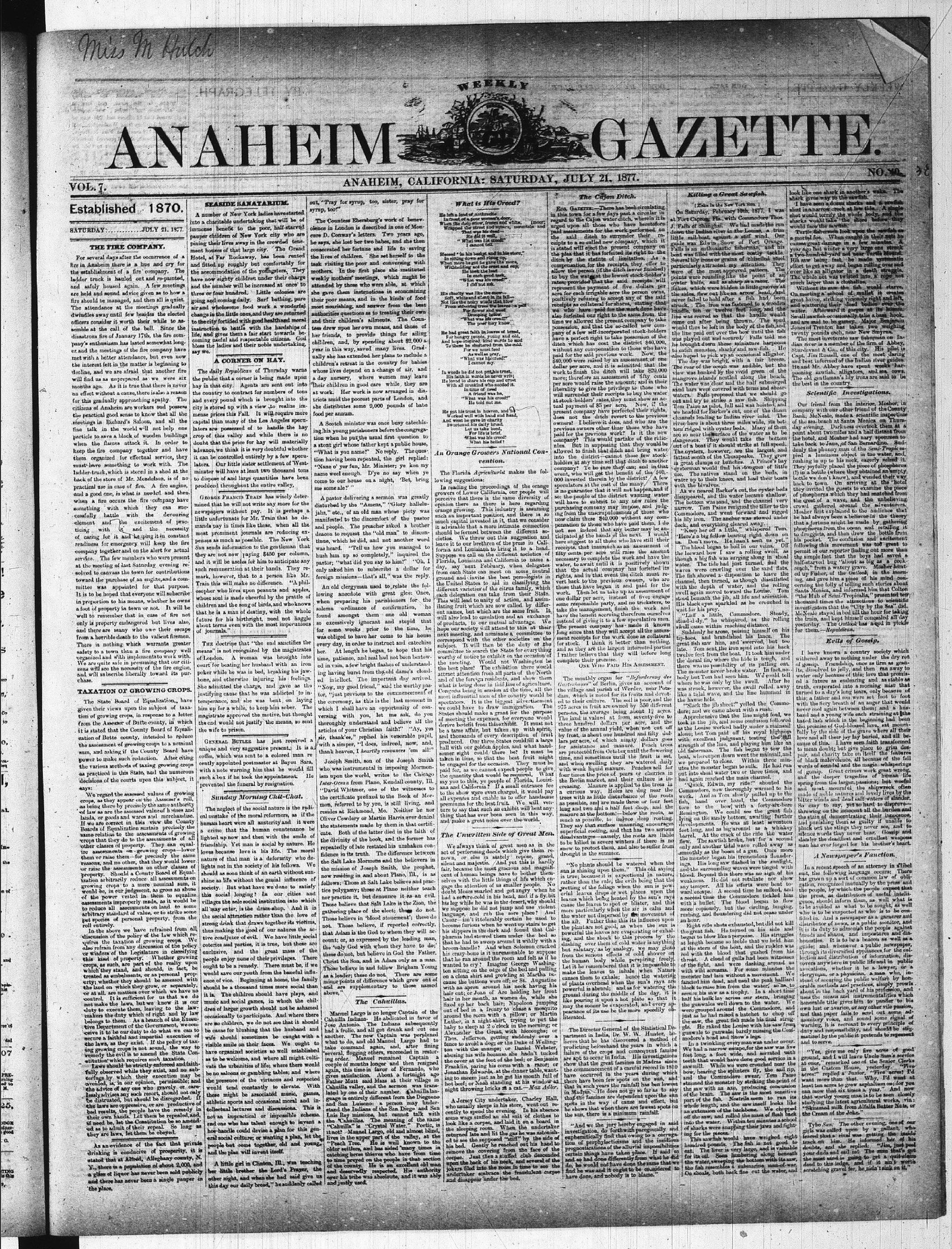
Searchable text
Miss M Hutch
ANAHEIM
VOL. 7.
Established 1870.
SATURDAY: JULY 21, 1977.
THE FIRE COMPANY.
For several days after the occurrence of a fire in Anaheim there is a hue and cry for the establishment of a fire company. The ladder truck is hauled out and repainted, and safely housed again. A few meetings are held and sound advice given as to how a fire should be managed, and then all is quiet. The attendance at the meetings gradually dwindles away until few besides the elected officers consider it worth their while to assemble at the call of the bell. Since the disastrous fire of January 17th, the fire company's enthusiasm has lasted somewhat longer and the meetings of the fire company have met with a better attendance, but even now the interest felt in the matter is beginning to decline, and we are afraid that another fire will find us as unprepared as we were six months ago. As it is true that there is never an effect without a cause, there is also a reason for this gradually approaching apathy. The citizens of Anaheim are workers and possess the practical good sense to know that all the meetings in Richard's Saloon, and all the fine talk in the world will not help one particle to save a block of wooden buildings when the flames attack it. In order to keep the fire company together and have them organized for effectual service, they must have something to work with. The
SEARIDE MANATARIUM.
A number of New York ladies have started into a charitable undertaking that will be of immense benefit to the poor, half-starved pauper children of New York city who are pining their lives away in the crowded tenement houses of that large city. The Grand Hotel, at Far Rockaway, has been rented and fitted up roughly but comfortably for the accommodation of the youngsters. They have now eighty children under their charge and the number will be increased at once to three or four hundred. Little colonies are going and coming daily. Surf bathing, pure air and wholesome food work a wonderful change in the little ones, and they are returned to the city fortified with good health and moral instruction to battle with the hardships of life, and gives them a fair start towards becoming useful and respectable citizens. God bless the ladies and their noble undertaking, say we.
A CORNER ON HAY.
The daily Republican of Thursday warns the public that a corner is being made upon hay in that city. Agents are sent out into the country to contract for numbers of tons and every pound which is brought into the city is stored up with a view to realize immense prices this Fall. It will require more capital than many of the Los Angeles speculators are possessed of to handle the hay crop of this valley and while there is no doubt that the price for hay will materially advance, we think it is very doubtful whether it can be controlled entirely by a few speculators. Our little sister settlement of West-
decline, and we are afraid that another fire will find us as unprepared as we were six months ago. As it is true that there is never an effect without a cause, there is also a reason for this gradually approaching apathy. The citizens of Anaheim are workers and possess the practical good sense to know that all the meetings in Richard's Saloon, and all the fine talk in the world will not help one particle to save a block of wooden buildings when the flames attack it. In order to keep the fire company together and have them organized for effectual service, they must have something to work with. The ladder-truck, which is stored in a shed at the back of the store of Mr. Mendelson, is of no practical use in case of fire. A fire engine, and a good one, is what is needed and then when a fire occurs the fire company have something with which they can successfully battle with the devouring element and the excitement of practicing with it and the necessity of caring for it and keeping it in constant readiness for emergency will keep the fire company together and on the alert for actual service. The few members who were present at the meeting of last Saturday evening resolved to canvass the town for contributions toward the purchase of an engine, and a committee was appointed for that purpose. It is to be hoped that everyone will subscribe in proportion to his means, whether he owns a foot of property in town or not. It will be well to remember that in case of fire not only is property endangered but lives also, and there are many who owe their escape from a horrible death to the valiant firemen.
There is nothing which warrants greater safety to a town than a fire company well organized and with implements to work with. We are quite safe in presuming that our citizens will see the necessity of the fire engine, and will subscribe liberally toward its purchase.
TAXATION OF GROWING CROPS.
The State Board of Equalization, have given their views upon the subject of taxation of growing crops, in response to a letter from the Assessor of Butte county, in which it is stated that the County Board of Equalization of Butte county, intended to reduce the assessment of growing crops to a nominal sum, and asking if the County Board have power to make such reduction. After citing the various methods of taxing growing crops as practiced in this State, and the numerous decisions of the courts upon this subject, it says:
We regard the assessed values of growing crops, as they appear on the Assessor's roll, as being there by precisely the same authority of law as are the assessed value of houses and lands, or goods and wares and merchandise. If we are correct in this view the County Boards of Equalization sustain precisely the same relation to the assessments of growing crops that they do to the assessments of all other classes of property. They can equalize assessments on growing crops—lower them or raise them—for precisely the same reasons, and no other, that they would lower or raise the assessments on other classes of property. Should a County Board of Equalization arbitrarily reduce all assessments on decline, and we are afraid that another fire will find us as unprepared as we were six months ago. As it is true that there is never an effect without a cause, there is also a reason for this gradually approaching apathy. The citizens of Anaheim are workers and possess the practical good sense to know that all the meetings in Richard's Saloon, and all the fine talk in the world will not help one particle to save a block of wooden buildings when the flames attack it. In order to keep the fire company together and have them organized for effectual service, they must have something to work with. The ladder-truck, which is stored in a shed at the back of the store of Mr. Mendelson, is of no practical use in case of fire. A fire engine, and a good one, is what is needed and then when a fire occurs the fire company have something with which they can successfully battle with the devouring element and the excitement of practicing with it and the necessity of caring for it and keeping it in constant readiness for emergency will keep the fire company together and on the alert for actual service. The few members who were present at the meeting of last Saturday evening resolved to canvass the town for contributions toward the purchase of an engine, and a committee was appointed for that purpose. It is to be hoped that everyone will subscribe in proportion to his means, whether he owns a foot of property in town or not. It will be well to remember that in case of fire not only is property endangered but lives also, and there are many who owe their escape from a horrible death to the valiant firemen.
There is nothing which warrants greater safety to a town than a fire company well organized and with implements to work with. We are quite safe in presuming that our citizens will see the necessity of the fire engine, and will subscribe liberally toward its purchase.
TAXATION OF GROWING CROPS.
The State Board of Equalization, have given their views upon the subject of taxation of growing crops, in response to a letter from the Assessor of Butte county, in which it is stated that the County Board of Equalization of Butte county, intended to reduce the assessment of growing crops to a nominal sum, and asking if the County Board have power to make such reduction. After citing the various methods of taxing growing crops as practiced in this State, and the numerous decisions of the courts upon this subject, it says:
We regard the assessed values of growing crops, as they appear on the Assessor's roll, as being there by precisely the same authority of law as are the assessed value of houses and lands, or goods and wares and merchandise. If we are correct in this view the County Boards of Equalization sustain precisely the same relation to the assessments of growing crops that they do to the assessments of all other classes of property. They can equalize assessments on growing crops—lower them or raise them—for precisely the same reasons, and no other, that they would lower or raise the assessments on other classes of property. Should a County Board of Equalization arbitrarily reduce all assessments on decline, and we are afraid that another fire will find us as unprepared as we were six months ago. As it is true that there is never an effect without a cause, there is also a reason for this gradually approaching apathy. The citizens of Anaheim are workers and possess the practical good sense to know that all the meetings in Richard's Saloon, and all the fine talk in the world will not help one particle to save a block of wooden buildings when the flames attack it. In order to keep the fire company together and have them organized for effectual service, they must have something to work with. The ladder-truck, which is stored in a shed at the back of the store of Mr. Mendelson, is of no practical use in case of fire. A fire engine, and a good one, is what is needed and then when a fire occurs the fire company have something with which they can successfully battle with the devouring element and the excitement of practicing with it and the necessity of caring for it and keeping it in constant readiness for emergency will keep the fire company together and on the alert for actual service. The few members who were present at the meeting of last Saturday evening resolved to canvass the town for contributions toward the purchase of an engine, and a committee was appointed for that purpose.
It is to be hoped that everyone will subscribe in proportion to his means, whether he owns a foot of property in town or not. It will be well to remember that in case of fire not only is property endangered but lives also, and there are many who owe their escape from a horrible death to the valiant firemen.
There is nothing which warrants greater safety to a town than a fire company well organized and with implements to work with. We are quite safe in presuming that our citizens will see the necessity of the fire engine, and will subscribe liberally toward its purchase.
TAXATION OF GROWING CROPS.
The State Board of Equalization, have given their views upon the subject of taxation of growing crops, in response to a letter from the Assessor of Butte county, in which it is stated that the County Board of Equalization of Butte county, intended to reduce the assessment of growing crops to a nominal sum, and asking if the County Board have power to make such reduction. After citing the various methods of taxing growing crops as practiced in this State, and the numerous decisions of the courts upon this subject, it says:
We regard the assessed values of growing crops, as they appear on the Assessor's roll, as being there by precisely the same authority of law as are the assessed value of houses and lands, or goods and wares and merchandise. If we are correct in this view the County Boards of Equalization sustain precisely the same relation to the assessments of growing crops that they do to the assessments of all other classes of property. They can equalize assessments on growing crops—lower them or raise them—for precisely the same reasons, and no other, that they would lower or raise the assessments on other classes of property. Should a County Board of Equalization arbitrarily reduce all assessments on decline, and we are afraid that another fire will find us as unprepared as we were six months ago. As it is true that there is never an effect without a cause, there is also a reason for this gradually approaching apathy. The citizens of Anaheim are workers and possess the practical good sense to know that all the meetings in Richard's Saloon, and all the fine talk in the world will not help one particle to save a block of wooden buildings when the flames attack it. In order to keep the fire company together and have them organized for effectual service, they must have something to work with. The ladder-truck, which is stored in a shed at the back of the store of Mr. Mendelson, is of no practical use in case of fire. A fire engine, and a good one, is what is needed and then when a fire occurs the fire company have something with which they can successfully battle with the devouring element and the excitement of practicing with it and the necessity of caring for it and keeping it in constant readiness for emergency will keep the fire company together and on the alert for actual service. The few members who were present at the meeting of last Saturday evening resolved to canvass the town for contributions toward the purchase of an engine, and a committee was appointed for that purpose.
It is to be hoped that everyone will subscribe in proportion to his means, whether he owns a foot of property in town or not. It will be well to remember that in case of fire not only is property endangered but lives also, and there are many who owe their escape from a horrible death to the valiant firemen.
There is nothing which warrants greater safety to a town than a fire company well organized and with implements to work with. We are quite safe in presuming that our citizens will see the necessity of the fire engine, and will subscribe liberally toward its purchase.
TAXATION OF GROWING CROPS.
The State Board of Equalization, have given their views upon the subject of taxation of growing crops, in response to a letter from the Assessor of Butte county, in which it is stated that the County Board of Equalization of Butte county, intended to reduce the assessment of growing crops to a nominal sum, and asking if the County Board have power to make such reduction. After citing the various methods of taxing growing crops as practiced in this State, andthe numerous decisions ofthe courts upon this subject.it says:
We regardthe assessedvaluesofgrowingcropsastheyappearontheAssessorsroll.asbeingtherebypreciselythesameauthorityoflawasaretheassessedvalueofhousesandlands.orgoodsandwaresandmerchandise.IfwearecorrectinthisviewtheCountyBoardsOfEqualizationsustainpecificallythesamerelationtotheassessmentsofgrowingcropsthattheydotocontheassessmentsofallotherclassesofproperty.ShouldaCountyBoardOfEqualizationobitrarilysedallassessmentsondeclines,andweareafraidthatanotherfirewillfindusaspreparedaswewere六monthsago.Asitistruesthatanewpupilsonhisyoungpaulionwhenhepuplishstocountersoftheandpeople.Thedeacontorequetrtime,theheardwasheard.“Thehushhimupapast pastor;“whatdonlyaskhimforeignmissionse
An old clergydowinganecdotewhenpreparingsolemnordomainfoundamongsoexcessivelyforsomeweekswouldobeyeveryday.inouther.Atlengthtimepatientedin vain,afevinghavingburiedintellect.“Now,mygoodtor,"justprevetheceremony,"whichIshallversingwiththoroughlyunarticlesofyourair,thank'lee;”witha simper,thank heaven,
JosephSmithwhowasinstructismupontheInter-Oceanfrom“DavidWhittithecertificatenonreferredresidesatRic OliverCowdenthestatementcate.BothoelfathdivinityoifequidenceoffidenceinitsSaltLakethemissionofnowresidingfollowe
We regard the assessed values of growing crops, as they appear on the Assessor's roll, as being there by precisely the same authority of law as are the assessed value of houses and lands, or goods and wares and merchandise. If we are correct in this view the County Boards of Equalization sustain precisely the same relation to the assessments of growing crops that they do to the assessments of all other classes of property. They can equalize assessments on growing crops—lower them or raise them—for precisely the same reasons, and no other, that they would lower or raise the assessments on other classes of property. Should a County Board of Equalization arbitrarily reduce all assessments on growing crops to a mere nominal sum, it would be, in our judgment, as gross an abuse of the power vested in them to equalize assessments improperly made, as it would be to reduce all assessments on land to some arbitrary standard of value, or to strike some put species of personal property, from the roll entirely.
In the above we have refrained from all discussion of the policy of the law which requires the taxation of growing crops. We also refrain from any discussion of the policy or wisdom of the Legislature in classifying this kind of property. Whether growing crops, as such, are part of the reality upon which they stand, and should, in fact, be treated as embelments, or as personal property; whether they should be assessed with the land on which they grow, or separately, or at all, are matters over which we have no control. It is sufficient for us that we do not make the laws, but we know it is our duty to execute them, leaving to the lawmakers the duty which of right and by law belongs to them. As a branch of the Executive Department of the Government, we conceive it to be our duty to do what we can to secure a faithful and impartial execution of the laws, as they exist. If the policy of taxing growing crops is not sound, the way to remedy the evil is to amend the State Constitution which requires such taxation.
Laws should be strictly enforced and faithfully observed while they exist, and no subterfuge by which their execution may be avoided, is, in our opinion, permissible; and the advice of any one who gravely or carelessly advises any such resort, should not only be distrusted, but should be disregarded. If the laws are oppressive, or are productive of bad results, the people have the remedy in their own hands. Let them be repealed, and if need be, let the Constitution be so amended as to admit of their repeal. So long as they are laws, let them be obeyed.
As an evidence of the fact that private drinking is conducive of prosperity, it is stated that at Alfred, Alleghany county, N.Y., there is a population of about 2,000, and a plan of liquor has never been said publicly and there has never been a single pauper in 'the place.'
Sunday Morning Chit-Chat.
The neglect of the social nature is the radical mistake of the moral reformers, as if the human heart were all austerity and it were a crime that the human countenance be lighted up now and then with the smile of friendship. Yet man is social by nature. He loves because love is his life. The moral nature of that man is a deformity who delights not in the society of his fellows. We should as soon think of an earth without sunshine as life without the genial influence of society. But what have we done to satisfy this social longing? In our cities and villages the sale social institution into which all may enter, is the drain-shop. And it is the social attraction rather than the love of strong drink that draws together its victims, thus making the good of our natures the active coadjutor of evil. We have little social coteries and parties, it is true, but these are exclusive, and the great mass of the people enjoy none of their privileges. There ought to be a remedy. There must be, if we would save our youth from the harmful influence of vice. Beginning at home, the family should be a thousand times more social than it is. The children should have plays, and music and social games, in which the children of larger growth should not be ashamed occasionally to participate. And where there are no children, we do not see that it should be cause for blushing that the husband and wife should sometimes be caught with a visible smile on their faces. We ought to have organized societies so well established as to be welcome, and where all might cultivate the urbanities of life; where there would be no saloons or gambling tables; and where the presence of the virtuous and respected would tend constantly to elevate. With these might be associated music, games, athletic sports and occasional moral and intellectual lectures and discussions. This is not an impractical or impossible scheme. And one who has talent enough to invent a how-handle could devise a plan for this general social culture; or wanting a plan, let the people but come together, old and young, and the plan will invent itself.
A little girl in Clinton, Ill., was teaching her little brother the Lord's Prayer, the other night, and when she had said give us this day our daily bread," he suddenly called
WEEKLY
EIM GA
ANAHEIM, CALIFORNIA: SATURDAY, JULY 21, 1877.
out, "Pray for syrup, too, sister, pray for syrup, too!"
The Countess Ebersburg's work of benevolence in London is described in one of Moncure D. Conway's letters. Two years ago, he says, she lost her two babes, and she then consecrated her fortune and life to saving the lives of children. She set herself to the task visiting the poor and conversing with mothers. In the first place she instituted weekly mothers' meetings, which might be attended by those who were able, at which she gave them instructions in economizing their poor means, and in the kinds of food most nourishing, and answer from the best authorities questions as to treating their own and their children's ailments. The Countess drew upon her own means, and those of her friends, to provide things for ailing children, and, by spending about $2,000 a year in this way, saved many lives. Gradually she has extended her plans to include a children's retreat in the country for babies whose lives depend on a change of air, and a day nursery, where women may leave their children in good care while they are at work. Her work is now arranged in districts amid the poorest parts of London, and she distributes some 9,000 pounds of babe food per annum.
A Scotch minister was once busy catechising his young parishioners before the congregation when he put the usual first question to a stout girl whose father kept a public house, "What is you name?" No reply. The question having been repeated, the girl replied:
"Name? I am fun Mr. Minister; ye ken my
What is His Creed?
He left a load of anthracite
In trust of a poor woman's door,
When the deep snow frozen and white,
Wrapped the street and square, mountain and
That was his dead—
He did it well,
"What was his creed?"
I cannot tell.
Blessed "in his beset and in his store,"
In sitting down and rising up,
When more he got he gave the more,
Withholding not the sweet and carp,
He took the last
In each good task,
"What was his creed?"
I did not ask.
His charity was like the snow—
Soft, white and silent in its fall—
Not like the noisy winds that blow
From shivering trees the leaves—a pall
For flower and wind
Drooping below
"What was his creed?"
The power may know.
He had great faith in leaves of bread,
For hungry people, young and old,
And hope-inspired kind words he said
To those he sheltered from the cold.
For we must feed
As well as pray,
"What was his creed?"
I cannot say.
In words he did not put his trust,
His faith in words he never writ;
He loved to share his emp and trust
With all mankind who needed it.
In time of need
A friend was he,
"What was his creed?"
He told not me.
He put his trust in heaven, and he
Worked well with hand and head,
And what he gave in charity
Sweetened his daily bread.
Let us take heed,
For life is brief.
What was his creed?
What his belief?
An Orange Growers National Convention.
A Scotch minister was once busy catechising his young parishoners before the congregation when he put the usual first question to a stout girl whose father kept a public house, "What is you name?" No reply. The question having been repeated, the girl replied: "Nane o' yer fun, Mr. Minister; ye ken my name weel enough. D'ye no say when ye come to our house on a night, Bet, bring me some ale?"
A pastor delivering a sermon was greatly disturbed by the "Amens," "Glory ballelujahs," etc., of an old man whose piety was manifested to the discomfort of the pastor and people. The preacher asked a brother deacon to request the "old man" to discontinue, which he did, and not another word was heard. "Tell us how you managed to hush him up so completely," inquired the pastor; "what did you say to him?" "Oh, I only asked him to subscribe a dollar for foreign missions—that's all," was the reply.
An old clergyman used to relate the following anecdote with great glee: Once, when preparing his parishioners for the solemn ordinance of confirmation, he found amongst them one old woman so excessively ignorant and stupid that for some weeks prior to the time, he was obliged to have her come to his house every day, in order to instruct and catechise her. At length he began to hope that his time, patience, and zeal had not been bestowed in vain, a few bright flashes of understanding having burst from the old dame's clouded intellect. The important day arrived. "Now, my good friend," said the worthy pastor, "just previous to the commencement of the ceremony, as this is the last moment in which I shall have an opportunity of conversing with you, let me ask, do you thoroughly understand and believe all the articles of your Christian faith?" "Ay, yes sir, thankee," replied his venerable pupil, with a simper, "I does, indeed, now, and thank heaven, I heartily renounces 'em all!"
Joseph Smith, son of the Joseph Smith who was instrumental in imposing Mormonism upon the world, writes to the Chicago Inter-Ocean from Plano, Kendall county, Ill. "David Whitmer, one of the witnesses to the certificate prefixed to the Book of Mormon, referred to by you, is still living, and resides at Richmond, Mo. Neither he nor Oliver Cowdery or Martin Harris ever denied the statements made by them in that certificate. Both of the latter died in the faith of the divinity of the book, and the former has repeatedly of late restated his unshaken confidence in its truth. The difference between the Salt Lake Mormons and the believers in the mission of Joseph Smith, the prophet, now residing in and about Plano, Ill., is as follows: Those at Salt Lake believe and practice more lives depend on a change of air, and a day nursery, where women may leave their children in good care while they are at work. Her work is now arranged in districts amid the poorest parts of London, and she distributes some 9,000 pounds of babe food per annum.
A Scotch minister was once busy catechising his young parishoners before the congregation when he put the usual first question to a stout girl whose father kept a public house, "What is you name?" No reply. The question having been repeated, the girl replied: "Nane o' yer fun, Mr. Minister; ye ken my name weel enough. D'ye no say when ye come to our house on a night, Bet, bring me some ale?"
A pastor delivering a sermon was greatly disturbed by the "Amens," "Glory ballelujahs," etc., of an old man whose piety was manifested to the discomfort of the pastor and people. The preacher asked a brother deacon to request the "old man" to discontinue, which he did, and not another word was heard. "Tell us how you managed to hush him up so completely," inquired the pastor; "what did you say to him?" "Oh, I only asked him to subscribe a dollar for foreign missions—that's all," was the reply.
An old clergyman used to relate the following anecdote with great glee: Once, when preparing his parishioners for the solemn ordinance of confirmation, he found amongst them one old woman so excessively ignorant and stupid that for some weeks prior to the time, he was obliged to have her come to his house every day, in order to instruct and catechise her. At length he began to hope that his time, patience, and zeal had not been bestowed in vain, a few bright flashes of understanding having burst from the old dame's clouded intellect. The important day arrived. "Now, my good friend," said the worthy pastor, "just previous to the commencement of the ceremony, as this is the last moment in which I shall have an opportunity of conversing with you, let me ask, do you thoroughly understand and believe all the articles of your Christian faith?" "Ay, yes sir, thankee," replied his venerable pupil, with a simper, "I does, indeed, now, and thank heaven, I heartily renounces 'em all!"
Joseph Smith, son of the Joseph Smith who was instrumental in imposing Mormonism upon the world, writes to the Chicago Inter-Ocean from Plano, Kendall county, Ill. "David Whitmer, one of the witnesses to the certificate prefixed to the Book of Mormon, referred to by you, is still living, and resides at Richmond, Mo. Neither he nor Oliver Cowdery or Martin Harris ever denied the statements made by them in that certificate. Both of the latter died in the faith of the divinity of the book, and the former has repeatedly of late restated his unshaken confidence in its truth. The difference between the Salt Lake Mormons and the believers in the mission of Joseph Smith, the prophet, now residing in and about Plano, Ill., is as follows: Those at Salt Lake believe and prace
In reading the proceedings of the orange growers of Lower California, our people will perceive that there is the same diversity of opinion there as there is here regarding orange growing. This industry is assuming such an important position, and there is so much capital invested in it, that we consider it advisable that a more intimate connection should be formed between the different societies. We throw out this suggestion and leave it to our brethren of the press in California and Louisiana to bring it to a head. Suppose we call on the different societies of Florida, Louisiana and California to name a day, say next February, when delegates from each State can meet on some neutral ground and invite the best pomologists in the United States to aid in classifying the different varieties of the citrus family, which each delegation can take from their States. This will lead to unity of action, and assimilating fruit which are now called by different names, but which are the same fruit. It will also lead to simulation and an exchange of products, to our mutual advantage. We hope our society will attend to this at their next meeting, and nominate a committee to correspond with other societies on the subject. It will then be the duty of the committee to search the State for everything worthy of notice to exhibit on the occasion of the meeting. Would not Washington be the best place? The exhibition there would attract attention from all parts of the North and of the foreign residents, and show them what is being done in this line of agriculture. Congress being in session at the time, all the most influential men of the country would be spectators. It is the biggest advertisement we could have to draw immigration. The States should make a grant for the purpose of meeting the expenses for everyone would derive benefit from this exhibit. It must not be a tame affair, but taken up with spirit, and thousands of every description of fruit produced. Our three States could fill a large hall with our golden apples, and what handson sight could there be? It must be taken in time so that the best fruit might be engaged for the occasion. They must be paid for as we cannot expect people to give the quantity that would be required. What say you to this, ye people of Florida, Louisiana and California? If a small entrance fee to the show were even charged, it would pay all expenses and enable us to offer handsome premiums for the best fruit. We will venture to say that such an exhibit will beat anything that has ever been seen in this way,and make a great noise over the world.
The Unwritten Side of Great Men
We always think of great men as in the act of performing deeds which give them renown, or else in stately repose, grand silent and majestic. And yet this is hardly fair because the most gracious and magnificent human beings have to bother themselves with the little things of life which enlarge their lives depend on a change of air,and a day nursery,mwhere women may leave their children in good care while they are at work.Here we did not put his trust.His faith in words he never wilt;He loved to share his cup and erase With all munkind who needed it.In time for his trust in heaven,and He Worked well with hand and head,and what he gave in charity Sweetened his daily brand.Let us take beeke For life is brief What was his creed What his belief?
An Orange Growers National Convention.
The Florida Agriculturist makes the following suggestions:
In reading the proceedings of the orange growers of Lower California, our people will perceive that there is the same diversity of opinion there as there is here regarding orange growing. This industry is assuming such an important position,and there is so much capital invested in it,these consider it advisable that a more intimate connection should be formed between these different societies. We throw out this suggestion and leave it to our brethren of the press in California and Louisiana to bring it to a head.Suppose we call on the different societies of Florida,Louisiana and California to name a day,say next February,当delegates from each State can meet on some neutral ground and.invitethebestpomologistswouldhavetodrawimmigration.TheStatesshouldmakeagrantforthepurposeofmeetingtheexpensesforseverywouldderivebenefitfromthisexhibit.Imustnotbea tameaffair,buttakenupwithspirit,andthousandsofeverydescriptionoffruitproduced.OurthreeStatescouldfillalargehallwithourgoldenapples,andwhathandsonsightcouldtherebe?ItmustbeknowntothatthebestfruitmightbeenguidedfortheoccasionTheymustbepaidforaswecannotexpectpeopletogivethequantitythatwouldberequired.Wayyoutothis,yepeopleofFlorida,LouisianaandCalifornia?Ifasmallentrancefeetotheshowwereevencharged.itwouldpayallexpensesandenableustocherishsomepremiumsforthebestfruit.Wwillventuretowhatsuchanexhibitwillbeatanythingthathaseverbeenseeninthisway,andmakeagreatnoiseovertheworld.
The Unwritten Side of Great Men
We always think of great men as in the act of performing deeds which give them renown,或else in stately repose Grand silent and majestic.And yet this is hardly fair because the most gracious and magnificent human beings have to bother themselves withthe little thingsoflifewhichenablesthebestfruitmightbeenguidedfortheoccasionTheymustbepaidforaswecannotexpectpeopletogivethequantitythatwouldberequired.Wayyoutothis,yepeopleofFlorida,LouisianaandCalifornia?Ifasmallentrancefeetotheshowwereevencharged.itwouldpayallexpensesandenabledustocherishsomepremiumsforthebestfruit.Wwillventuretowhatsuchanexhibitwillbeteadultinythefloweringtime,and sometimes untilthefruitisset,dailyandswellingtheyarewaterdiedwithweakliquidmanure.Peaches sellfor four timesthepriceofpearsorcharriesintheBerlinmarket,and theircultureincreasing.Manureisappliedtothetreesinacuriousway.Holesaredugnearthetreeswithaslittledisturbanceoftherootsaspossible,andaremadethreeorfourfeetlongandtwoanda halffeetdeep,andthemanureatthebottom!belowtheroots,aasmuchaspossible,tod inducedeeprooting They say that surface manuringencouragessuperficialrooting,andthathastwoseriousdisadvantages-namely,the rootsare liabletobkeilledinseverewintersifthereisno snowtoprotectthemen,andalsoto sufferfromdroughtinthesummer.
No plants should be watered whenthe sunis shining upon them."This old saying is true;it is exceptionalin nature rather thanthe rule,the evils being thatthe
"David Whitmer, one of the witnesses to the certificate prefixed to the Book of Mormon, referred to by you, is still living, and resides at Richmond, Mo. Neither he nor Oliver Cowdery or Martin Harris ever denied the statements made by them in that certificate. Both of the latter died in the faith of the divinity of the book, and the former has repeatedly of late restated his unshaken confidence in its truth. The difference between the Salt Lake Mormons and the believers in the mission of Joseph Smith, the prophet, now residing in and about Plano, Ill., is follows: Those at Salt Lake believe and practice polygamy; those at Plano neither teach nor practice it, but denounce it as an evil. Those believe that Salt Lake is the Zion, the gathering place of the elect; they do not. Those believe in 'blood atonement'; these do not. Those believe, if reported correctly, that Adam is the God to whom they will account; or, as expressed by the leading man, the 'only God with whom they have to do'; these do not, but believe in God the Father, Christ the Son, and in Adam only as a man. Those believe in and follow Brigham Young as a leader; these do not. There are some minor points of difference which grew out of and are supplementary to those named above."
The Cahullas.
Manuel Largo is no longer Captain of the Cahulla Indians- He ablicated in favor of Jose Antonio. The Indians subsequently had a frolic, and all got drunk and cut one another. The new Captain was perplexed what to do, and old Manuel Largo had to take command again, and after fining several flogging others succeeded in restoring order. Manuel remained Captain a couple of months longer and then resigned again, this time in favor of Fernando, who gives satisfaction. About a fortnight ago Father Mutt said Mass at their village in Cahulla valley, and the sermon was translated by one of their number. Cahulla language is entirely different from the Diegueno and San Luiseno: a person may understand the Indians of the San Diego and San Luis Rey missions, but cannot talk with the Cahullas. The meaning of the name "Cahulla" is "Crystal Water." Poetic, is it not? Manuel Largo, old and almost blind, lives in the upper part of the valley, at the Peach Tree. He is well known to the older settlers, and has aided many times in catching horse thieves who have from time to time preyed on the people in that section of the county. He is an excellent old man and deservedly respected. His authority over his tribe was absolute, and it was ably and justly used.
The Unwritten Side of Great Men.
We always think of great men as in the act of performing deeds which give them renown, or else in stately repose, grand, silent and majestic. And yet this is hardly fair, because the most gracious and magnificent of human beings have to bother themselves with the little things of life which engage the attention of us smaller people. No doubt Moses suared and got angry when he had a severe-cold in his head, and if a fly bit his leg while he was in the desert, why should we suppose he did not jump and use violent language, and rub the sore place? And Caesar—inn't tolerably certain he used to become furious when he went up stairs to get his slippers in the dark and found that Calphurnia had stowed them under the bed so that he had to sweep around it wildly with a broom-handle? And when Solomon cracked his crazy-bone is it unreasonable to suppose that he ran around the room and felt as if he wanted to cry! Imagine George Washington sitting on the edge of the bed and pulling on a clean shirt and growling at Martha because the buttons were off; or St. Augustine with an apron around his neck having his hair cut; or Joan of Are holding her front hair in her month, as women do, while she fixed up her back hair; Napoleon jumping out of bed in a frenzy to chase a mosquito around the room with a pillow; or Martin Luther, in a night-shirt, trying to put the baby to sleep at 2 o'clock in the morning; or Alexander the Great, with hiccups; or Thos. Jefferson, getting suddenly over a fence to avoid a dog; or the Duke of Wellington with the mumps; or Daniel Webster, abusing his wife because she hadn't tucked the cover at the foot of the bed; or Benjamin Franklin, paring his corns with a razor; or Jonathan Edwards, at the dinner table, wanting to sneeze just as he got his mouth full of hot beef; or Noah standing at his window at night throwing bricks at a cat.—Max Aller.
A Jersey City undertaker, Charley Hall, who usually sleeps in his store, went out recently to spend the evening. In his absence some wags stuffed an old suit of clothes to look like a corpse, and laid it on a board in the sleeping room. When the undertaker returned late and lit the gas he was astonished to see the supposed "stiff" by the side of his bed. Gently he reached out his hand to remove the covering from the face of the corpse. Just then a stuffed club descended upon the back of his neck, and several of the jokers filled into the room in time to see the undertaker embrace the fraudulent corpses and disappear under the bed.
No plants should be watered when the sun is shining upon them." This old saying is true; because it is exceptional in nature rather than the rule; the evils being that they greet of the foliage when the sun is powerful leaves drops or wet places upon the leaves which being heated by the sun's rays cause the leaves to spot or blister, and this more particularly when the air is calm and the water not dispersed by the movement of air. Further than this its influence upon the plantare not good, as when the sun is powerfulthe leaves are evaporating or exhaling, and the shock to this process by dashing over them of cold water is anything but salutary, as by analogy, we may clear from the serious effects of cold shower on the human body while perpiring freely. Let it be remembered that it is impossible to make the leaves toinhale when Nature causes them to exhale; hence the watering of plants overhead when the sun's rays are powerfulis absurd; and as for watering during middle of the day, it like pouring it upon a hot plate so that it may be sooner be evaporated, and every appearance of its use be the more speedily or literated.
The Director General of the Statistical Department in India, Dr. W. W. Hunter, believes that he has discovered a method predicting beforehand the years in which failure of crops and consequent famines are apt to occur in India. His investigation show that the great famines in Madras since the commencement of a careful record in 1837 have occurred in the years during which there have been few spots on the sun, and that in such years the rainfall has ben lowened in Madras. He does not go so far as to say that the famines are dependent upon the sun spots in the way of cause and effect, but he shows that when there are fewest spots on the sun, there is a minimum rainfall.
And we we jury hereby engaged in an investigation, do forthwith pardonically as ephemeritically find that owing to a correlation of prophylacticisms and the insignificance prognostications of alluvial impossibilities certain things have taken place. If said I do so had done differently from what he did, he would not have done the same that he did he was and it ought to be considered have done, and nobody is to blame."
GAZETTE.
21, 1877.
Cifon Ditch.
There has been circulating few days past a circular in an water ditch, wherein it is those who have heretofore for the work performed on to surrender their reed new company, which it the present company on was forfited its right to the state of limitation. As a receipt, they offer to (if the ditch is never finished) that the lowest stock-holder's that the said receipt will amount of five dollars per table acre the person owns, to accept any of the said shares, stating that paid for the work done have right to the same from the present company to take that so-called new com-incorporated stock-holders right to take possession of the cost the district $40,000,公意ation to those who have previous work. Now, the need by an assessment of one and it is admitted that the ditch will take $20,000 in assessment of fifty cents rise the amount; and in their privilege to those who their receipts to buy the water rates, they must show an acco-per acr. Now, if the have perfected their rights, ditch revert to the previous it does, and who are the other than those who have noous work? Is it the new would partake of the ridic-posing that they would be that ditch and bring water—cannot those few stock-me sell that ditch to another
Killing a Great Sawfish.
[Zaka in the New York Sun.]
On Saturday, February 19th, 1877, I was at Port Capron, Fla., with Commodore Thos. J. Falls of Shanghai. We had made the run down the Indian river in the Louise, a trim little sail-boat against a stiff wind. Our guide was Edwin Snow of Port Orange. Falls is an enthusiastic fisherman, and his boat was filled with the most costly tackle. Several lily irons or grains of chiselled steel particularly attracted my attention. They were of the most approved pattern. The points were rounding like the point of an oyster knife, and as sharp as a razor. The lilks, which were hidden in little grooves at the sides, flew out like an arrow head, and never failed to hohl after a fish had been struck. The iron was fastened to a wooden handle, ten or twelve feet long, and the line was recoved so that the handle would come out after being thrown. The spud would thus be left in the body of the fish, and the line paid out over the bow until the fish was played out and secured. Falls told me he brought down these miniature harpoons to catch menatee, sharks and saw-fish. He also hoped to pick up an occasional alligator.
The day was bright, with a fair breeze. The rear of the ocean was audible, but the view was banked by the vivid green of the mangrove islands nestled along the beach. The water was clear and the half submerged sand bars were covered with terms and shear-waters. Falls proposed that we should go out and try to strike a saw fish. Shipping Tom Paine as pilot, full sail was hoisted, and we headed for Barker's cut, one of the dozen channels leading to Indian river inlet. The river here is about three miles wide, its bottom ridged with oyster beds. Many of them are so near the surface of the water as to be dangerous. They would take the bottom out of a boat if it should strike at full speed. The oysters, however, are the largest and fattest south of the Chesapeake. They grow in great clumps or bunches. A Prince's bay look like one shark in another's wake. The shark gives way to the sawfish.
I have seen a dozen sharks and a sawfish shut in a narrow creek at low tide. A single shot would terrify the whole body, and the sharks would take the shore before they would face the sawfish.
Turtle fishermen look upon the sawfish as a mortal foe. When caught in their nets he causes great damage in a few minutes. A year ago last winter a very large one struck a two-hundred yard net near Turtle Mound. His saw being fast, he made systematic effort to get away and began rolling over and over like an alligator in a death struggle. The whole net was twisted into a rope not much larger than a clothline.
Without its saw the fish would starve. On meeting a school of mullet it creates great havoc, striking viciously right and left, and scattering their dead bodies over the water. Afterward it gorges at its height. Small sawfish occasionally take a bass hook, and are said to be gaggy. Major Benjamin Jones of Trenton has taken two weighing twenty pounds each, near New Smyrna.
The most inveterate saw fisherman on Indian river is a member of the firm of Abbay, Sturlevant & Co., of this city. His pilot is Capt. Jim Russell, one of the most daring and best informed of the Indian river guides. He and Mr. Abbey have spent weeks harpooning sawfish, alligators, and sea cows. The old gentleman's lily irons are said to be the best in the country.
Scientific Investigations.
Our friend from the interior, Mosher, in company with our other friend of the County Bank, McNeale, made a scientific inspection of the sea-bear at Santa Monica on Thursday evening. Darkness overtook them at a point about two miles and a half distant from the hotel, and Mosher had nary specimen to take back to Jane, of San Bernardino. Suddenly the phunny man of the Semi-Tropical supplied a luminous object in the water, and rushing in up to his neck, eagerly seized it.
Organ for "Beforderung des Berlin, gives an account of parish of Werder, near Potsdam for its fruits and devotions." The soil is poor, and the it are owned by 350 different gardens being about 14 acres. Used at from seventy-five to dollars per acre, and the annual yield, when not cut off but one hundred and fifty dollars goes and manure. Peach trees from October until the flowering times until the fruit is set, lying they are watered daily and manure. Peaches sell for price of pears or cherries in stock, and their culture is inure is applied to the trees in hay. Holes are dug near the disturbance of the roots that are made three or four feet and a half foot deep, and the bottom—below the roots, as able, to induce deep rooting; surface manuring encourages ing, and that has two serious—namely, the roots are liable severe winters if there is no them, and also to suffer from summer.
Should be watered when the upon them." This old saying it is exceptional in nature, rule, the evils being that the view was banked by the vivid green of the mangrove islands nestled along the beach. The water was clear and the half submerged sand bars were covered with terms and shear-waters. Falls proposed that we should go out and try to strike a saw fish. Shipping Tom Paine as pilot, full sail was hoisted; and we headed for Barker's cut, one of the dozen channels leading to Indian river inlet. The river here is about three miles wide, its bottom ridged with oyster beds. Many of them are so near the surface of the water as to be dangerous. They would take the bottom out of a boat if it should strike at full speed. The oysters, however, are the largest and fattest south of the Chesapeake. They grow in great clumps or bunches. A Prince's bay dysterman would find his stongues of little use. The natives stand on the beds, in water up to their knees, and load their boats with the bivalves.
As we neared Barker's cut, the oyster beds disappeared, and the water became shallow. The bottom was sand, and the channel very narrow. Tom Paine resigned the tiller to the Commodore, and went forward and rigged his lily iron. The anchor was stowed under deck, and everything cleared away.
"Keep her off a little," whispered Tom. "Hero's a big fellow bearing right down on us. Don't move. He hasn't seen us yet."
The blood began to boil in our veins. Off the leeward bow I saw a rolling swell, as though a big fish was surging along in shoal water. The tide had just turned, and the waves were crawling over the sand flats. The fish showed a disposition to leave the channel, then turned, as though disentified with the depth of water, and the rolling swell again moved toward the Lonise. Tom stood beneath the jib, all life and animation. His black eyes sparkled as he crouched in wait for his prey.
"Luff a little, Commodore. Steady, stead-d-y." he whispered, as the rolling swall came within reaching distance.
Suddenly he arrose, poising himself on his tip-toes, and brandished his lance. The great fish saw him, and swerved, but too late. Tom sent the iron spind into his back twelve feet from the boat. It took him under the dorsal fin; where the hide is tough, and there was no possibility of its pulling out. The monster never broke water. In fact, nobody but Tom had seen him. We could tell where he was only by the swell. After he was struck, however, the swell rolled away like a tigral wave, and the line hummed in the hawse hole.
"Slack the jib sheet!" yelled the Commodore; and we came about with a rush.
Apprehensive that the line might foul, we took in the jib, and some confusion followed as the Louise worked badly under a mainrail alone; but Tom paid off his royal highness with excellent judgment, testing the full strength of the line, and playing him like an old fisherman. The fish began to tow the beat, whereupon down went the minnails, and we prepared to close. Within three minutes the monster began to sulk. He had run into shoal water two or three times, and had again reached the main channel.
"Quick, Edwin, my rifle!" shouted the Commodore, now thoroughly warmed to his work. And as Tom slowly pulled up to the fish, hand over hand, the Commodore tore to the bow with a forty-six-bore Remington. We could see the great fishing on the sandy bottom, awaiting further developments. He was at least seventeen feet long, and as big around as a whiskey barrel. At the crack of the rifle the water flew. The sawish broke, but for a second only and another tidal wave rolled away as smoothly as the boom of a gun. Once more the monster began his tremendous flounderings.
His long saw flashed in the sunlight, and the surrounding waves were tinged with blood. Beyond this there was no sign of his weakness. He did not retaliate nor show poisoning sawfish, alligators, and sea cows. The old gentleman's lily irons are said to be best in the country.
Scientific Investigations.
Our friend from the interior, Moshor, in company with our other friend of the County Bank, McNeale, made a scientific inspection of the sea-beach at Santa Monica on Thursday evening. Darkness overtook them at a point about twomilas and a half distant from the hotel, and Mosher had nary speemen to take back to Jane, of San Bernardino. Suddenly the phynon man of the Semi-Tropic espied a luminous object in the water, and rushing in up to his neck, eager seized it. They joyfully placed the piece of phosphorus (3) in a bottle (where they obtained an empty bottle we don't know), and wounded their way back to town. On arriving at the hotel they invited the guests to examine the piece of phosphorus which they had matched from the greatest of a wave, and the unbelieving crowd gathered around the adventurers. Mosher first explained to the audience that he had always been a believer in the theory that a fortune might be made by gathering phosphorus from the ocean and retailing it to druggists, and then drew the bottle from his pocket. The confusion and excitement following this movement was too great to permit of our reporter finding out more than the simple fact that the boys had saved a half-starved bug "about as big as a cockroach," from a watery grave. Mosher hunted up Fisher, of the Outlook, in the morning; and gave him a piece of his mind concerning the folly of telling such stories about Santa Monica, and informed him that Colton "the Hub of Semi-Tropicalia," presented ten thousand times to attractions to scientific investigators that the "City by the Sea" did McNeale stayed in bed till the hour for taking the train, and kept himself conquered all day yesterday. The Outlook has aged in pickles for them.
Evils of Gossip.
I have known a country society which withered away to nothing under the dry rot of gossip. Friendship, once as firm as granite, dissolved to jelly, and then ran away to water only because of this; love that promised a future as endearing and as stable as truth, evaporated into a morning mist that turned to day's long tears, only because of this; a father and son were set foot to foot with the fiery breath of an anger that would never cool again between them; and a husband and a young wife each straining at this hated lash which in the beginning had been the promise of God-blessed love; sat mournfully by the side of the grave where all their love and all their joy lay buried; and all because of this. I have seen faith transformed to mean doubt; but give place to grim despair, and charity take on itself the features of black malevolence, all because of the full words of seniall and the magic whisperings of gossip. Great crimes work great wrong; and deeper tragedies of human life spring from larger passions; but woofful and most mournful the shipwreck often made of noble natures and lovely lives by the bitter winds and dead salt waters of slander. So easy to say, yet so hard to disprove—throwing on the innocent all the burden and the stain of demonstrating their innocence; and punishing them as guilty if unable to pluck out the stings they never see; and to silence words they never hear. Gossip and slander the deadheat and cruelsthe weapons man has ever forged for his brother's heart.
A Newspaper's Function.
In a recent speech of an attorney in a libel suit, the following language occurs: There has grown up a sort of common law of obliquity in this country.
should be watered when the upon them." This old saying is exceptional in nature, the rule, the evils being that the foliage when the sun is pow-drops or wet places upon the boiling heated by the sun's rays to spot or blister, and this early when the air is calm and dispersed by the movement of air than this its influence upon not good, as when the sun is leaves are evaporating or exhaling to this process by the them of cold water is anything as by analogy, we may glean effects of cold shower on body while perpiring freely membered that it is impossible toaves to inhale when Nature so exhale; hence the watering head when the sun's rays are scarral; and as for watering the middle of the day, it is at upon a hot plate so that it be evaporated, and every applause use be the more speedily oblor General of the Statistical De-India, Dr. W. W. Hunter, he has discovered a method of beforehand the years in which a crops and consequent famine occur in India. His investigations of great famines in Madras sinceement of a careful record in 1810 led in the years during which even few spots on the sun, and years the rainfall has ben lowest He does not go so far as to say they are dependent upon the sun way of cause and effect, but when there are fewest spots on ice is a minimum rainfall.
The jury hereby engaged in said do forthwith paragonically and fully find that owing to a corrugation phylacticisms and the insidiousions of the alluvial impossibilities have taken place. If said so alone differently from what he did not have done the same that we and it ought to be considered to nobody is to blame."
"Quick, Eawin, my rite: showed the Commodore, now thoroughly warmed to his work. And as Tom slowly pulled up to the fish, hand over hand, the Commodore to the bow with a forty-six-bore Remington. We could see the great fish lying on the sandy bottom, awaiting further developments. He was at least seventeen feet long, and as big around as a whiskey barrel. At the crack of the rifle the water flew. The sawlfish broke, but for a second only and another tidal wave rolled away as smoothly as the boom of a gun. Once more the monster began his tremendous flounderings. His long saw flashed in the sunlight, and the surrounding waves were tingled with blood. Beyond this there was no sign of his weakness. He did not retaliate nor show any temper. All his efforts were bent toward escape. A second time he sulked, and a second time the Commodore tickled him with a bullet. The blood began to flow more copiously, but the circling, rushing, and floundering did not cease under an hour.
Eight rifle shots exhausted, but did not kill the great fish. He turned on his side and began to blow like a porpoise. His struggles at length became so leeable that we held him at the stern of the boat, and the raker was red with the blood that gushed from his throat. A cloud of gulls had been witnesses of the fight, and were dashing around us with wild screams. For some minutes the monster had lain without a movement. We fancied him dead, and used the peak halliard block to raise him from the water, so as to secure his saw as a trophy. In a short time half his bulk lay across our stern, bringing the gunwales well down to the water. We were grouped around the Commodore, and just as he had raised a hatchet to chop off the saw, the great fish made his final struggle. He raked the Louise with his saw from gunwale to gunwale, barely missing the Commodore's head and Snow's legs.
In a twinkling everyman was under cover. We had a narrow escape, for the saw was five feet long, a foot wide, and serrated with teeth that would have done good service in a sawmill. While we were crouched near the bow, hearing the splinters fly, the sail rip, and the Commodore swear, Tom Paine stunned the monster by striking the point of the saw with an axe, producing concussion of the brain. The saw is the most sensitive part of the fish. Notrills seem to run its whole length, and the saw itself looks like an extension of the backbone. We chopped off the saw, and rolled the mass of flesh back into the water. Within ten minutes a school of sharks were snapping their jaws and fighting for the pieces.
This sawfish would have weighed eight hundred pounds. The fish is not good to eat. The liver is very large, and is valuable for its oil. Sass lumbering along beneath the water, sweeping the bottom with its saw, the fish resembles a sabmarine man-of-war. On shoals, both back fins cut the water, and spring from the mastmouth and most mournful the shipwreck often made of noble natures and lovely lives by this bitter winds and dead salt waters of slander. So easy to say, yet so hard to disprove throwing on the innocent all the burden and the stain of demonstrating their innocence, and punishing them as guilty if unable to pluck out the stings they never see, and to silence words they never hear. Gossip and slander the deadliest and crudest weapons man has ever forged for his brother's heart.
A Newspaper's Function
In a recent speech of an attorney in a libel suit, the following language occurs: There has grown up a sort of common law of obligation, recognized mutually by the press and people, by which the people expect that the press, as distributors of useful intelligence should inform them, as well what is to be avoided as what to be sought, as well who is to be suspected as who is to be confided in. And a newspaper as a garner and distributor of news is a public monitor, and it is its duty to admonish the people against frauds and shamis, and impostures and dishonesties. It is to be a beacon as well as a guide; and whenever a public newspaper through its diversified appliances for the collection and distribution of information, discovers anywhere in public life and in public avocations, whether it be a lawyer, or a clergyman, or a physician, a man who instead of securing the public welfare by honorable methods and practices, simply prowls about in the back yard of his profession, and uses means and instrumentalities which honorable title gives him to pander to his own lust or avarice, or any other vile passion, and that paper fails to send out some admonitory voice, and sound some signal of warning; it is recurrent to every principle of duty and responsibility, and should be stigmatized by the public it pretends to represent and to serve.
"Yes, give me only five acres of good ground, and I will leave Uncle Sam's services at once," remarked one of the Senior Clerks in the Custom House, yesterday. "Five acres!" replied a Junior. "Five acres! I'd want more than that. Why, I'd want at least ten acres to grow asphalt tunn on; for you can move that six times a year." And now that worthy young man is to be seen closely studying the latest agricultural works, viz: "Skimmed milk from Alfalfa Butter Nuts, or Cream of the Joke."
Tybo Sun: The other evening, one of our girls was called upon by a gallant, who learned that a rival was getting the inside track on him. He informed her of his doubts, and she replied: "Jim, just paid your duds and sail int! The man that's got most sand is going to get a quit-alarm deed to this ledge, and if it isn't worth scratching gravel for, he didn't sink on it."