anaheim-gazette 1877-07-14
Scanned page
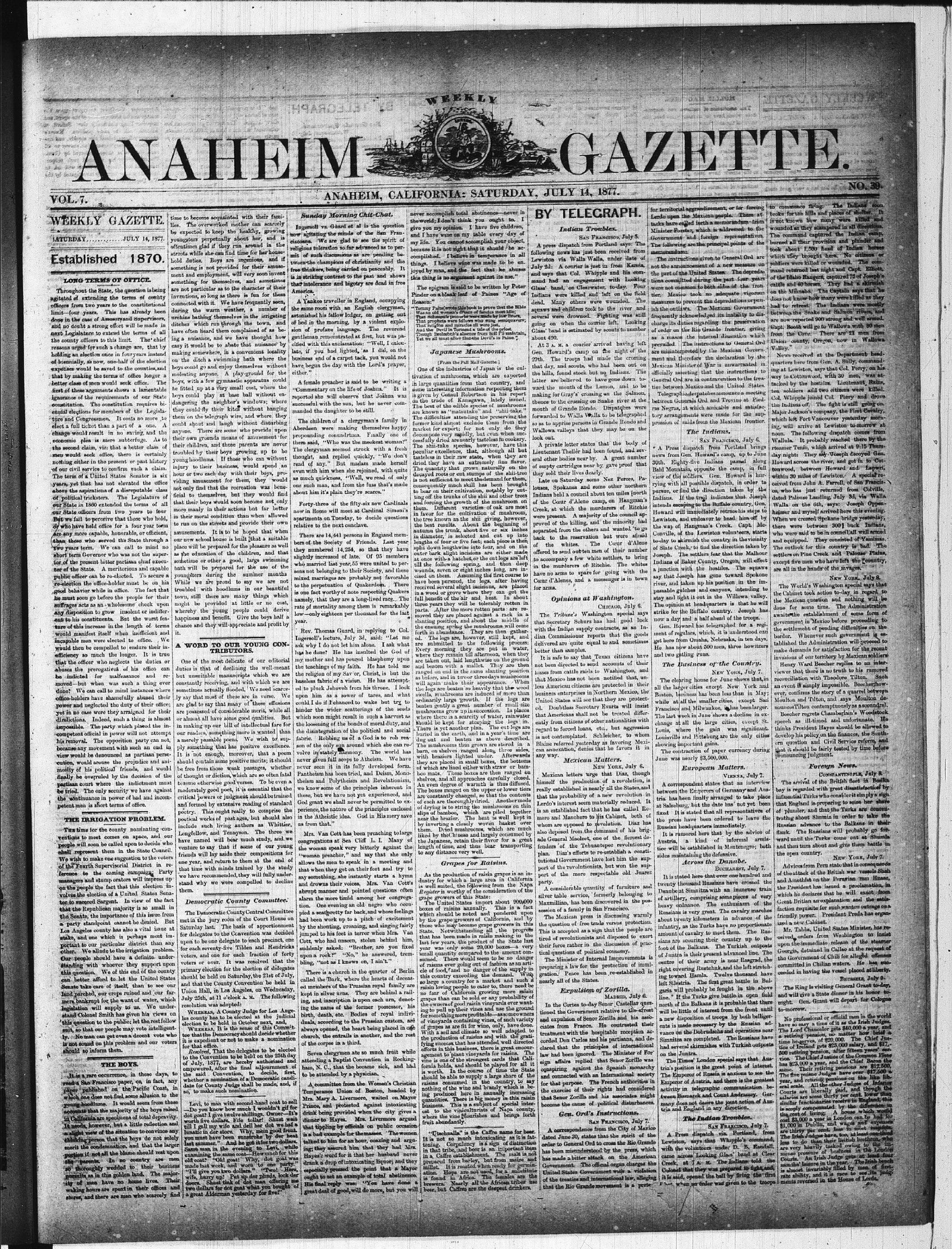
Searchable text
ANAHEIM
VOL. 7.
WEEKLY GAZETTE.
SATURDAY... JULY 14, 1877.
Established 1870.
LONG TERMS OF OFFICE.
Throughout the State, the question is being agitated of extending the terms of county officers from two years to the constitutional limit—four years. This has already been done in the case of Amesbury and Supervisors, and no doubt a strong effort will be made in next Logialatne to extend the terms of all the county officers to this limit. The chief reasons urged for such a change are, that by holding an election once in four years instead of biennially, as now, one-half of the election expenses would be saved to the counties, and that by making the terms of office longer a better class of men would seek office. The first of these arguments shows a lamentable ignorance of the requirements of our State constitution. The constitution requires biennial elections for members of the Legislature and Congressmen. It costs no more to elect a full ticket than a part of a one. A change would result in no saving, and the economic plea is mere subterfuge. As to the second claim, viz: that a better class of men would seek office, there is certainly nothing either in the present or past history time to become acquainted with their families. The overworked mother can scarcely be expected to keep the healthy, growing youngsters perpetually about her, and is oftentimes glad if they run around in the streets while she can find time for her household duties. Boys are ingenious, and if something is not provided for their amusement and employment, will very soon invent something for themselves, and sometimes are not particular as to the character of their inventions, so long as there is fun for them connected with it. We have frequently seen, during the warm weather, a number ofurchins bathing themselves in the irrigating ditches which run through the town, and have often heard them complained of as being a nuisance, and we have thought how easy it would be to abate that nuisance by making somewhere, in a convenient locality on the ditch a swimming bath where the boys could go and enjoy themselves without molesting anyone. A play-ground for the boys, with a few gymnastic apparatus could be fitted up at a very small cost, where the boys could play at base ball without endangering the neighbor's windows; where they could fly their kites without hanging them on the telegraph wire, and where they could shout and laugh without disturbing anyone. There are some who provide upon their own grounds means of amusement for their children, and those parents are never troubled by their boys growing up to be younghoods. If those who can without read of any." But m
expenses would be saved to the counties, and that by making the terms of office longer a better class of men would seek office. The first of these arguments shows a lamentable ignorance of the requirements of our State constitution. The constitution requires biennial elections for members of the Legislature and Congressmen. It costs no more to elect a full ticket than a part of a one. A change would result in no saving, and the economic plea is mere subterfuge. As to the second claim, viz: that a better class of men would seek office, there is certainly nothing either in the present or past history of our civil service to confirm such a claim. The term of a United States Senator is six years, yet that has not elevated the office above the aspirations of a disreputable class of political tricksters. The Legislature of our State in 1860 extended the terms of all our State officers from two years to four. But we fail to perceive that those who hold, or who have held office for a four year term are any more capable, honorable, or efficient, than those who served the State through a two years term. We can call to mind no short term Governor who was not the superior of the present bittor partisan chief executor of the State. A meritorious and capable public officer can be re-elected. To secure a re-election the office-holder must be on his good behavior while in office. The fact that he must soon go before the people for their suffrages acts as an wholesome check upon any disposition to grow insolent or indifferent to his constituents. But the worst feature of this increase in the length of terms would manifest itself when inefficient and incapable man were elected to office. We would then be compelled to endure their inefficiency so much the longer. It is true that the officer who neglects the duties or abuses the prerogatives of his office can be indicted for malfeasance and removed—but when was such a thing ever done? We can call to mind instances where office-holders have shamefully abused their power and neglected the duty of their office; yet in no case were they arraigned for their directions. Indeed, such a thing is almost impossible. The party which placed the incompetent official in power will not attempt his removal. The opposition party can not, because any movement with such an end in view would be denounced as partisan persecution, would arouse the prejudice and animosity of his political friends, and would finally be overruled by the decision of the partisan court where the indictment must be tried. The only security we have against the continuance in power of bad and incompetent men is short terms of office.
THE IRRIGATION PROBLEM.
This time for the county nominating conventions to meet comes on apace, and our people will soon be called upon to decide who shall represent them in the State Council. We wish to make one suggestion to the voters of the Fourth Supervisorial District in reference to the coming campaign. Party managers and stump orators will impress up expenses would be saved to the counties, and that by making the terms of office longer a better class of men would seek office. The first of these arguments shows a lamentable ignorance of the requirements of our State constitution. The constitution requires biennial elections for members of the Legislature and Congressmen. It costs no more to elect a full ticket than a part of a one. A change would result in no saving, and the economic plea is mere subterfuge. As to the second claim, viz: that a better class of men would seek office, there is certainly nothing either in the present or past history of our civil service to confirm such a claim. The term of a United States Senator is six years, yet that has not elevated the office above the aspirations of a disreputable class of political tricksters. The Legislature of our State in 1860 extended the terms of all our State officers from two years to four. But we fail to perceive that those who hold, or who have held office for a four year term are any more capable, honorable, or efficient, than those who served the State through a two years term. We can call to mind no short term Governor who was not the superior of the present bittor partisan chief executor of the State. A meritorious and capable public officer can be re-elected. To secure a re-election the office-holder must be on his good behavior while in office. The fact that he must soon go before the people for their suffrages acts as an wholesome check upon any disposition to grow insolent or indifferent to his constituents. But the worst feature of this increase in the length of terms would manifest itself when inefficient and incapable man were elected to office. We would then be compelled to endure their inefficiency so much the longer. It is true that the officer who neglects the duties or abuses the prerogatives of his office can be indicted for malfeasance and removed—but when was such a thing ever done? We can call to mind instances where office-holders have shamefully abused their power and neglected the duty of their office; yet in no case were they arraigned for their directions. Indeed, such a thing is almost impossible. The party which placed the incompetent official in power will not attempt his removal. The opposition party can not, because any movement with such an end in view would be denounced as partisan persecution, would arouse the prejudice and animosity of his political friends, and would finally be overruled by the decision of the partisan court where the indictment must be tried. The only security we have against the continuance in power of bad and incompetent men is short terms of office.
A WORD TO OUR YOUNG CONTRIBUTORS.
One of the most delicate of our editorial duties is that of declining the well-meant but unsuitable manuscripts which we are constantly receiving, and with which we are sometimes actually flooded. We need scarcely say that most of these are in verse. We are glad to say that many of these effusions are possessed of considerable merit, while all or almost all have some good qualities. But in making up our bill of intellectual fare for our readers, something more is wanted than a merely passable poem. We wish to supply something that has positive excellence. It is not enough, moreover, that a poem should contain some positive merits; it should be free from those weak passages, whether of thought or diction, which are so often fatal to some otherwise good verses. To be even a moderately good poet, it is essential that the critical powers or judgment should be trained and formed by extensive reading of standard poetry. This ought really to comprise the poetical works of past ages, but should also include such living authors as Whittier, Longfellow, and Tennyson. The three we have named will bear much study, and we venture to say that if some of our young friends will lay aside their compositions for one year, and return to them at the end of that time with minds trained by the study we have recommended, they will fully understand why we were compelled to decline
A female preacher is said "Commentary on the life reported she will observe successful with the sun," manded the daughter to read of any." But me even with him when she as much quickness, "Who one such man, and from about him it's plain they."
Forty-three of the fifty now in Rome will meet at apartments on Tuesday, relative to the next concord.
There are 14,441 persons of the Society of 14,254, slightly increased of late who married last year, 52 sons not belonging to this mixed marriages are prepared to the perpetuation of it is one fact worthy of not namely, that they are at rate of mortality among low—only eighteen per year.
Rev. Thomas Guard, Ingersoll's lecture, July ask why I do not let him has he done? He has my mother and has poured the teachings of my faith the religion of my Savior baseless fabric of a visioned to pluck Jehovah from upon him as a sower could I do if I chanced hinder the wider scarcity which soon might result loosening of the bone disintegration of the fabric. Robbing us off son of only sun arrow volve in stately harmony never given full scope never seen it in its faint Pantheism has been tried thieism and Polytheism we know some of the these, but we have not God grant we shall new perience, the nature of it in the Atheistic idea us from that."
Mrs. Van Cott has b congregations at Sea for woman speak very "woman preacher," and allows the men to speak that when they get on say something, she insists
THE IRRIGATION PROBLEM.
The time for the county nominating conventions to meet comes on apace, and our people will soon be called upon to decide who shall represent them in the State Council. We wish to make one suggestion to the voters of the Fourth Supervisorial District in reference to the coming campaign; Party managers and stump orators will impress up on the people the fact that this election involves the election of a United States Senator to succeed Sargent. In view of the fact that the Republican majority is so small in the Senate, the importance of this issue from a party standpoint cannot be denied. But Los Angeles county has also a vital issue at stake, and one which is perhaps most important to our particular district than any other. We allude to the irrigation problem. Our people should have a definite understanding with whoever they support upon this question. We of this end of the county can better afford to let the United States Senate take care of itself, than to see our land parched, our crops ruined and our farmers bankrupt for the want of water, which legislation will supply to us. We understand Colonel Smith has given his views on this question to the public; let the rest follow suit, so that our people may vote intelligently. No man can get even a decent vote who is not sound on this problem and our voters should so inform them.
THE BOYS.
It is a rare occurrence, in these days, to read a San Francisco paper, on in fact, any paper published on the Pacific Coast, in which one does not find some allusion to the younghoods. It would seem from these accounts that the majority of the boys raised in California are specimens of total depravity. It needs, however, but a little reflection and a slight view of the situation to convince any thinking person that the boys do not solely marit the condemnation, and that the larger portion if not all the blame should rest upon the parents. In no country are men so thoroughly wedded to their business pursuits as in this golden land. The majority of men have no home lives. Their waking hours are spent in their offices and stores, and there are men who scarcely find moderately good poet, it is essential that the critical powers or judgment should be trained and formed by extensive reading of standard poetry. This ought really to comprise the poetical works of past ages, but should also include such living authors as Whittier, Longfellow, and Tennyson. The three we have named will bear much study, and we venture to say that if some of our young friends will lay aside their compositions for one year, and return to them at the end of that time with minds trained by the study we have recommended, they will fully understand why we were compelled to decline them.
Democratic County Committee.
The Democratic County Central Committee met in the jury room of the Court House on Saturday last. The basis of apportionment for delegates to the Convention was decided upon to be one delegate to each precinct, one for each seventy-five Tilden and Hendricks voters, and one for each fraction of forty voters or over. It was resolved that the primary election for the election of delegates should be held on Saturday, the 21st of July, and that the County Convention be held in Union Hall, in Los Angeles, on Wednesday, July 25th, at 11 o'clock A.M. The following resolution was adopted:
WHEREAS, A County Judge for Los Angeles county has to be elected at the judicial election to be held in October next, and,
WHEREAS, It is the sense of this Committee that the Democracy should decide whether it is expedient or not to make a nomination for that office.
Resolved That the delegates to be elected to the Convention be held on the 25th day of July, 1877, are hereby authorized and empowered, after the final adjournment of the said Convention, to decide first, whether a nomination of a Democratic candidate for County Judge shall be made, and, if so, to make such nomination.
Levi, to man with second-hand coat to sell—Do you know how much I wouldn't gif for dot goat? I give twelve shillings. Owner—It's worth five dollars. Five tollar! Shust waits till I gall my wife and dell her dot we haf a lunatic in der store. Why, mein good friend you must have been sunstroke by der heat last summer." And he got it for two dollars. Same man in the evening to Levi while examining the same coat—How much for this old coat? "Old goat! Why, dot goat was made hast week, and worn to one party." "I'll give you kwo dollars." "Two!—Hans wife, harry up! Put up dar phinda, look der doors. Shust tink of dot man offering me two dollars for dot goat what you bought of a great Alderman yesterday for five!"
WEEKLY
CIM GAZ
ANAHEIM, CALIFORNIA: SATURDAY, JULY 14, 1877.
Sunday Morning Chit-Chat.
Ingersoll vs. Guard et al is the question now agitating the minds of the San Francisco. We are glad to see the spirit of religious toleration so far advanced as to permit such discussions as are pending between the champions of Christianity and the free thinkers, being carried on peaceably. It is in striking contrast to the past and shows that intolerance and bigotry are dead in free America.
A Yankee traveller in England, occupying the same room with an English clergyman, astonished his fellow lodger, on getting out of bed in the morning, by a violent explosion of profane language. The reverend gentleman demonstrated at first, but was pacified with this exclamation: "Well, I calculate, if you had lighted, as I did, on the business end of a carpet tack, you would not have begun the day with the Lord's prayer, either."
A female preacher is said to be writing a "Commentary on the life of Joshua." It is reported she will observe that Joshua was successful with the sun, but he never commanded the daughter to be still.
The children of a clergyman's family in Aberdeen were making themselves happy propounding conundrums. Finally one of them said, "Who was the meekest woman?" The clergyman seemed struck with a fresh thought, and replied quickly. "We don't read of any." But madam made herself never accomplish total abstinence—never in the world; I don't think you ought to. I give you my opinion. I have five children, and I have wine on my table every day of my life. You cannot accomplish your object, because it is not right that it should be accomplished. I believe in temperance in all things. I believe wine was made to be enjoyed by man, and the fact that he abuses this thing is no argument against its use."
The epigram is said to be written by Peter Pinder on a blank leaf of Paines "Age of Reason:"
"Tommy Palm wrote this book to prove that the Bible Was an old woman's dream of fortune most likely; That Holiness's providence were made by low rivers; That prophets were followers who sung semiquavers; That religions and miracles all were jealous; And the Devil in Torment a tale of the priest. Though Deelzabub's absence from hall Pil maintain, Yet we all must allow that the Devil's in Paine."
Japanese Mushrooms.
[From the Pall Mall Gazette.]
One of the industries of Japan is the cultivation of mushrooms, which are exported in large quantities from that country, and some interesting information respecting them is given by Consul Robertson in his report on the trade of Kanagawa, lately issued. The best of the edible species of mushrooms are known as "matsutake" and "shii-take." The difficulties attending the preserving the former kind almost exclude them from the market for export; for not only do they decompose very rapidly, but even when successfully dried are nearly tasteless in cookery. The shii-take species, however, have this peculiar excellence, that, although all but tasteless in their raw state, when they are dried they have an extremely fine flavor.
BY TELEGRAPH.
Indian Troubles.
SAN FRANCISCO, July 5.
A press dispatch from Portland says: The following news has just been received from Lewiston via Walla Walla, under date of July 2d: A courier is just in from Kamia, and says that Col. Whipple and his command had an engagement with Looking Glass' band, on Clearwater, to-day. Four Indians were killed and left on the field dead. Many others were wounded. The squaws and children took to the river and several were drowned. Fighting was still going on when the courier left. Looking Glass' band is estimated by scouts to number about 400.
At 3 A.M. a courier arrived having left Gen. Howard's camp on the night of the 29th. The troops had made the crossing that day, and scouts, who had been out on the hills, found stock but no Indians. The latter are believed to have gone down toward the mouth of the Lemon, and to be making for Gray's' crossing on the Salmon, thence to the crossing on Snake river at the mouth of Grande Rondo. Dispatches were forwarded to Walla Walla to be telegraphed so as to apprise persons in Grande Rondo and Wallowa valleys that they may be on the look out.
A private letter states that the body of Lieutenant Theller had been found, and several other bodies near by. A great number of empty cartridges near by gave proof that
A female preacher is said to be writing a "Commentary on the life of Joshua." It is reported she will observe that Joshua was successful with the sun, but he never commanded the daughter to be still.
The children of a clergyman's family in Aberdeen were making themselves happy propounding conundrums. Finally one of them said, "Who was the meekest woman?" The clergyman seemed struck with a fresh thought, and replied quickly, "We don't read of any." But madam made herself even with him when she rejoined, with quite as much quickness, "Well, we read of only one such man, and from the fuss that's made about him it's plain they're scarce."
Forty-three of the fifty-six new Cardinals now in Rome will meet at Cardinal Simone's apartments on Tuesday, to decide questions relative to the next conclave.
There are 14,441 persons in England members of the Society of Friends. Last year they numbered 14,254, so that they have slightly increased of late. Of 95 members who married last year, 55 were united to persons not belonging to their Society, and these mixed marriages are probably not favorable to the perpetuation of Quakerdom. There is one fact worthy of note respecting Quakers namely, that they are a long-lived race. The rate of mortality among them is remarkably low—only eighteen per thousand for the last year.
Rev. Thomas Guard, in reply to Col. Ingersoll's lecture, July 3d, said: "Let me ask why I do not let him alone. I ask what has he done? He has insulted the God of my mother and has poured blasphemy upon the teachings of my faith. He has told me the religion of my Savor, Christ, is but the baseless fabric of a vision. He has attempted to pluck Jehovoh from his throne. I look upon him as a sower of tares, and what could I do if I chanced to wake but try to hinder the wider scatterings of the seeds which soon might result in such a harvest as the loosening of the bonds of moral duty, and the disintegration of the political and social fabric. Robbing us of a God is to rob reason of the only sun around which she can revolve in stately harmony. The world has never given full scope to Atheism. We have never seen it in its fully developed form. Pantheism has been tried, and Deism, Monotheism and Polytheism and Revelationism, we know some of the principles inherent in these, but we have not yet experienced, and God grant we shall never be permitted to experience, the nature of the principles enclosed in the Atheistic idea. God in His mery saves us from that."
Mrs. Van Cott has been preaching to large congregations at Sea Cliff L. L. Many of the woman speak very bitterly against the "woman preacher," and say that she only allows the men to speak in a meeting and that when they get on their feet and try to say something, she instantly starts a hymn well that is able to be written in large quantities from that country, and some interesting information respecting them is given by Consul Robertson in his report on the trade of Kanagawa, lately issued. The best of the edible species of mushrooms are known as "matsutake" and "shii-take." The difficulties attending the preserving the former kind almost exclude them from the market for export; for not only do they decompose very rapidly, but even when successfully dried are nearly tasteless in cookery. The shii-take species, however, have this peculiar excellence, that, although all but tasteless in their raw state, when they are dried they have an extremely fine flavor. The quantity that grows naturally on the decayed roots or cut stumps of the shii-tree is not sufficient to meet the demand for them, consequently much skill has been brought to bear on their cultivation, notably by cutting off the trunks of the shii and other trees and forcing the growth of the mushroom on them. Different varieties of oak are most in favor for the cultivation of mushroom, the tree known as the shii giving, however, the best results. About the beginning of autumn the trunk, about five or six inches in diameter, is selected and cut up into lengths of four or five feet; each piece is then split down lengthwise into four, and on the bark bark slight incisions are either made at once with a hatchet, or cut logs are left till the following spring, and then deep wounds, seven or eight inches long, are incised on them. Assuming the first course to have been pursued, the logs, after having received several slight incisions, are placed in a wood or grove where they can get the full benefit of the air and heat. In about three years they will be tolerably rotten in parts. After the more rotten parts are removed they are placed against a rack in a slanting position, and about the middle of the ensuing spring the mushrooms will come forth in abundance. They are then gathered. The logs are, however, still kept, and are submitted to the following process: Every morning they are put in water, where they remain till afternoon, when they are taken out, laid lengthwise on the ground and beaten with a mallet. They are then ranged on end in the same slanting position as before, and in two third days mushrooms will again make their appearance. When the logs are beaten so heavily that the wood swells, mushrooms are induced of more than ordinarily large growth. If the logs are beaten gently a great number of small-size mushrooms grow up in succession. In places where there is a scarcity of water, rainwater should be kept for steeping the logs in. There is yet another plan. The cut logs are buried in the earth, and in a year's time are dug out and beaten as above described. The mushrooms thus grown are stored in a barn, on shelves ranged along three sides, with braziers lightened under. Afterwards they are placed in small boxes, the bottoms of which are lined either with straw or bamboo mats. These boxes are then ranged on shelves, and all approaches carefully closed. An even degree of warmth is thus diffused. The boxes ranged on the upper or lower tiers are constantly changed, so that the contents of each are thoroughly dried. Another mode of drying is to string the mushrooms on thin slips of bamboo, which are piled together near the brazier. The heat is well kept in by inverting a closely woven basket over them. Dried mushrooms, which are much liked by the Chinese and largely consumed by the Japanese, retain their flavor for a great length of time, and thus bear transporting to any distance very well.
Grapes for Raisins.
As the production of raisin grapes is an industry for which a large area in California
we know some of the principles inherent in these, but we have not yet experienced, and God grant we shall never be permitted to experience, the nature of the principles enclosed in the Atheistic idea. God in His mercy saves us from that."
Mrs. Van Cott has been preaching to large congregations at Sea Cliff L. I. Many of the woman speak very bitterly against the "woman preacher," and say that she only allows the men to speak in a meeting and that when they get on their feet and try to say something, she instantly starts a hymn and drowns their voices. Mrs. Van Cott's abrupt manner and pointed questions often alarm the more timid among her congregation. One evening an old negro who occupied a seat pretty far back, and whose feelings had been work up to a pitch of exertement by the shouting, groaning, and singing fairly jumped to his feet in terror when Mrs. Van Cott, who had unseen, stolen behind him, suddenly asked: "Brother, are you fixed upon a rock?" "No," he answered, trembling, "not as I knows on, Iain't."
There is a church in the quarter of Berlin called the Burk, where the hearts of deceased members of the Prussian royal family are kept in silver urns. They are behind a railing, and inscription is upon each urn, denoting the name of the former possessor, his birth, death, etc. Bodies of royal individuals, according to the Prussian custom, are always opened, the heart being placed in one church, the entrails in another, and the rest of the corpse in a third.
Seven clergymen ate so much fruit while attending a Baptist Convention in Rockingham, N.C., that the became sick, and had to be attended by a physician.
A committee from the Women's Christian Temperance Union of Boston, headed by Mrs. Mary A. Livermore, waited on Mayor Prince, and protested against intoxicating drink being provided when the city gives a dinner to Hayes. Mrs. Livermore argued that tippling by officials on public occasion is a bad example for the masses. The women talked to him for an hour, coaxing and arguing; they assured him that they had Mrs. Hayes' word for it that her husband never drank a drop of intoxicating liquor; and they especially pressed the point that a Mayor ought to set an example of total abstinence. His final reply was: "You have done a great deal of good, will do more, but you will
An even degree of warmth is thus dimmed. The boxes ranged on the upper or lower tiers are constantly changed, so that the contents of each are thoroughly dried. Another mode of drying is to string the mushrooms on thin skips of bamboo, which are piled together near the brazier. The heat is well kept in by inverting a closely woven basket over them. Dried mushrooms, which are much liked by the Chinese and largely consumed by the Japanese, retain their flavor for a great length of time, and thus bear transporting to any distance very well.
Grapes for Raisins.
As the production of raisin grapes is an industry for which a large area in California is well suited, the following from the Napa Register is worthy of the consideration of the grape growers of this State:
The United States import about 900,000 boxes of raisins annually. This is a fact which should be noted and pondered upon by the grape growers of California, and by those who may become grape growers in this State. Notwithstanding all the progress that has been made in raisin making in the last few years, the product of the State last year was only some 20,000 boxes—a very small quantity compared to the amount consumed. There would seem to be no danger of raisins ever going out of fashion as an article of food, and no danger of the supply in this country exceeding the demand. With so large a country for a market and such a raisin loving people to cater to, there need be no fear of California growing more raisin grapes than can be sold or any probability of the owners of good raisin vineyards ever wanting to pull up their vines and use the ground for something more profitable—as some owners of vineyards containing vines, of such variety of grapes as are fit for wine, only, have done. With a soil and climate so well adapted to the production of raisins and with the gratifying success that has attended well directed efforts in this business, there is great encouragement to plant vineyards for raisins. The vine is one of the strongest cards that California holds, and should be played for all it is worth. In the course of time the State should be able to supply a large share of the raisins consumed in the country, to say nothing of the wine and brandy which is being produced here in annually increasing quantities. There is big money in this raisin business. This is a subject of special interest to the viniculturists of Napa county, where the vine flourishes and brings forth fruit abundantly.
"Utachnalla" is the Caffre name for beer. It is not so much intoxicating as it is fattening. Corpulency is a sign of distinction in that tribe, and beer is an important item in a Caffre establishment. The malt is not prepared from barley, but from maize and millet. It is roasted when ready for germination. Hops are not used, for a substitute is found in Africa. The females are the brewers. Nearly all the African tribes use beer, but Caffres are the deepest drinkers.
A correspondence from the City of Mexico dated June 30, states that the spirit of the order to General Ord to cross the Rio Grande has been misunderstood by the press, which has made a bitter attack on the American Government. The official organ charges the United States Government with a violation of the treaties and international law, alleging that the Rio Grande movement is a pre-
AZETTE.
NO. 39
GRAPH.
Toubles.
FRANCISCO, July 5.
Portland says: The been received from Villa, under date of set in from Kamia,apple and his com-ment with Looking Water, to-day. Four left on the field were wounded. The to the river and Fighting was still near left. Looking boy scouts to number arrived having left on the night of the made the crossing had been out on no Indians. The have gone down to Lemon, and to be on the Salmon, Snake river at the Dispatches were to be telegraphed Grande Rondo and they may be on that the body of been found, and seventh A great number gave proof that for territorial aggrandizement, or for forcing Lerdo upon the Mexican people. These attacks have called forth a memorandum from Minister Forster, which is addressed to the Government and foreign representatives. The following are the principal points of the memorandum:
The instructions given to General Ord are not the announcement of a new measure on the part of the United States. The depredations committed during the past four years were not common to both sides of the frontier. Mexico took no adequate vigorous measures to prevent the depredations or punish the outlaws. The Mexican Government frequently acknowledged its inability to discharge its duties regarding the preservation of order on the Rio Grande frontier, giving as a reason the internal dissention which prevailed. The instructions to General Ord are misinterpreted by the Mexican Government and therefore the declaration by the Mexican Minister of War is unwarranted in officially asserting that the instructions to General Ord are in contravention to the treaties between Mexico and the United States.
Telegraphic dispatches announce a meeting between Generals Ord and Trevino at Piedras Negras, at which amicable and satisfactory arrangements were made for the suppression of raids from the Mexican frontier.
The Indians.
SAN FRANCISCO, July 6.
A Press dispatch from Portland brings news from Gen. Howard's camp, up to June 30th. Eighty-five Indians passed along to commence firing. The Indians soon broke for the hills and places of shelter. It is not known how many were killed and wounded as they scampered in all directions. The command captured the Indian camp, burned all their provision and plunder and took about 1,500 head of Indian horses which they brought here. No citizens or soldiers were killed or wounded. The command returned last night and Capt. Elliott, of the Idaho Rangers, captured 75 of Joseph's cattle and 40 horses. They had a skirmish on the Minnabo. The Captain says that he does not know how many were killed as they had to retreat. The Indians were mostly between the Snake and Salmon rivers, and are now reported 900 strong and well armed. Capt. Booth will go to Wallowa with 90 men from the Cove. There are 21 men from Union county, Oregon, now in Wallowa Valley.
News received at the Department headquarters here from Gen. A. Sully, commanding at Lewiston, says that Col. Perry, on his way to Cottonwood, with 30 men, was attacked by the hostiles. Lieutenant Rains, ten soldiers and two citizens were killed. Col. Whipple joined Col. Perry and drove the Indians off. The fight is still going on. Major Jackson's company, the First Carairry, which left Fort Vancouver yesterday morning, will arrive at Lewiston to-morrow at noon. The following dispatch comes from Wallula. It probably reached there by the rescuer Tenio, which arrived at 9:15 Thursday night: They say Joseph decoyed Gen. Howard across the river, and got in to Cot-
The body of the news is on no Indians. The have gone down to Lemon, and to be king on the Salmon, Snake river at the Dispatches were to be telegraphed in Grande Rondo and they may be on the body of Nez Perces, Pa. Some other northern outlines about ten miles north of Hangman's Harborers of Ritchie city of the council appointed the minority had and wanted 'to go but were afraid the Cœur d'Alene men of their number settlelers, to bringATCHIE. The whites for going with the messenger is in town.
Washington.
CHICAGO, July 6. Washington special says has had good luck contracts, as an Inports that the goods all to and sometimes Texan citizens have accounts of their to Washington, and not notified that, unprotected in their Northern Mexico, the they are protectively Evarts will insist it be treated differ-her nationalities with deter, but aggression schleicher, to whom may as favoring Mexi-that he favors it in Matters.
NEW YORK, July 6. That Diaz, though one of the fiercest de-antepec revolutionary re-establish a constituent lost him the supps, but won the sup-pectable old Juarez
SAN FRANCISCO, July 6. A Press dispatch from Portland brings news from Gen. Howard's camp, up to June 30th. Eighty-five Indians passed along Bald Mountain, opposite the camp, in full view of the soldiers. Gen. Howard is hurrying with all possible dispatch, in order to pursue, or find the direction taken by the Indians. If the trail indicates that Joseph intends escaping to the Buffalo country, Gen. Howard will immediately retrace his steps to Lewiston, and endeavor to head him off by the way of Hangman's Creek. Capt. McConville, of the Lewiston volunteers, starts to-day to skirmish the country in the vicinity of Slate Creek, to find the direction taken by Joseph. The settlers fear that Malhour Indians of Baker County, Oregon, will effect a junction with the hostiles. The squaws say that Joseph has gone toward Spokone river, and taken up his position in the impassable gulches and canyons, intending to stay and fight it out in the Willowa valley. The opinion at headquarters is that his will strike for the Buffalo country. Joseph has now a day and a half ahead of the troops.
Gen. Howard has telegraphed for a regiment of regulars, which, it is understood can get here from Omaha, Nebraska, in ten days. He has now about 500 men, three howitzers and two gatling guns.
The Business of the Country.
NEW YORK, July 7. The clearing house for June shows that, in all the larger cities except New York and Boston, business has been less than in May; while at all the smaller cities, except Sail Francisco and Milwaukee, it has been larger. The last week in June shows a decline in exchange at all the large cities, except St. Louis, where the gain was significant. Louisville and Pittsburgh are the only cities showing important gains.
The contraction of paper currency during June was nearly $3,500,000.
European Matters.
VIENNA, July 7. A correspondent states that an interview between the Emperors of Germany and Austria has been finally arranged to take place at Salsburg, but the date has not yet been fixed. It is stated that all representatives of the press have been ordered to leave the Russian headquarters immediately.
It is rumored here that by the advice of Austria, a kind of informal armistice will be established in Montenegro; both sides maintaining the defensive.
Across the Danube.
BUCHAREST, July 7. It is stated here that over one hundred and twenty-five persons have crossed the Danube.
Foreign News.
CONSTANTINOPLE, July 8. The arrival of the British fleet in Beikka bay is regarded with great dissatisfaction by influential Turks who consider it simply a sign that England is preparing to seize her share of plunder, and that the Turks are concentrating about Shimla in order to take the Russian advance to the Balkans in their flank. The Russians will probably go forward until the Turks come out at Shumla and then turn about and give them battle in the open country.
NEW YORK, July 7. Advices from Pern state that in consequence of the attack of the British war vessels Shah and Amothlas on the Persian ram Huase,
A correspondent states that an interbetween the Emperors of Germany and Austria has been finally arranged to take place at Salsburg, but the date has not yet been fixed. It is stated that all representatives of the press have been ordered to leave the Russian headquarters immediately.
It is rumored here that by the advice of Austria, a kind of informal armistice will be established in Montenegro; both sides maintaining the defensive.
Across the Danube.
BUCHAREST, July 7.
It is stated here that over one hundred and twenty thousand Russians have crossed the Danube at Simnitza with an immense train of artillery, comprising some pieces of very heavy ordnance. The enthusiasm of the Russians is very great. The cavalry marches about twenty kilometers in advance of the infantry, as the Turks have no proportionate amount of cavalry to meet them. The Russians are scouring their country up to the foot of the Balkans. The Turkish outposts of Juntra is their present advanced line. The centre of their army is near Rasgrad, the right covering Rustchnik, and the left stretching toward Hamla. Twelve thousand have left Silestria. The first great battle in Bulgaria will probably be fought in the above line. If the Turks give battle in open field north of the Balkans it is probable that there will be little interest from the front until a new disposition of troops by both balligerents is made necessary by the Russian advance on the Dobrudscha and operations near Simnitza are completed. The Russians have had several skirmishes with Turkish outposts on the Juntra.
The Times' London special says that Austria's position is the great point of interest. The Emperor of Russia is anxious to see the Emperor of Austria, and there is the greatest activity in telegraphic communication between Bismarek and Count Andrassay. Germany does not desire the joint action of Austria and England in any direction.
The Indian Troubles.
SAN FRANCISCO, July 7.
A Press dispatch via Portland, from Lewiston, says that Whipple's command, with the volunteers under D. B. Randall, came across Looking Glass' band at Clear Creek, at 7 A.M. The Indians told the Colonel that they was prepared to fight, and it is said, opened the hall by firing the first shot when an order was given to the troops bay is regarded with great dissatisfaction by influential Turks who consider it simply a sign that England is preparing to seize her share of plunder, and that the Turks are concentrating about Shumia in order to take the Russian advance to the Balkans in their flank. The Russians will probably go forward until the Turks come out at Shumla and then turn about and give them battle in the open country.
NEW YORK, July 7.
Advices from Pern state that in consequence of the attack of the British war vessels Shah and Amothlist on the Peruvian ram Husao, the President has issued a proclamation, in which he declares that he will exact from Great Britian an explanation and the satisfaction requisite for such wanton outrage on a friendly power. President Preda has organized a new Cabinet.
Mr. Tabba, United States Minister, has received orders from Washington to insist upon the immediate release of the steamer Georgia, detained in Callao at the request of the Government of Chili for alleged offenses committed in Chilian waters. He has succeeded in having the vessel placed at liberty.
BRUSSELS, July 9.
The King is visiting General Grant today, and will give a State dinner in his honor tonight. Gen. Grant will depart for Cologne to-morrow.
No professional or official men in the world have so easy a time of it as the Irish Judges. The Lord Chancellor gets $40,000 a year, and a retiring pension, no matter how long he serves, of $20,000. The Chief Justice of Ireland gets $25,000 salary, and $17,-500 retiring pension, after fifteen years' service. The Chief Justice of the Common People has $23,000 a year, and the Chief Baron the same. Their retiring pensions are $12,500. The five puisne Judges have over $17,000 a year, and retaining pensions on the like liberal scale. All the other Judges of Inferior Courts are liberally paid, and though the salaries are some thirty per cent lower than similar functionaries receive in England, this is amply compensated by the difference in the cost of living. A house which would cost $3,000 a year in London can be had for $1,000 in Dublin, and wages and expenses are thirty per cent less to do than their British brother, who are very heavily tasked owing to the immense pressure of business in the London Courts. An Irish Judge gets at least four months' leisure in the year. The Irish bench is almost invariably filled by man of first rate ability, and it is rare to see its judgments reversed in the House of Lords.