anaheim-gazette 1877-07-07
Scanned page
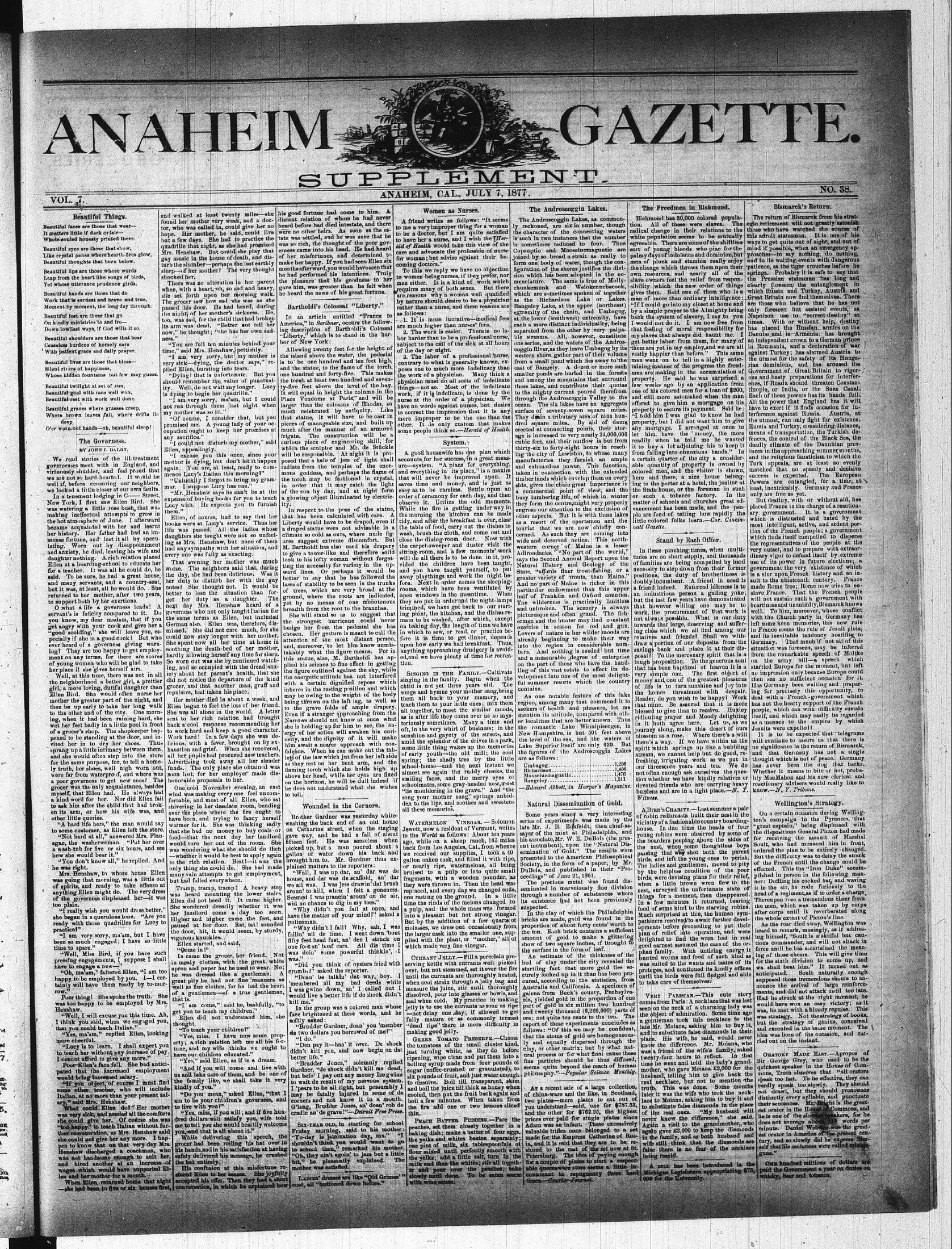
Searchable text
ANAHEIM
VOL. 7.
Beautiful Things.
Beautiful faces are those that wear—
It matters little if dark or fair—
Whole-souled honesty printed there.
Beautiful eyes are those that show,
Like crystal panes where hearth-fires glow,
Beautiful thoughts that burn below.
Beautiful lips are those whose words
Leap from the heart like songs of birds,
Yet whose utterance prudence girds.
Beautiful hands are those that do
Work that is earnest and brave and true,
Moment by moment, the long day through.
Beautiful feet are those that go
On kindly ministries to and fro—
Down lowliest ways, if God wills it so.
Beautiful shoulders are those that bear
Ceaseless burdens of homely care
With patient grace and daily prayer.
Beautiful lives are those that bless—
Silent rivers of happiness,
Whose hidden fountains but few may guess.
Beautiful twilight at set of sun,
Beautiful goal with race well won,
Beautiful rest with work well done.
Beautiful graves where grasses creep,
Where brown leaves fall, where drifts lie deep
O'er worn-out hands—oh, beautiful sleep!
The Governess.
BY JOHN I. DALBY.
We read stories of the ill-treatment governess meet with in England, and walked at least twenty miles—she found her mother very weak, and a doctor, who was called in, could give her no hope. Her mother, he said, could live but a few days. She had to practice the quadrille that night, as she had promised Mrs. Henshaw. But could she play that gay music in the house of death, and disturb the slumber—perhaps the last earthly sleep—of her mother? The very thought shocked her.
There was no alteration in her parent when, with a heart, oh, so sad and heavy, she set forth upon her morning walk. The grocer saw how sad she was as she passed his door. He had heard, during the night, of her mother's sickness. He, too, was sad, for the child that had broken its arm was dead. "Better not tell her now," he thought; "she has her own sadness."
"You are full ten minutes behind your time," said Mrs. Henshaw, pettishly.
"I am very sorry, but my mother is very sick—dying, the doctor says," replied Ellen, bursting into tears.
"Dying? that is unfortunate. But you should remember the value of punctuality. Well, do not wait any longer. Lucy is dying to begin her quadrille."
"I am very sorry, ma'am, but I could not run through them last night when my mother was so ill."
"Of course, I consider that, but you promised me. A young lady of your occupation ought to keep her promises at any sacrifice."
"I could not disturb my mother," said Ellen, appealingly.
"I excuse you this once, since your mother is dying, but don't let it happen his good fortune had come distant relation of whom he heard before had died intestines were no other heirs. As sate was settled, and he was so rich, the thought of theerness came into his head. Of her misfortunes, and did make her happy. If you had months afterward, you would have performed his intention the pleasure that his good gave him, was greater than he heard the news of his great Bartholdi's Colossal "In an article entitled America," in Scribner, occupying description of Bartholdi's Liberty," which is to standbor of New York:
Allowing twenty feet for the island above the water, is to be one hundred and one hundred and forty-five. The torch at least two hundred-five feet above the level It will equal in height the Place Vendome at Paris; larger than the colossus on much celebrated by anti-that statue, it will have pieces of manageable size; much after the manner of frigate. The construction curious piece of engineering which the sculptor and Mr. will be responsible. At nighposed that a halo of jets o
Silent rivers of happiness,
Whose hidden fountains but few may guess.
Beautiful twilight at set of sun,
Beautiful goal with race well won,
Beautiful rest with work well done.
Beautiful graves where grasses creep,
Where brown leaves fall, where drifts lie deep
O'er worn-out hands—oh, beautiful sleep!
The Governess.
BY JOHN I. DALBY.
We read stories of the ill-treatment governesses meet with in England, and virtuously shudder, and feel proud that we are not so hard-hearted. It would be well if, before censuring our neighbors, we looked a little closer at our own faults.
In a tenement lodging in C—— Street, New York, I first saw Ellen Bird. She was watering a little rose bush that was making ineffectual attempts to grow in the hot atmosphere of June. I afterward became acquainted with her and learnt her history. Her father had had an immense fortune, and lost it all by speculating. Worn out by disappointment and anxiety, he died, leaving his wife and daughter nothing. A rich relation placed Ellen at a boarding-school to educate her for a teacher. It was all he could do, he said. To be sure, he had a great house, and many servants, and a country-seat, but it was, at least, all he would do. She returned to her mother, after two years, to support both by her exertions.
O what a life a governess leads! A servant's is feticity compared to it. Do you know, my dear madam, that if you get angry with your cook and give her a "good scolding," she will leave you, especially if she is a good cook? But who ever heard of a governess giving warning? They are too happy to get employment on any terms, for there are scores of young women who will be glad to take her place if she gives herself airs.
Well, at this time, there was not in all the neighborhood a better girl, a prettier girl, a more loving, dutiful daughter than Ellen Bird. She would often nurse her mother the greater part of the night, and then be up early to take her long walk to the other end of the city. One morning, when it had been raining hard, she wet her feet badly in a little pool in front of a grocer's shop. The shopkeeper happened to be standing at the door, and invited her in to dry her shoes. Thus sprang up a little intimacy between them, and she would often step into the store for the same purpose, for, to tell a homey truth, her shoes, well nigh worn out, were far from waterproof, and where was a poor governess to get new ones? The grocer was the only acquaintance besides myself, that Ellen had. He always had a kind word for her. Nor did Ellen fail to ask him after the child that had broken its arm, or how his wife was, and other little queries.
"A hard life hers," the man would say to some customer, as Ellen left the store.
"Not hard at all," answered Mrs. Flanagan, the washerwoman. "Put her over a wash-tub for five or six hours, and see how she would bear it."
"You don't know all," he replied. And he was right.
Mrs. Henshaw, to whose house Ellen was going that morning, was a little outplied Ellen, bursting into tears.
"Dying? that is unfortunate. But you should remember the value of punctuality. Well, do not wait any longer. Lucy is dying to begin her quadrille."
"I am very sorry, ma'am, but I could not run through them last night when my mother was so ill."
"Of course, I consider that, but you promised me. A young lady of your occupation ought to keep her promises at any sacrifice."
"I could not disturb my mother," said Ellen, appealingly.
"I excuse you this once, since your mother is dying, but don't let it happen again. You are at least, ready to commence Lucy's Italian this morning!""
"Unluckily I forgot to bring my grammar. I suppose Lucy has one."
"Mr. Henshaw says he can't be at the expense of buying books for you to teach Lucy with. He expects you to furnish them."
Ellen, of course, had to say that her books were at Lucy's service. Thus her life was passed. All the ladies whose daughters she taught were not so unfeeling as Mrs. Henshaw, but none of them had any sympathy with her situation, and every one was fully as exacting.
That evening her mother was much worse. The neighbors said that, during the day, she had been delirious. Was it her duty to disturb her with the gay notes? She thought not. It would be better to lose the situation than forget her duty as a daughter. The next day Mrs. Henshaw heard of a governess who not only taught Italian for the same terms as Ellen, but included German also. Ellen was therefore dismissed. She did not care much; for she could now stay longer with her mother. She spent now all her time at home in soothing the death-bed of her mother, hardly allowing herself any time for sleep. So worn out was she by continued watching, and so occupied with the dread anxiety about her parent's health, that she did not notice the departure of the kind grocer, and that another man, gruff and repulsive, had taken his place.
Her mother died in about a week, and Ellen began to feel the loss of her friend. She was all alone in the world. A letter sent to her rich relation had brought back a cool response recommending her to work hard and keep a good character. Work hard! In a few days she was delirious with a fever, brought on by exhaustion and grief. When she recovered, all her pupils had procured new teachers. Advertising took away all her slender funds. The only place she obtained was soon lost, for her employer made dishonorable proposals to her.
One cold November evening, an east wind was making every one feel uncomfortable, and most of all Ellen, who sat shivering in her desolate room, bending over the place where the fire ought to have been, and trying to fancy herself warmer for it. She was thinking sadly that she had no money to buy coals or food—that the next day her landlord would turn her out of the room. She was wondering what she should do then—whether it would be best to apply again to the rich relation. Best!—it was the only thing she could do. She had made many vain attempts to get employment, but had failed everywhere.
and the statue, to the name one hundred and forty-five feet above the levee. It will equal in height the Place Vendome at Paris; larger than the colossus on much celebrated by antique statue; it will have pieces of manageable size; much after the manner of frigate. The construction curious piece of engineer which the sculptor and Mr will be responsible. At night posed that halo of jets or radiate from the temples of mous goddess, and perhaps the torch may be fashioned in order that it may carry off the sun by day; and as a glowing object illuminates it.
In respect to the pose of that has been calculated Liberty would have to be on a draped statue rather than a climate so cold as ours; wheresuggest extreme disruption M. Bartholdi has also used to give a tower-like and look to his lofty woman wearing the necessity for various ward lines. Or perhaps better to say that he has laws of stability to be seen of trees, which are very ground, where the roots yet by no means of one breadth from the root to thief.
She will stand so as to be strongest hurricane budge her from the ped chosen. Her gesture is made attention of the most or moreover, to let him takably what the figure is this statue; also, M. Bartoldi plied his science to fine effect the figure outlined against the energetic attitude has with a certain dignified inheres in the resting position may be owing to the weight being thrown on the left toe to the grave folds of an Even if a stranger approaches Narrows should not know she is holding up for him energy of her action will awakeosity, and the dignity of his aim await a nearer approach. When he can make lets of the law which just fright as they rest on her bent flaming torch which she above her head, while here on the horizon, he will be he does not understand what to tell.
Wounded in the
grocer was the only acquaintance, besides myself, that Ellen had. He always had a kind word for her. Nor did Ellen fail to ask him after the child that had broken its arm, or how his wife was, and other little queries.
"A hard life hers," the man would say to some customer, as Ellen left the store.
"Not hard at all," answered Mrs. Flanagan, the washerwoman. "Put her over a wash-tub for five or six hours, and see how she would bear it."
"You don't know all," he replied. And he was right.
Mrs. Henshaw, to whose house Ellen was going that morning, was a little out of spirits, and ready to take offense at anything Ellen might do. The very dress of the governess displeased her—it was too plain.
"I really wish you would dress better," she began in a querulous tone. "Are you ready with those quadrilles for Lucy to practice!"
"I am very sorry, ma'am, but I have been so much engaged; I have so little time to spare."
"Well, Miss Bird, if you have such pressing engagements, I suppose I shall have to engage a new—"
"Oh, ma'am," faltered Ellen, "I am too happy to be employed by you. I—I certainly will have them ready by to-morrow."
Poor thing! She spoke the truth. She was too happy to be employed by Mrs. Henshaw.
"Well, I will excuse you this time. Ah, I think you said, when we engaged you, that you could teach Italian."
"Yes, ma'am," replied Ellen, looking more cheerful.
"Lucy is to learn. I shall expect you to teach her without any increase of pay. I cannot afford to give any more."
Poor Ellen's face fell. She had anticipated that the increased employment would bring increased salary.
"If you object, of course I must find some other teacher, who will include Italian, at no more than your present salary," said Mrs. Henshaw.
What could Ellen do? Her mother was very sick, and needed all the comforts she could give her. Of codrue she was "too happy" to teach Italian without further remuneration, as Mrs. Henshaw said she could not give her any more. I happen to know that on that very day Mrs. Henshaw discharged a coachman, who was not handsome enough to suit her, and hired another at an increase of wages which would have supported Ellen and her mother for a month.
When Ellen returned home that night—she had been to five or six houses first,
One cold November evening, an east wind was making every one feel uncomfortable, and most of all Ellen, who sat shivering in her desolate room, bending over the place where the fire ought to have been, and trying to fancy herself warmer for it. She was thinking sadly that she had no money to buy coals or food—that the next day her landlord would turn her out of the room. She was wondering what she should do then—whether it would be best to apply again to the rich relation. Best!—it was the only thing she could do. She had made many vain attempts to get employment, but had failed everywhere.
Tramp, tramp, tramp! A heavy step was heard mounting the lower stairs. Ellen did not heed it. It came higher. She wondered drearily whether it was her landlord come a day too soon. Higher and higher came the feet, and paused at her door. Rat, tat! sounded the door, hit, it would seem, by sturdy, vigorous knuckles.
Ellen started, and said,
"Come in!"
In came the grocer, her friend. Not in mealy clothes, with the great white apron and paper hat he used to wear. No; he was dressed like a gentleman. A great pity he had not fine manners as well as fine clothes, for he had the heart of a gentlemen—of a true gentleman, that is.
"I am come," said he, bashfully, "to get you to teach my children."
Ellen did not understand him, she thought.
"To teach your children!"
"Yes, miss. I have now some property; a rich relation left me all his fortune, and my wife thinks we ought to have our children educated."
"Yes," said Ellen, as if in a dream.
"And if you will come and live with us and take care of them, and be one of the family like, we shall take it very kindly of you."
"Do you mean," asked Ellen, "that I am to be your children's governess, and to live with you!"
"Yes, miss, if you will; and if five hundred dollars will satisfy you, wife told me to tell you she would heartily welcome you—and that is all about it."
While delivering this speech, the grocer had been rolling his hat over in his hands, and in his satisfaction at having safely delivered his message, he crushed the hat entirely.
His confusion at this misfortune restored Ellen to her senses. She joyfully accepted his offer. Then they had a short conversation, in which he explained how Brother Gardner was washing the back end of on Catharine street, who gave way, and he had fifteen feet. He was picked up, but a man paid gallon of water down brought him to. Mr. Gardner plained matters to the reporter.
"Wall, I was up darling," asked the reporter.
"Doan' be talkin' day membered all my body I was gwine down, an' would live a better life in kill me."
In the group was a co-face brightened at these softly asked:
"Brudder Gardner, do de two dollars you borrow?
I do."
"Den pay it—han' it didn't kill you, and n better life."
"Brudder Jones," said Gardner, "de shock did but beto' I pay out any to wait die result of my I'pears to be all right may be fatally injured corners and not known G'lang, Brudder Jones cradle an' de grave!"
this good fortune had come to him. A distant relation of whom he had never heard before had died intestate, and there were no other heirs. As soon as the estate was settled, and he was sure that he was so rich, the thought of the poor governess came into his head. He had heard of her misfortunes, and determined to make her happy. If you had seen Ellen six months afterward, you would have seen that he had performed his intentions. Truly the pleasure that his goodness to her gave him, was greater than he felt when he heard the news of his great fortune.
Bartholdi's Colossal "Liberty."
In an article entitled "France to America," in Seribner, occurs the following description of Bartholdi's Colossal "Liberty," which is to stand in the harbor of New York:
Allowing twenty feet for the height of the island above the water, the pedestal is to be one hundred and ten feet high, and the statue, to the flame of the torch, one hundred and forty-five. This makes the torch at least two hundred and seventy-five feet above the level of the bay. It will equal in height the column in the Place Vendome at Paris, and will be larger than the colossus of Rhodes, so much celebrated by antiquity. Like that statue, it will have to be cast in pieces of manageable size, and built up much after the manner of an armored frigate. The construction will be a curious piece of engineering skill, for which the sculptor and Mr. de Stuckle will be responsible. At night it is proposed that a halo of jets of light shall radiate from the temples of the enoor.
Women as Nurses.
A friend writes as follows: "It seems to me a very improper thing for a woman to be a doctor, but I am quite satisfied to have her a nurse, and I wish the Herald of Health would take this view of the case and advocate the profession of nurse for woman; but advise against their becoming doctors."
To this we reply we have no objection to women being nurses, if they prefer, nor men either. It is a kind of work which requires many of both sexes. But there are reasons why a woman well qualified by nature should desire to be a physician rather than a nurse, and these reasons are as follows:
1. It is more lucrative—medical fees are much higher than nurses' fees.
2. The work is easier. There is no labor harder than to be a professional nurse, subject to the call of the sick at all hours of the day or night.
3. The labor of a professional nurse, contrary to what is generally known, exposes one to much more indelicacy than the work of a physician. Many think a physician must do all sorts of indelicate things—not so. Most of the indelicate work, if it is indelicate, is done by the nurse at the order of a physician. We have no words against nurses, but desire to correct the impression that it is any more improper to be the one than the other. It is only custom that makes some people think so.—Herald of Health.
System.
A good housewife has one plan which accounts for her success, in a great measure: "A place for everything."
and the statue, to the name of the torch, one hundred and forty-five. This makes the torch at least two hundred and seventy-five feet above the level of the bay. It will equal in height the column in the Place Vendome at Paris, and will be larger than the colossus of Rhodes, so much celebrated by antiquity. Like that statue, it will have to be cast in pieces of manageable size, and built up much after the manner of an armored frigate. The construction will be a curious piece of engineering skill, for which the sculptor and Mr. de Stückle will be responsible. At night it is proposed that a halo of jets of light shall radiate from the temples of the enormous goddess, and perhaps the flame of the torch may be fashioned in crystal, in order that it may catch the light of the sun by day, and at night form a glowing object illuminated by electricity.
In respect to the pose of the statue, that has been calculated with care. A Liberty would have to be draped, even if a draped statue were not advisable in a climate so cold as ours, where nude figures suggest extreme discomfort. But M. Bartholdi has also used his drapery to give a tower-like and therefore solid look to his lofty woman without forgetting the necessity for variety in the upward lines. Or perhaps it would be better to say that he has followed the laws of stability to be seen in the trunks of trees, which are very broad at the ground, where the roots are indicated, yet by no means of one monotonous breadth from the root to the branches.
She will stand so as to suggest that the strongest hurricane could never budge her from the pedestal she has chosen. Her gesture is meant to call the attention of the most distant person, and moreover, to let him know unmistakably what the figure means. For in this statue, also, M. Bartholdi has applied his science to fine effect in getting the figure outlined against the sky, while the energetic attitude has not interfered with a certain dignified repose which inheres in the resting position and which may be owing to the weight of the body being thrown on the left leg, as well as to the grave folds of ample drapery. Even if a stranger approaching from the Narrows should not know at once what she is holding up for him to see, the energy of her action will awaken his curiosity, and the dignity of it will make him await a nearer approach with confidence. When he can make out the tablets of the law which jut from her left side as they rest on her bent arm, and the flaming torch which she holds high up above her head, while her eyes are fixed on the horizon, he will be dull indeed if he does not understand what she wishes to tell.
Wounded in the Corners.
Brother Gardner was yesterday white-washing the back end of an old house on Catharine street, when the staging gave way, and he had a fall of about fifteen feet. He was senseless when picked up, but a man poured about a gallon of water down his back and brought him to. Mr. Gardner thus explained matters to the reporters:
"Wall, I was up dar, an' dar was de house, and dar was de scaffold, an' dar poses one to much more indelicacy than the work of a physician. Many think a physician must do all sorts of indelicate things—not so. Most of the indelicate work, if it is indelicate, is done by the nurse at the order of a physician. We have no words against nurses, but desire to correct the impression that it is any more improper to be the one than the other. It is only custom that makes some people think so." —Herald of Health.
System.
A good housewife has one plan which accounts for her success, in a great measure—system. "A place for everything, and everything in its place," is a maxim that will never be improved upon. It saves time and money, and is just as easy as to be careless. Settle upon an order of ceremony for each day, and then observe it. Utilize the odd moments. While the fire is getting under way in the morning the kitchen can be made tidy, and after breakfast is over, clear the table of food, carry out the dishes to wash, brush the cloth, and come out and close the dining-room door. Now with the carpet-sweeper and duster visit the sitting-room, and a few moments' work will do all there is to be done in it, provided the children have been taught, and you have taught yourself, to put away playthings and work the night before. Next in order comes the sleeping rooms, which have been ventilated by open windows in the meantime. When they are put in order and the night-lamps trimmed, we have got back to our starting pinst, the kitchen, and the dishes remain to be washed, after which, except on baking day, the length of time we have in which to sew, or read, or practice before it is time to get dinner, depends upon how early we had breakfast. Thus, anything approaching drudgery is avoided,and we have plenty of time for recreation.
Singing in the Family. —Cultivate singing in the family. Begin when the child is not yet three years old. The songs and hymns your mother sang,bring them all back to your memory,and teach them to your little ones; mix them all together; meet the similar moods,as in after life they come over us so mysteriously sometimes. Many a time and oft,在 very whirl of business; in the sunshine and gayey of the streets,and amid the splendor of the drives in a park,some little thing wakes up the memories of early youth—the old mill;the cool spring;the shady tree by the little school-house—and next instant we almost see again the ruddy cheeks,the smiling faces,and the merry eyes of schoolmates,some gray-headed now,most "lie mouldering in the grave." And "the song your mother sang" springs unbidden to the lips,and soothes and sweetens all these memories.
Watermelon Vinegar. —Solomon Jewett,now a resident of Vermont, writes to The World as follows: About ten years ago,while on a sheep ranch,165 miles back from Los Angeles,Cal.,from whence we received our supplies.I took a 40 gallon oaken cask,and filled it with ripe,或 nearly ripe,水melons,all being bruised to a pulp or into quite small fragments,以 a wooden pounder,
As one notable feature of this lake region, among many that commend it to seekers of health and pleasure,Let me mention its altitude,compared with other localities that are better known.Thus the romantic Lake Winnipiscogee,在 New Hampshire,是 but 501 feet above the level of the sea,and the waters of Lake Superior itself are only 630.But the figures of the Androscoggin Lakes are as follows:
Umbagog.....1,256
Richardson.....1,456
Mooselae maguntile.....1,476
Rangeley.....1,511
Edward Abbott,(in Harper's Magazine.
Natural Dissemination of Gold.
Some years since a very interesting series of experiments was made by the late Mr.J.R.Eckfeldt,the chief-sayer of the mint at Philadelphia,and his associate,Mr.W.E.DuBois(the present incumbent),upon the "Natural Dissemination of Gold."The results were presented to the American Philosophical Society,在form of a paper,由Mr.DuBois,and published in their "Proceedings"of June 21,1801.
A Bird's Creation of robin redbreast vicinity of a fawn house.In due young robins,the boarders,the nest,passing that birds,and leftofthe ladies andbythe helpbirds,drewdiscovered
Wounded in the Corners.
Brother Gardner was yesterday white-washing the back end of an old house on Catharine street, when the staging gave way, and he had a fall of about fifteen feet. He was senseless when picked up, but a man poured about a gallon of water down his back and brought him to. Mr. Gardner thus explained matters to the reporters:
"Wall, I was up dar, an' dar was de house, and dar was de scaffold, an' dar we all was. I was jess drawin'd dat brush aroun't to kill, when I felt a goneness. Seemed I was prancin' aroun'on de air, wid no chance to dig in my toes."
"Why didn't you fall at once, and have the matter off your mind?" asked a policeman.
"Why didn't I fall? Why, sah, I was fallin' all de time. I went down 'bout fifty feet head fust, an' den I struck on one foot an' boaf ears. All dis time I was doin' some powerful thinkin', I was."
"Did you think of oysters fried with crumbal" asked the reporter.
"Doan' be talkin' dat way, boy. I 'membered all my bad deeds while I was gwine down, an' I called out I would live a better life if de shock didn't kill me."
In the group was a colored man whose face brightened at these words, and he softly asked:
"Brudder Gardner, doan' you 'member de two dollars you borrowed of me!"
"I do."
"Den pay it—han' it over. De shock didn't kill you, and now begin on dat better life."
"Brudder Jones," solemnly replied Gardner, "de shock didn't kill me dead, but befo' I pay out any money Ize gwine to wait de result of my nervous system. I'pears to be all right, but possumbly I may be fatally injured in some of de corners and not know it in a month. Glang, Brudder Jones, an' doan' rob de cradle an' de grave!" —Detroit Free Press.
Six-year old, in starting for school Friday morning, said to his mother:
"To-day is jamination day, ma." "I shouldn't think you would want to go to school then," remarked his mother. "Oh, they ain't again' to jam but a little hit," he pleasantly explained. The mother was satisfied.
Ladies' dresses are like "Old Grimes'" coat, all "buttoned down before."
Watermelon Vinegar. — Solomon Jewett, now a resident of Vermont, writes to the World as follows: About ten years ago, while on a sheep ranch, 165 miles back from Los Angeles, Cal., from whence we received our supplies, I took a 40 gallon oaken cask, and filled it with ripe, or nearly ripe, watermelons, all being bruised to a pulp or into quite small fragments, with a wooden pounder, as they were thrown in. Then the head was replaced, and every day we changed ends, one resting on the ground. In a little time the rinds of the melons changed to a pulp, and the whole mass was formed into a pleasant but not strong vinegar. But by the addition of a few quarts of molasses, we drew out occasionally from the larger cask into the smaller one, supplied with the plant, or "mother," all of which made very fine vinegar.
Currant Jelly. — Fill a porcelain preserving kettle with currants well picked over, but not stemmed, set it over the fire until the currants are thoroughly heated, when cool strain through a jelly bag and measure the juice, stir until thoroughly dissolved, pour into glasses or bowls, and seal when cold. My practice in making jelly is to use the currants as soon as ripe—not delay one day; if allowed to get fully mature or as commonly termed "dead ripe" there is more difficulty in making good jelly.
Green Tomato Preserve. — Choose the tomatoes of the small cluster kind, just turning white, as they do before ripening, wipe clean and put them into a boiling syrup made from four pounds of sugar (coffee-crushed or granulated), to six pounds of fruit, and just water enough to dissolve. Boil till transparent, skim and boil the juice till thick as honey when cooled, then put the fruit back again and boil a few minutes. When taken from the fire add one or two lemons sliced thin.
Peach Batter Pudding. — Pare the peaches, set them closely together in a baking dish; make a batter of four eggs, the yelks and whites beaten separately; one pint of milk, six tablespoonfuls of flour mixed until perfectly smooth with the yelks; add a little salt, turn in the milk and then the whites; stir all together and pour over the peaches; shake slowly until done. To be eaten warm with wine sauce.
Natural Dissemination of Gold.
Some years since a very interesting series of experiments was made by the late Mr. J. R. Eckfeldt, then chief-sayer of the mint at Philadelphia, and his associate, Mr. W. E. DuBois (the present incumbent), upon the "Natural Dissemination of Gold." The results were presented to the American Philosophical Society, in the form of a paper, by Mr. DuBois, and published in their "Proceedings" of June 21, 1801.
The precious metal was found disseminated in marvelously fine division through a number of substances where its existence had not been previously suspected.
In the clay of which the Philadelphia bricks are made, gold was found in the proportion of about forty cents' worth to the ton. Each brick contains a sufficient amount of gold to make a glittering show of two square inches, if brought to the surface in the form of leaf.
An estimate of the thickness of the bed of clay under the city revealed the startling fact that more gold lies securely locked up in it than has been procured, according to the statistics from Australia and California. A specimen of galena from Buck's county, Penhsylvania, yielded gold in the proportion of one part of gold in six million two hundred and twenty thousand (6,220,000) parts of ore; not quite ten cents to the ton. The report of these experiments concludes as follows: "Of this we may be confident that the atoms of gold are homogeneously and equally dispersed through the clay, or other matrix; but by what natural process or for what final cause these fine particles should be thus diffused, seems quite beyond the reach of human philosophy." —Popular Science Monthly.
At a recent sale of a large collection, of china-ware and the like, in Scotland, two plates—mere plates to eat out of you understand—sold, one for $787.53, and the other for $762.25, the highest prices ever paid for single plates since Adam was an infant. These excessively valuable trifles once belonged to a set made for the Empress Catherine of Russia, and it is said that they are to be restored to the rest of the set now at St. Petersburg. The idea of paying enough for a couple of plates to start a respectable queenaware store seems a little inconsonant to repugnancy these hard times. —Courier Journal.
GAZETTE.
NO. 38.
The Freedmen in Richmond.
Richmond has 30,000 colored population. All of these were slaves. The radical change in their relations to the white population seems to be mutually agreeable. There are some of the shiftless sort of young bloods who pine for the palmy days of indolence and dominion, but men of pluck and stamina really enjoy the change which throws them upon their own resources, and nearly all of the slave owners feel the relief from responsibility which the new order of things gives them. Said one of them who is a man of more than ordinary intelligence: "If I could go into my closet at home and by a simple prayer to the Almighty bring back the system of slavery, I say to you I would not do it. I am now free from that feeling of moral responsibility for my slaves that always did haunt me. I get better labor from them, for many of them are yet in my employ, and we are all vastly happier than before." This same man went on to tell in a highly entertaining manner of the progress the freedmen are making in the accumulation of property. He said he was surprised a few weeks ago by an application from one of his colored men for a loan of $200, and still more astonished when the man offered to give him a mortgage on his property to secure its payment. Said he: "I told him I was glad to know he had property, but I did not want him to give any mortgage. I arranged at once to let him have the money, the more readily when he told me he wanted it to buy a lot adjoining his to keep it from falling into obnoxious hands." In a certain quarter of the city a considerable quantity of property is owned by
Bismarck's Return.
The return of Bismarck from his strategic retirement will not greatly astonish those who have watched the course of this adroit statesman. It is one of his ways to get quite out of sight, and out of mind if possible, when an emergency approaches—to say nothing, do nothing, and to lie waiting events with dangerous patience, as the tiger crouches before he springs. Probably it is safe to say that the Prussian statesman has long and clearly foreseen the entanglement in which Russia and Turkey, Austria and Great Britain now find themselves. There are those who believe that he has not only foreseen but assisted events, as Napoleon use to "correct destiny" at times. With or without help, destiny has placed the Russian armies on the Danube and in Armenia; has brought an independent crown to a German prince in Roumania, and a declaration of war against Turkey; has alarmed Austria to the utmost for the safety of its Hungarian dominions, and has aroused the Government of Great Britain to vigorous and hasty preparations for interference, if Russia should threaten Constantinople, or India, or the Suez Canal. Each of these powers has its hands full. All the power that England has it will have to exert if it finds occasion for interference against Russia. Austria, at the utmost, can only fight for existence. Russia and Turkey, considering distance, means of transportation, the Turkish defences, the control of the Black Sea, the deadly climate of the Danubian provinces in the approaching summer months, and the religious fanaticism to which the Turk appeals, are at least so evenly
Government of Great Britain to vigorous and hasty preparations for interference, if Russia should threaten Constantinople, or India, or the Suez Canal. Each of these powers has its hands full. All the power that England has it will have to exert if it finds occasion for interference against Russia. Austria, at the utmost, can only fight for existence. Russia and Turkey, considering distance, means of transportation, the Turkish defences, the control of the Black Sea, the deadly climate of the Danubian provinces in the approaching summer months, and the religious fanaticism to which the Turk appeals, are at least so evenly matched that no speedy and decisive success is expected. The European Powers are entangled, for a time, at least, inextricably. Germany and France only are free as yet.
But destiny, with or without aid, has placed France in the charge of a reactionary government. It is a government which is distrusted and hated by the most intelligent, active, and ardent portion of the French people; a government which finds itself compelled to disperse the representatives of the people at the very outset, and to prepare with extraordinary vigor to defend itself by extreme use of its power in future elections; a government the very existence of which is a slur upon French history and an insult to the nineteenth century. France made Rome free; Rome now tries to enslave France. That the French people will not sustain such a government with heartiness and unanimity, Bismarck knows well. To him, moreover, whose conflict with the Church party in Germany has left some keen memories, this new rule in France seems the rule of Jesuit plots, and its inevitable tendency hostility to Germany. That much if not all of this situation was foreseen, may be inferred from the remarkable speech of Moltke on the army bill—a speech which startled Europe for the moment, but left no impression only because Europe could then see no sufficient occasion for it. Has Germany been waiting and preparing for precisely this opportunity, to deal with a French government which has not the hearty support of the French people, which can with difficulty sustain itself, and which may easily be regarded as a menace to the empire by which Jesuits were expelled?
It is to be expected that telegrams will continue to assure us that there is no significance in the return of Bismarck, and that Germany has not a single thought which is not of peace. Germany has never been the dog that barks. Whether it means to bite or not, probably MacMahon and his new clerical and reactionary advisers would really like to know.—N. Y. Tribune.
Wellington's Strategy.
On a certain occasion during Wellington's campaign in the Pyrenees, that "great captain," being displeased with the dispositions General Picton had made for receiving the assault of Marshal Soult, who had menaced him in front, ordered the plan to be entirely changed. But the difficulty was to delay the attack of the French until the change could be effected. This the "Iron Duke" accomplished in person in the following manner: Dofling his cocked hat, and waving
A BIRD'S CHARITY.—Last summer a pair of robin redbreasts built their nest in the vicinity of a fashionable country boarding-house. In due time the heads of four young robins were observed by some of the boarders peeping above the sides of the nest, when some thoughtless boys passing that way shot both the parent birds, and left the young ones to perish. The ladies and gentlemen, moved to pity by the helpless condition of the poor birds, were devising plans for their relief, when a little brown wren flew to the nest, surveyed the unfortunate state of things for a moment, then disappeared. In a few minutes it returned, bearing food of some kind to the starving robins. Much surprised at this, the human sympathizers resolved to await further developments before proceeding to put their plan of relief into operation, and were delighted to find the wren had in real good earnest assumed the care of the orphan family. With untiring energy it hunted worms and food of such kind as was suited to the wants and tastes of its proteges, and continued its kindly offices until the birds were full fledged and able to take care of themselves.
VERY PARISIAN.—This cute story comes from Paris: A necklace that was last seen on the neck of a charming lady was the object of admiration. Some time ago a gentleman took this necklace to the late Mr. Moiana, asking him to buy it, and to substitute false diamonds in their place. His wife, he said, would never know the difference. Mr. Moiana, who was a friend of the wife's family, asked twenty-four hours to reflect. In that time he went and told the lady's grandmother, who gave Moiana £2,000 for the husband, telling him to give back the real necklace, but not to mention the truth. This was done. Some months later it was the wife who took the necklace to Moians, asking him to buy it and to substitute false diamonds in the place of the real ones. "My husband will never know the difference," she said. Again a visit to the grandmother, who again gave £2,000 to keep the diamonds in the family, and as both husband and wife still think that the diamonds are false there is no fear of the necklace being resold.
A bill has been introduced in the Michigan Legislature appropriating $75,000 for the University.
Wellington's Strategy.
On a certain occasion during Wellington's campaign in the Pyrenees, that "great captain," being displeased with the dispositions General Picton had made for receiving the assault of Marshal Soult, who had menaced him in front, ordered the plan to be entirely changed. But the difficulty was to delay the attack of the French until the change could be effected. This the "Iron Duke" accomplished in person in the following manner: Doffling his cocked hat, and waving it in the air, he rode furiously to the head of a regiment, as if to order a charge. Thereupon rose a tremendous cheer from the men, which was taken up by corps after corps until it reverberated along the whole extent of Picton's line.
As the roar died away, Wellington was heard to remark, musingly, as if addressing himself: "Soult is a skilful but cautious commander, and will not attack in force until he has ascertained the meaning of those cheers. This will give time for the sixth division to come up, and wa shall beat him." It turned out as anticipated. Soult naturally enough supposed those tremendous shouts to announce the arrival of large reinforcements; and did not attack until too late. Had he struck at the right moment, he would have won an easy victory; as it was, he met with a bloody repulse. This was strategy. Not the strategy of books, but the strategy of genius, conceived and executed in the same moment. The idea was born of the occasion, and carried out on the instant.
ORATORY MADE EASY.—Apropos of Sir George Grey, who used to be the quickest speaker in the House of Commons, Truth observes that "all orators speak too fast. To be effective, they can hardly speak too slowly. They should not drawl, but they should pronounce distinctly every syllable, and punctuate their sentences. Mr. Height is the greatest orator in the House of Commons, and he is one of the slowest speakers, for he does not average above 148 words per minute. Daniel Webster was the greatest orator in America of the present century, and so slowly did he express himself that his sentences were called minute-guns."
One hundred millions of dollars are paid to Government a year on duties on whisky, beer and tobacco.