anaheim-gazette 1877-07-07
Scanned page
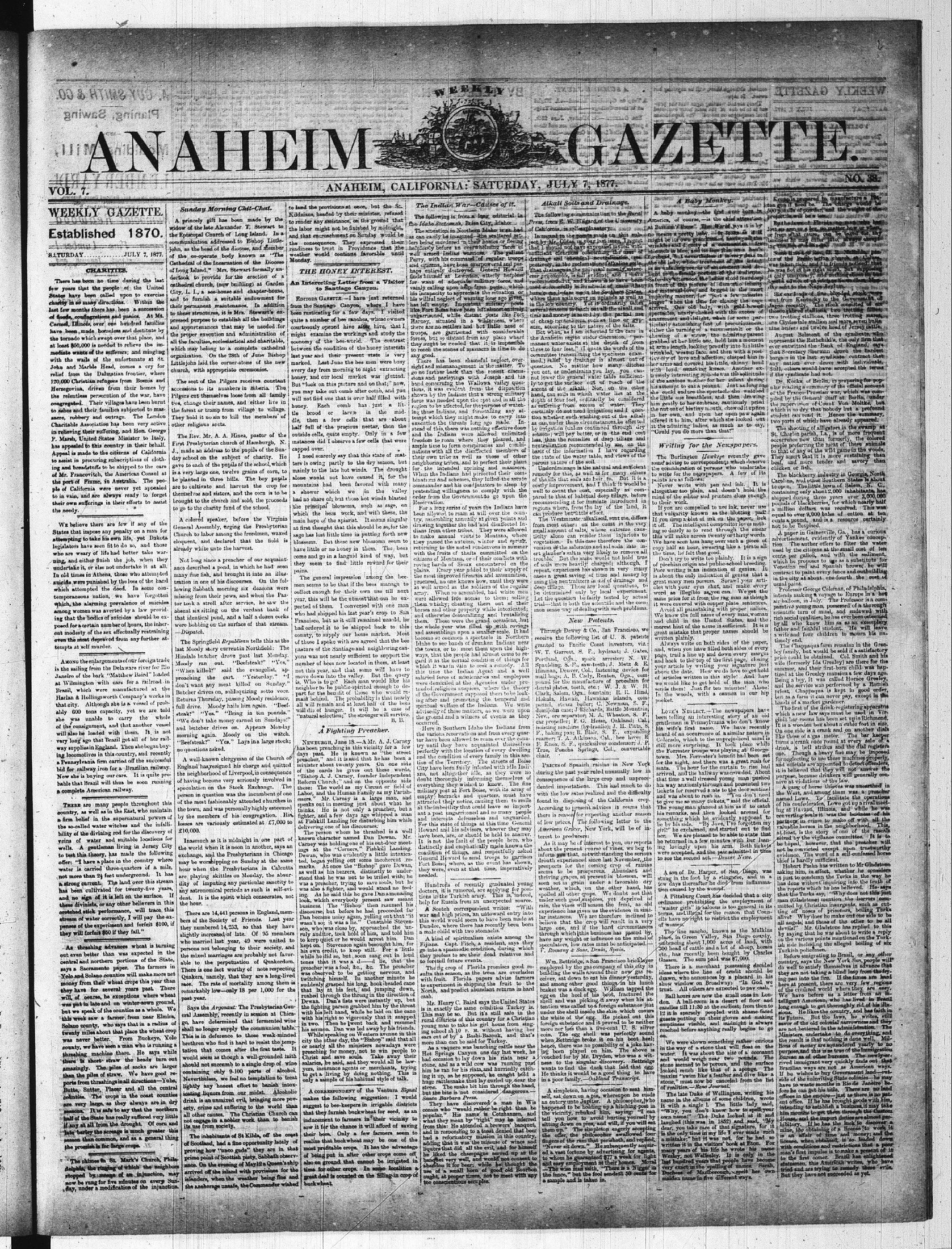
Searchable text
WEEKLY GAZETTE.
Established 1870.
SATURDAY...JULY 7, 1877.
CHARITIES.
There has been no time during the last few years that the people of the United States have been called upon to exercise charity in so many directions. Within the last few months there has been a succession of floods, conflagrations and panics. At Mt. Carmel, Illinois, over one hundred families have been made homeless and destitute by the tornado which swept over that place, and at least $50,000 is needed to relieve the immediate wants of the sufferers; and mingling with the wails of the unfortunate at St. John and Marble Head, comes a cry for relief from the Dalmatian frontier, where 120,000 Christian refugees from Bosnia and Herzegovina, driven from their homes by the relentless persecution of the war, have congregated. Their villages have been burnt to ashes and their families subjected to massacre, robbery and outrage. The London Charitable Association has been very active in relieving their suffering, and Hon. George P. Marsh, United States Minister to Italy, has appealed to this country in their behalf. Appeal is made to the citizens of California to assist in procuring subscriptions of cloth.
Sunday Morning Chit-Chat.
A princely gift has been made by the widow of the late Alexander T. Stewart to the Episcopal Church of Long Island. In a communication addressed to Bishop Little-john, as the head of the diocese, and member of the co-operate body known as "The Cathedral of the Incarnation of the Diocese of Long Island." Mrs. Stewart formally undertook to provide for the erection of a cathedral church (now building) at Garden City, L. I., a see-house and chapter-house, and to furnish a suitable endowment for their permanent maintenance. In addition to these structures, it is Mrs. Stewart's expressed purpose to establish all the buildings and appurtenances that may be needed for the proper execution and administration of all the faculties, ecclesiastical and charitable, which may belong to a complete cathedral organization. On the 28th of June Bishop Little-john laid the corner-stone of the new church, with appropriate ceremonies.
The sect of the Pilgera receives constant accessions to its numbers in Siberia. The Pilgera cut themselves loose from all family ties, change their names, and either live in the forest or tramp from village to village. They hold it no aim to kill the members' of other religious sects.
The Rev. Mr. A. A. Hines, pastor of the First Prebysterian church of Hamburg, N. J., made an address to the pupils of the Sunday school on the subject of charity. He gave to each of the pupils of the school which land the provisions at Kildaina, headed by their labor might not be financed and that encroachment on the consequence. They readiness to trust in Precaution would continue Monday.
THE HONEY DAY
An Intersecting Letter to Santiago
EDITORS GAZETZ:—I bury from the Santiago Canyon been rusticating for a few quite a number of bee ranches courteously opened hive might examine the work economy of the bee-worm between the condition of last year and their presence marked. Last June they every day from morning honey, and our local maid But "look on this picture you may take out comb will not find one that is on honey. Each comb brood or larvae, then a few cell half full of the precious outside cells, quite empty instances did I observe a capped over.
I need scarcely say thither it is owing partly to
We believe there are few if any of the States that impose any penalty on a man for attempting to take his own life, yet Dakota legislators have seen fit to do so, and those who are weary of life had better take warning, and either finish the job, when they undertake it, or else not undertake it at all. In old times in Athens, those who attempted suicide were punished by the loss of the hand which attempted the deed. In some contemporaneous nation, we have forgotten which, the alarming prevalence of suicides among women was averted by a law providing that the bodies of suicides should be exposed for a certain number of hours, the inherent modesty of the sex effectually restraining even the most depraved from any further attempts at self murder.
Among the enlargements of our foreign trade is the sailing from the Delaware river for Rio Janeiro of the bark "Matthew Baird" loaded at Wilmington with cars for a railroad in Brazil, which were manufactured at the Harlan & Hollingsworth Company's works in that city. Although she is a vessel of probably 600 tons capacity, yet we are told she was unable to carry the whole of the consignment, and that another vessel will also be loaded with them. It is not very long ago that Brazil got all of her railway supplies in England. Then she began buying locomotives in this country, and recently a Pennsylvania firm carried off the successful bid for railway iron for a Brazilian railway. Now she is buying our cars. It is quite probable that Brazil will thus be soon running a complete American railway.
There are many people throughout this country, as well as in the East, who maintain a firm belief in the supernatural powers of the so-called water witches and the infallibility of the divining rod for the discovery of veins of water and suitable locations for wells. A gentleman living in Jersey City to test this theory, has made the following offer: "I have a place in the country where water is carried three-quarters of a mile, not more than 24 feet underground. It has land over this stream
The sect of the Pilgera receives constant accessions to its numbers in Siberia. The Pilgera cut themselves loose from all family ties, change their names, and either live in the forest or tramp village to village. They hold it no aim to kill the members' of other religious sects.
The Rev. Mr. A. A. Hinea, pastor of the First Presbyterian church of Hamburg, N.J., made an address to the pupils of the Sunday school on the subject of charity. He gave to each of the pupils of the school, which is a very large one, twelve grains of corn, to be planted in three hills. The boy pupils are to cultivate and harvest the crop for themselves and sisters, and the corn is to be brought to the church and sold, the proceeds to go to the charity fund of the school.
A colored speaker, before the Virginia General Assembly, urging the Presbyterian Church to labor among the freedmen, waxed eloquent, and declared that the field is already white unto the harvest.
Not long since a preacher of our acquaintance described a pond, in which he had seen many fine fish, and brought it into an illustration in one of his discourses. On the following Sabbath morning six deadons were missing from their pews, and when the Pastor took a stroll after service, he saw the absent six sitting on the verdant bank of that identical pond, and a half a dozen corks were bobbing on the surface of that stream.
The Springfield Republican tells this as the last Moody story current in Northfield: The Hindale butcher drove past last Monday. Moody ran out. "Beefsteak?" "Yes," "When killed?" said the evangelist, approaching the cart. "Yesterday." "I don't want any meat killed on Sunday." Butcher drives on, soliloquizing sotto voce. Returns Thursday, passing Moody residence, full drive. Moody hails him again. "Beefsteak?" "Yes." "Bring in ten pounds." "We don't take money earned on Sundays!" and butcher drives on. Appears Monday morning again. Moody on the watch. "Beefsteak?" "Yes." Lays in a large stock; no questions asked.
A well-known clergyman of the Church of England has resigned his charge and quitted the neighborhood of Liverpool, in consequence of having become very seriously involved in speculation on the Stock Exchange. The person in question was the incumbent of one of the most fashionably attended churches in the town, and was personally highly esteemed by the members of his congregation. His losses are variously estimated at £7,000 to £10,000.
Inasmuch as it is midnight in one part of the world when it is noon in another, says an exchange, and the Presbyterians in Chicago may be worshipping on Sunday at the same hour when the Presbyterians in Calcutta are playing skittles on Monday, the absurdity of impressing any particular sanctity to every day from morning to honey, and our local maid But "look on this picture you may take out comb will not find one that is o honey. Each comb half full of the precious outside cells, quite empty instances did I observe a capped over.
I need scarcely say that tars is owing partly to mainly to the late hot weather alone would not have mountains had been a shower which we had no share of; but those principal blossoms, which the bees work, main hope of the apiaries at first thought that this sage has lost little time in blossoms. But these nee have little or no honey i come and go in a language they seem to find little pains.
The general impression seems to be that if collect enough for their year, this will be the utmostpected of them. I convoke who had shipped his last Francisco, but as it still had ordered it to be shi county, to supply our lot of those I spoke with an pasture of the Santiago yons was not nearly sufficient number of bees now located not this year, and that move down into the valley is Who is to go? Each neighbor to be public-supported for the benefit of main behind. The prowl all will remain and at least will die of hunger. It "natural selection;" then
A Fighting
NEWBURGH, June 18th has been preaching in this days past. He is kept prescriber," and it is said minister about twenty years old of the cards he gives "Bishop A. J. Carney; Reform Church;" and these: The world as Labor, and the Human ones." Mr. Carney speaks out in meeting thinks. He is not on fighter, and a few days at Fishkill Landing for delivering one of his diaries.
The person whom he known character name Carney was holding onings at the "Corner Dewan, who was evicted, began yelling out marks. At once the as well as his hearers stand that he was not
There are many people throughout this country, as well as in the East, who maintain a firm belief in the supernatural powers of the so-called water witches and the infallibility of the divining rod for the discovery of veins of water and suitable locations for wells. A gentleman living in Jersey City to test this theory, has made the following offer: "I have a place in the country where water is carried three-quarters of a mile, not more than 24 feet underground. It has a strong current. The land over this stream has been cultivated for twenty-five years, and no sign of it is left on the surface. If these divinists, or any other believers in this crotched stick performance, will trace this stream of water correctly, I will pay the expenses of the experiment and forfeit $100, if they will forfeit $30 if they fail."
As thrashing advances wheat is turning out even better than was expected in the central and northern portions of the State, says a Sacramento paper. The farmers in Yolo and Solano counties will make more net money from their wheat crops this year than they have for several years past. There will, of course, be exceptions where wheat was put in late and on winter-sown ground, but we speak of the counties as a whole. We this week saw a farmer from near Elmira, Solano county, who says that in a radius of twenty miles about that place the wheat crop was never better. From Buckeye, Yolo county, we have seen a man who is running a thrashing machine there. He says while there is short straw the heads turn out amazingly. The piles of sacks are larger than the piles of straw. We have good reports from thrashings in all directions—Yuba, Butte, Sutter, Placer and all the central counties. The crops in the coast counties are very large, as they always are in dry summons. It is safe to say that the northern half of the State has really suffered very little if any at all from the drought. Of corn and late barley the sorrage is much greater this season than common, and as a general thing the promise is far large crops.
The chimes in St. Mark's Church, Philadelphia, the singing of which the neighbors stopped by means of an injunction, may now be rung for five minutes on every Sunday, under a modification of the injunction.
Inasmuch as it is midnight in one part of the world when it is noon in another, says an exchange, and the Presbyterians in Chicago may be worshipping on Sunday at the same hour when the Presbyterians in Calcutta are playing skittles on Monday, the absurdity of imputing any particular sanctity to any astronomical periods as such is self-evident. It is the spirit which consecrates, not the hour.
There are 14,441 persons in England, members of the Society of Friends. Last year they numbered 14,253, so that they have slightly increased of late. Of 95 members who married last year, 49 were united to persons not belonging to their society, and the mixed marriages are probably not favorable to the perpetuation of Quakerdom. There is one fact worthy of note respecting Quakers, namely, that they are a long-lived race. The rate of mortality among them is remarkably low—only 18 per 1,000 for the past year.
Says the Arponaut: The Presbyterian General Assembly, recently in session at Chicago, have determined that fermented wine shall no longer supply the communion table. This is in deference to those weak-minded brothren who find it hard to resist the temptation that comes after the first taste. It would seem as though a well-grounded faith should not succeed to a single drop of wine containing only 9-100 parts of alcohol. Nevertheless, we feel no temptation to treat lightly any honest effort to banish intoxicating liquors from our midst. Alcoholic drink is an unmixed evil, bringing more poverty, crime and suffering to the world than all other causes. The Christian Church can not engage in a nobler work than to banish its use from society.
The inhabitants of St Kilda, off the coast of Scotland, had a fine opportunity lately of proving how "unco gude" they are in that prime point of Scottish piety. Sabbath observance. On the evening of May 12 a Queen's ship arrived off the island with provisions for the islanders, when the weather being fine and the anchorage unsafe, the Commander wished speculation on the Stock Exchange. The person in question was the incumbent of one of the most fashionably attended churches in the town, and was personally highly esteemed by the members of his congregation. His losses are variously estimated at £7,000 to £10,000.
Inasmuch as it is midnight in one part of the world when it is noon in another, says an exchange, and the Presbyterians in Chicago may be worshipping on Sunday at the same hour when the Presbyterians in Calcutta are playing skittles on Monday, the absurdity of imputing any particular sanctity to any astronomical periods as such is self-evident. It is the spirit which consecrates, not the hour.
There are 14,441 persons in England, members of the Society of Friends. Last year they numbered 14,253, so that they have slightly increased of late. Of 95 members who married last year, 49 were united to persons not belonging to their society, and the mixed marriages are probably not favorable to the perpetuation of Quakerdom. There is one fact worthy of note respecting Quakers, namely, that they are a long-lived race. The rate of mortality among them is remarkably low—only 18 per 1,000 for the past year.
Says the Arponaut: The Presbyterian General Assembly, recently in session at Chicago, have determined that fermented wine shall no longer supply the communion table. This is in deference to those weak-minded brothren who find it hard to resist the temptation that comes after the first taste. It would seem as though a well-grounded faith should not succumb to a single drop of wine containing only 9-100 parts of alcohol. Nevertheless, we feel no temptation to treat lightly any honest effort to banish intoxicating liquors from our midst. Alcoholic drink is an unmixed evil, bringing more poverty, crime and suffering to the world than all other causes. The Christian Church can not engage in a nobler work than to banish its use from society.
The inhabitants of St Kilda, off the coast of Scotland, had a fine opportunity lately of proving how "unco gude" they are in that prime point of Scottish piety. Sabbath observance. On the evening of May 12 a Queen's ship arrived off the island with provisions for the islanders, when the weather being fine and the anchorage unsafe. The Commander wished speculation on the Stock Exchange. The person in question was the incumbent of one of the most fashionably attended churches in the town, and was personally highly esteemed by the members of his congregation. His losses are variously estimated at £7,000 to £10,000.
Inasmuch as it is midnight in one part of the world when it is noon in another, says an exchange, and the Presbyterians in Chicago may be worshipping on Sunday at the same hour when the Presbyterians in Calcutta are playing skittles on Monday, the absurdity of imputing any particular sanctity to any astronomical periods as such is self-evident. It is the spirit which consecrates, not the hour.
There are 14,441 persons in England, members of the Society of Friends. Last year they numbered 14,253, so that they have slightly increased of late. Of 95 members who married last year, 49 were united to persons not belonging to their society, and the mixed marriages are probably not favorable to the perpetuation of Quakerdom. There is one fact worthy of note respecting Quakers, namely, that they are a long-lived race. The rate of mortality among them is remarkably low—only 18 per 1,000 for the past year.
Says the Arponaut: The Presbyterian General Assembly, recently in session at Chicago, have determined that fermented wine shall no longer supply the communion table. This is in deference to those weak-minded brothren who find it hard to resist the temptation that comes after the first taste. It would seem as though a well-grounded faith should not succumb to a single drop of wine containing only 9-100 parts of alcohol. Nevertheless, we feel no temptation to treat lightly any honest effort to banish intoxicating liquors from our midst. Alcoholic drink is an unmixed evil, bringing more poverty, crime and suffering to the world than all other causes. The Christian Church can not engage in a nobler work than to banish its use from society.
The inhabitants of St Kilda, off the coast of Scotland, had a fine opportunity lately of proving how "unco gude" they are in that prime point of Scottish piety. Sabbath observance. On the evening of May 12 a Queen's ship arrived off the island with provisions for the islanders, when the weather being fine and the anchorage unsafe. The Commander wished speculation on the Stock Exchange. The person in question was the incumbent of one of the most fashionably attended churches in the town, and was personally highly esteemed by the members of his congregation. His losses are variously estimated at £7,000 to £10,000.
Inasmuch as it is midnight in one part of the world when it is noon in another, says an exchange, and the Presbyterians in Chicago may be worshipping on Sunday at the same hour when the Presbyterians in Calcutta are playing skittles on Monday, the absurdity of imputing any particular sanctity to any astronomical periods as such is self-evident. It is the spirit which consecrates, not the hour.
There are 14,441 persons in England, members of the Society of Friends. Last year they numbered 14,253, so that they have slightly increased of late. Of 95 members who married last year, 49 were united to persons not belonging to their society, and the mixed marriages are probably not favorable to the perpetuation of Quakerdom. There is one fact worthy of note respecting Quakers, namely, that they are a long-lived race. The rate of mortality among them is remarkably low—only 18 per 1,000 for the past year.
Says the Arponaut: The Presbyterian General Assembly, recently in session at Chicago, have determined that fermented wine shall no longer supply the communion table. This is in deference to those weak-minded brothren who find it hard to resist the temptation that comes after the first taste. It would seem as though a well-grounded faith should not succumb to a single drop of wine containing only 9-100 parts of alcohol. Nevertheless, we feel no temptation to treat lightly any honest effort to banish intoxicating liquors from our midst. Alcoholic drink is an unmixed evil, bringing more poverty, crime and suffering to the world than all other causes. The Christian Church can not engage in a nobler work than to banish its use from society.
The inhabitants of St Kilda,offthe coastofScotland,hadafineopportunitylatelyofprovinghow"uncogude"theyareinthatprimepointofScottishpiety.Sabbathobservance.OntheeveningofMay12aQueen'sshiparrivedofftheislandwithprovisionsfortheislanderswhentheweatherbeingfineandtheanchorageunsafe,theCommanderwishedspeculationontheStockExchange.Thepersoninquestionwastheincumbentofoneofthemostfashionablyattendedchurchesinthetown,andwaspersonallyhighestesteemedbythemembersofhiscongregation.MehrthanasknowncharacternameCarneywasholdingongingsatthe"CorneredDewanwhowasevidenced,begyladyoutorkeesholdingtothekeepquietorkeeshouldkeepquietorkeeshouldkeepquietorkeeshouldkeepquietorkeeshouldkeepquietorkeeshouldkeepquietorkeeshouldkeepquietorkeeshouldkeepquietorkeeshouldkeepquietorkeeshouldkeepquietorkeeshouldkeepquietorkeeshouldkeepquietorkeeshouldkeepquietorkeeshouldkeepquietorkeeshouldkeepquietorkeeshouldkeepquietorkeeshouldkeepquietorkeeshouldkeepquietorkeeshouldkeepquietorkeeshouldkeepquietorkeeshouldkeepquietorkeeshouldkeepquietorkeeshouldkeepquietorkeeshouldkeepquietorkeeshouldkeepquietorkeeshouldkeepquietorkeeshouldkeepquietorkeeshouldkeepquietorkeeshouldkeepquietorkeeshouldkeepquietorkeeshouldkeepquietorkeehasrealizethatbuckwhomcarneywasholdingongingsatthe"CorneredDewanwhowasevidenced,begyladyoutorkeesholdingtothekeeplazyoutorkeesholdingtothekeeplazyoutorkeesholdingtothekeeplazyoutorkeesholdingtothekeeplazyoutorkeesholdingtothekeeplazyoutorkeesholdingtothekeeplazyoutorkeesholdingtothekeeplazyoutorkeesholdingtothekeeplazyoutorkeesholdingtothekeeplazyoutorkeesholdingtothekeeplazyoutorkeesholdingtothekeeplazyoutorKEESHOLDINGFORMONEYSINCOMMONANDGENERALTHINGSINFORTHESEASONSINTHECOLLECTIONOFTHESEASONSINTHECOLLECTIONOFTHESEASONSINTHECOLLECTIONOFTHESEASONSINTHECOLLECTIONOFTHESEASONSINTHECOLLECTIONOFTHESEASONSINTHECOLLECTIONOFTHESEASONSINTHECOLLECTIONOFTHESEASONSINTHECOLLECTIONOFTHESEASONSINTHECOLLECTIONOFTHESEASONSINTHECOLLECTIONOFTHESEASONSINTHECOLLECTIONOFTHESEASONSINTHECOLLECTIONOFTHESEASONSINTHECOLLECTIONOFTHESEASONSINTHECOLLECTIONOFTHESEASONSINTHECOLLECTIONOFTHESEASONSINTHECOLLECTIONOFTHESEASONSINTHECOLLECTIONOFTHESEASONSINTHECOLLECTIONOFTHESEASONSINTHECOLLECTIONOFTHESEASONSINTHECOLLECTIONOFTHESEASONSIN THECOLLECTIONOFTHESEASONSINTHECOLLECTIONOFTHESEASONSINTHECOLLECTIONOFTHESEASONSINTHECOLLECTION OF THESEASONS IN THE COLORATION OF THESE ASONS IN THE COLORATION OF THESE ASONS IN THE COLORATION OF THESE ASONS IN THE COLORATION OF THESE ASONS IN THE COLORATION OF THESE ASONS IN THE COLORATION OF THESE ASONS IN THE COLORATION OF THESE ASONS IN THE COLORATION OF THESE ASONS IN THE COLORATION OF THESE ASONS IN THE COLORATION OF THESE ASONS IN THE COLORATION OF THESE ASONS IN THE COLORATION OF THESE ASONS IN THE COLORATION OF THESE ASONS IN THE COLORATION OF THESE ASONS IN THE COLORATION OF THESE ASONS IN THE COLORATION OF THESE ASONS IN THE COLORATION OF THESE ASONS IN THE COLORATION OF THESE ASONS IN THE COLORATION OF THESE ASONS IN THE COLORATION OF THESE ASONS IN THE COLORATION OF THESE ASONS IN THE COLORATION OF THESE ASONS IN THE COLORATION OF THESE ASONS IN THE COLORATION OF THESE ASONS IN THE COLORATION OF THESE ASONS IN THE COLORATION OF THESE ASONS IN THE COLORATION OF THESE ASONS IN THE COLORATION OF THESE ASONS IN THE COLORATION OF THESE ASONS IN THE COLORATION OF THESE ASSONS IN THE COLORATION OF THESE ASSONS IN THE COLORATION OF THESE ASSONS IN THE COLORATION OF THESE ASSONS IN THE COLORATION OF THESE ASSONS IN THE COLORATION OF THESE ASSONS IN THE COLORATION OF THESE ASSONS IN THE COLORATION OF THESESASSONS IN THE COLORATION OFTHESESASSONS INTHECOLORATIONOFTHESESASSONSINTHENCOLORATIONOFTHESCOLORATIONOFTHESCOLORATIONOFTHESCOLORATIONOFTHESCOLORATIONOFTHESCOLORATIONOFTHESCOLORATIONOFTHESCOLORATIONOFTHESCOLORATIONOFTHESCOLORATIONOFTHESCOLORATIONOFTHESCOLORATIONOFTHESCOLORATIONOFTHESCOLORATIONOFTHESCOLORATIONOFTHESCOLORATIONOFTHESCOLORATIONOFTHESCOLORATIONOFTHESCOLORATIONOFTHESCOLORATIONOFTHESCOLORITIONOFTHESCOLORITIONOfThESCOLORITIONOfThESCOLORITIONOfThESC_COLORITIONOfThESC_COLORITIONOfThESC_COLORITIONOfThESC_COLORITIONOfThESC_COLORITIONOfThESC_COLORITIONOfThESC_COLORITIONOfThESC_COLORITIONOfThESC_COLORITIONOfThESC_COLORITIONOfThESC_COLORITIONOfThESC_COLORITIONOfThESC_COLORITIONOfThESC_COLORITIONOfThESC_COLORITIONOfThESC_COLORITIONOfThESC_COLORITIONOfThESC_COLORITIONOfThESC_COLORITIONOfThSCOLORITIONOfThSCOLORITIONOfThSC_COLORITIONOfThSC_COLORITIONOfThSC_COLORITIONOfThSC_COLORITIONOfThSC_COLORITIONOfThSC_COLORITIONOfThSC_COLORITIONOfThSC_COLORITIONOfThSC_COLORITIONOfThSC_COLORITIONOfThSC_COLORITIONOfThSC_COLORITIONOfThSC_COLORITIONOfThSC_COLORITIONOfThSC_COLORITIONOfThSC_COLORITIONOfThSC_COLORITIONOfThSC_COLORITIONOfThSC_COLORITIONOfThSC_COLORITIONOfThSC_COLORITIONOfThSC_COLORITIONOfThSC_COLORITIONOfThSC_COLORITIONOfThSC_COLORITIONOfThSC_COLORITIONOfThSC_COLORITIONOfThSC_COLORITIONOfThSC_COLORITIONOfThSC_COLORITIONOfThSC_COLORITIONOfThSC_COLORITIONOfThSC_COLORITIONOfThSC_COLORITIONOfThSC_COLORITIONOfThSC_COLORitionOfThSC_COLORitionOfThSCColoritionOfThSCColoritionOfThSCColoritionOfThSCColoritionOfThSCColoritionOfThSCColoritionOfThSCColoritionOfThSCColoritionOfThSCColoritionOfThSCColoritionOfThSCColoritionOfThSCColoritionOfThSCColoritionOfThSCColoritionOfThSCColoritionOfThSCColoritionOfThSCColoritionOfThSCColoritionOfThSCColoritionOfThSCColoritionOfThscColoritionOf ThscColorition Of ThscColorition Of ThscColorition Of ThscColorition Of ThscColorition Of ThscColorition Of ThscColorition Of ThscColorition Of ThscColorition Of ThscColorition Of ThscColorition Of ThscColorition Of ThscColorition Of ThscColorition Of ThscColorition Of ThscColorition Of ThscColorition Of ThscColorition Of ThscColorition Of ThscColorition Of ThscColorition Of ThscColorition Of ThscColorition Of ThscColorition Of ThscColorization Of ThscColorization Of ThscColorization Of ThscColorization Of ThscColorization Of ThscColorization Of ThscColorization Of ThscColorization Of ThscColorization Of ThscColorization Of ThscColorization Of ThscColorization Of ThscColorization Of ThscColorization Of ThscColorization Of ThscColorization Of ThscColorization Of ThscColorization Of ThscColorization Of ThscColorization Of ThscColorization Of ThscColorization Of ThscColorization Of Thsc Colorization Of Thsc Colorization Of Thsc Colorization Of Thsc Colorization Of Thsc Colorization Of Thsc Colorization Of Thsc Colorization Of Thsc Colorization Of Thsc Colorization Of Thsc Colorization Of Thsc Colorization Of Thsc Colorization Of Thsc Colorization Of Thsc Colorization Of Thsc Colorization Of Thsc Colorization Of Thsc Colorization Of Thsc Colorization Of Thsc Colorization Of Thsc Colorization Of Thssc Colorization Of Thssc Colorization Of Thssc Colorization Of Thssc Colorization Of Thssc Colorization Of Thssc Colorization Of Thssc Colorization Of Thssc Colorization_of Thssc Colorization_of Thssc Colorization_of Thssc Colorization_of Thssc Colorization_of Thssc Colorização_of_thssc Colorização_of_thssc Colorização_of_thssc Colorização_of_thssc Colorização_of_thssc Colorização_of_thssc Colorização_of_thssc Colorização_of_thssc Colorização_of_thssc Colorização_of_thssc Colorização_of_thssc Colorização_OF_thssc Colorização_OF_thssc Colorização_OF_thssc Colorização_OF_thssc Colorização_OF_thssc Colorização_OF_thssc Colorização_OF_thssc Colorização_OF_thssc Colorização_OF_thssc Colorização_OF_thssc Colorização_OF_thssc Colorização_OF_thssc Colorização_OF_thssc Colorização_OF_thssc Colorização_OF_thssc Colorização_OF_thssc Colourização_OF_thssc Colourização_OF_thssc Colourização_OF_thssc Colourização_OF_thssc Colourização_OF_thsshс Colourisation_OF_thsshс Colourisation_OF_thsshс Colourisation_OF_thsshс Colourisation_OF_thsshс Colourisation_OF_thsshс Colourisation_OF_thsshс Colourisation_OF_thsshс Colourisation_OF_thsshс Colourisation_OF_thsshс Colourisation_OF_thsshс Colourisation_OF_thsshс Colourisation_OF_thsshс Colourisation_OF_thsshс Colourisation_OF_thsshс Colourisation_OF_THSSC Colourisation_OF_THSSC Colourisation_OF_THSSC Colourisation_OF_THSSC Colourisation_OF_THSSC Colourisation_OF_THSSC Colourisation_OF_THSSC Colourisation_OF_THSSC Colourisation_OF_THSSC Colourisation_OF_THSSC Colourisation_OF_THSSC Colourisation_OF_THSSC Colourisation_OF_THSSC Colourisation_OF_THSSC Colourisation_OF_THSSCs Colourisation_OF_THSSCs Colourisation_OF_THSSCs Colourisation_OF_THSSCs Colourisation_OF_THSSCs Colourisation_OF_THSSCs Colourisation_OF_THSSCs Colourisation_OF_THSSCs Colourisation_OF_THSSCs Colourisation_OF_THSSCs Colourisation_OF_THSSCs Colourisation_OF_THSSCs Colourisation_OF_THSSCs Colourisation_OF_THSSCs Colourisation_OF_THSSCs Colouriation_OF_THSSCs Colouriation_OF_THSSCs Colouriation_OF_THSSCs Colouriation_OF_THSSCs Colouriation_OF_THSSCs Colouriation_OF_THSSCs Colouriation_OF_THSSCs Colouriation_OF_THSSCs Colouriation_OF_THSSCs Colouriation_OF_THSSCsColouriation_OF_THSSCs Colouriation_OF_THSSCs Colouriation_OF_THSSCs Colouriation_OF_THSSCs Colouriation_OF_THSSCs Colouriation_OF_THSSCs Colouriation_OF_THSSCs Colouriation_OF_THSSCs Colurification_OF_THSSCs Colurification_OF_THSSCs Colurification_OF_THSSCs Colurification_OF_THSSCs Colurification_OF_THSSCs Colurification_OF_THSSCs Colurification_OF_THSSCs Colurification_OF_THSSCs Colurification_OF_THSSCsColurification_OF_THSSCsColurification_OF_THSSCsColurification_OFThresholdOFTHESTATEOFTHESTATEOFTHESTATEOFTHESTATEOFTHESTATEOFTHESTATEOFTHESTATEOFTHESTATEOFTHESTATEOFTHESTATEOFTHESTATEOFTHESTATEOFTHESTATEOFTHESTATEOFTHESTATEOFTHESTATEOFTHESTATEOFTHESTATEOFTHESTATEOFTHESTATEOFTHESTATEOFTHESTATEOFTHESTATEOFTHESTATEOFTHESTATEOFTHESTATEOFTHESTATEOFTHESTATEOFTHESTATEOFTHESTATEOFTHESTATEOFTHESTATEOFTHESTATEOFTHESTATEOFTHESTATEOFTHESTATEOFTHESTATEOFTHESTATEOFTHESTATEOFTHESTATEOFTHESTATEOftheStateOftheStateOftheStateOftheStateOftheStateOftheStateOftheStateOftheStateOftheStateOftheStateOftheStateOftheStateOftheStateOftheStateOftheStateOftheStateOftheStateOftheStateOftheStateOftheStateOftheStateOftheStateOftheStateOftheStateOftheStateOftheStateOftheStateOftheStateOftheStateOftheStateOftheStateOftheStateOftheStateOftheStateOftheStateOftheStateOftheStateOftheStateOftheStateOftheStateoftheStateoftheStateoftheStateoftheStateoftheStateoftheStateoftheStateoftheStateoftheStateoftheStateoftheStateoftheStateoftheStateoftheStateooftheStstateooftheStateooftheStateooftheStateooftheStateooftheStateooftheStateooftheStateooftheStateooftheStateooftheStateooftheStateooftheStateooftheStateooftheStateooftheStateooftheStateooftheStateooftheStateooftheStateooftheStateooftheStateooftheStateooftheStateoofthestateoofthestateooftheststateooftheststateooftheststateooftheststateooftheststateooftheststateooftheststateooftheststateooftheststateooftheststateoofthest
WEEKLY
EIM GAZI
ANAHEIM, CALIFORNIA: SATURDAY, JULY 7, 1877.
THE HONEY INTEREST.
An Interesting Letter from a Visitor to Santiago Canyon.
Editors Gazette: I have just returned from the Santiago Canyon, where I have been rusticating for a few days. I visited quite a number of bee ranches, whose owners courtously opened hive after hive, that I might examine the workings and study the economy of the bee-world. The contrast between the condition of the honey interests last year and their present state is very marked. Last June the bee men were busy every day from morning to night extracting honey, and our local market was glutted. But "look on this picture and on that;" now, you may take out comb after comb, and you will not find one that is over half filled with honey. Each comb has just a little brood or larvae in the middle, then a few cells that are about half full of the precious nectar, than the outside cells, quite empty. Only in a few instances did I observe a few cells that were capped over.
I need scarcely say that this state of matters is owing partly to the dry season, but to land the provisions at once, but the St. Kildaiana, headed by their minister, refused to render any assistance, on the ground that the labor might not be finished by midnight, and that encroachment on Sunday would be the consequence. They expressed their readiness to trust in Providence that the weather would continue favorable until Monday.
THE HONEY INTEREST.
An Interesting Letter from a Visitor to Santiago Canyon.
The Indian War—Cause of it.
The following is from a long editorial in the Idaho Stateman, Ritso City, Idaho.
The situation in Northern Idaho is bad as can easily be imagined—the scattered settlers being murdered in their homes or fleeing helplessly before an overwhelming force of well armed Indian warriors. The gallant Purry, with his command of regular troops and citizens, have been overpowered and perhaps entirely destroyed. General Howard finds himself at Lewiston, utterly helpless for want of adequate military force, and vainly calling upon help from posts which his incapacity to appreciate the situation or his willful neglect of warning long ago given has left empty. Important military posts like Fort Bass have been left almost entirely ungarisoned, while distant posts like Fort Harney, situated in a wilderness, where there are no settlers and little need of troops, are garrisoned with considerable forces, but so distant from any place where they might be needed that it is impossible to reach the scenes of massacre in time to do any good.
There has been shameful neglect, oversight and mismanagement in the matter. To go no further back than the recent discussions and parleyings with Joseph and his band concerning the Wallowa valley questions, it was evident from the disposition shown by the Indians that a strong military force was needed upon the spot and in all the region to be affected, for the purpose of watching these Indians, and forestalling any attempt which they might make to carry into execution the threads long ago made. Instead of this, there was nothing effective done and the Indians were allowed unlimited freedom to roam where they pleased, and ample time to form conspiracies and combinations with all the disaffected members of their own tribe as well as those of other neighboring tribes, and to perfect their plans
Alkali Soils and Drainage.
The following communication to the Rural Press, from E. W. Hilgard of the University of California, is self-explanatory.
In regard to the points made on this subject by Mr. Olden in your last issue, I point that I should not have expressed myself with sufficient clearness concerning the use of drainage and chemical neutralization, particularly in the reclamation of alkaline soils that drainage is the universal remedy wherever practicable, is self-evident; and I have recommended it, and known it to have been used successfully in hundreds of cases that have come before me in the Southern States, where these soils occur on uplands as well as in the low country. Yet it ordinarily takes several seasons to teach out all the alkali, and time and money is saved by the partial use of cheap neutralizers, such as lime or gypsum, according to the nature of the tale.
But when, as I am informed is the case in the Anaheim region under discussion, "permanent water exists at the depth of three to four feet," (I quote the words of the committee transmitting the specimen examined), relief by drainage is almost out of question. No matter how many ditches you out or undermines you lay, you cannot lower the general water table sufficiently to get the surface out of reach of the amount of alkali. Nor, on the other hand, can soils in which water lies at the depth of four feet, ordinarily be considered as suffering from excess of water. They certainly do not need irrigation; and I question whether such swimming-out of the alkali as can under these circumstances, be effected by irrigation (unless continued through dry seasons) will pay better, or in the end cost less than the remedies of deep tillage and neutralization recommended by me, on the basis of the information I have regarding the state of the water table, and views of the parous nature of the soil.
every day from morning to night extracting honey, and our local market was glutted. But "look on this picture and on that," now, you may take out comb after comb, and you will not find one that is over half filled with honey. Each comb has just a little brood or larvae in the middle, then a few calls that are about half full of the precious nectar, than the outside cells, quite empty. Only in a few instances did I observe a few cells that were capped over.
I need scarcely say that this state of matters is owing partly to the dry season, but mainly to the late hot winds. The drought alone would not have caused it, for the mountains had been favored with many a shower which we in the valley had no share of; but those hot winds blasted the principal blossoms, such as sage, on which the bees work, and with these, the main hope of the apiarian. It seems singular at first thought that this should be so, for the sage has lost little time in putting forth new blossoms. But these new blossoms seem to have little or no honey in them. The bees come and go in a languid kind of way, but they seem to find little reward for their pains.
The general impression among the bee men seems to be that if the bees manage to collect enough for their own use till next year, this will be the utmost that can be expected of them. I conversed with one man who had shipped his last year's crop to San Francisco, but as it still remained unsold, he had ordered it to be shipped back to this county, to supply our home market. Most of those I spoke with are agreed that the bee pasture of the Santiago and neighboring canyons was not nearly sufficient to support the number of bees now located in them, at least not this year, and that some will have to move down into the valley. But the query is, Who is to go? Each man would like his neighbor to be public-spirited enough to depart for the benefit of those who would remain behind. The probability is that nearly all will remain and at least half of the bees will die of hunger. It will be a case of "natural selection" the stronger will survive.
B.E.
A Fighting Preacher.
NEWBURGH, June 18.—A Mr. A. J. Carney has been preaching in this vicinity for a few days past. He is known as "the street preacher," and it is said that he has been a minister about twenty years. On one side of the cards he gives out these words, "Bishop A. J. Carney, founder Independent Reform Church;" and on the opposite side these: The world as my Circuit or field of Labor, and the Human Family as my Parishers." Mr. Carney is a large man, and speaks out meeting just about what he thinks. He is not only a preacher, but a fighter, and a few days ago whipped a man at Fishkill Landing for disturbing him while delivering one of his discourses.
The person whom he thrashed is a well known character named Dan Dewan. Mr. Carney was holding one of his out-door meetings at the "Corners," Fishkill Landing Dewan, who was evidently a little intoxicated, began yelling out some incoherent remarks. At once the "Bishop" gave Dewan, as well as his hearers, distinctly to understand that he was not to be trilled with; he but he go further back than the recent discussions and parleyings with Joseph and his band concerning the Wallowa valley questions, it was evident from the disposition shown by the Indians that a strong military force was needed upon the spot and in all the region to be affected, for the purpose of watching these Indians, and forestalling any attempt which they might make to carry into execution the threats long ago made. Instead of this, there was nothing effective done and the Indians were allowed unlimited freedom to roam where they pleased, and ample time to form conspiracies and combinations with all the disaffected members of their own tribe as well as those of other neighboring tribes, and to perfect their plans for the intended uprising and massacre. When the Indians had perfected their combinations and schemes, they killed the satute commander and his coadjutators to sleep by pretending willingness to comply with the order from the Government to go upon the Reservation.
For a long series of years the Indians have been allowed to roam at will over the country, assembling annually at given points and drawing together the bad and disaffected Indians from other tribes. They were allowed to make annual visits to Montana, where they passed the autumn, winter and spring, returning to the noted rendezvous in summer with the fruits of thefts committed on the citizens of Montana, or of their conflicts with roving bands of Sioux encountered on the plains. Every year added to their supply of the most improved firearms and ammunition procured, no one knows how, until they were as well armed as the soldiers of the regular army. When so assembled, bad white men were allowed access to them; selling them whisky; cheating them out of their horses and other property while intoxicated; and otherwise demoralizing and brutalizing them. These were the grand occasions, but the whole year was filled up with rovings and assemblings upon a smaller scale. It had become so common a spectacle in Northern Idaho to see bands of drunken Indians near the towns, or to meet them upon the highways, that the people had almost come to regard it as the normal condition of things for which it was in vain to seek a remedy. All this time the Indian Agent and a well salaried force of missionaries and employees were demicted at the Agencies under pretended religious auspices, where the theory of the Government supposed them to be looking after and promoting the temporal and spiritual welfare of the Indians. We write advisedly of these matters, as we were upon the ground and a witness of events as they occurred.
Here in Southern Idaho the Indians from various reservations and from every quarter have been allowed to roam over the country until they have acquainted themselves perfectly with the location of every dwelling and the condition of every family in this section of the Territory. The streets of Boise City have been fairly infested with idle Indians, not altogether idle, as they were no doubt thoroughly informing themselves of everything they wished to know. The fine military post at Fort Boise, with its array of empty barracks and quarters, must have attracted their notice, causing them to smile at the imbecility that could leave so important a post ingrisoned and so many people and interests defenseless and unguarded. For this state of things at this time General Howard and his advisors, who ever they may have been, are, or should be held to answer. It is not the fault of the people here, who distinctly and emphatically made known the condition of things, and respectfully asked General Howard to send troops to garrison Fort Boise; where, as the event has shown, they were even at that time, imperatively needed.
Prices of Spanish raisins in New York during the past year ruled unusually low in consequence of the large crop and unprecedented importations. This had much to do with the low rates realized and the difficulty found in disposing of the California crop. According to present advice it seems that there is reason for expecting another season of low prices. The following letter to the American Grocer, New York, will be of interest to producers:
As it may be of interest to you, our reports about the present course of vines, we beg to inform you that, notwithstanding the serious drouth experienced since last November, the prospects for the coming crop of raisins seems to be prosperous. Abundant and thriving grapes, at present in blossom, will set up in grain under a favorable dry
The world as my Circuit or field of Labor, and the Human Family as my Parish-onsurs," Mr. Carney is a large man, and speaks out in meeting just about what he thinks. He is not only a preacher, but a fighter, and a few days ago whipped a man at Fishkill Landing for disturbing him while delivering one of his discourses.
The person whom he thrashed is a well known character named Dan Dewan. Mr. Carney was holding one of his out-door meetings at the "Corners," Fiskkill Landing. Dewan, who was evidently a little intoxicated, began yelling out some incoherent remarks. At once the "Bishop" gave Dewan, as well as his hearers, distinctly to understand that he was not to be trilled with; he was also a fighter, and would stand no fooling. As he said this he gave Dan a menacing look, which everybody present saw meant business. The "Bishop" then resumed his discourse, but before he had proceeded far Dan became noisy again, yelling out that "it wasn't so, it was a lie." Constable Stevenson, who was close by, approached the unruly auditor, took hold of him, and told him to keep quiet or he would arrest him. Dan kept on. Stevenson again besought him, for his own eredit, to keep still. For a little while he did so, but soon sang out in loud tones that it was a d——d lie, that the preacher was a fool, &c., &c. The preacher was observed to be getting nervous, and twitching himself. In another minute he suddenly grasped his long, hook-headed cane that lay at his feet, and jumping down, rushed through the throng in the direction of Dewan. Dan's fists were instantly up, but the fighting parson grabbed him by the throat with his left hand, while he laid on the cane with his right so vigorously that it snapped in two. Then he went back and resumed his sermon. Dan was led away by his friends.
While speaking on Western avenue in this city the other day, the "Bishop" said that all or nearly all the ministers nowadays were preaching for money, not to win people to Christ and save souls. Take away their salaries, he said, and they would all be lawyers, insurance agents or merchants, trying to get a living by doing nothing. This is only a sample of his habitual style of talk.
A correspondent of the Ventura Signal makes the following suggestion: I would suggest to bee-keepers in irrigable districts that they furnish buckwheat for seed, as an inducement to farmers in their vicinity to sow it for the chance it will afford of saving their bees. Only a few farmers seem to realize that buckwheat may be one of the most profitable crops. It has the advantage of being put in after other crops come off also on ground that cannot be irrigated in time for other crops. In some localities a great deal is counted on the filling-in crop of buckwheat.
Hundreds of recently graduated young doctors, it is rumored, are applying for positions in the Turkish army. This is indeed help for Russia from an unexpected source.
A Scotch correspondent writes: "With war and high prices, an untoward entry into this world would seem to have been made at Dundee, where there has recently been born a male child with two stomachs."
A kind of spiritualism exists among the Fijians. Capt. Fitch, a resident, says they go into a spasmodie condition, during which they profess to see their dead relatives and to forefall future events.
The fig crop of Florida promises good results this season, as the trees are overladen with fruit. Florida papers advise farmers to experiment in shipping the fruit to the North, and predict abundant returns in hard cash.
Mr. Henry C. Baird says the United States is in exactly the same condition Turkey is. This may be so. But it's still safe in the rural districts of this country for a Christian young man to take his girl home from singing school at 10 p.m. without having her ears cut off by a Bashi-Bazouk, and that's more than can be said for Turkey.
As a vaquero was bunching cattle near the Hot Springs Canyon one day last week, he had occasion to lay down his riata near a stone, and as a wild cow was running past him he ran for his riata, and hurriedly catching it up, as he supposed, he caught hold a huge rattlesnake that lay curled up near the stone. The snake bit him through the hand, but the bite is not considered dangerous.
Santa Barbara Press.
They have discovered a man in Wisconsin who "would rather be right than be popular." His name is Cotzhanzenen, and what they mean by "right" may be inferred from this: He attended a brewers' banquet, and in responding to a tooth denied that beer had a reformatory mission in this country, adding that it was the misuse of wines and liquors that did all the evil, and for himself he liked the champagne served up at the banquet very well, and would not consent to abandon it for beer, while he thought the use of a small horn of good old Bourbon ought at proper times, not to meet with any too conscientious samples.
Wm. Bettridge, a San Francisco bricklayer employed by the gas company of this city in building the walls around their new gas receiver, sat down to eat his dinner yesterday, and among other good things in his lunch basket was a duck egg. William tapped the egg on the heel of his boot, fractured the shell and was picking it away when his attention was called to a foreign substance just under the shell inside the skin which covers the white of the egg. He picked out this foreign substance and it proved to be neither more nor less than a five-cent U.S. silver coin. The egg shell was perfectly sound when Bettridge broke it on his boot heel; hence there was no possibility of a joke having been played on him. The above is vouchered for by Mr. Dryden, who was a witness to the singular discovery. Bettridge wants to find the duck that laid that egg. He thinks it would be a good thing to have in a poor family.
Oakland Transcript.
A simpleton having occasion to seat himself, sat down on a pin, wherein he made an ounter unto Jupiter. A philosopher who happened to be holding up a hitching-post in the vicinity, rebuked him saying: "I can tell you how to avoid hurting yourself by sitting down on pins, and will; if you will set them up." The simpleton eagerly accepting the offer, the philosopher swallowed four fingers of the run that perisheth, and replied: "Never sit down." He subsequently acquired a vast fortune by advertising for agents, to whom he guaranteed $77 a week for light and easy employment at their homes. Moral—The wise man saith: "There is a Nigger in the fence," but the fool sendeth 50 cents for a sample and is taken in.
WEEKLY GAZETTE.
NO. 38
Drainage.
A baby Monkey.
A baby monkey—the first ever born in America, of course—is the chief attraction at Barnum's show. The Karp says it is by no means a pretty baby. It looks as if it might be its own grandmother, having all the wrinkles and dignity of a continuation. Its stomach is blue, and its limbs thin as a hen's lurehead, but nevertheless is very dear to the old lady, whose treatment of the infant is an unfamiliar source of amusement and delight to the female portion of the audience. Saturday afternoon the ladies stood foondrap in front of this picture of domestic felicity and maternal love, and begged in the most imploring manner, for "Just a few minutes longer" when the time for closing the case arrived. One old lady, with gold-howd spectacles, nearly choked with the excess of amazement and delight, while for some particularly astonishing feat of precociousness, either the turning of a summersault or the chewing of a straw, the admiring parent grabbed at her little one, held him a moment at arms length, looking proudly into his little wrinkled, weasen face, and then with a positive cry of love and affection, clasped him in her arms and covered his little, skinny head with loud, snapping kisses. Another extremely interesting episode was the solitude of the anxious mother for her infant during his attempt to eat a peanut. Just as long as she could endure the spectacle she watched the little one breathless, and then drawing him gently to her embrace, cautiously pried the nut out of his tiny mouth, chewed it upine in her own, and upon her open paw again offered it to him, after which she looked out at the admiring ladies, as much as to say, "Could you do more than that?"
Writing for the Newspapers.
The Burlington Hawke recently gave some advice to correspondents which deserve
Writing for the Newspapers.
The Burlington Harvey recently gave some advice to correspondents which deserve the consideration of persons who undertake to write for the newspapers. A few of its points are as follows:
Never write with pen and ink. It is altogether too plain, and doesn't hold the mind of the editor and printers close enough to their work.
If you are compelled to use ink, never use that vulgarity known as the blotting pad! If you drop a blot of ink on the paper, lick it off. The intelligent compositor loves nothing so clearly as to read through the smear this will make across twenty or thirty words. We have seen him hang over such a piece of copy half an hour, swearing like a pirate all the time, he felt that good.
Don't try to write too plainly. It is a sign of plebian origin and public-school breeding. Poor writing is an indication of genius. It is about the only indication of genius that a great many men possess. Sprawl your articles with your eyes shut, and make every word as illegible as you can. We get the same price for it from the rag man as though it were covered with copper plate sentences.
Avoid all painstaking with proper names. We know the full name of every man, woman and child in the United States, and the merit hint of the name is sufficient. It is a great mistake that proper names should be written plainly.
Always write on both sides of the paper, and when you have filled both sides of every page, trail a line up and down every margin and back to the top of the first page, closing your article by writing your signature just above the date. How we do love to get hold of articles written in this style! And how we would like to get hold of the man who sends them! Just for ten minutes! Alone! In the woods, with a cannon in our hip pocket.
Love's Neglect.—The newspapers have been telling an interesting story of an old gentleman in Pennsylvania who don't know his wife's first name. We have recently heard of an occurrence of a similar nature in Colorado, which to the unprejudiced mind is still more surprising. It took place while the Forrester troupe was playing at Georgetown. Mrs. Forrester's benefit had been set for the night, and there was a great rush for seats. The hour for the curtain to rise had arrived, and the hallway was crowded. About that time a well dressed young man pushed his way anxiously through and presented two tickets for reserved seats to the door sentinel and was about to rush in. "You don't need give me so many tickets," said the official.
The young man glanced at him as if to catch his remarks, and then looked around for something which he evidently supposed to be by his side. "By Jove I've forgotten my girl!" he exclaimed, and started out to find her. We are pleased to be able to state that he returned in a few minutes with her loaning lovingly upon his arm. Both tickets were accepted, and the pair admitted in time to see the second act.—Denver News.
A son of Dr. Harper, of San Diego, was stung in the foot by a stinging insect, and in a extremely irritating episode was the splittitude of the anxious mother for her infant during his attempt to eat a peanut. Just as long as she could endure the spectacle she watched the little one breathless, and then drawing him gently to her embrace, cautiously prized the nut out of his tiny mouth, chewed it up fine in her own, and upon her open paw again offered it to him, after which she looked out at the admiring ladies, as much as to say, "Could you do more than that?"
Writing for the Newspapers.
The Burlington Harvey recently gave some advice to correspondents which deserve the consideration of persons who undertake to write for the newspapers. A few of its points are as follows:
Never write with pen and ink. It is altogether too plain, and doesn't hold the mind of the editor and printers close enough to their work.
If you are compelled to use ink, never use that vulgarity known as the blotting pad! If you drop a blot of ink on the paper, lick it off. The intelligent compositor loves nothing so clearly as to read through the smear this will make across twenty or thirty words. We have seen him hang over such a piece of copy half an hour, swearing like a pirate all the time, he felt that good.
Don't try to write too plainly. It is a sign of plebian origin and public-school breeding. Poor writing is an indication of genius. It is about the only indication of genius that a great many men possess. Sprawl your articles with your eyes shut, and make every word as illegible as you can. We get the same price for it from the rag man as though it were covered with copper plate sentences.
Avoid all painstaking with proper names. We know the full name of every man, woman and child in the United States, and the merit hint of the name is sufficient. It is a great mistake that proper names should be written plainly.
Always write on both sides of the paper, and when you have filled both sides of every page, trail a line up and down every margin and back to the top of the first page, closing your article by writing your signature just above the date. How we do love to get hold of articles written in this style! And how we would like to get hold of the man who sends them! Just for ten minutes! Alone! In the woods, with a cannon in our hip pocket.
Love's Neglect.—The newspapers have been telling an interesting story of an old gentleman in Pennsylvania who don't know his wife's first name. We have recently heard of an occurrence of a similar nature in Colorado, which to the unprejudiced mind is still more surprising. It took place while the Forrester troupe was playing at Georgetown. Mrs. Forrester's benefit had been set for the night, and there was a great rush for seats. The hour for the curtain to rise had arrived, and the hallway was crowded. About that time a well dressed young man pushed his way anxiously through and presented two tickets for reserved seats to the door sentinel and was about to rush in. "You don't need give me so many tickets," said the official.
The young man glanced at him as if to catch his remarks, and then looked around for something which he evidently supposed to be by his side. "By Jove I've forgotten my girl!" he exclaimed, and started out to find her. We are pleased to be able to state that he returned in a few minutes with her loaning lovingly upon his arm. Both tickets were accepted, and the pair admitted in time to see the second act.—Denver News.
A son of Dr. Harper, of San Diego, was stung in the foot by a stinging insect, and in a extremely irritating episode was the splittitude of the anxious mother for her infant during his attempt to eat a peanut. Just as long as she could endure the spectacle she watched the little one breathless, and then drawing him gently to her embrace, cautiously prized the nut out of histary mouth, chewed it up fine in her own, and upon her open paw again offered it to him, after which she looked out at the admiring ladies, as much as to say, "Could you do more than that?"
Writing for the Newspapers.
The Burlington Harvey recently gave some advice to correspondents which deserve the consideration of persons who undertake to write for the newspapers. A few of its points are as follows:
Never write with pen and ink. It is altogether too plain, and doesn't hold the mind of the editor and printers close enough to their work.
If you are compelled to use ink, never use that vulgarity known as the blotting pad! If you drop a blot of ink on the paper, lick it off. The intelligent compositor loves nothing so clearly as to read through the smear this will make across twenty or thirty words. We have seen him hang over such a piece of copy half an hour, swearing like a pirate all the time, he felt that good.
Don't try to write too plainly. It is a sign of plebian origin and public-school breeding. Poor writing is an indication of genius. It is about the only indication of genius that a great many men possess. Sprawl your articles with your eyes shut, and make every word as illegible as you can. We get the same price for it from the rag man as though it were covered with copper plate sentences.
Avoid all painstaking with proper names. We know the full name of every man, woman and child in the United States, and the merit hint of the name is sufficient. It is a great mistake that proper names should be written plainly.
Always write on both sides of the paper, and when you have filled both sides of every page, trail a line up and down every margin and back to the top of the first page, closing your article by writing your signature just above the date. How we do love to get hold of articles written in this style! And how we would like to get hold of the man who sends them! Just for ten minutes! Alone! In the woods, with a cannon in our hip pocket.
Love's Neglect.—The newspapers have been telling an interesting story of an old gentleman in Pennsylvania who don't know his wife's first name. We have recently heard of an occurrence of a similar nature in Colorado, which to the unprejudiced mind is still more surprising. It took place while the Forrester troupe was playing at Georgetown. Mrs. Forrester's benefit had been set for the night, and there was a great rush for seats. The hour for the curtain to rise had arrived, and the hallway was crowded. About that time a well dressed young man pushed his way anxiously through and presented two tickets for reserved seats to the door sentinel and was about to rush in. "You don't need give me so many tickets," said the official.
The young man glanced at him as if to catch his remarks, and then looked around for something which he evidently supposed to be by his side. "By Jove I've forgotten my girl!" he exclaimed, and started out to find her. We are pleased to be able to state that he returned in a few minutes with her loaning lovingly upon his arm. Both tickets were accepted, and the pair admitted in time to see the second act.—Denver News.
A son of Dr. Harper, of San Diego, was stung in the foot by a stinging insect, and in a extremely irritating episode was the splittitude of the anxious mother for her infant during his attempt to eat a peanut. Just as long as she could endure the spectacle she watched the little one breathless, and then drawing him gently to her embrace, cautiously prized the nut out of histary mouth, chewed it up fine in her own, and upon her open paw again offered it to him, after which she looked out at the admiring ladies, as much as to say, "Could you do more than that?"
Writing for the Newspapers.
The Burlington Harvey recently gave some advice to correspondents which deserve the consideration of persons who undertake to write for the newspapers. A few of its points are as follows:
Never write with pen and ink. It is altogether too plain, and doesn't hold the mind of the editor and printers close enough to their work.
If you are compelled to use ink, never use that vulgarity known as the blotting pad! If you drop a blot of ink on the paper, lick it off. The intelligent compositor loves nothing so clearly as to read through the smear this will make across twenty or thirty words. We have seen him hang over such a piece of copy half an hour, swearing like a pirate all the time, he felt that good.
Don't try to write too plainly. It is a sign of plebian origin and public-school breeding. Poor writing is an indication of genius. It is about the only indication of genius that a great many men possesses. Sprawl your articles with your eyes shut, and make every word as illegible as you can. We get the same price for it from the rag man as shown by one-fourth cost of usual paint.
Professor George Coleman, of Philadelphia, intends making a voyage to Europe in a hot air balloon; in July. The Professor is a comparative young man, possessed of a thorough scientific turn of mind, and endowed with rich social qualities; he has ever been esteemed by all who know him as an exemplary father and faithful student. He will leave a wife and four children to mourn his untimely end.
The Chappaqua farm remains in the Greene family but would be sold if a satisfactory price could be obtained. Col. Smith and his wife (formerly Ida Greene) are there for the summer; and their first-born child was baptized at the Greene mansion a few days ago. Being a boy, it was called Horace Greene; and the service was performed by a Romish priest; Chappaqua is kept in good order but as a farm it can never pay except in hands of a market gardener.
The first of the drink-registering apparatus which a new law says must be used in Virginia bar rooms has been set up Richmond; it is a wooden box about a cible foot in size; On one side is a crank and on another dial like those of a gas motor. The bar keeper turns a crank once round at every sale of a drink; a bell strikes andthe dial registers one. Though a heavy fine may be imposed for neglecting to use these machines properly; and officials are appointed to detect offenders; it is believed that they will not answer their purpose because drinkers will generally conceive at violations ofthe law.
A gang of horse thieves was unearthed in West,and among them was a preacher named Lowe.To facilitatethe operationsof his confederates,Lowe got upa rival meetingat Havana Illinois,and whilehe was converting soulsit wasthe businessofhis partnersin crimeto makeoffwithallthe valuable horsesinthe neighborhoodThis.at leastis,the storyofoneofthe rascalsseizedbythe vigilancecommittee。它是to hoped,hhoweverthatthepreacherwillnotbe convictedexceptupontrustworthyevidence.Thewordofaself-confessedhorsethiefishardlysufficient.HobartPashahaswrittentoMrGladstoneaskinghimin,effect whetherheconsideristjusttocondemntheTurksinthewayholedearmwithoutincurringintothetruthof
A son of Dr. Harper, of San Diego, was stung in the foot by a stingaree, and in a few days thereafter he died from inflammation caused by the wound.
A Pittsburg Court has decided that a city ordinance prohibiting the employment of "waiter girls" in saloons is too general in its terms, and illegal for the reason that Councils have no right to restrict the employment of women.
The fine rancho, known as the Mulkins place, in Green Valley, San Diego county, embracing about 1,000 acres of land, with 300 head of cattle and a lot of sheep, horses etc., has recently been bought by Charles Gassen. The sum paid was $7,000.
There is a merchant possessing decided ideas where the line of credit should be drawn, who announces by a placard in his show window on Broadway: "In God we trust. All others are expected to pay cash."
Ball hours are now the small ones in London. A ball-room is a desert of floor and candles till 11:30 at the earliest; from then to 12 it is sparsely peopled with shame-faced guards putting on their gloves and making emptiness visible, and midnight is always reached before anything really begins to go on.
We were shown something rather curious in the way of a stone that will float on the water. It was about the size of a cocoon and would weigh near two pounds. The stone seemed to be porous, and the surface looked much like that of a sponge. The maxim "swim like a feather and dive like a stone," must now be canceled from the list of realities.—Reno Journal.
The late Duke of Wellington, writing his name in the albums of some children, wrote it with a single l. The little lady said, "Why, you don't know how to speak your own name!" The Duke looked at it and laughed (this was in 1852) and said, "My dear, you take care of that signature, for it is the only time in my life I ever made such a mistake;" but it was not, for he had so written it in the visitors' book at Eton. For many years of his life he wrote his name Weasley, not Wellsley. It is only in the last hundred years that people have become very exact in the spelling of names. Sarah Duchess of Marlborough, spelt her own maiden name in five different ways.
A gang of horse thieves was unearthied in the West, and among them was a pranker named Lowe. To facilitate the operations of his confederates, Lowe got up a rival meeting at Havand, Illinois, and while he was converting souls it was the business of his partners in crime to make off with all the valuable horses in the neighborhood. This, at least, is the story of one of the raisals seized by the vigilance committee. It is to be hopeful, however, that the preacher will not be convicted except upon trustworthy evidence. The word of a self-confessed horse thief is hardly sufficient.
Hobart Pascha has written to Mr Gladstone asking him, in effect, whether he considers it just to condemn the Turks in the way he has done without inquiry into the truth of the reports which he has believed. He says that the Turks say, "Why does not this just man (Gladstone) mention the horrors committed by Christian insurgents, such as cutting off noses of prisoners, boiling Turks alive? Why does he make out one side to be all angels; and those of the other to be all devils?" Mr. Gladstone has replied to this by saying that he was about to write a reply on the various points mentioned on the Turkish side including the alleged boiling of six Turkish policemen.
Before emigrating to Brazil, or any other country, says the New York Sun, people will do well to satisfy themselves in advance that they are not taking a blind leap from the frying pan into the fire. If the times are hard here at present, there are very few regions of the civilized world where they are easy. We have before us a letter from an intelligent American, who has lived in Brazil long enough to get thoroughly rid of his illusions. He likes the country, and has faith in its future. But the laws, he writes still favor of the old colonial narrowness and they are not bettered in the administration. The ministers undertake to do everything, and the result is that nothing is done well. Millions of money are squandered yearly to no purpose, and this is as true of the Immigration Bureau as of other bureaus. The newly-arrived immigrant very quickly finds out that Brazilian ways are not as American ways. If he wishes to buy Government land—outside of the uninviting State colonies—he may have to waste months in Rio de Janeiro before he can get his title. There are no land offices in the empire—just as there is no patient office. If he has brought goods with him, intending to establish a business, it may take him months to get them through the Custom House, and the import duties are almost prohibitory. If he has the luck to discover a mine, the obtaining of a license (to work it is an affair of time and money; and the license when obtained is so loaded down with conditions and restrictions that a poor man's first impulse is to make a present of it to the first comer. Brazil has enlightened statesmen, this American writer, who have tried and are trying to remedy these evils. But they have not succeeded as yet.