anaheim-gazette 1877-06-30
Scanned page
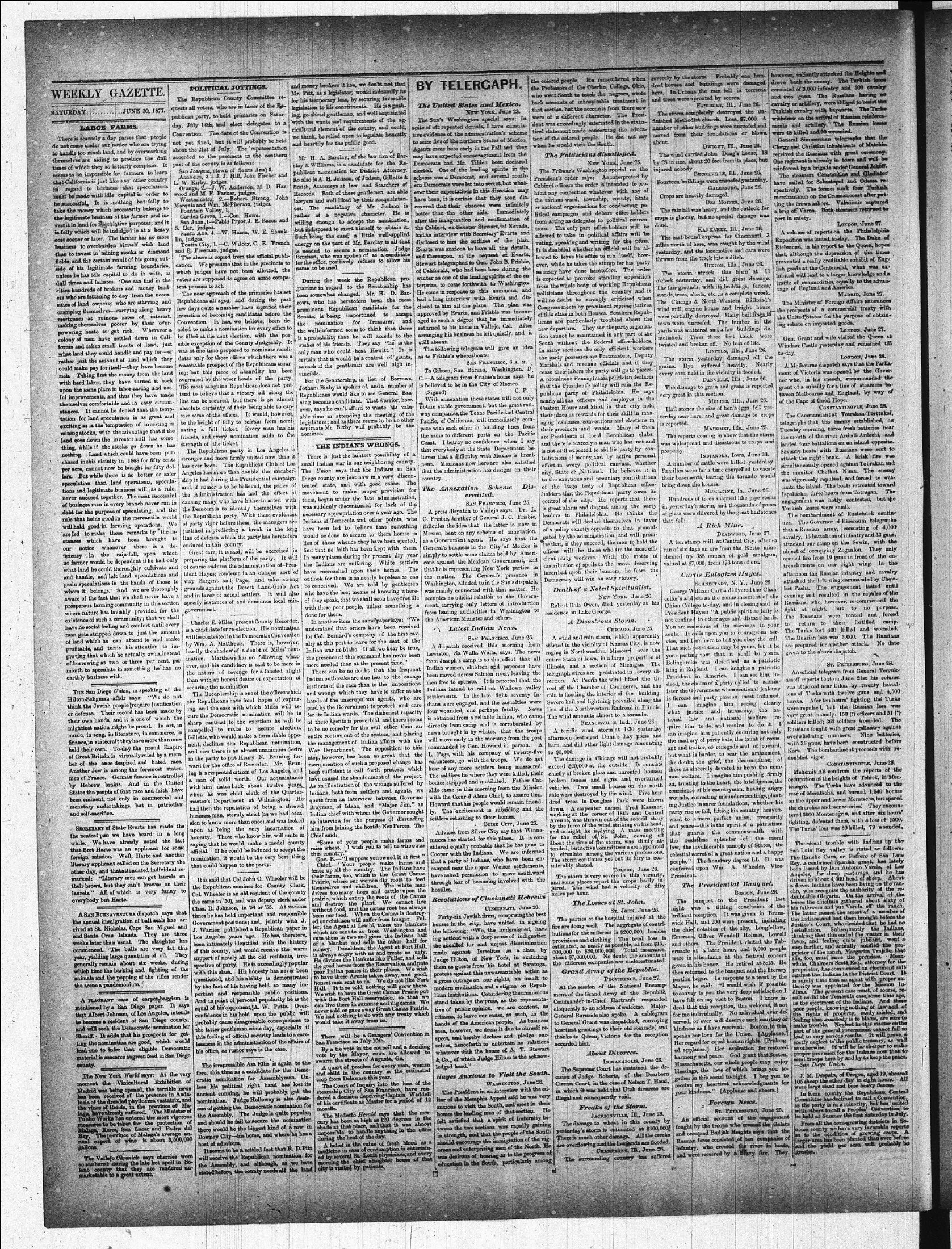
Searchable text
WEEKLY GAZETTE.
SATURDAY... JUNE 30, 1877.
LARGE PARMS.
There is scarcely a day passes that people do not come under our notice who are trying to handle too much land, and by overworking themselves are aiding to produce the dull times of which they so bitterly complain. It seems to be impossible for farmers to learn that California is just like any other country in regard to business—that speculations must be made with idle capital in order to be successful. It is nothing but folly to take the money which necessarily belongs to the legitimate business of the farmer and invest it in land for legislative purposes; and it is folly which will be indulged in at a heavy cost sooner or later. The farmer has no more business to overburden himself with land than to invest in mining stocks or diamond fields; and the certain result of his going outside of his legitimate farming boundaries, unless he has idle capital to do it with, is dull timea and failures. One can find in the cities hundreds of brokers and money lenders who are fattening to-day from the necessities of land owners; who are starving and cramping themselves—carrying along heavy mortgages at ruinous rates of interest making themselves poorer by their overpowering haste to get rich. Wherever a colony of men have settled down in California and taken small tracts of land, just what land they could handle and pay for—or rather just the amount of land which they could make pay for itself—they have become rich. Taking first the money from the land with hard labor, they have turned it back upon the same place in labor-saving and useful improvements, and thus they have made themselves comfortable and in easy circumstances. It cannot be denied that the temptation for land speculation is as great and exciting as is the temptation of investing in mining stocks, with the advantage that if the land goes down the investor still has something, while if the stocks go down he has nothing. Land which could have been purchased in this vicinity in 1863 for fifty cents
POLITICAL JOTTINGS.
The Republican County Committee requests all voters, who are in favor of the Republican party, to hold primaries on Saturday, July 14th, and elect delegates to a Convention. The date of the Convention is not yet fixed, but it will probably be held about the 21st of July. The representation accorded to the precincts in the southern part of the county is as follows:
San Joaquin (town of Santa Ana) 5,
Anaheim, 3.—J. J. Hill, John Fischer and L. W. Kirby, judges.
Orange, 2.—J. W. Anderson, M. D. Harwood and M. P. Parker, judges.
Weetminator, 2.—Robert Strong, John Marquis and Wm. McPherson, judges.
Fountain Valley, 1.
Garden Grove, 1.—Con. Howe.
San Juan, 1.—Pablo Pryor, J. E. Bacon and S. Herl, judges.
Santa Ana, 4.—W. Hazen, W. E. Shanklin, judges.
Teatin City, 1.—C. Wilcox, C. E. French and R. Freeman, judges.
The above is copied from the official publication. We presume that in the precincts to which judges have not been allotted, the voters are supposed to agree on some competent persons to act.
The near approach of the primaries has set Republicans all agog, and during the past few days quite a number have signified their intention of becoming candidates before the Convention. It has, we believe, been decided to make a nomination for every office to be filled at the next election, with the possible exception of the County Judgeship. It was at one time proposed to nominate candidates only for those offices which there was a reasonable prospect of the Republicans securing; but this piece of absurdity has been overruled by the wiser heads of the party.
The most sanguine Republican does not pretend to believe that a victory all along the line can be secured, but there is an almost absolute certainty of their being able to capture some of the offices. It would, however, be the height of folly to refrain from nominating a full ticket. Every man has his friends, and every nomination adds to the strength of the ticket.
The Republican party in Los Angeles is stronger and more firmly united now than it has ever been. The Republican Club of Los
Mr. H. A. Barclay, of clay & Williams is a candidate public nomination for So also is A. H. Judson, Smith, Attorneys at law Records. Both of these lawyers and well liked bces. The candidacy rather of a negative willing enough to accuse but indisposed to exert such being the case; an energy on the part of Mr. Brunison, who was spoken for the office positively name to be used.
During the week gramme in regard to been somewhat changed rows, who has heretofore prominent Republican Senate, is being impressed the nomination for the well-informed secretary is a probability that he wishes of his friends.
Only man who could certain that it would be as each of the gentlemen vincible.
For the Senatorship Jotham Bixby is spoke Republicans would liking become a candidate ever says he can't afford time in attending legislature; and as they aspirants Mr. Bixby nominee.
THE INDIAN
There is just the far small Indian war in c
Taking first the money from the land with hard labor, they have turned it back upon the same place in labor-saving and useful improvements, and thus they have made themselves comfortable and in easy circumstances. It cannot be denied that the temptation for land speculation is as great and exciting as is the temptation of investing in mining stocks, with the advantage that if the land goes down the investor still has something, while if the stocks go down he has nothing. Land which could have been purchased in this vicinity in 1863 for fifty cents per acre, cannot now be bought for fifty dollars. But while there is no better or safer speculation than land operations, speculations and legitimate business will, as a rule, never succeed together. The most successful of business men in every branch never run in debt for the purpose of speculating, and the rule that holds good in the mercantile world will hold good in farming operations. We are led to make these remarks by the instances which have been brought to our notice whenever there is a deficiency in the rain-fall, upon which no farmer would be dependent if he had only what land he could thoroughly cultivate and handle, and left land speculations and grain speculations in the hands of those to whom it belongs. And we are thoroughly aware of the fact that we shall never have a prosperous farming community in this section where nature has lavishly provided for the existence of such a community; that we shall have no social feeling and comfort until every man gets stripped down to just the amount of land which he can attend to and make profitable, and turns his attention to improving that which he actually owns, instead of borrowing at two or three per cent. per month to speculate in something he has no earthly business with.
The San Diego Union, in speaking of the Hilton-Seligman affair says: "We do not think the Jewish people require justification or defense. Their record has been made by their own hands, and it is one of which the mightiest nation might be proud. In art, music, in song, in literature, in commerce, in finance, in statecraft they have more than once held their own. To-day the proud Empire of Great Britain is virtually ruled by a member of the once despised and hated race. Another Jew is among the foremost statesmen of France. German finance is controlled by Hebrew brains. And in the United States the people of that race and faith have been eminent, not only in commercial and monetary undertakings, but in patriotism and self-sacrifice.
Secretary of State Evarts has made the neatest pun we have heard in a long while. We have already noted the fact that Brot Harte was an applicant for some foreign mission. Well, Harte and another literary applicant called on the Secretary the other day, and that attenuated individual remark: "Literary men can get laurels on ing; but this piece of absurdity has been overruled by the wiser heads of the party. The most sanguine Republican does not pretend to believe that a victory all along the line can be secured, but there is an almost absolute certainty of their being able to capture some of the offices. It would, however, be the height of folly to refrain from nominating a full ticket. Every man has his friends, and every nomination adds to the strength of the ticket.
The Republican party in Los Angeles is stronger and more firmly united now than it has ever been. The Republican Club of Los Angeles has more than double the membership it had during the Presidential campaign and, if rumor is to be believed, the policy of the Administration has had the effect of causing many who have hitherto acted with the Democrats to identify themselves with the Republican party. With these evidences of party vigor before them, the managers are justified in predicting a break in the long line of defeats which the party has heretofore endured in this county.
Great care, it is said, will be exercised in preparing the platform of the party. It will of course endorse the administration of President Hayes; condemn in an oblique sort of way Sargent and Page; and take strong grounds against the Desert Land-Grab Act and in favor of actual settlers. It will also specify instances of and denounce local misgovernment.
Charles E. Miles, present County Recorder, is a candidate for re-election. His nomination will be contested in the Democratic Convention by Wm. A. Matthews. There is, however, hardly the shadow of a doubt of Miles' nomination. Matthews has no following whatever, and his candidacy is said to be more in the nature of revenge for a fancied slight than with an honest desire or expectation of securing the nomination.
The Recordership is one of the offices which the Republicans have fond hopes of capturing, and the ease with which Miles will secure the Democratic nomination will be in sharp contrast to the exertions he will be compelled to make to secure election. Gillette, who would make a formidable opponent, declines the Republican nomination, and now there is an almost unanimous desire in the party to put Henry N. Bruning forward for the office of Recorder. Mr. Bruning is a respected citizen of Los Angeles, and a man of solid worth. Our acquaintance with him dates back about twelve years when he was chief clerk of the Quartermaster's Department at Wilmington. He had then the reputation of being a shrewd business man, sternly strict (as we had occasion to know more than once), and was looked upon as being the very incarnation of honesty. Those who know him will unite in saying that he would make a model county official. If he could be induced to accept the nomination, it would be the very best thing that could happen to the party.
It is said that Col.John O. Wheeler will be vinciable.
For the Senatorship Jotham Bixby is spoken Republicans would like ning become a candidate ever, says he can't afford time in attending legislature; and as they aspirants Mr. Bixby nominee.
THE INDIAN
There is just the fa small Indian war in The Union says tha Diego county are just tented state, and w movement to make them begun under tha was suddenly disconti necessary appropriati Indians of Temecula have been led to would be done to se lie of those whence find that no faith ha In many places durin Indians are suf have encroached up outlook for them is al be conceived. We who have the best m of they speak, that w with these poor peo done for them.
In another item th understand that oor Col.Bornard's c alry at this post to Indian war in Idaho the presence of this more needed than a There can be no Indian outbreaks ar instincts of the race and wrongs which hands of the unsur paid by the Governme for its Indian ward these agents is p to be no remedy fo entire rooting out tha management o War Department step, however, has more mention of st have caused tha ab As an illustration Indians, both from quote from an int Brayman, of Idah Indian chief with an interview for th him from joining Chief said:
"Some of you raise wheat. I w this country."
Gov. B.-"Your fence up all th e their farms, too Priairie where ou
SECRETARY of State Evarts has made the neatest pun we have heard in a long while. We have already noted the fact that Bret Harte was an applicant for some foreign mission. Well, Harte and another literary applicant called on the Secretary the other day, and that attenuated individual remark: "Literary men can get laurels on their brows, but they can't browse on their laurels." All of which is very funny to everybody but Harte.
A SAN BURNAVENTURA dispatch says that the annual immigration of bull seals has arrived at St. Nicholas, Cape San Miguel and Santa Cruz Islands. They are three weeks later than usual. The slaughter has commenced. The bulls are very fat this year, yielding large quantities of oil. They generally remain about six weeks, during which time the barking and fighting of the animals and the popping of the rifles render the scene a pandemonium.
A FLAGRANT case of carpet-baggism is mentioned by a San Diego paper. It says that Albert Johnson, of Los Angeles, intends to become a resident of San Diego county, and will seek the Democratic nomination for Sheriff. It adds that his prospects for getting the nomination are good, which would lead one to infer that eligible Democratic material is as scarce as green food in San Diego county.
The New York World says: At the very moment the Vinicultural Exhibition of Madrid was being opened, the terrible news has been received of the presence in Andalusia of the dreaded phylloxera vastatrix, and the vines of Ronda, in the province of Malaga, have already suffered. The Minister of Public Works has ordered the most vigorous measures to be taken for the protection of Malaga, Kavra, San Lucar and Padra del Ray. The province of Malaga's average annual export of wine is about 3,800,000 gallons.
The Vallejo Chronicle says cherries were so sunburned during the late hot spell in Solano county that they are rendered unmarketable to a great extent.
It is said that Col. John O. Wheeler will be the Republican nominee for County Clerk, Col. Wheeler is an old resident of the county (he came in '50), and was deputy clerk under Chas. R. Johnson, in '54 or '55. At various times he has held important and responsible Government positions; and, jointly with J. Warner, published a Republican paper in Los Angeles years ago. He has, therefore, been intimately identified with the history of this county, and would receive the warm support of nearly all the old residents, irrespective of party. He is exceedingly popular with this class. His honesty has never been questioned, and his ability is demonstrated by the fact of his having held so many important and responsible public positions. And in point of personal popularity he is the equal of his opponent, A. W. Potts. Overconfidence in his hold upon the public will probably cause disagreeable consequences to the latter gentleman some day, especially if this feeling of official security leads to a carelessness in the administration of the affairs of his office, as rumor says is the case.
The irrepressible Asa Ellis is again to the fore, this time as a candidate for the Democratic nomination for Assemblyman. Unless his political right hand has lost its ancient cunning, he will probably get the nomination. Judge Holloway is also desirous of getting the Democratic nomination for the Assembly. The Judge is quite popular, and should he fail to secure the nomination there would be the biggest kind of a row in Downey City—his home, and where he has a host of admirers.
It seems to be a settled fact that R. D. Pitt will receive the Republican nomination for the Assembly, and although, as we have stated before, the county needs all the land with him dates back about twelve years when he was chief clerk of the Quartermaster's Department at Wilmington. He had then the reputation of being a shrewd business man, sternly strict (as we had occasion to know more than once), and was looked upon as being the very incarnation of honesty. Those who know him will unite in saying that he would make a model county official. If he could be induced to accept the nomination, it would be the very best thing that could happen to the party.
As an illustration of Indians, both from quote from an inter-Brayman, of Idaho Indian chief with an interview for him from joining Chief said:
"Some of you raise wheat. I wish this country."
Gov. B.—"I surfeit Chief."—"Your fence up all the our farms, too," Prairie, where our themselves and drives too many prairie, which eat and destroy them without food, and been our food. We ed our childen wiler, the Agent at which are sent to cuts them in two of a blanket and money. Donald is always angry he divides the bad good horses for poor Indian ponies to have these Aden honest men sent Hall. It is so coarse We wish to have with the Fort Hancock can live there in never sold or gass We had nothing would take it away.
There will be San Francisco o By a tie vote vote by the Mawarm the street
A quart of peach and child in the crop from Delaware
The Court of steamship City derided a decision of his certification months.
The Modest curry has been a shade at that point impossible to during the heat.
A belief in medicine in caused by several Summers the city is visited here
and money brokers it has, we doubt not that Mr. Pitt, as a legislator, would indemnify us for his temporary loss, by securing favorable legislation to his constituents. He is a pashing, go-ahead gentleman, and well acquainted with the wants and requirements of the agricultural element of the county, and could, we think, be relied upon to legislate honestly and heartily for the public good.
Mr. H. A. Barclay, of the law firm of Barclay & Williams, is a candidate for the Republican nomination for District Attorney. So also is A. H. Judson, of Judson, Gillette & Smith, Attorneys at law and Starchers of Records. Both of these gentlemen are able lawyers and well liked by their acquaintances. The candidacy of Mr. Judson is rather of a negative character. He is willing enough to accept the nomination, but indisposed to exert himself to obtain it. Such being the case, a little well-applied energy on the part of Mr. Barclay is all that is needed to secure a nomination. Judge Brunison, who was spoken of as a candidate for the office, positively refuses to allow his name to be used.
During the week the Republican programme in regard to the Senatorship has been somewhat changed. Mr. H. D. Barrows, who has heretofore been the most prominent Republican candidate for the Senate, is being importuned to accept the nomination for Treasurer, and the well-informed seem to think that there is a probability that he will accede to the wishes of his friends. They say "he is the only man who could beat Hewitt." It is certain that it would be a contest of giants, as each of the gentlemen are well nigh invincible.
For the Senatorship, in lieu of Barrows, Jotham Bixby is spoken of, and a number of Republicans would like to see General Banning become a candidate. That warrior, however, says he can't afford to waste his valuable time in attending the meeting of the legislature; and as there seems to be no other aspirant Mr. Bixby will probably be the nominee.
THE INDIAN'S WRONGS.
There is just the faintest possibility of a small Indian war in our neighboring county.
BY TELERCAPH.
The United States and Mexico.
New York, June 23.
The Sun's Washington special says: In spite of oft repeated denials, I have cannoliative evidence of the administration's scheme to seize five of the northern States of Mexico. Agents came here early in the Fall and they may have expected encouragement from the Democrats had Mr. Tilden been declared elected. One of the leading spirits in the scheme was a Democrat, and several southern Democrats were let into secret, but whatever their expectations in this direction may have been, it is certain that they soon discovered that their chances were infinitely better than the other side. Immediately after the inauguration and confirmation of the Cabinet, ex-Senator Stewart, of Nevada, had an interview with Secretary Evarts and disclosed to him the outlines of the plan. Evarts was anxious to have all the details, and thereupon at the request of Evarts, Stewart telegraphed to Gen. John B. Frisbie, of California, who had been here during the winter as one of the leading spirits of the enterprise, to come forthwith to Washington. He came in response to this summons, and had a long interview with Evarts and disclosed to him all the plans. The plan was approved by Evarts, and Frisbie was encouraged to such a degree that he immediately returned to his home in Vallejo, Cal. After arranging his business he left quietly, and is still absent.
The following telegram will give an idea as to Frisbie's whereabouts:
SAN FRANCISCO, 6 A.M.
To Gibbon, Sun Bureau, Washington. D.C.-A telegram from Frisbie's home says he is believed to be in the City of Mexico.
C.P.
With annexation these states will not only obtain stable government, but the great railway companies, the Texas Pacific and Central Pacific, of California, will immediately compete with each other in building lines from the same to different ports on the Pacific Coast. I betray no confidence when I say that everybody at the State Department believes that a difficulty with Mexico is imminent. Mexicans now here are also satisfied
the colored people. He remembered when the Professors of the Oberlin College, Ohio, who went South to teach the negroes wrote back accounts of inhospitable treatment in that section, but the accounts from there now were of a different character. The President was exceedingly interested in the statistical statement made concerning the education of the colored people. He did not say when he would visit the South.
The Politicians dissatisfied.
New York, June 25.
The Tribune's Washington special on the President's order says: As interpreted by Cabinet officers the order is intended to prohibit any connection whatever with any of the various ward, township, county, state or national organizations for conducting political campaigns and delays office-holders from acting as delegates to political conventions. The only part office-holders will be allowed to take in political affairs will be voting, speaking and writing for the press. It is doubtful whether an official will be allowed to leave his office to run itself, however, while he takes the stump for his party as many have done heretofore. The order is expected to provoke standing opposition from the whole body of working Republican politicians throughout the country and it will no doubt be strongly criticised when Congress meets by prominent representatives of this class in both House. Southern Republicans are particularly troubled about the new departure. They say the party organization cannot be maintained in any part of the South without the Federal office-holders.
In many sections the only efficient workers the party possesses are Postmasters, Deputy Marshals and revenue officials and if they cease their labors the party will go to pieces. A prominent Pennsylvania politician declares that the President's policy will ruin the Republican party of Philadelphia. He says nearly all the officers and employees in the Custom House and Mint in that city hold their place as rewards for their skill in managing caucuses,'conventions and elections in their precincts and wards. Many of them are Presidents of local Republican clubs, and there is scarcely a man who has not and is not still expected to aid his party by contributions of money and by active personal effort in every political canvass, whether
For the Senatorship, in lieu of Barrows, Jotham Bixby is spoken of, and a number of Republicans would like to see General Banning become a candidate. That warrior, however, says he can't afford to waste his valuable time in attending the meeting of the legislature; and as there seems to be no other aspirants Mr. Bixby will probably be the nominee.
THE INDIAN'S WRONGS.
There is just the faintest possibility of a small Indian war in our neighboring county. The Union says that the Indians in San Diego county are just now in a very discontented state, and with good cause. The movement to make proper provision for them, begun under the late administration, was suddenly discontinued for lack of the necessary appropriation over a year ago. The Indians of Temecula and other points, who have been led to believe that something would be done to secure to them homes in lieu of those whence they have been ejected, find that no faith has been kept with them. In many places during the present dry year the Indians are suffering. White settlers have encroached upon their homes. The outlook for them is as nearly hopeless as can be conceived. We are told by gentlemen who have the best means of knowing where they speak, that we shall soon have trouble with these poor people, unless something is done for them.
In another item the same paper says: "We understand that orders have been received for Col. Bernard's company of the first cavalry at this post to leave for the seat of the Indian war in Idaho. If all we hear be true, the presence of this command has never been more needed than at the present time."
There can be no doubt that the frequent Indian outbreaks are due less to the savage instincts of the race than to the impositions and wrongs which they have to suffer at the hands of the unscrupulous agents, who are paid by the Government to protect and care for its Indian wards. The dishonest rapacity of these agents is proverbial, and there seems to be no remedy for the evil other than an entire rooting out of the system, and placing the management of Indian affairs with the War Department. The opposition to this step, however, has been so great that the mere mention of such a proposed change has been sufficient to call forth protests which have caused the abandonment of the project. As an illustration of the wrongs suffered by Indians, both from settlers and agents, we quote from an interview between Governor Brayman, of Idaho, and "Major Jim," an Indian chief with whom the Governor sought an interview for the purpose of dissuading him from joining the hostile Nez Perces. The Chief said:
"Some of your people make farms and raise wheat. I wish you to tell us who owns this country."
Gov. B.—"I suppose you owned it at first." Chief—"Your people make farms and fence up all the country. The Indians have their farms, too, which is the Great Camas Prairie, where our women dig roots to feed."
To Gibson, Sun Bureau, Washington. D.C.-A telegram from Frisbie's home says he is believed to be in the City of Mexico.
C.P.
With annexation these states will not only obtain stable government, but the great railway companies, the Texas Pacific and Central Pacific, of California, will immediately compete with each other in building lines from the same to different ports on the Pacific Coast. I betray no confidence when I say that everybody at the State Department believes that a difficulty with Mexico is imminent. Mexicans now here are also satisfied that the administration has designs on their country.
The Annexation Scheme Discredited.
SAN FRANCISCO, June 25.
A press dispatch to Vallejo says: Dr. L. C. Frisbie, brother of General J. C. Frisbie, ridicules the idea that the latter is now in Mexico, bent on any scheme of annexation as a Government agent. He says that the General's business in the City of Mexico is simply to settle some claims held by Americans against the Mexican Government, and that he is representing New York parties in the matter. The General's presence in Washington, alluded to in the Sun's dispatch, was mainly connected with that matter. He occupies no official relation to the Government, carrying only letters of introduction from leading authorities in Washington to the American Minister and others.
Latest Indian News.
SAN FRANCISCO, June 25.
A dispatch received this morning from Lewiston, via Walla Walla, says: The news from Joseph's camp is to the effect that all Indian women, children and papooses have been moved across Salmon river, leaving the men free to operate. It is reported that the Indians intend to raid on Wallowa valley settlements. In the late fight seventy Indians were engaged, and the casualties were four wounded, one perhaps fatally. News is obtained from a reliable Indian, who came directly from camp and is corroborated by news brought in by whites, that the troops will move early in the morning from the post commanded by Gen. Howard in person. A L. Page, with his company of twenty-five volunteers, go with the troops. We do not hear of any more settlers being massacred. The soldiers lie where they were killed, their bodies stripped and mutilated, Father Catalo came in this morning from the Mission with the Cœur-d'Alene Chief, to assure Gen. Howard that his people would remain friendly. The excitement is subsiding and the settlers returning to their homes.
BOISE CRY, June 25.
Advices from Silver City say that Winneucca has started for this place. It is considered equally probable that he has gone to Cooper with the Indians. We are informed that a party of Indians, who have been encamped near the upper Weiser settlements, have asked permission to move southward through fear of becoming involved with the cease their labors the party will go to pieces. A prominent Pennsylvania politician declares that the President's policy will ruin the Republican party of Philadelphia. He says nearly all the officers and employees in the Custom House and Mint in that city hold their place as rewards for their skill in managing caucuses; conventions and elections in their precincts and wards. Many of them are Presidents of local Republican clubs, and there is scarcely a man who has not and is not still expected to aid his party by contributions of money and by active personal effort in every political canvass, whether city, State or National. He believes it is to the exertions and pecuniary contributions of the large body of Republican officeholders that the Republican party owes its control of the city. He reports that there is great alarm and disgust among the party leaders in Philadelphia. He thinks the Democrats will declare themselves in favor of a policy exactly opposite to that promulgated by the administration, and will promise that, if they succeed, the men to hold the offices will be those who are the most efficient party workers. With the motto of distribution of spoils to the most deserving inscribed upon their banners, he fears the Democracy will win an easy victory.
Death of a Noted Spiritualist.
NEW YORK, June 26.
Robert Dale Owen, died yesterday at his residence on Lake George.
A Disastrous Storm.
CHICAGO, June 25.
A wind and rain storm, which apparently started in the vicinity of Kansas City, is now raging in Northwestern Missouri, over the entire State of Iowa, in a large proportion of Illinois, and a section of Michigan. The telegraph wires are prostrated in every direction. At Peoria the wind lifted the tin roof off the Chamber of Commerce, and the rain is flooding the interior of the building. Severe hail and lightning prevailed along the line of the Northwestern Railroad in Illinois. The wind amounts almost to a tornado.
FRANCISVILLE, Ind., June 26.
A teriffic wind storm at 1:30 yesterday afternoon destroyed Dunn's hay press and barn, and did other light damage amounting to $5,000.
The damage in Chicago will not probably exceed $20,000 at the outside. It consists chiefly of broken glass and unroofed houses; broken fences and signs and overturned vehicles. Two small houses on the north side were destroyed by the wind. Five hundred trees in Douglass Park were blown down. A carpenter named Fred Kassner, working at the corner of 18th and Central Avenue, was thrown out of the second story by the force of the wind, striking on his head, and to-night he is dying. A mass meeting for the relief of St. John, coming off about the time of the storm, was slimly attended, but active committees were appointed to circulate among various professions. The storm continues yet but its fury is considerably abated.
TOLEDO, June 26.
The storm is very severe in this vicinity,and some places reportthe crops badly in-
As an illustration of the wrongs suffered by Indians, both from settlers and agents, we quote from an interview between Governor Brayman, of Idaho, and "Major Jim," an Indian chief with whom the Governor sought an interview for the purpose of dissuading him from joining the hostile Nez Perces. The Chief said:
"Some of your people make farms and raise wheat. I wish you to tell us who owns this country."
Gov. B.—"I suppose you owned it at first." Chief—"Your people make farms and fence up all the country. The Indians have their farms, too, which is the Great Camas Prairie, where our women dig roots to feed themselves and children. The white man drives too many hogs and cattle upon the prairie, which eat up the roots of the Camas and destroy the plant. We cannot live without food, and the camas root has always been our food. When the Camas is destroyed our children will suffer from hunger. Fuller, the Agent at Lemhi, takes the blankets which are sent to us from Washington and cuts them in two and gives the Indians half of a blanket and sells the other half for money. Donaldson, the Agent at Fort Hall, is always angry with us and treats us ugly. He divides the blankets like Fuller, and sells the good horses from the Reservation, and puts poor Indian ponies in their places. We wish to have these Agents taken away, and good, honest men sent to us. We do not like Fort Hall. It is so cold nothing will grow there. We wish to have the Great Camas Prairie put with the Fort Hall reservation, so that we can live there in summer and dig canes. We never sold or gave away Great Camas Prairie. We had nothing to do with any treaty which would take it away from us.
There will be a Grangers' Convention in San Francisco on July 10th.
By a tie vote in the council and a deciding vote by the Mayor, cows are allowed to swarm the streets of Angusta, Ga.
A quart of peaches for every man, woman and child in the country is the estimated crop from Delaware this year.
The Court of Inquiry into the loss of the steamship City of San Francisco, have rendered a decision depriving Captain Waddell of his certificate as Master for a period of 12 months.
The Modesto Herald says that the mercury has been as high as 120 degrees in the shade at that place, and that it was almost impossible to handle anything in the office during the heat of the day.
A belief in the value of fresh blood as a medicine in case of consumption is entertained by several St. Louis physicians, and every morning the chief slaughter house of that city is visited by patients.
Advices from Silver City say that Winneucca has started for this place. It is considered equally probable that he has gone to Cooper with the Indians. We are informed that a party of Indians, who have been encamped near the upper Weiser settlements, have asked permission to move southward through fear of becoming involved with the hostiles.
Resolutions of Cincinnati Hebrews
CINCINNATI, June 26.
Forty-six Jewish firms, comprising the best houses in the city, have united in signing the following: "We, the undersigned, having noticed with a deep sense of indignation the uncalled for and unjust discrimination made against Israelites as a class, by Judge Hilton, of New York, in excluding them as guests from his hotel at Saratoga, protest against this unwarrantable action as a gross outrage on our rights, an insult to modern civilization and a stigma on Republican institutions. Considering the unanimous stand taken by the press, as the representative of public opinion, we are content, as citizens, to leave our cause, as such, in the hands of the American people. As business men, however, we deem it due to ourselves respect, and hereby declare and pledge ourselves, henceforth to entertain no relations whatever with the house of A. T. Stewart & Co., of which Judge Hilton is the acknowledged head."
Hayes Anxious to Visit the South.
WASHINGTON, June 26.
The President in an interview with the editor of the Memphis Appeal said he was very anxious to visit the South, and meet in their houses the leading men of that section. He felt satisfied that a spirit of fraternity between the two sections was rapidly gaining in strength, and that the people of the South should encourage the immigration of the vigorous and enterprising men of the North. He was desirous of hearing as to the progress of education in the South, particularly among vehicles. Two small houses on the north side were destroyed by the wind. Five hundred trees in Douglass Park were blown down. A carpenter named Fred Kassner, working at the corner of 18th and Central Avenue, was thrown out of the second story by the force of the wind, striking on his head, and to-night he is dying. A mass meeting for the relief of St. John, coming off about time of the storm, was slimly attended, but active committees were appointed to circulate among various professions. The storm continues yet but its fury is considerably abated.
TOLEDO, June 26.
The storm is very severe in this vicinity, and some places report the crops badly injured. The wind had a velocity of fifty miles per hour.
The Losses at St. John.
St. John, June 26.
The parties at the hospital injured at the fire are doing well. The aggregate of contributions for the sufferers is $200,000; besides provisions and clothing. The total loss is estimated, as nearly as possible, at from $15,-000,000 to $20,000,000. Total insurance, about $7,000,000. No doubt the amounts of different companies are underestimated.
Grand Army of the Republic.
PROVIDENCE, June 27.
At the session of the National Encampment of the Grand Army of the Republic, Commander-in-Chief Hartranft responded eloquently to an address of welcome. Major-General Burnside also spoke. A cablegram to General Grant was dispatched, conveying heartiest greetings to their old comrade; and thanks to Queen Victoria for the reception accorded him.
About Divorces.
INDIANAPOLIS, June 26.
The Supreme Court has sustained the decision of Judge Roberts, of the Dearborn Cirenit Court, in the case of Nelson T. Hood, in which it was held that Utah divorces are illegal and consequently void.
Freaks of the Storm.
JACKSONVILLE, Ill., June 26.
The damage to wheat in this county by yesterday's storm is estimated at $100,000; there is much other damage. All the creeks are overflowing and the lowlands are flooded.
CHAMPAGNE, Ill., June 26.
The surrounding country has suffered
remembered when Berlin College, Ohio, the negroes wroteitable treatment in grants from there nowanter. The President in the statistic concerning the education He did not say South.
New York, June 25.
Boston special on the As interpreted by is intended to pro-statever with any of ship, county, State for conducting polledbars office-holders to political conven-office-holders will be critical affairs will be writing for the press. An official will be able to run itself, howstump for his party pretofore. The order standing opposition to working Republican in the country and it strongly criticised when eminent representatives house. Southern Republi-troubled about the way the party organiza-den in any part of the Federal office-holders. Only efficient workers Postmaster, Deputy officials and if they party will go to pieces. Grania politician declares policy will ruin Re-Philadelphia. He says he and employes in the court in that city hold for their skill in man-ntions and elections in Wards. Many of them real Republican clubs, a man who has not and no aid his party by con-ding by active personal canvass, whether severely by the storm. Probably one hundred houses and buildings were damaged here. In Urbana the rain fell in torrents and trees were uprooted by scores.
Fairbury, Ill., June 26.
The storm completely destroyed the unfinished Methodist church. Loss, $7,000. A number of other buildings were unroofed and moved from their foundations or blown about.
Dwight, Ill., June 26.
The wind carried John Dong's house, 18 by 28 in size, about 20 feet from its place, but injured nobody.
Brookville, Ill., June 26.
Fourteen buildings were unroofed yesterday.
Galesburg, June 26.
Crops are heavily damaged.
Des Moines, June 26.
The rainfall was heavy, and the outlook for crops is gloomy, but no special damage was done.
Kankakee, Ill., June 26.
The east-bound express for Cincinnati, 3 miles north of here, was caught by the wind yesterday, and the locomotive and cars were thrown from the track into a ditch.
Dixton, Ill., June 26.
The storm struck this town at 11 o'clock yesterday, and did great damage. The fair grounds, with its buildings, fences, stands, trees, sheds, etc., is a complete wreck.
The Chicago & North-Western Railroad's wind mill, engine house and freight house were partially destroyed. Many buildings in town were unroofed. The lumber in the yards was scattered and a few buildings demolished. Trees three feet thick were twisted and broken off. No loss of life.
Lincoln, Ill., June 26.
The storm yesterday damaged all the grains. Rye suffered heavily. Nearly every corn field in the vicinity is flooded.
Danville, Ill., June 26.
The damage to grain and grass is reported very great in this section.
Moline, Ill., June 26.
Hail stones the size of hen's eggs fell yesterday near here, and great damage to crops is reported.
Manomet, Ill., June 25.
The reports coming in show that the storm was widespread and disastrous to crops and property.
Indianola, Iowa, June 26.
A number of cattle were killed yesterday.
however, valiantly attacked the Heights and drove back the enemy. The Turkish forces consisted of 3,000 infantry and 300 cavalry and two guns. The Russians having no cavalry or artillery, were obliged to resist the Turkish cavalry with bayonets. The Turks withdrew on the arrival of Russian reinforcements and artillery. The Russian losses were 48 killed and 90 wounded.
General Simmerman telegraphs that the Clergy and Christian inhabitants of Matchin received the Russians with great ceremony. One regiment is already in town and will be reinforced by a brigade under General Johoff.
The steamers Constantine and Gladiator have sailed for Sebastopol and Olessa respectively. The former sunk four Turkish merchantmen on the Crimean coast after putting the crowds ashore. Valadimir captured a brig off Varna. Both steamers returned to port in safety.
London, June 27.
A volume of reports on the Philadelphia Exposition was issued to-day. The Duke of Richmond, in his report to the Queen, hopes that, although the depression of the times prevented a really creditable exhibit of English goods at the Centennial, what was exhibited will lead to a larger knowledge and a traffic of commodities, equally to the advantage of England and America.
Madrid, June 27.
The Minister of Foreign Affairs announces the prospects of a commercial treaty with the United States for the purpose of obtaining rebate on imported goods.
London, June 27.
Gen. Grant and wife visited the Queen as Windsor Castle yesterday and remained till to-day.
London, June 28.
A Melbourne dispatch says that the Parliament of Victoria was opened by the Governor who, in his speech, recommended the grant of a subsidy for a line of steamers between Melbourne and England, by way of of the Cape of Good Hope.
Constantinople, June 28.
The Commandant at Totrakan-Turttukai, telegraphs that the enemy established, on Tuesday morning, three fresh batteries near the mouth of the river Ardishi-Ardechi, and landed four battalions on an island opposite Seventy boats with Russians were sent to attack the right bank. A brisk fire was simultaneously opened against Totrakan and
The recent trouble with Indians up the San Luis Rey valley is stated as follows: The Rancho Cucas, or Potrero of San Luis Rey, a confirmed Spanish grant, has lately been leased by Don Antonio Varela, of Los Angeles, for sheep pasture, and he has driven in about 4,000 head of sheep. About every corn field in the vicinity is flooded.
DANVILLE, Ill., June 26.
The damage to grain and grass is reported very great in this section.
MOLINZ, Ill., June 26.
Hail stones the size of hen's eggs fell yesterday near here, and great damage to crops is reported.
MAHOMET, Ill., June 25.
The reports coming in show that the storm was widespread and disastrous to crops and property.
INDIANOLA, Iowa, June 26.
A number of cattle were killed yesterday. Families were for a time compelled to vacate their basements, fearing the tornado would bring down the houses.
MUSCATINE, Ia., June 26.
Hundreds of trees snapped like pipe stems in yesterday's storm, and thousands of panes of glass were shivered by the great hail stones that fell:
A Rich Mine.
DEADWOOD, June 27.
A ten stamp mill at Central City, after a run of six days on ore from the Ketto mine cleaned up 388 ounces of gold amalgam, valued at $7,000; from 173 tons of ore.
Curtis Eulogizes Hayes.
SCHNEIDTADY, N.Y., June 29.
George William Curtia delivered the Chancellor's address at the commencement of the Union College to-day, and in closing said of President Hayes: "A public spirit so lofty is not confined to other ages and distant lands. You are conscious of its starring in your souls. It calls upon you to courageous service, and I am here to bid you obey the call. That such patriotism may be yours, let it be your parting vow that it shall be yours. Bolingbroke was described as a patriotic king in England. I can imagine a patriotic President in America. I can see him, indeed, the choice of a party called to administer the Government when sectional jealousy is fiercest and party passion most inflamed. I can imagine him seeing clearly what justice and humanity, the national law and national welfare require him to do, and resolve to do it. I can imagine him patiently enduring not only the mad cry of party hate, the taunt of recusant and traitor, of renegade and of coward, but what is harder, to bear the amazement, the doubt, the grief, the denunciation, of those as sincerely devoted as he to the common welfare. I imagine him pushing firmly on, trusting to the heart, the intelligence, the conscience of his countrymen, healing angry wounds, correcting misunderstandings, planting Justice in surer foundations, whether his party rise or fall, lifting his country heavenward to a more perfect union, prosperity and peace—this is the spirit of a patriotism that guards the commonwealth with the resistless splendor of the moral law, the invulnerable panoply of States, the celestial secret of a great nation and a happy people." The honorary degree LL. D. was conferred upon Wm. A. Wheeler, Vice-President.
CONSTANTINOPLE, June 28.
The Commandant at Totrakan-Turttukai, telegraphs that the enemy established on Tuesday morning, three fresh batteries near the mouth of the river Ardesi-Ardechi, and landed four battalions on an island opposite. Seventy boats with Russians were sent to attack the right bank. A brisk fire was simultaneously opened against Tobrakan and the monitor Chefket Nima. The enemy was vigorously repulsed, and forced to evacuate the island. The boats retreated toward Isaltisha, three hours from Totrakan. The engagement was hotly contested, but the Turkish losses were small.
The bombardment of Rustehneck continues. The Governor of Erzeroum telegraphs that a Russian army, consisting of 4,000 cavalry, 15 battalions of infantry and 33 guns, attacked our camp on the Sewin, with the object of occupying Zoganlon. They only opened fire from 19 guns in front of the entrenchments on our right wing. In the afternoon the Russian infantry and cavalry attacked the left wing commanded by Chewket Pasha. The engagement lasted until evening and resulted in the repulse of the Russians, who, however, re-commenced the fight at night, but to no purpose. The Russians were rented and forced to return to their fortified camp. The Turks lost 400 killed and wounded. The Russian loss was 3,000. The Russians are prepared for another attack. No date given to the above dispatch.
ST. PETERSBURG, June 28.
An official telegram from General Terukkassoff reports that on June 21st his column was attacked near Dillon by twenty battalions of Turks with twelve guns and 4,500 horses. After ten hours' fighting the Turks were repulsed, but the Russian loss was very great; namely: 150 (?) officers and 51 (?) soldiers killed; 302 soldiers wounded. The Russians fought with great gallantry against overwhelming numbers. Nine batteries, with 36 guns, have been constructed before Kars. The bombardment proceeds with redoubled vigor.
CONSTANTINOPLE, June 28.
Mehiemi Aii confirms the reports of the occupation of the heights of Tehick, in Montenegro. The Turks have advanced to the rear of Moratacha, and burned 1,540 houses on the upper and lower Moratacha, but spared the churches and monasteries.' They encountered 5000 Montenegrin, and after six hours' fighting, defeated them, with a loss of 1500. The Turks' loss was 89 killed, 79 wounded.
The recent trouble with Indians up the San Luis Rey valley is stated as follows: The Rancho Cucas, or Potrero of San Luis Rey, a confirmed Spanish grant has lately been leased by Don Antonio Varela, of Los Angeles, for sheep pasture, and he has driven in about 4,000 head of sheep. About every corn field in the vicinity is flooded.
DANVILLE, Ill., June 26.
The damage to grain and grass is reported very great in this section.
MOLINZ, Ill., June 26.
Hail stones the size of hen's eggs fell yesterday near here, and great damage to crops is reported.
MAHOMET, Ill., June 25.
The reports coming in show that the storm was widespread and disastrous to crops and property.
INDIANOLA, Iowa, June 26.
A number of cattle were killed yesterday. Families were for a time compelled to vacate their basements, fearing the tornado would bring down the houses.
MUSCATINE, Ia., June 26.
Hundreds of trees snapped like pipe stems in yesterday's storm, and thousands of panes of glass were slivered by the great hail stones that fell:
A Rich Mine.
DEADWOOD, June 27.
A ten stamp mill at Central City, after a run of six days on ore from the Ketto mine cleaned up 388 ounces of gold amalgam, valued at $7,000; from 173 tons of ore.
Curtis Eulogizes Hayes.
SCHNEIDTADY, N.Y., June 29.
George William Curtia delivered the Chancellor's address at the commencement of the Union College to-day, and in closing said of President Hayes: "A public spirit so lofty is not confined to other ages and distant lands. You are conscious of its starring in your souls. It calls upon you to courageous service, and I am here to bid you obey the call. That such patriotism may be yours, let it be your parting vow that it shall be yours. Bolingbroke was described as a patriotic king in England. I can imagine a patriotic President in America. I can see him, indeed, the choice of a party called to administer the Government when sectional jealousy is fiercest and party passion most inflamed. I can imagine him seeing clearly what justice and humanity,the national law and national welfare require him to do,and resolve to do it.I can imagine him patiently enduring not only the mad cry of party hate,the taunt of recusant and traitor,of renegade and of coward,but what is harder,tBear the amazement,the doubt,the grief,the denunciation,of those as sincerely devoted as he tothe common welfare.I imagine him pushing firmly on,trusting tothe heart,theintelligence,theconscienceofhiscountrymen,healingangrywounds,correctingmisunderstandings,plantingJusticeinsurerfoundations,whetherhispartyriseorfall,liftinghiscountryheavenwardtoamoreperfectunion,prosperityandpeace—thisisthespiritofapatriotismthatguardsthecommonwealthwiththeresistlesssplendorofthemorallaw,theinvulnerablepanoplyofStates,thecelestialsecretofaGreatnationandahappypeople."ThehonorarydegreeLL.D.wasconferreduponWm.A.Wheeler,Vice-President.
The Presidential Banquet.
Boston, June 28.
The banquet to the President last night was a fitting conclusion of the brilliant reception. It was given in Brunswick Hall, and 200 were present, including the chief notables of the city, Longfellow, Emerson, Olliver Wendell Holmes, Lowell and others. The President visited the Tabernacle at a later hour, and 8,000 people were in attendance at the festival concert given in his honor. He retired at 8:15. He then returned to the banquet and the literary portion began. In response to a toast by the Mayor, he said: "I would wish if possible to convey to you the very deep satisfaction I have felt on my visit to Boston. I know indeed that this reception, this welcome, is not for me individually. No individual ever deserved, or ever will deserve such courtesy or kindness as I have received. Boston, in this speaks her love for the Union. [Applause.] Her regard for equal human rights. [Prolonged applause.] Her aspiration for restored harmony and peace. God grant that Boston, Massachusetts, our whole people may enjoy blessings, the love of which brings you together in this social to-night. I beg you to receive my heartiest acknowledgments for your kindness." [Applause and cheers.]
Foreign News.
St. Petersburg, June 25.
An official account of the engagement fought by the troops who crossed the Galatz and occupied Budjak Heights says that the Russian force consisted of ten companies of infantry, who crossed the river in boats, and were received by a heavy fire. They...