anaheim-gazette 1877-06-23
Scanned page
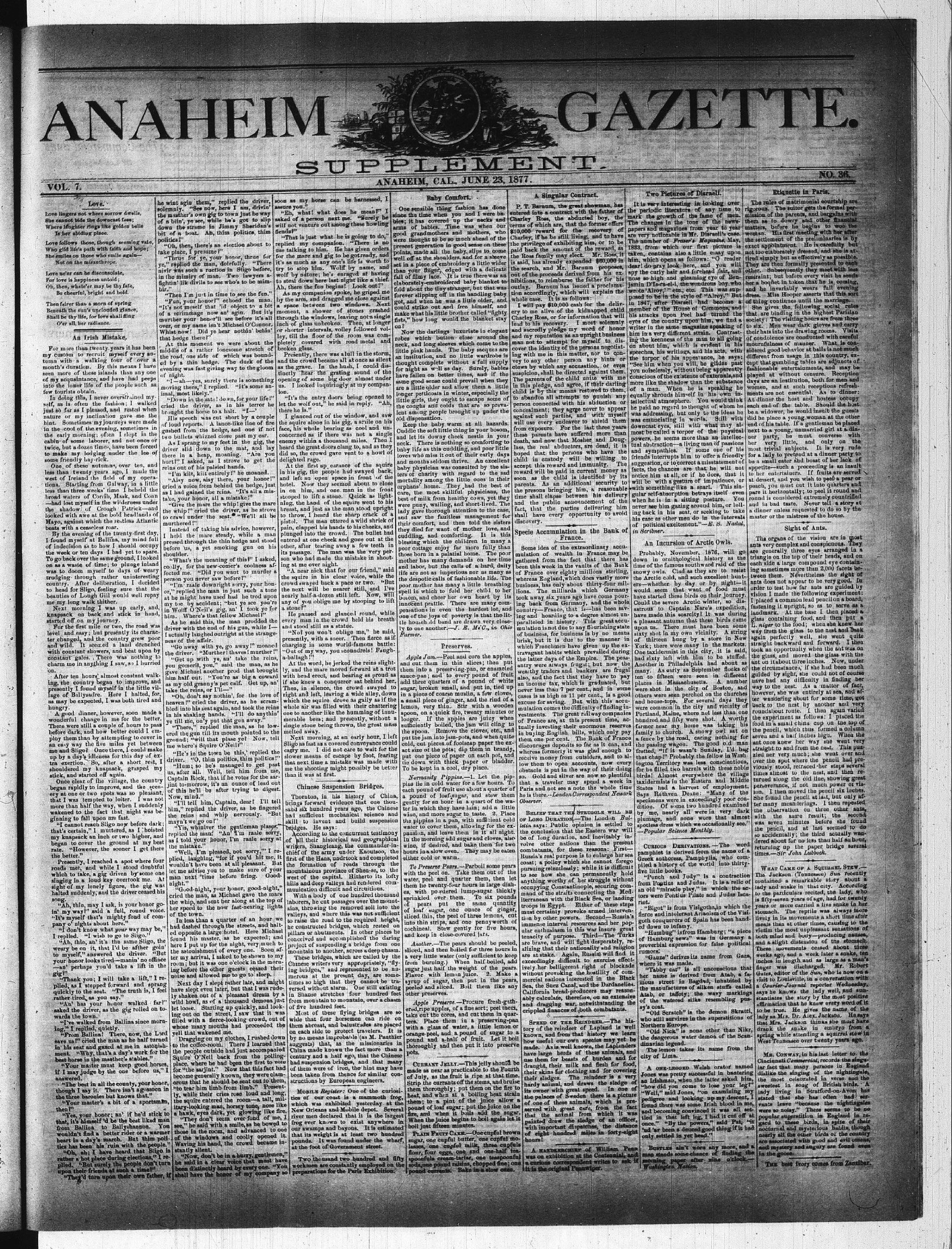
Searchable text
ANAHEIM
VOL. 7.
Love.
Love lingers not where sorrow dwells,
She cannot bide the downcast face;
Where laughter rings like golden bells
Is her abiding place.
Love follows those, though seeming vain,
Who gild life's path with faith and hope;
She smiles on those who smile again—
Not on the misanthrope.
Love ne'er can be disconsolate,
For love is happiness untold;
Oh, then, whata'er may be thy fate,
Be cheerful, bright and bold.
Then fairer than a morn of spring
Beneath the sun's unclouded glance,
Shall be thy life, for love shall fling
O'er all, her radiance.
An Irish Mistake.
For more than twenty years it has been my custom to recruit myself every autumn with a walking tour of over a month's duration. By this means I have seen more of these islands than any one of my acquaintance, and have had peeps into the inner life of the people such as few tourists obtain.
In doing this, I never oversrained myself, as is often the fashion; I walked just so far as I pleased, and rested when nature or my inclination gave me the hint. Sometimes my journeys were made in the cool of the evening, sometimes in the early morning; often I slept in the cabin of some laborer, and not once or twice, but a dozen times, have been forced to make my lodging under the lee of some friendly hay-rick.
One of these autumns over ten, and he wint agin them," replied the driver, solemnly. "See now, here I am, drivin' the masher's own gig to town just be way of a blin', ye see, while he's got to slip down the strame in Jimmy Sheridan's bit of a boat. Ah, thin politics, thim politics?"
"Oh, then, there's an election about to take place, I presume?"
"Thrue for ye, your honor, thrue for ye," replied the man, dolefully. "There nivir was such a ruction in Sligo before, in the mimiry of man. Two lawyers fightin' lik divils to see who's to be mimbir."
"Then I'm just in time to see the fun." "Fun, your honor!" echoed the man. "It's not meself that 'id object to a bit of a scrimmage now an' again. But it's murther your honor'll see before it's all over, or my name isn't Michael O'Connor. Whist now! Did ye hear nothin' behin' that hedge there?"
At this moment we were about the middle of a rather lonesome stretch of the road, one side of which was bounded by a thin hedge. The dusk of the evening was fast giving way to the gloom of night.
"I—ah—yes, surely there is something moving there," I replied. "It's some animal, most likely."
"Down in the sate! down, for your life!" cried the driver, as in his terror he brought the horse to a halt. "I—"
His speech was cut short by a couple of loud reports. A lance-like line of fire gushed from the hedge, and one if not two bullets whizzed close past my ear.
As I sprang to my feet in the gig, the driver slid down to the mat, and lay there in a heap, moaning. "Are you hurt?" I asked, as I strove to get the soon as my horse can be assured you."
"Eh, what! what does he ask of a person next me will not venture out among the fiends?"
"That is just what he is got replied my companion. "I use talking to him. He has it as much as any one's life try to stop him. Wolff by wolf by nature; he's enraged to steal down here last night. Ah, there the fun begins! L
As my companion spoke, he by arm, and dragged me a space between two wind moments, a shower of storm through the windows, leaving inch of glass unbroken. Th or shorter intervals, volley f ley, till the floor of the roopletely covered with road broken glass.
Presently, there was a lull and the crowd became all at as the grave. In the hush, tinley hear the grating opening of some big door us. I looked inquiringly at ion.
"It's the entry doors being let the wolf out," he said in there he is."
I glanced out of the wind the squire alone in his gig, face, his whole bearing as concerned as if there was enemy within a thousand m heard the great doors clang did so, the crowd gave vent delighted rage.
By this means I have seen more of these islands than any one of my acquaintance, and have had peeps into the inner life of the people such as few tourists obtain.
In doing this, I never overstrained myself, as is often the fashion; I walked just so far as I pleased; and rested when nature or my inclination gave me the hint. Sometimes my journeys were made in the cool of the evening, sometimes in the early morning; often I slept in the cabin of some laborer, and not once or twice, but a dozen times, have been forced to make my lodging under the lee of some friendly hay-rick.
One of these autumns, over ten, and less than twenty years ago, I made the west of Ireland the field of my operations. Starting from Galway, in a little less than three weeks' time I beheld the broad waters of Corrib, Mask, and Conn—had lost myself in the wilderness under the shadow of Croagh Patrick—and looked with awe at the bold headlands of Mayo, against which the restless Atlantic beats with a ceaseless roar.
By the evening of the twenty-first day, I found myself at Ballina, my mind full of indecision as to how I should occupy the week or ten days I had yet to spare. To go back over the same ground, I looked on as a waste of time; to plunge inland was to doom myself to days of weary trudging through rather uninteresting country. After deliberation, I decided to头 for Sligo, feeling sure that the beauties of Lough Gill would well repay me my long walk thither.
Next morning I was up early, and knapsack on back and stick in hand, started off on my journey.
For the first mile or two, the road was level and easy; but presently its character changed, and the country grew poor and wild. It seemed a land drenched with constant showers, and beat upon by constant gales. There was nothing to charm me in anything I saw, so I hurried on.
After ten hours almost constant walking, the country began to improve, and presently I found myself in the little village of Ballysadre. Here I halted, for, as may be expected, I was both tired and hungry.
A good dinner, however, soon made a wonderful change in me for the better. There were still a couple of hours to pass before dark, and how better could I employ them than by attempting to cover in an easy way the five miles yet between me and Sligo! Once there, I could make up by a day's idleness for this day of extra exertion. So, after a short rest, I shouldered my knapsack, grasped my atick, and started off again.
Once clear of the village, the country began rapidly to improve, and the scenery at one or two spots was so pleasant, that I was tempted to loiter. I was not more than half the way, when I suddenly wakened to the fact that night was beginning to fall upon me fast.
"I cannot reach Sligo now before dark; that's certain," I muttered, as I hoisted my knapsack an inch or two higher, and began to cover the ground at my best rate. "However, the sooner I get there the better."
Presently, I reached a spot where four roads met, and while I stood doubtful which to take, a gig driven by some one singing in a loud key overtook me. At evening was fast giving way to the gloom of night.
"I—ah—yes, surely there is something moving there," I replied. "It's some animal, most likely."
"Down in the sate! down for your life!" cried the driver, as in his terror he brought the horse to a halt. "I—"
His speech was cut short by a couple of loud reports. A lance-like line of fire gushed from the hedge, and one if not two bullets whizzed close past my ear.
As I sprang to my feet in the gig, the driver slid down to the mat, and lay there in a heap, moaning. "Are you hurt?" I asked, as I strove to get the reins out of his palsied hands.
"I'm kilt, kilt entirely!" he moaned.
"Aisy now, aisy there, your honor!" cried a voice from behind the hedge, just as I had gained the reins. "It's all a mistake, your honor, all a mistake!"
"Give the mare the whip! give the mare the whip!" cried the driver, as he strove to crawl under the seat. "We'll all be murhered!"
Instead of taking his advice, however, I held the mare steady, while a man pressed through the thin hedge and stood before us, a yet smoking gun on his shoulder.
"What's the meaning of this?" I asked, coolly, for the new-comer's coolness affected me. "Did you want to murder a person you never saw before?"
"I'm raale downright sorry, your honor," replied the man in just such a tone at he might have used had he trod upon my toe by accident; "but ye see you're in Wolff O'Neil's gig, an' I took ye for him. Where's that fellow Michael?"
As he said this, the man prodded the driver with the end of his gun, while I actually laughed outright at the strangeness of the affair.
"Go away with ye, go away!" moaned the driver. "Murther! thaves! murther!"
"Get up with ye, an' take the reins you gomeril, you," said the man, as he gave Michael another prod that brought him half out. "You're as big a coward as my old granny's pet calf. Get up, an' take the reins, or I'll—"
"Oh, don't say nothin', for the love of heaven!" cried the driver, as he scrambled into his seat again, and took the reins in his shaking hands. "I'll do anythin' ye till me, on'y put that gun away."
"There," replied the man, as he lowered the gun till its mouth pointed to the ground; "will that plase ye! Now, tell me where's Squire O'Neil?
"He's in the town be this,' replied the driver. "O, thin politics, thin politics!"
"Hum; so he's managed to get past us, after all. Well, tell him from me, Captain Rock, that if he votes for the sarcint to-morrow, it's an ounce of lead out of this he'll be after trying to digest. Now, mind."
"I'll tell him, Captain dear! I'll tell him," replied the driver, as he fingered the reins and whip nervously. "But mayn't we go on!"
"Yis, whiniver the gentleman plases," replied the man: "An' I'm raale sorry, as I told your honor, I'm raale sorry at the mistake."
"Well, I'm pleased, not sorry," I replied laughing: "for if you'd hit me, it wouldn't have been at all pleasant. But let me advise you to make sure of your man next time before firing. Goodnight."
At first apaceance in his gig, the people had left an open space in hotel. Now they seemed in on him and one man stooped to lift a stone. Quining, the hand of the squirrel breast, and just as the man to throw. He heard the shank pistol. The man uttered a pain, clapped his hands to plunged into the crowd. The entered at one cheek and got other after tearing away its passage. The man was son who had made the mis-ing at me over night.
"A near nick that for our squire in his clear vow crowd swayed back a pace at the next will be nearer nearly half-a-dozen still left any of you oblige me by sai a stone!"
He paused and glanced every man in the crowd hieand stood still as a statue.
"No! you won't oblige presently with a sneer. T充电ing in some world-fire Out of my way, you count-a-ballagh!"
At the word, he jerked tyrily,andthe mare moved for with head erect,and bearing if she knew a conqueror Then,在 silence,the croight and left.leaving awa which squire drove as whole air was filled with one to another like the hunter merable bees;and present single stone being thrown,melted away.
Next morning.at an es Sligo as fast as a covered co carry me.I did not care slower means of escape b sand six hundred years ago had sufficient mechanic skill to invent and bu bridges.Hes says:
According to the concen of all their historical and writers.Shangleam,the chief ofthe army under firstofthe Hans undtrookthe formation of road mountainous province of westofthe capital.Hi hills and deep mountains had
began rapidly to improve, and the scenery at one or two spots was so pleasant, that I was tempted to loiter. I was not more than half the way, when I suddenly wakened to the fact that night was beginning to fall upon me fast.
"I cannot reach Sligo now before dark; that's certain," I muttered, as I hoisted my knapsack an inch or two higher, and began to cover the ground at my best rate. "However, the sooner I get there the better."
Presently, I reached a spot where four roads met, and while I stood doubtful which to take, a gig driven by some one singing in a loud key overtook me. At sight of my lonely figure, the gig was halted suddenly, and the driver ceased his song.
"Ah, thin, may I ask, is your honor goin' my way?" said a full, round voice. "It's myself that's mighty fond of company o' nights about here."
"I don't know what your way may be," I replied. "I wish to go to Sligo."
"Ah, thin, an' it's the same Sligo, the weary be on it, that I'd be afther gain' to myself," answered the driver. "But your honor looks tired—manin' no offence—an' perhaps you'd take a lift in the gig!"
"Thank you; I will take a lift," I replied, as I stepped forward and sprang quickly to the seat. "The truth is, I feel rather tired, as you say."
"An' has your honor walked far?" asked the driver, as the gig rolled on towards the town.
"I've walked from Ballina since morning," I replied quietly.
"From Ballina! There, now, the Lord save us!" cried the man as he half turned in his seat and gazed at me in astonishment. "Why, that's a day's work for the best horse in the massther's stables."
"Your master must keep good horses, if I may judge by the one before us," I answered.
"The best in all the county, your honor, though I say it. There isn't agassoon in the three baronies but knows that."
"Your master's a bit of a sportsman, then?"
"Yes, your honor; an' if he'd stick to that, it's himself'd be the best liked man from Ballina to Ballyshannon. You wouldn't find a better rider or a warmer heart in a day's march. But thim politics has been his ruin with the people."
"Oh, ah; I have heard that Sligo is rather a hot place during elections," I replied. "But surely the people don't turn upon their friends at such a time!"
"They'd turn upon their own father, if jint to morrow, it's an ounce of lead out of this hell'll be after trying to digest. Now, mind."
"I'll tell him, Captain, dear! I'll tell him," replied the driver, as he fingered the reins and whip nervously. "But mayn't we go on?"
"Yis, whiniver the gentleman plases," replied the man. "An' I'm raale sorry, as I told your honor, I'm raale sorry at the mistake."
"Well, I'm pleased, not sorry," I replied, laughing, "for if you'd hit me, it wouldn't have been at all pleasant. But let me advise you to make sure of your man next time before firing. Good-night."
"Good-night, your honor, good-night," cried the man, as Michael gave the mare the whip, and sent her along at the top of her speed to the now fast-nearing lights of the town.
In less than a quarter of an hour we had dashed through the streets, and halted opposite a large hotel. Here Michael found his master, as he expected; and here I put up for the night, very much to the astonishment of every one. Soon after my arrival, I asked to be shown to my room; but it was one o'clock in the morning before the other guests ceased their noise and allowed me to go to sleep.
Next day I slept rather late, and might have slept even later, but that I was rudely shaken out of a pleasant dream by a wild howl, as of a thousand demons just let loose. Starting up quickly, and looking out on the street, I saw that it was filled with a fierce-looking crowd, out of whose many months had proceeded the yell that waked me.
Dragging on my clothes, I rushed down to the coffee-room. There I learned that the people outside had just accompanied Squire O'Neil back from the polling-place, where he had been the first to vote for "the sarjint." Now that this fact had become generally known, they were clamorous that he should be sent out to them, to tear him limb from limb." Presently, while their cries rose loud and long, the squire entered the room—a tall, military-looking man, horsey tone, nose like a hawk, eyes dark yet glowing like fire.
"They don't seem over-fond of me," I see," he said with a smile, as he bowed to those in the room, and advanced to one of the windows and coolly opened it. Waving his hand, the crowd became instantly silent.
"Now, don't be in a hurry, gentlemen," he said in a clear voice that must have been distinctly heard by everyone. "You shall have the honor of my company so
With a body of one hundred laborers, he cut passages into a valley, throwing the removal valleys, and where this way to raise the road to the river he constructed bridges, with pillars or abutments. In conceived and accomplished project of suspending a bridge mountain to another, across these bridges, which are Chinese writers very apprehensive bridges," and represents merous at the present times so high that they versed without alarm. In Shanse stretches forth from mountain to mountain of five hundred feet.
Most of these flying wide that four horsemen abreast, and balustroes on each side to protect them against alarms and balustroes on each side to protect them against alarms and balustroes on each side to protect them against alarms and balustroes on each side to protect them against alarms and balustroes on each side to protect them against alarms and balustroes on each side to protect them against alarms and balustroes on each side to protect them against alarms and balustroes on each side to protect them against alarms and balustroes on each side to protect them against alarms and balustroes on each side to protect them against alarms and balustroes on each side to protect them against alarms and balustroes on each side to protect them against alarms and balustroes on each side to protect them against alarms and balustroes on each side to protect them against alarms and balustroes on each side to protect them against alarms and balustroes on each side to protect them against alarms and balustroes on each side to protect them against alarms and balustroes on each side to protect them against alarms and balustroes on each side to protect them against alarms and balustroes on each side to protect them against alarms and balustroes on each side to protect them against alarms and balustroes on each side to protect them against alarms and balustroes on each side to protect them against alarms and balustroes on each side to protect them against alarms and balustroes on each side to protect them against alarms and balustroes on each side to protect them against alarms and balustroes on each side to protect them against alarms and balustroes on each side to protect them against alarms and balustroes on each side to protect them against alarms and balustroes on each side to protect them against alarms and balustroes on each side to protect them against alarms and balustroes on each side to protect them against alarms and balustroes on each side to protect them against alarms and balustroes on each side to protect them against alarms and balustroes on each side to protect them against alarms and balustroes on each side to protect them against alarms and balustroes on each side to protect them against alarms and balustroes on each side to protect them against alarms and balustroes on each side to protect them against alarms and balustroes on each side to protect them against alarms and balustroes on each side to protect them against alarms and balustroes on each side to protect them against alarms and balustroes on each side to protect them against alarms and balustroes on each side to protect them against alarms and balustroes on each side to protect them against alarms and balustroes on each side to protect them against alarms and balustroes on each side to protect them against alarms and balustroes on each side to protect them against alarms and balustroes on each side to protect them against alarms and balustroes on each side to protect them against alarms and balustroes on each side to protect them against alarms and balustroes on each side to protect them against alarms and balustroes on each side to protect them against alarms and balustroes on each side to protect them against alarms and balustroes on each side to protect them against alarms and balustroes on each side to protect them against alarms and balUSTROES ONCE TO BE IN A HURRY,GENTLEMAN,
He said in a clear voice that must have been distinctly heard by everyone. "You shall have the honor of my company so
With a body of one hundred laborers, he cut passages into a valley, throwing the removal valleys, and where this way to raise the road to the river he constructed bridges, with pillars or abutments. In conceived and accomplished project of suspending a bridge mountain to another, across these bridges, which are Chinese writers very apprehensive bridges," and represents merous at the present times so high that they versed without alarm. In Shanse stretches forth from mountain to mountain of five hundred feet.
Most of these flying wide that four horsemen abreast, and balustr roses are constantly preparations for the Punishment
M GAZ
SUPPLEMENT.
ANAHEIM, CAL., JUNE 23, 1877.
soon as my horse can be harnessed, I assure you."
"Eh, what! what does he mean!" I asked of a person next me. "Surely he will not venture out among these howling birds!"
"That is just what he is going to do," applied my companion. "There is no use talking to him. He has given orders or the mare and gig to be got ready, and it's as much as any one's life is worth to try to stop him. Wolff by name, and Wolf by nature; he's enraged at having to steal down here last night like a thief. Ah, there the fun begins! Look out!"
As my companion spoke, he griped me by the arm, and dragged me close against the space between two windows. Next moment, a shower of stones crashed through the windows, leaving not a single piece of glass unbroken. Then, at longer or shorter intervals, volley followed volley, till the floor of the room was completely covered with road metal and broken glass.
Presently, there was a lull in the storm, and the crowd became all at once as silent as the grave. In the hush, I could distinctly hear the grating sound of the opening of some big door almost under us. I looked inquiringly at my companion.
"It's the entry doors being opened to let the wolf out," he said in reply. "Ah, where he is."
I glanced out of the window, and saw the squire alone in his gig, a smile on his face, his whole bearing as cool and unconcerned as if there was not a single enemy within a thousand miles. Then I heard the great doors clang to, and as they did so, the crowd gave vent to a howl of delightful rage.
At the first uprance of the sonire
Baby Comfort.
One sensible thing fashion has done since the time when you and I were babies; it has covered up the necks and arms of babies. Time was when our good grandmothers and mothers, who were thought to be so much ahead of the present generation in good sense on these points, made all the baby slips to come well off at the shoulders, and for a sleeve set in a piece of embroidery a little wider than your finger, edged with a delicate fall of filmy lace. It is true there was an elaborately-embroidered baby blanket to fold about the tiny stranger, but that was forever slipping off in the handling baby got, and when he was a little older, and could strike out and free himself, and make what his little brother called "fighty fists," how long would the blanket stay on?
Now the darlings luxuriate in elegant robes which button close around the neck, and long sleeves which come to the little pink hands. The baby sacques are an institution, and no little wardrobe is thought complete without a full supply for night as well as day. Surely, babies have fallen on better times, and if the same good sense could prevail when they are a little older and allow them a little longer peticoats in winter, especially the little girls, they ought to escape some of the coughs and colds that are so prevalent among people brought up under the old dispensation.
Keep the baby warm at all hazards. Cuddle the soft little thing in your bosom, and let its downy cheek nestle in your neck. There is nothing so comforting to baby life as this cuddling, and poor little loves who miss it out of their early days and months seldom thrive. An excellent treat for every endeavor to shield them from exposure. For the last three years these parents have suffered more than death, and now that Mosher and Douglass, the real abductors, are dead, it is hoped that the persons who have the child in custody will be willing to accept this reward and immunity.
A Singular Contract.
P. T. Barnum, the great showman, has entered into a contract with the father of Charley Ross, the abducted boy, the terms of which are, that the former offers $10,000 reward for the recovery of Charley, if he be still living, and to have the privilege of exhibiting him, or to be paid back the amount of the reward, as the Ross family may elect. Mr. Ross, it is said, has already expended $60,000 in the search, and Mr. Barnum proposes, out of the proceeds derived from his exhibitions, to reimburse the father for his outlay. Barnum has issued a proclamation accordingly, which will explain the whole case. It is as follows:
I will pay $10,000 cash for the delivery to me alive of the kidnapped child Charley Ross, or for information that will lead to his recovery. I most solemnly and sacredly pledge my word of honor and my reputation as an upright business man not to attempt for myself to discover the identity of the persons negotiating with me in this matter, nor to convey to any other person any hints or clues by which any accusation, or even suspicion, shall be directed against them. The parents of the child unite with me in this pledge, and agree, if their darling child is by this means restored to them, to abandon all attempts to punish any person connected with his abduction or concealment; they agree never to appear against such parties, and with myself will use every endeavor to shield them from exposure.
It is very interesting that periodic literature marks the growth. The changes in papers and magazine are very noticeable. The number of members taken contains him, which open dear! do pray hard nose so high and jamin D'Isa-el wrote 'Allroy,' posed to be in town in 1847, after he member of the his attacks upon eyes of the court writer in the same him in a very difficult on about him, speeches, his war torpor of L'See when he noiselessly conscious of them more like the shiffof a man. We equally shroud intellectual atmosphere he paid no regain was emunciating downcast eyes; most be called a power; he seen total abstraction and sympathetic friends interrupt suggestion, or
At the first ap carance of the squire in his gig, the people had swayed back, and left an open space in front of the hotel. Now they seemed about to close in on him, and one man in the front stooped to lift a stone. Quick as lightning, the hand of the squire went to his breast, and just as the man stood upright to throw, I heard the sharp crack of a pistol. The man uttered a wild shriek of pain, clapped his hands to his cheeks, and plunged into the crowd. The bullet had entered at one cheek and gone out at the other, after tearing away a few teeth in its passage. The man was the very person who had made the mistake in shooting at me over night.
"A near nick that for our friend," said the squire in his clear voice, while the crowd swayed back a pace or two. "But the next will be nearer still, and I've nearly half-a-dozen still left. Now, will any of you oblige me by stooping to lift a stone!"
He paused and glanced round, while every man in the crowd held his breath and stood still as a statue.
"Not you won't oblige me," he said, presently, with a sneer. Then fierce as if charging in some world-famous battle: "Out of my way, you scoundrels! Faugha-ballagh!"
At the word, he jerked the reins slightly, and the mare moved forward at a trot with head erect, and bearing as proud as if she knew a conqueror sat behind her. Then, in silence, the crowd swayed to right and left, leaving a wide alley, down which the squire drove as gaily as if the whole air was filled with their chattering one to another like the humming of innumerable bees; and presently, without a single stone being thrown, the great mass melted away.
Next morning, at an early hour, I left Sligo as fast as a covered conveyance could carry me. I did not care to wait for the slower means of escape by foot, fearing that next time a mistake was made with me the shooting might possibly be better than it was at first.
Chinese Suspension Bridges.
Thoraton, in his history of China, brings forward evidence that one thousand six hundred years ago, the Chinese had sufficient mechanical science and skill to invent and build suspension bridges. He says:
According to the concurrent testimony of all their historical and geographical writers, Shangleang, the commander-in-chief of the army under Kaoutsoo, the first of the Hans, undrtook and completed the formation of roads through the mountainous province of Shen-se, to the west of the capital. Hitherto its lofty hills and deep walls had rendered com
Preserves.
Apple Jam.—Peel and core the apples, and cut them in thin slices; then put them into a preserving-pan, or enameled sauce-pan; and to every pound of fruit add three quarters of a pound of white sugar, broken small, and put in, tied up in a piece of coarse muslin, a few cloves, a small piece of ginger, and the rind of a lemon, very thin. Stir with a wooden spoon, on a quick fire, twenty minutes or longer. If the apples are juicy when sufficiently boiled, the jam will cling to the spoon. Remove the cloves, etc., and put the jam into jam-pots, and when quite cold, cut pieces of foolscap paper the exact size of the pots; dip them in brandy, put one piece of paper on each pot, and tie down with thick paper or bladder. To be kept in a cool, dry place.
Normandy Pippins.—1. Let the pippins lie in cold water for a few hours. To each pound of fruit use about a quarter of a pound of loaf-sugar, and stew them gently for an hour in a quart of water in which they have lain; add a little wine, and more sugar to taste. 2. Place the pippins in a pan, with sufficient cold water to cover them, allowing for the expansion, and leave them in it all night. In the morning add sugar and cloves, also wine, if desired, and bake them for two hours in a slow oven. They may be eaten either cold or warm.
To Preserve Pears.—Parboil some pears with the peel on. Take them out of the water, peel and quarter them, then let you noiselessly, conscious of the more like the shape of a man. You equally shrouds telllectual atmosphere he paid no regard was addressing; was emunciating downcast eyes; most be called powers; he seems tual abstraction and sympathetic friends interrupt suggestion, or to facts; the chance notice him at all will be with something gular self-absorption when he is never seen him going back in his ease as other political exponents.
Specie Acumulation in the Bank of France.
Some idea of the extraordinary accumulation of wealth in France may be gathered from the fact that there has been this week in the vaults of the Bank of France over eighty millions sterling, whereas England, which does vastly more business, has only about thirty-four million. The milliards which Germany took away six years ago have come pouring back from Germany, and the whole country—France, that is—has been saving and hoarding to a degree almost unparalleled in history. This great accumulation is not due to any flourishing state of business; for business is by no means brisk, but it is due to the manner in which Frenchmen have given up the extravagant habits which prevailed during the latter days of the Empire. The peasantry were always frugal; but now the wealthy traders and bankers are frugal also, and the fact that they have to pay an income tax, which is graduated, but never less than 7 per cent., and in some cases is as high as 11 per cent., is a good excuse for saving. But with this accumulation comes difficulty of finding investments. The great railway companies of France are, at this present time, actually investing their enormous reserves in buying English bills, which only pay them one per cent. The Bank of France discourages deposits so far as it can, and whereas formerly it was glad enough to receive money from outsiders, and to allow them to open accounts, now every obstacle is put in the way of their doing so. Gold and silver are now so plentiful that a traveler may spend a week in Paris and not see a note the whole time he is there.—London Correspondent Newark Observer.
BELIEF THAT THE STRUGGLE WILL BE OF LONG DURATION.—The London Bulletin says: Public opinion is settled to the conclusion that the Eastern war will be of long duration, and inevitably involve other nations than the present combatants; for these reasons: First—Russia's real purpose is to enlarge her sea coast; a policy which she cannot forego pursuing relentlessly; while it is difficult to see how she can permanently hold anything worthy of her struggle without
Chinese Suspension Bridges.
Thornton, in his history of China, brings forward evidence that one thousand six hundred years ago, the Chinese had sufficient mechanical science and skill to invent and build suspension bridges. He says:
According to the concurrent testimony of all their historical and geographical writers, Shangleang, the commander-in-chief of the army under Kaoutsoo, the first of the Hans, undrtook and completed the formation of roads through the mountainous province of Shen-se, to the west of the capital. Hitherto its lofty hills and deep valleys had rendered communication difficult and circuitious.
With a body of one hundred thousand laborers, he cut passages over the mountains, throwing the removed soil into the valleys, and where this was not sufficient to raise the road to the required height, he constructed bridges, which rested on pillars or abutments. In other places he conceived and accomplished the daring project of suspending a bridge from one mountain to another, across a deep chasm.
These bridges, which are called by the Chinese writers very appropriately, "flying bridges," and represented to be numerous at the present day, are sometimes so high that they cannot be traversed without alarm. One still existing in Shanse stretches four hundred feet from mountain to mountain, over a chasm of five hundred feet.
Most of these flying bridges are so wide that four horsemen can ride on them abreast, and balustrades are placed on each side to protect travelers. It is by no means improbable (as M. Pauthier suggests) that, as the missionaries in China made known the fact more than a century and a half ago, that the Chinese had suspension bridges, and that many of them were of iron, the hint may have been taken from thence for similar constructions by European engineers.
Mobile Register: One of the curiosities of our coast is a mammoth frog, which was exhibited yesterday at the New Orleans and Mobile depot. Several river men declared that it is the largest frog ever known to exist anywhere in our swamps and bayons. It is estimated that its weight is at least two hundred pounds. It was found under the wharf, at the foot of Government street.
Two thousand two hundred and fifty workmen are constantly employed on the preparations for the Paris Exhibition.
To Preserve Pearls.—Parboil some pears with the peel on. Take them out of the water, peel and quarter them, then let them lie twenty-four hours in large dishes, with powdered lump-sugar thickly sprinkled over them. To six pounds of pears put the same quantity of loaf sugar, one ounce of ginger, sliced thin, the peel of three lemons, cut into thin strips, and one pennyworth of cochineal. Stew gently for five hours, and keep in close-covered jars.
Another.—The pears should be peeled, sliced, and then boiled for three hours in a very little water (only sufficient to keep from burning.) When half boiled, add sugar just half the weight of the pears. Flavor with lemon juice. 2. Make a syrup of sugar, then put in the pears, peeled and sliced. Boil them like any other preserves.
Apple Preserve.—Procure fresh-gathered ripe apples, of a fine sort; peel them, take out the cores, and cut them in quarters. Place them in a preserving-pan with a glass of water, a little lemon or orange-peel, and a pound of sugar to a pound and a-half of fruit. Let it boil thoroughly and then put it into preserve pots.
Currant Jelly.—This jelly should be made as near as practicable to the Fourth of July, as the fruit is ripe at that time. Strip the currants off the stems, and bruise them thoroughly; put them on the fire to heat, and when at a boiling heat strain them; to a pint of the juice allow a pound of loaf sugar; put the juice on the fire, and when it boils add the sugar. When the juice begins to boil again let it boil just fifteen minutes.
Plain Fruit Cake.—One cupful brown sugar, one cupful butter, one cupful mozzarella, one cupful milk, three cupfuls flour, four eggs, one and one-half teaspoonful cream-tartar, one teaspoonful soda, one pound raisins, chopped fine; one pound currants. Bake in a slow oven.
BELIEF THAT THE STRUGGLE WILL BE OF LONG DURATION.—The London Bulletin says: Public opinion is settled to the conclusion that the Eastern war will be of long duration, and inevitably involve other nations than the present combatants, for these reasons: First—Russia's real purpose is to enlarge her sea coast; a policy which she cannot forego pursuing relentlessly; while it is difficult to see how she can permanently hold anything worthy of her struggle without occupying Constantinople, securing command of the straits connecting the Mediterranean with the Black Sea, or landing troops in Egypt. Either of these steps must certainly provoke armed intervention by other powers. Second—Russia's immense interval resources and her popular enthusiasm in this war insure great tenacity of purpose. Third—the Turks are brave, and will fight desperately, realizing that their nationality and religion are at stake. Again, Russia will find it exceedingly difficult to exercise effectively her belligerent right of blockade without provoking the hostility of commercial nations interested in the Black Sea, the Suez Canal, and the Dardanelles. California bread-producers may reasonably calculate, therefore, on an extensive and dragging war, notwithstanding the crippled finances of both combatants.
SPEED OF THE REINDEER.—The history of the reindeer of Lapland is well known, and from that history we learn how useful our own species may yet be made. As is well known, the Laplanders have large herds of these animals, and use them for beasts of burden and for draught, their milk and flesh for food, their skins for clothing and for covering their sledges. The reindeer is a very hardy animal, and draws the sledge of its owner with great speed. In one of the palaces of Sweden there is a picture of one of these animals, which is preserved with great care, from the fact that the animal from which it was painted drew the sledge of an officer, with important dispatches, the distance of eight hundred miles in forty-eight hours!
A handkerchief of William Penn was on exhibition at the Centennial; and a curious correspondent writes to ask if it is the original Pennwiper.
AZETTE.
NO. 36.
Two Pictures of Disraeli.
It is very interesting in looking over the periodic literature of any time to mark the growth of the fame of men. The changes in the tone of the newspapers and magazines from year to year are very noticeable in Mr. Disraeli's case. The number of Fraser's Magazine, May, 1833, from which our first picture is taken, contains also a little essay upon him, which opens as follows: "O reader dear! do pray look here, and you will spy the curly hair and forehead fair, and nose so high and gleaming eye of Benjamin D'Is-ra-el-i, the wondrous boy who wrote 'Alroy.'" etc., etc. This was supposed to be in the style of "Alroy." But in 1847, after Disraeli had become a member of the House of Commons, and his attacks upon Peel had turned the eyes of the country upon him, we find a writer in the same magazine speaking of him in a very different strain. Contrasting the keenness of the man to all going on about him, which is evident in his speeches, his writings, and his acts, with the torpor of his appearance, he says: "See him when you will, he glides past you noiselessly, without being apparently conscious of the existence of externals, and more like the shadow than the substance of a man. When he is speaking he equally shrouds himself in his own intellectual atmosphere. You would think he paid no regard to thought of whom he was addressing, but only to the ideas he was emunciating in words. Still with downcast eyes, still with what may almost be called a torpor of the physical powers, he seems more than an intellectual abstraction—a living man of passions and sympathies. If some one of his friends interrupts him to offer a friendly suggestion, or to correct a misstatement of
Etiquette in Paris.
The rules of matrimonial courtship are rigorous. The suitor gets the formal permission of the parents, and bargains with them as to dowry and other financial matters, before he begins to woo the woman. His first meeting with her after the settlement of the preliminary is by exact appointment. He is carefully but not too elaborately dressed, and she is attired simply but as effectively as possible. They are then formally presented to each other. Subsequently they meet with less restraint; but before every visit he sends her a boquet in taken that he is coming, and he invariably wears full evening dress. Miss Hooper asserts that this sort of thing continues until the marriage.
She gives the following social rules that are binding in the highest Parisian society: The visiting hours are from three to six. Men wear dark gloves and carry their hats into the drawing rooms. Visits of condolence are conducted with careful mournfulness of manner. What is considered good behavior at balls is not much different from usage in this country, except that gambling tables are adjuncts of fashionable entertainments, and may be played at without censure. Reception days are an institution, both for men and women, and at such receptions refreshments are not essential. As to dinner: At dinner the host and hostess occupy each end of the table. Should the host be a widower, he would insult the guests did he place a young woman at the other end of his table. If a gentleman be placed next to a young, unmarried girl at a dinner party, he must converse with her very little, and only on the most trivial subjects. It is very rude for a lady to pretend at a dinner party to be a small enter and boast of her lack of
An Incursion of Arctic Owls.
Probably, November, 1876, will go down in ornithological history as the time of the famous southward raid of the snowy owls. Clad as they are to resist the Arctic cold, and such excellent hunters—whether by day or by night—it would seem that want of food must have started these birds on their journey. Could the severe Arctic winter, so disastrous to Captain Nare's expedition, have made this scarcity? It was during a pleasant autumn that these birds came upon us. There must have been some sixty shot in my own vicinity. A string of thirteen bung by a store in New York; there were many in the markets. One taxidermist in this city, it is said, had sixty left with him to be stuffed. Another in Philadelphia had about as many. As early as September flocks of ten to fifteen were seen in different places in Massachusetts. A number were shot in the city of Boston, and others were seen perched on the churches and house-tops. For several days they were common in the city and vicinity of Portland, Maine, where not less than one hundred and fifty were shot. A worthy farmer near my home was taking his family to church. A snowy owl sat on a fence by the road, caring nothing for the passing wagon. The good old man fretted, "If it wasn't Sunday, I'd bag that chap!" Probably the fellow in Washington Territory was less conscientious, for he filled two barrels with these noble birdal. Almost everywhere the village taxidermists in the Eastern Middle States had a harvest of employment. Says Ruthven Deane: "Many of the specimens were in exceedingly poor condition. Of some two hundred examined by me, nearly all were in very dark plumage, and none wore that almost spotless dress which we occasionally see." —Popular Science Monthly.
Curious Derivations.—The word pamphlet is derived from the name of a Greek authoress, Pamphylia, who compiled a history of the world into thirty-five little books.
"Punch and Judy" is a contraction from Pontius and Judas. It is a relief of fashionable entertainments, and may be played at without censure. Reception days are an institution, both for men and women, and at such receptions refreshments are not essential. As to dinner: At dinner the host and hostess occupy each end of the table. Should the host be widower, he would insult the guests did he place a young woman at the other end of his table. If a gentleman be placed next to a young, unmarried girl at a dinner party, he must converse with her very little, and only on the most trivial subjects. It is very rude for a lady to pretend at a dinner party to be a small eater and boast of her lack of appetite—such a proceeding is an insult to her entertainers. If fruits are served at dessert, and you wish to peel a pear or peach, you must cut it into quarters and pare it horizontally; to peel it round and round is considered extremely countrified and in bad taste. Never tell a story at a dinner unless requested to do so by the master or the mistress of the house.
Sight of Ants.
The organs of the vision are in most ants very complex and conspicuous. They are generally three eyes arranged in a triangle on the top of their heads, and on each side a large compound eye containing sometimes more than 2,000 facets between them. Nevertheless the sight of ants does not appear to be very good. In order to test how far ants are guided by vision I made the following experiment: I placed a common lead pencil on a board, fastening it upright, so as to serve as a landmark. At the base I then placed a glass containing food, and then put a L. niger to the food; when she knew her way from the glass to the nest and back again perfectly well, she went quite straight backward and forward. I then took an opportunity when the ant was on the glass, and moved the glass with the ant on it about three inches. Now, under the circumstances, if she had been much guided by sight, she could not of course have any difficulty in finding her way to the nest. As a matter of fact, however, she was entirely at sea, and after wandering about for some time, got back to the nest by another and very roundabout route. I then again varied the experiment as follows: I placed the food in a small china cup on the top of the pencil, which thus formed a column seven and a half inches high. When the ant once knew her way she went very straight to and from the nest. This puzzled her very much; she went over and over the spot where the pencil had previously stood, retraced her steps several times almost to the nest; and then returned along the old line, showing great perseverance, if not much power or vision. I then moved the pencil six inches. She found the pencil at last, but only after many meanderings. I then repeated the observation on three other ants, with the same result; the second was seven minutes before she found the pencil, and at last seemed to do so accidentally; the third actually wandered about for no less than half an hour, returning up the paper bridge several times. Sir John Lubbock.
What Came of a Squirrel Stew.
The Jackson (Tennessee) Sun recently contained a remarkable story about a
States had a harvest of employment. Says Rathven Deane: "Many of the specimens were in exceedingly poor condition. Of some two hundred examined by me, nearly all were in very dark plumage, and none wore that almost spotless dress which we occasionally see." — Popular Science Monthly.
Curious Derivations. — The word pamphlet is derived from the name of a Greek authores, Pamphylia, who compiled a history of the world into thirty-five little books.
"Punch and Judy" is a contraction from Pontius and Judas. It is a relic of an old "miracle play," in which the actors were Pontius Pilate and Judas Iscariot.
"Bigot" is from Visigoth, in which the fierce and intolerant Arianism of the Visigoth conquerors of Spain has been handed down to infamy.
"Humbug" is from Hamburg; "a piece of Hamburg news" was in Germany a proverbial expression for false political rumors;
"Gauze" derives its name from Gaza, where it was made.
"Tabby cat" is all unconscious that her name is derived from Atab, a famous street in Baghdad, inhabited by the manufactures of silken stuffs called Atab, or taffoty; the wavy markings of the watered silks resembling pusy's coat.
"Old Scratch" is the demon Skratti, who still survives in the superstitions of Northern Europe.
"Old Nick" is none other than Nikx, the dangerous water demon of the Scandinavian legend.
The lemon takes its name from the city of Lima.
A one-legged Welsh orator named Jones was pretty successful in bantering an Irishman, when the latter asked him, "how did you come to lose your leg?"
Well," said Jones, "on examining my pedigree and looking up my descent, I found there was some Irish blood in me, and becoming convinced it was all settled in that left leg. I had it cut off at once."
By the powers," said Pat, "it 'ud'aw been a deuced good thing if it had only settled in yer head."
Bustler ain't wore any more, and a man stands some chance of finding the morning paper after nine o'clock—Washington Nation.
What Game of a Squirrel Stew. — The Jackson (Tennessee) Sun recently contained a remarkable story about a lady and snake in that city. According to the particulars recited, the lady, who is fifty-seven years of age, had for twenty years or more carried a live snake in her stomach. The reptile was always more lively in its movements a short time after meals than at other times, causing to the victim the most unpleasant sensations of both mind and body—producing nausea, and a slight distension of the stomach. These movements ceased about three weeks ago, and a week later a snake, ten inches in length and as large as a man's finger was discharged. Mr. Robert Gates, editor of the Sun, who is now on a visit to Louisville, in a conversation with a Courrier-Journal reporter Wednesday, says he knows the lady well, and sustantiates the story by the most positive affirmation that he knew every word of it to be true. He gives the names of the lady as Mrs. Dr. Alex Jackson. He says that Mrs. Jackson thinks she must have drank the snake in embryo from a spring while attending a squirrel stew in West Tennessee over twenty years ago.
Mr. Conway, in his last letter to the Cincinnati Commercial, records the singular fact that many persons in England dislike the singing of the nightingale, the most celebrated in verse and the sweetest in song of British birds. A lady living in Stratford-on-Avon has stated that she has often had servants leave "because the nightingales were so noisy." There seems to be no popular superstition in England in regard to these birds, in spite of their nocturnal and mysterious habits, though nearly all the other birds of the country are associated with good and evil omens, and mystery and angury are found even in the goose.
The best ivory comes from Zanzibar.