anaheim-gazette 1877-06-16
Scanned page
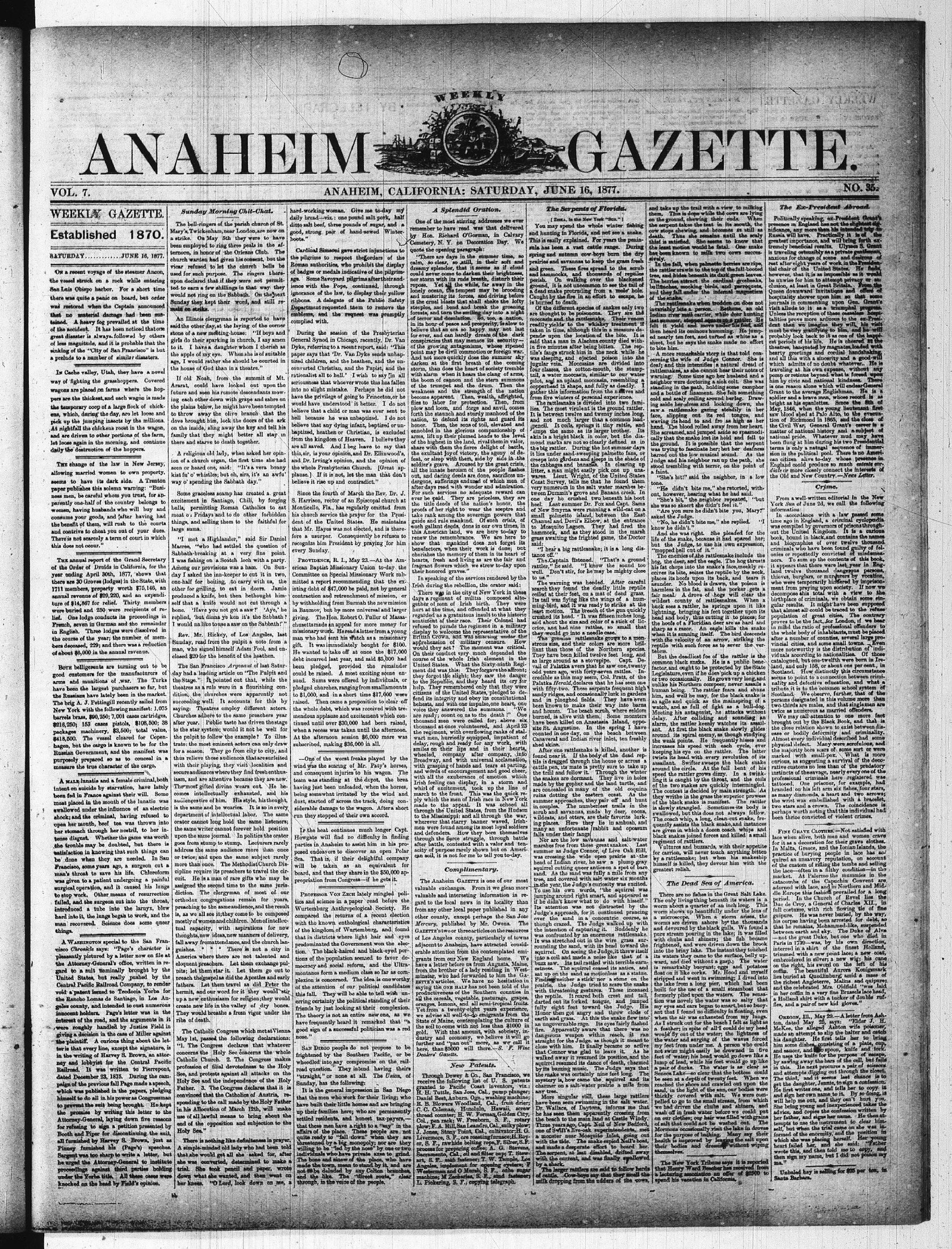
Searchable text
WEEKLY GAZETTE.
Established 1870.
SATURDAY...JUNE 16, 1877.
On a recent voyage of the steamer Ancon, the vessel struck on a rock while entering San Luis Obispo harbor. For a short time there was quite a panic on board, but order was restored when the Captain announced that no material damage had been sustained. A heavy fog prevailed at the time of the accident. It has been noticed that one great disaster is always followed by others of less magnitude, and it is probable that the sinking of the "City of San Francisco" is but a prelude to a number of similar disasters.
In Cache valley, Utah, they have a novel way of fighting the grasshopper. Covered wagons are placed on farms where the hoppers are the thickest, and each wagon is made the temporary coop of a large flock of chickens, which, during the day, are let loose and pick up the jumping insects by the millions. At nightfall the chickens roost in the wagon, and are driven to other portions of the farm, let loose again in the morning, and continue daily the destruction of the hoppers.
The change of the law in New Jersey,
Sunday Morning Chit-Chat.
The bell-ringers of the parish church of St. Mary's, Twickenham, near London, are now on a strike. On May 5th they were to have been employed to ring three peals in the afternoon, in honor of the Orleans Club. The church warden had given his consent, but the vicar refused to let the church bells be used for such purpose. The ringers thereupon declared that if they were not permitted to earn a few shillings in that way they would not ring on the Sabbath. On the next Sunday they kept their word, and still remained on strike.
An Illinois clergyman is reported to have said the other day, at the laying of the corner stone of a new meeting-house: "If boys and girls do their sparkling in church, I say amen to it. I have a daughter whom I cherish as the apple of my eye. When she is of suitable age, I would rather she should be courted in the house of God than in a theatre."
If old Noah, from the summit of Mt. Ararat, could have looked out upon the future and seen his remote descendants mowing each other down with grape and sabre on the plains below, he might have been tempted to throw away the olive branch that the dove brought him, lock the doors of the ark on the inside, sling away the key and tell his family that they might better all stay in there and starve to death together.
A religious old lady, when asked her opinion of a church organ, the first time she had hard-working woman. Given daily bread—viz.: one pot ditto salt beef, three pounds good, strong pair of hawks."
Cardinal Simsoni gave a speech to respect Roman authorities, who pledged badges or medals indicating age. Some Savoyard pilgrimage with the Pope, owing ignorance of the law, to ribbons. A delegate of Department requested emblems, and the request complied with.
During the session of General Synod in Chicago Dyke, referring to a recent paper says that 'Dr. Van Zytelized children, and the he converted Christian, and rationalist all to hell.' If seriousness that whoever into no slight mistake. I have the privilege of going would have understood believe that a child or man hell because he was unbelieve that any dying in baptized, heathen or Church from the kingdom of Heaven are all saved. And I beg this sir, is your opinion, and Dr. Irving's opinion.
In Cache valley, Utah, they have a novel way of fighting the grasshoppers. Covered wagons are placed on farms where the hoppers are the thickest, and each wagon is made the temporary coop of a large flock of chickens, which, daring the day, are let loose and pick up the jumping insects by the millions. At nightfall the chickens roost in the wagon, and are driven to other portions of the farm, let loose again in the morning, and continue daily the destruction of the hoppers.
The change of the law in New Jersey, allowing married women to own property, seems to have its dark side. A Trenton paper publishes this solemn warning: "Business men, be careful whom you trust, for apparently one-half of the country belongs to women, having husbands who will buy and consume your goods, and after having had the benefit of them, will rush to the courts and contrive to cheat you out of your dues. There is not scarcely a term of court in which this does not occur."
The annual report of the Grand Secretary of the Order of Druids in California, for the year ending April 30th, 1877, shows that there are 30 Groves (lodges) in the State, with 1711 members, property worth $75,146, an annual revenue of $29,220, and an expenditure of $14,867 for relief. Thirty members were buried and 250 were recipients of relief. One lodge conducts its proceedings in French, seven in German and the remainder in English. Three lodges were dissolved in the course of the year; the number of members deceased, 229; and there was a reduction about $6,000 in the annual revenue.
Both belligerents are turning out to be good customers for the manufacturers of arms and munitions of war. The Turks have been the largest purchasers so far, but the Russians have lately been in the market. The brig A. J. Pettingill recently sailed from New York with the following manifest: 1,075 barrels brass, $90,250; 7,001 cases cartridges, $216,250; 153 cases pistols, $108,500; 38 packages machinery, $3,500; total value, $418,500. The vessel cleared for Copenhagen, but the cargo is known to be for the Russian Government, and the manifest was purposely prepared so as to conceal in a measure the true character of the cargo.
A male lunatic and a female criminal, both intent on suicide by starvation, have lately been fed in France against their will. Some meat placed in the mouth of the lunatic was swallowed under the influence of an electric shock; and the criminal, having refused to open her mouth, beef tea was thrown into her stomach through her nostril, to her intense disgust. Whether the game was worth the trouble may be doubted, but there is satisfaction in knowing that such things can be done when they are needed. In San Francisco, some years ago, a surgeon cut a man's throat to save his life. Chloroform was given to a patient undergoing a painful way of fighting the grasshoppers.
If old Noah, from the summit of Mt. Ararat, could have looked out upon the future and seen his remote descendants mowing each other down with grape and sabre on the plains below, he might have been tempted to throw away the olive branch that the dove brought him, lock the doors of the ark on the inside, sling away the key and tell his family that they might better all stay in there and starve to death together.
A religious old lady, when asked her opinion of a church organ, the first time she had seen or heard one, said: "It's a vera bonny kist fu' o' whistles; but oh, sir, it's an awfu' way o' spending the Sabbath day."
Some graceless scamp has created a great excitement in Santiago, Chili, by forging bulls, permitting Roman Catholics to eat meat on Fridays and to do other forbidden things, and selling them to the faithful for large sums.
"I met a Highlander," said Sir Daniel Macree, "who had settled the question of Sabbath-breaking at a very fine point. I was fishing on a Scotch loch with a party. Among our provisions was a ham. On Sunday I asked the inn-keeper to cut it in two, one-half for boiling, to carry with us, the other for grilling, to eat in doors. Jamie produced a knife, but then bethought himself that a knife would not cut through a bone. 'Have you not got a saw?' 'Aye,' he replied, 'but dinna ye ken it's the Sabbath? I would na like to use a saw on the Sabbath!'"
Rev. Mr. Hickey, of Los Angeles, last Sunday, read from the pulpit a note from a man, who signed himself Adam Fool, and enclosed $20 for the benefit of the heathen.
The San Francisco Argonaut of last Saturday had a leading article on "The Pulpit and the Stage." It pointed out that, while thetheatres as a rule were in a flourishing condition,the churches were apparently not succeeding well. It accounts for this by saying: Theatres employ different actors. Churches adhere to the same preachers year after year. Public taste has driven thestage to the star system; would it not be well for the pulpit to follow the example? To illustrate: the most eminent actors can only draw for a season. They go from city to city,and thus relieve those audiences that are surfeited with their playing,they visit localities and secure audiences where they find fresh enthusiasm,and are attentive because they are new.The most gifted divine wears out. He becomes intellectually exhausted,and his audiences tire of him.His style,his thought is the same and he wearies. It is so in every department of intellectual labor.The same orator cannot long hold the same listeners;the same writer cannot forever hold position upon the same journal.In politics the orator goes from stump to stump.Lecturers rarely address the same audience more than once or twice;and upon the same subject rarely more than once.The Methodist Church Discipline require its preachers to travel the circuit.He is a man of rare gifts who may be converted Christian,and no rationalist all to hell.'I am seriousness that whoever into no slight mistake.I have the privilege of going into no slight mistake.I have the privilege of going into no slight mistake.I have the privilege of going into no slight mistake.I have the privilege of going into no slight mistake.I have the privilege of going into no slight mistake.I have the privilege of going into no slight mistake.I have the privilege of going into no slight mistake.I have the privilege of going into no slight mistake.I have the privilege of going into no slight mistake.I have the privilege of going into no slight mistake.I have
intent on suicide by starvation, have lately been fed in France against their will. Some meat placed in the mouth of the lunatic was swallowed under the influence of an electric shock; and the criminal, having refused to open her mouth, beef tea was thrown into her stomach through her nostril, to her intense disgust. Whether the game was worth the trouble may be doubted, but there is satisfaction in knowing that such things can be done when they are needed. In San Francisco, some years ago, a surgeon cut a man's throat to save his life. Chloroform was given to a patient undergoing a painful surgical operation, and it caused his lungs to stop work. Other means of resurrection failed, and the surgeon cut into the throat, introduced a tube into the larynx, blew hard into it, the lungs began to work, and the man recovered. Science does some queer things.
A Washington special to the San Francisco Chronicle says: "Page's character is pleasantly pictured by a letter now on file at the Attorney-General's office, written in regard to a suit nominally brought by the United States, but really pushed by the Central Pacific Railroad Company, to render void a patent issued to Teodocia Yorba for the Rancho Lomas de Santiago, in Los Angeles county, and intended to oust numerous innocent holders. Page's letter was in the interest of the road, and the arguments in it were roughly handled by Justice Field in giving a decision in the case of Miller against the plaintiff. A curious thing about the letter is that every line, except the signature, is in the writing of Harvey S. Brown, an attorney and lobbyist for the Central Pacific Railroad. It was written to Pierrepont, dated December 23, 1875. During the campaign of the previous fall Page made a speech, which was published in the papers, pledging himself to do all in his power as Congressman to prevent the suit being brought. He kept the promise by writing this letter to the Attorney-General, laying down five reasons for refusing to sign a petition presented by Booth and Piper for discontinuing the suit, all furnished by Harvey S. Brown, just as Pinney furnished his (Page's) speeches. Sargent was too sharp to write a letter, but he urged the Attorney-General to institute proceedings against third parties holding under the York title. All these cases were knocked on the head by Field's opinion.
The most gifted divine wears out. He becomes intellectually exhausted, and his audience tires of him. His style, his thought, is the same and he wearies. It is so in every department of intellectual labor. The same orator cannot long hold the same listeners; the same writer cannot forever hold position upon the same journal. In politics the orator goes from stump to stump. Lecturers rarely address the same audience more than once or twice; and upon the same subject rarely more than once. The Methodist Church discipline require its preachers to travel the circuit. He is a man of rare gifts who may be assigned the second time to the same jurisdiction. The clergyman of most of our orthodox congregations remain for years, preaching to the same audience, and the result is, as we all see it; they come to be composed mostly of women and children. Men of intellectual capacity, with aspirations for new thoughts, new ideas, new manners of delivery, fall away fromattendance,and the church languishes.
There is not a city in America where there are not talented and eloquent preachers. Let them exchange pulps; let them star it. Let them go out to preach the gospel as did the Apostles and early fathers. Let them travel as did Peter the hermit, and our word for it they would stir up a new enthusiasm for religion;they would create new life in the valley of dry bones. They would breathe a fresh vigor under the ribs of death.
The Catholic Congress which met at Vienna May 1st, passed the following declarations:
"1. The Congress declares that whatever concerns the Holy See concerns the whole Catholic Church.
2. The Congress makes profession of filial devotedness to the Holy See, and protests against all attacks on the Holy See and the independence of the Holy Father.
3. The Congress declares that it is convinced that the Catholics of Austria, responding to the call made by the Holy Father in his Allocation of March 12th, will make use of all lawful means to bring about the end of the opposition and subjection to the Holy Sea."
There is nothing like definiteness in prayer. A simple-minded old lady who had been told that she would get all she asked for, after she was converted, determined to make a trial. She took pencil and paper, wrote down what she wanted, and then went on her knees. "O Lord, look down on me," a
If the heat continues Howgate will find no parties in Anaheim to pose endeavors to discern Sea. That is, if their will be taken as board, and that they shall propriation from Congress.
Professor Von Zeichert and science in a past Wurtemburg Anthropology compared the returns with the known enthologies of the kingdom of Wurtemburg that in districts where predominated the Government. The black-haired nations of the population mocracy and social reform montanes form a medium plexion is concerned. Of the attention of our this fall. They will be erring certainty the police friends by just looking at The theory is not an enmity have frequently heard in good sign of a successful nose."
SAN DIEGO people do frightened by the South wheedled into any common road question. They are "straight," or none at Sunday, has the followi
It is the general imply that the men who work have built their little halls up their families here; settled residents; and that these men have an affairs of the place. They quite ready to "fall dead threatened by a big man willing to be 'led by those individuals who have made the town mean't not be deluded by and like." The through, is the voice of
WEEKLY
EIM GAZ
ANAHEIM, CALIFORNIA: SATURDAY, JUNE 16, 1877.
hard-working woman. Give me to-day my daily bread—viz.: one pound salt pork, half ditto salt beef, three pounds of sugar, and a good, strong pair of hand-sewed Winter-boots."
Cardinal Simsoni gave strict injunctions to the pilgrims to respect the orders of the Roman authorities, who prohibit the display of badges or medals indicative of the pilgrimage. Some Savoyard pilgrims after their audience with the Pope, continued, through ignorance of the law, to display their yellow ribbons. A delegate of the Public Safety Department requested them to remove the emblems, and the request was promptly complied with.
During the session of the Presbyterian General Synod in Chicago, recently, Dr. Van Dyke, referring to a recent report, said: "This paper says that 'Dr. Van Dyke sends unbaptized children, and the heathen, and the unconverted Christian, and the Papist, and the rationalist all to hell.' I wish to say [in all seriousness that whoever wrote this has fallen into no slight mistake]. Perhaps he did not have the privilege of going to Princeton, or he would have understood it better. I do not believe that a child or man was ever sent to hell because he was unbaptized. I do not believe that any dying infant, baptized or unbaptized, heathen or Christian, is excluded from the kingdom of Heaven. I believe they are all saved. And I beg leave to say that this, sir, is your opinion, and Dr. Ellinwood's, and Dr. Irving's opinion, and the opinion of hard-working woman. Give me to-day my daily bread—viz.: one pound salt pork, half ditto salt beef, three pounds of sugar, and a good, strong pair of hand-sewed Winter-boots."
A Splendid Oration.
One of the most stirring addresses we ever remember to have read was that delivered by Hon. Richard O'Gorman, in Calvary Cemetery, N.Y. on Decoration Day. We quote the opening paragraph:
"There are days in the summer time, so calm, so clear, so still, in their soft and dreamy splendor, that it seems as if cloud could never come to darken their brightness, nor storm with its rude breath, disturb their repose. Yet all the while, far away in the lonely ocean, the tempest may be brooding and mustering its forces, and driving before it the cruel blasts that shall shake the lofty steeples, and bend and break the groaning forests, and turn the smiling day into a night of terror and desolation. So, too, a nation, in its hour of peace and prosperity, is slow to believe that an era so happy may not last for ever, and can hardly dream of the dark conspiracies that may menace its security—of the growing antagonisms, whose ripened point may be divil commotion or foreign war. And not more quickly does the summer sky darken at the first breath of the coming storm, than does the heart of society tremble with alarm when it hears the clang of arms, the boom of cannon and the stern summons of the trumpet and the drum. Then the weakness and the strength of the nation become apparent. Then, wealth, affrighted flies to labor for protection. Then, from plow and loom, and forge and anvil, comes forth the stannah and sturdy manhood of the nation, to defend its rights and guard its honor. Then, the sons of toil, elevated and ennobled in the glorious companionship of arms, lift up their plumed heads to the level of the highest in the land, rival them in valor, share with them the force delight of battle, the exultant joy of victory, the agony of defeat, or sleep with them, side by side in the soldier's grave. Aroused by the great crisis."
The Serpents of Florida.
[Zinnia in the New York "Sun."]
You may spend the whole winter fishing and hunting in Florida, and not see a snake. This is easily explained. For years the penimila has been a vast cattle range. During spring and autumn cow-boys burn the dry prairies and savannas to keep the grass fresh and green. These fires spread to the scrub and hammocks, and thousands of reptiles perish. On walking over the black sand ground, it is not uncommon to see the tail of a dead snake protruding from a mole hole. Caught by the fire in an effort to escape, he is burned to death.
Of the different species of snakes only two are thought to be poisonous. They are the moccasin and the rattlesnake. Their venom readily yields to the whiskay treatment if taken in time, although this in a measure depends upon the location of the bite. It is said that a man in Alachua county died within five minutes after being bitten. The reptile's fangs struck him in the neck while he was sleeping, and ejected poison into the jugular vein. Moccasins are divided into four classes—the cotton-mouth—the stamp-tail—a water moccasin; similar to our water pilot, and an upland moccasin; resembling a copperhead in shape, and fully as deadly. I gather this information from the natives and from five winter's personal experience.
The rattlesnake is divided into two families. The most virulent is the ground rattler. It is between twelve and twenty inches long, and not much larger than a common lead-pencil. It coils; springs it tiny rattle; andumps its same as its larger brother. Its skin is a bright black in color, but the diamond marks are not so clearly defined as in the big rattler. During the hot summer days it lies under sand-sweeping palmetto fans, or creepers into gardens and sleeps in the shade of the cabbage and bananas.
And take them. On the grove the serpent death thief is mast has been sively.
In the rattles tree, and The harrier bullfinch and they of the amm
The raven invariably Indian last summer felt it y then heard nearly sheet but to bite hit.
A more corning tide deaf; and rattlesnake warning neighbor standing and a bot cold and insider saw a raft face; alley waving hand. She cairns that she ground was trying barred on Judge an
Since the fourth of March the Rev. Dr. J. S. Harrison, rector of an Episcopal church at Monticello, Fla., has regularly omitted from his church service the prayer for the President of the United States. He maintains that Mr. Hayes was not elected, and is therefore a usurper. Consequently he refuses to recognize him President by praying for him every Sunday.
PROVIDENCE, R.I., May 23.—At the American Baptist Missionary Union to-day the Committee on Special Missionary Work submitted a report recommending that the existing debt of $47,000 be paid, not by general contraction and retrenchment of mission, or by withholding from Burmah the new mission in Baumov, but by more universal and larger giving. The Hon. Robert O. Fuller of Massachusetts made an appeal for more money for missionary work. Here a letter from a young man who had sent his watch as a missionary gift. It was immediately bought for $100. He wanted to take off at once the $17,000 debt incurred last year, and said $5,000 had been pledged, provided the remainder could be raised. A most exciting scene ensued. Sums were offered by individuals, or pledged churches, ranging from small amounts to $1,000, and in a short time $17,000 were raised. Then came a proposition to clear off the whole debt, which was received with tremendous applause and excitement which continued until over $30,000 had been raised, when a recess was taken until the afternoon. At the afternoon session $6,000 more was subscribed, making $36,000 in all.
One of the worst freaks played by the wind was the scaring of Mr. Paty's horses, and consequent injuries to his wagon. The team was standing at the depot, the brea having just been unloaded, when the horses, being somewhat irritated by the wind and dust, started off across the track, doing considerable damage to the wagon. After a short run they stopped of their own accord.
In the heat continues much longer Capt. Howgate will find no difficulty in finding parties in Anaheim to assist him in his proposed endeavors to discover an open Polar Sea. That is, if their delightful company will be taken as an equivalent for board, and that they share in the $50,000 appropriation from Congress—if he gets it.
Complimentary.
The Anaheim Gazette is one of our most storm than does the heart of society tremble with alarm when it hears the clang of arms, the boom of cannon and the stern summons of the trumpet and the drum. Then the weakness and the strength of the nation become apparent. Then, wealth, affrighted flies to labor for protection. Then, from plow and loom, and forge and anvil, comes forth the staunch and sturdy manhood of the nation, to defend its rights and guard its honor. Then, the sons of toil, elevated and ennobled in the glorious companionship of arms, lift up their plumed heads to the level of the highest in the land, rival them in valor, share with them the fierce delight of battle, the exultant joy of victory, the agony of defeat, or sleep with them, side by side in the soldier's grave. Aroused by the great crisis, all the innate heroism of the people flashes out, and daring deeds are done, sacrifices undergone, sufferings endured of which men of after days read with wonder and admiration. For such services no adequate reward can ever be paid. They are priceless, they are the title deeds of the nation's honor, the proofs of her right to wear the sceptre and take rank among the sovereign powers that guide and rule mankind. Of such crisis, each gallant deeds, done in our own times, in this American land, we are here to-day to renew the remembrance. We are here to show that mankind does not forget its benefactors, when their work is done; but cherishes the memory of them in its heart of hearts, fresh and living as are the fair and fragrant flowers which we strew to-day upon their honored graves."
In speaking of the services rendered by the Irish during the rebellion, the orator said:
There was in the city of New York in these days a regiment of militia composed altogether of men of Irish birth. They were hurt at the time, and offended at what they regarded as a gratuitous insult to the historic sentiment of their race. Their Colonel had refused to parade the regiment in a military display to welcome the representative of the British Crown, and was smashing under their apprehension of military censure. How would they act? The moment was critical. On their conduct very much depended the course of the whole Irish element in the United States. What the Sixty-ninth Regiment did was this: They forgave the affront; they forgot the slight; they saw the danger to the Republic, and they heard its cry for help. They remembered only that they were citizens of the United States, pledged to defend its integrity and obey its constitutional behests, and with one impulse, one heart, one voice they answered the summons.
"We are ready; count on us to die!" One thousand men were called for; above six thousand at once volunteered, and April 23 the regiment, with overflowing ranks of stalwart men, hurriedly equipped, impatient of delay, rough and ready for any work, with smiles on their lips and in their hearts, wheeled, company after company, into Broadway, and with universal acclamation, with grasping of hands and tears at parting, words of encouragement and good cheer, with all the exuberance of emotion which Irish feeling can display in a storm and whirl of excitement, took up the line of march to the front. This was the quick reply which the men of Irish race in New York made to the appeal. It was echoed all through the United States, from the Hudson to the Mississippi: and all through the war, wherever that starry banner waved, Irishmen were found among its most loyal soldiers and defenders. How they bore themselves through the fierce struggle, through battle after battle, contested with a valor and tenacity of purpose rarely shown but on American soil, it is not for me to tell you to-day.
Complimentary.
The Anaheim Gazette is one of our most storm than does the heart of society tremble with alarm when it hears the clang of arms, the boom of cannon and the stern summons of the trumpet and the drum. Then the weakness and the strength of the nation become apparent. Then, wealth, affrighted flies to labor for protection. Then, from plow and loom, and forge and anvil, comes forth the staunch and sturdy manhood of the nation, to defend its rights and guard its honor. Then,the sons of toil,elevated and ennobled in the glorious companionship of arms,Lift up their plumed heads tothe levelofthe highestintheland,rivaltheminval,shairethymenintheland,rivaltheminval,shairethymenintheland,rivaltheminval,shairethymenintheland,rivaltheminval,shairethymenintheland,rivaltheminval,shairethymenintheland,rivaltheminval,shairethymenintheland,rivaltheminval,shairethymenintheland,rivaltheminval,shairethymenintheland,rivaltheminval,shairethymenintheland,rivaltheminval,shairethymenintheland,rivaltheminval,shairethymenintheland,rivaltheminval,shairethymenintheland,rivaltheminval,shairethymenintheland,rivaltheminval,shairethymenintheland,rivaltheminval,shairethymenintheland,rivaltheminval,shairethymenintheland,rivaltheminval,shairethymenintheland,rivaltheminval,shairethymenintheland,rivaltheminval,shairethymenintheland,rivaltheminval,shairethymenintheland,rivaltheminval,shairethymenintheland,rivaltheminval,shairethymenintheland,rivaltheminval,shairethymenintheland,rivaltheminval,shairethymenintheland,rivaltheminval,shairethymenintheland,rivaltheminval,shairethymenintheland,rivaltheminnerval,shairethymenintheraion,valsaion,valsaion,valsaion,valsaion,valsaion,valsaion,valsaion,valsaion,vvalsaion,vvalsaion,vvalsaion,vvalsaion,vvalsaion,vvalsaion,vvalsaion,vvalsaion,vvalsaion,vvalsaion,vvalsaion,vvalsaion,vvalsaion,vvalsaion,vvalsaion,vvalsaion,vvalsaion,vvalsaion,vvalsaion,vvalsaion,vvalsaion,vvalsaion,vvalsaion,vvalsaion,vvalsaion,vvalsaion,vvalsaion,vvalsaion,vvalsaion,vvalsaion,vvalsaion,vvalsaion,vvalsaion,vvalsaion,vvalsaion,vvalsaion,vvalsaion,vvalsaion,vvalsaion,vvalsaion,vvalsaion,vvalsaion,vvalsaion,vvaluesonvalsaonvalsaonvalsaonvalsaonvalsaonvalsaonvalsaonvalsaonvalsaonvalsaonvalsaonvalsaonvalsaonvalsaonvalsaonvalsaonvalsaonvalsaonvalsaonvalsaonvalsaonvalsaonvalsaonvalsaonvalsaonvalsaonvalsaonvalsaonvalsaonvalsaonvalsaonvalsaonvalsaonvalsaonvalsaonvalsaonvalsaonvalsaonvalsaonvalsaonvalsaonvalsaonvalsaonvalsaonvalsaonvalsaonvalsaonvalsaonvalsaonvalssaonaionaionaionaionaionaionaionaionaionaionaionaionaionaionaionaionaionaionaionaionaionaionaionaionaionaionaionaionaionaionaionaionaionaionaionaionaionaionaionaionaionaionaionaionaionaioneonaioneonaioneonaioneonaioneonaioneonaioneonaioneonaioneonaioneonaioneonaioneonaioneonaioneonaioneonaioneonaioneonaioneonaioneonaioneonaioneonaioneonaioneonaioneonaioneonaioneonaioneonaioneonaioneonaioneonaioneonaioneonaioneonaioneonaioneonaioneonaioneonaioneonaioneonaioneonaioneonaioneonaioneonaioneonaioneonaioneonaioneonaioneonaioneonaioneonaioneonaioneonnaioneonaioneonaioneonaioneonnaioneonaioneonnaioneonnaioneonnaioneonnaioneonnaioneonnaioneonnaioneonnaioneonnaioneonnaioneonnaioneonnaioneonnaioneonnaioneonnaioneonnaioneonnaioneonnaioniestaoniestaoniestaoniestaoniestaoniestaoniestaoniestaoniestaoniestaoniestaoniestaoniestaoniestaoniestaoniestaoniestaoniestaoniestaoniestaoniestaoniestaoniestaoniestaoniestaoniestaoniestaoniestaoniestaoniestaoniestaoniestaoniestaoniestaoniestaoniestaoniestaoniestaoniestaoniestaoniestaoniestaoniestaoniestaoniestaoniestaoniestaoniestaoniestaoniestiastasiestiastiestiestiestiestiestiestiestiestiestiestiestiestiestiestiestiestiestiestiestiestiestiestiestiestiestiestiestiestiestiestiestiestiestiestiestiestiestiestiestiestiestiestiestiestiestiestiestiestiestiestiestiestiestiestiestiestiestiestiestiostiemiestsitiemiestsitiemiestsitiemiestsitiemiestsitiemiestsitiemiestsitiemiestsitiemiestsitiemiestsitiemiestsitiemiestsitiemiestsitiemiestsitiemiestsitiemiestsitiemiestsitiemiestsitiemiestsitiemiestsitiemiestsitiemiestsitiemiestsitiemiestsitiemiestsitiemiestsitiemiestsitiemiestsitiemiestsitiemiestsitiemiestsitiemiestsitiemiestsitiemiestsitiemiestsitiemiestsitiemiestsitiemiestsitiemiestsitiemiestsitiemiestsitiemiestsitiemiestsitiemiestsitiemiestsitiemisiestsitiemiestsitiemiestsitiemiestsitiemiestsitiemiestsittielliestiielliestiielliestiielliestiielliestiielliestiielliestiielliestiielliestiielliestiielliestiielliestiielliestiielliestiielliestiielliestiielliestiielliestiielliestiielliestiielliestiielliestiielliestiielliestiielliestiielliestiielliestiialliestiielliestiilliestiielliestiialliestiielliestiialliestiialliestiialliestiialliestiialliestiialliestiialliestiialliestiialliestiialliestiialliestiialliestiialliestiialliestiialliestiialliestiiiellestiiiellestiiiellestiiiellestiiiellentiiiellentiiiellentiiiellentiiiellentiiiellentiiiellentiiiellentiiiellentiiiellentiiiellentiiiellentiiiellentiiiellentiiiellentiiiellentiiiellentiiiellentiiiellentiiiellentiiiellentiiiellentiiiellentiiiellentiiiellentiiiellentiiiellentiiiellentiiiellentiiiellentiiiellentiiiellentiiiellentiiiellentiiiellentiiiellentiiiellentiiiellentiiiellentiiiellentiiiellentiiiellentiiiellentiiiellentiiiellentiiiellentiiiellentiiiellentiiiellentiiiellentiiiellentiiiellentIIIELLESTIIIELLESTIIIELLESTIIIELLESTIIIELLESTIIIELLESTIIIELLESTIIIELLESTIIIELLESTIIIELLESTIIIELLESTIIIELLESTIIIELLESTIIIELLESTIIIELLESTIIIELLESTIIIELLESTIIIELLESTIIIELLESTIIIELLESTIIIELLESTIIIELLESTIIIELLESTIIIELLESTIIIELLESTIIIELLESTIIIELLESTIIIELLESTIIIELLESTIIIELLESTIIIELLESTIIIELLESTIIIELLEST IIILL EST IIILL EST IIILL EST IIILL EST IIILL EST IIILL EST IIILL EST IIILL EST IIILL EST IIILL EST IIILL EST IIILL EST IIILL EST IIILL EST IIILL EST IIILL EST IIILL EST IIILL EST IIILL EST IIILL EST IIILL EST IIILL EST IIILL EST IIILL EST IIILL EST IIILL EST IIILL EST IIILL EST IIILL EST IIILL EST IIILL EST IIILL EST IIILL EST III LL EST III LL EST III LL EST III LL EST III LL EST III LL EST III LL EST III LL EST III LL EST III LL EST III LL EST III LL EST III LL EST III LL EST III LL EST III LL EST III LL EST III LL EST III LL EST III LL EST III LL EST III LL EST III LL EST III LL EST III LL EST III LL EST III LL EST III LL EST III LL EST III LL EST III LL EST III LL EST III LL ST II LL ST II LL ST II LL ST II LL ST II LL ST II LL ST II LL ST II LL ST II LL ST II LL ST II LL ST II LL ST II LL ST II LL ST II LL ST II LL ST II LLC LLC LLC LLC LLC LLC LLC LLC LLC LLC LLC LLC LLC LLC LLC LLC LLC LLC LLC LLC LLC LLC LLC LLC LLC LLC LLC LLC LLC LLC LLC LLC LLC LLC LLC LLC LLC LLC LLC LLC LLC LLC LLC LLC LLC LLC LLC LLC LLC LLC LLC LLC LLC LLC LLC LLC LLC LLC LLC LLC LLC LLC LLC LLC LLC LLC LLC LLC LLC LLC LLC LLC LLC LLC LLC LLC LLC LLC LLC LLC LLC LLC LLC LLC LLC LLC LLC LLC LLC LLC LLC LLC LLC LLC LLC
The common factor is that all factors have been killed on Anastasia Island; opposite site is that human life has been killed on Anastasia Island; opposite site is that human life has been killed on Anastasia Island; opposite site is that human life has been killed on Anastasia Island; opposite site is that human life has been killed on Anastasia Island; opposite site is that human life has been killed on Anastasia Island; opposite site is that human life has been killed on Anastasia Island; opposite site is that human life has been killed on Anastasia Island; opposite site is that human life has been killed on Anastasia Island; opposite site is that human life has been killed on Anastasia Island; opposite site is that human life has been killed on Anastasia Island; opposite site is that human life has been killed on Anastasia Island; opposite site is that human life has been killed on Anastasia Island; opposite site is that human life has been killed on Anastasia Island; opposite site is that human life has been killed on Anastasia Island; opposite site is that human life has been killed on Anastasia Island; opposite site is that human life has been killed on Anastasia Island; opposite site is that human life has been killed on Anastasia Island; opposite site is that human life has been killed on Anastasia Island; opposite site is that human life has been killed on Anastasia Island; opposite site is that human life has been killed on Anastasia Island; opposite site is that human life has been killed on Anastasia Island; opposite site is that human life has been killed on Anastasia Island; opposite site is that human life has been killed on Anastasia Island; opposite site is that human life has been killed on Anastasia Island; opposite site is that human life has been killed on Anastasia Island; opposite site is that human life has been killed on Anastasia Island; opposite site is that human life has been killed on Anastasia Island; opposite site is that human life has been killed on Anastasia Island; opposite site is that human life has been killed on Anastasia Island; opposite site is that human life has been killed on Anastasia Island; opposite site is that human life has been killed on Anastasia Island; opposite site is that human life has been killed on Anastasia Island; opposite site is that human life has been killed on Anastasia Island; opposite site is that human life has been killed on Anastasia Island; opposite site is that human life has been killed on Anastasia Island; opposite site is that human life has been killed on Anastasia Island; opposite site is that human life has been killed on Anastasia Island; opposite site is that human life has been killed on Anastasia Island; opposite site is that human life has been killed on Anastasia Island; opposite site is that human life has been killed on Anastasia Island; opposite site is that human life has been killed on Anastasia Island; opposite site is that human life has been killed on Anastasia Island; opposite site is that human life has been killed on Anastasia Island; opposite site is that human life has been killed on Anastasia Island; opposite site is that human life has been killed on Anastasia Island; opposite site is that human life has been killed on Anastasia Island; opposite site is that human life has been killed on Anastasia Island; opposite site is that human life has been killed on Anastasia Island; opposite site is that human life has been killed on Anast西亚岛;相反site是Anast西亚岛;相反site是Anast西亚岛;相反site是Anast西亚岛;相反site是Anast西亚岛;相反site是Anast西亚岛;相反site是Anast西亚岛;相反site是Anast西亚岛;相反site是Anast西亚岛;相反site是Anast西亚岛;相反site是Anast西亚岛;相反site是Anast西亚岛;相反site是Anast西亚岛;相反site是Anast西亚岛;相反site是Anast西亚岛;相反site是Anost西亚岛;相反site是Anost西亚岛;相反site是Anost西亚岛;相反site是Anost西亚岛;相反site是Anost西亚岛;相反site是Anost西亚岛;相反site是Anost西亚岛;相反site是Anost西亚岛;相反site是Anost西亚岛;相反site是Anost西亚岛;相反site是Anost西亚岛;相反site是Anost西亚岛;相反site是Anost西亚岛;相反site是Anost西亚岛;相反site是Anost西亚岛;相反site是Anost西亚岛;相反site是Anost西亚岛;相反site是Anost西亚岛;相反site是Anost西亚岛;相反site是Anost西亚岛;相反site是Anost西亚岛;相反site是Anost西亚岛;相反site是Anost西亚岛;相反site是Anost西亚岛;相反site是Anost西亚岛;相反site是Anost西亚岛;相反site是Anost西亚岛;相反site是Anost西亚岛;相反site是Anost西亚岛;相反site是Anost西亚岛;相反site是Anost西亚岛;相反site是Anost西亚岛;相反site是Anost西亚岛;相反site是Anost西亚岛;相反site是Anost西亚岛;相反site是Anost西亚岛;相反site是Anost西亚岛;相反site是Anost西亚岛;相反Site
The Anaheim Gazette is one of our most
classified.
The Anaheim Gazette is one of our most
classified.
The Anaheim Gazette is one of our most
classified.
The Anaheim Gazette is one of our most
classified.
The Anaheim Gazette is one of our most
classified.
The Anaheim Gazette is one of our most
classified.
The Anaheim Gazette is one of our most
classified.
The Anaheim Gazette is one of our most
classified.
The Anaheim Gazette is one of our most
classified.
The Anaheim Gazette is one of our most
classified.
The Anaheim Gazette is one of our most
classified.
The Anaheim Gazette
having just been unloaded, when the horzes, being somewhat irritated by the wind and dust, started off across the track, doing considerable damage to the wagon. After a short run they stopped of their own accord.
If the heat continues much longer Capt. Howgate will find no difficulty in finding parties in Anaheim to assist him in his proposed endeavors to discover an open Polar Sea. That is, if their delightful company will be taken as an equivalent for board, and that they share in the $50,000 appropriation from Congress—if he gets it.
PROFESSOR VON ZECH lately mingled politics and science in a paper read before the Wurtemburg Anthropological Society. He compared the returns of a recent election with the known enthological characteristics of the kingdom of Wurtemburg, and found that in districts where light hair and eyes predominated the Government won the election. The black-haired and black-eyed portions of the population seemed to favor democracy and social reform, and the Ultra-montanes form a medium class so far as complexion is concerned. The idea is one worthy of the attention of our political candidates this fall. They will be able to tell with unerring certainty the political standing of their friends by just looking at their complexion. The theory is not an entire new one, as we have frequently heard it remarked that "a good sign of a successful politician was a red nose."
SAN DIEGO people do not propose to be frightened by the Southern Pacific, or be wheeled into any compromise on the railroad question. They intend having their "straight," or none at all. The Union, of Sunday, has the following:
It is the general impression in San Diego that the men who work for their living; who have built their little homes and are bringing up their families here; who are permanently settled residents, and honest tax-payers,—that these men have a right to a "way" in the affairs of the place. These people are not quite ready to "fall down" when they are threatened by a big monopoly; nor are they willing to be "led by the nose" by one or two individuals who have private axes to grind. The bones and snout of the place, who have made the town, mean to stand by it, and are not be deluded by any Colton branch, and the like. The "direct route," clear through, is the voice of the people.
The Anaheim Gazette is one of our most valuable exchanges. From it we glean more valuable and interesting information in regard to the local news in its locality than from any other local paper published in any other county, except perhaps the San Jose Mercury, published by Mr. Owens. The Gazette's twooor three articles on the resources of Los Angeles county, particularly of towns adjacent to Anaheim, have attracted considerable attention from the contemplated emigrants from our New England home. We have a letter before us from Augusta, Maine, from the brother of a lady residing in Westminster, who had forwarded to him the Gazette's articles. We have no hesitation in saying the ONE HALF has not been told of the productiveness of the Southern counties in all the cereals, vegetable, pasture, grape, oranges, lemons, and all semi-tropical fruits. Yet from a twenty-eight years experience, we advise all well-to-do immigrants from the State of Maine, contemplating the culture of the soil to come with not less than $1000 in gold. With that amount, with sobriety, industry and economy, we believe it will go further and "pan out" more, as we call it here, than $5000 will there.—S. F. Wine Dealers' Gazette.
New Patents.
Through Dewey & Co., San Francisco, we receive the following list of U. S. patents granted to Pacific Coast inventors, viz.: H. H. Tuttle, San Jose, Cal., pump plunger; Daniel Best, Auburn, Ogn., washing machine; R. B. Blowars Woodland, Cal., fruit drier; C. C. Coleman, Honolulu, Hawaii, screw thread counter; H. W. Forman, Golden City, Col., pen rack; W. Freeborn, S. F., rotary plow; F. A Hill, San Leandro, Cal., sulky plow; J. Jones, Stony Point, Cal., cultivator; H. G. Livermore, S. F., ore roasting furnace; H. Royer, S. F., rawhide belting ropa; F. Silver, S.F. process for preparing coffee; A. G. Stevens, Sacramento, Cal., oil and filter omp; T. Stewart, S.F., ash fastener; T. W. Temple, Los Angeles, implement for opening cysts; F Westernman and O Mursh, S.F., onion sugar machines; M Zacharias, S.E., sand fastener; L Pickering, S.F., copying telegraph.
More singular still, these large rattlers have been seen swimming in the salt water. Dr. Wallace, of Daytona, informs me that he has seen them apparently crossing from the beach to the main land at Castle Windy. Three years ago, Capt. Neil of New Bedford, one of Swift's live-oak superintendents, met a monster near Mosquito Inlet, going out with the side. The snake expiied Neil's boat, and made a desperate effort to board her. The serpent, at last disabled, drifted away with the current, and was finally swallowed by a shark.
The larger rattlers are said to follow herds of cattle. Cow-boys say that they small the milk dropping from the udders of the cows.
Vultures for carriage by a rat himself greatest...
GAZETTE.
1877. NO. 35
Florida.
Snake "Sun."]
Pole winter fishing
and not see a snake.
For years the peninsula range.
During boys burn the dry
keep the grass fresh
read to the scrub
mounds of reptiles
her the blackened
to see the tail of
from a mole hole.
effort to escape, he
of snakes only two
They are the snake.
Their venom
treatment if
is in a measure deof the bite. It is
a county died withbitten. The repthe neck while he
poison into the
are divided into
mouth, the stumpnilar to our water
as fully as deadly. I
from the nails and
experience.
died into two famitwenty inches long,
an a common leadit tiny rattle, and
larger brother. Its
color, but the disearly defined as in
the hot summer days
palmetto fans, or
keeps in the shade of
In clearing up
and take up the trail with a view to milking them. This is done while the cows are lying on the ground, chewing their ends. When the serpent takes the test in its mouth, the cow stops chewing, and becomes as still as death. Thus she remains until the scaly thief is satisfied. She seems to know that the least motion would be fatal. One snake has been known to milk two cows successively.
In the fall, when palmetto berries are ripe, the rattler crawls to the top of the full-booted tree, and hides beneath its dark green leaves. The berries attract the cardinal grosbeaks, bullfinches, mocking birds, and parroquets, and they fall under the internal magnetism of the snake.
The rattlesnake when trodden on does not invariably bite a person. Bethune, an old Indian river mail carrier, while dear hunting last summer, stepped against a rattler. He felt it yield and move under his feet, said then heard its ominous humming. He jumped nearly ten feet, and turned as white as a sheet, but he says the snake made no effort to bite him.
A more remarkable story is that told concerning the wife of Judge Connor. She is deaf; and this intensifies a natural dread of rattlesnakes, as she cannot hear their notes of warning. Some time ago her husband and a neighbor were doctoring a sick colt. She was standing in the path, holding some camphor and a bottle of linament. She felt something cold and scaly coiling around her leg. Drawing aside her dress and looking down, she saw a rattlesnake gazing steadily in her face, slipping out its red tongue, and waving its head to and fro as high as her hand. The blood rolled away from her heart. She screamed, and jumped aside so spasmodically that the snake lost its hold and fell to the ground. It is possible that the serpent was trying to fascinate her; but her deafness barred out the low musical sound. As the Judge and his neighbor ran up the path, she trembled with terror on the point of
The Ex-President Abroad.
Politically speaking, ex-President Grant's presence in England has not the slightest significance, any more than his intended trip to Russia will have. Practically it is of the greatest importance, and will bring forth extremely beneficial results. Ulysses S. Grant is traveling ostensibly as a private gentleman, anxious for change of scene and desires of roast after eight years of work in the Presidential chair of the United States. He stands however, that it is as impossible as it would be unwise for him to attempt privacy orclusion, at least in Great Britain. From the Queen downward invitations and offers of hospitality shower upon him so that some journals in commenting upon Gen. Grant's visit allude to it as a triumphal program. Unless the reception of these ceaseless habitualities prove more arduous to the ex-President than we imagine they will, his visit must be very gratifying to him, and he will probably look back to it as one of the happiest periods of his life. He is cheered at the theatre, banqueted by magnates, loaded with hearty greetings and cordial handshaking, and all this with a sincerity and a good-will which admits of no doubt whatever. He is travelling at his own expense, without any pomp or retinue beyond what is forced upon him by civic and national kindness. There is one reason alone which will endear General Grant to the average Englishman. He is a soldier and a brave man, whose record is as bright as his epanlettes. Since the 6th of May, 1846, when the young lieutenant first saw blood shed at Palo Alto, to the evacuation of Richmond in 1865, and the close of the Civil War, General Grant's career is a matter of national history and a subject of national pride. Whatever mud may have been flung at him during his two Presidential terms is only a natalal sequence of immersion in the political pool. There is no American citizen alive to-day whose presence in England could produce so much entreaty...
rattlesmakes, as she cannot hear their notes of warning. Some time ago her husband and a neighbor were doctoring a sick colt. She was standing in the path, holding some camphor and a bottle of lament. She felt something cold and acaly coiling around her leg. Drawing aside her dress and looking down, she saw a rattlesnake gazing steadily in her face, slipping out its red tongue, and waving its head to and fro as high as her hand. The blood rolled away from her heart. She screamed, and jumped aside so spasmodically that the snake lost its hold and fell to the ground. It is possible that the serpent was trying to fascinate her; but her deafness barred out the low musical sound. As the Judge and his neighbor ran up the path, she stood trembling with terror, on the point of a faint.
"She's bit!" said the neighbor, in a low tone.
"He didn't bite me," she retorted, however, hearing what he had said.
"She's bit," the neighbor repeated, "but she was so akeert she didn't feel it."
"Are you sure he didn't bite you, Mary?" asked the Judge.
"No, he didn't bite me," she replied. "I know he didn't."
And she was right. She pleaded for the life of the snake, because it had spared her; but the Judge, to use his own expression, "mopped hell cut of it."
The enemies of the rattlesnake include the hog, the deer, and the eagle. The hog thrusts his fat chops into the snake's face, meekly receives its bite, seizes the reptile by the neck, places its hoofs upon its back, and tears it asunder. No blood is drawn, the porker gets a fair meal. A drove of hogs will clear the wildest county of rattlesnakes. When a buck sees a rattler, he springs upon it like lightning, bringing his feet together upon its head and body, thus cutting it to pieces; for the hoofs of a Floridian deer are as hard and sharp as a razor. An eagle kills the snake when it is sunning itself. The bird descends with the velocity of an arrow, striking the reptile with such force as to sever the vertebra.
But the deadliest foe of the rattler is the common black snake. He is a public benefactor, and ought to be protected by the State Legislature, even if he does pick up a chicken or two occasionally. He grows very long, and unlike his Northern compere, never assails a human being. The rattler fears and shuns him, and well he may, for the black snake is as agile and quick as the mainspring of a watch, and as full of fight as a bull-dog. Meeting his antagonist, he attacks without delay. After colliding and sounding an alarm, the rattler keenly watches its assault. At first the black snake slowly glides around its spiral enemy, as though studying the weak points. He frequently hisses and increases his speed with each cycle, ever keeping his eye on the rattler. The latter twists its head with every revolution of its assault. Swifter sweeps the black snake around the circle. At the full bent of his speed the rattler grows dizzy. In a twinkling it is caught by the throat, and the coils of the two snakes are quickly intermingled. The contest is decided by main strength. As they writhe in the grass the superior prowess of the black snake is manifest. The rattler is slowly strangled. Sometimes its body is swallowed, but this does not always follow. The coach whip, a long, clean-cut snake, frequently assists the black snake, and instances are given in which a dozen coach whips and black snakes joined forces and killed a small regiment of rattlers.
Vultures and buzzards, with their appetite for carrion, will never touch anything bitten by a rattlesnake; but when his snakeship himself is killed, they devour him with the greatest relish.
Crime.
From a well-written editorial in the New York Sun of June 2d, we cull the following information:
In accordance with a law passed some time ago in England, a criminal cyclopodia was compiled by governors of prisons throughout the United Kingdom. It is a curious book, bound in black, and contains the names and biographies of over twelve thousand criminals who have been found guilty of follones or repeatedly convicted of misdemeans. To sum up the contents of this book, it appears that there were last year in England twelve thousand dangerous persons, thieves, burglars, or murderers by vocation, who were temporarily hindered by imprisonment from preying upon society. If now we decompose this total with to the birthplace of criminals, we obtain some singular results. It might have been supposed that almost all could be traced to the refuse population of great cities. The contrary proves to be the fact, for London, if we bear in mind the ratio of professional offenders to the whole body of inhabitants, must be placed after a number of counties, several large provincial cities, and some small towns. Even more noteworthy is the distribution of individuals according to nationalities. Of those catalogued, but one-twelth were born in Ireland, and only 158, or about one per cent., in Scotland. How distinctly this circumstance seems to point to a connection between criminality and defective education, and what a tribute it is to the common school system of Scotland. We observe further that of the persons designated in this volume more than two-thirds are males, and that single men are twice as numerous as married offenders.
We may call attention to one more fact brought out by the Black Book, and that is the close relation shown to exist between disease or bodily deformity and criminality. Almost every individual described had some physical defect. Many were scorfulous, and the majority bore scars of some sort or were marked with small-pox. What is more curious, as suggesting a survival of the decorative customs no less than of the predatory instincts of these savage, nearly everyone of the professional criminals here registered was tattooed. One prisoner, for example, had branded on his left arm six fishes, four stars; as many diamonds, a heart and two arrows; the wrist was embellished with a bracelet; two stars and a crown. The coincidence is perhaps worth noting that this individual had been thrice convicted of violent crimes.
FINE GRAVE CLOTHES—Not satisfied with lace when alive, both men and women crave for it as a decoration for their grave clothes. In Malta, Greece, and the Ionian Islands, the practice of burying people in lace has acquired an unsavory reputation, on account of the custom of rifling the tombs and selling the lace—often in a filthy condition—in the market. At Palermo the mummies in the catacombs of the Capuchin Convent are
The Dead Sea of America.
There are no fishes in the Great Salt Lake. The only living thing beneath its waters is a worm about a quarter of an inch long. This worm shows up beautifully under the lens of a microscope. When a storm arises, the worms are driven ashore by the thousands and devoured by the black gulls. We found a pure stream pouring in the lake; it was filled with chubs and shiners; the fish became frightened, and were driven down the brook into the briny lake. The instant they touched its waters they came to the surface, belly upward, and died without a gasp. The water is remarkably buoyant; eggs and potatoes float on it like corks. Mr. Hood and myself stripped and went in swimming; I dived into the lake from a long pier, which had been built for the use of a small steamboat that formerly plied upon the waters. The sensation was novel; the water was so salty that my eyes and ears began to smart, but so buoyant that I found no difficulty in floating, even when the air was exhausted from my lungs. As I struck out for the beach I felt as light as a feather; in spite of all I could do my head would fly out of the water; the lightness of the water and surging of the waves forced my feet from under me. A person who could not swim might easily be drowned in five feet of water; his head would go down like a lump of lead, while his feet would go up like a pair of ducks. The water is as clear as Seneca Lake—so clear that the bottom could be seen at a depth of twenty feet. When we reached the shore and crawled out upon the sand, in the light of the sun, our bodies were thickly covered with salt. We were compelled to go to the small stream, from which we had driven the chubs and shiners, and wash off in fresh water before we could put on our clotlies; our hair was filled with grains of salt that could not be washed out. The Mormons occasionally visit the lake in droves for the purpose of bathing. Many say their health is improved by leaving the salt upon their bodies and dressing without wiping themselves.
The New York Tribune says it is reported that Henry Ward Bassler has received from a lecturing association an offer of $2500 to spend his vacation in California.
FINE GRAVE CLOTHES—Not satisfied with lace when alive, both men and women crave for it as a decoration for their grave clothes. In Malta, Greece, and the Ionian Islands, the practice of burying people in lace has acquired an unsavory reputation, on account of the custom of rifting the tombs and selling the lace—often in a filthy condition—in the market. At Palermo the mummies in the catacombs of the Capuchin Convent are adorned with lace, and in Northern and Middle Europe this fashion prevailed for a long period. In the Church of Revel lies the Duc de Croy, a General of Charles XII., in full costume, with rich flowing tie of fine guipure. He was never buried, by the way, his corpse having been arrested for debt, so that he remains, Mohammed-like, suspended between earth and sky. The Duke of Alva—not the great Duke, but one who died in Paris in 1739—was, by his own direction, interred in a shirt of the finest Holland, trimmed with a new point lace; a new coat, embroidered in silver; a new wig; his cane on the right, his sword on the left of his coffin. The beautiful Aurora Konigmark lies buried at Quedlinburg, amid a mass of the richest Angletierre, Malina and quipure; and the celebrated Mrs. Oldfield "was laid in her coffin in a very fine Prussels lace head, a Holland shirt with a tucker of double ruffles, and a pair of new kid gloves."
ORGAN, Ill., May 29.—A letter from Ashton, dated May 25, says: "Elder J. H. McKee, the alleged Ashton wife poisoner, made an attempt to slip the halter and catch his daughter. He first tells her to bring him some dishes, consisting of a plate, cup, and saucer, and to spoon, knife and fork. He uses the knife for the purpose of escape, by sawing away the bars of the cell, but fails in this. He next procures a pair of scissors and attempts digging out through the closet. The third, and it seems last chance is to get the daughter, Jennie, to sign a confession. He first writes one, and tells her to copy it and sign her own name to it. By so doing, it will help me out, and they can't hurt you. She being young and inexperienced takes the advice, and copies the confession written by her father, and signs her name. He then attempts to use the instrument to clear himself, but when the trial came on she was informed of the enormity, and the position in which she was placing herself. Her young heart failed her, and she said: "Father wrote this, and then told me to copy, and then sign my name, but I did not poison my ma."
Unhaled hay is selling for $25 per ton, in Santa Barbara.