anaheim-gazette 1877-06-09
Scanned page
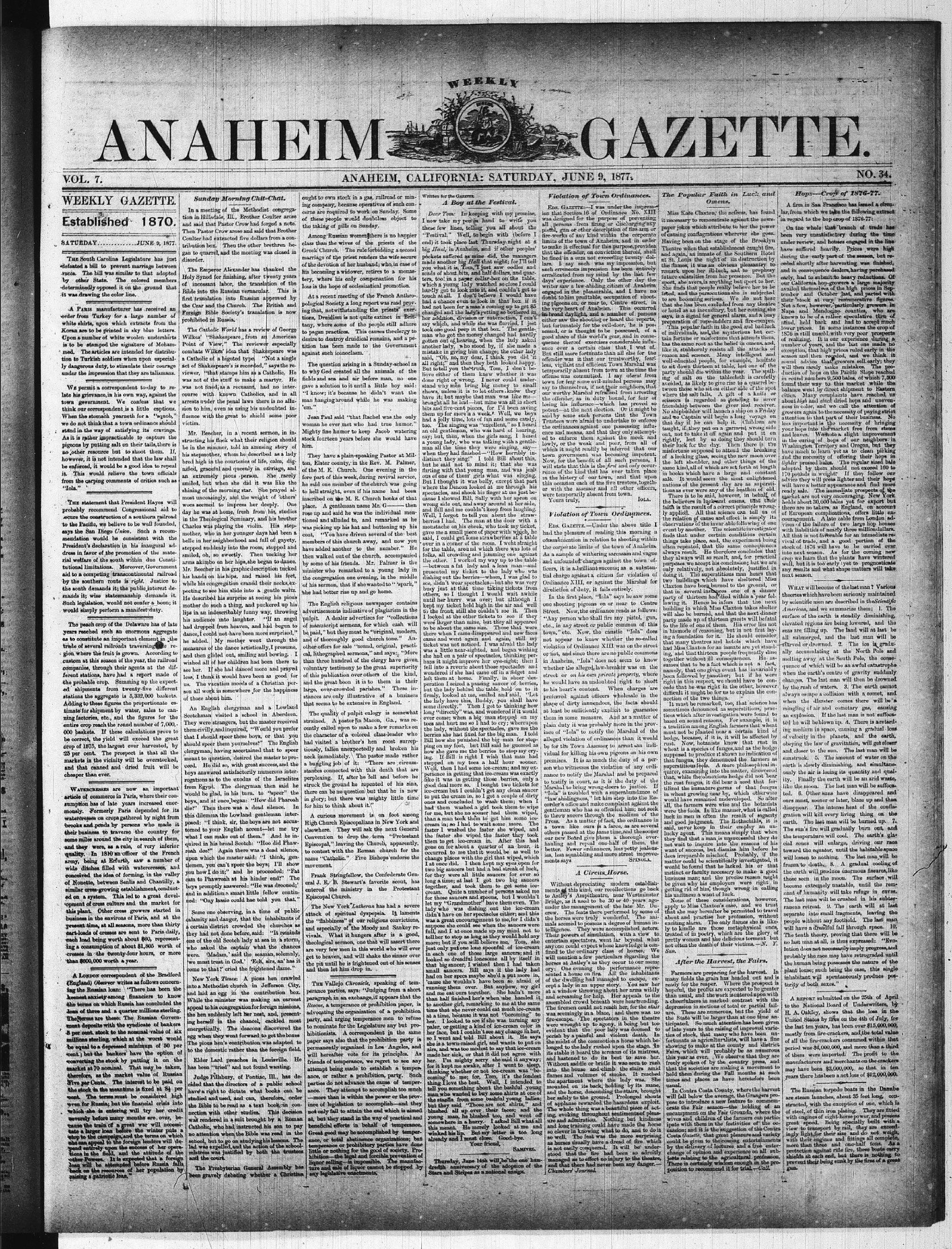
Searchable text
WEEKLY GAZETTE.
Established 1870.
SATURDAY...JUNE 9, 1877.
The South Carolina Legislature has just defeated a bill to prevent marriage between races. The bill was similar to that adopted by other State. The colored members determinedly opposed it on the ground that it was drawing the color line.
A Paris manufacturer has received an order from Turkey for a large number of white shirts, upon which extracts from the Koran are to be printed in sky blue letters. Upon a number of white woolen undershirts is to be stamped the signature of Mohammed. The articles are intended for distribution to Turkish soldiers when upon especially dangerous duty, to stimulate their courage under the impression that they are talismans.
We permit a correspondent to-day to relate his grievance, in his own way, against the town government. We confess that we think our correspondent is a little captious. When the stomach yearneth for a "squob," we do not think that a town ordinance should stand in the way of satisfying its cravings. As it is rather impracticable to capture the pigeons by putting salt on their tails, there is no other resource but to shoot them. If, however, it is not intended that the law shall be reformed, it would be a good idea to renew
Sunday Morning Chit-Chat.
In a meeting of the Methodist congregation in Hilladale, Ill., Brother Coulter arose and said that Pastor Crow had forged a note. Then Pastor Crow arose and said that Brother Coulter had extracted five dollars from a contribution box. Then the other brethren began to quarrel, and the meeting was closed in disorder.
The Emperor Alexander has thanked the Holy Synod for finishing, after twenty years of incessant labor, the translation of the Bible into the Russian vernacular. This is first translation into Russian approved by the Czar and the Church. The British and Foreign Bible Society's translation is now prohibited in Russia.
The Catholic World has a review of George Wilkes' "Shakespeare from an American Point of View." The reviewer especially combats Wilkes' idea that Shakespeare was a Catholic of a bigoted type. "Not a single act of Shakespeare's is recorded," says the reviewer, "that stamps him as a Catholic. He was not of the stuff to make a martyr. He was not fined; as a recusant, had no intercourse with known Catholics, and in all arrests under the penal laws there is no allusion to him, even as using his undoubted influence with the great to shield some poor victim.
Mr. Beecher, in a recent sermon, instructing his flock what their religion should be in the summer, told an amusing story of his stepmother, whom he described as a lady bred high in the courtesies of life, calm, digg
We permit a correspondent to-day to relate his grievance, in his own way, against the town government. We confess that we think our correspondent is a little captious. When the stomach yearneth for a "squob," we do not think that a town ordinance should stand in the way of satisfying its cravings. As it is rather impracticable to capture the pigeons by putting salt on their tails, there is no other resource but to shoot them. If, however, it is not intended that the law shall be enforced, it would be a good idea to repeal it. This would relieve the town officials from the carping comments of critics such as "Iola."
The statement that President Hayes will probably recommend Congressional aid to secure the construction of a southern railroad to the Pacific, we believe to be well founded, says the San Diego Union. Such a recommendation would be consistent with the President's declaration in his inaugural address in favor of the promotion of the material welfare of the south within due Constitutional limitations. Moreover, Government aid to a competing transcontinental railroad by the southern route is right. Justice to the south demands it; the public interest demands it; wise statesmanship demands it. Such legislation, would not confer a boon; it would simply perform a manifest duty.
The peach crop of the Delaware has of late years reached such an enormous aggregate as to constitute an important element in the trade of several railroads traversing the region where the fruit is grown. According to custom at this season of the year, the railroad companies, through their agents at the different stations, have had a report made of the probable crop. Summing up the expected shipments from twenty-five different stations the aggregate is 5,332,000 baskets. Adding to these figures the proportionate estimate for shipment by water, sales to canning factories, etc., and the figures for the entire crop reach the round number of 7,000,000 baskets. If these calculations prove to be correct, the yield will exceed the great crop of 1875, the largest ever harvested, by 25 per cent. The prospect is that all the markets in the vicinity will be overstocked, and that canned and dried fruit will be cheaper than ever.
Watercresses are now an important article of commerce in Paris, where their consumption has of late years increased enormously. Formerly Paris depended for its watercresses on crops gathered by night from brooks and ponds by persons who made it their business to traverse the country for some miles around the city in search of them, and they were, as a rule, of very inferior quality. In 1810 an officer of the French army, being at Erfurt, saw a number of wide ditches filled with watercresses, and conceived the idea of forming, in the valley of Nonette between Senlis and Chantilly, a viewer, "that stamps him as a Catholic. He was not of the stuff to make a martyr. He was not fined, as a recusant, had no intercourse with known Catholics, and in all arrests under the penal laws there is no allusion to him, even as using his undoubted influence with the great to shield some poor victim.
Mr. Beecher, in a recent sermon, instructing his flock what their religion should be in the summer, told an amusing story of his stepmother, whom he described as a lady bred high in the courtesies of life, calm, dignified, graceful and queenly in carriage, and an extremely pious person. She rarely smiled, but when she did it was like the shining of the morning star. She prayed almost unceasingly, and the weight of others' woes seemed to impress her deeply. One day he was at home, fresh from his studies in Theological Seminary, and his brother Charles was playing the violin. His stepmother, who in her younger days had been a belle in her neighborhood and full of gayety, stepped suddenly into the room, stopped and smiled, oh, so sweetly. Then tucking her arms akimbo on her hips, she began to dance. Mr. Beecher in his graphic description tucked his hands on his hips, and raised his feet, while his congregation craned their necks, expecting to see him slide into a gentle waltz. He described his surprise at seeing his pious mother do such a thing, and puckered up his lips in an indescribably funny way, throwing his audience into laughter. "If an angel had dropped from heaven, and had begun to dance, I could not have been more surprised," he added. My mother went through the measures of the dance artistically, I presume, and then glided out, smiling and bowing. I wished all of her children had been there to see her. If she had danced more and prayed less, I think it would have been as good for us. The vacation moods of a Christian person all work in somewhere for the happiness of those about him.
An English clergyman and a Lowland Scotchman visited a school in Aberdeen. They were strangers, but the master received them civilly,and inquired,"Would you prefer that I should speer these boys, or that you should speer them yourselves?" The English clergyman, having ascertained that to speer meant to question, desired the master to proceed. He did so, with great success,and the boys answered satisfactorily numerous interrogations as to the exodus of the Israelites from Egypt. The clergyman then said he would be glad, in his turn, to "speer" the boys,and at once began: "How did Pharoh die?" Then there was a dead silence. In this dilemma the Lowland gentleman interposed: "I think,sir,the boys are not accustomed to your English accent—let me try what I can make out of them." And he inquired in his broad Scotch: "Hoo did Phawroah do?" Again there was a dead silence, upon which the master said: "I think,gentlemen,你 can't speer the boys; I'll show you how I do it;" and he proceeded: "Fat cam to Phawroah at his hinder end?" The quality of pulsation. A pastor centently called upon to character of a cohad visited a brothotually fallen unexpected neck immediately.
A bungling job of it stances connected with perplexing. If after struck the ground here there can be no questions in glory; but there is for him to think about.
A curious movement High Church Episcopal elsewhere. They waven Convention to drope Episcopal," leaving to contest with the name "Catholic." movement.
Frank Stringfellow oral J.E.B. Stawne
WATERCRESSES are now an important article of commerce in Paris, where their consumption has of late years increased enormously. Formerly Paris depended for its watercresses on crops gathered by night from brooks and ponds by persons who made it their business to traverse the country for some miles around the city in search of them, and they were, as a rule, of very inferior quality. In 1810 an officer of the French army, being at Erfurth, saw a number of wide ditches filled with watercresses, and conceived the idea of forming, in the valley of Nonette, between Senlis and Chantilly, a similar cress-growing establishment, conducted on a system. This led to a great development of cress culture and the market for this plant. Other cress growers started in business in the environs of Paris, and at the present time, at all seasons, more than thirty cart-loads of cresses are sent to Paris daily, each load being worth about $60, representing a consumption of about $1,805 worth of cresses in the twenty-four hours, or more than $600,000 worth a year.
A London correspondent of the Bradford (England) Observer writes as follows concerning the Russian loan: "There has been the keenest anxiety among financiers to know the terms on which Russia has concluded the loan of three and a quarter millions sterling. The terms are those: The Russian Government deposits with the syndicate of bankers 5 per cent stock to the nominal value of six million sterling, which at the worst would be equal to a depressed minimum of 50 per cent; but the bankers have the option of converting the stock by putting it on the market at 70 nominal. That may be taken, therefore, as the market value of Russian Five per Cent. The interest to be paid on the stock in the meantime is fixed at 84 per cent. The terms must be considered high even for Russia; but the financial crisis into which she is entering will try her credit severely before many months are over, because the train of a great war will necessitate a larger loan before the winter puts a stop to the campaign, and the terms on which she can appeal to the foreign lenders will depend entirely upon the success of her operations in the field, and the attitude of the other Powers. It is expected that a foreign loan will be attempted before Russia falls back on the resources of her population by gaining a patricolic loan."
Some one observing, in a time of public calamity and danger, that the inhabitants of a certain district crowded the churches as they had not done before, said: "It reminds one of the old Scotch lady at sea in a storm, who asked the captain what the chances were. Madam,' said the seaman, solemnly, 'we must trust in God.' 'Ech, siris, an' has it come to that?' cried the frightened dame."
New York Times: A pious hen crawled into a Methodist church in Jefferson City, and laid an egg in the contribution box. While the minister was making an earnest appeal to his congregation for foreign missions, he hen suddenly left her nest, and, presenting herself in the chancel, cackled most energetically. The deacons discovered the egg when they went forward to get the boxes. The pious hen's contribution was adapted to to the domestic rather than the foreign field.
Elder Lard preaches in Louisville. He has been "tried" and not found wanting.
Judge Pillsbury, of Pontiac, Ill., has decided that the directors of a public school have a right to dictate what books can be studied and used, and can, therefore, order the Bible to be read as a text book in connection with other studies. This decision was rendered in a suit brought by a Roman Catholic, who had instructed his son to pay no attention when the Bible was read in the school, but to go on studying his lessons. The lad was expelled, and the action of the schoolmistress was justified by both the trustees and the court.
The Presbyterian General Assembly has been gravy debating whether a Christian from Egypt. The clergyman then said he would be glad, in his turn, to "speer" the boys, and at once began: "How did Pharoah die?" Then there was a dead silence. In this dilemma the Lowland gentleman interposed: "I think, sir, the boys are not accustomed to your English accent—let me try what I can make out of them." And he inquired in his broad Scotch: "Hoo did Phawroah do?" Again there was a dead silence, upon which the master said: "I think, gentlemen, you can't speer the boys; I'll show you how I do it;" and he proceeded: "Fat cam to Phawroah at his hinder end?" The boys promptly answered: "He was drooned; and in addition a smart little fellow continued: 'Ony lassie could hae told you that.'"
A curious movement High Church Episcopal elsewhere. They wove Convention to drop Episcopal," leaving to contest with the name "Catholic." movement.
Frank Stringfellow eral J. E. B. Stewart entered the ministers Episcopal Church.
The New York Daily attack of spiritualism the "flabbiness" of and especially of rivals. What it has thеological sermon, are very few men in get to heaven, and thе pit until he is fined and then let him drivе.
The Vallejo Christ perance parties, say paragraph in an exe Rescue, a temperance advocating the organ party, and urging tо nominate for thеhibitionists. A co paper says also tha thе permanently organ will hereafter vote friends of temperance attempt being madance, or rather а parties do not advance. They attenueth —more than is withe since of legislation not only fail to atta ct but they stand beneficial efforts i n Great good may be ance or total abat temperature or prohibition—the legal liquor sailing—in it nature and sale of ho any legislative en
WEEKLY
EIM GAZ
ANAHEIM, CALIFORNIA: SATURDAY, JUNE 9, 1877:
ought to own stock in a gas, railroad or mining company, because operatives of such concerns are required to work on Sunday. Some of these people would doubtless object to the taking of pills on Sunday.
Among Russian women there is no happier class than the wives of the priests of the Greek Church. The rule forbidding a second marriage of the priest renders the wife secure of the devotion of her husband; who, in case of his becoming a widower, retires to a monastery, where his only compensation for his loss is the hope of ecclesiastical promotion.
At a recent meeting of the French Anthropological Society a long report was read proving that, notwithstanding the priests' exertions, Druidism is not quite extinct in Brittany, where some of the people still adhere to pagan practices. This causes the clergy to desire to destroy druidical remains, and a petition has been made to the Government against such iconoclasm.
The question arising in a Sunday-school as to why God created all the animals of the fields and sea and air before man, no one gave a solution to it until a little boy said: "I know; it's because he didn't want the man hanging around while he was making 'em."
Jean Paul said "that Rachel was the only woman he ever met who had true humor." Mighty fine humor to keep Jacob watering stock fourteen years before she would have him.
They have a plain-speaking Pastor at Milton, Elster county, in the Rev. M. Palmer,
Written for the Gazette.
A Boy at the Festival.
Dear Tom: In keeping with my promise, I now take my pen in hand to write you these few lines, telling you all about the "Festival." Well, to begin with (before I end) it took place last Thursday night at a big Haul; in Anaheim, and if other peoples' pocketets suffered as mine did, the managers made another big Hall that night; for I'll tell you what it is, Tom, I just saw oodles and scads of short bits, and half dollars, and quarters, too! in a paper collar-box on the table, which a young lady watched so close I could hardly get to look into it, and couldn't get to touch at all. I don't believe I would have had a chance even to look in that box if it had not been for a man's coming up to get $5 changed and the lady's petting so bothered in her addition, division or subtraction, I can't say which, and while she was flurried, I just took one good peep in that box." The gentleman who got the money changed had hardly gotten out of hearing, when the lady asked another lady, who stood by, if she made a mistake in giving him change; the other lady said, "Oh, no, my dear, I think you did it all right;" and then they both looked happy. But to tell you their truth, Tom, I don't believe either of them knew whether it was done right or wrong. I never could understand why men bring big money to small shows, unless it is to let others know they have it; but maybe that man was like me—brought all he had—but mine was all in short bits and five-cent pieces, for I'd been saving them up for more n'a week.# Well, we boys had a jolly time, lots of fun and some candy, too. The singing was "excellent," so I heard an old gentleman, who was hard of hearing, say; but then, when the girls sang, I heard a young lady, who was talking with a gentleman all the time they were singing, say—when they had finished—"How horribly indistinct they sing!" I told Bill about this, but he said not to mind it; that she was
Violation of Town Ordinances.
Eds. GAZETTE:—I was under the impression that Section 16 of Ordinance No. XIIH was designed for the purpose of preventing all persons from firing or discharging any pistol, gun or other description of fire arm or fire-works of any kind within the corporate limits of the town of Anaheim; and in order to make it effectual for this purpose, provides that the offender, on conviction thereof, shall be fined in a sum not exceeding twenty dollars. I say such was my impression, but such erroneous impression has been entirely eradicated from my mind by the last few days' experience. Only the other day the writer saw a law-abiding citizen of Anaheim engaged in the pleasurable, and I have no doubt to him profitable, occupation of shooting pigeons on, or near to, Centre street, in the very heart of Anaheim. This occurred in broad daylight, and a number of persons either saw the shooting or heard the reports, but fortunately for the evil-doer, he is possessed, or is thought to be possessed, of a good share of this world's gear, and in consequence thereof exercises considerable influence over a certain class that I wot of. But still more fortunate than all else for the offender was it that our trustworthy, fearless, vigilant and efficient Town Marshal was temporarily absent from town at the time the offense was committed. I say absent from town for fear some evil-minded persons may say to themselves, if not their neighbors, that our worthy Marshal refrained from arresting the offender, as in duty bound, for fear of losing his influence—which has proved so potent—at the next election. Or it might be said by some such persons that the Town Trustees were afraid to undertake to enforce the ordinances against one possessing influence and means, and that they only attempted to enforce them against the meek and lowly, or the weak and poor, from all of which it might readily be inferred that our town government was becoming impatient. Now, for the benefit of all such persons, I will state that this is the first and only occurrence...
to why God created all the animals of the fields and sea and air before man, no one gave a solution to it until a little boy said: "I know; it's because he didn't want the man hanging around while he was making 'em."
Jean Paul said "that Rachel was the only woman he ever met who had true humor." Mighty fine humor to keep Jacob watering stock fourteen years before she would have him.
They have a plain-speaking Pastor at Milton, Elster county, in the Rev. M. Palmer, of the M. E. Church. One evening in the fore part of this week, during revival service, he said one member of the church was going to hell straight, even if his name had been inscribed on the M. E. Church books of that place. A gentleman name Mr. G——then rose up and said he was the individual mentioned and alluded to, and remarked as he was picking up his hat and buttoning up his coat, "You have driven several of the best members of this church away, and now you have added another to the number." He then walked out of the church, accompanied by some of his friends. Mr. Palmer is the minister who remarked to a young lady in the congregation one evening, in the middle of his sermon, that if she wanted to "spark," she had better rise up and go home.
The English religious newspaper contains advertisements indicative of plagiarism in the pulpit. A dealer advertises for "collections of manuscript sermons, for which cash will be paid," but they must be "original, modern, and of thoroughly good church tone." Another offers for sale "sound, original, practical, lithographed sermons," and says: "More than three hundred of the clergy have given voluntary testimony to the great superiority of this publication over others of the kind, and the great boon it is to them in their large, over-crowded parishes." These instances are only illustrative of a business that seems to be extensive in England.
The quality of pulpit eulogy is somewhat strained. A pastor in Macon, Ga., was recently called upon to make a few remarks on the character of a colored class-leader who had visited a brother's hen roost surreptiously, fallen unexpectedly and broken his neck immediately. The pastor made rather a bungling job of it: "There are circumstances connected with this death that are perplexing. If, after he fell and before he struck the ground he repented of his sins, there can be no question that but that he is now in glory; but there was mighty little time for him to think about it."
A curious movement is on foot among High Church Episcopalians in New York and elsewhere. They will ask the next General Convention to drop the term "Protestant Episcopal," leaving the Church, apparently, to contest with the Roman church for the name "Catholic." Five Bishops endorse the movement.
Frank Stringellow, the Confederate General I.E.B. Stewart's favorite scout has but to tell you the truth, Tom, I don't believe either of them knew whether it was done right or wrong. I never could understand why men bring big money to small shows, unless it is to let others know they have it; but maybe that man was like me—brought all he had—but mine was all in short bits and five-cent pieces, for I'd been saving them up for more in a week. Well, we boys had a jolly time, lots of fun and some candy, too. The singing was "excellent," so I heard an old gentleman, who was hard of hearing, say; but then, when the girls sang, I heard a young lady, who was talking with a gentleman all the time they were singing, say—when they had finished—"How horribly distinct they sing!" I told Bill about this, but he said not to mind it; that she was thriring with that young man, and was jealous of one of them girls what was singing. But I thought it was bully, except that part where the Deacon looked at me through his spectacles, and shook his finger at me just because I showed Bill, Sally with her apron on wrong side out, and away around at her side, and Bill and me couldn't keep from laughing. Well, I forgot to tell you about the strawberries I had. The man at the door with a moustache on his cheek, who took my ticket, gave me a small piece of paper with which he said, I could get some strawberries at a table over in a corner of the room. I welt straight for the table, around which there was lots of folks, all crowding and jamming one against the other. I worked my way up to the table—between a fat lady and a lean man—and presented my ticket to the lady who was dishing out the berries—whom, I was glad to see, didn't wear spectacles—but she was very busy just at that time taking tickets from others, so I thought I would wait awhile until her hurry was over; but although I kept my ticket hold high in the air and well to the front, still she couldn't see it. Then I looked at the other tickets to see if they were larger than mine, but they all appeared to be about the same size. Those that were there when I came disappeared and new faces came and went again and again, still my ticket was not noticed. I was afraid the lady was a little near-sighted, and began wishing she had on a pair of spectacles, thinking perhaps it might improve her eye-sight; then I fell into a reverie about those spectacles and wondered if she had come off in a fidget and left them at home. Finally, in sheer desperation I seized a passing saucer of berries, but the lady behind the table held on to it firmly, looked at me, smiled and said, "Let the lady have this, Buddy, you shall have some directly." Then I got to thinking how long "directly" was, and wondered if it would ever come; when a big man stepped on my toes and hurt me so I had to cry; whereupon the lady, without the spectacles, gave me the berries she had fixed for the big man. I told Bill how she punished the big man for stepping on my foot, but Bill said he guessed as how she gave me the berries to stop my crying. If Bill is right I wish that man had stepped on my toes a half hour sooner. Well, then I had some ice-cream; and my experience in getting that ice-cream was exactly like it was in getting those berries, only a good deal more so. I bought two tickets for ice-cream but I couldn't get any clean sausage to put the cream in, so I got a couple of dirty ones and concluded to wash them; when I had them washed a girl took them to wipe for me, but she no sooner had them wiped, than a man took them to get him some ice-cream in; so I had to wait some more. The faster I washed the faster she wiped, and the faster she wiped the faster they took them to get ice-cream in. After this had gone on for about a quarter of an hour, it occurred to me that it would be as well to change places with the girl that wiped, which I once did. I then kept my eyes open for two big saucers but had a bad streak of luck, for they were all little saucers for ever so long a time; at last I got two big saucers temporarily absent from town at the time the offense was committed. I say absent from town for fear some evil-minded persons may say to themselves, if not their neighbors, that our worthy Marshal refrained from arresting the offender, as in duty bound, for fear of losing his influence—which has proved so potent—at the next election. Or it might be said by some such persons that the Town Trustees were afraid to undertake to enforce the ordinances against one possessing influence and means, and that they only attempted to enforce them against the meek and lowly, or the weak and poor, from all of which it might readily be inferred that our town government was becoming impotent. Now, for the benefit of all such persons, I will state that this is the first and only occurrence of the kind that has ever taken place in this history of our town, and that upon this occasion each of the five trustees,together with the assessor and all other officers,
were temporarily absent from town.
Yours truly,
IOLA.
Violation of Town Ordinances.
Eds. Gazette.—Under the above title I had the pleasure of reading this morning a communication in relation to shooting within the corporate limits of the town of Anaheim. As a sample of withering sarcasm and vague and unfounded charges against the town officers, it is a brilliant success; as a substantial charge against a citizen for violation of Ordinance XIII, or against the Marshal for direliction of duty, it fails entirely.
In the first place, "Iola" says he saw some one shooting pigeons on or near Centre Street. Now,the ordinance reads as follows: "Any person who shall fire any pistol,gun,eTC.,in any street or public common of this town," etc. Now,the canatic "Iola" does not appear to know whether the so-called violation of Ordinance XIII was on the street or not,and since there are no public commons in Anaheim," "Iola" does not seem to know whether the alleged law-breaker was on the street or on his own private property ,where he would have an undoubted right to shoot to his heart's content. When charges are preferred against officers wholesale in the shape of dirty innuendoes,the facts should at least be sufficiently explicit to guarantee them in some measure.And as a matter of plain duty it was probably more in the province of "Iola" to notify the Marshal of the alleged violation of ordinances than it would be for the Town Assessor to arrest an individual for killing his own pigeons on his own premises. It is as much the duty of a person who witnesses the violation of any ordinance to notify the Marshal to bring wrong-doers to justice. If "Iola" is troubled with a superabundance of "law abidingness," lot him step into the Recorder's office and make complaint against the gentleman who has so offended him; not seek to throw sneers through the medium of Press.As a matter of fact,the ordinance in a town like ours is a farce,a as several others passed at the same time,and these sooner our new Board give them a thorough overhauling and repeal one-half of them,the better.Fewer ordinances less petty jealousies less squabbling and more street improvements says
SPINOLA.
A Circus Horse.
A curious movement is on foot among High Church Episcopalians in New York and elsewhere. They will ask the next General Convention to drop the term "Protestant Episcopal," leaving the Church, apparently, to contest with the Roman church for the name "Catholic." Five Bishops endorse the movement.
Frank Stringfellow, the Confederate General J. E. B. Stewart's favorite scout, has entered the ministry in the Protestant Episcopal Church.
The New York Lutheran has had a severe attack of spiritual dyspepsia. It lambents the "flabbiness" of our religious convictions, and especially of the Moody and Sankey revivals. What it hungers after is a good, theological sermon, one that will assert there are very few men in this world who will ever get to heaven, and will shake the sinner over the pit until he is frightened out of his senses and then let him drop in.
The Vallejo Chronicle, speaking of temperance parties, says: "Judging from a short paragraph in an exchange, it appears that the Rescue, a temperance or prohibition paper, is advocating the organization of a prohibition party, and urging temperance men to refuse to nominate for the Legislature any but prohibitionists. A correspondent in the same paper says also that the prohibition party is permanently organized in Los Angeles, and will hereafter vote for its principles. As friends of temperance, we regret to see any attempt being made to establish a temperance, or rather a prohibition, party. Such parties do not advance the cause of temperance. They attempt to accomplish too much—more than is within the power or the province of legislation to accomplish—and they not only fail to attain the end which is aimed at, but they stand in the way of practical and beneficial efforts in behalf of temperance. Great good may be accomplished by temperance, or total abstinence organizations; but temperance or prohibitory parties have done little or nothing for the good of society. Prohibition—the legal and forebids prevention of liquor selling—is impossible. The mannificature and sale of liquor cannot be stopped by any legislative ensembles.
I bought two tickets for ice-cream but I couldn't get any clean saucer to put the cream in, so I got a couple of dirty ones and concluded to wash them; when I had them washed a girl took them to wipe for me, but she no sooner had them wiped, than a man took them to get him some ice-cream in; so I had to wait some more. The faster I washed the faster she wiped, and the faster she wiped the faster they took them to get ice-cream in. After this had gone on for about a quarter of an hour, it occurred to me that it would be as well to change places with the girl that wiped, which I at once did. I then kept my eyes open for two big saucers but had a bad streak of luck, for they were all little saucers for ever so long a time; at last I got two big saucers together, and took them to get some ice-cream. Quite a number of persons asked me for those saucers and spoons, but I wouldn't let my "Grandmother" have them even. The lady who was dishing out the ice-cream didn't have on her spectacles either; and this was a great encouragement to me, for I didn't suppose she could see when the saucers were full, and I at once made up my mind not to tell her to stop as long as they would hold any more; but if you will believe me, Tom, she just only put one loone spoonful of ice-cream in each one of those large saucers; and it looked so dreadful lonesome all by itself in that big saucer, I wished then I had taken small saucers. Bill says if the lady had had on her speces maybe she'd a put more in, cause she wouldn't have been so afraid of running them over. But anyhow, my girl and me eat ours together. She hadn't more than half finished her's when she handed it to another girl, remarking to me at the same time that she never could eat much ice-cream at a time, because it was not "becoming" to her. I looked to see if she was turning any paler, or getting a kind of ice-cream color in her face, but I couldn't see any change in her, I went and told Bill about it. He says she is a town-raised girl, and wants to put on airs, and was too modest to say that ice-cream made her sick, or that it did not agree with her. I'm mighty sorry she said it anyway; for it kept me awake, after I went to sleep, thinking whether or not ice-cream was "becoming" to me; for, Tom, it's the fondest thing I love the best. Well, I intended to tell you something about the bashful young man who wanted to buy some shirts at one of the stands from some bashful young ladies; but they said "Those are not shirts," and blushed all up over their faces; and the young man, he blushed too, and went off somewhere in a hurry. I asked Bill what all this meant. He merely looked at me and winked his lip. But my letter is too long already and I must close. Good-bye.
Your friend,
SAMIVEL
Thursday, June 14th will be 'the one hundredth anniversary of the adoption of the Stars and Stripes as a national ensign.
A Circus Horse.
Without depreciating modern establishments of this kind, our recollections go back to Astley's Ampitheatre, near Westminster Bridge, as it used to be 30 or 40 years ago under the management of the late Mr. Durow. The feats there performed by some of the horses were truly wonderful. The animals seemed to possess a degree of human intelligence. They were accomplished actors. Their powers of simulation, with a view to entertain spectators, went far beyond what anyone could expect whose knowledge is confined to the ordinary class of horses: We will mention a few particulars regarding the horses at Astley's as they occur to our memory: One evening the performance represented a house on fire. All the inhabitants of the dwelling had managed to escape except a lady in an upper story. You saw her at a window throwing about her arms wildly and screaming for help. Her appeals to the assembled crowd beneath were heartrending. The firemen could not reach her, for the stair was seemingly in a blaze, and there was no fire-escape. The spectators in the theatre were wrought up to agony, it being but too evident that the poor lally was doomed to perish by a painful and violent death. In the midst of the commotion a horse which belonged to the lady rushed upon the stage. In its stable it heard the screams of its mistress, and hastened to do its best to save her. Without saddle or bridle it was seen to rush into the house and climb the stairs amid flames and volumes of smoke. It reached the apartment where the lady was. She mounted on its back, holding by its mane, and the horse, descending the stairs, brought her safely to the ground. Prolonged shouts of applause rewarded the hazardous exploit. The whole thing was a beautiful piece of acting, evoking throughout sentiments of pleasure and admiration. Nothing but kindness and long training could have made the horse so clever in knowing what to do, and to do it so well. The feat was the more surprising as horses usually have a dread of fire which is not easily conquered. It will be understood that the fire had been so adroitly managed as to effect no injury to the theatre, and that there had never been any danger.
Chambers' Journal
GAZETTE.
NO. 34.
Hown Ordinances.
was under the impressordinance No. XIII
purpose of preventing
sing or discharging any
description of fire arm or
held within the corporate
Anaheim; and in order
for this purpose, provides
conviction thereof, shall
exceed twenty dollars my impression, but
session has been entirely
mind by the last few
only the other day the
being citizen of Anaheim
surable, and I have no
note, occupation of shooter to, Centre street, in Anaheim. This occurred
and a number of persons
sing or heard the reports,
the evil-doer, he is posto be possessed, of a world's gear, and in consciises considerable influclass that I wot of.
rate than all else for the your trustworthy, fearient Town Marshal was from town at the time the said. I say absent from ill-minded persons may not their neighbors, that refrained from arresting guilty bound, for fear of which has proved so selection. Or it might be persons that the Town to undertake to enforce it one possessing influence that they only attempt against the meek and poor, from all of may be inferred that our was becoming impatient of all such persons, I the first and only occur-
The Popular Faith in Luck and Omens.
Miss Kate Claxton, the actress, has found it necessary to demonstrate against the newspaper jokes which attribute to her the power of causing conflagrations wherever she goes. Having been on the stage of the Brooklyn Theatre when that establishment caught fire, and again, an inmate of the Southern Hotel at St. Louis the night of its destruction by the flames, it was an obvious pleasantry to remark upon her ill-luck, and to prophesy future calamities from her presence. But the sport, she avers, is anything but sport to her. She finds that people really believe her to be fated, and the persecutions she is subjected to are becoming serious. We do not hear that she has been excluded from any theatre or hotel as an incendiary, but her coming, she says, is a signal for general alarm, and a busy preparation of rope-ladders and fire-cscapes.
This popular faith in the good and bad luck of individuals, and the mysterious but certain fortune or misfortune that attends them, has the same root as the belief in omens, and like it, stubbornly resists all the attacks of reason and science. Many intelligent and well-educated people, for example, hesitate to sit down thirteen at table, lest one of the party should die within the year. The spelling of salt on the tablecloth is carefully avoided, as likely to give rise to a quarrel between those who sit on either side of the spot where the salt falls. A gift of a knife or scissors is regarded as stending to sever friendship between the giver and receiver. No shipbuilder will launch a ship on a Friday and no Captain will begin a long voyage on that day if he can help it. Children are taught, if they put on a garment wrong side out, not to take it off again and put it on rightly, leet by so doing they should turn their luck for the day. Then there is the misfortune supposed to attend the breaking of a looking glass, seeing the new moon over the left shoulder, and other things of the
Hops—Crop of 1876-77.
A firm in San Francisco has issued a circular from which we take the following extract in regard to the hop crop of 1876-77:
On the whole that branch of trade has been very unsatisfactory during the time under review, and houses engaged in the line have suffered heavily. Prices were high during the early part of the season, but receded shortly after harvesting was finished, and in consequence dealers having purchased early, had to submit to heavy reductions. Of our California hop-growers a large majority availed themselves of the high prices in September and October last, and parted with their stock at very remunerative figures. Not a few, however, particularly growers in Napa and Mendocino counties, who are known to be of a rather speculative turn of mind, held back and had to accept much lower prices. In some instances the drop of 1876 is still unsold with very poor prospects of realizing. It is our experience during a number of years, and the last one made no exception, that high prices ruled early in the season and then receded, and we think it sound advice that growers sell early; they will then rarely make mistakes. The production of hops on the Pacific Slope reached in round numbers 9,500 bales, of which 7,500 found their way to this market while the balance went by direct shipment to Eastern cities. Many complaints have reached us about high and slack dried hops and unavveness in color, and we call the attention of growers again to the necessity of paying strict attention to that part of their business. No less important is the necessity of bringing your hops into the market free from stems and leaves. We note a slight improvement in the curing of hops of our neighbors in Washington Territory and Oregon, but they have much to learn yet as to clean picking and the necessity of offering their hops in lighter pressed bales. The regular sized bale
DOWN Ordinances.
Under the above title I reading this morning a relation to shooting within of the town of Anaheim bring sarcasain and vague ties against the town of success; as a substantiate for violation of against the Marshal for fails entirely.
"Iola" says he saw some on or near Centre ordinance reads as follows: all fire any pistol, gun, public common of this one canatic "Iola" does whether the so-called XIII was on the street are no public commons does not seem to know law-breaker was on the private property, where doubted right to shoot. When charges are officers wholesale in the does, the facts should explicitly to guarantee there. And as a matter of probably more in the provisory Marshal of the ordinances than it would messer to arrest an indown pigeons on his own much the duty of a peril violation of any ordiMarshal and be prepared as it is the duty of the long-doers to justice. If the superabundance of that step into the Reake complaint against the two offended him; not seek though the medium of the fact, the ordinance in is a farce, as are several same time, and the sooner them a thorough over one-half of them, theances, less petty jealousy and more street improve SPINOLA.
US Horse.
There is to be said, however, in behalf of the believers in luck and omens, that their faith is the result of a correct principle wrongly applied. All that science can tell us of the relation of cause and effect is simply its observations of the invariable following of one event by another. The scientific investigator finds that under certain conditions certain things take place, and the experiment being often repeated, that the same consequences always result. He therefore concludes that they always will so result, and for practical we accept his conclusion; but we are only relatively, not absolutely, justified in doing it. The superstitious man hears that two buildings which have sheltered Miss Claxton have been burned to the ground, or that in several instances one of a dinner party of thirteen had died within a year following it. Hence he infers that the next building in which Miss Claxton takes shelter will also be burned, and that the next dinner party made up of thirteen guests will be fatal to the life of one of them. His error lies not in his mode of reasoning, but in not first laying a foundation for it. He should consider that many theatres and hotels which have had Miss Claxton for an inmate are yet standing, and that thirteen people frequently dine together without ill consequences. He assumes that to be a fact which is not a fact, namely, that one given event has invariably been followed by another; but if he were right in this respect, we should have to concede that he was right in the other, however difficult it might be for us to explain the connection of the two things.
It must be remarked, too, that science has sometimes denounced as superstitions practices which after investigation were found to based on sound reasons. For example, it is a tradition among English farmers that wheat must not be planted near a certain kind of hedge, because, if it is, it will be affected by rust. Now, botanists know that rust in wheat is a species of fungus, and as the hedge supposed to produce it shows no indication that fungus, they denounced the farmers as superstitious fools. A more philosophical inquirer, examining into the matter, discovered that while the obnoxious hedge did not bear rust fungus, it did bear a seed that fertilized the immature germs of that fungus in wheat growing near by, which otherwise would have remained undeveloped. So after all, the farmers were wise and the botanists were the fools. In like manner, what is called luck in men is often the result of sagacity and good judgment. The Rothschilds, it is said, never keep in their employ an unlucky agent. This means simply that when they find that a man is unsuccessful they do not wait to inquire into the reasons of his want of success, but dismiss him before he does irreparable mischief. Probably, if the matter could be scientifically investigated, it would be found that he lacked his or that instinct or faculty necessary to make a good business man; and the precise reason might party should die within the year. The spilling of salt on the tablecloth is carefully avoided, as likely to give rise to a quarrel between those who sit on either side of the spot where the salt falls. A gift of a knife or scissors is regarded as stending to sever friendship between the giver and receiver. No shipbuilder will launch a ship on a Friday and no Captain will begin a long voyage on that day if he can help it. Children are taught, if they put on a garment wrong side out, not to take it off again and put it on rightly, leet by so doing they should turn their luck for the day. Then there is the misfortune supposed to attend the breaking of a looking glass, seeing the new moon over the left shoulder, and other things of the same kind, all of which are set forth at length in books which have a large and constant sale. It would seem the most enlightened nations of the present day are as superstitions as ever were any of the heathen of old.
There is to be said, however, in behalf of the believers in luck and omens, that their faith is the result of a correct principle wrongly applied. All that science can tell us of the relation of cause and effect is simply its observations of the invariable following of one event by another. The scientific investigator finds that under certain conditions certain things take place, and the experiment being often repeated, that the same consequences always result. He therefore concludes that they always will so result, and for practical we accept his conclusion; but we are only relatively, not absolutely, justified in doing it. The superstitious man hears that two buildings which have sheltered Miss Claxton have been burned to the ground, or that in several instances one of a dinner party of thirteen had died within a year following it. Hence he infers that the next building in which Miss Claxton takes shelter will also be burned, and that the next dinner party made up of thirteen guests will be fatal to the life of one of them. His error lies not in his mode of reasoning, but in not first laying a foundation for it. He should consider that many theatres and hotels which have had Miss Claxton for an inmate are yet standing, and that thirteen people frequently dine together without ill consequences. He assumes that to be a fact which is not a fact, namely, that one given event has invariably been followed by ganother; but if he were right in this respect, we should have to concede that he was right in the other, however difficult it might be for us to explain the connection of the two things.
It must be remarked, too, that science has sometimes denounced as superstitions practices which after investigation were found to based on sound reasons. For example, it is a tradition among English farmers that wheat must not be planted near a certain kind of hedge, because, if it is, it will be affected by rust. Now, botanists know that rust in wheat is a species of fungus, and as the hedge supposed to produce it shows no indication that fungus, they denounced the farmers as superstitions fools. A more philosophical inquirer, examining into the matter, discovered that while she obnoxious hedge did not bear rust fungus, it did bear a seed that fertilized the immature germs of that fungus in wheat growing near by, which otherwise would have remained undeveloped. So after all, the farmers were wise and the botanists were the fools. In like manner, what is called luck in men is often the result of sagacity and good judgment. The Rothschilds, it is said, never keep in their employ an unlucky agent. This means simply that when they find that a man is unsuccessful they do not wait to inquire into the reasons of his want of success, but dismiss him before he does irreparable mischief. Probably, if the matter could be scientifically investigated, it would be found that he lacked his or that instinct or faculty necessary to make a good business man; and the precise reason might party should die within the year. The spilling of salt on the tablecloth is carefully avoided, as likely to give rise to a quarrel between those who sit on either side of the spot where the salt falls. A gift of a knife or scissors is regarded as stending to sever friendship between the giver and receiver. No shipbuilder will launch a ship on a Friday and no Captain will begin a long voyage on that day if he can help it. Children are taught, if they put on a garment wrong side out, not to take it off again and put it on rightly, leet by so doing they should turn their luck for the day. Then there is the misfortune supposed to attend the breaking of a looking glass, seeing the new moon over the left shoulder, and other things of the same kind, all of which are set forth at length in books which have a large and constant sale. It would seem the most enlightened nations of the present day are as superstitions as ever were any of the heathen of old.
There is to be said, however, in behalf of the believers in luck and omens, that their faith is the result of a correct principle wrongly applied. All that science can tell us of the relation of cause and effect is simply its observations of the invariable following of one event by another. The scientific investigator finds that under certain conditions certain things take place, and the experiment being often repeated, that the same consequences always result. He therefore concludes that they always will so result, and for practical we accept his conclusion; but we are only relatively, not absolutely, justified in doing it. The superstitious man hears that two buildings which have sheltered Miss Claxton have been burned to the ground, or that in several instances one of a dinner party of thirteen had died within a year following it. Hence he infers that the next building in which Miss Claxton takes shelter will also be burned, and that the next dinner party made up of thirteen guests will be fatal to one of them. His error lies not in his mode of reasoning, but in not first laying a foundation for it. He should consider that manytheatres and hotels which have had Miss Claxton for an inmate are yet standing,and that thirteen people frequently dine together without ill consequences. He assumes that to be a fact which is not a fact,namely,that one given event has invariably been followed by ganother; but if he were right in this respect,we should have to concede that he was right in the other,however difficult it might be for us to explain the connection of the two things.
What will become of the last man? Various theories which have been seriously maintained by scientific men are described in The Scientific American,and we summarize them: 1. The surface of the earth is steadily diminishing,elevated regions are being lowered,andthe seas are filling up.The land will at last be all submerged,andthe last man will be starved or drowned.2.The ice is gradually accumulating atthe North Poleand melting away atthe South Pole,the consequenceofwhichwillbeanawfulcatastrophewhentheearth'scentrof gravity suddenlychanges.Thelastmanwillthenbenddrownedbytherushofwaters.3.Theearthcannotalwaysescapeacollisionwithacomet,andwhenthe disaster comes therewillbeamalingofairandcometarygas,causeanexplosion.InIfthelastmanisnotsuffocatedhewillbeblownup.Athereisretardingmediuminspace,causeagraduallossofvelocityintheplanets,andtheearthobeyingthelawofgravitationwillgetcloserandclosertothesun.Thelastmanwillbewunstruck:5.Theamountofwaterontheearthis slowlydiminishing,andsimultaneouslytheairislosingitsquantityandquality.Finallytheearthwillbeanaridwastelikethemoon.Thelastmanwillbesuffocated6.Othersunshavedisappearedandoursmust,southernor later,blazeupandthandisappear.Theintenseheatoftheconflagrationwillkillevery livingthingontheearth.Thelastmanwillbeburnedup.7.Thesun'sfirewillgraduallyburnout,andthetemperaturewillcool.Theearth'sglacialzonestillenlarge,drivingourracetowardtheequator,tunelithehabitablespacewilllessento nothing.Thelastmanwillbefrozentodeath:8.Agradualcoolingoftheearthwillproduceenormousfissuresliketheseseeninthemoon.Thesurfacewill
After the Harvest, the Fairs.
Farmers are preparing for the harvest. In many fields the grain has headed out and is ready for the reaper. Where the prospect is hopeful, the profits are expected to be greater than usual, and the work is entered upon with a cheerfulness in marked contrast with the depression in sections of total or partial failure. These are numerous, but the yield of the State will be larger than at one time anticipated. So much attention has been given of late years to the raising of improved varieties of stock, that many who have been fortunate as agriculturists, will have a fine showing to make at the county and district Fairs, which will probably be as numerous this year as ever. We observe that they are freely spoken of by the country press, and that the societies are making a movement to hold them during the Fall months at such times and places as have heretofore been usual.
In Contra Costa County, where the harvest will fall below the average, the Grangers propose to introduce a new feature to commemorate the Fair season—the holding of an encampment on the Fair Grounds, where the wives and children of the farmers can participate with them in the festivities of the occasion; and it is the suggestion of the Contra Costa Gazette, that great pleasure and variety could be given to the coming entertainments by the delivery of lectures and a free enterance of opinion and experience on all subjects relating to the agricultural profession. There is certainly wisdom enough in the proposition to recommend it for trial.
A report submitted on the 25th of April to the National Board of Underwriters, by H. A. Oakley, shows that the loss in the United States by fires on the 4th of July, for the last ten years, has been over $15,000,000, mostly from fire-crackers, and the total value of all the fire-crackers consumed within that period was $4,000,000, and more than a third of them were imported. The profit to the manufacturers and merchants on the crackers may have been $3,000,000, so that in ten years there has been a net loss of $12,000,000.
The Russian torpedo boats in the Danube are steam launches, about 35 feet long, constructed with the exception of one, which is of steel, of thin iron plating. They are fitted with engines of eight-horse power, and possess great speed. Being specially built with a view to transport by rail, they are exceedingly light for their size and do not weigh with their engines and fittings all complete, more than three and one-half tons. As a protection against rifle fire, these boats carry shields at each end, but there is nothing to prevent their being sunk by the fires of a great gun.