anaheim-gazette 1877-06-02
Scanned page
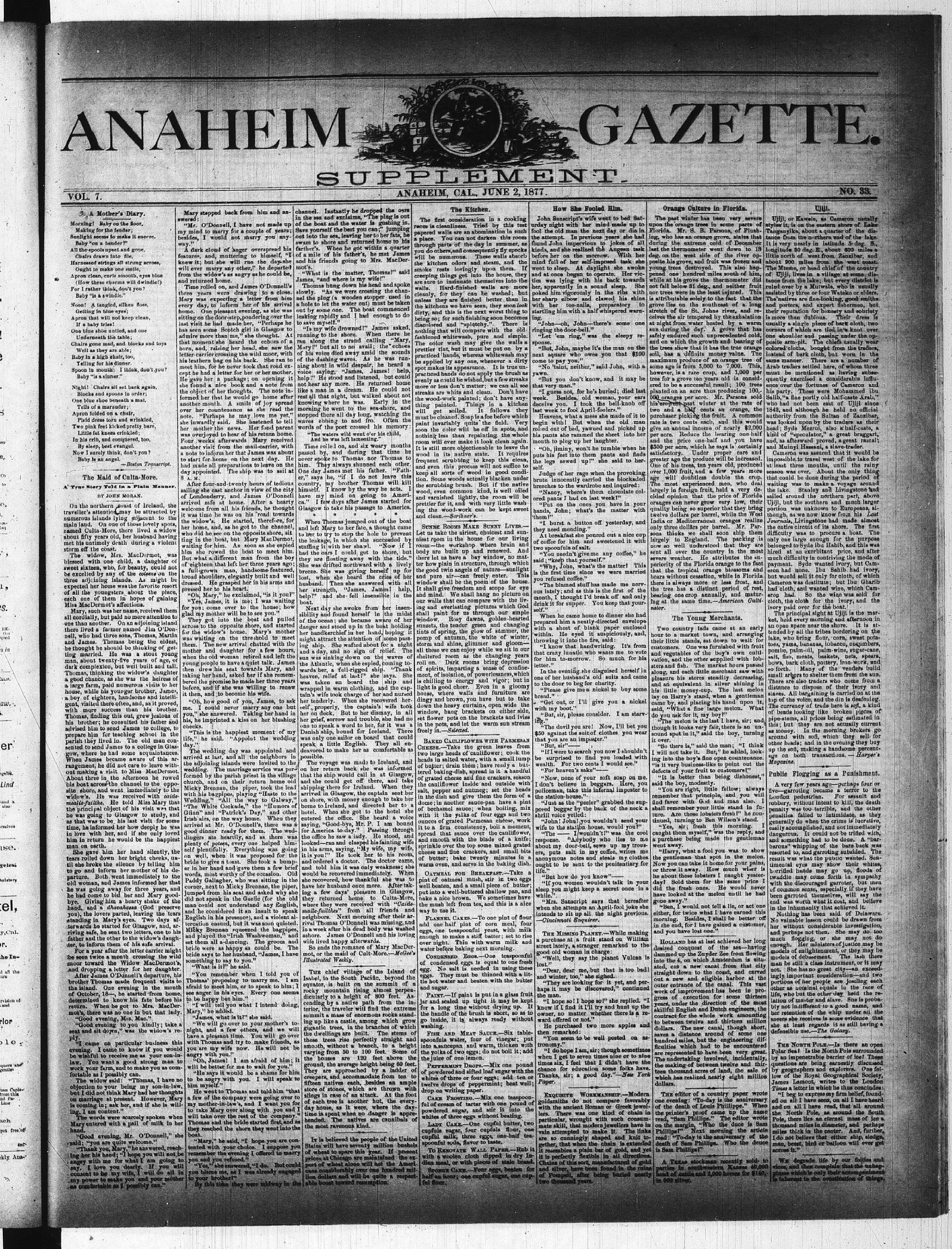
Searchable text
A Mother's Diary.
Morning! Baby on the floor,
Making for the fender;
Sunlight seems to make it sneeze.
Baby "on a bender?"
All the spools upset and gone,
Chairs drawn into file.
Harnessed strings all strung across,
Ought to make one smile,
Apron clean, curls smooth, eyes blue
(How these charms will dwindle!)
For I rather think, don't you?
Baby "is a swindle."
Noon! A tangled, allken floss,
Getting in blue eyes;
Apron that will not keep clean,
If a baby tries!
One blue shoe untied, and one
Underneath the table;
Chairs gone mad, and blocks and toys
Well as they are able;
Baby in a high chair, too,
Yelling for his dinner.
Spoon in mouth: I think, don't you?
Baby "is a sinner."
Night! Chairs all set back again,
Blocks and spoons in order;
One blue shoo beneath a mat,
Tells of a marauder;
Apron folded on a chair,
Plaid dress torn and wrinkled,
Two pink feet kicked pretty bare,
Little fat knees crinkled;
In his crib, and conquered, too,
By sleep, best evangel.
Now I surely think, don't you?
Baby is an angel.
Boston Transcript.
Mary stepped back from him and answered:
"Mr. O'Donnell, I have not made up my mind to marry for a couple of years; besides, I would not marry you anyway."
A dark cloud of anger overspread his features, and, muttering to himself, "I knew it; but she will rue the day-she will ever marry any other," he departed from the widow's as angry as he could be, and returned home.
Time rolled on, and James O'Donnell's three years were drawing to a close. Mary was expecting a letter from him every day, to inform her of his arrival home. One pleasant evening, as she was sitting on the door-step, pondering over the last visit he had made her, "Perhaps he has seen some Scotch girl in Glasgow to admire more than me," she thought. At that moment she heard the echoes of a horn, and, raising her head, she saw the letter-carrier crossing the wild moor, with his leathern bag on his back. She ran to meet him, for he never took that road except he had a letter for her or her mother. He gave her a package; on opening it she found a nice book and a note from the object of her thoughts. The note informed her that he would go home after another month. A smile of joy spread over her countenance as she read the note. "Perhaps he may love me yet," she inwardly said. She hastened to tell her mother the news. Her fond parent was overjoyed to hear of his return home. Four weeks afterwards Mary received another visit from the mail-carrier, with a note to inform her that James was about to start for home on the next day. He had made all preparations to leave on the channel. Instantly he in the sea and exclaim of the boat and the ww Save yourself the best out into the sea, leaving swam to shore and re farther's. When he got of a mile of his father and his friends going mot's.
"What is the matter James," and where is Thomas hung down slowly. "As we were nel the plug (a wood) a hole to let the water out by some one. The leaking rapidly and I to save myself."
"Is my wife drown running to the shore ran along the strait Mary!" but all to no of his voice died awake of the dashing waves ning about in wild dance saying, "Jam help!" He stood and not hear any more. like a man in a drear rest all that night, but knowing where he went to stopped there all days waves ebbing to words of the poet cry.
"The waters wild w And he was left Time rolled on, and passed by, and dun never spoke to Thom him. They always sai
The Maid of Culta-More.
A True Story Told in a Plain Manner.
BY JOHN MORAN.
On the northern coast of Ireland, the traveller's attention may be attracted by numerous islands lying adjacent to the main land. On one of those lovely spots, named Culta-More, there lived a widow about fifty years old, her husband having met his untimely death during a violent storm off the coast.
The widow, Mrs. MacDermot, was blessed with one child, a daughter of sweet sixteen, who, for beauty, could not be excelled by any of the coleena on the three adjoining islands. As might be expected her home was the favorite resort of all the youngsters about the place, each one of them in hopes of gaining Miss MacDermot's affections.
Mary, such was her name, received them all cordially, but paid no more attention to one than another. On an adjoining island there lived a farmer named Jim O'Donnell, who had three sons, Thomas, Martin and James. Thomas being the eldest, he thought he should be thinking of getting married. He was a stout young man, about twenty-five years of age, of dark complexion, but well built and tall. Thomas, thinking the widow's daughter a good chance, as she was the heiress of a large farm, paid numerous visits to her house, while his younger brother, James, a boy of eighteen, handsome and intelligent, visited there often, and, as it proved, with more success than his brother. Thomas, finding this out, grew jealous of his brother; he consulted his father and advised him to send James to college, to prepare him for teaching school in the parish they lived in. The old man consented to send James to a college in Glasgow, where he had some acquaintances.
When James became aware of this arrangement, he did not care to leave without making a visit to Miss MacDermot. About three in the afternoon he rowed his boat across the channel to the opposite shore, and went immediately to the widow's. He was received with caide-mealie-failthe. He told Miss Mary that the principal object of his visit was that he was going to Glasgow to study, and as that was to be his last visit for some time, he informed her how deeply he was in love with her, and if she only loved him in return he would be the happiest man on earth.
She gave him her hand silently, the tears rolled down her bright cheeks, until she broke the silence by telling him to go and inform her mother of his departure. Both went immediately to the old woman and James informed her that he had a letter for her or her mother. He gave her a package; on opening it she found a nice book and a note from the object of her thoughts. The note informed her that he would go home after another month. A smile of joy spread over her countenance as she read the note. "Perhaps he may love me yet," she inwardly said. She hastened to tell her mother the news. Her fond parent was overjoyed to hear of his return home. Four weeks afterwards Mary received another visit from the mail-carrier, with a note to inform her that James was about to start for home on the next day. He had made all preparations to leave on the day appointed. The ship was to sail at 8 A.M.
After four-and-twenty hours of tedious sailing she cast anchor in view of the city of Londonderry, and James O'Donnell arrived safe at home. After a hearty welcome from all his friends, he thought it was time he was on his road towards the widow's. He started, therefore, for her home, and, as he got to the channel, who did he see on the opposite shore, sitting in the boat, but Mary MacDermot, waiting for him. As soon as she espied him she rowed the boat to meet him. But what a different man from the boy of eighteen that left her three years ago; a full-grown man, handsome-featured, broad shoulders, elegantly built and well dressed. He grasped her in his arms and pressed her to his heart.
"Oh Mary," he exclaimed, "is it you?" "Yes, James, it is me; I was waiting for you; come over to the house; how glad my mother will be to see you."
They got into the boat and pulled across to the opposite shore, and started for the widow's house. Mary's mother was waiting on the threshold to meet them. The new arrival chatted with the mother and daughter for a few hours, when the old woman retired and left the young people to have a quiet talk. James then drew his seat towards Mary, and taking her hand, asked her if she remembered the promise he made her three years before, and if she was willing to renew it then, and to become his wife.
"Oh how good of you, James, to ask me. I could never marry any one but you," she answered. Taking her hand in his, he imprinted a kiss on her blushing cheeks.
"This is the happiest moment of my life," he said. "Appoint the wedding day."
The wedding day was appointed and arrived at last, and all the neighbors in the adjoining islands were invited to the wedding. The marriage service was performed by the parish priest in the village church, and on their return home old Micky Brennan, the piper, took the lead with his bagpipes, playing "Haste to the Wedding," "All the way to Galway," "The White Cockade," the "Humors of Glinn" and "Patrick's Day," and other Irish airs on the way home. When they arrived at Mr. O'Donnell's, there was a good dinner ready for them. The weddings ate heartily, and as there was plenty of poteen, every one helped himself plentifully. Everything was going on well, when it was proposed for the bride to give a toast. She took a bumper in her hand and gave them a few brief words, most worthy of the occasion. Old Paddy Gallagher, who was sitting in the room for her book review said: "Jam help!" He stood and not hear any more. Like a man in a dream rest all that night, but knowing where he woke morning where he went to stoped there all days waves ebbing to an words of the poet cry.
"The waters wild wandered by and he was left lazily rolled on; and passed by; and dawn never spoke to Thom him. They always saw One day James met her," says he, "if I country, my brother himself. I know by have my mind on ca." I few days after Glasgow to take his boat.
Next day she awoke suddenly and found her of the ocean; she be danger and stood up her handkerchief in might attract the attaching ship. She wafted and a day, and no sun was sinking down the Atlantic; when she wards her a full-rip heaven, relief at last was taken on boat wrapped in warm cloth's wife took charge her tenderly. When self properly,the her on deck.But to her grief,sorrow and one to speak a word Danish ship,bound was only one sailor speak a little English deavoured to make his possible.
The voyage was run on her return back that the ship would get shipping there for I arrived in Glasgow on shore; with money home to Ireland,and hotel. When she entered the office,saying: "Good-bye,forg America to day,the office he saw a look—ran and claw in his arms,saying it is you!" He too ordered a doctor and told him it would be recovered she recovered,how
his boat across-the channel to the opposite shore, and went immediately to the widow's. He was received with caide-mealie-failthe. He told Miss Mary that the principal object of his visit was that he was going to Glasgow to study, and as that was to be his last visit for some time, he informed her how deeply he was in love with her, and if she only loved him in return he would be the happiest man on earth.
She gave him her hand silently, the tears rolled down her bright cheeks, until she broke the silence by telling him to go and inform her mother of his departure. Both went immediately to the old woman, and James informed her that he was going away for three years, and he had come to bid her and Mary good-bye. Giving him a hearty shake of the hand, and a dhacahassa (God preserve you), the lovers parted, leaving the tears standing in Mary's eyes. Two days afterwards he started for Glasgow, and, arriving safe, he sent two letters, one to his father and the other to the widow's daughter, to inform them of his safe arrival.
For a year after the letter carrier might be seen twice a month crossing the wild moor toward the Widow MacDermot's, and dropping a letter for her daughter.
After James O'Donnell's departure, his brother Thomas made frequent visits to the island. One evening in the month of October, 18—he started from home, determined to know his fate before his return. When he got to Mrs. MacDermot's, there was no one in but that lady.
"Good evening, Mrs. Mac."
"Good evening to you kindly; take a seat and sit down," was the widow's reply.
"I came on particular business this evening. I came to know if you would be wishful to receive me as your son-in-law. You want a good strong man to work your farm, and to make you as comfortable as I possibly can.
The widow said: "Thomas, I have no objection to your being my son-in-law, but I did not think Mary had her thoughts on marriage at present. However, Mary is coming in; ask her, and if she is willing, I am content."
The words were scarcely spoken when Mary entered with a pail of milk in her hand.
"Good evening, Mr. O'Donnell," she said; "you are quite welcome."
"Thank you, Mary," he answered, reaching her hand; "I hope you will not be angry with me for what I am going to say. I love you dearly. If you will consent to be my wife, I will do all in my power to make you and your mother as comfortable as I possibly can."
IM GAZE
SUPPLEMENT.
ANAHEIM, CAL., JUNE 2, 1877.
channel. Instantly he dropped the oars in the sea and exclaims, "The plug is out of the boat and the water is gnashing in. Save yourself the best you can;" jumping out into the sea, leaving her to her fate, he swam to shore and returned home to his farther's. When he got within a quarter of a mile of his father's, he met James and his friends going to Mrs. MacDermot's.
"What is the matter, Thomas?" said James, "and where is my wife?"
Thomas hung down his head and spoke slowly. "As we were crossing the channel the plug (a wooden stopper used in a hole to let the water out) must be taken out by some one. The boat commenced leaking rapidly and I had enough to do to save myself."
"Is my wife drowned?" James asked, running to the shore. When there he ran along the strand calling "Mary, Mary!" but all to no avail; the echoes of his voice died away amid the sounds of the dashing waves. As he was running about in wild despair, he heard a voice saying, "James, James! help, help!" He stood and listened, but could not hear any more. He returned home like a man in a dream. He could not rest all that night, but walked about not knowing where he was. Early in the morning he went to the sea-shore, and stopped there all day long, watching the waves ebbing to and fro. Often the words of the poet crossed his memory:
"The waters wild went o'er his child,
And he was left lamenting."
Time rolled on, and six weary months passed by, and during that time he never spoke to Thomas nor Thomas to him. They always shunned each other.
The Kitchen.
The first consideration in a cooking room is cleanliness. Tried by this test papered walls are an abomination in such a place. You can not darken this room through parts of the day in summer, as you do others, and consequently fly specks will be numerous. These walls absorb the kitchen odors and steam, and the smoke rests lovingly upon them. If creeping things get into the house, they are sure to insinuate themselves into the walls. Hard-finished walls are more cleanly, for they can be washed; but unless they are finished better than in the kitchens we have seen, they soon look dirty, and this is the next worst thing to being so; for such finishing soon becomes discolored and "splatchy." There is nothing that will compare with the old-fashioned whitewash, pure and simple. The color wash may give the walls a prettier tint, but it must be put on by a practiced hands, whereas whitewash may be applied by any one, whenever a dirty spot makes its appearance. It is true unpracticed hands do not apply the brush as evenly as could be wished, but a few streaks more or less don't matter; we can all see streaks are white and clean. Don't have the wood-work painted; don't have anything painted. Things in a kitchen will get soiled. It follows they must be cleaned. Soap is a foe before which paint invariably quits the field. Very soon the color will be off in spots, and nothing less than repainting the whole room will ever make it look clean again.
It is still more objectionable to leave the wood in its native state. It requires frequent scrubbing to keep this clean, and this process will not suffice to keep it clean.
How She Fooled Him.
John Sanscript's wife went to bed Saturday night with her mind made up to fool the old man the next day or die in the attempt. In previous years she had found John impervious to jokes of all kinds, and she realized the Angean task before her on the morrow. With her mind full of her self-imposed task she went to sleep. At daylight she awoke and at once began to operate. Her victim was lying with his back towards her, apparently in a sound sleep. She poked him vigorously in the ribs with her sharp elbow and clawed his shins with her toe-nails, preparatory to startling him with a half whispered warning.
"John—oh, John—there's some one ringing the door-bell."
"Let 'em ring," was the sleepy response.
"But, John, maybe it's the man on the next square who owes you that $100 come to pay you."
"No 'taint, neither," said John, with a yawn.
"But you don't know, and it may be that very man."
"I guess not, for he's buried; died last week. Besides, old woman, your ears deceive you. I took the bell-knob off last week to fool April-foolers."
Heavens, what a mess she made of it to begin with! But when the old man rolled out of bed, yawned and picked up his pants she rammed the sheet into her mouth to plug up her laughter.
"Oh, Jiminy, won't he tumble when he puts his feet into them pants and finds the legs sewed up!" she said to her-
Orange.
The paused upon the Florida island during the last two days not fall nor trees is attributive grove lies stretching over receives that at night sun during safely enclosed tree for planted on 000 orchard his crops rate is given an average per acre and the $500 per satisfactory greater亩 One of
Time rolled on, and six weary months passed by, and during that time he never spoke to Thomas nor Thomas to him. They always shunned each other. One day James met his father. "Father," says he, "if I do not leave this country, my brother Thomas will kill himself. I know by the way he acts. I have my mind on going to America." I few days after James started to Glasgow to take his passage to America.
When Thomas jumped out of the boat and left Mary to her fate, a thought came to her to try to stop the hole to prevent the leakage, in which she succeeded by stuffing it with her shawl. "Now if I had the oars I could get to shore, but they are floating away with the tide." She was drifted northward with a lively breeze. She was giving herself up for lost, when she heard the cries of her husband. Then she answered with all her strength, "James, James! help, help!" and she fell insensible in the boat.
Next day she awoke from her insensibility and found herself in the midst of the ocean; she became aware of her danger and stood up in the boat holding her handkerchief in her hand, hoping it might attract the attention of some passing ship. She wafted about for a night and a day, and no sign of relief. The sun was sinking down on the waves of the Atlantic, when she espied coming towards her, a full-rigged ship. "Thank heaven, relief at last!" she says. She was taken on board the ship and wrapped in warm clothing, and the captain's wife took charge of her and nursed her tenderly. When she recovered herself properly, the captain's wife took her on deck. But to her dismay, in all her grief, sorrow and trouble, she had no one to speak a word to her, for it was a Danish ship, bound for Iceland. There was only one sailor on board that could speak a little English. They all endeavored to make her as comfortable as possible.
The voyage was made to Iceland, and on her return back she was informed that the ship would call in at Glasgow, and she could get off there, and take shipping there for Ireland. When they arrived in Glasgow, the captain sent her on shore, with money enough to take her home to Ireland, and directed her to a hotel. When she got to the hotel she entered the office. She heard a voice saying, "Good-bye, Mr. P. I am bound for America to day." Passing through the office he saw a lady. He stood, and looked—ran and clasped his fainting wife in his arms, saying, "My wife, my wife, it is you!" He took her to his room, and ordered a doctor. The doctor came, and told him it was only weakness; she would be recovered immediately. When she recovered, how thankful she was to voice saying, "James, James! help!" He stood and listened, but could not hear any more. He returned home like a man in a dream. He could not rest all that night, but walked about not knowing where he was. Early in the morning he went to the sea-shore, and stopped there all day long, watching the waves ebbing to and fro. Often the words of the poet crossed his memory:
"The waters wild went o'er his child,
And he was left lamenting."
Time rolled on, and six weary months passed by, and during that time he never spoke to Thomas nor Thomas to him. They always shunned each other. One day James met his father. "Father," says he, "if I do not leave this country, my brother Thomas will kill himself. I know by the way he acts. I have my mind on going to America." I few days after James started to Glasgow to take his passage to America.
When Thomas jumped out of the boat and left Mary to her fate, a thought came to her to try to stop the hole to prevent the leakage, in which she succeeded by stuffing it with her shawl. "Now if I had the oars I could get to shore, but they are floating away with the tide." She was drifted northward with a lively breeze. She was giving herself up for lost, when she heard the cries of her husband. Then she answered with all her strength, "James, James! help, help!" and she fell insensible in the boat.
Next day she awoke from her insensibility and found herself in the midst of the ocean; she became aware of her danger and stood up in the boat holding her handkerchief in her hand, hoping it might attract the attention of some passing ship. She wafted about for a night and a day, and no sign of relief. The sun was sinking down on the waves of the Atlantic, when she espied coming towards her, a full-rigged ship. "Thank heaven, relief at last!" she says. She was taken on board the ship and wrapped in warm clothing, and the captain's wife took charge of her and nursed her tenderly. When she recovered herself properly, the captain's wife took her on deck. But to her dismay, in all her grief, sorrow and trouble, she had no one to speak a word to her, for it was a Danish ship, bound for Iceland. There was only one sailor on board that could speak a little English. They all endeavored to make her as comfortable as possible.
The voyage was made to Iceland, and on her return back she was informed that the ship would call in at Glasgow, and she could get off there, and take shipping there for Ireland. When they arrived in Glasgow, the captain sent her on shore, with money enough to take her home to Ireland, and directed her to a hotel. When she got to the hotel she entered the office. She heard a voice saying, "Good-bye, Mr. P. I am bound for America to day." Passing through the office he saw a lady. He stood, and looked—ran and clasped his fainting wife in his arms, saying, "My wife, my wife, it is you!" He took her to his room, and ordered a doctor. The doctor came, and told him it was only weakness; she would be recovered immediately. When she recovered, how thankful she was to voice saying, "James, James! help!" He stood and listened, but could not hear any more. He returned home like a man in a dream. He could not rest all that night, but walked about not knowing where he was. Early in the morning he went to the sea-shore, and stopped there all day long, watching the waves ebbing to and fro. Often the words of the poet crossed his memory:
"The waters wild went o'er his child,
And he was left lamenting."
Time rolled on, and six weary months passed by, and during that time he never spoke to Thomas nor Thomas to him. They always shunned each other. One day James met his father. "Father," says he, "if I do not leave this country, my brother Thomas will kill himself. I know by the way he acts. I have my mind on going to America." I few days after James started to Glasgow to take his passage to America.
When Thomas jumped out of the boat and left Mary to her fate, a thought came to her to try to stop the hole to prevent the leakage, in which she succeeded by stuffing it with her shawl. "Now if I had the oars I could get to shore, but they are floating away with the tide." She was drifted northward with a lively breeze. She was giving herself up for lost, when she heard the cries of her husband. Then she answered with all her strength, "James, James! help!, help!" and she fell insensible in the boat.
Next day she awoke from her insensibility and found herself in the midst of the ocean; she became aware of her danger and stood up in the boat holding her handkerchief in her hand, hoping it might attract the attention of some passing ship. She wafted about for a night and a day, and no sign of relief. The sun was sinking down on the waves of the Atlantic, when she espied coming towards hershe had no one to speak a word to her; for it was a Danish ship,bound for Iceland. There was only one sailor on board that could speak a little English. They all endeavored to make her as comfortable as possible.
The voyage was made to Iceland,and on her return back she was informed that the ship would call in at Glasgow,and she could get off there,and take shipping there for Ireland. When they arrived in Glasgow,the captain sent her on shore,money enough to takeher home to Ireland,and directedhertoa hotel.当she gottothehothelseenteredtheoffice.Sheheardavoiceaying,"Good-bye,Mr.P.IamboundforAmericatoday."Passingthroughtheofficehesawadiyouhestoodintheairiest,choiceastundiestroominthehouseforour livingroom—theworkshopwherebrainandbodyarebuiltupandrenew.Andthereletushavea baywindow,notherhowplaininstructure,throughwhichgoodtwinangelsofnature—sunlightandpureair—canfreelyenter.Thewindowshallbethepoemofthehouse.Inthesmallpaintforusthroughoumplewindow.Rosydawnsgolden-heartedsunsets,thetendergreenandchangingtintsofspring,theglowofsummer,thepompofautumn,thewhiteofwinter stormandshine,glimmerandgloom—allthewecanenjoywhilewe sitinourshelteredroomasthechangingyearsrollon.Darkroomsbringdepressionofspirits impartinga senseofconfinement,ofisolation,ofpowerlessness,whichchillingtoenergyandvigor;但inlightisgoodcheer.Eveninagloomyhouse,wherewallsandfurniturearedingyandbrownyouhavebuttocawindtheheavycurtainsopenwidethewindow,hangbracketsonc bracket,selfflowerpotsonthebracketsandlivingsinthepots,andletthewarmsstreamfreelyin.Selected.
BAKED CAULIFLOWER WITH PARMESAN CHEESE.-Take the green leaves from two large heads of cauliflower; cooktheheadsin saltedwaterwitha smalllumpofbutter; drainthem;havereadyabutteredbaking-dish,spreaditinhalfhandled cheeseandfine crackers seasonthecauliflowerinsideoutsidewithsaltpepperandnutmeg;settheheadsinthe dishandgive themtheformofa朵ome;inanother sauce-panhaveapintofbechamel Sauce;whenboiling,mixwithittheyelksoffoureggsandtwoouncesofgratedParmesan cheeseworkitafirm consistency boil momentspreppedbeggarbythebackoftheneckashrillvoiceyelled:
"John! John! you wouldn't send your wifetothestation-house.wouldyou"
"TheIwouldn't!"wasthecoolresponse.“Anybodywho liestomeaboutmydoor-bell,sewupmytrousers,puts盐inmycoffee,写meanonymousnotesandstealsmyclothesoughttobesenttothepenitentiaryforlife.”
"Buthowdoyouknow”——
"Butyoudon'tknow,anditmaybethatveryman.”
"Iguessnot,forke'sburied;diedlastweek.Besidesoldwoman,youreardeciveyou.I tookthebell-knobofflastweektofoodApril-foolera."
Heavenswhatamesshamedofitbeginwith!Butwhenoldmanrolledoutofbed,yawnedand pickeduphispantsrammedthesheet.intomouthtopplugupher laughter.
"Oh,jiminy_won'thetumblewhenheputshisfeetinto thempantsandfindsthelegssewedup!”she said治self.
Judgeofherragewhentheprovokingbruteinnocentlycarriedtheblockadedbreachestothewardrobeandinquired:“Nancy,where themchocolatecoloredpantsIhadonlastweek?”
"PutontheonesyouhaveinyourhandsJohn;what'sthematterwiththem?”
"Iburstatbuttonoff yesterday,andtheyneedmending."
AtbreakfastshepouredoutanicecupofcoffeeforhimandsweeteneditwithtwopoonfullsOf盐.
"Youneedsitgivemeanycoffee,”hesaid;“keepthatyourself.”
"WhyJohn,'what'sthematter?"Thisisfirsttimesincewemarriedyourefusedcoffee."
"Theblamedstuffmade me nervouslately;andasthisisfirstofthemonth.IthoughtI'dbreakoffandonlydrinkitforsupper.Youkeepthatyourself."
Whenhecamehometo dinnershehadpreparedhima neatlydirected envelopewitha sheetofblankpaper enclosedwithin.He eyedit suspiciously,andthrowingitintothefire,said:
"Iknowthathandwriting.Itsfromthat crazy lunatic who wants meto voteforhimtomorrow.So muchforhisletter."
Intheeveningshedisguisedherselfinoneofherhusband'soldsuitsandcametothedoortobegforsuarity.
"Pleasegivemea nickelwithmyboot."
"But,sir,pleaseconsider.Iamstarving."
"Thedevilyouare!Now.I'llbetyou$50againstthe suitof clothesyouwearthatyouareanimposter."
"But,sir"
"IfIweresearchyounowIshouldn'tbe surprisedtofindyouloadedwithwealth.ForewothencountysIwouldsee."
"Forheaven'ssake"
"Now,noneofyoursoftsoaponme.Idon'tbelieveinbeggars.Here,youpoliceman,takethisinfermostimpostertothestation-house."
"Justasthe"“peeler’grabbledthesupposedbeggarbythebackoftheneckashrillvoiceyelled:
"John! John! you wouldn't send your wifetothe station-house.wouldyou"
"TheIwouldn't!"wasthecoolresponse.“Anybodywho liestomeaboutmydoor-bell,sewupmytrousers,puts盐inmycoffee,写meanonymousnotes和stealsmyclothesoughttobesenttothepenitentiaryforlife.”
"Buthowdoyouknow”——
"Butyoudon'tknow,anditmaybethatveryman."
"Iguessnot,forke'sburied;diedlastweek.Besidesoldwoman,youreardeciveyou.I tookthebell-knobofflastweektofoodApril-foolera."
Heavenswhatamesshamedofitbeginwith!Butwhenoldmanrolledoutofbed,yawnedand pickeduphispantsrammedthesheet.intomouthtopplugupher laughter.
"Oh,jiminy_won'thetumblewhenheputshisfeetinto thempants和findsthelegssewedup!”she said治self.
Judgeofherragewhentheprovokingbruteinnocentlycarriedtheblockadedbreachestothewardrobe和inquired:“Nancy,where themchocolatecoloredpantsIhadonlastweek?”
"PutontheonesyouhaveinyourhousesImmediatelyandanisserieswouldbeengreedyhavingatthreetorview."
Twohourslongtheretoilecustomerywillsendfreshvegetablesandstemsalongalpressionandanisserieswouldbeengreedyhavingatthreetorview.Attwostepeserveveryproductisthreatenedbyanisserieswouldbeengreedyhavingatthreetorview.Attwostepeserveveryproductisthreatenedbyanisserieswouldbeengreedyhavingatthreetorview.Attwostepeserveveryproductisthreatenedbyanisserieswouldbeengreedyhavingatthreetorview.Attwostepeserveveryproductisthreatenedbyanisserieswouldbeengreedyhavingatthreetorview.At twostepeserveveryproductisthreatenedbyanisserieswouldbeengreedyhavingatthreetorview.At twostepeserveveryproductisthreatenedbyanisserieswouldbeengreedyhavingatthreetorview.At twostepeserveveryproductisthreatenedbyanisserieswouldbeengreedyhavingatthreetorview.At twostepeserveveryproductisthreatenedbyanisserieswouldbeengreedyhavingatthreetorview.At twostepeserveveryproductisthreatenedbyanisserieswouldbeengreedyhavingatthreetorview.At twostepeserveveryproductisthreatenedbyanisserieswouldbeengreedyhavingatthreetorview.At twostepeserveveryproductisthreatenedbyanisserieswouldbeengreedyhavingatthreetorview.At twostepeserveveryproductisthreatenedbyanisserieswouldbeengreedyhavingatthreetorview.At twostepeserveveryproductisthreatenedbyanisserieswouldbeengreedyhavingatthreetorview.At twostepeserveveryproductisthreatenedbyanisserieswouldbeengreedyhavingatthreetorview.At twostepeserveveryproductisthreatenedbyanisserieswouldbeengreedyhavingatthreetorview.At twostepeserveveryproductisthreatenedbyanisserieswouldbeengreedyhavingatthreetorview.At twostepeserveveryproductisthreatenedbyanisserieswouldbeengreedyhavingatthreetorview.At twostepeserveveryproductisthreatenedbyanisserieswouldbeengreedyhavingatthreetorview.At twostepeserveveryproductisthreatenedbyanisserieswouldbeengreedyhavingatthreetorview.At twostepeserveveryproductisthreatenedbyanisserieswouldbeengreedyhavingatthreetorview.At twostepeserveveryproductisthreatenedbyanisserieswouldbeengreedyhavingatthreetorview.At twostepeserveveryproductisthreatenedbyanisserieswouldbeengreedyhavingatthreetorview.At twostEPESERVEVERYPRODUCTISTHREATTORVIEW."
Two hourslongtheretoilecustomerywill送freshvegetables和stemsalongalpressionandanisserieswouldbeengreedyhavingatthreetorview.At twostEPESERVEVERYPRODUCTISTHREATTORVIEW."
Two hourslongtheretoilecustomerywill送freshvegetables和stemsalongalpressionandanisserieswouldbeengreedyhavingatthreetorview.At twOSTEPESERVEVERYPRODUCTISTHREATTORVIEW."
Two hourslongtheretoilecustomerywill送freshvegetables和stemsalongalpressionandanisserieswouldbeengreedyhavingatthreetorview.At twOSTEPESERVEVERYPRODUCTISTHREATTORVIEW."
Two hourslongtheretoilecustomerywill送freshvegetables和stemsalongalpressionandanisserieswouldbeengreedyhavingatthreetorview.At twOSTEPESERVEVERYPRODUCTISTHREATTORVIEW."
Two hourslongtheretoilecustomerywill送freshvegetables和stemsalongalpressionandanisserieswouldbeengreedyhavingatthreetorview.At twOSTEPESERVEVERYPRODUCTISTHREATTORVIEW."
Two hourslongtheretoilecustomerywill送freshvegetables和stemsalongalpressionandanisserieswouldbeengreedyhavingatthreetorview.At twOSTEPESERVEVERYPRODUCTISTHREATTORVIEW."
Two hourslongtheretoilecustomerywill送freshvegetables和stemsalongalpressionandanisserieswouldbeengreedyhavingatthreetorview.At twOSTEPESERVEVERYPRODUCTISTHREATTORVIEW."
Two hourslongtheretoilecustomerywill送freshvegetables和stemsalongalpressionandanisserieswouldbeengreedyhavingatthreetorview.At twOSTEPESERVEVERYPRODUCTISTHREATTORVIEW."
Two hourslongtheretoilecustomerywill送freshvegetables和stemsalongalpressionandanisserieswouldbeengreedyhavingatthreetorview.At twOSTEPESERVEVERYPRODUCTISTHREATTORVIEW."
Two hourslongtheretoilecustomerywill送freshvegetables和stemsalongalpressionandanisserieswouldbeengreedyhavingatthreetorview.At twOSTEPESERVEVERYPRODUCTISTHREATTORVIEW."
Two hourslongtheretoilecustomerywill送freshvegetables和stemsalongalpressionandanissserieswouldbeengreedyhavingatthreetorview.At twOSTEPESERVEVERYPRODUCTISTHREATTORVIEW."
Two hourslongtheretoilecustomerywill送freshvegetables和stemsalongalpressionandanissserieswouldbeengreedyhavingatthreetorview.At twOSTEPESERVEVERYPRODUCTISTHREATTORVIEW."
Two hourslongtheretoilecustomerywill送freshvegetables和stemsalongalpressionandanissserieswouldbeengreedyhavingatthreetorview.At twOSTEPESERVEVERYPRODUCTISTHREATTORVIEW."
Two hourslongtheretoilecustomerywill送freshvegetables和stemsalongalpressionandanissserieswouldbeengreedyhavingatthreetorview.At twOSTEPESERVEVERYPRODUCTISTHREATTORVIEW."
Two hourslongtheretoilecustomerywill送freshvegetables和stemsalongalpressionandanissserieswouldbeengreedyhavingatthreetorview.At twOSTEPESERVEVERYPRODUCTISTHREATTORVIEW."
Two hourslongtheretoilecustomerywill送freshvegetables和stemsalongalpressionandanissserieswouldbeengreedyh havingatthreetorview.At twOSTEPESERVEVERYPRODUCTISTHREATTORVIEW."
Two hourslongtheretoilecustomerywill送freshvegetables和stemsalongalpressionandanissserieswouldbeengreedyh havingatthreetorview.At twOSTEPESERVEVERYPRODUCTISTHREATTORVIEW."
Two hourslongtheretoilecustomerywill送freshvegetables和stemsalongalpressionandanissserieswouldbeengreedyh havingatthreetorview.At twOSTEPESERVEVERYPRODUCTISTHREATTORVIEW."
Two hourslongtheretoilecustomerywill送freshvegetables和stemsalongalpressionandanissserieswouldbeengreedyh havingat th烯torview.At twOSTEPESERVEVERYPRODUCTISTHREATTORVIEW."
Two hourslongtheretoilecustomerywill送freshvegetables和stemsalongalpressionandanissserieswouldbeengreedyh havingat th烯torview.АтtwOSTEPESERVEVERYPRODUCTISTHREATTORVIEW."
Two hourslongtheretoilecustomerywill送freshvegetables和stemsalongalpressionandanissserieswouldbeENGREEDYHAVINGATTH烯torview.АтtwOSTEPESERVEVERYPRODUCTISTHREATTORVIEW."
Two hourslongtheretoilecustomerywill送freshvegetables和stemsalongalpressionANDANISSERSWILLBEINGATTH烯torview.АтtwOSTEPESERVEVERYPRODUCTISTHREATTORVIEW."
Two hourslongtheretoilecustomerywill送freshvegetables ANDSTEMSALMONSWILLBEINGATTH烯tor view.АтtwOSTEPESERVEVERYPRODUCTISTHREATTORVIEW."
Two hourslongtheretoilecustomerywill送freshvegetables ANDSTEMSALMONSWILLBEINGATTH烯tor view.АтtwOSTEPESERVEVERYPRODUCTISTHREATTORVIEW."
Wait, let me re-read line 12: "The devil you are! Now I'll bet you $50 against the suit of clothes you wear that you are an imposter." No such information exists here.
Let me re-read line 13: "But you don't know," — No such information exists here.
Let me re-read line 14: "However you must enter into these customary systems."
Let me re-read line 15: "The tree for a tree for a tree for a tree for a tree for a tree for a tree for a tree for a tree for a tree for a tree for a tree for a tree for a tree for a tree for a tree for a tree for a tree for a tree for a tree for a tree for a tree for a tree for a tree for a tree for a tree for a tree for a tree for a tree for a tree for a tree for a tree for a tree for a tree for"
Let me re-read line 16: "The devil you are! Now I'll bet you $50 against the suit of clothes you wear that you are an imposter." No such information exists here.
Let me re-read line 17: "But you don't know," — No such information exists here.
Let me re-read line 18: "However you must enter into these customary systems."
Let me re-read line 19: "The tree for a tree for a tree for a tree for a tree for a tree for a tree for a tree for a tree for a tree for a tree for a tree for a tree for a tree for a tree for a tree for a tree for"
Let me re-read line 20: "The devil you are! Now I'll bet you $50 against the suit of clothes you wear that you are an imposter." No such information exists here.
Let me re-read line 21: "But you don't know," — No such information exists here.
Let me re-read line 22: "However you must enter into these customary systems."
Let me re-read line 23: "The tree for a树 FOR A TREE FOR A TREE FOR A TREE FOR A TREE FOR A TREE FOR A TREE FOR A TREE FOR A TREE FOR A TREE FOR A TREE FOR A TREE FOR
The chief village of the Island of Isabel, in the South Pacific, beyond the equator, is built on the summit of a rocky mountain rising almost perpendicularly to a height of 800 feet. Ascending by a native path from the interior, the traveler will find the extreme summit a mass of enormous rocks standing up like a castle, among which grow gigantic trees, in the branches of which the dwellings are built. The stems of these trees rise perfectly straight and smooth, without a branch, to a height varying from 50 to 100 feet. Some of the houses are 120 feet above the ground, the average height being 60 feet. They are approached by a ladder of creepers, and accommodate from ten to fifteen natives each, besides an ample store of stones, which are thrown with slings in case of an attack. At the foot of each tree is another hut, the everyday house, as it were, where the daytime is spent when no danger is apprehended. The natives are cannibals of the most ravenous kind.
It is believed the people of the United States will have seventy million bushels of wheat to spare this year. If present prices at Chicago are maintained the export of wheat alone will not be the American considerably over one hundred million dollars and will be quite a respectable boost toward resumption.
OATMEAL FOR BREAKFAST.—Take a pint of oatmeal mush, stir in two eggs well beaten, and a small piece of butter; put into a well-buttered shallow pan, and bake a nice brown. We sometimes have the mush left from tea, and this is a nice way to use it.
FLANNEL CAKES.—To one pint of flour add one half pint of corn meal, four eggs, one teaspoonful yeast, with milk enough to make a stiff batter; set to rise over night. Thin with warm milk and water before baking next morning.
CONDENSED EGGS.—One teaspoonful of condensed eggs is equal to one fresh egg. No salt is needed in using these eggs. They must be thinned with a little hot water and beaten with the butter and sugar.
PAINT.—If paint is put in a glass fruit jar and sealed up tight it may be kept for a long time without drying up. If the handle of the brush is short, so as to go inside, it is always ready without washing.
FISH AND MEAT SAUCE.—Six table-spoonfuls water, four of vinegar; put into a saucepan and warm, thicken with the yolks of two eggs; do not boil it; add the juice of one lemon.
PEPPERMINT DROPS.—Mix one pound of powdered and sifted loaf sugar with the whites of three or four eggs; add ten or twelve drops of peppermint; beat well; drop on writing paper.
CAKE FROSTING.—Mix one teaspoonful of cream of tartar with one pound of powdered sugar, and stir it into the whites of three eggs without beating.
LADY CAKE.—One cupful butter, two cupful sugar, four cupful flour, one cupful milk, three eggs, one-half teaspoonful soda, flavor to taste.
TO REMOVE WALL PAPER.—Rub it with a woolen cloth dipped in dry Indian meal, or with pieces of stale bread.
SPONGE CAKE.—Four eggs, beaten for half an hour; one cupful sugar, one cupful flour.
EXQUISITE WORKMANSHIP.—Modern goldsmiths do not compare favorably with the ancient Roman or Greek jewellers. There was one kind of chain in particular, wrought with such consumate skill, that modern jewellers have in vain attempted to make it. The links are so cunningly shaped and knit together, that when the chain is extended it resembles a plain bar of gold, and yet it is perfectly flexible in all directions. Chains of this sort, manufactured of gold and silver, have been found in the ruins of Pompeii, after being buried nearly two thousand years.
I don't believe in beggars. Here, you policeman, take this infernal imposter to the station-house."
"Just as the "peeler" grabbed the supposed beggar by the back of the neck a shrill voice yelled:
"John! John! you wouldn't send your wife to the station house. would you?"
"The I wouldn't!" was the cool response.
"Anybody who lies to me about my door-bell, sews up my trousers, puts salt in my coffee, writes me anonymous notes and steals my clothes ought to be sent to the penitentiary for life."
"But how do you know?"——
"If you women wouldn't talk in your sleep you might keep a secret once in a while."
"Mrs. Sanscript says that hereafter when she attempts an April-fool joke she intends to sit up all the night previous."——Cincinnati Enquirer.
THE MISSING PLANET.—While making a purchase at a fruit stand on William street lately, a stranger remarked to the good old woman in charge:
"Well, they say the planet Vulcan is lost."
"Dear, dear me, but that is too bad! and winter, too," she sighed.
"They are looking for it yet, and perhaps it may be discovered," continued the man.
"I hope so! I hope so!" she replied. "I know if I find it I'll try and hunt up the owner, no matter whether there is a reward offered or not."
He purchased two more apples and then remarked:
"You seem to be well posted on astronomy."
"I do hope I am, sir; though sometimes when I get to seven times nine or nine times six I feel that I didn't have the chance for education some folks have. Thanks, sir; a good day."——New York Paper.
EXQUISITE WORKMANSHIP.—Modern goldsmiths do not compare favorably with the ancient Roman or Greek jewellers. There was one kind of chain in particular, wrought with such consumate skill, that modern jewellers have in vain attempted to make it. The links are so cunningly shaped and knit together, that when the chain is extended it resembles a plain bar of gold, and yet it is perfectly flexible in all directions. Chains of this sort, manufactured of gold and silver, have been found in the ruins of Pompeii, after being buried nearly two thousand years."——
GAZETTE.
NO. 33.
Ed Him.
went to bed Satmind made up to
next day or die in
us years she had
to jokes of all
the Angen task
row. With her
imposed task she
light she awoke
operate. Her victory back towards
sound sleep. She
in the ribs with
clawed his shins
preparatory to
whispered warnhere's some one
the sleepy rets the man on the
you that $100
said John, with a
w, and it may be
buried; died last
woman, your ears
the bell-knob off
foolers."
she made of it to
on the old man
and picked up
the sheet into her
aughter.
the tumble when he
pants and finds
she said to her-
Orange Culture in Florida.
The past winter has been very severe upon the orange trees in some parts of Florida. Mr. S. B. Parsons, of Flushing, who has an orange grove, states that during the extreme cold of December last the thermometer went down to 18 deg. on the west side of the river opposite his grove, and fruit was frozen and young trees destroyed. This also happened one hundred miles south of him, while at his grove the thermometer did not fall below 81 deg., and neither fruit nor trees were in the least injured. This is attributable solely to the fact that the grove lies on the southeast of a long stretch of the St. Johns river, and receives the air tempered by the exhalation at night from water heated by a warm sun during the day. A grove that has safely endured such unprecedented cold, and on which the growth and bearing of the trees show that it has the true orange soil, has a definite money value. The maximum produce of an orange tree of some age is from 5,000 to 7,000. This, however, is a rare crop, and 1,000 per tree for a grove ten years old is considered to be a successful result; 100 trees planted on an acre thus producing 100,000 oranges per acre. Mr. Parsons sold his crop the past winter at the rate of two and a half cents an orange, the purchaser picking the fruit. A common rate is two cents each, and this would give an annual income of nearly $2,000 per acre. Reduce the bearing one-half and the price one-half and you have $500 per acre, which he says is certainly satisfactory. Under proper care and greater age the produce will be increased.
Ujiji.
Ujiji, or Kawale, as Cameron usually styles it, is on the eastern shore of Lake Tanganyika, about a quarter of the distance from the northern end of the lake. It is very nearly in latitude 5-deg. S., longitude 90 deg. E., about 600 miles a little north of west from Zanzibar, and about 900 miles from the west coast. The Mteme, or head chief of the country of Ujiji, lives in a village at some distance from the lake; but every district is ruled over by a Mutwale, who is usually assisted by three or four Watako or elders. The natives are fine-looking, good smiths and porters, and expert fishermen, but their reputation for honesty and sobriety is more than dubious. Their dress is usually a single piece of bark cloth, two corners of which are tied in a knot over one shoulder and passing under the opposite arm-pit. The chiefs usually wear colored cloths, bought from the traders, instead of bark cloth, but worn in the same manner. There are a number of Arab traders settled here, of whom three must be mentioned as having subsequently exercised a considerable influence over the fortunes of Cameron and his party. These were Mohammed ibu Salib, "a fine portly old-caste Arab," who had not been east of Ujiji since 1842, and although he held no official authority from the Sultan of Zanzibar, was looked upon by the traders as their head; Syde Mezrui, also a half-caste, a kind of "speculator," a great braggart, and, as afterward proved, a great rascal; and Muinyi Hassani, a slave-trader.
Cameron was assured that it would be impossible to travel west of the lake for at least three months, until the rainy
when the provoking and the blockaded case inquired:
from chocolate colt week?"
you have in your matter with off yesterday, and out a nice cup sweetened it with any coffee," he said.
the matter? This we were married made me nervious of the break off and only you keep that your to dinner she had directed envelope paper enclosed suspiciously, and, said: writing. It's from wants me to vote So much for his disguised herself in old suits and came charity. nickel to buy some give you a nickel consider. I am starv-Now, I'll bet you clothes you wear er."
now now I shouldn't you loaded with is I would see."
The Young Merchants.
Two country lads came at an early hour to a market town, and arranging their little stands, sat down to wait for customers. One was furnished with fruit and vegetables of the boy's own cultivation, and the other supplied with lobsters and fish. The market hours passed along, each little merchant saw with pleasure his stores steadily decreasing, and an equivalent in silver shining in his little money-cup. The last melon lay on Harry's stand, when a gentleman came by, and placing his hand upon it, said, "What a fine large melon. What do you ask for it, my boy?"
"The melon is the last I have, sir; and though it looks very fair, there is an unsound spot in it," said the boy, turning it over.
"So there is," said the man; "I think I will not take it. But," he added, looking into the boy's fine open countenance. "is it very business-like to point out the defects of your fruit to customers?"
"It is better than being dishonest," said the boy, modestly.
"You are right, little fellow; always remember that principle, and you will find favor with God and man also. I shall remember your little stand in future. Are those lobsters fresh?" he continued, turning to Ben Wilson's stand.
"Yes, sir; fresh this morning. I caught them myself," was the reply, and a purchase being made the gentleman went away.
"Harry, what a fool you was to show the gentleman that spot in the melon. Now you can take it home for your pains, or throw it away. How much wiser is he about these lobsters I caught yesterday." Sold them for the same price I
Public Flogging as a Punishment.
A very few years ago—perhaps four or five—garroting became a terror to the London pedestrian. For assault and robbery, without intent to kill, the death penalty was too terrible, and the other penalties failed to intimidate, as they generally do when the crime is lucrative, easily accomplished, and not immediately dangerous. It could not be trifled with, and something had to be done. A "barbarous" whipping of the bare back was resorted to, and garroting subsided. The result was what the public wanted. Sentimental eyes may show their whites, horrified hands may go up, floods of twaddle may come forth in sympathy with the discouraged carter, but men must be mentioned as having subsequently exercised a considerable influence over the fortunes of Cameron and his party. These were Mohammed ibu Salib, "a fine portly old half-caste Arab," who had not been east of Ujiji since 1842, and although he held no official authority from the Sultan of Zaozibar, was looked upon by the traders as their head; Syde Mezrui, also a half-caste, a kind of "speculator," a great braggart, and, as afterward proved, a great rascal; and Muinyl Hassani, a slave-trader.
Cameron was assured that it would be impossible to travel west of the lake for at least three months, until the rainy season was over. About the only thing that could be done during the period of waiting was to make a voyage around the lake. Stanley and Livingstone had sailed around the northern part, above Ujiji, but the southern and much larger portion was unknown to Europeans, although, as we now know from his Last Journals, Livingstone had made almost the entire circuit of its shore. The first difficulty was to procure a boat. The only one large enough for the purpose belonged to Syde ibu Habib, and this was hired at an exorbitant price, and after much difficulty in contriving the mode of payment. Syde wanted ivory, but Cameron had none. Ibu Sahib had ivory, but would sell it only for cloth, of which Cameron was destitute; but Ibu Gharib had cloth, and wanted wine, which Camerop had. So the wine was sold for cloth, the cloth for the ivory, and the ivory paid over for the boat.
The principal sight at Ujiji is the market, held every morning and afternoon in an open space near the shore. It is attended by all the tribes bordering on the lake, who bring flour, corn, sweet potatoes, yams, bananas, tobacco, cuumbers, pombe, palm-oil, palm-wine, sugar-cane, salt, fish, meats, baskets, nets, spears, bows, bark cloth, pottery, iron-work, and so forth. Many of the vendors build small arrows to shelter them from the sun. There are also traders who come from a distance to dispose of their ivory and slaves. All bargaining is carried on at the top of the voice, and the din is deafening. The currency of trade here is soft, a kind of beads looking like broken pieces of pipe-stems, all prices being estimated in this; but they are not actually current as money. In the morning brokers go around with soffl, which they sell for other beads; and in the evening they buy up the soil, making a handsome percentage on both transactions. — Harper's Magazine.
"grabbed the supack of the neck a
shouldn't send your
case, would you?"
was the cool
who lies to me
news up my trouscoffee, writes me
steals my clothes
the penitentiary for
now"
couldn't talk in your
secret once in a
April-fool joke she
night previous.
While making
stand on William
remarked to the charge:
planet Vulcan is
that is too bad!
signed.
for it yet, and perpowered," continued
she replied. "I
hry and hunt up the
neither there is a remore apples and
well posted on asthough sometimes
times nine or to nine
I didn't have the
some folks have.
day."—New York
Modern compare favorably
man or Greek jewelkind of chain in
with such consumjewellers have in
make it. The links
shaped and knit to
chain is extended
of gold, and yet
in all directions,
manufactured of gold
found in the rails
being buried nearly
A Texas stockman recently sold- to parties in southwestern Kansas 40,000 head of cattle and 2,000 horses for $140,- in 000 silver.
A very few years ago—perhaps four or five—garroting became a terror to the London pedestrian. For assault and robbery, without intent to kill, the death penalty was too terrible, and the other penalties failed to intimidate, as they generally do when the crime is lucrative, easily accomplished, and not immediately dangerous. It could not be trilled with, and something had to be done. A "bar-barous" whipping of the bare back was resorted to, and garroting subsided. The result was what the public wanted. Sentimental eyes may show their whites, horrified hands may go up, floods of twaddle may come forth in sympathy with the discouraged garroter, but men of common sense, especially if they have been garroted themselves, will say the end was worth what it cost, and believe in the inhumanity that achieved it.
Nothing has been said of Delaware. No valuable lesson could be drawn from her without considerable investigation, and perhaps not then. She may do too much flogging, or she may not do enough. Her ministers of justice may be models of enlightenment, or they may be models of debasement. The lash there man be still a class instrument, or it may not. She has no great city—an exceedingly important consideration—and two portions of her people are joystling each other as nominal equals in the race of life, who but the other day held the relation of master and slave. She is probably not indifferent to a good name, and her retention of the whip under all the sneers she receives is some evidence that she at least regards it as still having a defensible use.—The Galaxy.
THE NORTH POLE—Is there an open Polar Sea? Is the North Pole surrounded by an impenetrable barrier of ice? These questions are being earnestly discussed by geographers and explorers. One follow of the Royal Geographical Society, James Lamont, writes to the London Times a letter in which he thus concludes:
"I beg to express my firm belief, founded on all I have seen, on all I have heard and on all I have read, that all around the North Pole, as around the South Pole, there lies an eternal mass of ice a thousand miles in diameter, and perhaps miles thick in the center. And further, I do not believe that either ship, sledge, man, beast, bird or balloon will ever get across it."
We degrade life by our follies and vices, and then complain that the unhappiness which is only their accompaniments is inherent in the constitution of things.