anaheim-gazette 1877-05-26
Scanned page
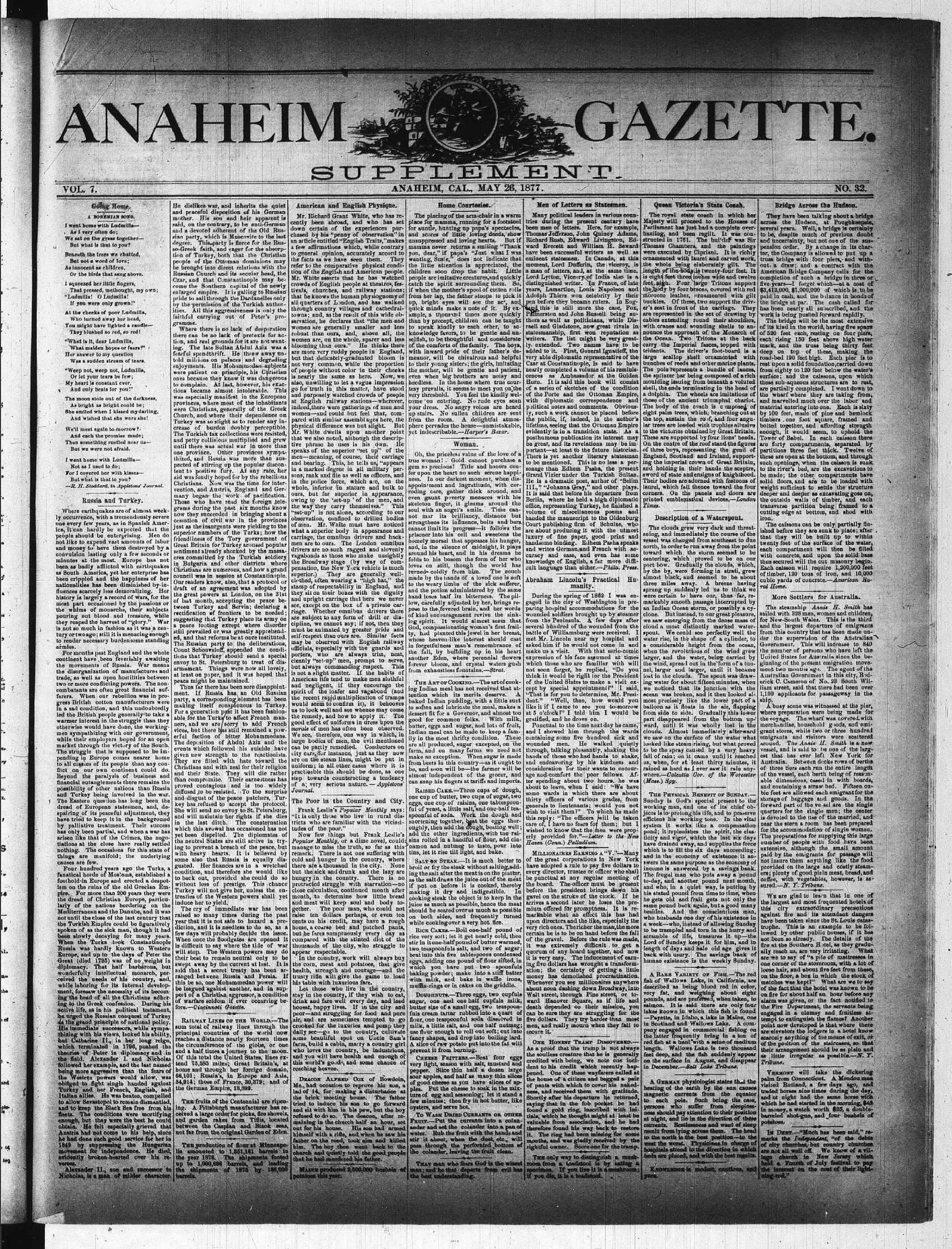
Searchable text
ANAHEIM
VOL. 7.
Going Home.
A BOHEMIAN SONG.
I went home with Ludmilla—
As I very often do;
We sat on the grass together—
But what is that to you?
Beneath the trees we chatted,
But not a word of love;
As innocent as children,
Or the birds that sang above.
I squeezed her little fingers,
That pressed, methought, my own;
"Ludmilla! O Ludmilla!
If you were only grown!"
At the cheeks of poor Ludmilla,
Who turned away her head,
You might have lighted a candle—
They blushed so red, so red!
"What is it, dear Ludmilla,
What malden hopes or fears?"
Her answer to my question
Was a sudden stream of tears.
"Weep not, weep not, Ludmilla,
Or let your tears be few;
My heart is constant ever,
And only heats for you!"
The moon stole out of the darkness,
As bright as bright could be;
She smiled when I kissed my darling,
And wished that she were she!
We'll meet again to-morrow?
And each the promise made;
Then something rustled near us—
But we were not afraid.
I went home with Ludmilla—
Not as used to do.
He dislikes war, and inherits the quiet and peaceful disposition of his German mother. His son and heir apparent is said, on the contrary, to be anti-German and a devoted adherent of the Old Russian party, which is Muscovite to the last degree. This party is fierce for the Russo-Greek faith, and eager for the absorption of Turkey, both that the Christian people of the Ottoman dominions may be brought into direct relations with the Russian Church and its secular head, the Czar, and that Constantinople may become the Southern capital of the newly enlarged empire. It is galling to Russian pride to sail through the Dardanelles only by the permission of the Turkish authorities. All this aggressiveness is only the faithful carrying out of Peter's programme.
Where there is no lack of desperation there can be no lack of pretexts for action, and real grounds for it are not wanting. The late Sultan Abdul Aziz was a fearful spendthrift. He threw away untold millions on palaces and degrading enjoyments. His Mohammedan subjects were patient on principle, his Christian ones because they knew it was dangerous to complain. At last, however, his exactions became almost intolerable. This was especially manifest in the European provinces, where most of the inhabitants were Christians, generally of the Greek Church, and where their dependence on Turkey was so slight as to render any increase of burden doubly perceptible. The Turkish tax collections were resisted, and petty collisions multiplied and grew until there was actual war in more than one province. Other provinces sympathized, and Russia was more than suspected of stirring up the popular discontent.
American and English
Mr. Richard Grant Widely known centently been abroad, and down certain of the chased by his "penny o' an article entitled "English a few affirmations which to general opinion, acco the facts as we have seen refer to the comparative tion of the English and Mr. White asserts that crowds of English people tribals, churches, and that he knows the human all quarters of London through country village towns; and, as the result servation, he declares that women are generally robust than ours, and women are, on the whole blooming than ours." are more very ruddy pea but that delicately-grass not very common, while of people without color is nearly the same as also, unwilling to let a go for truth in this man and purposely watched at English railway站 indeed, there were gathered women—and could but pared with similar asses physical difference was Mr. White dwells upon that we also noted, although phrase he uses in speaks of the superior men—meaning, of course and bearing. This, he
"Weep not, weep not, Ludmilla,
Or let your tears be few;
My heart is constant ever,
And only beats for you!"
The moon stole out of the darkness,
As bright as bright could be;
She smiled when I kissed my darling,
And wished that she were she!
We'll meet again to morrow?
And each the promise made;
Then something rustled near us—
But we were not afraid.
I went home with Ludmilla—
Not as I used to do;
For I covered her with kisses—
But what is that to you?
—R. H. Stoddard, in Appletons' Journal.
Russia and Turkey.
Where earthquakes are of almost weekly occurrence, with a tremendously severe one every few years, as in Spanish America, it can hardly be expected that the people should be enterprising. Men do not like to expend vast amounts of labor and money to have them destroyed by a convulsion lasting only a few seconds or minutes at the most. Europe has not been as badly afflicted with earthquakes as South America, yet her enterprise has been crippled and the happiness of her nationalities has been diminished by influences scarcely less demoralizing. Her history is largely a record of wars, for the most part occasioned by the passions or the whims of monarchs, their subjects pouring out blood and treasure, while they reaped the harvest of "glory." War is not so much in fashion as it was a century or two ago; still it is menacing enough to render necessary burdensome standing armies.
For months past England and the whole continent have been feverishly awaiting the movements of Russia. War means the disorganization of manufactures and trade; as well as open hostilities between two or more conflicting powers. The non-combatants are often great financial sufferers. When our rebellion was in progress British cotton manufacturers were in a sad condition, and this undoubtedly led the British people generally to take a warmer interest in the struggle than they otherwise would have done, the working-men sympathizing with our government, while their employers hoped for an open market through the victory of the South. The struggle that is supposed to be impending in Europe comes nearer home to all classes of its people than any conflict on our own continent could do. Beyond the paralysis of business and financial entanglements there remains the possibility of other nations than Russia and Turkey being involved in the war. The Eastern question has long been the dread of European statesmen, and, despairing of its peaceful adjustment, they have tried to keep it in the background by palliative treatment. Their success has only been partial, and when a war has arisen like that of the Crimes, the negotiations at the close have really settled nothing. The occasions for this state of things are manifold; the underlying causes are few.
Four hundred years ago the Turks, a fanatical horde of Moslems, established a foothold in Europe and erected a despotial empire. His patient on principle, his Christian ones because they knew it was dangerous to complain. At last, however, his excavations became almost intolerable. This was especially manifest in the European provinces, where most of the inhabitants were Christians, generally of the Greek Church, and where their dependence on Turkey was so slight as to render any increase of burden doubly perceptible. The Turkish tax collections were resisted, and petty collisions multiplied and grew until there was actual war in more than one province. Other provinces sympathized, and Russia was more than suspected of stirring up the popular discontent to positive fury. At any rate, her aid was fondly hoped for by the rebellious Christians. Now was the time for intervention, and Austria, England and Germany began the work of pacification. Those who have read the foreign telegrams during the past six months know how they succeeded in bringing about a cessation of civil war in the provinces just as the insurgents were yielding to the superior numbers of the Turks; how the friendliness of the Tory government of Great Britain for Turkey aroused popular sentiment already shocked by the massacres committed by the Turkish soldiery in Bulgaria and other districts where Christians are numerous, and how a grand council was in session at Constantinople. Our readers know, also, that a protocol or draft of an agreement was adopted by the great powers at London, on the 31st of last month, accepting the peace between Turkey and Servia; declaring a rectification of frontiers to be needed; suggesting that Turkey place its army on a peace footing except where disorder still prevailed or was greatly apprehended, and that reforms be at once instituted. The Russian party to the deliberations, Count Schouvaloff, appended the conditions that Turkey should send a special envoy to St. Petersburg to treat of armament. Things were now all lovely, at least on paper, and it was hoped that peace might be maintained.
Thus far there has been sore disappointment. If Russia has an Old Russian party, a corresponding element has been making itself conspicuous in Turkey. For a generation past it has been fashionable for the Turks to affect French manners, and we are sorry to add French vices, but there has still remained a powerful faction of bitter Mohammedans. The deposition of Abdul Aziz and the events which followed his suicide have given new strength to the reactionists. They are filled with hate toward the Christians and with zeal for their religion and their State. They will die rather than compromise. Their earnestness has proved contagious and is too widely diffused to be resisted. To the surprise and disgust of the peace patchers, Turkey has refused to accept the protocol. She will send no envoy to St. Petersburg, and will maintain her rights if she dies in the last ditch. The consternation which this avowal has occasioned has not yet been dispelled. The diplomates of the neutral States are still active in trying to prevent a breach of the peace, but with heavy hearts. It is believed by some also that Russia is equally disgusted. Her finances are in a wretched condition, and therefore she would like to back out, provided she could do so.
of people without color is nearly the same as also, unwilling to let anyone go for truth in this matter and purposely watched at English railway stations indeed; there were gathered women—and could but pared with similar assorted physical difference was Mr. White dwells upon that we also noted, although a phrase he uses in speaks of the superior men—meaning of course and bearing. This, he in a marked degree in persons, rank and file as we in the police force, we whole, inferior in status ours, but far superior owing to the 'set-up,' is not alone, observation, confined of men. Mr. White must what a superior body is carriage, the omnibus of men are to ours. The drivers are no such rags vagabonds as those whose Broadway stage (the pennsylvania) they are clothed, often wearing a stamp of respectability; they sit on their boxes and upright carriage thus see, except on the boxriage. Whether omnibirds are subject to any form cipline, we cannot say; must be animated by going self-respect than ours and may be observed with officials, especially with porters, who are always cleanly "set-up" men; but always commanding is not a slight matter.
American life tend to me and negligent; if their spirit of the loafer and the recent rapid multiply would seem to confirm us to look well and see us in the remedy, and how to good effect of uniform morale of men has often We see, therefore, one large bodies of men; they can be partly remedied city cars; for instance, are on the steam lines; uniform; in all other cases practicable this should step towards counterparts of a very serious naval Journal.
The Poor in the Con
Frank Leslie's Popular "It is only those who lieve tricts who are familiar tides of the poor."
Now few things but Popular Monthly, or a manage to miss the true remark. There is not a cold and hunger in there are a thousand in but the sick and drunk hungry in the country
Four hundred years ago the Turks, a fanatical horde of Moslems, established a foothold in Europe and erected a despotism on the ruins of the old Grecian Empire. For more than 200 years they were the dread of Christian Europe, particularly of the nations bordering on the Mediterranean and the Danube, and it was not until the close of the last century that the Turkish Empire could be figuratively spoken of as the slick man, though it had been slowly decaying for many years. When the Turks took Constantinople Russia was hardly known to Western Europe, and up to the days of Peter the Great (died 1725) was of no weight in diplomacy. That half barbarous, but wonderfully intellectual monarch, perceived the needs of his country, and, while laboring for its internal development, foresaw the necessity of its becoming the head of all the Christians adhering to the Greek confession. During his active life, as in his political testament, he urged the Russian conquest of Turkey as the grand principle of national policy. His immediate successors, while sympathizing with his views, lacked his ability, but Catharine II., in her long reign, which terminated in 1796, pushed the theories of Peter in diplomacy and in the field. Alexander I. and Nicholas followed her example, and the last named being more aggressive than the fears of the Western powers would allow, was obliged to fight single handed against Turkey and her French, English, and Italian allies. He was beaten, compelled to allow Sevastopol to remain dismantled, and to keep the Black Sea free from his fleets. The conditions were mortifying enough, but they were the best he could obtain. He felt especially grieved that Austria had not come to his help, since he had done such good service for her in 1849 by suppressing the Hungarian movement for independence. He died, evidently broken-hearted over his reverses.
Alexander II., son and successor to Nicholas, is a man of milder character.
AMERICAN AND ENGLISH PHYSIQUE.
Mr. Richard Grant White, who has recently been abroad, and who has set down certain of the experiences purchased by his "penny of observation" in an article entitled "English Traits," makes a few affirmations which, while contrary to general opinion, accurately accord to the facts as we have seen them. They refer to the comparative physical condition of the English and American people. Mr. White asserts that he has watched crowds of English people at theatres, festivals, churches, and railway stations; that he knows the human physiognomy of all quarters of London, and has walked through country villages and cathedral towns; and, as the result of this wide observation, he declares that "the men and women are generally smaller and less robust than ours, and, above all, the women are, on the whole, sparer and less blooming than ours." He thinks there are more very ruddy people in England, but that delicately-graduated bloom is not very common, while the proportion of people without color in their cheeks is nearly the same as here. Now, we also, unwilling to let a vague impression go for truth in this matter, have stood and purposely watched crowds of people at English railway stations—wherever indeed, there were gatherings of men and women—and could but feel that, compared with similar assemblages here, the physical difference was but slight. But Mr. White dwells upon another point that we also noted, although the descriptive phrase he uses is his own. He speaks of the superior "set up" of the men—meaning, of course, their carriage and bearing. This, he tells us, "appears
Home Courtesies.
The placing of the arm-chair in a warm place for mamma, running for a footstool for auntie, hunting up papa's spectacles, and scores of little loving deeds, show unsuppressed and loving hearts. But if mamma never returns a smiling "Thank you, dear," if papa's "Just what I was wanting, Susie," does not indicate that the little attention is appreciated, the children soon drop the habit. Little people are imitative creatures, and quickly catch the spirit surrounding them. So, if when the mother's spool of cotton rolls from her lap, the father stops to pick it up, bright eyes will see the act, and quick minds make a note of it. By example, a thousand times more quickly than by precept, children can be taught to speak kindly to each other, to acknowledge favors, to be gentle and unselfish, to be thoughtful and considerate of the comforts of the family. The boys with inward pride of their father's demeanor, will be chivalrous and helpful to their young sisters; the girls, mutilating the mother, will be gentle and patient, even when big brothers are noisy and heedless. In the home where true courtesy prevails, it seems to meet you on the very threshold. You feel the kindly welcome on entering. No rude eyes scan your dress. No angry voices are heard up stairs. No sullen children are sent from the room. A delightful atmosphere pervades the house—unmistakable, yet indescribable.—Harper's Bazar.
Woman.
Oh, the priceless value of the love of a true woman! Gold cannot purchase a title and honor a person.
Men of Letters as Statesmen.
Many political leaders in various countries during the present century have been men of letters. Here, for example, Thomas Jefferson, John Quincy Adams, Richard Rush, Edward Livingston, Edward Everett and William H. Seward have been successful writers as well as eminent statesmen. In Canada, at this moment, Lord Dufferin, the viceroy, is a man of letters, and, at the same time, Lord Lytton, Viceory of India also is a distinguished writer. In France, of late years, Lamartine, Louis Napoleon and Adolph Thiers won celebrity by their pen before they became rulers. In England this is still more the case, Fox, Palmerston and John Russell being authors as well as politicians, while Disraeli and Gladstone now great rivals in statesmanship, first won reputation as writers. The list might be very greatly extended. Two names have to be added to it. First, General Ignatieff, the very able diplomatic representative of the Czar at Constantinople, is said to have nearly completed a volume of his reminiscences as Ambassador at the Golden Horn. It is said this book will consist of a series of sketches of the condition of the Porte and the Ottoman Empire, with diplomatic correspondence and political notes and comments. Obviously, such a work cannot be placed before the public, if, indeed, in the author's lifetime, seeing that the Ottoman Empire evidently is in a transition state. As a posthumous publication its interest may be great, and its revelations may be important—at least to the future historian. There is yet another literary statesman to be mentioned. This in no less a per-
Queen.
The royal Majesty will Parliament hauling an assembled in Thomas Cox were executed ornamented the whole length of the length of the body by morocco buckles. Queen's seat in are represented cables extend with cranes nounce the Ocean carrying tridents. Large scalene bunches off The pole rope splintering inside shell; the end a dolphin. Those of the body eight palm-shaped tree are to the victor These are seas On the center of three boots England; Sinking the imp
of people without color in their cheeks is nearly the same as here. Now, we also, nawilling to let a vague impression go for truth in this matter, have stood and purposely watched crowds of people at English railway stations—wherever, indeed, there were gatherings of men and women—and could but feel that, compared with similar assemblages here, the physical difference was but slight. But Mr. White dwells upon another point that we also noted, although the descriptive phrase he uses is his own. He speaks of the superior "set up" of the men—meaning, of course, their carriage and bearing. This, he tells us, "appears in a marked degree in all military persons, rank and file as well as officers, and in the police force, which are, on the whole, inferior in stature and bulk to ours, but far superior in appearance, owing to the 'set-up' of the men, and the way they carry themselves." This "set-up" is not alone, according to our observation, confined to drilled bodies of men. Mr. White must have noticed what a superior body in appearance and carriage, the omnibus drivers and hackmen are to ours. The London omnibus drivers are no such ragged and slovenly vagabonds as those who make unsightly the Broadway stage (by way of compensation, the New York vehicle is much superior.) They are generally well-clothed, often wearing a "high hat," the stamp of respectability in England, and they sit on their boxes with the dignity and upright carriage that here we never see, except on the box of a private carriage. Whether omnibus drivers there are subject to any form of drill or discipline, we cannot say; if not, then they must be animated by greater pride and self-respect than ours are. Similar facts may be observed with English railway officials, especially with the gnards and porters, who are always trim, neat, cleanly "set-up" men, prompt to serve, but always commanding respect. This is not a slight matter. If the habits of American life tend to make men slothful and negligent, if they encourage the spirit of the loafer and vagabond (and the recent rapid multiplication of tramps would seem to confirm it), it behooves us to look well and see whence may come the remedy, and how to apply it. The good effect of uniforms in dress upon the morale of men has often been observed. We see, therefore, one way in which, in large bodies of men, the evil mentioned can be partly remedied. Conductors on city cars for instance, just as they now are on the steam lines, might be put in uniform; in all other cases where it is practicable this should be done, as one step towards counteracting a tendency of a very serious nature. — Appletons Journal.
The Poor in the Country and City.
Frank Leslie's Popular Monthly says: "It is only those who live in rural districts who are familiar with the vicissitudes of the poor."
Now few things but Frank Leslie's Popular Monthly, or a dime novel, could manage to miss the truth, so far as this remark. There is not one suffering with cold and hunger in the country, where there are a thousand in the city. None but the sick and drunk and the lazy are hungry in the country. There is no
Oh, the priceless value of the love of a true woman! Gold cannot purchase a gem so precious! Title and honors confer upon the heart no such serene happiness. In our darkest moment, when disappointment and ingratitude, with corroding care, gather thick around, and even gaunt poverty menaces with his skeleton finger, it gleams around the soul with an angel's smile. Time cannot mar its brilliancy, distance but strengthens its influence, bolts and bars cannot limit its progress—it follows the prisoner into his cell and sweetens the homely morsel that appeases his hunger, and in the silence of midnight, it plays around his heart, and in his dreams he folds to his bosom the form of her loves on still, though the world has turned coldly from him. The couch made by the hands of a loved one is soft to the weary limbs of the sick sufferer, and the potion administered by the same hand loses half its bitterness. The pillow, carefully adjusted by her, brings repose to the fevered brain, and her words of kind encouragement revive the sinking spirit. It would almost seem that God, compassionating woman's first frailty, had planted this jewel in her breast, whose heaven-like interest should cast in forgetfulness man's remembrance of the fall, by building up in his heart another Eden, where perennial flowers forever bloom, and crystal waters gush from exhaustless fountains. — Strat.
The Art of Cooking. — The art of cooking Indian meal has not received that attention which its merits deserve. A baked Indian pudding, with a little sauce to soften and lubricate the meal, makes a dessert fit for a Governor, and almost too good for common folks. With milk, butter, eggs and sugar, and lots of fruit, Indian meal can be made to keep a family in the most thrifty condition. These are all produced, sugar excepted, on the farm, and on many farms we need not make an exception. When sugar is made from beets in this country—as it ought to be, and soon will be—the farmer will be almost independent of the grocer, and can snap his fingers at tariffs and imports.
RAISED CAKE. — Three cups of dough, one cup of butter, two cups of sugar, two eggs, one cup of raisins, one tablespoonful of yeast, a little salt, and one-half tea-spoonful of soda. Work the dough and shortening together; beat the eggs thoroughly; then add the dough; beating well; add the other ingredients with the raisins rolled in a handful of flour; add cinnamon and nutmeg to taste; pour into tins; let it rise till light; and bake.
SALT ON STEAK. — It is much better to broil or fry the steak without salting; adding the salt after the meat is on the platter; as the salt draws the juice out of the meat mother will be gentle and patient even when big brothers are noisy and heedless. In the home where true courtesy prevails, it seems to meet you on the very threshold. You feel the kindly welcome on entering. No rude eyes scan your dress. No angry voices are heard up stairs. No sullen children are sent from the room. A delightful atmosphere pervades the house—unmistakable yet indescribable. — Harper's Bazaar.
Woman.
Oh, the priceless value of the love of a true woman! Gold cannot purchase a gem so precious! Title and honors confer upon the heart no such serene happiness. In our darkest moment, when disappointment and ingratitude, with corroding care, gather thick around, and even gaunt poverty menaces with his skeleton finger; it gleams around the soul with an angel's smile. Time cannot mar its brilliency, distance but strengthens its influence, bolts and bars cannot limit its progress—it follows the prisoner into his cell and sweetens the homely morsel that appeases his hunger,and in the silence of midnight; it plays around his heart,and in his dreams he folds to his bosom the form of her loves on still,toughthe world has turned coldly from him.The couch made by the hands of a loved one is soft to the weary limbs of the sick sufferer,and the potion administered by the same hand loses half its bitterness.The pillow,carefully adjusted by her,brings repose to the fevered brain,and her words of kind encouragement revive the sinking spirit.它 would almost seem that God,compassionating woman's first frailty,had planted this jewel in her breast,whose heaven-like interest should cast in forgetfulness man's remembrance of the fall,by building up in his heart another Eden,where perennial flowers forever bloom,and crystal waters gush from exhaustless fountains. — Strat.
During the spring of 1862 I was engaged in the city of Washington in preparing hospital accommodations for the wounded soldiers brought up by steamer from the Peninsula.A few days after several hundred of the wounded from the battle of Williamsburg were received.I met Mr.Lincoln near my hospital and asked him if he would come in and make us a visit.With that serio-comic expression of his face assumed at times which those who are familiar with will not soon forget,the replied,"Do you think it would be right for the President of United States to make a visit except by special appointment?"I said,"That is for you to determine.Mr.President."“Well then,how would you like it if I came to see you to-morrow at 5 o'clock?"I told him I would be gratified,and he drove on.
Punctual to the time next day he came,and I showed him through the wards containing some five hundred sick and wounded men.He walked quietly through,talking pleasantly,shaking the hands of those who had hands to shake,and endeavoring by his kindness and consideration for their wants to encourage and comfort the poor fellows.After spending about two hours,他 was about to leave,当 I said: "We have some wards in which there are about thirty officers of various grades,从 generals to lieutenants;would you not wish to visit them?"To which he made this reply:"The officers will be taken care of,我有 no fears for them;但 I wished to know that the men were properly provided for."——Letter to The New Haven (Conn.) Palladium.
MILLIONAIRES EARNING A "V."——Many of the great corporations in New York have adopted a rule to pay five dollars to every director,trustee or officer who shall be punctual at any regular meeting of people without color in their cheeks is nearly the same as here.Now,我们 willing to let a vague impression go for truth in this matter,有stood and purposely watched crowds of people at English railway stations—wherever Indeed,the were gatherings of men和 women—and could but feel that,compared with similar assemblages here,the physical difference was but slight。但Mr. White dwells upon another point that we also noted,although the descriptive phrase he uses is his own.Hew speaks of the superior "set up"ofthe men—meaning,nourseme importance,confined to drilled bodies of men.Mr. White must have noticed what a superior body in appearance and carriage,the omnibus drivers are no such ragged and slovenly vagabonds as those who make unsurightlythe Broadway stage (by way of compensation,the New York vehicle is much superior.)They are generally well-clothed,often wearing a "high hat,"the stamp of respectability in England,and they sit on their boxes with the dignity and upright carriage that here we never see,except on the box of a private carriage.Whether omnibus drivers there are subject to any form of drill or discipline,我们 cannot say;if not then they must be animated by greater pride and self-respect than ours are.Similar facts may be observed with English railway officials,epecially with the gnards and porters,我们 always trim,near,cleanly "set-up"men,prompt to serve,但 always commanding respect。这 is not a slight matter.F ifthe habits of American life tend to make men slothful and negligent,如果 encouragethe spiritofthe loaferand vagabond(andthe recent rapid multiplicationof tramps would seemto confirm it),it behoovesus us look well and see whence may comethe remedy,and howto apply it.Thegood effectof uniformsin dressuponthe moraleofmenhas oftenbeobserved。我们therefore,一人wayinwhich,在large bodiesofmen,theevilmentionedcanbepartymedied.Conductorsoncitycarsforinstance,justastheynowareonthesteamlines,mightbeputinuniform;在allothercaseswhereitispracticablethisshouldbedone.asonesteptowardcounteractinga tendencyofa,veryseriousnature.-AppletonsJournal.
The Poor in the Country and City.
Frank Leslie's Popular Monthly says: "It is only those who live in rural districtswho are familiarwiththe vicissitudesofthepoor."
Now few things but Frank Leslie's Popular Monthly,或a dime novel,可以管理to missthetruth,所以as remark。Thereisnotone sufferingwithcoldandhungerinthecountry,wheretherearea thousandinthecity.Nonebutthesickanddrunkandthelazyarehungryinthecountry。Thereisno
The Poor in the Country and City.
Frank Leslie's Popular Monthly says:
"It is only those who live in rural districts who are familiar with the vicissitudes of the poor."
Now few things but Frank Leslie's Popular Monthly, or a dime novel, could manage to miss the truth, so far as this remark. There is not one suffering with cold and hunger in the country, where there are a thousand in the city. None but the sick and drunk and the lazy are hungry in the country. There is no protracted struggle with starvation—no close calculation, continued month after month, to determine how little bread and meat will keep soul and body together. The poor man, who could not raise ten dollars perhaps, or even ten cents on his credit, may have a rough home, a coarse bed and patched pants, but he fares sumptuously every day as compared with the stinted dist of the thousands of the city, who struggle to appear respectable.
In the country, work will always buy the corn, meat and potatoes, that give health, strength and courage—and the trusty ride will give the game to load his table with luxurious fare.
Let those who live in the country, stay in the country, if they wish to eat, drink and fare well every day, and lead honest, happy lives. If in the city and poor—and struggling for food and pure air, and are sometimes tempted to go crooked for the luxuries and pomp they daily see—go to the country, cultivate some beautiful spot on Uncle Sam's farm, build a cabin, marry a country girl who loves the country, be industrious, and you will have health and enough of this world's goods, and some chance of reaching heaven.
DEACON ALFRED Cox of Bowdoin, Me., had occasion to reprove his son, a lad of 14, for making a disturbance at the brick meeting house. The father tried to induce his son to go forward and sit with him in his pew, but the boy refused to do so. The deacon, after remaining in the church half an hour, set out for his house. His son had armed himself with a rifle, and when he saw his father on the road, took aim and killed him. The boy then went back to the church and quietly told the good people that he had murdered his father.
MAINE produced 2,500,000 bushels of potatoes this year.
RAISED CAKE.—Three cups of dough, one cup of butter, two cups of sugar, two eggs, one cup of raisins, one tablespoonful of yeast, a little salt, and one-half teaspoonful of soda. Work the dough and shortening together, beat the eggs thoroughly, then add the dough, beating well; add the other ingredients, with the raisins rolled in a handful of flour, add cinnamon and nutmeg to taste, pour into tins, let it rise till light, and bake.
SALT ON STEAK.—It is much better to broil or fry the steak without salting, adding the salt after the meat is on the platter, as the salt draws the juice out of the meat if put on before it is cooked, thereby making it dry and indigestible. In cooking steak the object is to keep in the juice as much as possible, hence the meat should be seared over as much as possible on both sides, and frequently turned while cooking over a very hot fire.
RICE CAKES.—Boil one-half pound of rice very soft; let it get nearly cold, then stir in it one-half pound of butter warmed, two teaspoons salt, and two of sugar; beat into this five tablespoons condensed eggs, adding one pound of flour sifted, in which you have put two spoonfuls baking powder; make into a stiff batter with milk, and bake in waffle irons, muffin-rings or in cakes on the griddle.
DoughNUTS.—Three eggs, two cupfuls sugar, one and one half cupfuls milk, butter size of a small egg, two teaspoons cream tartar rubbed into a quart of flour, one teaspoonful soda dissolved in milk, a little salt, and one half nutmeg; use flour enough to roll out soft; cut into fancy shapes, and drop into boiling lard. A slice of raw potato put into the fat will prevent it from burning.
CHEESE FRIITTERS.—Beat four eggs very light, season with salt, mustard and pepper. Slice thin half a dozen large sour apples, and half as many thin slices of good cheese as you have slices of apples. Put the cheese to soak in the mixture of egg and seasoning; let it stand a few minutes; then fry in hot butter, like oysters, and serve hot.
TO WASH DRIED CURRANTS OR OTHER FRUIT.—Put the currants into a colander and set the colander into a pan of water. Rub the fruit with the hands and stir it about, when the dust etc., will pass through the perforated bottom of the colander, leaving the fruit clean.
THAT MAN WHO FEARS GOD IS THE WISEST MAN; AND HE THAT DEPARTS FROM EVIL HAS THE BEST UNDERSTANDING.
MILLIONAIRES EARNING A "V."—Many of the great corporations in New York have adopted a rule to pay five dollars to every director, trustee or officer who shall be punctual at any regular meeting of the board. The officer must be present before the president brings down his gavel on the stroke of the clock. If he arrives a second later he loses the premium offered for promptness. It is remarkable what an effect this has had upon directors and the like, especially the very rich ones. The richer the man,the more certain he is to be on hand before the fall of the gravel. Before the rule was made, it was extremely difficult to get a quorum of any board together,and now it is very easy. The inducement of earning five dollars has wrought a transformation;the certainty of getting a little money has demolished procrastination. Whenever you see millionaires anywhere about noon dashing down Broadway,int Wall street,trough Pine street,或 toward Hanover Square,as if life and death depended on their mission,you can be sure they are struggling for the five dollars. They try harder than most men,and really mourn when they fail to secure it.
ONE HONEST TRAMP DISCOVERED.—As a proof that the tramp is not always the soulless creature that he is generally credited with being,我们 note one incident to his credit which recently happened. One of these wayfarers called at the house of a citizen and begged a pair of pants with which to cover his nakedness,and received them with gratitude.Shortly after his departure he returned,saying that in the fob pocket he had found a gold ring inscribed with initials which he thought might at least be valuable from association,and he had therefore found his way back to restore it.The ring had been missing for some months,and was gladly received by the rightful owner.Score one for the trump.
The only way to distinguish a mushroom from a toadstool is by eating a specimen.If you live it is a mushroom;if you die it is a toadstool.
GAZETTE.
NO. 32.
Statesmen.
In various councils of the century have been, for example, Quincy Adams, Calvinist, Edmund H. Seward and Canada, at this time the viceroy, is the same time India also is a France, of late Napoleon and Emperor by their salaries. In England the case, Fox, Russell being auctions, while Disgreat rivals in reputation as be very greats have to be Al Ignatieff, the representative of the said to have one of his reminiscences at the Golden link will consist of the condition Roman Empire, dependence and debts. Obvious place before on the author'sットoman Empire in state. As a facts interest may be imature historian. Library statesman no less a per-
Queen Victoria's State Coach.
The royal state coach in which her Majesty will proceed to the Houses of Parliament has just had a complete overhauling, and been regilt. It was constructed in 1761. The builder was Sir Thomas Chambers, and the paintings were executed by Cipriani. It is richly ornamented with laurel and carved work, the whole being elaborately gilt. The length of the body is twenty-four feet. It is eight feet three inches wide and twelve feet high. Four large Tritons support the body by four braces, covered with red morocco leather, ornamented with gilt buckles. Of these, two support the driver's seat in front of the carriage. They are represented in the act of drawing by cables extending round their shoulders, with cranes and sounding shells to announce the approach of the Monarch of the Ocean. Two Tritons at the back carry the Imperial fasces, topped with tridents. The driver's foot-board is a large scallop shell ornamented with bunches of reeds and other marine plants. The pole represents a bundle of lances, the splinter bar being composed of a rich moulding issuing from beneath a voluted shell, the ends terminating in the head of a dolphin. The wheels are imitations of those of the ancient triumphal chariot. The body of the coach is composed of eight palm trees, which; branching out at the top, sustain the roof, and four angular trees are loaded with trophies allusive to the victories obtained by Great Britain. These are supported by four lions' heads. On the centre of the roof stand the figures of three boys, representing the genius of England, Scotland and Ireland, supporting the imperial crown of Great Britain,
Bridge Across the Hudson.
They have been talking about a bridge across the Hudson, at Poughkeepsie, several years. Well, a bridge is certainly to be, despite much of previous doubt and uncertainty, but not one of the suspension order. By a change in its charter, the Company is allowed to put up a truss bridge with four piers, and without a draw; and a contract with the American Bridge Company calls for the completion of such a bridge in three or five years—I forget which—at a cost of $3,412,000, $1,000,000 of which is to be paid in cash, and the balance in bonds of the bridge at par. The cash called for has been nearly all subscribed, and the work is being pushed forward rapidly.
The bridge will be the most extensive of its kind in the world, having five spans of 520 feet each, resting on four piers, each rising 150 feet above high water mark, and the truss being thirty feet deep on top of these, making the road-bed 190 feet high. Each pier is to rest upon a solid foundation, carried down from eighty to 120 feet below the water's surface; and the caissons, upon which these sub-aqueous structures are to rest, are partially completed. I went down to the wharf where they are taking from, and marvelled much over the labor and material entering into one. Each is sixty by 100 feet, made of pine and hemlock timbers one foot square, framed and bolted together, and affording strength enough, it would seem to uphold the Tower of Babel. In each caisson there are forty compartments, separated by partitions three feet thick. Twelve of these are open at the bottom, and through such openings, when the caisson is sunk
The pole represents a bundle of lances, the splinter bar being composed of a rich moulding issuing from beneath a voluted shell, the ends terminating in the head of a dolphin. The wheels are imitations of those of the ancient triumphal chariot. The body of the coach is composed of eight palm trees, which, branching out at the top, sustain the roof, and four angular trees are loaded with trophies allusive to the victories obtained by Great Britain. These are supported by four lions' heads. On the centre of the roof stand the figures of three boys, representing the genii of England, Scotland and Ireland, supporting the imperial crown of Great Britain, and holding in their hands the sceptre, sword of state and ensigns of knighthood. Their bodies are adorned with festoons of laurel, which fall thence toward the four corners. On the panels and doors are printed emblematic devices.—London Times.
Description of a Waterspout.
The clouds grew very dark and threatening, and immediately the course of the vessel was changed from southeast to due north, in order to run away from the point toward which the storm seemed to be centering, which proved to be on our port bow. Gradually the clouds, which, by the by, were forming in strati, grew almost black, and seemed to be about three miles away. A breeze having sprung up suddenly led us to think we were certain to have our, thus far, remarkably smooth passage interrupted by an Indian Ocean storm, or possibly a cyclone. But instead, to our great pleasure, we saw emerging from the dense mass of cloud a most distinctly marked waterspout. We could see perfectly well the water rise, in the shape of a cylinder, to a considerable height from the ocean, when the revolutions of the wind grew larger, and the water, being carried by the wind, spread out in the form of a tunnel, larger and larger, until it became lost in the clouds. The spout was drawing water for about fifteen minutes, when we noticed that its junction with the ocean was broken, and it then looked almost precisely like the lower part of a balloon as it floats in the air, flapping from side to side. Gradually this lower part disappeared from the bottom upward, until it was wholly lost in the clouds. Almost immediately afterward we saw on the surface of the water what looked like steam rising, but what proved to be the spray caused by a very heavy fall of rain; on it came until it reached us, when, for at least thirty minutes, it rained as hard as I ever saw it rain anywhere.—Calcutta Oor. of the Worcester (Mass.) Spy.
The Physical Benefit of Sunday.
Sunday is God's special present to the working man, and one of its chief objects is to prolong his life, and to preserve efficient his working tone. In the vital system it works like a compensation pond; it replenishes the spirit, the elasticity and vigor, which last six days have drained away, and supplies the force which is to fill the six days succeeding; and in the economy of existence it answers the same purpose as the economy of income is answered by a savings bank. The frugal man who puts away a pound to-day, and another pound next month,
from eighty to 120 feet below the water's surface; and the caissons, upon which these sub-aqueous structures are to rest, are partially completed. I went down to the wharf where they are taking from, and marvelled much over the labor and material entering into one. Each is sixty by 100 feet, made of pine and hemlock timbers one foot square, framed and bolted together, and affording strength enough, it would seem, to uphold the Tower of Babel. In each calisson there are forty compartments, separated by partitions three feet thick. Twelve of these are open at the bottom, and through such openings, when the caisson is sunk to the river's bed, are the excavations to be made; the other compartments have solid floors, and are to be loaded with weight sufficient to settle the structure deeper and deeper as excavating goes on, the outside walls of timber, and each transverse partition being framed to a cutting edge at bottom, and shod with iron.
The caissons can be only partially finished before they are sunk to place; after that they will be built up to within twenty feet of the surface of the water, each compartment will then be filled with concrete, and upon the solid base thus secured will the cut masonry begin. Each caisson will require 1,200,000-feet of timber, 120 tons of iron, and 10,000 cubic yards of concrete.—American Rural Home.
More Settlers for Australia.
The steamship Annie H. Smith has sailed with 328 men, women and children, for New-South Wales. This is the third and the largest departure of emigrants from this country that has been made under the supervision of the Australian Government. This will increase to 840 the number of persons who have left the United States for Australia since the beginning of the present immigration movement two months ago. The agent of the Australian Government in this city, Rodrick C. Cameron of No. 23 South William street, said that there had been over 1,100 applicants for passageway in the ship.
A busy scene was witnessed at the pier, where preparation were being made for the voyage. The wharf was covered with merchandise, household goods, and emigrant stores, while two or three hundred emigrants and visitors were scattered around. The Annie H. Smith is a new vessel, and is said to be one of the largest that has ever left New York for Australia. Between decks rows of berths of three tiers each run the entire length of the vessel, each berth being of reasonable dimensions, cased in with boards, and containing a straw bed. Fifteen cubic feet are allowed each emigrant for the storage of baggage and goods. In the forward part of the vessel are the single quarters for the single men; the center is devoted to use of the married, and near the stern a room has been prepared for the accommodation of single women.
The preparations for supplying this large number of people with food have been extensive, although the small amount paid by the emigrants for passage will not insure them anything like the food provided on the large and costly steamers; plenty of good plain meat, bread, and coffee, with vegetables, however, is as
THE PHYSICAL BENEFIT OF SUNDAY. — Sunday is God's special present to the working man, and one of its chief objects is to prolong his life, and to preserve efficient his working tone. In the vital system it works like a compensation pond; it replenishes the spirit, the elasticity and vigor, which the last six days have drained away, and supplies the force which is to fill the six days succeeding; and in the economy of existence it answers the same purpose as the economy of income is answered by a savings bank. The frugal man who puts away a pound to-day, and another pound next month, and who, in a quiet way, is putting by his stated pound from time to time, when he gets old and frail gets not only the same pound back again, but a good many besides. And the conscientious man, who husbands one day of his existence in a week—who, instead of allowing Sunday to be trampled and torn in the hurry and scramble of life, treasures it up—the Lord of Sunday keeps it for him, and in length of days and hale old age gives it back with usury. The savings bank of human existence is the weekly Sunday.
A RARE VARIETY OF FISH. — The red fish of Wallows Lake, in California, are described as being blood red in color, very fat, and weighing about eight pounds, and are preferred, when taken, to salmon. It is said there are only four lakes known in which this fish is found—Payette, in Idaho, a lake in Maine, one in Scotland and Wallows Lake. A company engaged in commercial fishing on the latter frequently bring in a ton of red fish at a haul with a seine of medium length. Wallows Lake is two thousand feet deep, and the fish suddenly appear on the surface in August, and disappear in December. — Salt Lake Tribune.
A GERMAN physiologist states that the heating of the earth by the sun causes magnetic currents from the equator to each pole. Such being the case, persons who suffer from sleeplessness should pay attention to their position at night, and lie in the direction of these currents. Restlessness and want of sleep result from lying across them. The head to the north is the best position—to the west the worst. Physicians in charge of hospitals attend to the direction in which beds are placed, and with the best results.
KNOWLEDGE is modest, cautious, and pure.
and containing a straw bed. Fifteen cubic feet are allowed each emigrant for the storage of baggage and goods. In the forward part of the vessel are the single quarters for the single men; the center is devoted to the use of the married, and near the stern room has been prepared for the accommodation of single women. The preparations for supplying this large number of people with food have been extensive, although the small amount paid by the emigrants for passage will not insure them anything like the food provided on the large and costly steamers; plenty of good plain meat, bread, and coffee, with vegetables, however, is assured. — N. Y. Tribune.
We are glad to learn that in one of the largest and most frequented hotels of this city extraordinary precautions against fire and its attendant dangers have been taken since the St. Louis catastrophe. This is an example to be followed by other public houses, if it has not been so already. The details of the fire at the Southern Hotel, as they gradually reach us, are very irritating. What are we to say of "a pile of mattresses in one corner of the storeroom, with a lot of loose hair, and about five feet from these, on the floor, a box in which the stock of matches was kept?" What are we to say of the fact that the hotel was known to be on fire for about half an hour before any alarm was given, or the fact notified to the Fire Department, the servants being engaged in a clamsey and fruitless attempt to extinguish the flames? Another point now developed is that where there are elevators the lodgers in a hotel know scarcely anything of the means of exit, or of the position of the staircases, so that their arrangement should be as plain and as little irregular as possible. — N. Y. Tribune.
VERMONT will take the dickering palm from Connecticut. A Mendon man visited Butland, a few days ago, and traded horses nine times during the day, and at night had the same horse with which he had started in the morning,$45 in money, a watch worth $25, a double-barreled shot-gun, and four bushels of potatoes.
IN DEBT. — "Much has been said," remarks the Independent, "of the debts of city churches, but country churches are not all well off. We know of a village church in New Jersey which held a Fourth of July festival to pay the interest on the cost of their lightning-red."