anaheim-gazette 1877-05-26
Scanned page
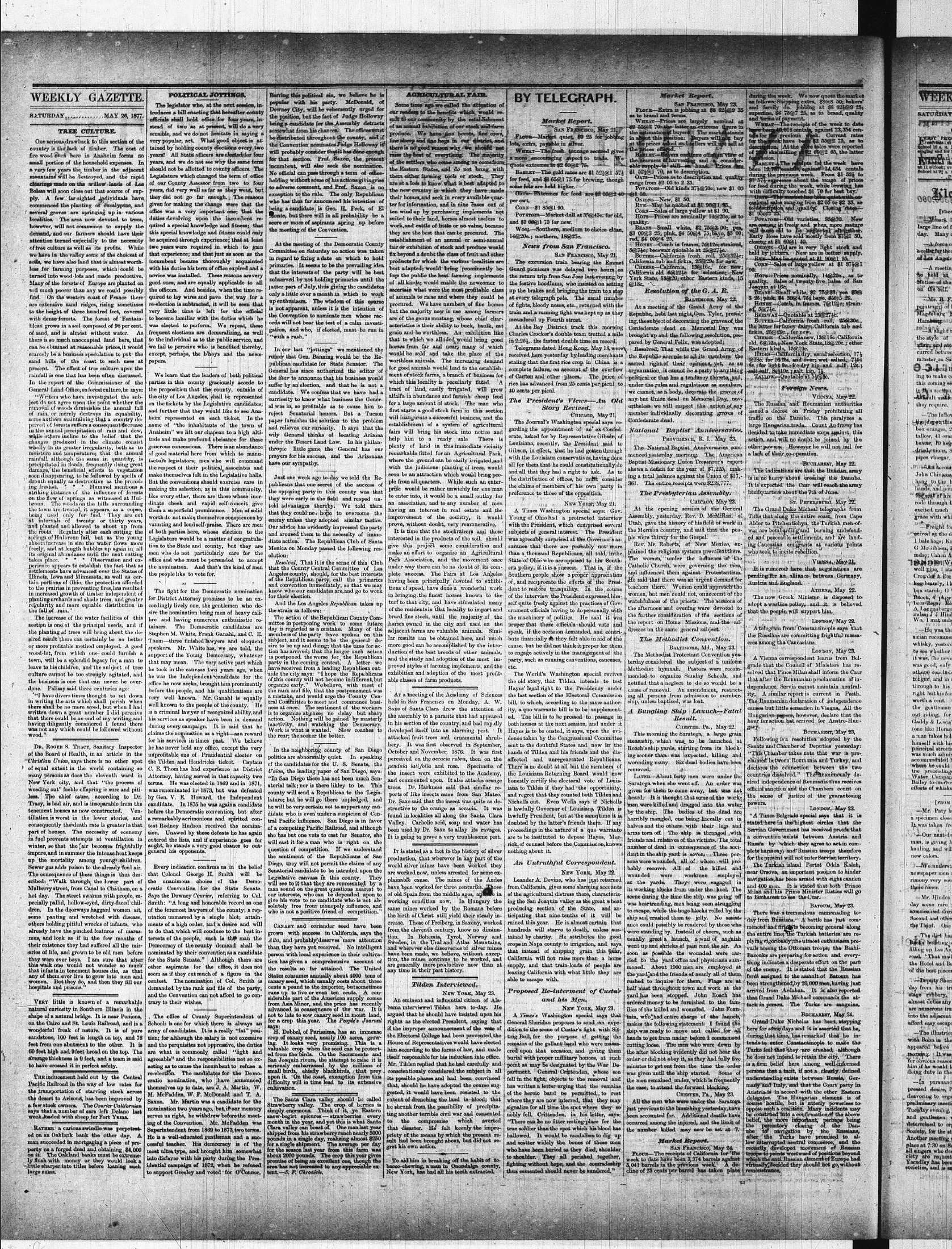
Searchable text
WEEKLY GAZETTE
SATURDAY MAY 26, 1877.
TREE CULTURE
One serious drawback to this section of the country is the lack of timber. The cost of fire wood even here in Anaheim forms no small portion of the household expenses. In a very few years the timber in the adjacent mountains will be destroyed, and the rapid clearings made on the willow lands of Los Bolsas will soon close out that source of supply. A few far-sighted individuals have commenced the planting of eucalyptus, and several groves are springing up in various localities. The area now devoted to trees, however, will not commence to supply the demand, and our farmers should have their attention turned especially to the necessity of tree culture as well as its profits. While we have in the valley some of the choice of soils, we have also land that is almost worthless for farming purposes, which could be turned into wood-lots and made productive. Many of the forests of Europe are planted on soil much poorer than any we could possibly find. On the western coast of France there are extensive sand ridges, rising sometimes to the height of three hundred feet, covered with dense forests. The forest of Fontainbleau grows in a soil composed of 98 per cent. of sand, and is almost without water. As there is so much unoccupied land here, that can be obtained at reasonable prices, it would scarcely be a business speculation to put the sand hills of the coast to such uses at present. The effect of tree culture upon the rainfall is one that has been often discussed. In the report of the Commissioner of the General Land Office, on forest culture, he says:
"Writers who have investigated the subject do not agree upon the point whether the removal of woods diminishes the annual fall of rain, or merely destroys its equability, some authors maintaining that a country deprived of forests suffers a consequent decrease in the annual precipitation of rain and dew, while others incline to the belief that the changes produced in the climate consist wholly in its greater irregularity, both as to moisture and temperature; that the annual rainfall, although the same in quantity, is precipitated in floods, frequently doing great
POLITICAL JOTTINGS,
The legislator who, at the next session, introduces a bill enacting that heresafter county officials shall hold office for four years, instead of two as at present, will do a very sensible, and we do not hesitate in saying a very popular act. What good object is attained by holding county elections every two years? All State officers are elected for four years, and we do not see why the same term should not be allotted to county officers. The Legislature which changed the term of office of our County Assessor from two to four years, did very well as far as they went, but they did not go far enough. The reasons given for making the change were that the office was a very important one; that the duties devolving upon the incumbent required a special knowledge and fitness; that this special knowledge and fitness could only be acquired through experience; that at least two years were required in which to gain that experience; and that just as soon as the incumbent became thoroughly acquainted with his duties his term of office expired and a novice was installed. These reasons are very good ones, and are equally applicable to all the officers. And besides, when the time required to lay wires and pave the way for a re-election is subtracted, it will be seen that very little time is left for the official to become familiar with the duties which he was elected to perform. We repeat, these frequent elections are demoralizing, as well to the individual as to the public service, and we fail to perceive who is benefited thereby, except, perhaps, the b'hoys and the newspapers.
We learn that the leaders of both political parties in this county graciously accede to the proposition that the county, outside of the city of Los Angeles, shall be represented on the tickets by the Legislative candidates; and further that they would like to see Anaheim represented on each ticket. In the name of "the inhabitants of the town of Anaheim" we lift our chapeau to a high altitude and make profound obscenity for these generous concessions. There is an abundance of good material here from which to manufacture legislators; men who will command Barring this political sin, we have popular with his party. Meadow City, will be vehemently opposed to the position, but the fact of Judge being a candidate for the Assembly somewhat from his chances. The district distributed throughout the county Convention nominates Judge Dixon will probably consider that it has done for that section. Prof. Saxon, then incumbent, will also seek the role No official can pass through a term holding without some of his actions to adverse comment, and Prof. Saxon exception to the rule. The only person who has thus far announced his intention being a candidate is Geo. H. Poe Monte, but there will in all probable score or more of aspirants spring up in enthusiasm. The wisdom of this is not apparent, unless it is the intention to nominate menords will not bear the test of a campaign, and who, if elected, must "with a rush."
In our last "jotnings" we mention that Gen. Banning would be publican candidate for State Senate General has since authorized that Star to announce that his business suffer by an election, and that he candidate. We confess that we curriosity to know what business was in, so profitable as to cannot reject Senatorial honors. But paper furnishes the solution to this and relieves our curiosity. It says wisely General thinks of location under the Desert Land Law. In thropic little game the Generals prayers for his success, and they have our sympathy.
The effect of tree culture upon the rainfall is one that has been often discussed.
In the report of the Commissioner of the General Land Office, on forest culture, he says:
"Writers who have investigated the subject do not agree upon the point whether the removal of woods diminishes the annual fall of rain, or merely destroys its equability, some authors maintaining that a country deprived of forests suffers a consequent decrease in the annual precipitation of rain and dew, while others incline to the belief that the changes produced in the climate consist wholly in its greater irregularity, both as to moisture and temperature; that the annual rainfall, although the same in quantity, is precipitated in floods, frequently doing great damage, the beneficial effects to vegetation soon disappearing, to be followed by spells of drought equally as destructive as the preceding freshet.
Hummel mentions a striking instance of the influence of forests on the flow of springs as witnessed at Hulbroun. The woods on the hills surrounding the town are treated, it appears, as a copse, being used only for fuel. They are cut at intervals of twenty or thirty years, and planted and allowed to shoot up from the roots. Regularly after each cutting the springs of Hulbroun fail, but as the young shoots increase in size the water flows more freely, and at length bubbles up again in all its original abundance until the next cutting takes place.
Observation and experience appear to establish the fact that as settlements have advanced over the States of Illinois, Iowa and Minnesota, as well as certain portions of Ohio, the protection afforded to the prairies in preventing fires, has resulted in increased growth of timber independent of planting orchards and shade trees, and greater regularity and more equable distribution in the fall of rain."
The increase of the water facilities of this section is one of the principal needs, and if the planting of trees will bring about the desired result there can certainly be no better or more profitable method employed. A good wood-lot, from which one could furnish a town, will be a splendid legacy for a man to leave to his children, and the subject of tree culture cannot be too strongly agitated, and the business is one that can never be overdone. Palissy said three centuries ago:
"I have divers times thought to set down in writing the arts which shall perish when there shall be no more wood, but when I had written down a great number I did perceive that there could be no end of my writing, and having diligently considered I found there was not any which could be followed without wood."
Dr. Rooger S. Tracy, Sanitary Inspector of the Board of Health, in an article in the Christian Union, says there is no other spot of equal extent in the world containing so many persons as does the eleventh ward in New York city, and that "the process of weeding out" feeble offspring is sure and pitiless. The chief cause, according to Dr. Tracy, is bad air, and is inseparable from the tenement houses as now constructed. Ventilation is worst in the lower stories, and consequently the death rate is greater in that part of houses. The necessity of economy in fuel prevents attempts at ventilation in winter, so that the fair becomes frightfully impure, and in summer the intense heat keeps up the mortality among young children. Sewer gas adds poison to the already foul air. The consequence of these things is thus described: "Walk through the lower part of
We learn that the leaders of both political parties in this county graciously accede to the proposition that the county, outside of the city of Los Angeles, shall be represented on the tickets by the Legislative candidates; and further that they would like to see Anaheim represented on each ticket. In the name of "the inhabitants of the town of Anaheim" we lift our chapeau to a high altitude and make profound obeisance for these generous concessions. There is an abundance of good material here from which to manufacture legislators; men who will command the respect of their political associates and make themselves felt in the Legislative halls.
But the conventions should exercise care in making the selection; as in this community, like every other, there are those whoseordinate cheek and vapid self-conceit give them a superficial prominence. Men of solid worth do not make themselves conspicuous by vaunting and loud self-praise. There are men of both parties here, whose election to the Legislature would be a matter of congratulation to the State and county, but they are men who do not particularly care for the office and who must be persuaded to accept the nomination. And that's the kind of men the people like to vote for.
The fight for the Democratic nomination for District Attorney promises to be an exceedingly lively one, the gentlemen who desire the nomination being men of heavy calibre and having numerous enthusiastic retainers. The Democratic candidates are Stephen M. White, Frank Ganahl, and C. E. Thom—three finished lawyers and eloquent speakers. Mr. White has, we are told, the support of the Young Democracy, whatever that may mean. The very active part which he took in canvass two years ago, when he was the Independent candidate for the office he now seeks, brought him prominently before the people, and his qualifications are very well known. Mr. Ganahl is equally well known to the people of the county. He is a criminal lawyer of recognized ability,and his services as speaker have been in demand during every campaign. It is said that he claims the nomination as a right—aas reward for his services in times past. We believe he has never held any office, except the very unproficient one of Presidential elector on the Tilden and Hendricks ticket. Captain C. E. Thom has had experience as District Attorney, having served in that capacity two terms. He was elected in 1869 and in 1871, was renominated in 1873, but was defeated by Gen. V. E. Howard, the Independent candidate. In 1875 he was again a candidate before the Democratic convention, but after a remarkably acrimonious and spirited contest Rodney Hudson received the nomination. Unawed by these defeats he has again entered the lists, and if experience goes for aught, he stands a very good chance to out-general his opponents.
Every indication confirms us in the belief that Colonel George H. Smith will be the unanimous choice of the Demo-
General has since authorized them to be Star to announce that his business suffer by an election, and that he candidate. We confess that we curriosity know what business was in, so profitable as to cannot reject Senatorial honors. But paper furnishes the solution to their relieves our curiosity. It says wily General thinks of locating under the Desert Land Law. In thropic little game the General prayers for his success, and they have our sympathy.
Just one week ago to-day we told publicans that one secret of the opposing party in this county they were early in the field and told advantages thereby. We say that they could no hope to overcome enemy unless they adopted similar Our advice has evidently impressed and aroused them to the necessity diate action. The Republican Club Monica on Monday passed the foliution:
Resolved That it is the sense of that the County Central Committee Angeles county, should for the best of the Republican party, call them and convention immediately, so that know who our candidates are,and for their election.
And the Los Angeles Republican strain as follows:
The action of the Republican Committee in postponing work to soon day is regarded as a mistake.Main members of the party have spoken subject,and it seems to be the galeire to be up and doing;that they tion has arrived;that she longer satisfiesthe party in the coming contest.A party have received from a leading Republie side the city says: "I hope the Redof this county will not become indolicate early."Web believewith rank and file,the postponed mistake,and would urgethe Central Committee to meet and commens at once.The sentiment of this is to organize at once;no delay in action.Nothing will be gained byinactivity,and watchingthe DWork is what is wanted.Slow owethe rear;the soonerthe better.
In the neighboring county of South politics are abnormally quiet.In.ofthe candidates for U.S.SeniorUnion,theleadingpaperofSanDia-"InSanDiegotherehasnotbeenmaterialtalk;noristhere likleyto县委will sendARepublicantoLiature;buthewill go thereunpledihilewillbeverycertainnottosupportdidatewhoisevenunderasuspicioustralPacificinfluence.SanDiegoofacompetingPacificRailroad,andshehasbutonevotetocastforSandwillcastitforamanwhoisrightquestionofcompetition.IwerethesentimentoftheRepublicanDiego,theyllnotpermittheclaiSenatorialcandidatetobeintrudedLegislativecanvasinthiscountywillseeitthosehaveoursympathy.
NEW YORK city, and that the process of weeding out "feeble offspring is sure and pitiless. The chief cause, according to Dr. Tracy, is bad air, and is inseparable from the tenement houses as now constructed. Ventilation is worst in the lower stories, and consequently the death rate is greater in that part of houses. The necessity of economy in fuel prevents attempts at ventilation in winter, so that the fair becomes frightfully impure, and in summer the intense heat keeps up the mortality among young children. Sewer gas adds poison to the already foul air. The consequence of these things is thus described: "Walk through the lower part of Mulberry street, from Canal to Chatham, on a hot day. The street swarms with people, especially pallid, hollow-eyed, dirty-faced children. In the doorways haggard women sit, some panting and wretched with disease, others holding pitiful wrecks of infants, who already have the pinched features of marasmus, and look as if in the few months of their existence they had suffered all the miseries of life, and grown to be old men before they were ever boys. I am sure that after this walk one would not wonder so much that infants in tenement houses die, as that any of them ever live to grow into men and women. But they do, and then they fill our hospitals and prisons."
VERY little is known of a remarkable natural curiosity in Southern Illinois in the shape of a natural bridge. It is near Pomona, on the Cairo and St. Louis Railroad, and is a wonderful freak of nature. It is of pure sandstone, 100 feet in length on top, and 76 feet from one abutment to the other. It is 60 feet high and 9 feet broad on the top. The average thickness is 9 feet, and a team is said to have crossed it in perfect safety.
The inducement held out by the Central Pacific Railroad in the way of low rates for the transportation of starving stock across the desert to Arizona, has been improved by a few stock owners. The Courier California says that a number of ears left Delano last week loaded with sheep for Fort Yuma.
RATHER a curious swindle was perpetrated on an Oaklank bank the other day. A man succeeded in mortgaging a piece of property on a forged deed and obtaining $4,000 on it. The Oakland banks must be extremely flush with money or they would look a little sharper into titles before loaning such large sums.
Every indication confirms us in the belief that Colonel George H. Smith will be the unanimous choice of the Democratic Convention for the State Senate. Says the Downey Courier, referring to Col. Smith: "A long and honorable record as one of the foremost lawyers of the county; a reputation unmarred by a single blot; attainments of a high order, and a desire and will to do that which will conduce to the best interests of the people, such is the man the Democracy of the county demand shall be nominated by their convention as a candidate for the State Senate." Although there are other aspirants for the office, it does not seem as if they cut much of a figure in the contest. The nomination of Col. Smith is demanded by the rank and file of the party, and the Convention can not afford to go contrary to their wishes.
The office of County Superintendent of Schools is one for which there is always an army of candidates. It is a really "fat" position; for although the salary is not excessive and the perquisites not oppressive, the duties are what is commonly called "light and agreeable" and the responsibilities not so exacting as to cause the incumbent to refuse a re-election. The candidates for the Democratic nomination, who have announced themselves up to date, are J. A. Martin, W. M. McFadden, W. P. McDonald and T. A. Saxon. Mr. Martin was a candidate for the nomination two years ago, but, if our memory serves us right, he withdrew before the meeting of the Convention. Mr. McFadden was Superintendent from 1869 to 1873, two terms. He is a well-educated gentleman and a successful teacher. His democracy is of the most ultra type, and brought him somewhat into disfavor with his party during the Presidential campaign of 1872, when he refused to support Greeley and voted for O'Connor.
Every indication confirms us in the belief that Colonel George H. Smith will be the unanimous choice of the Democratic Convention for the State Senate. Says the Downey Courier, referring to Col. Smith: "A long and honorable record as one of the foremost lawyers of the county; a reputation unmarred by a single blot; attainments of a high order, and a desire and will to do that which will conduce to the best interests of the people, such is the man the Democracy of the county demand shall be nominated by their convention as a candidate for the State Senate." Although there are other aspirants for the office, it does not seem as if they cut much of a figure in the contest. The nomination of Col. Smith is demanded by the rank and file of the party, and the Convention can not afford to go contrary to their wishes.
The office of County Superintendent of Schools is one for which there is always an army of candidates. It is a really "fat" position; for although the salary is not excessive and the perquisites not oppressive, the duties are what is commonly called "light and agreeable" and the responsibilities not so exacting as to cause the incumbent to refuse a re-election. The candidates for the Democratic nomination, who have announced themselves up to date, are J. A. Martin, W. M. McFadden, W. P. McDonald and T. A. Saxon. Mr. Martin was a candidate for the nomination two years ago, but, if our memory serves us right, he withdrew before the meeting of the Convention. Mr. McFadden was Superintendent from 1869 to 1873, two terms. He is a well-educated gentleman and a successful teacher. His democracy is of the most ultra type, and brought him somewhat into disfavor with his party during the Presidential campaign of 1872, when he refused to support Greeley and voted for O'Connor.
The office of County Superintendent of Schools is one for which there is always an army of candidates. It is a really "fat" position; for although the salary is not excessive and the perquisites not oppressive, the duties are what is commonly called "light and agreeable" and the responsibilities not so exacting as to cause the incumbent to refuse a re-election. The candidates for the Democratic nomination, who have announced themselves up to date, are J. A. Martin, W. M. McFadden, W. P. McDonald and T. A. Saxon. Mr. Martin was a candidate for the nomination two years ago, but, if our memory serves us right, he withdrew before the meeting of the Convention. Mr. McFadden was Superintendent from 1869 to 1873, two terms. He is a well-educated gentleman and a successful teacher. His democracy is of the most ultra type, and brought him somewhat into disfavor with his party during the Presidential campaign of 1872, when he refused to support Greeley and voted for O'Connor.
The office of County Superintendent of Schools is one for which there is always an army of candidates. It is a really "fat" position; for although the salary is not excessive and the perquisites not oppressive, the duties are what is commonly called "light and agreeable" and the responsibilities not so exacting as to cause the incumbent to refuse a re-election. The candidates for the Democratic nomination, who have announced themselves up to date, are J. A. Martin, W. M. McFadden, W. P. McDonald and T. A. Saxon. Mr. Martin was a candidate for the nomination two years ago, but, if our memory serves us right, he withdrew before the meeting of the Convention. Mr. McFadden was Superintendent from 1869 to 1873, two terms. He is a well-educated gentleman and a successful teacher. His democracy is of the most ultra type, and brought him somewhat into disfavor with his party during the Presidential campaign of 1872, when he refused to support Greeley and voted for O'Connor.
The office of County Superintendent of Schools is one for which there is always an army of candidates. It is a really "fat" position; for although the salary is not excessive and the perquisites not oppressive, the duties are what is commonly called "light and agreeable" and the responsibilities not so exacting as to cause the incumbent to refuse a re-election. The candidates for the Democratic nomination, who have announced themselves up to date, are J. A. Martin, W. M. McFadden, W. P. McDonald and T. A. Saxon. Mr. Martin was a candidate for the nomination two years ago, but, if our memory serves us right, he withdrew before the meeting of the Convention. Mr. McFadden was Superintendent from 1869 to 1873, two terms. He is a well-educated gentleman and a successful teacher His democracy is of the most ultra type, and brought him somewhat into disfavor with his party during the Presidential campaign of 1872, when he refused to support Greeley and voted for O'Connor.
The office of County Superintendent of Schools is one for which there is always an army of candidates. It is a really "fat" position; for although the salary is not excessive and the perquisites not oppressive, the duties are what is commonly called "light and agreeable" and the responsibilities not so exacting as to cause the incumbent to refuse a re-election. The candidates for the Democratic nomination, who have announced themselves up to date, are J. A. Martin, W. M. McFadden, W. P. McDonald and T. A. SaxonMr. Martin was a candidate forthe nomination two years ago butif our memory serves us right,their involvement in time lead to its cultivation.
The Santa Clara valley should be Strawberry valley.The crop of canary seed,nasally enormous.Tinkofit,yellow-begogi epicures-strawberry month inthe year,and yetthisiswherClara valley can boast.ofOne man shippedfromhis strawberry ranchn poundsina single day,réalizing alfora single shipment.The averageforthe season last yearfromthisabout2000pounds.The cropthispromiseofbeinganexcellentone,treasureshasnotincreasedtoanyappreciation.-S.P.Chrondale
During this political air, we believe he is similar with his party. McDonald, of Norway City, will be vehemently urged for position, but the fact of Judge Holloway being a candidate for the Assembly detracts what from his chances. The offices must be distributed throughout the county, and if Convention nominates Judge Holloway it probably consider that it has done enough that section. Prof. Saxon, the present ambent, will also seek the nomination. Official can pass through a term of office without some of his actions giving rise to adverse comment, and Prof. Saxon is no exception to the rule. The only Republican has thus far announced his intention of being a candidate is Geo. H. Peck, of Elate, but there will in all probability be a more or less aspirant spring up before meeting of the Convention.
At the meeting of the Democratic County committee on Saturday no action was taken regard to fixing a date on which to hold nominations. It seems to be the prevailing idea the interests of the party will be best served by not holding primaries until the next part of July, thus giving the candidates a little over a month in which to work enthusiasm. The wisdom of this course not apparent, unless it is the intention of Convention to nominate men whose recalls will not bear the test of a calm investigation, and who, if elected, must be run in with a rush."
In our last "jottings" we mentioned the story that Gen. Banning would be the Redelegant candidate for State Senator. The general has since authorized the editor of Star to announce that his business would be by an election, and that he is not a candidate. We confess that we have had a priority to know what business the General is in, so profitable as to cause him to act Senatorial honors. But a Tucson farmer furnishes the solution to the problem relieves our curiosity. It says that the General thinks of locating Arizona over the Desert Land Law. In his philanthropic little game the General has our farmers for his success, and the Arizonans are our sympathy.
AGRICULTURAL FAIR
Some time ago we called the attention of our readers to the benefits which would result to our community by the establishment of an annual exhibition of our stock and farm produce. We have fine horses, fine cows, fine sheep and fine hogs in our district, and there is no good reason why we should not raise the best of everything. The majority of the settlers who come among us come from the Eastern States, and do not bring with them either farming tools or stock. They are at a loss to know what is best adapted to the new country in which they have made their homes, and seek in every available quarter for information, and in nine cases out of ten wind up by purchasing implements not suited to their land, horses almost useless to work, and cattle of little or no value, because they are the best that can be procured. The establishment of an annual or semi-annual fair or exhibition of stock and produce would fix beyond a doubt the class of fruit and other products for which the various localities are best adapted; would bring prominently before the public the best farming implements of all kinds; would enable the newcomer to ascertain what were the most profitable class of animals to raise and where could be procured. We have numbers of fine horses but the majority now in use among farmers are of the genus mustang, whose chief characteristics is their ability to buck, banlk, eat grain and be worthless. An exhibition like that to which we alluded would bring good horses from far and near, many of which would be sold and take the place of the worthless animals. The increasing demand for good animals would lead to the establishment of stock farms, a branch of business for which this locality is peculiarly fitted. A tract of land, easily irrigated, will grow alfalfa in abundance and furnish cheap feed for a large amount of stock. The man who first starts a good stock farm in this section will inaugurate a successful business, and the establishment of a system of agricultural fairs will bring his stock into notice and help him to a ready sale. There is plenty of land in this immediate vicinity remarkable fitted for an Agricultural Park, where the ground can be easily irrigated,and
BY TELEGRAPH.
Market Report.
SAN FRANCISCO, May 21.
FLOUR—Market quiet, $9 25 for jobbing lots, extra payable in silver.
WHEAT—The fresh tonnage secured gives a more encouraging aspect to trade. We quote extremes at $2 60@2 75.
BARLEY—The gold rates are $1 521@1 573 for feed, and $1 65@1 75 for brewing, though some lots are held higher.
OATS—Extremes for feed are $2 05@2 40 per cwt.
CORN—$1 85@1 90.
POTATOES—Market dall at 35@45c: for old, and $1 00@1 75 for new.
WOOL—Southern, medium to choice clean, 14@20c.; northern, 18@27c.
News from San Francisco.
SAN FRANCISCO, May 21.
The excursion train bearing the Emmet Guard picnicers was delayed two hours on the return trip from San Jose last evening by the festive hoodlums, who insisted on setting up the brakes and bringing the train to a stop at every telegraph pole. The usual number of fights, bloody noses, etc., returned with the train and a running fight was kept up as they meandered up Fourth street.
At the Bay District track this morning Charles Crocker's double team trotted a mile in 2:26], the fastest double time on record.
Telegrams dated Hong Kong, May 18, were received here yesterday by leading merchants staining that the first rice crop in China is a complete failure, on account of the overflow of Cairton and other places. The price of rice has advanced from 25 cents per picaI to 40 cents per picul.
The President's Views—An Old Story Revived.
CHICAGO, May 21.
The Journal's Washington special says regarding the appointment of an ex-Confederate, asked for by Representative Gibson, of Louisiana, recently, the President said to Gibson, in effect, that he had gotten through with the Louisiana conservatives, having done all for them that he could constitutionally do.
Martha
FLOUR—Extra as to brand and thie WHEAT—Price $2 55@2 70s share the estimation of about this price at the prices asked by Barley—the inearness of his able supply as $1 52@1 70s as OATS—Prices range from $2 05 Potatoes—Old $1 50.
ONIONS—New,
RYE—May be
CORN—Sales ol' HOPS—Prices al' quality.
BRANS—Small $3 00@3 25; pint red $4 00@4 25;
HONEY—Combined $574c; beeswax at BUTTER—California tub and CHEESE—California old York State, 18@28 @18c.
Resolution
At a meeting o Republic, held last ing,the subject o Confederate dea brought up and tha paired by Generalal Resolved That tho Republic acceded sacred right o organization, it can political or that h under the rules ar we cannot as a b any but Union d ertealth we will member individual Confederate dead National Boar
PRO
The National De mented yesterday Baptist Missionary
General has since authorized the editor of Star to announce that his business would run by an election, and that he is not a candidate. We confess that we have had aiosity to know what business the Generals in, so profitable as to cause him to test Senatorial honors. But a Tucson firm furnishes the solution to the problem that relieves our curiosity. It says that the General thinks of locating Arizona over the Desert Land Law. In his philanthropic little game the General has our writers for his success, and the Arizonans our sympathy.
Last one week ago to-day we told the Republicans that one secret of the success of opposing party in this county was that they were early in the field and reaped unanticipated thereby. We told them they could no hope to overcome the enemy unless they adopted similar tactics. Advice has evidently impressed the party aroused them to the necessity of immediate action. The Republican Club of Santa Ana on Monday passed the following resolution:
Resolved, That it is the sense of this Club at the County Central Committee of Los Angeles county, should for the best interests of the Republican party, call the primaries convention immediately, so that we may why our candidates are, and go to work their election.
And the Los Angeles Republican takes up strain as follows:
The action of the Republican County Conference in postponing work to some future is regarded as a mistake. Many of the members of the party have spoken on this sect, and it seems to be the general doctrine to be up and doing; that the time for accohes arrived; that the longer such action postponed, the worse for the Republican party in the coming contest. A letter we received from a leading Republican outspoken city says: "I hope the Republicans this county will not become indifferent, but忍ize early." Web believe, with most of bank and file, that the postponement was stake, and would urge the County Cen-Committee to meet and commence business once. The sentiment of the workers organize at price; no delay but sharp action. Nothing will be gained by masterly activity, and watching the Democracy. Is what is wanted. Slow coaches to rear; the sooner the better.
In the neighboring county of San Diego critics are abnormally quiet. In speaking to the candidates for the U. S. Senate, the nomin, the leading paper of San Diego, says: San Diego there has not been much Senal talk; nor is there likley to be. This city will send a Republican to the Legislature; but he will go there unpledged, and will be very certain not to support any cante who is even under a suspicion of Cen-Pacific influence. San Diego is in favor competing Pacific Railroad, and although but one vote to cast for Senator, she cast it for a man who is right on the notion of competition. If we understand sentiment of the Republicans of San Diego, they will not permit the claims of any historial candidate to be intruded upon the relative canvass in this county. They are confident that if they are persecuted by good animals would lead to the establishment of stock farms, a branch of business for which this locality is peculiarly fitted. A tract of land, easily irrigated, will grow alfalfa in abundance and furnish cheap feed for a large amount of stock. The man who first starts a good stock farm in this section will inaugurate a successful business, and the establishment of a system of agricultural fairs will bring his stock into notice and help him to a ready sale. There is plenty of land in this immediate vicinity remarkable fitted for an Agricultural Park, where the ground can be easily irrigated, and with the judicious planting of trees, would soon be an attraction which would bring people from all quarters. While such an enterprise would be rather unwieldy for one man to enter into, it would be a small outlay for an association, and to any number of men having an interest in real estate and the improvement of the country, it would prove, without doubt, very remunerative.
It is time that the stockraizers and those interested in the products of the soil, should give this project some consideration and make an effort to organize an Agricultural Park Association, and the movement once under way there can be no doubt of its complete success. The Fairs at Los Angeles having been principally devoted to exhibitions of speed, have done a wonderful work in bringing the finest horses known to the turf to that city, and have stimulated many of the residents in that locality to import and breed fine stock, until the majority of the horses owned in the city and used on the adjacent farms are valuable animals. Similar results can be obtained here, and much more good can be accomplished by the introduction of the best breeds of other animals, and the study and adoption of the most improved styles of farming implements, and the exhibition and adoption of the most profitable classes of farm products.
At a meeting of the Academy of Sciences held in San Francisco on Monday, A. W. Saxe of Santa Clara drew the attention of the assembly to a parasite that had appeared in his section of the country, and had rapidly developed itself into an alarming pest. It attacked fruit trees and ornamental shrubbery. It was first observed in September, October and November, 1876. It was first perceived on the accacia rubra, then on the pendula latifolia and rose. Specimens of the insect were exhibited to the Academy, and commented upon. It also attacks orange trees. Dr. Harkness said that similar reports of like insects came from San Mateo. Dr. Saxe said that the insect was quite as destructive to the orange as accacia. It was found in localities all along the Santa Clara Valley. Carbolic acid, soap and water has been used by Dr. Saxe to allay its ravages. It is going to prove a very troublesome pest.
It is stated as a fact in the history of silver production, that wherever in any part of the world silver mines have been worked they are worked now, unless arrested for some explainable cause. The mines of the Andes complete failure; on account of the overflow of Cauten and other places. The price of rice has advanced from 25 cents per picai to 40 cents per picai.
The President's Views—An Old Story Revived.
Chicago, May 21.
The Journal's Washington special says regarding the appointment of an ex-Confederate, asked for by Representative Gibson of Louisiana, recently, the President said to Gibson, in effect, that he had gotten through with the Louisiana conservatives, having done all for them that he could constitutionally do and all that they had a right to ask. As to the distribution of offices, he must consider the claims of members of his own party in preference to those of the opposition.
New York, May 21.
A Times Washington special says: Gov. Young of Ohio had a protracted interview with the President, which comprised several subjects of general interest. The President was agreeably surprised at the Governor's assurance that there are probably not more than a thousand Republicans, all told, inthe State of Ohio who are opposed to his Southern policy, if it is a success. That is, if the Southern people show a proper appreciation of, and reciprocate the efforts of the President to restore tranquility. In the course of the interviewthe President expressed himself quite freely againstthe practices of Government officials having to do personally withthe machineryof politics.He said it was proper that these officials should vote and speak, ifthe occasion demanded,and contribute financially as they felt able in aid ofthe cause,but he did not think it proper for themto engage actively inthe managementofthe party,such as running conventions,caucuses,etc.
The World's Washington special revivesthe old storythat Tilden intendsto test Hayes' legal righttothe Presidencyunderthe last sectionofthe Electoral Commissionbill,towhichaccordingtothe sameauthority,a quo warranto billistobe supplemented.The billistobe pressedto passagein bothhousesatthenextsession,andundertHayesistobeousted.itsays.upontheevidencetakenbytheCongressionalCommittee senttothedoubtfulStatesandnowinthehandsofTildenandhisfriendsandthedisaffectedandunregeneratedRepublicans.Thereisno doubtatallbutthemembersoftheLouisianaReturnBoardwouldnow honestlycertifytheelectoralvoteofLouisianaTildeniftheyhadtheopportunity,andregretthattheycountbothTildenandNichollsout.EvenWellssaysifNichollsislawfullyGovernorofLouisianaTildenislawfullyPresident,butatthesametimeitisdoubtedbythelatter'sfriendsthere.IffanyproceedingsinthenatureofaquowarrantoaretobeinstituetedtodeposeHayes,MerrickofcounselbeforetheCommissionknowsnothingaboutit.
An Untruthful Correspondent.
New York, May 22.
Leander A. Devine, who has just returned
AttheopeningAssembly,yesterdayUtah,gavethehimandtheMormoncountrieswerethirstyforRev.Mr.RobertplainedthereligionThewomen,nuncatholicChurch,andinfluencedthanHe saidthatthereteachersthere.womenbutmenwatchfulnessoftheafternoonandthefurtherconsiderethereportOnHourdressesonthesame.
TheMethodB
The MethodistterdayconsideredMethodisthymn,mendednotifiedthatanegicalcauseofremovalingallpersonsfromship.unlessbaptise
A Bungling S
This morning therestaurantwhichRoach'sshipyardingsoonerthanwoundingmanyremoved.
LATER—AboutSaratogawhenshgivenforthemtobeard。它isthoughtmenwerekilledandbythe ship.Thehorriblymangled,halvesandtheotherarmsturnoff.Thefriendsandrelativenumberofdeadindentintheshipyearsonwounderedbablyrecover.woundedweretheard。
cal talk; nor is there likley to be. This city will send a Republican to the Legislature; but he will go there unpledged, and will be very certain not to support any candidate who is even under a suspicion of Con-Pacific influence. San Diego is in favor of competing Pacific Railroad, and although has but one vote to cast for Senator, she cast it for a man who is right on the motion of competition. If we understand sentiment of the Republicans of San Diego, they will not permit the claims of any historical candidate to be intruded upon the relative canvass in this county. They see to it that they are represented by a sound on the great questions nearest to interests, who can be depended upon to his vote to no candidate who is not abolished free from monopoly influence, and is not a positive friend of competition."
An arary and coriandar seed have been grown with success in California, says the writer, and probably deserves more attention they have yet received. No intelligent opinion with local experience in their cultivation has given a comprehensive account of results so far attained. The United States consumes annually about 4000 tons of arary seed, which usually costs about three cents a pound to the importer, but sometimes up to five or even ten cents. A considerable part of the American supply comes from Asia Minor, and the price has recently increased in consequence of the war. It is too late to sow canary seed in moist land, crop this year. The People's Journal Dobbel, of Purissima, has an immense stock of canary seed, nearly 100 acres, growing. It looks very promising. This is a valuable crop when the seed can be protected from the birds. On the Sacramento and Joaquin rivers, the attempt to raise it is usually embarrassed by the millions of bird species, chiefly blackbirds, that prey on it. On the coast, exemption from thisulty will in time lead to its extensive invation.
The Santa Clara valley should be called strawberry valley. The crop of berries is highly enormous. Think of it, ye Eastern-begit epicures — strawberries every inch in the year, and yet this is what Santa Clara valley can boast of. One man last year seed from his strawberry ranch nearly 5000 yards in a single day, realizing almost $250 single shipment. The average per day the season last year from this farm was 2000 pounds. The crop this year gives rise of being an excellent one, though the harvest has not increased to any appreciable extent.
Dr. Harkness said that similar reports of like insects came from San Mateo. Dr. Saxe said that the insect was quite as destructive to the orange as accacia. It was found in localities all along the Santa Clara Valley. Carbolic acid, soap and water has been used by Dr. Saxe to allay its ravages. It is going to prove a very troublesome pest.
It is stated as a fact in the history of silver production, that wherever in any part of the world silver mines have been worked they are worked now, unless arrested for some explainable cause. The mines of the Andes have been worked for three centuries. Those of old Spain from the middle ages, and since working condition now. In Hungary the same mines worked by the Romans before the birth of Christ still yield their steady increase. Those of Freiberg, in Saxony, worked from the eleventh century, know no diminution. In Bohemia, Tyrol, Norway and Sweden, in the Ural and Atlas Mountains, and wherever else discoveries of silver mines have been made, we believe, without exception, the mines continue to be worked, and are generally more productive now than at any time in their past history.
Tilden Interviewed.
NEW YORK, May 23.
An eminent and influential citizen of Alabama interviewed Tilden here to-day. He argued that he should have insisted upon his rights as the elected President, saying that if the improper announcement of the vote of the Electoral College had been prevented, the House of Representatives would have elected him according to the forms of law, and made itself responsible for his induction into office. Mr. Tilden replied that he had carefully and conscientiously considered the subject in all its possible phases and had been convinced that, should he have adopted the course suggested, it would have been resisted to the extent of drenching the land in blood; that he shrunk from the possibility of precipitating another terrible civil war and consented to the compromise which averted that disaster. He felt keenly the impropriety of the means by which the present result had been brought about, but did not regret his own action.
To aid him in breaking off the habit of tobacco-chewing, a man in Onondalga county, New York, has had all his teeth extracted.
An Untruthful Correspondent.
NEW YORK, May 22.
Leander A. Devine, who has just returned from California, gives some alarming accounts of the agricultural distress there, characterizing the San Joaquin valley as the great wheat producing section of the State, and anticipating that nine-tenths of it will be ruined this year. He is almost certain that hundreds will starve to death, unless sustained by charity. He attributes the good crops in Napa county to irrigation, and says that instead of shipping grain this year, California will not raise more than a home supply, and that train-loads of people are leaving California with what little they are able to escape with.
Proposed Re-interment of Custair and his Men.
NEW YORK, May 21.
A Times's Washington special says that General Sheridan proposes to send an expedition to the scene of Custair's fight with Sitting Bull, for the purpose of getting the remains of the gallant band who were massacred upon that occasion, and giving them burial with proper military honors, at such point as may be designated by the War Department. General Crittenden, whose son fell in the fight, objects to the removal and has written a letter urging that the remains of the heroic band be permitted, to rest where they are now interred, that they may signalize for all time the spot where they so nobly fell. Crittenden, in his letter says: "There can be no fitter resting-place for the true soldier than the spot which his blood has hallowed. It would be vandalism to dig up and scatter widely the bones of those men who have been buried as they died, shoulder to shoulder. They all perished together, fighting without hope, and the contradiship thus cemented should never be sundered."
Market Report.
SAN FRANCISCO, May 23.
Flour—Extra is jobbing at $8 621@9 35 as to brand and terms.
Wheat—Prices are largely nominal at $2 552 70; the latter an extreme figure in the estimation of buyers. The market stands in about this position: Buyers will not buy at the prices asked and sellers will not sell at the prices offered.
Bakery—Buyers continue office in view of the narrowness of harvesting and a considerable supply in still on hand. Prices are $1 521@1 70, as to description.
Oats—Prices as to description and quality range from $2 05 to 2 35.
Potatoes—Old kinds 371@70c; new $1 00 @1 50.
Onions—New, $1 50.
Rye—May be quaked at $1 90@1 85.
Corn—Sales of large yellow at $1 90.
Hops—Prices are nominally 14@20c, as to quality.
Beans—Small white, $2 75@3 00; pea, $3 00@3 25; pink, $4 50@4 75; bayo, $5 00; red, $4 00@4 25.
Honey—Comb in frames, 7@12c; strained, 5@74c; beeswax quotable at 25@27c.
Butter—California fresh roll, 25@32c; California tub and firkin, 25@29c for new.
Cheese—California, 13@16c, for new; California old 6@12c for selection; New York State, 18@20; other Eastern kinds, 15 @18c.
Resolution of the G. A. R.
BALTIMORE, May 22.
At a meeting of the Grand Army of the Republic, held last night, Gen. Tyler, presiding, the subject of decorating the graves of the Confederate dead on Memorial Day was brought up and the following resolution, prepared by General Felix, was adopted;
Resolved, That while the Grand Army of the Republic accords to all its members the sacred right of their opinions, yet, as an organization, it cannot be a party to anything political or that has a tendency thereto, and under the rules and regulations as members, we cannot, as a body, decorate the graves of any but Union dead on Memorial Day, northeless we will respect the action of any member individually decorating graves of Confederate dead.
National Baptist Anniversaries.
PROVIDENCE, R. I., May 23.
The National Baptist Anniversaries commenced yesterday morning. The American Baptist Missionary Union Treasurer's report during the week. We now quote the market as follows: Shipping extra, $8@8 50; bakers' and family do, jobbing at $8 621@9 25; superfine, $6 75@7 25, as to brand, quality and terms of payment.
Wharf—the receipts of the week to date have been 40,016 centsals against 23,354 centsals for the previous week. Current rates for the week have been $2 55@2 75, as to description. At the close sales were reported of 230 skins milling at $2 60@2 65, the latter for voice.
Barley—The receipts for the week have been 12,767 centsals against 14,454 centsals during the previous week. From $1 521 to $1 571 expresses about the range of prices for feed during the week, while brewing has with difficulty touched $1 70 for best bay.
Oats—the market has been quite with occasional sales ranging from $2 05 to $2 35, as to description and quality. Closing rates—$1 05@2 20.
Potatoes—Old varieties, 85@70. New are coming in freely and when more mature will come old to be neglected altogether. Early Rose have sold mostly from $1@1 50, closing at $1 60@1 40.
Onions—Old are in very light stock and held by jobbers. New are in better supply.
Rye—May be quoted at $1 90@1 95.
Corn—Sales of large yellow at $1 87@1 90.
Hops—Prices nominally, 14@20c, as to quality. Sales of twenty-five bales of San Joaquin at 16c.
Beans—Small white, $2 75@83; pea $3@3 25; pink, $4 50@4 75; bayo, $5 00; honey—Comb in frames, 7@12c; strained, 5@74c.
Beeswax—Quotable at 25@27c.
Butter—California fresh roll, 25@30c, the latter for fancy dairy; California tub and firkin, 25@29c, for new.
Cheese—California new, 13@16c; California old, 6@12c; New York State, 18@20c.; other Eastern kinds, 15@19c.
Hides—California dry, usual selection, 17(@18c; for 16 thrs., and over; wet salted, 7(@8c; for light vcs.; for dry kip and calf, 12c.; salt salt, 8@@10c; salt kip, 7l.
Tallow—Quotable at 54@@6c.
Foreign News.
VIENNA, May 22.
The Russian and Roumanian authorities issued a decree on Friday prohibiting all traffic on the Danube. This paralyzes a large Hungarian trade. Count Andrassy has decided to take immediate steps against this action, and will no doubt be joined by the other powers. However he will not fail for a lack of their co-operation.
BUCHAREST, May 22.
National Baptist Anniversaries.
Providence, R.I., May 23.
The National Baptist Anniversaries commenced yesterday morning. The American Baptist Missionary Union Treasurer's report shows a deficit for the year of $7,225, making a total balance against the Union of $17,361. The entire receipts were $238,777.
The Presbyterian Assembly.
Chicago, May 23.
At the opening session of the General Assembly, yesterday, Rev. D. McMillan, of Utah, gave the history of his field of work in the Mormon country, and said that the people were thirsty for the Gospel.
Rev. Mr. Roberts, of New Mexico, explained the religious systems prevalent there. The women, under the influence of the Catholic Church, were governing the men, and influenced them against Protestantism. He said that there was an urgent demand for teachers there. Women could approach the women, but men could not on account of the watchfulness of the priests. The sessions of the afternoon and evening were devoted to the further consideration of the sections of the report on Home Missions, and the addresses on the same general subject.
The Methodist Convention.
Baltimore, Md., May 23.
The Methodist Protestant Convention yesterday considered the subject of a uniform Methodist hymnal. Pastors were recommended to organize Sunday Schools, and notified that a neglect to do so would be a cause of removal. An amendment, restricting all persons from admission to membership, unless baptised, was lost.
A Bungling Ship Launch--Fatal Result.
Chester, Pa., May 22.
This morning the Saratoga, a large grain steamship, which was to be launched at Roach's ship yards, starting from its blocking sooner than was expected, killing and wounding many. Six dead bodies have been removed.
Later—About forty men were under the Saratoga when she went off. An order was given for them to come away, but was not heard. It is thought that some of the workmen were killed and dragged into the water by the ship. The bodies of the dead are horribly mangled, one being literally cut in halves and the others with their legs and arms torn off. The ship is thronged with friends and relatives of the victims. The total number of dead in consequence of the accident in the ship yard is seven. Three persons were wounded, all of whom will probably recover. All of the killed and wounded were workmen employed at the yards. There were engaged in salt self, schloe, salt kip, 71 Tallow-Quotable at 50 Cane.
Foreign News.
Vienna, May 22.
The Russian and Roumanian authorities issued a decree on Friday prohibiting all traffic on the Danube. This paralyzes a large Hungarian trade. Count Andrassy has decided to take immediate steps against this action, and will no doubt be joined by the other powers. However he will not tail for a lack of their co-operation.
Bucharest, May 22.
The indications are that the Russian army is in no hurry about crossing the Danube. It is expected the Czar will reach the army headquarters about the 7th of June.
St. Petersburg, May 22.
The Grand Duke Micheal telegraphs from Tillis that along the entire coast, from Cape Alder to Pitchentichyn, the Turkish men-of-war are bombarding and burning undefended and peaceable settlements, and are landing Caucasian immigrants at various points who seek to incite rebellion.
Vienna, May 21.
It is rumored here that negotiations are pending for an alliance between Germany, Austria and England.
Athena, May 22.
The now Greek Minister is disposed to adopt a warlike policy, and it is believed that the people will support him.
London, May 22.
A telegram from Constantinople says that the Russians are committing frightful massacres among the Caucasians.
London, May 23.
A Vienna correspondent learns from Belgrade that the Council of Ministers has resolved that Pince Milan shall inform the Czar that after the Roumanian proclamation of independence, Servia cannot maintain neutrality. A similar report is current in Peath. The Roumanian declaration of independence causes but little sensation in Vienna. All the Hungarian papers, however, declare that the hour for action hat arrived for Austro-Hungary.
Bucharest, May 23.
Following is a resolution adopted by the Senate and Chamber of Deputies yesterday: "This Chamber takes note that war is proclaimed between Roumania and Turkey, and declares the connection between two countries dissolved." The unanimously desired independence of Roumania thus receives official sanction and the Chambers count on the sense of justice of the guaranteeing powers.
London, May 23.
A Times Belgrade special says that it is stated here in the highest circles that the Servian Government has received proofs that a convention exists between Austria and Russia by which they agree to act in complete harmony; and Russian troops therefore for the present will not enter Servian territory. The Turkish island Fortast Odala Kaleh, near Ormosa, an important position to hinder navigation, has been armed with eight cannon...
Saratoga when she went on. An order was given for them to come away, but was not heard. It is thought that some of the workmen were killed and dragged into the water by the ship. The bodies of the dead are horribly mangled, one being literally cut in halves and the others with their legs and arms torn off. The ship is thronged with friends and relatives of the victims. The total number of dead in consequence of the accident in the ship yard is seven. Three persons were wounded, all of whom will probably recover. All of the killed and wounded were workmen employed at the yards. They were engaged in in working blocks from under the keel. The scene during the time the ship was going off was heartrending, men being seen struggling to escape, while the huge blocks rolled by the ship and crushed them to jelly. No assistance could possibly be rendered by those who were standing by. Instead of cheers, such as usually greet a launch, a wail of anguish went up and shrieks of pain rent the air. As soon as possible the wounded were carried to the yard office and physicians summoned. About 1900 men are employed at the yard and the friends of nearly all of them rushed to inquire for them. Flags are at half mast throughout town and work at the yard has been stopped. John Roach has ordered money to be furnished to the families of the killed and wounded. John Fountain, who had entire charge of the launch, makes the following statement: I found the ship was ready to move and called for all hands to get from under before I commenced cutting loose. The men who were down by the after blocking evidently did not hear the order or did not obey it, as they had fully five minutes to get out from the time the order was given until the ship started. Some of the men remained under, which is frequently the case, to attend the forward blocking.
CHESTER, Pa., May 23.
All the men who were under the Saratoga just previous to the launching yesterday, have been accounted for. Additional deaths have occurred among the injured, and the limit of the number killed may now be set at 7.
Market Report.
SAN FRANCISCO, May 24.
FLOUR—The receipts of California for the week to date have been 3,374 barrels against 5,041 barrels in the previous week. A decline of 25 cents per barrel has taken place official sanction and the Chambers count on the sense of justice of the guaranteeing powers.
LONDON, May 23.
A Times Belgrade special says that it is stated here in the highest circles that the Servian Government has received proofs that a convention exists between Austria and Russia by which they agree to act in complete harmony, and Russian troops therefore for the present will not enter Servian territory.
The Turkish island Fortat Odla Kaleh, near Ornova, an important position to hinder navigation, has been armed with eight cannon and 400 men. It is stated that both Prince Milan and his Prime Minister Risties will go to Bucharest to see the Czar.
BATOUM, May 23.
There was a tremendous cannonading today from Russians. A battle has just commenced and firing is becoming general along the entire line; The Turkish batteries are replying vigorously; the utmost enthusiasm prevails among the Ottoman troops; the Bashi-Bazouks are preparing for action and everything indicates a desperate effort on the part of the enemy. It is stated that the Russian force assigned to the assault of Batoum has been strengthened, by 20,000 men, having just arrived from Arlahan. It is also reported that Grand Duke Michael commands the attack in person. The Turks are sanguine.
BUCHARKET, May 24.
Grand Duke Nicholas has been stopping here for some days and it is asserted that he, during that time, has remarked that he intends to enter Constantinople to make the Turks feel that they are crushed, although he does not intend to retain the city. There is a firm belief here among well-informed persons that a tacit, if not a clearly defined understanding exists between Russia, Germany and Italy, and that the Court party in Austria is in accord with the other Eastern delegates. The Hungarian element is of course hostile, but is utterly powerless to oppose such a coalition. Many incidents may be construed into a confirmation of the above belief, the more important, perhaps being the peremptory closing of the Danube to navigation by the Russians, after the Turks have promised to allow interrupted neutral commerce, and the recently developed movement of Russian troops to points westward of positions beyond which the anti-Russian element of Europe had virtually decided they should not go without remonstrance.