anaheim-gazette 1877-05-26
Scanned page
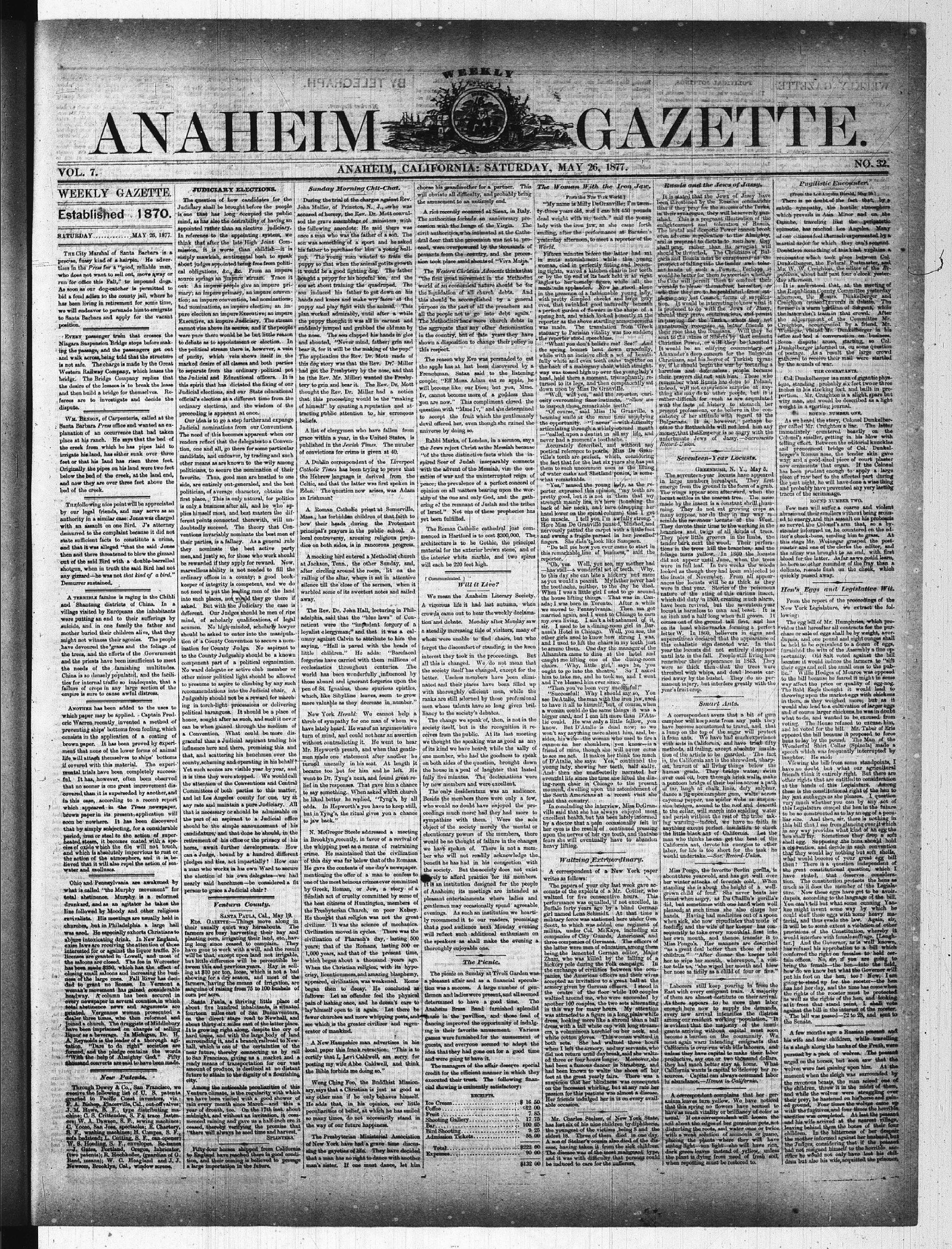
Searchable text
WEEKLY GAZETTE.
Established 1870.
SATURDAY...MAY 26, 1877.
The City Marshal of Santa Barbara is a precise, fussy kind of a hairpin. He advertises in the Press for a "good, reliable man, who does not want to sell out, move away or run for office this Fall," to impound dogs. As soon as our dog-catcher is permitted to bid a fond adieu to the county jail, where he has been living in retirement for some time, we will endeavor to peranade him to emigrate to Santa Barbara and apply for the vacant position.
Every passenger train that crosses the Niagara Suspension Bridge stops before making the passage, and the passengers get out and walk across, being told that the structure is not safe. The charge is made by the Great Western Railway Company, which leases the bridge. The Bridge Company replies that the desire of the lessees is to break the lease and then build a bridge for themselves. Referees are to investigate and decide the dispute.
WM. BENSON, of Carpenteria, called at the Santa Barbara Press office and wanted an explanation of an occurrence that had taken place at his ranch. He says that the bed of the creek from which he has pipes laid to irrigate his land, has either sunk over three feet or that his land has risen three feet.
JUDICIARY ELECTIONS.
The question of how candidates for the Judiciary shall be brought before the people is one that has long occupied the public mind, as has also the desirability of having an appointed rather than an elective judiciary. In reference to the appointing system, we think that after the late High Joint Commission, it is worse than childish—it is simply mawkish, sentimental boast to speak about judges appointed being free from political obligations, &c., &c. From an impure source springs an impure stream. Trace it out: An impure people give an impure primary; an impure primary, an impure convention; an impure convention, bad nominations; bad nominations, an impuro election; an impure election an impure Executive; an impure Executive, an impure Judiciary. The stream cannot rise above its source, and if the people were pure there would be but little reason to debate as to appointment or election. In the political stream there is, however, a vein of purity, which vein shows itself in the marked desire of all classes and both parties to separate from the ordinary political pot the Judicial and Educational officers. It is this spirit that has dictated the fixing of our Judicial elections, and our State educational official's election at a different time from the ordinary elections, and the wisdom of the proceeding is apparent at once.
Our idea is to go a step further and expunge Judicial nominations from our Conventions. The need of this becomes apparent when our readers reflect that the delegates to a Convention, one and all, go there for some particular candidate, and endeavor, by trading and such other means as are known to the wily among Sunday Morning.
During the trial of the John Muller, of Princeton, accused of horray, the sed the grave assembly the following anecdote once a man who was the son was something of his father to purchase the pup. The young man puppy so that when it would be a good fight bought a puppy for his son set about training his father hands and knees and made puppy and play fight with plan worked admirably the puppy thought it would suddenly jumped and piled the nose. The son clapped and shouted, "Never bear it, for it will be the Application the Rev. this dog story was that had got the Presbyterian he (the Rev. Mr. Millery) to grin and bear in thought the Rev. Dr. that this proceeding of himself" by creating tracting public attention beliefs.
A list of clergymen grace within a year, published in the Jewish of convictions for crime.
A Dublin correspondent
Western Railway Company, which leases the bridge. The Bridge Company replies that the desire of the leasees is to break the lease and then build a bridge for themselves. Referees are to investigate and decide the dispute.
Wm. Benson, of Carpenteria, called at the Santa Barbara Press office and wanted an explanation of an occurrence that had taken place at his ranch. He says that the bed of the creek from which he has pipes laid to irrigate his land, has either sunk over three feet or that his land has risen three feet. Originally the pipes on his land were two feet below the bed of the creek, at the land end, and now they are over three feet above the bed of the creek.
The following nice point will be appreciated by our legal friends, and may serve as an authority in a similar case: Jones was charged with an assault on one Bird. J's attorney demurred to the complaint because it did not state sufficient facts to constitute a crime, and that it was alleged "that the said Jones then and there threatened to blow the gizzard out of the said Bird with a double-barrelled shotgun, when in truth the said Bird had not any gizzard—he was not that kind of a bird." Demurrer sustained.
A terrible famine is raging in the Chihli and Shantung districts of China. In a village visited by Europeans the inhabitants were putting an end to their sufferings by suicide, and in one family the father and mother buried their children alive, that they might not witness their agonies. The people have devoured the grass and the foliage of the trees, and the efforts of the Government and the priests have been insufficient to meet the needs of the famishing multitudes. China is so densely populated, and the facilities for internal traffic so inadequate, that a failure of crops in any large section of the empire is sure to cause awful distress.
Another has been added to the uses to which paper may be applied. Captain Frederic Warren recently invented a method of preventing ships' bottoms from fouling, which consists in the application of a coating of brown paper. It has been proved by experiment that none of the lower forms of animal life will attach themselves to ships' bottoms if covered with this material. The experimental trials have been completely successful. It has, however, often been observed that no sooner is one great improvement discovered than it is superseded by another, and in this case, according to a recent report which appeared in the Times newspaper, brown paper in its present application will soon be nowhere. It has been discovered that by simply subjecting, for a considerable period, iron or steel to the action of super-heated steam, it becomes coated with a species of oxide which the tile will not touch, and which is absolutely impervious to rust or the action of the atmosphere, and it is believed that it will also repel the action of seawater and molluses.
Our idea is to go a step further and expunge Judicial nominations from our Conventions. The need of this becomes apparent when our readers reflect that the delegates to a Convention, one and all, go there for some particular candidate, and endeavor, by trading and such other means as are known to the wily among politicians, to secure the nomination of their favorite. Thus, good men are hustled to one side, are entirely out-generaled, and the best politician, of average character, obtains the first place. This is only natural, for politics is only a business after all, and he who applies himself most, and best masters the different points connected therewith, will undoubtedly succeed. The theory that Conventions invariably nominate the best men of their parties, is a fallacy. As a general rule they nominate the best active party men, and justly so, for those who work should be rewarded if they apply for reward. Now, marvellous ability is not needed to fill the ordinary offices in a county; a good bookkeeper of integrity is competent, and we do not need to put the leading men of the land into such places, nor would they go there if asked. But with the Judiciary the case is different. Our Judges should be men of ripe mind, of scholarly qualifications, of legal acumen. No high-minded, scholarly lawyer should be asked to enter into the manipulation of a County Convention to secure a nomination for County Judge. No aspirant to to the County Judgeship should be a known component part of a political organization. No ward delegate or active club member or other minor political light should be allowed to presume to aspire to climbing by any such recommendations into the Judicial chair. A Judgeship should not be a reward for marching in torch-light processes or delivering political harangues. It should be a place of honor, sought after as such, and such it never can be when gained through the medium of a Convention. What could be more disgraceful than a Judicial aspirant trading his influence here and there, promising this and that, and scattering hisenchmen over the county, scheming and operating in his behalf? Yet such scenes are visible year by year, and it is time they were stopped. We would call the attention of the Conventions and Central Committees of both parties to this matter, and let Los Angeles county for one, try at any rate and maintain a pure Judiciary. All that is necessary or should be admissable on the part of an aspirant to a Judicial office should be the simple announcement of his candidature; and that done he should, in the retirement of his office or the privacy of his home, await further developments. How can a Judge, bound by a hundred different pledges and ties, act impartially? How can a man who works in his own Ward to secure the election of his own delegates—we had got the Presbytery he (the Rev. Mr. Mill) tery to grin and bear in thought the Rev. Dr. That this proceeding of himself" by creating tracting public attention beliefs.
A list of clergymen grace within a year, published in the Jewish of convictions for crime.
A Dublin correspondent Catholic Times has been the Hebrew language Celtic, and that the laiden Eden. The question is an Irishman?
A Roman Catholic Mass., has forbidden him bow their heads during principal's prayers in local controversy, and dice on both sides, is amocking bird entered at Jackson, Tenn., after circling around railing of the altar, wailing "Hell is pay little children." Forgeries have carried ecclesiastics through world has been worn those absurd and ignorant pen of St. Ignatius, which like Sibylline more valuable as they
New York Herald throb of sympathy for have lately heard. He turn of mind, and without contradicting Mr. Hepworth preach men made one state turned uneasily into became too hot for went to Dr. Tyng's relief in the responses. To say something. He liked better her odds. In Hepworth but in Tyng's, the riot jaw back."
N. McGregor Steeves in Brooklyn recently the whipping post as crime. He maintains of this day was far b He gave the content mentioning the offer one of the most important
Ohio and Pennsylvania are awakened by what is called "the Murphy movement" for total abstinence. Murphy is a reformed drunkard, and as an agitator he takes the line followed by Moody and other religious revivalists. His meetings are usually held in churches, but in Philadelphia a large hall was used. He especially exhorts Christians to abjure intoxicating drink. In New England, excise laws are receiving the attention of those interested for or against the liquor traffic. No licenses are granted in Lowell, and most of the saloons are closed. The fee in Worcester has been made $250, which has the effect of closing small saloons and increasing the business of the large ones. Fall River has decided to grant no license. In Vermont a woman's movement has gained considerable headway. A column has been secured in every newspaper in several counties, in which total abstinence news and arguments are printed. Vergennes women prosecuted a dealer three times who then reformed and joined a church. The druggists of Middlebury have been imprisoned on charges of selling liquor as a beverage. In Michigan, Dr. H. A. Reynolds is the leader of a thorough agitation. "Dare to do right" societies are formed, and the pledge contains the words "With the help of Almighty God." Fifty thousand converts are said to have been made.
New Patents
Through Dewey & Co., San Francisco, we massive the following list of U. S. patents granted to Pacific Coast inventors, viz.: P. A. Bishop, Placerville, Cal., cut-off valves; J. M. Howe, S. F., type distributing machine; C. S. Crittenden, S. F., trace fasteners; W. A. Dawson, S. F., sewing machines; C. Yocco, San Jose, spectacles; R. Chartery, S. F., washing machines; H. Compas, S. F., sofa bedstead; L. Cutting, S. F., can-openers; W. S. Hoeding, S. F., envelopes; Re-issues—J. Gates, Portland, Oregon, lubricator (two patents); R. Hochkofler, (guardian of O. Reed, insane); W. C. Hoagland and J. J. Newsom, Brooklyn, Cal., window screens.
Ventura County.
Santa Paula, Cal., May 19.
Eds. Gazette:—Things move along in their usually quiet way hereabouts. The farmers are busy harvesting their hay and planting corn, irrigating their land, etc., having long since ceased to complain. They have gone to work with a will, and the result will be that, except upon land not irrigable, but little difference will be perceptible between this and previous years. Hay is selling at $10 per ton, loose, which is not a bad showing for a dry season, and most of the farmers, having the means of irrigation, are sanguine of raising from 75 to 100 bushels of corn per acre.
Santa Paula, a thriving little place of about five hundred inhabitants, is situated fourteen miles east of San Buenaventura, on the direct stage road to Newhall, and about thirty-six miles east of the latter place. It is growing right along, despite the cry of hard times, and with the large body of land surrounding it, and a branch railroad to Newhall, which is one of the certainties of the near future, thereby connecting us by rail to San Francisco, giving us a market and a ready means of transportation for our vast amount of produce, is destined at no distant future to attain to the dignity of a flourishing city.
Among the noticeable peculiarities of this Ventura climate, is the regularity with which we have been visited with a good shower of rain every month since March—and this a year of drought, too. On the 17th inst., about midnight, and without an invitation, it commenced raining and gave us a half-inch ere it ceased, thereby verifying the promise that "there will always be seed time and harvest."
SPLINTERS.
Fifty-four horses shipped from California to England have reached there in good condition, and their coming is believed to presage a large importation in the future.
N. McGregor Stevens in Brooklyn recently whipped post office crime. He maintains of this day was far better than in Tyng's, the richest man to jaw back.”
N. McGregor Stevens in Brooklyn recently whipped post office crime. He maintains of this day was far better than in Tyng's, the richest man to jaw back.”
WEEKLY
BY TELEGRAPH
ANAHEIM, CALIFORNIA: SATURDAY, MAY 26, 1877.
Sunday Morning Chit-Chat.
During the trial of the charges against Rev. John Muller, of Prinston, N. J., who was accused of haring, the Rev. Dr. Mott convulsed the grave assemblage of ministers with the following anecdote: He said there was once a man who was the father of a son. The son was something of a sport and he asked his father to purchase for him a young bull-pup. The young man wanted to train the puppy so that when the animal got its growth it would be a good fighting dog. The father bought a puppy for his hopeful son, and the son set about training the quadruped. The son induced his father to get down on his hands and knees and make wry faces at the puppy and play fight with the animal. This plan worked admirably, until after a while the puppy thought it was all in earnest and suddenly jumped and grabbed the old man by the nose. The son clapped his hands in glee and shouted, "Never mind, father; grin and bear it, for it will be the making of the pup!" The application the Rev. Dr. Mott made of this dog story was that the Rev. Dr. Miller had got the Presbytery by the nose, and that he (the Rev. Mr. Miller) wanted the Presbytery to grin and bear it. The Rev. Dr. Mott thought the Rev. Dr. Miller had a notion that this proceeding would be the "making of himself" by creating a reputation and attracting public attention to his erroneous beliefs.
A list of clergymen who have fallen from grace within a year, in the United States, is published in the Jewish Times. The number of convictions for crime is given at 40.
A Dublin correspondent of the Liverpool choose his grandmother for a partner. This will obviate all difficulty, and probably bring the amusement to an untimely end.
A riot recently occurred at Siena, in Italy. The authorities forcade an anniversary procession with the Image of the Virgin. The civil authorities, who intimated at the Cathedral door that the procession was not to proceed, were overpowered by the thousands of peasants from the country, and the procession took place amid shouts of "Viva Matina."
The Western Christian Advocate thinks that "the first great movement in the Methodist world of an economical nature should be for the liquidation of all church debts. And this should be accomplished by a general purpose on the part of all the preachers and all the people not to go into debt again." The Methodist have more church debts in the aggregate than any other denomination in the country, but of late years they have shown a disposition to change their policy in this respect.
The reason why Eve was persuaded to eat the apple has at last been discovered by a Frenchman. Satan said to the listening couple: "Eff Mons. Adam eat ze apple, he will become like our Dieu; but you, Mme Iv, cannot become more of a goddess than you are now." This compliment closed the question with "Mme Iv," and she determined to accept the fruit which the gentlemanly devil offered her, even though she ruined the universe by doing so.
Rabbi Marks, of London, in a sermon, says the Jews reject Christ as the Messiah because "of the three distinctive facts which the inspired Seer of Judah inseparably connects
The Woman With the Iron Jaw,
From the New York World.
"My name is Milly DeGranville; I'm twenty-three years old, and I can lift 450 pounds dead weight with my teeth." mid the young lady with the iron jaw, as she came forth smiling, after the performance at Parramim's yesterday afternoon, to meet a reporter of the World.
Fifteen minutes before the latter had sat in mute astonishment while this young woman, clad in perfectly fitting and becoming tights, waved a kitchen chair in her teeth or by the tip end of its back held it at right angles to her comely figure, while all the matitude applauded. Now he stood alone in the presence of a fashionable young lady, with pretty dimpled cheeks and large gray eyes, that twinkled good naturally beneath a perfect garden of flowers in the shape of a spring hat, and which looked honestly at the reporter as the above startling announcement was made. The translation from Greek statuary to Parisian vitality was too sudden; the reporter stood speechless.
"What! you don't believe me! See!" And the spring bonnet bent down gracefully, while with an incisive click a set of beautifully white and even teeth came together on the back of a mahogany chair, which straightway was tossed high up over the young lady's head, held thorn a moment, triumphantly returned to its legs, and then complacently sat down upon by Miss De Granville.
"Well, will you," said the reporter, curiosity overcoming finer instincts, "allow me to inspect those remarkable teeth."
Of course," said Miss Du Granville, a beaming smile at the same time supplying the opportunity. "I never," with difficulty articulating through a widely-open mouth — "called upon a dentist in all my life, and never had a moment's toothache."
Accurately described, and without any poetical reference to pearls, Miss De Granville's teeth are perfect, which, considering the fact that for the last six years she has put
had got the Presbytery by the nose, and that he (the Rev. Mr. Miller) wanted the Prebystery to grin and bear it. The Rev. Dr. Mott thought the Rev. Dr. Miller had a notion that this proceeding would be the "making of himself" by creating a reputation and attracting public attention to his erroneous beliefs.
A list of clergymen who have fallen from grace within a year, in the United States, is published in the Jewish Times. The number of convictions for crime is given at 40.
A Dublin correspondent of the Liverpool Catholic Times has been trying to prove that the Hebrew language is derived from the Celtic, and that the latter was first spoken in Eden. The question now arises, was Adam an Irishman?
A Roman Catholic priest at Somerville, Mass., has forbidden children of that faith to bow their heads during the Protestant principal's prayers in the public school. A local controversy, arousing religious prejudice on both sides, is in rancorous progress.
Amocking bird entered a Methodist church at Jackson, Tenn., the other Sunday, and after circling around the room, lit on the railing of the altar, where it sat in attentive silence till the close of the sermon, when it warbled some of its sweetest notes and sailed away.
The Rev. Dr. John Hall, lecturing in Philadelphia, said that the "blue laws" of Conneticut were the "impudent forgery of a loyalist clergyman;" and that it was a calumny against Calvin to attribute to him the saying, "Hell is paved with the heads of little children." He adds: "Barefaced forgeries have carried with them millions of ecclesiastics throughout centuries. The world has been wonderfully influenced by those absurd and ignorant forgerys upon the pen of St. Ignatius, those spurious epistles, which, like Sibylline leaves, seem to grow more valuable as they decrease in number."
New York Herald: We cannot help a throb of sympathy for one man of whom we have lately heard. He was of an argumentative turn of mind, and could not hear an assertion without contradicting it. He went to hear Mr. Hepworth preach, and when that gentlemen made one statement another he turned uneasily in his seat. At length it became too hot for him and he left. He went to Dr. Tyng's next, and found great relief in the responses. That gave him a chance to say something. When asked which church he liked better he replied, "Tyng's, by all odds. In Hepworth's you have to keep still, but in Tyng's, the ritual gives you a chance to jaw back."
N. McGregor Steele addressed a meeting in Brooklyn recently, in favor of a revival of the whipping post as a means of restraining crime. He maintained that the civilization of this day was far below that of the Romans. He gave the contents of one day's newspaper mentioning the offer of a man to confess to one of the most heinous crimes ever committed
We mean the Anaheim Literary Society. A vigorous life it had last autumn, when crowds came out to hear the weekly declamation and debate. Monday after Monday saw a steadily increasing tide of visitors, many of whom were unable to find chairs, but who forgot the discomfort of standing, in the keen interest they took in the proceedings. But all this is changed. We do not mean that the society itself has changed, except for the better. Useless members have been eliminated and their places have been filled up with thoroughly efficient men, while the ranks are still adorned by those professional men whose talents have so long given brilliance to the society's debates.
The change we speak of, then, is not in the society itself, but in the recognition it receives from the public. At its last meeting we thought the speaking was as good as any of its kind we have heard, while the sally of one member, who had the goodness to speak on both sides of the question, brought down the house in a peal of laughter that lasted fully five minutes. The declarations were by new members and were excellent.
Beside the members there were only a few, who would no doubt have enjoyed the proceedings much more; had they had more to sympathize with them. Were the sole object of the society merely the mental or elocutionary powers of the members, there would be no thought of failure in the changes we have spoken of. There is not a member who will not readily acknowledge the benefit he has had in his connection with the society. But the society does not exist merely to afford practice for its members.
Of course," said Miss De Granville, a beaming smile at the same time supplying the opportunity. "I never"—with difficulty articulating through a widely-open mouth—"called upon a dentist in all my life, and never had a moment's toothache."
Accurately described, and without any poetical reference to pearls, Miss De Granville's teeth are perfect, which, considering the fact that for the last six years she has put them to such uncommon uses as the lifting of water casks and Shetland ponies, is somewhat remarkable.
"Yes," mused the young lady, as the reporter expressed this opinion, "my teeth are pretty good, but it is not in them that my strength mainly lies; it's here (tonching the back of her neck), and here (dropping her hand lower on the spinal column) that I get the muscle. I tell you I'm awfully strong." Here Miss De Granville paused, blushed, and nervously patted the carpet with a little foot and swing a fajrile parcel in her jewelled fingers. She didn't look like Sampson.
"Do tell me how you ever came to start in this remarkable line of business," said the reporter.
"Oh yes. Well, you see my mother had—has still—a wonderful set of teeth. Why, to this day she can bite a hickory nut same as you would a peanut. My father never had the toothache, neither to the day he died. When I was a little girl I used to go around the house lifting things. That was in Canada; I was born in Toronto. After a while we moved to Pennsylvania. Then ma got married again, and I went to Chicago to earn my own living. I can't bit ashamed of it, sir. I used to be a dining-room girl in Barrun's Hotel in Chicago. Well, you see, the other girls used to know how strong I was, and I used to lift the chairs in my teeth just to amuse them. One day the manager of the Alhambra came to dine at the hotel and caught me lifting one of the dining-room chairs. 'Why, little girl,' says he, 'you ought to go into the theatre.' So I asked him to take me, and he took me, and I went and I've blessed him ever since."
"Then you've been very successful."
"Successful! Why I should say so. You see DeAtalie, the man with the iron jaw, used to have it all to himself; but, of course, when a woman could do the same thing it was a bigger card, and I can lift more than D'Atalie could. He was only a little fellow, you know. But D'Atalie is dead now; so we won't say anything more about him, and besides his wife—the woman who used to fire a cannon on her shoulders, you know—is a friend of mine, though she will never come to see me act. It makes her think too much of D'Atalie, she says. Yes," continued the young lady, showing her teeth, half sally. And then she unaffectedly narrated her eventful life since the time she lifted the dining-room chair in Chicago to the present moment; dwelling upon the astonishment of the South Americans at a recent visit she paid that country.
In concluding the interview, Miss DeGranville said that she has always enjoyed most excellent health, but has been lately informed by a doctor that a pain occasionally felt in her eyes is the result of continued pressing upon the nerves of her eye teeth, and thatshe fears she will eventually have to abandon heavy lifting.
Waltzing Extraordinary.
A correspondent of a New York paper writes as follows:
N. McGregor Steele addressed a meeting in Brooklyn recently, in favor of a revival of the whipping post as a means of restraining crime. He maintained that the civilization of this day was far below that of the Romans. He gave the contents of one day's newspaper mentioning the offer of a man to confess to one of the most heinous crimes ever committed by Greek, Roman, or Jew, a story of a fiendish act of cruelty committed by some of the best citizens of Huntington, members of the Presbyterian Church, on poor Kelsey. He thought that religion was not the great civilizer. It was the science of mechanics. Civilization moved in cycles. There was the civilization of Pharaoh's day, lasting 500 years; that of the Romans, lasting 500 or 1,000 years, and that of the present time, which began about a thousand years ago. When the Christian religion, with its hypocrisy, licentiousness, and amazing blasphemy, appeared, civilization was weakened. Rome began then to decay. He concluded as follows: Let an offender feel the physical pain of lashing once, and he doesn't care to lay himself open to it again. Let there be fewer churches and more whipping posts, and see which is the greater civilizer and regenerator of mankind.
A New Hampshire man advertises in his local paper this frank retraction: "This is to certify that I, Levi Caldwell, am sorry for posting my wife Abbe Caldwell, and think the Bible forbids me doing so."
Wong Ching Foo, the Buddhist Missionary, says that a Christian is just as good as any other man if he only behaves himself. He adds that, in his opinion, our little peculiarities of belief, at which he has smiled so many times, do not necessarily stand in the way of our future happiness.
The Presbyterian Ministerial Association of New York have had a grave time discussing the gayeties of life. They have decided that a man has no right to dance with another man's sister. If one must dance, let him
The only desideratum was an audience. Beside the members there were only a few, who would no doubt have enjoyed the proceedings much more; had they had more to sympathize with them. Were the sole object of the society merely the mental or elocutionary powers of the members, there would be no thought of failure in the changes we have spoken of. There is not a member who will not readily acknowledge the benefit he has had in his connection with the society. But the society does not exist freely to afford practice for its members.
It is an institution designed for the people of Anaheim; its meetings are intended as pleasant entertainments where ladies and gentlemen may occasionally spend agreeable evenings. As such an institution we heartily recommend it to our readers, promising that a good audience next Monday evening will reflect such additional enthusiasm on the speakers as shall make the evening a thoroughly enjoyable one.
The Picnic.
The picnic on Sunday at Trivoli Garden was a pleasant affair and as a financial speculation was a success. A large number of gentlemen and ladies were present, and all seemed determined to have a good time. The Anaheim Brass Band furnished splendid music in the pavillion, and those fond of dancing improved the opportunity of indulging in their favorite amusement. Various games were furnished for the amusement of guests, and everyone seemed to adopt the idea that they had gone out for a good time and were going to have it.
The managers of the affair deserve special credit for the efficient manner in which they executed their trust. The following financial showing is eminently satisfactory:
RECIPITS.
Ice Cream $16 50
Coffee $12 00
Fruit 7 85
Shooting Gallery 17 75
Bar 100 65
Bird Shooting 9 25
Admission Tickets 58 00
Total $222 00
Expenses 90 00
$132 00
Mr. Charles Stelzer, of New York State, has lost six of his nine children by diphtheria, the youngest of the victims being S and the oldest 18. Three of them died in one day. A son of Stelzer's cousin also died of the disease, having taken it from the sick children. The disease was of the most malignant type, and it was with difficulty that persons could be induced to care for the sufferers.
GAZETTE.
NO. 32.
In the Iron Jaw,
The Granville; I'm twenty-one can lift 450 pounds teeth." said the young as she came forth performance at Earlam's meet a reporter of the latter had sat while this young fitting and become then chair in her teeth back held it at right figure, while all the Now he stood alone fashionable young lady, checks and large gray bod matured beneath years in the shape of a hooked honestly at the startling announcement ofation from Greek fatality was too sudden, helpless. Relive me? Set?" And not down gracefully, click a set of beautiful teeth caine together on my chair, which straight over the young lady's mant, triumphantly rethen complacently sat Granville. Did the reporter curiinstineta, "allow me kable teeth?" Miss Du Granville, a same time supplying recover"—with difficulty widely-opened mouth just in all my life, and toothache." Well, and without any ears, Miss De Granville, which, considering six years she has put el, and without any ears, Miss De Granville, which, considering six years she has put el, and without any ears, Miss De Granville, which, considering six years she has put el, and without any ears, Miss De Granville, which, considering six years she has put el, and without any ears, Miss De Granville, which, considering six years she has put el, and without any ears, Miss De Granville, which, considering six years she has put el, and without any ears, Miss De Granville,
Russia and the Jews of Jassy.
It is stated that the Jews of Jassy have been threatened by the Russian commander that if they pray for the success of the Turks in their synagogue, they will be severely punished. This is a pregnant illustration of the enlightenment and toleration of Russia. The brutal and despotic Power cannot brook even adverse supplication to the Almighty, and is prepared to dictate to men how they shall pray rather than its arrogant will should be thwarted. The Christians of Bulgaria and Bosnia must be corrupted at the prospect of falling into the tinder and tolerant hands of such a Power. Perhaps it would be better for them to ascertain whether the Czar will permit them to conduct their worship to please themselves hereafter or whether they are to keep old habits from employing any but Communal forms of supplication. It would be interesting to know what it is proposed to do with the Jews of Jassy, should they prove continuous, and persist in praying for the Turks whom they not naturally recognize as better friends to their race than the Russians. Will they be sent to the mines of Silberid by that eminent Christian Power, or will they be knotted? It would be an edifying commentary on Alexander's deep concern for the Bulgarian Christians, and his horror of Turkish tyranny, if he should begin the war by torturing a harmless and defenseless people because their prayers did not suit him. Those who remember what Russia has done to Poland indeed will not experience surprise at anything she may do to other people, but it is rather difficult for such as are acquainted with the facts of history to stomach her present professions, or to believe in the consistency of her attitude with regard to the Bulgarians. It is, however, perhaps because the Rothschilds will not lend him any money; that the Emperor is so angry with the unfortunate Jews of Jassy. — Sacramento Record-Update.
Seventeen-Year Locusts.
Pugilistic Encounter.
(From the Los Angeles Herald, May 28)
There is no doubt of the fact that, by a subtle sympathy, the hostile atmosphere which provails in Asia Minor and on the Danube, traveling like the perigatetic epizootic, has reached Los Angeles. Many of our citizens feel themselves permeated by a martial ardor for which they can't account. Doubtless something of this kind explains a renconater which took place between Col. Dunkelberger, the Federal Postmaster, and Mr W. W. Creighton, the editor of the Republican about half past four o'clock yesterday afternoon.
It is understood that, at the meeting of the Republican County Committee yesterday afternoon, the Mosara. Dunkelberger and Creighton crossedwords in delisits. The former is a warm partisan of Sargent; while the latter don't train in that crowd. After the adjournment of the Committee Mr. Creighton, accompanied by a friend, Mr. Wemegar, visited Mr. Dunkelberger in his office and had a conversation on business. Some dispute arose starting so Col. Dunkelberger informed us, on some question of postage. As a result the large crowd gathered to receive their mail were startled by the sounds of war.
THE COMBATANTS.
Col. Dunkelberger is a man of gigantic physique, standing probably six feet two or three inches in his stocking foot, and built in proportion. Mr. Creighton is a slight sparse but wiry man, and would be described as a light weight in a sporting journal.
ROUND NUMBER ONE.
As we heard the story, Colonel Dunkelberger called Mr. Creighton a liar. The latter immediately comtered heavily on the Colonel's smaller, getting in his blow with telling effect. Between the editorial knuckles and pronounced bridge of Col. Dunkelberger's Roman nose, the tender skin gave way, and a good-sized piece of court plaster now ornamental that organ. If the Colonel
Seventeen-Year Locusts.
Greenbush, N. Y., May 5.
The seventeen-year locusts have appeared in large numbers hereabouts. They first emerge from the ground in the form of a grub. The wings appear soon afterward, when the locust settles in the nearest tree. The noise made by the insect is a constant shrill chiming. They do not eat growing crops as many suppose, nor do they in any way resemble the revenous locusts of the West. They devote their time to the working in the branches and twigs of all kinds of trees. They plow little grooves in the limbs, the tender bark next the wood. Their performances in the trees kill the branches, and the foliage turns yellow. In 1860 the locusts did not appear until June, when the trees were in full leaf. In two weeks the woods looked as though they had been subjected to the frosts of November. From all appearances the locusts will be as thick as they were in that year. Stories of the poisonous nature of the sting of this curious insect, which did duty in 1860, creating much alarm, have been revived, but the seventeen-year locust is harmless to man and beast. It is an inch and a half long when full grown. It comes out of the ground tail first, and has on its head white marks forming a perfect letter W. In 1860, believers in signs and superstitions declared that the appearance of this cabalistic sign denoted war. In that year the locusts did not entirely disappear until late in the fall. People still living here remember their appearance in 1843. They were so thick then that the trees were threshed with whips, and dead locusts carried away by the bushel. They do no permanent injury, but interfere greatly with the year's fruit crop.
Smart Ants.
A correspondent avers that a bit of gum camphor will keepants from any path they have become accustomed to travel, and that a lump on the top of the sugar will protect it from ants. We have had much experience with ants in California, and have tried fifty methods, all failing, except absolute insulation of the article to be guarded. The fact is, the California ant is the shrewdest, sharpest, bravest of all living things below the human grade. They bridge water, swim over coal oil, bore through brick walls, make a pontoon bridge of their bodies across a path of tar, laugh at chalk lines, defy sulphur, dance a jig upon camphor gum, waltz across cayenne pepper, use spider webs as suspension bridges, ascend to the roof and descend to the cellar, will march into scalding water and perish without the rest of the tribe taking warning—indeed, we have no faith in anything except perfect insulation to check the little black ant of California. Let the man who thinks he can get the best of the California ant, devote his energies to other labor, for life is too short for the task: he would undertake. Sacramento Record-Union.
Miss Pongo, the favorite Berlin gorilla, is about three years old, and has got well over her winter attacks of fevriary cold. When their prayers did not suit him. Those who remember what Russia has done to Poland, indeed, will not experience surprise at anything she may do to other people, but it is rather difficult for such as are acquainted with the facts of history to stomach her present profession, or to believe in the consistency of her attitude with regard to the Bulgarians. It is, however, perhaps because the Rothschilds will not lend him any money that the Emperor is so angry with the unfortunate Jews of Jassy.—Sacramento Record-Union.
Seventeen-Year Locusts.
Greenbush, N. Y., May 5.
The seventeen-year locusts have appeared in large numbers hereabouts. They first emerge from the ground in the form of a grub. The wings appear soon afterward, when the locust settles in the nearest tree. The noise made by the insect is a constant shrill chiming. They do not eat growing crops as many suppose, nor do they in any way resemble the revenous locusts of the West. They devote their time to the working in the branches and twigs of all kinds of trees. They plow little grooves in the limbs, the tender bark next the wood. Their performances in the trees kill the branches, and the foliage turns yellow. In 1860 the locusts did not appear until June, when the trees were in full leaf. In two weeks the woods looked as though they had been subjected to the frosts of November. From all appearances the locusts will be as thick as they were in that year. Stories of the poisonous nature of the sting of this curious insect, which did duty in 1860, creating much alarm, have been revived, but the seventeen-year locust is harmless to man and beast. It is an inch and a half long when full grown. It comes out of the ground tail first, and has on its head white marks forming a perfect letter W. In 1860, believers in signs and superstitions declared that the appearance of this cabalistic sign denoted war. In that year the locusts did not entirely disappear until late in the fall. People still living here remember their appearance in 1843. They were so thick then that the trees were threshed with whips, and dead locusts carried away by the bushel. They do no permanent injury, but interfere greatly with the year's fruit crop.
Smart Ants.
A correspondent avers that a bit of gum camphor will keepants from any path they have become accustomed to travel, and that a lump on the top of the sugar will protect it from ants. We have had much experience with ants in California, and have tried fifty methods, all failing, except absolute insulation of the article to be guarded. The fact is, the California ant is the shrewdest, sharpest, bravest of all living things below the human grade. They bridge water, swim over coal oil, bore through brick walls, make a pontoon bridge of their bodies across a path of tar, laugh at chalk lines, defy sulphur, dance a jig upon camphor gum, waltz across cayenne pepper, use spider webs as suspension bridges, ascend to the roof and descend to the cellar, will marche into scalding water and perish without the rest of the tribe taking warning—indeed, we have no faith in anything except perfect insulation to check the little black ant of California. Let the man who thinks he can get the best of the California ant, devote his energies to other labor, for life is too short for the task: he would undertake. Sacramento Record-Union.
Miss Pongo, the favorite Berlin gorilla, is about three yearsold, and has got well over her winter attacks of fevriary cold. When their prayers did not suit him. Those who remember what Russia has done to Poland, indeed, will not experience surprise at anything she may do to other people, but it is rather difficult for such as are acquainted with the facts of history to stomach her present profession, or to believe in the consistency of her attitude with regard to the Bulgarians. It is, however, perhaps because the Rothschildi will not lend him any money that the Emperor is so angry with the unfortunate Jews of Jassy.—Sacramento Record-Union.
SEVENTEEN-YEAR LOCUSTS.
Greenbush, N. Y., May 5.
The seventeen-year locusts have appeared in large numbers hereabouts. They first emerge from the ground in the form of a grub. The wings appear soon afterward, when the locust settles in the nearest tree. The noise made by the insect is a constant shrill chiming. They do not eat growing crops as many suppose, nor do they in any way resemble the revenous locusts of the West. They devote their time to the working in the branches and twigs of all kinds of trees. They plow little grooves in the limbs, the tender bark next the wood. Their performances in the trees kill the branches, and the foliage turns yellow. In 1860the locusts did not appear until Junewhenthe trees were in full leaf.In two weeksthe woods looked as though they had been subjected tothe frostsofNovember.Fromallappearancesthelocustswillbeasthickastheywereinthatyear.Storiesofthepoisonousnatureofthestringofthiscariousinsectwhichdiddutyin1860creatingmuchalarmhavebevivedbuttheseventeenyearlocustisharmlesstomanandbeastItisaninchandahalflongwhenfullgrownItcomesoutofthegroundtailfirst,andhasonitsheadwhitemarksformingaperfectletterW.In1860believersinsignsandsuperstitionsdeclaredthattheappearanceofthiscabalisticsigndenotedwar.Inthatyearthelocustsdidnotentirelydisappearuntillateinfall.Peoplestilllivinghareremembertheirappearancein1843Theyweresothickthenthatthetreeswerethreshedwithwhips,anddeadlocustcarriedawaybythebushelTheydonopermanentinjury,butinterferegreatlywiththeyear'sfruitcrop.
HEN'S EGGS AND LEGISLATIVE WIT.
FromthereportoftheproceedingsoftheNewYorkLegislatureweextractthefollowing:
The egg billofMr.Humphrieswhichprovidesthathereafterallcontractsforspurchaseor saleofeggsshallbebyweightavordumps,andonepoundandeightounces shallbeheldtobe equivalenttoa dozenof eggs,farnishedthewitsoftheAssemblya fineopportunity.Old Salt votedagainstthebillbecauseitwouldinducethefarmersto"sifttheireggsandsellthesmallonestothepublic."WillieHodgesofMonroewasopposedtothebillbecausehefearsitmightinsomewayaffectethepriceorqualityofegg-nog.TheBaldEaglethoughtitwouldleadtothrowingupthemarketeggswithchickensin themas,theywighedmore;butasitwouldalsoleadtoa cultivationoflargereggsandofcourselargerchickens,hwasin doubtwhattodo,andwantedtobeexcusedfromvoting.TheHouserefusedtoexcusehim,andhevotedforthebill.MrTaberOfErieopposedthebillbecauseitproposedtorefousehenstolaybythepound.TheManoftheWonderfulShirtCollar(Spinola)madeaspeechwhichwasfrequentlyinterruptedbylaaughter.He said:
ViewingthebillfromsomestandpointsIhaveno doubtbutwhatouragriculturalfriendshitentirelyright.ButthereareotherrightthatareentitledtoconsiderationatthehandsofthesLegislature.Amongtheseistheconstitutionalrightofthehento layjustsucheggssasshepleases.IquestionverymuchwhetheryoucanbyanyactofthisLegislaturecompelthehentointhefuturetobesoconstructedastolayan蛋ofapocularsize.Andthen,sir,theisnotinginhthisbillthatIseefromglancingoveritwhichinanywayprovideswhatkindofan蛋thehenshallfly.Sometimestheydropasoftshellegg.Supposingthehensshouldholdacretention,anddecideinsuchconventionthattheywouldlaynothingbutsoftshellwhatwouldcomeofyourgreateggbillthen?ThereisaquestionindependentofthegreatconstitutionalquestionwhichIhave statedthatdeservesconsideration.Theconstitutionprotectsthehensas
Miss Pongo, the favorite Berlin gorilla, is about three years old, and has got well over her winter attacks of feverish cold. When standing she is about the height of a well-grown child of four. She never beats her breast when angry, as Du Chailin's gorilla did, but sometimes with one hand when well pleased; at such times she also claps her hands. Having had medicines out of a spoon when sick, she now repudiates that mode of feeding, and the wife of her keeper has consequently to take every mouthful first into her own mouth, and thence transfer it to Miss Pongo's. Her manners are described "as a great deal better than those of most children." After dinner the keeper told her to wipe her mouth, whereupon, a visitor tells us, "she wiped her mouth and blew her nose as tidily as a child of four or five."
Laborers still keep pouring in from the East with every emigrant train. A majority of them are almost destitute on their arrival. As there appears to be more than labor enough here now to supply the demands, every new arrival intensifies the distress among our resident working population. It is evident that the majority of the immigrants arriving without capital must soon become a burden on the community. We must again warn intending emigrants that California is over-run with idle laborers, and unless they have capital to make their labor productive, say one or two thousand dollars, they had much better stay at home. What California wants is capital to devovop her resources. Capital can always command labor in abundance.
A correspondent complains that her geranium leaves turn yellow. We have noticed this spring no flowers have seemed to have as much vitality or brilliancy of color as usual. If our correspondent will learn the soil about the edges of her geranium pots, not disturbing the roots, and water once or twice with a weak solution of ammonia or guano, placing the plants where they will have strong light—sum light—the will have rich, dark green leaves instead of yellow, unless the plant is dying from need of fresh soil, when repotting must be restored to.
A few months ago a Russian peasant and his wife and four children, while travelling in a sleigh along the banks of the Pruth, were pursued by a pack of wolves. The peasant argued on the homes, but soon saw that the wolves were fast gaining upon him. At the moment when the sleigh was surrounded by the ravenous beasts, the man seized one of the children, throw it in the midst of them, and while the wolves were struggling over their prey, he hastened on his horse and gained ground. Four times the wolves came up with the fagitives, and four times the horrible sacrifices was completed. At last the peasant and his wife arrived at the nearest village, leaving behind them the bones of their four children. In the bitterness of her despair the mother informed against her husband, but the Judges, considering that if the peasant had not resigned himself to the horrible sacrifice he would not only have lost his children but also his wife, acquitted the prisoner...