anaheim-gazette 1877-05-12
Scanned page
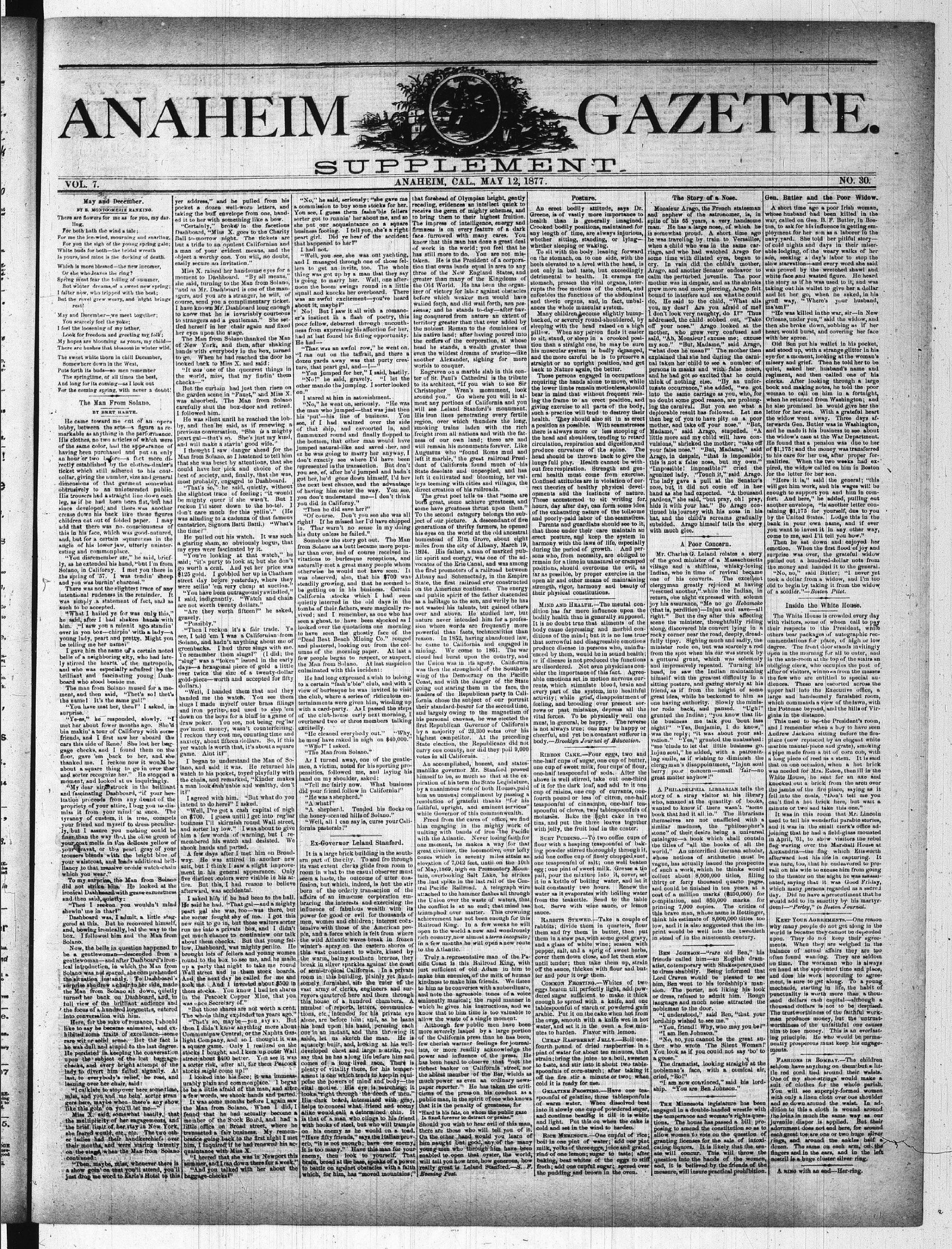
Searchable text
May and December.
BY B. MONTGOMERIE RANKING.
There are flowers for me as for you, my darling,
For both hath the wind a tale;
For me the ice-wind, mourning and snarling,
For you the sigh of the young spring gale;
White buds for both—the bridal wreath
Is yours, and mine is the decking of death.
Which is more blessed—the new incomer,
Or she who leaves the ring?
Spring must fear the toiling of summer,
But winter dreams of a sweet new spring;
I falter now, who tripped with the beat;
But the revel grew weary, and night brings rest!
May and December—we meet together;
You scarcely feel the yoke;
I feel the loosening of my tether,
Look for freedom and greeting my folk;
My hopes are blooming as yours, my child—
There are bushes that blossom in winter wild.
The sweet white thorn in chill December,
Somewhere down in the West,
Puts forth its buds—so men remember
The springtime, of all times the best,
And long for its coming—as I look out
For the coming spring, with never a doubt!
The Man From Solano.
BY BRET HARTE.
He came toward me cut of an opera lobby, between the acts—a figure as remarkable as anything in the performance.
His clothes, no two articles of which were of the same color, had the appearance of having been purchased and put on only an hour or two before—a fact more directly established by the clothes-dealer's yer address," and he pulled from his pocket a dozen well-worn letters, and taking the buff envelope from one, handed it to her with something like a bow.
"Certainly," broke in the facetious Dashboard, "Miss X. goes to the Charity Ball to morrow night. The tickets are but a trifle to an opulent Californian and a man of your evident means, and the object a worthy one. You will, no doubt, easily secure an invitation."
Miss X. raised her handsome eyes for a moment to Dashboard. "By all means," she said, turning to the Man from Solano, "and as Mr. Dashboard is one of the managers, and you are a stranger, he will, of course, send you a complimentary ticket. I have known Mr. Dashboard long enough to know that he is invariably courteous to strangers and a gentleman." She settled herself in her chair again and fixed her eyes upon the stage.
The Man from Solano thanked the Man of New York, and then, after shaking hands with everybody in the box, turned to go. When he had reached the door he looked back to Miss X. and said:
"It was one of the queerest things in the world, miss, that my findin' them checks—"
But the curtain had just then risen on the garden scene in "Faust," and Miss X. was absorbed. The Man from Solano carefully shut the box-door and retired. I followed him.
He was silent until he reached the lobby, and then he said, as if renewing a previous conversation, "She is a mighty peart gal—that's so. She's just my kind, and will make a stavin' good wife."
I thought I saw danger ahead for the Man from Solano, so I hastened to tell him that she was beset by attentions, that she
"No," he said, serioa commission to buy a
You see, I guess them
sorter got to runnin'
she put our acquaintbusiness footing. I te
peart girl. Did ye he
that happened to her?
I had not.
"Well, you see, she
and I managed throulers to get an invitething was got up by a
is going to marry her
noon the boom swing
squall and knocks here
was an awful excitemabout it, maybe?"
No! But I saw it aer's instinct in a flapoor fellow, debarred
ness from expressing b
had at last found his
He had—
"Thar was an awful
"I ran out on the t
dozen yards away wi
ture, that peart gal, an
"You jumped for b
"No!" he said, gr
other man do the jumpon."
I stared at him in a
"No," he went on,
the man who jumped d
his 'put'—his line ee
see, if I had waited
of that ship, and
flummuxed round an
the bottom, that other
jumped natural-like ee
he was going to m
don't exactly see wi
Puts forth its buds—so men remember
The springtime, of all times the best,
And long for its coming—as I look out
For the coming spring, with never a doubt!
The Man From Solano.
BY BRET HARTE.
He came toward me cut of an opera lobby, between the acts—a figure as remarkable as anything in the performance. His clothes, no two articles of which were of the same color, had the appearance of having been purchased and put on only an hour or two before—a fact more directly established by the clothes-dealer's ticket which still adhered to his coat-collar, giving the number, size and general dimensions of that garment somewhat obtrusively to an uninterested public. His trousers had a straight line down each leg, as if he had been born flat, but had since developed, and there was another crease down his back like those figures children cut out of folded paper. I may add that there was no consciousness of this in his face, which was good-natured, and, but for a certain squareness in the angle of his lower jaw, utterly uninteresting and commonplace.
"You disremember me," he said, briefly, as he extended his hand, "but I'm from Solano, in California. I met you there in the spring of '57. I was tendin' sheep and you was burnin' charcoal."
There was not the slightest trace of any intentional rudeness in the reminder. It was simply a statement of fact, and as such to be accepted.
"What I hailed ye for was only this," he said, after I had shaken hands with him. "I saw you a minnit ago standin' over in yon box—chirpin' with a lady—a young lady, peart and pretty. Might you be telling me her name?"
I gave him the name of a certain noted belle of a neighboring city, who had laterly stirred the hearts of the metropolis, and who was especially admired by the brilliant and fascinating young Dashboard who stood beside me.
The man from Solano mused for a moment, and then said, "Thet's sol that's the namel! It's the same gall!"
"You have met her, then?" I asked, in surprise.
"Ye-es," he responded, slowly. "I met her about fower months ago. She'd bin makin' a tour of California with some friends, and I first saw her aboard the cars side of Reno. She lost her baggage checks, and I found them on the floor, gave 'em back to her, and she thanked me. I reckon now it would be about a square thing to go in over thar and sorter recognize her." He stopped a moment, and looked at us inquiringly.
"My dear sir! struck in the brilliant and fascinating Dashboard, if your hesitation proceeds from any degree of the propriety of your attire, I beg you to dismiss it from your mind at once. The tyranny of custom, it is true, compels your friend and myself to dress peculiarly, but I assure you nothing could be finer than the way that the olive green of your coat melts in the delicate yellow of your gravest, or the pearl gray of your trousers blends with the bright blue of your waistcoat, and heads additional brilliancy to that massive orioide watch-chain which you wear."
To my surprise, the Man from Solano
"It was one of the queerest things in the world, miss, that my findin' them checks—"
But the curtain had just then risen on the garden scene in "Faust," and Miss X. was absorbed. The Man from Solano carefully shut the box-door and retired. I followed him.
He was silent until he reached the lobby, and then he said, as if renewing a previous conversation, "She is a mighty peart gail—that's so. She's just my kind, and will make a stavin' good wife."
I thought I saw danger ahead for the Man from Solano so I hastened to tell him that she was beset by attention, that she could have her pick and choice of the best of society, and finally, that she was most probably engaged to Dashboard.
"That's so," he said quietly, without the slightest trace of feeling; "it would be mighty queer if she wasn't. But I reckon I'll steer down to the ho-tel. I don't care much for this yellin'." (He was alluding to a cadenza of that famous cantatrice, Signora Batti Batti.) "What's the time?"
He pulled out his watch. It was such a glaring sham, so obviously bogus, that my eyes were fascinated by it.
"You're looking at that watch," he said; "it's purty to look at; but she don't go worth a cent. And yet her price was $125 gold. I gobbled her up in Chatham street day before yesterday, where they were sellin' em very cheap at auction."
"You have been outrageously swindled," I said, indignantly. "Watch and chain are not worth twenty dollars."
"Are they worth fifteen?" he asked, gravely.
"Possibly."
"Then I reckon it's a fair trade. Ye see, I told 'em I was a Californian from Solano, and hadn't anything about me of greenbacks. I had three slugs with me. Ye remember them slugs?' (I did; the "slug" was a "token" issued in the early days—a hexagonal piece of gold a little over twice the size of a twenty-dollar gold-piece—worth and accepted for fifty dollars.)"
"Well, I handed them that and they handed me the watch. You see them slugs I made myself outer brass filings and iron pyrites, and used to shap 'em down on the boys for a bluff in a game of draw poker. You see, not being reg'l lar government money, wasn't counterfeiting. I reckon they cost me, counting time and anxiety, about fifteen dollars. So, if this yer watch is worth that, it's about a square game. Aint it?"
I began to understand the Man of Solano, and said it was. He returned his watch to his pocket, toyed playfully with the chain, and remarked, "Kinder makes a man look cash'nable and wealthy, don't it?"
I agreed with him. "But what do you intend to do here?" I asked.
"Well, I've got a cash capital of nigh on $700. I guess until I get into reg'l business I'll skirmish round Wall street, and sorter lay low." I was about to give him a few words of warning, but I remembered his watch and desisted. We shook hands and parted.
A few days after I met him on Broadway. He was attired in another new suit, but I think I saw a slight improvement in his general appearance. Only five distinct colors were visible in his attire; that peart gal; that "No!" he went on; the man who jumped his 'put'—his line ocee; if I had waited of that ship, and flummuxed round and bottom; that other jumped natural-like ez he was going to me don't exactly see ww represented in the train you see; ef, after he'd got her; he'd gone down the next best chance; of having him outer you don't understand you did in California.
Then he did save "Of course. Don't right? If he missed no his duty unless he fail.
Somehow the story from Solano as a butt lar than ever, and of vitations to burlesque naturally-met a great otherwise he would was observed; also steadily growing; and be getting on in his California stocks w quietly interred in their tombs of their father vived; and I remember seen a ghost; to have looked over the quote to have seen the gg "Dead Beat Beach M and plastered; looking umms of the morning few people began to the Man from Solano culminated with this.
He had long express to a certain "fash'n'b view of burlesque her club, where a ser tertainments were given with a card-party.
of the club-house ce overheard two or thre excitedly.
"He cleaned every he must have raked in "Who?" I asked.
"The Man from So As I turned away men, a victim noted pensities, followed hand on my shoulder."
"Tell me fairly nor did you friend follow."
"He was a shepherd "A what?"
"A shepherd. T the honey-scented him "Well, all I can sa formis pastorals!"
"My dear sir, struck in the brilliant and fascinating Dashboard, 'if your hesitation proceeds from any doubt of the propriety of your attire, I bag you to dismiss it from your mind at once. The tyranny of custom, it is true, compels your friend and myself to dress peculiarly, but I assure nothing could be finer than the way that the olive green of your coat melts in the delicate yellow of your gravat, or the pearl gray of your trousers blends with the bright blue of your waistcoat, and loads additional brilliancy to that massive oroide watch-chain which you wear."
To my surprise, the Man from Solano did not strike him. He looked at the ironical Dashboard with grave earnestness and then said quietly:
"Then I reckon you wouldn't mind shewin' me in thair!"
Dashboard was, I admit, a little staggered at this. But he recovered himself, and bowing ironically, led the way to the box. I followed him and the Man from Solano.
Now, the belle in question happened to be a gentlewoman—descended from a gentlewoman—and after Dashboard's ironical introduction, in which the Man from Solano was not spared, she comprehended the situation instantly. To Dashboard's surprise she drew a chair to her side, made the Man from Solano sit down, quietly turned her back on Dashboard, and, in full view of the brilliant audience and the focus of a hundred lorgnettes, entered into conversation with him.
Here, for the sake of romance, I should like to say he became animated, and exhibited some traits of excellence—some rare wit or solid sense. But the fact is he was dull and stupid to the last degree. He persisted in keeping the conversation upon the subject of the lost baggage-checks, and every bright attempt of the lady to divert him failed signally. At last, to everybody's relief, he rose, and leaning over her chair, said:
"I calllate to stop over here some time, miss, and you and me bein' sorter strangers here, maybe when there's any show like this goin' on you'll let me—"
Miss X. said, somewhat hastily, that the multiplicity of her engagements, and the brief limit of her stay in New York, she feared would, etc., etc. The two other ladies had their handkerchiefs over their mouths, and were staring intently on the stage when the Man from Solano continued:
"Then, maybe, miss, whenever there is a show goin' on that you'll attend, you'll just drop me word to Earle's Hotel to this man look dash'nable and wealthy, don't it?"
I agreed with him. "But what do you intend to do here?" I asked.
"Well, I've got a cash capital of nigh on $700. I guess until I get into regular business I'll skirmish round Wall street, and sorter lay low." I was about to give him a few words of warning, but I remembered his watch and desisted. We shook hands and parted.
A few days after I met him on Broadway. He was attired in another new suit, but I think I saw a slight improvement in his general appearance. Only five distinct colors were visible in his attire. But this, I had reason to believe afterward, was accidental.
I asked him if he had been to the ball. He said he had. "That gal—and a mighty peart gal she was, too—was there, but she sorter fought shy of me. I got this new suit to go in, but those waiters sorter run me into a private box, and I didn't get much chance to continniew our talk about them checks. But that young fellow, Dashboard, was mighty perilite. He brought lots of fellers and young women round to the box to see me, and he made up a party that night to take me round Wall street and in tham stock boards. And the next day he called for me and took me. And I invested about $500 in them stocks. You know I had ten shares in the Peacock Copper Mine, that you was once Secretary of."
"But those shares are not worth a cent. The whole thing exploded ten years ago."
"That's so, maybe—you say so. But then I didn't know anything more about Communipaw Central, or the Naphta Gaslight Company, and so I thought it was a square game. Only I realized on the stocks I bought, and I kept up outer Wall street about $400 better. You see it was a sorter risk, after all, for them Peacock stocks might come up."
I looked into his face; it was immeasurably plain and commonplace. I began to be a little afraid of the man, and after a few words, we shook hands and parted.
It was some months before I again saw the Man from Solano. When I did, I found that he had actually become a member of the Stock Board, and had a little office on Broad street where he transacted a fair business. My remembrance going back to the first night I met him, I inquired if he had renewed his acquaintance with Miss X.
"I heard that she was in Newport this summer, and I ran down there for a week."
"And you talked with her about the baggage-checks!"
IM GAZ
SUPPLEMENT.
ANAHEIM, CAL., MAY 12, 1877.
"No," he said, seriously; "she gave me a commission to buy some stocks for her. You see, I guess them fash'n'ble fellers sorter got to runnin' her about me, and so she put our acquaintance on a square business footing. I tell you, she's a right peart girl. Did ye hear of the accident that happened to her?"
I had not.
"Well, you see, she was ont yachting, and I managed through one of those fellers to get an invite, too. The whole thing was got up by a man that they say is going to marry her. Well, one afternoon the boom swings round in a little squall and knocks her overboard. There was an awful excitement—you've heard about it, maybe?"
No! But I saw it all with a romancer's instinct in a flash of poetry, this poor fellow, debarred through uncouthness from expressing his affection for her, had at last found his fitting opportunity. He had—
"Thar was an awful row," he went on. "I ran out on the taffrail, and there a dozen yards away was that purty creature, that peart gal, and—I—"
"You jumped for her," I said, hastily.
"No!" he said, gravely. "I let the other man do the jumping. I sorter looked on."
I stared at him in astonishment.
"No," he went on, seriously. "He was the man who jumped—that was just then his 'put'—his line of business. You see, if I had waltzed over the side of that ship, and cavoorted in, and flummuxed round and finally flopped to the bottom, that other man would have jumped natural-like and saved her, and ez he was going to marry her anyway, I don't exactly see where I'd have been represented in the transaction. But don't that forehead of Olympian height, gently receding, evidences an intellect quick to receive the germ of mighty schemes, and to bring them to their highest fruition. The impress of intelligence, energy and firmness is on every feature of a dark face furrowed with many cares. You know that this man has done a great deal of work in the world; you feel that he has still more to do. You are not mistaken. He is the President of a corporation that owns lands equal in area to any three of the New England States, and greater than many of the Kingdoms of the Old World. He has been the organizer of victory for labor against obstacles before which weaker men would have wailed forth, and did wail forth, non possumus; and he stands to-day—after having conquered from nature an extent of territory greater than that ever added by the noblest Roman to the dominions of his native land; after having poured into the coffers of the corporation, at whose head he stands, a wealth greater than even the wildest dreams of avarice—like another Alexander, sighing for more worlds to conquer.
Engraven on a marble slab in this center of St. Paul's Cathedral is the tribute to its architect, "If you wish to see Sir Christopher Wren's monument, look around you." Go where you will in almost any portions of California and you will see Leland Stanford's monument. His iron lines penetrating every fertile region, over which thunders the long, smoking trains laden with the rich freight from all nations and with the fatness of our own land; these are and will remain his monuments forever. Like Augustus who "found Rome mud and left it marble," the great railroad President of California found much of his that forehead of Olympian height, gently receding, evidences an intellect quick to receive the germ of mighty schemes, and to bring them to their highest fruition. The impress of intelligence, energy and firmness is on every feature of a dark face furrowed with many cares. You know that this man has done a great deal of work in the world; you feel that he has still more to do. You are not mistaken. He is the President of a corporation that owns lands equal in area to any three of the New England States, and greater than many of the Kingdoms of the Old World. He has been the organizer of victory for labor against obstacles before which weaker men would have wailed forth, and did wail forth, non possumus; and he stands to-day—after having conquered from nature an extent of territory greater than that ever added by the noblest Roman to the dominions of his native land; after having poured into the coffers of the corporation, at whose head he stands, a wealth greater than even the wildest dreams of avarice—like another Alexander, sighing for more worlds to conquer.
Engraven on a marble slab in this center of St. Paul's Cathedral is the tribute to its architect, "If you wish to see Sir Christopher Wren's monument, look around you." Go where you will in almost any portions of California and you will see Leland Stanford's monument. His iron lines penetrating every fertile region, over which thunders the long, smoking trains laden with the rich freight from all nations and with the fatness of our own land; these are and will remain his monuments forever. Like Augustus who "found Rome mud and left it marble," the great railroad President of California found much of his that forehead of Olympian height, gently receding, evidences an intellect quick to receive the germ of mighty schemes, and to bring them to their highest fruition. The impress of intelligence, energy and firmness is on every feature of a dark face furrowed with many cares. You know that this man has done a great deal of work in the world; you feel that he has still more to do. You are not mistaken. He is the President of a corporation that owns lands equal in area to any three of the New England States, and greater than many of the Kingdoms of the Old World. He has been the organizer of victory for labor against obstacles before which weaker men would have wailed forth, and did wail forth, non possumus; and he stands to-day—after having conquered from nature an extent of territory greater than that ever added by the noblest Roman to the dominions of his native land; after having poured into the coffers of the corporation, at whose head he stands, a wealth greater than even the wildest dreams of avarice—like another Alexander, sighing for more worlds to conquer.
Engraven on a marble slab in this center of St. Paul's Cathedral is the tribute to its architect, "If you wish to see Sir Christopher Wren's monument, look around you." Go where you will in almost any portions of California and you will see Leland Stanford's monument. His iron lines penetrating every fertile region, over which thunders the long, smoking trains laden with the rich freight from all nations and with the fatness of our own land; these are and will remain his monuments forever. Like Augustus who "found Rome mud and left it marble," the great railroad President of California found much of his that forehead of Olympian height, gently receding, evidences an intellect quick to receive the germ of mighty schemes, and to bring them to their highest fruition. The impress of intelligence, energy and firmness is on every feature of a dark face furrowed with many cares. You know that this man has done a great deal of work in the world; you feel that he has still more to do. You are not mistaken. He is the President of a corporation that owns lands equal in area to any three of the New England States, and greater than many of the Kingdoms of the Old World. He has been the organizer of victory for labor against obstacles before which weaker men would have wailed forth, and did wail forth, non possumus; and he stands to-day—after having conquered from nature an extent of territory greater than that ever added by the noblest Roman to the dominions of his native land; after having poured into the coffers of the corporation, at whose head he stands, a wealth greater than even the wildest dreams of avarice—like another Alexander, sighing for more worlds to conquer.
Engraven on a marble slab in this center of St. Paul's Cathedral is the tribute to its architect, "If you wish to see Sir Christopher Wren's monument, look around you." Go where you will in almost any portions of California and you will see Leland Stanford's monument. His iron lines penetrating every fertile region, over which thunders the long, smoking trains laden with the rich freight from all nations and with the fatness of our own land; these are and will remain his monuments forever. Like Augustus who "found Rome mud and left it marble," the great railroad President of California found much of his that forehead of Olympian height, gently receding, evidences an intellect quick to receive the germ of mighty schemes, and to bring them to their highest fruition. The impress of intelligence, energy and firmness is on every feature of a dark face furrowed with many cares. You know that this man has done a great deal of work in the world; you feel that he has still more to do. You are not mistaken. He is the President of a corporation that owns lands equal in area to any three of the New England States, and greater than many of the Kingdoms of the Old World. He has been the organizer of victory for labor against obstacles before which weaker men would have wailed forth, and did wail forth, non possumus; and he stands to day—after having conquered from nature an extent of territory greater than that ever added by the noblest Roman to the dominions of his native land; after having poured into the coffers of the corporation, at whose head he stands, a wealth greater than even the wildest dreams of avarice—like another Alexander, sighing for more worlds to conquer.
Engraven on a marble slab in this center of St. Paul's Cathedral is the tribute to its architect, "If you wish to see Sir Christopher Wren's monument, look around you." Go where you will in almost any portions of California and you will see Leland Stanford's monument. His iron lines penetrating every fertile region, over which thunders the long, smoking trains laden with the rich freight from all nations and with the fatness of our own land; these are and will remain his monuments forever. Like Augustus who "found Rome mud and left it marble," the great railroad President of California found much of his that forehead of Olympian height, gently receding, evidences an intellect quick to receive the germ of mighty schemes, and to bring them to their highest fruition. The impress of intelligence, energy and firmness is on every feature of a dark face furrowed with many cares. You know that this man has done a great deal of work in the world; you feel that he has still more to do. You are not mistaken. He is the President of a corporation that owns lands equal in area to any three of the New England States, and greater than many of the Kingdoms of the Old World. He has been the organizer of victory for labor against obstacles before which weaker men would have wailed forth, and did wail forth, non possumus; and he stands to day—after having conquered from nature an extent of territory greater than that ever added by the noblest Roman to the dominions of his native land; after having poured into the coffers of the corporation, at whose head he stands, a wealth greater than even the wildest dreams of avarice—like another Alexander, sighing for more worlds to conquer.
Engraven on a marble slab in this center of St. Paul's Cathedral is the tribute to its architect, "If you wish to see Sir Christopher Wren's monument, look around you." Go where you will in almost any portions of California and you will see Leland Stanford's monument. His iron lines penetrating every fertile region, over which thunders the long, smoking trains laden with the rich freight from all nations and with the fatness of our own land; these are and will remain his monuments forever. Like Augustus who "found Rome mud and left it marble," the great railroad President of California found much of his that forehead of Olympian height,gently receding,evidences an intellect quick to receive the germ of mighty schemes,and to bring them to their highest fruition. The impress of intelligence,energy和 firmness is on every featureofa dark face furrowedwithmanycares.Most children become slightly humpbacked,或 severely round-shouldered,由sleepingwiththeheadraisedonahighpillow。Whenanypersonfindsiteasierto sit,stand,orsleepinacrookedpositionthanastraightone,他maybehismuscularsystemisbadlydegranged,和themorecarefulheistopreserveastraightoranuprightposition,andgetbacktoNatureagain,thebetter。
Those persons engaged in occupations requiringthehandsalonetomove,而thelowerlimbsremainmotionlessshouldbearinmindthatwithoutfrequentraisingtheframetoan erectposition,andgivingexercisetoallpartsofthebody,suchapracticewill tendtodestroythehealth。Theyshouldalsositinaserectapositionaspossible.Withseamstressesthereisalwaysmoreorlessstoleepingoftheheadandshoulders,tendingtoretardcirculation,respirationanddigitation,andproducecurvatureofthespine。Theheadshouldbe thrownbacktogivethelungsfullplay。Healthcannotbewith-
```markdown
No,” he said,seriously。“He wasthemanwhojumped—thatwasjustthen‘put’—hislineofbusiness。YouseeifIhadwaltzedoverthesideofthatship,andcavooortedin,andflummuxedroundandfinallyfloppedtothebottom,那othermanwouldhavejumpednatural-likeandsavedher,andezhewasgoingtomarryheranyway.Idon’texactlyseewhereIdcouldberepresentedinthetransaction。但don't```
"You jumped for her," I said, hastily.
"No!" he said, gravely. "I let the other man do the jumping. I sorter looked on."
I stared at him in astonishment.
"No," he went on, seriously. "He was the man who jumped—that was just then his 'put'—his line of business. You see, if I had waltzed over the side of that ship, and cavorted in, and flummoxed round and finally flopped to the bottom, that other man would have jumped natural-like and saved her, and ez he was going to marry her anyway, I don't exactly see where I'd have been represented in the transaction. But don't you see, ef, after he'd jumped and hadn't got her, he'd gone down himself, I'd hev the next best chance, and the advantage of having him outer the way. You see, you don't understand me—I don't think you did in California."
"Then he did save her?"
"Of course. Don't you see she was all right? If he missed her I'd have chipped in. Thar warnn't no sense in my doing his duty onless he failed."
Somehow the story got out. The Man from Solano as a butt became more popular than ever, and of course received invitations to burlesque receptions, and naturally met a great many people whom otherwise he would not have seen. It was observed, also, that his $700 was steadily growing, and that he seemed to be getting on in his business. Certain California stocks which I had seen quietly interred in the old days in the tombs of their fathers, were magically revived; and I remember, as one who has seen a ghost, to have been shocked as I looked over the quotations one morning to have seen the ghostly face of the "Dead Beat Beach Mining Co." rouged and plastered, looking out from the columns of the morning paper. At last a few people began to respect, or suspect, the Man from Solano. At last suspicion culminated with this incident:
He had long expressed a wish to belong to a certain "fash'n'ble" club, and with a view of burlesque he was invited to visit the club, where a series of ridiculous entertainments were given him, winding up with a card-party. As I passed the steps of the club-house early next morning, I overheard two or three members talking excitedly.
"He cleaned everybody out." "Why, he must have raked in nigh on $40,000." "Who?" I asked.
"The Man from Solano."
As I turned away, one of the gentlemen, a victim, noted for his sporting prowess, followed me, and laying his hand on my shoulder, asked:
"Tell me fairly now. What business did your friend follow in California?" "He was a shepherd." "Δ what?"
"A shepherd. Tended his flocks on the honey-scented hills of Solano." "Well, all I can say is, curse your California pastorals!"
Ex-Governor Leland Stanford.
It is a large brick building in the southern part of the city. To and fro through its vast extent clerks guide room to room in what to the casual observer must seem a haste, the outcome of utter conference.
Engraven on a marble slab in this center of St. Paul's Cathedral is the tribute to its architect, "If you wish to see Sir Christopher Wren's monument, look around you." Go where you will in almost any portions of California and you will see Leland Stanford's monument. His iron lines penetrating every fertile region, over which thunders the long, smoking trains laden with the rich freight from all nations and with the fatness of our own land; these are and will remain his monuments forever. Like Augustus who "found Rome mud and left it marble," the great railroad President of California found much of his State desolate and unpeopled, and has left it cultivated and blooming, her valleys teeming with cities and villages, the direct creation of his railroads.
The great poet tells us that "some are born great, some achieve greatness, and some have greatness thrust upon them." To the second category belongs the subject of our picture. A descendant of five generations of thrifty farmers, he opened his eyes on the world at the old ancestral homestead of Elm Grove, about eight miles from the city of Albany, March 19, 1824. His father, a man of marked public spirit and energy, was one of the advocates of the Erie Canal, and was among the first promoters of a railroad between Albany and Schenectady, in the Empire State, the first railroad ever constructed on the American continent. The energy and public spirit of the father descended as a heritage to the son, and verily he has not wasted his talents, but gained others over and above. He studied law, but nature never intended him for a profession where words are frequently more powerful than facts, technicalities than reason. In 1852, having abandoned law, he came to California and engaged in mining. We come to 1861. The war cloud had burst upon the country, and the Union was in its agony. California was then the stronghold of the Southern wing of the Democracy on the Pacific Coast, and with the danger of the State going out staring them in the face, the leaders of the Republican party in California chose the subject of our portrait their standard-bearer for the second time, and largely owing to the magnetism of his personal canvass, he was elected the first Republican Governor of California by a majority of 23,300 votes over his highest competitor. At the preceding State election, the Republicans did not carry one county, nor did they poll 9,000 votes in all California.
An accomplished, honest, and statesmanlike governor Mr. Stanford proved himself to be, so much so that at the expiration of his term the State Legislature, by a unanimous vote of both Houses, paid him an unusual compliment by passing a resolution of grateful thanks "for his faithful, upright, and eminent services" while Governor of this commonwealth.
Freed from the cares of office, we find him engaging in the mighty work of uniting with bands of iron—the Pacific with the Atlantic. Never losing faith for one moment, he makes a way for that great civilizer, the locomotive, over lofty cones which in seventy miles attain an elevation of 7,042 feet, until on the 10th May, 1869, high on Promontory Mountain, overlooking Salt Lake, he strikes last spike in the last rail of the Genius PUDDING.—To two coffee cups of flour with a heaping teaspoonful of baking powder stirred thoroughly through it, add one coffee cup of finely chopped suet, one teaspoonful of salt; one well beaten egg; one pint of sweet milk. Grease a tin pail, pour the mixture into it, cover it in a kettle of boiling water,and let it back to Nature again,the better.
Those persons engaged in occupations requiring the hands alone to move while the lower limbs remain motionless should bear in mind that without frequent raising in mind that without frequent raising in mind that without frequent raising in mind that without frequent raising in mind that without frequent raising in mind that without frequent raising in mind that without frequent raising in mind that without frequent raising in mind that without frequent raising in mind that without frequent raising in mind that without frequent raising in mind that without frequent raising in mind that without frequent raising in mind that without frequent raising in mind that without frequent raising in mind that without frequent raising in mind that without frequent raising in mind that without frequent raising in mind that without frequent raising in mind that without frequent raising in mind that without frequent raising in mind that without frequent raising in mind that without frequent raising in mind that without frequent raising in mind that without frequent raising in mind that without frequent raising in mind that without frequent raising in mind that without frequent raising in mind that without frequent raising in mind that without frequent raising in mind that without frequent raising in mind that without frequent raising in mind that without frequent raising in mind that without frequent raising in mind that without frequent raising in mind that without frequent raising in mind that without frequent raising in mind that without frequent raising in mind that without frequent raising in mind that without frequent raising in mind that without frequent raising in mind that without frequent raising in mind that without frequent raising in mind that without frequent raising in mind that without频繁raisinginmindthatwithout频繁raisinginmindthatwithout频繁raisinginmindthatwithout频繁raisinginmindthatwithout频繁raisinginmindthatwithout频繁raisinginmindthatwithout频繁raisinginmindthatwithout频繁raisinginmindthatwithout频繁raisinginmindthatwithout频繁raisinginmindthatwithout频繁raisinginmindthatwithout频繁raisinginmindthatwithout频繁raisinginmindthatwithout频繁raisinginmindthatwithout频繁raisinginmindthatwithout频繁raisinginmindthatwithout频繁raisinginmindthatwithout频繁raisinginmindthatwithout频繁raisinginmindthatwithout频繁raisinginmindthatwithout频繁raisinginmindthatwithout频繁raisinginmindthatwithout频繁raisinginmindthatwithout频繁raisinginmindthatwithout频繁raisinginmindthatwithout频繁raisinginmindthatwithout频繁raisinginmindthatwithout频繁raisinginmindthatwithout频繁raisinginmindthatwithout频繁raisinginmindthatwithout频繁raisinginmindthatwithout频繁raisinginmindthatwithout频繁raisinginmindthat WITHOUT频繁raisingINMINDTHATWITHOUTFREQUENCYWITHOUTFREQUENCYWITHOUTFREQUENCYWITHOUTFREQUENCYWITHOUTFREQUENCYWITHOUTFREQUENCYWITHOUTFREQUENCYWITHOUTFREQUENCYWITHOUTFREQUENCYWITHOUTFREQUENCYWITHOUTFREQUENCYWITHOUTFREQUENCYWITHOUTFREQUENCYWITHOUTFREQUENCYWITHOUTFREQUENCYWITHOUTFREQUENCYWITHOUTFREQUENCYWITHOUTFREQUENCYWITHOUTFREQUENCYWITHOUTFREQUENCYWITHOUTFREQUENCYWITHOUTFREQUENCYWITHOUTFREQUENCYWITHOUTFREQUENCYWITHOUTFREQUENCYWITHOUTFREQUENCYWITHOUTFREQUENCYWITHOUTFREQUENCYWITHOUTFREQUENCYWITHOUTFREQUENCYWITHOUTFREQUENCYWITHOUTFREQUENCYWITHOUTFREQUENCYWITHOUTFREQUENCYWITHOUTFREQUENCYWITHOUTFREQUENCYWITHOUTFREQUENCYWITHOUTFREQUENCYWITHOUTFREQUENCYWITHOUTFREQUENCYWITOUTFREQUENCYWITOUTFREQUENCYWITOUTFREQUENCYWITOUTFREQUENCYWITOUTFREQUENCYWITOUTFREQUENCYWITOUTFREQUENCYWITOUTFREQUENCYWITOUTFREQUENCYWITOUTFREQUENCYWITOUTFREQuencyWitOutFrequencyWitOutFrequencyWitOutFrequencyWitOutFrequencyWitOutFrequencyWitOutFrequencyWitOutFrequencyWitOutFrequencyWitOutFrequencyWitOutFrequencyWitOutFrequencyWitOutFrequencyWitOutFrequencyWitOutFrequencyWitOutFWitOutFWitOutFWitOutFWitOutFWitOutFWitOutFWitOutFWitOutFWitOutFWitOutFWitOutFWitOutFWitOutFWitOutFWitOutFWitOutFWitOutFWitOutFWitOutFWitOutFWitOutFWitOutFWitOutFWitOutFWitOutFWitOutFWitOutFWitOutFWitOutFWitOutFWitOutFWitOutFWitOutFWi
ntoutFWitOutFWitOutFWitOutFWitOutFWitOutFWitOutFWitOutFWit_outFWit_outFWit_outFWit_outFWit_outFWit_outFWit_outFWit_outFWit_outFWit_outFWit_outFWit_outFWit_outFWit_outFWit_outFWit_outFWit_outFWit_outFWit_outFWit_outFWit_outFWit_outFWit_outFWit_outFWit_outFWi
ntoutFWi
ntoutFWi
ntoutFWi
ntoutFWi
ntoutFWi
ntoutFWi
ntoutFWi
ntoutFWi
ntoutFWi
ntoutFWi
ntoutFWi
ntoutFWi
ntoutFWi
ntoutFWi
ntoutFWi
ntoutFWi
ntoutFWi
ntoutFWi
ntoutFWi
ntoutFWi
ntoutFWi
ntoutFWi
ntoutWWiwiwiwiwiwiwiwiwiwiwiwiwiwiwiwiwiwiwiwiwiwiwiwiwiwiwiwiwiwiwiwiwiwiwiwiwiwiwiwiwiwiwiwiwiwiwiwiwiwiwiwiwiwiwiwiwiwiwiwiwiwiwiwiwiwiwiwiwiwiwiwiwiwiwiwuwuwuwuwuwuwuwuwuwuwuwuwuwuwuwuwuwuwuwuwuwuwuwuwuwuwuwuwuwuwuwuwuwuwuwuwuwuwuwuwuwuwuwuwuwuwuwuwuwuwuwuwuwuwuwuwuwuwuvuvuvuvuvuvuvuvuvuvuvuvuvuvuvuvuvuvuvuvuvuvuvuvuvuvuvuvuvuvuvuvuvuvuvuvuvuvuvuvuvuvuvuvuvuvuvuvuvuvuvuvuvuvuvuvuvuvuvuvuvuvuvuvuvuvuvuvuvuvuvuvuvuvuvuvUVUVUVUVUVUVUVUVUVUVUVUVUVUVUVUVUVUVUVUVUVUVUVUVUVUVUVUVUVUVUVUVUVUVUVUVUVUVUVUVUVUVUVUVNVNVNVNVNVNVNVNVNVNVNVNVNVNVNVNVNVNVNVNVNVNVNVNVNVNVNVNVNVNVNVNVNVNVNVNVNVNVNVNVNVNVNVNVNVNVNVNVNVNV NVNVNVNVNVNVNVNVNVNVNVNVNVNVNVNV NV NV NV NV NV NV NV NV NV NV NV NV NV NV NV NV NV NV NV NV NV NV NV NV NV NV NV NV NV NV NV NV NV NV NV NV NV NV NV NV NV NV NV NV NV NV NV NV NV NV NV NV NV NV NV NV NV NV NV NV NV NV NV NV NV NV NV NV NV NV NV NV NV NV NV NV NV NV NV NV NV NV NV NV NV NV NV NV NV NV NV NV NV NV NV NV NV NV NV NV NV NV NV NV NV NV NV NV NV NV NV NV NV NV NV NV NV NV NV NV NV NV NV NV NV NV NV NV NV NV NV NV NN VN VN VN VN VN VN VN VN VN VN VN VN VN VN VN VN VN VN VN VN VN VN VN VN VN VN VN VN VN VN VN VN VN VN VN VN VN VN VN VN VN VN VN VN VN VN VN VN VN VN VN VN VN VN VN VN VN VN VN VN VN VN VN VN VN VN VN VN VN VN VN VN VN VN VNNNNNNNNNNNNNNNNNNNNNNNNNNNNNNNNNNNNNNNNNNNNNNNNNNNNNNNNNNNNNNNNNNNNNNNNNNNNNNNNNNNNNNNNNNNNNNNNNNNNNNNNNNNNNNNNNNNNNNNNNNNNNNNNNNNNNNNNNNNNNNNNNNNNNNNNNNNNNNNNNNNNNNNNNNNNNNNNNNNNNNNNNNNNnnnnnnnnnnnnnnnnnnnnnnnnnnnnnnnnnnnnnnnnnnnnnnnnnnnnnnnnnnnnnnnnnnnnnnnnnnnnnnnnnnnnnnnnnnnnnnnnnnnnnnnnnnnnnn nn nn nn nn nn nn nn nn nn nn nn nn nn nn nn nn nn nn nn nn nn nn nn nn nn nn nn nn nn nn nn nn nn nn nn nn nn nn nn nn nn nn nn nn nn nn nn nn nn nn nn nn nn nn nn nn nn nn nn nn nn nn nn nn nn nn nn nn nn nn nn nn nn nn nn nn nn nn nn nn nn nn nn nn nn nn nn mn mn mn mn mn mn mn mn mn mn mn mn mn mn mn mn mn mn mn mn mn mn mn mn mn mn mn mn mn mn mn mn mnmnmnmnmnmnmnmnmnmnmnmnmnmnmnmnmnmnmnmnmnmnmnmnmnmnmnmnmnmnmnmnmnmnmnmnmnnmnmnmnmnmnmnmnmnmnmnmnmnmnmnmnmnmnmnmnmnmnmnmnmnmnmnmnmnmnmnmnmnmnmnmnmnmnmnmnmnmnmnmnm nm nm nm nm nm nm nm nm nm nm nm nm nm nm nm nm nm nm nm nm nm nm nm nm nm nm nm nm nm nm nm nm nm nm nm nm nm nm nm nm nm nm nm nm nm nm nm nm nm nm nm nm nm nm nm nm nmNMNMNMNMNMNMNMNMNMNMNMNMNMNMNMNMNMNMNMNMNMNMNMNMNMNMNMNMNMNMNMNMNMNMNMNMNMNMNMNMNMNMNMNMNMNMNMNMNMNMNMNMNMNMNMNMNMNMNMNMNMNMNMNMNMNMNMNMNMNMNMNMNMNMNMNMNMNMNMNMNMNMNMNMNMNMNMNMNMNMNMNMMMMMMMMMMMMMMMMMMMMMMMMMMMMMMMMMMMMMMMMMMMMMMMMMMMMMMMMMMMMMMMMMMMMMMMMMMMMMMMMMMMMMMMMMMMMMMMMMMMMMMMMMMMMMMMMMMMMMMMMMMMMMMMMMMMMMMMMMMMMMMMMMMMMMMMMMMMMMMMMMMMMMMMMM MM MM MM MM MM MM MM MM MM MM MM MM MM MM MM MM MM MM MM MM MM MM MM MM MM MM MM MM MM MM MM MM MM MM MM MM MM MM MM MM MM MM MM MM MM MM MM MM MM MM MM MM MM MM MM MM MM MM MM MM MM MM MM MM MM MM MM MM MM MM MM MM MM MM MM MM MM MM MM mm mm mm mm mm mm mm mm mm mm mm mm mm mm mm mm mm mm mm mm mm mm mm mm mm mm mm mm mm mm mm mm mm mm mm mm mm mm mm mm mm mm mm mm mm mm mm mm mm mm mm mm mm mm mm mm mm mm mm mm mm mm mm mm mm mm mm mm mm mm mm mm mm mm mm mm mm mmmmmmmmmmmmmmmmmmmmmmmmmmmmmmmmmmmmmmmmmmmmmmmmmmmmmmmmmmmmmmmmmmmmmmmmmmmmmmmmmmmmmmmmmmmmmmmmmmmmmmmmmmmmmmmmmmmmmmммммммммммммммммммммммммммммммммммммммммммммммммммммммммммммммммммммммммммммммммммммммммммммммммммммммммммммffffffffffffffffffffffffffffffffffffffffffffffffffffffffffffffffffffffffffffffffffffffffffffffffffffffffffffffffffffffffffffffffffffffffffffffffffffffffffffffffffffffffffffffffffffffffffffffffffffffffffffffffffffffffffffffffffffffffffffffffffffffffffffffffffffffffffffffffffffffffffffffffffffffffffffffffffffffffffffffffffffffffffffffffffffffffffffffffffffffffffffffffffffffffffffffffffffffffffffffffffffffffffffffffffffffffffffffffffffffffffffffffffffffffffffffffffffffffffffffffffffffffffffffffffffffffffffffffffffffffffffffffffffffffffffffffffffffffffffffffffffffffffffffffffffffifflffffffffffffffffffffffffffffffffffffffffffffffffffffffffffffffffffffffffffffffffffffffffffffffffff ff ff ff ff ff ff ff ff ff ff ff ff ff ff ff ff ff ff ff ff ff ff ff ff ff ff ff ff ff ff ff ff ff ff ff ff ff ff ff ff ff ff ff ff ff ff ff ff ff ff ff ff ff ff ff ff ff ff ff ff ff ff ff ff ff ff ff ff ff ff ff ff ff ff ff ff ff ff ff ff ff ff fe fe fe fe fe fe fe fe fe fe fe fe fe fe fe fe fe fe fe fe fe fe fe fe fe fe fe fe fe fe fe fe fe fe fe fe fe fe fe fe fe fe fe fe fe fe fe fe fe fe fe fe fe fe fe feed feed feed feed feed feed feed feed feed feed feed feed feed feed feed feed feed feed feed feed feed feed feed feed feed feed feed feed feed feed feed feed feed feed feed feed feed feed feed feed feed feed feed feed feed feed feed feed feed feed feed feed feed feed feed feed feed feed feed feed feed feedback feedback feedback feedback feedback feedback feedback feedback feedback feedback feedback feedback feedback feedback feedback feedback feedback feedback feedback feedback feedback feedback feedback feedback feedback feedback feedback feedback feedback feedback feedback feedback feedback feedback feedback feedback feedback feedback feedback feedback feedback feedback feedback feedback feedback feedback feedback feedback feedback feedback feedback反馈反馈反馈反馈反馈反馈反馈反馈反馈反馈反馈反馈反馈反馈反馈反馈反馈反馈反馈反馈反馈反馈反馈反馈反馈反馈反馈反馈反馈反馈反馈反馈反馈反馈反馈反馈反馈反馈反馈反馈反馈反馈反馈反馈反馈反馈反馈反馈反馈反馈反馈反馈反馈反馈反馈反馈反馈反馈反馈反馈反馈反馈反馈反馈反馈反馈痕迹痕迹痕迹痕迹痕迹痕迹痕迹痕迹痕迹痕迹痕迹痕迹痕迹痕迹痕迹痕迹痕迹痕迹痕迹痕迹痕迹痕迹痕迹痕迹痕迹痕迹痕迹痕迹痕迹痕迹痕迹痕迹痕迹痕迹痕迹痕迹痕迹痕迹痕迹痕迹痕迹痕迹痕迹痕迹痕迹痕迹痕迹痕迹痕迹痕迹痕迹痕迹痕迹痕迹痕迹痕迹痕迹痕迹痕迹痕迹痕迹痕迹痕迹痕迹痕迹痕迹痕迹痕迹痕迹痕迹痕迹痕迹痕迹痕迹痕迹痕迹痕迹痕迹痕迹痕迹痕迹痕迹痕迹痕迹痕迹痕迹痕迹痕迹痕迹痕迹痕迹痕迹痕迹痕迹痕迹痕迹痕迹痕迹足迹足迹足迹足迹足迹足迹足迹足迹足迹足迹足迹足迹足迹足迹足迹足迹足迹足迹足迹足迹足迹足迹足迹足迹足迹足迹足迹足迹足迹足迹足迹足迹足迹足迹足迹足迹足迹足迹足迹足迹足迹足迹足迹足迹足迹足迹足迹足迹足迹足迹足迹足迹足迹足迹足迹足迹足迹足迹足迹足迹足迹足迹足迹足迹足迹足迹足迹足迹足迹足迹足迹足迹足迹足迹足迹足迹足迹足迹足球足球足球足球足球足球足球足球足球足球足球足球足球足球足球足球足球足球足球足球足球足球足球足球足球足球足球足球足球足球足球足球足球足球足球足球足球足球足球足球足球足球足球足球足球足球足球 football football football football football football football football football football football football football football football football football football football football football football football football football football football football football football football football football football football football football football football football football football football football football football football football football football football football football football football football football football football football football football football football football football football football football football football football football football foot foot foot foot foot foot foot foot foot foot foot foot foot foot foot foot foot foot foot foot foot foot foot foot foot foot foot foot foot foot foot foot foot foot foot foot foot foot foot foot foot foot foot foot foot foot foot foot foot foot foot foot foot foot foot foot foot foot foot foot foot foot foot foot foot foot foot foot footFoot Foot Foot Foot Foot Foot Foot Foot Foot Foot Foot Foot Foot Foot Foot Foot Foot Foot Foot Foot Foot Foot Foot Foot Foot Foot Foot Foot Foot Foot Foot Foot Foot Foot Foot Foot Foot Foot Foot Foot Foot Foot Foot Foot Foot Foot Foot Foot Foot Foot Foot Foot Foot Foot Foot Foot Foot Foot Foot Foot Foot Foot Foot Foot Foot Foot Foot Foot Foot Foot Foot Foot Foot Foot Feet Feet Feet Feet Feet Feet Feet Feet Feet Feet Feet Feet Feet Feet Feet Feet Feet Feet Feet Feet Feet Feet Feet Feet Feet Feet Feet Feet Feet Feet Feet Feet Feet Feet Feet Feet Feet Feet Feet Feet Feet Feet Feet Feet Feet Feet FEET FEET FEET FEET FEET FEET FEET FEET FEET FEET FEET FEET FEET FEET FEET FEET FEET FEET FEET FEET FEET FEET FEET FEET FEET FEET FEET FEET FEET FEET FEET FEET FEET FEET FEET FEET FEET FEET FEET FEET FEET FEET FEET FEET FEET FEET FEET FEET FEET FEET FEEFEFEFEFEFEFEFEFEFEFEFEFEFEFEFEFEFEFEFEFEFEFEFEFEFEFEFEFEFEFEFEFEFEFEFEFEFEFEFEFEFEFEFEFEFEFEFEFEFEFEFEFEFEFEFEFEFEFEFEFEFEFEFEFEFEFEFEFEFEFEFEFEFEFEFEFEFEFEFEFEFEFEFEFEFEFEFEFEFEFEFEFEFeFeFeFeFeFeFeFeFeFeFeFeFeFeFeFeFeFeFeFeFeFeFeFeFeFeFeFeFeFeFeFeFeFeFeFeFeFeFeFeFeFeFeFeFeFeFeFeFeeFeeFeeFeeFeeFeeFeeFeeFeeFeeFeeFeeFeeFeeFeeFeeFeeFeeFeeFeeFeeFeeFeeFeeFeeFeeFeeFeeFeeFeeFeeFeeFeeFeeFeeFeeFeeFeeFeeFeeFeeFeeFeeFeeFeeFeeFeeFeeFeeFeeFeeFeeFeeFeeFeeFeeFeeFeeFeeFeeFeeFeeFeeFeeFeeFeeFeeFeeFeeFeeFeeFeeFeeFeeFeeFeeFeeFeeFeeFeeFeeFeeFeeFeeFee feefefefefefefefefefefefefefefefefefefefefefefefefefefefefefefefefefefefefefefefefefefefefefefefefefefefefefefefefefefefefefeifeffeifeffeifeffeifeffeifeffeifeffeifeffeifeffeifeffeifeffeifeffeifeffeifeffeifeffeifeffeifeffeifeffeifeffeifeffeifeffeifeffeifeffeifeffeifeffeifeffeifeffeifeffeifeffeifeffeifeffeifeffeifeffeifeffeifeffeifeffeifeffeifeffeifeffeifeffeifeffeifeffeifeffeifeffeifeffeifeffeifeffeifeffeifeffeifeffeifeffeifeffeifeffeifeffeifeffeifeffeiffefteiffefteiffefteiffefteiffefteiffefteiffefteiffefteiffefteiffefteiffefteiffefteiffefteiffefteiffefteiffefteiffefteiffefteiffefteiffefteiffefteiffefteiffefteiffefteiffefteiffefteiffefteiffefteiffefteiffefteiffefteiffefteiffefteiffefteiffefteiffefteiffefteiffefteiffefteiffefteiffefteiffefteiffefteiffefteiffefteiffefteiffefteiffefteiffefte斐斐斐斐斐斐斐斐斐斐斐斐斐斐斐斐斐斐斐斐斐斐斐斐斐斐斐斐斐斐斐斐斐斐斐斐斐斐斐斐斐斐斐斐斐斐斐斐斐斐斐斐斐斐斐斐舜舜舜舜舜舜舜舜舜舜舜舜舜舜舜舜舜舜舜舜舜舜舜舜舜舜舜
Ex-Governor Leland Stanford.
It is a large brick building in the southern part of the city. To and fro through its vast extent clerks glide from room to room in what to the casual observer must seem a haste, the outcome of utter confusion, but which, indeed, is but the stir born of the orderly transaction of the affairs of an immense corporation embracing the interests and exercising the influence of fabulous wealth with its power for good or evil for thousands of men, women and children; interest coextensive with those of the American people, and a force which is felt from where the wild Atlantic waves break in frozen winter's spray on the eastern shores of this vast continent to where, kissed by the warm, balmy southern breezes, they break in silver sparkles against the coast of semi-tropical California. In a private room in this building, plainly yet handsomely furnished, sits the ruler of the vast army of clerks, engineers and surveyors quartered here and there through this house of a hundred chambers. A number of reports, letters, communications, etc., intended for his private eye alone, are before him; and, as he leans his head upon his hand, perusing each one in an instant, and then throwing it aside, let us sketch the man. He is squarely built, and looking at his well-developed chest and large nostrils, you say that he has a long life before him and comes of a long-lived race. There is plenty of vitality there, for his temperament is one which tends to keep in equipoise the powers of mind and body—the vital motive. His eye is searching; it looks "right through the deeds of men." His dark beard, intermixed with gray, helps to conceal what friend and enemy alike would call a determined chin. It is that of a man who clings to his friend with hooks of steel, but who will trample on his enemy as he would on a toad. "Have fifty friends," says the Italian proverb, "it is not enough; have one enemy, it is too many." Have this man for your enemy, then look to yourself. That brain, broad at the base, speaks of a power to battle on against obstacles with a faith which, for him, has "moved mountains;" by two coffee cups of flour with a heaping teaspoonful of baking powder stirred thoroughly through it, add one coffee cup of finely chopped suet, one teaspoonful of salt; one well beaten egg; one pint of sweet milk. Grease a tin pail, pour the mixture into it, cover, set it in a kettle of boiling water, and let it boil constantly two hours. Renew the water as it evaporates with boiling water from the teakettle. Send to the table hot. Serve with wine sauce, or lemon sauce.
Rabbits Stewed.—Take a couple of rabbits; divide them in quarters, flour them and fry them in butter, then put them in a stew pan, with some good gravy, and a glass of white wine; season with pepper, salt, and a sprig of sweet herbs, cover them down close, and let them stew until tender; then take them up, strain off the sauce, thicken with flour and butter and pour it over them.
Common Frosting.—Whites of two eggs beaten till perfectly light, add powdered sugar sufficient to make it thick enough to spread with a knife, and one tablespoonful of starch or powdered gum arabi. Put it on the cake when hot from the oven, smooth with a knife wet in hot water, and set it in the oven a few minutes to harden. Flavor with lemon.
Cheap Raspberry Jelly.—Boil one-fourth pound of dried raspberries in a pint of water for about ten minutes, then strain; bring the juice to a boil, sweeten to taste, and stir into it about two tablespoonfuls of corn-starch; after taking it off the fire stir a minute or two; when cold it is ready for use.
Gelatine Frosting.—Have one teaspoonful of gelatine, three tablespoonfuls of warm water. When dissolved beat into it slowly one cup of powdered sugar, and continue beating it till it is white and light. Put this on when the cake is cold and set in the wind to harden.
Rice Meringue.—One cupful of rice; boil in one pint of water; add one pint milk, yolks of three eggs, juice and grated rind of one lemon; sugar to taste; after baking, beat whites of the eggs to stiff froth; add one cupful sugar; spread over the pudding and brown in the oven.
GAZETTE.
NO. 30.
The Story of a Nose.
Monsieur Arago, the French statesman and nephew of the astronomer, is, in spite of his 65 years, a very handsome man. He has a large nose, of which he is somewhat proud. A short time ago he was traveling by train to Versailles, when a child who was in the same carriage, and who had watched Arago for some time with dilated eyes, began to cry. In vain did the child's mother, Arago, and another Senator endeavor to calm the perturbed juvenile. The poor mother was in despair, and as the shrieks grew more and more piercing, Arago felt bound to interfere and see what he could do. He said to the child, "What ails you, my dear? Are you afraid of me?" I don't look very naughty, do I?" Thus addressed, the child sobbed out, "Take off your nose." Arago looked at the mother, who grew very confused and said, "Ah, Monsieur! excuse me; excuse my son." "But, Madame," said Arago, "what does he mean?" The mother then explained that she had during the carnival taken her child to see a number of persons in masks and with false noses, and he had got so excited that he could think of nothing else. "By an unfortunate occurrence," she added, "we got into the same carriage as you, who, for no doubt some good reason, are prolonging the carnival. But you see what a deplorable result has followed. Let me then beg of you to have pity on a poor mother, and take off your nose." "But, Madame," said Arago, stupefied. "A little more and my child will have convulsions," shrieked the mother; "take off your false nose." "But, Madame," said Arago, in despair, "that is impossible; this is not a false nose, but my own."
Gen. Butler and the Poor Widow.
A short time ago a poor Irish woman, whose husband had been killed in the war, called on Gen. B. F. Butler, in Boston, to ask for his influence in getting employment for her son as a laborer in the navy yard. She told her pitiful story—of cold nights and days in their miserable lodging, of the weary walks of her son, seeking a day's labor to stop the slow starration—and every word she said was proved by the wretched shawl and white face and wasted figure. He heard the story as if he was used to it, and was taking out his wallet to give her a dollar and let her go, when he asked, in his gruff way, "Where's your husband, ma'am!"
"He was killed in the war, sir—in New Orleans, under you," said the widow, and then she broke down, sobbing as if her heart would burst, and covering her face with her apron.
Old Ben put his wallet in his pocket, and stood up, with a strange glitter in his eye for a moment, looking at the woman's misery and grief. Then he told her to be quiet, asked her husband's name and regiment, and then called one of his clerks. After looking through a large book and making notes, he told the poor woman to call on him in a fortnight, when he returned from Washington; and he also promised he would give her the letter for her son. With a grateful heart the widow went away. Three days afterwards Gen. Butler was in Washington, and he made it his business to see about the widow's case at the War Department. He found that a pension was due to her of $1,175; and the money was transferred to his care for her use, after proper formalities. When the two weeks had ex-
In the better, in occupations one to move, while motionless, should about frequent raisefect position, and hearts of the body, did to destroy their sit in as erect With seamstresses less stooping of attending to retard and digestion, and little spine. The back to give the cannot be with strength and genie from exercise. In violation of cor- physical devel- nices of nature. Sit writing for form some idea of the toilsome of the seamstress. Should see to it, care maintain an up the system in of life, especially growth. And per-力y, are obliged to natural or cramped home the evil, as exercise in the arms of maintaining beauty and beauty of nations.
The mental confluence upon the generally supposed. In ailments of the land morbid conduct it is no less true greenable emotions mons who, uninfluenced in sound health;uced the functions men physicians cont this fact. Agree-otion nervous cur- blood, brain and arm, into healthful disappointment of over present sorrow, depress all the physically well one oppy. The reverse may be happy or constant sufferer in total of Education.
Our eggs, two and one cup of butter, four cups of flour, soda. After the take out one-third and add to it one of currants, one-half onion, one-half tea tablespoonfuls of night cake in two leaves together if in the center.
Two coffee cups of waspoonful of bake roughly through it, nearly chopped suet; one well beaten milk. Grease a tin into it, cover, set water, and let it
A Poor Concern.
Mr. Charles G. Leland relates a story of the good minister of a Massachusetts village and a shiftless, whisky-loving Indian, who in time of revival became one of his converts. The excellent clergyman greatly rejoiced at having "rescued another," while the Indian, in return, one night expressed with solemn joy his assurance, "Me no go Hobamako (that is, perdition)—Injun soul save—all right." But the day after this affecting scene the minister, thoughtfully riding along, discovered his convert lying in a rocky corner near the road, deeply, dreadfully tipsy. Sighing much and sadly, the minister rode on, but was scarcely a rod from the spot when his ear was struck by a guttural grunt, which was solemnly and impressively repeated. Turning his head, he saw the Indian maintaining himself with the greatest difficulty in a sitting posture, and gazing sternly at his friend, as if from the height of some great idea, while he beckoned to him as one having authority. Slowly the minister rode back, and paused. "Ugh!" grunted the Indian; "you know that little business me talk you 'bout lass night?" "Yes, Benjamin, I do know," was the reply; "it was about your salvation." "Yes," grunted the unabashed: "me 'clude to let dat little business go. Injun soul," he added, with a patronizing smile, as if wishing to diminish the clergyman's disappointment. "Injun soul berry poor concern—small 'fair'—no great matter anyhow!"
A PHILADELPHIA LIBRARIAN tells the story of a stray visitor at his library who, amazed at the quantity of books, wanted to know if there wasn't "some book that had it all in." The librarians themselves are not unafflicted with a similar madness, the "philosopher's stone" of their desire being a universal catalogue—a book which shall contain the titles of "all the books of all the world."
An unterrified German scholar, whose notions of arithmetic must be vague, has actually issued the prospectus of such a work, which he thinks would collect about 8,000,000 titles, filling thirty or forty thousand quarto pages.
quiet, asked her husband's name and regiment, and then called one of his clerks. After looking through a large book and making notes, he told the poor woman to call him in a fortnight, when he returned from Washington; and he also promised he would give her the letter for her son. With a grateful heart the widow went away. Three days afterwards Gen. Butler was in Washington, and he made it his business to see about the widow's case at the War Department. He found that a pension was due to her of $1,175; and the money was transferred to his care for her use, after proper formalities. When the two weeks had expired, the widow called on him in Boston for the letter for her son.
"Here it is," said the general; "this will get him work, and his wages will be enough to support you and him in comfort. And here," he added, pulling out another envelope, "is another letter containing $1,175 for yourself, due to you by the United States. Lodge this in the bank in your own name, and if ever you want to invest it in any other way, come to me, I'll tell you how."
Then he sat down and enjoyed her emotion. When the first flood of joy and surprise was over, the grateful widow pulled out a hundred-dollar note from the money and handed it to the general.
"No, no," said Butler; "I never yet took a dollar from a widow, and I'm too old to begin by taking it from the widow of a soldier."—Boston Pilot.
Inside the White House.
The White House is crowded every day with visitors, some of whom call to pay their respects to the President, while others bear packages of autographic recommendations for place, of high or low degree. The front door stands invitingly open in the morning for all to enter, and in the ante-room at the top of the stairs an obliging clerk, who occupies the post of sifter of visitors, winnowes from the masses the few who are entitled to special audiences. These are escorted across the upper hall into the Executive office, a large and handsomely furnished room, which commands a view of the lawn, with the Potomac beyond, and the hills of Virginia in the distance.
This used to be-the President's room, and I remember when a boy to have seen Andrew Jackson sitting before the fireplace (now replaced by an elegant white marble mantel-piece and grate), smoking a pipe made from a bit of corn cob, with a long piece of reed as a stem. It is said that on one occasion, when a hot brick was needed for Mrs. Eaton, then ill in the White House, he sent for an axe and knocked out a brick from the arch over the jambs of the fire place, saying as it fell into the coals. "Don't tell me you can't find a hot brick here, but wait a minute or two and take this one."
It was in this room that Mr. Lincoln used to tell his wonderful parable stories, and it was in the small creek's office adjoining that he had a field-glass mounted in April. 01., to show visitors the rebel flag waving over the Marshall House at Alexandria—the flag which Ellsworth afterward lost his life in capturing. It was here, too, that he endeavored to prevail on his wife to excuse him from going to the theater on the night he was assassinated saying that it was Good Friday.
A PHILADELPHIA LIBRARIAN tells the story of a stray visitor at his library who, amazed at the quantity of books wanted to know if there wasn't "some book that had it all in." The librarians themselves are not unaffected with a similar madness, the "philosopher's stone" of their desire being a universal catalogue—a book which shall contain the titles of "all the books of all the world." An unterrified German scholar, whose notions of arithmetic must be vague, has actually issued the prospectus of such a work, which he thinks would collect about 8,000,000 titles, filling thirty or forty thousand quarto pages, and could be finished in ten years at a cost of a million marks ($250,000) for compilation, and 850,000 marks for printing 7,000 copies. The critics of this brave man, whose name is Hottinger, think his estimate of 8,000,000 titles too low, and it is also suggested that the imprint would be well into the twentieth in stead of in the nineteenth century.
Ben Johnson—"rare old Ben," his friends called him—an English dramatist, cotemporary with Shakespeare, used to dress shabbily. Being informed that Lord Craven would be pleased to see him, Ben went to his lordship's mansion. The porter, not liking his look or dress, refused to admit him. Rough language and much noise attracted the nobleman to the door.
"I understood," said Ben, "that your lordship wished to see me."
"You, friend! Why, who may you be?"
"I am Ben Johnson."
No, no, you cannot be the great author who wrote 'The Silent Woman.' You look as if you could not say 'bo' to a goose."
The dramatist, looking straight at the nobleman's face, with a comical air, cried, "Bo!"
"I am now convinced," said his lordship. "You are Ben Johnson."
The Minnesota legislature has been engaged in a double-handed wrestle with the temperance and woman's rights questions. The house has passed a bill proposing to amend the constitution so as to allow women to vote on the question of granting licenses for the sale of intoxicating liquors. It is likely that the seate will concur. This will throw the question into the hands of the women, and it is believed by the friends of the measure, will insure practical prohibition.
It was in this room that Mr. Lincoln used to tell his wonderful parable stories, and it was in the small clerk's office adjoining that he had a field-glass mounted in April, 61, to show visitors the rebel flag waving over the Marshall House at Alexandria—the flag which Elisworth afterward lost his life in capturing. It was here, too, that he endeavored to prevail on his wife to excuse him from going to the theater on the night he was assassinated, saying that it was Good Friday, which many persons regarded as a sacred day. Did he have a presentiment that he would add to its sanctity by his martyrdom?—"Perley," in Boston Journal.
Keep Your Agreements.—One reason why many people do not get along in the world is because they cannot be depended upon. They do not keep their agreements. When they are weighed in the balance of actual affairs they are too often found wanting. They are seldom on time. The workman who is always on hand at the appointed time and place, and does his work according to agreement, is sure to get along. To a young mechanic, starting in life, the habit of punctuality is worth more than a thousand dollars cash capital—although a thousand dollars is not to be despised. The trustworthiness of the faithful workman produces money, but the untrustworthiness of the unfaithful one causes him to lose money. This is an everlasting principle. He who would be permanently prosperous must keep his engagements.
Fashions in Bombay.—The children seldom have anything on them but a little red cord tied around their waists. One of my shoe-strings would make a suit of clothes for the whole parish. You will see superply-formed women with only a linen cloth over one shoulder and so down around the waist. In addition to this a cloth is wound around the loins in much the same way as our juvenile diaper is applied. But their adornment does not end here, for around each great toe are one or two huge silver rings, and around the ankles half a dozen. The same on each arm, on the fingers and in the ears, and in the left nostril is a huge cluster silver ring.
A Ring with an End—Her-ring.