anaheim-gazette 1877-05-12
Scanned page
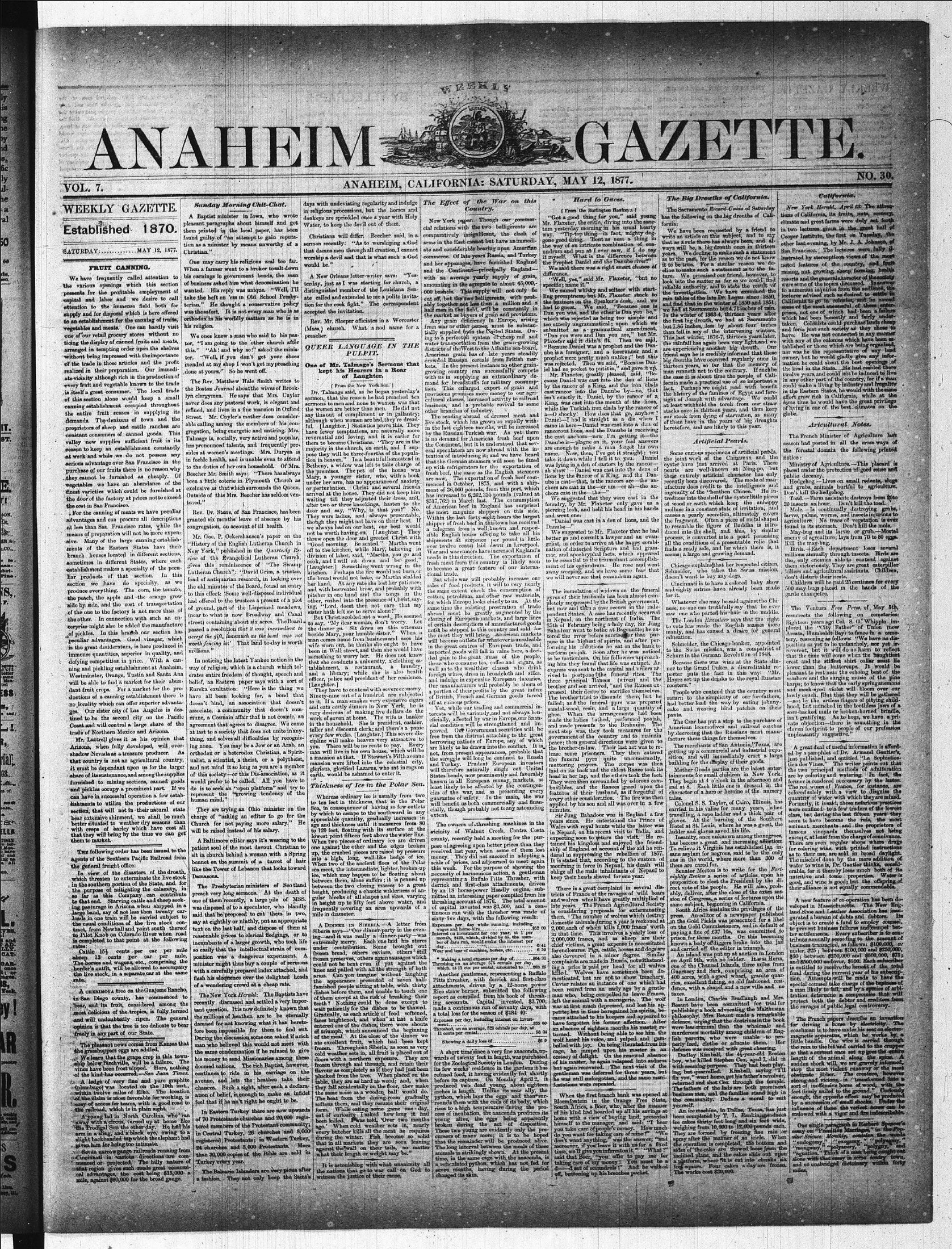
Searchable text
ANAHEIM
VOL. 7.
WEEKLY GAZETTE.
Established 1870.
SATURDAY... MAY 12, 1877.
FRUIT CANNING.
We have frequently called attention to the various openings which this section presents for the profitable employment of capital and labor and we desire to call attention to the immense field both for supply and for disposal which is here offered to an establishment for the canning of fruits, vegetables and meats. One can hardly visit one of our retail grocery stores without not ticing the display of canned fruits and meats, arranged in tempting order upon the shelves without being impressed with the importance of the trade in those articles and the profit realized in their preparation. Our immediate vicinity although rich in the production of every fruit and vegetable known to the trade is itself a great consumer. The local trade of this section alone would keep a small canning establishment occupied throughout the entire fruit season in supplying its demands. The denizens of town and the proprietors of sheep and cattle ranches are constant consumers of canned goods. This valley now supplies sufficient fruit in its season to keep an establishment constantly at work and while we do not possess any serious advantage over San Francisco in the Sunday Morning Chit-Chat.
A Baptist minister in Iowa, who wrote pleasant paragraphs about himself and got them printed in the local paper, has been found guilty of "an attempt to gain reputation as a minister by means unworthy of a Christian."
One may carry his religious zeal too far. When a farmer went to a broker to salt down his earnings in government bonds, the man of business asked him what denomination he wanted. His reply was unique. "Well, I will take the heft on 'em in Old School Prebyterian." He thought a conservative policy was the safest. It is not every man who is as orthodox in his worldly matters as he is in his religion.
We once knew a man who said to his pastor, "I am going to the other church after this," "Ah! and why so?" asked the minister. "Well, if you don't get your shoes mended at my shop I won't get my preaching done at yours." So he went off.
The Rev. Matthew Hale Smith writes to the Boston Journal about the wives of Brooklyn clergymen. He says that Mrs. Cuyler never does any pastoral work, is elegant and refined, and lives in a fine mansion in Oxford Street. Mr. Cuyler's mother does considerable calling among the members of his congregation, being energetic and untiring. Mrs. Talmage is, socially, very active and popular, has pronounced talents, and frequently presides at women's meetings. Mrs. Duryea is in feeble health, and is unable even to attend to the duties of her household.
Christians will discuss sermon recently: "that damns men through worship a devil and would be."
A New Orleans leftover day, just as I was distinguished memberate called and extension for the cock fight accepted the invitation.
Rev. Mr. Sleeper (Mass.) church. W preacher.
QUEER LANE PU
One of Mr. Talmage kept his Health of Life.
[From the Dr. Talmage said, sermon, that the rest sermons to men and the women are better say this out of comfort although when womanful. [Laughter.] She have fewer temptations reverential and love them to become Christian majority in the church pose they will be the nation in heaven." In Bethany a widow
realized in their preparation. Our immediate vicinity although rich in the production of every fruit and vegetable known to the trade is itself a great consumer. The local trade of this section alone would keep a small canning establishment occupied throughout the entire fruit season in supplying its demands. The denizens of town and the proprietors of sheep and cattle ranches are constant consumers of canned goods. This valley now supplies sufficient fruit in its season to keep an establishment constantly at work and while we do not possess any serious advantage over San Francisco in the purchase of our fruits there is no reason why they cannot be furnished as cheaply. Of vegetables we have an abundance of the finest varieties which could be furnished at the door of the factory at prices not to exceed the cost in San Francisco.
For the canning of meats we have peculiar advantages and can procure all descriptions at less than San Francisco rates, while the means of preparation will not be more expensive. Many of the large canning establishments of the Eastern States have their branch houses located in different sections, sometimes in different States, where each establishment makes a specialty of the peculiar products of that section. In this section we have no specialty, as we produce everything. The corn, the tomato, the peach, the apple and the orange grow side by side, and the cost of transportation of the one to the factory is not more than of the other. In connection with such an enterprise might also be added the manufacture of pickles. In this branch our section has peculiar advantages. Good vinegar, which is the great desideratum, is here produced in immense quantities, superior in quality, and defying competition in price. With a canning and pickling establishment at Anaheim, Westminster, Orange, Tustin and Santa Ana will be able to find a market for their abundant fruit crops. For a market for the productions of a canning establishment there is no locality which can offer superior advantages. Our sister city of Los Angeles is destined to be the second city on the Pacific Coast and will control a large share of the trade of Northern Mexico and Arizona.
Mr. Luttrell gives it as his opinion that Arizona, when fully developed, will overshadow Nevada as a treasure producer. As that country is not an agricultural country, it must be dependant upon us for the larger share of its sustenance, and among the supplies furnished to mining sections, canned goods and pickles occupy a prominent part. If we can have in successful operation a few establishments to utilize the productions of our section, that will not in their natural state bear extensive shipment, we shall be much better situated to weather dry seasons than with creps of barley which have cost all that they will bring by the time we can get them to market.
The following order has been issued to the agents of the Southern Pacific Railroad from the general freight office:
In view of the disasters of the drought, which threaten to exterminate the live stock realized in their preparation. Our immediate vicinity although rich in the production of every fruit and vegetable known to the trade is itself a great consumer. The local trade of this section alone would keep a small canning establishment occupied throughout the entire fruit season in supplying its demands. The denizens of town and the proprietors of sheep and cattle ranches are constant consumers of canned goods. This valley now supplies sufficient fruit in its season to keep an establishment constantly at work and while we do not possess any serious advantage over San Francisco in the purchase of our fruits there is no reason why they cannot be furnished as cheaply. Of vegetables we have an abundance of the finest varieties which could be furnished at the door of the factory at prices not to exceed the cost in San Francisco.
For the canning of meats we have peculiar advantages and can procure all descriptions at less than San Francisco rates, while the means of preparation will not be more expensive. Many of the large canning establishments of the Eastern States have their branch houses located in different sections, sometimes in different States, where each establishment makes a specialty of the peculiar products of that section. In this section we have no specialty, as we produce everything. The corn, the tomato, the peach, the apple and the orange grow side by side, and the cost of transportation of the one to the factory is not more than of the other. In connection with such an enterprise might also be added the manufacture of pickles. In this branch our section has peculiar advantages. Good vinegar, which is the great desideratum, is here produced in immense quantities, superior in quality, and defying competition in price. With a canning and pickling establishment at Anaheim, Westminster, Orange, Tustin and Santa Ana will be able to find a market for their abundant fruit crops. For a market for the productions of a canning establishment there is no locality which can offer superior advantages. Our sister city of Los Angeles is destined to be the second city on the Pacific Coast and will control a large share of the trade of Northern Mexico and Arizona.
Mr. Luttrell gives it as his opinion that Arizona, when fully developed, will overshadow Nevada as a treasure producer. As that country is not an agricultural country, it must be dependant upon us for the larger share of its sustenance, and among the supplies furnished to mining sections, canned goods and pickles occupy a prominent part. If we can have in successful operation a few establishments to utilize the productions of our section, that will not in their natural state bear extensive shipment, we shall be much better situated to weather dry seasons than with creps of barley which have cost all that they will bring by the time we can get them to market.
The Rev. Matthew Hale Smith writes to the Boston Journal aboutthe wives of Brooklyn clergymen. He says that Mrs. Cuyler never does any pastoral work, is elegant and refined, and lives in a fine mansion in Oxford Street. Mr. Cuyler's mother does considerable calling among the members of his congregation, being energetic and untiring. Mrs. Talmage is, socially, very active and popular, has pronounced talents, and frequently presides at women's meetings. Mrs. Duryea is in feeble health, and is unable even to attend to the duties of her own household. Of Mrs. Beecher Mr. Smith says: "There has always been a little coterie in Plymouth Church as exclusive as that which surrounds the Queen. Outside of this Mrs. Beecher has seldom ventured."
Rev. Dr. Stone, of San Francisco, has been granted six months' leave of absence by his congregation, on account of ill health.
Mr. Geo. P. Ockershausen's paper on the "History of the English Lutheran Church in New York," published in the Quarterly Review of the Evangelical Lutheran Church, gives this reminiscence of "The Swamp Lutheran Church": "David Grim, a trustee, fond of antiquarian research, in looking over the old minutes of the Board, found an entry to this effect: 'Some well-disposed individual had offered to the trustees a present of a plot of ground, part of the Lispenard meadows (near to what is now Broadway and Canal street) containing about six acres.' The Board passed a resolution that it was inexpedient to accept the gift, inasmuch as the land was not worth fencing in:' That land to-day is worth millions."
In noticing the latest Yankee notion in the way of religion, which is a church which tolerates entire freedom of thought, speech and belief, an Eastern paper says with a sort of Eureka exultation: "Here is the thing we have all been looking for, a bond that doesn't bind, an association that doesn't associate, a community that doesn't commit, a Cosmain affair that is not cosmic, an agreement that agrees to disagree. We come at last to a society that does not unite in anything, and solves all difficulties by recognizing none. You may be a Jow or an Arab, an orthodox or a heterodox Christian, a Spiritualist, a scientist, atheist, or a polytheist, and not mind it so long as you are a member of this society—or this Dis-association, as it would prefer to be called. All you have to do is seek an "open platform" and try to represent the "growing tendency of the human mind."
They are trying an Ohio minister on the charge of "asking an editor to go for the Church for not paying more salary." He will be raised instead of his salary.
A Baltimore editor says it's wearing to the patient soul of the most devout Christian to sit in church behind a woman with a Spring bonnet on the summit of a turret of hair like the Tower of Lebanon that looks toward Damasoua.
Dr. Talmage said sermon, that the rest sermons to men and women are better say this out of comfort although when worn full.[Laughter.] She have fewer temptations reverential and love them to become Christ majority in the church pose they will be thine in heaven." In Betheny, a widow with premises. The Mary, a younger man under her arm, has or perturbation. On arrival at the house waiting till they are after two or three kings door and say,"Wife They were ladies though they might off to the kitchen division of labor,s cook,and I will sit[Laughter.] Some kitchen Perhaps she bread would not her hand. At anyand with besweated pitcher in one hand other,rushed into ing," Lord,does sister hath left me.
But Christ scoldls to say,"My dear wife the dinner go.Side beside Mary,your man comes home from wife worn out,here been in Wall street something to worry that she conducts an tablishment,a teller and discount every few weeks.[ciplice] will make you There will be man live in his mansion were lifeless glorious,glorified earth.would be ad Thicknessof
The following order has been issued to the agents of the Southern Pacific Railroad from the general freight office:
In view of the disasters of the drought, which threaten to exterminate the live stock in the southern portion of the State, and for the purpose of mitigating the calamity, in so far as this Company can contribute to that end. Starving cattle and sheep seeking pasturage in Arizona when shipped in a large hand, say of not less than twenty carloads in one train will be carried subject to the usual conditions of the live stock contract, from Newhall and point south thereof to Pilot Knob on Colorado River when road is completed to that point at the following rates:
Cattle 15½ cents per car per mile sheep 13 cents per car per mile. The horses and wagons, etc., comprising the herder's outfit, will be allowed to accompany the live stock, in a separate car at the same rate.
A Cherimoya tree on the Guajome Rancho, in San Diego county, has commenced to bear, and its fruit, considered among the most delicious of the tropics, is fully formed and will undoubtedly ripen. The general opinion is that the tree is too delicate to bear freely in any part of our State.
The pleasant news comes from Kansas that the grasshoppers eggs are addled.
We learn that the grape crop in this township below Barchville, will be a failure. The vines have been frost nipped. Here, nothing of the kind has occurred.—San Juan Times.
A lodge of very fine and pure graphite (plumbago) was located on the 10th inst., within twelve miles of Elko. The location of the claim is most favorable for working, is easy of access for teams, with a good road to the railroad, which is in plain sight.
A young lad in North Carolina, who ran away with a circus, turned up at home like the Prodigal Son the other day. He had his arm in a sling, and a black eye, owing to a slight backhanded tap which the elephant had given him for being too intimate.
Seven narrow gauge railroads running from Cincinnati in various directions are commenced or projected. The hilly nature of that region gives such roads great economical advantages, the cost being $16,000 a mile, against $60,000 for the broad gauge.
The Baltimore editor says it's wearing to the patient soul of the most devout Christian to sit in church behind a woman with a Spring bonnet on the summit of a turret of hair like the Tower of Lebanon that looks toward Damascus.
The Presbyterian ministers of Scotland preach very long sermons. At the death of one of them recently, a large pile of MSS. was disposed of to a speculator, who blandly said that he proposed to cut them in two, say at eighthly or ninthly, put an appropriate text on the last half, and dispose of them at reasonable prices to clerical fledgings, or to incumbents of a larger growth, who took life so easily that the intellectual strain of composition was a dangerous experiment. A minister might thus buy a couple of sermons with a carefully prepared index attached, and flash his eloquence over the delighted heads of a wondering crowd at a cheap rate.
The New York Herald: The Baptists have recently discussed and settled a very important question. It is now definitely known that the millions of heathen are to be eternally damned for not knowing what it has heretofore been impossible for them to find out. During the discussion some one asked if a rich man who believed this would not meet with the same condemnation if he refused to give his money to send Missionaries among these doomed nations. The rich Baptist, however, continues to ride in his carriage on the avenue, and lets the heathen take their chances. Such a sight, after such a declaration of belief, is enough to make an infidel feel that if he isn't right he ought to be.
In Eastern Turkey there are now upwards of 70 Protestants churches and 20,000 registered members of the Protestant community; in Central Turkey, 26 churches and 8,000 registered Protestants; in Western Turkey, 24 churches and 5,000 Protestants. More than 30,000 copies of the Bible are sold in Turkey every year.
The Balearic Islanders are very pious after a fashion. They not only keep the Saint's do is to seek an "open platform" and try to represent the "growing tendency of the human mind."
They are trying an Ohio minister on the charge of "asking an editor to go for the Church for not paying more salary." He will be raised instead of his salary.
A Baltimore editor says it's wearing to the patient soul of the most devout Christian to sit in church behind a woman with a Spring bonnet on the summit of a turret of hair like the Tower of Lebanon that looks toward Damascus.
The Presbyterian ministers of Scotland preach very long sermons. At the death of one of them recently, a large pile of MSS. was disposed of to a speculator, who blandly said that he proposed to cut them in two, say at eighthly or ninthly, put an appropriate text on the last half, and dispose of them at reasonable prices to clerical fledgings, or to incumbents of a larger growth, who took life so easily that the intellectual strain of composition was a dangerous experiment. A minister might thus buy a couple of sermons with a carefully prepared index attached, and flash his eloquence over the delighted heads of a wondering crowd at a cheap rate.
The New York Herald: The Baptists have recently discussed and settled a very important question. It is now definitely known that the millions of heathen are to be eternally damned for not knowing what it has heretofore been impossible for them to find out. During the discussion some one asked if a rich man who believed this would not meet with the same condemnation if he refused to give his money to send Missionaries among these doomed nations. The rich Baptist, however, continues to ride in his carriage on the avenue, and lets the heathen take their chances. Such a sight, after such a declaration of belief, is enough to make an infidel feel that if he isn't right he ought to be.
In Eastern Turkey there are now upwards of 70 Protestants churches and 20,000 registered members of the Protestant community; in Central Turkey, 26 churches and 8,000 registered Protestants; in Western Turkey, 24 churches and 5,000 Protestants. More than 30,000 copies of the Bible are sold in Turkey every year.
The Balearic Islanders are very pious after a fashion. They not only keep the Saint's do is to seek an "open platform" and try to represent the "growing tendency of the human mind."
Whereas ordaining to ten feet in this Sea, in consequence by which to escapе appreciable quantity age and thickness to 120 feet, floating lowest point fifteen When two pieces one against the otte up, the crushed pail into a high, long When two of thе sea meet,the interiece which may hь between them,a lie between thе two height producing gular blocks o f life in height up fo f frequently covering mile in diameter.
A DINNER IN Sibiria says—"Oriental—and it was extremely merry under contributu frzen bread,o frozen preserves,could not be ben knee and pulled arms. Can you use the appearance famished people dishes before tha£of them except ar teeth? Nothing wait patiently for Gradually,as ca faces brightened entered one of th£of triumph,which of the meal. All ate excellent fr冻 frozen. Through cold weather set doors with a no frozen through а flavour as compl placked from thе table,they are а they fall accidente thе same noise s The heat从 softens them,and form. While co out of curiosity been killed.Page ago.' When co every butcher kills during thе win tthat in all mark against thе waalt what their length
It is astonishing tha£nations tha£witness tha£just
ANAHEIM, CALIFORNIA: SATURDAY, MAY 12, 1877.
days with undeviating regularity and indulge in religious processions, but the horses and donkeys are sprinkled once a year with Holy Water, to keep the devil out of them.
Christians will differ. Beecher said, in a sermon recently: "As to worshiping a God that damns men through all creation, I cannot worship a devil and that is what such a God would be."
A New Orleans letter-writer says: "Yesterday, just as I was starting for church, a distinguished member of the Louisiana Senate called and extended to me a polite invitation for the cock fight." The correspondent accepted the invitation.
Rev. Mr. Sleeper officiates in Worcester (Mass.) church. What a nod name for a preacher.
QUEER LANGUAGE IN THE PULPIT.
One of Mr. Talmage's Sermons that kept his Hearers in a Roar of Laughter.
[From the New York Sun.]
Dr. Talmage said, as he began yesterday's sermon, that the reason he had preached ten sermons to men and none to women was that the women are better than men. He did not say this out of compliment or in gallantry; although when women are bad, they're dreadful. [Laughter.] Statistics prove this. They have fewer temptations, are naturally more reverential and loving, and it is easier for them to become Christians. "They are in the majority in the church, on earth, and I suppose they will be three-fourths of the population in heaven." In a beautiful homestead in Betheny, a widow was left to take charge of
The Effect of the War on this Country.
New York paper: Though our commercial relations with the two belligerents are comparatively insignificant, the clash of arms in the East cannot but have an immediate and considerable bearing upon American commerce. Of late years Russia, and Turkey and her appanages, have furnished England and the Continent—principally England—with an average yearly supply of grain, amounting in the aggregate to about 45,000,000 bushels. This supply will not only be sent off, but the two belligerents, with probably together not less than a million and a half men in the field, will be constantly in the market as buyers of grain and provisions.
Any grain deficiency in Europe, arising from war or other causes, must be substantially supplied from the United States. Owing to a perfected system of cheap rail and water transportation from the grain-growing districts of the West to the Atlantic sea-board, American grain has of late years steadily crowded Russian cereals from British markets. In the present instance no other grain-growing country can successfully compete with us in supplying an extraordinary demand for breadstuffs for military consumption. This enlarged export of grain and provisions promises more money to our agricultural classes, increased activity to railroad business, and a probable revival to some other branches of industry.
The sending abroad of dressed meat and live stock, which has grown so rapidly within the last eighteen months, will be increased by the Russian-Turkish war. As yet there is no demand for American fresh beef upon the Continent, but it is understood that several speculators are now abroad with the intention of introducing it; and we have heard that the German steamers will soon be fitted
Hard to Guess.
[From the Burlington Hawkeya.]
"Got a good thing for you," said young Mr. Flaxeter, the critic, diving into the sanctum yesterday morning in his usual hearty way. "Tip-top thing—in fact, mighty dog-gone good thing." Bout as neat a thing in the way of an intricate combination of conundrum and pun as I ever saw, if I do say it myself. What is the difference between the Prophet Daniel and the Danube river?
We said there was a right smart chance of difference.
"Well, yes," said Mr. Flaxeter, "but no specific; name it."
We named whisky and seltzer with startling promptness, but Mr. Flaxeter stuck to the business on the Speaker's desk, and we had to guest. We said, "Because one is Dan you was, and the other is Dan you be," which was rejected as being too simple and too utterly ungrammatical; upon which we submitted as a grammatical amendment, "Dan you were and Dan you are," but Mr. Flaxeter said it didn't fit. Then we said, "Because Daniel was a prophet and the Danube is a foreigner, and a forerunner and a prophet were pretty much unlike;" but this was rejected. Then we said, "Because Daniel had no pocket to putitin," and gave it up.
Mr. Flaxeter, greatly pleased, said, "Because Daniel was cast into the den of lions by the rancor of a King, and the iron clads cast rancor into the Danube by—no, that isn't exactly it. Daniel, by the rancor of a King, was cast into the mouth of the lions, while the Turkish iron clads by the rancor of a—O shocky! How does that go, anyhow? Daniel—I had it straight as a die when I came in here—Daniel was cast into a den of rancorous lions, and the Danube is receiving the cast anchors—now I'm getting it—the Danube is—plague on it, your fool answers are enough to make a man forget his own name. Now then, I've got it straight; you take it down while I tell it to you. Daniel was living in a den of castors by the rancor—
kopt his Hearers in a Roar of Laughter.
[From the New York Sun.]
Dr. Talmage said, as he began yesterday's sermon, that the reason he had preached ten sermons to men and none to women was that the women are better than men. He did not say this out of compliment or in gallantry; although when women are bad, they're dreadful. [Laughter.] Statistics prove this. They have fewer temptations, are naturally more reverential and loving, and it is easier for them to become Christians. "They are in the majority in the church, on earth, and I suppose they will be three-fourths of the population in heaven." In a beautiful homestead in Betheny, a widow was left to take charge of the premises. The pet of the house was Mary, a younger sister, who, with a book under her arm, has no appearance of anxiety or perturbation. Christ and several friends arrived at the house. They did not keep him waiting till they adjusted their dress, and after two or three knockings, hasten to the door and say, "Why, is that you?" No. They were ladies, and always presentable, though they might not have on their best. If we always had on our best, our best would not be worth having on. [Laughter.] They threw open the door and greeted Christ with "Good morning. Be seated." Martha went off to the kitchen, while Mary, believing in division of labor, said, "Martha, you go and cook, and I will sit down and be good." [Laughter.] Something went wrong in the kitchen. Perhaps the fire would not burn, or the bread would not bake, or Martha scaled her hand. At any rate she lost her patience; and with besweated brow, and probably with pitcher in one hand and the tongs in the other, rushed into the presence of Christ, saying, "Lord, doct then not care that my sister hath left me to serve alone."
But Christ scolded not a word. He seemed to say, "My dear woman, don't worry. Let the dinner go. Sit down on this ottoman beside Mary, your humble sister." When a man comes home from business and sees his wife worn out, he thinks she ought to have been in Wall street, and then she would have something to worry her. He does not know that she conducts a university, a clothing establishment, a restaurant, a laundry, and a library; while she is also health officer, police and president of her residence.
[Laughter.]
They have to contend with severe economy. Ninety-nine out of a hundred are subjected to it. If a man smokes very expensive cigars and cats costly dinners in New York, he is very desirous of making five dollars do the work of seven at home. The wife is banker in the household. She is president, cashier, teller and discount clerk; and there's a panic few weeks. [Laughter.] This severe discipline will make heaven very attractive to you. There will be no rents to pay. Every man will live in his own house, which will be a mansion at that. If Stewart's Fifth avenue mansion were lifted into the celestial city, glorious, glorified Lazarus, who sat in rags on earth, would be ashamed to enter it.
Thickness of Ice in the Polar Sea.
Whereas ordinary ice is usually from two to ten feet in thickness, that in the Polar Sea, in consequence of having so few outlets by which to escape to the southward in any appreciable quantity, gradually increases in age and thickness until it measures from 80 to 120 feet, floating with its surface at the lowest point fifteen feet above the water line. When two pieces of ordinary ice are driven one against the other and the edges broken up, the crushed pieces are raised by pressure into a high, long-wall-like hedge of ice. When two of the ancient floes of the Polar sea meet, the intermediate lighter, broken-up ice, which may happen to be floating about between them, alone suffers; it is penned up growing country can successfully compete with us in supplying an extraordinary demand for breadstuffs for military consumption. This enlarged export of grain and provisions promises more money to our agricultural classes, increased activity to railroad business, and a probable revival to some other branches of industry.
The sending abroad of dressed meat and live stock, which has grown so rapidly within the last eighteen months, will be increased by the Russian-Turkish war. As yet there is no demand for American fresh beef upon the Continent, but it is understood that several speculators are now abroad with the intention of introducing it; and we have heard that the German steamers will soon be fitted up with refrigerators for the exportation of fresh beef, the same as the English steamers are now. The exportation of fresh beef commenced in October, 1875, and with a shipment of 36,000 pounds, from this port, which has increased to 6,262,355 pounds (valued at $517,762) in March last. The consumption of American beef in England has surprised the most sauvage shippers on this side. Within the last forty-eight hours the largest shipper of fresh beef in this town has received a telegram from a well-known and responsible English house offering to take all his shipments at sixpence per pound (a little over twelve cents) laid down in Liverpool. War and war rumors have increased England's needs in this direction. The exportation of fresh meat from this country is likely soon to become a great feature of our international trade.
But while war will probably increase our sales of food products, it will to very nearly the same extent check the consumption of cotton, petroleum, and other raw materials for which Europe looks chiefly to us. At the same time the existing prostration of trade abroad must be greatly augmented by the closing of European markets, and large lines of certain descriptions of manufactured goods must be shipped to this country and sold for the most they will bring. American markets will become outlets for whatever is unsaleable in the great centres of European trade, and imported goods will fall in value here, a decided gain to the great mass of the people those who consume tea, coffee and cigars, as well as to the wealthier classes who drink foreign wines, dress in broadcloth and silks and indulge in expensive European luxuries. Our manufacturers will probably be shorn of a portion of their profits by the great influx of British, French and German goods forced off at rainous prices.
Yet, while our trading and commercial interest will be variously, and not always beneficially affected by war in Europe, our financial condition will be strengthened and improved. Our Government securities will be free from the distrust attaching to the great borrowing nations of Europe, any of which are likely to be drawn into the conflict. It is not, from present appearances, probable that the struggle will long be confined to Russia and Turkey. Prudent European investors will therefore naturally single out United States bonds, now prominently and favorably known in all European money markets, as least likely to be affected by the contingencies of the war, and as presenting every guarantee of safety. In the main, the war will benefit us both commercially and financially, though probably not to any astounding extent.
The owners of threshing machines in the vicinity of Walnut Creek, Contra Costa county, recently held a meeting for the purpose of agreeing upon better prices than they received last year, when some of them lost money. They did not succeed in adopting a scale of prices, and adjourned to meet again this week. For the purpose of showing the necessity of harmonious action, a gentleman representing a Buffalo Pitts Thresher, with Mr Flaxeter greatly pleased, said "Because Daniel was cast into the den of lions by the rancor of a King, and the iron clads cast rancor into the Danube by—no, that isn't exactly it. Daniel, by the rancor of a King, was cast into the mouth of the lions, while the Turkish iron clads by the rancor of a—O shocky! How does that go; anyhow? Daniel! I had it straight as a die when I came in here—Daniel was cast into a丹of rancorous lions,and the Danube is receiving the cast anchors—now I'm getting it—the Danube is—plague on it; your fool answers are enough to make a man forget his name. Now then I've got it straight; you take it down while I tell it to you. Daniel was lying in a den of castors by the rancor of a King,and the Danube is cast—that is,the rancors are—the anchors are cast in—the er um—er ah—the anchors cast in—the—the
We suggested that they were cast in the foundry, by Mr Flaxeter only gave us a piercing look,and held his head in his hands and went one:
"Daniel was cast in a丹of lions,and the Danube—"
We suggested to Mr. Flaxeter that he had better go and consult a lawyer and an evangelist,在 order to arrive at the happy combination of distorted Scripture and bad grammar,and apochryphal factswhich appeared to be essential to the triumphant accomplishment of his conundrum.Here rose and went away sweeping,and we have some fear that we will never see that conundrum again.
The immolation of wildows on the funeral pyre of their husbands has been almost completely suppressed by the British government,但 now and then a case occurs in the independent States.A case has recently occurred in Nepal.on the northeast of India.The 25th of February being a fully day,Sir Jung Bahadoor went to bathe at Baguntte;he entered the river before sunrise;or that purpose in the highest spirits,and after performing his abultions he sat on the bank to perform poojah.Soon after he was noticedto be motionless.On his followers approaching him they found that life was extinct.An express was sent to the capital and officers arrived to postpone(the funeral rites.The three principal Rannes (wives)和the brother and son arrived,"andthe Rannes expressed their desire to sacrifice themselves.The brother tried to dissuade thembut he failed;and the funeral pyre was prepared sandal-wood ,resin,and a large quantity of gheeWhenthe arrangementshad been madethe ladies'bathed,personalpojah,andmade presentstotheBrahmins.The next stepwas,they took measuresforthegovernmentofthecountryandtomaintainpeace;thengeneraldirectionsweregiventothebrother-in-law.Thelastactwasreleasedthefuneralpyrequiteunconcernedlymutteringprayers.ThecorpsewasthenlaidonitsbackandtheeldestRancetookitsheadinherlap,andtheotherstookthefeetTheywerethensurroundedbyodorouscombustibles,andtheRannesgrazedupthefeaturesofthehusband.asifforgetfulofeveryotherconsideration.Thefirewasthenappliedbyhissonandallwasoverinafewminutes.
Sir Jung Bahadoor was in Englanda few years since.Ho entertainedthePrinceofWaleswith royal huntswhilethe latterwasinNepail.onhis recent visittoIndia,andexpectingsoontoreturnthevisit.He retainedhiskingdomandenjoyedthefriendshipofEnglandonaccountoftheaidherenderedinsuppressingtherebellionof1857。它is statedthat,accordingtothecustomofmourninginforceinNepail,hisdawnwillobligallthemain inhabitantsofNepaaltokeeptheirheadshavedforoneyear.
Whereas ordinary ice is usually from two to ten feet in thickness, that in the Polar Sea, in consequence of having so few outlets by which to escape to the southward in any appreciable quantity, gradually increases in age and thickness until it measures from 80 to 120 feet, floating with its surface at the lowest point fifteen feet above the water line. When two pieces of ordinary ice are driven one against the other and the edges broken up, the crushed pieces are raised by pressure into a high, long, wall-like hedge of ice. When two of the ancient floes of the Polar sea meet, the intermediate, lighter, broken-up ice, which may happen to be floating about between them, alone suffers; it is penned up between the two closing masses to a great height, producing a chaotic wilderness of angular blocks of all shapes and sizes, varying in height up to fifty feet above water, and frequently covering an area upwards of a mile in diameter.
A DINNER IN SIBERIA—A letter from Sibiria says—"Our dinner-party in the evening—and it was really a dinner-party—was extremely merry. Each one laid his stores under contribution. Some brought out frozen bread, others caviare, others still frozen preserves, others again sausages which could not be bent even if put against the knee and pulled with all the strength of both arms. Can you imagine without laughing the appearance presented of seven half-famished people sitting at table, with thirty dishes before them, and unable to touch one of them except at the risk of breaking their teeth? Nothing could be done except to wait patiently for the dishes to be thawed. Gradually, as each article of food softened, faces brightened, and when at last a knife entered one of the dishes, there were shouts of triumph, which announced the beginning of the meal. At the close of the dinner we ate excellent fruit, which had been kept frozen. Throughout Siberia, as soon as very cold weather sets in, all fruit is placed out of doors with a northern exposure. They are frozen through and through, and retain their flavour as completely as if they had just been placked from the tree. When placed on the tables, they are as hard as wood; and, when they fall accidentally on the floor, they make the same noise as a wooden ball would do. The heat from the dining-room gradually softens them, and they resume their original form. While eating some game one day, out of curiosity I asked how long it had been killed. Was told, 'Over two months ago.' When cold weather sets in, nearly every butcher kills all the meat he requires during the winter. Fish become so solid that in all markets they are seen leaning against the wall on their tails, no matter what their length or weight may be."
It is astonishing with what unanimity all the nations that go to war call on God to witness the justice of their cause.
The owners of threshing machines in the vicinity of Walnut Creek, Contra Costa county, recently held a meeting for the purpose of agreeing upon better prices than they received last year, when some of them lost money. They did not succeed in adopting a scale of prices, and adjourned to meet again this week. For the purpose of showing the necessity of harmonious action, a gentleman representing a Buffalo Pitts Thresher, with derrick and first-class attachments, driven by an 18 horse-power Hoadley engine, submitted an interesting paper compiled from his threshing account of 1876. The total amount of capital invested was $3,500, and a continuous run with the thresher was made of sixty-five days, with the following result:
Expenses per day while running, including wages and horse-hire...$52 00
Interest on investment for one year, at 1 per month...$420, which divided by 65, the number of days run, would make the interest per day...6 41
Wear and tear of machine, horses, etc...6 50
* Making a total expense per day of...$64 91
Threshing on an average 515 cents per day,
which at 11 eta per cental, amounted to...$63 25
Another gentleman, representing a Buffalo Pitts thresher, with derrick and first-class attachments, driven by a 12 horse power Rice straw burner, submitted the following report as compiled from his book of threshing accounts. Capital invested...$3,700; made a continuous run of seventy days, with a total loss for the season of $484 40:
Expenses per day, including interest on investment...$35 00
Threshing on an average 523 cents per day, at 11 cents per cental...$58 04
Showing a daily loss of...$6 9
A short time since a very fine anaconda, upwards of twenty feet in length, was purchased for the Zoological Society in London. During its few weeks' residence in the gardens it has refused food, it having evidently fed shortly before its capture. On Monday April 2, it produced two dead young, about eighteen inches in length. Unlike its ally, the python, which lays the eggs and then surrounds them with the coils of its body, which rises to a high temperature during the process of incubation, the anaconda produces its young alive; the egg being apparently broken during the act of disposition. These two young are evidently only the precursors of many more; it is to be hoped that the remainder will be produced alive. The long interval between the meals of these animals is strikingly shown. At the present time, in the same cage with the anaconda, is a rehabilitated python, which has not fed for seven months, having during the period changed its skin.
There is a great complaint in several districts of France of the ravages of wild boars and wolves which have greatly multiplied of late years. The French Agricultural Society is considering proposals for exterminating them. The number of wolves which destroy domestic animals during a year is reckoned at 2,000 each of whom kills 1,000 francs worth in that time. This involves a yearly loss of 2,000,000 francs, and as sheep are their chief victims, a great expense is necessitated for enclosures. Pigs, cattle and dogs are also devoured in a minor degree. Similar complaints are made in Russia, notwithstanding a price is paid per head for all wolves killed. Wolves have sometimes been domesticated, but are apt to show treachery. Cuvier relates an instance of one which had been reared from an early age by a gentleman who, being compelled to leave France, left the animal with a menagerie. The wolf was at first much depressed, and lost his appetite; but in time he regained his spirits, became attached to his keepers and appeared to have forgotten his former affection. After an absence of eighteen months his master returned. Without being able to see him the wolf heard his voice, and yelped and gainled with joy. On being liberated from his cage, he jumped upon his master in an ecstatic delight. On the renewed absence of his master, he again relapsed into sadness but again recovered. The next visit of the gentleman was deferred for three years, but he was still unforgotten, and the same manifestations were repeated.
When the first branch bank was opened at Bloemfontein in the Orange Free State, South Africa, a Boer who, after the manner of his kind had heard up all his savings at home with a view of buying land, presented himself to the manager, and said: "I hear you take care of people's money. How much do you want for taking care of mine?" "We don't want anything," was the answer; "and moreover, if you leave it with us for a fixed time we'll give you interest it." "What?" said that Boer; "you offer to pay me for taking care of my money! You must be a d—d set of secondrails!" And he walked off, buttoning up his breasts pocket.
GAZETTE.
NO. 30.
Mr. Flaxeter, "but no and seltzer with startMr. Flaxeter stuck to speaker's desk, and we said, "Because one is the other is Dan you be," being too simple and artificial; upon which weammatical amendment, Dan you are," but Mr. not fit. Then we said, a prophet and the Danand a forerunner and a much unlike;" but this we said, "Because Danpatitin," and gave it up. Bently pleased, said, "Beat into the den of lions ing, and the iron clads Danube by—no, thatiel, by the rancor of a mouth of the lions, on clams by the rancor of does that go, anyhow? might as a die when I was cast into a den of the Danube is receiving now I'm getting it—the in it, your fool answers a man forget his own I've got it straight; you tell it to you. Daniel coasters by the rancor—
The Big Droughts of California.
The Sacramento Record-Union of Saturday has the following on the big droughts of California:
We have been requested by a friend to write an article on this subject, and to say that as a rule there has always been, and always will be, a big drouth once in thirteen years. We decline to make such a statement as to the past, for the reason we do not know it to be true. For a similar reason we decline to make such a statement as to the future. We promised our friend, however, to look into the matter as far as we could find reliable authority, and to state the result of the investigation. We have examined the rain tables of the late Dr. Legan since 1850, and find that in the winter of 1850 and 1851; we had at Sacramento but 4.71 inches of rain. In the winter of 1863-4, thirteen years after the first big drouth, we had at Sacramento but 7.85 inches, less by about four inches than fall in any of the intervening winters. This last winter, 1876-7, thirteen years later, the rainfall has again been very light, and we are experiencing another big drouth. Our friend says he is credibly informed that these big drouths have occurred regularly once in thirteen years, so far that the memory of man runneth not to the contrary. If such be the case it is about time the people of California made a practical use of so important a fact. Perhaps we might read with benefit the history of the famines of Egypt and fore-sight of Joseph with advantage. We could at least withhold the torch from our straw stacks once in thirteen years, and thus keep our stock from dying of starvation, as many of them have in the years of big droughts heretofore, and are likely to this year.
Artificial Pearls.
Some curious specimens of artificial pearls, the joint work of the Chinaman and the oyster have just arrived at Paris. These
California.
New York Herald, April 23. The attractions of California, its fruits, nuts, scenery, climate and great farms were duly set forth in two lectures given in the great hall of Cooper Institute, the first on Tuesday, the other last evening, by Mr. J. A. Johnson, of San Francisco. The lectures were fully illustrated by stereopticon views of the most noted features of the country, and fruit raising, nut growing, sheep farming, health resorts and the general character of the society were some of the topics discussed. In answer to numerous inquiries from the audience, the lecturer advised such as desired to settle in California to go in colonies, and he named some of the most successful of these enterprises, not one of which had been a failure which had been honestly and fairly undertaken. Colonists could purchase lands cheap and form just such society as they chose to have. He was not connected in any manner with any of the colonies which have been established or those which are being organized nor was he the representative of any land owner, but he would gladly give any information he could about the best openings of the kind in the State. He had resided there twelve years, and could not be induced to live in any other part of the country, for if a man could make a living by industry and frugality in the Eastern States, he would withthe same effort grow rich in California, while at the same time he would have the great privilege of living in one of the best climates on the globe.
Agricultural Notes.
The French Minister of Agriculture last season had posted in all the cross ways of the forestal domain the following printed notice: Ministry of Agriculture.—This placard is
Artificial Pearls.
Some curious specimens of artificial pearls, the joint work of the Chinaman and the oyster have just arrived at Paris. These pearls are well-known at Ningpo, but their entirely artificial character has only recently been discovered. The mode of manufacture does credit to the intelligence and ingenuity of the "heathen Chinese." He introduces into the shell of the oyster little pieces of wood or earth which keep the unhappy mollusc in a constant state of irritation, and causes a pearly secretion, ultimately covers the fragment. Often a piece of mutual shaped to resemble the figure of Buddha is introduced into the shell, and this, by similar process, is converted into a pearl possessing all the conditions of a presentable rolie that finds a ready sale, and for which there is, it seems; a large and growing demand.
Chicago explaining that her respected citizen, Schneider, who takes the Swiss mission, doesn't want to buy any dogs.
Cincinnati is to have a colored baby show and eighty entries have already been made for it.
Whatever else may be said against the Chinese, no one can truthfully say that he ever saw one who parted his hair in the middle.
The London Examiner says that the right to vote has made the English masses more manly, and has caused a desire for general education.
Schneider, the Chicago banker, appointed to the Swiss mission, was a compatriot of Schurz in the German Revolution of 1848.
Because there was wine at the State dinner to the Grand Dukes, a disreputable reporter puts the fact in this way: "Mr. Hayes set up the drinks to the royal Russian roosters."
People who contend that the country must return to the simplicity of our forefathers, had better lead the way by eating johnnycake and wearing hind patches on their pants.
The Czar has put a stop to the purchase of American locomotives and railroad coaches by decreeing that the Russians must manufacture these things for themselves.
The merchants of San Antonio, "Texas," are getting up a commercial and industrial expedition, and will immediately erect a large building for the display of their goods.
Mother Goode parties are the latest entertainments for small children in New York. They begin at 4 o'clock in the afternoon and end at 8. Each little one is dressed in the character of a hero or heroine of the nursery tales.
Colonel S. S. Taylor, of Cairo, Illinois, has carried in his valise for many years, when travelling, a rope ladder and a thick pair of gloves. At the burning of the Southern Hotel at St. Louis, where he was a guest, the ladder and gloves saved his life.
Insanity, once unknown among the negroes, has become a great and increasing affection. To relieve it Virginia has established an insane asylum for negroes, said to be the only one in the world, where more than 300 of them are cared for.
Senator Morton is to write for the Fortnightly Review a series of articles upon his proposition to elect the President by the kind in the State. He has reached there twelve years, and could not be induced to live in any other part of the country, for if a man could make a living by industry and frugality in the Eastern States, he would with the same effort grow rich in California, while at the same time he would have the great privilege of living in one of the best climates on the globe.
Agricultural Notes.
The French Minister of Agriculture last season had posted in all the cross-ways of the forestal domain the following printed notice:
Ministry of Agriculture.—This placard is placed under the protection of good sense and public decency.
Hedgehog.—Lives on small rodents, slugs and grubs, animals harmful to agriculture. Don't kill the hedgehog.
Toad.—Farm assistant; destroys from 20 to 30 insects an hour. Don't kill the toad.
Mole.—Is continually destroying grubs, larvae, palms, worms, and insects injurious to agriculture. No trace of vegetation is ever found in its stomach. Don't kill the mole.
May-bug and its larvae or grub.—Mortal enemy of agriculture; lays from 70 to 80 eggs. Kill the may-bug.
Birds.—Each department loses several millions annually through insects. Birds are the only enemies able to contend against them victoriously. They are great caterpillar killers and agricultural assistants. Children don't disturb their nests.
Children will be paid 25 centimes for every 500 may-bugs placed in the hands of the garde champetre.
The Ventura Free Press, of May 5th, resurrects the following on cemetery: Eightteen years ago Col. S. G. Whipple implored the "City Father" of Union (now Arvata, Humboldt Bay) to fence in a cemetery, reasoning as follows: "We have no disposition as yet to be melancholy, nor yet irreverent, but it will do no harm to reflect that time will come when the haughtiest crest and the stiffest shirt collar must lie lower than the buttercups. It would be pleasant to rest near the echoing beat of the seashore and the surging music of the pine harps; to know that the early spring anemone and meek-eyed violant will bloom over our lowly couch. But that they will be gathered—not by the artless fingers of pitting childhood, but minced in the toothless jaws of a sore-backed mule or broken-horned brindle, isn't gratifying. As to hogs, we have a private objection—there is something in the cloven footprint to people of our profession unpleasantly suggestive."
A great deal of useful information is afforded by a pamphlet of Dr. Armand Gantier's, just published, and entitled "La Sophistica des Vines." The writer points out that the two principal methods of adulteration are by coloring and watering. In fact, the former is rendered necessary by the latter. The red wines of France, for instance, are colored solely with a view to disguise the quantity of water with which they are mixed. Formerly, it is said, these nefarious practices were confined to a few traders of the lowest class, but during the last fifteen years they seem to have become the rule, the most eminent merchants and the proprietors of famous vineyards themselves not being exempt, at least from the charge of connivance. There are even regular shops where drugs for coloring wine, with printed instructions as to their use, are sold in broad daylight. The mischief done by the mere addition of water to wine is, Dr. Gantier thinks, considerable; for it thereby loses much both of its nutritive and tonic properties. Water is good and wine is good; but the offering of
complaint in several distracts the ravages of will boars have greatly multiplied of French Agricultural Society proposals for exterminating order of wolves which destroy during a year is reckoned at ten kills 1,000 francs' worth this involves a yearly loss of sheep and as sheep are their great expense is necessitated cattle, horses and dogs are a minor degree. Similar trade in Russia, notwithstanding per head for all wolves have sometimes been done apt to show treachery instance of one which had an early age by a gentle-compelled to leave France with a menagerie. The wolf depressed, and lost his apes heregained his spirits, be his keepers and appeared to a former affection. After twelve months his master retiring being able to see him the price, and yelped and gamely On being liberated from his old upon his master in an On the renewed absence again relapsed into sadness. The next visit of the referred for three years, but forgotten, and the same mani-peated.
The branch bank was opened at the Orange Free State, Boer, who, after the manner boarded up all his savings at new of buying land, presented manager, and said: "I hear people's money. How much making care of mine?" "We being" was the answer; "and leave it with us for a fixed interest on it." "What?" you offer to pay me for my money! You must be a mandrels!" And he walked his breaches pocket.
Colonel S. S. Taylor, of Cairo, Illinois, has carried in his valise for many years, when travelling, a rope ladder and a thick pair of gloves. At the burning of the Southern Hotel at St. Louis, where he was a guest, the ladder and gloves saved his life.
Insanity, once unknown among the negroes, has become a great and increasing affliction. To relieve it Virginia has established Ian insane asylum for negroes, said to be the only one in the world, where more than 300 of them are cared for.
Senator Morton is to write for the Fortnightly Review a series of articles upon his proposition to elect the President by the direct vote of the people. He will also, probably, deliver, after the close of the extra session of Congress, a series of lectures upon the same subject, beginning in California.
South Africa sustains the privileges of the press. An editor of a newspaper published in the Gold Fields was prosecuted for a libel on the Gold Commissioners, and in default of paying a fine of £37 10s., was committed to prison for three months. On this becoming known a body of diggers broke into the jail and carried off the editor in triumph.
An island was put up at auction in London on April 9th, with no bidder. It was Herm, one of the Channel Islands, three miles from Guernsey and Sark, comprising an area of 400 acres, with a good wharf, granite quarries, excellent fishing, an old fashioned residence, with a chapel and a new villa and no taxes.
In London, Charles Bradlaugh and Mrs. Besant have been committed for trial for publishing a book advocating the Malthusian philosophy. Mrs. Besant made a remarkable defence, urging that the doctrines in the book were less criminal than the wholesale and murderous mortality among children of English parents who were unable to properly feed, clothes or educate them. Her defence was received with great cheering.
Dudley Kimball, the 44-year-old Boston boy, who killed Stephen Cox, aged 7, did it with seeming purpose. They had been playing but quarreled. Kimball, saying "I'll fix you," went home, got his father's revolver, returned and shot Cox through the temple. The fathers of the lads are both prominent business men, and the families stand high in the community. Deducs a moral to suit yourself.
An ice machine, in Dallas, Texas, has just been completed by T. L. Rankin, grodness ice cakes thirty feet long and six feet wide, weighing from 10,000 to 12,000 pounds each. They are formed by freezing fine rain or spray after the manner of an icicle. When the operation is completed, the bottom and sides of the cake are thawed loose from the inclined plane, and the cakes slide out upon a platform, where it is cut into chunks six feet square. Four cakes a day are frozen. The works cost $30,000.
The red wines of France, for instance, are colored solely with a view to disguise the quantity of water with which they are mixed. Formerly, it is said, these nefarious practices were confined to a few traders of the lowest class, but during the last fifteen years they seem to have become the rule, the most eminent merchants and the proprietors of famous vineyards themselves not being exempt, at least from the charge of connivance. There are even regular shops where drugs for coloring wine, with printed instructions as to their use, are sold in broad daylight. The mischief done by the mere addition of water to wine is, Dr. Gautier thinks, considerable, for it thereby loses much both of its nutritive and tonic properties. Water is good, and wine is good; but the offspring of their alliance is not equally commendable.
A new feature of co-operation has been developed in Massachusetts. The New England Shoe and Leather Association has inaugurated a bureau of debts and debtors. Its object is to create a fund to employ counsel to prevent business failures and compel better settlements. Every subscriber is to contribute annually according to the amount of business transacted, as follows: $100,000 or under; $25; between $100,000 and $250,000; $50; between $250,000 and $500,000; $75; and $500,000 and over; $100. Each subscriber is entitled to receive the benefit of the total fund during the current year of his subscription. Attempts will be made to have the special counsel take charge of the business of a man likely to fail, and by a species of arbitration determine a compromise that will protect both the debtor and creditors from the ravages of public legal controversy.
The French papers describe an invention for driving a horse by electricity. The coachman is to have under his seat an electro-magnetic apparatus, which he works by a little handle. One wire is carried through the rein to the bit and carried to the crusher so that a current once set up goes entire length of the animal along the spins. A sudden shock will we are gravely informed stop the most violent runaway or the most obstructive jibber. The creature however strong and viciosa is "transformed into a sort of inoffensive horse of wood," with the feet firmly nailed to the ground." Cariously enough, the opposite effect may be produced by a succession of small shocks. Under the influence of these various amuses can be endowed with a vigor and fire indescribable.
One single paragraph in Harbert Spencer's essay on "Primitive Marriages," in the Popular Science Monthly contains the words "endogomy," "exogamy," "polygamy," "mongamy," "polyanary," "polygyny," and "nagation." Think of a man being caught out alone with that essay in some country town, and no unbridged dictionary within forty miles.