anaheim-gazette 1877-05-05
Scanned page
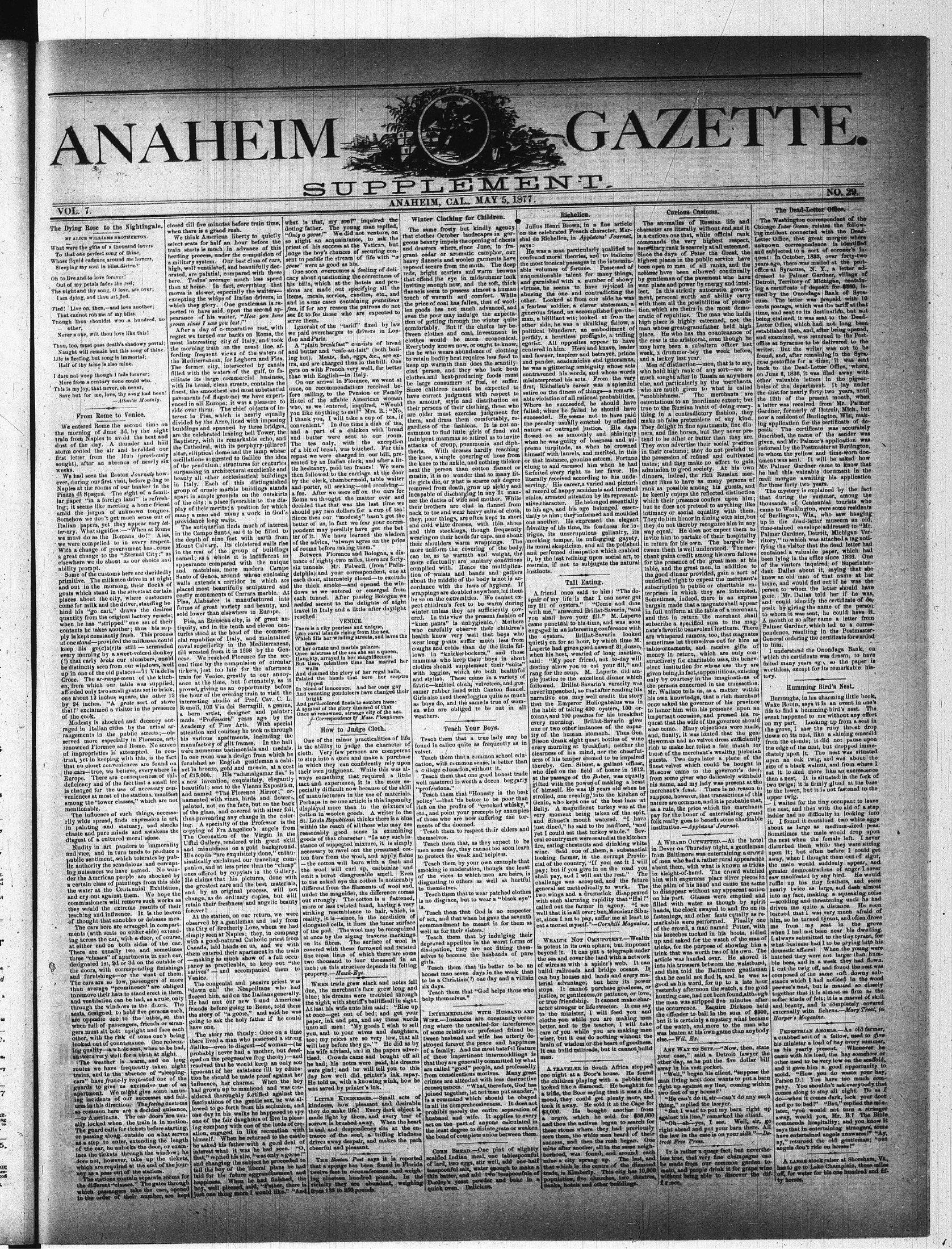
Searchable text
ANAHEIM
VOL. 7.
The Dying Rose to the Nightingale.
BY ALICE WILLIAMS BROTHERTON.
What were the gifts of a thousand lovers
To that one perfect song of thine,
Whose liquid cadence around me hovers,
Steeping my soul in bliss divine?
Oh to live and to love forever!
Out of my petals fades the red;
The night and thy song, O love, are over;
I am dying, and thou art fled.
Fled! Live on, then,—and love another;
That cannot rob me of my bliss.
Though thou shouldst woo a hundred, no other,
Never a one, wilt thou love like this!
Thou, too, must pass death's shadowy portal;
Naught will remain but this song of thine.
Life is fleeting, but song is immortal;
Half of thy fame is also mine.
I dare not weep though I fade forever;
More from a century none could win.
This is my joy, that never, oh never,
Save but for me, love, thy song had been!
—Atlantic Monthly.
From Rome to Venice.
We entered Rome the second time on the morning of June 3d, by the night train from Naples to avoid the heat and dust of the day. A thunder and hail storm cooled the air and heralded our first letter from the Hub (previously sought), after an absence of nearly six closed till five minutes before train time, when there is a grand rush.
We think American liberty to quietly select seats for half an hour before the train starts is much in advance of this herding process, under the compulsion of a military system. Our best class of cars, high, well ventilated, and beautifully decorated, are palatial, compared with those here. Trains average much less speed than at home. In fact, everything that moves is slower, especially the waiters—excepting the whips of Italian drivers, in which they glory. One gentleman is reported to have said, upon the second appearance of his waiter, "How you have grown since I saw you last."
After a day of comparative rest, with regret we turned our backs on Rome, the most interesting city of Italy, and took the morning train on the coast line, affording frequent views of the waters of the Mediterranean, for Leghorn and Pisa. The former city, intersected by canals filled with the waters of the gulf, to facilitate its large commercial business, with its broad, clean streets, contains the finest, the smoothest and most substantial pavements (of flagstone) we have experienced in all Europe; it was a pleasure to ride over them. The chief objects of interest in Pisa, which is nearly equally divided by the Arno, lined with imposing buildings and spanned by three bridges, are the celebrated leaning bell Tower, the Baptistry, with its remarkable echo, and the Cathedral, with its porphyry-pillared altar, elliptical dome and the lamp whose oscillations suggested to Galileo the idea of the pendulum: structures for centuries what is that, my son? doting father. The young "Only a goose!" We did so slight an acquaintance priest of his success at the judge the boy’s chances sent to paddle the stream goose” were as good as his.
One soon overcomes a cacy about questioning his bills, which at the sions are made out apart items, meals, service, care and in some cases contain fees, if for any reason this see fit to fee those who serve them.
Ignorant of the “tariff we paid overcharges to don and Paris.
A “plain breakfast” cauld butter and “cafe-au-ling hot). Meatz, fish, eira, and are charged thus gets on with French ver than with English—in I On our arrival in Florence once, on recommendation fore sailing, to the Pet Hotel of the affable A who, as we entered, in you like anything to eat I thank you, I will take convenient.” In due ti and a part of a chili and butter were sent The tea only, with of a bit of bread, was to repast we were charged sent by an Italian cle
From Rome to Venice.
We entered Rome the second time on the morning of June 3d, by the night train from Naples to avoid the heat and dust of the day. A thunder and hail storm cooled the air and heralded our first letter from the Hub (previously sought), after an absence of nearly six weeks.
We had seen the Boston Journal however, during our first visit, before going to Naples at the rooms of our banker in the Piazza di Spagna. The sight of a familiar paper "in a foreign land" is refreshing; it seems like meeting a home friend amid the jargon of unknown tongues. Somehow we don't get much sense out of Italian papers, yet they appear very letter-ary. What signifies:—"When at Rome we must do as the Romans do!" Alas, we were compelled to in every respect. With a change of government has come a great change to the "Eternal City," as elsewhere we do about as our choice and ability prompt.
Some of the customs here are decidedly primitive. The milkmen drive in at night and out in the morning, their flocks of goats which stand in the streets at certain places about the city, where customers come for milk and the driver, standing behind his "go cart," draws the desired quantity from the original factory vessels; when he has "stripped" one set of their contents he takes another; thus his supply is kept constantly fresh. This process at one stand—provided the milkman could keep his go(c)a(r)s still—serenaded every morning by a sweet-voiced donkey (l) that early broke our slumbers, could be distinctly seen from our windows, well up in one of the old palaces—71 Via della Croce. The ar-range-ment of the kitchen, from which our table was supplied, afforded only two small grates set in brick, one about 12 inches square, the other 12 by 24 inches. "A grate sort of stove that!" exclaimed a visitor in the presence of the cook.
Modesty is shocked and decency outraged in Italian cities by the urinal arrangements in the public streets; observed more especially in Florence, art-renowned Florence and Rome. No screen of improprieties is attempted. In contrast, yet in keeping with this, is the fact that no closet conveniences are found on the cars—true, we believe, everywhere in Europe. There are consequences of this deficiency and of the fact that a small tee is charged for the use of necessary conveniences at most of the stations, manifest among the "lower classes," which are not mentionable.
The influence of such things, necessarily wide spread, finds expression in art, in painting and statuary, and shocks chaste and pure minds and awakens the disgust of a cultured moral sense.
Nudity in art panders to immorality and vice, and in turn tends to produce a public sentiment, which tolerates by public authority the scandalous and corrupt nuisances we have named. No wonder the American people are shocked by paintings from this side filled with the waters of the gulf, to facilitate its large commercial business, with its broad, clean streets, contains the finest, the smoothest and most substantial pavements (of flagstone) we have experienced in all Europe; it was a pleasure to ride over them. The chief objects of interest in Pisa, which is nearly equally divided by the Arno, lined with imposing buildings and spanned by three bridges, are the celebrated leaning bell Tower, the Baptistry, with its remarkable echo, and the Cathedral, with its porphyry-pillared altar, elliptical dome and the lamp whose oscillations suggested to Galileo the idea of the pendulum; structures for centuries surpassing in architectural excellence and beauty all other ecclesiastical buildings in Italy. Each of this distinguished group of ornate marble buildings stands apart in ample grounds on the outskirts of the city; a place favorable to the display of their merits; a position for which many a man and many a work in God's providence long waits.
The autuquarian finds much of interest in the Campo Santa, said to be filled to the depth of nine feet with earth from Mount Calvary. Its cloistered walls rise in the rear of the group of buildings named; as a whole it is indifferent in appearance compared with the unique and matchless, more modern Campo Santo of Genoa, around whose enclosing walls extends a corridor in which are placed most beautifully sculptured and costly monuments of Carrara marble. At Pisa, Alabaster is manufactured into forms of great variety and beauty, and sold lower than elsewhere in Europe.
Pisa, an Etruscan city, is of great antiquity, and in the tenth and eleven centuries stood at the head of the commercial republics of Italy, and maintained naval superiority in the Mediterranean till wrested from it in 1298 by the Genoese. We reached Florence for the second time by the compulsion of circular tickets; just too late for the afternoon train for Venice, greatly to our annoyance at the time, but fortunately, as it proved, giving us an opportunity before the hour of the evening train to visit the interesting studio of Prof. Cav. C. L. Romoli, 103 Via dei Serragili, a genius, a born artist, designer and painter; made "Professore" years ago by the Academy of Fine Arts. With special attention and courtesy he took us through his various apartments, including the manufactory of gilt frames. In the hall were numerous testimonial and medals. In one room was a design from which he furnished an English gentleman a cabinet in bronze, gold and mosaic, at a cost of £15,000. His "adamalgamar fissa" is a new invention, exquisitely elegantly beautiful; sent to the Vienna Exposition, and named "The Florence Mirror"; ornamented with vines, birds and flowers, painted, not on the face, but on the back of the glass, and covered with silver foil, thus preventing any change in coloring. A specialty of the Professor is the copying of Fra Angelico's angels from The Coronation of the Virgin in the Uffizi Gallery, rendered with great skill and minuteness on a gold background. His copies "are exquisitely done," enthusiastically exclaimed our traveling companion, and at less price than the "cheap" ones offered by copyists in the Gallery. He claims that his pictures, done with French verbs than with English—in Ivy.
On our arrival in Florence once, on recommendation fore sailing to the Pele Hotel of the affable A who, as we entered, in you like anything to eat I thank you, I will take convenient." In due time and a part of a child and butter were sent The tea only, with one of bit of bread, was to repast we were charged sent by an Italian chef he hesitancy paid ten days then followed to the case by the clerk, chambermaid and porter, all seeking a fee. After we were owed Rome we thought that he decided that that was should pay two dollars Since then our "modes better of us," in fact we ponder may possibly be off it. We have leaved off the advice, "always so rooms before taking between Florence an tance of eighty-two min six tunnels. Mr. Folio delphia) and your corp each door alternately by the thick smoke—and dows as we entered each tunnel. After p nodded ascent to the travel in Italy and a life reached
VENICE
There is a city peerless Like coral islands raising Which fills her winding base Of her ornate and marbled Once mistress of the sea Haughty, arrayed in her But time, galentless til walls And dimmed the glory Palsied the hands that dipped In blood of innocence And vaunting gondoleer bright And partl-colored floats A symbol of the glory once so renowned, straight Correspondence B
How to Juice
One of the minor rises is the ability to judge cloth. Very few perch to step into a store or in which they can coat their own judgment. Ways something that tact and experience specially difficult now cotton in woolen good St. Louis Republican within reach of reasonably good goods of that character stance of suspected necessary toravel on ton fibre fromthe cotton will bethe wool will curt emit a burut disagreetothe naked eye
The influence of such things, necessarily wide spread, finds expression in art, in painting and statuary, and shocks chaste and pure minds and awakens the disgust of a cultured moral sense.
Nudity in art panders to immorality and vice, and in turn tends to produce a public sentiment, which tolerates by public authority the scandalous and corrupt nuisances we have named. No wonder the American people are shocked by a certain class of paintings from this side the water at the Centennial Exhibition, and cry out against them. We hope the commissioners will remove such works as they would the extreme results of their teaching and influence. It is the leaven of thought that ennobles or debases men.
The cars here are arranged in compartments (with seats on either side) extending across the car, with a door, of course, at either end on both sides of the car. There are usually two and sometimes three "classes" of apartments in each car, designated 1st, 2d or 3d on the outside of the doors, with corresponding finishings and furnishings—or the want of them. The cars are so low, passengers of more than average "prominence" are obliged to remove their hats to stand erect in them, and ventilation can be had, as a rule, only through the windows in the doors. The seats, designed to hold five persons each, are opposite one to the other, so that when full of passengers, friends or strangers must sit bolt upright and face each other, with the risk of some one's being looked out of countenance. One redeeming quality—a whole seat, when to be had, answers very well for a birth at night.
The weather is warm, and on long routes we have frequently taken night trains, and in the absence of "sleeping cars" have frantically requested one of the guards to give us exclusive use of an apartment. We might give some amusing incidents of our successes and failures in this direction. The feeling customs so common here are a decided nuisance,—to Americans. The car doors are usually locked when the train is in motion. The guard calls for tickets before starting, or passing along outside on what serves as a step to enter, extending the length of the car, he unlocks the door, or examines the tickets through the window; he does not, however, take up the tickets, which are required at the end of the journey as a pass out of the stations.
The stations contain separate rooms for the different "classes." The gates through which passengers take the car, opened in the order of their number, are kept beautifully sent to the Vienna Exposition, and named "The Florence Mirror;" ornamented with vines, birds and flowers, painted, not on the face, but on the back of the glass, and covered with silver foil, thus preventing any change in the coloring. A specialty of the Professor is the copying of Fra Angelico's angels from The Coronation of the Virgin in the Uffizi Gallery, rendered with great skill and minuteness on a gold background. His copies "are exquisitely done," enthusiastically exclaimed our traveling companion, and at less price than the "cheap" ones offered by copyists in the Gallery. He claims that his pictures, done with the greatest care and the best materials, and by an original process, will not change, as do ordinary copies, but will retain their freshness and angelic beauty forever!
At the station, on our return, we were observed by a gentleman and lady from the City of Brotherly Love, whom we had simply seen at Naples; they, in company with a good-natured Catholic priest from Canada, laid hands on us, and we with them entered their apartment in the train—making as much show of a full occupancy as practicable, to keep out "the natives"—and accompanied them to Venice.
The congenial and pensive priest was "down on" the Neapolitans who had fleeced him, and on the Italians generally. He had met our new found American friends before going to Rome, told them the story of "a goose," and said he was going to ask the holy father if he could have one.
The story ran thusly: Once on a time there lived a man who possessed a strong dislike—even to disgust—of woman—(he probably never had a mother, but developed on the progressive frog theory)—and resolved that he would keep an only son ignorant of her existence till by education he should be made proof against her influence, her charms. When the boy had grown up to manhood and was considered thoroughly fortified against the fascinations of the gentle sex, he was allowed to go forth from his seclusion, and one day in his walks he happened to spy one of the fair daughters of Eve in pleasing company with one of the lords of creation, engaged in like recreation with himself. When he returned to the castle he asked his father with a good deal of interest what it was he had seen. "O, that," replied his sire, "was only a goose!" and changing the subject he proceeded to tell the boy of the liberal plans he had laid for his future aggrandizement and happiness. When he had finished, the boy well pleased said, "Father, there is just one thing more I would like." And
When trade grew due, the merchant blue; his dreams were night; with sheer At last his wife united at once by the zigzag on its fibres. The covered with these fine cross lines of two thousand to four inches; on this structure property.—Hawk-Hand
Little Kindness how they do make life made light by the sorrow is brushed is sad, and despair of the sort drives away desperate cheerful and pleasant.
The Boston Fashion that a sponge has twelve feet in clothing nineteen hundred vicinity they are from 125 to 250
what is that, my son?" inquired the doting father. The young man replied,
"Only a goose!" We did not venture, on so slight an acquaintance, to ask the priest of his success at the Vatican, but judge the boy's chances of securing consent to paddle the stream of life with "a goose" were as good as his.
One soon overcomes a feeling of delicacy about questioning the correctness of his bills, which at the hotels and pensions are made out specifying all the items, meals, service, candles, etc., and in some cases containing gratuitous fees, if for any reason the patrons do not see fit to fee those who are expected to serve them.
Ignorant of the "tariff" fixed by law we paid overcharges to drivers in London and Paris.
A "plain breakfast" consists of bread and butter and "cafe-au-lait" (both boiling hot). Meats, fish, eggs, &c., are extra, and are charged thus in the bill. One gets on with French very well, far better than with English—in Italy.
On our arrival in Florence, we went at once, on recommendations received before sailing, to the Pension or Family Hotel of the affable American woman who, as we entered, inquired, "Would you like anything to eat?" Mrs. B.: "No, I thank you. I will take a cup of tea, if convenient." In due time a dish of tea, and a part of a chicken with bread and butter were sent to our room. The tea only, with the exception of a bit of bread, was touched. For this repast we were charged in our bill, presented by an Italian clerk; and after a litter what is that, my son?" inquired the doting father. The young man replied,
"Only a goose!" We did not venture, on so slight an acquaintance, to ask the priest of his success at the Vatican, but judge the boy's chances of securing consent to paddle the stream of life with "a goose" were as good as his.
One soon overcomes a feeling of delicacy about questioning the correctness of his bills, which at the hotels and pensions are made out specifying all the items, meals, service, candles, etc., and in some cases containing gratuitous fees, if for any reason the patrons do not see fit to fee those who are expected to serve them.
Ignorant of the "tariff" fixed by law we paid overcharges to drivers in London and Paris.
A "plain breakfast" consists of bread and butter and "cafe-au-lait" (both boiling hot). Meats, fish, eggs, &c., are extra, and are charged thus in the bill. One gets on with French very well, far better than with English—in Italy.
On our arrival in Florence, we went at once, on recommendations received before sailing, to the Pension or Family Hotel of the affable American woman who, as we entered, inquired, "Would you like anything to eat?" Mrs. B.: "No, I thank you. I will take a cup of tea, if convenient." In due time a dish of tea, and a part of a chicken with bread and butter were sent to our room. The tea only, with the exception of a bit of bread, was touched. For this repast we were charged in our bill, presented by an Italian clerk; and after a litter what is that, my son?" inquired the doting father. The young man replied,
"Only a goose!" We did not venture, on so slight an acquaintance, to ask the priest of his success at the Vatican, but judge the boy's chances of securing consent to paddle the stream of life with "a goose" were as good as his.
One soon overcomes a feeling of delicacy about questioning the correctness of his bills, which at the hotels and pensions are made out specifying all the items, meals, service, candles, etc., and in some cases containing gratuitous fees, if for any reason the patrons do not see fit to fee those who are expected to serve them.
Ignorant of the "tariff" fixed by law we paid overcharges to drivers in London and Paris.
A "plain breakfast" consists of bread and butter and "cafe-au-lait" (both boiling hot). Meats, fish, eggs, &c., are extra, and are charged thus in the bill. One gets on with French very well, far better than with English—in Italy.
On our arrival in Florence, we went at once, on recommendations received before sailing, to the Pension or Family Hotel of the affable American woman who, as we entered, inquired, "Would you like anything to eat?" Mrs. B.: "No, I thank you. I will take a cup of tea, if convenient." In due time a dish of tea, and a part of a chicken with bread and butter were sent to our room. The tea only, with the exception of a bit of bread, was touched. For this repast we were charged in our bill, presented by an Italian clerk; and after a litter what is that, my son?" inquired the doting father. The young man replied,
"Only a goose!" We did not venture, on so slight an acquaintance, to ask the priest of his success at the Vatican, but judge the boy's chances of securing consent to paddle the stream of life with "a goose" were as good as his.
One soon overcomes a feeling of delicacy about questioning the correctness of his bills, which at the hotels and pensions are made out specifying all the items, meals, service, candles, etc., and in some cases containing gratuitous fees, if for any reason the patrons do not see fit to fee those who are expected to serve them.
Ignorant of the "tariff" fixed by law we paid overcharges to drivers in London and Paris.
A "plain breakfast" consists of bread and butter and "cafe-au-lait" (both boiling hot). Meats, fish, eggs, &c., are extra, and are charged thus in the bill. One gets on with French very well, far better than with English—in Italy.
On our arrival in Florence, we went at once, on recommendations received before sailing, to the Pension or Family Hotel of the affable American woman who, as we entered, inquired, "Would you like anything to eat?" Mrs. B.: "No, I thank you. I will take a cup of tea, if convenient." In due time a dish of tea, and a part of a chicken with bread and butter were sent to our room. The tea only, with the exception of a bit of bread, was touched. For this repast we were charged in our bill, presented by an Italian clerk; and after a litter what is that, my son?" inquired the doting father. The young man replied,
"Only a goose!" We did not venture, on so slight an acquaintance, to ask the priest of his success at the Vatican, but judge the boy's chances of securing consent to paddle the stream of life with "a goose" were as good as his.
One soon overcomes a feeling of delicacy about questioning the correctness of his bills, which at the hotels and pensions are made out specifying all the items, meals, service, candles, etc., and in some cases containing gratuitous fees, if for any reason the patrons do not see fit to fee those who are expected to serve them.
Ignorant of the "tariff" fixed by law we paid overcharges to drivers in London and Paris.
A "plain breakfast" consists of bread and butter and "cafe-au-lait" (both boiling hot). Meats, fish,eggs,&c., are extra,and are charged thus in the bill. One gets on with French very well,far better than with English—in Italy.
On our arrival in Florence,we went at once,on recommendations received before sailing,to the Pension or Family Hotel of the affable American woman who,as we entered,inquired,“Would you like anything to eat?” Mrs. B.: “No,I thank you。I will take a cup of tea,if convenient.” In due time a dish of tea,and a part of a chicken with bread and butter were sent to our room.The tea only,with the exception of a bit of bread,was touched.For this repast we were charged in our bill,presented by an Italian clerk;and after a litter what is that,my son?" inquired the doting father.The young man replied,
"Only a goose!" We did not venture,on so slight an acquaintance,to ask the priest of his success at the Vatican,但 judge the boy's chances of securing consent to paddle the stream of life with "a goose" were as good as his.
One soon overcomes a feeling of delicacy about questioning the correctness of his bills,which at the hotels和pensions are made out specifying allthe items,meals,service,candles,etc.,and in some cases containing gratuitous fees,if for any reasonthe patrons do not see fit to fee those who are expected to serve them.
Ignorant of the "tariff" fixed by law we paid overcharges to drivers in London and Paris.
A "plain breakfast" consists of bread and butter and "cafe-au-lait" (both boiling hot). Meats,fish,eggs,&c.,are extra,and are charged thus in the bill. One gets on with French very well,far better than with English—in Italy.
On our arrival in Florence,we went at once,on recommendations received before sailing,to the Pension or Family Hotel of the affable American woman who,as we entered,inquired,“Would you like anything to eat!” Mrs. B.: “No,I thank you。I will take a cup of tea,if convenient.” In due time a dish of tea,and a part of a chicken with bread and butter were sent to our room.The tea only,with the exception of a bit of bread,was touched.For this repast we were charged in our bill,presented by an Italian clerk;and after a litter what is that,my son?" inquired the doting father.The young man replied,
"Only a goose!" We did not venture,on so slight an acquaintance,to ask the priest of his success at the Vatican,但 judge the boy's chances of securing consent to paddle the stream of life with "a goose" were as good as his.
One soon overcomes a feeling of delicacy about questioning the correctness of his bills,which at the hotels和pensions are made out specifying allthe items,meals,service,candles,etc.,and in some cases containing gratuitous fees,if for any reasonthe patrons do not see fit to fee those who are expected to serve them.
Ignorant of the "tariff" fixed by law we paid overcharges to drivers in London and Paris.
A "plain breakfast" consists of bread and butter and "cafe-au-lait" (both boiling hot). Meats,fish,eggs,&c.,are extra,and are charged thus in the bill. One gets on with French very well,far better than with English—in Italy.
On our arrival in Florence,we went at once,on recommendations received before sailing,to the Pension or Family Hotel of the affable American woman who,as we entered,inquired,“Would you like anything to eat!” Mrs. B.: “No,I thank you。I will take a cup of tea,if convenient.” In due time a dish of tea,and a part of a chicken with bread and butter were sent to our room.The tea only,以the exceptionof a bit of bread,was touched.For this repast we were charged in our bill,presented by an Italian clerk;and after a litter what is that,my son?" inquired the doting father.The young man replied,
"Only a goose!" We did not venture,on so slight an acquaintance,to ask the priest of his success at the Vatican,但 judge the boy's chances of securing consent to paddle the stream of life with "a goose" were as good as his.
One soon overcomes a feeling of delicacy about questioning the correctness of his bills,which at the hotels和pensions are made out specifying allthe items,meals,service,candles,etc.,and in some cases containing gratuitous fees,if for any reasonthe patrons do not see fit to fee those who are expected to serve them.
Ignorant of the "tariff" fixed by law we paid overcharges to drivers in London and Paris.
A "plain breakfast" consists of bread and butter and "cafe-au-lait" (both boiling hot). Meats,fish,eggs,&c.,are extra,and are charged thus in the bill. One gets on with French very well,far better than with English—in Italy.
On our arrival in Florence,我们 went at once,on recommendations received before sailing,to the Pension or Family Hotel of the affable American woman who,as we entered,inquired,“Would you like anything to eat!” Mrs. B.: “No,I thank you。I will take a cup of tea,if convenient.” In due time a dish of tea,and a part of a chicken with bread and butter were sent to our room.The tea only,以the exceptionof a bit of bread,was touched.For this repast we were charged in our bill,presented by an Italian clerk;and after a litter what is that,我子?"在问的法国人我有吗?他们是多么喜欢吃面包和鸡蛋吗?他们是否喜欢吃咖啡吗?他们是否喜欢吃奶油吗?他们是否喜欢吃牛奶吗?他们是否喜欢吃咖啡吗?他们是否喜欢吃牛奶吗?他们是否喜欢吃咖啡吗?他们是否喜欢吃咖啡吗?他们是否喜欢吃咖啡吗?他们是否喜欢吃咖啡吗?他们是否喜欢吃咖啡吗?他们是否喜欢吃咖啡吗?他们是否喜欢吃咖啡吗?他们是否喜欢吃咖啡吗?他们是否喜欢吃咖啡吗?他们是否喜欢吃咖啡吗?他们是否喜欢吃咖啡吗?他们是否喜欢吃咖啡吗?他们是否喜欢吃咖啡吗?他们是否喜欢吃咖啡吗?他们是否喜欢吃咖啡吗?他们是否喜欢吃咖啡吗?他们是否喜欢吃咖啡吗?他们是否喜欢吃咖啡吗?他们是否喜欢吃咖啡吗?他们是否喜欢吃咖啡吗?他们是否喜欢吃咖啡吗?他们是否喜欢吃咖啡吗?他们是否喜欢吃咖啡吗?他们是否喜欢吃咖啡吗?他们是否喜欢吃咖啡吗?他们是否喜欢吃咖啡吗?他们是否喜欢吃咖啡吗?他们是否喜欢吃咖啡吗?他们是否喜欢吃咖啡吗?他们是否喜欢吃咖啡吗?他们是否喜欢吃咖啡吗?他们是否喜欢吃咖啡吗?他们是否喜欢吃咖啡吗?他们是否喜欢吃咖啡吗?他们是否喜欢吃咖啡吗?他们是否喜欢吃咖啡吗?他们是否喜欢吃咖啡吗?他们是否喜欢吃咖啡吗?他们是否爱好吃饭和水果吗?
They may have been open for many hours since they arrived.
In this day person with them attention which is most important.
High place is high place.
Man whose gaze is intense.
Men who have been busy since they arrived.
He has been busy since they arrived.
He has been busy since they arrived.
He has been busy since they arrived.
He has been busy since they arrived.
He has been busy since they arrived.
He has been busy since they arrived.
He has been busy since they arrived.
He has been busy since they arrived.
He has been busy since they arrived.
He has been busy since they arrived.
He has been busy since they arrived.
He has been busy since they arrived.
He has been busy since he arrived.
He has been busy since he arrived.
He has been busy since he arrived.
He has been busy since he arrived.
He has been busy since he arrived.
He has been busy since he arrived.
He has been busy since he arrived.
He has been busy since he arrived.
He has been busy since he arrived.
He has been busy since he arrived.
He has been busy since he arrived.
He has been busy since he arrived.
He has been busy since he arrived.
He has been busy since he arrived.
He has been busy since he arrived.
He has been busy since he arrived.
He has been busy since he arrived.
He has been busy since he arrived.
He has been busy since he arrived.
He has been busy since he arrived.
He has been busy since he arrived.
He has been busy since he arrived.
He has been busy since he arrived.
He has been busy since he arrived.
He has been busy since he arrived.
He has been busy since he arrived.
He has been busy since he arrived.
He has been busy since he arrived.
He has been busy since he arrived.
He has been busy since he arrived.
He has been busy since he arrived.
He has been busy since he arrived.
He has been busy since he arrived.
He has been busy since he arrived.
He has been busy since he arranged.
He has been busy since he arranged.
He has been busy since he arranged.
He has been busy since he arranged.
He has been busy since he arranged.
He has been busy since he arranged.
He has been busy since他 arranged.他 arranged.他 arranged.他 arranged.他 arranged.他 arranged.他 arranged.他 arranged.他 arranged.他 arranged.他 arranged.他 arranged.他 arranged.他 arranged.他 arranged.他 arranged.他 arranged.他 arranged.他 arranged.他 arranged.他 arranged.他 arranged.他 arranged.他 arranged.他 arranged.他 arranged.他 arranged.他 arranged.他 arranged.他 arranged.他 arranged.她 arrangements.他 arrangements.他 arrangements.他 arrangements.他 arrangements.他 arrangements.他 arrangements.他 arrangements.他 arrangements.他 arrangements.他 arrangements.他 arrangements.他 arrangements.他 arrangements.他 arrangements.他 arrangements.他 arrangements.他 arrangements.他 arrangements.他 arrangements.她 arrangements.她 arrangements.她 arrangements.她 arrangements.她 arrangements.她 arrangements.她 arrangements.她 arrangements.她 arrangements.她 arrangements.她 arrangements.她 arrangements.她 arrangements.她 arrangements.她 arrangements.她 arrangements.她 arrangements.她 arrangements.她 arrangements.她 arrangements.她 arrangements.她 arrangements.她 arrangements.她 arrangements.她 arrangements.她 arrangements.她 arrangements.她 arrangements.她 arrangements.她 arrangements.她 arrangements.她 arrangements.她 arrangements.她 arrangements.她 arrangements.她 arrangements.她 arrangement.该 arrangement.该 arrangement.该 arrangement.该 arrangement.该 arrangement.该 arrangement.该 arrangement.该 arrangement.该 arrangement.该 arrangement.该 arrangement.该 arrangement.该 arrangement.该 arrangement。该 arrangement。该 arrangement。该 arrangement。该 arrangement。该 arrangement。该 arrangement。该 arrangement。该 arrangement。该 arrangement。该 arrangement。该 arrangement。该 arrangement。该 arrangement。该 arrangement。该 arrangement。该 arrangement。该 arrangement。该 arrangement。该 arrangement。该 arrangement。该 arrangement。该 arrangement。该 arrangement。该 arrangement。该 arrangement。该 arrangement。该 arrangement。该 arrangement。该 arrangement。该 arrangement。该 arrangement。该 arrangement。该 arrangement.该 arrangement.该 arrangement.该 arrangement.该 arrangement.该 arrangement.该 arrangement.该 arrangement.该 arrangement.该 arrangement.该 arrangement.该 arrangement.该 arrangement.该 arrangement.该 arrangement.该 arrangement.该 arrangement.该 arrangement.该 arrangement.该 arrangement.该 arrangement.该 arrangement.该 arrangement.该 arrangement.该 arrangement.该排列.其排列.其排列.其排列.其排列.其排列.其排列.其排列.其排列.其排列.其排列.其排列.其排列.其排列.其排列.其排列.其排列.其排列.其排列.其排列.其排列.其排列.其排列.其排列.其排列.其排列.其排列.其排列.其排列.其排列.其排列.其排列.其排列.其排列其排列其排列其排列其排列其排列其排列其排列其排列其排列其排列其排列其排列其排列其排列其排列其排列其排列其排列其排列其排列其排列其排列其排列其排列其排列其排列其排列其排列其排列其排列其排列其排列其排列其排列其行列其行列其行列其行列其行列其行列其行列其行列其行列其行列其行列其行列其行列其行列其行列其行列其行列其行列其行列其行列其行列其行列其行列其行列其行列其行列其行列其行列其行列其行列其行列其行列其行列其行列其行列其行列其行列其行列其行列其行列是其排列.其排列.其排行.其排行.其排行.其排行.其排行.其排行.其排行.其排行.其排行.其排行.其排行.其排行.其排行.其排行.其排行.其排行.其排行.其排行.其排行.其排行.其排行.其排行.其排行.其排行.其排行.其排行.其实.这种.这种.这种.这种.这种.这种.这种.这种.这种.这种.这种.这种.这种.这种.这种.这种.这种.这种.这种.这种.这种.这种.这种.这种.这种.这种.这种.这种.这种.这种.这种.这种.这种.这种.这种.这种.这种.这种.这种.这种.这种.这种.这种.这种.这种.这种.这种.比如这种.比如这种.比如这种.比如这种.比如这种.比如这种.比如这种.比如这种.比如这种.比如这种.比如这种.比如这种.比如这种.比如这种.比如这种.比如这种.比如这种.比如这种.比如这种.比如这种.比如这种.比如这种.比如这种.比如这种.比如这种.比如这种.比如这种.比如这种.比如这种.比如这种.比如这种.比如这种.Http://www.google.com/Search?q=only-a-goose!&hl=en&s=UTF-8&r=1&t=2015-03-24T17:00:00&ei=96b7e8d6f2e4d1e4d1e4d1e4d1e4d1e4d1e4d1e4d1e4d1e4d1e4d1e4d1e4d1e4d1e4d1e4d1e4d1e4d1e4d1e4d1e4d1e4d1e4d1e4d1e4d1e4d1e4d1e4d1e4d1e4d1e4d1e4d1e4d1e4d1e4d1e4d1e4d1e4d1e4d1e4d1e4d1e4d1e4d1e4d1e4d1e4d1e4d1e4d1e4d1e4d1e4d1e4d1e4d1e4d1e4d1e4d1e4d1e4d1e4d1e4d1e4d1e4d1e4d1e4d1e4d1e4d1e4d1e4d1e4d1e4d1e4d1e4d1e4d1e4d1.ei=96b7e8d6f2e4d1e4d1e4d1e4d1e4d1e4d1e4d1e4d1e4d1e4d1.ei=96b7e8d6f2e4d1.ei=96b7e8d6f2.ei=96b7e8d6f2.ei=96b7e8d6f2.ei=96b7e8d6f2.ei=96b7е8д6f2.ei=96b7е8д6f2.ei=96b7е8д6f2.ei=96b7е8д6f2.ei=96b7е8д6f2.ei=96b7е8д6f2.ei=96b7е8д6f2.ei=96b7е8д6f2.ei=96b7е8дбf2.ei=96b7е8дбf2.ei=96b7е8дбf2.ei=96b7е8дбf2.ei=96b7е8дбf2.ei=96b7е8дбf2.ei=96b7е8дбf2.ei=96b7е8дбf2.ei=96b7е8дбf2.ei=96b7е8дбf2.ei=96b7е8дбf2.ei=96b7е8дбf2.ei=96b7е8дбf2.ei=96b7е8дбf2.ei=96b7е8дбf2.ei=96b7е8дбf2.ei=96b7е8дбf2.ei=96b7е8дбf2.ei=96b7е8дбf2.ei=96b7е8дбf2.ei=96b7е8дбf2.ei=96b7е8дбf2.ei=96b7е8дбf2.ei=96b7е8дбf2.ei=96b7е8дбf2.ei=96b7еевдевдеевдеевдеевдеевдеевдеевдеевдеевдеевдеевдеевдеевдеевдеевдеевдеевдеевдеевдеевдеевдеевдеевдеевдеевдеевдеевдеевдеевдеевдеевдеевдеевдеевдеевдеевдеевдеевдеевдеевичедействительно не в состоянии выполнять обязанности так же как и другие
The anomaly characterizes it is
a curious or difficult passage
that does not follow common rules
for reading or writing
It is impossible for people
to read without assistance
It is impossible for people
to read without assistance
It is impossible for people
to read without assistance
It is impossible for people
to read without assistance
It is impossible for people
to read without assistance
It is impossible for people
to read without assistance
It is impossible for people
to read without assistance
It is impossible for people
to read without assistance
It is impossible for people
to read without assistance
It is impossible for people
to read without assistance
It is impossible for people
to read without assistance
It is impossible for people
to read without assistance
It is impossible for people
to read without assistance
It is impossible for people
to read without assistance
It is impossible for people
to read without assistance
It is impossible for people
to read without assistance
It is impossible for people
to read without assistance
It is impossible for people
to read without assistance
It is impossible for people
to read without assistance
It is impossible for people
to read without assistance
It is impossible for people
to read without assistance
It is impossible for people
to read without assistance
It is impossible for people
to read without assistance
It is impossible for people
to read without assistance
It is impossible for people
to read without assistance
It is impossible for people
to read without assistance
It is impossible for people
to read without assistance
It is impossible for people
to read without assistance
It is impossible for people
to read without assistance
It is impossible for people
to read without assistance
It is impossible for people
to read without assistance
It is impossible for people
to read without assistance
It is impossible for people
to read without assistance
It is impossible for people
to read without assistance
It is impossible for people
to read without assistance
It is impossible for people
to read without assistance
It is impossible for people
to read without assistance
It is impossible for people
to read without assistance
It is impossible for people
to read without assistance
It is impossible for people
to read without assistance
It is impossible for people
to read without assistance
It is impossible for people
to read without assistance
It is impossible for people
to read without assistance
It is impossible for people
to read without assistance
It is impossible for people
to read without assistance
It is impossible for people
to read without assistance
It is impossible for people
To be careful when reading or writing,
it should be done carefully,
not hastily,
not carelessly,
not carelessly,
not carelessly,
not carelessly,
not carelessly,
not carelessly,
not carelessly,
not carelessly,
not carelessly,
not carelessly,
not care
On our arrival in Florence, we went at once, on recommendations received before sailing, to the Pension or Family Hotel of the affable American woman who, as we entered, inquired, "Would you like anything to eat!" Mrs. B.: "No, I thank you, I will take a cup of tea, if convenient." In due time a dish of tea and a part of a chicken with bread and butter were sent to our room. The tea only, with the exception of a bit of bread, was touched. For this repast we were charged in our bill, presented by an Italian clerk, and after a little hesitancy, paid ten francs. We were then followed to the carriage at the door by the clerk, chambermaid, table waiter and porter, all seeking—and receiving—a fee. After we were off on the cars for Rome we thought the matter over and decided that that was the last time we should pay two dollars for a cup of tea! Since then our "modesty" hasn't got the better of us, in fact fear your correspondent may possibly have got the better of it. We have learned the wisdom of the advice, "always agree on the price of rooms before taking them."
Between Florence and Bologna, a distance of eighty-two miles, there are forty-six tunnels. Mr. Folwell (from Philadelphia) and your correspondent, one at each door, alternately closed—to exclude the thick smoke—and opened the windows as we entered or emerged from each tunnel. After passing Bologna we nodded ascent to the delights of night travel in Italy and a little after daylight reached.
VENICE.
There is a city peerless and unique, Like coral islands rising from the sea, Which fills her winding streets, and laves the base Of her ornate and marble palaces. Once mistress of the sea she sat a queen, Haughty, arrayed in her magnificence; But time, velentless time has marred her walls And dimmed the glory of her regal halls, Palsied the hands that bore her sceptre dipped In blood of innocence. And her once gay And vaunting gondoleers have changed their bright And parti-colored floats to sombre hues; A symbol of the glory dimmed of that Once so renowned, strange city of the sea.
Correspondence of Mass. Ploughman.
How to Judge Cloth.
One of the minor practicalities of life is the ability to judge the character of cloth. Very few persons are competent to step into a store and make a purchase in which they can confidently rely upon their own judgment. While this was always something that required a little tact and experience, it is the more especially difficult now because of the skill of manufacturers in the use of materials. Perhaps in no one article is this ingenuity displayed more than in the mixture of cotton in woolen goods. A writer in the St. Louis Republican thinks there is a clue within the reach of all those who may use reasonably good sense in examining goods of that character: "In any such instance of suspected mixture, it is simply necessary toravel out the presumed cotton fibre from the wool, and apply flame—the cotton will burn with a flash and the wool will curl up, carbonize and emit a burut disagreeable smell. Even to the naked eye the cotton is noticeably gets on with French very well, far better than with English—in Italy.
On our arrival in Florence, we went at once, on recommendations received before sailing, to the Pension or Family Hotel of the affable American woman who, as we entered, inquired, "Would you like anything to eat!" Mrs. B.: "No, I thank you, I will take a cup of tea, if convenient." In due time a dish of tea and a part of a chicken with bread and butter were sent to our room. The tea only, with the exception of a bit of bread, was touched. For this repast we were charged in our bill, presented by an Italian clerk, and after a little hesitancy, paid ten francs! We were then followed to the carriage at the door by the clerk, chambermaid, table waiter and porter, all seeking—and receiving—a fee. After we were off on the cars for Rome we thought the matter over and decided that that was the last time we should pay two dollars for a cup of tea! Since then our "modesty" hasn't got the better of us, in fact fear your correspondent may possibly have got the better of it. We have learned the wisdom of the advice, "always agree on the price of rooms before taking them."
Between Florence and Bologna, a distance of eighty-two miles, there are forty-six tunnels. Mr. Folwell (from Philadelphia) and your correspondent, one at each door, alternately closed—to exclude the thick smoke—and opened the windows as we entered or emerged from each tunnel. After passing Bologna we nodded ascent to the delights of night travel in Italy and a little after daylight reached.
VENICE.
There is a city peerless and unique, Like coral islands raising from the sea, Which fills her winding streets, and laves the base Of her ornate and marble palaces. Once mistress of the sea she sat a queen, Haughty, arrayed in her magnificence; But time, velentless time has marred her walls And dimmed the glory of her regal halls, Palsied the hands that bore her sceptre dipped In blood of innocence. And her once gay And vaunting gondoleers have changed their bright And parti-colored floats to sombre hues; A symbol of the glory dimmed of that Once so renowned, strange city of the sea.
Correspondence of Mass. Ploughman.
How to Judge Cloth.
One of the minor practicalities of life is the ability to judge the character of cloth. Very few persons are competent to step into a store and make a purchase in which they can confidently rely upon their own judgment. While this was always something that required a little tact and experience, it is the more especially difficult now because of the skill of manufacturers in the use of materials. Perhaps in no one article is this ingenuity displayed more than in the mixture of cotton in woolen goods. A writer in the St. Louis Republican thinks there is a clue within the reach of all those who may use reasonably good sense in examining goods of that character: "In any such instance of suspected mixture, it is simply necessary toravel out the presumed cotton fibre from the wool, and apply flame—the cotton will burn with a flash and the wool will curl up, carbonize and emit a burut disagreeable smell. Even to the naked eye the棉子 is noticeably gets on with French very well, far better than with English—in Italy.
On our arrival in Florence, we went at once, on recommendations received before sailing, to the Pension or Family Hotel of the affable American woman who, as we entered, inquired, "Would you like anything to eat!" Mrs. B.: "No, I thank you, I will take a cup of tea, if convenient." In due time a dish of tea and a part of a chicken with bread and butter were sent to our room. The tea only, with the exception of a bit of bread, was touched. For this repast we were charged in our bill, presented by an Italian clerk, and after a little hesitancy, paid ten francs! We were then followed to the carriage at the door by the clerk, chambermaid, table waiter and porter, all seeking—and receiving—a fee. After we were off on the cars for Rome we thought the matter over and decided that that was the last time we should pay two dollars for a cup of tea! Since then our "modesty" hasn't got the better of us, in fact fear your correspondent may possibly have got the better of it. We have learned the wisdom of the advice, "always agree on the price of rooms before taking them."
Between Florence and Bologna, a distance of eighty-two miles, there are forty-six tunnels. Mr. Folwell (from Philadelphia) and your correspondent, one at each door, alternately closed—to exclude the thick smoke—and opened the windows as we entered or emerged from each tunnel. After passing Bologna we nodded ascent to the delights of night travel in Italy and a little after daylight reached.
VENICE.
There is a city peerless and unique,
Like coral islands raising from the sea,
Which fills her winding streets,and laves the base Of her ornate and marble palaces.
Once mistress ofthe sea she sat a queen,Haughty ,arrayed in her magnificence;
But time ,velentless time has marred her walls
And dimmedthe gloryofherregalhalls,Palsiedthehandsthatboreherseptre dipped
In bloodofinnocence.AndheroncegayAndvauntunggondoleershavechangedtheir brightAndparti-coloredfloatsto sombrehues;AsymboloftheglorydimmedofthatOncesorenowned.strangecityofthesea.
CorrespondenceofMass.Ploughman.
How to Judge Cloth.
One of the minor practicalities of life is the ability to judge the character of cloth. Very few persons are competent to step into a store and make a purchase in which they can confidently rely upon their own judgment. While this was always something that required a little tact and experience, it is the more especially difficult now because of the skill of manufacturers in the use of materials. Perhaps in no one article is this ingenuity displayed more than in the mixture of cotton in woolen goods. A writer in the St. Louis Republic thinks there is a clue within the reach of all those who may use reasonably good sense in examining goods of that character: "In any such instance of suspected mixture,它is simply necessary toravel outthe presumed cotton fibre fromthe wool,andapplyflame—thecottonwillburnwithaflashandthewoolwillcurlup,carbonizeandemitaburutdisagreeablesmell.Evento巾的nakedeyethe棉子isnoticeablygetsonwithFrenchverywellfarbetterthanwithEnglish—inItaly.
On our arrival in Florence,we went at once,on recommendations receivedbeforesailing,tothePensionorFamilyHoteloftheaffableAmericanwomanwhoasweentered,theticketmaypossiblybegetinhomuchsoughtelseandpainwhatismuchsoughtbecauseofthethinginthehousechantlikenessrankaspoehekeenycothinethechantgainforintereinthechantgainforintereinthechantgainforintereinthechantgainforintereinthechantgainforintereinthechantgainforintereinthechantgainforintereinthechantgainforintereinthechantgainforintereinthechantgainforintereinthechantgainforintereinthechantgainforintereinthechantgainforintereinthechantgainforintereinthechantgainforintereinthechantgainforintereinthechantgainforintereinthechantgainforintereintextinctallthethinginthisplaceinthisplaceinthisplaceinthisplaceinthisplaceinthisplaceinthisplaceinthisplaceinthisplaceinthisplaceinthisplaceinthisplaceinthisplaceinthisplaceinthisplaceinthisplaceinthisplaceinthisplaceinthisplaceinthisplaceinthisplaceinthisplaceinthisplaceinthisplaceinthisplaceinthisplaceinthisplaceinthisplaceinthisplaceinthisplaceinthisplaceinthisplaceinthisplaceinthisplaceinthisplaceinthisplaceinthisplaceinthisplaceinthisplaceinthisplaceinthisplaceinthis placeinthis placeinthis placeinthis placeinthis placeinthis placeinthis placeinthis placeinthis placeinthis placeinthis placeinthis placeinthis placeinthis placeinthis placeinthis placeinthis placeinthis placeinthis placeinthis placeinthis placeinthis placeinthis placeinthis placeinthis placeinthis placeinthis placeinthis placeinthis placeinthis placeinthis placeinthis placeinthis placein this place in this place in this place in this place in this place in this place in this place in this place in this place in this place in this place in this place in this place in this place in this place in this place in this place in this place in this place in this place in this place in this place in this place in this place in this place in this place in this place in this place in this place in this place in this place in this place in this place in this place intheplace intheplace intheplace intheplace intheplace intheplace intheplace intheplace intheplace intheplace intheplace intheplace intheplace intheplace intheplace intheplace intheplace intheplace intheplace intheplace intheplace intheplace inttheplace inttheplace inttheplace inttheplace inttheplace inttheplace inttheplace inttheplace inttheplace inttheplace inttheplace inttheplace inttheplace inttheplace inttheplace inttheplace inttheplace inttheplace inttheplace inttheplace inttheplace inttheplace inttheplace inttheplace inttheplace inttheplace inttheplace intthrepleaseinthepleaseinthepleaseinthepleaseinthepleaseinthepleaseinthepleaseinthepleaseinthepleaseinthepleaseinthepleaseinthepleaseinthepleaseinthepleaseinthepleaseinthepleaseinthepleaseinthepleaseinthepleaseinthepleaseinthepleaseinthepleaseintothepleaseintothepleaseintothepleaseintothepleaseintothepleaseintothepleaseintothepleaseintothepleaseintothepleaseintothepleaseintothepleaseintothepleaseintothepleaseintotheplease(intotheplease,intotheplease,intotheplease,intotheplease,intotheplease,intotheplease,intotheplease,intotheplease,intotheplease,intotheplease,intotheplease,intotheplease,intotheplease,intotheplease,intotheplease,intotheplease,intotheplease,intotheplease,intotheplease,intotheplease,intotheplease,intotheplease,intotheplese.intotheplese.intotheplese.intotheplese.intotheplese.intotheplese.intotheplese.intotheplese.intotheplese.intotheplese.intotheplese.intotheplese.intotheplese.intotheplese.intotheplese.intotheplese.intotheplese.intotheplese.intotheplese.intotheplese.intotheplese.intotheplese.intotheplese.intotheplese.intotheplese.intotheselapse(intotheselapse(intotheselapse(intotheselapse(intotheselapse(intotheselapse(intotheselapse(intotheselapse(intotheselapse(intotheselapse(intotheselapse(intotheselapse(intotheselapse(intotheselapse(intotheselapse(intotheselapse(intotheselapse(intotheselapse(intotheselapse(intotheselapse(intotheselapse(intotheselapse(intotheselapse(intotheselapse(intotheselapsesee.intotheselapsesee.intotheselapsesee.intheselsapsesee.intheselsapsesee.intheselsapsesee.intheselsapsesee.intheselsapsesee.intheselsapsesee.intheselsapsesee.intheselsapsesee.intheselsapsesee.intheselsapsesee.intheselsapsesee.intheselsapsesee.intheselsapsesee.intheselsapsesee.intheselsapsesee.intheselsapsesee.intheselsapsesee.intheselsapsesee.intheselsapsesee.intheselsapsesee.intheselsapsesee.intheselsapsesee.intheselsapsesee.intheselsapsesee.intheselsapsesee.intheselsapsesee.intheselsapsesee.intheselsapsesee.intheselsapsesee.intheselsapsesee.intheselsapssesee.intheselsapssessee.intheselsapssessee.inthes elsapssessee.inthes elsapsSESsee.inthes elsapsSESsee.inthes elsapsSESsee.inthes elsapsSESsee.inthes elsampsSESsee.inthes elsampsSESsee.inthes elsampsSESsee.inthes elsampsSESsee.inthes elsampsSESsee.inthes elsampsSESsee.inthes elsampsSESsee.inthes elsampsSESsee.inthes elsampsSESsee.inthes elsampsSESsee.inthes elsampsSESsee.inthes elsampsSESsee.inthresampsSESsee.inthresampsSESsee.inthresampsSESsee.inthresampsSESsee.inthresampsSESsee.inthresampsSESsee.inthresampsSESsee.inthresampsSESsee.inthresampsSESsee.inthresampsSESsee.inthresampsSESsee.inthresampsSESsee.inthresampsSESsee.inthresampsSESsee.inthresampsSESsee.inthresampsSESsee.inthresampsSESsee.inthresampsSESsee.inthresampsSES see.inthresampsSESsee.inthresampsSESsee.inthresampsSESsee.inthresampsSESsee.inthresampsSESsee.inthresampsSESsee.inthresampsSESsee.inthresampsSESsee.inthresampsLESsee.inthresampsLESsee.inthresampsLESsee.inthresampsLESsee.inthresampsLESsee.inthresampsLESsee.inthresampsLESsee.inthresampsLESsee.inthresampsLESsee.inthresampsLESsee.inthresampsLESsee.inthresampsLESsee.inthresampsLES see.inthresampsLS see.inthresampsLS see.inthresampsLS see.inthresampsLS see.inthresampsLS see.inthresampsLS see.inthresampsLS see.inthresampsLS see.inthresampsLS see.inthresampsLS see.inthresampsLS see.inth resampLS see.inth resampLS see.inth resampLS see.inth resampLS see.inth resampLS see.inth resampLS see.inth resampLS see.inth resampLS see.inth resampLS see.inth resampLS see.inth resampLS see.inth resampLS see.inth resampLS see.Inth resampLS see.Inth resampLS see.Inth resampLS see.Inth resampLS see.Inth resampLS see.Inth resampLS see.Inth resampLS see.Inth resampLS see.Inth resampLS see.Inth resampLS see.Inth resampLS see.Inth resampLS see.Inth resampLS see.Inth resampLS see.Inth resampLS see.Inth resampLS see.In thresh resampLS see.In thresh resAMPLS see.In thresh resAMPLS see.In thresh resAMPLS see.In thresh resAMPLS see.In thresh resAMPLS see.In thresh resAMPLS see.In thresh resAMPLS see.In thresh resAMPLS see.In thresh resAMPLS see.In thresh resAMPLS see.In thresh resAMPLS see.In thresh resAMPLS see.In thresh resAMPLs see.In thresh resAMPLs see.In thresh resAMPLs see.In thresh resAMPLs see.In thresh resAMPLs seen.In thresh resAMPLs seen.In thresh resAMPLs seen.In thresh resAMPLs seen.In thresh resAMPLs seen.In thresh resAMPLs seen.In thresh resAMPLs seen.In thresh resAMPLs seen.In thresh resAMPLs seen.IN thresh resAMPLs seen.IN thresh resAMPLs seen.IN thresh resAMPLs seen.IN thresh resAMPLs seen.IN thresh resAMPLs seen.IN thresh resAMPLs seen.IN thresh resAMPLs seen.IN thresh resAMPLs seen.IN thresh resAMPLs seen.IN thresh resAMPLs seen.IN thresh resAMPLs seen.IN thresh resAMPLls seen.IN thresh resAMPLls seen.IN thresh resAMPLls seen.IN thresh resAMPLls seen.IN thresh resAMPLls seen.IN thresh resAMPLls seen.IN thresh resAMPLls seen.IN thresh resAMPLls seen.IN thresh resAMPLls seen.IN thresh resAMPLls seen.IN thresh resAMPLls seen.IN thresh RESAMPLEILSSEEINTHRESAMPLEILSSEEINTHRESAMPLEILSSEEINTHRESAMPLEILSSEEINTHRESAMPLEILSSEEINTHRESAMPLEILSSEEINTHRESAMPLEILSSEEINTHRESAMPLEILSSEEINTHRESAMPLEILSSEEINTHRESAMPLEILSSEEINTHRESAMPLEILSSEEINTHRESAMPLEILSSEEINTHRESAMPLEILSSEEINTHRESAMPLEILSSEEINTHRESAMPLEILSSEEINTHRESAMPLEILSSEEINTHRESAMPLEILSSEEINTHRESAMPLEILSSEEINTHRESAMPLEILSSEEINTHRESAMPLEILSSEEINTHRESAMPLEILSSEEEINTHRESAMPLEILSSEEEINTHRESAMPLEILSSEEEINTHRESAMPLEILSSEEEINTHRESAMPLEILSSEEEINTHRESAMPLEILSSEEEINTHRESAMPLEILSSEEEINTHRESAMPLEILSSEEEINTHRESAMPLEILSSEEEINTHRESAMPLEILSSEEEINTHRESAMPLEILSSEEEINTHRESAMPLEILSSEEEINTHRESAMPLEILSSEEEINTHRESAMPLEILSSEEEINTHRESAMPLEILSSEEEINTHRESAMPLEILSSEEEINTHRESAMPLEILSSEEEINTHRESAMPLEILSSEEEINTHRESAMPLEILSSEEEINTHRESAMPLEILSSEEEINTHRESAMPLEILSSEEEINTHRESAMPLEILSSEEEINTHRESAMPLEILSSEEEINTHRESAMPLEILSSEEEINTHRESAMPLEILSSEEEINTHRESAMPLEILSSEEEEINTHRESAMEILISSEEEINTHRESAMEILISSEEEINTHRESAMEILISSEEEINTHRESAMEILISSEEEINTHRESAMEILISSEEEINTHRESAMEILISSEEEINTHRESAMEILISSEEEINTHRESAMEILISSEEEINTHRESAMEILISSEEEINTHRESAMEILISSEEEINTHRESAMEILISSEEEINTHRESAMEILISSEEEE IN THRESAME ILISSEEEE IN THRESAME ILISSEEEE IN THRESAME ILISSEEEE IN THRESAME ILISSEEEE IN THRESAME ILISSEEEE IN THRESAME ILISSEEEE IN THRESAME ILISSEEEE IN THRESAME ILISSEEEE IN THRESAME ILISSEEEE IN THRESAME ILISSEEEE IN THRESAME ILISSEEEE IN THRESAME ILISSEEEE IN THRSME ILISSEEEE IN THRSME ILISSEEEE IN THRSME ILISSEEEE IN THRSME ILISSEEEE IN THRSME ILISSEEEE IN THRSME ILISSEEEE IN THRSME ILISSEEEE IN THRSME ILISSEEEE IN THRSME ILISSEEEE IN THRSME ILIS SEEEE IN THRSME ILIS SEEEE IN THRSME ILIS SEEEE IN THRSME ILIS SEEEE IN THRSME ILIS SEEEE IN THRSME ILIS SEEEE IN THRSME ILIS SEEEE IN THRSME ILIS SEEEE IN THRSME ILIS SEEEE IN THRSME ILIS SEEEE IN THRSME ILIS SEEEE IN THRSME ILIS SEEEE IN THRSSME ILIS SEEEE IN THRSSME ILIS SEEEE IN THRSSME ILIS SEEEE IN THRSSME ILIS SEEEE IN THRSSME ILIS SEEEE IN THRSSME ILIS SEEEE IN THRSSME ILIS SEEEE IN THRSSME ILIS SEEEE IN THRSSME ILIS SEEEE IN THRSSME ILIS SEEEE IN THRSSMELI IS SEEEE IN THRSSMELI IS SEEEE IN THRSSMELI IS SEEEE IN THRSSMELI IS SEEEE IN THRSSMELI IS SEEEE IN THRSSMELI IS SEEEE IN THRSSMELI IS SEEEE IN THRSSMELI IS SEEEE IN THRSSMELI IS SEEEE IN THRSSMELI IS SEEEE IN THRSSMELI IS SESSHELLI IS SESSHELLI IS SESSHELLI IS SESSHELLI IS SESSHELLI IS SESSHELLI IS SESSHELLI IS SESSHELLI IS SESSHELLI IS SESSHELLI IS SESSHELLI IS SESSHELLI IS SESSHELLI IS SESSHELLI IS SESSHELLI IS SESSHELLI IS SESSHESELLI IS SESSHESELLI IS SESSHESELLI IS SESSHESELLI IS SESSHESELLI IS SESSHESELLI IS SESSHESELLI IS SESSHESELLI IS SESSHESELLI IS SESSHESELLI IS SESSHESELLI IS SESSHESELLI IS SESSHESELLI IS SESSHESELLI IS SESSHESSELLI IS SESSHESSELLI IS SESSHESSELLI IS SESSHESSELLI IS SESSHESSELLI IS SESSHESSELLI IS SESSHESSELLI IS SESSHESSELLI IS SESSHESSELLI IS SESSHESSELLI IS SESSHESSELLI IS SESSHESSELLI IS SESSHESSELLI IS SESSHESSELLI IS SSHSSELLI IS SSHSSELLI IS SSHSSELLI IS SSHSSELLI IS SSHSSELLI IS SSHSSELLI IS SSHSSELLI IS SSHSSELLI IS SSHSSELLI IS SSHSSELLI IS SSHSSELLI IS SSHSSELLI IS SSHSSELLI IS SSHSSELLI Is SSHSSELLI Is SSHSSELLI Is SSHSSELLI Is SSHSSELLI Is SSHSSELLI Is SSHSSELLI Is SSHSSELLI Is SSHSSELLI Is SSHSSELLI Is SSHSSELLI Is SSHSSELLI Is SSHSSELLI Is SSHSSELLI Is SSHSSELLI Is SSHSSELLI Is SSHSSELLI Is SSHSSELLI Is SSHSSELLI Is SSHSSELLI Is SSHSSELLiIs SSHSSELLiIs SSHSSELLiIs SSHSSELLiIs SSHSSELLiIs SSHSSELLiIs SSHSSELLiIs SSHSSELLiIs SSHSSELLiIs SSHSSELLiIs SSHSSELLiIs SSHSSELLiIs SSHSSELLiIs SSHSSELLiIs SSHSSELLiIs SSHSSELLiIs SSHSSELLiIs SSHSSELLiIs SSHSSELLiIs SSHSSELLiIs SSDSHSLIIIs SSDSHSLIIIs SSDSHSLIIIs SSDSHSLIIIs SSDSHSLIIIs SSDSHSLIIIs SSDSHSLIIIs SSDSHSLIIIs SSDSHSLIIIs SSDSHSLII
When trade grew slack and notes fell due, the merchant's face grew long and blue; his dreams were troubled through the night, with sheriff's bailiffs all in sight. At last his wife unto him said: "Rise up at once—get out of bed; and get your paper, ink and pen, and say these words unto all men: 'My goods I wish to sell you, and to your wives and daughters, too; my prices are so very low, that all will buy before they go.'" He did as by his wife advised, and in the papers advertised. Crowds came and bought off all he had; his notes were paid, his dreams were glad; and he will tell you to this day how well did pricker's ink repay. He told us, with a knowing wink, how he was saved by printer's ink.
Little Kindnesses—Small acts of kindness, how pleasant and desirable they do make life! Every dark object is made light by them, and every tear of sorrow is brushed away. When the heart is sad, and despondency sits at the entrance of the soul, a trifling kindness drives away despair, and makes the path cheerful and pleasant.
The Boston Post says it is reported that a sponge has been found in Florida twelve feet in circumference and weighing nineteen hundred pounds. In the vicinity they are abundant, weighing from 125 to 250 pounds.
Teach them that "Honesty is the best policy"—that 'tis better to be poor than rich on the profits of "crooked whisky," etc., and point your precepts by examples of those who are now suffering the torments of the doomed.
Teach them to respect their elders and themselves.
Teach them that, as they expect to be men some day, they cannot too soon learn to protect the weak and helpless.
Teach them by your own example that smoking in moderation, though the least of the vices to which men are heirs, is disgusting to others as well as hurtful to themselves.
Teach them that to wear patched clothes is no disgrace, but to wear a "black eye."
Teach them that God is no respecter of sex, and that when he gave the seventh commandment he meant it for them as well as for their sisters.
Teach them that by indulging their depraved appetites in the worst forms of dissipation, they are not fitting themselves to become the husbands of pure girls.
Teach them that 'tis better to be an honest man seven days in the week than to be a Christian(?) one day and a villain six days.
Teach them that "God helps those who help themselves."
Intermeddling with Husband and Wife—Instances are constantly occurring where the uncalled-for interference of some relative or professed friend between husband and wife has utterly destroyed forever the peace and happiness of a family. And the most hateful feature of these impertinent intermeddlings is that they are generally committed by what are called "good" people, and professedly from conscientious motives. Many great crimes are attended with less destructive consequences. "What, therefore, God has joined together, let not man put asunder," is a command which should be obeyed in all its comprehensiveness. It does not prohibit merely the entire separation of husband and wife. It applies to every act on the part of anyone calculated in the least degree to disintegrate or weaken the bond of complete union between them.
Corn Bread—One pint of slightly scalded Indian meal, one tablespoonful of lard, two eggs, stir well, add one-half teaspoonful salsa, water enough to make a thin batter, and add two teaspoonsfuls of Dooley's yeast powder and bake in a quick oven. Delicious.
Wealth Not Omnipotent—Wealth is potent in its own sphere, but impotent beyond it. It can put a telegraph under the sea and cover the land with a network of wires as with a spider's web. It can build railroads and bridge oceans. It can buy houses and lands and every material advantage; but here its power stops. It cannot purchase goodness, or justice, or gentleness, or patience, or love, or true friendship. It cannot make character stronger or life sweeter. It can say to the minister, I will feed you and clothe you while you are making men better, and to the teacher, I will take care of you while you are making men wisier, but it can do nothing without the brain of wisdom or the heart of goodness. It can build railroads, but it cannot build men.
A Traveler in South Africa stopped one night at a Boor's house. He found the children playing with a pebble that looked like a diamond. He bought it for a trifle, the Boor saying that it was a diamond, they could get plenty more, and took it away. He sold it at the Cape for $3,000. He bought another from a negro, which he sold for $56,000 and then the natives began to search for these stones where they had previously seen them, the white men heard of their success, and then the rush began. One mine after another, all in the same neighborhood, was found, and around each mine a city sprang up. The last, and that which is the centre of the diamond trade, is Kimberly. This city has 10,000 population, five churches, twotheatres,banks,hotels and other buildings.
GAZETTE.
NO. 29
Curious Customs.
The anomalies of Russian life and character are literally without end and it is a curious one that, while official rank commands the very highest respect, hereditary rank is scarcely at all esteemed. Since the days of Peter the Great, the highest places in the public service have been open to men of all ranks, and the noblesse have been elbowed continually by gentleman of the pavement who have won place and power by energy and intellect. In this strictly autocratic government, personal worth and ability carry with them all the possibilities of promotion, which are theirs in the most democratic republics. The man who holds high place is highly esteemed, not the man whose great-grandfather held high place. He who has the countenance of the czar is the aristocrat, even though he may have been a subaltern officer last week, a drummer-boy the week before, and a lackey last year.
Men of distinction—men, that is to say, who hold high rank of any sort—are as much sought after in Russia as anywhere else, and particularly by the merchants, who are much given to what is called "snobbishness." The merchants are ostentatious to an inordinate extent; but true to the Russian habit of doing everything in a contradictory fashion, they make no false pretensions of any kind. They delight in fine apartments, fine dinners, and fine horses, but they never pretend to be other or better than they are. They even advertise their social position in their costume; they do not pretend to the possession of refined and cultivated tastes; and they make no effort to gain
The Dead-Letter Office.
The Washington correspondent of the Chicago Inter-Ocean relates the following incident connected with the Dead-Letter Office, that great morgue where unknown correspondence is identified and subjected to a sort of coroner's inquiry: In October, 1835, over forty-two years ago, there was mailed at the postoffice at Syracuse, N. Y., a letter addressed to Palmer Gardner, village of Detroit, Territory of Michigan, containing a certificate of deposit for $360, issued by the Onondaga Bank of Syracuse. The letter was prepaid with 10 cents postage, which was the tariff at that time, and sent to its destination, but not being claimed, it was sent to the Dead-Letter Office, which had not long been established then, and, after being opened, and examined, was returned to the Postoffice at Syracuse to be delivered to the writer. But the writer was not to be found, and, after remaining in the Syracuse postoffice for a time, it was sent back to the Dead-Letter Office, where on June 6, 1836, it was filed away with other valuable letters in the pigeonholes of the department. It lay under the dust for nearly forty-two years, until the 13th of the present month, when a letter was received from Mr. Palmer Gardner, formerly of Detroit, Mich., but now a resident of Burlington, Wis., making application for the certificate of deposit. The certificate was accurately described, the name of the sender was given, and Mr. Palmer's application was indorsed by the Postmaster at Burlington, to whom the yellow and time-worn document was sent. It will be asked how Mr. Palmer Gardner came to know that
whose words from the very
was a splendid
probabilities,
should have
should have
to have paid
by offended
ace. His days
and shiningly
sensness and sutain he crowned
merited, in this
fortune. Fortune
when he had
favor. He
giving to his undeded and pictoriists and inverted
its representating essentially
elonged essendled and moulded
the elegant
possession for ingesting gayety, its
bagging gayety,
all the polished
which enabled
on social art, to
generate the natural
him: "The decome and dine
that Savarin, "and
all." M. Laperte
and was soon
conference with
Savarin looked
up which time M.
news of 31 dozen,
not to-day will
get your fill," and
Laperte did amount dinner which
Sin's veracity was
after reading his
credit the story
of bogabalus was in
oysters, 100 orfor his breakfast
that Savarin gives
of the capacmach. Thus Gen.
got bottles of wine
fast; neither the
nurse the cheerfulto be impaired
a gallant officer,
of honor in 1612,
October, was equally
of making a beast
years old when he
into the kitchen of
the best inn at
turkey was at the
baken off the spit,
watered. "I have
the landlord, "and
key whole." Seveated at the kitchen
and drinking white
hem, a substantial
corrupt Provinyou eat it I will
on the road you
at the rest." The
ted, and the future
A WIZARD OUTWITTED.—At the hotel in Dover on Thursday night, a gentleman from Baltimore was entertaining a crowd of men who had a rather rural appearance about them, with what is known as tricks in sleight-of-hand. The crowd watched him with eagerness place silver pieces in who hold high rank of any sort—are as much sought after in Russia as anywhere else, and particularly by the merchants, who are much given to what is called "snobbishness." The merchants are ostentations to an inordinate extent; but true to the Russian habit of doing everything in a contradictory fashion, they make no false pretensions of any kind. They delight in fine apartments, fine dinners, and fine horses, but they never pretend to be other or better than they are. They even advertise their social position in their costume; they do not pretend to the possession of refined and cultivated tastes; and they make no effort to gain admission to good society. At his own dinners, indeed, the rich Russian merchant likes to have as many persons of rank as possible among his guests, and he keenly enjoys the reflected distinction which their presence confers upon him; but he does not pretend to anything like intimacy or social equality with them. They do him honor in dining with him, but they do not thereby recognize him in any way equal. He does not expect them to invite him to partake of their hospitality in return for his own. The bargain between them is well understood. The merchant gains credit among his own fellows for the presence of the great men at his table, and the great men, in addition to the good dinner provided, gain a sort of undefined right to expect the merchant's subscription to public or charitable enterprises in which they are interested. Sometimes, indeed, there is an express bargain made that a magnate shall appear in full uniform at the table of a merchant, and that in return the merchant shall subscribe a specified sum to the magnate's favorite benevolent institute. There are whispered rumors, too, that magnates sometimes let themselves out for hire as table-ornaments, and receive gifts of money in return, which are only constructively for charitable uses, the benevolent institution for whose use they are given being, in fact, supposititious, existing only by courtesy in the imaginations of the persons concerned in the transaction. Mr. Wallace tells us, as a matter within his own knowledge, that a rich merchant once asked the governor of his province to honor him with his presence upon an important occasion, and pressed his request that the wife of the governor should also come. Many objections were made, and finally, it was hinted that the gentlewoman had no velvet dress sufficiently rich to make her toilet a fair match for those of the merchant's wealthy plebeian guests. Two days later a piece of the finest velvet which could be bought in Moscow came to the governor's door, from some giver who delicately withheld his name, and my lady was present at the merchant's feast. There is no reason to suppose, however, that transactions of this nature are common, and it is probable that, as a rule, the price which the merCHANTS pay for the honor of entertaining grand folk really goes to benefit some charitable institution.—Appletons' Journal.
Humming Bird's Nest.
Burroughs, in his charming little book, Wake Robin, says it is an event in one's life to find a humming-bird's nest. The event happened to me without any effort on my part. Looking up from a seat in the grove, I saw the ruby throat drop down on its nest, like a shining emerald from the clouds; it did not pause upon the edge of the nest, but dropped immediately upon it. The nest was situated upon an oak twig, and was about the size of a black walnut, and from where I sat it looked more like an exosence than a nest. It is situated in the fork of two twigs; it is firmly glued at the base to the lower, but it is not fastened to the upper twig.
I waited for the tiny occupant to leave the nest, and then with the aid of a step ladder had no difficulty in looking into it. I found it contained two white eggs as large as medium-sized peas. Sometimes the male would drop upon the nest when the female left. I never disturbed them while they were sitting upon it; but often before I could get away, when I thought them out of sight, the male would suddenly appear, and greater demonstrations of anger I never saw manifested by any bird. He would ruffle up his tiny feathers, and seem
A WIZARD OUTWITTED.—At the hotel in Dover on Thursday night, a gentleman from Baltimore was entertaining a crowd of men who had a rather rural appearance about them, with what is known as tricks in sleight-of-hand. The crowd watched him with eagerness place silver pieces in the palm of his hand and cause the same to disappear without any apparent action on his part. Glasses were emptied and filled with water as though by spirit bands, the clock awayed to and fro on its fastenings, and other feats equally as remarkable were performed. Finally one of the crowd, a man named Potter, with his breeches tucked in his boots, sidled up and asked for the watch of the man of tricks, for the purpose of showing him a trick that was worth two of his own. The article was handed over. He showed it into his trowers between the waistband, and then told the Baltimore gentleman that he could not find it, and he was as good as his word, for up to a late hour yesterday afternoon the watch, a fine gold hunting case, had not been found, although the man was stripped five minutes after the occurrence. Esquire Dickson held the offender to bail in the sum of $300, but it is certainly a mystery what became of the watch, and more to the man who was beaten at his own game than anybody else.—Wil. Ex.
ANY WAY TO SUIT.—"Now, then, state your case," said a Detroit lawyer the other day, as he put the five dollar bill away in his vest pocket.
"Well," began his client, "suppose the man living next door wants to put a barn right up against my line, coming within two feet of my house!"
"He can't do it, sir—can't do any such thing," replied the lawyer.
"But I want to put my barn right up against his line," remarked the client.
"Oh—ah—yes, I see. Well, sir, go right ahead and put your barn there. All the law in the case is on your side."—Detroit Free Press.
It is rather a quarer fact, but nevertheless true, that very fine champagne can be made from our common garden tomato, and people drink it for grape wine without being able to discover the difference.
A LARGE STOCK RAISE AT SHORHAM, Vt., has to go to Lake Champlain, three miles off, for water for his one hundred and fifty horses.