anaheim-gazette 1877-05-05
Scanned page
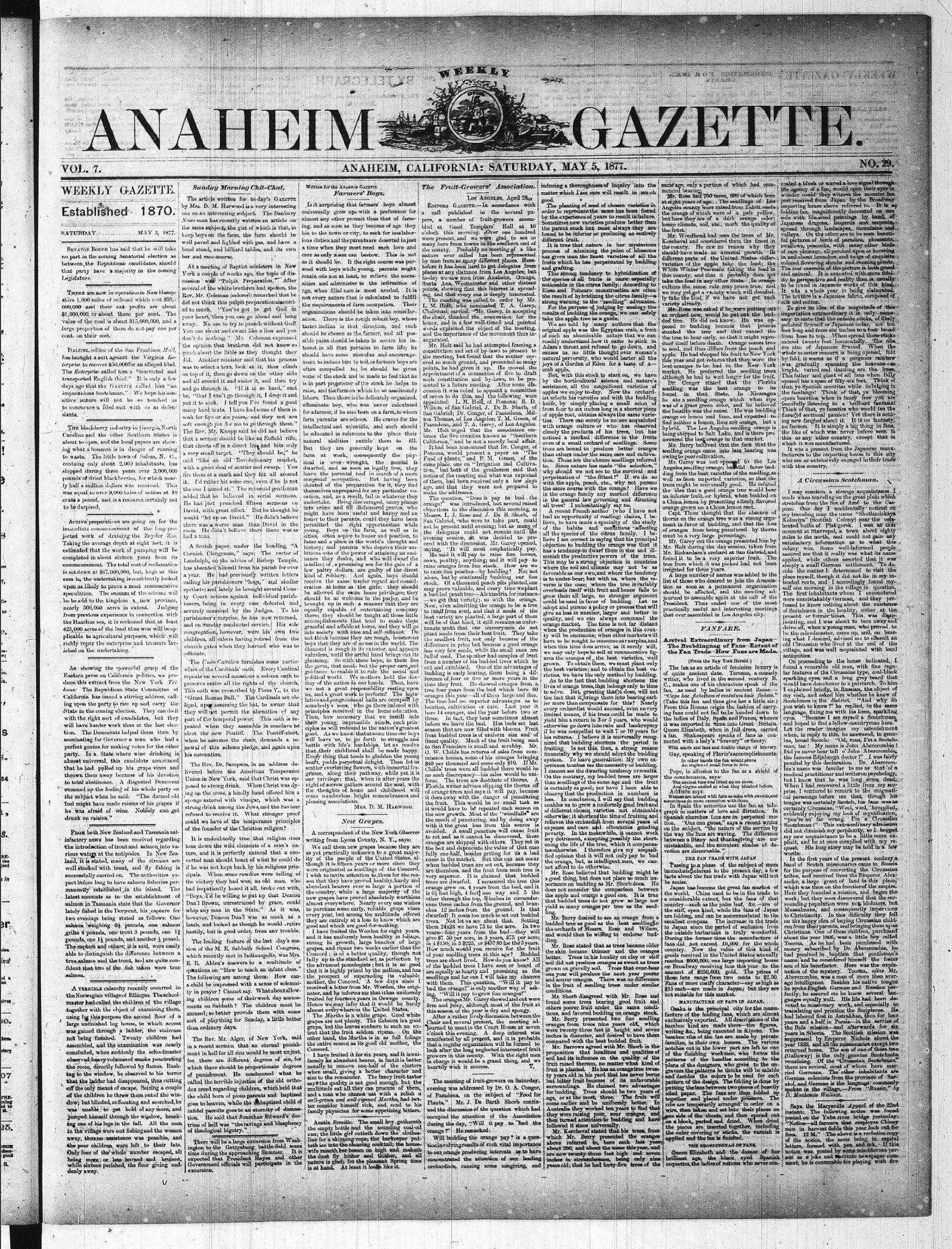
Searchable text
WEEKLY GAZETTE.
Established 1870.
SATURDAY... MAY 5, 1877.
Senator Booth has said that he will take no part in the coming Senatorial election as between the Republican candidates, should that party have a majority in the coming Legislature.
There are now in operation in New Hampshire 1,000 miles of railroad which cost $35,000,000 and their net profits are about $1,000,000, or about three per cent. The value of the road is about $15,000,000, and a large proportion of them do not pay one per cent. on their cost.
Dalziel, editor of the San Francisco Mail, has brought a suit against the Virginia Enterprise to recover $50,000 for an alleged libel. The Enterprise called him a "convicted and transported English thief." It is only a few days ago that the Gazette called him "an impacuous Scotchman." We hope his sensitive nature will not be so touched as to commence a libel suit with us as defendants.
The blackberry industry in Georgia, North Carolina and the other Southern States is about to open, and the local papers are showing what a bonanza is in danger of running to waste. The little town of Salem, N. C., contains only about 2,000 inhabitants, has
Sunday Morning Chit-Chat.
The article written for to-day's Gazette by Mrs. D. M. Harwood is a very interesting one on an interesting subject. The Danbury Newsman has recently written an article on the same subject, the gist of which is that, to keep boys on the farm, the farm should be well paved and lighted with gas, and have a band stand, and billiard tables, and its own bar and race-course.
At a meeting of Baptist ministers in New York a couple of weeks ago, the topic of discussion was "Pulpit Preparation." After several of the white brethren had spoken, the Rev. Mr. Coleman (colored) remarked that he did not think this pulpit preparation amounted to much. "You've got to get God in your heart; then you can go ahead and hang away. No use to try to preach without God! You can sweat and sweat like a lion and you don't do nothing." Mr. Coleman expressed the opinion that brethren did not know so much about the Bible as they thought they did. Another minister said that his process was to select a text, look at it, then climb on top of it, then go down on the other side and all around it and under it, and then try and go through it. "If it is so hard," said he, "that I can't go through it, I drop it and put it to soak. I tell you I've found a good many hard texts. I have had some of them in soak for five or six years; and they not are soft enough yet for me to go through them."
The Rev. Mr. Knapp said he did not believe that a sermon should be like an Enfield rifle, that shoots off in a direct line and hits only a very small target. "They should be," he said "like an old Revolutionary musket,
Written for the AnheIM FARMER
Is it surprising that universally grow up almost any other purity, and as soon as the tie to the town or citious duties, and the paul care as only a son can as it should be. It tensed with boys while retain one son at least sites and administered age, when filial care not every nature that the requirements of life organizations shouldation. There is the tastes incline in that should be chosen as the sible pains should be terrestin all that per should have some ment to induce him often compelled to some of the stock and is in part proprietor raise, and the farm on labors. Then there is offernate boy, who for a farmer, if he was farm pursuits are od intellectual and science be educated in referr natural abilities
But they are ge farm at work, cical is over-wro
The Enterprise called him a "convicted and transported English thief." It is only a few days ago that the Gazette called him "an impeccable Scotchman." We hope his sensitive nature will not be so touched as to commence a libel suit with us as defendants.
The blackberry industry in Georgia, North Carolina and the other Southern States is about to open, and the local papers are showing what a bonanza is in danger of running to waste. The little town of Salem, N. C., containing only about 2,000 inhabitants, has shipped during three years over 3,000,000 pounds of dried blackberries, for which nearly half a million dollars was received. This was equal to over 9,000 bales of cotton at 10 cents a pound, and is a resource certainly not to be despised.
Active preparations are going on for the immediate commencement of the long-projected work of draining the Zuyder Zee. Taking the average depth at eight feet, it is estimated that the work of pumping will be completed in about sixteen years from its commencement. The total cost of reclamation is set down at $67,000,000, but, huge as this sum is, the undertaking is confidently looked upon as likely to prove a most remunerative speculation. The success of the scheme will be to add to the kingdom a new province, nearly 500,000 acres in extent. Judging from previous experience in connection with the Haarlem sea, it is reckoned that, at least 425,000 acres of the land thus won will be applicable to agricultural purposes, which will richly repay the enterprise and treasure lavished on the undertaking.
As showing the powerful grasp of the Eastern press on California politics, we produce this extract from the New York Tribune: The Republican State Committee of California has issued a stirring address, calling upon the party to rise up and carry the State in the coming election. They can do it with the right sort of candidates, but they will have harder work than at the last election. The Democrats helped them then by nominating for Governor a man who had a perfect genius for making votes for the other party. In a State where wine drinking is almost universal, this candidate announced that he had pulled up his grape vines and thrown them away because of his devotion to total abstinence. A disgusted Democrat summed up the feeling of his whole party on the subject when he said: "The darned old fool might have made raisins of his grapes if he was afraid of wine. Nobody can get drunk on raisins."
From both New Zealand and Tasmania satisfactory news has been received regarding the introduction of trout and salmon into various waters at the antipodes. In New Zealand, it is stated, many of the streams are well stocked with trout, and fly fishing is successfully carried on. The authorities expect before long to have salmon fisheries per
It is undoubtedly true that religion does tone down the wild elements of a man's nature, and it is perfectly natural that a converted man should boast of what he could do if he was not kept back by his religious principals. When some rowdies were telling of the victory they had won, an old man, who was to select a text, look at it, then chime on top of it, then go down on the other side and all around it and under it, and then try and go through it. "If it is so hard," said he, "that I can't go through it, I drop it and put it to soak. I tell you I've found a good many hard texts. I have had some of them in soak for five or six years; and they not are soft enough yet for me to go through them."
The Rev. Mr. Knapp said he did not believe that a sermon should be like an Enfield rifle, that shoots off in a direct line and hits only a very small target. "They should be," he said "like an old Revolutionary musket, with a great deal of scatter and sweep. You fire them at a mark and they hit all around it. I'd rather hit some one, even if he is not the one I aimed at." The reverend gentleman added that he believed in serial sermons. He had just preached fifteen sermons on David, with great effect. But he thought he would "let up on David." He didn't believe there was a worse man than David in the room. He didn't believe there there was as bad a man.
A Scotch paper, under the heading, "A Cornish Clergyman," says: The rector of Landulph, on the advice of Bishop Temple, has absented himself from his parish for over a year. He had previously written letters calling his parishioners "hogs," and similar epithets; and lately he brought several County Court actions against individual parishioners, being in every case defeated and severely censured by the Judges. To his parishioner's surprise, he has now returned, and on Sunday conducted service. His sole congregation, however, were his own two children, all others having retired from the church gates when they learned who was to officiate.
The Unito Cattolica furnishes some particulars of the Cardinals' oath. Every Cardinal repeats on several occasions a solemn oath to preserve entire all the rights of the church. This oath was prescribed by Pious V., in the "Great Roman Bull." The Cardinals are obliged upon assuming the hat, to swear that they will not permit the alienation of any part of the temporal power. This oath is repeated when they assemble in conclave to elect the new Pontiff. The Pontiff-elect, when he assumes the chair, demands a renewal of this solemn pledge, and again upon his coronation.
The Rev. Dr. Sampson, in an address delivered before the American Temperance Union in New York, said that Christ was opposed to strong drink. When Christ was dying on the cross, a kindly hand offered him a sponge saturated with vinegar, which was a strong drink among the Jews, and the Saviour refused to receive it. What stronger proof could we have of the temperance principles of the founder of the Christian religion?
It is undoubtedly true that religion does tone down the wild elements of a man's nature, and it is perfectly natural that a converted man should boast of what he could do if he was not kept back by his religious principals. When some rowdies were telling of the victory they had won, an old man, who was to select a text, look at it, then chime on top of it, then go down on the other side and all around it and under it, and then try and go through it. "If it is so hard," said he, "that I can't go through it, I drop it and put it to soak. I tell you I've found a good many hard texts. I have had some of them in soak for five or six years; and they not are soft enough yet for me to go through them."
The Rev. Mr. Knapp said he did not believe that a sermon should be like an Enfield rifle, that shoots off in a direct line and hits only a very small target. "They should be," he said "like an old Revolutionary musket, with a great deal of scatter and sweep. You fire them at a mark and they hit all around it. I'd rather hit some one, even if he is not the one I aimed at." The reverend gentleman added that he believed in serial sermons. He had just preached fifteen sermons on David, with great effect. But he thought he would "let up on David." He didn't believe there was a worse man than David in the room. He didn't believe there there was as bad a man.
A Scotch paper, under the heading, "A Cornish Clergyman," says: The rector of Landulph, on the advice of Bishop Temple, has absented himself from his parish for over a year. He had previously written letters calling his parishioners "hogs," and similar epithets; and lately he brought several County Court actions against individual parishioners, being in every case defeated and severely censured by the Judges. To his parishioner's surprise, he has now returned, and on Sunday conducted service. His sole congregation, however, were his own two children, all others having retired from the church gates when they learned who was to officiate.
The Unito Cattolica furnishes some particulars of the Cardinals' oath. Every Cardinal repeats on several occasions a solemn oath to preserve entire all the rights of the church. This oath was prescribed by Pious V., in the "Great Roman Bull." The Cardinals are obliged upon assuming the hat, to swear that they will not permit the alienation of any part of the temporal power. This oath is repeated when they assemble in conclave to elect the new Pontiff. The Pontiff-elect, when he assumes the chair, demands a renewal of this solemn pledge, and again upon his coronation.
The Rev. Dr. Sampson, in an address delivered before the American Temperance Union in New York, said that Christ was opposed to strong drink. When Christ was dying on the cross, a kindly hand offered him a sponge saturated with vinegar, which was a strong drink among the Jews, and the Saviour refused to receive it. What stronger proof could we have of the temperance principles of the founder of the Christian religion?
It is undoubtedly true that religion does tone down the wild elements of a man's nature, and it is perfectly natural that a converted man should boast of what he could do if he was not kept back by his religious principals. When some rowdies were telling of the victory they had won, an old man, who was to select a text, look at it, then chime on top of it, then go down on the other side and all around it and under it, and then try and go through it. "If it is so hard," said he, "that I can't go through it, I drop it and put it to soak. I tell you I've found a good many hard texts. I have had some of them in soak for five or six years; and they not are soft enough yet for me to go through them."
The Rev. Mr. Knapp said he did not believe that a sermon should be like an Enfield rifle, that shoots off in a direct line and hits only a very small target. "They should be," he said "like an old Revolutionary musket, with a great deal of scatter and sweep. You fire them at a mark and they hit all around it. I'd rather hit some one, even if he is not kept back by his religious principals. He had just preached fifteen sermons on David, with great effect. But he thought he would "let up on David." He didn't believe there was a worse man than David in the room. He didn't believe there there was as bad a man.
A Scotch paper, under the heading, "A Cornish Clergyman," says: The rector of Landulph, on the advice of Bishop Temple, has absented himself from his parish for over a year. He had previously written letters calling his parishioners "hogs," and similar epithets; and lately he brought several County Court actions against individual parishioners, being in every case defeated and severely censured by the Judges. To his parishioner's surprise, he has now returned, and on Sunday conducted service. His sole congregation, however, were his own two children, all others having retired from the church gates when they learned who was to officiate.
The Unito Cattolica furnishes some particulars of the Cardinals' oath. Every Cardinal repeats on several occasions a solemn oath to preserve entire all the rights of the church. This oath was prescribed by Pious V., in the "Great Roman Bull." The Cardinals are obliged upon assuming the hat, to swear that they will not permit the alienation of any part of the temporal power. This oath is repeated when they assemble in conclave to elect the new Pontiff. The Pontiff-elect, when he assumes the chair, demands a renewal of this solemn pledge, and again upon his coronation.
The Rev. Dr. Sampson, in an address delivered before the American Temperance Union in New York, said that Christ was opposed to strong drink. When Christ was dying on the cross,a kindly hand offered him a sponge saturated with vinegar,which was a strong drink among the Jews,and the Saviour refused to receive it. What stronger proof could we have of the temperance principles of the founder of the Christian religion?
It is undoubtedly true that religion does tone down the wild elements of a man's nature,and it is perfectly natural that a converted man should boast of what he could do if he was not kept back by his religious principals. When some rowdies were telling of the victory they had won,an old man,who was to select a text,look at it,then chime on top of it,then go down on the other side and all around it和under it,and then try and go through it.“If it is so hard,” said he,“that I cannot be compelled to some of the stock market or raise,andthe farm only labors。Then there is offended boy,who for a farmer,if he was farm pursuits are old intellectual and scientificbe educated in referred natural abilitiesBut they are gee farm at work,oilical is over-written dwarfed,and as soon leave parental occupationcheated of the prep themselves unprepared,and as a rest undertake.Being into crime and filling might have been unhappyto their parental permitted,the right young.Boyes on boys on cities,often aspire fame and place in history;and parentsbittions sons ofthe prince desire,intellect,a promise few paltry dollars,kind of robbery.The same receivesthe same treatmentat homeas thenreuniteinto societywithcannot think becausethey boys that they areo diamond is roughinvalueless,t untilthe gleaming.So withthe germ,that need guidanceto enablepolitical world.Will tinyofthe nationinwe nota greatreuse,anda greatworklativeandcongresssomebody's sons,wprincipalseceivedThen,hownecessarytheiryoung,imperialciplesaswillredoublergood.As we knowwill leaveus,tog battlewith life'slifethat theirchildhoodEvery thing thatteheart,yieldsperpetuateseverlastinggrance.alongtheirtrivillegealthnightof sorrowgatherthethoughtsofhecomenumberlesspleasingassociation
From both New Zealand and Tasmania satisfactory news has been received regarding the introduction of trout and salmon into various waters at the antipodes. In New Zealand, it is stated, many of the streams are well stocked with trout, and fly fishing is successfully carried on. The authorities expect before long to have salmon fisheries permanently established in the island. The latest accounts as to the establishment of salmon in Tasmania state that the Governor lately fished in the Derywent, his capture for two evenings being stated as follows: One salmon weighing 5½ pounds, one salmon grille 4 pounds, one trout 3 pounds, one 1½ pounds, one 1¼ pounds, and another ¼ pound. The captors and others, it is said, were easily able to distinguish the difference between a true salmon and the trout, and are quite confident that two of the fish taken were true salmon.
A terrible calamity recently occurred in the Norwegian village of Ellingsso. The schoolmaster had called the children of the village together with the object of examining them, using for this purpose the second floor of a large unfinished log house, to which access was gained through a ladder, the staircase not being finished. Twenty children had assembled, and the examination was nearly concluded, when suddenly the schoolmaster observed heavy volumes of smoke penetrating the room, directly followed by flames. Rushing to the window, he observed to his terror that the ladder had disappeared, thus cutting off the only means of escape. Seizing a couple of the children he threw them out of the window; but blinded, suffocating and scorched, he was unable to get hold of any more, and jumped himself through the window, breaking one of his legs in the fall. All the men in the village were out fishing and the women away, thus no assistance was possible, and the poor children were left to their fate. Only four of the whole number escaped, all being more or less burned and bruised, while sixteen perished, the floor giving suddenly away.
It is undoubtedly true that religion does tone down the wild elements of a man's nature, and it is perfectly natural that a converted man should boast of what he could do if he was not kept back by his religious principals. When some rowdies were telling of the victory they had won, an old man, who had impatiently heard it all, broke out with, "Boys, I'd be willing to put up that Deacon Dan'l Brown, unrestrained by grace, could whip any man in the State." As it was, however, Deacon Dan'l was as meek as a lamb, and looked as though he would retire hastily, but in good order, from any trouble.
The leading feature of the last day's session of the M.E.Sabbath School Congress, which recently met in Indianapolis, was Mrs. E.R. Alden's answers to a multitude of questions on "How to teach an infant class." The following are among them: How can a child be impressed with a sense of solemnity in prayer? Cannot say. What about allowing children some of their weekday amusements on Sabbath? The children must be amused; so better provide them with some sort of plaything for Sunday, a little better than ordinary days.
The Rev. Mr. Alger, of New York, said in a recent sermon that an eternal punishment in hell for all sins would be most unjust, for there are different degrees of sin, for which there should be proportionate degrees of punishment. He condemned what he called the terrible injustice of the old orthodox creed regarding children, which held that the child born of pious parents and baptized goes to heaven, while the baptized child of infidel parents goes to an eternity of damnation. He said that Jonathan Edward's doctrine of hell was "the ravings and blasphemy of theological bigotry."
There will be a large excursion from Washington to the Gettysburg battle-field some time during the approaching Summer. It is expected that President Hayes and other Government officials will participate in the excursion.
WEEKLY
ANAHEIM, CALIFORNIA: SATURDAY, MAY 5, 1877.
Written for the Anaheim Gazette.
Farmers' Boys.
Is it surprising that farmers' boys almost universally grow up with a preference for almost any other pursuit than that of farming, and as soon as they become of age they hit to the town or city, to seek for less laborious duties, and the parents are deserted in just a time when they most need such love and care as only a son can bestow. This is not as it should be. It the right course was pursued with boys while young, parents might retain one son at least, to relieve the necessities and administer to the infirmities of age, when filial care is most needed. It is not every nature that is calculated to fulfill the requirements of farm occupation. Their organizations should be taken into consideration. There is the rough robust boy, whose tastes incline in that direction, and such should be chosen as the farmer, and all possible pains should be taken to secure his interest in all that pertains to farm life; he should have some stimulus and encouragement to induce him to toil, as farmers boys are often compelled to; he should be given some of the stock and be made to feel that he is in part proprietor of the stock he helps to raise, and the farm on which he so assimilously labors. Then there is the delicately-organized, offeminate boy, who was never calculated for a farmer, if he was born on a farm, to whom farm pursuits are obvious. He craves for the intellectual and scientific, and such should be educated in reference to the place their natural abilities entitle them to fill. But they are generally kept on the farm at work, consequently the physical is over-wrought, the mental is inducing a thoroughness of inquiry into the matter which I am sure will result in much good.
The Fruit-Growers' Association.
Los Angeles, April 28
Editors Gazette:—In accordance with a call published in the several papers, a number of fruit-growers assembled at Good Templars' Hall at 10 o'clock this morning. Over one hundred were present, and we were glad to see so many here from towns in the southern end of the county. Probably no meeting of a like nature ever called has been represented by men from so many different places. Heretofore it has been hard to get delegates from places at any distance from Los Angeles; but to-day we saw men from Anaheim, Orange, Santa Ana, Westminster and other distant points, showing that this interest is spreading, and that every one is deeply interested.
The meeting was called to order by Mr. L. M. Holt, who nominated T. A. Garey, Chairman; carried. Mr. Garey, in accepting the chair, thanked the convention for the honor, and in a few well-timed and pointed words explained the object of the meeting, and the importance of the movement thus inaugurated.
Mr. Holt said he had attempted framing a constitution and set of by-laws to present to the meeting, but found that the matter covered so much ground, and presented so many points, he had given it up. He moved the appointment of a committee of five to draft such constitution and by-laws, to be presented to a future meeting. After some discussion it was voted to appoint a committee of seven to do this, and the following were appointed: L. M. Holt, of Pomona; B. D. Wilson, of San Gabriel; J. De B. Shorb, of San Gabriel; Dr. Conger, of Passadena, Milton Thomas, of Los Angeles; T. M. Green, of Passadena, and T. A. Garey, of Los Angeles. Mr. Holt urged that the association embrace the five counties known as "Southern California," and be not a merely local affair.
It had been announced that Dr. Conger, of Pomona, would present a paper on "The Food of plants," and P. M. Green, of the same place, one on "Irrigation and Cultivation." These are the chance seedlings referred to Since nature has made "the selection"
But with this stock to start on, we have by the horticultural science and nature's assistance, all the magnificent varieties of apples we enjoy to-day. Now the orchardist selects his varieties and with the budding knife, by simply placing a small scion of four to six inches long in a shorter piece of apple root, obtains always the same varieties. There can surely be no one acquainted with orange culture or who has observed closely the products of his trees, but has noticed a marked difference in the fruits even of a small orchard of seedlings. Some trees are bound to produce better oranges than others under the same care and cultivation. These are the chance seedlings referred to. Since nature has made "the selection," why should we not see to the survival and perpetuation of "the fittest"? If we do so with the apple, peach, etc., why not pursue the same course with the orange? Have we in the orange family any marked difference in the general law governing and directing all trees? Unhesitatingly say no.
A recent French author (who I have not had an opportunity of reading) claims, I believe, to have made a specialty of the study of the habits and conditions affecting all the species of the citrus family. I believe I am correct in saying that his principal objection to budding the orange was that it has a tendency to dwarf them in size and diminish the productive powers of the trees. This may be a strong objection in countries where the soil and climate may not be as favorable as our own, and where the tendency is to under-bear; but with us, where the reverse is the case, where the tree invariably overloads itself with fruit and hence fails to grow them all large, no stronger argument could be used in favor of budding. Let us adopt and pursue a policy or process that will give us less in number, larger and better in quality, and we can always command the orange market. The time is not far distant when the production of oranges in this county will be enormous; when other markets will have to be sought to consume our surplus, and when this time does arrive, as it surely will, we may only hope to sell at remunerative figures of the best varieties, well grown. To obtain them, we must plant only the best varieties; and to obtain the best varieties, we have the only method by budding.
As to the fact that budding shortens the lives of orange trees that belongs only to time to solve. But, granting that it brings them into bearing earlier more than compensate for this? Nearly every orchardist would succeed, even on very limited means, if his trees could be made to yield him a return in 3 or 5 years, who would otherwise go down into ruin and bankruptcy if he was compelled to wait 7 or 10 years for his returns. I believe it is universally recognized that budding shortens the period in fruiting. Is not this, then, a strong reason financially why we should adopt the budding system. To leave generalities: My own experience teaches me the necessity of budding. I cannot see the dwarf tendency or results. On the contrary, my budded trees are larger than seedlings of the same age and the fruit is certainly as good; nor have I been able to observe that production in numbers is less. In conclusion, I will say that budding enables us to grow a uniformly good fruit and of different chosen varieties not obtainable otherwise; it shortens the time of fruiting and relieves the orchardist from several years of expense and care and oftentimes grinding poverty. In the meanwhile, it cannot work any detriment, except possibly the shortening of the life of the tree, which it compensates otherwise. I therefore give my unqualified opinion that it will not only pay to bud the orange, but, as intelligent men, we cannot afford to do otherwise.
Mr. Rose believed that budding might be a good thing, but does not place so much impact on its side when try it, said it and a good item in it not are them."
Believe in rifle, rats only use them.
He musket,
You around is not gentleman vermons.
On ought he believe in the was as particular Temple for over letters similar Counsparishal and
To his returned, his soleOWN two from the was to participate cardinal path to church;
In the are obeyed that of any boy is relive toiff-elect, is a reain upon
Press deperance was opwas dyed him a was Saviour per proof principles?
We mothers hold destiny of nation in our hands. Then, have we not a great responsibility resting upon us, and a great work to perform? The legislative and congressional halls are occupied by somebody's sons, who go there imbued with principles received in the home education.
Then, how necessary that we instil into their young, impressible minds, such principles as will redound to the nation's greatest good.
As we know that at some time our boys will leave us, to go forth to struggle and battle with life's hardships, let us resolve that their childhood shall be made happy.
Every thing that tends to gladden the young heart, yields perpetual delight.
Then let us scatter everlasting flowers, with immortal fragrance, along their pathway, while yet it is our privilege; that, when in after years the night of sorrow gathers around the soul, with the thoughts of home and childhood will come numberless bright remembrances and pleasing associations.
MRS. D. M. Harwood.
New Grapes.
A correspondent of the New York Observer writing from Lyons County, N.Y., says:
We call them new grapes because they are as yet practically unknown to a great majority of the people of the United States, although it is fifteen years or more since they were originated as seedlings of the Concord-I wish to invite attention to them for the reason that they have proved healthy, hardly and pointless points he had given it up. He moved the appointment of a committee of five to draft such constitution and by laws, to be presented to a future meeting. After some discussion it was voted to appoint a committee of seven to do this, and the following were appointed: L. M. Holt of Pomona; B. D. Wilson, of San Gabriel, J. De B. Shorb, of San Gabriel; Dr. Conger of Passadena, Milton Thomas, of Los Angeles; T. M. Green, of Pasadena, and T. A. Garey, of Los Angeles.
Mr. Holt urged that the association embrace the five counties known as "Southern California," and be not a merely local affair.
It had been announced that Dr. Conger, of Pomona, would present a paper on "The Food of plants," and P. M. Green, of the same place, one on "Irrigation and Cultivation," but both of the gentlemen said that notice of the meeting and what was expected of them, had been received only a few days ago, and that they were not prepared to make the addresses.
The question, "Does it pay to bud the orange?" was introduced, but several raised objections to the discussion this morning, as Messrs. L. J. Rose and J. De B. Shorb, of San Gabriel, who were to take part, could not be present until evening; but as many of the delegates could not remain until the evening session, it was decided to proceed with the discussion. Mr. Garey opened, saying, "It will most emphatically pay.
He said it will pay to raise fine horses, cows, poultry anything; and it will pay to raise oranges from fine stock. How are we to raise fine peaches—by budding? No; not alone, but by continually budding our fine stock.
Of a thousand peach pits planted, one may prove valuable, and every time we plant a budded peach tree—Alexandria for instance—we get that variety; so with the orange.
Now, even admitting the orange to be a tree to itself from seed, and that if seeds of the best variety are planted, a large part of them will be of that kind; it still remains an unfortunate truth that our nurserymen do not plant seeds from their best fruit. They take the smallest fruit, not only because of the difference in price but because a good orange has very few seeds, while the small ones are full of seed. The speaker had samples of fruit from a number of his budded trees which he cut and exhibited. One of the advantages of budding is early bearing, there being a difference of four or five or more years in time they fruit. He showed oranges from a tree four years from the bud which bore 60 oranges this year—all of them large and fine.
The tree had no superior advantages as to location, cultivation or care. Last year it bore 14 oranges, and the year before two or three.
In fact, they bear sometimes almost before we leave the bush. Has buds set last season that are now filled with blooms. Fruit from budded trees is uniform size and of finest quality. Much of the fruit being sent to San Francisco is small and scrubby.
Mr. O. W. Childs has returns of sales from commission houses, some of his oranges bringing $40 per thousand and some only $10.
If Mr. Childs' trees were all budded there would be no such discrepancy—his sales would be uniform.
The trees are destitute of thorns.
A Florida writer advises clipping the thorn off of orange trees and says it will pay because it does away with the danger of puncturing the fruit.
This would be no small task as it would have to be repeated each season on the new growth. Most of the "windfalls" are result of puncturing, and by doing away with it the great loss from this source is avoided.
A small puncture will cause fruit to rot and as it cannot be discovered, these oranges are shipped with others. They rot in the box and depreciate the value of that case fully one-half besides getting for us a bad name in the market. But this can not occur when budded trees are set out because they are thornless, and the fruit from such tree is very superior.
It is claimed that budded trees are dwarfed.
I measured the tree this
New Grapes.
A correspondent of the New York Observer writing from Lyons County, N.Y., says:
We call them new grapes because they are as yet practically unknown to a great majority of the people of the United States, although it is fifteen years or more since they were originated as seedlings of the Concord. I wish to invite attention to them for the reason that they have proved healthy, hardy and abundant bearers over so large a portion of the country, while a large majority of the new grapes have proved absolutely worthless almost everywhere. Nearly every one wishes to purchase some early, reliable grape vines every year, but among the multitude offered they are entirely at a loss to know which are good and which are good-for-nothing.
I have fruited the Worlen for eight years, and it has uniformly been healthy in foliage, strong in growth, large bunches of large grapes, and ripens two weeks earlier than the Concord; is of a better quality, though not fully up to the standard set as perfection by the advanced pomologists; but it is so good that it is highly prized by the million, and has the prospect of supersaling its valuable mother, the Concord. A few days since I received a letter from Mr. Worden, the originator, and he informs me that it has uniformly fruited for fourteen years in Oswego county. Hence we may infer that it would be hardly almost everywhere in the United States.
The Martha is a white grape. Good white grapes are not plenty. The Rebecca is a good grape, but the leaves sunburn to such an extent that the fruit seldom ripens. On the other hand, the Martha is in as full foliage the entire season as its good old mother, the Concord.
I have fruited it for six years, and it is uniformly an abundant bearer, in fact it is better usually to remove one-half of the clusters when small, giving a better character and size to the remainder. The fancy fruit-taster says: "the quality is not good enough. But the multitude eat all they can procure of them, and a man who cannot eat with a relish a well-grown and well-ripened Martha, had better consider himself sick, and send to his family physician for some appetizing bitters.
Austin Rewille: The small boy gathereth the empty bottle and the sounding coal-oil can; the little girl cutteth down the clothes-line for a skipping-rope; the harkeeper puteth ice into the cheering cocktail; the housewife raiseth her besom on high and maketh the dust hither and thither, and all nature is glad; for the pleasant Spring time is at hand. At least it looks like it.
Florida writer advises clipping the thorns off of orange trees and says it will pay, because it does away with the danger of puncturing the fruit. This would be no small task as it would have to be repeated each season on the new growth. Most of the "windfalls" are the result of puncturing, and by doing away with it the great loss from this source is avoided. A small puncture will cause fruit to rot and as it cannot be discovered, these oranges are shipped with others. They rot in the box and deprecate the value of that case fully one-half, besides getting for us a bad name in the market. But this can not occur when budded trees are set out, because they are thornless, and the fruit from such tree is very superior. It is claimed that budded trees are dwarfed. I measured the tree this orange grew on, 4 years from the bud, and it is 6 feet high, 4 feet one way and 5 the other through the top, 5 inches in circumference three inches from the ground, and branches 12 inches from the ground. Is that dwarfed? It costs too much to set out budded trees. Not let us see about that. Setting them 24x24 we have 75 to the acre. In two years—four years from the bud—the will give $7.50 per acre; in 3 years,$75 per acre; in 4 $150; in 5 $225, or $457.50 for the 5 years. How much would you receive for the fruit of your seedling at this age? Budded trees are short lived. How do you know? All of the budded trees I have seen or heard of are equally as hearty and promising as the seedlings and for one I will take my chances with them. This question, "Will it pay to bud the orange?" is only another way of asking, "Will it pay to grow fine oranges?"
The oranges Mr. Garey showed and sent were firm and juicy, although most of the fruit at this season of the year is dry and spongy.
After a rather lively discussion between the Chair and several present, the meeting adjourned to meet in the Court-House at seven o'clock this evening. A deep interest was manifested by all present, and it is probable that a regular organization will be formed to look after the long neglected interests of fruit growers in this county. With the right men in charge it would be a grand thing, and we heartily wish it success.
The meeting of fruit-growers on Saturday, evening was addressed by Dr. O. A. Conger, of Pasadena, on the subject of "Food for Plants." Mr. J. De Barth Shorb continued the discussion of the question which had occupied the attention of the Association during the day, "Will it pay to bind the orange?" He remarked:
Will budding the orange pay? is a question involving results of such vital importance to our orange producing interests as to have concentrated the attention of our leading orchardists, causing some misgiving, and certainty as good; nor have I been able to observe that the production in numbers is less. In conclusion, I will say that budding enables us to grow a uniformly good fruit and of different chosen varieties not obtainable otherwise; it shortens the time of fruiting and relieves the orchardist from several years of expense and care and oftentimes grinding poverty. In the meanwhile, it cannot work any detriment, except possibly the shortening life of the tree, which it compensates otherwise. I therefore give my unqualified opinion that it will not only pay to bud the orange, but, as intelligent men, we cannot afford to do otherwise.
Mr. Rose believed that budding might be a good thing, but does not place so much importance on budding as Mr. Shorb does. He does not consider the comparison between the apple and orange a good one. It is true that budded trees do not grow so large nor yield so many oranges per tree as the seedling.
Mr. Berry desired to see an orange from a budded tree as good as the best seedling in the orchards of Messrs. Rose and Wilson, and would then be willing to endorse budding.
Mr. Rose stated that as trees became older the skin became thinner and the oranges better. Trees in locality on clay or stiff soil did not produce oranges as sweet as trees grown on gravelly soil. Trees that over-bear one year will produce the next year poorer and sourier orange. There was no difference in the fruit of seedling trees under similar conditions.
Mr. Shorb disagreed with Mr. Rose and found some trees bearing good fruit and others poorer fruit under the same conditions, and favored budding on orange stock.
Mr. Berry presented two fine seedling oranges from trees nine years old, which were twenty-three feet in height and seven inches in diameter, and desired to have them compared with the best budded fruit.
Mr. Barrows agreed with Mr. Shorb in the proposition that localities and qualities of soil had its influence on the quality of the fruit raised thereon, no matter what kind of fruit is planted. He has an orange tree twenty years old in his yard that has never borne but bitter fruit because of its unfavorable surroundings. He claimed two advantages for budding: Trees should be two years of age, or at the most three. The fruit will come earlier and be uniformly better. In Australia they worked ten years to find that they were raising poor, sour oranges, and then turned attention to budding and have followed it since universally.
Mr. Karcheval stated that his trees, from which Mr. Berry presented the oranges above referred to, bore each last year about 200, and about the same this year, and are now twenty-three feet high and seven inches in circumference, being only nine years old; that he had forty-five trees of the
GAZETTE.
NO. 29.
of inquiry into the
will result in much
d of chosen varieties in
same has been found
years to result infailuredes produce better than
most always they are
or producing an entirely
are in her mysterious
the polen of blossoms
best varieties of all the
perpetuated by budding
by hybridization of
its is more especially
as family. According to
monstrosities are often
ing the citrus family—a
"seedling" advocates.
judging by analogy the
orange, we can safely
a guide.
many authors that the
Egyptian crab, a fruit
nature that we can
now it came to stick in
fused to go down, and
thought over woman's
no would barter all the
den for a taste of a—
to start on, we have
science and nature's
magnificent varieties of
day. Now the orchardand with the budding
casing a small scion of
long in a shorter piece
always the same variely be no one acquainted
or who has observed
of trees, but has difference in the fruits
hard of seedlings. Some produce better oranges
same care and cultivaance seedlings referred
made "the selection."
same age, only a portion of which had commenced bearing.
Mr. Rose had 700 trees, 600 of which bore at eight years of age. The seedlings of Los Angeles county were raised from Tahiti seeds the orange of which were of a pale yellow, but here they are of a dark orange color; hence climate, soil, etc., mark the quality of the frust.
Mr. Woodhead had seen the trees of Mr. Kereheval and considered them the finest in the county. He saw no reason why they should have made an unusual growth. In different parts of the United States differ-varieties of the apple take the lead; the White Winter Pearmain taking the lead in this county, and that it probably does not take the lead in any other State. In orange culture the same rule may prove true, and we may yet get a variety which will decidedly take the lead, if we have not got such variety already.
Mr. Rose was asked if he were putting out an orchard now, would he put out the budded tree. He did not know. He was opposed to budding because that process stunted the tree and that caused the tree to bear early, so that it might reproduce itself before death. Orange comes true to seed, and thus differs from the peach and apple. He had shipped his fruit to New York this year and got returns that they wore the best oranges to be had in the New York market. He preferred the seedling trees although he had to wait longer for the fruit.
Dr. Conger stated that the Florida seedling was the best orange to be found in that State. In Nicaragua he ate a seedling orange which when ripe was of a grass green color, and he believed the locality was the cause. He was building orange on lemon and lime, and expected to find neither a lemon, lime nor orange, but a hybrid. The Los Angeles seedling orange is being shipped to Salt Lake, and is there pronounced the best orange in that market.
Mr. Berry believed that the fact that the seedling orange came into late bearing was owing to poor cultivation.
Mr. Garoy was not opposed to the Los
called a blush or waved a love signal through the agency of a fan, would open their eyes in wonder could they witness the monster fan just received from Japan by the Broadway importing house above referred to. It is a folding fan, magnificently decorated on one side with life-sized paintings by hand, of Japanese dragons, leopards and serpents, spread through landscapes, mountains and valleys. On the other are to be seen beautiful pictures of birds of paradise, phoenix, swallows, peacocks, with many other birds of rare plumage, all parched upon or hovering in and about branches and twigs of exquisite colored flowering shrubs and running plants.
The tout ensemble of the picture is both grand and natural. It is executed with more idolality to perspective and reality than is usually to be found in Japanese works of this kind. It was a whole year in being elaborated. The texture is a Japanese fabric, composed of silk and cotton.
To give an idea of the magnitude of this importation extraordinary it is only necessary to state that the outside sticks, of finely poised firwood or Japanese cedar, are ten feet long and from six inches to a foot broad from base to top. When spread those sticks extend twenty feet horizontally. The ribs are also of Japanese firwood. When the whole monster concern is being opened, fold by fold, it seems as if a gorgeous rainbow was gradually spanning this heavens—so bright, varied and dazzling are the hues. This father and giant of all fans when fully opened has a span of fifty-six feet. Think of that, ye Spanish senoritas while indulging in the fandango! Think of that, ye blooming opera beauties, when in fancy free you are fancifully listening to a brilliant fantasia! Think of that, ye fanatics who would fan the flame of sectional passion! Yet there is nothing new-fangled about it. It is no fantasy, no fantasy. It is simply a big thing in fans, like of which was never before seen in this or any other country, except that in which it was manufactured.
It was a present from the Japanese manufacturers to the importing house in this city who are so extensively engaged in their trade with this country.
The first years of the present century a band of Scotch missionaries came to Russia for the purpose of converting the Circassian tribes, and received from the Emperor Alexander, a large grant of land in this place.
He preferred the seedling trees although he had to wait longer for the fruit. Dr. Conger stated that the Florida seedling was the best orange to be found in that State. In Nicaragua he ate a seedling orange which when ripe was of a grass green color, and he believed the locality was the cause. He was building orange on lemon and lime, and expected to find neither a lemon; lime nor orange, but a hybrid. The Los Angeles seedling is being shipped to Salt Lake, and is there pronounced the best orange in that market.
Mr. Berry believed that the fact that the seedling orange came into late bearing was owing to poor cultivation.
Mr. Carey was not opposed to the Los Angeles seedling orange, but did favor budding from the best varieties of the seedling, as well as from imported varieties, so that the trees might be universally good. He refuted the idea that a good orange tree would bear an inferior fruit, or hybrid, when budded on a China lemon by presenting a finely flavored orange grown on a China lemon root.
Capt. Thom thought that the absence of thorns on the orange tree was a strong argument in favor of budding, and that the loss of oranges from being punctured by thorns must be a very large percentage.
Mr. Carey cut the orange presented him by Mr. Holt during the day session, taken from Mr. Richardson's orchard at San Gabriel, and found it to be a very superior fruit. The tree from which it was picked had not been irrigated for three years.
A large number of names was added to the list of those who desired to join the Association as soon as a permanent organization should be affected, and the meeting adjourned to assemble again at the call of the President. Thus ended one of the most practically useful and interesting meetings that ever assembled in Los Angeles city.
FANFARE.
Arrival Extraordinary from Japan—The Brooding angel of Fans—Extent of the Fan Trade—How Fans are Made.
[From the New York Herald:]
The fan as an article of feminine luxury is of quite ancient date. Terence, a comedy writer, who lived in the second century B.C., makes one of his characters speak of the fan, as used by ladies in ancient Rome: "Cape hoc flabellum et ventulum huic fadeto." (Take this fan and thus give her a little air.) From this Roman origin the fashion of carrying fans could not fail to be handed down to the ladies of Italy, Spain and France, whence it was imported in time into Great Britain. Queen Elizabeth, when in full dress, carried a fan. Shakespeare speaks of fans as connected with a lady's "bravery" or finery:
With scarfs and fans and double charge of bravery.
Gay, speaking of Flavio's accomplishments:
In other hands the fan would prove An engine of small force in love.
Pope, in allusion to the fan as a shield of the countenance, says:
The modest face was lifted up no more. And virginia smiled at what they blushed before. Addison says:
Women are armed with fans as man with swords, and sometimes do more execution with them.
In Spain the senoritas use the fan as telegraph in matters of love and flirtation. In Spanish churches fans are in perpetual motion. "One can guess," says a recent writer on the subject, "the nature of the service by the way the fans are waving. The difference between a literary and thanksgiving are unmistakable, and the minutest shades of devotion are discernable."
THE FAN TRADE WITH JAPAN
Passing to a phase of the subject of more immediate interest to the present day, a few facts about the fan trade with Japan will not be amiss.
This father and giant of all fans when fully opened has a span of fifty-six feet. Think of that, ye Spanish senoritas while indulging in the fanlango! Think of that, ye blooming opera beauties, when in fancy free you are fancifully listening to a brilliant fantasia! Think of that, ye fanatics who would fan the flame of sectional passion! Yet there is nothing new fangled about it. It is no fantasy, no fantom. It is simply a big thing in fans, like of which was never before seen in this or any other country, except that in which it was manufactured.
It was a present from the Japanese manufacturers to the importing house in this city who are so extensively engaged in their trade with this country.
A Circassian Scotchman.
I may mention a strange acquaintance I made when travelling on the great plain which stretches from the Sea of Azof to the Caspian. One day I accidentally noticed on my traveling map the name "Shotlandakaya Kolonya" (Scottish Colony) near the celebrated baths of Platigorsk. I was at that moment at Stavropol, a town about eighty miles to the north, and could not gain any satisfactory information as to what this colony was. Some well-informed people assured me that it really was what its name applied, while others asserted that it was simply a small German settlement. To decide the matter I determined to visit the place myself, though it did not lie in my intended route, and I accordingly found myself one morning in the village in question. The first inhabitants whom I encountered were unmistakably German, and they professed to know nothing about the existence of Scotchmen in the locality, either at the present or former times. This was disappointing, and I was about to turn away and drive off, when a young man, who proved to be the schoolmaster, came up, and on hearing what I desired, advised me to consult an old Circassian who lived at the end of the village, and was well acquainted with local antiquities.
On proceeding to the house indicated, I found a venerable old man, with fine regular features of the Circassian type, coal-black sparkling eyes, and a long grey beard that would have done honor to a patriarch. To him I explained briefly, in Russian, the object of my visit, and asked him whether he knew of Scotchmen in the district. "And why do you wish to know?" he replied, in the same language, fixing me with his keen, sparkling eyes. "Because I am myself a Scotchman, and hoped to find a fellow-countryman here." Let the reader imagine my astonishment when in reply to this, he answered, in genuine broad Scotch: "Old man I'm a Scotchman; tae! My name is John Abercrombie! Did ye never hear tell o'John Abercrombie, the famous Edinburgh doctor?!" I was fairly puzzled by this declaration. Dr. Abercrombie's name was familiar to me as that of a medical practitioner and writer on psychology, but I knew that he was long since dead. When I had recovered a little from my surprise, I ventured to remark to the enigmatic personage before me tint, though his tongue was certainly Scotch; his face was as certain Circassian: "Weel, weel," he spotted, evidently enjoying my look of mystification, "you're no far wrong." I'm a Circassian Scotchman! This extraordinary admission did not diminish my perplexity, so I begged my new acquaintance to be a little more explicit, and he at once complied with my request. His long story may be told in a few words:
In the first years of the present continuity a band of Scotch missionaries came to Russia for the purpose of converting the Circassian tribes, and received from the Emperor Alexander, a large grant of land in this place.
THE FAN TRADE WITH JAPAN
Passing to a phase of the subject of more immediate interest to the present day, a few facts about the fan trade with Japan will not be amiss.
Japan has become the great fan market of the world. China used to be in the trade to a considerable extent, but the fans of that country—such as the palm leaf, &c.—are of the stiff, open kind, while the fans of Japan are folding, and can be accommodated to the smallest compass. The increase in the trade in Japan since the period of seclusion from the outside barbarians is truly wonderful.
During the former time the manufacture of fans did not exceed 10,000 for the whole country. Now the value of this kind of goods received in the United States annually reaches $600,000, one large importing house on Broadway receiving fans this year to the amount of $250,000, gold. The prices of those fans range from two cents to $2.50. Fans of more costly character—say as high as $15 each—are made in Japan; but they are not suitable for this market.
MANUFACTURE OF FANS IN JAPAN.
Osaka is the principal city for the manufacture of the folding fans, which are almost exclusively exported. All descriptions of the bamboo kind are made there—the figures, writing &c., being executed in Kiyoto. The bamboo ribs of the fan are made by private families, in their own houses. The various notches cut in the lower part are left to one of the finishing workmen, who forms the patterns of the handles according to the plans of the designers, who gives to the engravers the patterns he thinks will be salable and decides the colors to be used for each pattern of the design. The folding is done by putting the fans between two pieces of heavily oilled paper. The fans are then folded up together and placed under pressure. The ribs are temporarily arranged in order on a wire, then taken and set into their places on one side of the sheets, and then spread out on a block, parted and dried. When dried the pieces are inserted together, including the outer covering or sticks, the varnish is applied and the fan is finished.
THE BRIDINGMAO OF FANS.
Queen Elizabeth and the dames of her brilliant age, the black eyed Spanish coquettes, the ladies of nations who never con-
When I had recovered a little from my surprise, I ventured to remark to the enigmatic person before me that, though his tongue was certainly Scotch, his face was as certainly Circassian, "Weel, weel," hereplied, evidently enjoying my look of mystification, "you're no' far wrong." I'm a Circassian Scotchman! This extraordinary admission did not diminish my perplexity, so I begged my new acquaintance to be a little more explicit, and he at once complied with my request. His long story may be told in a few words:
In the first years of the present century a band of Scottish missionaries came to Russia for the purpose of converting the Circassian tribes, and received from the Emperor Alexander, a large grant of land in this place, which was then on the frontier of the empire. Here they founded a mission, and began the work; but they soon discovered that the surrounding population were not isolators, but Mussulmans, and consequently impervious to Christianity. In this difficulty they fell on the happy idea of buying Circassian children from their parents, and bringing them up as Christians. One of these children, purchased about the year 1806, was a little boy called Teooma. As he had been purchased with money subscribed by Dr. Abercrombie, he had received in baptism that gentleman's name, and he considered himself the foster son of his benefactor. Here was the explanation of the mystery. Teooma, alias Mr. Abercrombie, was a man of more than average intelligence. Besides his native tongue he spoke English German and Russian perfectly; he assured me he knew several languages equally well. His life had been devoted to missionary work, and especially to translating and printing the Scriptures. He had labored first in Astrakhan, then for four years and a half in Persia—in the service of the Bale mission—and afterwards for six years in Siberia. The Scottish mission was suppressed by Emperor Nichols about the year 1835, and all the missionaries except two returned home. The son of one of these two (Galloway) is the only genuine Scotchman remaining. Of the "Circassian Scotchman" there are several, most of whom have married Germans. The other inhabitants are German colonists from the province of Saratof, and German is the language commonly spoken in the village—From "Russia," by D. Mackenzie Wallace.
Says the Marysville Appeal of the 22nd instant: The following notice was found posted on the Yuba river bridge yesterday: "Notice—all farmers that employee Chiney men in harvest fields this year look out for fires. 12 M." The above is a verbation copy of the notice, the same being in capital letters, formed with pen and ink. If this notice was posted by some mischievous person as a joke and create newspaper comment, he is censurable for playing with fire