anaheim-gazette 1877-04-28
Scanned page
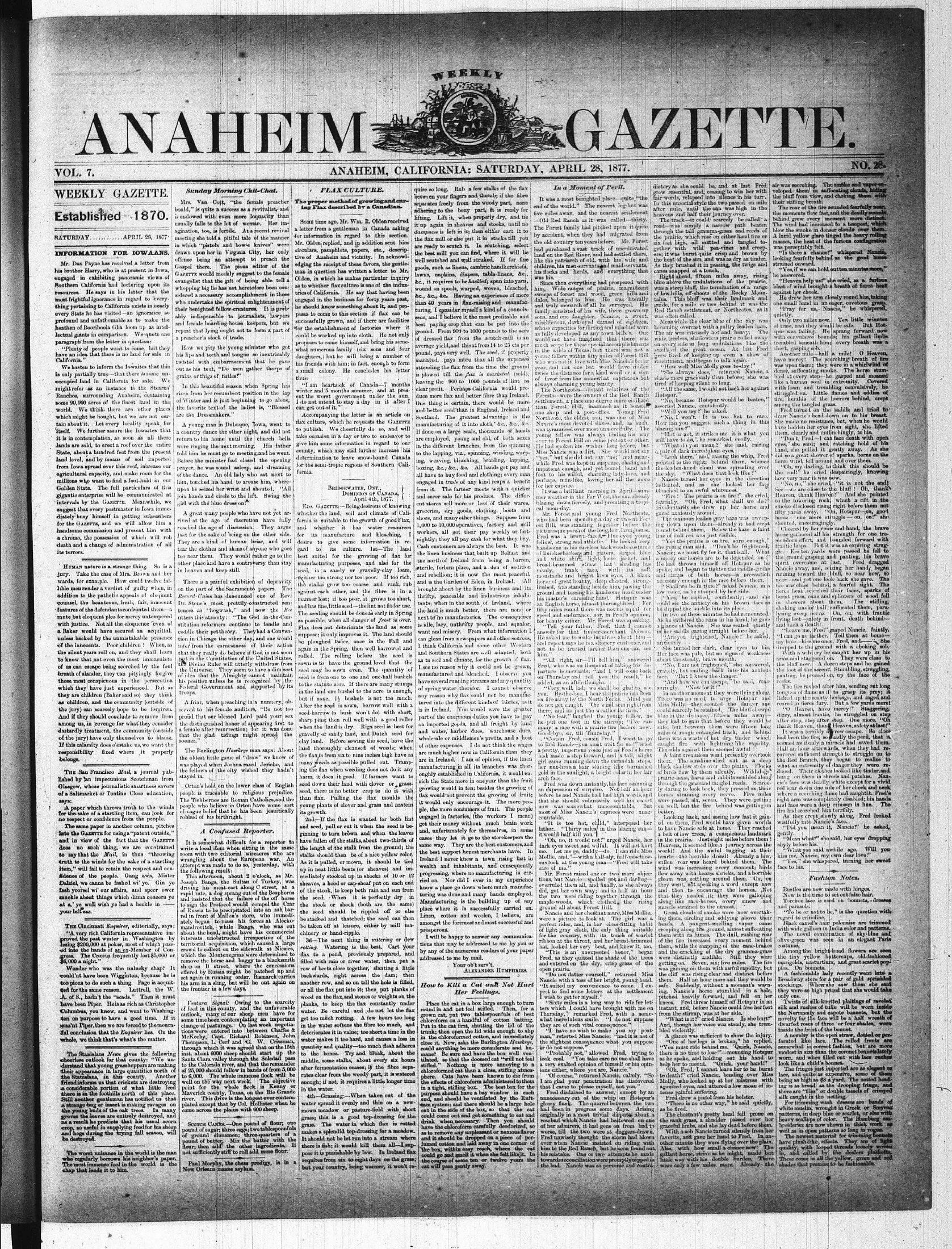
Searchable text
WEEKLY GAZETTE.
Established 1870.
SATURDAY...APRIL 23, 1877
INFORMATION FOR IOWAANS.
Mr. Dan Payne has received a letter from his brother Harry, who is at present in Iowa, engaged in exhibiting panoramic views of Southern California and lecturing upon its resources. He says in his letter that the most frightful ignorance in regard to everything pertaining to California exists in nearly every State he has visited—an ignorance so profound and unfathomable as to make the heathen of Booriboola Gha loom up as intellectual giants in comparison. We quote one paragraph from the letter in question:
"Plenty of people want to come, but they have an idea that there is no land for sale in California."
We hasten to inform the Iowaites that this is only partially true—that there is some unoccupied land in California for sale. We might refer as an instance to the Stearns Ranchos, surrounding Anaheim, containing some 90,000 acres of the finest land in the world. We think there are other places which might be bought, but we are not certain about it. Let every locality speak for itself. We further assure the Iowaites that it is in contemplation, as soon as all these lands are sold, to erect a roof over the entire State, about a hundred feet from the present land level, and by means of soil imported from Iowa, over this roof inbrease our Sunday Morning Chit-Chat.
Mrs. Van Cott, "the female preacher bould," is quite a success as a revivalist, and is endowed with even more loquacity than usually falls to the lot of woman. Her imagination, too, is fertile. At a recent revival meeting she told a pitiful tale of the manner in which "pistols and bowe knives" were drawn upon her in Virginia City, her only offense being an attempt to preach the Gospel there. The pious editor of the Gazette would meekly suggest to the female evangelist that the gift of being able tell a whopping big lie has not heretofore been considered a necessary accomplishment in those who undertake the spiritual enlightenment of their benighted fellow-creatures. It is probably indispensable to journalists, lawyers and female boarding-house keepers, but we repeat that lying ought not to form a part of a preacher's stock of trade.
How we pity the young minister who got his lips and teeth and tongue so inextricably twisted with embarrassment that he gave out as his text, "Do men gather thorps of grains or thigs of fistles?"
In this beautiful season when Spring has risen from her recumbent position in the lap of Winter and is just beginning to go alone, the favorite text of the ladies is, "Blessed are the Dressmakers."
A young man in Dubuque, Iowa, went to a country dance the other night, and did not return to his home until the church bells were ringing the next morning. His father told him he must go to meeting, and he went. Before the minister had closed the opening FLAX CUIT
The proper method of writing Flax described
Some time ago, Mr. W. wrote from a gentleman-for information in regard to Mr. Olden replied, and circulars, pamphlets, positive Anaheim and vicious of California. He engaged in the business he should know something poses to come to this seasuccessfully grown, and for the establishment of could be worked up into proposes to come himself what numerous family daughters,) but he will his friends with him; in a small colony. He thus:
"I am heartsick of winter and 5 months since the worst government I do not intend to stay can get out of it."
Accompanying the lefax culture, which he reto publish. We cheerfully take occasion in a day to give him some information county, which may still determination to leave for the semi-tropic region."
Human nature is a strange thing. So is a jury. Take the case of Mrs. Brown and her wards, for example. How could twelve fallible men render a verdict of guilty when, in addition to the pathetic appeals of eloquent counsel, the beauteous, fresh, fair, innocent features of the defendants confronted them—a mute but eloquent plea for mercy un tempered with justice. Not all the eloquence even of a Baker would have secured an acquittal, unless backed by the unmistakable presence of the innocents. Poor children! When, as the silent years roll on, and they shall learn to know that not even the most immaculate of us can escape being scorched by the foul breath of slander, they can pityingly forgive those most conspicuous in the persecution which they have just experienced. But as they are children (Baker said so) they think as children, and the community (outside of the jury) can scarce hope to be forgiven. And if they should conclude to remove from among us, in revenge for what they consider dastardly treatment, the community (outside of the jury) have only themselves to blame. If this calamity does o'estake us, we want the responsibility fixed where it properly belongs.
The San Francisco Mail, a journal published by an imbeculous Scotchman from Glasgow, whose journalistic smartness savors of a Saltmarket or Tontine Close education, says:
A paper which throws truth to the winds for the sake of a startling item, can look for no respect or confidence from the people.
The same paper in another column, pitches into the Gazette for using a "patent outside," and in view of the fact that the Gazette does no such thing, we are constrained to say that the Mail, in thus "throwing truth to the winds for the sake of a startling item," will fail to retain the respect and confidence of the people. Gang awa, Mister Delriel.
We listen to inform the news that this is only partially true—that there is some unoccupied land in California for sale. We might refer as an instance to the Stearns Ranchos, surrounding Anaheim, containing some 90,000 acres of the finest land in the world. We think there are other places which might be bought, but we are not certain about it. Let every locality speak for itself. We further assure the Iowaites that it is in contemplation, as soon as all these lands are sold, to erect a roof over the entire State, about a hundred feet from the present land level, and by means of soil imported from Iowa spread over this roof, increase our agricultural capacity, and make room for the millions who want to find a foot-hold in our Golden State. The full particulars of this gigantic enterprise will be communicated at intervals by the Gazette. Meanwhile, we suggest that every postmaster in Iowa immediately busy himself in getting subscribers for the Gazette, and we will allow him a handsome commission and present him with a chromo, the possession of which will rob death and a change of administration of all its terrors.
In this beautiful season when Spring has risen from her recumbent position in the lap of Winter and is just beginning to go alone, the favorite text of the ladies is, "Blessed are the Dressmakers."
A young man in Dubuque, Iowa, went to a country dance the other night, and did not return to his home until the church bells were ringing the next morning. His father told him he must go to meeting, and he went. Before the minister had closed the opening prayer, he was sound asleep, and dreaming of the dance. An old lady who sat next to him, touched his hand to arouse him, whereupon he seized her wrist and shouted, "All join hands and circle to the left. Swing the girl with the blue dress on!
A great many people who have not yet arrived at the age of discretion have fully reached the age of discussion. They argue just for the sake of being on the other side. They are a kind of human briar, and will tear the clothes and skins of anyone who goes too near them. They would rather go to the other place and have a controversy than stay in heaven and keep still.
There is a painful exhibition of depravity on the part of the Sacramento papers. The Record-Union has denounced one of Rev. Dr. Stone's most prettily-constructed sentences as "hogwash," and now the Beetlers this atrocity: "The God in-the-Constitution reformers continue to fondle and coddle their pettheory. They had a Convention in Chicago the other day; and one would infer from the earnestness of their action that they really do believe if God is not soon got in the Constitution of the United States, the Divine Ruler will utterly withdraw from the Universe. They seem to have a dim sort of idea that the Almighty cannot maintain his position unless he is recognized by the Federal Government and supported by its troops.
A friar, when preaching in a nursery, observed to his female auditors, "Be not too proud that our blessed Lord paid your sex the distinguished honor of appearing first to a female after resurrection; for it was done that the glad tidings might spread the sooner."
The Burlington Hawkeye man says: About the oldest little game of "draw" we know of was played when Joshua razed Jericho, and the fellows of the city wished they hadn't stayed in.
Orton's hold on the lower class of English people is traceable to religious prejudice. The Tiebbornes are Roman Catholics, and the people who believe in Orton have some sort of vague belief that he has been jesuitically robbed of his birthright.
A Confused Reporter.
It is somewhat difficult for a reporter to write a local item when sitting in the same room with two editorial wiscacres who are wrangling about the European war. An attempt was made to do so, yesterday, with the following result:
This afternoon, about 2 o'clock, as Mr. Joseph Bangs the Sultan of Turkey, was out as his text, "Do men gather thorps of grains or thigs of fistles?"
In this beautiful season when Spring has risen from her recumbent position in the lap of Winter and is just beginning to go alone, the favorite text of the ladies is, "Blessed are the Dressmakers."
Accompanying the lefthand flax culture, which he rejoins to publish. We cheerfully take occasion in a day or give him some information county, which may still determination to leave for the semi-tropical region.
Bridgewater Domestic
Eds. Gazette:—Being whether the land, soil or forma is suitable to thine and whether it hires for its manufacture desire to give some gard to its cultured best suited for its manufacturing purpose seed, is a sandy or neither too strong nor stalks grow too against each other, and manner lost; if too poor and has line, little seed—The seeding should be as possible, when all de Flax does not deterior suppose; it only improves be ploughed twice, or again in the Spring, then rolled. The rolling sown is to have the gseed may be sown even seed is from one to one to the statute acre. If in the land one bushel but if none, 13 bushels After the seed is sowed seed-harrow (a bush sharp pins; then roll when the land is dry gravelly or sandy land clay land. Before sow land thoroughly cleansthe flax is from six to nine many weeds as possibly ingthe flax when weed harm it does it good seed down their land seed there is no better than flax. Pulling t young plants of clover its growth.
2nd—If the flax is and seed, pull or cut ginning to turn brown have fallen off the stalk length of the stalk stalks should then be As it is pulled, or moved up in neat little beets mediately stooked up
Glasgow, whose journalistic smartness savors of a Saltmarket or Tontine Close education, says:
A paper which throws truth to the winds for the sake of a startling item, can look for no respect or confidence from the people.
The same paper in another column, pitches into the Gazette for using a "patent outside," and in view of the fact that the Gazette does no such thing, we are constrained to say that the Mail, in thus "throwing truth to the winds for the sake of a startling item," will fail to retain the respect and confidence of the people. Gang awa, Mister Dalziel, we canna be fashed wi' ye. Gin ye fash yoursel wi' our affairs, and speer ower snuckle about things which dinna concern ye at a,' ye wull wish ye had a heckle in — your left ear.
The Cincinnati Enquirer, editorially, says:
"A very rich California representative improved the past winter in Washington by losing $200,000 at poker, most of which passed into the hands of an ex-Member of Congress. The Crossus frequently lost $5,000 or $6,000 a night."
Wonder who was the unlucky chap? It couldn't have been Wigginton, because he is too pious to do such a thing. Page is acquitted for the same reason. Luttrell, the W. A. of S., hadn't the "scads." Then it must have been Piper. He is as rich as Christopher Columbus, you know, and went to Washington on purpose to have a good time. If it wasn't Piper, then we are forced to the mournful conclusion that the Enquirer lies. On the whole, we think that's what's the matter.
The Stanislans News gives the following cheerless outlook for that county: "We understand that young grasshoppers are making their appearance in large quantities north of the Stanislans, in this county. Another friend informs us that crickets are destroying a considerable portion of what little feed there is in the foothills north of this place. Still another gentleman has notified us that a strange bug or insect is making ravages on the young buds of the oak trees. In many groves the leaves are entirely destroyed, and as a result he predicts that his usual acorn crop, so useful in supplying food for his sheep and hogs during the trying fall season, will be destroyed.
The worst nuisance in the world is the man who regularly borrows his neighbor's paper. The most immense fool in the world is the chap that lends it to him.
Orton's hold on the lower class of English people is traceable to religious prejudice. The Tiehlbornes are Roman Catholics, and the people who believe in Orton have some sort of vague belief that he has been jesuitically robbed of his birthright.
A Confused Reporter.
It is somewhat difficult for a reporter to write a local item when sitting in the same room with two editorial wiseacres who are wrangling about the European war. An attempt was made to do so yesterday, with the following result:
This afternoon, about 2 o'clock, as Mr. Joseph Bangs, the Sultan of Turkey, was driving his meat-cart along C street, at a rapid rate, a dog sprang out of the Bosphorus and insisted that the failure of the off horse to sign the Protocol would compel the Czar of Russia to be precipitated into an ash barrel in front of Mallon's store, who immediately began to mass his forces at Aleckmandrovitch, while Bangs, who was cut about the head, might have his commercial interests unobstructed irrespective of the territorial acquisition, which caused a large crowd to collect on the sidewalk at Nicsics, which the Montenegrins were determined to remove the horse and buggy to a blacksmith shop on B street, where the concessions offered by Russia might be patched up and set again in running order. Bismarck carries his arm in a sling, but will be out again on the frontier in a few days.
Ventura Signal: Owing to the scarcity of feed in this county, and the unfavorable outlook, many of our sheep men have for some time been contemplating an important change of pasturage. On last week negotiations were entered into between Chaffee & McKeeby; Capt. Richard Robinson, John Thompson, L. Cerf and G. W. Crissman, through which it was agreed that on the 15th inst., about 6000 sheep should start up the Santa Clara valley through the Soledad pass to the Colorado river, and that the remainder of 25,000 should follow in bands of from 5,000 to 6,000. The whole immense flock will be well on the way next week. The objective point for the whole flock is Kenny or Maverick county, Texas, on the Rio Grande river. This drive is the longest ever contemplated except that by Col. Hollister when he came across the plains with 600 sheep.
Scotch Cakes—One pound of flour; one pound of sugar; three eggs; two tablespoonfuls of ground sinnamon; three-quarters of a pound of butter. Mix the batter with the flour; then add the other ingredients. If not sufficiently stiff to roll add more flour.
Paul Morphy, the chess prodigy, is in a New Orleans insane asylum.
WEEKLY
IM GAZ
ANAHEIM, CALIFORNIA: SATURDAY, APRIL 28, 1877.
FLAX CULTURE.
The proper method of growing and exing Flax described by a Canadian.
Some time ago, Mr. Wm. R. Olden received a letter from a gentleman in Canada asking for information in regard to this section. Mr. Olden replied, and in addition sent him circulars, pamphlets, papers, etc., descriptive of Anaheim and vicinity. In acknowledging the receipt of these favors, the gentleman in question has written a letter to Mr. Olden, in which he makes particular inquiry as to whether flax culture is one of the industries of California. He say that having been engaged in the business for forty years past, he should know something about it, and proposes to come to this section if flax can be successfully grown, and if there are facilities for the establishment of factories where it could be worked up into cloth. He not only proposes to come himself, and bring his somewhat numerous family (six sons and four daughters), but he will bring a number of his friends with him; in fact, enough to form a small colony. He concludes his letter thus:
"I am heartsick of Canada—7 months winter and 5 months summer, and at present the worst government under the sun. I do not intend to stay a day in it after I can get out of it."
Accompanying the letter is an article on flax culture, which he requests the Gazette to publish. We cheerfully do so, and will take occasion in a day or two to endeavor to give him some information in regard to our county, which may still further increase his determination to leave snow-bound Canada for the semi-tronic regions of Southern Cali-
quire so long. Rub a few stalks of the flax between your fingers and thumb; if the fibre separates freely from the woody part, none adhering to the bony part, it is ready for lifting. Lift it, when properly dry, and tie it up again in sheaves and stocks, until no dampness is left in it; then either cast it to the flax mill or else put it in stacks till you are ready to scutch it. In scutching, select the best mill you can find, where it will be well scutched and well straked. If for fine goods, such as linens, cambric handkerchiefs, lawns, napkins, diapers, table-linens, &c., &c., it requires to be hackled; spun into yarn, wound on spools, warped, woven, bleached, &c., &c., &c. Having an experience of more than 40 years in flax-raising and manufacturing, I consider myself a kind of a connoisseur, and I believe it the most profitable and best paying crop that can be put into the ground. From 900 to 1000 pounds to the acre of dressed flax from the scutch-mill is an average yield, and this at from 14 to 25 ets per pound, pays very well. The seed, if properly managed, pays more than all the expenses attending the flax from the time the ground is plowed till the flax is marketed (sold), leaving the 900 to 1000 pounds of lint as clear profit. Perhaps California would produce more flax and better fibre than Ireland. One thing is certain, there would be more and better seed than in England, Ireland and Scotland. The greatest advantage is the manufacturing of it into cloth,' &c., &c., &c. If done on a large scale, thousands of hands are employed, young and old, of both sexes in the different branches, from the spinning to the lapping, viz., spinning, winding, warping, weaving, bleaching, braiding, lapping,
In a Moment of Peril.
It was a most benighted place—quite,"the end of the world." The nearest log-hut was five miles away, and the nearest settlement—Old Red Ranch as it was called—thirty. The Forest family had pitched upon it quite by accident, when they had migrated from the old country ten years before. Mr. Forest had purchased a vast track of unencivated land on the Red River, and had settled there, like the patriarch of old, with his wife and children, his man-servants and maid-servants, his flocks and herds, and everything that was his.
Since then everything had prospered with him. Wide ranges of prairie, magnificent sweeps of forest and wood, green hills and dales, belonged to him. He was literally and truly monarch of all he surveyed. His family consisted of his wife, three grown-up sons, and one daughter, Nancie, a sweet mischievous, dark-eyed damselfish whose capacities for flirting and machining were as fully developed as any town belle's. One would not have imagined that there was much scope for these special accomplishments in the wilds of Texas; but there was not a young fellow within fifty miles of Forest Hill who was not in love with Miss Nancie's beauty year, and not one but would have ridden twice the distance for a kind word or a sign of favor from the somewhat capricious but always charming young beauty.
The Northwestes—distant relatives of the Forests—were the owners of the Red Ranch settlement, a place one degree more civilized than Forest Hill, insinuasit as it boasted one shop and a post-office. Young Fred Northcote, the eldest son, was one of Miss Nancie's most devoted slaves, and as such, was syrannised over most unmercilessly. The young fellow was always finding his way over to Forest Hill on some pretext or other. He had spoken his wishes long before, but Miss Nancie was a dirt boy. She would not say "yes," but she did not say "no;" and meanwhile Fred was kept in annapseh chafing and dictory grow reeds.
Right blue abeau was a sage of low lattains.
Guide to Red Ranch was often used.
Mean becomecom
The air wide traced on even swells or grew resentment.
How Shade shade tainted tired off.
All Hotspots
No asserberies
Wo
No How blazing
How will hail
Who a pair o' pointto
BRIDGEWATER, ONT., DOMINION OF CANADA, April 4th, 1877.
EDS. GAZETTE:—Being desirous of knowing whether the land, soil and climate of California is suitable to the growth of good Flax, and whether it has water resources for its manufacture and bleaching, I desire to give some information in regard to its culture. 1st—The land best suited for the growing of flax for manufacturing purposes, and also for the seed, is a sandy or gravelly-clay loam, neither too strong nor too poor. If too rich, the stalks grow too coarse and rank, rub against each other, and the fibre is in a manner lost; if too poor, it grows too short, and has fine, little seed—the lint not fit for use. The seeding should be done as early in Spring as possible, when all danger of frost is over. Flax does not deteriorate the land as some suppose; it only improves it. The land should be ploughed twice, once in the Fall and again in the Spring, then well harrowed and rolled. The rolling before the seed is sown is to have the ground level that the seed may be sown even. The quantity of seed is from one to one and one-half bushels to the statute acre. If there are many stumps in the land one bushel to the acre is enough, but if none, 1½ bushels is not too much. After the seed is sown, harrow well with a seed-harrow (a bush won't do) with short, sharp pins; then roll well with a good roller when the land is dry. Riga seed is best for gravelly or sandy land, and Dutch seed for clay land. Before sowing the seed, have the land thoroughly cleansed of weeds; when the flax is from six to nine inches high have as many weeds as possible pulled out. Trumping the flax when weeding does not do it any harm, it does it good. If farmers want to seed down their land with clover or grass-seed, there is no better crop to do it with than flax. Pulling the flax moulds the young plants of clover and grass and nastens its growth.
2nd—If the flax is wanted for both lint and seed, pull or cut it when the seed is beginning to turn brown and when the leaves have fallen off the stalks, about two-thirds of the length of the stalk from the ground; the stalks should then be of a nice yellow color. As it is pulled, or mown, it should be tied up in neat little beets (or sheaves) and immediately stooked up in shocks of 10 or 12 inches.
Attending the hax from the time the ground is plowed till the flax is marketed (sold), leaving the 900 to 1000 pounds of lint as clear profit. Perhaps California would produce more flax and better fibre than Ireland. One thing is certain, there would be more and better seed than in England, Ireland and Scotland. The greatest advantage is the manufacturing of it into cloth,'&c., &c., &c. If done on a large scale, thousands of hands are employed, young and old, of both sexes in the different branches, from the spinning to the lapping, viz., spinning, winding, warping, weaving, bleaching, braiding, lapping, boxing, &c., &c., &c. All hands get pay and all have to buy food and clothing; every man engaged in trade of any kind reaps a benefit from it. The farmer meets with a quicker and surer sale for his produce. The different stores sell more or less of their wares, groceries, dry goods, clothing, boots and shoes, and many other things. Suppose from 1,000 to 10,000 operatives, factory and mill workers, all get their pay weekly or fortnightly; they all pay cash for what they buy. Cash customers are always the best. It was the linen business that built up Belfast and the north of Ireland from being a barren, sterile, forlorn place, and a den of sedition and rebellion; it is now the most peaceful, and is the Garden of Eden, in Ireland. All brought about by the linen business and its thrifty, peaceable and industrious inhabitants; when in the south of Ireland, where the land is much better, there are none or next to no manufactories. The consequence is idle, lazy, unthrifty people, and squolar, want and misery. From what information I can glean from newspapers and other sources, I think California and some other Western and Southern States are well adapted, both as to soil and climate, for the growth of flax. I see no reason why it could not be grown, manufactured and bleached. I observe you have several running streams and any quantity of spring water therefor. I cannot observe any reason why flax could not be manufactured into the different kinds of fabrics, as it is in Ireland. You would save the greater part of the enormous duties you have to pay on imported goods, and all freight by land and water, harbor dues, warehouse dues, wholesale or middlemen's profits, and a host of other expenses. I do not think the wages are much higher now in California than they are in Ireland. I am of opinion, if the linen manufacturing in all its branches was thoroughly established in California, it would enrich the State more in one year than the fruit growing would in ten; besides the growing of flax would not prevent the growing of fruit; it would only encourage it. The more people, the more consumers of fruit. The people engaged in factories (the workers I mean) get their money without much brain work and unfortunately for themselves, in some cases they let it go to the storekeepers the same way. They are the best customers,and the best support honest merchants have.In Ireland I never knew a town rising fast in wealth and inhabitants,and consequently progressing,where no manufacturing is carried on.Nor did I ever in my experience attending the hax from the time the ground is plowed till the flax is marketed (sold), leaving the 900 to 1000 pounds of lint as clear profit.Permaps California would produce more flax and better fibre than Ireland. One thing is certain,the would be more and better seed than in England, Ireland and Scotland.The greatest advantage is the manufacturing of it into cloth,’&c., &c., &c. If done on a large scale,two thousand of hands are employed,young and old,both sexes in different branches,从the spinning to the lapping,viz.,spinning,winding,warping,weaving,bleaching,braiding,lapping,boxing,&c., &c., &c.All hands get pay and all have to buy food and clothing;every man engaged in trade of any kind reaps a benefit from it.The farmer meets with a quicker and surer sale for his produce.The different stores sell more or less of their wares,groceries,dry goods,clothing,boots和shoes,and many other things.Suppose from 1,000 to 10,000 operatives,factoryandmillworkers.allget theirpayweeklyorfortnightly;theyallpaycashforwhattheybuy.Cashcustomersarealwaysthebest.IwasthelinenbusinessthatbuiltupBelfastandthenorthofIrelandfrombeingabarrensterile,forklorplace,andadenofseditionandrebellion;itisnowthemostpeaceful,andistheGardenofEden.inIreland.Allbroughtaboutbythelinenbusinessanditsthrify,peaceableandindustriousinhabitants;wheninthesouthofIrelandwherelandismuchbetter,theareindoneornexttonomanufactories.Theconsequenceislidyleazy,nuthriftypeople,andsqualor.wantandmisery.FromwhatinformationIcangleanfromnewspapersandothersources.IthinkCaliforniaandsomeOtherWesternandSouthernStatesarewelladapted,bothastoilandclimate.forthegrowthofflax.Iseenoreasonwhyitcouldnotbegrown.manufacturedandbleached.Iobserveyouhaveseveralrunningstreamsandanyquantityofspringwatertherefor.Icannotobserveyanyreasonwhyflaxcouldnotbemanufacturedintothedifferentkindsoffabrics.asitisinIreland.Youwouldsavethegreaterpartoftheenormousdutiesyouhavetopayonimportedgoods,andallfreightbylandandwater Harbor dues,warehouse dueswholesaleormiddlemen'sprofits,andahostofotherexpenses.Ido notthinkthewagesaremuchhighernowinCaliforniathantheyareinIreland.Iamofopinion,thelinemanufacturinginallitsbrancheswasthoroughlyestablishedinCalifornia,它wouldenrichtheStatemoreinoneyearthanthefruitgrowingwouldinten;besidesthegrowingofflaxwouldnotpreventthegrowingoffruit;itwouldonlyencourageit.Themorepeople,themoreconsumersoffruit.Thepeopleengagedinfactories,(theworkersImean)gettheirmoneywithoutmuchbrainworkandunfortunatelyforthemselves,在somecasestheyletitgo击thestorekeepersthesameway。Theyarethebestcustomers,andthebestsupporthonestmerchantshave.InIrelandIneverknowa.townrisingfastinwealthandinhabitants,andconsequentlyprogressingwherenomanufacturingiscarriedon.Nor didIeverinmyexperienceattendingthehaxfromthetimethegroundisplowedtilltheflaxismarketed(sold),leavingthe900to1000poundsoflintasclearprofit.PermapsCaliforniawouldproducemoreflaxandbetterfibrethanforest.Hillinausmuchasitbosthereandapostoffice.AyoufredNorthcore,theeldestson,missedslaves,andassuchwastyramnisedovermostunmercifully.TheyoufellowwasalwaysfindinghiswayovertoForestHillonsomepretextorother.Head spokenhiswisheslongbefore,BmissNanciewasafirst.Shewouldnotsay"yes,"butshe didnot say"no;"andmeanwhileFredwaskeptinsuspense.chailingandimpatientenough,andyetboundhandandfoottohiswillful.charminglady-love,andperhapsman-like.lovingherallthemoreforhercaprice.
ItwasabrilliantmorninginApril-summerweatherintheFarWest,thesumatrainallyblazingdown fiercely,andpromisingatropicalnoon-day.
Mr.ForestandyoungFredNorthcore,theeldestson,missedslaves,andassuchwastyramnisedovermostunmercifully.TheyoufellowwasalwaysfindinghiswayovertoForestHillonsomepretextorother.Head spokenhiswisheslongbefore,BmissNanciewasafirst.Shewouldnotsay"yes,"butshe didnot say"no;"andmeanwhileFredwaskeptinsuspense.chailingandimpatientenough,andyetboundhandandfoottohiswillful.charminglady-love,andperhapsman-like.lovingherallthemoreforhercaprice.
"Itallright,sir-Ill tell him,"answeredFred who was onthepointof takinghisdeparturehomeward;s:"AndIwillcomebackontheThursdayandtellyoutheresult,"heaided_asanafter thought.
"Verywell,had;weshallbegladtoseeyou.By-the-bye.I heartheprairiehasbeenonfire离bytheNorthPorks.Mindyoudonget caught."Thewindseeksrightfromthere,anditsjusttheweatherfor fires."
"Noear,"laughedtheyoungfellow-asheputonefootinthe stirrup:"I'veranmanyaracewithaprairiefirebeforenow.Good-bye,sir,tillThursday."
"Cons Fred,cons Fred,i wanttogoToRedRanch-youmustwaitforme!"crieda pretty,i imperiousvoicejustasFred'shorsehadmadeastepforward,anda tall,slight girl came running downtheverandahtsteps,hertnut-brown hairshininglikburnishedgoldinthe sunlight,a brightcolorinherfairarchface.
Fredwasdown instantly,hisfaceassuminganexpressionofsurprise.NothailahourbeforeheandNanciehadhadhighwords,andthatsheshould voluntarily seekhis escortnowwas somewhatunaccountable.ButmostofMissNancie'scapriceswereunaccountable.
"Itistoohotchild,"interposedherfather."Thirty milesinthisblazingsun-itwouldhalfkillyou."
"Oh.no,i wouldnot!"urgedNancie,hervarkeysweetandwild!It will hurtme.Let me go,daddy-do.我可以 ride Miss Mollie,and."with half-a yacht,half-miscellieviewlook atthe young man."Fredwill take care of me."
Mr.Forest raised one or two moreobjections,但Nancie-spoiled pet and darling-"Lookedohoundtohavea beltinheHeaviestworldheartssuiltwindflowa gloom."
seed down their land with clover or grass seed, there is no better crop to do it with than flax. Pulling the flax moulds the young plants of clover and grass and nastens its growth.
2nd—If the flax is wanted for both lint and seed, pull or cut it when the seed is beginning to turn brown and when the leaves have fallen off the stalks, about two-thirds of the length of the stalk from the ground; the stalks should then be of a nice yellow color. As it is pulled, or mown, it should be tied up in neat little beets (or sheaves) and immediately stooked up in shocks of 10 or 12 sheaves, a hood or cap-sheaf put on each end of the stok, to keep both rain and sun from the seed. When it is perfectly dry in the stok or shock (both are the same) the seed should be rippled off or else be stacked and thatched; the seed can then be taken off at leisure, either by mill machinery or hand-ripple.
3rd—The next thing is watering or dew rotting. Watering is the best. Cart your flax to a pond, previously prepared, and filled with rain or river water, then put a row of beets close together, slanting a little backwards, right across the dam; then another row, and so on till the hole is filled, or all the flax put into it; then put planks of wood on the flax, stones or weights on the planks, to keep the flax constantly under water. Be careful and do not let the flax get too much rotting. A few hours too long in the water softens the fibre too much, and deteriorates it in value; too short a time in the water makes it too hard, and causes a loss in quantity and quality—too much flesh adheres to the bones. Try and break, about the middle, some stalks, about every six hours after fermentation ceases; if the fibre separates clear from the woody part, it is watered enough; if not, it requires a little longer time in the water.
4th—Grassing:—When taken out of the water spread it evenly and thin on a new-mown meadow or pasture-field with short grass; this is a good top-dressing for the grass. The water in which flax is rotted makes a splendid top-dressing for a meadow. It should not be let run into a stream where there is fish; it would kill them all—I suppose it is punishable by law. In Ireland flax requires from six to eight days on the grass; but your country, being warmer, it won't re-growing in ten; besides the growing of flax would not prevent the growing of fruit; it would only encourage it. The more people, the more consumers of fruit. The people engaged in factories, (the workers I mean) get their money without much brain work and, unfortunately for themselves, in some cases they let it go to the storekeepers the same way. They are the best customers, and the best support honest merchants have. In Ireland I never knew a town rising fast in wealth and inhabitants, and consequently progressing, where no manufacturing is carried on. Nor did I ever in my experience know a place go down where much manufacturing was done and many hands employed. Manufacturing is the building up of any place where it is successfully carried on. Linen, cotton and woolen, I believe, are amongst the foremost and most successful and prosperous.
I will be happy to answer any communications that may be addressed to me by you or by any of the numerous readers of your paper addressed to me by mail.
Your obt' serv't,
ALEXANDER HUMPHRIES.
How to Kill a Cat and Not Hurt Her Feelings.
Place the cat in a box large enough to turn round in and not feel stiffed. Then, for a grown cat, put two tablespoonfuls of best chloroform on a handful of cotton batting. Put in the cat first, shutting the lid of the trunk; then open the lid wide enough to slip in the chloroformed cotton, and immediately close it. Now, asks the Burlington Hawkegee, could anything be more considerate and humane? Be sure and have the box well ventilated, so that the doomed cat "will not feel stiffed." Nothing is more annoying to a chloroformed cat than a close, stifling atmosphere. Cats have been known to die from the effects of chloroform administered to them in a tight, stifling box. The best box for the purpose should have a bay window in each end, and should be ventilated by the Ruff-tam system; and there should be a large hole cut in the side of the box, so that the cat could come out and get something to eat and drink when necessary. Then you should have the chloroform carefully decolorized, so as to remove any unpleasant or noxious flavor and it should be dropped on a piece of perfumed cotton and laid away in one corner of the box, within easy reach, where the cat could go and smell it when she felt like it. In the course of some ten or twelve years the cat will pass gently away.
Fred was down instantly, his face assuming an expression of surprise. Not half an hour before he and Nancie had had high words, and that she should voluntarily seek his escort now was somewhat unaccountable. But most of Miss Nancie's caprices were uncountable.
"It is too hot, child," interposed her father. "Thirty miles in this blazing sun—it would half kill you."
"Oh no, it would not!" urged Nancie, her dark eyes sweet and wilful. It will not hurt me. Let me go, daddy—do. I can ride Miss Mollie, and,"—witha half-a-yal, half-mischievous look at the man man—"Fred will take care of me."
Mr. Forest raised one or two more objects, but Nancie—spoiled pet and darling—overruled them all, and finally, as she always did, got her own way; and in half an hour the two were riding together through the maple-woods, which clothed, the rising ground all about Forest Hill.
Nancie and her chestnut mare, Miss Mollie, were a picture to look at. The girl was a perfect rider, and in her close-fitting habit of light gray cloth, the only thing suitable for the country, with its touch of scarlet ribbon at the throat, and her broad-brimmed hat, looked her very best, and knew it, too.
"This is an unexpected honor," began Fred, as they quitted the shade of the trees and entered on the dry, crisp grass of the open prairie.
"Do not flatter yourself," returned Miss Nancie with a toss of her bright, young head. "It suited my convenience to come. I expect to find some letters at the settlement I wish to get for myself."
"Sixty miles is a long way to ride for letters which I could have brought with me on Thursday," remarked Fred, with a somewhat incredulous smile. "I do not suppose they are of such vital consequence."
"I have no wish to make you my postman," retorted Miss Nancie; "and it is not of the slightest consequence what you suppose or do not suppose."
"Probably not," allowed Fred, trying to look cool. "You take care no one shall have a very exalted opinion of himself or his opinions either, where you are, Nancie."
"Of course," returned Nancie calmly. "So I am glad your penetration has discovered that I came to please myself, not you."
Fred disdained to answer, except by an unnecessary cat of the whip on Hotapur's glossy flank. The quarrel between the two had been in progress some days. Arising originally in a most trivial dispute about a rosebud which Nancie had bestowed on one of her admirers, it had gone on from bad to worse, till the two were at daggers-drawn. Fred unwisely thought the storm had blown over when Nancie insisted on riding with him to the Red Ranch, but he soon found out his mistake. One or two attempts he made towards reconciliation were promptly nipped in the bud. Nancie was as perverse and contra-
GAZETTE.
NO. 28.
of Peril.
had prospered with prairie, magnificent soil, green hills and He was literally the surveyed His wife, three grown-up Nancie, a sweet, damsel of eighteen, long and mischief were by town bello's. One led that there was special accomplishments but there was not a miles of Forest Hill Miss Nancie's beauty would have ridden kind word or a sign what capricious but beautify. The relatives of the sons of the Red Ranch degree more civilized manch as it boasted office. Young Fred son, was one of Miss laves, and, as such, it unmerelyly. The ways finding his way ohne pretext or other, was long before, but She would not say day "no;" and mean suspense, chafing and dictory as she could be, and at last Fred grew resentful, and, ceasing to win her with fair words, relapsed into silence in his tarr. In this unsocial style the two passed on mile after mile, until the sun was high in the heavens and half their journey over.
The track—it could scarcely be called a road—was simply a narrow path beaten through the tall gramma-grass and reeds of the prairie, which rose on either hand five or six feet high, all matted and tangled together with wild pea-vines and creepers; it was burnt quite crisp and brown by the heat of the sun, and was as dry as tinder. As they brushed it in passing, the twigs and canes snapped at a touch.
Right ahead, fifteen miles away, rising blue above the undulations of the prairie, was a steep bluff, the termination of a range of low hills, off-shoots of the Rocky Mountains. This bluff was their landmark and guide, for a mile or two behind it was the Red Ranch settlement, or Northcotes, as it was often called.
Meanwhile the clear blue of the sky was becoming overcast with a sultry leaden haze. The air was intensely hot and heavy. The wide treeless, shadowless prairie rolled away on every side in long undulations like the swells of the great ocean. At last Fred grew tired of keeping up even a show of resentment, and began to talk again.
"How well Miss Molly goes to-day!"
"She always does," returned Nancie, a shade more graciously than before; she was tired of keeping silent so long.
"All the same, I would not back her against Hotspur."
"No, because Hotspur would be beaten," asserted Nancie, confidently.
"Will you try?" he asked.
"No, I won't. It is too hot to race. How can you suggest such a thing in this blazing sun?"
"Hot or not, it strikes me it is what you will have to do," he remarked, coolly.
"What do you mean?" she said, raising a pair of dark incredulous eyes.
"Look there," and, raising the whip, Fred pointed to the right; behind them, whence air was scorching. The smoke and vapor enveloped them in suffocating clouds, hiding the bluff from view, and choking them with their stifling breath.
The roar of the fire sounded fearfully near, the moments flew fast, and the deadly sounds behind grew every moment more distinct. The wind had increased to a tempest, which blew the smoke in dense clouds over them. A harid yellow glare tinged the heavy rolling masses, the heat of the furious conflagration was perceptibly felt.
"Is there a chance?" whispered Nancie, looking fearfully behind as the good horse strained onward.
"Yes, if we can hold out ten minutes more," he answered.
"Heaven help us!" she cried, as a furious blast of wind brought a breath of fierce heat against her cheek.
He drew her arm closely round him, taking one small hand in an eager, covetous grasp.
"Pray for us, Nancie," he whispered quietly.
Only two miles now. Ten little minutes of time, and they would be safe. But Hotspur was failing. He sprang forward now with convulsive bounds; his gallant limbs trembled beneath him; every breath was a short, gasping siph.
Another mile—half a mile! O Heaven, have mercy! The searching breath of fire was upon them; they were in a whirlwind of dense, suffocating smoke. The horse stumbled at every step—he gasped and moaned like a human soul in extremity. Covered with foam and trembling convulsively, he struggled on. Little flames and additions of fire, heralds of the horrors behind, creeps among the tangled grass.
Fred turned on the saddle and tried to draw Nancie's head down on to his breast. She made no resistance, but, when he would have hidden her eyes from sight, she lifted them, clearly and mullinchingly, to his.
"Don't Fred—I can face death with open eyes," she said; and catching hold of his hand, she pulled it gently away. As she did so a great shower of sparks, borne on the fierce wind, fell around and over them.
"She always does," returned Nancie, a shade more graciously than before; she was tired of keeping silent so long.
"All the same, I would not back her against Hotspur."
"No, because Hotspur would be beaten," asserted Nancie, confidently.
"Well you try?" he asked.
"No, I won't. It is too hot to race. How can you suggest such a thing in this blazing sun?"
"Hot or not, it strikes me it is what you will have to do," he remarked, coolly.
"What do you mean?" she said, raising a pair of dark incredible eyes.
"Look there," and raising the whip, Fred pointed to the right, behind them, whence the leaden-hued cloud was spreading over the sky.
"What does that look like?"
Nancie turned her eyes in the direction indicated, and as she looked her face blanched to an awful whiteness.
"Fire! The prairie is on fire!" she cried fearfully.
"Oh, Fred, what shall we do? Involuntarily she drew up her horse and gazed anxiously around.
The ominous leader gray haze was sweeping down upon them—already it had crept round behind them. Below the haze a faint line of dull red was just visible.
"Yes the prairie is on fire, sure enough," the young man said.
"Don't be frightened, Nancie; we must fly for it, that is all. What a niggy our horses are to be depended on!"
He had thrown himself off Hotspur as he spoke, and began to tighten the saddle-girth and straps of both horses—a precaution necessary enough in the race before them.
"Shall we be in time?" asked Nancie, in a low tone, as he stopped by her side.
"Yes," he replied, confidently; and she could see the anxiety in his brown face as he slipped the backleak into its place.
In two or three minutes he had remounted. As he gathered the reins in his hand, he gave a glance at Nancie. She was seated quietly in her saddle gazing straight before her.
"Are you frightened, Nancie?" he asked, anxiously.
She turned her dark, clear eyes to his. Her face was pale, but no signs of weakness about the steady, brave mouth.
"No, I am not frightened," she answered, gravely, but smiling back into his anxious face.
"But I know the danger."
And how we can escape," he said, reassuringly.
"Now for it!"
In another moment they were flying along. There was no need to urge Hotspur and Miss Molly—they scented the danger and could scarcely berate them. The bluff showed blue in the distance, fifteen miles away—they had to gain that before they would be safe; but between them were fifteen long miles of rough entangled track, and behind them was a waste of hot dry tinder which caught fire with lightning-like rapidity. The odds against them seemed awful!
A faint tremulous wind presently overtook them. The sunshine shed out as a deep black shadow stole over the plains. Flocks of birds flew by them silently. Wild-dogs prairie-hens, hares and rabbits scudded along through the grass and tangled reeds. Scarceily daring to look back, they pressed on their horses straining every nerve. Five miles were passed, six seven. They were getting on well, but the fire behind was getting on better.
Looking back, and seeing how fast it gained on them, Fred would have given worlds to have Nancie safe at home. They reached a belt of low trees, a conspicuous landmark in the prairie. Just eight miles before them! Heavens, it seemed like a journey across the world! And the awful tugging at their hearts—the horrible dread! Already a low, sullen roar was heard behind them. The wind was increasing every moment; birds flew away with hoarse shricks, and a horrible gloom was settling around them. On, on densely suffocating smoke. The horse stumbled at every step—he gasped and moaned like a human soul in extremity. Covered with foam and trembling convulsively, he struggled on. Little flames and addies of fire, heralds of the horrors behind, crpt among the tangled grass.
Fred turned on the saddle and tried to draw Nancie's head down on to his breast. She made no resistance, but when he would have hidden her eyes from sight, she lifted them, clearly and unilinchingly, to his.
"Don't, Fred—I can face death with open eyes," she said; and catching hold of his hand, she pulled it gently away. As she did so a great shower of sparks, borne on the fierce wind, fell around and over them.
"Oh, my darling, to think this should be the end!" he cried despairingly, knowing how very near it was now.
"No, no," she cried, "it is not the end! See—we are close to the bluff! Oh, thank Heaven, thank Heaven! And she pointed to the towering rock, which a rift in the smoke disclosed rising right before them not fifty yards away." "On, Hotspur—on, good horses—one more struggle—on, on!" she shouted, encouragingly.
Cheered by her voice and hand, the brave horse gathered all his strength for one tremendous effort, and bounded forward with frantic leaps. But it was an expiring struggle. Ere ten yards were passed he fell to the ground gasping and panting, his brave spirit overcome at last. Fred dragged Nancie away, and seizing her hand, began running toward the bluff, so near now, so near—and yet one look back she gave. The fire was close behind—a fearful sight. The fierce heat scorched their faces, sparks of burnt grass, cane and splinters of wood fell in showers about them. The stilling, choking smoke half suffocated them, paralysing every nerve. On, on with frantic flying feet—safety in front, death behind—and each a death!
"Leave me, Fred!" gasped Nancie, faintly.
"I can go no farther. Tell them at home—my love—kiss me once, Fred, and——" She dropped to the ground with a choking sob.
With a wild cry he caught her up in his arms and staggered on. They were close to the bluff now. A dozen steps and he gained the foot of the ascent. Stumbling, struggling, panting, he pressed on up the face of the rocks.
The fire rushed after him, sending out long tongues of flame as if to grasp its prey; it licked up the scanty heritage, and raged and roared in fierce fury. But a few yards more! "O Heaven, have勇!" Staggering, dizzy, almost frantic, he struggled on step after step, step after step. One more. "Oh Heaven, thand Heaven, safety at last!"
It was a terribly narrow escape. So close had been the fire, so quickly peril that it is seemed as if only a miracle had saved them. Half an hour afterwards, when they had recovered sufficient strength to struggle on to the Red Branch, they began to realize to what an extremity of danger they were reduced. Their clothes looked like tinder,and hung on them in shrews and patches. Nancie's face was decally white except for a vivid red scar down one side of her cheek and neck where a scorching flame had caught it. Fred's right arm was completely disabled; his hands and face were a deep crimson in hue. The fire had scorched him terribly.
As they crept slowly along Fred looked wistfully into Nancie's face.
"Did you mean it, Nancie?" he asked,gently.
"Mean what?" she said, her eyes dropping shylly before his.
"What you said awhile ago. Will you kiss me,Nancie,my own dear love!"
"Yes," she whispered, turning her sweet face to his.
Fashion Notes.
Not half an hour had high words, and barely took his escort unaccountable. But caprices were unaequal.
In this blazing sun—but urged Nancie, her helpless. It will not hurt—do. I can ride Miss Half-sly, half-mischievous man—"Fred will take or two more objected pet and darling—and finally, as she always and in half an hour together through the clothed, the rising at Hill.
Nut mare, Miss Mollie, sat at. The girl was a poor close-fitting habit the only thing suitable its touch of scarlet and her broad-brimmed beast, and knew it, too. Expected honor," began the shade of the trees dry, crisp grass of the self," returned Miss her bright, young head. Science to come. I excerpts at the settlement.
A way to ride for let me brought with me on Fred, with a some- "I do not suppose consequence."
Make you my post-nanciere; "and it is not of course what you suppose allowed Fred, trying to care no one shall have of himself or his opinions, Nancie."
Nanciere, calmly. "Sooration has discovered myself, not you."
Answer, except by an whip on Hotspur's barrel between the two some days. Arisingivial disputes about a had bestowed on one gone on from bad to worse at daggers-drawn. At the storm had blown assisted on riding with but he soon found out we attempts he made were promptly nipped in as perverse and contra-
Looking back, and seeing how fast it gained on them, Fred would have given worlds to have Nancie safe at home. They reached a belt of low trees, a conspicuous landmark in the prairie. Just eight miles before them! Heavens, it seemed like a journey across the world! And the awful tugging at their hearts—the horrible dread! Already a low, sullen roar was heard behind them. The wind was increasing every moment; birds flew away with hoarse shrieks, and a horrible gloom was settling around them. On, on they went, not speaking a word except now and then to encourage the horses. Not that they needed it; they were galloping along like race-horses, every sinew and muscle strained to the utmost.
Great clouds of smoke were now overtaking them, circling and eddying above their heads. A pungent-smelling vapor came creeping along the ground, almost suffocating them with its fumes. The dull, rushing rear of the fire increased every moment behind them, while the snapping of the cane-brakes and the crackling of the dry gramma-grass were distinctly audible. Still they were getting on. Seven, six; five miles. The fire was gaining on them with awful rapidity, but the cliff was rising clear and distinct before them. Half an hour more and they would be safe. Suddenly, without a moment's warning, Nancie's horse stumbled in a hole, pitched heavily forward, and fell on her knees. Fred threw himself off Hotspur in an instant, and before Nancie could free her foot from the stirrup, was at her side.
"What is it?" cried Nancie. Is she hurt? And, though her voice was steady, she trembled violently.
A glance was sufficient to show the injury.
"One of her legs is broken," he replied. "You must ride behind me. Quick, Nancie, there is no time to lose!"—mounting Hotspur as he spoke, and holding out his hand to help her to mount. "Quick, your hand!"
Oh, Fred, I cannot leave her to be burnt to death!" cried Nancie, bending over Miss Molly, who looked up at her mistress with agonized eyes, and uttered a low moan of intense painful suffering.
Fred drew a pistol from his holster.
"There is no other way," he said quietly, as he fired.
The chestnut's pretty head fell prone on the rank grass, a shudder passed over her graceful limbs, and she lay dead before them.
With a sob Nancie turned silently from her favorite, and gave her hand to Fred. In another minute they were flying over the plain. Alas, with how small a chance now! The gallant horse, strive as he might, made little way with his double burden. There were only a few miles more. Already the red scar down one side of her cheek and neck where a searching flame had caught it. Fred's right arm was completely disabled; his hands and face were a deep crimson in hue. The fire had scorched him terribly.
As they crept slowly along, Fred looked wistfully into Nancie's face.
"Did you mean it, Nancie?" he asked gently.
"Mean what?" she said, her eyes dropping shyly before his.
"What you said awhile ago. Will you kiss me, Nancie, my own dear love!"
"Yes," she whispered, turning her sweet face to his.
Pashion Notes.
Bustles are now made with hinges.
Now is the time to set out false hair.
Torechon lace is used on bonnets, dresses and parasols.
To be or not to be," is the question with regard to crimoline.
Black camel's hair polonaise are trimmed with wide galloon in India color and patterns.
The novel combination of sky-blue and olive-green was seen in an elegant Paris costume.
Among the bright-hued flowers are seen the tiny yellow buttercups, old-fashioned marigolds, nasturtium, and great scarlet poppies. On bonnets.
A fashionable lady recently went into a Broadway store for a pair of gold sprinkled stockings. Whorl she saw them she said they were so high priced that she would take only one.
Twists of silk-knotted plaitings ofravelled silk and ruches of tulle will be worn inside the Normandy and capote bonnets, but the novelty for the face will be a half wreath of dwarfed roses of three or four shades, worn inside the front of the bonnet.
A novelty is the open straw, dotted or perforated like lace. The rolled fronts are somewhat in correct fashion, but are more modest in size than the coronet bonnets laterly worn, and when filled out with lace ruches look like a child's bonnet.
The fringes just imported are as elegant as lace, and quite as expensive, some of them being as high as $8 a yard. The netted handling is as broad as the drooping fringe, and there are "flies" or double tassels of crimped silk caught in the netting.
For trimming wash dresses are bands of white muslin, wrought in Greek or Smyrna patterns, in deep blue or scarlet, or also with heavy scallops of color. The Hamburg embroideries are now shown in thick work as well as in open patterns so long in vogue.
The newest material for trimming bonnets have plush-like effects. They are of light quality, with looped threads loosely woven in, and called by the dealers plaisirs.
These come in all the yellow, green and red shades that promise to be fashionable.