anaheim-gazette 1877-04-21
Scanned page
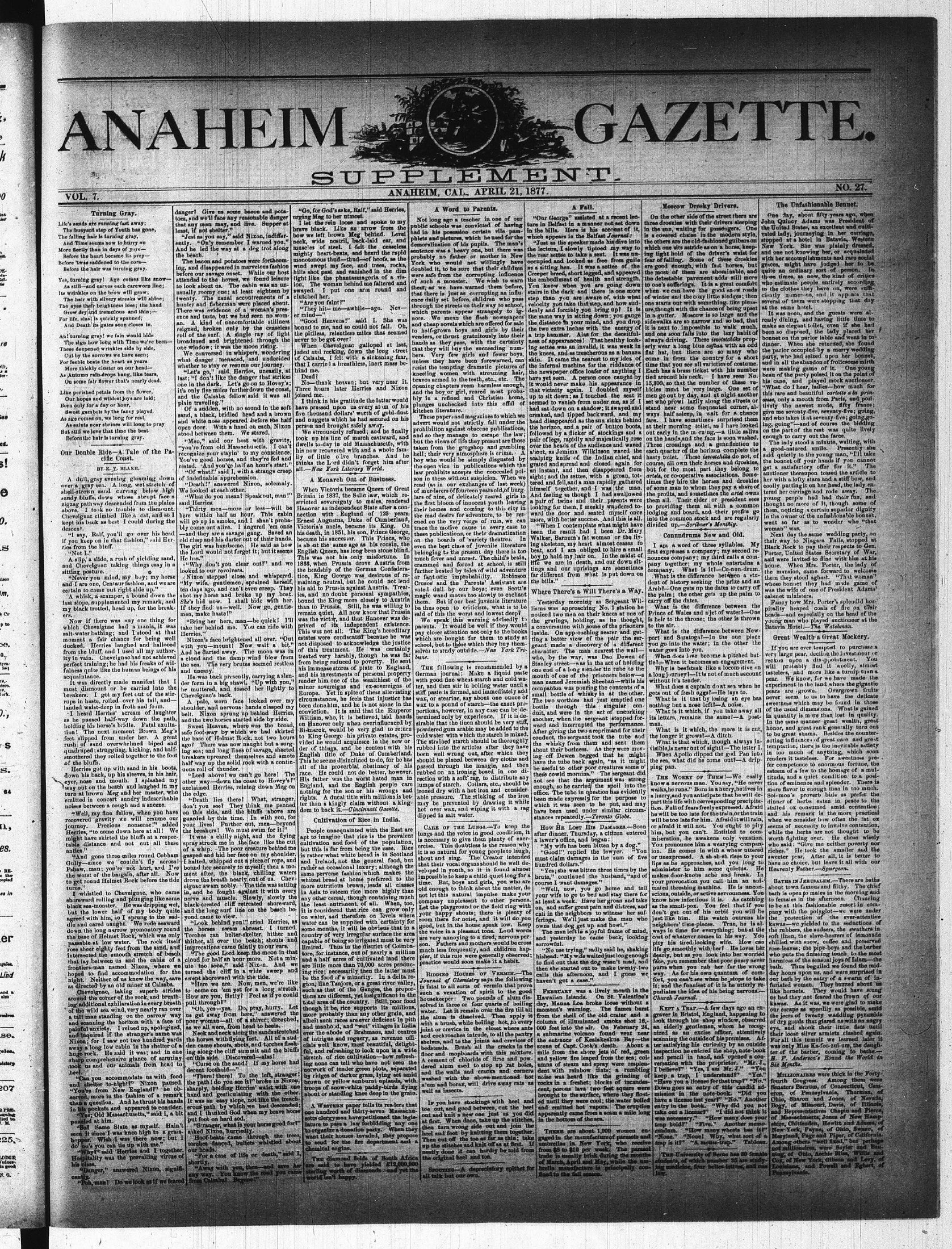
Searchable text
ANAHEIM
VOL. 7.
Turning Gray.
Life's sands are running fast away;
The buoyant step of Youth has gone,
The falling hair is turning gray,
And Time seems now to hurry on
More fleetly than in days of yore—
Before the heart became its prey—
Before 'twas saddened to the core—
Before the hair was turning gray.
Yes, turning gray! Age comes like snow—
As still—and carves each careworn line;
Its wrinkles on the brow will grow;
The hair with allvery streaks will shine;
The eyes their brightness lose; the hand
Grow dry and tremulous and thin;—
For life, alas! Is quickly spanned;
And Death its gates soon closes in.
Ah! turning gray! we fain would hide
The sign how long with Time we've been—
These deepened wrinkles side by side,
Cut by the sorrows we have seen;
For feeble beats the heart as years
More thickly cluster on our head—
As Autumn rain-drops hang, like tears,
On some fair flower that's nearly dead.
Like perished petals from the flower,
Our hopes and wildest joys are laid;
Born only for a day or hour,
Sweet gambols by the fancy played.
As age comes on, we long for rest,
As saints near shrines will long to pray
But still we love that time the best
Before the hair is turning gray.
Our Double Ride—A Tale of the Pacific Const.
danger? Give us some bacon and potatoes, and we'll face any reasonable danger that any man may, and live. Supper at least, if not shelter."
"Just as you say," said Nixon, indifferently. "On'y remember I warned you." And he led the way at a dog trot along the beach.
The bacon and potatoes were forthcoming, and disappeared in marvelous fashion before our savage onset. While our host attended to the horses, we found leisure to look about us. The cabin was an unusually roomy one; at least eighteen by twenty. The usual accountments of a hunter and fisherman were placed about. There was evidence of a woman's presence and taste, but we had seen no woman. A kind of uncomfortable stillness reigned, broken only by the ceaseless roll of the surf. A single ray of light broadened and brightened through the one window; it was the moon rising.
We conversed in whispers, wondering what danger menaced, and undecided whether to stay or resume our journey.
"Let's go," said Herrie, uneasily, at last; "I don't like the danger that strikes one in the dark. Let's go on to Hovey's; it's only five miles further down the coast, and the Calsaba fellow said it was all plain travelling."
Of a sudden, with no sound in the soft sand, a black, bridled head and a brown and white nose appeared before the half open door. With a hand on each, Nixon stood between them. We stared.
"Men," said our host with gravity, "you're from old Massachusetts. I can't recognize your stayin' to my conscience. You've good horses, and they're fed and rested. And you've half an hour's start."
"Go, for God's sake, luring Meg to her utmma. I let the rein loose brave black. Like any bow we left brown Me neck, wide nostril, big muscles of steel. I mighty heart-beats, a monotonous thud—thu wind swept my face, hills shot past and van light like the phantasy ion. The woman behi awayed. I put one clutched her.
"Are you faint?"
"They hit me—awher mind—"
"Good Heavens!" bound to me, and so co the pitileas, relentless never to be got over!
When Cheveignac juded and reckling, do of Calsaba, I felt with that I carried a breath hind me.
Dead?
No—thank heaven: Three hours later H joined me.
I think in his gratitude have pressed upon us five thousand dollars' and nuggets which ha person and brought sa We stronously refuted took up his line of m dwells to-day in old his now recovered wil ily of little olive thinks the Lord didn'
More thickly cluster on our head—
As Autumn rain-drops hang, like tears,
On some fair flower that's nearly dead.
Like perished petals from the flower,
Our hopes and wildest joys are laid;
Born only for a day or hour,
Sweet gambols by the fancy played.
As age comes on, we long for rest,
As saints near shrines will long to pray
But still we love that time the best
Before the hair is turning gray.
Our Double Ride—A Tale of the Pacific Coast.
BY E. Y. BLAKE.
A dull, gray evening gloaming down over a gray sea. A long, wet stretch of shell-strewn sand curving below high sandy bluffs, down whose abrupt face a zigzag pathway descended from the plains above. I took no trouble to dismount. Cheveignac climbed like a cat, and so I kept his back as best I could during the descent.
"I say, Ralf, you'll go over his head if you keep on in that fashion," said Herries at the bluff.
"Not I."
A slip, a slide, a rush of yielding sand, and Cheveignac taking things easy in a sitting posture.
"Never you mind, my boy; my horse and I are one, Centaur fashion, and we are certain to come out right side up."
A whisk, a scamper, a bound down the last slope, supplemented my remark, and my black trotted, head up, for the breakers.
Now if there was any one thing for which Cheveignac had a mania, it was salt-water bathing; and I stood at that moment a fair chance for being well ducked. Herries laughed and hallooed from the bluff, and I used all my authority in vain. Cheveignac had not achieved perfect training; he had his freaks of wilfulness quite like the human beings of his acquaintance.
It was directly made manifest that I must dismount or be carried into the breakers. I got my feet out of the stirrups in haste, rolled over his tail, and landed waist-deep in froth and foam.
I heard Herries' scream of laughter as he paused half-way down the path, holding his horse's bridle. Fatal exultation! The next moment Brown Meg's feet slipped from under her. A great rush of sand overwhelmed biped and quadruped; struggling, kicking, and half-smothered they rolled together to the foot of the bluffs.
Herries got up with sand in his boots, down his back, up his sleeves, in his hair, eyer, nose and mouth. I splashed my way out on the beach and laughed in my turn at brown Meg and her master, who emitted in concert sundry indescribable noises between a cough and a anceze.
"Well, my fine fellow, when you have recovered gravity we will resume our journey. Precious nonsense!" added Herries. "to come down here at all! We might have skirted the bluffs at a respectable distance and not cut all these antics."
And gone three miles round Cobham Gully—since we couldn't fly across! Pahaw, man; you're not hurt, and I've the worst of the bargain, after all. Now to get round Helmet Rock before the tide
"Let's go," said Herries, uneasily at last; "I don't like the danger that strikes one in the dark. Let's go on to Hovey's; it's only five miles further down the coast, and the Calsaba fellow said it was all plain travelling."
Of a sudden, with no sound in the soft sand, a black, bridled head and a brown and white nose appeared before the half open door. With a hand on each, Nixon stood between them. We stared.
"Men," said our host with gravity, "you're from old Massachusetts. I can't recognize your stayin' to my conscience. You've good horses, and they're fed and rested. And you've half an hour's start."
"Of what?" said I, with a strange creep of indefinable apprehension.
"Death!" answered Nixon, solemnly. We looked at each other.
"What do you mean? Speak out, man!" said Herries.
"Thirty men—more or less—will be here within half an hour. This cabin will go up in smoke, and I shan't probably come out alive. I angered em once—and they are a savage gang. Saved an old chap and his darter out of their hands. The girl was handsome. He said as how the Lord would not forget it; but it seems He has."
"Why don't you clear out?" and we looked to our revolvers.
Nixon stepped close and whispered: "My wife, gentlemen, sprained herself, ten days ago, and can't even creep. They shot my horse and broke up my boat. She's hid now. I shall hide with her. If they find us—well. Now go, gentlemen, make haste!"
"Bring her here, man—be quick! I'll take her behind me. You can ride with Herries."
Nixon's face brightened all over. "Out with you—mount! Now wait a bit." And he darted away. The moon was in a cloud and the damp wind blew from the sea. The very brutes seemed restless and uneasy.
He was back presently, carrying a slender form in a big shawl. "Up with you," he muttered, and tossed her lightly to Cheveignac's back.
A pale, worn face looked over my shoulder, and nervous hands clasped my belt. Nixon sprung up behind Herries, and the two horses started side by side.
Sweet Heaven, where was the broad, safe foot-way by which we had skirted the base of Helmet Rock; not two hours ago? There was now caught but a surging sea; and long lines of savage, sheeted breakers uproared themselves and smote halfway up the solid rock with a continuous roll of thunder.
"Lord above! we can't go here!" The other way—down the coast to Hovey's!" exclaimed Herries, reining down Meg on the edge.
"Death lies there! What, stranger, don't you see? They think me penned on this side, and the bluffs above are guarded by this time. In with you, for your lives! Further out, men—beyond the breakers! We must swim for it!"
It was a chilly night, and the flying spray struck me in the face like the cut of a whip. The poor creature behind me gasped and hid her face on my shoulder. I halted, whipped out a piece of rope, and bound her securely to myself; then a moment after, the black, chilling waters drove the breath nearly out of us. Chev-
way out on the beach and laughed in my turn at brown Meg and her master, who emitted in concert sundry indescribable noises between a cough and a sneeze.
"Well, my fine fellow, when you have recovered gravity we will resume our journey. Precious nonsense!" added Herries, "to come down here at all! We might have skirted the bluffs at a respectable distance and not cut all these antics."
"And gone three miles round Cobham Gully—since we couldn't fly across! Pahaw, man; you're not hurt, and I've the worst of the bargain, after all. Now to get round Helmet Rock before the tide turns."
I whistled to Cheveignac, who came shoreward rolling and plunging like some black sea-monster. He was dripping wet, but the lower half of my body quite agreed with him, so I sprung to the saddle and cared naught. We rode seaward down the long narrow promontory round the base of Helmet Rock, which was only passable at low water. The rock itself rose sheer eighty feet from the sand, and intersected the smooth stretch of beach that lay between us and the cabins of a frontiersman named Nixon, where we hoped to find accommodation for the night. Neither of us knew the way, save as directed by an old miner at Calsaba.
Cheveignac, taking superb strides around the corner of the rock, and breathing additional exhilaration in every breath of the wild sea wind, very nearly ran over a tall man standing on the narrow way and scanning the horizon with a face of painful anxiety. I relied up, apologized, and inquired if the stranger's name was Nixon; for I saw not two hundred yards away a long low cabin in the shelter of a huge rock. He said it was; and in one sharp comprehensive glance of scrutiny took us and our animals from heal to heel.
"Can you accommodate us with food and shelter to-night?" Nixon paused. "You're from New England!" he observed, more in the fashion of a remark than a question. And he thrust his hands in his pockets and appeared to consider.
"Yes; Old Massachusetts," said I, a bit puzzled at him.
"So! Same State as myself. Hain't seen it since I was knee high to a grasshopper. Wish I was there now; but I do'no's you can tie up with me."
"Why!" said Herries and I together. Hospitality was the prevailing virtue of his class.
"Danger," answered Nixon, significantly.
"Poh, man! Do we look as if we feared exclaimed Herries, relining down Meg on the edge.
"Death lies there! What, stranger, don't you see? They think me penned on this side, and the bluffs above are guarded by this time. In with you, for your lives! Further out, men—beyond the breakers! We must swim for it!"
It was a chilly night, and the flying spray struck me in the face like the cut of a whip. The poor creature behind me gasped and hid her face on my shoulder. I halted, whipped out a piece of rope, and bound her securely to myself; then a moment after, the black, chilling waters drove the breath nearly out of us. Chevignac swam nobly. The tide was setting in, and he fought against it with every nerve and muscle. Slowly, slowly the black-created cliff retreated shoreward, and the long surf line on the beach beyond came to view.
"Look behind you!" cried Herries, as the horses swam abreast. I turned. Torches ran helter-skelter, hither and thither, all over the beach; shouts and imprecations came faintly to our ears.
"The good Lord keep the moon in that cloud for half an hour more. Not a minute too soon," said Nixon. And we turned the cliff in a wide sweep and swept shoreward with the tide.
"Here we are. Now, men, we're like to come on 'em yet for a long stretch. How are you, Hetty? Feel as if ye could pull through!"
"Oh, yes—yes. Do, pray, hurry. Let us get away from here," answered the poor woman—all of a shiver; drenched, as we all were, from head to heels.
Neck and neck along the sands stretched the horses with flying feet. All of a sudden came shouts, shots, and torches flashing along the cliff summit and the bluffs on this side. Discovered—alas!
"Curse on the sand! If my horse had decent foothold—"
"There! there! To the left, stranger! the path! do you see it!" broke in Nixon, sharply, holding Herries' waist with one hand and gesticulating with the other. It was an easy slope, not like the treacherous path by which we had descended; and I thanked God when my brave horse put foot on hard sod.
"Stranger, what is your horse good for!" asked Nixon, hurriedly.
Hoof-beats came through the trees, torches danced, bullets whistled about our heads.
"For a case of life or death," said I, shortly.
"Away with you, then—and save her any way. You know the road you came from Calsaba! Begun!"
IM GAZE
SUPPLEMENT.
ANAHEIM, CAL., APRIL 21, 1877.
"Go, for God's sake, Ralf," said Herries, urging Meg to her utmost.
I let the rain loose and spoke to my brave black. Like an arrow from the bow we left brown Meg behind. Level neck, wide nostril, back-laid ear, and muscles of steel. I felt the ceaseless mighty heart-beats, and heard the rapid monotonous thud—thud—of hoofs, as the wind swept my face, and trees, rocks, hills shot past and vanished in the dim light like the phantasmagoria of a vision. The woman behind me faltered and awayed. I put one arm round and clutched her.
"Are you faint?"
"They hit—me—awhils—ago. Never mind!"
"Good Heavens!" said I. She was bound to me, and so could not fall. Oh, the pitiless, relentless miles that seemed never to be got over!
When Cheveignac galloped at last, jaded and reeking, down the long street of Calsaba, I felt with a sickening fear, that I carried a breathless, inert mass behind me.
Dead?
No—thank heaven; but very near it. Three hours later Herries and Nixon joined me.
I think in his gratitude the latter would have pressed upon us every atom of his five thousand dollars' worth of gold-dust and nuggets which he had secured on his person and brought safely away.
We stronically refused; and he finally took up his line of march eastward, and dwells to-day in old Massachusetts, with his now recovered wife and a whole family of little olive branches. And he thinks the Lord didn't forget him after
A Word to Parents.
Not long ago a teacher in one of our public schools was convicted of having had in his possession certain vile pamphlets and pictures, which he used for the demoralization of his pupils. The man's sentence was a heavy one, but there was probably no father or mother in New York who would not willingly have doubled it, to be sure that their children were safe from the corrupting influence of such a monster. We wish to warn them, as we have warned them before, that there is just as corrupting an influence daily set before children who pass through the streets on their way to school, which parents appear strangely to ignore. We mean the flash newspapers and cheap novels which are offered for sale to half-grown boys and girls by their vendors, or thrust gratuitously into their hands as they pass, with the certainty that they will buy the succeeding numbers. Very few girls and fewer boys, unless they have been forewarned, can resist the tempting dramatic pictures of kneeling women with streaming hair, bravos armed to the teeth, etc., etc. The opening chapters seem harmless enough, and the boy or girl, reared most probably in a refined and Christian home, plunges unchecked into this offal of kitchen literature.
These papers and magazines to which we advert would not strictly fall under the prohibition against obscene publications, and so they manage to escape the law; but the views of life they present are those taken from the grogshop and gambling hell; their very atmosphere is crime. A boy who would be simply disguised by the open vice in publications which the
A Fall.
"Our George" assisted at a recent lecture in Belfast in a manner not set down in the bills. Here is his account of it, which appears in the Belfast Journal:
"Just as the speaker made his dive into the lecture, I slowly tiptoed my way to the rear settee to take a seat. It was unoccupied and looked as free from guille as a sitting hen. It was a settee of the Creeper breed, short legged, and appeared the embodiment of health and strength. You know when you are going down stairs in the dark and there is one more step than you are aware of, with what velocity you take that step, and how suddenly and forcibly you bring up? It is the same way in sitting down; you gauge the distance in your mind, and you drop the two extra inches with the energy of a trip hammer. Alas for the deceitfulness of appearances! That healthy looking settles was an invalid, it was weak in the knees, and as treacherous as a banana skin. It came the nearest to my idea of the infernal machine for the riddance of the newspaper office loafer of anything I have yet seen. A person once caught by it would never make his appearance in that vicinity again. I doubled myself up to sit down; as I touched the seat it seemed to vanish from under me, as if I had sat down on a shadow; it awayed and creaked, and tipped backward, and my head disappeared as the sun sinks behind the horizon, and a pair of button boots, followed by a flicker of stockings and a pair of legs, rapidly and majestically rose over the heads of the audience and waved about, as Jemima Wilkinson waved the scalping knife of the Indian chief, and grated and spread and closed again for
Most
On the creeper three droops in the sun; is a cover for others which one ing tight fear of fall are good for most of detestation to one's suet when we come on winter one starts wearing flat hat; is next to one skirt early wear flat hat; come in time that Each has tied around 15,800 so hides men go out set who pull stand near ways halt fare. I have at their mouth out early on the hard Three creep each quarrel hasty toilet all
A Monarch Out of Business.
When Victoria became Queen of Great Britain in 1837, the Salic law, which restricted sovereignty to males, rendered Hanover an independent State after a connection with England of 123 years. Ernest Augustus, Duke of Cumberland, Victoria's uncle, became its King. On his death, in 1851, his son, Prince George, became his successor. This Prince, who is about the same age as his cousin, the English Queen, has long been stone blind. This was not his only misfortune. In 1866, when Prussia drove Austria from the headship of the German Confederation, King George was desirous of remaining neutral, but he could not lend his aid to Prussia against Austria. Treaties, and no doubt personal sympathies, bound the King more closely to Austria than to Prussia. Still, he was willing to remain quiet. All now know that Prussia was the victor, and that Hanover was deprived of its independent existence. This was not all. The King's hereditary estates were confiscated because he was not disposed to acknowledge the justice of this treatment. He was certainly treated very harshly, though he was far from being reduced to poverty. He sent his immense stores of plate to England, and his investments of personal property render him one of the wealthiest of the minor sovereigns and ex-sovereigns of Europe. Yet in spite of these alleviating circumstances, he feels that injustice has been done him, and he is not alone in the conviction. It is said that the Emperor William, who, it is believed, laid hands on Hanover only when overinfluenced by Bismarck, would be very glad to return to King George his private estate, provided he would acquiesce in the new or der of things, and be content with his English title of Duke of Cumberland. This he seems disinclined to do, for he has all of the proverbial obstinacy of his race. He could not do better, however. His father was the worst hated man in England, and the English people care notning for the son or his wrongs and rights. A ducal title with millions is better than a kingly claim without a kingdom to back it.—Gincinnati Gazette.
Cultivation of Rice in India.
People unacquainted with the East are apt to imagine that rice is the prevalent cultivation and food of the population, but this is far from being the case. Rice is rather what white bread is in Scotland and Ireland, not the general food, but rather an occasional luxury; although the same pervasive fashion which makes the whitest bread at home preferred to the resist the tempting dramatic pictures of kneeling women with streaming hair, bravos armed to the teeth, etc., etc. The opening chapters seem harmless enough, and the boy or girl, reared most probably in a refined and Christian home, plunges unchecked into this offal of kitchen literature.
These papers and magazines to which we advert would not strictly fall under the prohibition against obscene publications, and so they manage to escape the law; but the views of life they present are those taken from the grogshop and gambling hell; their very atmosphere is crime. A boy who would be simply disgusted by the open vice in publications which the law prohibits accepts the concealed poison in these without suspicion. When we read (as in our exchanges of last week) of murdersers of fourteen years old, of burglar sors of nine, of delicately reared girls in the first bloom of innocent youth leaving their homes and coming to this city in the mad desire for adventure, to be rescued on the very verge of ruin, we can trace the motive cause in every case to these publications, or their dramatization on the boards of variety theatres. In even the best class of juvenile literature belonging to the present day there is too much fever and unrest. The child's brain, crammed and forced at school, is still further heated by tales of wild adventure or fantastic improbability. Robinson Crusoe and the Parents' Assistant are voted dull by our boys; even Scott's magic wand moves too slowly to enchant them. But if our best juvenile literature be thus open to criticism, what is to be said of this the worst and lowest deep?
We speak this warning advised to parents. It would be well if they would pay closer attention not only to the books which are bought for them to study at school, but to those which they buy themselves to study outside.—New York Tribune.
The following is recommended by a German journal: Make a liquid paste with good fine wheat starch and cold water, and then stir in boiling water until a stiff paste is formed, and immediately add wax, or stearine, say about one ounce of wax to a pound of starch—the exact proportions, however, in any case can be determined only by experience. If it is desirable that the linen should be very stiff, powdered gum arabic may be added to the cold water with which the starch is mixed. The strained starch should be thoroughly rubbed into the articles after they have been well wrung out, after which they should be placed between dry cloths and passed through the mangle, and then rubbed on an ironing board in one direction with a soft rag, to distribute any lumps of starch. Collars, etc., should be ironed dry with a hot iron and considerable pressure. The sticking of the iron may be prevented by drawing it while hot over wax, and wiping it with a rag dipped in salt water.
CARE OF THE LUNGS.—To keep the lungs and the voice in good condition, it is necessary to give them plenty of exercise. This doubtless is the reason why it is so natural for young people to laugh, shout and sing. The Creator intended that their vocal organs should be well developed in youth, so it is found almost impossible to keep a child quiet long for a time. But horns and girls who are
How He Lost His Damages.—Soon after dinner. Thursday, a citizen entered a lawer's office, and began:
"My wife has been bitten by a dog."
"Good!" replied the lawyer. "You must claim damages in the sum of five hundred dollars."
"Yes; she was bitten three times by the brute," continued the husband, "and of course I want damages."
England, and the English people care nothing for the son or his wrangs and rights. A ducal title with millions is better than a kingly claim without a kingdom to back it.—Ocinnati Gazette.
Cultivation of Rice in India.
People unacquainted with the East are apt to imagine that rice is the prevalent cultivation and food of the population, but this is far from being the case. Rice is rather what white bread is in Scotland and Ireland, not the general food, but rather an occasional luxury; although the same perverse fashion which makes the whitest bread at home preferred to the more nutritious brown, leads all classes in Asia to esteem rice more highly than any other cereal, though containing much the least nutrient of all. When, too, it is considered that rice can grow only on water, and therefore on levels where water can be supplied with certainty for some months, it will be obviens that in a country of very irregular surface the area capable of being so irrigated must be very limited. Thus in the district of Coimbatore, for instance, out of nearly a million and a half acres of cultivated land there are little more than 70,000 acres producing rice; necessarily then the latter must be the food of a minority. In a delta region, like Tanjore, or a great river valley, such as that of the Ganges, the proportions are different, yet insignificant in the total area of the country. Still, poor food though it be, rice supports its millions, more probably than any other grain, and albeit such races are ever deficient in pith and manhood, and "wet" villages in India ever the abode of Brahmans, and centres of intrigue and rogery, as revenue officials well know, most beautiful, delightful, and refreshing to look upon is a wide stretch of rice cultivation—how refreshing none can tell who have not seen the network of tender green plots, separated by ridges of darker grass, lying set amid brown or yellow sunburnt uplands, with troops of snow-white paddy-birds flying about or standing knee deep in the grain.
A Western paper tells its readers that one hundred and thirty-seven Massachusetts clergymen have petitioned the legislature to pass a law for bidding any one to organize a donation party. When they want their houses invaded, they propose to send for the fire department and a chemical engine.
The diamond fields of South Africa are said to have yielded £12,000,000 sterling worth of diamonds—and yet the world isn't happy.
CARE OF THE LUNGS.—To keep the lungs and the voice in good condition, it is necessary to give them plenty of exercise. This doubtless is the reason why it is so natural for young people to laugh, shout and sing. The Creator intended that their vocal organs should be well developed in youth, so it is found almost impossible to keep a child quiet long for a time. But, boys and girls, you who are old enough to think about the matter, do not let this natural impulse make your company unpleasant to other persons. Let the playground or the field ring with your happy shouts; there is plenty of room there for noise, and it will do you good, but in the house speak low. Keep the voice in a pleasant tone. Loud words are very annoying to a tired, nervous person. Fathers and mothers would be cross much less frequently, and children happier, if this rule were generally observed; practice would soon make it a habit.
RIDDING HOUSES OF VERMIN.—The Journal of Chemistry says the following is fatal to all sorts of vermin that prove such a vexation of spirit to the good housekeeper: Two pounds of alum dissolved in three or four quarts of boiling water. Let it remain over the fire till all the alum is dissolved. Then apply it with a brush, while boiling hot, to every joint or crevice in the closet where ants and cockroaches intrude, to all the pantry shelves, and to the joints and crevices of bedsteads. Brush all the cracks in the floor and mopboards with this mixture. A cement of chloride of lime and powdered alum used to stop up rat holes, and the walls and cracks and corners washed with the above-mentioned hot alum and borax, will drive away rats as well as insects.
If you have stockings with heel and toe out, and good between, cut the heel out and knit a now one just as you did at first. When done, take up the stitches, then turn wrong side out and join the heel and foot by knitting them together. Then cut off the toe as far as thin; take up the stitches and knit off as at first. If neatly done it can hardly be told from the original heel and toe.
Sootting—a depreciatory epithet for all talk but our own.
How He Lost His Damages.—Soon after dinner. Thursday, a citizen entered a lawyer's office, and began:
"My wife has been bitten by a dog."
"Good!" replied the lawyer. "You must claim damages in the sum of five hundred dollars."
"Yes; she was bitten three times by the brute," continued the husband, "and of course I want damages."
"Well, now, you go home and tell your wife to go to bed and stay there for at least a week. Have her groan and take on, and suffer great pain and distress, and call in the neighbors to witness her sufferings. We'll just make the man who owns that dog get up and howl."
The man left is joyful frame of mind, and yesterday he came back looking sorrowful.
"No use trying," sadly said he, shaking his head. "My wife waited just long enough to find out that the dog wasn't mad, and then she started out to make twenty-two calls this afternoon, and I guess we haven't got a case."
February was a lively month in the Hawaiian Islands. On St. Valentine's day, Manna Loa broke loose without a moment's warning. The flames burst from the shell of the old crater and a column of illuminated smoke shot 16,000 feet into the air. On February 24, a submarine volcano found vent near the entrance of Kealakeakua Bay—the scene of Capt. Cook's death. About a mile from the shore jets of red, green and yellow fire leaped from the sea; columns of steam and spray were resplendent with rainbow fints; a rumbling noise was heard like the grinding of rocks in a freshet; blocks of incandescent porous lava two feet square were brought to the surface where they floated until they were cool; the water boiled and emitted hot vapor. The eruption apparently came from a seam a mile long in the bottom of the sea.
There are about 1,000 women engaged in the manufacture of parasols and umbrellas in New York, who receive from $8 to $10 per week. The parasol trade is usually brisk during the months of March, April and May; while the umbrella manufacture is principally confined to the fall season.
GAZETTE.
NO. 27.
Moscow Drosky Drivers.
On the other side of the street there are three droskies with their drivers sleeping in the sun, waiting for passengers. One is a covered chause in the modern style, the others are the old-fashioned gnibars on which one sits astride as on a horse, keeping tight hold of the driver's waist for fear of falling. Some of these droskies are good enough, with fast horses, but the most of them are abominable, and the detestable pavement adds still more to one's sufferings. It is a great comfort when we can have the good snow roads of winter and the cozy little sledges; then one starts out with something like pleasure, though with the chance of being upset in a gutter. Moscow is so large and the sidewalks are so narrow and so bad, that it is next to impossible to walk much, and one soon falls into the lazy habit of always driving. These inotstohika properly wear a long blue caftan with an odd flat hat, but there are so many who come in from the country for a short time that you see all varieties of costume. Each has a brass ticket with his number fied around his neck. I have seen No. 15,800, so that the number of these vehicles must be very large. One set of men go out by day, and at night another set who prowl lazily along the streets or stand near some frequented corner, always half asleep, in wait for a chance fare. I have sometimes surprised them at their morning toilet, as I have looked out early in the morning—a little saliva on the hands, and the face is soon washed. Three crossings and a genuflection to each quarter of the horizon complete the hasty toilet. These inotstohika do not, of course, all own their horses and droskies,
The Unfashionable Bonnet.
One day, about fifty years ago, when John Quincy Adams was President of the United States, an excellent and cultivated lady, journeying in her carriage, stopped at a hotel in Batavia, Western New York. She was plainly dressed, and one not knowing her, or acquainted with her accomplishments and rare social graces, might have judged her to be quite an ordinary sort of person. In those times, as now, the kind of critics who estimate people entirely according to the clothes they have on, were sufficiently numerous, and it apparared that several of them were stopping that day at the same hotel.
It was noon, and the guests were already dining, and having little time to make an elegant toilet, even if she had been so disposed, the lady placed her bonnet on the parlor lable and went in to dinner. When she returned, she found the parlor occupied by a merry wedding party, who had seized upon her bonnet, and in all the abandon of frolicsome mirth were making game of it. One young beau of the party polished it on the point of his cane, and played mock auctioneer. "What do I hear, ladles—how much for this rare and beautiful carlotta a la princesse, only a mouth from Paris, and positively the newest mode, fifty francs; give me seventy-five, seventy-five; going, and who takes it at seventy-five; going, going,"—and of course the bidding on the part of the rest was quite lively enough to carry out the farce.
The lady stood a minute, waiting, with a good-natured smile. Presently she said quietly to the young man, "I'll take the bonnet off your hands if you cannot
Once caught by the appearance in doubled myself the seat it tender me, as if I saw; it swayed and awkward, and my hunn sinks behind of button boots, stockings and a majestically rose incidence and wared Johnson waved the Indian chief, and closed again for disappeared from with a groan, tootrapidly gathered was the man. He had swallowed their parents were likely wandered tootted myself once. And this is all what might have been Dr. Mary woman or the lively most ceases to lend to hire a small In the midst of and our down siters are sometimes put down on There's a Way.
As Sergeant Wilk No.1 station he our knees at one of as he thought, of the prisoners nearer and get the pair the servery of a different nearest the wall—Dad Dewen of the act of holding her tin tube to the prisoners below—a sheehan—while his contents of a pin at the other. Just emptied one singular concoct of uncorking meant stepped for the performance. Apprimand for their took the tube and and sent them as they were moved that he might strain, "as it might creatures some o' The sergeant did moment was strong the spoil into the interior has evidently for the purpose to be put, and may similar circum- toronto Globe.
Damages.—Soon a citizen entered organ: written by a dog." You in the sum of five three times by the husband," and of
Each has a brass ticket with his number tied around his neck. I have seen No. 15,300, so that the number of these vehicles must be very large. One set of men go out by day, and at night another set who prowl lazily along the streets or stand near some frequented corner, always half asleep, in wait for a chance fare. I have sometimes surprised them at their morning toilet, as I have looked out early in the morning—a little saliva on the hands, and the face is soon washed. Three crossings and a genuflection to each quarter of the horizon complete the hasty toilet. These nostochika do not, of course, all own their horses and droskies, but for the most part they belong to artel, or co-operative associations. Sometimes they hire the horses and droskies of some man to whom they pay a share of the profits, and sometimes the artel owns them all. Their elder or president sees to providing them all with a common lodging and board, and their profits go into the common stock and are regularly divided up.—Scribner's Monthly.
Conundrums New and Old.
I am a word of three syllables. My first expresses a company; my second renounces company; my third calls a company together; my whole entertains a company. What is it?—Co-nun-drum.
What is the difference between a student of history seeking the prize and an Arab?—One gets up the dates to carry off the palm; the other gets up the palm to carry off the dates.
What is the difference between Newport and Saratoga?—In the one place you go into the water; in the other the water goes into you.
When does love become a pitched battle?—When it becomes an engagement.
Why is beefsteak like a locomotive on a long journey?—It is not of much account without it's tender.
What does a captain do sex when he gets out of fresh eggs?—He lays to.
What is it that by losing an eye has nothing but a nose left?—A noise.
What is it which, if you take away all its letters, remains the same?—A postman.
What is it which, the more it is cut, the longer it grows?—A ditch.
What is that which, though always invisible, is never out of sight?—The letter I.
When Apollo dipped the god Pan into the sea, what did he come out?—A dripping pan.
The Worry of Them!—We easily know a nervous man. You say, "He never walks, he runs." Born in a hurry, he lives in a hurry, and you anticipate that he will depart this life with corresponding precipitation. Full of fears freely expressed. Afraid he will be too late for the train or the train will be too late for him. Afraid it will rain, or afraid it will not. You ought to pity him, but you can't. Entitled to commiseration, he awakens only vexation. You pronounce him a wearying companion. He comes in with a whew uttered or unexpressed. A sh-sh-sh rises to your lips as he approaches, and you long to administer to him some quietus. He makes door-knots ache and break. In your provocation you call him an anti-were making game of it. One young bean of the party polised it on the point of his cane, and played mock auctioneer. "What do I hear, ladles—how much for this rare and beautiful carlotte la princess, only a month from Paris, and positively the newest mode, fifty france; give me seventy-five, seventy-five; going, and who takes it at seventy-five; going, going"—and of course the bidding on the part of the rest was quite lively enough to carry out far the farce.
The lady stood a minute, waiting with a good-natured smile. Presently she said quietly to the young man, "I'll take the bonnet off your hands if you cannot get a satisfactory offer for it." The auctioner thereupon tossed the article to her with a lofty stare and a stiff bow, and coolly putting it on her head, the lady entered her carriage and rode away. The young people had had their fun, and thought no more of it, though some of them, noticing a certain superior dignity in the owner of the unfashionable bonnet, went so far as to wonder who "that woman" was.
Next day the same wedding party, on their way to Niagara Falls, stopped at Black Rock to pay their respects to Gen. Porter, United States Secretary of War, and were invited to dine with him as his house. When Mrs. Porter, the lady of the mansion, came forward to welcome them they stood agasth. "That woman" whose bonnet they had made game of was the wife of one of President Adams' cabinet ministers.
Fancy how Mrs. Porter's splendid hospitality heaped coals of fire on their heads—and especially on the head of the young man who played auctioneer at the Batavia Hotel.—The Watchman.
Great Wealth a Great Mockery.
If you are ever tempted to purchase a very large pear, declining the investment or reckon upon a disappointment. You will probably find it woolly, almost tasteless, and more like a turnip than a pear. We know, for we have made the experiment in the land where the gigantic pears are grown. Overgrown fruits never seem to us to have the delicate sweetness which may be found in those of the usual dimensions. What is gained in quantity is more than lost in quality. In the same manner great wealth, great honor, and great rank generally turn out to be great shams. Besides the counteracting influences of great care and great temptation, there is the inevitable satiety in too much of anything, which soon renders it tasteless. For sweetness prefer competence to enormous fortune,the esteem of a few to the homage of a multitude,and a quiet condition to a position of eminence and splendor. There is more flavor in enough than in too much.Solomon's proverb bids us prefer the dinner of herbs eaten in peace to the stalled ox consumed amid contention; and his remark is the more practical when we consider how often the fat ox seems of necessity to involve contention, while the herbs are not thought to be worth fighting over. He chose wisely who said: "Give me neither poverty nor riches." He took the smaller and the sweeter pear. After all, it is better to have no choice, but leave it all with our Heavenly Father—Spurgeon.
BATHS IN JERUSALEM.—There are baths
Damages.—Soon a citizen entered the house by a dog.” The lawyer. “You will be too late for the train, or the train will be too late for him. Afraid it will rain, or afraid it will not. You ought to pity him, but you can't. Entitled to commission, he awakens only vexation. You pronounce him a wearying companion. He comes in with a whew uttered or unexpressed. A sh-sh-sh rises to your lips as he approaches, and you long to administer to him some quietus. He makes door-knobs ache and break. In your provocation you call him an automated threshing machine. He is unconscious, outside, or active nervousness. You know how infectious it is. As catching as the small-pox. You feel that if you don't get out of his orbit you will be just like him. His watch outruns his neighbors' time-pieces. True, he is always in time for everything; but at the cost of whatever comes in his way. You pity his tired-looking wife. How can life go smoothly with her? He loves her dearly, but as you look into her worried face, you remember that poor pussy never purrs when you rab her fur the wrong way. As for his own quantum of comfort, you can't see when he stops to take it; and the funniest of it is he utterly repudiates the idea of his being nervous.
Church Journal.
Keep a trap.—A few days ago an engraver in Bristol, England, happening to look through his shop window, observed an elderly gentleman, whom he recognized as an excise officer, attentively scanning the outside of his premises. After satisfying his curiosity by an outside inspection he entered the shop, note-book and pencil in hand, and opened a conversation with the proprietor. “Mr. J., I believe!” “Yes, I am Mr. J.” “You keep a trap, I understand!” “Yes.” “Have you a license for that trap?” “No.” Down goes an entry of this candid admission in the note-book. “Did you have a license last year?” “No.” Another entry in the book. “Why did you not take out a license?” “I did not think it was necessary.” “How many does your trap hold!” “Five.” Another memorandum. “How many wheels has it?” “None.” “None! Why, what sort of a trap is it?” “A mouse-trap.” Tableau.
The University of Berne has 20 female students, of which number 25 are studying medicine, four better-littles, and one law.
Baths in Jerusalem.—There are baths about town famous and filthy. The chief bath is open to males in the morning and to females in the afternoon. Chancing to be at this fashionable resort in company with the polyglot—we were under the protection of the ever-attentive kawas—we yielded to the seductions of the rubbers, the sudsers, the swathers in soft linen, the slave-bearers of lemonade chilled with snow, coffee and preserved rose-leaves; the pipe-boyz and the barber who puts the finishing touch to the most harmless of the sensual joys of Islam—the bath. Thus beguiled we found the midday hours upon us, and were surprised in our bath by the entry of a swarm of infuriated women. They buzzed about us like hornets. They would have stung us had they not feared the frown of our kawas. As it was, we were glad to make our escape as speedily as possible, amid the jeers of twenty waddling pyramids of dry goods that glared us with an angry eye, and shook their little fists until their loose silver armlets clasped again. For all this tumult we learned later it was only Miss Ka-foo-zul-um, the daughter of the barber, coming to bathe—H. P. Anderson's Round the World in Six Months.
Millionaires were thick in the Forty-fourth Congress. Among them were Senators Barnum, of Connecticut, Cameron, of Pennsylvania, Thurman, of Ohio, Sharon and Jones, of Nevada, Boggy, of Missouri, Davis, of Illinois, and Representatives Chapin and Pierce, of Massachusetts, Jones of New Hampshire, Chittenden, Hawitt and Adams, of New York, Payne, of Ohio, Swano, of Maryland, Page and Piper, of California. Among others "well fixed," but perhaps not millionaires, were Sayler and Hanning, of Ohio, Archie Minsa, Willis and Cox, of New York, Gibson and Lavy, of Louisiana, and Powell and Egbert, of Pennsylvania.