anaheim-gazette 1877-04-21
Scanned page
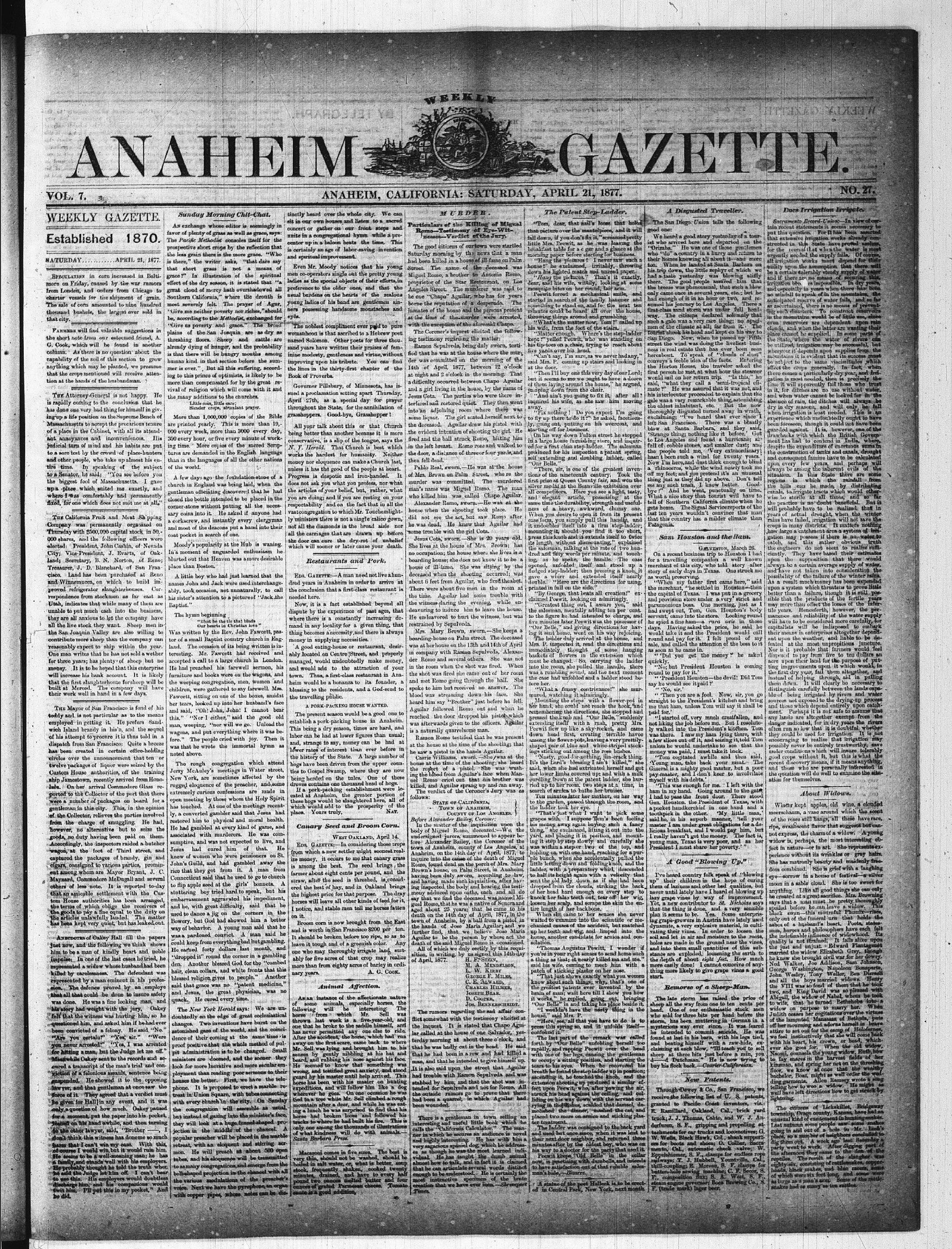
Searchable text
WEEKLY GAZETTE.
Established 1870.
SATURDAY...APRIL 21, 1877.
Speculation in corn increased in Baltimore on Friday, caused by the war rumors from London, and orders from Chicago to charter vessels for the shipment of grain. The sale of corn amounted to nine hundred thousand bushels, the largest ever sold in that city.
Farmers will find valuable suggestions in the short note from our esteemed friend, A. G. Cook, which will be found in another column. As there is no question about the capability of the soil of this section to grow anything which may be planted, we presume that the crops mentioned will receive attention at the hands of the husbandman.
The Attorney-General is not happy. He is rapidly coming to the conclusion that he has done one very bad thing for himself in giving up a life position on the Supreme Bench of Massachusetts to accept the precarious tenure of a place in the Cabinet, with all its attendant annoyances and inconveniences. His judicial turn of mind and his habits are put to a sore test by the crowd of place-hunters and other people, who take up almost his entitlement.
Sunday Morning Chit-Chat.
An exchange whose editor is seemingly in favor of plenty of grass as well as grace, says: The Pacific Methodist consoles itself for the prospective short crops by the reflection that the less grain there is the more grace. "Who is there," the writer asks, "that dare say that short grass is not a means of grace?" In illustration of the spiritual effect of the dry season, it is stated that "a great cloud of mercy hath overshadowed all Southern California," where the drouth is most severely felt. The prayer of Agur, "Give me neither poverty nor riches," should be, according to the Methodist, exchanged for "Give us poverty and grace." The broad plains of the San Joaquin are as dry as threshing floors. Sheep and cattle are already dying of hunger, and the probability is that there will be hungry mouths among human kind in that section before the summer is over." But all this suffering, according to this prince of optimists, is likely to be more than compensated for by the great revival of religion which will come with it and the many additions to the churches.
Little coin, little care;
Slender crops, abundant prayer.
More than 1,000,000 copies of the Bible are printed yearly. This is more than 19,000 every week, more than 3000 every day, 300 every hour, or five every minute of working time. More copies of the sacred Scriptures are demanded in the English language than in the languages of all the other nations.
Even Mr. Moody notice men co-operators single out ladies as the special object preference to the older ones usual burdens on the heart young ladies of his hand and nera possessing handsome eyes.
The noblest compliment womanhood is that ascribed named Solomon. Other poets and years have written their innine modesty, gentleness and improving upon his tribute the lines in the thirty-first Book of Proverbs.
Governor Pillsbury, of issued a proclamation setting April 27th, as a special throughout the State, for grasshoppers. Good-bye,
All your talk about this being better than another conservative, is a slip of the N. Y. Herald. That Church works the hardest for hum money nor eloquence can m
The Attorney-General is not happy. He is rapidly coming to the conclusion that he has done one very bad thing for himself in giving up a life position on the Supreme Bench of Massachusetts to accept the precarious tenure of a place in the Cabinet, with all its attendant annoyances and inconveniences. His judicial turn of mind and his habits are put to a sore test by the crowd of place-hunters and other people, who take up almost his entire time. In speaking of the subject to a Senator, he said: "You see before you the biggest fool of Massachusetts. I gave up a place which suited me exactly, and where I was comfortably and permanently fixed, for one which does not suit me at all."
The California Fruit and Meat Shipping Company was permanently organized on Thursday with $500,000 capital stock in 50,000 shares, and the following officers were elected: President, John Cashin, of Nevada City; Vice-President, J. Evarts, of Oakland; Secretary, B. N. Norton, of Reno; Treasurer, J. D. Blanchard, of San Francisco. Land has been purchased at Reno and Winnemucca, on which to build improved refrigerator slaughterhouses. Correspondence from stockmen as far east as Utah, indicates that while many of them are unable to put much cash into the business, they are all anxious to let the company have all the live stock they want. Sheep men in the San Joaquin Valley are also willing to contribute more sheep than the company can reasonably expect to ship within the year. One man writes that he has not sold a wether for three years; has plenty of sheep but no money. It is to be hoped that this enterprise will increase his bank account. It is likely that the first slaughterhouse for sheep will be built at Merced. The company will have their work well in hand in a few days.
The Mayor of San Francisco is fond of his toddy and is not particular as to the means employed in getting it. He prefers Sandwich Island brandy in his'n, and the sequel of his attempt to procure it is thus told in a dispatch from San Francisco: Quite a breeze has been created in certain office-holding circles over the announcement that ten or twelve packages of liquor were seized by the Custom House authorities, off the training ship Jamestown, recently arrived from Honolulu. On her arrival Commodore Glass reported to the Collector of the port that there were a number of packages on board for a gentleman in this city. This, in the opinion of the Collector, relieves the parties involved from the charge of smuggling. He had, however, no alternative but to seize the goods, no duty having been paid on them. Accordingly, the inspectors raided a butcher wagon, at the foot of Third street, and captured the packages of brandy, gin and cigars, consigned to various parties, prominent among whom are Mayor Bryant, J. C. Maynard, Commodore McDugall and several
More than 1,000,000 copies of the Bible are printed yearly. This is more than 19,000 every week, more than 3000 every day, 300 every hour, or five every minute of working time. More copies of the sacred Scriptures are demanded in the English language than in the languages of all the other nations of the world.
A few days ago the foundation-stone of a church in England was being laid, when the gentleman officier discovered that he had closed the bottle intended to be placed in the corner-stone without putting all the necessary coins into it. He asked if anyone had a corkscrew, and instantly every clergyman and most of the deacons put a hand into their coat pocket in search of one.
Moody's popularity at the Hub is waning. In a moment of unguarded enthusiasm he blurted out that Heaven was a more desirable place than Boston.
A little boy who had just learned that the names John and Jack were used interchangeably, took occasion, not naturally, to call his sister's attention to a picture of "Jack the Baptist."
The hymn beginning:
"Elest be the tie that blinds
Our hearts in Christian love"
Was written by the Rev. John Fawcett, pastor of a small Baptist country church in England. The occasion of its being written is interesting. Mr. Fawcett had received and accepted a call to a large church in London. He had preached his farewell sermon, his furniture and books were on the wagons, and the weeping congregation, men, women and children, were gathered to say farewell. Mrs. Fawcett, sitting on one of the boxes, amidst her tears, looked up into her husband's face and said, "Oh! John, John! I cannot bear this." "Nor I either," said the good old man, weeping, "nor will we go. Unload the wagons, and put everything where it was before." The people cried with joy. Then it was that he wrote the immortal hymn as noted above.
The rough congregation which attend Jerry McAuley's meetings in Water street, New York, are sometimes affected by the rugged eloquence of the preacher, and some extremely curious confessions are made in open meeting by those whom the Holy Spirit has touched. At one of the meetings recently, a converted gambler said that Jesus had restored him to physical and moral health. He had gambled at every kind of game, and associated with murderer. He was consumptive, and was not expected to live, and Jesus had cured him of that. He knew of women who were pensioners on St. John's Guild, and had gambled away the rice that they got from it. A man from Connecticut said that he used to go to church
Governor Pillsbury, of April 27th, as a special throughout the State, for graashoppers. Good-bye.
All your talk about this being better than another conservative, is a slip of the N.Y.Herald. That Church works the hardest for his money nor eloquence can unless it has the good of this Progress is despotic and does not ask you what you do articles of your belief you are doing; and if you are respectability and on the vast congregation to which they ministers there is not all the diamonds in the all the carriages that are the door can cure the dry which will sooner or later.
Restaurants are
Eds. Gazette:—A man dredged years in Anaheim in the conclusion that a first-needed here.
Now, it is a fact established dispute by the experience where there is a constant mand in any locality for anything becomes an necessity; money in supplying necessities.
A good eating-house or habily located on Centre Street managed would undoubtedly would add to the town. Thus, a first-class heim would be a bonanza blessing to the residents; the travelling public.
A PORK-PACKING HOUSE
The present season would establish a pork-packing house. This being a dry season, labor can be had at lower rates and strange to say, money lower rates of interest than the history of the State hogs have been driven from ties to Gospel Swamp, while being herded on the tall droves contains one thousand these hogs would be slaughtered at Anaheim; the farmer about eight cents per straw; after the seed is Yours truly,
Canary Seed and WEST OAK
Eds. Gazette:—In connection with which a new settlementizes money, it occurs to me is among the best. The farmer about eight cents per straw; after the seed is Yours truly,
```
Anecdotes of Oakey Hall fill the papers just now, and the following we think shows him to be a man of kindly heart and noble impulse: In one of the last cases he tried, he represented a widow whose husband had been killed by carelessness. The defendant was represented by a man eminent in his profession. The defence proved by an employee that all that could be done to insure safety was done. He was a fine looking man, and his story had weight with the jury, Oakey felt that the witness was hurting him, so he questioned him, and asked him if he had ever been convicted of a felony. He said "No." "Are you certain?" "Yes, sir." "Were you never arrested?" "Yes, I was arrested for hitting a man, but the Judge let me off." Meanwhile Oakey sent to the records and secured a transcript of the man's trial and conviction of a felonious assault, sentence being suspended. He showed it to the opposing lawyer, and that gentleman at once saw the force of it. They agreed that a verdict must be given for Hall in any event, and it was only a question of how much. Oakey paused for a moment, put the paper into his pocket, fanned on his hand awhile, and then turning to the other lawyer, said, "Brother —, I don't think this witness has done me so much harm that I can't win my case. With this, of course I would win, but it would ruin him. He seems to be a well-meaning man; he has a family, and stands well with his employers. He probably thought he told the truth when he said the Judge let him off. I can't bear to use this. His employers would doubtless discharge him, and his companions would惩 him. I'll put this in my pocket." And he did.
The New York Herald says: We are undoubtedly on the edge of great ecclesiastical changes. Two inventions have burst on the astonished gaze of the world, and the coincidence of their coming at the same time is proof positive that the whole method of pulpit administration is to be changed. Small ministers are doomed, and the sooner they look for more lucrative and more secular employment than reading poor sermons to their houses the better. First, we have the telephone. It is proposed to erect a marble retreat in Union Square, with tubes connecting with every church in the city. On Sunday the congregation will assemble as usual, but instead of gazing into the minister's face, they will look at a huge funnel-shaped projection in the middle of the chancel. A popular preacher will be placed in the marble retreat, with an eloquent and stirring sermon. He will preach at about 500 open tubes, and his eloquence will be transmitted to as many congregations, and emerge from the bell-shaped projection in the chancel with all the various modulations of the preacher's voice. Next we have the pyrophone, an organ with copper pipes, whose notes can be rudged eloquence of the preacher, and some extremely curious confessions are made in open meeting by those whom the Holy Spirit has touched. At one of the meetings recently, a converted gambler said that Jesus had restored him to physical and moral health. He had gambled at every kind of game, and associated with murderers. He was consumptive, and was not expected to live, and Jesus had cured him of that. He knew of women who were pensioners on St. John's Guild, and had gambled away the rice that they got from it. A man from Connecticut said that he used to go to church to flip apple seed at the girls' bonnets. A stuttering boy tried hard to speak, but his embarrassment aggravated his impediment, and he, with great difficulty, said that he used to dance a jig on the corners in the Bowery, but God had showed him a better way of behavior. A young man said that he was a pardoned convict. A man said he could keep from everything bad but gambling. He earned forty dollars last month, and "dropped it" round the corner in a gambling den. Another blessed God for the "combed hair, clean collars, and white fronts that this blessed religion gives to people." Another said that grace was no "patent medicine," and Jesus, the great physician, was no quack. He cured every time.
As an instance of these of some animals, esp., following will be observed last week is one that he broke to the head has never permitted anything after the accident, the head away on the first scarre Mr. Sell was lying and senses by gently nibbling beard, and rubbing his nose. He seemed to know the wrong, and testified greatly guard by his master until horse has been with his expeditions, and will follow wherever he goes. On tired to a tree while Mr. Sullivan mountain after a deer, aming a lunch he was surprised horse had broken loose tracks to where he had only one among the thousands of what kindness will call Santa Barbara Press.
Macaroni comes in five very thin, should not be boiled in salt water or stock frequently shaken minutes drained, and pound two ounces malted ounces of grated Parmesan sauce is a good addition...
WEEKLY
EMM GAZ
ANAHEIM, CALIFORNIA: SATURDAY, APRIL 21, 1877.
tinctly heard over the whole city. We can sit in our own houses and listen to a sacred concert or gather on our front steps and unite in a congregational hymn while a presentor up in a baloon beats the time. This is certainly an age of labor-saving invention and spiritual improvement.
Even Mr. Moody notices that his young men co-operators single out the pretty young ladies as the special objects of their efforts, in preference to the older ones, and that the usual burdens on the hearts of the zealous young ladies of his band are gentlemen sinners possessing handsome moustaches and eyes.
The noblest compliment ever paid to pure womanhood is that ascribed to a Hebrew poet named Solomon. Other poets for three thousand years have written their praises of feminine modesty, gentleness and virtue, without improving upon his tribute. You can find the lines in the thirty-first chapter of the Book of Proverbs.
Governor Pillsbury, of Minnesota, has issued a proclamation setting apart Thursday, April 27th, as a special day for prayer throughout the State, for the annihilation of grasshoppers. Good-bye, Grasshopper!
All your talk about this or that Church being better than another because it is more conservative, is a slip of the tongue, says the N.Y. Herald. That Church is best which works the hardest for humanity. Neither money nor eloquence can make a Church last,
MURDER.
Particulars of the Killing of Miguel Romo—Testimony of Eye-Witnesses—Verdict of the Jury.
The good citizens of our town were startled Saturday morning by the news that a man had been killed in a house of ill-fame on Palm Street. The name of the deceased was Miguel Romo, a brother to Antonio Romo, proprietor of the Star Restaurant, on Los Angeles Street. The murderer was said to be one "Chapo" Aguilar, who has for years borne the reputation of a desperate. The inmates of the house and the persons present at the time of the murder were arrested, with the exception of the aforesaid Chapo.
The Coroner's inquest elicited the following testimony regarding the matter:
Ramon Sepulveda, being daily sworn, testified that he was at the house where the murder was committed on the morning of the 14th of April, 1877, between 12 o'clock at night and 2 o'clock in the morning. That a difficulty occurred between Chapo Aguilar and a girl living in the house, by the name of Jesus Gota. The parties who were there interfered and restored quiet. They then went into an adjoining room where there was some liquor. The girl seated herself next to the deceased. Aguilar drew his pistol with the evident intention of shooting the girl. He fired and the ball struck Romo, hitting him in the left breast. Romo rose and walked to the door, a distance of three or four yards, and then fell dead.
The Patent Step-Ladder.
"Tom, dear, that nail's loose that holds that picture over the mantelpiece, and it will fall down, if you don't fix it," screamed pretty little Mrs. Peewit, as he was leaving the breakfast table for a c gar and a glance at the morning paper before starting for business.
"Hang the pictures! I never saw such a house!" he exclaimed, irritably, throwing down his lighted match and unread paper.
"Hang the pictures." That's it exactly, dear, said his wife, wittily, looking at some mosquito bites on her round, fair arm.
Peewit forced a mechanical smile, and started in search of the family hammer and something to stand on, and for the next ten minutes could be heard all over the house, throwing things around and grumbling.
"What's the matter now, Tom?" called up his wife, from the foot of the stairs.
"Mattter enough. Where's the step-ladder kept?" yelled Peewit, who was standing on his tip-toes on a chair, trying to reach about five yards over his head.
"Can't say I'm sure, as we never had any," said Mrs. P., coming up stairs and looking in at the door.
"Then I'll buy one this very day of our Lord; but it seems to me we ought to have a dozen of them laying around the house," he argued, jumping down from the chair.
"And ain't you going to fix it, after all? inquired his wife, as she saw him moving away."
"Fix nothing! Do you expect I'm going to fly up there to do it?" he asked, facetiously, going out, putting on his overcoat, and starting off for business.
On his way down Fulton street he stopped in a large house furnishing store, and inquired for a first class step-ladder. The salesman produced for his inspection a patent spring, self-extending and doubling laidder, called "Our Belle."
Governor Pillsbury, of Minnesota, has issued a proclamation setting apart Thursday, April 27th, as a special day for prayer throughout the State, for the annihilation of grasshoppers. Good-bye, Grasshopper!
All your talk about this or that Church being better than another because it is more conservative, is a slip of the tongue, says the N.Y. Herald. That Church is best which works the hardest for humanity. Neither money nor eloquence can make a Church last, unless it has the good of the people at heart. Progress is despotic and iron-handed. It does not ask you what you profess, nor what the articles of your belief, but rather, what you are doing; and if you are resting on your respectability and on the fact that in all the vast congregation to which Mr. Touchellightly ministers there is not a single calico gown, not all the diamonds in the broad aisle nor all the carriages that are drawn up before the door can cure the dry-rot of unbelief which will sooner or later cause your death.
Restaurants and Pork.
Eds. Gazette:—A man need not live a hundred years in Anaheim in order to arrive at the conclusion that a first-class restaurant is needed here.
Now, it is a fact established beyond all dispute by the experience of past ages, that where there is a constantly increasing demand in any locality for a given thing, that thing becomes a necessity, and there is always money in supplying necessities.
A good eating-house or restaurant, desirably located on Centre Street, and properly managed, would undoubtedly make money, and would add to the attraction of your town. Thus, a first-class restaurant in Anaheim would be a bonanza to its founder, a blessing to the residents, and a God-send to the travelling public.
A PORK-PACKING HOUSE WANTED.
The present season would be a good one to establish a pork-packing house in Anaheim. This being a dry season, times are hard, and labor can be had at lower figures than usual; and, strange to say, money can be had at lower rates of interest than ever before in the history of the State. A large number of hogs have been driven from the upper counties to Gospel Swamp, where they are now being herded on the tails. One of these droves contains one thousand head of hogs.
If a pork-packing establishment were located at Anaheim, the greater portion of these hogs would be slaughtered here, all of which would add to the prosperity of the place. Yours truly,
NAT.
Canary Seed and Broom Corn.
WEST OAKLAND, April 14.
Eds. Gazette:—In considering those crops from which a new settler might soonest realize money, it occurs to me that canary grass is among the best. The seed brings the farmer about eight cents per pound, and the straw, after the seed is threshed, is consid-
at night and 2 o'clock in the morning. That a difficulty occurred between Chapo Aguilar and a girl living in the house, by the name of Jesus Cota. The parties who were there interfered and restored quiet. They then went into an adjoining room where there was some liquor. The girl seated herself next to the deceased. Aguilar drew his pistol with the evident intention of shooting the girl. He fired and the ball struck Romo, hitting him in the left breast. Romo rose and walked to the door, a distance of three or four yards, and then fell dead.
Pablo Real, sworn.—He was at the house of Mrs. Brown on Palm Street, who rethe murder was committed. The murder man's name was Miguel Romo. The man who killed him was called Chapo Aguilar.
Alexander Romo, sworn.—He was at the house when the shooting took place. He did not see the act, but saw Romo after he was dead. He knew that Aguilar had some trouble with the girl Cota.
Jesus Cota, sworn.—She is 20 years old. She lives at the house of Mrs. Brown; has no occupation; the house where she lives is a boarding house; she does not know it to be a house of ill-fame. She was sitting by the deceased when the shooting occurred; was about 6 feet from Aguilar, who fired the shot. There were about five men in the room at the time. Aguilar had some trouble with the witness during the evening, while endeavoring to induce him to leave the house. He endeavored to hurt the witness, but was restrained by Sepulveda.
Mrs. Mary Brown, sworn.—She keeps a boarding-house on Palm street. The deceased was at her house on the 13th and 14th of April in company with Ramon Sepulveda, Alexander Romo and several others. She was not in the room when the shot was fired. When the shot was fired she came out of her room and met Romo going through the hall. She spoke to him but received no answer. The blood was streaming down his face. She heard him say "Brother" just before he fell. Aguilar followed Romo out and when he reached the door dropped his pistol which was afterwards given to the officers. Aguilar is a naturally quarrelsome man.
Ramon Romo testified that he was present at the house at the time of the shooting; that he saw a pistol in the hands Aguilar.
Carrie Williams, sworn.—She/was at the house at the time of the shooting; she heard the report of a pistol. She was washing the blood from Aguilar's face when Manuel Romo cried out that his brother was killed, and Aguilar sprang up and ran away.
The verdict of the Coroner's Jury was as follows:
STATE OF CALIFORNIA,
TOWN OF ANAHEIM,
COUNTY OF LOS ANGELES.
Before Alexander Bailey, Coroner:
In the matter of the inquisition upon the body of Miguel Romo, deceased:—We, the undersigned jurors, summoned to appear before Alexander Bailey, the Coroner of the town of Anaheim, county of Los Angeles, at Anaheim, on the 14th day of April, 1877, to inquire into the cause of the death of Miguel Romo, found dead on the porch of Mrs. Mary Brown's house, on Palm Street, in Anaheim, having been duly sworn, according to law, and having made such inquisition, after having made such inquisition again with a velocity that sent her old lady down as if she had been at the door.
Then I'll buy one this very day of our Lord; but it seems to me ought to have a dozen of them laying around the house," he argued, jumping down from the chair.
And ain't you going to fix it, after all? inquired his wife, as she saw him moving away.
Fix nothing! Do you expect I'm going to fly up there to do it? he asked, facetiously, going out, putting on his overcoat, and starting off for business.
On his way down Fulton street he stopped in a large house furnishing store, and inquired for a first class step-ladder. The salesman produced for his inspection a patent spring, self-extending and doubling ladder, called "Our Belle."
There sir, is one of the greatest inventions of nineteenth century. Took the first prize at Queen County fair, and won the silver medal at the Beauville exhibition over all competitors. Here you see a light, tasty, and elegant article, possessing at same time the durability, strength and usefulness of a heavy, awkward chumy one. When you desire to open it from its present case form you simply pull this handle, and it undoubles itself into a firm step-ladder; mounting it should you find it too short, press this knob and it extends itself to twice its length without dismounting," explained the salesman, talking at the rate of two hundred and fifty words per minute, and touching as he spoke, the handle. The case opened, unfolded itself and stood up a fledged step-ladder; then pressing a knob, it gave a whirr and extended itself nearly double.
"Here are the directions for using, printed in full on the side."
By George that beats all creation!" exclaimed Peewit, looking on admiringly.
Greatest thing out I assure you," said the salesman, mentally adding ten per cent to the figure he had intended to charge,and five minutes later Peewit was the possessor of "Our Belle,"and giving directions for having it sent home.went on his way rejoicing.
The ladder duly arrived at the house,and Mrs.P inspected it,read directions and immediately thought of some hanging baskets of flowers in the extension which must be changed.So carrying the ladder into the room,she pulledthe handle,the was a rumbling sound,andthe next momentthe case had unfolded and a ladder stood before her.
What a funny contrivance!" she murmured,watching it admiringly.
Mounting the steps with a flower-pot in her hand,she could not reachthe hook,and rememberingthe directions,she stoppedand pressedthe knoband "Our Belle,"suddenly extending itself with a rush,pretty Mrs.Peewit flew up like a sky-rocket,and came down head first,creating terrible havoc amongthe flower-pots,havinga very prettily-shaped pairof blue and white-striped stockings sticking out amongthe rose bushes.
Nasty,good-for-nothing,jim-crack thing.
It'sthe Lord's blessingIainn'tkilled,"she saidwhen she had extricated herselfand gother lower limbs coveredup;andwitha milk curdlingfrownatthepatentladder,hurrieduptoherroom,twostepsatattime,intsearchofarmicehathartebrushes.
Ten minutes later her mother.on her waytothe garden,passedthroughtheroom,andtheladdertookhereye.
That'sjustwhatIwanttophickgrapeswithiSupposeTom'sbeen foolinghismoneyawayagainbuyingsuchafancything,"sheexclaimed.liftingitoutintheyard,andplacingitinposition,andmountingtitstepbystepallowylandcarefullyshewaswithansteportwoofthetop,andholdingonwithonehand.reachingforapurplebunch,当sheaccidentallypullthelittlelettingdownandfoldingknob,andtheladderwithapreparatorywhirl,descendedto半itsheightagainwithavelocitythatsenttheold ladydownasifshehad been
Canary Seed and Broom Corn.
West Oakland, April 14.
Eds. Gazette;—In considering those crops from which a new settler might soonest realize money, it occurs to me that canary grass is among the best. The seed brings the farmer about eight cents per pound, and the straw, after the seed is threshed, is considered the best of hay, and in Oakland brings the highest price for that purpose. The dray horses will leave all other kinds of feed for it, I notice, and stable men tell me horses fatten on it.
Broom corn is now brought from the East and is worth in San Francisco $200 per ton. It should be broken before too ripe, so as to leave it tough and of a greenish color. Any one who may thoroughly irrigate land suitably for five acres of that crop may realize more than from eighty acres of barley in ordinary years.
A. G. Cook.
Animal Affection.
As an instance of the affectionate nature of some animals, especially horses, the following will be interesting: The horse from which Mr. Sell was thrown last week is a five-year-old, and one that he broke to the saddle himself, and has never permitted any one else to ride. After the accident, the horse, which had run away on the first scare, came back to where Mr. Sell was lying and brought him to his senses by gently nibbling at his hat and beard, and rubbing his nose against his face. He seemed to know that something was wrong, and testified great anxiety, and stood guard by his master until help arrived. This horse has been with his master on hunting expeditions, and will follow him like a dog wherever he goes. On one occasion he was tied to a tree while Mr. Sell climbed a rough mountain after a deer, and while he was eating a lunch he was surprised to find that his horse had broken loose and followed his tracks to where he had built his fire. This is only one among the thousands of illustrations of what kindness will do with animals—Santa Barbara Press.
Macaroni comes in five sizes. The best is very thin, should not be washed, should be boiled in salt water, or, what is better, amps stock, frequently shaken, cooked twenty minutes, drained, and have to every half pound two ounces melted butter and four ounces of grated Parmesan cheese. Tomato sauce is a good addition.
The rumors regarding the sad affair conflict somewhat with the testimony elicited at the inquest. It is stated that Chapo Aguilar called at the house of one Salvador, yesterday morning at about three o'clock, and that he was badly cut in the head. He said that he had been in a row and had killed a man, and that he intended to give himself up. It is also said upon the street that Aguilar had trouble with Ramon Sepulveda and was stabbed by him, and that the shot was intended for Sepulveda and not for Rome. All the outside rumors go to prove that there had been a quarrel, in which Aguilar had been wounded.
There is a gentleman in town selling an interesting and useful little book which he calls the "California Calculator." The manner in which he secures an audience is novel and highly interesting. He has with him a very sagacious spainel dog, which he addresses as though he was the most learned individual. He has taught the dumb animal almost how to talk, and in fact it is claimed that he can articulate several words distinct enough to be understood. He is certainly the most instructive specimen of the brute creation that we have ever seen—Strangeport Times.
Ten minutes later her mother, on her way to the garden, passed through the room, and the ladder took her eye.
"That's just what I want to pick some grapes with. I suppose Tom's been fooling his money away again buying such a fancy thing," she exclaimed, lifting it out into the yard, and placing it in position, and mounting it step by step slowly and carefully she was within a step or two of the top, and holding on with one hand, reaching for a purple bunch, when she accidentally pulled the little letting down and folding knob, and the ladder, with a preparatory whirl, descended to half its height again with a velocity that sent the old lady down as if she had been dropped from the clouds, striking the back of her head hard enough on every step to knock her fals teeth out, tear off her wig, loosen her scalp, and scrape the skin the entire length of her backbone.
When she came to her senses she never waited to examine into the scientific or mechanical causes of the accident, but snatched up her teeth and wig, and limped into the house, another candidate for arnica and consolation.
"Thomas Augustus Pewitt, I wonder if you're in your right senses to send home such a thing as that; at nearly killed ma and me," said his wife, coming to meet him with a patch of sticking plaster on her nose.
"That just shows exactly what you women know about such things; why, that's one of the greatest patents ever invented by the brain of man; wait here till I show you how it works," he replied, going out, bringing "Our Belle" in and taking his place beside it.
"I wouldn't have the nasty thing in the house," said Mrs. P.
"Here, see, all that you have to do is to press this spring so, and it unfolds itself—confound it."
The last part of the remark was called forth by "Our Belle" unfolding herself too rapidly, and rapping Pewit over the head with one of her legs causing the gentleman to occupy a sitting position, and starting the tears to his eyes. When he recovered his breath he found the step ladder up in position; ascending it, he touched the knob, and the extension shooting up produced a similar effect upon Pewit, who after pawing the air, struck his head against the ceiling, and colliding on his way down with the servant carrying in the dishes, scaled that damselfly, demolished the dinner, mashed the carcass, placed two more on amics and sticking plaster treatment.
The ladder was consigned to the back yard and used but once since, when it was lent to their next door neighbor, and returned three minutes after by the oldest bay, who was on his way to a doctor for the party that used it.
Pewit keeps "Old Belle" in the collar now, is practising with dumbbells,and intends to have satisfaction out of that valuable salesman's hide—Bizarre.
A statue of the poet Hallenkirk is to be erected in Central Park, New York next month.
AZETTE.
1877. NO. 27.
Ladder.
loose that hollow piece, and it will screamed pretty was leaving the land a glance at the ring for business. Never saw such a writily, throwing unusual paper. That's it exactly, looking at some fair arm, manical smile, and easily hammer and for the next ten over the house, grumbling. Ton't! called up the stairs.
It's the step-ladder was standing on to reach about have never had any," hairs and looking in every day of our Lord; but to have a dozen house," he argued, hair.
Fix it, after all? saw him moving expect I'm going be asked, facetious-this overcoat, and street he stopped store, and inquiryer. The salesman is a patent spring, ling laudder, called
A Disgusted Traveller.
The San Diego Union tells the following good one:
We heard a good story yesterday of a tourist who arrived here and departed on the "Orizaba." He was one of those gentlemen who "do" a country in a hurry and return to their homes knowing all about it—and more too. When he landed at Santa Barbara on his trip down, the little zephyr of which we had a taste yesterday was blowing stiffly there. The good people assured him that the breeze was phenomenal, that such a blow only came once in several years, etc.; but he had enough of it in an hour or two, and resumed his journey to Los Angeles. There a first-class sand storm was under full headway. The citizens declared solemnly that such a gale was a very rare thing; no specimen of the climate at all; far from it. The tourist shook his head and kept on his way to San Diego. Now, when he passed up Fifth street the wind was doing the liveliest business in real estate that has ever been seen hereabout. To speak of "clouds of dust" conveys a feeble idea of the facts. Entering the Horton House, the traveler asked the first person he met, at what hour the steamer would sail on her return trip. "Is this," he said, "what they call a semi-tropical estimate?" He was assured that it was not, and his interlocutor proceeded to explain that the gale was a very remarkable thing, astonishing the oldest inhabitant, etc. But the now thoroughly disgusted turned away in wrath, exclaiming; "I've heard that ever since I left San Francisco. There was a brastly blow at Santa Barbara, and they said, 'Strange thing; nothing like it before.' Got to Los Angeles and found a hurricane; air full of cobble stones, and smaller dust; and the people told me, 'Very extraordinary; hasn't been such a wind for twenty years.' Now I'm here, and dust thick enough to blind
Does Irrigation Irrigate.
Sacramento Record-Union:—In view of certain recent statements it seems necessary to put this question. For it has been asserted that extensive irrigation works already constructed in this State have proved useless for the record that when the water is most urgently needed the supply fails. Of course, all irrigation works must depend for their utility upon the assumption that there will be a certain tolerably steady supply of water and if there are no means of securing this irrigation bee as impossible. In dry years, and especially in years when there has been no rainfall to speak of in the mountains, the anticipated reserve of water fails, and so far as ascertained, there is no means of preventing such灾害. To construct reservoirs in the mountains would be of little use, since even reservoirs are dependent upon rain clouds, and when the latter are wanting their place cannot be supplied. In some parts of the State, where the water of rivals can be utilized, irrigation may be successful, but whenever it depends upon supplies from the mountains it is evident that its success must be subject to the same viscissitudes which affect the crops generally. In fact, when there comes a particularly dry year, and irrigation is most needed, then is precisely the time it will apparently fall those who trust in it, for ditches are no use without water, and when water cannot be looked for in the absence of rain, the ditches will always be dry in dry seasons, and will only be full when irrigation is least needed. This is an experience which undoubtedly ought to have been foreseen, though it could not have been guarded against. It is, however, one of the drawbacks with which the British Government has had to contend in India, where despite the expenditure of enormous sums in the construction of tanks and canals, drought and consequent famine have to be calculated upon every few years, and perhaps will
Sam Houston and the Ham.
GALVESTON, March 26.
On a recent business trip to Houston I had for a travelling companion a well known merchant of this city, who told story after story of early days in Texas. One struck me as worth preserving.
"When my father first came here," said the merchant, "he settled in Houston—then the capital of Texas. I was put in a grocery and provision store under a very strict and paramonious boss. One morning, just as I had swept out, Tom, Gen. Houston's body servant, came into the store. Looking round he spied a fine ham—a rara avis in those days. Having naked the price, he would take it and the President would call round and pay for it. I felt proud of my sale, and called the attention of the boss to it as soon as he came in.
"Did you get the money?" he asked quickly.
"No; but President Houston is coming round to pay for it."
"President Houston—the devil! Did Tom say he would see it paid?"
"No, sir."
"Then you are a fool. Now, sir, you go straight to the President's kitchen and bring me that ham, unless Tom will say it shall be paid for."
"I started off, very much crestfallen, and not liking the job before me. But I resolutely walked into the President's kitchen. Tom was there. I saw my ham lying there, with a few slices cut off it, and seizing it, told Tom unless he would undertake to see that the money was paid, I must take it back.
"Tom cogitated awhile and then said, 'Young man, take back your meat.' The General is a mighty good master, but a poor pay-master, and I don't keer to involvitate myself with his debts.'"
"This was enough for me. I left with the ham in my hand. Going around to the gate, I had to pass the front door. There stood Gen. Houston, the President of Texas, with a pocket handkerchief in one hand and a toothpick in the other. 'My little man,' said he, in his superb manner, 'tell your master I am under great obligations for a delicious breakfast, and I would pay him, but I really haven't got the money. The fact is, young man, Texas is very poor, and as her President I must share her poverty.'"
A Good "Blowing Up."
I've heard country folk speak of "blowing up" their children in the hope of curing
there comes a particularly dry year, and irrigation is most needed, then is precisely the time it will apparently fail those who trust in it, for ditches are no use without water, and when water cannot be looked for in the absence of rain, the ditches will always be dry in dry seasons, and will only be full when irrigation is least needed. This is an experience which midoubtedly ought to have been foreseen, though it could not have been guarded against. It is, however, one of the drawbacks with which the British Government has had to contend in India, where despite the expenditure of enormous sums in the construction of tanks and canals, drought and consequent famine have to be calculated upon every few years, and perhaps will always be among the inherent evils of the situation. In this State there are some regions in which the rainfall from the hills can be made by distributing canals to irrigate tracts which would otherwise be sterile at all times, and so far the practice is no doubt beneficial. But it will probably have to be realized that in years of actual drought, when the winter rains have failed, irrigation will not save crops in many districts. It matters nothing how large a catchment area a system of irrigation may possess if there is no water to catch, and this rather obvious truth the engineers do not seem to realize sufficiently. They have based their estimates upon the supposition that there would always be a certain average supply of water, and have not taken into consideration the possibility of the failure of the winter rains.
As a result much money has been expended upon a system which threatens to prove little better than a failure, though it is still possible that the products of the fertile years may more often offset the losses of the infertile years. Henceforth, however, the permanence and reliability of the water supply will have to be considered more carefully for capitalists will be indisposed to embark their means in enterprises altogether dependant upon the weather, and liable to be defeated at the most unproportionate juncture. Nor is it probable that farmers would feel disposed to pay from five to ten dollars an hour upon their land for the purpose of putting improvements upon it which would, in the first dry year, fail them altogether, and instead of helping through, aid in pulling them down. It will clearly be necessary to distinguish carefully between the lands capable of being irrigated by rivers and water sources not exposed to the drying-up process and those which depend entirely upon catchment. Perhaps it is not safe to assume that any lands are altogether exempt from the danger indicated; for in dry years the rivers often run so low that it is doubtful whether they could be used for irrigation. It is not encouraging to realize that irrigation may possibly never be entirely trustworthy, save under conditions which will insure tolerably good crops without it, but this is what the recent discovery means; if it means anything, and those who are personally interested in the question will do well to examine the situation for themselves.
About Widows.
Winter kept apples, old wine, a clouded moerschamn, a vase around which the scent of the roses still hangs, all these have rare, ripe, ovanescent flavor that suggests but cannot express, the charm of a widow. A young widow is perhaps, the most interesting object in nature—or in art. She represents experience without its wrinkles or grey hairs. She has matronly beauty and maidenly freedom combined. She is grief with a laughing eye—sorrow in a house of festival—a silver clouded one.
"This was enough for me. I left with the ham in my hand. Going around to the gate I had to pass the front door. There stood Gen. Henson, the President of Texas, with a pocket handkerchief in one hand and a toothpick in the other. 'My little man,' said he, in his superb manner, 'tell your master I am under great obligations for a delicious breakfast, and I would pay him, but I really haven't got the money. The fact is, young man, Texas is very poor, and as her President I must share her poverty.'"
A Good "Blowing Up."
I've heard country folk speak of "blowing up" their children in the hope of curing them of laziness and other bad qualities, but never until lately have I heard of blowing up lazy grape vines by way of improvement. Yet, a new contributor to St. Nicholas says that the thing is done, and a very sensible plan it seems to be. Yes. Some enterprising grape-growers in Austria have lately used dynamite, a very explosive material, in cultivating their vines. In order to loosen the soil and let in air and moisture to the roots, holes are made in the ground near the vines, and into them small quantities of this substance are exploded, loosening the earth to the depth of about eight feet. How much more easily done! I cannot conceive of anything more likely to give grape vines a good start.
Remorse of a Sheep-Man.
The late storm has raised the price of sheep all the way from one to ten cents per head. One of our enthusiastic stock men who sold for three bits per head before the storm, has been muttering in German in a mysterious way ever since. It was heard he intended to commit suicide. He was found at last in his barn, with his legs tied, and beating himself with a raw-hide, exclaiming at each blow, "Ill teach you to sell sheep at three bits just before a rain, you d——d Dutchman." He is now trying to buy his flock back. —Counter-Californian.
New Patents.
Through Dewey & Co., San Francisco, we receive the following list of U.S. patents, granted to Pacific Coast inventors, viz.: E. Ramillard, Oakland, Cal., brick yard truck; J. J. Thomas, Cahto, and W. J. Anderfurst, S.F., gripping and propelling attachments for car trucks and locomotives; G. W. Wells, Black Hawk, Col., shank supports for boots and shoes; O. Collier, Sacramento, Cal., automatic check valve; W. Eppelshierer, S.F., clamps for endless rope railways; T. J. Hubbell, Yountville, Cal., thill-coupling; E. Moran, S.F. clamps for button-hole sewing machine; C. F. Secor, S.F., composition flux; S. A. West, S.F., steam engine governor; Roza Brewing Co., S.F. (trade mark) lager beer.
About Widows.
Winter kept apples, old wine, a clouded meerschaum, a vase around which the scent of the roses still hangs, all these have rare, ripe, ovandissent flavor that suggests but cannot express, the charm of a widow. Ayoung widow is, perhaps, the most interesting object in nature—or in art. She represents experience without its wrinkles or gray hairs. She has matronly beauty and maidenly freedom combined. She is grief with a laughing eye—sorrow in a house of festival—a silver moon in a sable cloud. She is too sweet for anything. Like all good things she can only be created at a great sacrifice. Mrs. Browning says that a man must be pretty thoroughly spoiled before he can leave a widow. This black swan—this mournful Phoenix—rises only out of the funeral urn that holds the nares of a husband's heart. Poets, stakesmen, heroes and philosophers have each felt the indelinable influence of wildwood. Its quality is not strained. It falls alike upon the just and unjust. Edward Plantagenet married the widow Elizabeth Grey, though he knew she brought civil war for her dowry. Ned Walker, Joe Addison, Sam Johnson, George Washington, Napoleon Bonaparte, John Wesley, Tony Weller, Ben Diamall and all the boys married widows. Henry the VIII was so fond of them that he took two, and King David was so pleased with Abigail, the widow of Nabel, whom he took to wife, that he turned Bethesda into a widow on purpose to marry her. When Judith ceases her cognitiveness over the virtues of the lamented Manassas of Bethalia, puts off her mourning and adorns herself in brave attire to set out for the camp of Holofernes, we feel instinctively that she will come back with his heart, his crown, or head, which ever she goes for. When the old widow, Naomi, counsels the young widow Ruth how to lay mares in the harvest fields of her kinman, and spring her net on the thrashing floor, we know at once that the wealthy bachelor Boaz might as well order the wading garments. Allen Hamsey wrote a song telling how to woo a widow. He might as well have left directions how to get struck by lightning.
The citizens of Lickskillet Bridgeway township, Orange county, Kansas, have had an unusual kind of excitement in hunting snakes. Last autumn some people saw some snakes going in and out of a hole in Mr. Lank's place, so a number of neighbors concluded to dig them out. A week ago last Saturday a party went to work. After digging part of the afternoon they name to the den of the raptiles. The result of the slaughter was eighty-six consisting of rattlesnakes, copperheads, black snakes and blue snakes, some of which were six feet long, and some were as large as a man's arm. Some of the rattlesnakes had as many as ten snakes.