anaheim-gazette 1877-04-07
Scanned page
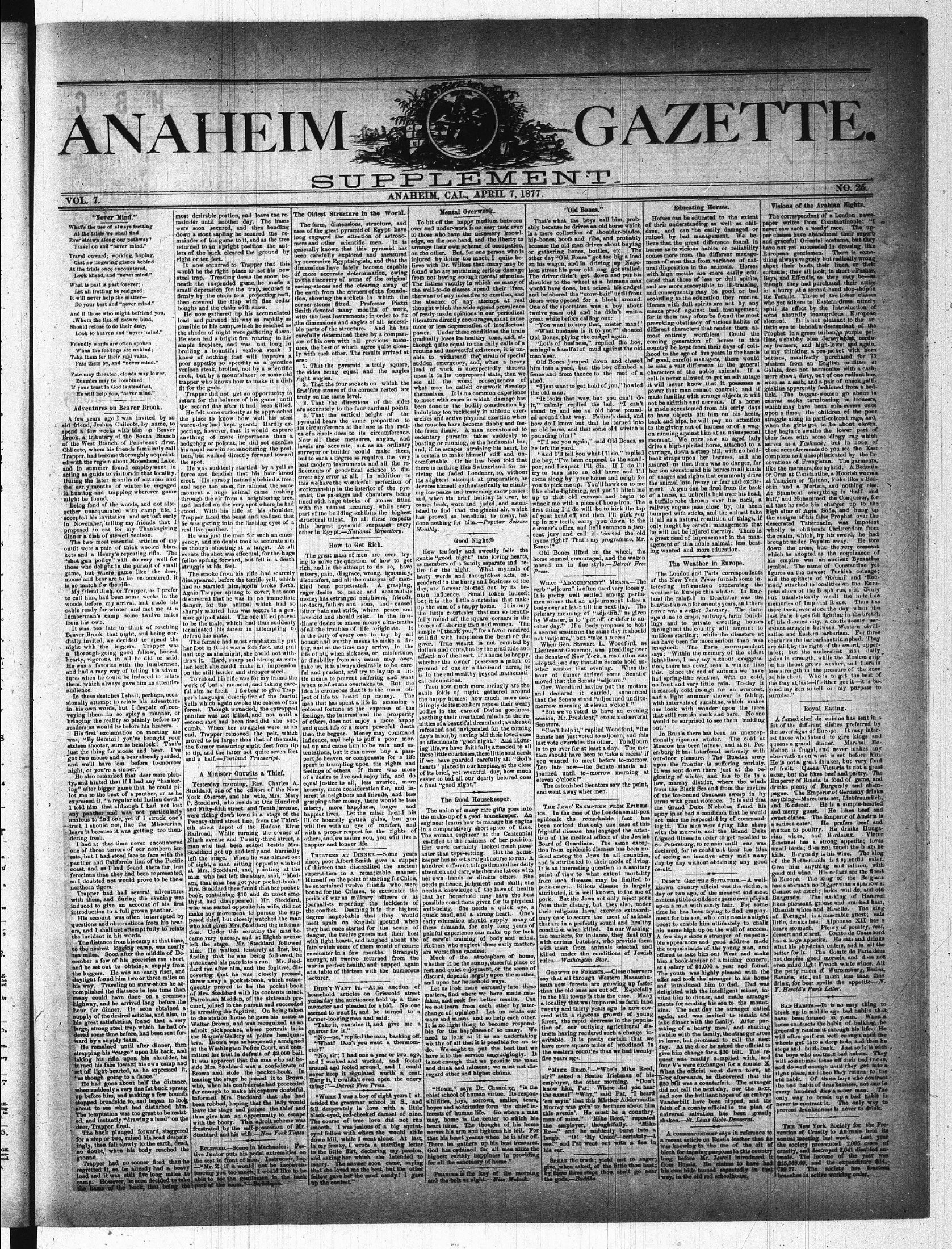
Searchable text
ANAHEIM
VOL. 7.
"Never Mind."
What's the use of always fretting
At the trials we shall find
Ever strewn along our pathway?
Travel on and "never mind."
Travel onward; working, hoping,
Cast no lingering glance behind
At the trials once encountered,
Look ahead, and "never mind."
What is past is past forever;
Let all fretting be resigned;
It will never help the matter—
Do your best and "never mind."
And if those who might befriend you,
Whom the ties of nature bind,
Should refuse to do their duty,
Look to heaven and "never mind."
Friendly words are often spoken
When the feelings are unkind;
Take them for their real value,
Pass them by, and "never mind."
Pate may threaten, cloaks may lower,
Enemies may be combined;
If your trust in God is steadfast,
He will help you, "never mind."
Adventures on Beaver Brook.
A few years ago I was invited by an old friend, Joshua Chilcote, by name, to spend a few weeks with him on Beaver Brook, a tributary of the South Branch of the West Branch of Penobscot river. Chilcote, whom his friends familiarly call Trapper, had become thoroughly acquainted with the region about Moosehead Lake,
most desirable portion, and leave the remainder until another day. The hams were soon secured, and then bending down a stout sapling he secured the remainder of his game to it, and as the tree returned to an upright position the antlers of the buck cleared the ground by eight or ten feet.
It now occurred to Trapper that this would be the right place to set his new steel trap. Treading down the snow beneath the suspended game, he made a small depression for the trap, secured it firmly by the chain to a projecting rooft, then covered the trap with fine cedar boughs and the chain with snow.
He now gathered up his accumulated load and pursued his way as rapidly as possible to his camp, which he reached as the shades of night were gathering down. He soon had a bright fire roaring in his ample fireplace, and was not long in broiling a bountiful venison steak. I know of nothing that will improve a poor appetite so speedily as a gennine venison steak, broiled, not by a scientific cook, but by a mountaineer or some old trapper who knows how to make it a dish fit for the gods.
Trapper did not get an opportunity to return for the balance of his game until the second day after it had been killed.
He felt some curiosity as he approached the place to know how well his steel watch-dog had kept guard. Hardly expecting, however, that it would capture anything of more importance than a hedgehog or polecat, he did not exercise his usual care in reconnoitering the position, but walked directly forward toward the spot.
The Oldest Structure
The form, dimensions names of the great pyramid long engaged theAtters and other scientists generally known that been carefully explored by successive Egyptologists dimensions have lately to the discovery of some casing-stones and the earth from the cone-tion, showing the sock-corner-stones fitted.
Smith devoted many with the best instruments the dimensions and able parts of the structure carefully determined to son of his own with a urges, the best of which ly with each other. They are:
1. That the pyramid the sides being equa- right angles.
2. That the four soo first-four stones of the truly on the same level.
3. That the direct are accurately to the f.
4. That the vertical pyramid bears the its circumference at thus us of a circle does to Now all these mea levels are accurate, surveyor or builder but to such a degree best modern instrument.
Adventures on Beaver Brook.
A few years ago I was invited by an old friend, Joshua Chilcote, by name, to spend a few weeks with him on Beaver Brook, a tributary of the South Branch of the West Branch of Penobscot river. Chilcote, whom his friends familiarly call Trapper, had become thoroughly acquainted with the region about Moosehead Lake, and in summer found employment in acting as guide to visitors in that locality. During the later months of autumn and the early months of winter he engaged in hunting and trapping wherever game might be found.
Being fond of the woods, and not altogether unacquainted with camp life, I accepted his invitation and set out early in November, telling my friends that I proposed to eat for my Thanksgiving dinner a dish of stewed venison.
The two most essential articles of my outfit were a pair of thick woolen blankets and a Henry's repeating rifle. The "shot gun policy" will do very well for those who delight in the pursuit of small game, but where game like the deer, moose and bear are to be encountered, it is no match for the rifle.
My friend Josh, or Trapper, as I prefer to call him, had been some weeks in the woods before my arrival, had made his cabin ready for winter and met me at a lumberman's camp some twelve miles from his own.
It was too late to think of reaching Beaver Brook that night, and being cordially invited, we decided to spend the night with the loggers. Trapper was a thorough-going good fellow, honest, hearty, vigorous, in all he did or said. He was a favorite with the lumbermen, and had a racy way of telling his adventures when he could be induced to relate them, which always gave him an attentive audience.
In these sketches I shall, perhaps, occasionally attempt to relate his adventures in his own words, but I despair of conveying them in so spicy a manner, or bringing the reality so plainly before my readers as would he before his hearers.
His first exclamation on meeting me was, "By Gemini! you've brought your sixteen shooter, sure as hemlock! That's just the thing for moose and bear. I've got two moose and a bear already yarded, and we'll have 'em before to-morrow night, or you're a sinner."
He also remarked that deer were plenty, and hinted that if I had any "hankering" after bigger game that he could pilot me to the beat of a panther, or as he expressed it, "a regular old Indian devil." I told him that although I had not lost any panther and was not particularly anxious to find one, yet if I struck one's trail, I should not, like the Missouriian, leave it because it was getting too thundering fresh.
I had at that time never encountered one of those terrors of our northern forests, but I had stood face to face with the panther and California lion of the Pacific coast, and as I had found them far less ferocious than they had been represented, so I doubted not would prove to be these venison steak, broiled, not by a scientific cook, but by a mountaineer or some old trapper who knows how to make it a dish fit for the gods.
Trapper did not get an opportunity to return for the balance of his game until the second day after it had been killed.
He felt some curiosity as he approached the place to know how well his steel watch-dog had kept guard. Hardly expecting, however, that it would capture anything of more importance than a hedgehog or polecat, he did not exercise his usual care in reconnoitering the position, but walked directly forward toward the spot.
He was suddenly startled by a yell so fierce and flendish that his hair stood erect. He sprang instantly behind a tree; and none too soon, for almost the same moment a huge animal came rushing through the air from a neighboring tree, and landed on the very spot where he had stood. With his rifle at his shoulder, Trapper faced the beast and realized that he was gazing into the flashing eyes of a real live panther.
He was just the man for such an emergency, and no doubt took as accurate aim as though shooting at a target. At all events the shot was effectual, for the huge feline sprang forward, but fell in a death struggle at his feet.
The smoke from his rifle had scarcely disappeared, before the terrific yell, which had so startled him again broke forth. Again Trapper sprang to cover, but soon discovered that he was in no immediate danger; for the animal which had so sharply saluted him was secure in a genuine grip of steel. The one killed proved to be the male, which had thus suddenly terminated his career in attempting to defend his mate.
The female had most emphatically put her foot in it—it was a fore foot, and pull and tug as she might; she could not withdraw it. Hard, sharp and strong as were her teeth she could make no impression on the still harder and stronger steel.
To reload his rifle was for my friend the work of but a moment, and taking careful aim he fired. I forbear to give Traper's language descriptive of the fearful yells which again awoke the echoes of the forest. Though wounded, the entrapped panther was not killed, and not until a second shot had been fired did she succumb. When her struggles were at an end, Trapper removed the pelt, which proved to be larger than that of the male, the former measuring eight feet from tip to tip, and the latter not quite seven feet and a half.—Portland Transcript.
A Minister Outwits a Thief
Yesterday morning, Rev. Charles A. Stoddard, one of the editors of the New York Observer, and his wife, Mrs. Mary P. Stoddard, who reside at One Hundred and Fifty-fifth street and Tenth avenue, were riding down town in a stage of the Twenty-third street line from the Thirtieth street depot of the Hudson River Railroad. While turning the corner of Ninth avenue and Twenty-third street, a man who had been seated beside Mrs. Stoddard got up suddenly and hurriedly left the stage. When he was almost out of sight, a man sitting opposite winked at Mrs. Stoddard, and pointing at the man who had left the stage, said: "Madam that man has got your pocket-book."
How to
The great mass of feeling to solve the questions rich, and in the attest misery, pain, disgrace discomfort, and all that kind been perpetual eager desire to make money has estranged others, fathers and bitter hate and strife love did and should dinate desire to amass all the troubles of is the duty of every honest and worthy ringing, and as the time life of all, when sick or disability from any take us, it is always ful and prudent, and te means to prevent when misfortune over idea is erroneous that object of life to hoarse man that has spent colossal fortune at feelings,the interest of others,does not oat than the beggar.M influence,and help tal up and cause him tentations,but it can port to heaven,或 can spent in trampling feelings of others.of a desire to live as equal justice to all honesty,more consternest in neighbors' grasping after monies,more happy lives.Let ill ,or honestly go will live with an o with a proper respect others,and we assume happier and longer.
THIRTEEN AT IT since poor Albert of thirteen that dipped superstition in a Himself on the po
I had at that time never encountered one of those terrors of our northern forests, but I had stood face to face with the panther and California lion of the Pacific coast, and as I had found them far less ferocious than they had been represented, so I doubted not would prove to be these northern tigers.
Trapper had had several adventures with them, and during the evening was induced to give an account of his first introduction to a full grown panther.
His account was often interrupted by questions and observations from his hearers, and I shall not attempt fully to relate the incident in his words.
The distance from his camp at that time, to the nearest logging camp, was nearly ten miles. Soon after the middle of December a few of his groceries ran short, and he set out to obtain a supply from the loggers. He was an early riser, and daylight found him two or three miles on his way. Traveling on snow-shoes he accomplished the distance in less time than many could have done on a common highway, and he arrived long before the hour for dinner. He soon obtained a supply of the desired articles, and also, to his great satisfaction, found that a very large, strong steel trap which he had ordered some time before, had been sent forward by a supply team.
He remained until after dinner, then strapping his "cargo" upon his back, and taking his rifle upon his shoulder, he turned his face toward his own camp and set off light-hearted, as he expressed it, "as though going to a dance."
He had gone about half the distance, when suddenly a very fine buck sprang up before him, and making a few bounds stopped broadside to, and began to look about to see what had disturbed him. The temptation was too great to be resisted, and instantly "drawing a bead" on the deer, Trapper fired.
The buck plunged forward, staggered for a step or two, raised his head desperately, then fall slowly to the earth, dead, no doubt, when his body reached the ground.
Trapper had no sooner fired than he regretted it, as he already had a heavy load and it was still five long miles to camp. However, he soon decided to take the hands of the buck, that being the Yesterday morning, Rev. Charles K. Stoddard, one of the editors of the New York Observer, and his wife, Mrs. Mary P. Stoddard, who reside at One Hundred and Fifty-fifth street and Tenth avenue, were riding down town in a stage of the Twenty-third street line, from the Thirtieth street depot of the Hudson River Railroad. While turning the corner of Ninth avenue and Twenty-third street, a man who had been seated beside Mrs. Stoddard got up suddenly and hurriedly left the stage. When he was almost out of sight, a man sitting opposite winked at Mrs. Stoddard, and pointing at the man who had left the stage, said, "Madam, that man has got your pocket-book." Mrs. Stoddard then found that her pocket-book, containing $10 and an unset amethyst, had disappeared. Mr. Stoddard, who was seated opposite his wife, did not make any movement to pursue the supposed thief, but closely watched the man who had given Mrs. Stoddard the information. Under this scrutiny the man became very uneasy, and at Eighth avenue left the stage. Mr. Stoddard followed him. He walked leisurely at first, but finding that he was being followed, he quickened his pace into a run. Mr. Stoddard ran after him, and the fugitive, discovering that he was closely pressed, throw away a pocket-book, which subsequently proved to be the pocket book of Mrs. Stoddard with its contents intact. Patrolman Madden, of the sixteenth precinct, joined in the pursuit and succeeded in arresting the fugitive. On being taken to the station house he gave his name as Walter Brown, and was recognized as an adroit pickpocket whose portrait is in the Rogue's Gallery at police headquarters. Brown was subsequently arraigned at the Washington Police Court, and committed for trial in default of $2,000 bail. It was apparent that the man who sat beside Mrs. Stoddard was a confederate of Brown and stole the pocket-book. In leaving the stage he passed it to Brown, who, when his confederate had proceeded far enough to make his capture doubtful, informed Mrs. Stoddard that she had been robbed, hoping that the lady would leave the stage and pursue the thief and thus give him an opportunity to escape with the booty. This adroit scheme was frustrated by the self-possession of Mr. Stoddard and his wife—New York Times.
ECLIPSED—Scene in Mechanica: Fewive Junior puts his pedal extremities on the seat in front of him. Instructor, log—"Mr. Z., if it would not be inconvenience you too much," I would like to be able to see the gentlemen in the back part of the room."—Mortgages.
IM GAZ
SUPPLEMENT.
ANAHEIM, CAL., APRIL 7, 1877.
The Oldest Structure in the World.
The form, dimensions, structure, and uses of the great pyramid of Egypt have long engaged the attention of astronomers and other scientific men. It is generally known that this pyramid has been carefully explored and measured by successive Egyptologists, and that the dimensions have lately become capable of more accurate determination, owing to the discovery of some of the original casing-stones and the clearing away of the earth from the corners of the foundation, showing the sockets in which the corner-stones fitted. Professor Piazzi Smith devoted many months of work, with the best instruments; in order to fix the dimensions and angles of all accessible parts of the structure. And he has carefully determined these by a comparison of his own with all previous measures, the best of which agree quite closely with each other. The results arrived at are:
1. That the pyramid is truly square, the sides being equal and the angles right angles.
2. That the four sockets on which the first four stones of the corners rested are truly on the same level.
3. That the directions of the sides are accurately to the four cardinal points.
4. That the vertical height of the pyramid bears the same proportion to its circumference at the base as the radius of a circle does to its circumference. Now all these measures, angles, and levels are accurate, not as an ordinary surveyor or builder could make them, but to such a degree as requires the very best modern instruments and all the reMental Overwork.
To hit off the happy medium between over and under-work is no easy task even to those who have the necessary knowledge, on the one hand, and the liberty to arrange their own scheme of occupation, on the other. But, for one person who is injured by doing too much, I quite believe with Dr. Wilkes that many may be found who are sustaining serious damage from not having enough mental stimulus. The listless vacuity in which so many of the well-to-do classes spend their lives, the want of any incentive to exertion, and the absence of any attempt at real thought which the wide-spread prevalence of ready made opinions in our periodical literature directly encourages must cause more or less degeneration of intellectual power. Under these conditions the brain gradually loses its healthy tone, and, although quite equal to the daily calls of a routine and uneventful existence, it is unable to withstand the strain of special sudden emergency, and, when a heavy load of work is unexpectedly thrown upon it in its unprepared state, then we see all the worst consequences of what may be called overwork 'develop themselves'. It is no common experience to meet with cases in which damage has been done to the bodily constitution by indulging too recklessly in athletic exercises and active physical exertion when the muscles have become flabby and feeble from disuse. A man accustomed to sedentary pursuits takes suddenly to boating or running, or the horizontal bar, and, if he escapes straining his heart, he is certain to make himself stiff and uncomfortable. Or he has been told that
"Old Bones."
That's what the boys call him, probably because he drives an old horse which is a mere collection of shoulder-blades, hip-bones, hoofs and ribs, and probably because the old man drives about buying or gathering bones, bottles, etc. The other day "Old Bones" got too big a load on his wagon, and in driving up Napoleon street his poor old nag got stalled. The driver didn't get down and put his shoulder to the wheel as a humane man would have done, but seized his cudgel and belabored the "crow-bait" until front doors were opened for a block around. One of the spectators was a boy about twelve years old and he didn't wait a great while before calling out:
"You want to stop that, mister man!"
"What business is it to you?" shouted Old Bones, plying the cudgel again.
"Lot's of business," replied the boy, seningd a handful of mud against the old man's ear.
Old Bones jumped down and chased him into a yard, but the boy climbed a fence and from thence to the roof of a shed.
"I just want to get hold of you," howled the old man.
"It looks that way, but you can't do it," calmly replied the lad. "I can't stand by and see an old horse pounded around that way. Father's dead, and how do I know but that he turned into an old horse, and that some old wretch is pounding him?"
"I'll see you again," said Old Bones, as he left the yard.
"And I'll tell you what I'll do," replied the boy. "I've been exposed to the small strands I cannot control." If I do I'll drive a high carriage, back straight.
Horses of their uncle dren, and ruined by love that they horses as come most enticed with high cated than are made and consecrated according Horses which means prey for in their prevoking different dogs most enticed coming country hood to throw of good, be seen as character colt is new it will not power them made famer not be skil is made to have back and to give on running moment drive a high carriage, back straight.
How to Get Rich.
The great mass of men are ever trying to solve the question of how to get rich, and in the attempt to do so, have misery, pain, disgrace, wrong, ignominy, discomfort, and all the outrages of mankind been perpetrated. A grasping, eager desire to make and accumulate money has estranged neighbors, friends, brothers, fathers and sons, and caused bitter hate and strife, where peace and love did and should exist. In the inordinate desire to amass money nine-tenths of all the troubles of life originate. It is the duty of every one to try by all honest and worthy means to make a living, and as the time may arrive, in the life of all, when sickness, or misfortune, or disability from any cause may overtake us, it is always desirable to be careful and prudent, and try to lay up a little means to prevent suffering and want when misfortune overtakes us. But the idea is erroneous that it is the main object of life to hoard up money. The man that has spent a life in amassing a colossal fortune at the expense of the feelings, the interest and the prosperity of others, does not enjoy a more happy and quiet life or a more peaceful death than the beggar. Money may command influence, and help to puff a poor mortal up and cause him to be vain and ostentatious, but it can never buy a passport to heaven, or compensate for a life spent in trampling upon the rights and feelings of others. If there was more of a desire to live and enjoy life, and do equal justice to all, less avarice, more honesty, more consideration for, and interest in neighbors and friends, and less grasping after money, there would be less misery, more happiness, longer and happier lives. Let the miser hoard his ill, or honestly gotten gains, but you will live with an eye of comfort, and with a proper respect for the rights of others, and we assure you, you will live a happier and longer life.
THIRTEEN AT DINNER.—Some years since, poor Albert Smith gave a supper of thirteen that discredited the ancient superstition in a remarkable manner. Himself on the point of starting for China,
Good Night.
How tenderly and sweetly falls the gentle "good night" into loving hearts, as members of a family separate and retire for the night. What myriads of hasty words and thoughtless acts, engendered in the hurry and business of the day, are forever blotted out by its benign influence. Small token indeed; but it is the little courtesies that make up the sum of a happy home. It is only the little courtesies that can so beautifully round off the square corners in the homes of laboring men and women. The simple "I thank you," for a favor received will fill with happiness the heart of the giver. True wealth is not counted by dollars and cents, but by the gratitude and affection of the heart. If a home be happy, whether the owner possesses a patch of ground of one or a thousand acres, he is in the end wealthy beyond mathematical calculations.
Then how much more lovingly are the sable folds of night gathered around the happy homes; how much more confidently do its members repose their weary bodies in the care of Divine goodness, soothing their overtaxed minds to the realities of a beautiful dreamland: awakened refreshed and invigorated for the coming daily labor, by having bid their loved ones an affectionate "good night." And if, during life, we have faithfully attended to all these little courtesies, these little soul needs if we have guarded carefully all "God's hearts" placed in our keeping, at the close of its brief, yet eventful day, how much easier to bid all our dearly beloved ones a final "good night."
The Good Housekeeper.
The union of many rare gifts goes into the make-up of a good housekeeper. An engineer learns how to manage his engine in a comparatively short space of time. The woman engineer at the Centennial testified to the easiness of her position. Her work certainly looked much pleasanter than type-setting. But the housekeeper has no set, straight course to run. A hundred different things demand her daily attention and care, whether she labors with her own hands or directs others. She loads up work is unexpectedly thrown upon it in its unprepared state, then we see all the worst consequences of what may be called overwork "develop themselves." It is no common experience to meet with cases in which damage has been done to the bodily constitution by indulging too recklessly in athletic exercises and active physical exertion when the muscles have become flabby and feeble from disuse. A man accustomed to sedentary pursuits takes suddenly to boating or running, or the horizontal bar, and if he escapes straining his heart, he is certain to make himself stiff and uncomfortable. Or he has been told that there is nothing like Switzerland for reviving the faded Londoner, so without the slightest attempt at preparation, he devotes himself enthusiastically to climbing ice-peaks and traversing snow passes; and when his brief holiday is over, he comes back, worn and jaded, and astonished to find that the glacial air, which has proved so beneficial to many, has done nothing for him.—Popular Science Monthly.
And I tell you what I'll do," replied the boy, "I've been exposed to the small-pox, and I expect I'll die. If I do I'll try to turn into an old horse, and I'll come along by your house and neigh for you to pick me up. You'll hawk on me like chain-lightning, and you'll hitch me up to that old caravan and begin to whack me with a piece of hoop-iron. The first thing I'll do will be to kick the top of your head off, and then I'll pick you up in my teeth, carry you down to the coroner's office, and he'll summon a two-cent jury and call it: 'Served the old hyena right!' That's my programme, Mr. Bones!"
Old Bones lifted on the wheel, the horse seemed encouraged, and the wagon moved on in fine style.—Detroit Free Press.
WHAT "ADJOURNMENT" MEANS.—The verb "adjourn" is often used very loosely. It is pretty well settled among parliamentarians that an adjournment takes a body over at least till the next day. The primary meaning of "adjourn," as given by Webster, is to "put off; or defer to another day." If a body proposes to hold a second session on the same day it should not "adjourn," but "take a recess."
When Gen. Stewart L. Woodford, as Lieutenant-Governor, was presiding over the Senate of New York, a resolution was adopted one day that the Senate held another session that evening. When the hour of dinner arrived some Senators moved that the Senate "adjourn."
Gov. Woodford having put the motion and declared it carried, announced that the Senate stood "adjourned until tomorrow morning at eleven o'clock."
But we've voted to have an evening session, Mr.President," exclaimed several Senators.
"Can't help it," replied Woodford, "the Senate has just voted to adjourn,and this last vote overrides the other. To adjourn is to go over for at least a day. The motion should have been to 'take a recess' if you wanted to meet before to-morrow. Too late now—the Senate stands adjourned until to-morrow morning at eleven o'clock!"
The astonished Senators saw the point, and went away wiser men.
THE JEWS' EXEMPTION FROM EPIDEMICS. In the case of the London small-pox epidemic the remarkable fact has been noticed among the Jews in all countries, and is attributed to their mode of living. It is an interesting question in a sanitary point of view to what extent mortality from such diseases may be limited to
THIRTEEN AT DINNER.—Some years since, poor Albert Smith gave a supper of thirteen that discredited the ancient superstition in a remarkable manner. Himself on the point of starting for China, he entertained twelve friends who were bound for the Crimea, to encounter the perils of war as military officers or as journalists reporting the incidents of the conflict. Deeming it in the highest degree improbable that they would meet again on English ground when they had once started for the scene of danger, the twelve guests met their host with light hearts, and laughed about the fate which some of them would of course encounter in a few months. Strangely enough, all twelve returned from the war in perfect health; and supped again at a table of thirteen with the humorous lecturer.
DIDN'T WANT IT.—At an auction of household articles on Griswold street yesterday the auctioneer held up a thermometer and pleaded for a bid. No one seemed to want it, and he turned to a farmer-looking man and said:
"Take it, examine it, and give me a quarter for it."
"No—no," replied the man, backing off.
"What? Don't you want a thermometer?"
"No, sir; I had one a year or two ago, and I worked and worked, and fooled around and fooled around, and I could never keep it regulated worth a cent. Hang it, I couldn't even open the onery thing!"—Detroit Free Press.
"When I was a boy of eight years I attended the grammar school in S., and fell desperately in love with a little black-eyed, red-cheeked damsel of nine. The course of true love did not run smooth. I was jealous of a big squinty eyed fellow with whom she would slide down hill, while I went alone. At last, in my frenzy, I wrote a startling letter to the little flirt, declaring my passion, and asking her which she intended to marry. The answer soon came, saying that she loved me the best, but the other fellow gave her the most candy! I gave up the content."
The union of many rare gifts goes into the make-up of a good housekeeper. An engineer learns how to manage his engine in a comparatively short space of time. The woman engineer at the Centennial test-tified to the easiness of her position. Her work certainly looked much pleasant than type-setting. But the housekeeper has no set, straight course to run. A hundred different things demand her daily attention and care, whether she labors with her own hands or directs others. She needs patience, judgment and skill; she needs a knowledge of the laws of health that her household may have the best possible conditions given for its physical well-being. She needs a quick eye, a quick hand, and a strong heart. One's early education should supply many of these demands, for only long years of painful experience can make up for lack of careful training of body and mind. Mothers who neglect these early matters are worse than careless.
Much of the atmosphere of home, whether it be the sunny, cheerful place of rest and quiet enjoyment, or the scene of discord, depends largely upon the mother, and upon her household ways.
Let us look more earnestly into these matters, find where we have made mistakes, and seek for better results. Can we not learn from each other by interchange of opinion? Let us relate our ways and means and so help each other. It is no light thing to become responsible for the happiness of so many. We need to look at it as an undertaking worthy of all that it is possible for us to do. We ought to put the best that we have into the service ungradgingly. It is not enough that we provide the meat and drink and raiment; we must not disregard other and higher claims.
"HOME," says Dr. Channing, "is the chief school of human virtue. Its responsibilities, joys, sorrows, smiles, tears, hopes and solicitudes form the chief interests of human life. Go where a man may, home is the center to which his heart turns. The thought of his home nerves his arm and lightens his toil. For that his heart yearns when he is afar off. There he gathers up his best treasures. God has ordained for all men alike the highest earthly happiness in providing for all the sanctuary of home."
PRAYING is the key of the morning and the bolt at night—Miss Muloch.
The astonished Senators saw the point, and went away wiser men.
THE JEWS’ EXEMPTION FROM EPIDEMICS. In the case of the London small-pox epidemic the remarkable fact has been noticed that only one case of this frightful disease has engaged the attention of the medical officer of the Jewish Board of Guardians. The same exception from epidemic diseases has been noticed among the Jews in all countries, and is attributed to their mode of living. It is an interesting question in a sanitary point of view to what extent mortality from such diseases may be limited to pork-eaters… Billious disease is largely attributed, it is well known, to the use of pork. But the Jews not only reject pork from their dietary, but they also, under their religious laws, exercise extraordinary care to secure the meat of animals that are in perfectly sound and healthy condition when killed. In our Washington markets, for instance, they deal only with certain butchers, who provide them with meat from animals selected and killed under the conditions of Jewish rules—Washington Star.
GROWTH OF FORESTS.—Close observers say that all through Western Massachusetts new forests are growing up faster than the old ones are cut off. Especially in the hill towns is this case. Many a locality that was improved as farm land twenty and thirty years ago is now covered with a vigorous growth of young forest, the rapid decrease in the population of our outlying agricultural districts having rendered such a change inevitable. It is pretty certain that we have more square miles of woodland in the western counties than we had twenty-five years ago.
"MIKE READ."—"Who's Mike Reed, sir?" asked a Boston Irishman of his employer, the other morning. "Don't know him, Pat. Where did you hear the namel?" "Why," said Pat, "I heard 'em sayin' that this Misher Adderrondic Murray was gain'o to lecture about him this avenin'. He must be a counthry-man of mine." "Mike Reed," repeated the employer, thoughtfully. "Mike Ree—and he suddenly burst into a laugh." "O! 'My Creed'—certainly-I see!" and Pat went out with a flea in his ear.
SPAKK THE truth; yield not to anger; give, when asked, of the little thou hast; by these three steps thou shalt go near the gods—Buddha.
GAZETTE.
NO. 26.
Edneating Horses.
Horses can be educated to the extent of their understanding as well as children, and can be easily damaged or ruined by bad management. We believe that the great difference found in horses as to vicious habits or reliability comes more from the different management of men than from variance of natural disposition in the animals. Horses with high mettle are more easily educated than those of less or dull spirits, and are more susceptible to ill-training, and consequently may be good or bad according to the education they receive. Horses with dull spirits are not by any means proof against bad management, for in them may often be found the most provoking obstinacy of vicious habits of different characters that render them almost entirely worthless. Could the coming generation of horses in this country be kept from their days of colthood to the age of five years in the hands of good, careful managers, there would be seen a vast difference in the general characters of the noble animals. If a colt is never allowed to get an advantage it will never know that it possesses a power that man cannot control; and if made familiar with strange objects it will not be skittish and nervous. If a horse is made accustomed from his early days to have objects hit him on his heels, back and hips, he will pay no attention to the giving out of harness or of a wagon running against him at an unsuspected moment. We once saw an aged lady drive a high-spirited horse, attached to a carriage, down a steep hill, with no holdback straps upon her harness, and she assured us that there was no danger, for
Visions of the Arabian Nights.
The correspondent of a London newspaper writes from Constantinople: "I never saw such a 'seedy' race. The upper classes have abandoned their superb and graceful Oriental costume, but they have not yet succeeded in dressing like European gentlemen. There is something always vaguely but radically wrong about their boots, their linen, or their sultouts; they all look, in short—Pashar, Beys, and Effendis, as they may be—though they had purchased their attire in a hurry at a second-hand slop-shop in the Temple. Those of the lower classes who yet adhere to Eastern dress utterly spoil its effect by the introduction of some absurdly incongruous European element. It is not pleasant to the artistic eye to behold a descendant of the Prophet in a green turban, a purple pellisse, a shabby blue Jersey shirt, corduroy trousers, and high-lows; and again, to my thinking, a pea-jacket with horn buttons, manifestly purchased for 75 piastres from an English outfitter at Galata, does not harmonize with a cash-mere shawl, dirty, but of one radiant hue, worn as a sash, and a pair of check gallakins apparently fashioned from a bed-tick. The beggar-women go about in canvas sacks terminating in trousers, which may have been soft-covers once upon a time; the children of the poor straggle along in pari-colored rags, and, when the girls get to be about eleven, they begin to swathe the lower part of their faces with some dingy rag which serves as a Yashmak; but in none of these accountrements do you see the East complete and unsophisticated by the innovations of Frangistan. The garments,
The Weather in Europe.
The London and Paris correspondents of the New York Times furnish some interesting information concerning the weather in Europe this winter. In England the rainfall in December was the heaviest known for seventy years, and there never was a wetter January. The damage done to crops, railways, farm buildings and to private dwelling houses throughout the country will amount to millions sterling; while the disasters at sea have been far more serious than was imagined. The Paris correspondent says: "Within the memory of the oldest inhabitant, I may say without exaggeration, there has never been a winter like this. Since the end of autumn we have had spring-like weather, with no cold, no frost and very little rain. To-day it is scarcely cold enough for an overcost, and a light summer shower is falling, with intervals of sunshine, which makes one look with wonder upon the trees that still remain stark and bare. No one would be surprised to see them budding out."
In Russia there has been an unexceptionally rigorous winter. The cold at Moscow has been intense, and at St. Petersburg it has interfered seriously with out-door pleasure. The Russian army upon the frontier is suffering terribly. It was sent down there just at the beginning of winter, and has to lie in a low, marshy district, where the winds from the Black Sea and from the ravines of the ice-bound Caucasus sweep in by turns with great violence. It is said that the Grand Duke Nicholas found his army in so bad a condition that he would not take the responsibility of commanding it. The men were dying like sheep with the murrain, and the Grand Duke feigned illness in order to get recalled to St. Petersburg, to remain until war was declared, for he could not bear the idea of seeing an inactive army melt away day by day without obtaining any good result.
DIDN'T GET THE SITUATION.—A well-charteed lady drive a high-spirited horse, attached to a carriage, down a steep hill, with no holdback straps upon her harness, and she assured us that there was no danger, for her son accustomed his horses to all kinds of usages and sights that commonly drive the animal into frenzy or fear and excitement. A gun can be fired from the back of a horse, an unbrella held over his head, a buffalo robe thrown over his neck, a railway engine pass close by, his heels bumped with sticks, and the animal take it all as a natural condition of things, if only taught by careful management that he will not be injured thereby. There is a great need of improvement in the management of this noble animal; less beating wanted and more education.
Galata, does not harmonize with a cashmere shawl, dirty, but of one radiant hue, worn as a sash, and a pair of check galligans apparently fashioned from a bed-tick. The beggar-women go about in canvas sacks terminating in trousers, which may have been soft-covers once upon a time; the children of the poor straggle along in parti-colored rags, and when the girls get to be about eleven, they begin to swathe the lower part of their faces with some dingy rag which serves as a Yashmak; but in none of these accountrements do you see the East complete and unsophisticated by the innovations of Frangistan. The garments, like the manners, are hybrid. A Bedouin or Oran at Constantine, a Moorish woman at Tangiers or Tetuan, looks like a Bedouin and a Morisca, and nothing else. At Stamboul everything is 'half and half,' and Mohammed the Conqueror, for all that he rode his charger up to the high altar of Agia Sofia, and hung up the ensigns of his false Prophet over the desecrated Tabernacle, was impotent wholly to obliterate Christendom from the realm, which, by his sword, he had brought under Paynim sway. He tore down the cross, but the very crescent which he adopted as the cognizance of his empire was an ancient Byzantine symbol. The name of Constantine yet figures on the newest Turkish coinage; and the epithets of 'Roumi' and 'Roumai,' attached to localities on the European shore of the Bosphorus, still dainty but unmistakably recall the indelible memories of Imperial Rome. Thus has there been, ever since the day when the last Paleologos fell fighting in the breach of his domed city, a continuously persistent struggle between Western civilization and Eastern barbarism. For three centuries the barbarians triumphed. They are still by the right of the sword, uppermost; but the undermost man daily gains in strength, while the Moslem grip on his throat grows weaker, and there is less strength in the pressure of the knee on his chest. Who is to get the best of the fray at last—if either get it—it is beyond my ken to tell or my purpose to surmise."
Royal Eating.
A famed chef de cuisine has sent in a list of the different dishes preferred by the sovereigns of Europe. It may interest those who intend to give kings and queens a grand dinner. Marshal McMahon is frugal, and never makes any observations on what is set before him. He is not a great drinker, but very fond of fruit. Queen Victoria is not a great eater, but she likes beef and pastry. The Emperor of Russia is food of game, and drinks plenty of Burgundy and champagne. The Emperor of Germany drinks anything—Marcobranner, Liebfraundich, and Rocderer. He is a simple-hearted and merry guest. He likes beef and sweet dishes. The Emperor of Austria is a serious eater. He prefers beef and mutton to poultry. He drinks Hungarian wines, and Bordeaux. Victor Emannuel has a strong appetite; loves small birds; does not touch the bears he kills. Burgundy is his wine. The king of the Netherlands is a splendid eater. Give him anything and salmon, with good old wine. His cellars are the finest in Europe. The king of the Belgians
FROM EPIDEMY
London small-pox
mankable fact has only one case of this engaged the attendant officer of the Jewish
The same excepdiscases has been noin all countries,
their mode of living
question in a sanitary
extent mortality may be limited to
disease is largely known, to the use of not only reject pork but they also, under exercise extraordithe meat of animals sound and healthy.
In our Washingance, they deal only who provide them animals selected and conditions of Jewish Star.
DIDN'T GET THE SITUATION.—A well-known country official was the victim, a day or two ago, of the meanest and most contemptible confidence game ever played upon a man with sandy hair. For some time he has been trying to find employment for his son, who only needs a slight boost to enable him ultimately to chalk his name high up on the wall of success. A few days since a stranger of respectable appearance and good address made acquaintance of the young man, and offered to take him out West and make him a book-keeper of a mining concern, at a salary of $1,000 a year and found. The youth was highly pleased with the offer and took the stranger to his house and introduced him to dad. Dad was delighted with the intelligent miner, invited him to dinner, and made arrangements for sending his son to the mountains. The next day the stranger called again, and was invited to remain and take dinner with the family. After partaking of a hearty meal, and chatting awhile with the family, the stranger arose to leave, but promised to call the next day. At the door he asked the official to give him change for a $20 bill. The request was readily complied with, and four V's were exchanged for a double X. When the official went down town, an hour afterwards, he discovered that the $20 bill was a counterfeit. The stranger did not call the next day, nor the next, and now the brilliant hopes of an embryo Vanderbilt have been nipped, and the faith of a county official in the plan of universal salvation has been greatly shaken.—St. Louis Globe-Democrat.
BAD HARITS.—It is no easy thing to break up in middle age bad habits that have been formed in youth. When a horse contracts the habit of balking, he generally retains it through his life. He will often perform well enough until the wheels get into a deep hole, and then he stops and holds back. Just so it is with the boys who contract bad habits. They will sometimes leave off their bad traces, and do well enough until they get into a tight place, and then they return to the old habit. Of those boys who contract the bad habit of drunkenness, not one in every hundred dies a sober man. The only way to break up a bad habit is never to contract it. The only way to prevent drunkenness is never to drink.
THE New York Society for the Prevention of Cruelty to Animals held its annual meeting last week. Last year the society prosecuted 1,005 cases of cruelty, and destroyed 2,041 disabled animals. The income of the year was $15,068.69, and the expenditure $14,-799.27. The society has fourteen branches in active working order.