anaheim-gazette 1877-04-07
Scanned page
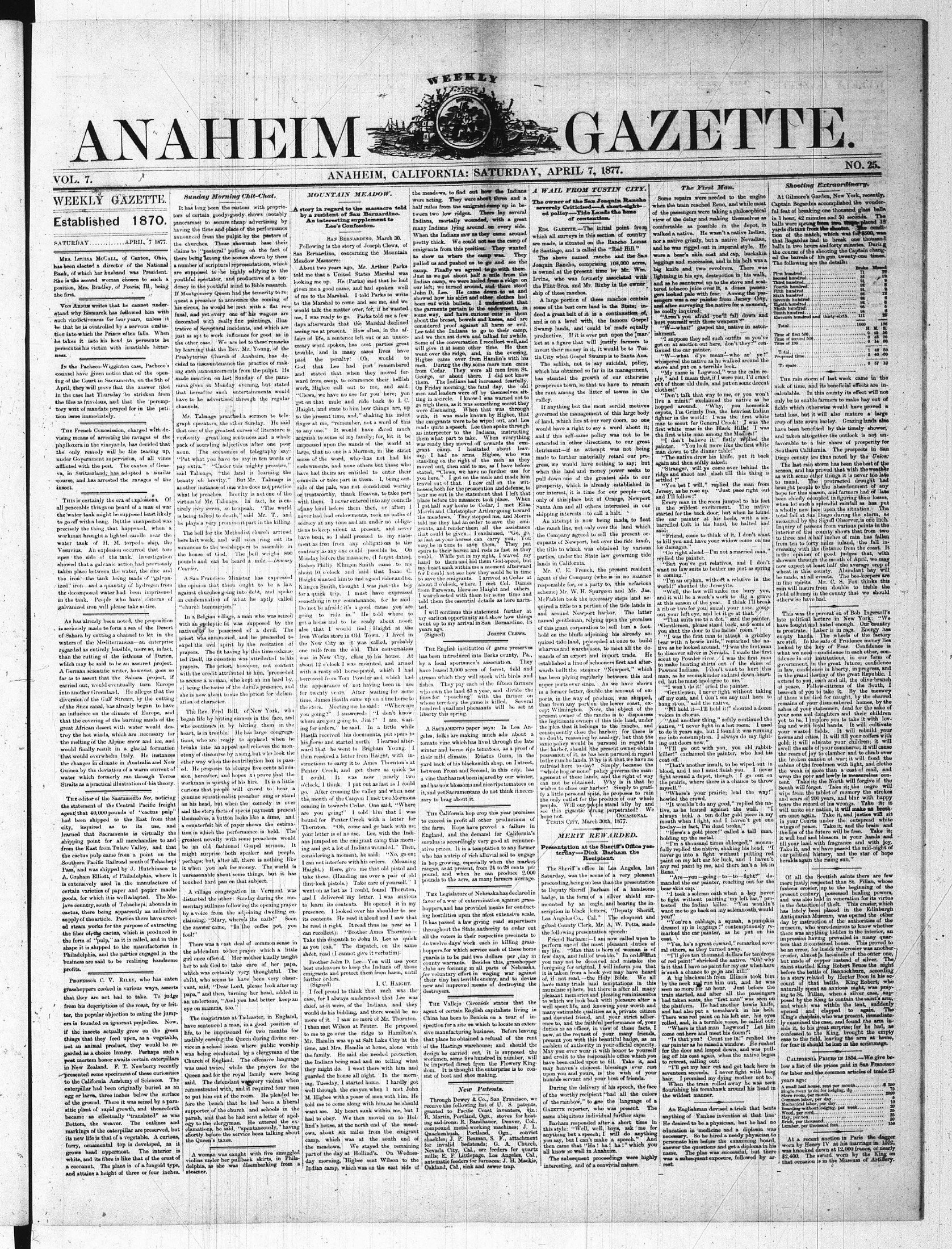
Searchable text
WEEKLY GAZETTE.
Established 1870.
SATURDAY...APRIL, 7 1877.
MRS. LOUISA McCALL, of Canton, Ohio, has been elected a director of the National Bank, of which her husband was President. She is the second woman chosen to such a position, Mrs. Bradley, of Peoria, Ill., being the first.
VON ARNIM writes that he cannot understand why Bismarck has followed him with such vindictiveness for four years, unless it be that he is controlled by a nervous exaltation into which the Prince often falls. When he takes it into his head to persecute his victim with insatiable bitterness.
In the Pacheco-Wigginton case, Pacheco's counsel have given notice that on the opening of the Court in Sacramento, on the 9th of April, they will move that the answer filed in the case last Thursday be stricken from the files as frivolous, and that the peremptory writ of mandate prayed for in the petition issue immediately.
The French Commission, charged with devising means of arresting the ravages of the phylloxera in the vineyards, has decided that the only remedy will be the tearing up, under Government supervision, of all vines affiliated with the root. The canton of Geneva
Sunday Morning Chit-Chat.
It has long been the custom with proprietors of certain goody-goody shows (notably panoramas) to secure cheap advertising by having the time and place of the performance announced from the pulpit by the pastors of the churches. These showmen base their claims to "pastoral" puffing on the fact of there being among the scenes shown by them a number of scriptural representations, which are supposed to be highly edifying to the youthful spectator, and productive of a tendency in the youthful mind to Bible research. If Montgomery Queen had the temerity to request a preacher to announce the coming of his circus, he would be met with a flat refusal, and yet every one of his wagons are decorated with really fine paintings, illustrative of Scriptural incidents, and which are just as apt to work influence for good as in the other case. We are led to these remarks by learning that the Rev. Mr. Young, of the Presbyterian Church of Anaheim, has decided to discountenance the practice of making such announcements from the pulpit. He made mention on last Sunday of the panorama given on Monday evening, but stated that hereafter such entertainments would have to be advertised through the regular channels.
Mr. Talmage preached a sermon to telegraph operators, the other Sunday. He said that one of the greatest curses of literature is versatility - great long sentences and a whole pack of sounding adjectives after one poor noun. The economies of telegraphy say: "Put what you have to say in ten words or say extra." Under this mighty pressure.
MOUNTAIN A
A story in regard to the by a resident of San An interesting sn Lee's Conf
SAN BERNARDINE
Following is the story of San Bernardino, concerning Meadow Massacre:
About two years ago, told me that a United looking me up. He (Pain) given me a good name, and of me to the Marshal. To the Marshal to come would talk the matter of me, I was ready to go days afterwards that seeing me at present. Hairs of life, a sentence essary word spoken, hard trouble, and in many paid the penalty!
God that Lee had and stated that whore ward from camp, to com work, Higbee call out "Clews, we have no use get on that mule and Haight, and state to him to the present time, and finger at me, "remembrance to any one." It would anguish to some of my impressed upon the mi large, that no one is a M sense of the word, wh
The French Commission, charged with devising means of arresting the ravages of the phylloxera in the vineyards, has decided that the only remedy will be the tearing up, under Government supervision, of all vines afflicted with the post. The canton of Geneva, in Switzerland, has adopted a similar course, and has arrested the ravages of the insect.
This is certainly the era of explosions. Of all peaceable things on board of a man of war the water tank might be supposed least likely to go off with a bang. But the unexpected was precisely the thing that happened, when a workman brought a lighted candle near the water tank of H. M. torpedo ship, the Vesuvius. An explosion occurred that tore open the side of the tank. Investigation showed that a galvanic action had previously taken place between the water, the zinc and the iron—the tank being made of "galvanized" iron—and a quantity of hydrogen from the decomposed water had been imprisoned in the tank. People who have eiserns of galvanized iron will please take notice.
As has already been noted, the proposition is seriously made to form a sea of the Desert of Sahara by cutting a channel to let in the waters of the Mediterranean—an enterprise regarded as entirely feasible, more so, infact, than the cutting of the isthmus of Darien, which may be said to be an assured project. A German scientific writer, however, goes so far as to assert that the Sahara project, if carried out, would eventually turn Europe into another Greenland. He alleges that the diversion of the Gulf Stream, by the cutting of the Suez canal, has already begun to have an influence on the climate of Europe, and that the covering of the burning sands of the great African desert with water would destroy the hot winds, which are necessary for the melting of the Alpine snow and ice, and would finally result in a glacial formation that would overwhelm Italy. He instances the changes in climate in Australia and New Guinea by the deviation of a warm current of water which formerly ran through Torres Straits as a practical illustration of his theory.
The editor of the Sacramento Beer, noticing the statement of the Central Pacific freight agent that 40,000 pounds of "cactus pulp" had been shipped to the East from that city, inquired as to its use, and learned that Sacramento is virtually the shipping point for all merchandise to and from the East from Tulare Valley, and that the cactus pulp came from a point on the Southern Pacific Railroad south of Teachepi Pass, and was shipped by J. Hutchinson to A. Graham Elliott, of Philadelphia, where it is manufactured.
Mr. Talmage preached a sermon to telegraph operators, the other Sunday. He said that one of the greatest curses of literature is verosity—great long sentences and a whole pack of sounding adjectives after one poor noun. The economies of telegraphy say: "Put what you have to say in ten words or pay extra." "Under this mighty pressure," said Talmage, "the land is learning the beauty of brevity." But Mr. Talmage is another instance of one who does not practice what he preaches. Brevity is not one of the virtues of Mr. Talmage. In fact, he is entirely rejoiced over it, so to speak. "The world is being taiked to death," said Mr. T., and he plays a very prominent part in the killing.
The bell for the Methodist church arrived here last week, and will soon ring out its summons to the worshippers to assemble in the house of God. The bell weighs 800 pounds and can be heard a mile—Donney Courier.
A San Francisco Minister has expressed the opinion that there ought to be a law against churches going into debt, and spoke in condemnation of what he aptly called "church bummerism."
In a Belgian village, a man who was seized with an epileptic fit was supposed by the natives to be possessed of a devil. The priest was summoned, and he proceeded to expel the evil spirit by the recitation of prayers. The fit having by this time exhausted itself, its cessation was attributed to his prayers. The priest, however, not content with the credit attributed to him, proceeded to accuse a woman, who kept an inn hard by, of being the cause of the devil's presence, and she is now about to sue the priest for defaulction of character.
The Rev. Fred Bell, of New York, who began life by hitting simmers in the face, and who continues it by hitting them in the heart, is in trouble. He has large congregations, who are ready to applaud when he breaks into an appeal and relieves the monotony of discourse by a song, but who look at other way when the contribution box is passed. He proposes to charge five cents admission hereafter, and hopes to prove that the workman is worthy of his hire. It is a little curious that people will crowd to hear a genuine sensationalist preacher sing or stand on his head, but when the comedy is over and the stern facts of specie payment present themselves, a button looks like a dime, and a counterfeit bit of paper shows the estimation in which the performance is held. The greatest novelty with some preachers would be an old fashioned Gospel sermon. It might surprise both speaker and people; perhaps; but, after all, there is nothing like it when you ask for money. The world is unreasonable about some things, but it has touched hard pan on that subject.
Mr. Talmage preached a sermon to telegraph operators, the other Sunday. He said that one of the greatest curses of literature is verosity—great long sentences and a whole pack of sounding adjectives after one poor noun. The economies of telegraphy say: "Put what you have to say in ten words or pay extra." "Under this mighty pressure," said Talmage, "the land is learning the beauty of brevity." But Mr. Talmage is another instance of one who does not practice what he preaches. Brevity is not one of the virtues of Mr. Talmage. In fact, he is entirely rejoiced over it, so to speak. "The world is being taiked to death," said Mr. T., and he plays a very prominent part in the killing.
The bell for the Methodist church arrived here last week, and will soon ring out its summons to the worshippers to assemble in the house of God. The bell weighs 800 pounds and can be heard a mile—Donney Courier.
A San Francisco Minister has expressed the opinion that there ought to be a law against churches going into debt, and spoke in condemnation of what he aptly called "church bummerism."
In a Belgian village, a man who was seized with an epileptic fit was supposed by the natives to be possessed of a devil. The priest was summoned, and he proceeded to expel the evil spirit by the recitation of prayers. The fit having by this time exhausted itself, its cessation was attributed to his prayers. The priest, however, not content with the credit attributed to him, proceeded to accuse a woman, who kept an inn hard by, of being the cause of the devil's presence, and she is now about to sue the priest for defaulction of character.
The Rev. Fred Bell, of New York, who began life by hitting simmers in the face, and who continues it by hitting them in the heart, is in trouble. He has large congregations, who are ready to applaud when he breaks into an appeal and relieves the monotony of discourse by a song, but who look at other way when the contribution box is passed. He proposes to charge five cents admission hereafter, and hopes to prove that the workman is worthy of his hire. It is a little curious that people will crowd to hear a genuine sensationalist preacher sing or stand on his head, but when the comedy is over and the stern facts of specie payment present themselves, a button looks like a dime, and a counterfeit bit of paper shows the estimation in which the performance is held. The greatest novelty with some preachers would be an old fashioned Gospel sermon. It might surprise both speaker and people; perhaps; but after all, there is nothing like it when you ask for money. The world is unreasonable about some things, but it has touched hard pan on that subject.
Mr. Talmage preached a sermon to telegraph operators, the other Sunday. He said that one of the greatest curses of literature is verosity—great long sentences and a whole pack of sounding adjectives after one poor noun. The economies of telegraphy say: "Put what you have to say in ten words or pay extra." "Under this mighty pressure," said Talmage, "the land is learning the beauty of brevity." But Mr. Talmage is another instance of one who does not practice what he preaches. Brevity is not one of the virtues of Mr. Talmage. In fact, he is entirely rejoiced over it, so to speak. "The world is being taiked to death," said Mr. T., and he plays a very prominent part in the killing.
The bell for the Methodist church arrived here last week, and will soon ring out its summons to the worshippers to assemble in the house of God. The bell weighs 800 pounds and can be heard a mile—Donney Courier.
A San Francisco Minister has expressed the opinion that there ought to be a law against churches going into debt, and spoke in condemnation of what he aptly called "church bummerism."
In a Belgian village, a man who was seized with an epileptic fit was supposed by the natives to be possessed of a devil. The priest was summoned, and he proceeded to expel the evil spirit by the recitation of prayers. The fit having by this time exhausted itself, its cessation was attributed to his prayers. The priest, however, not content with the credit attributed to him, proceeded to accuse a woman, who kept an inn hard by, of being the cause of the devil's presence, and she is now about to sue the priest for defaulction of character.
The Rev. Fred Bell, of New York, who began life by hitting simmers in the face, and who continues it by hitting them in the heart, is in trouble. He has large congregations, who are ready to applaud when he breaks into an appeal and relieves the monotony of discourse by a song, but who look at other way when the contribution box is passed. He proposes to charge five cents admission hereafter, and hopes to prove that the workman is worthy of his hire. It is a little curious that people will crowd to hear a genuine sensationalist preacher sing or stand on his head, but when the comedy is over and the stern facts of specie payment present themselves, a button looks like a dime, and a counterfeit bit of paper shows the estimation in which the performance is held. The greatest novelty with some preachers would be an old fashioned Gospel sermon. It might surprise both speaker and people; perhaps; but after all, there is nothing like it when you ask for money. The world is unreasonable about some things, but it has touched hard pan on that subject.
Mr. Talmage preached a sermon to telegraph operators, the other Sunday. He said that one of the greatest curses of literature is verosity—great long sentences and a whole pack of sounding adjectives after one poor noun. The economies of telegraphy say: "Put what you have to say in ten words or pay extra." "Under this mighty pressure," said Talmage, "the land is learning the beauty of brevity." But Mr. Talmage is another instance of one who does not practice what he preaches. Brevity is not one of the virtues of Mr. Talmage. In fact, he anguishuishly before they never had had endowment security at any time and tended to keep silent attentions to free from any contrary as any one coined Monday before these mass Bishop Philip Klingenberg about 10 o'clock and Haight wanted him to leave Klingen Smith; though for a quick trip I could something in my county Do not be afraid; it's going to ride in." I would get a horse and be also that I would Iron Works store in Orlando New City as it one mile from New City; cheer about 12 o'clock I was with a rusty old horse borrowed from Tom Porter; appearance of me for twenty years.A time James Hastia cares store.Meeting my you going?" I answer where are you going for orders," he said Hastia received his dress his horse and startedward that he went tending structures to carry it Penter Creek,and I could It was o'clock I think.I go go After crossing ther mouth of Cana Coming in towards Cena are you going?" I bound for Penter Crieur Thornton."Oh,cong your letter isof no nos ans jumped onthe en ingand gota lotof Im consideringa moment I cannot interferewith Haight.) Here,give take these.(Handling disguise things onboardofa manwhosepeaksfromtheclimateofEurope,andthatcoveringoftheburningsandsoftheGreatAfricandesertwithwaterwoulddestroythehotwindsawhicharenecessaryforthemeltingoftheAlpinesnowandice,andwouldfinallyresultinaglacialformationthatwouldoverwhelmIt.ThechangesinclimateinAustraliaandNewGuineabythedeviationofawarmcurrentofwaterwhichformerlyranthroughTorresStraitsasapracticalillustrationofhistheory.
The editoroftheSacramentoBeernoticingthestatementoftheCentralPacificfreightagentthat40000poundsof“cactuspulp”hadbeenshippedtotheEastfromthatcityinquiredastoitsuse,andlearnedthatSacramentoisvirtuallytheshippingpointforallmerchandisetoandfromtheEastfromTulareValley,andthatthecactuspulpcamefromapointontheSouthernPacificRailroadsouthOfTeachepiPass,andwasshippedbyJ.HutchinsontoA.GrahamElliott.ofPhiladelphiawhereitisalreadybeguntohavetheclimateofEurope,andthatthecoveringoftheburningsandsoftheGreatAfricandesertwithwaterwoulddestroythehotwindsawhicharenecessaryforthemeltingoftheAlpinesnowandice,andwouldfinallyresultinaglacialformationthatwouldoverwhelmIt.ThechangesinclimateinAustraliaandNewGuineabythedeviationofawarmcurrentofwaterwhichformerlyranthroughTorresStraitsasapracticalillustrationofhistheory.
The editoroftheSacramentoBeernoticingthestatementoftheCentralPacificfreightagentthat40000poundsof“cactuspulp”hadbeenshippedtotheEastfromthatcityinquiredastoitsuse,andlearnedthatSacramentoisvirtuallytheshippingpointforallmerchandisetoandfromtheEastfromTulareValley,andthatthecoveringoftheburningsandsoftheGreatAfricandesertwithwaterwoulddestroythehotwindsawhicharenecessaryforthemeltingoftheAlpinesnowandice,andwouldfinallyresultinaglacialformationthatwouldoverwhelmIt.ThechangesinclimateinAustraliaandNewGuineabythedeviationofawarmcurrentofwaterwhichformerlyranthroughTorresStraitsasapracticalillustrationofhistheory.
The editoroftheSacramentoBeernoticingthestatementoftheCentralPacificfreightagentthat40000poundsof“cactuspulp”hadbeenshippedtotheEastfromthatcityinquiredastoitsuse,andlearnedthatSacramentoisvirtuallytheshippingpointforallmerchandisetoandfromtheEastfromTulareValley,andthatthecoveringoftheburningsandsoftheGreatAfricandesertwithwaterwoulddestroythehotwindsawhicharenecessaryforthemeltingoftheAlpinesnowandice,andwouldfinallyresultinaglacialformationthatwouldoverwhelmIt.ThechangesinclimateinAustraliaandNewGuineabythedeviationofawarmcurrentofwaterwhichformerlyranthroughTorresStraitsasapracticalillustrationofhistheory.
The editoroftheSacramentoBeernoticingthestatementoftheCentralPacificfreightagentthat40000poundsof“cactuspulp”hadbeenshippedtotheEastfromthatcityinquiredastoitsuse,andlearnedthatSacramentoisvirtuallytheshippingpointforallmerchandisetoandfromtheEastfromTulareValley,andthatthecoveringoftheburningsandsoftheGreatAfricandesertwithwaterwoulddestroythehotwindsawhicharenecessaryforthemeltingoftheAlpinesnow和ice,andwouldfinallyresultinaglacialformationthatwouldoverwhelmIt.ThechangesinclimateinAustralia和NewGuineabythedeviationofawarmcurrentofwaterwhichformerlyranthroughTorresStraitsasapracticalillustrationofhistheory.
The editoroftheSacramentoBeernoticingthestatementoftheCentralPacificfreightagentthat40000poundsof“cactuspulp”hadbeenshippedtotheEastfromthatcityinquiredastoitsuse,andlearnedthatSacramentoisvirtuallytheshippingpointforallmerchandise.toandfromtheEastfromTulareValley,andthatthecoveringoftheburningsandsoftheGreatAfricandesertwithwaterwoulddestroy-thehotwindsawhicharenecessaryforthemeltingoftheAlpinesnow和ice,andwouldfinallyresultinaglacialformationthatwouldoverwhelmIt.ThechangesinclimateinAustralia和NewGuineabythedeviationofawarmcurrentofwaterwhichformerlyranthroughTorresStraitsasapracticalillustrationofhistheory.
The editoroftheSacramentoBeernoticingthestatementoftheCentralPacificfreightagentthat40000poundsof“cactuspulp”hadbeenshippedto.theEastfromthatcityinquiredastoitsuse,andlearnedthatSacramentoisvirtuallytheshippingpointforallmerchandise.toandfromtheEastfromTulareValley,andthatthecoveringof_theburningsandsoft_theGreatAfricandesert_withWaterWould Be Selected For Sale At This Point
Mr.Talmage preached a sermon to telegraph operators,the other Sunday,iHe made mention on last Sunday.of thieancountries to keep silent attentions to keep silent attentions to keep silent attentions to keep silent attentions to keep silent attentions to keep silent attentions to keep silent attentions to keep silent attentions to keep silent attentions to keep silent attentions to keep silent attentions to keep silent attentions to keep silent attentions to keep silent attentions to keep silent attentions to keep silent attentions to keep silent attentions to keep silent attentions to keep silent attentions to keep silent attentions
The editor of the Sacramento Bee, noticing the statement of the Central Pacific freight agent that 40,000 pounds of "cactus pulp" had been shipped to the East from that city, inquired as to its use, and learned that Sacramento is virtually the shipping point for all merchandise to and from the East from Tulare Valley, and that the cactus pulp came from a point on the Southern Pacific Railroad south of Tehachepi Pass, and was shipped by J. Hutchinson to A. Graham Elliott, of Philadelphia, where it is extensively used in the manufacture of certain varieties of paper and papier mache goods, for which it is well adapted. The Mojave country, south of Tehachepi, abounds in cactus, there being apparently an unlimited supply of the article. Parties there have erected steam works for the purpose of extracting the fiber of the cactus, which is produced in the form of "pulp," as it is called, and in this shape it is shipped to the manufactories in Philadelphia, and the parties engaged in the business are said to be realizing handsome profits.
PROFESSOR C. V. RILEY, who has eaten grasshoppers cooked in various ways, asserts that they are not bad to take. To judge from his descriptions of the roast, fry or fritter, the popular objection to eating the jumpers is founded on ignorant prejudice. Now, if the insects actually grow on the green things that they feed upon, as a vegetable, not an animal product, they would be regarded as a choice luxury. Perhaps such a post mortem honor awaits certain caterpillars in New Zealand. F. T. Newberry recently presented some specimens of these curiosities to the California Academy of Sciences. The caterpillar had been originally buried as an egg or larva, three inches below the surface of the ground. There it was seized by a parasitic plant of rapid growth, and thenceforth became as effectually "translated" as was Bottom, the weaver. The outlines and markings of the caterpillar are preserved, but its new life is that of a vegetable. A curious, furry, ornamental top is developed, as it grows head uppermost. The interior is white, and its fibre is like that of the crust of a cocoonnut. The plant is of a fungoid type, and attains a height of three or four inches.
A village congregation in Vermont was disturbed the other Sunday during the momentary stillness following the opening prayer by a voice from the adjoining dwelling exclaiming, "Mary, where's the nails?" Soon the answer came, "In the coffee pot, you fool!"
There was a vast deal of common sense in the addendum to her prayer which a little girl once offered. Her mother kindly taught her to ask God to take care of her papa, which was certainly very thoughtful. The child, who seems to have been very observant, said, "Dear Lord, please look after my papa," and then, turning her head, added in an undertone, "And you had better keep an eye on mamma, too."
The magistrates at Tadcaster, in England, have sentenced a man, in a good position of life, to be imprisoned for two months for audibly cursing the Queen during divine service in a school room where public worship was conducted by a clergyman of the Church of England. The offensive language was used twice while the prayers for the Queen and for the royal family were being said. The defendant was very violent when remonstrated with, and it required four men to put him out of the room. He pleaded before the bench that he had been a liberal supporter of the church and schools in the parish, and that he had sent a letter of apology to the clergyman. He uttered the exclamations, he said, "spontaneously," having shortly before the service been talking about the Queen's taxes.
A woman was caught with five smuggled violins under her pullback skirts, in Philadelphia, as she was disembarking from a steamer.
After crossing the mouth of the Canopy coming in towards Ceylon are you going? I bound for Penter Creek Thornton. "Oh, come your letter is of no use ans jumped on the emerging and got a lot of In considering a moment I can not interfere with Haight.) Here, give take these. (Handling flint-lock pistols.) They went on as fast as I and I delivered my to learn its contents presence. I looked at its contents. He rewrote he read it right. It can recollect): "Brow Take this dispatch too as you can." The sheet, read (I cannot Brother John D. I best endeavors to keep emigrants and protect further orders.
(Signed)
I feel proud to this case, for I always unchief, as it were, of what would do his bidding more of it. I saw me then met Wilson again to me to go over the Mr. Hamlin was up time, and Mrs. Hamlin the family. He said the Indians being made they might do. I was guarded the house and ing; Tuesday, I start well through the cape M. Higbee with a poem told me to come along want me. My heart had to obey. We lind's house, at the ows, about six miles camp, which was me meadows. We part of the day at H day morning, High Indian camp, which
WEEKLY
IM GAZ
ANAHEIM, CALIFORNIA: SATURDAY, APRIL 7, 1877.
MOUNTAIN MEADOW.
A story in regard to the massacre told by a resident of San Bernardino. An interesting supplement to Lee's Confession.
SAN BERNARDINO, March 30.
Following is the story of Joseph Clews, of San Bernardino, concerning the Mountain Meadow Massacre:
About two years ago, Mr. Arthur Parks told me that a United States Marshal was looking me up. He (Parks) said that he had given me a good name, and had spoken well of me to the Marshal. I told Parks to write to the Marshal to come and see me, and we would talk the matter over, for, if he wanted me, I was ready to go. Parks told me a few days afterwards that the Marshal declined seeing me at present. How often, in the affairs of life, a sentence left out or an unnecessary word spoken, has cost parties great trouble, and in many cases lives have paid the penalty! Oh, would to God that Lee had just remembered and stated that when they moved forward from camp, to commence their hellish work, Higbee call out to me, and said: "Clews, we have no use for you here; you get on that mule and ride back to L.C. Haight, and state to him how things are, up to the present time, and," shaking his index finger at me, "remember, not a word of this to any one." It would have saved much anguish to some of my family; for, let it be impressed upon the minds of the world at large, that no one is a Mormon, in the strict sense of the word, who has not had his own imprisonments and none others but those who the meadows, to find out how the Indians were acting. They were about three and a half miles from the emigrant camp up in between two low ridges. There lay several Indians, mortally wounded, with a great many Indians lying around on every side. When the Indians saw us they came around pretty thick. We could not see the camp of emigrants from this position. They wanted to show us where the camp was. They pulled us and pushed us to go and see the camp. Finally we agreed to go with them. Just as we got about half a mile from the Indian camp, we were hailed from a ridge on our left; we turned around, and there stood John D. Lee. He came down to us and showed how his shirt and other clothes had been cut with bullets. I understand that the garments pertain to the endowment, in some way, and have curious cuts in them about the breast, bowels and knees, and are considered proof against all harm or evil. Lee told the Indians to go to their camp, and we then sat down and talked for awhile. Some of the conversation I recollect well, and will give it at some other time. He then went over the ridge, and, in the evening, Higbee came over from Hamlin's with his men. During the day some more men came from Cedar. They were all men from St. George, or about there. I did not know them. The Indians had increased fearfully. On Friday morning, the fatal day, the old men and leaders were off by themselves sitting in a circle. I know-I was warned not to go nigh them, as it was something secret they were discussing. When that was through with, it was made known by Higbee, that the emigrants were to be wiped out, and Les made quite a speech. Lee then spoke through an interpreter to the Indians, instructing them what part to take. When everything was ready they moved off towards the emigrant camp. I hesitated about leaving; I had no arms. Higbee, who was standing on the right of the men as they moved down to them said to me as I have before
A WAIL FROM TUSTIN CITY.
The owner of the San Joquin Rancho severely Criticised—A short-sighted policy—Tide Lands the home of contention.
EDS. GAZETTE—The initial point from which all surveys in this section of country are made, is situated on the Rancho Lomas de Santiago, and is called the "Red Hill."
The above named rancho and the San Joquin Rancho, comprising 108,000 acres, is owned at the present time by Mr. Wm. Irvine, who was formerly associated with the Flint Bros. and Mr. Bixby in the owner ship of these ranchos.
A large portion of these ranchos contain some of the best corn land in the State; indeed a great belt of it is a continuation of, and is on a level with, the famous Gospel Swamp lands, and could be made equally productive. If it is ever put upon the market at a figure that will justify farmers to invest their money in it, it would be to Tustin City what Gospel Swamp is to Santa Ana.
The selfish, not to say suicidal policy, which has obtained so far in its management, has stunted the growth of our otherwise prosperous town, so that we have to remain the runt among the litter of towns in the valley.
If anything but the most sorridid motives governed the management of this large body of land, which lies at our very doors, no one would have a right to say a word about it; and if this self-same policy was not to be extended in other directions, to our great detriment—if an attempt was not being made to further materially retard our progress, we would have nothing to say; but
and stated that when they moved forward from camp, to commence their hellish work, Higbee call out to me, and said: "Clews, we have no use for you here; you get on that mule and ride back to L.C. Haight, and state to him how things are, up to the present time, and," shaking his index finger at me, "remember, not a word of this to any one." It would have saved much anguish to some of my family; for, let it be impressed upon the minds of the world at large, that no one is a Mormon, in the strict sense of the word, who has not had his endowments, and none others but those who have had thirts are entitled to enter their councils or take part in them. I, being outside of the pale, was not considered worthy or trustworthy, thank Heaven, to take part with them. I never entered into any councils of any kind before them, or after; I never had had endowments, took no oaths of secrecy at any time and an under no obligations to keep silent at present, and never have been, so I shall proceed to my statement as free from any obligations to the contrary as any one could possible be. On Monday before the massacre, (I forget dates), Bishop Philip Klingen Smith came to me about 10 o'clock and said that Isaac C. Haight wanted him to find a good rider and he, Klingen Smith, thought I was just—the boy for a quick trip. I must have expressed something in my countenance, for he said: Do not be afraid; it's a good cause you are going to ride in." He told where to get a horse and to be ready about noon; also that I would find Haight at the Iron Works store in Old Town. I lived in the New City as it was called, probably one mile from the old. This conversation was in New City, close to his house. At about 12 o'clock I was mounted, and armed with a rusty old horse-pistol, which I had borrowed from Tom Powder and which had the appearance of not having been in use for twenty years. After waiting for some time, James Hastla came up on a fine horse to the store. Meeting me he said: "Where are you going?" I answered: "I don't know where are you going to, Jim? I am, waiting for orders," he said. In a little while Hastla received his documents, put spurs to his horse and started north. I learned afterward that he went to Brigham Young. I then received a letter from Haight, with instructions to carry it to Ames Thornton's at Penter Creek, and get there as quick as I could. It was now nearly two o'clock, I think. I put out as fast as I could. After crossing the valley and when near the mouth of the Canyon I met two Mormons coming in towards Cedar. One said, "Where are you going?" I told him that I was bound for Penter Creek with a letter for Thornton. "Oh, come and go back with us; your letter is of no use. Lee, with the Indians jumped on the emigrant camp this morning and got a lot of Indians wounded." Then, considering a moment, he said: "No, go on; I can not interfere with his orders." (Meaning Haight.) Here, give me that old pistol and take these. (Handling me over a pair of old first aid kits). Take care of yourself."
The English institution of game preserves has been introduced into Berks county, Pa., by a local sportsmen's association. They have leased 3,000 acres of forest, field and stream which they will stock with birds and fishes. They pay each of the fifteen farmers who own the land 85 a year, and divide the fines for "poaching" with the farmer on whose territory the game is killed. Several hundred quail and pheasants will be set at liberty this spring.
A Sacramento paper says: In Los Angeles, folks are making much ado about a tomato vine which has lived through the late winter and borne ripe tomatoes, as a proof of their mild climate. Erastus Gunn, in the yard back of his blacksmith shop, on I street, between Front and Second, in this city, has a vine that has not been injured by our winter, and has now blossoms and nice ripe tomatoes on it, and yet Sacramentans do not think it necessary to brag about it.
The California hop crop this year promises to exceed in profit all other productions of the farm. Hops have proved a failure in England, and the demand for California's surplus is accordingly very good at remunerative prices. It is a temptation to any farmer who has a strip of rich alluvial soil to engage in hop growing, especially when the market ranges, as at present, from 24 to 28 cents per pound, and when he can produce 2,000 pounds to the acre, as many farmers average.
which has obtained so far in its management, has stunted the growth of our otherwise prosperous town, so that we have to remain the rant among the litter of towns in the valley.
If anything but the most sordid motives governed the management of this large body of land, which lies at our very doors, no one would have a right to say a word about it; and if this self-same policy was not to be extended in other directions, to our great detriment—if an attempt was not being made to further materially retard our progress, we would nothing to say; but when this land and money power seeks to pull down one of the greatest aids to our prosperity, which is already established in our interest, it is time for our people—not only of this place but of Orange, Newport Santa Ana and all others interested in our shipping interests—to call a halt.
An attempt is now being made to float the ranch line, not only over the land which the Company agreed to sell the present occupants of Newport, but over the tide lands, the title to which was obtained by various parties, under the State law governing tide lands in California.
Mr. C. E. French, the present resident agent of the Company (who is in no manner responsible for, or a party to, this nefarious scheme) Mr. W.H. Spurgeon and Mr. Jas McFadden took the necessary steps and acquired a title to a portion of the tide lands in and around Newport harbor. The latter named gentleman, relying upon the promises of this giant corporation to sell him a foothold on the bluffs adjoining his already acquired tide land, proceeded at once to build wharves and warehouses, to meet all the demands of an export and import trade. He established a line of schooners first and afterwards built the steamer "Newport," which has been plying regularly between this and upper ports ever since. As we have shown in a former letter, double the amount of exports, in the way of produce, was shipped, than from any port on the lower coast, except Wilmington. Now, the object of the present owner of the rancho is to dispossesse the legitimate owners of this tide land, under the plea that it belongs to the rancho, and consequently close the harbor; for there is no doubt, reasoning by analogy, but that the same policy would be pursued in regard to the harbor; should the present owner obtain possession of it, as has been pursued in regard to the rancho lands. Why is it that we have no railroad here too day? Simply because the "whole hog or none" policy governs the management of these lands, and the right of way cannot be obtained. Why is it that we wishes to close our harbor? Simply to gratify a little personal spite; he proposes to ruin the only outlet for the produce of our whole people. Will our people stand ill by and see this gigantic wrong perpetrated? We hope not.
TUSTIN CITY, March 30th, 1877.
MERIT REWARDED.
Presentation at the Sheriff's Office yesterday—Dick Barham the Recipient.
The Sheriff's office in Los Angeles, last Saturday, was the scene of a very pleasant prologue being no less than the presentation
After crossing the valley and when near the mouth of the Canyon I met two Mormons coming in towards Cedar. One said, "Where are you going?" I told him that I was bound for Penter Creek with a letter for Thornton. "Oh, come and go back with us; your letter is of no use. Lee, with the Indians jumped on the emigrant camp this morning and got a lot of Indians wounded." Then, considering a moment, he said: "No, go on; I can not interfere with his orders. (Meaning Haight.) Here, give me that old pistol and take these. (Handing me over a pair of old flint-lock pistols.) Take care of yourself." I went on as fast as I could, found Thornton, and I delivered my letter. I was anxious to learn its contents. He opened it in my presence. I looked over his shoulder to see its contents. He read it aloud and I saw that he read it right. It read thus (as near as I can recollect): "Brother Ames Thornton—Take this dispatch to John D. Lee as quick as you can." The dispatch, on the same sheet, read (I cannot give it verbatim):
Brother John D. Lee—Yon will use your best endeavors to keep the Indians off those emigrants and protect them from harm, until further orders.
(Signed)
I.C.Haight.
I feel proud to think that such was the case, for I always understood that Lee was chief, as it were, of the Indians, and they would do his bidding, and there would be no more of it. I saw no more of Mr. Thornton. I then met Wilson at Penter. He proposed to me to go over the ridge to Hamilton's Mr. Hamlin was up at Salt Lake City at the time, and Mrs. Hamlin at home, alone with the family. He said she needed protection, the Indians being mad and no telling what they might do. I went there with him and guarded the house all night. In the morning, Tuesday, I started home. I hardly got well through the canyon when I met John M. Higbee with a posse of men with him. He told me to come along with him, as he should want me. My heart sunk within me, but I had to obey. We then moved on to Holland's house, at the north end of the meadows, about six miles from the emigrant camp, which was at the south end of the meadows. We stayed the remaining part of the day at Hollind's. On Wednesday morning, Higbee sent Wilson to the Indian camp, which was on the east side of
The California hop crop this year promises to exceed in profit all other productions of the farm. Hops have proved a failure in England, and the demand for California's surplus is accordingly very good at remunerative prices. It is a temptation to any farmer who has a strip of rich alluvial soil to engage in hop growing, especially when the market ranges, as at present, from 24 to 28 cents per pound, and when he can produce 2,000 pounds to the acre, as many farmers average.
The Legislature of Nebraska has declared in favor of a war of extermination against grasshoppers, and has provided means for conducting hostilities upon the most extensive scale. It has passed a law giving road supervisors throughout the State authority to order out all the voters in their respective precincts to do twelve days' work each in killing grasshoppers, for which service each of these home guards is to be paid two dollars per day in county warrants. Besides this, grasshopper clubs are forming in all parts of Nebraska, for voluntary effort in waging war against their tiny but terrible enemy, and to devise new and improved means of destroying the destroyers.
The Vallejo Chronicle states that the agent of certain English capitalists living in China has been to Benicia on a tour of inspection for a site on which to locate an extensive manufacturing business. Before leaving that place he obtained a refusal of the rent of the Hastings warehouse; and should the design be carried out, it is supposed the workmen, some five hundred in number, will be imported direct from the Flowery Kingdom. It is thought the enterprise is to consist of boot and shoe making.
New Patents.
Through Dewey & Co., San Francisco, we receive the following list of U.S. patents, granted to Pacific Coast inventors, viz.: R. Martin, Portland, Ogn., stoves for heating saffrons; R. Bandhaner, Denver, Col., compound metal-working machines; J. L. Quackenbush, Portland, Ogn., convict shackles; J. P. Beaman, S. F., attachment for invalid bedsteads; G. A. Church, Nevada City, Cal., ore feeders for quartz mills; E. F. Littlepage, Los Angeles, Cal., automatic feeders for furnaces: J. H. Mackie, Oakland, Cal., sink and sewer trap.
MERIT REWARDED.
Presentation at the Sheriff's Office yesterday—Dick Barham the Recipient.
The Sheriff's office in Los Angeles, last Saturday, was the scene of a very pleasant proceeding, being no less than the presentation to Deputy Sheriff Barham of a handsome badge, in the form of a silver shield mounted by an eagle, and bearing the inscription in black letters: "Deputy Sheriff, Los Angeles Co., Cal." The eloquent and gifted County Clerk, Mr. A. W. Potta, made the following presentation speech:
Friend Barham:—I am now called upon to perform one of the most pleasant duties of my life. "Man that is born of woman is of few days, and full of trouble." In order that you may not be deceived and mistake the foregoing for original, I will inform you that it is taken from a book you may have heard of, if not read—the Holy Bible. We all have many trials and temptations in this mundane sphere, but there is after all many pleasant memories and pleasing reminiscences to which we look back with pleasure after a well spent life, and knowing your worth and many estimable qualities as a private citizen and devoted friend, and your strict adherence to, and the faithful performance of your duties as an officer, in view of these facts, I now, at the request of your many friends, present you with this beautiful badge, as an emblem of authority in your official capacity. May you ever wear it with honor to yourself and credit to the responsible office which you have been called upon to fill. Take it, and may heaven's choiceest blessings ever rest upon you and yours, is the wish of your humble servant and your host of friends.
During the delivery of his speech, the face of the worthy recipient "had all the colors of the rainbow," to use the language of a Gazette reporter, who was present. The same ubiquitous individual further says:
Barham responded after a short time in this style: "Well, well, boys, ask me for anything but a speech; I will do anything you say, but I can't make a speech." And came that "Ha! ha! ha!" which you all know so well in Anaheim.
The subsequent proceedings were highly interesting, and of a convivial nature.
GAZETTE.
1877. NO. 25.
USTIN CITY.
Josequin Rancho
A short sightmands the home
section of country
the Rancho Lomas
the "Red Hill."
Rancho and the San
time by Mr. Wm.
only associated with
mixby in the owner
The First Man.
Some repairs were needed to the engine when the train reached Reno, and while most of the passengers were taking a philosophical view of the delay and making themselves as comfortable as possible in the depot, in walked a native. He wasn't a native Indian, nor a native grizzly, but a native Nevadaian, and he was rigged out in imperial style. He wore a bear's skin coat and cap, buckakin leggings and moccasins, and in his belt was a big knife and two revolvers. There was lightning in his eye, destruction in his walk, and as he sauntered up to the stove and scattered tobacco juice over it, a dozen passengers looked pale with fear. Among the passengers was a car painter from Jersey City, and after surveying the native for a moment, he coolly inquired:
"Aren't you afraid you'll fall down and hurt yourself with those weapons?"
"W—what?" gasped the native in astonishment.
"I suppose they sell such outfits as you've got on at auction out here, don't they?" continued the car painter.
"W—what d'ye mean—who ar' ye?" whispered the native as he walked around the stove and put on a terrible look.
"My name is Logwood," was the calm reply," and I mean that, if I were you, I'd crawl out of those old duds, and put on some decent clothes!"
"Don't talk that way to me, or you won't live a minit!" exclaimed the native as he hopped around. "Why, you homestead coyote, I'm Grizzly Dan, the heaviest Italian fighter in the world! I was the first white man to scout for General Crook! I was the first white man in the Black Hilla! I was the first white man among the Moors!"
"I don't believe it!" flatly replied the painter. "You look more like the first white man down to the dinner table!"
"The native drew his knife, put it back again and then softly asked:
Shooting Extraordinary.
At Gilmore's Garden, New York, recently, Captain Bogardus accomplished the wonderful feat of breaking one thousand glass balls in 1 hour, 42 minutes and 50 seconds. The balls were sprung from two tubes placed 18 yards distant from the shaded area. The condition of the match, which was for $500, was that Bogardus had to break one thousand balls in two hours and forty minutes. During the course of the shooting the Captain changed the barrels of his gun twenty-one times.
The following are the details:
Total... 1000 130
H. M. B.
Time of first 500... 0 45 50
Time of second 500... 0 45 00
Time of 130... 0 14 00
Total... 1 48 50
Proposed time... 2 40 00
To spare... 0 57 10
The rain storm of last week came in the nick of time, and its beneficial effects are incalculable. In this county its effect will not only be to enable farmers to make hay out of fields which otherwise would have proved a total loss, but it will also mature a large crop of late sown barley. Grazing lands also have been benefited by this timely shower, and taken altogether the outlook is not unfavorable to a fair share of prosperity for Southern California. The prospects in San Diego county are thus noted by the Union: The last rain storm has been the best of the
The rain storm of last week came in the nick of time, and its beneficial effects are incalculable. In this county its effect will not only be to enable farmers to make hay out of fields which otherwise would have proved a total loss, but it will also mature a large crop of late sown barley. Grazing lands also have benefited by this timely shower, and taken altogether the outlook is not unfavorable to a fair share of prosperity for Southern California. The prospects in San Diego county are thus noted by the Union:
The last rain storm has been the best of the season, and has proved that with the weather as with some other things it is never too late to mend. The protracted drought had brought people to the abandonment of any hope for this season, and farmers had of late been chiefly occupied in figuring their losses when lot such a splendid rainfall as has put a wholly new face upon the situation. The total fall at San Diego during the storm, as measured by the Signal Observer, is one inch. Inquiry of persons from various points in the interior of the county shows that from two to three and a half inches of rain has fallen from ten to forty miles inland, the fall increasing with the distance from the coast. It is the opinion of good judges that, with showers through the month of April, we may now expect at least half the average crop of wheat in this county. Abundant hay will be made, at all events. The bee-keepers are in fine spirits. Mr. C. S. Fox thinks this rain will insure from double to treble the yield of honey in the county that we should otherwise have had.
This was the peroration of Bob Ingersoll's late political lecture in New York: "We have fought and hated enough. Our country is prostrate. Labor is in rags. Energy has empty hands. The wheels of the factory are still. In the safe of Prudence money lies locked by the key of Fear. Confidence is what we need—confidence in each other, confidence in our institutions, in our form of government, in the great future; confidence in law, confidence in liberty, in progress, and in the grand destiny of the great Republic. I extend to you, each and all, the olive-branch of peace. Fellow-citizens of the South, I beseech you to take it. By the memory of those who died for naught, by the charred remains of your dismembered homes, by the aches of your statemen, dead for the sake of your sons and daughters and their children yet to be, I implore you to take it with loving and with loyal hands. It will cultivate your wasted fields. It will rebuild your towns and cities. It will fill your coffers with gold; it will educate your children; it will swell the sails of your commerce; it will cause the roses of joy to clamber and to climb over the broken cannon of war; it will flood the cabins of the freedmen with light, and clothhe weak in more than a coat of mail, and wrap the poor and lowly in measureless content. Take it; the North will forgive if the South will forget. Take it; the negro will wipe from the tablet of memory the strokes and scars of 200 years, and blur with happy tears the record of his wrongs. Take it; it will unite our nation, it will make us brothers once again. Take it, and justice will sit in your Courts under the outspread white wings of peace. Take it, and the brain and the lips of the future will be free. Take it; it will bud and blossom in your hands and fill your land with fragrance and with joy. Take it, and we have passed the mid-night of our political history, and the star of hope heralds again the rising sun."
Of all the Scottish saints there are few more justly respected than St. Fillon, whose
IN LOS ANGELES, last June of a very pleasant occasion than the presentation of our whole stand idly by and being perpetrated? We Occasional at 30th, 1877.
THE SHERIFF'S OFFICE YES, BARHAM THE REPLICANT.
IN Los Angeles, last June of a very pleasant occasion than the presentation of our whole stand idly by and being perpetrated? We Occasional at 30th, 1877.
THE SHERIFF'S OFFICE YES, BARHAM THE REPLICANT.
IN Los Angeles, last June of a very pleasant occasion than the presentation of our whole stand idly by and being perpetrated? We Occasional at 30th, 1877.
THE SHERIFF'S OFFICE YES, BARHAM THE REPLICANT.
IN Los Angeles, last June of a very pleasant occasion than the presentation of our whole stand idly by and being perpetrated? We Occasional at 30th, 1877.
THE SHERIFF'S OFFICE YES, BARHAM THE REPLICANT.
IN Los Angeles, last June of a very pleasant occasion than the presentation of our whole stand idly by and being perpetrated? We Occasional at 30th, 1877.
THE SHERIFF'S OFFICE YES, BARHAM THE REPLICANT.
IN Los Angeles, last June of a very pleasant occasion than the presentation of our whole stand idly by and being perpetrated? We Occasional at 30th, 1877.
THE SHERIFF'S OFFICE YES, BARHAM THE REPLICANT.
IN Los Angeles, last June of a very pleasant occasion than the presentation of our whole stand idly by and being perpetrated? We Occasional at 30th, 1877.
THE SHERIFF'S OFFICE YES, BARHAM THE REPLICANT.
IN Los Angeles, last June of a very pleasant occasion than the presentation of our whole stand idly by and being perpetrated? We Occasional at 30th, 1877.
THE SHERIFF'S OFFICE YES, BARHAM THE REPLICANT.
IN Los Angeles, last June of a very pleasant occasion than the presentation of our whole stand idly by and being perpetrated? We Occasional at 30th, 1877.
THE SHERIFF'S OFFICE YES, BARHAM THE REPLICANT.
IN Los Angeles, last June of a very pleasant occasion than the presentation of our whole stand idly by and being perpetrated? We Occasional at 30th, 1877.
THE SHERIFF'S OFFICE YES, BARHAM THE REPLICANT.
IN Los Angeles, last June of a very pleasant occasion than the presentation of our whole stand idly by and being perpetrated? We Occasional at 30th, 1877.
THE SHERIFF'S OFFICE YES, BARHAM THE REPLICANT.
IN Los Angeles, last June of a very pleasant occasion than the presentation of our whole stand idly by and being perpetrated? We Occasional at 30th, 1877.
THE SHERIFF'S OFFICE YES, BARHAM THE REPLICANT.
IN Los Angeles, last June of a very pleasant occasion than the presentation of our whole stand idly by and being perpetrated? We Occasional at 30th, 1877.
THE SHERIFF'S OFFICE YES, BARHAM THE REPLICANT.
IN Los Angeles, last June of a very pleasant occasion than the presentation of our whole stand idly by and being perpetrated? We Occasional at 30th, 1877.
THE SHERIFF'S OFFICE YES, BARHAM THE REPLICANT.
IN Los Angeles, last June of a very pleasant occasion than the presentation of our whole stand idly by and being perpetrated? We Occasional at 30th, 1877.
THE SHERIFF'S OFFICE YES, BARHAM THE REPLICANT.
IN Los Angeles, last June of a very pleasant occasion than the presentation of our whole stand idly by and being perpetrated? We Occasional at 30th, 1877.
THE SHERIFF'S OFFICE YES, BARHAM THE REPLICANT.
IN Los Angeles, last June of a very pleasant occasion than the presentation of our whole stand idly by and being perpetrated? We Occasional at 30th, 1877.
THE SHERIFF'S OFFICE YES, BARHAM THE REPLICANT.
IN Los Angeles, last June of a very pleasant occasion than the presentation of our whole stand idly by and being perpetrated? We Occasional at 30th, 1877.
THE SHERIFF'S OFFICE YES, BARHAM THE REPLICANT.
IN Los Angeles, last June of a very pleasant occasion than the presentation of our whole stand idly by and being perpetrated? We Occasional at 30th, 1877.
THE SHERIFF'S OFFICE YES, BARHAM THE REPLICANT.
IN Los Angeles, last June of a very pleasant occasion than the presentation of our whole stand idly by and being perpetrated? We Occasional at 30th, 1877.
THE SHERIFF'S OFFICE YES, BARHAM THE REPLICANT.
IN Los Angeles, last June of a very pleasant occasion than the presentation of our whole stand idly by and being perpetrated? We Occasional at 30th, 1877.
THE SHERIFF'S OFFICE YES, BARHAM THE REPLICANT.
IN Los Angeles, last June of a very pleasant occasion than the presentation of our whole stand idly by and being perpetrated? We Occasional at 30th, 1877.
THE SHERIFF'S OFFICE YES, BARHAM THE REPLICANT.
IN Los Angeles, last June of a very pleasant occasion than the presentation of our whole stand idly by and being perpetrated? We Occasional at 30th, 1877.
THE SHERIFF'S OFFICE YES, BARHAM THE REPLICANT.
IN Los Angeles, last June of a very pleasant occasion than the presentation of our whole stand idly by and being perpetrated? We Occasional at 30th, 1877.
THE SHERIFF'S OFFICE YES, BARHAM THE REPLICANT.
IN Los Angeles, last June of a very pleasant occasion than the presentation of our whole stand idly by and being perpetrated? We Occasional at 30th, 1877.
THE SHERIFF'S OFFICE YES, BARHAM THE REPLICANT.
IN Los Angeles, last June of a very pleasant occasion than the presentation of our whole stand idly by and being perpetrated? We Occasional at 30th, 1877.
THE SHERIFF'S OFFICE YES, BARHAM THE REPLICANT.
IN Los Angeles, last June of a very pleasant occasion than the presentation of our whole stand idly by and being perpetrated? We Occasional at 30th, 1877.
THE SHERIFF'S OFFICE YES, BARHAM THE REPLICANT.
IN Los Angeles, last June of a very pleasant occasion than the presentation of our whole stand idly by and being perpetrated? We Occasional at 30th, 1877.
THE SHERIFF'S OFFICE YES, BARHAM THE REPLICANT.
IN Los Angeles, last June of a very pleasant occasion than the presentation of our whole stand idly by and being perpetrated? We Occasional at 30th, 1877.
THE SHERIFF'S OFFICE YES, BARHAM THE REPLICANT.
IN Los Angeles, last June of a very pleasant occasion than the presentation of our whole stand idly by and being perpetrated? We Occasional at 30th, 1877.
THE SHERIFF'S OFFICE YES, BARHAM THE REPLICANT.
IN Los Angeles, last June of a very pleasant occasion than the presentation of our whole stand idly by and being perpetred? We Occasional at 30th, 1877.
THE SHERIFF's Office yes Barham the Repaint. In Los Angeles last June of a very pleasant duty to his born woman is off trouble. In order that loved and mistake the I will inform you that you may have heard Holy Bible. We all had temptations in this there is after all many pleasing reminiscences with pleasure after a knowing your worth and joy as a private citizen and your strict adherent performance of your view of these facts. I will your many friends beautiful badge as an in your official capacity with honor to yourself reasonable office which you to fill. Take it,and blessings ever rest is the wish of your host of friends. In July of his speech,the face was "had all the colors use the language of who was present. The individual further says: after a short time in hell,boy,s ask me for I will do anything make a speech." And ha! ha!!" which you mahheim. Proceedings were highly convivial nature.