anaheim-gazette 1877-03-17
Scanned page
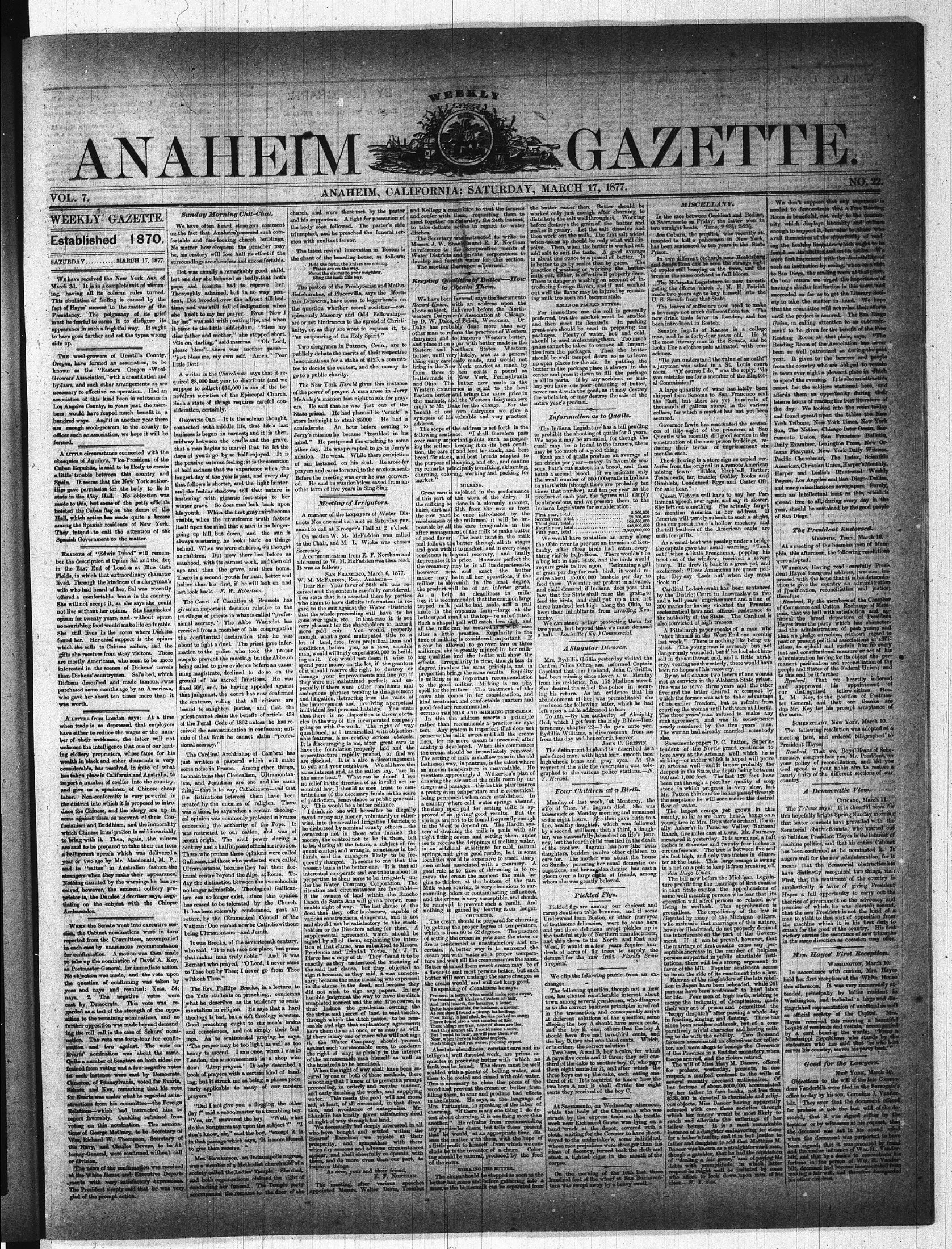
Searchable text
ANAHEIM
VOL. 7.
WEEKLY GAZETTE.
Established 1870.
SATURDAY...MARCH 17, 1877.
We have received the New York Sun of March 3d. It is in a complete suit of mourning having all its column rules turned. This ebullition of feeling is caused by the fact of Hayes' success in the matter of the Presidency. The poignancy of its grief must be fearful to cause it to disfigure its appearance in such a frightful way. It ought to have gone further and set the types wrong side up.
The wool-growers of Umatilla County, Oregon, have formed an association, to be known as the "Eastern Oregon Wool-Growers' Association," with a constitution and by-laws, and such other arrangements as are necessary to effective co-operation. Had an association of this kind been in existence in Los Angeles County, in years past, the members would have reaped much benefit in a hundred ways. And if in another year there are enough wool-growers in the county to officer such an association, we hope it will be formed.
A little circumstance connected with the obsequies of Aguilera, Vice-President of the Sunday Morning Chit-Chat.
We have often heard strangers comment on the fact that Anaheim possessed such comfortable and fine-looking church buildings. No matter how eloquent the preacher may be, his oratory will lose half its effect if the surroundings are cheerless and uncomfortable.
Dot was usually a remarkably good child, but one day she behaved so badly that both papa and mamma had to reprove her. Thoroughly ashamed, but in no way penitent, Dot brooded over the affront till bedtime, and was still full of indignation when she knelt to say her prayer. Even "Now I lay me" was said with pouting lips, and when it came to the little addendum, "Bless my dear father and mother," she stopped short. "Go on, darling," said mamma. "Oh Lord, please bless"—there was another pause—"just bless me, my own self. Amen." Poor little Dot!
A writer in the Churchman says that it required $8,000 last year to distribute (and we suppose to collect) $10,000 in one of the benevolent societies of the Episcopal Church. Such a state of things requires careful consideration, certainly.
GROWING OLD.—It is the solemn thought, connected with middle life, that life's last business is begun in earnest; and it is then, midway between the cradle and the grave, that a man begins to marvel that he let the days of youth go by so half-enjoyed. It is the pensive autumn feeling; it is the sensation church, and were there and his supporters. A figthe body soon followed. triumphed, and he preachmon with exultant fervor.
The latest revival invoked the chant of the boarding
The pastors of the Presidium churches, of Placevriat Democrat, have come to question whether seceded Masonry and are or not hindrances to sanity, or, as they are worried "an outpouring of the Hate."
Two clergymen in Putnam publicly debate the merits denominations for a staketee to decide the contest to go to a public charity.
The New York Herald of the power of prayer: A McAnley's mission last week. He said that he was State prison. He had put store last night to steal confederate. An hour Jerry's mission he became mind." He postponed another day. He was promission. He went. We of sin fastened on him.
A LITTLE circumstance connected with the obsequies of Aguilera, Vice-President of the Cuban Republic, is said to be likely to create a little trouble between this country and Spain. It seems that the New York authorities gave permission for the body to lie in state in the City Hall. No objection was made to this, but some of the petty officials hoisted the Cuban flag on the dome of the Hall, which action has made quite a breeze among the Spanish residents of New York. They intend to call the attention of the Spanish Government to the matter.
READERS of "Edwin Drood" will remember the description of Opium Sal and the den in the East End of London at Blue Gate Fields, in which that extraordinary character lived. Through the kindness of a clergyman's wife who had heard of her, Sal was recently offered a comfortable home in the country. She will not accept it, as she says she could not live without her opium. She has smoked opium for twenty years, and without opium no nourishing food would make life endurable. She still lives in the room where Dickens found her. Her chief support is the opium which she sells to Chinese sailors, and the gifts she receives from stray visitors. These are mostly Americans, who seem to be more interested in the scenes of Dickens' novels than Dickens' countrymen. Sal's bed, which Dickens described and made famous, was purchased some months ago by an American, who gave her about ten times more than it was worth.
A LETTER from London says: At a time when trade is so depressed, that employers have either to reduce the wages or the number of their workmen, the latter will not welcome the intelligence that one of our leading clergy proprietors, whose fame for his wealth in black and other diamonds is very considerable, has resolved, in spite of what has taken place in California and Australia, to import a number of coolies into the country, and give us a specimen of Chinese cheap labor. Non-conformity is very powerful in the district into which it is proposed to introduce the Chinese, and the clergy are up in arms against them on account of their Confucianism and Buddhism, and the immorality which Chinese immigration is said invariably to bring with it. Then, again, the miners are said to be prepared to take their cue from a belligerent speech which was delivered a year or two ago by Mr. Macdonald, M. P., and to "ratten" in Australian fashion the strangers when they make their appearance. Notwithstanding the warnings he has re-
A writer in the Churchman says that it required $8,000 last year to distribute (and we suppose to collect) $10,000 in one of the benevolent societies of the Episcopal Church. Such a state of things requires careful consideration, certainly.
GROWING OLD.—It is the solemn thought, connected with middle life, that life's last business is begun in earnest; and it is then, midway between the cradle and the grave, that a man begins to marvel that he let the days of youth go by half-enjoyed. It is the pensive autumn feeling; it is the sensation of half sadness that we experience when the longest day of the year is past, and every day that follows is shorter, and the light fainter, and the feebler shadows tell that nature is hastening with gigantic foot-steps to her winter grave. So does man look back upon his youth. When the first gray hairs become visible, when the unwelcome truth fastens itself upon the mind that a man is no longer going up hill, but down, and the sun is always westering, he looks back on things behind. When we were children, we thought as children. But now there lies before us manhood, with its earnest work, and then old age and then the grave, and then home. There is a second youth for man, better and holier than his first, if he will look on and not look back.—F. W. Robertson.
The Court of Cassation at Brussels has given an important decision relative to the privileges of priests in what is called "professional secrecy." The Abbe Wautelet has received from a member of his congregation the confidential declaration that he was about to fight a duel. The priest gave information to the police who took the proper steps to prevent the meeting; but the Abbe, on being called to give evidence before an examining magistrate, declined to do so on the ground of his sacred functions. He was fined 50f., and, he having appealed against that judgment, the court has now confirmed the sentence, ruling that all citizens are bound to enlighten justice, and that the priest cannot claim the benefit of article 458 of the Penal Code of 1862 unless he has received the communication in confession; outside of that limit he cannot claim "professional secrecy."
The Cardinal Archbishop of Cambrai has just written a pastoral which will make some noise in France. Among other things, he maintains that Clericalism, Ultramontanism, and Jesuitism are one and the same thing—that is to say, Catholicism—and that the distinctions between them have been created by the enemies of religion. There was a time, he says when a certainological opinion was commonly professed in France concerning the authority of the Pope. It was restricted to our nation, and was of recent origin. The civil power during a century and a half imposed official instruction. Those who profess these opinions were called Gallicans, and those who protested were called Ultramontanes, because they had their doctrinal centre beyond the Alps, at Rome. Today the distinction between the two schools is
When the Senate went into executive session, the Cabinet nominations were in turn reported from the Committees, accompanied in such case by unanimous recommendation for confirmation. A motion was then made to take up the nomination of David A. Key, as Postmaster-General, for immediate action. No objection was made, and the vote upon the question of confirming was taken by yeas and nays and resulted: Yeas, 54; nays, 2. The negative votes were cast by Democrats. This vote was regarded as a test of the strength of the opposition to the remaining nominations, and no further opposition was made beyond demanding the roll call in the case of Schurz' nomination. The vote was forty-four for confirmation and two against. The vote on Evarts' nomination was about the same. Quite a number of Senators on both sides refused from voting and a few negative votes in each instance were cast by Democrats. Cimarron, of Pennsylvania, voted for Evarts, Schurz and Key, remarking that his vote for Evarts was under what he regarded as instructions from his committee—the Foreign Relations—which had instructed him to report favorably. Conkling refrained from voting on this nomination. The nominations of George McCrary, to be Secretary of War, Richard W. Thompson, Secretary of this Navy, and Charles Davens, to be Attorney-General, were confirmed without call or division.
The news of the confirmation was received at the White House and Executive Departments with very satisfactory expressions. The President simply said that he was very glad of the prompt action.
The distinction between them have been created by the enemies of religion. There was a time, he says when a certain theological opinion was commonly professed in France concerning the authority of the Pope. It was restricted to our nation, and was of recent origin. The civil power during a century and a half imposed official instruction. Those who profess these opinions were called Gallicans, and those who protested were called Ultramontanes, because they had their doctrinal centre beyond the Alps, at Rome. Today the distinction between the two schools is no longer admissible. Theological Gallicanism can no longer exist, since this opinion has ceased to be tolerated by the Church. It has been solemnly condemned, past all return, by the Ecumenical Council of the Vatican: One cannot now be Catholic without being Ultramontane—and Jesuit.
It was Brooks, of the seventeenth century, who said, "It is not race nor place, but grace that makes man truly noble." And it was Bernard who prayed, "O Lord, I never came to Thee but by Thee; I never go from Thee without Thee."
The Rev. Phillips Brooks, in a lecture to the Yale students on preaching,, condemns what he describes as the tendency to sentimentalism in religion. He says that a hard theology is bad, but a soft theology is worse. Good preaching ought to stir men's brains and consciences, and not simply their feelings. As to sentimental praying he says: 'The prayer may be too light, as well as too heavy to ascend. I saw once, when I was in London, the announcement in a shop window: 'Limp prayers.' It only described a book of prayers with a certain kind of binding; but it struck me as being a phrase peculiarly applicable to many of our modern prayers."
"Did I not give you a flogging the other day?" said a schoolmaster to a trembling boy. "Yes, sir," answered the boy. "Well, what do the Scriptures say upon the subject?" "I don't know, sir," said the boy, "except it is in that passage which says, 'It is more blessed to give than receive.'"
Mrs. Hawkinson, an Indianapolis negress, was a member of a Methodist church staff of a society called the Ladies' Temple. She died, and both organizations claimed the right of conducting her funeral. The Temple party accompanied the remains to the door of the thing—that is to say, Catholicism—and that the distinctions between them have been created by the enemies of religion. There was a time, he says when a certain theological opinion was commonly professed in France concerning the authority of the Pope. It was restricted to our nation, and was of recent origin. The civil power during a century and a half imposed official instruction. Those who profess these opinions were called Gallicans, and those who protested were called Ultramontanes, because they had their doctrinal centre beyond the Alps, at Rome. Today the distinction between the two schools is no longer admissible. Theological Gallicanism can no longer exist, since this opinion has ceased to be tolerated by the Church. It has been solemnly condemned, past all return, by the Ecumenical Council of the Vatican: One cannot now be Catholic without being Ultramontane—and Jesuit.
It was Brooks, of the seventeenth century, who said, "It is not race nor place, but grace that makes man truly noble." And it was Bernard who prayed, "O Lord, I never came to Thee but by Thee; I never go from Thee without Theee."
The Rev. Phillips Brooks, in a lecture to the Yale students on preaching,, condemns what he describes as the tendency to sentimentalism in religion. He says that a hard theology is bad, but a soft theology is worse. Good preaching ought to stir men's brains and consciences, and not simply their feelings. As to sentimental praying he says: 'The prayer may be too light, as well as too heavy to ascend. I saw once, when I was in London, the announcement in a shop window: 'Limp prayers.' It only described a book of prayers with a certain kind of binding; but it struck me as being a phrase peculiarly applicable to many of our modern prayers."
"Did I not give you a flogging the other day?" said a schoolmaster to a trembling boy. "Yes, sir," answered the boy. "Well, what do the Scriptures say upon the subject?" "I don't know, sir," said the boy, "except it is in that passage which says, 'It is more blessed to give than receive.'"
Mrs. Hawkinson, an Indianapolis negress, was a member of a Methodist church staff of a society called the Ladies' Temple. She died, and both organizations claimed the right of conducting her funeral. The Temple party accompanied the remains to the door of the thing—that is to say, Catholicism—and that the distinctions between them have been created by the enemies of religion. There was a time, he says when a certain theological opinion was commonly professed in France concerning the authority of the Pope. It was restricted to our nation, and was of recent origin. The civil power during a century and a half imposed official instruction. Those who profess these opinions were called Gallicans,and those who protested were called Ultramontanes,because they had their doctrinal centre beyond the Alps, at Rome. Today the distinction between the two schools is no longer admissible. Theological Gallicanism can no longer exist, since this opinion has ceased to be tolerated by the Church. It has been solemnly condemned,past all return,bYthe Ecumenical Council of the Vatican: One cannot now be Catholic without being Ultramontane—and Jesuit.
It was Brooks, of the seventeenth century, who said, "It is not race nor place, but grace that makes man truly noble." And it was Bernard who prayed,"O Lord, I never came to Thee but by Thee; I never go from Thee without Theee."
The Rev. Phillips Brooks, in a lecture to the Yale students on preaching,, condemns what he describes as the tendency to sentimentalism in religion. He says that a hard theology is bad, but a soft theology is worse. Good preaching ought to stir men's brains and consciences, and not simply their feelings. As to sentimental praying he says: 'The prayer may be too light, as well as too heavy to ascend. I saw once, when I was in London,the announcement in a shop window: 'Limp prayers.' It only described a book of prayers with a certain kind of binding; but it struck me as being a phrase peculiarly applicable to many of our modern prayers."
"Did I not give you a flogging the other day?" said a schoolmaster to a trembling boy. "Yes, sir," answered the boy. "Well,what do the Scriptures say upon the subject?" "I don't know,sir," said the boy,"except it is in that passage which says,'It is more blessed to give than receive.'"
Mrs. Hawkinson,an Indianapolis negress,was a memberofaMethodistchurchstaffofasocietycalledtheLadiesTempla.Shedied,andbothorganizationsclaimedtherightofconductingherfuneral.TheTemplpartyaccompaniedtheremainstothedoorofthething—thatisto say,Catholicism—andthatthedistinctionsbetweenthemhavebeencreatedbytheenemiesofreligionTherewasatime,hesayswhena certaintheologicalopinionwasscommonlyprofessedinFranceconcerningtheauthorityofthePope。它wasrestrictedtoournation,andwasofrecentorigin.The CivilpowerduringacenturyandahalfimposedofficialinstructionThosewhoprofesstheopinionswerecalledGallicans,andthosewhoprotestedwerecalledUltramontanes,becausetheyhadtheirdoctrinalcentrebeyondtheAlps.atRome.Todaythedistinctionbetweenthetwostoolsisno longeradmissible.TheologicalGallicanismcanno longerexist,sincethisopinionhasceasedtobettoleratedbytheChurch.它hasbeensolemnlycondemned,pastallreturn,BYtheEcumenicalCounciloftheVatican:OnecannotnowbeCatholicwithoutbeingUltramontane—andJesuit.
ItwasBrooks,oftheseventeenthcentury,whosaid,"Itisnotracenorplacebutgracethatmakesmantrulynoble."AnditwasBernardwhoprayed,"O Lord,InevercametoTheebutbyThee;InevergofromTheewithoutTheee."
TheRev.PhillipsBrooks,alecturetotheYalestudentsoncpreaching.,condemnswhathedescribesasthetendencytosentimentalisminreligionHesaythatahardtheologyisbadbutasofttheologyisworseGoodpreachingoughtsto stirmen'sbrainsandconsciences,andnotsimplytheireffectings.Astosentimentalprayinghesays:"Theprayermaybetoooight.aswellastooweavytoascend.I sawonce,whenIwasinLondon,theannouncementinashopwindow:'Limpprayers.'Itonlydescribedabookofprayerswithacertainkindofbindiing;butitstruckmeasbeingaphrasepeculiarlyapplicabletotomanyofourmodernprayers."
"DidInotgiveyouafloggingtheotherday?"saida学校mastertoatremblingboy."Yes,sir,"answeredtheboy."Well,whadoftheScripturessayuponthesubject?" "Idon'tknow,sir,"saidtheboy,"exceptitisinthatpassagewhichsays,'Itismoreblessedtogivethanreceive.'"
Mrs.Hawkinson,anIndianapolisnegress,wasamemberofaMethodistchurchstaffofasocietycalledtheLadiesTempla.Shedied,andbothorganizationsclaimedtherightofconductingherfunal.TheTemplpartyaccompaniedtheremainstothedoorofthething—thatisto say,Catholicism—andthatthedistinitionsbetweenthemhavebeencreatedbytheenemiesofreligionTherewasatime,hesayswhena certaintheologicalopinionwasscommonlyprofessedinFranceconcerningtheauthorityofthePope.它wasrestrictedtoournation,andwasofrecentorigin.The CivilpowerduringacenturyandahalfimposedofficialinstructionThosewhoprofesstheopinionswerecalledGallicans,andthosewhoprotestedwerecalledUltramontanes,becausetheyhadtheirdoctrinalcentrebeyondtheAlps.atRome.Todaythedistinctionbetweenthetwostoolsisno longeradmissible.TheologicalGallicanismcanno longerexist,sincethisopinionhasceasedtobettoleratedbytheChurch.它hasbeensolemnlycondemned,pastallreturn,BYtheEcumenicalCounciloftheVatican:OnecannotnowbeCatholicwithoutsuchunreasonable.thehundredsboyes.inthedirectnominallaw;ishouldntoffersuchunreasonable.thehundredsboyes.inthedirectnominallaw;ishouldntoffersuchunreasonable.thehundredsboyes.inthedirectnominallaw;ishouldntoffersuchunreasonable.thehundredsboyes.inthedirectnominallaw;ishouldntoffersuchunreasonable.thehundredsboyes.inthedirectnominallaw;ishouldntoffersuchunreasonable.thehundredsboyes.inthedirectnominallaw;ishouldntoffersuchunreasonable.thehundredsboyes.inthedirectnominallaw;ishouldntoffersuchunreasonable.thehundredsboyes.inthedirectnominallaw;ishouldntoffersuchunreasonable.thehundredsboyes.inthedirectnominallaw;ishouldntoffersuchunreasonable.thehundredsboyes.inthedirectnominallaw;ishouldntoffersuchunreasonable.thehundredsboyes.inthedirectnominallaw;ishouldntoffersuchunreasonable.thehundredsboyes.inthedirectnominallaw;ishouldntoffersuchunreasonable.thehundredsboyes.inthedirectnominallaw;ishouldntoffersuchunreasonable.thehundredsboyes.inthedirectnominallaw;ishouldntoffersuchunreasonable.thehundredsboyes.inthedirectnominallaw;ishouldntoffersuchunreasonable.thehundredsboyes.inthedirectnominallaw;ishouldntoffersuchunreasonable.thehundredsboyes.inthedirectnominal law;i shouldnt offer such unreasonable.the hundred sboyes.in theright ominal law;i shouldnt offer such unreasonable.the hundred sboyes.in theright ominal law;i shouldnt offer such unreasonable.the hundred sboyes.in theright ominal law;i shouldnt offer such unreasonable.the hundred sboyes.in theright ominal law;i shouldnt offer such unreasonable.the hundred sboyes.in theright ominal law;i shouldnt offer such unreasonable.the hundred sboyes.in theright ominal law;i shouldnt offer such unreasonable.the hundred sboyes.in theright ominal law;i shouldnt offer such unreasonable.the hundred sboyes.in theright ominal law;i shouldnt offer such unreasonable.the hundred sboyes.in theright ominal law;i shouldnt offer such unreasonable.the hundred sboyes.in theright ominal law;i shouldnt offer such unreasonable.the hundred sboyes.in theright ominal law;i shouldnt offer such unreasonable.the hundred sboyes.in theright ominal law;i shouldnt offer such unreasonable.the hundred sboyes.in theright ominal law;i shouldnt offer such unreasonable.the hundred sboyes.in theright ominal law;i shouldnt offer such unreasonable.the hundred sboyes.in theright ominal law;i shouldnt offer such unreasonable.the hundred sboyes.in theright ominal law;i shouldnt offer such unreasonable.the hundred sboyes.in theright ominal law;i shouldnt offer such unreasonable.the hundred sboyes.in theright ominal law;i shouldnt offer such unreasonable.the hundred sboyes.in theright ominal law;i shouldnt offer such unreasonable.the hundred sboyes.in theright ominal law;i shouldnt offer such unreasonable.the hundred sboyes.in theright ominal law;i shouldnt offer such unreasonable.the hundred sboyes.in theright ominal law;i shouldnt offer such unreasonable.the hundred sboyes.in theright ominal law;i shouldnt offer such unreasonable.the hundred sboyes.in theright ominal law;i shouldnt offer such unreasonable.the hundred sboyes.in theright ominal law;i shouldnt offer such unreasonable.the hundred sboyes.in theright ominal law;i shouldnt offer such unreasonable.the hundred sboyes.in theright ominal law;i shouldnt offer such unreasonable.the hundred sboyes.in theright ominal law;i shouldnt offer such unreasonable.the hundred sboyes.in theright ominal law;i shouldnt offer such unreasonable.the hundred sboyes.in theright ominal law;i shouldnt offer such unreasonable.the hundred sboyes.in theright ominal law;i shouldnt offer such unreasonable.the hundred sboyes.in theright ominal law;i shouldnt offer such unreasonable.the hundred sboyes.in theright ominal law;i shouldnt offer such unreasonable.the hundred sboyes.in theright ominal law;i shouldnt offer such unreasonable.the hundred sboyes.in theright ominal law;i shouldnt offer such unreasonable.the hundred sboyes.In theright ominal law;i shouldnt offer such unreasonable.the hundred sboyes.In theright ominal law;i shouldnt offer such unreasonable.the hundred sboyes.In theright ominal law;i shouldnt offer such unreasonable.the hundred sboyes.In theright ominal law;i shouldnt offer such unreasonable.the hundred sboyes.In theright ominal law;i shouldnt offer such unreasonable.the hundred sboyes.In theright ominal law;i shouldnt offer such unreasonable.the hundred sboyES.In theright ominal law;i shouldnt offer such unreasonable.the hundred SBoyES.In therIGHT OMINAL LAW;I Shouldn't Offer Such UnReasonable.The Hundred Sbody Is Not Necessary For Anyone To Have Brought A Stake Or Penalty.After All That Is Known By Someone Who Has Been Brought A Stake Or Penalty.After All That Is Known By Someone Who Has Been Brought A Stake Or Penalty.After All That Is Known By Someone Who Has Been Brought A Stake Or Penalty.After All That Is Known By Someone Who Has Been Brought A Stake Or Penalty.After All That Is Known By Someone Who Has Been Brought A Stake Or Penalty.After All That Is Known By Someone Who Has Been Brought A Stake Or Penalty.After All That Is Known By Someone Who Has Been Brought A Stake Or Penalty.After All That Is Known By Someone Who Has Been Brought A Stake Or Penalty.After All That Is Known By Someone Who Has Been Brought A Stake Or Penalty.After All That Is Known By Someone Who Has Been Brought A Stake Or Penalty.After All That Is Known By Someone Who Has Been Brought A Stake Or Penalty.After All That Is Known By Someone Who Has Been Brought A Stake Or Penalty.After All That Is Known By Someone Who Has Been Brought A Stake Or Penalty.After All That Is Known By Someone Who Has Been Brought A Stake Or Penalty.After All That Is Known By Someone Who Has Been Brought A Stake Or Penalty.After All That Is Known By Someone Who Has Been Brought A Stake Or Penalty.After All That Is Known By Someone Who Has Been Brought A Stake Or Penalty.After All That Is Known By Someone Who Has Been Brought A Stake Or Penalty.After All That Is Known By Someone Who Has Been Brought A Stake Or Penalty.After All That Is Known By Someone Who Has Been Brought A Stake Or Penalty.After All That Is KnownBySomeoneWhoHasBeenBroughtAStakeOrPenalty.AfterAllThatIsKnownBySomeoneWhoHasBeenBroughtAStakeOrPenalty.AfterAllThatIsKnownBySomeoneWhoHasBeenBroughtAStakeOrPenalty.AfterAllThatIsKnownBySomeoneWhoHasBeenBroughtAStakeOrPenalty.AfterAllThatIsKnownBySomeoneWhoHasBeenBroughtAStakeOrPenalty.AfterAllThatIsKnownBySomeoneWhoHasBeenBroughtAStakeOrPenalty.AfterAllThatIsKnownBySomeoneWhoHasBeenBroughtAStakeOrPenalty.AfterAllThatIsKnownBySomeoneWhoHasBeenBroughtAStakeOrPenalty.AfterAllThatIsKnownBySomeoneWhoHasBeenBroughtAStakeOrPenalty.AfterAllThatIsKnownBySomeoneWhoHasBeenBroughtAStakeOrPenalty.AfterAllThatIsKnownBySomeoneWhoHasBeenBroughtAStakeOrPenalty.AfterAllThatIsKnownBySomeoneWhoHasBeenBroughtAStakeOrPenalty.AfterAllThatIsKnownBySomeoneWhoHasBeenBroughtAStakeOrPenalty.AfterAllThatIsKnownBySomeoneWhoHasBeenBroughtAStakeOrPenalty.AfterAllThatIsKnownBySomeoneWhoHasBeENBroughtAStakeOrPenalty.AfterAllThatIsKnownBySomeoneWhoHasBeENBroughtAStakeOrPenalty.AfterAllThatIsKnownBySomeoneWhoHasBEENBroughtAStakeOrPenalty.AfterAllThatIsKnownBySomeoneWhoHasBEENBroughtAStakeOrPenalty.AfterAllThatIsKnownBySomeONEWhoHasBEENBroughtAStakeOrPenalty.AfterAllThatIsKnownBySomeONEWhoHasBEENBroughtAStakeOrPenalty.AfterAllThatISKnownBySomeONEWhoHasBEENBroughtAStakeOrPenalty.AfterAllThatISKnownBySomeONEWhoHasBEENBroughtAStakeOrPenalty.AfterAllThatISKnownBYSomeONEWhoHasBEENBroughtAStakeOrPenalty.AfterAllThatISKnownBYSomeONEWhoHasBEENBroughtAStakeOrPenalty.AfterAllThatISKnownBYSomeONEWhoHasBEENBroughtAStakeOrPenalty.AfterAllThatISKnownBYSomeONEWhoHasBEENBroughtAStakeOrPenalty.AfterAllThatISKnownBYSomeONEWhoHasBEENBroughtAStakeOrPenalty.AfterAllThatISKnownBYSomeONEWhoHasBEENBroughtAStakeOrPenalty.AfterAllThatISKnownBYSomeONEWhoHasBEENBroughtAStakeOrPenalty.AfterAllThatISKnownBYSomeONEWhoHasBEENBroughtAStakeOrPenalty.AfterAllThatISKnownBYSomeONEWhoHasBEENBroughtAStakeOrPenalty.AfterAllThatISKnownBYSomeONEWhoHasBEENBroughtAStakeOrPenalty.AfterAllThatISKnownBYSomeONEWhoHasBEENBroughtAStakeOrPenalty.AfterAllThatISKnownBYSomeONEWhoHasBEENBroughtAStakeOrPenalty.AfterAllThatISKnownBYSomeONEWhoHasBEENBroughtAStakeOrPenalty.AfterAllThatISKnownBYSomeONEWhoHasBEENBroughtAStakeOrPenalty.AfterAllThatISKnownBYSomeONEWhoHasBEENBroughtAStakeOrPenalty.AfterAllThatISKnownBYSomeONEWhoHasBEENBroughtAStakeOrPenalty.AfterAllThatISKnownBYSomeONEWhoHasBEENBroughtAStakeOrPenalty.AfterAllThatISKnownBYSomeONEWhoHasBEENBroughtAStakeOrPenalty.AfterAllThatISKnownBYSomeONEWhoHasBEENBroughtAStakeOrPenalty.AfterAllThatISKknownBySomeONEWhoHasBEENBrowsingABuildingAnUnauthorizedBuildingAnUnauthorizedBuildingAnUnauthorizedBuildingAnUnauthorizedBuildingAnUnauthorizedBuildingAnUnauthorizedBuildingAnUnauthorizedBuildingAnUnauthorizedBuildingAnUnauthorizedBuildingAnUnauthorizedBuildingAnUnauthorizedBuildingAnUnauthorizedBuildingAnUnauthorizedBuildingAnUnauthorizedBuildingAnUnauthorizedBuildingAnUnauthorizedBuildingAnUnauthorizedBuildingAnUnauthorizedBuildingAnUnauthorizedBuildingAnUnauthorizedBuildingAnUnauthorizedBuildingAnUnauthorizedBuildingAnUnauthorizedBuildingAnUnauthorizedBuildingAnUnauthorizedBuildingAnUnauthorizedBuildingAnUnauthorizedBuildingAnUnauthorizedBuildingAnUnauthorizedBuildingAnUnauthorizedBuildingAnUnauthorizedBuildingAnUnauthorizedBuildingAnUnauthorizedBuildingAnUnauthorizedBuildingAnUnauthorizedBuildingAnUnauthorizedBuildingAnUn authorized Building An Unauthorized Building An Unauthorized Building An Unauthorized Building An Un authorized Building An Un authorized Building An Un authorized Building An Un authorized Building An Un authorized Building An Un authorized Building An Un authorized Building An Un authorized Building An Un authorized Building An Un authorized Building An Un authorized Building An Un authorized Building An Un authorized Building An Un authorized Building An Un authorized Building An Un authorized Building An Un authorized Building An Un authorized Building An Un authorized Building An Un authorized Building An Un authorized Building An Unauthorized Building An Unauthorized Building An Unauthorized Building An Unauthorized Building An Unauthorized Building An Unauthorized Building An Unauthorized Building An Unauthorized Building An Unauthorized Building AN UNauthorized Building AN UNauthorized Building AN UNauthorized Building AN UN authorized Building AN UN authorized Building AN UN authorized Building AN UN authorized Building AN UN authorized Building AN UN authorized Building AN UN authorized Building AN UN authorized Building AN UN authorized Building AN UN authorized Building AN UN authorized Building AN UN authorized Building AN UN authorized Building AN UN authorized Building AN UN authorized Building AN UN authorized Building AN UN authorized Building AN UN authorized Building AN UN authorized Building AN UN authorized Building AN UN authorized Building AN UN authorized building AN UN authorized building AN UN authorized building AN UN authorized building AN UN authorized building AN UN authorized building AN UN authorized building AN UN authorized building AN UN authorized building AN UN authorized building AN UN authorized building AN UN authorized building AN UN authorized building AN UN authorized building AN UN authorized building AN UN authorized building AN UN authorized building AN UN authorized building AN UN authorized building AN UN authorized building AN UN authorized building AN UN authorized building AN UN authorized building AN UN AUTHORIZED BUILDING AN AUTHORIZED BUILDING AN AUTHORIZED BUILDING AN AUTHORIZED BUILDING AN AUTHORIZED BUILDING AN AUTHORIZED BUILDING AN
WEEKLY
CIM GAZ
ANAHEIM, CALIFORNIA: SATURDAY, MARCH 17, 1877.
church, and were there met by the pastor and his supporters. A fight for possession of the body soon followed. The pastor's side triumphed, and he preached the funeral sermon with exultant fervor.
The latest revival innovation in Boston is the chant of the boarding-house, as follows:
Hold the fork, the knives are coming.
Plates are on the way.
Shout the chorus to your neighbor,
Sling the hush this way.
The pastors of the Presbyterian and Methodist churches, of Placerville, says the Mountain Democrat, have come to loggerheads on the question whether secret societies—conspicuously Masonry and Odd Fellowship—are or not hindrances to the spread of Christianity, or, as they are wont to express it, to "an outpouring of the Holy Spirit."
Two clergymen in Putnam, Conn., are to publicly debate the merits of their respective denominations for a stake of $125, a committee to decide the contest, and the money to go to a public charity.
The New York Herald gives this instance of the power of prayer: A man arose in Jerry McAuley's mission last night to ask prayers. He said that he was just out of the State prison. He had planned to "crack" a store last night to steal $5000. He had a confederate. An hour before coming to Jerry's mission he became "troubled in his mind." He postponed the cracking to some other day. He was prompted to go to Jerry's mission. He went. While there conviction of sin fastened on his soul. He arose for church, and were there met by the pastor and his supporters. A fight for possession of the body soon followed. The pastor's side triumphed, and he preached the funeral sermon with exultant fervor.
The latest revival innovation in Boston is the chant of the boarding-house, as follows:
Hold the fork, the knives are coming.
Plates are on the way.
Shout the chorus to your neighbor,
Sling the hush this way.
The pastors of the Presbyterian and Methodist churches, of Placerville, says the Mountain Democrat, have come to loggerheads on the question whether secret societies—conspicuously Masonry and Odd Fellowship—are or not hindrances to the spread of Christianity, or, as they are wont to express it, to "an outpouring of the Holy Spirit."
Two clergymen in Putnam, Conn., are to publicly debate the merits of their respective denominations for a stake of $125, a committee to decide the contest, and the money to go to a public charity.
The New York Herald gives this instance of the power of prayer: A man arose in Jerry McAuley's mission last night to ask prayers. He said that he was just out of the State prison. He had planned to "crack" a store last night to steal $5000. He had a confederate. An hour before coming to Jerry's mission he became "troubled in his mind." He postponed the cracking to some other day. He was prompted to go to Jerry's mission. He went. While there conviction of sin fastened on his soul. He arose for church, and were there met by the pastor and his supporters. A fight for possession of the body soon followed. The pastor's side triumphed, and he preached the funeral sermon with exultant fervor.
The latest revival innovation in Boston is the chant of the boarding-house, as follows:
Hold the fork, the knives are coming.
Plates are on the way.
Shout the chorus to your neighbor,
Sling the hush this way.
The pastors of the Presbyterian and Methodist churches, of Placerville, says the Mountain Democrat, have come to loggerheads on the question whether secret societies—conspicuously Masonry and Odd Fellowship—are or not hindrances to the spread of Christianity, or, as they are wont to express it, to "an outpouring of the Holy Spirit."
Two clergymen in Putnam, Conn., are to publicly debate the merits of their respective denominations for a stake of $125, a committee to decide the contest, and the money to go to a public charity.
The New York Herald gives this instance of the power of prayer: A man arose in Jerry McAuley's mission last night to ask prayers. He said that he was just out of the State prison. He had planned to "crack" a store last night to steal $5000. He had a confederate. An hour before coming to Jerry's mission he became "troubled in his mind." He postponed the cracking to some other day. He was prompted to go to Jerry's mission. He went. While there conviction of sin fastened on his soul. He arose for church, and were there met by the pastor and his supporters. A fight for possession of the body soon followed. The pastor's side triumphed, and he preached the funeral sermon with exultant fervor.
The latest revival innovation in Boston is the chant of the boarding-house, as follows:
Hold the fork, the knives are coming.
Plates are on the way.
Shout the chorus to your neighbor,
Sling the hush this way.
The pastors of the Presbyterian and Methodist churches, of Placerville, says the Mountain Democrat, have come to loggerheads on the question whether secret societies—conspicuously Masonry and Odd Fellowship—are or not hindrances to the spread of Christianity, or, as they are wont to express it, to "an outpouring of the Holy Spirit."
Two clergymen in Putnam, Conn., are to publicly debate the merits of their respective denominations for a stake of $125, a committee to decide the contest, and the money to go to a public charity.
The New York Herald gives this instance of the power of prayer: A man arose in Jerry McAuley's mission last night to ask prayers. He said that he was just out of the State prison. He had planned to "crack" a store last night to steal $5000. He had a confederate. An hour before coming to Jerry's mission he became "troubled in his mind." He postponed the cracking to some other day. He was prompted to go to Jerry's mission. He went. While there conviction of sin fastened on his soul. He arose for church, and were there met by the pastor and his supporters. A fight for possession of the body soon followed. The pastor's side triumphed, and he preached the funeral sermon with exultant fervor.
The latest revival innovation in Boston is the chant of the boarding-house, as follows:
Hold the fork, the knives are coming.
Plates are on the way.
Shout the chorus to your neighbor,
Sling the hush this way.
The pastors of the Presbyterian and Methodist churches, of Placerville, says the Mountain Democrat, have come to loggerheads on the question whether secret societies—conspicuously Masonry and Odd Fellowship—are or not hindrances to the spread of Christianity, or, as they are wont to express it, to "an outpouring of the Holy Spirit."
Two clergymen in Putnam, Conn., are to publicly debate the merits of their respective denominations for a stake of $125, a committee to decide the contest, and the money to go to a public charity.
The New York Herald gives this instance of the power of prayer: A man arose in Jerry McAuley's mission last night to ask prayers. He said that he was just out of the State prison. He had planned to "crack" a store last night to steal $5000. He had a confederate. An hour before coming to Jerry's mission he became "troubled in his mind." He postponed the cracking to some other day. He was prompted to go to Jerry's mission. He went. While there conviction of sin fastened on his soul. He arose for church, and were there met by the pastor and his supporters. A fight for possession of the body soon followed. The pastor's side triumphed, and he preached the funeral sermon with exultant fervor.
The latest revival innovation in Boston is the chant of the boarding-house, as follows:
Hold the fork, the knives are coming.
Plates are on the way.
Shout the chorus to your neighbor,
Sling the hush this way.
The pastors of the Presbyterian and Methodist churches, of Placerville, says the Mountain Democrat, have come to loggerheads on the question whether secret societies—conspicuously Masonry and Odd Fellowship—are or not hindrances to the spread of Christianity, or, as they are wont to express it, to "an outpouring of the Holy Spirit."
Two clergymen in Putnam, Conn., are to publicly debate the merits of their respective denominations for a stake of $125, a committee to decide the contest, and the money to go to a public charity.
The New York Herald gives this instance of the power of prayer: A man arose in Jerry McAuley's mission last night to ask prayers. He said that he was just out of the State prison. He had planned to "crack" a store last night to steal $5000. He had a confederate. An hour before coming to Jerry's mission he became "troubled in his mind." He postponed the cracking to some other day. He was prompted to go to Jerry's mission. He went. While there conviction of sin fastened on his soul. He arose for church, and were there met by the pastor and its addresses.
The scope of the address is set forth in following sentence: "I shall therefore pass over many important points, such as preparingthe soil and keeping it in its best condition,the care of and feed for stock,and best breed for stock,and best breeds adaptedtothe purposeof dairying,and etc.,and confine"
The butter easier then. Butter should be worked only just enough after churningto distributethe salt well throughit.Workingbefore destroysthe grainofthe butterand makes it greasy.Letthe salt dissolveandthen work outthe milk.The first salt addedwhen-taken up should be only what will dissolveThen,whenthe butterisworkedout,add saltto suitthe taste.Agoodaverageisaboutoneouncetoa poundofbutter。Itisbettertogoby scalesthanbyguess.Thepracticeofwashingorworkingthebuttermilkout,eitheris effectiveifproperlydoneThereis dangerin washingonaccountofintroducingforeignflavors,andifnotworkedoutwellthe flavormaybeinjuredbyremainingsilktosoonandbecomestale.
ROLLS OR PACKED BUTTER.
For immediate usethe rollisgenerallypreferred,butthemarkekmustbestudiedandthenmeetits demands.Inpackinggreatcareshouldbeusedinpreparingthepackages.Plentyofwater,hotandcoldshouldbeusedincleansingthem.Too muchpains cannotbe takentoremoveallimpuritiesfromthepackages。Thenthebuttershouldbewelltampeddownsoasleavenoopenplacesfortheair.InputtingthebutterinthepackageplaceitalwaysinthecenterandpressitdownfilthepackageinallitspartsIfbyanyaccidentormisaphyap youhaveonepoorchurnningofbutter,neveruseitwiththegood,theasitdestroythewholelot,或maydestroythesaleoftheentireyear’sproduct.
Information as to Quails.
The Indiana Legialature hasa bill pendingto prohibitthe shootingofquailsfor5yearsWehopeitmaybeamended,forsuchthequailmaybeabriendtothefarmers,themaybetooMuchofagoodthingEachpairofquailsproducean averageoftenchicksperyear—many,favorablesea-
Meeting of Irrigators.
A number of the taxpayers of Water Districts Nos one and two met on Saturday pursuant to call at Kroeger's Hall at 2 o'clock. On motion W. M. McFadden was called to the Chair, and M. L. Wicks was chosen Secretary.
A communication from E. F. Northam and addressed to W. M. McFadden was then read. It was as follows:
SAN FRANCISCO, March 6, 1877.
W. M. McFadden, Esq., Anaheim—
Dear Sir—Your favor of 26th ult. was received and the contents carefully considered. You state that it is asserted there by parties who claim to have definite information in regard to the suit against the Water Districts that the whole proceeding will have to be gone over again, etc. In that case it is not very pleasant for the shareholders to hazard more gold coin. You would, properly enough, want a good undisputed title to a lot of land, free from prejudicial liens and conditions, before you, as a sane, sensible man, would willingly expend $50,000 in building on it. You would not deem it wise to spend your money on the lot, if the grantors of it should reserve the right to destroy or damage your improvements and fine you if they were not maintained perfect; and especially if there were other conditions and ambiguous phrases tending to disagreement and litigation, detracting from the value of the improvement and involving a perpetual individual and personal liability. You state that there is no disposition to throw obstacles in the way of the incorporated company going on with the work. The right of way questioned, and trammelled with objectionable features, is an existing serious obstacle. It is discouraging to me, after great care to have the foundation properly laid and the superstructure rapidly pushed, to find we are checked. It is also a discouragement to you and your neighbors. We all have the same interest and, as the sailors say, "are in the same boat." What can be done? I see no relief in the direction of an invalid act or nominal law; I should as soon trust to contributions of the necessary funds on the score of patriotism, benevolence or public generosity. This would be a better reliance.
I think no one will hereafter be illegally taxed or pay any money, voluntarily or otherwise, into the so-called Irrigation Districts, to be disbursed by nominal county officers—the ownership not in those who furnish the money, the control not to be in these, but to be during all the future, a subject of frequent contest and wrangle, sometimes in bad hands, and the managers likely to be frequently changed. It seems to me that the present basis is the better one. It is that all interested co-operate and contribute about in proportion to their acres to be irrigated, unfit for use.
The New York Herald gives this instance of the power of prayer: A man arose in Jerry McAuley's mission last night to ask for prayers. He said that he was just out of the State prison. He had planned to "crack" a store last night to steal $5000. He had a confederate. An hour before coming to Jerry's mission he became "troubled in his mind." He postponed the cracking to some other day. He was prompted to go to Jerry's mission. He went. While there conviction of sin fastened on his soul. He arose for prayers and came forward, to the anxious seat. Before the meeting was over he was converted. He said he was doubtless saved from another term of five years in Sing Sing.
Milking.
Great care is enjoined in the performance of this part of the work of the dairy. If the milking be done in a slovenly manner, hairs, dirt and filth from the cow or from the cow yard be once introduced by the carelessness of the milkmen, it will be impossible by all the care imaginable in the after management of the milk to make butter of good flavor. The least taint in the milk pal follows the butter through all its stages and goes with it to market, and in every stage condens it beyond recovery, and finally depreciates it in price. However perfect the cremery may be in all its departments, however neat and exact the butter maker may be in all her operations, if the milker be slovenish in the least degree, the product will be of an inferior grade.
As a help to cleanliness in milking, it is recommended that the common large topped milk pail be laid aside, and a pallet made in the opposite form—large at the bottom and small at the top—be substituted. Such a shapel pail will catch less dirt, and all the milk can be secured in it with case after a little practice. Regularity in the time of milking is considered important. If a cow be allowed to go over two or three milkings, she is greatly injured in her milking qualities and the butter will show the effects. Irregularity in time, though less in degree, involves the same principle, and in proportion brings the same results. Rapidity in milking is an important recommendation to the good milkler. Milking is no play spell for the milkler. The treatment of the cows also comes in for consideration, and kind treatment and comfortable quarters and good feed are recommended.
SETTING THE MILK AND SKIMMING THE CREAM.
In this this address asserts a principle rather than recommends a practice or system. Any system is imperfect that does not preserve the milk sweet until all the cream rises, for no more cream is procured after acidity is developed. When this commences the cream should be immediately removed. The setting of milk in shallow pans in the old fashioned way, in pantries, is the safest where an uneven temperature is unavoidable. He mentions approvingly J. Wilkerson's plan of drawing the air out of the milk room by underground passages—thinks this plan insures a pretty even temperature and is economical, being permanent when once established. In a country where cold water springs abound, the deep open pal for setting milk is approved of as giving good results. But the springs are not to be found frequently enough in the West to depend on. The Hardin system of straining the milk in pails with air tight fitting covers and setting them under toe receive the drippings of melting water, is an artificial substitute for cold, natural springs, and gives good results, but in some localities would be expensive to small dairy-men unless associated with a cremery. A good rule as to time of skimming is to remove the cream moment the milk begins to thicken at the bottom of the pan.
Information as to Quails.
The Indiana Legislature has a bill pending to prohibit the shooting of quails for 5 years. We hope it may be amended, for though the quail may be a friend to the farmers, there may be too much of a good thing.
Each pair of quails produce an average of ten chickes per year—many, in favorable seasons, hatch out sixteen in a brood, and then hatch a second brood. If we estimate only the small number of 500,000 quails in Indiana to start with (though there are probably ten times that number), and ten per year as the product of each pair, the figures will simply be stupendous, and we present them to the Indiana Legislature for consideration:
First year, total = 3,000,000
Second year, total = 19,000,000
Third year, total = 109,000,000
Fourth year, total = 648,000,000
Fifth year, total = 3,588,000,000
We would have to station an army along the Ohio river to prevent an invasion of Kentucky; after these birds had eaten everything visible in Indiana. There wouldn't be a bug left in that State, and the birds would require grain to live upon. Estimating a gill of grain per day for each bird, it would require about 15,000,000 bushels per day to feed them. We enter our protest in advance, and shall demand, if Indiana does pass that law, that the State shall raise the grain to feed the birds, and shall put up a bird net three hundred feet high along the Ohio, to keep their inhabitants from invading Kentucky.
We can stand a law protecting them for two years, but beyond that we must demand a halt—Louisville (Ky.) Commercial.
A Singular Divorce.
Mrs. Bydilla Griffin yesterday visited the Central Police Office,and informed Captain Copeland that her husband John C.Griffin had been missing since eleven A.M.Monday from his residence No.178 Madison street.She desired the aid of the police in securing his return.As an evidence that his abandonment of her was premeditated she producedthe following letter which he had left upon a table addressed to her:
To ALL—By the authority of Almighty God, which I get from the Holy Bible—Deuteronomy ,chapter 22-I do give unto you.Bydilla Williams,a divorcement from me from this day and henceforth forever.
John C.Griffin.
The delinquent husband is described as a pale-faced man with light hair,smooth face.high cheek bones and gray eyes.At the request ofthe wife description was telegraphedtothe various police stations.N.-Y.Herakl.
Four Children at a Birth.
Monday of last week,fat Monterey,the wife of Thos.W.Ingram died.She was taken sick on Monday morning and remained so for eight hours.She then gave birth to a fine,健康 daughterwhich was followed bya second stillborn;then a third,daughterwas successfully launched on life's journeybutthe fourth child resulted inthe deathof mother.Ingram has nowthe twin daughters,besides twelve other childrento care for.The mother was aboutthe house on Sunday pursuing her usual domestic occupations,and her sudden demise has casta gloom overa large circleof friends,manywhom she was greatly beloved.
I think no one will hereafter be illegally taxed or pay any money, voluntarily or otherwise, into the so-called Irrigation Districts, to be disbursed by nominal county officers—the ownership not in those who furnish the money, the control not to be in these, but to be, during all the future, a subject of frequent contest and wrangle, sometimes in bad hands, and the managers likely to be frequently changed. It seems to me that the present basis is the better one. It is that all interested co-operate and contribute about in proportion to their acres to be irrigated, under the Water Company Corporation. The situation and circumstances are favorable—if the owners of land within the Rancho Canon de Santa Ana will give a proper, reasonable right of way. The last clause of the deed that they offer is obseure, capable of various constructions, dangerous, and is not and should not be satisfactory to the stockholders or the Directors acting for them. A supplemental agreement, which should be signed by all of them, explaining the intention of that clause, was submitted to Measara Prudencia and Trindad Yorba. Mr. J. B. Pierce has a copy of it. They found it to be exactly as they understood the meaning of the said last clause, but they objected to sign it because, as they said, it was unnecessary; because the same meaning was expressed in the clause in the deed, and because they did not wish to sign any papers. In my humble judgment the way to have the ditch completed soonest and the one true course is this: Induce the gentlemen owning the strips and pieces of land in said rancho through which the ditch passes, to be reasonable and sign that explanatory agreement; have them do so at once, or as many as will. If there is any one or more who will not sign it, the Water Company should proceed against such unreasonable ones, to condemn the right of way; as plainly in the interest of the unreasonable man himself as well as the hundreds to be benefited.
When the right of way shall have been secured by one or both of these methods, there is nothing that I know of to prevent a prompt proceeding, in orderly and regular manner, and early finishing the works, and supplying water. This needs the good will and moral aid, at least, of all concerned, in that direction, and avoidance of antagonism. Mr. Shanklin has kindly given satisfactory deed of right of way through his hand.
We necessarily feel deeply interested in all who have bought and settled within the Steaars' Ranchos; we rejoice at their prosperity, and sympathize with them when dry seasons and adverse circumstances appear, and shall cheerfully co-operate with them, and do more even than our part, to improve things.
As ever your and their friend,
K. F. Nornham.
The meeting, after various speeches appointed Messrs. Walter Davis, Toombes
derground passages—thinks this plan insures a pretty even temperature and is economical, being permanent when once established. In a country where cold water springs abound, the deep open pail for setting milk is approved of as giving good results. But the springs are not to be found frequently enough in the West to depend on. The Hardin system of straining the milk in pails with air tight fitting covers and setting them under ice to receive the drippings of melting water, is an artificial substitute for cold, natural springs, and gives good results, but in some localities would be expensive to small dairy-men unless associated with a creamery. A good rule as to time of skimming is to remove the cream the moment the milk begins to thicken at the bottom of the pan. Milk when souring, is very obnoxious to surrounding odors or contaminating influences, and the cream is very susceptible, and should be removed to prevent such a result. And nothing is gained by leaving it on longer churning.
The cream should be prepared for churning by getting the proper degree of temperature, which is from 60 to 62 degrees. The practice of setting the cream in pots near the stove or fire is condemned as unsatisfactory and uncertain. A better way is to surround the cream pot with water at a proper temperature and wait till the cream assumes the same. Butter churned from sweet cream may be of a flavor to suit most persons better, but such butter will soon undergo the same changes as the cream would, and will not keep good.
In speaking of cleanliness he says:
I've seen in butter what would make some swear,
For instances, all kinds and colors of hair,
And little insects, for instance, a mouse;
Quite large animals, for instance, a mouse;
At one time I found a plump fat boiling;
Poor thing, it had died; he was packed so sang;
I have found also a vast number of flies.
These things are true, none of them are lies,
And they are not all, I could name a score.
But I must for fear, so will pass them o'er.
Now, when there is habitual neglect,
Such things, and yet worse, you may expect.
Absolute cleanliness, constant care and intelligent well directed work, are prime requisites in procuring butter with which no fault can be found.
The churn must be well scalded with a plenty of boiling water, and then to be cooled and rinsed with cold water. This is necessary to close the pores of the wood and prevent the cream or butter from filling them, to sour and produce bad effects in the future. He says, in the language of Mrs. Partington, in speaking of the labor of churning: "If there is any one thing I do defeat about churning, it is one thing more than another." He refrains from recommending any particular churn, but tells those present that he would, at an appropriate time, discuss the matter with them, with the hope of a little profit to himself—from which we conclude he is the inventor of a churn. Coloring should be natural, produced by the feed of the cow.
WORKING THE BUTTER.
The churn should be stopped as soon as the butter has come before gathering into a mass; as the buttermilk can be separated from
Four Children at a Birth.
Monday of last week, at Monterey, the wife of Thoe. W. Ingram died. She was taken sick on Monday morning and remained so for eight hours. She then gave birth to a fine healthy daughter, which was followed by a second, stillborn; then a third, a daughter, was successfully launched on life's journey; but the fourth child resulted in the death of the mother. Ingram has now five twin daughters, besides twelve other children to care for. The mother was about the house on Sunday pursuing her usual domestic occupations, and her sudden demise has cast a gloom over a large circle of friends, among whom she was greatly beloved.
Pickled Figs.
Pickled figs are among our choiceest and rarest Southern table luxuries, and if some Underwood from Boston, or other purveyor of toothsome delicacies were to come here and put those delicious sweet pickles up in the tasteful style of Northern manufacturerr,and ship them to the North and East and West; it would in a few years require hundreds of acres of 6g trees to supply the demand for the raw fruit—Florida Semi-Tropical.
We clip the following puzzle from an exchange:
The following question, though not a new one, has elicited considerable interest about town among several gentlemen, who disagree as to the correct business principles involved in the transaction,and consequently arrive at different solutions of the question,some alleging the boy A should have seven cents,and the boy B,一one; others that the boy A should have five and two-third cents,and the boy B,two and one-third cents. Which,或is either,the correct solution?
Two boys,A and B,buy a cake,fork which A pays five cents and B three;they sell one-third of the cake to another boy,Cwho pays them eight cents for it,and after whichthe three boys eat up the cake,each eating one-third of it.It is required to know howthe two boysA and B shall dividethe eight cents they receivedofthe boy C.
At Sacramento.on Wednesday afternoon,whilethe bodyofthe Chinamanwho was struckbythe express trainonthe trestworknearRichmondGrovewas lyingona hand"truckatthedepot,coverswitha cloth.waitingfortheCoronertohaveitconveyedtotheundertaker's,some individualwhoseraceprejudiceswerestrongerthanhisideasofdecency turnedbacktheclothandstrucka lightedcigarinthemouthofthecorpuse.
Onthemorningofthe10thinst.three hundred feetofthewharfatSanBuenaventurawas sweptawaybya heavy swell.
GAZETTE.
1877. NO. 22.
MISCELLANY.
In the race between Occident and Bodine, at Sacramento on Friday, the latter won in two straight heats. Time, 2:23; 2:25.
Joe Coburn, the pugilist, who recently attempted to kill a policeman in New York, has been sentenced to ten years in the State Prison.
In two different orchards near Henkelsburg and Santa Rosa can be seen the strange sight of apples still hanging on the trees, and the trees in the same orchard in full bloom.
The Nebraska Legislature is now investigating the efforts which J. N. H. Patrick made two years ago to buy himself into the U. S. Senate from that State.
The leaves of coffee are now used to make a beverage not much different from tea. The new drink finds favor in London, and has been introduced in Boston.
Senator Ingalls of Kansas is a college man, and he is forty-four years old. He is the most literary man in the Senate, and he looks like a clothes pole animated with conscience.
"Do you understand the value of an oath?" a juryman was asked in a St. Louis court room. "Of course I do," was the reply, "do you mistake me for a member of the Electoral Commission?"
A large quantity of wine has lately been shipped from Sonoma to San Francisco and the East, but there are yet hundreds of thousands of gallons stored in the various cellars, for which a market has not yet been secured.
Governor Irwin has commuted the sentences of fifty-eight of the prisoners at San Quentin who recently did good service in the construction of the new prison buildings, reducing their terms of imprisonment six months each.
The following is a store sign as copied rerun from the original in a remote American
to Quails.
there has a bill pending of quails for 5 years.
added, for though the farmers, there good thing.
produce an average of many, in favorable seas on a brood, and then if we estimate only 10,000 quails in Indiana there are probably ten per year as the figures will simply represent them to the consideration:
3,000,000
18,000,000
108,000,000
648,000,000
3,888,000,000
an army along at an invasion of Kennels had eaten every day.
There wouldn't be and the birds would fly.
Estimating a gill bird, it would rebushels per day to our protest in advance,
Indiana does pass that raise the grain to pull up a bird net along the Ohio, to from invading Kendiana protecting them for what we must demand (J) Commercial.
Divorce.
yesterday visited the police in securion evidence that his was premeditated she letter, which he had passed to her:
Authority of Almighty the Holy Bible—DenI do give unto you. deviance from me forth forever.
John C. Griffin.
and is described as a bright hair, smooth face, gray eyes. At the description was telelis police stations.—N.
at a Birth.
back, fat Monterey, theogram died. She was morning and remained then gave birth to a child, which was followed then a third, a daughun launched on life's jourild resulted in the death man has now the twin twelve other children to her was about the house other usual domestic occident denise has cast a smile of friends, among beloved.
fat Monterey, theogram died. She was morning and remained then gave birth to a child, which was followed then a third, a daughun launched on life's jourild resulted in the death man has now the twin twelve other children to her was about the house other usual domestic occident denise has cast a smile of friends, among beloved.
Of course I do," was the reply, "do you mistake me for a member of the Electoral Commission!"
A large quantity of wine has lately been shipped from Sonoma to San Francisco and the East, but there are yet hundreds of thousands of gallons stored in the various cellars, for which a market has not yet been secured.
Governor Irwin has commuted the sentences: of fifty-eight of the prisoners at San Quentin who recently did good service in the construction of the new prison buildings, reducing their terms of imprisonment six months each.
The following is a store sign as copied rerbitim from the original in a remote American mining town: "Bibles, blackball, Butter; Testaments, tar, traucle; Godley books and Gimblets, Condensed Eggs and Caster Oil, for sale hear."
Queen Victoria will have to say her Parlament speech over again and say it slower. She left out something. She actually forgot to mention America in her address. If America will tamely submit to such a slight, then our proud name is hollow mockery and the tail feathers of the American eagle are unfit for quills.
As a canal-boat was passing under a bridge the captain gave the usual warning, "Look out!" when a little Frenchman, popping his head out of the window, received a severe bump. He drew it back in a great pet, and exclaimed: "Dese Americans are queer people. Dey say 'Look out' when dey mean 'look in!'
Cardinal Ledochowski has been sentenced by the District Court in Snowrazlaw to two and a half years' imprisonment and a fine of 300 marks for having violated the Prussian ecclesiastical laws and offered resistance to the authority of the State. The Cardinal is also convicted of high treason.
A Pittsburgh paper speaks of a man who "shot himself in the West End one evening last week." There is nothing like being explicit. The young man is severely but not dangerously wounded; but if he had shot himself in the southwest end, and a little northly, veering southwesterly, there would have been no hopes of his recovery.
By an odd chance two lovers of one woman met as convicts in the Alabama State prison. One was to serve three years and the other five; and the latter desired a compact by which the former was not to take advantage of his earlier freedom, but to refrain from courting the woman until both were at liberty. The three years' man refused to make any such agreement, and was in consequence nearly murdered by the five years' man. The woman had already married somebody else.
Sacramento paper: D. C. Patton, Superintendent of the Norris grant, continues to bore away at the artesian well which he is sinking—or rather which is hoped will prove an artesian well—and it is now probably the deepest in the State, the depth being between 990 and 1,000 feet. The last 120 feet have been cut through a peculiar quality of soap stone, in which progress is very slow, but Mr. Patton thinks after he has passed through the soapstone he will soon secure the desired flow of water.
The largest orange yet grown in this county, so far as we have heard, hangs on a young tree in Mrs. Brewster's orchard, (formally Ashner's) in Paradise Valley, National Ranch, five miles east of town. Mr. Journey measured it yesterday. It is seven and a half inches in diameter and twenty-four inches in circumference. The tree is between five and six feet high, and only two inches in diameter at the butt. This large orange is swung in a net on a pole to keep it from breaking off.
San Diego Union.
The bill now before the Michigan Legislature is commuted.
The largest orange yet grown in this county, so far as we have heard, hangs on a young tree in Mrs. Brewster's orchard, (formally Ashner's) in Paradise Valley, National Ranch, five miles east of town. Mr. Journey measured it yesterday. It is seven and a half inches in diameter and twenty-four inches in circumference. The tree is between five and six feet high, and only two inches in diameter at the butt. This large orange is swung in a net on a pole to keep it from breaking off.
San Diego Union.
The bill now before the Michigan Legislature is commuted.
The largest orange yet grown in this county, so far as we have heard, hangs on a young tree in Mrs. Brewster's orchard, (formally Ashner's) in Paradise Valley, National Ranch, five miles east of town. Mr. Journey measured it yesterday. It is seven and a half inches in diameter and twenty-four inches in circumference. The tree is between five and six feet high, and only two inches in diameter at the butt. This large orange is swung in a net on a pole to keep it from breaking off.
San Diego Union.
The bill now before the Michigan Legislature is commuted.
The largest orange yet grown in this county, so far as we have heard, hangs on a young tree in Mrs. Brewster's orchard, (formally Ashner's) in Paradise Valley, National Ranch, five miles east of town. Mr. Journey measured it yesterday. It is seven and a half inches in diameter and twenty-four inches in circumference. The tree is between five and six feet high, and only two inches in diameter at the butt. This large orange is swung in a net on a pole to keep it from breaking off.
San Diego Union.
The bill now before the Michigan Legislature is commuted.
The largest orange yet grown in this county, so far as we have heard, hangs on a young tree in Mrs. Brewster's orchard, (formally Ashner's) in Paradise Valley, National Ranch, five miles east of town. Mr. Journey measured it yesterday. It is seven and a half inches in diameter and twenty-four inches in circumference. The tree is between five and six feet high, and only two inches in diameter at the butt. This large orange is swung in a net on a pole to keep it from breaking off.
San Diego Union.
The bill now before the Michigan Legislature is commuted.
The largest orange yet grown in this county, so far as we have heard, hangs on a young tree in Mrs. Brewster's orchard, (formally Ashner's) in Paradise Valley, National Ranch, five miles east of town. Mr. Journey measured it yesterday. It is seven and a half inches in diameter and twenty-four inches in circumference. The tree is between five and six feet high, and only two inches in diameter at the butt. This large orange is swung in a net on a pole to keep it from breaking off.
San Diego Union.
The bill now before the Michigan Legislature is commuted.
The largest orange yet grown in this county, so far as we have heard, hangs on a young tree in Mrs. Brewster's orchard, (formally Ashner's) in Paradise Valley, National Ranch, five miles east of town. Mr. Journey measured it yesterday. It is seven and a half inches in diameter and twenty-four inches in circumference. The tree is between five and six feet high, and only two inches in diameter at the butt. This large orange is swung in a net on a pole to keep it from breaking off.
San Diego Union.
The bill now before the Michigan Legislature is commuted.
The largest orange yet grown in this county, so far as we have heard, hangs on a young tree in Mrs. Brewster's orchard, (formally Ashner's) in Paradise Valley, National Ranch, five miles east of town. Mr. Journey measured it yesterday. It is seven and a half inches in diameter and twenty-four inches in circumference. The tree is between five and six feet high, and only two inches in diameter at the butt. This large orange is swung in a net on a pole to keep it from breaking off.
San Diego Union.
The bill now before the Michigan Legislature is commuted.
The largest orange yet grown in this county, so far as we have heard, hangs on a young tree in Mrs. Brewster's orchard, (formally Ashner's) in Paradise Valley, National Ranch, five miles east of town. Mr. Journey measured it yesterday. It is seven and a half inches in diameter and twenty-four inches in circumference. The tree is between five and six feet high, and only two inches in diameter at the butt. This large orange is swung in a net on a pole to keep it from breaking off.
San Diego Union.
The bill now before the Michigan Legislature is commuted.
The largest orange yet grown in this county, so far as we have heard, hangs on a young tree in Mrs. Brewster's orchard, (formally Ashner's) in Paradise Valley, National Ranch, five miles east of town. Mr.Journey measured it yesterday. It is seven and a half inches in diameter and twenty-four inches in circumference. The tree is between five and six feet high, and only two inches in diameter at the butt. This large orange is swung in a net on a pole to keep it from breaking off.
San Diego Union.
The bill now before the Michigan Legislature is commuted.
The largest orange yet grown in this county, so far as we have heard, hangs on a young tree in Mrs.Brewster's orchard,(formally Ashner's)in Paradise Valley,National Ranch,five miles east of town.Mr.Journey measured it yesterday.Its seven anda half inchesin diameterand twentyfour inchesincircumference.Thetreeisbetweenfiveandsixfeethigh,andonlytwoinchesin Diameterandtwentyfourincircumference.Thetreeisbetweenfiveandsixfeethigh,andonlytwoinchesin Diameterandtwentyfourincircumference.Thetreeisbetweenfiveandsixfeethigh,andonlytwoinchesin Diameterandtwentyfourincircumference.Thetreeisbetweenfiveandsixfeethigh,andonlytwoinchesin Diameterandtwentyfourincircumference.Thetreeisbetweenfiveandsixfeethigh,andonlytwoinchesin Diameterandtwentyfourincircumference.Thetreeisbetweenfiveandsixfeethigh,andonlytwoinchesin Diameterandtwentyfourincircumference.Thetreeisbetweenfiveandsixfeethigh,andonlytwoinchesin Diameterandtwentyfourincircumference.Thetreeisbetweenfiveandsixfeethigh,andonlytwoinchesin Diameterandtwentyfourincircumference.Thetreeisbetweenfiveandsixfeethigh,andonlytwoinchesin Diameterandtwentyfourincircumference.Thetreeisbetweenfiveandsixfeethigh,andonlytwoinchesin Diameterandtwentyfourincircumference.Thetreeisbetweenfiveandsixfeethigh,andonlytwoinchesin Diameterandtwentyfourincircumference.Thetreeisbetweenfiveandsixfeethigh,andonlytwoinchesin Diameterandtwentyfourincircumference.Thetreeisbetweenfiveandsixfeethigh,andonlytwoinchesin Diameterandtwentyfourincircumference.Thetreeisbetweenfiveandsixfeethigh,andonlytwoinchesin Diameterandtwentyfourincircumference.Thetreeisbetweenfiveandsixfeethigh,andonlytwoinchesin Diameterandtwentyfourincircumference.Thetreeisbetweenfiveandsixfeethigh,andonlytwoinchesin Diameterandtwentyfourincircumference.Thetreeisbetweenfiveandsixfeethigh,andonlytwoinchesin Diameterandtwentyfourincircumference.Thetreeisbetweenfiveandsixfeethigh,andonlytwoinchesin Diameterandtwentyfourincircumference.Thetreeisbetweenfiveandsixfeethigh,andonlytwoinchesin Diameterandtwentyfourincircumference.Thetreeisbetweenfiveandsixfeethigh,andonlytwoinchesin Diameterandtwentyfourincircumference.Thetreeisbetweenfiveandsixfeethigh,andonlytwoinchesin Diameterandtwentyfourincircumference.Thetreeisbetweenfiveandsixfeethigh,andonlytwoinchesin Diameterandtwentyfourincircumference.Thetreeisbetweenfiveandsixfeethigh,andonlytwoinchesin Diameterandtwentyfourincircumference.Thetreeisbetweenfiveandsixfeethigh,andonlytwoinchesin DiameterandtwentyfourIncircumference.Thetreeisbetweenfiveandsixfeethigh,andonlytwoinchesIn diameters.In diameters.In diameters.In diameters.In diameters.In diameters.In diameters.In diameters.In diameters.In diameters.In diameters.In diameters.In diameters.In diameters.In diameters.In diameters.In diameters.In diameters.In diameters.In diameters.In diameters.In diameters.In diameters.In diameters.In diameters.In diameters.In diameters.In diameters.In diameters.In diameters.In diameters.In diameters.In diameters.In diameters.In diameters.In diameters.In diameters.In diamaters.In diamaters.In diamaters.In diamaters.In diamaters.In diamaters.In diamaters.In diamaters.In diamaters.In diamaters.In diamaters.In diamaters.In diamaters.In diamaters.In diamaters.In diamaters.In diamaters.In diamaters.In diamaters.In diamaters.In diamaters。在 diamond.Is diamond.Is diamond.Is diamond.Is diamond.Is diamond.Is diamond.Is diamond.Is diamond.Is diamond.Is diamond.Is diamond.Is diamond.Is diamond.Is diamond.Is diamond.Is diamond.Is diamond.Is diamond.Is diamond.Is diamond.Is diamond.Is diamond.Is diamond.Is diamond.Is diamond.Is diamond.Is diamond.Is diamond.Is diamond.Is diamond.Is diamond.Is diamond.Is diamond.Is diamond.Is diamond.Is diamond.Is diamond.Is diamond.Is diamond.Is diamond.Is diamond.Is diamond.Is diamond.Is diamond.Is diamond.Is diamond.Is diamond.Is diamondIs diamondIs diamondIs diamondIs diamondIs diamondIs diamondIs diamondIs diamondIs diamondIs钻石Is钻石Is钻石Is钻石Is钻石Is钻石Is钻石Is钻石Is钻石Is钻石Is钻石Is钻石Is钻石Is钻石Is钻石Is钻石Is钻石Is钻石Is钻石Is钻石Is钻石Is钻石Is钻石Is钻石Is钻石Is钻石Is钻石Is钻石Is钻石Is钻石Is钻石Is钻石Is钻石Is钻石Is钻石Is钻石Is钻石Is钻石Is钻石Is钻石Is钻石 Is钻石 Is钻石 Is钻石 Is钻石 Is钻石 Is钻石 Is钻石 Is钻石 Is钻石 Is钻石 Is钻石 Is钻石 Is钻石 Is钻石 Is钻石 Is钻石 Is钻石 Is钻石 Is钻石 Is钻石 Is钻石 Is钻石 Is钻石 Is宝石 Is宝石 Is宝石 Is宝石 Is宝石 Is宝石 Is宝石 Is宝石 Is宝石 Is宝石 Is宝石 Is宝石 Is宝石 Is宝石 Is宝石 Is宝石 Is宝石 Is宝石 Is宝石 Is宝石 Is宝石 Is宝石 Is宝石 Is宝石 Is宝石 Is宝石 Is宝石 Is宝石 Is宝石 Is宝石 Is宝石 Is宝石 是宝石 是宝石 是宝石 是宝石 是宝石 是宝石 是宝石 是宝石 是宝石 是宝石 是宝石 是宝石 是宝石 是宝石 是宝石 是宝石 是宝石 是宝石 是宝石 是宝石 是宝石 是宝石 是宝石 是宝石 是宝石 是宝石 是宝石 是宝石 是宝石 是宝石 是宝石 是宝石 是宝石 是宝石 是宝石 是宝石 是石
金是金金金金金金金金金金金金金金金金金金金金金金金金金金金金金金金金金金金金金金金金金金金金金金金金金金金金金金金金金金金金金金金金金金金金金金金金金金金金金金金金金金金金金金金金金金金金金金
银是银是银是银是银是银是银是银是银是银是银是银是银是银是银是银是银是银是银是银是银是银是银是银是银是银是银是银是银是银是银是银是银是银是银是银是银是银是银是银是银是银是银是银是银是银是银是银是银是银是
铜是铜是铜是铜是铜是铜是铜是铜是铜是铜是铜是铜是铜是铜是铜是铜是铜是铜是铜是铜是铜是铜是铜是铜是铜是铜是铜是铜是铜是铜是铜是铜是铜是铜是铜是铜是铜是铜是铜是铜是铜是铜是铜是铜是铜是铜是铜是铜是铜
白马白马白马白马白马白马白马白马白马白马白马白马白马白马白马白马白马白马白马白马白马白马白马白马白马白马白马白马白马白马白马白马白马白马白马白马白马白马白马白马白马白马白马白马白马白马白马白马白马
黑马黑马黑马黑马黑马黑马黑马黑马黑马黑马黑马黑马黑马黑马黑马黑马黑马黑马黑马黑马黑马黑马黑马黑马黑马黑马黑马黑马黑马黑马黑马黑马黑马黑马黑马黑马黑馬黑馬黒馬黒馬黒馬黒馬黒馬黒馬黒馬黒馬黒馬黒馬黒馬黒馬黒馬黒馬黒馬黒馬黒馬黒馬黒馬黒馬黒馬黒馬黒馬黒馬黒馬黒馬黒馬黒馬黒馬黒馬黒馬黒馬黒馬
棕色棕色棕色棕色棕色棕色棕色棕色棕色棕色棕色棕色棕色棕色棕色棕色棕色棕色棕色棕色棕色棕色棕色棕色棕色棕色棕色棕色棕色棕色棕色棕色棕色棕色棕色棕色棕色棕色棕色棕色棕色棕色棕色棕色棕色棕色棕色棕色
绿褐色绿褐色绿褐色绿褐色绿褐色绿褐色绿褐色绿褐色绿褐色绿褐色绿褐色绿褐色绿褐色绿褐色绿褐色绿褐色绿褐色绿褐色绿褐色绿褐色绿褐色绿褐色绿褐色绿褐色绿褐色绿褐色绿褐色绿褐色绿褐色绿褐色绿褐色绿褐色绿褐色绿褐色绿褐色绿褐色绿褐色绿褐色绿褐色绿褐色绿褐色绿褐色绿褐色绿褐色绿褐色绿褐色绿褐色绿
黄绿色黄绿色黄绿色黄绿色黄绿色黄绿色黄绿色黄绿色黄绿色黄绿色黄绿色黄绿色黄绿色黄绿色黄绿色黄绿色黄绿色黄绿色黄绿色黄绿色黄绿色黄绿色黄绿色黄绿色黄绿色黄绿色黄绿色黄绿色黄绿色黄绿色黄绿色黄绿色黄绿色黄绿色黄绿色黄绿色黄绿色黄绿色黄绿色黄绿色黄绿色黄绿色黄绿色黄绿色黄绿色黄绿色黄绿色
紫红色紫红色紫红色紫红色紫红色紫红色紫红色紫红色紫红色紫红色紫红色紫红色紫红色紫红色紫红色紫红色紫红色紫红色紫红色紫红色紫红色紫红色紫红色紫红色紫红色紫红色紫红色紫红色紫红色紫红色紫红色紫红色紫红色紫红色紫红色紫红色紫红色紫红色紫红色紫红色紫红色紫红色紫红色紫红色紫红色紫红色紫红色
橙黄色橙黄色橙黄色橙黄色橙黄色橙黄色橙黄色橙黄色橙黄色橙黄色橙黄色橙黄色橙黄色橙黄色橙黄色橙黄色橙黄色橙黄色橙黄色橙黄色橙黄色橙黄色橙黄色橙黄色橙黄色橙黄色橙黄色橙黄色橙黄色橙黄色橙黄色橙黄色橙黄色橙黄色褪黄色褪黄色褪黄色褪黄色褪黄色褪黄色褪黄色褪黄色褪黄色褪黄色褪黄色褪黄色褪黄色褪黄色褪黄色褪黄色褪黄色褪黄色褪黄色褪黄色褪黄色褪黄色褪黄色褪黄色褪黄色褪黄色褪黄色褪黄色褪黄色褪黄色褪
红紫色红紫色红紫色红紫色红紫色红紫色红紫色红紫色红紫色红紫色红紫色红紫色红紫色红紫色红紫色红紫色红紫色红紫色红紫色红紫色红紫色红紫色红紫色红紫色红紫色红紫色红紫色红紫色红紫色红紫色红紫色红紫色红紫色红紫色红紫色红紫色红紫色红紫色红紫色红紫色红紫色红紫色红紫色红紫色红紫色红紫色红紫色
粉蓝色粉蓝色粉蓝色粉蓝色粉蓝色粉蓝色粉蓝色粉蓝色粉蓝色粉蓝色粉蓝色粉蓝色粉蓝色粉蓝色粉蓝色粉蓝色粉蓝色粉蓝色粉蓝色粉蓝色粉蓝色粉蓝色粉蓝色粉蓝色粉蓝色粉蓝色粉蓝色粉蓝色粉蓝色粉蓝色粉蓝色粉蓝色粉蓝色粉蓝色粉蓝色粉蓝色粉蓝色粉蓝色
蓝灰色蓝灰色蓝灰色蓝灰色蓝灰色蓝灰色蓝灰色蓝灰色蓝灰色蓝灰色蓝灰色蓝灰色蓝灰色蓝灰色蓝灰色蓝灰色蓝灰色蓝灰色蓝灰色蓝灰色蓝灰色蓝灰色蓝灰色蓝灰色蓝灰色蓝灰色蓝灰色蓝灰色蓝灰色蓝灰色蓝灰色蓝灰色蓝灰色蓝灰色蓝灰色蓝灰色蓝灰色蓝灰色蓝灰色蓝灰色蓝灰色蓝灰色蓝灰色蓝灰色蓝灰色蓝灰色蓝灰色蓝灰白色
灰白色灰白色灰白色灰白色灰白色灰白色灰白色灰白色灰白色灰白色灰白色灰白色灰白色灰白色灰白色灰白色灰白色灰白色灰白色灰白色灰白色灰白色灰白色灰白色灰白色灰白色灰白色灰白色灰白色灰白色灰白色灰白色灰白色灰白色灰白色灰白色灰白色灰白色灰白色灰白色灰白色灰白色灰白色灰白色灰白色灰白色灰白色灰白色
深灰色深灰色深灰色深灰色深灰色深灰色深灰色深灰色深灰色深灰色深灰色深灰色深灰色深灰色深灰色深灰色深灰色深灰色深灰色深灰色深灰色深灰色深灰色深灰色深灰色深灰色深灰色深灰色深灰色深灰色深灰色深灰色深灰色深灰色深灰色深灰色深灰色深灰色深灰色深灰色深灰色深灰色深灰色深灰色深
浅灰色浅 grey浅 grey浅 grey浅 grey浅 grey浅 grey浅 grey浅 grey浅 grey浅 grey浅 grey浅 grey浅 grey浅 grey浅 grey浅 grey浅 grey浅 grey浅 grey浅 grey浅 grey浅 grey浅 grey浅 grey浅 grey浅 grey浅 grey浅 grey浅 grey浅 grey浅 grey浅 grey浅 grey浅 grey浅 grey浅 grey浅 grey浅 grey浅 grey浅 grey浅 grey浅 grey浅 grey浅 grey浅
淡金色淡金色淡金色淡金色淡金色淡金色淡金色淡金色淡金色淡金色淡金色淡金色淡金色淡金色淡金色淡金色淡金色淡金色淡金色淡金色淡金色淡金色淡金色淡金色淡金色淡金色淡金色淡金色淡金色淡金色淡金色淡金色淡金色淡金色淡金色淡金色淡金色淡金色淡金色淡金色淡金色淡金色淡金色淡金色淡金色淡金色淡金色淡金色淡金色淡金色淡金色淡金色淡金色淡金色淡金色淡金色淡金色淡金色淡金色淡金色淡金属金属金属金属金属金属金属金属金属金属金属金属金属金属金属金属金属金属金属金属金属金属金属金属金属金属金属金属金属金属金属金属金属金属金属金属金属金属金属金属金属金属金属金属金属金属金属金属金属金属金属金属金属金属金属金属金属金属金属金属金属 metallic metallic metallic metallic metallic metallic metallic metallic metallic metallic metallic metallic metallic metallic metallic metallic metallic metallic metallic metallic metallic metallic metallic metallic metallic metallic metallic metallic metallic metallic metallic metallic metallic metallic metallic metallic metallic metallic metallic metallic metallic metallic metallic metallic metallic metallic metallic metallic metallic metallic
中性中性中性中性中性中性中性中性中性中性中性中性中性中性中性中性中性中性中性中性中性中性中性中性中性中性中性中性中性中性中性中性中性中性中性中性中性中性中性中性中性中性中性中性中性中性中性中性中性中性中性中性中性中性中性中性中性中性中性中性中性中性中性中性中性中性中性中性中性性中介性中介性中介性中介性中介性中介性中介性中介性中介性中介性中介性中介性中介性中介性中介性中介性中介性中介性中介性中介性中介性中介性中介性中介性中介性中介性中介性中介性中介性中介性中介性中介性中介性中介性中介性中介性中介性中介性中介性中介性中介性中介性中介性中介性中介性中介性中介性中介性中介性中介性中介性中介性中介性中介性中介性中介性中介性中介性中介性中介性中介性中介性中介性中介性中介性中介性中介性中介性中介性中介性中介性中介性中介性介质介质介质介质介质介质介质介质介质介质介质介质介质介质介质介质介质介质介质介质介质
A Democratic View.
Chicago, March 11.
The Tribune says: It is cheerfully bright Spring Sunday morning that better counsels have prevailed with the Senatorial obstructionists, who started out to bulldose President Hayes in the interest of machine politics, and that his entire Cabinet has been confirmed as he nominated it. It augers well for the new administration, for it means that the Senatorial obstructionists have distinctly recognized two things, viz.: First, that the sentiment of the country is emphatically in favor of giving President Hayes a full opportunity to carry out the theories of government on the advooy and promise of which he was elected; second, that the new President is not the kind of a man to yield to that sort of opposition from the machine which it is his first duty to smash for the good of the country. His first victory carries the assurance of new triumphs in the same direction as occasion may offer.
Mrs. Hayes' First Reception.
WASHINGTON, March 10.
In accordance with custom, Mrs. Hayes held her first reception at the White House this afternoon. It was very numerously attended, principally by ladies resident in Washington, and included a large and distinguished representation of unofficial as well as official society of the Capital. Mrs. Hayes received this morning a beautiful boquet of rosebuds and vests, accompanied by a card bearing the words: "From a Mississippi Republican who stands by the statesman who has said that 'he who best serves his country, serves his party best.'"
Good for the Lawyers.
NEW YORK, March 10.
Objections to the will of the late Commodore Vanderbilt were filed in the Surrogate's office to-day by his son, Corneline J. Vanderbilt. They aver that the document offered for probate is not the last will of the deceased; that it was signed either by the testator or by witnesses at his request, that the deceased was not in his sound mind when the document was purported to have been signed; that it was presented by fraud and the undue influence of Wm. H. Vanderbilt; and that by a desire to concentrate his fortune in the person of Wm. H. Vanderbilt, deceived had become incapacitated from making a fair will, and therefore disgarded his other children.