anaheim-gazette 1877-03-10
Scanned page
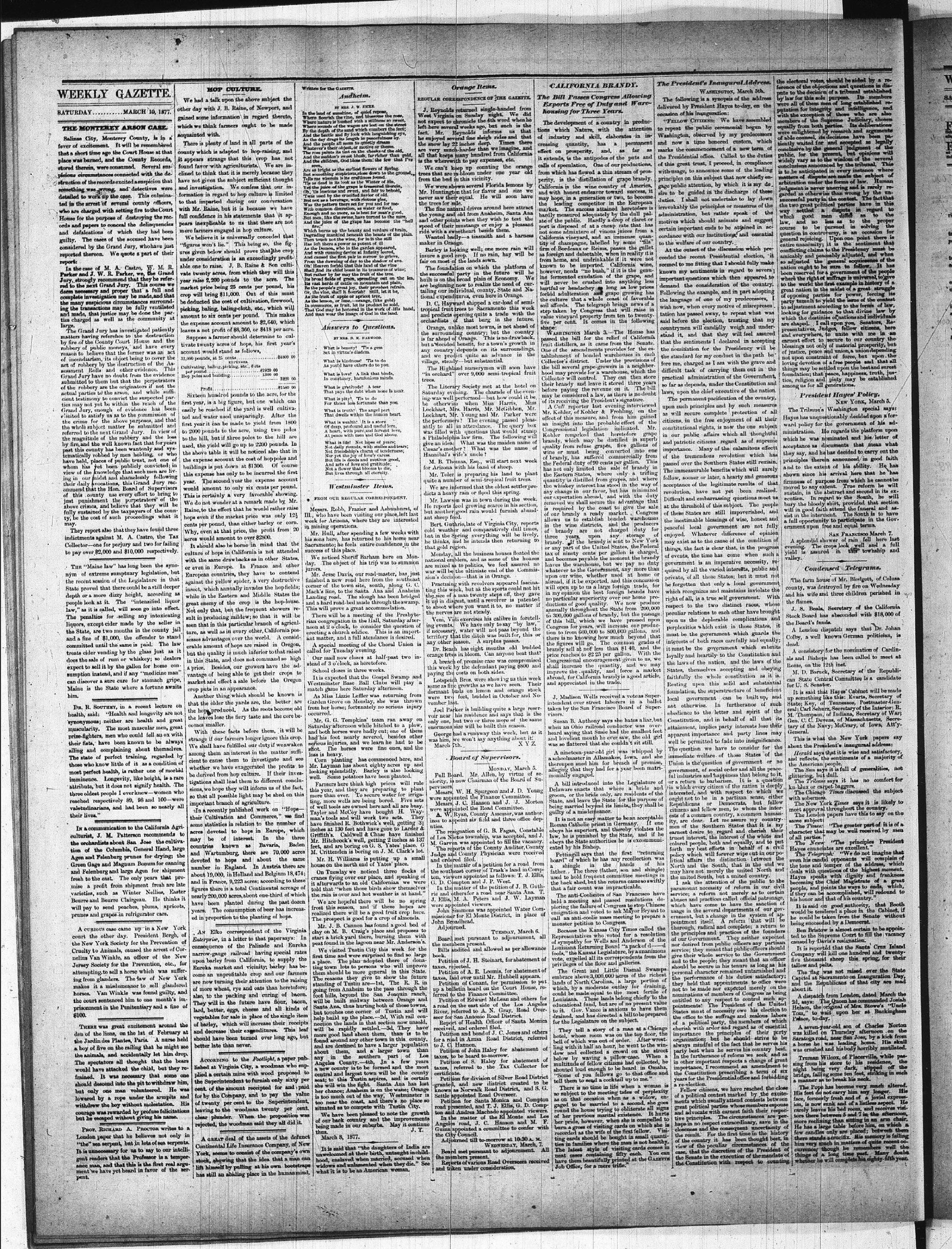
Searchable text
WEEKLY GAZETTE.
SATURDAY...MARCH 10, 1877.
THE MONTEREY ARSON CASE.
Salinas City, Monterey County, is in a fever of excitement. It will be remembered that a short time ago the Court House at that place was burned, and the County Records, stored therein, were consumed. Several suspicious circumstances connected with the destruction of the records excited a suspicion that something was wrong, and detectives were detailed to work up the case. This culminated in the arrest of several county officers, who are charged with setting fire to the Court House for the purpose of destroying the records and papers to conceal the delinquencies and defalcations of which they had been guilty. The cases of the accused have been considered by the Grand Jury, who have just reported thereon. We quote a part of their report:
In the case of M. A. Castro, W. M. R. Parker and J. W. R. Parker, we, the Grand Jury, strongly recommend that they be referred to the next Grand Jury. This course we deem necessary and proper that a full and complete investigation may be made, and that the many suspicious circumstances surrounding the transactions may be fully ventilated and made, that justice may be done the parties charged as well as the community at large.
The Grand Jury has investigated patiently matters having reference to the destruction by fire of the County Court House and the robbery of public moneys, and have every reason to believe that the former was an act of incendiarism, its object being to cover the act of robbery by the destruction of the Assessment Rolls and other evidence. This Grand Jury have no doubt from the evidence submitted to them but that the perpetrators of the robbery are the originators if not the actual parties to the arson, and while sufficient testimony to convict the suspected parties may not yet be within the reach of the Grand Jury, enough of evidence has been elicited to satisfy us as to the commission of the crime for the above purposes, and that the whole subject matter be submitted and referred to the next Grand Jury. In view of the magnitude of the robbery and the loss by fire, and the well known fact that for years past this county has been wantonly and systematically robbed by men holding, or who have held, places of public trust, not one of whom has been publicly convicted in HOP CULTURE.
We had a talk upon the above subject the other day with J. B. Raine, of Newport, and gained some information in regard thereto, which we think farmers ought to be made acquainted with.
There is plenty of land in all parts of the county which is adapted to hop-raising, and it appears strange that this crop has not found favor with agriculturists. We are inclined to think that it is merely because they have not given the subject sufficient thought and investigation. We confess that our information in regard to hop culture is limited to that imparted during our conversation with Mr. Raine, but it is because we have full confidence in his statements that it appears inexplicable to us that there are not more farmers engaged in hop culture.
We believe it is universally conceded that "figures won't lie." This being so, the figures given below should prove that the crop under consideration is an exceedingly profitable one to raise. J. B. Raine & Son cultivate twenty acres, from which they will this year raise 2,200 pounds to the acre. The market price being 25 cents per pound, his crop will bring $11,000. Out of this must be deducted the cost of cultivation, firewood, picking, baling, baling-cloth, etc., which will amount to six cents per pound. This makes the expense account amount to $2,640, which leaves a net profit of $8,360, or $418 per acre.
Suppose a farmer should determine to cultivate twenty acres of hops, his first year's account would stand as follows,
32,000 pounds at 25 cents.....$4900 00
Cultivating, baling, picking, etc., 6 ets
per pound.....$1920 00
Hop poles and building.....1300 00
Profit.....$1580 00
Sixteen hundred pounds to the acre, for the first year, is a big figure, but one which can easily be reached if the yard is well cultivated and water used unsparingly. After the first year it can be made to yield from 1800 to 2000 pounds to the acre, using two poles to the hill, but if three poles to the hill are used, the yield will go up to 2200 pounds. In the above table it will be noticed also that in the expense account the cost of hop poles and hops is not down at $1300.
Written for the Gazette.
Andhle
BY MRS. J.
In the land of sunshine,
Where flourish the vine,
Where nature is bushed wiWhere sounds of the wagBy the depth in its look aYet the juice of the grape
Oh; its luscious and sweet
Twas used by the crucifix
But not as a beverage,
Was the pattern there sewWith common discretion,
Enough and no more,
But men like the swine,
And the juice of the grieWhich burns up the beam.
Degrading mankind beneThen touch not the wine.
Has left there a power acAs the Demon, who in thaAnd with cunning device
And caused the first pain
From the dawning of day
Oh! Heaven forbid that it
shall find its chief boast.
But rather by far may it
Its broad fields of grain,
Its vast herds of cattle owe
To be people's great joy.
Or, the vine, shall it flourAs the fruit of apple or orAs the lemon, or lime...
In commerce, as fruit, leaThat God may be honored
And man wear the image.
Answers to
BY MRS. D.
What is beauty?
Set in virtue's sense.
What is kindness?
As you'd have done.
What is love?
In constancy.
What is gratitude?
That jays on me.
What is pity?
For those less fortunate.
What is truth?
That dwells with me.
What is wealth?
Of deep, profound heart.
What is health?
Of heart with mind.
What is life?
Not daily routine.
Not friendship.
Nor yet the joys life is deprived.
And acts of love.
Grand Jury have no doubt from the evidence submitted to them but that the perpetrators of the robbery are the originators if not the actual parties to the arson, and while sufficient testimony to convict the suspected parties may not yet be within the reach of the Grand Jury, enough of evidence has been elicited to satisfy us as to the commission of the crime for the above purposes, and that the whole subject matter is submitted and referred to the next Grand Jury. In view of the magnitude of the robbery and the loss by fire, and the well known fact that for years past this county has been wantonly and systematically robbed by men holding, or who have held, places of public trust, not one of whom has yet been publicly convicted; in view of the knowledge that such men are living in our midst and shamelessly following their daily avocations, this Grand Jury recommend that the Hon. Board of Supervisors of this county use every effort to bring to just punishment the perpetrators of the above crimes, and believe that they will be fully sustained by the taxpayers of the county, be the cost of such proceedings what it may.
They report also that they have found three indictments against M. A. Castro, the Tax Collector—one for perjury and two for failing to pay over $2,000 and $10,000 respectively.
The "Maine law" has long been the synonym of extreme sumptuary legislation, but the recent session of the Legislature in that State proved that there could be a still deeper depth or a more dizzy height, according as people look at it. The "intensified liquor law," as it is called, will soon go into effect. The penalties for selling any intoxicating liquors, except cider made by the seller in the State, are two months in the county jail and a fine of $1,000, the offender to stand committed until the same is paid. The law treats cider vending by the glass just as it does the sale of rum or whiskey; so dealers expect to sell it by the gallon for home consumption instead, and if any "medicine man" can discover a sure cure for stomach gripe, Maine is the State where a fortune awaits him.
Dr. R. Southey, in a recent lecture on health, said: "Health and longevity are not synonymous; neither are health and great muscularity. The most muscular men, great prize-fighters, men who could fell an ox with their fists, have been known to be always alling and complaining about themselves. The state of perfect training, regarded by those who know little of it as a condition of most perfect health, is rather one of morbid imminence. Longevity, like height, is a rare attribute, but it does not signify health. The three oldest people I ever knew—women who reached respectively 89, 98 and 100—were valetudinarians, and had been so nearly all their lives."
In a communication to the California Agriculturist, J. M. Patterson recommends to the orchardists about San Jose the cultivation of the Columbia, General Hand, large Agen and Felenburg prunes for drying; the Green Gage and Magnum Bonum for canning and Felenburg and large Agen for shipment fresh to the east. The only pears that pro-
Sixteen hundred pounds to the acre, for the first year, is a big figure, but one which can easily be reached if the yard is well cultivated and water used unsparingly. After the first year it can be made to yield from 1800 to 2000 pounds to the acre, using two poles to the hill, but if three poles to the hill are used, the yield will go up to 2200 pounds. In the above table it will be noticed also that in the expense account the cost of hoppoles and buildings is put down at $1300. Of course this expense has only to be incurred the first year. The second year the expense account would amount to only six cents per pound. This is certainly a very favorable showing. We do not wonder at a remark made by Mr. Raine, to the effect that he would rather raise hops even if the market price was only 12½ cents per pound, than either barley or corn. Why, even at that price, the profit from 20 acres would amount to over $2800.
It should also be borne in mind that the culture of hops in California is not attended with the same drawbacks as in other States, or even in Europe. In France and other European countries, they have to contend against the yellow spider, a very destructive insect, which annually invades the hopfields; while in the Eastern and Middle States the great enemy of the crop is the hop-louse. Not only that, but the frequent showers result in producing mildew; so that it will be seen that in this particular branch of agriculture, as well as in every other, California possesses advantages over the world. A considerable amount of hops are raised in Oregon, but the quality is much inferior to that raised in this State, and does not command so high a price. Besides, our growers have the advantage of being able to get their crops to market and effect a sale before the Oregon crop puts in an appearance.
Another thing which should be known is that the older the yards are, the better are the hops produced. As the roots become old the leaves lose the fiery taste and the core becomes smaller.
With these facts before them, it will be strange if our farmers longer ignore this crop. We shall have fulfilled our duty if we awaken among them an interest in the matter sufficient to cause them to investigate and see whether we have exaggerated the profits to be derived from hop culture. If their investigations shall lead them to different conclusions, we hope they will inform us of the fact, so that all possible light may be shed on this important branch of agriculture.
In a recently published work on "Hops—their Cultivation and Commerce," we find some statistics in relation to the number of acres devoted to hops in Europe, which may be of interest. In the three countries known as Bavaria, Baden and Wartumburg, there are 70,000 acres devoted to hops and about the same number in England. In Austria there are about 19,000, in Holland and Belgium 18,474; and in France 9,223 acres; according to these
In a communication to the California Agriculturist, J. M. Patterson recommends to the orchardists about San Jose the cultivation of the Columbia, General Hand, large Agen and Felenburg prunes for drying; the Green Gage and Magnum Bonum for canning and Felenburg and large Agen for shipment fresh to the east. The only pears that promise a profit from shipment fresh are late varieties, such as Winter Nellies, Easter Beurre and Beurre Clairgeau. He thinks it will pay to send peaches, plums, apricots, prunes and grapes in refrigerator cars.
A curious case came up in a New York court the other day. President Bergh, of the New York Society for the Prevention of Cruelty to Animals, caused the arrest of Cornelius Van Winkle, an officer of the New Jersey Society for the Prevention, etc., for attempting to sell a horse which was suffering from glanders. The law of New York makes it a misdemeanor to sell glandered horses. Van Winkle was found guilty, and the court sentenced him to one month's imprisonment in the Penitentiary and a fine of $100.
There was great excitement around the den of the lions, on the 1st of February at the Jardin des Plantes, Paris. A nurse held a boy of five on the railing that he might see the animals, and accidentally let him drop. The spectators all thought that the bears would have attacked the child, but they refrained. It was necessary that some one should descend into the pit to withdraw him, but only one man volunteered. He was lowered by a rope under the armpits and withdraw the boy without molestation. His courage was rewarded by profuse felicitations but he escaped without giving his name.
Prop. Richard A. Proctor writes to a London paper that he believes not only in "the" sea serpent, but in lots of sea serpents. It is unnecessary for us to say to our intelligent readers that the Professor is a temperance man, and that this is the first real argument we have yet heard in favor of the serpent.
An Elko correspondent of the Virginia Enterprise, in a letter to that paper says: In consequence of the Palisade and Eureka narrow-gauge railroad having special rates upon barley from California, to supply the Eureka market and vicinity; barley has become an unprofitable crop and our farmers are now turning their attention to the raising of more wheat, rye and oats than heretofore; also, to the packing and curing of bacon. They will in the future have flour, bacon, lard, butter, eggs, cheese and all kinds of vegetables for sale in place of the single item of barley, which will increase their receipts and decrease their expenditures. This leaf should have been turned over long ago, but better late than never.
According to the Footlight, a paper published at Virginia City, a woodman who supplied a certain mine with wood proposed to the Superintendent to furnish only sixty per cent of the amount received for and paid for by the Company, and to pay the value of twenty per cent to the Superintendent, leaving to the woodman twenty per cent clear plunder. When the proposition was rejected, the woodman said they all did it.
A great deal of the assets of the defunct Continental Life Insurance Company, of New York, seems to consist of the company's own stock, showing that the idea that a man can lift himself by pulling at his own bootstraps has still an abiding place in the human mind.
Written for the Gazette.
Andheim.
BY MRS. J. W. NICKS.
In the land of sunshine, of quiet repose,
Where flourish the vine, and blossoms the rose,
Where nature is bushed with a stillness so sweet,
Where sounds of the wagon are lost on the street
By the depth of the sand which numbers the feet;
And the beetle and fly look with languishing eye,
As the day drags its length in peacefulness by.
And the people all seem to quietly dream
Whatever's their object, or motive or theme.
The rose paints its tint on the cheeks of the old,
And the maiden's sweet blush, far richer than gold,
And the children, God bless them! The few that I've seen.
Are as bright as the earliest flowers of Spring.
But something suspicious, close down to the ground,
Tells me wherein its craftiness found.
Tis as dead in its look as the Winter of Six.
Yet the juices of the grape are treasured therein,
Oh! its juices and sweet, and fair to behold,
Twice used by the crucified Savior of old.
Bot not as a beverage, with riotous glee,
Was the pattern there set for you and for me
With common discretion, as water or food,
Enough and no more, as is best for man's good,
But men, like the swine, have turned to the mare,
And the juices of the grape has become the "hell fire".
Which burns up the beauty and verdure of brain,
Degrading mankind beneath the beasts of the plain.
Then touch not the wine, for in it the still
Has left there a power as potent of ill
As the Demon, who in the garden appeared,
And with cunning device in Infinity leered,
And caused the first pair in sorrow to grieve.
From the dawning of day to the shadow of eve.
Oh! Heaven forbid that this land of the vine
Shall find its chief boast in its treasures of wine;
But rather by far may the葡萄 be the "hell fire".
Which burns up the beauty and verdure of brain,
Degrading mankind beneath the beasts of the plain.
Then touch not the wine, for in it the still
Has left there a power as potent of ill
As the Demon, who in the garden appeared,
And with cunning device in Infinity leered,
And caused the first pair in sorrow to grieve.
From the dawning of day to the shadow of eve.
Oh! Heaven forbidden that this land of the vine
Shall find its chief boast in its treasures of wine;
But rather by far may the葡萄 be the "hell fire".
Which burns up the beauty and verdure of brain,
Degrading mankind beneath the beasts of the plain.
Then touch not the wine, for in it the still
Has left there a power as potent of ill
As the Demon, who in the garden appeared,
And with cunning device in Infinity leered,
And caused the first pair in sorrow to grieve.
From the dawning of day to the shadow of eve.
Oh! Heaven forbidden that this land of the vine
Shall find its chief boast in its treasures of wine;
But rather by far may the葡萄 be the "hell fire".
Which burns up the beauty and verdure of brain,
Degrading mankind beneath the beasts of the plain.
Then touch not the wine, for in it the still
Has left there a power as potent of ill
As the Demon, who in the garden appeared,
And with cunning device in Infinity leered,
And caused the first pair in sorrow to grieve.
From the dawning of day to the shadow of eve.
Oh! Heaven forbidden that this land of the vine
Shall find its chief boast in its treasures of wine;
But rather by far may the葡萄 be the "hell fire".
Which burns up the beauty and verdure of brain,
Degrading mankind beneath the beasts of the plain.
Then touch not the wine, for in it the still
Has left there a power as potent of ill
As the Demon, who in the garden appeared,
And with cunning device in Infinity leered,
And caused the first pair in sorrow to grieve.
From the dawning of day to the shadow of eve.
Oh! Heaven forbidden that this land of the vine
Shall find its chief boast in its treasures of wine;
But rather by far may the葡萄 be the "hell fire".
Which burns up the beauty and verdure of brain,
Degrading mankind beneath the beasts of the plain.
Then touch not the wine, for in it the still
Has left there a power as potent of ill
As the Demon, who in the garden appeared,
And with cunning device in Infinity leered,
And caused the first pair in sorrow to grieve.
From the dawning of day to the shadow of eve.
Oh! Heaven forbidden that this land of the vine
Shall find its chief boast in its treasures of wine;
But rather by far may the葡萄 be the "hell fire".
Which burns up the beauty and verdure of brain,
Degrading mankind beneath the beasts of the plain.
Then touch not the wine, for in it the still
Has left there a power as potent of ill
As the Demon, who in the garden appeared,
And with cunning device in Infinity leered,
And caused the first pair in sorrow to grieve.
From the dawning of day to the shadow of eve.
Oh! Heaven forbidden that this land ofthe vine
Shall find its chief boast in its treasures of wine;
But rather by far maythe葡萄 bethe "hell fire"
Which burns up the beauty and verdure of brain,
Degrading mankind beneath the beasts of the plain.
Then touch not the wine, for in it the still
Has left there a power as potent of ill
As the Demon, who in the garden appeared,
And with cunning device in Infinity leered,
And caused the first pair in sorrow to grieve.
From the dawning of day tothe shadowofeve.
Oh! Heaven forbidden that this landofthe vine
Shall find its chief boast in its treasuresof wine;
But rather by far maythe葡萄 bethe "hell fire"
Which burns up the beauty and verdure of brain,
Degrading mankind beneaththebeastsoftheplain.
Then touch notthewine,forsinitheland
Answers to Questions.
BY MRS. D. M. HARWOOD.
What is beauty? Tis a gem
Set in virtue's diadem.
What is kindness? Tis to do
As you'd have others do to you.
What is love? A link that binds,
In constancy, harmonious minds.
What is gratitude? A tear
That paysthe debt when none is near.
What is jity? Tis to do
For those less fortunate than you.
What is truth? The angel part
That dwells withinthehumanheart.
What is wealth? It isa store
Ofdeep,profoundandusefullore,
Aheart,pureandferventlove,
AtpeacewithmenandGodabove.
What is life? Notlapseofyears;
Notdailyroundswithsmilesandtears;
Notfriendship'scharmoftenderness;
Noryetthejoyoflove'scares.
Butlifeisdeedsandmotivesgood,
Andactsofloveandgratitude;
Orange Items.
REGULAR CORRESPONDENCE OF THE GAZETTE.
J. Reynolds returned single-handedfromWestVirginiaonSundaynight. We didnotexpecttochroniclethe4thwordwhenhelefthereseveralweeksago,bbutsuchisthefact.Mr.Reynolds informsusthatheenjoyedseveralfine骁骑ridesandthatthesnowlay22inchesdeep.Timesthereareverymuch-harderthanweimagine,andallthatkeepsmanyhundredfromCaliforniaiswherewithtowypayexpenses,eetc.
Wecan'tkeepupcountingtheorangetreesthatareimbloomunderoneyearoldfromthebedinthisvicinity.
WewereshownseveralfloralemonbyMr.Huntingtonthatforflavorandsizewenever sawtheirequal.Hewill soonhavethetreesforsale.
The finenaturaldrivesaroundhereattracttheyoungoldandfromAnaheim,SantaAnaandotherpointswhenthey wishtotestthespeedofthemustangsorenjoyapleasantridewitha sweetheartbeside them.
Wantedbadly—atinsmithandaharnessmakerinOrange.
Barleyislookingwell;onemorerainwillinsureagoodrop.Ifno rain,haywillbefaironmostofthelandssown.
ThefoundationonwhichtheplatformofthesuccessfulpartinythefuturewillbebuiltisonthebroadplainofEconomy.Wearebeginningnowtorealizeneedofcurtailingourindividual,county.StateandNationalexpenditures,evenhereinOrange.
D.C.Haywardshippedacarloadofsemi-tropicalfruittreetstosacramentothisweekandpredictopenquitea tradewiththeorchardistsofthatburginthen Future.
Orange,unlikemosttowns,isnotaheadofthesurroundingcountry;butthecountryisfarbackofOrange.Thisisnodrawbackbutadecidedbenefit,fora town'sgrowthinanycountrydependsonits surroundings,andwepredictquiteanadvanceinthevillage,steady—butsubstantial.
TheHighland nurserymenwill soonhave"inorchard"over9,000semi-tropicalfruittrees.
TheLiterarySocietymetatathelostonSaturdayevening.Thecharadeoftheeveningwaswellperformed—buthowcoulditbebeotherwisewhenMissHarris,MissLockhart,Mrs.Harris Mr.McGibbon,Mr.Lockhart,Mr.YoungandMr.Parkerweretheperformers?Theeveningpassedpleasantlytoallinattendance.ThequeryboxwasfilledwithquestionsthatwouldstumpaPhiladelphialaw firm.Thefollowingwilgiveanidea:WhatwasthemaidennameofCeezar'smother?WhatwasthenameofHannibal'swife'suncle?
M.B.Thomas,Esq.,willstartnextweek
CALIFORNIA BRANDY.
TheBillPassesCongressAllowingExportsFreeofDutyandWarehousingforThreeYears.
ThedevelopmentofacountryinproductionswhichNature,withtheattentionofindustryandskill, elaboratesincreasingquantity,hassapermanenteffectonprosperity,andasfarasitextends,theistoptdestailodepulation.Oneof ourproductions,从whichhasfloweda thinstreamofprosperity,thedistillationofgrapebrandy.CaliforniaisthewinecountryofAmerica,andwith honest endeavortowardsuccess,它mayhope.inagenerationortwo,tobecetheleadingcompetitorintheEuropeanmarket.Thesuccessattainedheretoforeishardlymeasuredadequatelybythedullpalateofthepublic.HardlyadropofclaretorportisdisposedofatacheapratethathasnotsomeadmixtureofvinonsjuicesfromaCaliforniavineyard,andanimmensequantityofchampagne,labelledbysome"fils"firmofBorleauxorReims,Passesthegulletasforeignanddelectable,wheninrealityitisfromhome,andundrinkableifitwerenotknowntobeimported.Californiawine,however,needs"nobuah,"ifitisethegenuinefermentalexudationofthegrape,andwillneverbecrushedintoanyhurtfulorheadachelongaslowpricesforbidadulterationandgrapegrowinghastheculturethatawholecoastoffavorablesoffarms.AtelegraphbringsnewsofasteptakenbyCongressthatwillraiseinvaluevineyardpropertyfromtentwenty-fivepercent.itcomesinthefollowingshape:
WASHINGTONMarch3.-TheHousehaspassedbillfordeliefofCaliforniafruitdistillers,asit camefromtheSenate.OneoftheamendmentsprovidesfortheestablishmentofbondedwarehousesineachCollector'sdistrict.Undertheprovisionsofthebillegrape-growersina neighborhoodmayprovidefordwarehouse,theCollectorwillcontrol.Theycanthenstore theirbrandyandleaveit storedthree yearsbeforepayingtherevenueonit. The billmaybeconsidereda law,asthereisno doubtofitsreceivingThepresident'ssignature.
ACallreporterlasteveninterviewedMr.Kohler,ofKohler&Frohlung.ontheeffectofthismeasure,andfromhim gainedan insight intotheprobable effectofthe Congressional legislationindicated.Mr.Kohlerremarkedthatheretoforegrapebrandywhichmaybedistributedinsuperbqualityfromrefusegrapes,five gallonsofwineormustbeingconvertedintoonebrandy,hassufferedcommerciallyfromtheFederaldutyof90centssuperillon.The
Westminster Items.
FROM OUR REGULAR CORRESPONDENT.
Messrs. Robb, Frazier and Ashunhurst, of Ill., who have been visiting our place, left last week for Arizona, where they are interested in mining operations.
Mr. Hull, after spending a few weeks with his sons here, has returned to his home near Sacramento; he feels entire confidence in the success of this place.
We noticed Sheriff Barham here on Monday. The object of his trip was to summon jurors.
Mr. Jesse Davis, our road-master, has just finished a new road here from the southeast corner of the town site, south, along G. C. Mack's line, to the Santa Ana and Anaheim Landing road. The slough has been bridged and a hard road-bed made through the swamp. This will prove a great accommodation.
There will be a meeting of the Presbyterian congregation in the Hall, Saturday afternoon at 2 o'clock, to consider the question of erecting a church edifice. This is an important matter, and a full attendance is desired.
A special meeting of the Choral Union is called for Tuesday evening.
Our mail now closes at half-past two instead of 3 o'clock, as heretofore.
School closes in three weeks.
It is expected that the Gospel Swamp and Westminster Base Ball Clubs will play a match game here Saturday afternoon.
As Miss Lizzie Leffler was returning from Garden Grove on Monday, she was thrown from her horse; fortunately no serious injury occurred.
Mr. G. G. Tompkins' team ran away on Saturday afternoon while hitched to a plow, and both horses were badly cut; one of them had his foot nearly severed, besides other serious injuries, and we learn he had to be afloat. The horses were fine ones, and the loss is heavy.
Corn planting has commenced here, and Mr. Layman has about eighty acres up and looking splendidly. Barley is also looking well. Some potatoes have been planted.
Farmers think high prices will rule this year, and they are preparing to plant more than ever. To secure water for irrigating, more wells are being bored. Five sets of well tools are owned here and all are busy. Taylor and McCoy have bought H. Wayman's tools and will work two sets. They have finished R. Bothwick's well, getting 31 inches at 130 feet and have gone to Larder & Griffith's. Caldwell & Chase have finished Mr. Hitchcock's well, getting 2 inches at 137 feet, and are boring on G. S. Yates' place. G. M. Crittenden is boring on J. M. Clark's lot.
Mr. H. Williams is putting up a small house on the north end of Yates' place.
On Tuesday we noticed three flocks of cranes flying over our place, and speaking of it from an old Californiaian we were informed that the oldest settler predicts a heavy rain or flood this spring.
Mr. Lawson was in town during the week. He reports feed growing scarce in his section, but another good rain would furnish abundant sheep feed.
Bert Guthrie, late of Virginia City, reports cold weather and comparatively dull times, but in the Spring everything will be lively, he thinks, and he intends then returning to that gold region.
Monday, all the business houses floated the national emblem, and as some of the houses are mixed as to politics, we feel assured no war will be the ultimate end of the Commission's decision—that is in Orange.
Practising with revolvers appeared fascinating this week, but as the sports could not hit the size of a man twenty steps off, they gave it up in disgust, until a revolver is patented to shoot where you want it to, no matter if the nerves are not steady.
Veni, Vili exercises his calibre in foretelling events. We have only to say "by law," if necessary, water will not pass beyond the territory that the ditch was built for, this or any other season. A surplus passes.
Dr. Beach has eight months old budded orange trees in bloom. Can anyone beat that?
A breach of promise case was compromised this week by the defendant paying $800 and paying the costs on both sides.
Lotspeich Bros. were showing us this week some as fine growths as we have seen. Their dormant buds on lemon and orange stock were two feet, budded in October and November last.
Joel Parker is building quite a large reservoir near his residence and says that is the only one, but two or three more of the same enormous size will be built this season.
George had a runaway this week, but as it was him, we won't say anything about it.
March 7th.
Board of Supervisors.
MONDAY, March 5.
Full Board. Mr. Allen, by virtue of seniority, is now Chairman of the Board of Supervisors.
Messrs. W. H. Spurgeon and J. D. Young were appointed the Finance Committee.
Messrs. J. C. Hanson and J. J. Morton were appointed the Road Committee.
A. W. Ryan, County Assessor, was authorized to appoint six field and three office deputies.
The resignation of G. B. Fagan, Constable of Los Nietos township, was accepted, and J. M. Garven was appointed to fill the vacancy.
The reports of the County Auditor, County Judge and County Physician were received and ordered filed.
In the matter of a petition for a road from the southeast corner of Trask's land in Compton, viewers appointed as follows: T. J. Ellis, G. D. Compton and J. P. West.
A Call reporter last evening interviewed Mr. Kohler, of Kohler & Frohling, on the effect of this measure, and from him gained an insight into the probable effect of the Congressional legislation indicated. Mr. Kohler remarked that hermtofore grape brandy, which may be distilled in superb quality from refuse grapes, five gallons of wine or must being converted into one of brandy, has suffered commercially from the Federal duty of 90 cents per gallon. This has not only limited the sale of brandy in the Eastern States, where only a trifling quantity is distilled from grapes, and where the whiskey interest has stood in the way of any change in our favor, but has minimized our exportation abroad, and with the duty removed we shall secure the advantage that is required by the coast to give the sale of our brandy a ready market. Congress allows us to establish bonded warehouses in the wine districts, and the producers of brandy are not charged duty for three years upon any storage of brandy. If the brandy is sent to New York or any part of the United States, the Federal tax of ninety cents per gallon is charged, and becomes payable the moment the brandy leaves the warehouse, but we pay no duty whatever to the Government, any more than upon our wine, whether used at home or abroad, if it be exported, and this concession will open up to us a large foreign trade, for in my opinion the best foreign brands have no particular superiority over our home productions of good quality. We now produce annually throughout the State from 200,000 to 300,000 gallons of brandy, but the passage of this bill, which we have pressed upon Congress for years, will increase our production to from 600,000 to 800,000 gallons, and there is no knowing how much beyond that the figures will go. The common grades of brandy sell at not less than $140, and the price reaches to $225 per gallon. With the Congressional encouragement given to us, we shall increase the quantity, and we may improve the quality, and force a market abroad, for California brandy is a good article, and appreciated in the trade.
J. Madison Wells received a voteas Superintendent over street laborers in a ballot taken by the San Francisco Board of Supervisors.
Susan B. Anthony says she hates aliar, but when an Ohio railroad conductor was overheard saying that Susie had the smallest feet and loveliest mouth he saw, the old girl was so flattered that she couldn't sit still.
A nineteen-year-old girl was whipped by a schoolmaster in Allamakee, Iowa, and she thereupon sued him for breach of promise, alleging that they had for a year been matrimonially engaged.
A bill introduced into the Legislature of Delaware enacts that where a bride and groom, or the bride only, are residents of the State, and leave the State for the purpose of being married beyond its limits, they shall be guilty of a misdemeanor.
It is not an easy matter to bean acceptable Roman Catholic priest in Germany. If one obeys his superiors, and thereby violates the law, he is punished by the State, and if he obeys the State authorities he is excommicated by his Bishop.
Pettingill says that the first "returning board" of which he has any recollection was a shingle in the hands of his father. The three (father, son and shingle) used to hold frequent committee meetings in back shed but the returns came so swiftly
Farmers here think high prices will rule this year, and they are preparing to plant more than ever. To secure water for irrigation, more wells are being bored. Five sets of well tools are owned here and all are busy. Taylor and McCoy have bought H. Wayman's tools and will work two sets. They have finished R. Bothwick's well, getting 31 inches at 130 feet and have gone to Larder & Griffith's. Caldwell & Chase have finished Mr. Hitchcock's well, getting 2 inches at 137 feet, and are boring on G. S. Yates' place. G. M. Crittenden is boring on J. M. Clark's lot.
Mr. H. Williams is putting up a small house on the north end of Yates' place.
On Tuesday we noticed three flocks of cranes flying over our place, and speaking of it afterwards to an old Californian we were told that "when those birds show themselves the rain is over and hot weather is at hand."
We are hopeful there will be no spring frost this season, and if these hopes are realized there will be a good fruit crop here. The prospect is good for a crop of almonds.
Mr. J. B. Cannon has found a good bed of clay on M. B. Craig's place and proposes to start a brick yard there, burning them with peat found in the lagoon near Mr. Anderson's.
We visited Tustin City this week for the first time and were surprised to find so large a place. The plan adopted there of donating town lots to persons who will improve them should be more general in this State. The reasons they give to show the future standing of Tustin are—1st, The R. R. in going from Anaheim to the pass through the foot hills, beyond the San Joaquin ranch, will be built midway between Orange and Santa Ana, thus hurting both of those towns, but touches one corner of Tustin and will help build up the place.—2nd, With rail connection the lands in that section now unsold, will be rapidly settled.—3rd, They have more good land about them, than is to be found around any other town in this county, and are destined to have a larger population about them, and a larger town than any in the southern part of Los Angeles County.—4th, In a few years a new county is to be formed and the most central and largest town will be the county seat; to this Tustin aspires, and is certain she will win the fight. Santa Ana has lost her chance; Anaheim is on the wane; Orange is too much out of the way, Westminster is too near the coast, and there's no place so situated as to compete with Tustin City.
We have been pleased to note the growth of our back country and the improvements being made in our suburbs. May it continue thus.
March 8, 1877.
It is said that "the daughters of India are unwelcome at their birth, untaught in childhood, enalaved when married, accused when widows and unlamented when they die." See what it is to be an American woman.
Messrs. W. H. Spurgeon and J. D. Young were appointed the Finance Committee.
Messrs. J. C. Hanson and J. J. Morton were appointed the Road Committee.
A. W. Ryan, County Assessor, was authorized to appoint six field and three office deputies.
The resignation of G. B. Fagan, Constable of Los Nietos township, was accepted, and J. M. Garven was appointed to fill the vacancy.
The reports of the County Auditor, County Judge and County Physician were received and ordered filed.
In the matter of a petition for a road from the southeast corner of Trask's land in Compton, viewers appointed as follows: T. J. Ellis, G. D. Compton and J. P. West.
In the matter of the petition of J. B. Guthrie and others for a road near Santa Ana, T. J. Ellis, M. A. Peters and J. W. Layman were appointed viewers.
John Simmons was appointed Water Commissioner for El Monte District, in place of John Broadhead.
Adjourned.
TUESDAY, March 6.
Board met pursuant to adjournment, all the members present.
Bills audited and allowed as per allowance book.
Petition of J. H. Steinart, for abatement of taxes, rejected.
Petition of A. R. Loomis, for abatement of taxes, laid over until Mr. Hubbell appears.
Petition of Conant, for permission to put up a bulletin board on the Court House, referred to the Finance Committee.
Petition of Edward McLean and others for a road on the east side of the Los Angeles River, referred to A. N. Gray, Road Overseer for San Antonio Road District.
Report of Health Officer of Santa Monica received, and ordered filed.
Petition and bond of J. C. Jones and others for a road in Azusa Road District, referred to J. C. Hannon.
Petition of John Haley for abatement of taxes, to be heard to-morrow.
Petition of S. Haley for abatement of taxes, referred to the Tax Collector for certificate.
Petition for division of Silver Road District granted, and new district created to be known as Norwalk Road District, and S. G. Settle appointed Road Overseer.
Petition for Santa Monica and Compton road presented, and T. J. Ellis, G. D. Compton and Andres Machado appointed viewers.
In the matter of the El Monte and Los Angeles road, J. C. Hanson and M. F. Guinn appointed a committee to confer with the City Council.
Adjourned till to-morrow at 10:20 A.M.
WEDNESDAY, March 7.
Board met pursuant to adjournment. All the members present.
Reports of various Road Overseers received and taken under consideration.
A bill introduced into the Legislature of Delaware enactts that where a bride or groom, or the bride only, are residents of the State, and leave the State for the purpose of being married beyond its limits, they shall be guilty of a misdemeanor.
It is not an easy matter to be an acceptable Roman Catholic priest in Germany. If one obeys his superiors, and thereby violates the law, he is punished by the State, and if he obeys the State authorities he is excommunicated by his Bishop.
Pettingill says that the first "returning board" of which he has any recollection was a shingle in the hands of his father.. The three (father, son and shingle) used to hold frequent committee meetings in the back shed, but the returns came so swiftly that a fair count was impracticable.
The anti-Coolieites of San Francisco have held a meeting and passed resolutions deploring the failure of Congress to stop Chinese emigration and voted to ask Mayor Bryant to call an anti-coolie mass meeting to prepare a monster petition to Congress.
Because the Kansas City Times called the Representatives who voted for a resolution of sympathy for Wells and Anderson of the Louisiana Returning Board "a pack of d——d fools," the Kansas Legislature, by a unanimous vote, expelled all its correspondents from the privileges of the floor and galleries.
The Great and Little Dismal Swamps embrace above 3,000,000 acres of the richest lands of North Carolina, a large portion of which, by a moderate outlay for draining could be made equal to the most fertile of Louisiana. These lands belong chiefly to the educational fund, but are of no present value to it. Gov.Vance is anxious to have them drained, and has directed a bill to be prepared for the Legislature on the subject.
They tell a story of a man at a Chicago hotel, whose room was on the top floor, the bell of which was out of order. After wrestling with it half an hour, he went to the window and collected a crowd on the street below by waving a pillow-case. When a multitude of fellow citizens had collected, he shouted loud enough to be heard in Omaha,
"Some of you fellows go to that office and tell them to send a cocktail up to me."
There is no time in life when a woman is so subject to the meeting tides of perplexity as on that occasion when as widow, engaged to be married to a second, she goes round the house trying to obliterate all signs of her previous marital existence. It hurts her pride, however, when she is compelled to burn a gross of visiting cards on which she is recorded as the wife of the first fellow.
Visiting cards should be bought in small quantities in families where the man is not healthy. The latest style of visiting cards comes in neat cases containing fifty each. You can have them beautifully printed at the Gazette Job Office, for a mere trifle."
The President's Inaugural Address.
WASHINGTON, March 5th.
The following is a synopsis of the address delivered by President Hayes to-day, on the occasion of his inauguration:
"Fellow Citizens: We have assembled to repeat the public ceremonial begun by Washington, observed by my predecessors and now a time honored custom, which marks the commencement of a new term of the Presidential office. Called to the duties of this great trust, I proceed, in compliance with usage, to announce some of the leading principles on this subject that now chiefly engage public attention, by which it is my desire to be guided in the discharge of these duties. I shall undertake to lay down irrevokably the principles or measures of the administration, but rather speak of the motives which should animate and suggest certain important ends to be attained in accordance with our institutions and essential to the welfare of our country.
At the outset of the discussion which preceded the recent Presidential election, it seemed to me fitting that I should fully make known my sentiments in regard to several important questions which then appeared to demand the consideration of the country. Following the example, and in part adopting the language of one of my predecessors, I wish now, when every motive of misrepresentation has passed away, to repeat what was said before the election, trusting that my countrymen will candidly weigh and understand it, and that they will feel assured that the sentiments I declared in accepting the nomination for the Presidency will be the standard for my conduct in the path before me, charged as I am with the grave and difficult task of carrying them out in the practical administration of the Government, so far as depends, under the Constitution and laws, upon the chief executive of the nation.
The permanent pacification of the country, upon such principles and by such measures as will secure complete protection of all citizens, in the free enjoyment of all their constitutional rights, is now the one subject in our public affairs which all thoughtful and patriotic citizens regard as of supreme importance. Many of the calamitous effects of the tremendous revolution which has passed over the Southern States still remain.
the electoral votes, should be sided by a reference of the objections and questions in dispute to the decision of a tribunal established by law for this sole purpose. Its members were all of them men of long established reputation for integrity and intelligence, and with the exception of those who are also members of the Supreme Judiciary, chosen equally from both parties. Its deliberations were enlightened by research and arguments of able counsel, its decisions have been patiently waited for and accepted as legally conclusive by the general judgment of the public, for the present, but opinions will widely vary as to the wisdom of the several conclusions announced by the tribunal. This is to be anticipated in every instance where matters of disputes are made the subject of arbitration under the forms of law. Human judgment is never unerring and is rarely regarded as otherwise than wrong by the unsuccessful party in the contest. The fact that the two great political parties have in this way settled a dispute in regard to which good man differs as to the law, and no less as to the proper course to be pursued in solving the question in controversy, is an occasion for general rejoicing. Upon one point there is entire unanimity; it is the sentiment that conflicting claims to the Presidency must be amicably and peacefully adjusted, and when so adjusted the general acquiescence of the nation ought to be sure to follow. It has been reserved for a government of the people where the right of suffrage is universal, to give to the world the first example in history of a great nation in the midst of a great struggle of opposing parties for power, forcing its party tumult to yield the issue of the contest to adjustment according to the forms of law, looking for guidance to that divine law by which the destinies of nations and individuals are shaped. I call upon you, Senators, Representatives, Judges, fellow citizens here and everywhere, to unite with me in an earnest effort to secure to our country the blessings not only of material prosperity, but of justice, peace and union, a union depending not upon constraint of force, but upon the loving devotion of a free people and that all things may be settled upon the best and最稳 foundation; that peace, happiness, truth, justice, religion and piety may be established among us for all generations.
President Hayes' Policy.
New York, March 5.
The Tribune's Washington special says:
Hayes has unquestionably decided upon a forward policy for the government of his administration. He regards the platform upon which he was nominated and his letter of acceptance as documents that mean what they say, and he has decided to carry out the principles therein announced in good faith among us for all generations.
President Hayes' Policy.
New York, March 5.
The Tribune's Washington special says: Hayes has unquestionably decided upon a forward policy for the government of his administration. He regards the platform upon which he was nominated and his letter of acceptance as documents that mean what they say, and he has decided to carry out the principles therein announced in good faith and to the extent of his ability. He has shown since his arrival here that he has firmness of purpose from which he cannot be moved to any extent. True reform he will sustain, in the abstract and second in its execution. In regard to the South, he will bury the bloody shirt, provided that section will in good faith attend the funeral and assist in the interment. The South is to have a full opportunity to participate in the Government upon free and equal terms.
SAN FRANCISCO March 7.
A splendid shower of rain fell here last evening. The crops look well and a full yield is assured in this township and valley.
Condensed Telegrams.
The farm house of Mr. Bloedgett, of Coluas county, was destroyed by fire on Wednesday and his wife and three children perished in the flames.
J. S. Beals, Secretary of the California Stock Board has absconded with $18,000 of the Board's funds.
A London dispatch says that Dr. Johan Colby, a well known German politician, is dead.
A consistency for the nomination of Cardinals and Bishops has been called to meet at Rome, on the 12th that.
M. D. Boruck, Secretary of the Republican State Central Committee is a candidate for U. S. Senator.
It is said that Hayes' Cabinet will be made up something like this: Evarts, Secretary of State; Key, of Tennessee; Postmaster-General; Carl Schurz, Secretary of the Interior: R. M. Thompson, of Indiana; Secretary of War; Gen. C. C. Devens, of Massachusetts; Secretary of the Navy; McCrary, of Iowa; Att'y-General.
This is what the New York papers say about the President's inaugural address:
Herald says that it is wise and satisfactory, and reflects, the sentiments of a majority of the American people.
The Sun says it is full of generalities, not glittering, but dull.
The Tribune says it has no comfort for ku-lux or carpet-baggers.
The Chicago Times discussed the subject with soberness.
The New York Times says it is likely to meet approval throughout the country.
The London papers have this to say on the same subject:
The Times: "The greater part of it is of a character that may be well received by men of all parties."
The News: "The principles President Hayes enunciates are excellent."
The Telegraph: "We do not imagine that even his candid opponents will complain of the tone and temper of the address, which deals with questions of the highest moment. Hayes speaks with dignity and frankness becoming the Chief Marshrat of a great difficult task of carrying them out in the practical administration of the Government, so far as depends, under the Constitution and laws, upon the chief executive of the nation.
The permanent pacification of the country, upon such principles and by such measures as will secure complete protection of all citizens, in the free enjoyment of all their constitutional rights, is now the one subject in our public affairs which all thoughtful and patriotic citizens regard as of supreme importance. Many of the calamitous effects of the tremendous revolution which has passed over the Southern States still remain. The immeasurable benefits which will surely follow, sooner or later, a hearty and generous acceptance of the legitimate results of that revolution, have not yet been realized. Difficult and embarrassing questions meet us at the threshold of this subject. The people of these States are still impoverished, and the inestimable blessings of wise, honest and peaceful local government are not fully enjoyed. Whatever difference of opinion may exist as to the cause of the condition of things, the fact is clear that, in the progress of events, the time has come when such a government is an imperative necessity, required by all the varied interests, public and private, of all those States; but it must not be forgotten that only a local government which recognizes and maintains inviolate the right of all, is a true self-government. With respect to the two distinct races, whose peculiar relations to each other have brought upon us the deplorable complications and perplexities which exist in those States, it must be the government which guards the interests of both races carefully and equally; it must be the government which submits loyalty and heartily to the Constitution and the laws of the nation, and the laws of the States, themselves accepting and obeying faithfully the whole constitution as it is. Resting upon this solid and substantial foundation, the superstructure of beneficial local government can be built up, and not otherwise. In furtherance of such obedience to the letter and spirit of the Constitution, and in behalf of all that its attainment implies party interests lose their apparent importance and party lines may well be permitted to fade into insignificance.
The question we have to consider for the immediate welfare of those States of the Union is the question of government or no government, of social order and all the peaceful industries and happiness that belong to it, or a return to barbarism. It is a question in which every citizen of the nation is deeply interested, and with respect to which we ought not to be in a partizan sense, either Republicans or Democrats, but fellow citizens and fellow men, to whom the interests of a common country, a common humanity, are dear. Let me assure my countrymen of the Southern States that it is my earnest desire to regard and cherish their truest interest, the interest of the white and colored people, both and equally, and to put forth my best efforts in behalf of a civil policy which will forever wipe out in our political affairs the distinction between the North and the South, that in the end we may have not merely the united North and the united South, but a united country.
I ask the attention of the public to the things may be settled upon the best-sheet foundation; that peace, happiness, truth, justice, religion and piety may be established among us for all generations.
President Hayes' Policy.
NEW YORK, March 5.
The Tribune's Washington special says: Hayes has unquestionably decided upon a forward policy for the government of his administration. He regards the platform upon which he was nominated and his letter of acceptance as documents that mean what they say, and he has decided to carry out the principles therein announced in good faith and to the extent of his ability. He has shown since his arrival here that he has firmness of purpose from which he cannot be moved to any extent. True reform he will sustain, in the abstract and second in its execution. In regard to the South, he will bury the bloody shirt, provided that section will in good faith attend the funeral and assist in the interment. The South is to have a full opportunity to participate in the Government upon free and equal terms.
SAN FRANCISCO March 7.
A splendid shower of rain fell here last evening. The crops look well and a full yield is assured in this township and valley.
Condensed Telegrams.
The farm house of Mr. Blodgett, of Coluas county, was destroyed by fire on Wednesday and his wife and three children perished in the flames.
J. S. Beals, Secretary of the California Stock Board has absconded with $18,000 of the Board's funds.
A London dispatch says that Dr. Johan Colby, a well known German politician, is dead.
A consistency for the nomination of Cardinals and Bishops has been called to meet at Rome, on the 12th that.
M. D. Boruck, Secretary of the Republican State Central Committee is a candidate for U. S. Senator.
It is said that Hayes' Cabinet will be made up something like this: Evarts, Secretary of State; Key, of Tennessee; Postmaster-General; Carl Schurz, Secretary of the Interior: R. M. Thompson, of Indiana; Secretary of War; Gen. C. C. Devens, of Massachusetts; Secretary of the Navy; McCrary, of Iowa; Att'y-General.
This is what the New York papers say about the President's inaugural address:
Herald says that it is wise and satisfactory, and reflects, the sentiments of a majority of the American people.
The Sun says it is full of generalities, not glittering, but dull.
The Tribune says it has no comfort for ku-lux or carpet-baggers.
The Chicago Times discussed the subject with soberness.
The New York Times says it is likely to meet approval throughout the country.
The London papers have this to say on the same subject:
The Times: "The greater part of it is of a character that may be well received by men of all parties."
The News: "The principles President Hayes enunciates are excellent."
The Telegraph: "We do not imagine that even his candid opponents will complain of the tone and temper of the address, which deals with questions of the highest moment. Hayes speaks with dignity and frankness becoming the Chief Marshrat of a great difficult task of carrying them out in the practical administration of the Government, so far as depends, under the Constitution and laws, upon the chief executive of the nation.
The permanent pacification of the country, upon such principles and by such measures as will secure complete protection of all citizens, in the free enjoyment of all their constitutional rights, is nowthe one subject in our public affairs which all thoughtful and patriotic citizens regard asof supreme importance. ManyofthecalamitouseffectoftheremendousrevolutionwhichhaspassedovertheSouthernStatesstillremain.Theimmeasurablebenefitswhichwill surelyfollow,s soonerorlater,aheartyandgenerousacceptanceofthelegitimateresultsofthatrevolution,havenotyetbeenrealized.Difficultandembarrassingquestionsmeetusatthethresholdofthissubject.ThepeopleoftheseStatesarestillimpoverished,andtheinestimablebeneficeswhichmustbeguardedtheinterestsofbothracescarefullyandequally;itmustbethegovernmentwhichsubmitsloyaltyandheartilytotheConstitutionandtheLawsofthenation,andthelawsoftheStates,themselvesacceptingandobeyingfaithfullythewholeconstitutionasitis.Restingupthis SolidandSubstantialfoundation,thesuperstructureofbeneficiallocalgovernmentcanbebuiltup,andnototherwise.InfurtheranceofsuchobediencetotheletterandspiritoftheConstitution,andinbethowitionwhichweoughtnottobeinapartizansense,eitherRepublicansorDemocrats,butfellowcitizensandfellowmen,towhomtheinterestsofacommoncountry,acommonhumanityaredear.LetmeassuremycountrymenoftheSouthernStatesthatitismyearnestdesiretoregardandcherishthetruestinterest,theinterestofthewhiteandcoloredpeople,bothandequally,andtoputforthmybesteffortsinbethowifacivilpolicywhichwillforeverwipeoutinourpoliticalaffairsthedistinctionbetweentheNorthandtheSouth ThatinthenewwemayhavenotmerelytheunitedNorthandtheunitedSouthbutaunitedcountry.Iasktheattentionofthepublictothethingsmaybesettleduponthebest-sheetfoundation;thatpeace,happiness,t truth,justice,religionandpietymaybeestablishedamongusforallgenerations."
that the first "returning he has any recollection was in which every citizen of the nation is deeply interested, and with respect to which we ought not to be in a partisan sense, either Republicans or Democrats, but fellow citizens and fellow men, to whom the interests of a common country, a common humanity, are dear. Let measure my countrymen of the Southern States that it is my earnest desire to regard and cherish their trust interest, the interest of the white and colored people, both and equally, and to put forth my best efforts in behalf of a civil policy which will forever wipe out in our political affairs the distinction between the North and the South, that in the end we may have not merely the united North and the united South, but a united country.
I ask the attention of the public to the paramount necessity of reform in our civil service; a reform not merely as to certain abuses and practices called official patronage, which have come to have the sanction of usage in the several departments of our government, but a change in the system of appointment itself. A reform that will be thorough, radical and complete; a return to the principles and practices of the founders of our Government. They neither expected nor desired from public officers any partisan service; they meant that public officers should give their whole service to the Government and to the people; they meant that an officer should be secure in his tenure as long as his personal character remained untarnished and the performance of his duties satisfactory; they held that appointments to office were not to be made nor expected merely on the nominations of members of Congress as being entitled to any respect to control such appointments! The President of the United States must of necessity owe his election to the office to the suffrage and zealous labors of a political party, the members of which cherish with ardor and regard as of essential importance the principles of their party organization; but he should strive to be always mindful of the fact that he serves his party beat when he serves his country best. In the furtherance of reform we seek and as in other important respects a change of great importance, I recommend an amendment to the Constitution prescribing a term of six years for the Presidential office and forbidding a re-election.
Fellow citizens, we have reached the close of a political contest marked by the excitements which usually attend contests between great political parties whose members espouse and advocate with earnest faith their respective principles. The circumstances are perhaps in no respect extraordinary, save in the closeness and the consequent uncertainty of the result. For the first time in the history of the country it has been thought best, in view of the peculiar circumstances of the case, that the discretion of the President of the Senate in the execution of the mandate of the Constitution with respect to counting ku-blux or carpet-baggers.
The Chicago Times discussed the subject with soberness.
The New York Times says it is likely to meet approval throughout the country.
The London papers have this to say on the same subject:
The Times: "The greater part of it is of a character that may be well received by men of all parties."
The News: "The principles President Hayes enunciates are excellent."
The Telegraph: "We do not imagine that even his candid opponents will complain of the tone and temper of the address, which deals with questions of the highest moment. Hayes speaks with dignity and frankness becoming the Chief Magistrate of a great people, and points the ways to ends, which if they can be accomplished, will redound to his honor and that of his country."
It is said on good authority, that Booth would be tendered a place in the Cabinet, if he could be taken from the Senate without being succeeded by a Democrat.
Ben Bristow is almost certain to be appointed to the Supreme Court to fill the vacancy caused by Davis's resignation.
It is reported that the Santa Cruz Island Company will kill one hundred and twenty-five thousand sheep this spring, for their tallow and pelts.
The flag was not raised over the State Capitol at Sacramento on Inauguration Day, and the Republicans of that city are mad about it.
A dispatch from London, dated March 2d, says: The Queen has commanded Josiah Helson, the original of Mrs. Stowe's "Uncle Tom," to wait upon her at Buckingham Palace, to-day.
A seven-year-old son of Charles Norton was killed on Thursday afternoon on the Saratoga road, near San Jose, by a kick from a horse he was leading home. His skull was crushed and his body horribly mutilated.
Truman Wilcox, of Placerville, while passing from his store to his residence, the night being very dark, slipped off the bridge, falling some ten feet, striking in such a manner as to break his neck.
The Pope has become very much altered. His feet do not carry him any longer. His face, formerly fresh and of a jerial expression, is now sunk and of a listless aspect. He rarely leaves his bed room, and receives visitors there between 5 and 7 in the afternoon, more reclining than sitting in an arm chair. He has a large table before him, on which a few candles only are placed; between them there stands a crucifix. His memory is failing him very much in matters of quite recent occurrence though he remembers well the things of a long time past. Many doubts whether he will complete his eighty-fifth year.