anaheim-gazette 1877-03-03
Scanned page
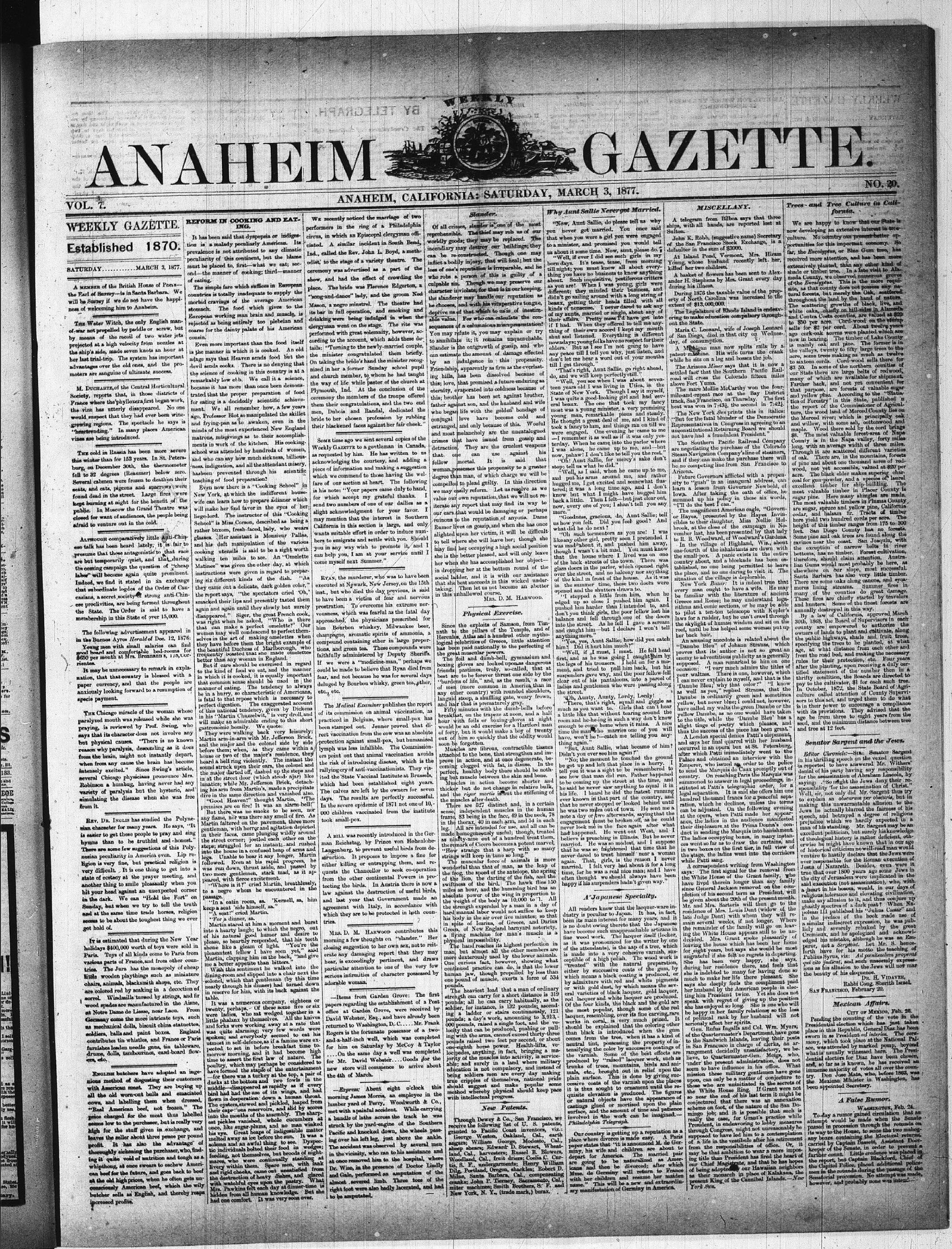
Searchable text
WEEKLY GAZETTE.
Established 1870.
SATURDAY...MARCH 3, 1877.
A member of the British House of Peers—the Earl of Surrey—is in Santa Barbara. We will be Surrey if we do not have the happiness of welcoming him to Anaheim.
The Water Witch, the only English man-of-war not propelled by paddle or screw, but by means of the recoil of two water jets projected at a high velocity from nozzles at the ship's side, made seven knots an hour at her last trial-trip. The system has important advantages over the old ones, and the promoters are sanguine of ultimate success.
M. Ducharte, of the Central Horticultural Society, reports that, in those districts of France where the phylloxera first began work, the vine has utterly disappeared. No one would suspect that they had ever been wine-growing regions. The spectacle he says is "heartrending." In many places American vines are being introduced.
The cold in Russia has been more severe this winter than for 153 years. In St. Petersburg, the thermometer
REFORM IN COOKING AND EATING.
It has been said that dyspepsia or indigestion is a malady peculiarly American. Its prevalence is not attributed to any climatic peculiarity of this continent, but the blame must be placed to, first—what we eat; second—the manner of cooking; third—manner of eating.
The simple fare which suffices in European countries is totally inadequate to supply the morbid cravings of the average American stomach. The food which gives to the European working man brain and muscle, is rejected as being entirely too plebeian and coarse for the dainty palate of his American cousin.
Even more important than the food itself is the manner in which it is cooked. An old adage says that Heaven sends food but the devil sends cooks. There is no denying that the science of cooking in this country is at a remarkably low ebb. We call it a science, because it has more than once been demonstrated that the proper preparation of food for eating is a decidedly scientific achievement. We all remember how, a few years ago, Professor Blot so manipulated the skillet and frying-pan as to awaken, even in the minds of the most experienced New England matrons, misgivings as to their accomplishments in work of the kitchen. His cooking-school was attended by hundreds of women, and who can say how much sickness, billious indigestion and all the attendant misery,
We recently noticed performers in the circus, in which anciated. A similar Ind., called the Reedist, to the stage ceremony was advertised show, and had the place. The bride "song-and-dance" Mason, a negro mines bar in full open drinking were being clergyman went on performed with great cording to the accents: "Turning to the minister cone On taking the bridle nized in her a form and church members the way of life w Plymouth, Ind. ceremony the men them their congregations men, Dubois and bride to her choos their blackened f
M. Ducharte, of the Central Horticultural Society, reports that, in those districts of France where the phylloxera first began work, the vine has utterly disappeared. No one would suspect that they had ever been wine-growing regions. The spectacle he says is "heartrending." In many places American vines are being introduced.
The cold in Russia has been more severe this winter than for 153 years. In St. Petersburg, on December 30th, the thermometer fell to 32 degrees (Reaumer) below zero. Several cabmen were frozen to death on their seats, and cats, pigeons and sparrows were found dead in the street. Large fires were kept burning at night for the benefit of the public. In Moscow the Grand Theatre was closed for want of audiences, the people being afraid to venture out in the cold.
Although comparatively little Anti-Chinese talk has been heard lately, it is fair to presume that those antagonistic to that race are but temporarily quiet, and that during the coming campaign the question of "cheap labor" will become again quite prominent. Indeed, we find it stated in an exchange that subordinate logodes of the Order of Caucasians, a secret society or strong anti-Chinese proclivities, are being formed throughout the State. The Order is said to have a membership in this State of over 15,000.
The following advertisement appeared in in the Buenos Ayres Herald of Dec. 12, 1876:
Young men with small salaries can find good board and comfortable bed-rooms for $60 per month at Mrs. Brennann's, 176 Corrientes.
It may be unnecessary to remark in explanation, that that country is blessed with a paper currency, and that the people are anxiously looking forward to a resumption of specie payment.
The Chicago miracle of the woman whose paralyzed mouth was released while she was praying, is reviewed by Prof. Swing, who says that its character does not involve any but physical causes. "There is no known reason why paralysis, descending as it does from the brain, might not instantly depart, when from any cause the brain has become intensely excited." Since Swing's article, several Chicago physicians pronounce Mrs. Robinson a humbug, having never had any variety of paralysis but the hysteric, and stimulating the disease when she was free from it.
Rev. Dr. Inglis has studied the Polynesian character for many years. He says, "It is easier to get these people to pray and sing hymns than to be truthful and honest."
There are some few suggestions of this Polynesian peculiarity in America even. Lip religion is very fine, but practical religion is very difficult. It is one thing to get into a state of ecstasy at the prayer meeting, and almost always when you see science of cooking in this country is at a remarkably low ebb. We call it a science, because it has more than once been demonstrated that the proper preparation of food for eating is a decidedly scientific achievement. We all remember how, a few years ago, Professor Blot so manipulated the skillet and frying-pan as to awaken, even in the minds of the most experienced New England matrons, misgivings as to their accomplishments in work of the kitchen. His cooking-school was attended by hundreds of women, and who can say how much sickness, billiousness, indigestion, and all the attendant misery, has been prevented through his scientific teaching of food preparation?
Even now there is a "Cooking School" in New York, at which the indifferent housewife can learn how to prepare dinner which will make her find favor in the eyes of her liege-lord. The instructor of this "Cooking School" is Miss Corson, described as being a rather buxom, fresh-faced, lady, who wears glasses. Her assistant is Monsieur Pallas, and his deft manipulation of the various cooking utensils is said to be a sight worth walking ten miles to see. An "Omelette Matinee" was given the other day, at which instructions were given in regard to preparing six different kinds of the dish. "As they came out a delicate, dark golden color," the report says, "the spectators cried 'Oh,' smacked their lips and presently tasted them again and again until they slowly but surely disappeared." Siger, the great French cook, was right when he asked, "Who is there that can make a perfect omelette?" Our women may well condescend to perfect themselves in the art of making omelettes when they have before them the bright example of the beautiful Duchess of Marlborough, who frequently boasted that she made omelettes better than any woman in England.
But if care should be exercised in regard to the kind of food we eat, and the manner in which it is cooked, it is equally important that common sense should be used in the manner of eating. The tendency to always be in a hurry, so characteristic of Americans, is fatal to that repose which is necessary to perfect digestion. The exaggerated account of this national tendency, given by Dickens in his "Martin Chuzzlewit," is very droll, and will make an admirable ending to this short gastronomic homily. We quote:
They were walking back very leisurely; Martin arm-in-arm with Mr. Jefferson Brick, and the major and the colonel side by side before them; when, as they came within a house or two of the major's residence, they heard a bell ring violently. The instant the sound struck upon their ears, the colonel and the major darted off, dashed up the steps and in at the street door (which stood ajar) like lunatics; while Mr. Jefferson Brick, detaching his arm from Martin's, made a precipitate dive in the same direction and vanished also.
"Good Heaven!" thought Martin. "The premises are on fire! It was an alarm-bell!"
But there was no smoke to be seen, nor any flame, nor was there any smell of fire. As Martin faltered on the pavement, three more gentleman, with horrgrand agitation depicted in their faces, came plunging wildly around the street corner; jostled each other on the steps; struggled for an instant; and rushed into the house in a confused heap of arms and legs. Unable to bear it any longer, Martin followed. Even at his rapid progress, he was run down, thrust aside, and passed by two more gentlemen, stark mad, as it appeared, with fierce excitement.
Some time ago Weekly Gazette as requested by his acknowledging the piece of information which we commenced of our section is his note: "You for which accept send two numbers slight acknowledged may mention that California in this wants suitable edibles to emigrate you in any way you can help you. I come myself next."
Ryan, the man executed at New inst., but who did to have a prostration. Vouusness, which approached, tha him Bourbon champagne, arro compound contitions, and green faithfully admired If we were able could be made fear, and not be deluged by Bou etc., etc.
The Medical office of its commission practiced in Beverly stained vaccination protection against lymph was less point out to the risk of intracting cry of itited the State which had been Calves ar days. The reaIn in the severe 2000 children took small-po
Rev. Dr. Inglis has studied the Polynesian character for many years. He says, "It is easier to get these people to pray and sing hymns than to be truthful and honest." There are some few suggestions of this Polynesian peculiarity in America even. Lip religion is very fine, but practical religion is very difficult. It is one thing to get into a state of ecstasy at the prayer meeting, and another thing to smile pleasantly when you hit your head against an unexpected corner in the dark. We can "Hold the Fort" on Sunday, but when we try to tell the truth and at the same time trade horses, religion seems to be about the toughest thing we ever got hold of.
It is estimated that during the New Year holidays $400,000 worth of toys were sold in Paris. Toys of all kinds come to Paris from various parts of France, and from other countries. The Jura has the monopoly of cheap little wooden playthings such as miniature chairs, animals, blacksmith shops, etc. They are colored red by soaking in a decoction of sorrel. Windmills turned by strings, and fir wood spades are manufactured in the Aisne, at Notre Dame de Liesse, near Laon. From Germany come the more intricate toys, such as mechanical dolls, biscuit china statuettes, soldiers, balls and paint boxes. England contributes tin whistles, and France or Paris furnishes leaden needle guns, tin tableware, drums, dolls, tambourines, card-board flowers, etc.
England butchers have adopted an ingenious method of disguising their customers with American meat. They are buying up all the old worn-out bulls and emaciated cows, and labelling them when dressed, "Real American beef, not frozen." The price charged for the meat thus labelled assumes low to the purchaser, but is really very high for the stuff given in exchange, and leaves the seller about three pence per pound profit. It has also the advantage of thoroughly siphoning the purchaser who finding it quite void of nutrition and tough as a whipthong, at once swears to oeshew American beef for the future, and goes back to beef at the old high prices, when he often gets unconsciously American beef, which the wily butcher sells as English, and thereby reaps increased profits.
ANAHEIM, CALIFORNIA: SATURDAY, MARCH 3, 1877.
We recently noticed the marriage of two performers in the ring of a Philadelphia circus, in which an Episcopal clergyman officiated. A similar incident in South Bend, Ind., called the Rev. John L. Boyd, a methodist, to the stage of a variety theatre. The ceremony was advertised as a part of the show, and had the effect of crowding the place. The bride was Flerence Edgerton, a "song-and-dance" lady, and the groom Ned Mason, a negro minstrel. The theatre had its bar in full operation, and smoking and drinking were being indulged in when the clergyman went on the stage. The rite was performed with great solemnity, however, according to the account, which adds these details: "Turning to the newly-married couple, the minister congratulated them briefly. On taking the bride's hand the minister recognized in her a former Sunday school pupil and church member, to whom he had taught the way of life while pastor of the church at Plymouth, Ind. At the conclusion of the ceremony the members of the troupe offered them their congratulations, and the two end men, Dubois and Randal, dedicated the bride to her chosen profession by rubbing their blackened faces against her fair cheek."
Some time ago we sent several copies of the Weekly Gazette to a gentleman in Canada, as requested by him. He has written to us acknowledging the courtesy, and adding a
Stander.
Of all crimes, slander is one of the most reprehensible. The thief may rob us of our worldly goods; they may be replaced. The incendiary may destroy our buildings; they can be reconstructed. Though one may inflict a bodily injury, that will heal; but the loss of one's reputation is irreparable, and he who robs a person of this is guilty of a culpable sin. Though we may preserve our character violate for that is in our keeping, the slanderer may handle our reputation as he chooses, and with his vituperative tongue, deprive us of that which to us is of inestimable value. For who can calculate the consequences of a calumnious misrepresentation? You may refute it, you may explain or try to annihilate it; it remains unquenchable. Slander is the outgrowth of gossip, and who estimate the amount of damage effected by an indulgence in this propensity. Friendship, apparently as firm as the everlasting hills, has been dissolved because of this; love, that promised a future enduring as eternity, evaporated into coldness because of this; brother has been set against brother, father against son, and the husband and wife who began life with the golden bondage of conjugal love have become cold and estranged, and only because of this. Woeful and most melancholy are the uncatalogued crimes that have issued from gossip and detraction. They are the cruelest weapons that one can use against his fellow mortal. It is said that
Why Aunt Sallie Never Got Married.
"Now, Aunt Sallie, do please tell us why you never got married. You once said that when you were a girl you were engaged to a minister, and promised you would tell us about it some time. Now, amt, please do.
"Well, if ever I did see such girls in my born days. It's tease, tease, from morning till night; you must know all about everything you have no business to know anything about. Such inquisitive, pestiferous critters as you are! When I was young, girls were different; they minded their business, and didn't go sailing around with a long string of beaux, getting their heads filled with all kinds of nonsense. I neyer dared to ask any of my aunts, married or single, about any of their affairs. Pretty mess I'd have got into if I had. When they offered to tell me anything of their own accord I kept my mouth shut and listened. Everything is different nowadays; young folks have no respect for their elders. But as I see I'm not going to have any peace till I tell you why, just listen, and don't let me hear a word out of your mouths till I get through."
"That's right, Aunt Sallie, go right ahead, do, and we will keep perfectly still."
"Well, you see when I was about seventeen years old I was living in Utica, in the State of New York. Though I say it myself, I was quite a good-looking girl and had several beauties. The one that took my fancy most was a young minister, a very promising young man, remarkable pious and steady. He thought a great deal of me, and I kind of took a fancy to him, and things ran on till we were engaged. One evening he came to me—I remember it as well as if it was only yesterday. When he came into the parlor where I was alone, he came up to me, and—but now, pshaw! I don't like to tell you the rest."
"Oh! Aunt Sallie, for mercy's sake don't tell me what he did."
Some time ago we sent several copies of the Weekly Gazette to a gentleman in Canada, as requested by him. He has written to us acknowledging the courtesy, and adding a piece of information and making a suggestion which we commend to those having the welfare of our section at heart. The following is his note: "Your papers came duly to hand, for which accept my grateful thanks. I send two numbers of one of our dailies as a slight acknowledgment for your favor. I may mention that the interest in Southern California in this section is large, and only wants suitable effort in order to induce numbers to emigrate and settle with you. Should you in any way wish to promote it, and I can help you, I am at your service until I come myself next Summer."
Ryan, the murderer, who was to have been executed at Newark, New Jersey, on the 15th inst., but who died the day previous, is said to have been a victim of fear and nervous prostration. To overcome his extreme nervousness, which was fearful as the fatal day approached, the physicians prescribed for him Bourbon whiskey, Milwaukee beer, champagne, aromatic spirits of ammonia, a compound containing ether in large proportions, and green tea. These compounds were faithfully administered by Deputy Sheriffs.
If we were a "medicine-man," perhaps we could be made to believe that Ryan died from fear, and not because he was for several days deluged by Bourbon whisky, green tea, etc., etc.
The Medical Examiner publishes the report of its commission on animal vaccination, as practiced in Belgium, where small-pox has been stamped out. Jenner proved that direct vaccination from the cow was an absolute protection against small-pox, but humanized lymph was less infallible. The Commissioners point out that animal vaccination avoids the risk of introducing disease, which is the rallying cry of anti-vaccinationists. They visited the State Vaccinal Institute at Brussels, which had been established eight years. The calves are left by the owners for seven days. The results are perfectly successful. In the severe epidemic of 1871 not one of 10,000 children vaccinated from the institute took small-pox.
A bill was recently introduced in the German Reichstag, by Prince von Hohenlohe-Langenburg, to prevent useful birds from destruction. It proposes to impose a fine for either killing or entrapping them, and requests the Chancellor to seek co-operation from the other continental Powers in providing her a former Sunday school pupil and church member, to whom he had taught the way of life while pastor of the church at Plymouth, Ind. At the conclusion of the ceremony the members of the troupe offered them their congratulations, and the two end men, Dubois and Randal, dedicated the bride to her chosen profession by rubbing their blackened faces against her fair cheek."
Friendship apparently as firm as ever since hills, has been dissolved because this; love, that promised a future enduring as eternity, evaporated into coldness because of this; brother has been set against brother, father against son, and the husband and wife who began life with the golden bondage of conjugal love have become cold and estranged, and only because of this. Woeful and most melancholy are the uncatalogued crimes that have issued from gossip and detraction. They are the cruelest weapons that one can use against his fellow mortal. It is said that woman possesses this propensity to a greater degree than man, of which charge we will be compelled to plead guilty. In this direction we may easily reform. Let us resolve as we value our own reputation, that we will not reiterate any report that may find its way to our ears that would be damaging or perhaps ruinous to the reputation of anyone. Dame Rumor lives on gossip, and when she has once alighted upon her victim, it will be difficult to tell where she will leave her; though she may find her occupying a high social position she is the better pleased, and will only leave her when she has accomplished her object—in dropping her at the bottom round of the social ladder, and it is with our assistance that she best succeeds in this wicked undertaking. Then let us not become an abettor in this unhallowed course.
MRS. D. M. Harwood.
Physical Exercise.
Since the exploits of Samson, from Timnath to the pillars of the Temple, and of Hercules, Atlas and a hundred other mythological celebrities of Greece, little attention has been paid nationally to the perfecting of the great muscular powers.
The foil and dumb-bell, gymnasium and boxing gloves are looked upon as dangerous friends; pastimes, truly, so-called, that at best are to be forever thrust one side by the "burdens of life," and as the result, a race of men (more common in America than in any other country) with rounded shoulders, languid stoop, a shuffling gate, weary frown, and hair that is prematurely gray.
Fifty minutes with the dumb-bells before breakfast, on the trapeze at noon, and a half hour with foils or boxing-gloves at night would be an odd exercise for a Hartford man of forty, but it would make a boy of twenty out of him so quickly that the oddity would soon be forgotten.
Muscles are fibrous, contractile tissues attached to the bone, that strengthen and improve in action, and at once degenerate, becoming clogged with fat, in disuse. In the perfect healthy body there should be nothing but muscle between the skin and bone.
Muscles in action become shorter and thicker but do not change in relative bulk, and the rijor mortia is but the stiffening of the muscles after death.
There are 527 distinct and, in a certain sense, independent muscles in the human frame 83 being in the face, 49 in the neck, 78 in the thorax, 40 in each arm, and 54 in each leg. All are intended for use, and all can be made homogeneous useful; though, treated as ninety-nine out of a hundred treat them, the remark of Cicero becomes a potent marvel. "How strange that a harp with so many strings will keep in tune so long."
The muscular force of animals is more wonderful than that of man, as the leap of the frog, the speed of the antelope, the spring of the lion, the darting of the fish, and the frowning of the bird.
"That's right, Aunt Sallee, go right ahead, do, and we will keep perfectly still."
Well, you see when I was about seventeen years old I was living in Utica, in the State of New York. Though I say it myself I was quite a good-looking girl and had several beaux. The one that took my fancy most was a young minister, a very promising young man, remarkable pious and steady. He thought a great deal of me, and I kind of took a fancy to him, and things ran on till we were engaged. One evening he came to me—I remember it as well as if it was only yesterday. When he came into the parlor where I was alone, he came up to me, and now pahaw! I don't like to tell you the rest." "Oh! Aunt Sallee, for mercy's sake don't stop; tell us what he did."
"Well as I said, when he came up to me, and put his arms around me, and rather hugged me, I got excited and somewhat flustered; it was a long time ago, and I don't know but what I might have hugged him back a little. Then I felt—but just clear out now every one of you; I shan't tell you any more."
"Goodness, gracious do, Aunt Sallee; tell us how you felt. Did you feel good? And what did he do next?
"Oh such tormentors as you are! I was like any other girl, pretty soon I pretended I was mad about it, and pushed him away though I wasn't a bit mad. You must know that the house where I lived on one of the back streets of the town. There was glass doors in the parlor, which opened right over the street, and no balcony nor anything of the kind in front of the house. As it was in the summer time these two doors were opened and the shutters drawn to.
"I stepped a little from him when he edged up so close I pushed him again. I pushed him harder than I intended to, and don't you think girls,the poor fellow lost his balance and fell through one of the doors into the street. As he fell I gave a scream and caught him—but I declare I won't tell anything more."
"Yes yes,Aunt Sallee; how did you catch him? Did it hurt him much?" "Well if it must.I must. He fell head first,and as he was going I caught him by the lags of his trousers. I held on for a moment,and tried to pull him back,but his suspenders gave way,and the poor fellow fell clear out of his pantaloons,into a parcel of laides and gentlemen who were passing along the street."
"Oh,Aunty,Aunty,Lordly."
"There that's right,squall and giggle as much as you want.to.Girls that can't hear a little like that without tearing around room and he-he-ing in such a way don't know enough to come home when it rains.A nice time the man who marries one of you will have,不得不he—catch me telling you anything again."
"But,Aunt Sallee,makes of him? Didn't you ever see him again?" "No;the moment he touched the ground he got up and left that place in a hurry.I tell you it was a sight to be remembered to see how that man did run.Father happened to be coming up the street at time,and he said he never saw anything to equal it in his life.I heard he did the fastest running ever known in that part of the country,and that he never stopped or looked behind until he was two miles out of town.Hen sent me a note a day or two afterwards,saying that he engagement must be broken off,-as he could never look me in the face again after what had happened.Hen went out West,and believe is preaching in Illinois.Beh了never married.Hen was so frightened that time that he never dared to trust himself near a woman again.
That,girls is the reason I never married.I felt very bad about it for a long time.for he was a real nice man;and I have often thought we should always have been if his magnificence had given
A bill was recently introduced in the German Reichstag, by Prince von Hohenlohe-Langenburg, to prevent useful birds from destruction. It proposes to impose a fine for either killing or entrapping them, and requests the Chancellor to seek co-operation from the other continental Powers in protecting the birds. In Austria there is now a law against the destruction of useful birds, and last year that Government made an agreement with Italy, in accordance with which they are to be protected in both countries.
Mrs. D. M. Harwood contributes this morning a few thoughts on "slander." Her closing suggestion to her own sex, not to reiterate any damaging report that they may hear, is exceedingly pertinent, and draws particular attention to one of the very few serious infirmities of character possessed by adorable woman.
Items from Garden Grove: The first papers regarding the establishment of a Post office at Garden Grove, were received by David Webster, Esq., and have already been returned to Washington, D.C....Mr. Frank Rogers is the fortunate possessor of a two-and-a-half-inch well, which was completed for him on Saturday by McCoy & Taylor ....On the same day a well was completed for Mr. David Webster...Goods for the new store will commence to arrive about the 4th of March.
Express: About eight o'clock this morning James Morris, an employee in the lumber yard of Perry, Woodworth & Co., met with a painful accident. While carrying a bundle of laths across the track he was struck by the yard-engine of the Southern Pacific and knocked down, the wheels passing over his left leg, just above the ankle. The accident was observed by several men in the vicinity, who ran to his assistance and at once removed him to the hospital, where Dr. Wise, in the presence of Doctor Lindly and Gale, performed an amputation of the almost severed limb. Three toes of the right foot were also badly lacerated, and had to be amputated.
Muscles in action decrease thicker but do not change in relative bulk, and the rigor mortis is out of the muscles after death.
There are 527 distinct and, in a certain sense, independent muscles in the human frame, 83 being in the face, 49 in the neck, 78 in the thorax, 40 in each arm, and 54 in each leg. All are intended for use, and all can be made homogeneously useful; though, treated as ninety-nine out of a hundred treat them, the remark of Cicero becomes a potent marvel, "How strange that a harp with so many strings will keep in tune so long."
The muscular force of animals is more wonderful than that of man, as the leap of the frog, the speed of the antelope, the spring of the lion, the darting of the fish, and the swiftness of the bird. The hawk flies 150 miles an hour, and the hummingbird has an absolute power of the wing in proportion to the weight of the body as 10,000 to 1.
All the strength expended by a man in a day of hard manual labor would not suffice to keep his body in the air over five minutes; so that in spite of Icarius, of Greece, and Darius Green, of New England barnyard notoriety, a flying machine for man's muscle is a physical impossibility.
The hand reaches its highest perfection in man, but almost all the other members are more dexterously used by the lower animals. One curious fact, however, showing what continued practice can do, is that the lower human jaw, though propelled by less than one pound of muscle, exerts a force of 534 pounds.
The heaviest load that a man of ordinary strength can carry for a short distance is 319 pounds; all he can carry habitually, as the soldier, for instance, is 132 pounds; ascending a ladder or stairs continuously, 121 pounds; a day's work, amounting to 3,913-000 pounds, raised a single foot, and the velocity that can be produced, pushing or pulling with the arms cannot exceed thirty-three pounds raised two feet per second, or about one-eighth horse power. Health-lifts, velocipedes, anything, in fact, bringing a majority of the muscles into activity, is serviceable; and surely in a land where military education is not compulsory, and instead of being soldiers men are every day making true cripples of themselves, national pride should suggest and make popular some method whereby physical should keep pace with intellectual progress.
New Patents.
Through Dewey & Co., San Francisco, we receive the following list of U. S. patents granted to Pacific Coast inventors, viz.: George Weston, Oakland, Cal., earth augurs; William George, Modesto, Cal., sheep shears; Edward D. Stewart, Wheatland, Cal., harvesters; Russel B. Blowers, Woodland, Cal., fruit driers; Coelia C. Curis, S. F., undergarments; Henry William Dilg, Portland, Oregon, shackles; Robert D. Milne, Santa Barbara, Cal., compensating cranks; John P. Tierney, Sacramento, Cal., miter machines; Smith Brothers, S. F., and New York, N. Y., (trade mark.) borax.
Our country is getting up a reputation place where divorce is made easy. A paper states that "it is announced M. de Germiny, his wife and children are about depart for America. The married are going to be naturalized as Americanicans and then be divorced; after Wine Mine de Germiny will return to France with her children and resume her maiden." This will be a new and extraordinary manifestation of Germiny in America.
GAZETTE.
NO. 20.
The Nevergot Married.
I do please tell us why married. You once said that a girl you were engaged promised you would tell me. Now, aunt, please do. I did see such girls in my case, tease, from morning it know all about every business to know anything sensitive, pestiferous critters I was young, girls were handed their business, and found with a long string of hairs filled with all I neyer dared to ask any real or single, about any of my mess I'd have got into they offered to tell me any accord I kept my mouth Everything is different folks have no respect for their face I'm not going to have told you why, just listen, and word out of your mouth Mount Sallie, go right ahead, keep perfectly still." When I was about seventen years living in Utica, in the city Though I say it myself, looking girl and had seveneone that took my fancy minister, a very promisingarkable pious and steady deal of me, and I kind of man, and things ran on till we one evening he came to me as well as if it was only yes-came into the parlor where came up to me, and—butn't like to tell you the rest." Iie, for mercy's sake don't be did.
MISCELLANY.
A telegram from Bilboa says that three ships, with all hands, are reported lost at Sulton.
John K. Robb, (suggestive name) Secretary of the San Francisco Stock Exchange, is a defaulter in the sum of $3000.
At Island Pond, Vermont, Mrs. Hiram Young, whose husband recently left her, killed her two children.
A basket of flowers has been sent to Alexander H. Stephens by Mrs. Grant every day during his illness.
During 1876 the taxable value of the property of North Carolina was increased to the extent of $13,000,000.
The Legislature of Rhode Island is endeavoring to make education compulsory throughout the State.
Maria C. Leonard, wife of Joseph Leonard of San Diego, died in that city on Wednesday, of consumption.
A Michigan man now splits rails by a patent machine. His wife turns the crank while he sits on a log and bosses the job.
The Arizona Miner says that it is now a settled fact that the Southern Pacific Railroad will cross the Colorado fifteen miles above Fort Yuma.
The mare Mollie McCarthy won the four-mile-and-repeat race at the Bay District track, San Francisco, on Thursday. The first heat was won in 7:43; the second in 7:42.
The New York Sun prints this in italics: "But for the fatal blunder of the Democratic Representatives in Congress in agreeing to an unconstitutional Returning Board we should not have had a fraudulent President."
The Southern Pacific Railroad Company are negotiating the purchase of the Colorado Steam Navigation Company's line of steamers, and if they can make the purchase there will be no connecting line from San Francisco to Trees and Tree Culture in California.
We are happy to know that our State is now developing an extensive interest in tree culture. No country can present better opportunities for this important economy. So far, the Eucalyptus, or Blue Gum tree, has received more attention, and has been more extensively planted, than any other kind of shade or timber tree. In a late visit to Alameda County, we observed numerous groves of the Eucalyptus. This is the more requisite, as that county does not possess any natural forests, but merely the Oak, scattered throughout the land by the hand of nature. The scattering growths of black, live, and white oaks, chiefly on hill-sides in Alameda and Contra Costa counties, are valued at $20 to $50 per acre. Cord-wood on the stump sells for $2 per cord. About twelve years ago cork-oak acorns were planted which are now in bearing. The timber of Lake County is mainly oak and pine. The former is in the valleys, twenty to fifty large trees to the acre, some trees making as much as twelve to sixteen cords. Cord-wood sells there for $350. In some of the northern counties of our State there are large belts of redwood, many of which are available for shipment. Farther back, and not yet convenient for that purpose, are forests of valuable sugar and yellow pine. According to the "Statistics of Forestry" in this State, published in the report of the Commissioner of Agriculture, the wood land of Merced County lies on the Merced river; which is principally oak and willow, with some ash, cottonwood and maple. Wood there sold by the cord brings $8. The most valuable forest-area of Napa County is in the Napa valley, forty miles long, with an average width of three miles. Through it are scattered different varieties of oak. There are, in the mountains, forests of pine and about one thousand acres of red-
When I was about seven years living in Utica, in the east, though I say it myself, I looked girl and had sew one that took my fancy minister, a very promising markable pious and steady. But deal of me, and I kind of me, and things ran on till we one evening he came to me well as if it was only yes-came into the parlor where came up to me, and—but don't like to tell you the rest." Lieie, for mercy's sake don't he did."
When he came up to me, he around me, and rather excited and somewhat flustered time ago, and I don't I might have hugged him when I felt—but just clear out, if you; I shan't tell you any pecious, do, Aunt Sallie; tell Did you feel good? And next?
Commenters as you are! I was old, pretty soon I pretended I was not, and pushed him away, but bit mad. You must know where I lived was on one stets of the town. There was a parlor, which opened right and no balcony nor anything above of the house. As it was time, these two doors were shutters drawn to.
Little from him, when he chose I pushed him again. I older than I intended to, and girls, the poor fellow lost his ear through one of the doors. As he fell I gave a scream—but I declare I won't tell Aunty, Lordy, Lordy!
It is right, squall and giggle as untold. Girls that can't hear without tearing around the building in such a way don't know home when it rains. A nice who marries one of you will—catch me telling you any Sallie, what became of him? See him again?
Comment he touched the ground left that place in a hurry. I a sight to be remembered to man did run. Father happened up the street at the time, and ever saw anything to equal it in real he did the fastest running that part of the country, and stopped or looked behind until times out of town. He sent me a two afterwards, saying that the must be broken off, as he could in the face again after what He went out West, and I teaching in Illinois. But he never was so modest, and I suppose he frightened that time that he trust himself near a woman girls, is the reason I never very bad about it for a long time was a real nice man; and I have we should always have been preachers hottened given way.
A correspondent writing from Washington says: The first signal for the removal from the White House of the Grant family, has lived therein longer than any family settled fact that the Southern Pacific Railroad will cross the Colorado fifteen miles above Fort Yuma.
The mare Mollie McCarthy won the four-mile-and-repeat race at the Bay District track, San Francisco, on Thursday. The first heat was won in 7:43; the second in 7:42.
The New York Sun prints this in italics: "But for the fatal blunder of the Democratic Representatives in Congress in agreeing to an unconstitutional Returning Board we should not have had a fraudulent President."
The Southern Pacific Rail Company are negotiating the purchase of the Colorado Steain Navigation Company's line of steamers, and if they can make the purchase there will be no competing line from San Francisco to Arizona.
Future Governors afflicted with a propensity to "gush" in an inaugural address, can learn a lesson from Governor Newbold, of Iowa. After taking the oath of office, he summed up his policy in these six words, "I'll do the best I can."
The magnificent American eagle, "Governor Hayes," presented by the Hayes Invincibles to their daughter, Miss Nellie Holbrook, at the close of the campaign in November last, has been presented by that lady to R. B. Woodward, of Woodward's Gardens.
In the village of Highland, Wis., about one-fourth of the inhabitants are down with the small-pox. A panic exists in the entire country about, and a blockade has been established, no one being permitted to leave the place, and no one daring to visit it. The situation of the village is deplorable.
New York Buzar: It is indeed true that every man ought to have a wife. He may be familiar with the literature of ancient Greece and Rome; he may understand logarithms and conic sections, or he may be able to pilot a ten-ton telescope with Kepler's laws for a rudder, but he can't crawl through the skylight of human wisdom and sit on the roof, until he has helped some woman put up her back hair.
An amusing anecdote is related about the "Danube Bleu" of Johann Strauss, which proves that its author is not so great an enemy to adventures publicity as is generally supposed. A man remarked to him on one occasion: "I very much admire the titles of your waltzes. There is one, however, which I cannot explain to myself, and that is the 'Danube Bleu,' why that color?" "I know as well as you," replied Strauss, that the Danube is ordinarily green and sometimes yellow, but never blue; I could not, however, have called my waits the green Danube or the yellow Danube, as no one would have taken to the title, while the 'Danube Bleu' has a slight tinge of poetry which pleases, and thus the success of the piece has been great."
A London special denies Patti's elopement, and says her final quarrel with her husband occurred in an opera box at St. Petersburg, after which Patti immediately went to the Palace and obtained an interview with the Emperor, who issued an order to the police to send the Marquis de Caux promptly out of country. On reaching Paris the Marquis was summoned to answer in legal proceedings, instituted at Patti's telegraphic order, for a legal separation. It is said she offered him one hundred thousand francs for a peaceful separation, which he declines, unless the terms can be adjusted. On the following evening at the opera, when Patti made her appearance, the ladies in the audience manifested their displeasure at the Prima Donna's conduct in sending the Marquis into banishment. The ladies occupying boxes, in many instances went so far as to draw the curtains, and in two boxes on the first tier, in full view of the stage, the ladies went into the corridors while Patti sang.
A correspondent writing from Washington says: The first signal for the removal from the White House of the Grant family, has lived therein lower than any family settled fact that the Southern Pacific Railroad will cross the Colorado fifteen miles above Fort Yuma.
The mare Mollie McCarthy won the four-mile-and-repeat race at the Bay District track, San Francisco, on Thursday. The first heat was won in 7:43; the second in 7:42.
The New York Sun prints this in italics: "But for the fatal blunder of the Democratic Representatives in Congress in agreeing to an unconstitutional Returning Board we should not have had a fraudulent President."
The Southern Pacific Rail Company are negotiating the purchase of the Colorado Steain Navigation Company's line of steamers, and if they can make the purchase there will be no competing line from San Francisco to Arizona.
Future Governors afflicted with a propensity to "gush" in an inaugural address, can learn a lesson from Governor Newbold, of Iowa. After taking the oath of office, he summed up his policy in these six words, "I'll do the best I can."
The magnificent American eagle, "Governor Hayes," presented by the Hayes Invincibles to their daughter, Miss Nellie Holbrook, at the close of the campaign in November last, has been presented by that lady to R. B. Woodward, of Woodward's Gardens.
In the village of Highland, Wis., about one-fourth of the inhabitants are down with the small-pox. A panic exists in the entire country about, and a blockade has been established, no one being permitted to leave the place, and no one daring to visit it. The situation of the village is deplorable.
New York Buzar: It is indeed true that every man ought to have a wife. He may be familiar with the literature of ancient Greece and Rome; he may understand logarithms and conic sections, or he may be able to pilot a ten-ton telescope with Kepler's laws for a rudder, but he can't crawl through the skylight of human wisdom and sit on the roof, until he has helped some woman put up her back hair.
An amusing anecdote is related about the "Danube Bleu" of Johann Strauss, which proves that its author is not so great an enemy to adventures publicity as is generally supposed. A man remarked to him on one occasion: "I very much admire the titles of your waltzes. There is one, however, which I cannot explain to myself, and that is the 'Danube Bleu,' why that color?" "I know as well as you," replied Strauss, that the Danube is ordinarily green and sometimes yellow, but never blue; I could not,however,have called my waits the green Danube or the yellow Danube,as no one would have taken to the title,while the 'Danube Bleu' has a slight tinge of poetry which pleases,and thus the success of the piece has been great."
A London special denies Patti's elopement,and says her final quarrel with her husband occurred in an opera box at St. Petersburg,
after which Patti immediately went to the Palace and obtained an interview with the Emperor,who issued an order to the police to sendthe Marquis de Caux promptly outofcountry.On reaching Paristhe Marquis was summonedtoanswerinlegalproceedingsinstitutedatPatti'stelegraphicorder,forgalseparation。它is said she offered him one hundred thousand francs fora peaceful separation,whichhedeclines,unlessthetermscanbeadjusted.Onthefollowingeveningattheopera,whenPattimadeherappearance,theladiesintheaudiencemanifestedthedispleasureatthePrimaDonna'sconductin sendingtheMarquisintobanishment.Theladiesoccupyingboxes,inmanyinstanceswentsofarastodrawthecurtain,andintwoboxsonthefirsttierinfullviewofthestage,theladieswentintothecorridorswhilePatti sang.
A correspondent writing from Washington says: The first signal for the removal from the White House of the Grant family,has lived therein lower than any family settled fact that the Southern Pacific Railroad will cross the Colorado fifteen miles above Fort Yuma.
The mare Mollie McCarthy won the four-mile-and-repeat race at the Bay District track,San Francisco,on Thursday. The first heat was won in 7:43;the second in 7:42.
The New York Sun prints this in italics: "But forthefatalblunderoftheDemocraticRepresentativesinCongressinagreeingtoanunconstitutionalReturningBoardweshouldnothavehadafraudulentBord."
The magnificent American eagle,"Governor Hayes," presented bytheHayesInvinciblesto their daughter,MissNellieHolbrook,tatcloseofthecampaigninNovemberlast,hasbeenpresentedbythat ladytoR.B.Woodward.ofWoodward'sGardens.
InthevillageofHighland.Wis.,aboutone-fourthoftheinhabitantsaredownwiththesmall-pox.Apanelexistsintheentirecountryabout,andablockadehasbeenestablishednoonebeingpermittedtoleavetheplace,andnoonedaringtovisitit.Thesituationofthevillageisdeplorable.
New York Buzar: It is indeed true that every man ought to have a wife.Heremaybe familiarwiththe literatureofancientGreeceandRome;hemayunderstandlogarithmsandconicsections,ratherthanbeingpermittedtoleavetheplace,andnoonedaringtovisitit.Thesituationofthevillageisdeplorable.
A London special denies Patti's elopement,and says her final quarrel with her husband occurredinan OperaboxatSt.Petersburg,
afterwhichPattiimmediatelywenttothePalaceandobtainaninterviewwiththeEmperor,theownerissuedanordertothepolicesendtheMarquisdeCauxpromptlyoutofcountry.OnreachingsParistheMarquiswassummerdedtoanswerinlegalproceedingsinstitutedatPatti'stelegraphicorder,forgalseparation.它is saidsheofferedhimonehundred thousandfrancsfora peaceful separation,whichhedeclines,unlessthetermscanbeadjusted.Onthefollowingeveningattheopera,whenPattimadeherappearance,theladiesintheaudiencemanifestedthedispleasureatthePrimaDonna'sconductin sendingtheMarquisintobanishment.Theladiesoccupyingboxes,inmanyinstanceswentsofarastodrawthecurtain,andintwoboxsonthefirsttierinfullviewofthestage,theladieswentintothecorridorswhilePatti sang.
A correspondent writing from Washington says: The first signal for the removal fromtheWhiteHouseoftheGrantfamily,has livedthereinlowerthananyfamily settledfactthattheSouthernPacificRailroadwillcrosstheColoradofifteenmilesaboveFortYuma.
The mare MollieMcCarthywontheremainlowtheranyfamilysettledfactthattheSouthernPacificRailroadwillcrosstheColoradofifteenmilesaboveFortYuma.
The mare MollieMcCarthywontheremainlowtheranyfamilysettledfactthattheSouthernPacificRailroadwillcrosstheColoradofifteenmilesaboveFortYuma.
The mare MollieMcCarthywontheremainlowtheranyfamilysettledfactthattheSouthernPacificRailroadwillcrosstheColoradofifteenmilesaboveFortYuma.
The mare MollieMcCarthywontheremainlowtheranyfamilysettledfactthattheSouthernPacificRailroadwillcrosstheColoradofifteenmilesaboveFortYuma.
The mare MollieMcCarthywontheremainlowtheranyfamilysettledfactthattheSouthernPacificRailroadwillcrosstheColoradofifteenmilesaboveFortYuma.
The mare MollieMcCarthywontheremainlowtheranyfamilysettledfactthattheSouthernPacificRailroadwillcrosstheColoradofifteenmilesaboveFortYuma.
The mare MollieMcCarthywontheremainlowtheranyfamilysettledfactthattheSouthernPacificRailroadwillcrosstheColoradofifteenmilesaboveFortYuma.
The mare MollieMcCarthywontheremainlowtheranyfamilysettledfactthattheSouthernPacificRailroadwillcrosstheColoradofifteenmilesaboveFortYuma.
The mare MollieMcCarthywontheremainlowtheranyfamilysettledfactthattheSouthernPacificRailroadwillcrosstheColoradofifteenmilesaboveFortYuma.
The mare MollieMcCarthywontheremainlowtheranyfamilysettledfactthattheSouthernPacificRailroadwillcrosstheColoradofifteenmilesaboveFortYuma.
The mare MollieMcCarthywontheremainlowtheranyfamilysettledfactthattheSouthernPacificRailroadwillcrosstheColoradofifteenmilesaboveFortYuma.
The mare MollieMcCarthywontheremainlowtheranyfamilysettledfactthattheSouthernPacificRailroadwillcrosstheColoradofifteenmilesaboveFortYuma.
The mare MollieMcCarthywontheremainlowtheranyfamilysettledfactthattheSouthernPacificRailroadwillcrosstheColoradofifteenmilesaboveFortYuma.
The mare MollieMcCarthywontheremainlowtheranyfamilysettledfactthattheSouthernPacificRailroadwillcrosstheColoradofifteenmilesaboveFortYuma.
The mare MollieMcCarthywontheremainlowtheranyfamilysettledfactthattheSouthernPacificRailroadwillcrosstheColoradofifteenmilesaboveFortYuma.
The mare MollieMcCarthywontheremainlowtheranyfamilysettledfactthattheSouthernPacificRailroadwillcrosstheColoradofifteenmilesaboveFortYuma.
The mare MollieMcCarthywontheremainlowtheranyfamilysettledfactthattheSouthernPacificRailroadwillcrosstheColoradofifteenmilesaboveFortYuma.
The mare MollieMcCarthywontheremainlowtheranyfamilysettledfactthattheSouthernPacificRailroadwillcrosstheColoradofifteenmilesaboveFortYuma.
The mare MollieMcCarthywontheremainlowtheranyfamilysettledfactthattheSouthernPacificRailroadwillcrosstheColoradofifteenmilesaboveFortYuma.
The mare MollieMcCarthywontheremainlowtheranyfamilysettledfactthattheSouthernPacificRailroadwillcross-theColoradofifteenmilesaboveFortYuma.
The mare MollieMcCarthywontheremainlowtheranyfamilysettledfactthattheSouthernPacificRailroadwillcross-theColoradofifteenmilesaboveFortYuma.
ThemareMollieMcCarthywontheremainlowtheranyfamilysettledfactthattheSouthernPacificRailroadwillcross-theColoradofifteenmilesaboveFortYuma.
ThemareMollieMcCarthywontheremainlowtheranyfamilysettledfactthattheSouthernPacificRailroadwillcross-theColoradofifteenmilesaboveFortYuma.
ThemareMollieMcCarthywontheremainlowtheranyfamilysettledfactthattheSouthernPacificRailroadwillcross-theColoradofifteenmilesaboveFortYuma.
ThemareMollieMcCarthywontheremainlowtheranyfamilysettledfactthattheSouthernPacificRailroadwillcross-theColoradofifteenmilesaboveFortYuma.
ThemareMollieMcCarthywontheremainlowtheranyfamilysettledfactthattheSouthernPacificRailroadwillcross-theColoradofifteenmilesaboveFortYuma.
ThemareMollieMcCarthywontheremainlowtheranyfamilysettledfactthattheSouthernPacificRailroadwillcross-theColoradofifteenmilesaboveFortYuma.
ThemareMollieMcCarthywontheremainlowtheranyfamilysettledfactthattheSouthernPacificRailroadwillcross-theColoradofifteenmilesaboveFortYuma.
ThemareMollieMcCarthywontheremainlowtheranyfamilysettledfactthattheSouthernPacificRailroadwillcross-theColoradofifteenmilesaboveFortYuma.
ThemareMollieMcCarthywontheremainlowtheranyfamilysettledfactthat.theSouthernPacificRailroadwillcross-theColoradofifteenmilesaboveFortYuna;
ThemareMollieMcCarthywonTHEREMAINLOWTHEREMAINLOWTHEREMAINLOWTHEREMAINLOWTHEREMAINLOWTHEREMAINLOWTHEREMAINLOWTHEREMAINLOWTHEREMAINLOWTHEREMAINLOWTHEREMAINLOWTHEREMAINLOWTHEREMAINLOWTHEREMAINLOWTHEREMAINLOWTHEREMAINLOWTHEREMAINLOWTHEREMAINLOWTHEREMAINLOWTHEREMAINLOWTHEREMAINLOWTHEREMAINLOWTHEREMAINLOWTHEREMAINLOWTHEREMAINLOWTHEREMAINLOWTHHEREMAINLOWTHHEREMAINLOWTHHEREMAINLOWTHHEREMAINLOWTHHEREMAINLOWTHHEREMAINLOWTHHEREMAINLOWTHHEREMAINLOWTHHEREMAINLOWTHHEREMAINLOWTHHEREMAINLOWTHHEREMAINLOWTHHEREMAINLOWTHHEREMAINLOWTHHEREMAINLOWTHHEREMAINLOWTHHEREMAINLOWTHHEREMAINLOWTHHEREMAINLOWTHHEREMAINLowThHEREMAINLowThHEREMAINLowThHEREMAINLowThHEREMAINLowThHEREMAINLowThHEREMAINLowThHEREMAINLowThHEREMAINLowThHEREMAINLowThHEREMAINLowThHEREMAINLowThHEREMAINLowThHEREMAINLowThHEREMAINLowThHEREMAINLowThHEREMAINLowThHEREMAINLowThHEREMAINLowThHEREMAINLowThHEREMPLowThHEREMPLowThHEREMPLowThHEREMPLowThHEREMPLowThHEREMPLowThHEREMPLowThHEREMPLowThHEREMPLowThHEREMPLowThHEREMPLowThHEREMPLowThHEREMPLowThHEREMPLowThHEREMPLowThHEREMPLowThHEREMPLowThHEREMPLowThHEREMPLowThHEREMPLowThHEREMPLowThHEREMPLowThHEREMPLowThHEREMPLowThHEREMPLowThHERREMPLowThHERREMPLowThHERREMPLowThHERREMPLowThHERREMPLowThHERREMPLowThHERREMPLowThHERREMPLowThHERREMPLowThHERRPLOWThHERRPLOWThHERRPLOWThHERRPLOWThHERRPLOWThHERRPLOWThHERRPLOWThHERRPLOWThHERRPLOWThHERRPLOWThHERRPLOWThHERRPLOWThHERRPLOWThHERRPLOWThHERRPLOWThHERRPLOWThHERRPLOWThHERRPLOW ThHERRPLOW ThHERRPLOW ThHERRPLOW ThHERRPLOW ThHERRPLOWN ThHERRPLOWN ThHERRPLOWN ThHERRPLOWN ThHERRPLOWN ThHERRPLOWN ThHERRPLOWN ThHERRPLOWN ThHERRPLOWN ThHERRPLOWN ThHERRPLOWN ThHERRPLOWN ThHERRPLOWN ThHERRPLOWN ThHERRPLOWN ThHERRPLOWN ThHERRPLOWN ThHERRPLOWN ThHERRPLOWN ThHerrPLOWN ThherrPLOWN ThherrPLOWN ThherrPLOWN ThherrPLOWN ThherrPLOWN ThherrPLOWN ThherrPLOWN ThherrPLOWN ThherrPLOWN ThherrPLCown ThherrPLCown ThherrPLCown ThherrPLCown ThherrPLCown ThherrPLCown ThherrPLCown ThherrPLCown ThherrPLCown ThherrPLCown ThherrPLCown ThherrPLCown ThherrPLCown ThherrPLCown ThherrPLCown ThherrPLCown ThherrPLCown ThherrPLCown ThherrPLCown ThherrPLCown THherrPLCown THherrPLCown THherrPLCown THherrPLCown THherrPLCown THherrPLCown THherrPLCown THherrPLCown THherrPLCown THherrPLCown THherrPLCown THherrPLCown THherrPLCown THherrPLCown THherrPLCown THherrPLCown THherrPLCown THherrPLCown THherrPLCown THhherrPLCown THhherrPLCown THhherrPLCown THhherrPLCown THhherrPLCown THhherrPLCown THhherrPLCown THhherrPLCown THhherrPLCown THhherrPLCown THhherrPLCown THhherrPLCown THhherrPLCown THhherrPLCown THhherrPLCown THhherrPLCown THhherrPLCown THhherrPLCown THhherrPLCown THhherrPC仑 THhherrPC仑 THhherrPC仑 THhherrPC仑 THhherrPC仑 THhherrPC仑 THhharrPC仑 THhharrPC仑 THhharrPC仑 THhharrPC仑 THhharrPC仑 THhharrPC仑 THhharrPC仑 THhharrPC仑 THhharrPC仑 THhharrPC仑 THhharrPC仑 THhharrPC仑 THhharrPC仑 ТНhharrPC仑 ТНhharrPC仑 ТНhharrPC仑 ТНhharrPC仑 ТНhharrPC仑 ТНhharrPC仑 ТНhharrPC仑 ТНhharrPC仑 ТНhharrPC仑 ТНhharrPC仑 ТНhharrPC仑 ТНhharrPC仑 ТНhharrPC仑 ТНhharrPC仑 ТНhharrPC仑 ТНhharrPC仑 ТНhharrРС仑 ТНhirrРС仑 ТНhirrРС仑 ТНhirrРС仑 ТНhirrРС仑 ТНhirrРС仑 ТНhirrРС仑 ТНhirrРС仑 ТНhirrРС仑 ТНhirrРС仑 ТНhirrРС仑 ТНhirrРС仑 ТНhirrРС仑 ТНhirrРС仑 ТТhirrРС仑 ТТhirrРС仑 ТТhirrРС仑 ТТhirrРС仑 ТТhirrРС仑 ТТhirrРС仑 ТТhirrРС仑 ТТhirrРС仑 ТТhirrРС仑 ТТhirrРС仑 ТТhirrРС仑 ТТhirrРС仑 ТТhirrРС仑 ТТhirrРС仑
A correspondent writing from Washington says: The first signal for the removal from White House of the Grant family,has lived therein longer than any family settling fact that over 1800 years ago some Jews in city of Jerusalem were implicated in this assassination (not assassination),who with
Senior Chronicle: Sir: Senator Sargent in his thrilling speech on vexed question is reported to have answered Mr. Witheri's denial of his party having any responsibility for his assassination of Abraham Lincoln,由 saying:"So might they deny their responsibility for his assassination of Abraham Lincoln,由 saying:"So might they deny their responsibility for his assassination of Abraham Lincoln,由 saying:"So might they deny their responsibility for his assassination of Abraham Lincoln,由 saying:"So might they deny their responsibility for his assassination of Abraham Lincoln,由 saying:"So might they deny their responsibility for his assassination of Abraham Lincoln,由 saying:"So might they deny their responsibility for his assassination of Abraham Lincoln,由 saying:"So might they deny their responsibility for his assassination of Abraham Lincoln,由 saying:"So might they deny their responsibility for his assassination of Abraham Lincoln,由 saying:"So might they deny their responsibility for his assassination of Abraham Lincoln,由 saying:"So might they deny their
Japanese Specialty.
We know that the lacquerware in earlier to Japan. It has, in fact, interest for many years, and it drew thereto that the Japanese such unapproachable artizans in work. The lacquer itself (locker, pronounced for the writer by one tenant), is the sap of a tree, which is a very cohesive varnish, suitable for high polish. The wood work with the natural preparation, successive coats of the gum, by a black coating is produced, or made with red and white pigments red dust, by which means the seams of black lacquer, gold lacquer, and white lacquer are produced. Kindles, the black and the gold are popular, though some of the red tumbling, over its fine carving, rare material, is very much prized. It explained that the coloring other objects have mortised upon the places brought out in relief upon the tree. This is done by giving successes of the varnish upon the places sought to ornament until the restoration is produced. The figures of objects have mortised upon the places brought out in relief upon the tree. This is done by giving successes of the varnish upon the places brought out in relief upon the tree.
This is done by giving successes of the varnish upon the places brought out in relief upon the tree.
Gen. Rufus Ingalls and Col. Wm. Myers, of the Quartermaster's Department, have gone to the Sandwich Islands, leaving their posts in San Francisco in charge of clerks, an arrangement decidedly unsatisfactory, we believe, to Quartermaster-Gen. Meigs, who, under the present administration, does not seem to have influence in his office. What mission these military gentlemen have gone upon, can only be a matter of conjecture to those who are uninitiated in the secrets of the White House Ring. If Grant were not so near the end of his last term it might be conjectured that there was an annexation scheme on foot, of the nature of the San Domingo job; and it is possible that such is really the case, for Grant's practice while President, in endeavoring to lobby measures through Congress, might not unreasonably be supposed to have led him to a contemplation of a life in the vestibule after his retirement from the responsibilities of office. Or, it may be that ambition to wear a more imposing title than President has fired the heart of our Chief Magistrate, and that he has hopes of being adopted by our Hawaiian neighbors as their monarch in place of Kalakaua, the present King of the Cannibal Islands.—New York Sun.
A False Humor.
Washington, Feb. 24.
To-day a rumor gained circulation that an attempt would be made when the Senate passed in procession through the rotunda on its way to the House, to seize the two mahogany boxes containing the Electoral returns carried by Captain Bassett, Assistant Doorkeeper of the Senate, in order to prevent a further count. Little credance was placed in the report, but Captain Blackford, Chief of the Capitol Police, placed additional policemen in the rotunda during the passage of the Senatorial process. No attempt was made, however, and probably none was intended...