anaheim-gazette 1877-02-17
Scanned page
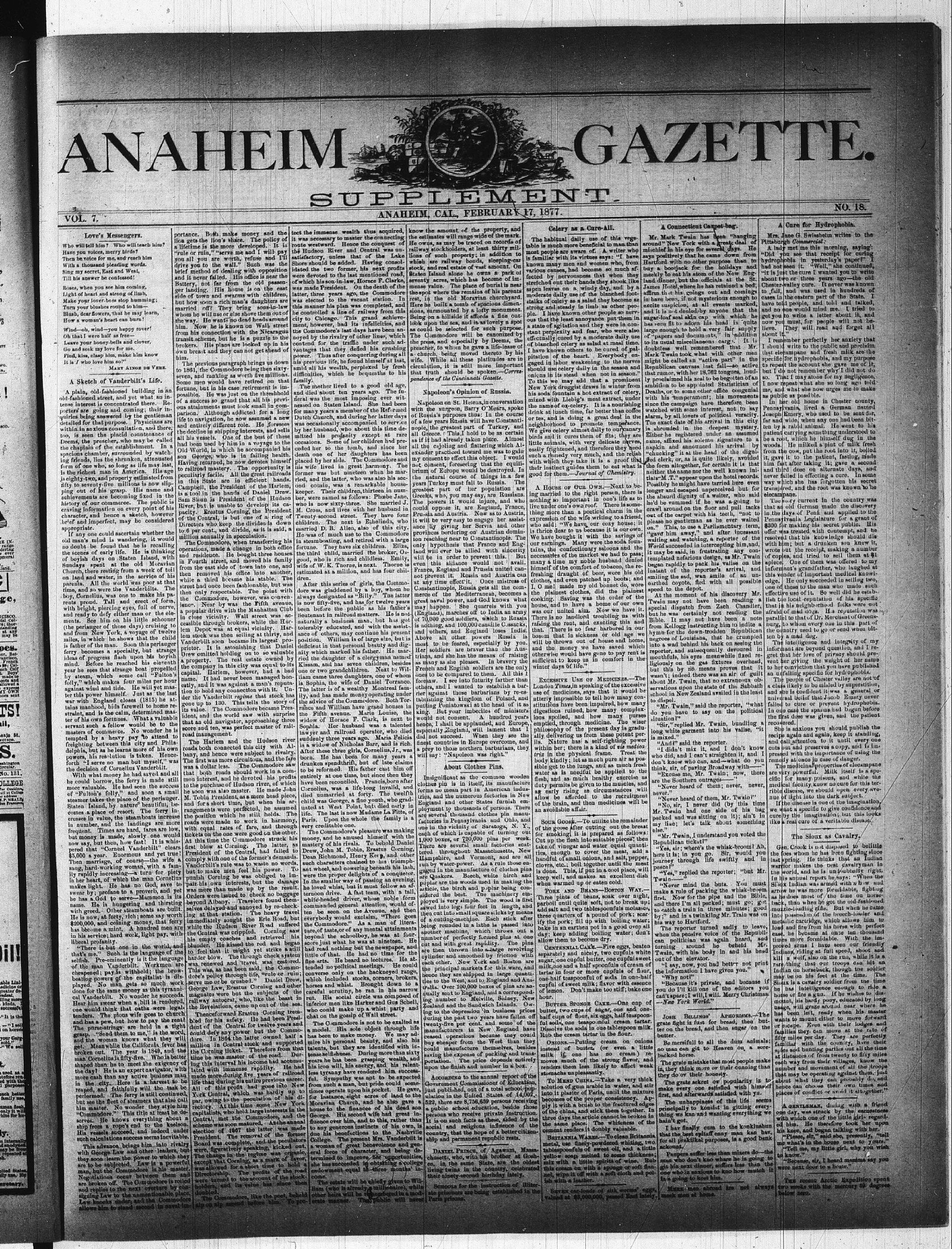
Searchable text
ANAHEIM
VOL. 7.
Love's Messengers.
Who will tell him? Who will teach him?
Have you voices, merry birds?
Then be voice for me, and reach him
With a thousand pleading words.
Sing my secret, East and West,
Till his answer be confessed!
Roses, when you see him coming,
Light of heart and strong of limb,
Make your lover-bees stop humming;
Turn your blushes round to him—
Blush, dear flowers, that he may learn,
How a woman's heart can burn!
Wind—oh, wind—you happy rover!
Oh that I were half as free—
Leave your honey-bells and clover,
Go and seek my love for me.
Find, kiss, clasp him, make him know
It is I who love him so!"
MARY AINOE DE VERE.
A Sketch of Vanderbilt's Life.
A plain, old-fashioned building in an old-fashioned street, and yet what an intense interest is concentrated there. Reporters are going and coming; their inquiries being answered by the gentleman detailed for that purpose. Physicians are within in anxious consultation, and there, too, is seen the placid countenance of Deems, the prescher, who may be called the chaplain of the establishment. In a spacious chamber, surrounded by watching friends, lies the shrunken, attenuated form of one who so long as life may last.
Importance. Both make money and the lion gets the lion's share. The policy of a lifetime is the more developed. It is "rule or ruin," "serve me and I will pay you all you are worth, refuse and I'll drive you to the wall." Such was the brief method of dealing with opposition and it never failed. His office is near the Battery, not far from the old passenger landing. His house is on the east side of town and swarms with children, but how soon a rich man's daughters are married off? They bring sons-in-law whom he will use or else shave them out of the way. He wants no dead heads around him. Now he is known on Wall street from his connection with the Nicaragua transit scheme, but he is a puzzle to the brokers. His plans are looked up in his own breast and they cannot get ahead of him.
The previous paragraph brings us down to 1861, the Commodore being then sixty-seven, and ranking as worth five millions. Some men would have retired on that fortune, but in his case retirement is impossible. He was just on the threshold of a success so grand that all his previous attainments must look small in comparison. Although addicted for a long life to navigation, he now assumed a new and entirely different role. He foresees the decline in shipping interests, and sells all his vessels. One of the best of these had been used by him in a voyage to the Old World, in which he accompanied his son George, who is in failing health. Having returned, he now devotes himself to protect the immense wealth it was necessary to mass route westward. Hence the Hudson River and satisfactory, unless the Shore should be added. Idated the two former were devoted to the last of which his son-in-law was made President. Latter, three years ago was elected to the villa manner his plan was controlled a line of city to Chicago. This ment, however, had it the Commodore's last owed by the rivalry of contend for the traffic vantages that they de power. Thus after concluding his previous life, he found amid all his wealth, particularly difficulties, which he family.
The mother lived to and died about ten years old was the most infrequent on Staten Island for many years a member Dutch Church, and du was occasionally accorded by her husband, who mitted his profanity occasions. Some of he ceded her to the tom death one of her d placed by her side.
A Sketch of Vanderbilt's Life.
A plain, old-fashioned building in an old-fashioned street, and yet what an intense interest is concentrated there. Reporters are going and coming; their inquiries being answered by the gentleman detailed for that purpose. Physicians are within in anxious consultation, and there too, is seen the placid countenance of Deems, the presacher, who may be called the chaplain of the establishment. In a spacious chamber, surrounded by watching friends, lies the shrunken, attenuated form of one who, so long as life may last, is the richest man in America. His age is eighty-two, and property estimated from fifty to seventy-five millions is now slipping out of his grasp. His name and achievements are becoming fixed in the history of our commerce. The public is craving information on every point of his character, and hence a sketch, however brief and imperfect, may be considered appropriate.
If any one could ascertain whether the old man's mind is wandering, it would no doubt be found that he is recalling the scenes of early life. He is thinking of boyish days on Staten Island, with Sundays spent at the old Moravian Church, there resting from a week of toil on land and water, in the service of his parents. All the world was poor at that time, and so were the Vanderbilts. The boy, Cornelius, was one to make his parents proud. Tall and erect of form, with bright, piercing eyes, full of nerve, and ready to defy either man or the elements. See him on his little schooner (the perianger of those days) cruising to and from New York, a voyage of twelve miles, in which he shows that the child is father of the man. Soon this periauer ferry becomes a specialty, but strange ideas of progress flash upon his boyish mind. Before he reached his eleventh year he sees that strange boat propelled by steam, which some call "Fulton's folly," which makes four miles per hour against wind and tide. He will yet master this power himself. Just as the last war with England closes (1815) he attains manhood, bids farewell to home restraint, and is the calm, determined master of his own fortunes. What a valuable servant such a fellow would be to the masters of commerce. No wonder he is tempted by a heavy pay to attend to freighting between this city and Philadelphia, but as he learns more of his own powers, his resolution is taken. Henceforth "I serve no man but myself," was the decision of Cornelius Vanderbilt.
With what money he had saved and all he could borrow, the ferry is made still more valuable. He had seen the success of "Fulton's folly," and soon a small steamer takes the place of the perianger. Staten Island, by nature beautiful, becomes a place of resort. The ferry increases in value, the steamboats increase in number, and the landings are more frequent. Times are hard, fares are low, but money is made, slowly one would now say, but then, how fast! It is whispered that "Cornelius Vanderbilt" clears $5,000 a year. Enormous and yet true!
Then marriage, of course—the wife a snug, hard-working woman, with a family rapidly increasing—a turn for piety in her heart, of which the man Cornelius
to 1861, the Commodore being then sixty-seven, and ranking as worth five millions. Some men would have retired on that fortune, but in his case retirement is impossible. He was just on the threshold of a success so grand that all his previous attainments must look small in comparison. Although addicted for a long life to navigation, he now assumed a new and entirely different role. He foresees the decline in shipping interests, and sells all his vessels. One of the best of these had been used by him in a voyage to the Old World, in which he accompanied his son George; who is in failing health. Having returned, he now devotes himself to railroad mastery. The opportunity is peculiarly facile. All the great railroads in this State are in efficient hands. Campbell, the President of the Harlem, is a tool in the hands of Daniel Drew. Sam Shoan is President of the Hudson River, but is unable to develop its capacity. Ernestus Corning, the President of the Central, is but one of a ring of Directors who keep the dividends down to 6 per cent., and divide, as it is said, a million annually in speculation.
The Commodore, when transferring his operations, made a change in both office and residence. He bought three houses in Fourth street, and moved his family from the east side of town into one, and then removed his office into another, while a third became his stable. The street had once been fashionable, but was then only respectable. The point with the Commodore, however, was convenience. Near by was the Fifth avenue, a popular drive with the Manhattan Club in close vicinity. Wall street was accessible through brokers, while the Harlem Depot was at equal vicinity. Harlem stock was then selling at thirty, and Vanderbilt soon became its largest proprietor. It is astonishing that Daniel Drew omitted holding on to so valuable a property. The real estate owned by the company in this city was equal to its capital. Harlem, however, had a bad name. It had never been managed honestly, and it was against a man's reputation to hold any connection with it. Under the Vanderbilt regime that stock has gone up to 130. This tells the story of its value. The Commodore became President, and the world saw with surprise that an old navigator approaching three score and ten, was perfect master of railroad management.
The Harlem and the Hudson river roads both connected this city with Albany, and hence were subject to rivalry. The first was more circuitous, and the fare was a dollar less. The Commodore saw that both roads should work in a common interest, and he devoted his profits to the purchase of Hudson river, of which he soon was also master. He made John M. Tobin President, as a mere head piece, and for a short time, but when his arrangements were perfected, he assumed the position which he still holds. The roads were made to work in harmony, with equal rates of fare, and through tickets on the one were good on the other. At this time the Commodore struck his first blow at Corning. The latter, as President of the Central, had failed to comply with one of the former's demands. Vanderbilt's rule was to waste no words, but to make men feel his power. To punish Corning he was obliged to imitate his interests but the damage
The mother lived too and died about ten years later was the most insured on Staten Island for many years a memorial Dutch Church, and duly was occasionally accounted by her husband who was mittened his prganity occasions. Some of her ceded her to the town death one of her days placed by her side. His wife lived in greenery formed was but matureried,and the latter ,whod cousin ,was a keeper. Their children were named as follows who is now sixty-three M.Cross,and lives with Twenty-second street children.The next married D.B.Allen.He was of much use in steamboating,and fortune They have had the third child,marry good who is rich and wife of W.K.Thorne estimated at a million dren.
After this series of dore was gladdened always designated as is now fifty-five,and been before the pulsation naturally a business tolerably educated,a sense of others,may be position.William is deficient in that personality which marked him ried the daughter of Kissam,and has served one or two grandchildren came three days Sophia,the wife of latter is of a wellily,and has made me advice of the Connance and William hiethe Fifth avenue.widow of Horace B.Sophia.Hor husbah lawyer and railroad suddenly three years is a widow of Nichol.After these three girls born.He has been drunken spendthrift to be reformed.His entirety at one time have been reconciled Cornelius ,was a li died unmarried at child was George,a mutated at West Poole life.The last is now Paris.Upon the wives very creditable one.
The Commodore's money,and he amused mastery of his rival Drew,john M.Toth Dean Richmond,His such characters charactert wheel,and cowere were the proper de
more valuable. He had seen the success of "Fulton's folly," and soon a small steamer takes the place of the perluager. Staten Island, by nature beautiful, becomes a place of resort. The ferry increases in value, the steamboats increase in number, and the landings are more frequent. Times are hard, fares are low, but money is made, slowly one would now say, but then, how fast! It is whispered that "Cornelel Vanderbilt" clears $5,000 a year. Enormous and yet true! Then marriage, of course—the wife a snug, hard-working woman, with a family rapidly increasing—a turn for piety in her heart, of which the man Cornellius makes light. He has no God, save to swear by; profane to a proverb, and yet he has a God to serve—Mammon is its name. He is hungering and thirsting with greed. Other steamboats are built: He is now, at forty, rich; some say worth $200,000, and colling money, that ferry has become a mint. A hundred men are in his service; hard work, light pay, with liberal profanity.
“There is but one in the world, and that's me.” Suoh is the language of the selfish. Pre-eminently is it the language of the man Vanderbilt. Workmen are cheapened; pay is withheld; the brow-beating powers of the capitalist is displayed. No man gets so much work done for the same money as this tyrannical Vanderbilt. No wonder he succeeds. Hear him swear when a bill is rendered, one would think that oaths were legal-tenders. The pious wife goes to church and has a pew, but how to pay the rent? The purse-strings are held in a tight grasp. “Send them to me,” is the word, and the woman knows what they will get. Meanwhile the California fever has broken out. The year is 1849, and the man Cornellius is fifty-five. Who is better shaped than he to meet the exigency of the day! He is an expert navigator, with more cash than any active business man in the city. Here is a harvest to be reaped, and faithfully will the task be performed. The ferry is still continued, but see the fleet of steamers that also call him master. No wonder they style him "Commodore." This title at least he serves. He knows everything about a ship from a rope's end to the keelson. His vessels succeed, and indeed under such calculations success seems inevitable.
This advance brings him into rivalry with George Law and other leaders, but they soon learn the power to which they are to be subjected. Law is a powerful man, but the Commodore is his master. Negotiations occur between them and are broken off. The Commodore is roiled and replies to the next overture by consigning Law to the unmentionable place. Law knocks under, and the Commodore allows him to stand second in naval in-
to the purchase of Hudson river, or which he soon was also master. He made John M. Tobin President, as a mere head piece, and for a short time, but when his arrangements were perfected, he assumed the position which he still holds. The roads were made to work in harmony, with equal rates of fare, and through tickets on the one were good on the other. At this time the Commodore struck his first blow at Corning. The latter, as President of the Central, had failed to comply with one of the former's demands. Vanderbilt's rule was to waste no words, but to make men feel his power. To punish Corning he was obliged to impair his own interests, but the damage was more than made up by the result. Orders were issued to check no baggage beyond Albany. Travelers found themselves delayed and annoyed by re-checking at that station. The heavy travel immediately sought the Erie Road, but while the Hudson River Road suffered the Central was crippled. Corning saw his empty coaches and retrieved his blunder. He kissed the rod and began to feel that it might yet strike a still harder blow. The through check system was renewed and travel was restored. This was, as has been said, the Commodore's policy through life, "rule or ruin; serve me or be crushed." Daniel Drew, George Law, Erastus Corning and other magnates were but the subjects of the railway autocrat, who, like the beast in the Revelations, came up out of the sea.
Theanceforward Erastus Corning trembled for his safety. He had been President of the Central for twelve years and could defy any power but the Commodore. In 1864 the latter owned half a million in Central stock and supported the Corning ticket. Therefore from that time he was master of the road. During this interval his income had accumulated with immense rapidity. He had made more during five years of railroad life than during his entire previous career. All of this profit had gone into New York Central, which was hardly up to par, owing to the peculation of his directory. At this time some New York capitalists, who held large interests in the Central, met the Commodore, and the scheme was soon matured. At the annual election of 1867 the latter was made President. The removal of the former Board was complete, and the peculators were figuratively speaking, kicked out. The change in the regime was organic except that Corning, as a mark of favor, was allowed for a short time to hold a Directorship. The profits of the road were turned to the account of the stockholders, and its value has since then doubled.
The Commodore, like the poet, behold alp on alp around himself. To proCornellius, was a lilied unmarried at child was George, as animated at West Point life. The last is now Paris. Upon the wavy very creditable one.
The Commodore's money, and he amuses mastery of his rival Drew, John M. Toben Richmond, He such characters chat ant wheel,and cowere were the proper deli In the smaller way he loved whist,but ternoon drive.A white-headed driver commanded genera ten be seen on everybody would owe the Commodore."
tureof taste.orof a beyondthe school score just what he had read nothing little of that.He fine arts.He heard tended no political converse only on which included s horses and whist careful scrutiny,rut.His social inferior men like who could make chat on the gossip.
The Commodor's model.His son has been to make mire his personal talents,但they tense selfishness.years he has been his iron will,his less tyranny have ful.Sympathy w from such a man,times operate upon instance,eight Moravian Church house to the florGeorge.His sece fluence over him.to any generous due his benefice College.The pra-a woman of great eral force of clermined to imp she has succeeded endowment equivome.
The estate will llam (who is strife other heirs will or erals manner.)
IM GAZ SUPPLEMENT.
ANAHEIM, CAL., FEBRUARY 17, 1877.
tect the immense wealth thus acquired,
it was necessary to master the connecting route westward. Hence the conquest of the Hudson River and Central was unsatisfactory, unless that of the Lake Shore should be added. Having consolidated the two former, his next profits were devoted to the last mentioned road, of which his son-in-law, Horace F. Clarke, was made President. On the death of the latter, three years ago, the Commodore was elected to the vacant station. In this manner his plan was completed, and he controlled a line of railway from this city to Chicago. This grand achievement, however, had its infelicities, and the Commodore's last days have been annoyed by the rivalry of other lines, which contend for the traffic under such advantages that they defied his crushing power. Thus after conquering during all his previous life, he found himself at last, amid all his wealth, perplexed by fresh difficulties, which he bequeaths to his family.
The mother lived to a good old age, and died about ten years ago. The funeral was the most imposing ever witnessed on Staten Island. She had been for many years a member of the Reformed Dutch Church, and during her latter days was occasionally accompanied to service by her husband, who about this time denied his profanity except at rare occasions. Some of her children had preceded her to the tomb, and since her death one of her daughters has been placed by her side. The Commodore and Consolidated Railroad company know the amount of the property, and the estimates will range wide of the mark. He owns, as may be traced on records of railway stockholders, at least thirty millions of such property; in addition to which are railway bonds, sleeping-car stock, and real estate of vast amount. On Staten Island alone he owns a park of seventy acres, which has become of immense value. The place of burial is near the spot where the remains of his parents rest, in the old Moravian churchyard. Here he built a tomb of spacious dimensions, surmounted by a lofty monument. Being on a hillside it affords a fine outlook upon the sea, and is as lovely a spot as could be selected for such purpose. The Commodore will be canonized by the press, and especially by Deems, the preacher, to whom he gave a life-lease of a church, being moved thereto by his wife. While all these platitudes are in circulation, it is still more important that truth should be spoken—Correspondence of the Cincinnati Gazette.
Napoleon’s Opinion of Russia.
Napoleon on St. Helena, in conversation with the surgeon, Barry O’Meara, spoke of Russia’s purposes thus: In the course of a few years Russia will have Constantinople, the greatest part of Turkey, and all Greece. This I hold to be as certain as if it had already taken place. Almost all the cajoling and flattering which Alexander practiced toward me was to gain my consent to effect this object. I would not consent, foreseeing that the equili-
Gelery as a Cure-All.
The habitual daily use of this vegetable is much more beneficial to man than most people are aware of. A writer who is familiar with its virtues says: “I have known many men and women who, from various causes, had become so much affected by nervousness that when they stretched out their hands they shook like aspen leaves on a windy day, and by a moderate daily use of the blanched foot-stalks of celery as a salad they become as strong and steady in limb as other people. I have known other people so nervous that the least annoyance put them in a state of agitation and they were in constant perplexity and fear, who were also effectively cured by a moderate daily use of blanched celery as salad at meal time. I have known others to be cured of palpitation of the heart. Everybody engaged in labor weakening to the nerves should use celery daily in the season and onions in its stead when not in season.” To this we may add that a prominent New York druggist draws in winter from his soda fountain a hot extract of celery, mixed with Liebig’s meat extract, under the name of ox-celery. It is a nourishing drink at lunch time, far better than coffee or tea, and is doing a great deal in the neighborhood to promote temperance. We give celery almost daily to our canary birds and it cures them of fits; they are little animals, with very delicate nerves, easily frightened, and therefore they need such a remedy very much, and the relish with which they take it is a proof that Mr. Mark around” No mischief lies Hartford winters buy a book meekly to land dinner James Hotter affirm that in have been excite sausage and it is no sugar-loaf has seen fit large enoughed “papers” to its usual doubtless Mark Twain might be co-Publican that rumorally proclaim ambition to Deaths; or with his name, affine napkin and “chucking clerk.”
The mother lived to a good old age, and died about ten years ago. The funeral was the most imposing ever witnessed on Staten Island. She had been for many years a member of the Reformed Dutch Church, and during her latter days was occasionally accompanied to service by her husband, who about this time demitted his prenuity except at rare occasions. Some of her children had preceded her to the tomb, and since her death one of her daughters has been placed by her side. The Commodore and his wife lived in great harmony. The former was but nineteen when he married, and the latter, who was also his second cousin, was a remarkable housekeeper. Their children, thirteen in number, were named as follows: Phoebe Jane, who is now sixty-three. She married J. M. Cross, and lives with her husband in Twenty-second street. They have four children. The next is Ethelinda, who married D. B. Allen, also of this city. He was of much use to the Commodore in steamboating, and retired with a large fortune. They have six children. Eliza, the third child, married the broker, Osgood, who is rich and childless. Emily, wife of W. K. Thorne, is next. Thorne is estimated at a million, and has four children.
After this series of girls, the Commodore was gladdened by a boy, whom he always designated as "Billy." The latter is now fifty-five, and has for twelve years been before the public as his father's lieutenant in railroad matters. He is not naturally a business man, but has got tolerably educated, and with the assistance of others, may continue his present position. William is of large size, but is deficient in that personal beauty and dignity which marked his father. He married the daughter of a clergyman named Kissam, and has seven children, besides one or two grandchildren. Next to William came three daughters, one of whom is Sophia, the wife of Daniel Torrance. The latter is of a wealthy Montreal family, and has made money operating under the advice of the Commodore. Both Torrance and William have grand houses in the Fifth avenue. Marie Louise, the widow of Horace F. Clark, is next to Sophia. Her husband was a talented lawyer and railroad operator, who died suddenly three years ago. Maria Felicia is a widow of Nicholas Barr, and is rich. After these three girls, Cornelius Jr., was born. He has been for many years a drunken spendthrift, but of late claims to be reformed. His father cast him off entirely at one time, but since then they have been reconciled. Francis, born after Cornelius, was a life-long invalid, and died unmarried at forty. The twelfth child was George, a fine youth, who graduated at West Point, but died early in life. The last is now Madame La Fitte, of Paris. Upon the whole family is a very creditable one.
The Commodore's pleasure was making money, and he amused himself with the master of his rivals. To behold Daniel Drew, John M. Tobin, Erasus Corning, Dean Richmond, Henry Keep, and other such characters chained to his triumphant wheel, and cowering beneath his lash, were the proper delights of a conqueror. In the smaller way of passing an evening.
Napoleon's Opinion of Russia.
Napoleon on St. Helena, in conversation with the surgeon Barry O'Meara, spoke of Russia's purposes thus: In the course of a few years Russia will have Constantinople, the greatest part of Turkey, and all Greece. This I hold to be as certain as if it had already taken place. Almost all the cajoling and flattering which Alexander practiced toward me was to gain my consent to effect this object. I would not consent, foreseeing that the equilibrium of Europe would be destroyed. In the natural course of things in a few years Turkey must fall to Russia. The greatest part of her population are Greeks, who you may say, are Russians. The powers it would injure, and who could oppose it, are England, France, Prussia and Austria. Now as Austria it will be very easy to engage her assistance by giving her Servia and other provinces bordering on Austrian dominion reaching near to Constantinople. The only hypothesis that France and England will ever be allied with sincerity will be in order to prevent this. But even this alliance would not avail France, England and Prussia united cannot prevent it. Russia and Austria can at any time effect it. Once mistress of Constantinople, Russia gets all the commerce of the Mediterranean becomes a great naval power, and God knows what may happen. She quarrels with you (England) marches off to India an army of 70,000 good soldiers, which to Russia is nothing, and 100,000 cannile Cossacks, and others, and England loses India. Above all other powers Russia is most to be feared, especially by you. Her soldiers are braver than the Austrians, and she has the means of raising as many as she pleases. In bravery the French and English soldiers are the only ones to be compared to them. All this I forewax. I see into futurity farther than others, and I wanted to establish a barrier against those barbarians by re-establishing the kingdom of Poland, and putting Poniatowski at the head of it as king. But your imbeciles of ministers would not consent. A hundred years hence, I shall be applauded, and Europe, especially England, will lament that I did not succeed. When they see the finest countries in Europe overcome, and a prey to those northern barbarians, they will say: "Napoleon was right."
About Clothes Pins.
Insignificant as the common wooden clothes pin is in itself, its manufacture forms no mean part in American industries, and the numerous factories in New England and other States furnish employment to thousands of persons. There are several thousand clothes pin manufacturers in Pennsylvania and Ohio, and one in the vicinity of Saratoga, N.Y., each of which is capable of turning out 1,000 boxes, or 720,000 pins per week. There are several small factories scattered throughout Massachusetts, New Hampshire, and Vermont; and are all run by water-power. As a rule those engaged in the manufacture of clothes pins are Quakers. Beech white birch and pine are the woods used in making the should use celery daily in the season and onions in its stead when not in season." To this we may add that a prominent New York druggist draws in winter from his soda fountain a hot extract of celery, mixed with Liebig's meat extract, under the name of ox-celery. It is a nourishing drink at lunch time, far better than coffee or tea,and is doing a great deal in the neighborhood to promote temperance.
We give celery almost daily to our canary birds and it cures them of fits; they are little animals, with very delicate nerves, easily frightened,and therefore they need such a remedy very much,and the relish with which they take it is a proof that their instinct guides them to eat what is good for them." Journal of Chemistry.
A House of Our Own.-Next to being married to the right person there is nothing so important in one's life as to live under one's own roof. There is something more than a poetical charm in the expression of the wife writing to a friend; who said: "We have our cozy house; it is thrice dear to us because it is our own. We have bought it with the savings of our earnings.Many were the soda fountains,the confectionary saloons and the necessities of the market we had to pass; many a time my noble husband denied himself of the comfort of tobacco,the refreshing draught of beer.wore his old clothes,and even patched up boots;and I.O medi made my old bonnet do,dore the plainest clothes,did the plainest cooking.Saving was the order of the house,and to have a home of our own was our united aim.Now we have it.There is no landlord troubling us with raising the rent,and exacting this and that.The there is no fear harbored in our bosom that in sickness or old age we will be thrown out of house and home,and the money we have saved which otherwise would have gone to pay rent is sufficient to keep us in comfort in the winter days of life."
Excessive Use of Medicines.-The London Times.in speaking of the excessive use of medicines,says that it would be utterly impossible to tell how many constitutions have been impaired,how many digestions ruined,how many complexions spoiled,and how many purses emptied through medicine.The wiser philosophy of the present day is gradually delivering us from these potent perils.Nature has a self-righting power within ber;there is a kind of via medicina in the physical frame.Treat the body kindly;let as much pure air as possible get to the lungs,and as much fresh water as is needful be applied to the flesh,and as much healthy exercise as duty permits be given to the muscles,and as early rising as circumstances allow be afforded to the recruitment of the brain,and then medicines will be an avoidable affair.
Sour Goose.-To utilize the remainder of the goose after cutting out the breast for smoking.it is prepared as follows:Cut up the flesh into suitable pieces;then take vinegar and water equal quantities,eough to cover the meat.add a handful of small onions,and salt pepper.cloves etc.;boll together until the meat is doneThis,iif put in a cool place.will keep well,and makes an excellent dish worn or eaten cold
Cornelius, was a life-long invalid, and died unmarried at forty. The twelfth child was George, a fine youth, who graduated at West Point, but died early in life. The last is now Madame La FITTE, of Paris. Upon the whole the family is very creditable one.
The Commodore's pleasure was making money, and he amused himself with the mastery of his rivals. To behold Daniel Drew, John M. Tobin, Erastus Corning, Dean Richmond, Henry Keep, and other such characters chained to his triumphant wheel, and cowering beneath his lash, were the proper delights of a conqueror. In the smaller way of passing an afternoon drive. A fast team, with a tall, white-headed driver, whose noble form commanded general attention, would often be seen on the Avenue, and then everybody would exclaim: "There goes the Commodore." As a man of literature, of taste, or of any mental attainments beyond the schoolboy, he was at four-score just what he was at nineteen. He had read nothing but the newspaper, and little of that. He had no time for the fine arts. He heard no lectures. He attended no political meetings. He could converse only on the hackneyed range, which included stocks, corners, brokers, horses and whist. Brought down to a careful scrutiny, he ran in his narrow rut. His social circle was composed of inferior men like Harker and Gus Schell, who could make up a whist party and chat on the gossip of Wall street.
The Commodore is not to be exalted as a model. His sole object through life has been to make money. We may admire his personal beauty, and also his talents, but they are identified with intense selfishness. During more than sixty years he has been grasping wealth, and his iron will, his energy, and his relentless tyranny have rendered him successful. Sympathy was not to be expected from such a man, but pride could sometimes operate upon his pocket. He gave, for instance, eight acres of land to the Moravian Church, and he also gave a house to the finance of his dead son George. His second wife had great influence over him, and to this, rather than to any generous instincts of his own, is due his benefactions to the Nashville College. The present Mrs. Vanderbilt is a woman of great benevolence and general force of character, and being determined to improve her opportunities, she has succeeded in obtaining a college endowment equal to three months' income.
The estate will be chiefly given to William (who is already a millionaire), while other hairs will be remanded in a moderate manner. The public will never
The machinery employed is very simple. The wood is first sawed into logs four feet in length, and then cut into small square sticks by means of a cutting-machine. Each stick after being rounded in a lathe is passed into another machine, which throws out a number of perfectly formed pins at one cut and with great rapidity. The pins are then thrown into a large revolving cylinder and smoothed by friction with each other. New York and Boston are the principal markets for this ware, and hence they are shipped in large quantities to the West, and to England and Australia. Over 100,000 boxes of pins are annually sent to England, and a corresponding number to Melville, Sidney, New Zealand and the Sandwich Islands. Owing to the depression in business prices during the past two years have fallen off twenty-five per cent., and some of the manufacturers in New England have ceased operations because they could buy cheaper from the West than they could manufacture themselves, besides saving the expense of packing and transportation. The price depends entirely upon the finish and number in a box.
According to the annual report of the Government Commissioner of Education, just published, out of a total school population in the United States of 14,002,522, there are 8,756,839 persons receiving a public school education, beside those persons who receive private instruction. It is on such facts as these, sided by the social and religious influence of the country, that the hope of a better citizenship and permanent republic rests.
DANIEL PRINCE, of Agawam, Massachusetts, who, with his brother at Goshen, in the same State, are the oldest living twins in the country, celebrated their ninety-second birthday lately.
Schools for the instruction of illiterate prisoners are being established in the Paris prisons.
SOUR GOOSE.-To utilize the remainder of the goose after cutting out the breast for smoking it is prepared as follows: Cut up the flesh into suitable pieces; then take of vinegar and water equal quantities enough to cover the meat, add a handful of small onions, and salt pepper, cloves, etc.; boil together until the meat is done. This, if put in a cool place, will keep well, and makes an excellent dish when warmed up or eaten cold.
PORK AND BEANS—BOSTON WAY.-Three pints of beans, soak over night, parboil until quite soft, not to break up; add salt and two tablespoonfuls molasses; three quarters of a pound of pork; scarify the pork; fill up with boiling water; bake in an earthen pot in a good oven all day; keep adding boiling water; don't allow them to become dry.
CENTENNIAL CAKE.-Five eggs, beaten separately and nicely, two cupfuls white sugar, one cupful butter, one cupful sweet milk, one and a half spoonfuls of cream of tartar in four or more cupfuls of flour, one-half teaspoonful of soda in one-half cupful of sweet milk; flavor with essence of lemon. Don't make too stiff; bake one hour.
ButTER SPONGE CAKE.-One cup of butter, two cups of sugar, one and one-half cups of flour, six eggs, half teaspoonful solids, one teaspoonful cream tartar. Dissolve the soda in one tablespoon milk. Rub the cream tartar in the flour.
ONIONS.-Putting cream on onions instead of butter (or even a little milk if one has no cream) removes much of the strong flavor, and renders them less likely to affect weak stomachs unpleasantly.
TO MEND CHINA.-Take a very thick solution of gum Arabic in water, and stir into it plaster of Paris; until the mixture becomes of the proper consistency. Apply it with a brush to the fractured edges of the china, and stick them together. In three days the article cannot be broken in the same place. The whiteness of the cement renders it doubly valuable.
BRITANNIA WALES.-To clean Britannia metal, use finely-powdered whiting; two tablespoonfuls of sweet oil, and a little yellow soap melted to some thickness; mix with a little spirits of wine. Rub this cream on with a sponge or soft flannel; wipe it off with a soft cloth and polish with a leather.
Seven carloads of silk morms' eggs valued at $20,000,000 passed East latey.
GAZETTE.
NO. 18.
A Connecticut Gazet-bag.
Mr. Mark Twain has been "hanging around" New York with a great deal of mischief in his eye for several days. He says positively that he came down from Hartford with no other purpose than to buy a bootjack for the holidays and meekly to eat his atom of the New England dinner, but the officials at the St. James Hotel, where he has retained a bed, affirm that his goings out and comings in have been, if not mysterious enough to excite suspicion, at all events marked, and it is not denied by anyone that the sugar-loaf seal skin cap with which he has seen fit to adorn his head is quite large enough to hold a very fair supply of "papers and documents," in addition to its usual miscellaneous cargo. It is doubtless well remembered that Mr. Mark Twain took what with other men might be called an "active part" in the Republican canvass last fall—so active that rumor, with her 18,762 tongues, loudly proclaimed his zeal to be begotten of an ambition to be appointed Statistician of Deaths, or to some other office congenial with his temperament; his movements since the campaign have therefore been watched with some interest, not to say alarm, by all lovers of political veracity. The exact date of his arrival in this city is shrouded in the deepest mystery. Either he registered under an assumed name, affixed his solemn signature to a napkin and announced his arrival by "chucking" it at the head of the dignified clerk, or, as is quite likely, avoided the form altogether for certain it is that
A Cure for Hydrophobia.
Mrs. Jane G. Swisshelm writes to the Pittsburgh Commercial:
A lady met me this morning, saying: "Did you see that receipt for curing hydrophobia in yesterday's paper?" I had not seen it. "Well," she continued, "it is just the cure I wanted you to write about two or three years ago—the old Chester-walley cure. It never was known to fail, and was used in hundreds of cases in the eastern part of the State. I have told people, and told and talked, and no one would mind me. I tried to get you to write a letter about it, and now you must, for people will not believe. They will read and forget all about it."
I remember perfectly her anxiety that I should write to the public and proclaim that elecampane and fresh milk are the specific for hydrophobia, and my purpose to repeat the account she gave me of it, but I do not remember why I did not do so. That I may atone for my negligence, I now repeat what she so long ago told me, and what she now urges me to make as public as possible.
In her old home in Chester county, Pennsylvania, lived a German named Joseph Emery, who used to be sent for far and wide when any one had been bitten by a rabid animal. He went to his patient carrying something understood to be a root, which he himself dug in the woods. He milked a pint of milk fresh from the cow, put the root into it, boiled it, gave it to the patient, fasting, made him fast after taking it; gave a second
Next to be the person there is one one's life as to there is some charm in the writing to a friend, or cozy house; it uses it is our own. The savings of the soda found in tobacco, the reamer, wore his old and up boots; and bonnet do, worse did the plainest order of the home of our own. Now we have it, troubling us with exacting this and harbored in our house and home, we saved which one to pay rent is comfort in the medicines.
The king of the excessive that it would be full how many compaired, how many complex now many purses medicine. The wiser present day is gradual these potent self-righting power kind of via medical frame. Treat the much pure air as posed and as much fresh applied to the healthy exercise as into the muscles, and circumstances will be the recruitment medicines will be
Initialize the remainder being out the breast prepared as follows: suitable pieces; then water equal quanti- for the meat, add a salt, pepper, other until the meat in a cool place, will an excellent dish frozen cold
Republican carriage, rumor, with her 18,762 tongues, loudly proclaimed his zeal to be begotten of an ambition to be appointed Statistician of Deaths, or to some other office congenial with his temperament; his movements since the campaign have therefore been watched with some interest, not to say alarm, by all lovers of political veracity. The exact date of his arrival in this city is shrouded in the deepest mystery. Either he registered under an assumed name, affixed his solemn signature to a napkin and announced his arrival by "chucking" it at the head of the dignified clerk, or, as is quite likely, avoided the form altogether, for certain it is that neither the name nor the well known initials M.T." appear upon the hotel records. Possibly he might have tarried here even longer and escaped unperceived but for the abaud dignity of a waiter, who said he'd be vummed if he was a going to crawl around on the floor and pull tacks out of the carpet with his teeth, "not to please no gentleman as he ever waited on." This, to use a Parliamentary term, "gave him away," and after incessant waiting and watching, a reporter of the World succeeded in intercepting him,and it may be said, in frustrating any contemplated nefarious design, as Mr. Twain began rapidly to pack his valise on the instant of the reporter's arrival, and smiling the sad, wan smile of an unearthed coyote, fled with all possible speed to the depot.
At the moment of his discovery Mr. Twain may not have been reading a special dispatch from Zach Chandler, but he was certainly not reading the Bible. It may not have been a note from Kellogg instructing him to indite a hymn for the down-trodden Republican negroes of Louisiana, that he crumpled into a wad behind his back on seeing the reporter, and subsequently devoured in mouthfuls, his eyes meanwhile fixed religiously on the gas fixtures overhead, but this by no means proves that it wasn't; indeed there was an air of guilt about Mr. Twain, that no extraneous observations upon the state of the Sabbath school in New Zealand availed in the least to dispel.
"Mr. Twain," said the reporter, "what do you have to say on the political situation?"
"Sir," replied Mr. Twain, bundling a long white garment into his valise, "it is mixed."
"And?" said the reporter.
"I didn't mix it, and I don't know who did, and I can't straighten it, and I don't know who can, and—what do you think, sir, of paving Broadway with——"
"Excuse me, Mr. Twain; now, there are the Southern outrages——"
"Never heard of them; never, never, never."
"Never heard of them, Mr. Twain?"
"No, sir, I never did (by this time Mr. Twain had one side of his bag packed and was sitting on it); ain't in my line; let's talk about something else."
"Mr. Twain, I understand you voted the Republican ticket?"
"Yes, sir; where's the whisk-broom? Ah, here it is; in you go. Sir, would you journey through life swiftly and in peace?"
"Yes," replied the reporter; "but Mr. Twain——"
but I do not remember why I did not do so. That I may atone for my negligence. I now repeat what she so long ago told me, and what she now urges me to make as public as possible.
In her old home in Chester county, Pennsylvania lived a German named Joseph Emery, who used to be sent far far and while, when any one had been bitten by a rabid animal. He went to his patient carrying something understood to be a root, which he himself dug in the woods. He milked a pint of milk fresh from the cow, put the root into it, boiled it, gave it to the patient, fasting made him fast after taking it; gave a second and third dose on alternate days, and never failed in effecting a cure. In some way which she has forgotten his secret transpired, and the root was known to be elocampane.
The story current in the country was that an old German made the discovery in the days of Penn and applied to the Pennsylvania Legislature for a grant of $300 for making his secret public. His offer was treated with contempt, and he resolved that his knowledge should dis with him; but a drunken son knew it, wrote but the receipt making a number of copies, and tried to sell them at $1 apiece. One of them was offered to my informant's grandfather who laughed at this vender of important medical knowledge. He only succeeded in selling two, one of these to the man who made such effective use of it. So well did he establish the local reputation of his specific that in his neighborhood folks were not afraid of mad dogs. His reputation was parallel to that of Dr. Merchant of Greensburg, to whom every one in this part of the country used to go or send when bitten by a mad dog.
The intelligence and integrity of my informant are beyond question, and I regret that her love of privacy should prevent her giving the weight of her name to her conviction that you have published an unfailing specific for hydrophobia.
The people of Chester valley are not of a class likely to be misled by superstition, and she is confident it was a general or universal belief that Jacob Emery never failed to cure or prevent hydrophobia. In one case the spasms had begun before the first dose was given, and the patient recovered.
She is anxious you should publish the recipe again and again, keep it standing, and call attention to it until every one cuts out and preserves a copy, and is impressed with the importance of using the remedy at once in case of danger.
The medicinal properties of elecampane are very powerful. Milk itself is a specific for many poisons, and while the medical faculty know no cure for this terrible disease, we should open every avenue of light into the dark subject.
If the disease is one of the imagination we want a specific to give confidence and cure by the imagination; but this looks like a real cure of a veritable disease.
The Sionx as Cavalry.
Gen. Crook is not disposed to belittle theoes whom he has been fighting since last spring. He thinks that an Indian warrior makes best cavalryman in the world, and he is unjustifiably right. In his annual report he says: "When the
"Never heard of them; never, never,
never."
"Never heard of them, Mr. Twain?"
"No, sir, I never did (by this time Mr. Twain had one side of his bag packed and was sitting on it); aln't in my line; let's talk about something else."
"Mr. Twain, I understand you voted the Republican ticket?"
"Yes, sir; where's the whisk-broom? Ab, here it is; in you go. Sir, would you journey through life swiftly and in peace?"
"Yes," replied the reporter; "but Mr. Twain——"
"Never mind the buts. You must make a rule of packing the whisk-broom first. Now for the pipe and the Bible, and there I'm all packed; must go; got to catch a train in three minutes; good by;" and in a twinkling Mr. Train was on his way to Hartford.
The reporter turned sadly to leave, when the pensive voice of the Republican politician was again heard, and turning around he beheld Mr. Twain, with his body in and his head out of the elevator.
"I say, now, you had better not print the information I have given you."
"Why not?"
"Because it's private, and because if you do I'll kill one of the editors you can't spare; I will, I will. Merry Christmas—New York World."
Josk Billings' Aphorisms—The grate fight iz fust for bread, then butter on the bread, and then sugar on the butter.
Be mersifull to all the dum animals; no man can git to Heaven on a sore-backed horse.
The grate mistake that most people make iz, they think more ov their cunning than they do ov their honesty.
The grate secret or popularity iz to make every one satisfied with himself first, and afterwards satisfied with you.
The unhappiness of this life seems principally to consist in gitting everything we kan and wanting everything we hain't got.
I have finally cum to the konklushun that the best epitaff enny man kan hav, for all praktikal purposes, is a good bank account.
Panspers suffer less than mizers do—the man who don't kno whare he iz going to git his next dinner, anfurs less than the one who iz anxious to kno how match it is a going to kost him.
Manx man abroad are not always mask man at home.
A gentleman, dining with a friend one day, was struck by the earnestness with which one of the little girls regarded him. He therefore took her upon his knee, and began talking with har.
"Please, sir," said she, presently, "tall me what's in the house next to yours."
"Tell me, my little girl, why you wish to know."
"Because, sir, I heard manna say you were next door to a brute."
The recent Arctic Expedition spent two weeks with the mercury 50 degrees below zero.