anaheim-gazette 1877-02-10
Scanned page
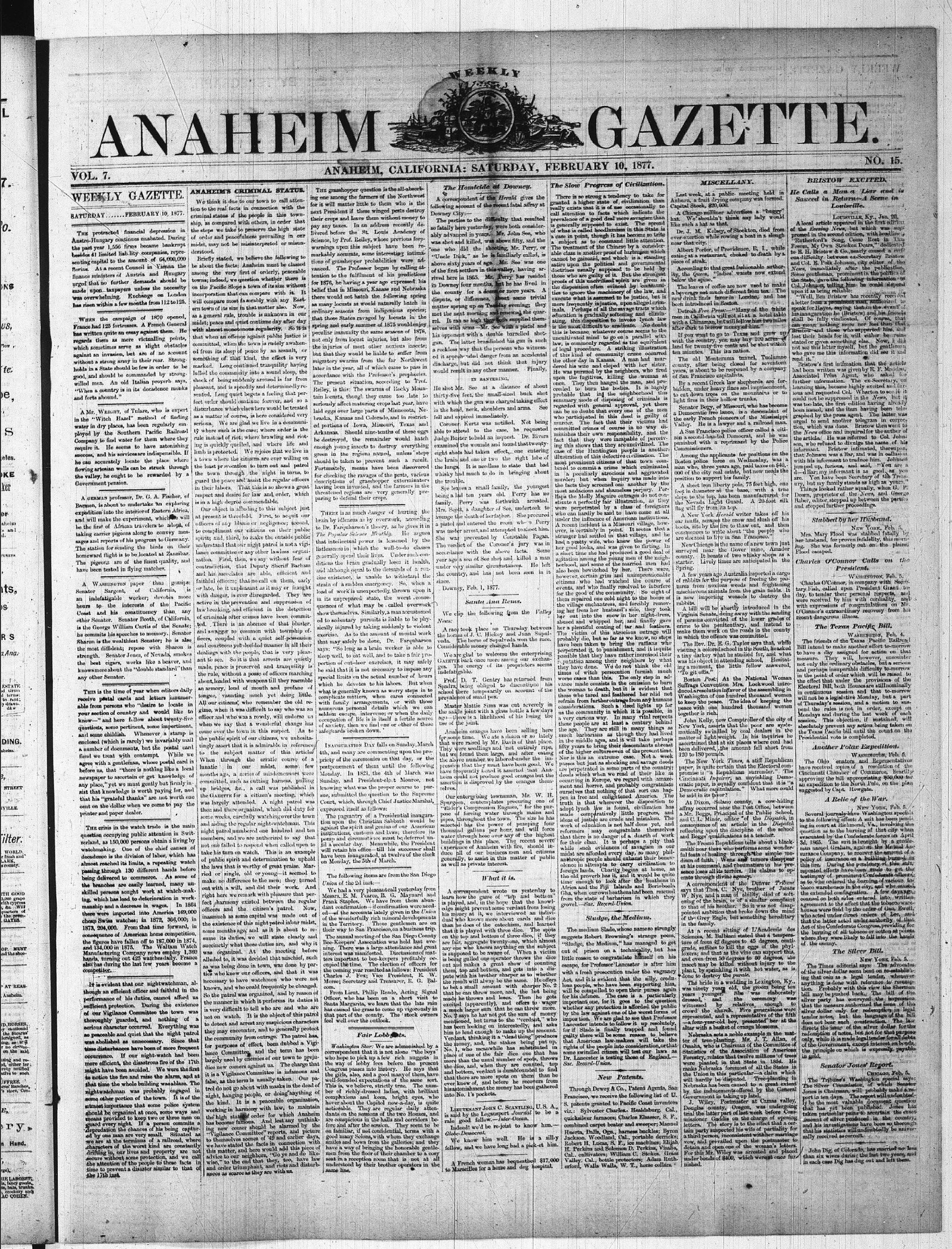
Searchable text
WEEKLY GAZETTE.
BATURDAY...FEBRUARY 10, 1877.
The protracted financial depression in Austro-Hungary continues unabated. During the past year 1,556 firms became bankrupt besides 41 limited liability companies, representing capital to the amount of 64,000,000 florins. At a recent Council in Vienna the finance ministers of Austria and Hungary urged that no further demands should be made upon taxpayers unless the necessity was overwhelming. Exchange on London has risen within a few months from 112 to 125.
When the campaign of 1870 opened, France had 125 fortresses. A French General has written quite an essay against them. He regards them as mere victuallising points, which sometimes serve as slight obstacles against an invasion, but are of no account without a strong army in their rear. Strongholds in a State should be few in order to be good, and should be commanded by strong-willed men. An old Italian proverb says, "When a country is in its decadence monks and forts abound."
A Mr. Wright, of Tulare, who is expert in the "Witch Hazel" method of finding water in dry places, has been regularly employed by the Southern Pacific Railroad Company to find water for them where they require it. He seems to have astonishing success, and his services are indispensable. If he can accurately locate the place where he can accurately locate the place where he think it due to our town to call attention to the real facts in connection with the criminal status of the people in this township, as compared with others, in order that the steps we take to preserve the high state of order and peacefulness prevailing in our midst, may not be misinterpreted or misunderstood.
Briefly stated, we believe the following to be about the facts: Anaheim must be classed among the very first of orderly, peaceable towns; indeed, we question whether there is on the Pacific Slope a town of its size without incorporation that can compare with it. It will compare most favorably with any Eastern town of its size in that matter also. Now, as a general rule, trouble is unknown in our milat; peace and quiet continue day after day with almost monotonous regularity. So it is that when an offence against public justice is committed, when the town is rudely awakened from its sleep of peace by an assault, or something of that kind, the effect is very marked. Long continued tranquility having fulfilled the community into a sound sleep, the shock of being suddenly awakened is far from pleasant, and is speedily and determinedly resented. Long quiet begets a feeling that perfect order should continue forever, and so a disturbance which elsewhere would be treated as a matter of course, is here considered very serious. We are glad we live in a community where such is the case; where order is the rule instead of riot; where brawling and rioting is quickly quelled, and where life and limb is protected. We rejoice that we live in a town where the citizens are ever willing on the heart preparation to turn out and patrol.
ANAHEIM'S CRIMINAL STATUS.
We think it due to our town to call attention to the real facts in connection with the criminal status of the people in this township, as compared with others, in order that the steps we take to preserve the high state of order and peacefulness prevailing in our midst, may not be misinterpreted or misunderstood.
Briefly stated, we believe the following to be about the facts: Anaheim must be classed among the very first of orderly, peaceable towns; indeed, we question whether there is on the Pacific Slope a town of its size without incorporation that can compare with it. It will compare most favorably with any Eastern town of its size in that matter also. Now, as a general rule, trouble is unknown in our milat; peace and quiet continue day after day with almost monotonous regularity. So it is that when an offence against public justice is committed, when the town is rudely awakened from its sleep of peace by an assault, or something of that kind, the effect is very marked. Long continued tranquility having fulfilled the community into a sound sleep, the shock of being suddenly awakened is far from pleasant, and is speedily and determinally resented. Long quiet begets a feeling that perfect order should continue forever, and so a disturbance which elsewhere would be treated as a matter of course, is here considered very serious. We are glad we live in a community where such is the case; where order is the rule instead of riot; where brawling and rioting is quickly quelled, and where life and limb is protected. We rejoice that we live in a town where the citizens are ever willing on the heart preparation to turn out and patrol.
The grasshopper ing one among them for it will matter next President if their crops and lea pay any taxes. I livered before the Science, by Prof. Laws warnings upon the markably accurate tions of grasshopper vaniced. The Protection to the future for 1876, he having belief that in Mis there would not be as many locusts as ordinary seasons that those States spring and early peculiar immunity not only from lock up but that they would migratory swarm later in the year accordance with The present sire Reiley is this: Tain locusts, though seriously affect new laid eggs over lava braska, Kansas ed portions of Arkansas. Should he destroyed, then enough young green in the re should be taken
A Mr. Wright, of Tulare, who is expert in the "Witch Hazel" method of finding water in dry places, has been regularly employed by the Southern Pacific Railroad Company to find water for them where they require it. He seems to have astonishing success, and his services are indispensable. If he can accurately locate the place where flowing artesian wells can be struck through the valley, he ought to be rewarded by a Government pension.
A German professor, Dr. G. A. Fischer, of Barmen, is about to undertake an exploring expedition into the interior of Eastern Africa, and will make the experiment, which he will be the first of African travelers to adopt, of taking carrier pigeons along to convey messages and reports of his progress to Germany. The station for sending the birds on their homeward flight is to be located at Zanzibar. The pigeons are of the finest quality, and have been tested in flying matches.
A Washington paper thus gossips: Senator Sargent, of California, is an indefatigable worker; devotes more hours to the interests of the Pacific Coast and his constituency than any other Senator. Senator Booth, of California, is the George William Curtis of the Senate; he commits his speeches to memory. Senator Sharon is the wealthiest Senator; he is also the most diffident; repose with Sharon is strength. Senator Jones, of Nevada, smokes the best cigars, works like a beaver, and knows more about the "double standard" than any other Senator.
This is the time of year when editors daily receive postal cards and letters innumerable from persons who "desire to locate in your section of country and would like to know—" and here follow about twenty-five questions, some pertinent, some impertinent, and some childish. Whenever a stamp is enclosed (which is rarely) we invariably mail a number of documents, but the postal card flend we treat with contempt. While we agree with a gentleman, whose postal card is before us, that "there is nothing like a local newspaper to ascertain or get knowledge of any place," yet we must gently but firmly insist that knowledge is worth paying for, and that his "grateful thanks" are not worth one cent on the dollar when we come to pay the printer and paper dealer.
The crisis in the watch trade is the main question occupying public attention in Switzerland, as 150,000 persons obtain a living by watchmaking. One of the chief causes of decadence is the division of labor, which has almost reached its limits, a repeating watch passing through 130 different hands before being delivered to commerce. As some of held in a State should be law in order to be good, and should be commanded by strong-willed men. An old Italian proverb says, "When a country is in its decadence monks and forts abound."
Our object in alluding to this subject just at present is threefold. First, to acquit our officers of any blame or negligence; second, to compliment our citizens on their public spirit; and third, to make the outside public understand that our night patrol is not a vigilance committee or any other lawless organization. First, then, we say without fear of contradiction, that Deputy Sheriff Barham and his associates are able, efficient and faithful officers; that no call on them, early or late, be it unpleasant as it may or fraught with danger, is ever disregarded. They are active in the prevention and suppression of law breaking, and efficient in the detention of criminals after crimes have been committed. There is an absence of that bluster, and swagger so common with township officers, coupled with a quiet self-passion and courteous yet decided manner in all their dealings with the people, that is very pleasant to see. So it is that arrests are quietly made, peace is preserved and tranquility is the rule, without a posse of officers marching about, loaded with weapons till they resemble an armory, loud of mouth and profane of tongue, vaniting much yet doing little. All our citizens' who remember the old regime, when it was difficult to say who was an officer and who was a rowdy, will endorse us when we say that a wonderful change has come over the town in this respect. As to the public spirit of our citizens, we unhesitatingly assert that it is admirable in reference to the subject matter of this article. When through the erratic course of a lunatic in our midst, some few months ago, a series of midsemenors were committed, such as cutting harness, pulling up bridges, &c., a call was published in the Gazette for a citizen's meeting, which was largely attended. A night patrol was then and there organized, which did duty for some weeks, carefully watching over the town and aiding the regular night-watchman. This night patrol numbered one hundred and ten members, and we are authorized to say that not one failed to respond when called upon to take his turn on watch. This is an example of public spirit and determination to uphold the laws that is worthy of great praise. Married or single, old or young—it seemed to make no difference to the men; they turned later in the year, accordance with The present issue Reiley, is this: Thetain locusta, though seriously affect n laid eggs over la braska, Kansas ed portions of Arkansas. Sho be destroyed, th enough young in green in the re should be taken Fortunately, n for checking these descriptions of having been involved threatened region paring to defenc
There is as many brain by idleness to Dr. Farquhail The Popular Science that intellectually listlessness in w generally spread dine existence; strain of a sudden load of work is in its unpreparedquences of wh show themselves ed to sedentary sicly injured exercise. As t hat may safely says: "So long sleep well, to c portion of out-be said that it special limits o which he dev what is general complicate mat with family s numerous parts seldom escape occupation of of anxiety,the safeguards bro
The crisis in the watch trade is the main question occupying public attention in Switzerland, as 150,000 persons obtain a living by watchmaking. One of the chief causes of decadence is the division of labor, which has almost reached its limits, a repeating watch passing through 130 different hands before being delivered to commerce. As some of the branches are easily learned, many unskilled persons sought work at watch-making, which has lead to deterioration in mannership and a decrease in wages. In 1864 there were imported into America 169,000 cheap Swiss watches; in 1872, 306,000; in 1873, 204,000. From that time forward, in consequence of American home competition, the figures have fallen off to 187,000 in 1874, and 134,000 in 1875. The Waltown Watch Manufacturing Company now employs 1,360 hands, turning out 425 watches daily. France also has during the last few years become a competitor.
It is evident that our nightwatchman, although an efficient officer and faithful in the performance of his duties, cannot afford us sufficient protection. During the existence of our Vigilance Committee the town was thoroughly guarded, and nothing of a serious character occurred. Everything was so peaceable and quiet that the night patrol was abolished as unnecessary. Since that time disturbances have been of more frequent occurrence. If our night-watch had been more efficient, the disastrous fire of the 17th might have been avoided. We were the first to notice the fire and raise the alarm, and at that time the whole building was ablaze. The nightwatchman was probably engaged in some other portion of the town. It is of the utmost importance that some police system should be organized at once, some ways and means provided to keep two or three men on guard every night. If a person commits a deprudation the chances of his being captured by one man are very small. Situated as we are at the terminus of a railroad, where characters of the worst kind are constantly drifting in, our lives and property are not secure without some protection, and we call the attention of the people to these facts in time to prevent a disaster similar to that of the 17th inst.
Up bridges, &c., a call was published in the Gazette for a citizen's meeting, which was largely attended. A night patrol was then and there organized, which did duty for some weeks, carefully watching over the town and aiding the regular night-watchman. This night patrol numbered one hundred and ten members, and we are authorized to say that not one failed to respond when called upon to take his turn on watch. This is an example of public spirit and determination to uphold the laws that is worthy of great praise. Married or single, old or young—it seemed to make no difference to the men; they turned out with a will, and did their work. And right here we remark with pleasure that perfect harmony existed between the regular officers and the citizen's patrol. Now, inasmuch as some capital was made out of the existence of this night patrol in our midst, some months ago, and as it is about to resume its duties, we will state clearly and succinctly what those duties are, and why it was organized. At the meeting before alluded to, it was decided that mischief such as was being done in town, was done by parties who knew our officers, and that it was necessary to have watchmen who were not known, and who could frequently be changed. So the patrol was organized, and by reason of the manner in which it performs its duties it is very difficult to tell who are and who are not on watch. It is the object of this patrol to detect and arrest any suspicious characters they may encounter, and to generally protect the community from outrage. The patrol has for purposes of effect, been dubbed a Vigilance Committee and the term has been largely used by enemies of our town to prejudice new comers against us. The charge that it is a Vigilance Committee is infamous and false, as the term is usually taken. Our patrol do not go about with masks in the dead of night, hanging people, or doing anything of the kind. It is a peaceable organization, working in harmony with law, to maintain the high stature of order for which Anaheim has become famous. And lest any unthinking new comer should be alarmed by the "Vigilance Committee" reports, and picture to themselves scenes of '49 and earlier days, we have stated the facts in connection with this matter, and here would add this piece of advice to our neighbors: "Go ye and do likewise," to the end that they, too, have law and order triumphant, and riots and disturbances as scarce as they are with us.
WEEKLY
EIM GA
ANAHEIM, CALIFORNIA: SATURDAY, FEBRUARY 10, 1877.
The grasshopper question is the all-absorbing one among the farmers of the Northwest for it will matter little to them who is the next President if these winged pests destroy their crops and leave them without money to pay any taxes. In an address recently delivered before the St. Louis Academy of Science, by Prof. Reiley, whose previous warnings upon this subject have been remarkably accurate, some interesting intimations of grasshopper probabilities were advanced. The Professor began by calling attention to the fulfilment of his predictions for 1876, he having a year ago expressed his belief in Missouri, Kansas and Nebraska there would not hatch the following spring as many locusts as would naturally hatch in ordinary seasons from indigenous species; that those States ravaged by locusts in the spring and early summer of 1875 would enjoy peculiar immunity the same seasons of 1876, not only from locust injuries, but also from the injuries of most other noxious insects; but that they would be liable to suffer from migratory swarms from the far Northwest later in the year, all of which came to pass in accordance with the Professor's prophecies. The present situation, according to Prof. Reiley, is this: The swarms of Rocky Mountain locusta, though they came too late to seriously affect maturing crops last year, have laid eggs over large parts of Minnesota, Nebraska, Kansas and Colorado, and in restricted portions of Iowa, Missouri, Texas and Arkansas. Should nine-tenths of these eggs be destroyed, the remainder would hatch enough young insects to destroy everything green in the regions named, unless steps should be taken to prevent such a result.
The Homicide at Downey.
A correspondent of the Herald gives the following account of the recent fatal affray at Downey City:
The parties to the difficulty that resulted so fatally here yesterday, were both considerably advanced in years. Mr. John See, who was shot and killed, was above fifty, and the one who did the shooting, Mr. Perry, or "Uncle Dick," as he is familiarly called, is above sixty years of age. Mr. See was one of the first settlers in this valley, having arrived here in 1865. Mr. Perry has resided in Downey four months, but he has lived in the county for a dozen or more years. A dispute, or difference, about some trivial matter sprung up on Tuesday evening; they met the next morning and renewed the quarrel. It ran so high they both supplied themselves with arms—Mr. See with a pistol and his opponent with a double barrelled shotgun. The latter brandished his gun in such a rockless way that the persons who witnessed it apprehended danger from an accidental discharge, but did not think that injury would result in any other manner. Finally,
IN BANTERING,
He shot Mr. See at a distance of about thirty-five feet, the small-sized buck shot with which the gun was charged taking effect in the head, neck, shoulders and arms. See fell and expired immediately.
Coroner Kurtz was notified. Not being able to attend to the case, he requested Judge Burter to hold an inquest. Dr. Rivers examined the wounds and found that twenty-eight shots had taken effect, one entering the brain and one or two the right lobe of it. It is no doubt that state that bad
The Slow Progress of Civilization.
There is so strong a tendency to take for granted a higher state of civilization than really exists that it is of no occasion to call attention to facts which indicate the prevalence of a good deal more savagism than is generally supposed to exist. The spread of what is called hoodlumism in this State is a case in point, though it has become so tittle a subject as to command little attention. The treatment of the Chinese by a considerable class is another proof of burbignium which cannot be gainaid, and which is a standing satire upon the political and governmental doctrines usually supposed to be held by those who are guilty of it. But the strongest proofs of this uncivilized spirit are given in the disposition often exhorted by communities to ignore the machinery of the law, and execute what is assumed to be justice, but is more frequently injustice, upon alleged criminals. Perhaps all of the savage traits which education is gradually softening and eliminating this disposition to invoke lynch law is the most difficult to amalgamate. No doubt this is because whatever course seems to the uncultivated mind to go on a parallel with law, is commonly regarded as the equivalent of legal procedure. A striking illustration of this kind of community crime occurred the other day in Kansas. A man had murdered his wife and eloped with her sister. He was pursued by the neighbors, who fired upon the fugitives, killing the woman at once. They then hanged the man, and proceeded to burn the bodies. It is highly probable that in the neighborhood this summary mode of disposing of criminals is regarded with general approval, yet there can be no doubt that every one of the men who participated in this deed is guilty of murder. The fact that their victims had committed crimes of course in no way diminishes their own responsibility, and the fact that they were incapable of perceiving this shows that they are uncivilized. The case of the Huntington people is another illustration of this defective civilization. The most prominent citizens of that town commemorated this event.
There is an much danger of hurting the brain by idleness as by overwork, according to Dr. Farquharson's theory, as he gives it in The Popular Science Monthly. He argues that intellectual power is lessened by the listlessness in which the well-to-do classes generally spend their lives. Under such conditions the brain gradually loses it health, and although equal to the demands of a routine existence, is unable to withstand the strain of a sudden emergency. So, when a load of work is unexpectedly thrown upon it in its unprepared state, the worst consequences of what may be called overwork show themselves. Similarly, a man accustomed to sedentary pursuits is liable to be physically injured by taking suddenly violent exercise. As to the amount of mental work that may safely be done, Dr. Farquharson says: "So long as a brain worker is able to sleep well, to eat well, and to take a fair proportion of out-door exercises, it may safely be said that it is not necessary to impose any special limits on the actual number of hours which he devotes to his labors. But when what is generally known as worry steps in to complicate matters, when cares connected with family arrangements, or with numerous personal details which we can seldom escape, intervene; or when the daily occupation of life is in itself a fertile source of anxiety, then we find one or other of these safeguards broken down."
INVAGRATION DAY falls on Sunday, March 4th, and many are commenting upon the propriety of the ceremonies on that day, or the postponement of them until the following Monday. In 1821, the 4th of March was Sunday, and President-elect Monroe, not knowing what was the proper course to pursue, submitted the question to the Supreme Court, which through Chief Justice Marshal, expressed itself as follows:
The pageantry of a Presidential inauguration upon the Christian Sabbath would be against the spirit and genius of our American institutions, customs and laws; therefore its pump and circumstance must be deferred until a secular day. Meanwhile, the President will retain his office—till his successor shall have been inaugurated, at twelve of the clock on Monday, the 5th of March.
The following items are from the San Diego Union of the 9th inst.
IN BANTERING,
He shot Mr. See at a distance of about thirty-five feet, the small-sized buck shot with which the gun was charged taking effect in the head, neck, shoulders and arms. See fell and expired immediately.
Coroner Kurtz was notified. Not being able to attend to the case, he requested Judge Burter to hold an inquest. Dr. Rivers examined the wounds and found that twenty-eight shots had taken effect, one entering the brain and one or two the right lobe of the lungs. It is needless to state that bad whisky had much to do in bringing about the trouble.
See leaves a small family, the youngest being a lad ten years old. Perry has no family. Perry was forthwith arrested. Mrs. Scott, a daughter of See, undertook to avenge the death of her father. She procured a pistol and entered the room where Perry was under arrest, and attempted to shoot him. She was prevented by Constable Fagan. The verdict of the Coroner's jury was in accordance with the above facts. Some year ago a son of See shot and killed a man under very similar circumstances. He left the country, and has not been seen in it since.
Downey, Feb. 1, 1877.
Santa Ana Items.
We clip the following from the Valley News:
A race took place on Thursday between the horrors of J. C. Hickey and Juan Supulveda. The horse of Sepulveda won the race. Considerable money changed hands.
We are glad to welcome the enterprising Gazette back once more among our exchanges. The energy of its proprietors seems indefatigable.
Prof. D. T. Gentry has returned from Spadra, being obliged to discontinue his school there temporarily on account of the prevalence of small pox.
Master Mattie Sims was cut severely in the ankle joint with a glass bottle a few days ago—a likelihood of his losing use of the joint.
Analeigh oranges have been selling here for some time. We ate a dozen or so lately that were raised by Mr. Davis of that place. They were seedlings and not entirely ripe, but we found them large, and after eating the above number we labored under the impression that they must have been good. We have frequently heard it asserted that Analeigh could not produce good oranges but the assertion is disproved by the oranges themselves.
Our enterprising townsman, Mr. W. H. Spurgeon, contemplates procuring one of "Rider's Compression Engines," for the purpose of forcing water through mains and pipes throughout the town. The size he has selected has the power of pumping four thousand gallons per hour, and will force water through hose over any of the highest buildings in this place. The recent severe experience of Analeigh with fire should induce all of our businesses men and citizens generally, to assist in this matter of public as well as private interest.
What it is.
He was pursued by the neighbors who fired upon the fugitives, killing the woman at once. They then hanged the man, and proceeded to burn the bodies. It is highly probable that in the neighborhood this summary mode of disposing of criminals is regarded with general approval, yet there can be no doubt that every one of the men participated in this deed is guilty of murder. The fact that their victims had committed crimes of course in no way diminishes their own responsibility, and the fact that they were incapable of perceiving this shows that they are uncivilized. The case of the Huntington people is another illustration of this defective civilization. The most prominent citizens of that town combined to commit a crime which culminated in a peculiarly atrocious and aggravated murder; but when inquiry was made into the facts they screened one another by the most audacious and shandless perjury. Perflajs the Molly Magnure outrages do not constitute a perfectly fair illustration, as they were perpetrated by a class of foreigners who can hardly be said to have come at all under the influence of American institutions. A recent incident in a Missouri village, however, is certainly in point. It seems that a stranger had settled in that village, and he had a pretty wife, who knew the power of her good looks, and was given to tiring. In a short time she had produced a good deal of agitation among the young men of the neighborhood, and some of the married men had also been bewitched by her. There were, however, certain grim and unimpressible citizens who had watched the course of events, and who finally resolved to interfere for the good of the community. So eight of them repaired one cold night to the house of the village enchantress, and forcibly removing her from her husband's side, they took her out into the snow in her night-dress, abused and whipped her, and finally gave her a plentiful coating of tar and feathers. The victim of this atrocious outrage will probably die, but so far as we know, no steps have been taken to bring the ruffians who perpetrated it, to punishment, and it is quite possible that they have rather increased their reputation among their neighbors by what they have done. We do not think the old times of witch persecution furnish much worse cases than this. The only step in advance made consists in the omission to burn the woman to death, but it is evident that those who tared and feathered her rid not refrain from further outrage from any humane considerations. Such a deed lights up for us the community in which it is possible, in a very curious way. In many vital respects these people are at least a century behind the age. They are still in many things as much barbarains as though they had lived in the middle ages, and it will take perhaps fifty years to bring their descendants ahead of the higher culture even of the present time. Nor is this an extreme case. Not a week passes but just as shocking and savage deeds are perpetrated in some parts of the country, deeds which when we read of their like occurring in Europe, we regard with amazement and horror, and probably congratulate ourselves that nothing of that sort can happen in free and enlightened America. The truth is that wherever the disposition to adopt lynch law is found, civilization has made comparatively little progress, and ideas of justice are crude and mistaken. The work of education is not half done yet, and reformers may congratulate themselves that there is no danger of a dearth of work for their class. It is perhaps a pity that while such evidences of savagism in our midst are afforded every day, so many philthropic people should exhaust their benevolence in attempts to carry civilization to foreign lands. Charity begins at home, as if the old proverb has it; and it would be quite time enough to look after the heathens in...
knowing what was the proper course to pursue, submitted the question to the Supreme Court, which through Chief Justice Marshal, expressed itself as follows:
The pageentry of a Presidential inauguration upon the Christian Sabbath would be against the spirit and genius of our American institutions, customs and laws; therefore its泵 and circumstance must be deferred until a secular day. Meanwhile, the President will retain his office—till his successor shall have been inaugurated, at twelve of the clock on Monday, the 5th of March.
The following items are from the San Diego Union of the 2d inst:—
We had a very pleasant call yesterday from Messrs. E. M. Pearce, B. G. Maynard and Frank Staples. We have from them abundant confirmation—if confirmation were needed—of the accounts lately given in the Union of the wonderfully rich mineral developments in the Territory. These gentlemen are on their way to San Francisco, on a business trip.
The annual meeting of the San Diego County Bee-Keepers' Association was held last evening. There was a large attendance and great interest was manifested. Discussions of matters important to bee-keepers profitably occupied the time. The election of officers for the coming year resulted as follows: President Charles J. Fox; Vice President, E. W. Morse; Secretary and Treasurer, R. G. Balcom.
From Lieut. Philip Reade, Acting Signal Officer, who has been on a short visit to Santa Margarita, we learn that the late rain has caused the grass to come up vigorously in that part of the county. The stock owners feel well over the outlook.
Fair Lobbits.
Washington Star: We are admonished by a correspondent that it is not alone "the boys" who hope to pick up a few rich nuggets in the way of lobby fees before the present Congress passes into history. He says that the girls, also, and a good many of them, have well-founded expectations of the same sort. This is, we believe, strictly true. The number of richly-dressed ladies, with brilliant complexions and keen, bright eyes, who hover about the Capitol now-a-day, is quite noticeable. They are regular daily attendants on the sessions of the two Houses, and are conspicuous in the halls and corridors before and after the session. They seem to be on familiar, if not confidential, terms with a good many Solons, with whom they exchange smiles and bows from the galleries; and they have a way of bringing the honorable gentlemen from the floor of their chamber to a cosy seat in a reception room that is not at all understood by their brother operators in the same line.
Our enterprising townsman, Mr. W. H. Spurgeon, contemplates procuring one of "Rider's Compression Engines," for the purpose of forcing water through mains and pipes throughout the town. The size he has selected has the power of pumping four thousand gallons per hour, and will force water through hose over any of the highest buildings in this place. The recent severe experience of Anaheim with fire should induce all of our business men and citizens generally, to assist in this matter of public as well as private interest.
What it is.
A correspondent wrote us yesterday to learn how the game of "top and bottom" is played, and, in the hope that the knowledge might prevent some verdant from losing his money at it, we interviewed an individual who knows more about cards and dice than he does of the catechism, and learned that it is played with three dice. The spots on the top and bottom of three dice, if they are fair, aggregate twenty-one, which almost any one who knows anything on the subject is supposed to be aware of. When a victim is being gulled one operator throws the dice out and makes a great show of counting them, top and bottom, and gets into a dispute with his brother sharper as to whether the result will always be the same. He offers to bet a small amount with sharper No. 2 that he can throw more, and, the bet being made he throws and loses. Then he gets excited (apparently), and offers to wager a much larger sum that he can throw more. No. 2 says he has not got the sum of money mentioned, but turns to the "verdant," who has been looking on interestedly; and asks him to lend enough to make up the amount. Verdant, thinking it a "dead thing" produces the money, and the stakes being put up, No. 1, who meanwhile has substituted in place of one of the fair dice one that has more than the usual number of spots, throws the dice, and, when they are counted, top and bottom, verdant is dumbfounded to find that there are more spots on them than he ever knew of, and before he recovers from his astonishment the money has been gathered into No. 1's pockets.
Lieutenant John C. Scantling, U.S.A., is said by the Logansport Journal to be a rare good fellow—Inter-Ocean.
Indeed! we'd be re-joinst to know him—Globe-Democrat.
We know him well. He is a sill-y fellow, and we have long had a pick-et him.
A French woman has bequeathed $17,000 to Marseilles for a horse and dog hospital.
Sludge, the Medium.
The medium Slade, whose name so strongly suggests Robert Browning's strange poem "Sludge," the Medium," has managed to get out of prison on a technicality, but has little reason to congratulate himself on his escape, for Professor Lancaster is after him with a fresh prosecution under the vagrancy Act, and it is evident that she silly, creature people who have been supporting him will be compelled to open their pursues again for his defence. The case is a particularly important one, for it goes to the question whether any protection is afforded the public by the law against one of the worst forms of impersonation. We are glad to see that Professor Lancaster intends to follow it up resolutely for if Slade is finally trapped and found guilty there will be some reason to believe that American law-makers will take their rights of the people into consideration or that some swindled citizen will test our laws at Dr. Lancester is testing those of England.
New Patents.
Through Dewey & Co., Patent Agents, San Francisco, we receive the following list of U.S. patents granted to Pacific Coast inventors: Sylvester Charles--Healdaburg; Calle quicksilver furnaces; Charles Elsaesser; S.F. combined carpet beater and sweeper; Manny Huerta; Dalls, Ogn., harness buckles; Byron Jackson; Woodland, Cal.; portable derrick Robert H. Lucas; S.F., ice machines; Elijah H. Perkins and Solomon D. Perkins; Visalia Cal., cultivators; William C. Stokes; Fir Valley Cal., bottle protectors; Adam Rubertford; Walla Walla, W.T., horse collars.
GAZETTE.
JRY 10, 1877.
NO. 15.
Sources of Civilization.
Last week, at a public meeting held in Auburn, a fruit drying company was formed. Capital Stock, $20,000.
A Chicago milliner advertises a "baggy" hat. We shouldn't think any lady would like such a hat as that.
Dr. J. M. Kelsey, of Stockton, died from over-exertion while rowing a boat in a slough near that city.
Albert Porter, of Providence, R. I., while eating at a restaurant, choked to death by a piece of steak.
According to that great fashionable authority, the Queen, "ladies' waists now extend below the spine."
The leaves of coffee are now used to make a beverage not much different from tea. The new drink finds favor in London, and has been introduced in Boston.
Detroit Free Press—"Many of the white men in California will not sit at a hotel table with a Chinaman, but will follow him two miles after dark to borrow money of him."
If you want to go to Texas and grow up with the country, you may buy 100 acres of land for twenty-five cents and be shot within ten minutes. This is a nation.
The old Montezuma tunnel, Tuolumne county, after being closed for seventeen years, is about to be reopened by a company of San Francisco capitalists.
By a recent Greek law shepherds are forbidden, under heavy fines and imprisonment, to cut down trees on the mountains or to light fires in their hollow trunks.
Senator Bogy, of Missouri, who has become a Democratic free lance, is a descendant of the early French pioneers of the Mississippi Valley. He is a lawyer and a railroad man.
A San Francisco police officer called a citizen a second-handed Democrat, and he was punished with a reprimand by the Police Commissioners.
Among the applicants for positions on the Boston police force on Wednesday, was a three-year paid tax on $40.
BRISTOW EXCITED.
He Calls a Man a Liar and is Sauced in Return—A Scene in Louisville.
LOUISVILLE, Ky., Jan. 20.
A local article appeared in the first edition of the Evening News, but which was supposed in the second edition, with headline "Rutherford's Song, Come Rest in this Rosom, My Own Stricken Dears," dedicated to R. H. Bristow & Co., nearly caused a serious difficulty between ex-Secretary Bristow and Col. E. Polk Johnson, city editor of the News, immediately after the publication. Some gentleman, prominent in the politics of the State, gave the following information to Col. Johnson, telling him he could sleep upon it as being reliable:
"Well, Ben Bristow has recently received a letter from a prominent man, authorized to speak for Hayes, saying that in the event of his inauguration he (Bristow) and his friends shall be fully vindicated. Of course, that can mean nothing more nor less than that Bristow and those who supported him, and lost their heads for it, will either be rained or given something else. Now, I did not see this letter myself, but the gentleman who gave me this information did see it and read it."
Bristow's first intimation that the article had been written was given by E. F. Madison, Associated Press Agent, who asked for further information. The ex-Secretary on learning this became highly excited and fervent and requested Col. Wharton to see if it could not be suppressed in the News, but it was too late, the first edition having already been issued, and the item having been telegraphied by the press agent. The latter was urged to send another telegram in correction, which was done. Bristow then went to the News office and inquired for the author of the article. He was referred to Col. Johnson, who refused to divulge the name of his informant. Bristow intimated thereupon that Johnson was a liar, and was in collusion with his informant to traduce him. Johnson informed him and said: "You are a
by the neighbors, who fired
themes, killing the woman at
them hanged the man, and protecting the bodies. It is highly
imaginable that the neighborhood this
general approval, yet there
that every one of the men
in this deed is guilty of
act that their victims had
down responsibility, and the
were incapable of perceivwhat they are uncivilized. The
Huntington people is another
of distinctive civilization. The
citizens of that town commit a crime which culminated
by atrocious and aggravated
when inquiry was made into
screened one another by the
and shandless parry. PerMagnuire outrages do not contain fair illustration, as they
had by a class of foreigners
who said to have come at all
pace of American institutions.
In a Missouri village, however in point. It seems that a
titled in that village, and he
who knew the power of
and was given to tiring. In
had produced a good deal of
the young men of the neighhome of the married men had
matched by her. There were,
a grim and unimpressionable
hand watched the course of
finally resolved to interfere
with the community. So eight
of the cold night to the house of
manress, and forbibly remover husband's side, they took
the snow in her night-dress,
ripped her, and finally gave
accenting of tar and feathers.
This atrocious outrage will
not so far as we know, no steps
to bring the ruffians who
too punishment, and it is quite
they have rather increased their
being their neighbors by what.
We do not think the old persecution furnish much
in this. The only step in addustors in the omission to burn
heath, but it is evident that
and feathered her valid not
other outrage from any humane
Such a deed lights up for
city in which it is possible, in
away. In many vital respects
are still in many things as
as though they had lived
ages, and it will take perhaps
bring their descendants abroad
culture even of the present time.
extreme case. Not a week
has shocking and savage deeds
in some parts of the country;
when we read of their like as
europe, we regard with amazeor, and probably congratulate
nothing of that sort can happenlightened America. The
wherever the disposition to law is found, civilization has
iteratively little progress, and
is a crude and mistaken. The intention is not half done yet, and may congratulate themselves on danger of a death of work.
It is perhaps a pity that evidences of savagism in our society is found everyday, so many philoble should exhalt their benevolence to carry civilization to Charity begins at home, as Bob has it, and it would be quite to look after the heathens in years, is about to be reopened by a company of San Francisco capitalists.
By a recent Greek law shepherds are forbidden, under heavy fines and imprisonment, to cut down trees on the mountains or to light fires in their hollow trunks.
Senator Bogy, of Missouri, who has become a Democratic free lance, is a descendant of the early French pioneers of the Mississippi Valley. He is a lawyer and a railroad man.
A San Francisco police officer called a citizen a second-handed Democrat, and he was punished with a reprimand by the Police Commissioners.
Among the applicants for positions on the Boston police force on Wednesday, was a man who, three years ago, paid taxes on $4000 of the city real estate, but now needs the position to support his family.
A sheet iron liberty pole, 75 feet high, one foot in diameter at the base, with a true slope to the top, has been manufactured for the Nevada Light Guard. A 20-foot silk flag will fly its top.
A New York Herald writer takes off his car mugs, scrapes the snow and slush off his boots, sits by the fire to thaw out, and then commences to write about "the people who are deemed to live in San Francisco."
New Chicago is the name of a new town just surveyed near the Cover mine. Amador county. It boasts of two whisky shops as a starter. Lively times are anticipated in the Spring.
A few years ago Australia imported a cargo of rabbits for the purpose of freezing the pastures from noxious weeds and frightening mischievous animals from the grain fields. It is now importing weasels to destroy the rabbits.
A bill will be shortly introduced in the Virginia Senate, doing away with the sending of persons convicted of the lower grades of crime to the penitentiary, and instead to make them work on the roads in the county in which the offense was committed.
The Rev. Dr. K.G. Taylor says that, while visiting a colored school in the South, heasked a tiny darkey what he stained for, and what was his object in attending school. Hesitating a moment, the little fellow answered, "To git off."
Boston Post: At the National Woman Suffrage Convention Mrs. Lockwood introduced a resolution invigoration of the assembly in Washington of one hundred thousand women to keep the peace. The idea of keeping the peace with one hundred thousand women together is rich.
John Kelly, now Comptroller of the city of New York, asserts that the poor are systematically swindled by coal dealers in the matter of lightweight. In his inquiries he ascertained that at six places where coal had been delivered, the amount fell short from 120 to 180 pounds.
The New York Times, a stiff Republican paper, is quite certain that the Electoral compromise is "a Republican surrender." The Cincinnati Inquirer, an unyielding Democratic paper, is equally confident that it is "a Democratic capitulation." What more could be said in its favor?
At Dixon, Solano county, a cow-hiding affray occurred near the Post Office, between a Mr. Bogg, Principal of the Public School, and C.L. Minor, editor of "The Dispatch," reflecting upon the discipline of the school and Bogg's qualifications as a teacher.
The Fresno Republican tells about a blacksmith near there who performs some wonderful feats of healing through the simple medium of faith. Wens and tumors disappear at his command, and rheumatism in his presence loses all its torrs. He claims to operate through divine agency.
Bristow intimated thereupon that Johnson was a liar, and was in collusion with his informant to traduce him. Johnson jumped up, furious, and said, "You are a d—d liar; my informant is as good as you are. You have been Secretary of the Treasury; but my family stands as high as yours."
Things looked rather squally when G.P. Dean, proprietor of the News, and George Baber, editor, stopped up between the parties and stopped further proceedings.
Stabbed by her Husband.
New York, Feb. 5.
Mrs. Mary Flood was stabbed fatally by her husband for proven infidelity; this morning She was formerly out on the plains Flood escaped.
Charles O'Connor Calls on the President.
Washington, Feb. 5.
Charles O'Connor in company with Secretary Fish, called upon President Grant today, to tender their personal respects, and were received by him with cordiality, and with expressions of congratulations on Mr. O'Connor's extraordinary recovery from his recent dangerous illness.
The Texas Pacific Bill.
Washington, Feb. 4.
The friends of the Texas Pacific Railroad Bill intend to make another effort to morrow to have a day assigned for action on that measure. They will, however, encounter not only the ordinary obstacles, but a serious and perhaps insuperable difficulty to morrow in the point of order which will be raised to the effect that under the provisions of the Electoral Bill, both Houses are still nominally in continuous session and that to-morrow will not be a legislative Monday, but a part of Thursday's session, and a motion to suspend the rules is not in order except on Mondays and during the last week of each session. This objection, if sustained, will absolutely prevent any action being taken on the Texas Pacific bill until the count on the Presidential vote is completed.
Another Polar Expedition.
Washington, Feb. 5.
The Ohio enorma and Representatives have received copies of a resolution of the Cincinnati Chamber of Commerce; heartily approving the bill appropriating $50,000 for an expedition to the North Pole; on the plan suggested by Capt. Howgate.
A Relie of the War.
New York, Feb. 5.
Several journals have Washington specials to follow in effect: A suit has been pending in court at Richmond, Va., involving the question as to the burning of that city whose evacuation by the Confederate forces on April 3d, 1865. The suit is brought by a gentleman named Graham against The Mutual Insurance Company; to recover the amount of a policy of insurance on a building burned in this fire. During the pendency of this suit, repeated efforts have been made to get this testimony of prominent Confederate officers; as to who ordered the burning of various towns
At Dixon, Solano county, a cow-hiding affray occurred near the Post Office, between a Mr. Bogga, Principal of the Public School, and C. L. Mindr, editor of the Dispatch, in consequence of an article in the Dispatch reflecting upon the discipline of the school and Bogga's qualifications as a teacher.
The Fresno Republican tells about a blacksmith near there who performs some wonderful feats of healing through the simple medium of faith. Wens and tumors disappear at his command, and rheumatism in his presence loses all its terrors. He claims to operate through divine agency.
A correspondent of the Denver Tribune says that Thos. C. Nye, brother of Jaina W. Nye, and a man of ability died of softening of the brain, or of a similar complaint to that of his brother. So it was not disappointed ambition that broke down the mind of the Grey Eagle, but something hereditary in the family.
At a recent sitting of L'Academie des Sciences, M. Balbiani stated that a temperature of from 42 degrees to 45 degrees, contigrate, suffices to kill the eggs of the phylloxera; and that as the vine can support this, and even from 50 degrees to 60 degrees, the insect may be killed without injury to the plant, by sprinkling it with hot water, as is done to destroy the purale.
The bride in a wedding in Lexington, Ky., was ninety years old, the groom being ten years younger. She was elaborately dressed, and the ceremony was witnessed by relatives, enough to crowd the church. Five generations were represented, and a representative of the fifth—a four-year-old boy, presented her at the altar with a basket of orange blossoms.
Nebraska sets a noble example in the matter of tree-planting. Mr. J. T. Allan, of Omaha, who is Chairman of the Committee of Statistics of the Association of American Forestry, relates that twelve millions 'of trees were planted in that State in 1854. He ranks Nebraska foremost of all the States in the Union in this particular—a claim which will hardly be disputed. Tree-planting in Nebraska has been caused to a great extent by the inducements offered by the General Government in taking up land.
J. Wiley, Postmaster at Camas valley, Douglas county, Oregon, was undergoing trial the latter part of last week before Commissioner Gaddis on the charge of opening letters. The story is to the effect that a certain party suspected his wife of partiality for a third person, inconsistent with her marriage vow, and prevailed upon the postmaster to detain and open one of the woman's letters. For this Mr. Wiley was arrested and placed under bonds of $400, which were not once furnished.
A Relic of the War.
New York, Feb. 5.
Several journals have Washington specials to the following effect: A suit has been pending in court at Richmond, Va., involving the question as to the burning of that city when evacuated by the Confederate forces on April 3d, 1865. The suit is brought by a gentleman named Graham, against the Mutual Insurance Company, to recover the amount of a policy of insurance on a building burned in this fire. During the pandemonium of this suit, repeated efforts have been made to get the testimony of prominent Confederate officers, as to who ordered the burning of various tobacco warehouses in the city, and who caused the extended conflagration. A few days ago, counsel on both sides entered into written agreement to the effect that the tobacco warehouses were fired by the order of Gen. Ewell, who acted under direct orders of Lee, and that the latter acted under authority of that Act of the Confederate Congress, providing for the burning of all tobacco or cotton at points where they were likely to fall into the hands of the enemy.
The Silver Bill.
New York, Feb. 5.
The Times editorial says: The advocates of the silver dollar soon bent on re-establishing that coin as a legal tender, whenever anything is done with reference to resumption. Probably with this view the Sherman bill may be pushed back. The bill of the silver party has conveyed the impression that the measure authorized the issue of the silver dollar only for redemption in legal tender notes, but the language of the bill does not bear such construction. The law directs the issue of the silver dollar for the redemption of notes, but not for that purpose only, while it is made legal tender for all debts of the Government, except interest on bonds, the principle on which is expressly payable in gold.
Senator Jones Report.
Chicago, Feb. 5.
The Tribune's Washington special says: The Silver Commission, of which Senator Jones is Chairman, will probably make a report in ten days. The report will undoubtedly be the most valuable document question that has yet been published. Jones has taken partionary pains to ascertain the exact amount of silver produced in the country; and his investigations have been so thorough that his statistics will undoubtedly be universally received as correct.
John Dig, of Colorado, has married no less than six wives during the last two years, and in each case Dig has dug out and left them.